
A English
Proteins Questions in English
Class 11 Biology · Biomolecules · Proteins
439+
Questions
English
Language
100%
With Solutions
Showing 50 of 439 questions in English
351
EasyMCQ
Simple proteins bonded with a non-proteinic prosthetic group (acting as cofactor) are called:
A
Simple proteins
B
Conjugated proteins
C
Proteonic proteins
D
None of these
Solution
(B) Conjugated proteins are composed of simple proteins combined with a non-protein component known as a prosthetic group or cofactor.
Upon hydrolysis,these proteins yield amino acids and the non-protein prosthetic group.
Examples include: mucin in saliva (prosthetic group: carbohydrate),casein in milk (prosthetic group: phosphoric acid),and haemoglobin in blood (prosthetic group: iron-containing pigment).
Upon hydrolysis,these proteins yield amino acids and the non-protein prosthetic group.
Examples include: mucin in saliva (prosthetic group: carbohydrate),casein in milk (prosthetic group: phosphoric acid),and haemoglobin in blood (prosthetic group: iron-containing pigment).
0 likes
View Solution352
EasyMCQ
Which of the following tests is not used for testing of proteins?
A
Millon's test
B
Molisch's test
C
Biuret test
D
Ninhydrin test
Solution
(B) Molisch's test is a chemical test used to detect the presence of carbohydrates in a sample.
It is not used for the detection of proteins.
Millon's test,Biuret test,and Ninhydrin test are all standard laboratory procedures used to identify proteins or amino acids.
It is not used for the detection of proteins.
Millon's test,Biuret test,and Ninhydrin test are all standard laboratory procedures used to identify proteins or amino acids.
0 likes
View Solution353
EasyMCQ
$A$ nanopeptide contains .... peptide linkages.
A
$10$
B
$8$
C
$9$
D
$18$
Solution
(B) nanopeptide is composed of $9$ amino acids linked together. In a polypeptide chain,the number of peptide linkages is always $(n-1)$,where $n$ is the number of amino acids. Therefore,for a nanopeptide,the number of peptide linkages is $9 - 1 = 8$.
0 likes
View Solution354
MediumMCQ
The $pH$ value of a solution in which a polar amino acid does not migrate under the influence of an electric field is called:
A
Isoelectronic point
B
Isoelectric point
C
Neutralization point
D
None of these
Solution
(B) The isoelectric point $(pI)$ is defined as the specific $pH$ value at which an amino acid or protein carries no net electrical charge.
At this $pH$,the molecule exists as a zwitterion,meaning the positive and negative charges are balanced.
Because the net charge is zero,the amino acid will not migrate toward either the anode or the cathode when placed in an electric field.
At this $pH$,the molecule exists as a zwitterion,meaning the positive and negative charges are balanced.
Because the net charge is zero,the amino acid will not migrate toward either the anode or the cathode when placed in an electric field.
0 likes
View Solution355
EasyMCQ
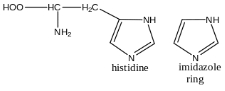
Which amino acid has an imidazole ring?
A
Alanine
B
Leucine
C
Tyrosine
D
Histidine
Solution
(D) Histidine is a basic amino acid that contains an imidazole ring in its side chain ($R$-group).
This ring structure is responsible for the unique buffering capacity of histidine at physiological $pH$ levels.
This ring structure is responsible for the unique buffering capacity of histidine at physiological $pH$ levels.
0 likes
View Solution356
MediumMCQ
The helical structure of protein is stabilized by
A
Dipeptide bonds
B
Hydrogen bonds
C
Ether bonds
D
Peptide bonds
Solution
(B) The helical structure of protein (specifically the $\alpha$-helix) is stabilized by hydrogen bonds between the amide group of the same peptide chain.
These hydrogen bonds are formed between the $-NH-$ group of one amino acid residue and the carbonyl oxygen $(C=O)$ of the fourth amino acid residue in the sequence.
These hydrogen bonds are formed between the $-NH-$ group of one amino acid residue and the carbonyl oxygen $(C=O)$ of the fourth amino acid residue in the sequence.
0 likes
View Solution357
MediumMCQ
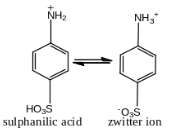
Which of the following exists as a Zwitter ion?
A
$p$-aminophenol
B
Salicylic acid
C
Sulphanilic acid
D
Ethanolamine
Solution
(C) Sulphanilic acid exists as a Zwitter ion.
It contains both an acidic group $(-SO_3H)$ and a basic group $(-NH_2)$ in the same molecule.
The proton from the sulphonic acid group is transferred to the amino group,resulting in the formation of a dipolar ion known as a Zwitter ion,represented as $H_3N^+-C_6H_4-SO_3^-$.
It contains both an acidic group $(-SO_3H)$ and a basic group $(-NH_2)$ in the same molecule.
The proton from the sulphonic acid group is transferred to the amino group,resulting in the formation of a dipolar ion known as a Zwitter ion,represented as $H_3N^+-C_6H_4-SO_3^-$.
0 likes
View Solution358
MediumMCQ
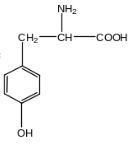
Which of the following compounds shows aromatic properties?
A
Valine
B
Leucine
C
Serine
D
Tyrosine
Solution
(D) Aromatic amino acids contain an aromatic ring in their side chain. Among the given options, Valine, Leucine, and Serine are aliphatic amino acids.
Tyrosine is an aromatic amino acid because it contains a phenol group (a benzene ring with a hydroxyl group) in its side chain.
Its chemical name is $\alpha$-amino-$\beta$($p$-hydroxyphenyl)propionic acid. Due to the presence of this aromatic nucleus, it exhibits aromatic properties.
Tyrosine is an aromatic amino acid because it contains a phenol group (a benzene ring with a hydroxyl group) in its side chain.
Its chemical name is $\alpha$-amino-$\beta$($p$-hydroxyphenyl)propionic acid. Due to the presence of this aromatic nucleus, it exhibits aromatic properties.
0 likes
View Solution359
MediumMCQ
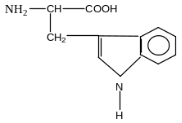
Which of the following is a heterocyclic amino acid?
A
Glycine
B
Alanine
C
Phenylalanine
D
Tryptophan
Solution
(D) Tryptophan is a heterocyclic amino acid because its side chain contains an indole ring,which is a heterocyclic structure (a bicyclic structure consisting of a six-membered benzene ring fused to a five-membered nitrogen-containing pyrrole ring).
0 likes
View Solution360
MediumMCQ
Which one of the following statements is correct?
A
All amino acids are optically active.
B
All amino acids except glycine are optically active.
C
All amino acids except glutamic acid are optically active.
D
All amino acids except lysine are optically active.
Solution
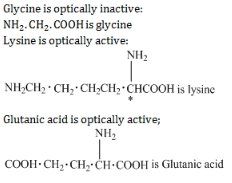
(B) An amino acid is optically active if it contains at least one chiral carbon atom (an asymmetric carbon atom bonded to four different groups).
Glycine has the structure $NH_2-CH_2-COOH$. Since the central carbon atom is bonded to two identical hydrogen atoms,it is achiral and therefore optically inactive.
All other naturally occurring amino acids have at least one chiral carbon atom (the $\alpha$-carbon) and are thus optically active.
Therefore,the statement 'All amino acids except glycine are optically active' is correct.
Glycine has the structure $NH_2-CH_2-COOH$. Since the central carbon atom is bonded to two identical hydrogen atoms,it is achiral and therefore optically inactive.
All other naturally occurring amino acids have at least one chiral carbon atom (the $\alpha$-carbon) and are thus optically active.
Therefore,the statement 'All amino acids except glycine are optically active' is correct.
0 likes
View Solution361
MediumMCQ
Protein can be most easily removed by:
A
Alkanes
B
Alkenes
C
Alkynes
D
Benzene
Solution
(D) Proteins are complex macromolecules that are generally insoluble in non-polar solvents like alkanes,alkenes,and alkynes. However,benzene is often used in laboratory procedures to dissolve or extract certain types of proteins or lipid-protein complexes due to its specific chemical properties. Therefore,among the given options,benzene is the most effective solvent for removing or dissolving protein-based stains or samples.
0 likes
View Solution362
EasyMCQ
The tripeptide present in most living cells is
A
Glutathione
B
Glutamine
C
Oxytocin
D
Ptyalin
Solution
(A) The tripeptide present in most living cells is glutathione.
It is composed of $3$ amino acids,namely glycine,glutamic acid,and cysteine.
It functions as an antioxidant and acts as a coenzyme in various cellular processes.
It is composed of $3$ amino acids,namely glycine,glutamic acid,and cysteine.
It functions as an antioxidant and acts as a coenzyme in various cellular processes.
0 likes
View Solution363
MediumMCQ
The compound,which gives a positive ninhydrin test and a negative Benedict's solution test,is
A
$A$ monosaccharide
B
$A$ disaccharide
C
$A$ lipid
D
$A$ protein
Solution
(D) The ninhydrin test is a chemical test used to detect amino acids or proteins. When a protein or amino acid reacts with ninhydrin,it produces a characteristic blue or purple color,indicating a positive result.
Benedict's solution is used to detect reducing sugars. Monosaccharides and many disaccharides (like maltose and lactose) act as reducing sugars and give a positive result (red/orange precipitate).
Since proteins are not reducing sugars,they give a negative result with Benedict's solution.
Therefore,a protein is the compound that gives a positive ninhydrin test and a negative Benedict's solution test.
Benedict's solution is used to detect reducing sugars. Monosaccharides and many disaccharides (like maltose and lactose) act as reducing sugars and give a positive result (red/orange precipitate).
Since proteins are not reducing sugars,they give a negative result with Benedict's solution.
Therefore,a protein is the compound that gives a positive ninhydrin test and a negative Benedict's solution test.
0 likes
View Solution364
MediumMCQ
The number of disulphide linkages present in insulin is
A
$1$
B
$2$
C
$3$
D
$4$
Solution
(C) Insulin is a peptide hormone composed of two polypeptide chains,referred to as chain $A$ and chain $B$.
Chain $A$ consists of $21$ amino acid residues,and chain $B$ consists of $30$ amino acid residues.
These two chains are linked together by two inter-chain disulphide bridges (between $A7-B7$ and $A20-B19$).
Additionally,there is one intra-chain disulphide bridge within chain $A$ (between $A6-A11$).
Therefore,the total number of disulphide linkages present in an insulin molecule is $3$.
Chain $A$ consists of $21$ amino acid residues,and chain $B$ consists of $30$ amino acid residues.
These two chains are linked together by two inter-chain disulphide bridges (between $A7-B7$ and $A20-B19$).
Additionally,there is one intra-chain disulphide bridge within chain $A$ (between $A6-A11$).
Therefore,the total number of disulphide linkages present in an insulin molecule is $3$.
0 likes
View Solution365
MediumMCQ
Which of the following statement$(s)$ is/are true?
$(i)$ All amino acids contain one chiral centre.
$(ii)$ Some amino acids contain one, while some contain more chiral centres or even no chiral centre.
$(iii)$ All amino acids in proteins have $L$-configuration.
$(iv)$ All amino acids found in proteins have $1^{\circ}$ amino group.
$(i)$ All amino acids contain one chiral centre.
$(ii)$ Some amino acids contain one, while some contain more chiral centres or even no chiral centre.
$(iii)$ All amino acids in proteins have $L$-configuration.
$(iv)$ All amino acids found in proteins have $1^{\circ}$ amino group.
A
$(ii), (iii)$ and $(iv)$
B
$(ii)$ and $(iii)$
C
$(i), (iii)$ and $(iv)$
D
$(i)$ and $(iv)$
Solution
(B) Statement $(i)$ is false because glycine is achiral (it has no chiral centre).
Statement $(ii)$ is true because amino acids like isoleucine have two chiral centres, while glycine has none.
Statement $(iii)$ is true because all amino acids incorporated into proteins during translation possess the $L$-configuration.
Statement $(iv)$ is false because proline is an amino acid found in proteins that contains a $2^{\circ}$ amino group (it is an imino acid).
Therefore, statements $(ii)$ and $(iii)$ are correct.
Statement $(ii)$ is true because amino acids like isoleucine have two chiral centres, while glycine has none.
Statement $(iii)$ is true because all amino acids incorporated into proteins during translation possess the $L$-configuration.
Statement $(iv)$ is false because proline is an amino acid found in proteins that contains a $2^{\circ}$ amino group (it is an imino acid).
Therefore, statements $(ii)$ and $(iii)$ are correct.
0 likes
View Solution366
MediumMCQ
Which statement about protein is wrong?
A
Proteins occur in all living cells
B
Proteins invariably contain $N, O, C$ and $H$
C
Proteins are synthesized by the plant kingdom only
D
Proteins are also synthesized in the laboratory
Solution
(C) Proteins are essential macromolecules found in all living organisms,including plants,animals,bacteria,and fungi.
Option $A$ is correct because proteins are present in all living cells.
Option $B$ is correct because proteins are polymers of amino acids,which always contain Carbon $(C)$,Hydrogen $(H)$,Oxygen $(O)$,and Nitrogen $(N)$.
Option $C$ is incorrect because proteins are synthesized by all living organisms,not just the plant kingdom. Animals and microorganisms also synthesize their own proteins.
Option $D$ is correct because proteins can be synthesized in a laboratory setting using techniques like solid-phase peptide synthesis or recombinant $DNA$ technology.
Option $A$ is correct because proteins are present in all living cells.
Option $B$ is correct because proteins are polymers of amino acids,which always contain Carbon $(C)$,Hydrogen $(H)$,Oxygen $(O)$,and Nitrogen $(N)$.
Option $C$ is incorrect because proteins are synthesized by all living organisms,not just the plant kingdom. Animals and microorganisms also synthesize their own proteins.
Option $D$ is correct because proteins can be synthesized in a laboratory setting using techniques like solid-phase peptide synthesis or recombinant $DNA$ technology.
0 likes
View Solution367
MediumMCQ
In glycine,the $R$ group is replaced by
A
$A$ methyl group
B
Hydroxy methyl
C
$A$ carboxylic group
D
$A$ hydrogen
Solution
(D) Glycine is the simplest amino acid. The general structure of an amino acid is $NH_2-CH(R)-COOH$. In glycine,the $R$ group is replaced by a hydrogen atom $(-H)$,making its formula $NH_2-CH_2-COOH$.
0 likes
View Solution368
MediumMCQ
Zwitterions are ionized species of
A
Acidic amino acids
B
Basic amino acids
C
Neutral amino acids
D
All of these
Solution
(D) Amino acids are amphoteric molecules containing both an amino group $(-NH_2)$ and a carboxyl group $(-COOH)$.
In an aqueous solution,the carboxyl group can lose a proton to become a negatively charged carboxylate ion $(-COO^-)$,and the amino group can accept a proton to become a positively charged ammonium ion $(-NH_3^+)$.
This dipolar ion,which carries both positive and negative charges simultaneously,is known as a Zwitterion.
Since all amino acids (acidic,basic,and neutral) possess these functional groups,they can all exist as Zwitterions at their respective isoelectric points.
In an aqueous solution,the carboxyl group can lose a proton to become a negatively charged carboxylate ion $(-COO^-)$,and the amino group can accept a proton to become a positively charged ammonium ion $(-NH_3^+)$.
This dipolar ion,which carries both positive and negative charges simultaneously,is known as a Zwitterion.
Since all amino acids (acidic,basic,and neutral) possess these functional groups,they can all exist as Zwitterions at their respective isoelectric points.
0 likes
View Solution369
MediumMCQ
Non-essential amino acids are:
A
Must be obtained from food
B
Synthesized in our body
C
Are not needed in our diet
D
Both $(b)$ and $(c)$
Solution
(D) Non-essential amino acids are those that can be synthesized by the human body.
Since the body can produce them,they are not strictly required in the diet.
Therefore,both statements $(b)$ and $(c)$ are correct.
Since the body can produce them,they are not strictly required in the diet.
Therefore,both statements $(b)$ and $(c)$ are correct.
0 likes
View Solution370
EasyMCQ
The most abundant protein in the animal world is
A
Chitin
B
Collagen
C
Peptidoglycan
D
Hyaluronic acid
Solution
(B) The most abundant protein in the animal world is $Collagen$.
$Chitin$ is a polysaccharide found in the exoskeleton of arthropods.
$Peptidoglycan$ is a polymer consisting of sugars and amino acids that forms a mesh-like layer outside the plasma membrane of most bacteria.
$Hyaluronic$ $acid$ is a glycosaminoglycan,which is a type of polysaccharide.
Therefore,$Collagen$ is the correct answer as it is the primary structural protein in the extracellular matrix of various connective tissues in animals.
$Chitin$ is a polysaccharide found in the exoskeleton of arthropods.
$Peptidoglycan$ is a polymer consisting of sugars and amino acids that forms a mesh-like layer outside the plasma membrane of most bacteria.
$Hyaluronic$ $acid$ is a glycosaminoglycan,which is a type of polysaccharide.
Therefore,$Collagen$ is the correct answer as it is the primary structural protein in the extracellular matrix of various connective tissues in animals.
0 likes
View Solution371
MediumMCQ
The amino acids in a protein are held together by
A
Glycosidic bond
B
Phosphodiester bond
C
Peptide bond
D
Hydrogen bond
Solution
(C) In a protein,amino acids are linked together by a peptide bond.
This bond is formed by the reaction between the carboxyl group $(-COOH)$ of one amino acid and the amino group $(-NH_2)$ of the next amino acid,resulting in the elimination of a water molecule.
Glycosidic bond: Formed between two monosaccharides in carbohydrates.
Phosphodiester bond: Formed in nucleic acids ($DNA$ or $RNA$) between the phosphate group and the sugar molecule.
Hydrogen bond: Responsible for the secondary and tertiary structure of proteins,but not for the primary linkage of amino acids.
This bond is formed by the reaction between the carboxyl group $(-COOH)$ of one amino acid and the amino group $(-NH_2)$ of the next amino acid,resulting in the elimination of a water molecule.
Glycosidic bond: Formed between two monosaccharides in carbohydrates.
Phosphodiester bond: Formed in nucleic acids ($DNA$ or $RNA$) between the phosphate group and the sugar molecule.
Hydrogen bond: Responsible for the secondary and tertiary structure of proteins,but not for the primary linkage of amino acids.
0 likes
View Solution372
EasyMCQ
$A$ protein which exhibits $\beta$-pleated structure is
A
Fibroin
B
Haemoglobin
C
Enzyme
D
$\alpha$-Keratin
Solution
(A) The secondary structure of proteins is stabilized by hydrogen bonds and exists in two forms: $\alpha$-helix and $\beta$-pleated sheet.
Fibroin,a protein found in silk,is a classic example of a protein that exhibits a $\beta$-pleated sheet structure.
Haemoglobin exhibits a quaternary structure.
Most enzymes exhibit a tertiary structure.
$\alpha$-Keratin is a fibrous protein that exhibits an $\alpha$-helical structure.
Therefore,the correct option is $A$.
Fibroin,a protein found in silk,is a classic example of a protein that exhibits a $\beta$-pleated sheet structure.
Haemoglobin exhibits a quaternary structure.
Most enzymes exhibit a tertiary structure.
$\alpha$-Keratin is a fibrous protein that exhibits an $\alpha$-helical structure.
Therefore,the correct option is $A$.
0 likes
View Solution373
MediumMCQ
An example of a protein with a quaternary structure is
A
Myoglobin
B
Haemoglobin
C
Keratin
D
All of these
Solution
(B) The quaternary structure of a protein refers to the arrangement of multiple folded protein subunits in a multi-subunit complex.
$1$. Myoglobin consists of a single polypeptide chain and exhibits a tertiary structure.
$2$. Haemoglobin is a classic example of a protein with a quaternary structure,as it is composed of four polypeptide subunits ($2$ alpha and $2$ beta chains).
$3$. Keratin is a fibrous protein that primarily exhibits a secondary structure (alpha-helical structure).
Therefore,the correct answer is Haemoglobin.
$1$. Myoglobin consists of a single polypeptide chain and exhibits a tertiary structure.
$2$. Haemoglobin is a classic example of a protein with a quaternary structure,as it is composed of four polypeptide subunits ($2$ alpha and $2$ beta chains).
$3$. Keratin is a fibrous protein that primarily exhibits a secondary structure (alpha-helical structure).
Therefore,the correct answer is Haemoglobin.
0 likes
View Solution374
MediumMCQ
The given amino acid is . . . . . . in nature.

A
Acidic
B
Basic
C
Neutral
D
Aromatic
Solution
(A) The provided structure is of Aspartic acid.
An amino acid is classified based on the number of amino $(-NH_2)$ and carboxyl $(-COOH)$ groups present in its structure.
If the number of carboxyl groups is greater than the number of amino groups,the amino acid is acidic in nature.
In the given structure,there are two carboxyl groups (one in the main chain and one in the side chain) and only one amino group.
Therefore,due to the presence of an extra carboxylic group,it is acidic in nature.
An amino acid is classified based on the number of amino $(-NH_2)$ and carboxyl $(-COOH)$ groups present in its structure.
If the number of carboxyl groups is greater than the number of amino groups,the amino acid is acidic in nature.
In the given structure,there are two carboxyl groups (one in the main chain and one in the side chain) and only one amino group.
Therefore,due to the presence of an extra carboxylic group,it is acidic in nature.
0 likes
View Solution375
MediumMCQ
The structure of protein which gives a three-dimensional view is:
A
Primary structure
B
$\alpha$-helix
C
$\beta$-pleated sheet
D
Tertiary structure
Solution
(D) The primary structure of a protein refers to the linear sequence of amino acids.
Secondary structures,such as the $\alpha$-helix and $\beta$-pleated sheet,represent the local folding of the polypeptide chain.
The tertiary structure represents the overall three-dimensional folding of the entire polypeptide chain,which is essential for the biological activity of the protein.
Therefore,the tertiary structure is the one that provides the three-dimensional view of the protein.
Secondary structures,such as the $\alpha$-helix and $\beta$-pleated sheet,represent the local folding of the polypeptide chain.
The tertiary structure represents the overall three-dimensional folding of the entire polypeptide chain,which is essential for the biological activity of the protein.
Therefore,the tertiary structure is the one that provides the three-dimensional view of the protein.
0 likes
View Solution376
EasyMCQ
Which of the following are basic amino acids?
A
Glycine and Alanine
B
Lysine and Arginine
C
Glutamic acid and Aspartic acid
D
Histidine and Proline
Solution
(B) Amino acids are classified based on the nature of their $R$ group.
$1$. Basic amino acids contain an extra amino group in their side chain,making them positively charged at physiological $pH$. Examples include $Lysine$,$Arginine$,and $Histidine$.
$2$. Acidic amino acids contain an extra carboxyl group in their side chain,making them negatively charged. Examples include $Glutamic$ $acid$ and $Aspartic$ $acid$.
$3$. Glycine and Alanine are neutral amino acids.
Therefore,$Lysine$ and $Arginine$ are basic amino acids.
$1$. Basic amino acids contain an extra amino group in their side chain,making them positively charged at physiological $pH$. Examples include $Lysine$,$Arginine$,and $Histidine$.
$2$. Acidic amino acids contain an extra carboxyl group in their side chain,making them negatively charged. Examples include $Glutamic$ $acid$ and $Aspartic$ $acid$.
$3$. Glycine and Alanine are neutral amino acids.
Therefore,$Lysine$ and $Arginine$ are basic amino acids.
0 likes
View Solution377
MediumMCQ
Which of the following amino acids is involved in the formation of $Heme$?
A
Tryptophan
B
Tyrosine
C
Glycine
D
Histidine
Solution
(C) The amino acid $Glycine$ is a crucial precursor in the biosynthesis of $Heme$.
It provides the nitrogen and carbon atoms required for the formation of the porphyrin ring structure of $Heme$.
It provides the nitrogen and carbon atoms required for the formation of the porphyrin ring structure of $Heme$.
0 likes
View Solution378
EasyMCQ
Which one of the following is an alcoholic amino acid pair?
A
Tyrosine and serine
B
Threonine and serine
C
Phenylalanine and tyrosine
D
Tryptophan and phenylalanine
Solution
(B) Amino acids are classified based on their side chains. Alcoholic amino acids are those that contain a hydroxyl $(-OH)$ group in their side chain.
Among the given options,$Threonine$ and $Serine$ are the two amino acids that possess a hydroxyl group in their side chain.
Therefore,they form an alcoholic amino acid pair.
Among the given options,$Threonine$ and $Serine$ are the two amino acids that possess a hydroxyl group in their side chain.
Therefore,they form an alcoholic amino acid pair.
0 likes
View Solution379
MediumMCQ
Lysine is an essential amino acid because
A
It is very rare
B
It has a high nutritive value
C
It is an important constituent of all proteins
D
It is not formed in the body and has to be provided through diet
Solution
(D) Essential amino acids are those amino acids that cannot be synthesized by the human body. Therefore,they must be obtained through the diet. Lysine is classified as an essential amino acid because the human body lacks the metabolic pathways to produce it.
0 likes
View Solution380
MediumMCQ
$A$: Tertiary structure of protein molecules makes them biologically active.
$R$: It is the native configuration of protein molecules maintained by multiple covalent bonds only.
$R$: It is the native configuration of protein molecules maintained by multiple covalent bonds only.
A
Assertion and Reason both are correct and Reason is the correct explanation of Assertion.
B
Assertion and Reason both are correct but Reason is not the correct explanation of Assertion.
C
Assertion is correct,but Reason is incorrect.
D
Both Assertion and Reason are incorrect.
Solution
(C) The tertiary structure of a protein is essential for its biological activity because it creates a specific three-dimensional shape.
In this structure,the polypeptide chain folds upon itself,bringing distant amino acid side groups into close proximity to form an active site.
The Reason statement is incorrect because the tertiary structure is maintained by various non-covalent interactions such as hydrogen bonds,ionic bonds,hydrophobic interactions,and van der Waals forces,in addition to covalent disulfide bridges,not just multiple covalent bonds.
In this structure,the polypeptide chain folds upon itself,bringing distant amino acid side groups into close proximity to form an active site.
The Reason statement is incorrect because the tertiary structure is maintained by various non-covalent interactions such as hydrogen bonds,ionic bonds,hydrophobic interactions,and van der Waals forces,in addition to covalent disulfide bridges,not just multiple covalent bonds.
0 likes
View Solution381
MediumMCQ
$A$: The polypeptide coil of collagen helix is strengthened by the establishment of hydrogen bonds between the $>NH$ group of the glycine residue of each strand and the $-CO$ group of the other two strands.
$R$: In the collagen helix,a locking effect also occurs with the help of proline and hydroxyproline amino acids.
$R$: In the collagen helix,a locking effect also occurs with the help of proline and hydroxyproline amino acids.
A
Assertion and Reason both are correct and Reason is the correct explanation of Assertion.
B
Assertion and Reason both are correct but Reason is not the correct explanation of Assertion.
C
Assertion is correct,but Reason is incorrect.
D
Both Assertion and Reason are incorrect.
Solution
(A) Collagen is a fibrous protein consisting of three polypeptide chains coiled around each other in a triple helix structure.
The stability of this triple helix is primarily maintained by interchain hydrogen bonds.
These hydrogen bonds form between the $>NH$ group of the glycine residue in one strand and the $-CO$ group of the amino acid residues in the other two strands.
Additionally,the presence of proline and hydroxyproline residues provides structural rigidity and a 'locking' effect,which further stabilizes the collagen helix.
Both the Assertion and the Reason are scientifically accurate,and the Reason provides a complementary structural detail that supports the stability described in the Assertion.
The stability of this triple helix is primarily maintained by interchain hydrogen bonds.
These hydrogen bonds form between the $>NH$ group of the glycine residue in one strand and the $-CO$ group of the amino acid residues in the other two strands.
Additionally,the presence of proline and hydroxyproline residues provides structural rigidity and a 'locking' effect,which further stabilizes the collagen helix.
Both the Assertion and the Reason are scientifically accurate,and the Reason provides a complementary structural detail that supports the stability described in the Assertion.
0 likes
View Solution382
MediumMCQ
$A$: Tertiary structure of protein is absolutely necessary for many biological activities of proteins.
$R$: In protein,only right-handed helices are observed.
$R$: In protein,only right-handed helices are observed.
A
Assertion and Reason both are correct and Reason is the correct explanation of Assertion.
B
Assertion and Reason both are correct but Reason is not the correct explanation of Assertion.
C
Assertion is correct,but Reason is incorrect.
D
Both Assertion and Reason are incorrect.
Solution
(C) The tertiary structure of a protein is essential for its biological activity because it creates the specific three-dimensional shape,including the active site in enzymes,required for its function.
Regarding the Reason,while right-handed helices are the most common in proteins due to steric constraints,it is incorrect to state that *only* right-handed helices are observed,as left-handed helices can exist in specific contexts or synthetic peptides.
Therefore,the Assertion is correct,but the Reason is incorrect.
Regarding the Reason,while right-handed helices are the most common in proteins due to steric constraints,it is incorrect to state that *only* right-handed helices are observed,as left-handed helices can exist in specific contexts or synthetic peptides.
Therefore,the Assertion is correct,but the Reason is incorrect.
0 likes
View Solution383
EasyMCQ
Amino acids like methionine and cysteine contain
A
$Zn$
B
$S$
C
$B$
D
$Cl$
Solution
(B) Methionine and cysteine are the only two proteinogenic amino acids that contain sulfur $(S)$ in their side chains. Sulfur is an essential element for the structure and function of proteins,as it allows for the formation of disulfide bonds,which stabilize the tertiary structure of proteins.
0 likes
View Solution384
EasyMCQ
Which one of the following amino acids is an essential part of the human diet?
A
Glycine
B
Phenylalanine
C
Serine
D
Aspartic acid
Solution
(B) Essential amino acids are those that cannot be synthesized by the human body and must be obtained through the diet. For human beings,there are nine essential amino acids: histidine,isoleucine,leucine,lysine,methionine,phenylalanine,threonine,tryptophan,and valine. Among the given options,Phenylalanine is an essential amino acid.
0 likes
View Solution385
EasyMCQ
Deficiency of which essential amino acid leads to deregulation of blood sugar?
A
Isoleucine
B
Valine
C
Threonine
D
Phenylalanine
Solution
(A) Proteins are composed of $20$ types of amino acids. Plants can synthesize all of these,whereas animals cannot synthesize all of them. About $10$ amino acids are synthesized by animals through processes like transamination. Amino acids that cannot be synthesized by the body and must be obtained through diet are called essential amino acids. Amino acids that the body can synthesize are termed non-essential amino acids. Isoleucine is an essential amino acid,and its deficiency is known to cause the deregulation of blood sugar levels.
0 likes
View Solution386
EasyMCQ
Haemoglobin molecule is made up of
A
One $\alpha$-chain and one $\beta$-chain
B
Two $\alpha$-chains and two $\beta$-chains
C
Two $\alpha$-chains and one $\beta$-chain
D
One $\alpha$-chain and two $\beta$-chains
Solution
(B) The haemoglobin molecule is a quaternary protein structure consisting of four polypeptide chains.
It is composed of two $\alpha$-chains,each containing $141$ amino acids,and two $\beta$-chains,each containing $146$ amino acids.
It is composed of two $\alpha$-chains,each containing $141$ amino acids,and two $\beta$-chains,each containing $146$ amino acids.
0 likes
View Solution387
MediumMCQ
In haemoglobin,which amino acid acts as a blood buffer?
A
Histidine
B
Glutamine
C
Aspartic acid
D
Lysine
Solution
(A) In haemoglobin,the buffering action is primarily performed by the imidazole group of the $Histidine$ residues. This residue can accept or donate protons,which helps in maintaining the $pH$ of the blood.
0 likes
View Solution388
EasyMCQ
Which one of the following amino acids is not found in proteins?
A
Arginine
B
Ornithine
C
Aspartic acid
D
Tyrosine
Solution
(B) Ornithine is a non-proteinogenic amino acid,meaning it is not incorporated into proteins during translation.
It acts as an intermediate in the urea cycle,where it is formed by the hydrolysis of arginine and subsequently reacts with carbamoyl phosphate to produce citrulline.
It acts as an intermediate in the urea cycle,where it is formed by the hydrolysis of arginine and subsequently reacts with carbamoyl phosphate to produce citrulline.
0 likes
View Solution389
EasyMCQ
The exoskeleton of birds and mammals is composed of which biomolecule?
A
Protein
B
Lipid
C
Nucleic acid
D
Carbohydrate
Solution
(A) The exoskeleton of birds (feathers,scales on legs) and mammals (hair,nails,claws) is primarily composed of $Keratin$.
$Keratin$ is a fibrous structural protein.
Therefore,the correct answer is $Protein$.
$Keratin$ is a fibrous structural protein.
Therefore,the correct answer is $Protein$.
0 likes
View Solution390
EasyMCQ
What type of amino acids are found in the structure of proteins?
A
$\alpha$-amino acids
B
$\beta$-amino acids
C
$\gamma$-amino acids
D
$\delta$-amino acids
Solution
(A) Proteins are polymers of amino acids. In these amino acids,the amino group $(-NH_2)$ and the carboxylic acid group $(-COOH)$ are attached to the same carbon atom,which is known as the $\alpha$-carbon. Therefore,the amino acids found in proteins are exclusively $\alpha$-amino acids.
0 likes
View Solution391
MediumMCQ
Select the incorrect statement regarding amino acids.
A
They are substituted methanes,where four substituent groups occupy the four valency positions.
B
Amino acids contain both acidic and basic groups.
C
Amino acids are inorganic compounds.
D
The simplest amino acid is glycine.
Solution
(C) Amino acids are organic compounds containing an amino group $(-NH_2)$ and a carboxylic acid group $(-COOH)$ attached to the same carbon atom,known as the $\alpha$-carbon.
They are considered substituted methanes because the four valency positions of the central carbon are occupied by a hydrogen atom,a carboxyl group,an amino group,and a variable $R$-group.
Since they contain carbon-hydrogen bonds,they are classified as organic compounds,not inorganic.
Glycine is the simplest amino acid where the $R$-group is a hydrogen atom.
They are considered substituted methanes because the four valency positions of the central carbon are occupied by a hydrogen atom,a carboxyl group,an amino group,and a variable $R$-group.
Since they contain carbon-hydrogen bonds,they are classified as organic compounds,not inorganic.
Glycine is the simplest amino acid where the $R$-group is a hydrogen atom.
0 likes
View Solution392
EasyMCQ
How many types of amino acids are found in the structure of proteins?
A
$20$
B
$21$
C
$22$
D
$23$
Solution
(A) Proteins are heteropolymers made up of amino acids. Although there are many amino acids,only $20$ types of amino acids are commonly involved in the formation of proteins in living organisms. These are known as proteinogenic amino acids.
0 likes
View Solution393
MediumMCQ
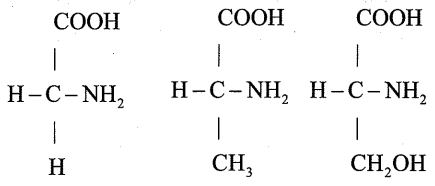
Identify the structures of the amino acids given below.
A
Alanine,Glycine,Serine
B
Glycine,Alanine,Serine
C
Serine,Alanine,Glycine
D
Serine,Glycine,Alanine
Solution
(B) The general structure of an amino acid is $R-CH(NH_2)-COOH$. The identity of the amino acid depends on the $R$ group attached to the central carbon atom.
$1$. In the first structure,the $R$ group is $H$. This is Glycine,the simplest amino acid.
$2$. In the second structure,the $R$ group is $CH_3$. This is Alanine.
$3$. In the third structure,the $R$ group is $CH_2OH$. This is Serine.
Therefore,the sequence is Glycine,Alanine,Serine.
$1$. In the first structure,the $R$ group is $H$. This is Glycine,the simplest amino acid.
$2$. In the second structure,the $R$ group is $CH_3$. This is Alanine.
$3$. In the third structure,the $R$ group is $CH_2OH$. This is Serine.
Therefore,the sequence is Glycine,Alanine,Serine.
0 likes
View Solution394
EasyMCQ
The variation in amino acids is due to which of the following groups?
A
Hydrogen
B
$R$ group
C
Carboxyl group
D
Amino group
Solution
(B) An amino acid is an organic compound containing an amino group $(-NH_2)$,a carboxyl group $(-COOH)$,a hydrogen atom $(-H)$,and a variable side chain ($-R$ group) attached to a central alpha-carbon atom.
While the amino group,carboxyl group,and hydrogen atom are common to all amino acids,the chemical nature of the $R$ group varies among different amino acids.
This $R$ group determines the specific properties of each amino acid,such as its size,charge,and hydrophobicity,leading to the diversity observed in amino acids.
While the amino group,carboxyl group,and hydrogen atom are common to all amino acids,the chemical nature of the $R$ group varies among different amino acids.
This $R$ group determines the specific properties of each amino acid,such as its size,charge,and hydrophobicity,leading to the diversity observed in amino acids.
0 likes
View Solution395
MediumMCQ
Match the following columns:
| Column-$I$ (Amino Acid) | Column-$II$ (Example) |
|---|---|
| $P$. Acidic | $I$. Lysine |
| $Q$. Basic | $II$. Valine |
| $R$. Neutral | $III$. Glutamate |
A
$(P-III), (Q-I), (R-II)$
B
$(P-I), (Q-II), (R-III)$
C
$(P-II), (Q-I), (R-III)$
D
$(P-III), (Q-II), (R-I)$
Solution
(A) The classification of amino acids based on their chemical nature is as follows:
$1$. Acidic amino acids contain an extra carboxyl group $(-COOH)$. Example: Glutamic acid (Glutamate).
$2$. Basic amino acids contain an extra amino group $(-NH_2)$. Example: Lysine.
$3$. Neutral amino acids have an equal number of amino and carboxyl groups. Example: Valine.
Matching the columns:
$P$ (Acidic) matches with $III$ (Glutamate).
$Q$ (Basic) matches with $I$ (Lysine).
$R$ (Neutral) matches with $II$ (Valine).
Therefore, the correct sequence is $(P-III), (Q-I), (R-II)$.
$1$. Acidic amino acids contain an extra carboxyl group $(-COOH)$. Example: Glutamic acid (Glutamate).
$2$. Basic amino acids contain an extra amino group $(-NH_2)$. Example: Lysine.
$3$. Neutral amino acids have an equal number of amino and carboxyl groups. Example: Valine.
Matching the columns:
$P$ (Acidic) matches with $III$ (Glutamate).
$Q$ (Basic) matches with $I$ (Lysine).
$R$ (Neutral) matches with $II$ (Valine).
Therefore, the correct sequence is $(P-III), (Q-I), (R-II)$.
0 likes
View Solution396
MediumMCQ
Which of the following amino acids is not aromatic?
A
Tyrosine
B
Phenylalanine
C
Cysteine
D
Tryptophan
Solution
(C) Amino acids are classified based on the nature of their side chains ($R$-groups).
$1$. Aromatic amino acids contain a benzene ring or a heterocyclic ring in their side chain. Examples include Phenylalanine,Tyrosine,and Tryptophan.
$2$. Cysteine is a sulfur-containing amino acid with a thiol $(-SH)$ group in its side chain. It is not aromatic.
Therefore,the correct option is $C$.
$1$. Aromatic amino acids contain a benzene ring or a heterocyclic ring in their side chain. Examples include Phenylalanine,Tyrosine,and Tryptophan.
$2$. Cysteine is a sulfur-containing amino acid with a thiol $(-SH)$ group in its side chain. It is not aromatic.
Therefore,the correct option is $C$.
0 likes
View Solution397
MediumMCQ
In the animal world,$P$ is the most abundant protein,and in the whole biosphere,$Q$ is the most abundant protein.
A
Collagen,RuBisCO
B
RuBisCO,Collagen
C
Elastin,RuBisCO
D
RuBisCO,Elastin
Solution
(A) Collagen is the most abundant protein in the animal world,as it is a major structural component of connective tissues.
RuBisCO (Ribulose$-1,5-$bisphosphate carboxylase-oxygenase) is the most abundant protein in the whole biosphere because it is essential for the process of photosynthesis in plants,which are the primary producers of the biosphere.
RuBisCO (Ribulose$-1,5-$bisphosphate carboxylase-oxygenase) is the most abundant protein in the whole biosphere because it is essential for the process of photosynthesis in plants,which are the primary producers of the biosphere.
0 likes
View Solution398
EasyMCQ
Which bond connects two amino acids?
A
Glycosidic bond
B
Ester bond
C
Phosphodiester bond
D
Peptide bond
Solution
(D) Amino acids are the building blocks of proteins.
When two amino acids combine,the carboxyl group $(-COOH)$ of one amino acid reacts with the amino group $(-NH_2)$ of another amino acid.
This reaction results in the elimination of a water molecule $(H_2O)$ and the formation of a covalent bond known as a peptide bond $(-CO-NH-)$.
Therefore,the correct option is $D$.
When two amino acids combine,the carboxyl group $(-COOH)$ of one amino acid reacts with the amino group $(-NH_2)$ of another amino acid.
This reaction results in the elimination of a water molecule $(H_2O)$ and the formation of a covalent bond known as a peptide bond $(-CO-NH-)$.
Therefore,the correct option is $D$.
0 likes
View Solution399
MediumMCQ
Match the following columns:
| Column-$I$ (Protein) | Column-$II$ (Function) |
|---|---|
| $P$. Collagen | $I$. Hormone |
| $Q$. Trypsin | $II$. Sensory receptor |
| $R$. Insulin | $III$. Fights infectious agents |
| $S$. Antibody | $IV$. Enzyme |
| $T$. Receptor | $V$. Intercellular ground substance |
| $U$. $GLUT-4$ | $VI$. Enables glucose transport into cells |
A
$(P-II), (Q-I), (R-V), (S-VI), (T-III), (U-IV)$
B
$(P-IV), (Q-I), (R-V), (S-II), (T-III), (U-VI)$
C
$(P-V), (Q-I), (R-IV), (S-III), (T-II), (U-VI)$
D
$(P-V), (Q-IV), (R-I), (S-III), (T-II), (U-VI)$
Solution
(D) The correct matches are as follows:
$P$. Collagen: It acts as the intercellular ground substance $(V)$.
$Q$. Trypsin: It is an enzyme $(IV)$.
$R$. Insulin: It is a hormone $(I)$.
$S$. Antibody: It fights against infectious agents $(III)$.
$T$. Receptor: It acts as a sensory receptor $(II)$.
$U$. $GLUT-4$: It enables glucose transport into cells $(VI)$.
Therefore,the correct sequence is $(P-V), (Q-IV), (R-I), (S-III), (T-II), (U-VI)$.
$P$. Collagen: It acts as the intercellular ground substance $(V)$.
$Q$. Trypsin: It is an enzyme $(IV)$.
$R$. Insulin: It is a hormone $(I)$.
$S$. Antibody: It fights against infectious agents $(III)$.
$T$. Receptor: It acts as a sensory receptor $(II)$.
$U$. $GLUT-4$: It enables glucose transport into cells $(VI)$.
Therefore,the correct sequence is $(P-V), (Q-IV), (R-I), (S-III), (T-II), (U-VI)$.
0 likes
View Solution400
MediumMCQ
Amino acids that are synthesized in our body are called $.......$.
A
Non-essential
B
Essential
C
Both
D
None of these
Solution
(A) Amino acids are classified into two types based on their requirement in the diet:
$1$. Essential amino acids: These cannot be synthesized by the human body and must be obtained through the diet.
$2$. Non-essential amino acids: These are synthesized by the human body and therefore are not strictly required in the diet.
Since the question asks about amino acids synthesized in our body,they are termed as non-essential amino acids.
$1$. Essential amino acids: These cannot be synthesized by the human body and must be obtained through the diet.
$2$. Non-essential amino acids: These are synthesized by the human body and therefore are not strictly required in the diet.
Since the question asks about amino acids synthesized in our body,they are termed as non-essential amino acids.
0 likes
View SolutionBiomolecules — Proteins · Frequently Asked Questions
1Are these Biomolecules questions useful for JEE and NEET?
Yes. All questions in this section are mapped to JEE Main and NEET exam patterns. Previous year questions from JEE Main, NEET, GUJCET and state-level exams are included with full solutions.
2Can I switch to Hindi or Gujarati for these questions?
Yes. Use the language tabs in the hero section or the sidebar to view the same questions and solutions in English, Hindi or Gujarati.
3How do I generate a question paper from this subtopic?
Use the Vedclass Exam Paper Generator — select the chapter and subtopic, set difficulty, and generate Sets A, B, C, D automatically. First 3 chapters of every subject are free.
Vedclass Products
For Students
Vedclass Test Series
Mock tests in real JEE/NEET style with performance analysis. 5-day free trial.
Start Free TrialFor Teachers
Exam Paper Generator
Generate Set A/B/C/D papers from this chapter in 2 minutes. 3 chapters free.
Try FreeFor Institutes
Online Exam Module
Live online exams with unlimited students, 360° analytics & white-label branding.
See DemoFor Teachers & Institutes
Generate a Biomolecules Exam Paper in 2 Minutes
Select subtopic & difficulty — Sets A, B, C, D auto-generated with No Repeat logic.
First 3 chapters of every subject are free — no payment required.