
A English
Proteins Questions in English
Class 11 Biology · Biomolecules · Proteins
439+
Questions
English
Language
100%
With Solutions
Showing 39 of 439 questions in English
401
MediumMCQ
Identify the function of proteins.
A
They help in the transport of nutrients across the cell membrane.
B
They provide protection against some infectious microorganisms.
C
Some hormones and some enzymes are made of proteins.
D
All of the above.
Solution
(D) Proteins perform a wide variety of functions in biological systems:
$1$. Transport: Membrane proteins act as channels or carriers to transport nutrients across the cell membrane.
$2$. Defense: Antibodies (immunoglobulins) are proteins that protect the body against infectious microorganisms.
$3$. Regulation and Catalysis: Many hormones (e.g.,insulin) are proteins that regulate physiological processes,and enzymes are proteins that catalyze biochemical reactions.
Therefore,all the given statements are correct.
$1$. Transport: Membrane proteins act as channels or carriers to transport nutrients across the cell membrane.
$2$. Defense: Antibodies (immunoglobulins) are proteins that protect the body against infectious microorganisms.
$3$. Regulation and Catalysis: Many hormones (e.g.,insulin) are proteins that regulate physiological processes,and enzymes are proteins that catalyze biochemical reactions.
Therefore,all the given statements are correct.
0 likes
View Solution402
MediumMCQ
Match the following columns regarding the representation of molecular structures:
| Column-$I$ (Science) | Column-$II$ (Meaning of molecular structure) |
|---|---|
| $P$. Inorganic Chemistry | $I$. Molecular formula |
| $Q$. Organic Chemistry | $II$. Four levels of organization |
| $R$. Physics | $III$. Two-dimensional view |
| $S$. Biological Protein | $IV$. Three-dimensional view |
A
$P-I, Q-IV, R-III, S-II$
B
$P-I, Q-III, R-IV, S-II$
C
$P-II, Q-III, R-IV, S-I$
D
$P-II, Q-IV, R-III, S-I$
Solution
(A) The correct matching is based on how molecular structures are represented in different scientific disciplines:
$1$. Inorganic Chemistry $(P)$ typically uses the molecular formula $(I)$ to represent compounds.
$2$. Organic Chemistry $(Q)$ often utilizes three-dimensional views $(IV)$ to represent complex carbon-based structures.
$3$. Physics $(R)$ often employs two-dimensional views $(III)$ for simplified modeling of molecular interactions.
$4$. Biological Proteins $(S)$ are characterized by four levels of structural organization $(II)$: primary,secondary,tertiary,and quaternary.
Therefore,the correct sequence is $P-I, Q-IV, R-III, S-II$.
$1$. Inorganic Chemistry $(P)$ typically uses the molecular formula $(I)$ to represent compounds.
$2$. Organic Chemistry $(Q)$ often utilizes three-dimensional views $(IV)$ to represent complex carbon-based structures.
$3$. Physics $(R)$ often employs two-dimensional views $(III)$ for simplified modeling of molecular interactions.
$4$. Biological Proteins $(S)$ are characterized by four levels of structural organization $(II)$: primary,secondary,tertiary,and quaternary.
Therefore,the correct sequence is $P-I, Q-IV, R-III, S-II$.
0 likes
View Solution403
MediumMCQ
The primary structure of a protein is determined by $..............$.
A
Nucleic acid
B
Carbohydrate
C
Lipid
D
Vitamin
Solution
(A) The primary structure of a protein refers to the specific sequence of amino acids in a polypeptide chain.
This sequence is determined by the genetic information stored in the $DNA$,which is a type of nucleic acid.
The $DNA$ sequence is transcribed into $mRNA$,which is then translated into the specific sequence of amino acids that form the protein.
Therefore,the primary structure is determined by the genetic code found in nucleic acids.
This sequence is determined by the genetic information stored in the $DNA$,which is a type of nucleic acid.
The $DNA$ sequence is transcribed into $mRNA$,which is then translated into the specific sequence of amino acids that form the protein.
Therefore,the primary structure is determined by the genetic code found in nucleic acids.
0 likes
View Solution404
MediumMCQ
Which structure of protein is linear and contains only peptide bonds?
A
Primary structure
B
Secondary structure
C
Tertiary structure
D
Quaternary structure
Solution
(A) The primary structure of a protein refers to the linear sequence of amino acids in a polypeptide chain.
In this structure,amino acids are linked together by peptide bonds.
Secondary,tertiary,and quaternary structures involve additional folding,coiling,and interactions (such as hydrogen bonds,disulfide bridges,and hydrophobic interactions) that go beyond the simple linear sequence of the primary structure.
Therefore,the primary structure is the only one that is strictly linear and defined solely by peptide bonds.
In this structure,amino acids are linked together by peptide bonds.
Secondary,tertiary,and quaternary structures involve additional folding,coiling,and interactions (such as hydrogen bonds,disulfide bridges,and hydrophobic interactions) that go beyond the simple linear sequence of the primary structure.
Therefore,the primary structure is the only one that is strictly linear and defined solely by peptide bonds.
0 likes
View Solution405
MediumMCQ
In protein synthesis,the first amino acid is known as $.....P.....$ and the last amino acid is known as $.....Q.....$.
A
$C$-terminal amino acid,$N$-terminal amino acid
B
$N$-terminal amino acid,$C$-terminal amino acid
C
$A$-terminal amino acid,$B$-terminal amino acid
D
$B$-terminal amino acid,$A$-terminal amino acid
Solution
(B) In a polypeptide chain,the amino acid sequence is written from the $N$-terminal end to the $C$-terminal end.
$1$. The first amino acid in the polypeptide chain has a free amino group $(-NH_2)$ and is called the $N$-terminal amino acid $(P)$.
$2$. The last amino acid in the polypeptide chain has a free carboxyl group $(-COOH)$ and is called the $C$-terminal amino acid $(Q)$.
$1$. The first amino acid in the polypeptide chain has a free amino group $(-NH_2)$ and is called the $N$-terminal amino acid $(P)$.
$2$. The last amino acid in the polypeptide chain has a free carboxyl group $(-COOH)$ and is called the $C$-terminal amino acid $(Q)$.
0 likes
View Solution406
EasyMCQ
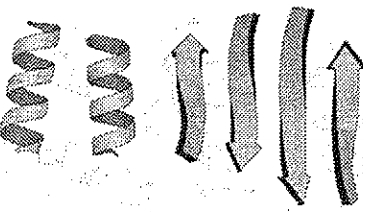
Identify the secondary structures of proteins shown below.
A
$\beta$-pleated sheet,$\alpha$-helix
B
$\alpha$-helix,$\beta$-pleated sheet
C
$\gamma$-helix,$\delta$-pleated sheet
D
$\gamma$-pleated sheet,$\gamma$-helix
Solution
(B) The image displays two common types of protein secondary structures.
$1$. The left structure is a coiled,spiral-like arrangement known as the $\alpha$-helix.
$2$. The right structure consists of extended polypeptide chains arranged side-by-side,known as the $\beta$-pleated sheet.
Therefore,the correct sequence is $\alpha$-helix and $\beta$-pleated sheet.
$1$. The left structure is a coiled,spiral-like arrangement known as the $\alpha$-helix.
$2$. The right structure consists of extended polypeptide chains arranged side-by-side,known as the $\beta$-pleated sheet.
Therefore,the correct sequence is $\alpha$-helix and $\beta$-pleated sheet.
0 likes
View Solution407
MediumMCQ
In which structure of a protein is the long polypeptide chain folded upon itself like a hollow ball of wool?
A
Primary structure
B
Secondary structure
C
Tertiary structure
D
Quaternary structure
Solution
(C) The $Tertiary$ structure of a protein represents the overall three-dimensional folding of the polypeptide chain.
In this structure, the long polypeptide chain undergoes extensive folding and coiling, creating a complex, globular shape that resembles a hollow ball of wool.
This folding is stabilized by various interactions such as hydrogen bonds, ionic bonds, hydrophobic interactions, and disulfide bridges between amino acid side chains.
In this structure, the long polypeptide chain undergoes extensive folding and coiling, creating a complex, globular shape that resembles a hollow ball of wool.
This folding is stabilized by various interactions such as hydrogen bonds, ionic bonds, hydrophobic interactions, and disulfide bridges between amino acid side chains.
0 likes
View Solution408
MediumMCQ
At which level of organization does a protein consisting of only a single polypeptide become functional?
A
Primary
B
Secondary
C
Tertiary
D
Quaternary
Solution
(C) Proteins are complex molecules that fold into specific three-dimensional shapes to perform biological functions.
While the primary structure refers to the linear sequence of amino acids,and secondary structure refers to local folding (like $\alpha$-helices or $\beta$-pleated sheets),these are generally not functional.
$A$ protein consisting of a single polypeptide chain must fold into its specific three-dimensional shape,known as the tertiary structure,to become biologically active or functional.
The quaternary structure is only relevant for proteins that consist of two or more polypeptide chains (subunits).
Therefore,for a single polypeptide protein,the tertiary structure is the level at which it becomes functional.
While the primary structure refers to the linear sequence of amino acids,and secondary structure refers to local folding (like $\alpha$-helices or $\beta$-pleated sheets),these are generally not functional.
$A$ protein consisting of a single polypeptide chain must fold into its specific three-dimensional shape,known as the tertiary structure,to become biologically active or functional.
The quaternary structure is only relevant for proteins that consist of two or more polypeptide chains (subunits).
Therefore,for a single polypeptide protein,the tertiary structure is the level at which it becomes functional.
0 likes
View Solution409
MediumMCQ
At which level of organization does a protein consisting of more than one polypeptide become functional?
A
Primary
B
Secondary
C
Tertiary
D
Quaternary
Solution
(D) Proteins are complex molecules that exhibit different levels of structural organization.
- The $Primary$ structure refers to the linear sequence of amino acids.
- The $Secondary$ structure refers to the folding of the polypeptide chain into shapes like $\alpha$-helices or $\beta$-pleated sheets.
- The $Tertiary$ structure refers to the overall three-dimensional folding of a single polypeptide chain.
- The $Quaternary$ structure refers to the arrangement of multiple polypeptide chains (subunits) into a single functional protein complex.
Therefore,a protein consisting of more than one polypeptide chain requires the $Quaternary$ structure to become functional.
- The $Primary$ structure refers to the linear sequence of amino acids.
- The $Secondary$ structure refers to the folding of the polypeptide chain into shapes like $\alpha$-helices or $\beta$-pleated sheets.
- The $Tertiary$ structure refers to the overall three-dimensional folding of a single polypeptide chain.
- The $Quaternary$ structure refers to the arrangement of multiple polypeptide chains (subunits) into a single functional protein complex.
Therefore,a protein consisting of more than one polypeptide chain requires the $Quaternary$ structure to become functional.
0 likes
View Solution410
MediumMCQ
What are the number and types of polypeptide chains in human hemoglobin, respectively?
A
$2, 2$
B
$4, 2$
C
$2, 4$
D
$4, 4$
Solution
(B) Human hemoglobin $(Hb)$ is a quaternary protein structure.
It consists of $4$ polypeptide chains in total.
These chains are of $2$ different types: $2$ alpha $(\alpha)$ chains and $2$ beta $(\beta)$ chains.
Therefore, the number of chains is $4$ and the types of chains is $2$.
It consists of $4$ polypeptide chains in total.
These chains are of $2$ different types: $2$ alpha $(\alpha)$ chains and $2$ beta $(\beta)$ chains.
Therefore, the number of chains is $4$ and the types of chains is $2$.
0 likes
View Solution411
MediumMCQ
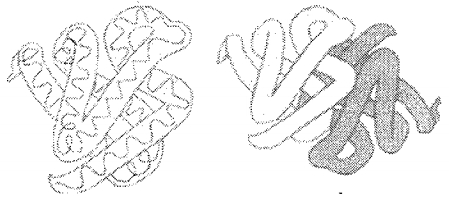
Identify the protein structures shown in the image.
A
Primary and Secondary
B
Secondary and Primary
C
Tertiary and Quaternary
D
Quaternary and Tertiary
Solution
(C) The image on the left shows a single polypeptide chain folded into a complex 3D shape,which represents the tertiary structure of a protein.
The image on the right shows multiple polypeptide chains (subunits) assembled together,which represents the quaternary structure of a protein.
Therefore,the correct sequence is Tertiary and Quaternary.
The image on the right shows multiple polypeptide chains (subunits) assembled together,which represents the quaternary structure of a protein.
Therefore,the correct sequence is Tertiary and Quaternary.
0 likes
View Solution412
MediumMCQ
Between which groups is the bond formed in two amino acids?
A
Between the $-NH_2$ group of one amino acid and the $-COOH$ group of another amino acid.
B
Between the $3'-OH$ of one amino acid and the $5'-phosphate$ of another amino acid.
C
Between the $1'-OH$ of one amino acid and the $4'-OH$ of another amino acid.
D
Between the $-CONH_2$ group of one amino acid and the $-OH$ group of another amino acid.
Solution
(A) Proteins are heteropolymers of amino acids.
Amino acids are linked by a peptide bond.
$A$ peptide bond is formed between the carboxyl $(-COOH)$ group of one amino acid and the amino $(-NH_2)$ group of the next amino acid.
This reaction involves the elimination of a water molecule $(H_2O)$,which is a dehydration synthesis reaction.
Amino acids are linked by a peptide bond.
$A$ peptide bond is formed between the carboxyl $(-COOH)$ group of one amino acid and the amino $(-NH_2)$ group of the next amino acid.
This reaction involves the elimination of a water molecule $(H_2O)$,which is a dehydration synthesis reaction.
0 likes
View Solution413
MediumMCQ
Which molecule is formed by the linkage of two amino acids?
A
Dinucleotide
B
Diglyceride
C
Dipeptide
D
Disaccharide
Solution
(C) When two amino acids are joined together,a peptide bond is formed between the carboxyl group $(-COOH)$ of one amino acid and the amino group $(-NH_2)$ of the adjacent amino acid.
This linkage results in the formation of a dipeptide molecule.
- $A$ dinucleotide is formed by the linkage of two nucleotides.
- $A$ diglyceride is formed by the linkage of two fatty acids with glycerol.
- $A$ disaccharide is formed by the linkage of two monosaccharides.
This linkage results in the formation of a dipeptide molecule.
- $A$ dinucleotide is formed by the linkage of two nucleotides.
- $A$ diglyceride is formed by the linkage of two fatty acids with glycerol.
- $A$ disaccharide is formed by the linkage of two monosaccharides.
0 likes
View Solution414
EasyMCQ
What is insulin?
A
Carbohydrate
B
Protein
C
Lipid
D
Nucleic acid
Solution
(B) Insulin is a peptide hormone produced by the beta cells of the pancreatic islets of Langerhans.
It consists of two polypeptide chains,chain $A$ and chain $B$,linked together by disulfide bridges.
Since it is composed of amino acids linked by peptide bonds,it is classified as a protein.
It consists of two polypeptide chains,chain $A$ and chain $B$,linked together by disulfide bridges.
Since it is composed of amino acids linked by peptide bonds,it is classified as a protein.
0 likes
View Solution415
MediumMCQ
Which bond connects two amino acids?
A
Glycosidic bond
B
Ester bond
C
Phosphodiester bond
D
Peptide bond
Solution
(D) Amino acids are the building blocks of proteins. When two amino acids join together,the carboxyl group $(-COOH)$ of one amino acid reacts with the amino group $(-NH_2)$ of another amino acid. This reaction results in the loss of a water molecule $(H_2O)$ and the formation of a covalent bond known as a peptide bond $(-CO-NH-)$. Therefore,the correct option is $D$.
0 likes
View Solution416
EasyMCQ
Antibodies are composed of $......$.
A
Lipids
B
Proteins
C
Nucleic acids
D
Carbohydrates
Solution
(B) Antibodies,also known as immunoglobulins $(Ig)$,are specialized proteins produced by $B$-lymphocytes in response to pathogens.
Each antibody molecule has a structure composed of four polypeptide chains: two light chains and two heavy chains,held together by disulfide bonds.
Therefore,antibodies are essentially proteinaceous in nature.
Each antibody molecule has a structure composed of four polypeptide chains: two light chains and two heavy chains,held together by disulfide bonds.
Therefore,antibodies are essentially proteinaceous in nature.
0 likes
View Solution417
EasyMCQ
The two polypeptide chains of insulin are linked together by which type of bond?
A
Hydrogen bond
B
Peptide bond
C
Hydrophilic bond
D
Disulfide bond
Solution
(D) Insulin is a peptide hormone composed of two polypeptide chains,chain $A$ and chain $B$.
These two chains are linked together by inter-chain disulfide bridges (disulfide bonds) between specific cysteine residues.
This structure is essential for the biological activity of the insulin molecule.
These two chains are linked together by inter-chain disulfide bridges (disulfide bonds) between specific cysteine residues.
This structure is essential for the biological activity of the insulin molecule.
0 likes
View Solution418
EasyMCQ
Primary proteins are also called as polypeptides because:
A
They are linear chains
B
They are polymers of peptide monomers
C
Successive amino acids are joined by peptide bonds
D
They can assume many conformations
Solution
(C) Primary proteins are referred to as polypeptides because they consist of a linear chain of amino acids linked together by peptide bonds.
In a polypeptide chain,the carboxyl group $(-COOH)$ of one amino acid reacts with the amino group $(-NH_2)$ of the next amino acid to form a peptide bond $(-CO-NH-)$.
Since the primary structure is defined by this specific sequence of amino acids held together by these covalent peptide bonds,the term 'polypeptide' is used to describe this linear arrangement.
In a polypeptide chain,the carboxyl group $(-COOH)$ of one amino acid reacts with the amino group $(-NH_2)$ of the next amino acid to form a peptide bond $(-CO-NH-)$.
Since the primary structure is defined by this specific sequence of amino acids held together by these covalent peptide bonds,the term 'polypeptide' is used to describe this linear arrangement.
0 likes
View Solution419
MediumMCQ
Given below are two statements:
Statement $I:$ Amino acids have a property of ionizable nature of $-NH_2$ and $-COOH$ groups,hence have different structures at different $pH$.
Statement $II:$ Amino acids can exist as Zwitterionic form at acidic and basic $pH$.
In the light of the above statements,choose the most appropriate answer from the options given below:
Statement $I:$ Amino acids have a property of ionizable nature of $-NH_2$ and $-COOH$ groups,hence have different structures at different $pH$.
Statement $II:$ Amino acids can exist as Zwitterionic form at acidic and basic $pH$.
In the light of the above statements,choose the most appropriate answer from the options given below:
A
Both Statement $I$ and Statement $II$ are correct
B
Both Statement $I$ and Statement $II$ are incorrect
C
Statement $I$ is correct but Statement $II$ is incorrect
D
Statement $I$ is incorrect but Statement $II$ is correct
Solution
(C) Statement $I$ is correct. Amino acids are amphoteric because they contain both an acidic carboxyl group $(-COOH)$ and a basic amino group $(-NH_2)$. These groups can ionize depending on the $pH$ of the solution,leading to different structural forms.
Statement $II$ is incorrect. $A$ Zwitterion is a dipolar ion that has both positive and negative charges,resulting in a net charge of zero. This state occurs at a specific $pH$ known as the isoelectric point $(pI)$. At highly acidic $pH$,the amino acid exists primarily in a cationic form $(-NH_3^+)$,and at highly basic $pH$,it exists primarily in an anionic form $(-COO^-)$. Therefore,it does not exist as a Zwitterion at all acidic or basic $pH$ levels.
Statement $II$ is incorrect. $A$ Zwitterion is a dipolar ion that has both positive and negative charges,resulting in a net charge of zero. This state occurs at a specific $pH$ known as the isoelectric point $(pI)$. At highly acidic $pH$,the amino acid exists primarily in a cationic form $(-NH_3^+)$,and at highly basic $pH$,it exists primarily in an anionic form $(-COO^-)$. Therefore,it does not exist as a Zwitterion at all acidic or basic $pH$ levels.
0 likes
View Solution420
MediumMCQ
Match List-$I$ with List-$II$.
Choose the correct answer from the options given below.
| List-$I$ | List-$II$ |
| $A$. $GLUT$-$4$ | $I$. Hormone |
| $B$. Insulin | $II$. Enzyme |
| $C$. Trypsin | $III$. Intercellular ground substance |
| $D$. Collagen | $IV$. Enables glucose transport into cells |
Choose the correct answer from the options given below.
A
$A-I, B-II, C-III, D-IV$
B
$A-II, B-III, C-IV, D-I$
C
$A-III, B-IV, C-I, D-II$
D
$A-IV, B-I, C-II, D-III$
Solution
(D) The correct matching is as follows:
$A$. $GLUT$-$4$ is a transport protein that enables glucose transport into cells $(IV)$.
$B$. Insulin is a peptide hormone $(I)$.
$C$. Trypsin is a proteolytic enzyme $(II)$.
$D$. Collagen is the most abundant protein in the animal world and acts as an intercellular ground substance $(III)$.
Therefore, the correct sequence is $A-IV, B-I, C-II, D-III$.
$A$. $GLUT$-$4$ is a transport protein that enables glucose transport into cells $(IV)$.
$B$. Insulin is a peptide hormone $(I)$.
$C$. Trypsin is a proteolytic enzyme $(II)$.
$D$. Collagen is the most abundant protein in the animal world and acts as an intercellular ground substance $(III)$.
Therefore, the correct sequence is $A-IV, B-I, C-II, D-III$.
0 likes
View Solution421
MediumMCQ
The triple helical structure of collagen was published in Nature in $1954$, and the analysis of the allowed conformations of proteins was performed through the use of the:
A
Sedimentation rate
B
Ramachandran plot
C
Svedberg's coefficient
D
$C$-value
Solution
(B) $G.N.$ Ramachandran, a renowned Indian biophysicist, published the triple helical structure of collagen in the journal Nature in $1954$.
He later developed the 'Ramachandran plot' in $1963$, which is a graphical representation used to visualize the energetically allowed regions for the backbone dihedral angles ($\phi$ and $\psi$) of amino acid residues in protein structures.
This tool is fundamental in understanding protein folding and structural biology.
He later developed the 'Ramachandran plot' in $1963$, which is a graphical representation used to visualize the energetically allowed regions for the backbone dihedral angles ($\phi$ and $\psi$) of amino acid residues in protein structures.
This tool is fundamental in understanding protein folding and structural biology.
0 likes
View Solution422
MediumMCQ
The manner in which individual folded polypeptides or subunits are arranged with respect to each other is $:-$
A
Quaternary structure
B
Tertiary structure
C
Secondary structure
D
Primary structure
Solution
(A) The structure of proteins is classified into four levels:
$1$. Primary structure: The linear sequence of amino acids in a polypeptide chain.
$2$. Secondary structure: The folding pattern of the polypeptide chain,such as $\alpha$-helices and $\beta$-pleated sheets,stabilized by hydrogen bonds.
$3$. Tertiary structure: The overall three-dimensional folding of a single polypeptide chain.
$4$. Quaternary structure: The arrangement and interaction of multiple folded polypeptide subunits to form a functional protein complex.
Therefore,the manner in which individual folded polypeptides or subunits are arranged with respect to each other is defined as the Quaternary structure.
$1$. Primary structure: The linear sequence of amino acids in a polypeptide chain.
$2$. Secondary structure: The folding pattern of the polypeptide chain,such as $\alpha$-helices and $\beta$-pleated sheets,stabilized by hydrogen bonds.
$3$. Tertiary structure: The overall three-dimensional folding of a single polypeptide chain.
$4$. Quaternary structure: The arrangement and interaction of multiple folded polypeptide subunits to form a functional protein complex.
Therefore,the manner in which individual folded polypeptides or subunits are arranged with respect to each other is defined as the Quaternary structure.
0 likes
View Solution423
MediumMCQ
Which of the following proteins helps in the transport of nutrients across the cell membrane?
A
Trypsin
B
Collagen
C
$GLUT$-$4$
D
Antibody
Solution
(C) Proteins perform various functions in living organisms.
$1$. Trypsin is an enzyme that helps in digestion.
$2$. Collagen is an intercellular ground substance that provides structural support.
$3$. $GLUT$-$4$ is a transport protein that enables the transport of glucose into cells across the cell membrane.
$4$. Antibodies are proteins that fight against infectious agents.
Therefore,the correct answer is $GLUT$-$4$.
$1$. Trypsin is an enzyme that helps in digestion.
$2$. Collagen is an intercellular ground substance that provides structural support.
$3$. $GLUT$-$4$ is a transport protein that enables the transport of glucose into cells across the cell membrane.
$4$. Antibodies are proteins that fight against infectious agents.
Therefore,the correct answer is $GLUT$-$4$.
0 likes
View Solution424
MediumMCQ
Statement $- I :$ All amino acids are protein-forming amino acids.
Statement $- II : R-$ group is a variable group in an amino acid.
Statement $- II : R-$ group is a variable group in an amino acid.
A
Both statements are true.
B
Both statements are false.
C
Statement $- I$ is true but Statement $- II$ is false.
D
Statement $- I$ is false but Statement $- II$ is true.
Solution
(D) Statement $- I$ is false because there are many amino acids that are not involved in protein synthesis,such as ornithine,citrulline,and $\gamma$-aminobutyric acid $(GABA)$.
Statement $- II$ is true because the general structure of an amino acid consists of a central $\alpha$-carbon atom bonded to an amino group $(-NH_2)$,a carboxyl group $(-COOH)$,a hydrogen atom,and a variable side chain known as the $R-$group. The $R-$group determines the specific properties of each amino acid.
Statement $- II$ is true because the general structure of an amino acid consists of a central $\alpha$-carbon atom bonded to an amino group $(-NH_2)$,a carboxyl group $(-COOH)$,a hydrogen atom,and a variable side chain known as the $R-$group. The $R-$group determines the specific properties of each amino acid.
0 likes
View Solution425
DifficultMCQ
Match List-$I$ with List-$II$:
Choose the correct answer from the options given below:
| List-$I$ | List-$II$ |
| $A$. Collagen | $I$. Enzyme |
| $B$. $\text{GLUT}-4$ | $II$. Most abundant enzyme in biosphere |
| $C$. Trypsin | $III$. Most abundant protein in animal world |
| $D$. RuBisCO | $IV$. Enables glucose transport into cells |
Choose the correct answer from the options given below:
A
$A-II, B-III, C-I, D-IV$
B
$A-III, B-IV, C-I, D-II$
C
$A-I, B-III, C-IV, D-II$
D
$A-III, B-I, C-IV, D-II$
Solution
(B) The correct matches are as follows:
$1$. Collagen $(A)$ is the most abundant protein in the animal world $(III)$.
$2$. $\text{GLUT}-4$ $(B)$ is a protein that enables glucose transport into cells $(IV)$.
$3$. Trypsin $(C)$ is an enzyme $(I)$.
$4$. RuBisCO $(D)$ is the most abundant enzyme in the whole biosphere $(II)$.
Therefore,the correct matching is $A-III, B-IV, C-I, D-II$.
$1$. Collagen $(A)$ is the most abundant protein in the animal world $(III)$.
$2$. $\text{GLUT}-4$ $(B)$ is a protein that enables glucose transport into cells $(IV)$.
$3$. Trypsin $(C)$ is an enzyme $(I)$.
$4$. RuBisCO $(D)$ is the most abundant enzyme in the whole biosphere $(II)$.
Therefore,the correct matching is $A-III, B-IV, C-I, D-II$.
0 likes
View Solution426
MediumMCQ
Molecules that bear charged groups of opposite polarity are known as $:-$
A
Cations
B
Anions
C
Zwitter ions
D
Negative ions
Solution
(C) $-$ Zwitterions,such as amino acids at physiological $pH$,have both a positive amino group $(-NH_3^+)$ and a negative carboxyl group $(-COO^-)$.
$-$ This makes them molecules with opposite polarity charges.
$-$ Cations and anions only have one type of charge.
$-$ This makes them molecules with opposite polarity charges.
$-$ Cations and anions only have one type of charge.
0 likes
View Solution427
EasyMCQ
What is correct about amino acid?
A
It is amphoteric
B
Present as zwitter ion at isoelectric point
C
It is unit of protein
D
All the above
Solution
(D) Amino acids are organic compounds containing an amino group $(-NH_2)$ and a carboxyl group $(-COOH)$.
$1$. They are amphoteric in nature because they possess both acidic $(-COOH)$ and basic $(-NH_2)$ groups,allowing them to react with both acids and bases.
$2$. At the isoelectric point $(pI)$,the amino acid exists as a zwitterion,where the molecule has a net charge of zero (the $-NH_2$ group is protonated to $-NH_3^+$ and the $-COOH$ group is deprotonated to $-COO^-$).
$3$. Amino acids are the fundamental building blocks (monomeric units) of proteins,linked together by peptide bonds.
Since all the given statements are correct,the correct option is $D$.
$1$. They are amphoteric in nature because they possess both acidic $(-COOH)$ and basic $(-NH_2)$ groups,allowing them to react with both acids and bases.
$2$. At the isoelectric point $(pI)$,the amino acid exists as a zwitterion,where the molecule has a net charge of zero (the $-NH_2$ group is protonated to $-NH_3^+$ and the $-COOH$ group is deprotonated to $-COO^-$).
$3$. Amino acids are the fundamental building blocks (monomeric units) of proteins,linked together by peptide bonds.
Since all the given statements are correct,the correct option is $D$.
0 likes
View Solution428
EasyMCQ
Given below are two statements.
Statement $I$ - Most of the blood proteins are acidic proteins.
Statement $II$ - Derived proteins are not found in nature.
In the light of above statements,select the correct option given below:
Statement $I$ - Most of the blood proteins are acidic proteins.
Statement $II$ - Derived proteins are not found in nature.
In the light of above statements,select the correct option given below:
A
Both statement $I$ and statement $II$ are correct.
B
Both statement $I$ and statement $II$ are incorrect.
C
Statement $I$ is correct but statement $II$ is incorrect.
D
Statement $I$ is incorrect but statement $II$ is correct.
Solution
(D) Statement $I$ is incorrect. Most blood proteins,such as albumin and globulin,are slightly basic or neutral at physiological $pH$ $(7.4)$,but they are generally classified as amphoteric. They are not predominantly acidic.
Statement $II$ is correct. Derived proteins are those that are obtained from native proteins by the action of heat,enzymes,or chemicals (e.g.,proteoses,peptones). They are not naturally occurring in the body but are products of protein degradation or denaturation.
Statement $II$ is correct. Derived proteins are those that are obtained from native proteins by the action of heat,enzymes,or chemicals (e.g.,proteoses,peptones). They are not naturally occurring in the body but are products of protein degradation or denaturation.
0 likes
View Solution429
EasyMCQ
Which element is a constituent of all amino acids?
A
Copper
B
Phosphorus
C
Nitrogen
D
Magnesium
Solution
(C) Amino acids are the building blocks of proteins.
Every amino acid has a basic structure consisting of a central carbon atom (alpha-carbon) bonded to an amino group $(-NH_2)$,a carboxyl group $(-COOH)$,a hydrogen atom,and a variable $R$-group.
Since all amino acids contain an amino group $(-NH_2)$,nitrogen is an essential constituent element of all amino acids.
Every amino acid has a basic structure consisting of a central carbon atom (alpha-carbon) bonded to an amino group $(-NH_2)$,a carboxyl group $(-COOH)$,a hydrogen atom,and a variable $R$-group.
Since all amino acids contain an amino group $(-NH_2)$,nitrogen is an essential constituent element of all amino acids.
0 likes
View Solution430
EasyMCQ
The spiral configuration of $\alpha$-helix and $\beta$-pleated sheet of polypeptide chains are held together by . . . . . . bonds to form the secondary structure of protein.
A
phosphodiester
B
hydrogen
C
peptide
D
disulphide
Solution
(B) The secondary structure of a protein is formed by the folding of the polypeptide chain into specific shapes,such as the $\alpha$-helix and $\beta$-pleated sheet.
These structures are stabilized by hydrogen bonds.
Hydrogen bonds form between the oxygen atom of the carbonyl group $(-C=O)$ and the hydrogen atom of the amino group $(-NH)$ in the polypeptide backbone.
These structures are stabilized by hydrogen bonds.
Hydrogen bonds form between the oxygen atom of the carbonyl group $(-C=O)$ and the hydrogen atom of the amino group $(-NH)$ in the polypeptide backbone.
0 likes
View Solution431
EasyMCQ
The peptide chains loop,twist and fold back on themselves due to the formation of . . . . . . bonds to form a stable tertiary structure of protein.
A
Disulphide
B
Diester
C
Peptide
D
Phosphate
Solution
(A) The tertiary structure of a protein represents the overall three-dimensional folding of the polypeptide chain.
This structure is stabilized by various interactions between the $R$-groups of amino acids,including hydrogen bonds,ionic bonds,hydrophobic interactions,and covalent $Disulphide$ bonds.
Among the options provided,$Disulphide$ bonds are crucial for maintaining the stability of the tertiary structure by linking distant parts of the polypeptide chain together.
This structure is stabilized by various interactions between the $R$-groups of amino acids,including hydrogen bonds,ionic bonds,hydrophobic interactions,and covalent $Disulphide$ bonds.
Among the options provided,$Disulphide$ bonds are crucial for maintaining the stability of the tertiary structure by linking distant parts of the polypeptide chain together.
0 likes
View Solution432
EasyMCQ
Egg albumin is an example of . . . . . . .
A
Simple proteins
B
Conjugated proteins
C
Simple lipids
D
Compound lipids
Solution
(A) Proteins are classified into three main types based on their chemical composition: simple proteins,conjugated proteins,and derived proteins.
Simple proteins are those that yield only amino acids upon hydrolysis.
Egg albumin is a classic example of a simple protein because it consists entirely of amino acids linked by peptide bonds without any non-protein prosthetic group.
Therefore,the correct option is $A$.
Simple proteins are those that yield only amino acids upon hydrolysis.
Egg albumin is a classic example of a simple protein because it consists entirely of amino acids linked by peptide bonds without any non-protein prosthetic group.
Therefore,the correct option is $A$.
0 likes
View Solution433
EasyMCQ
Identify the type of bond formed between the carboxyl group of one amino acid residue and the amino group of another amino acid residue.
A
Glycosidic bond
B
Hydrogen bond
C
Diester bond
D
Peptide bond
Solution
(D) The bond formed between the carboxyl group $(-COOH)$ of one amino acid and the amino group $(-NH_2)$ of an adjacent amino acid is known as a peptide bond.
This reaction involves the elimination of a water molecule $(H_2O)$,which is a dehydration synthesis or condensation reaction.
This bond is the fundamental linkage that connects amino acids to form polypeptide chains,which eventually fold into proteins.
This reaction involves the elimination of a water molecule $(H_2O)$,which is a dehydration synthesis or condensation reaction.
This bond is the fundamental linkage that connects amino acids to form polypeptide chains,which eventually fold into proteins.
0 likes
View Solution434
EasyMCQ
Match List-$I$ and List-$II$ with respect to proteins and their functions and select the correct option.
| List-$I$ | List-$II$ |
|---|---|
| $1$. Collagen | $p$. Fights infectious agents |
| $2$. Trypsin | $q$. Hormone |
| $3$. Insulin | $r$. Enzyme |
| $4$. Antibody | $s$. Intercellular ground substance |
A
$1-s, 2-p, 3-r, 4-q$
B
$1-q, 2-r, 3-p, 4-s$
C
$1-s, 2-q, 3-r, 4-p$
D
$1-s, 2-r, 3-q, 4-p$
Solution
(D) The correct matching is as follows:
$1$. Collagen: $s$. Intercellular ground substance (provides structural support).
$2$. Trypsin: $r$. Enzyme (a digestive enzyme that breaks down proteins).
$3$. Insulin: $q$. Hormone (regulates blood glucose levels).
$4$. Antibody: $p$. Fights infectious agents (part of the immune system).
Therefore,the correct sequence is $1-s, 2-r, 3-q, 4-p$.
$1$. Collagen: $s$. Intercellular ground substance (provides structural support).
$2$. Trypsin: $r$. Enzyme (a digestive enzyme that breaks down proteins).
$3$. Insulin: $q$. Hormone (regulates blood glucose levels).
$4$. Antibody: $p$. Fights infectious agents (part of the immune system).
Therefore,the correct sequence is $1-s, 2-r, 3-q, 4-p$.
0 likes
View Solution435
EasyMCQ
Match the compounds of Column-$I$ with their function in Column-$II$.
| Column-$I$ | Column-$II$ |
|---|---|
| $A$. Trypsin | $(i)$ Fights infectious agents |
| $B$. $GLUT$-$4$ | $(ii)$ Is an intercellular ground substance |
| $C$. Collagen | $(iii)$ Works as an enzyme |
| $D$. Antibody | $(iv)$ Enables glucose transport into cells |
A
$A-(iv), B-(iii), C-(ii), D-(i)$
B
$A-(iii), B-(iv), C-(i), D-(ii)$
C
$A-(iv), B-(iii), C-(i), D-(ii)$
D
$A-(iii), B-(iv), C-(ii), D-(i)$
Solution
(D) $A-(iii), B-(iv), C-(ii), D-(i)$
The correct matching is as follows:
$A$. Trypsin is an enzyme that digests proteins.
$B$. $GLUT$-$4$ is a protein that enables glucose transport into cells.
$C$. Collagen is a structural protein that forms the intercellular ground substance in connective tissues.
$D$. Antibody is a protein produced by our body to fight against infectious agents and foreign pathogens.
The correct matching is as follows:
$A$. Trypsin is an enzyme that digests proteins.
$B$. $GLUT$-$4$ is a protein that enables glucose transport into cells.
$C$. Collagen is a structural protein that forms the intercellular ground substance in connective tissues.
$D$. Antibody is a protein produced by our body to fight against infectious agents and foreign pathogens.
0 likes
View Solution436
EasyMCQ
What is the function of the protein $GLUT-4$?
A
Acts as an enzyme
B
Enables glucose transport into cells
C
Fights infectious agents
D
Functions as intercellular ground substance
Solution
(B) $GLUT-4$ is a specialized transport protein that facilitates the movement of glucose across the plasma membrane into cells.
It is primarily found in adipose tissues and skeletal muscle cells,where it is essential for maintaining glucose homeostasis.
It is primarily found in adipose tissues and skeletal muscle cells,where it is essential for maintaining glucose homeostasis.
0 likes
View Solution437
EasyMCQ
$RuBisCO$ and $Collagen$ are the most abundant proteins in the living world.
A
$PEPcase$ of plants and $Keratin$ of animals
B
$Ribozyme$ of plants and $Collagen$ of animals
C
$Alcohol \text{ } dehydrogenase$ of plants and $Melanin$ of animals
D
$RuBisCO$ of plants and $Collagen$ of animals
Solution
(D) $RuBisCO$ (Ribulose bisphosphate carboxylase-oxygenase) is the most abundant protein in the plant world, as it is essential for the process of photosynthesis.
$Collagen$ is the most abundant protein in the animal world, providing structural support to tissues.
Therefore, $RuBisCO$ of plants and $Collagen$ of animals are the most abundant proteins in the living world.
$Collagen$ is the most abundant protein in the animal world, providing structural support to tissues.
Therefore, $RuBisCO$ of plants and $Collagen$ of animals are the most abundant proteins in the living world.
0 likes
View Solution438
EasyMCQ
Alpha-helix is found in which level of protein structure?
A
$(1)$ Secondary structure
B
$(2)$ Primary structure
C
$(3)$ Tertiary structure
D
$(4)$ Quaternary structure
Solution
(A) The alpha-helix is a common motif in the secondary structure of proteins.
It is stabilized by hydrogen bonding between the carbonyl oxygen of one amino acid and the amino hydrogen of another amino acid located further along the polypeptide chain.
It is stabilized by hydrogen bonding between the carbonyl oxygen of one amino acid and the amino hydrogen of another amino acid located further along the polypeptide chain.
0 likes
View Solution439
MediumMCQ
Which of the following statements are correct regarding amino acids?
$A$. They are substituted methanes.
$B$. Serine is an aromatic amino acid.
$C$. Valine is a neutral amino acid.
$D$. Lysine is an acidic amino acid.
Choose the correct answer from the options given below:
$A$. They are substituted methanes.
$B$. Serine is an aromatic amino acid.
$C$. Valine is a neutral amino acid.
$D$. Lysine is an acidic amino acid.
Choose the correct answer from the options given below:
A
$(1)$ $A$ and $B$ only
B
$(2)$ $C$ and $D$ only
C
$(3)$ $B$ and $C$ only
D
$(4)$ $A$ and $C$ only
Solution
(D) Analysis of statements:
$(A)$ Amino acids are substituted methanes where four substituent groups (amino,carboxyl,hydrogen,and $R$-group) occupy the four valency positions of the $\alpha$-carbon. This statement is correct.
$(B)$ Serine is a polar,uncharged (neutral) amino acid,not an aromatic one. This statement is incorrect.
$(C)$ Valine possesses a non-polar,hydrophobic side chain and is classified as a neutral amino acid. This statement is correct.
$(D)$ Lysine contains an extra amino group in its side chain,which makes it a basic amino acid,not acidic. This statement is incorrect.
Therefore,statements $A$ and $C$ are correct. The correct option is $(4)$.
$(A)$ Amino acids are substituted methanes where four substituent groups (amino,carboxyl,hydrogen,and $R$-group) occupy the four valency positions of the $\alpha$-carbon. This statement is correct.
$(B)$ Serine is a polar,uncharged (neutral) amino acid,not an aromatic one. This statement is incorrect.
$(C)$ Valine possesses a non-polar,hydrophobic side chain and is classified as a neutral amino acid. This statement is correct.
$(D)$ Lysine contains an extra amino group in its side chain,which makes it a basic amino acid,not acidic. This statement is incorrect.
Therefore,statements $A$ and $C$ are correct. The correct option is $(4)$.
0 likes
View SolutionBiomolecules — Proteins · Frequently Asked Questions
1Are these Biomolecules questions useful for JEE and NEET?
Yes. All questions in this section are mapped to JEE Main and NEET exam patterns. Previous year questions from JEE Main, NEET, GUJCET and state-level exams are included with full solutions.
2Can I switch to Hindi or Gujarati for these questions?
Yes. Use the language tabs in the hero section or the sidebar to view the same questions and solutions in English, Hindi or Gujarati.
3How do I generate a question paper from this subtopic?
Use the Vedclass Exam Paper Generator — select the chapter and subtopic, set difficulty, and generate Sets A, B, C, D automatically. First 3 chapters of every subject are free.
Vedclass Products
For Students
Vedclass Test Series
Mock tests in real JEE/NEET style with performance analysis. 5-day free trial.
Start Free TrialFor Teachers
Exam Paper Generator
Generate Set A/B/C/D papers from this chapter in 2 minutes. 3 chapters free.
Try FreeFor Institutes
Online Exam Module
Live online exams with unlimited students, 360° analytics & white-label branding.
See DemoFor Teachers & Institutes
Generate a Biomolecules Exam Paper in 2 Minutes
Select subtopic & difficulty — Sets A, B, C, D auto-generated with No Repeat logic.
First 3 chapters of every subject are free — no payment required.