
A English
Proteins Questions in English
Class 11 Biology · Biomolecules · Proteins
439+
Questions
English
Language
100%
With Solutions
Showing 50 of 439 questions in English
301
EasyMCQ
What is a conjugated protein called if it contains a carbohydrate as a prosthetic group?
A
Chromoprotein
B
Glycoprotein
C
Lipoprotein
D
Nucleoprotein
Solution
(B) Conjugated proteins are proteins that contain a non-protein component known as a prosthetic group.
When the prosthetic group is a carbohydrate,the protein is classified as a $Glycoprotein$.
$Chromoproteins$ contain a pigment,$Lipoproteins$ contain lipids,and $Nucleoproteins$ contain nucleic acids as their prosthetic groups.
When the prosthetic group is a carbohydrate,the protein is classified as a $Glycoprotein$.
$Chromoproteins$ contain a pigment,$Lipoproteins$ contain lipids,and $Nucleoproteins$ contain nucleic acids as their prosthetic groups.
0 likes
View Solution302
EasyMCQ
What is collagen?
A
Fibrous protein
B
Globular protein
C
Lipid
D
Carbohydrate
Solution
(A) Collagen is the most abundant protein in the animal kingdom. It is a structural protein that provides strength and support to tissues. Structurally,it is classified as a fibrous protein because its polypeptide chains are arranged in long,parallel strands that form fibers,which are insoluble in water.
0 likes
View Solution303
EasyMCQ
The antibodies in our body are complex $ \dots $.
A
Steroids
B
Prostaglandins
C
Glycoproteins
D
Lipoproteins
Solution
(C) Antibodies, also known as immunoglobulins $(Ig)$, are specialized proteins produced by plasma cells in response to antigens.
Chemically, antibodies are $ \text{glycoproteins} $, meaning they consist of a protein backbone covalently bonded to carbohydrate side chains.
These carbohydrate moieties are essential for the stability, secretion, and biological function of the antibody molecule.
Therefore, the correct option is $C$.
Chemically, antibodies are $ \text{glycoproteins} $, meaning they consist of a protein backbone covalently bonded to carbohydrate side chains.
These carbohydrate moieties are essential for the stability, secretion, and biological function of the antibody molecule.
Therefore, the correct option is $C$.
0 likes
View Solution304
EasyMCQ
Which protein is found in the greatest abundance in the animal kingdom?
A
Trypsin
B
Haemoglobin
C
Collagen
D
Insulin
Solution
(C) Collagen is the most abundant protein in the animal kingdom. It is a structural protein that provides strength and support to various tissues,including skin,tendons,ligaments,and bones. While $RuBisCO$ is the most abundant protein in the whole biosphere (due to its presence in plants),$Collagen$ holds the record for the animal kingdom.
0 likes
View Solution305
MediumMCQ
Which of the following is least likely to be involved in stabilizing the three-dimensional folding of a protein?
A
Hydrogen bonds
B
Electrostatic interactions
C
Hydrophobic interactions
D
Ester bonds
Solution
(D) The three-dimensional structure of a protein is stabilized by various non-covalent interactions and specific covalent bonds.
$1$. Hydrogen bonds,electrostatic interactions (ionic bonds),and hydrophobic interactions are critical forces that maintain the tertiary structure of proteins.
$2$. Hydrophobic interactions are the primary driving force for protein folding,as non-polar side chains cluster in the interior.
$3$. Ester bonds are typically found in lipids (between fatty acids and glycerol) or nucleic acids (phosphodiester bonds),but they are not standard structural components involved in stabilizing the folding of polypeptide chains.
Therefore,ester bonds are the least likely to be involved in protein folding stabilization.
$1$. Hydrogen bonds,electrostatic interactions (ionic bonds),and hydrophobic interactions are critical forces that maintain the tertiary structure of proteins.
$2$. Hydrophobic interactions are the primary driving force for protein folding,as non-polar side chains cluster in the interior.
$3$. Ester bonds are typically found in lipids (between fatty acids and glycerol) or nucleic acids (phosphodiester bonds),but they are not standard structural components involved in stabilizing the folding of polypeptide chains.
Therefore,ester bonds are the least likely to be involved in protein folding stabilization.
0 likes
View Solution306
EasyMCQ
Which of the following amino acids is an essential part of the human diet?
A
Glycine
B
Phenylalanine
C
Serine
D
Aspartic acid
Solution
(B) Essential amino acids are those that cannot be synthesized by the human body and must be obtained through the diet.
There are $9$ essential amino acids: Histidine,Isoleucine,Leucine,Lysine,Methionine,Phenylalanine,Threonine,Tryptophan,and Valine.
Among the given options,Phenylalanine is an essential amino acid.
Glycine,Serine,and Aspartic acid are non-essential amino acids as they can be synthesized by the human body.
There are $9$ essential amino acids: Histidine,Isoleucine,Leucine,Lysine,Methionine,Phenylalanine,Threonine,Tryptophan,and Valine.
Among the given options,Phenylalanine is an essential amino acid.
Glycine,Serine,and Aspartic acid are non-essential amino acids as they can be synthesized by the human body.
0 likes
View Solution307
MediumMCQ
In elderly individuals,hair gradually begins to thin. This is due to a decrease in ..........
A
Glucose synthesis
B
Protein synthesis
C
Energy availability
D
Blood supply
Solution
(B) Hair is primarily composed of a tough,fibrous protein called $Keratin$.
As individuals age,the efficiency of cellular processes,including the synthesis of proteins like $Keratin$,declines.
This reduction in $Protein$ $synthesis$ leads to thinner hair shafts and a decrease in the overall density of hair follicles,resulting in the gradual thinning of hair observed in elderly individuals.
As individuals age,the efficiency of cellular processes,including the synthesis of proteins like $Keratin$,declines.
This reduction in $Protein$ $synthesis$ leads to thinner hair shafts and a decrease in the overall density of hair follicles,resulting in the gradual thinning of hair observed in elderly individuals.
0 likes
View Solution308
EasyMCQ
Hemoglobin is a type of ............ .
A
Carbohydrate
B
Vitamin
C
Skin pigment
D
Respiratory pigment
Solution
(D) Hemoglobin is a complex protein found in red blood cells $(RBCs)$.
It contains an iron-rich heme group and a protein called globin.
Its primary function is to transport oxygen from the lungs to the tissues and carbon dioxide from the tissues back to the lungs.
Due to this vital role in gas exchange,it is classified as a respiratory pigment.
It contains an iron-rich heme group and a protein called globin.
Its primary function is to transport oxygen from the lungs to the tissues and carbon dioxide from the tissues back to the lungs.
Due to this vital role in gas exchange,it is classified as a respiratory pigment.
0 likes
View Solution309
EasyMCQ
Alpha-keratin is a protein present in
A
blood
B
skin
C
lymph
D
eggs
Solution
(B) Alpha-keratin is a fibrous structural protein. It is found in high concentrations in the skin and epidermal appendages such as hair,nails,and horns in vertebrates.
0 likes
View Solution310
MediumMCQ
Assertion: Human diet should compulsorily contain glycine,serine,and tyrosine.
Reason: Essential amino acids cannot be synthesized in the human body.
Reason: Essential amino acids cannot be synthesized in the human body.
A
If both Assertion and Reason are correct and the Reason is a correct explanation of the Assertion.
B
If both Assertion and Reason are correct but Reason is not a correct explanation of the Assertion.
C
If the Assertion is correct but Reason is incorrect.
D
If both the Assertion and Reason are incorrect.
Solution
(D) Essential amino acids are those that cannot be synthesized by the human body and must be obtained through the diet. Non-essential amino acids are those that the body can synthesize on its own.
Glycine,serine,and tyrosine are classified as non-essential amino acids because the human body is capable of synthesizing them.
Therefore,the Assertion is incorrect because these amino acids do not need to be compulsorily included in the diet.
The Reason is a correct statement regarding the definition of essential amino acids.
Since the Assertion is incorrect and the Reason is correct,the correct option is $D$.
Glycine,serine,and tyrosine are classified as non-essential amino acids because the human body is capable of synthesizing them.
Therefore,the Assertion is incorrect because these amino acids do not need to be compulsorily included in the diet.
The Reason is a correct statement regarding the definition of essential amino acids.
Since the Assertion is incorrect and the Reason is correct,the correct option is $D$.
0 likes
View Solution311
MediumMCQ
Assertion : The amino acid glycine comes under the category of nonessential amino acids.
Reason : This is due to the fact that it can not be synthesised in the body.
Reason : This is due to the fact that it can not be synthesised in the body.
A
If both Assertion and Reason are correct and the Reason is a correct explanation of the Assertion.
B
If both Assertion and Reason are correct but Reason is not a correct explanation of the Assertion.
C
If the Assertion is correct but Reason is incorrect.
D
If both the Assertion and Reason are incorrect.
Solution
(C) Non-essential amino acids are those amino acids that do not need to be supplied in the diet because they can be synthesized by the human body,typically from carbohydrate metabolites.
Glycine is a non-essential amino acid because the body can synthesize it.
Essential amino acids are those that cannot be synthesized by the body and must be obtained through the diet.
Since the Assertion states that glycine is non-essential,it is correct.
However,the Reason states that it cannot be synthesized in the body,which is the definition of an essential amino acid,making the Reason incorrect.
Therefore,the Assertion is correct but the Reason is incorrect.
Glycine is a non-essential amino acid because the body can synthesize it.
Essential amino acids are those that cannot be synthesized by the body and must be obtained through the diet.
Since the Assertion states that glycine is non-essential,it is correct.
However,the Reason states that it cannot be synthesized in the body,which is the definition of an essential amino acid,making the Reason incorrect.
Therefore,the Assertion is correct but the Reason is incorrect.
0 likes
View Solution312
MediumMCQ
The "Ramachandran plot" is used to confirm the structure of:
A
$RNA$
B
Proteins
C
Triacylglycerides
D
$DNA$
Solution
(B) The "Ramachandran plot" is a visualization tool used in biochemistry to analyze the allowed regions of the backbone dihedral angles $\phi$ (phi) and $\psi$ (psi) of amino acid residues in protein structures.
It helps in determining the stereochemical feasibility of polypeptide chains, thereby confirming the secondary structure of proteins.
It helps in determining the stereochemical feasibility of polypeptide chains, thereby confirming the secondary structure of proteins.
0 likes
View Solution313
MediumMCQ
What is meant by the tertiary structure of proteins?
A
The linear sequence of amino acids.
B
The folding of the polypeptide chain into a complex three-dimensional shape.
C
The arrangement of multiple polypeptide subunits.
D
The formation of alpha-helices and beta-pleated sheets.
Solution
(B) The helical polypeptide chain undergoes coiling and folding to form a complex three-dimensional shape referred to as the tertiary structure of proteins.
These coils and folds are arranged to hide the non-polar amino acid side chains and to expose the polar side chains.
The tertiary structure is stabilized by various weak interactions such as hydrogen bonds,ionic bonds,hydrophobic interactions,and disulfide bridges between different parts of the polypeptide chain.
These coils and folds are arranged to hide the non-polar amino acid side chains and to expose the polar side chains.
The tertiary structure is stabilized by various weak interactions such as hydrogen bonds,ionic bonds,hydrophobic interactions,and disulfide bridges between different parts of the polypeptide chain.
0 likes
View Solution314
Medium
Proteins have a primary structure. If you are given a method to know which amino acid is at either of the two termini (ends) of a protein,can you connect this information to the purity or homogeneity of a protein?
Solution
(A) Yes,if we have a method to determine the sequence of amino acids in a protein,we can certainly connect this information to the purity or homogeneity of the protein.
$1$. The primary structure of a protein is defined by the specific sequence of amino acids.
$2$. Any deviation or impurity in the protein sample would result in the presence of different amino acids at the termini compared to the expected pure protein.
$3$. By identifying the $N$-terminal and $C$-terminal amino acids,we can verify if the sample matches the known sequence of the target protein.
$4$. If the terminal amino acids do not match the expected ones,it indicates that the sample is either impure or heterogeneous.
$5$. For example,in $Haemoglobin$,a single amino acid substitution in the primary structure can lead to abnormal protein function,such as in $Sickle$ $Cell$ $Anaemia$,which highlights the importance of sequence homogeneity for protein purity.
$1$. The primary structure of a protein is defined by the specific sequence of amino acids.
$2$. Any deviation or impurity in the protein sample would result in the presence of different amino acids at the termini compared to the expected pure protein.
$3$. By identifying the $N$-terminal and $C$-terminal amino acids,we can verify if the sample matches the known sequence of the target protein.
$4$. If the terminal amino acids do not match the expected ones,it indicates that the sample is either impure or heterogeneous.
$5$. For example,in $Haemoglobin$,a single amino acid substitution in the primary structure can lead to abnormal protein function,such as in $Sickle$ $Cell$ $Anaemia$,which highlights the importance of sequence homogeneity for protein purity.
0 likes
View Solution315
Medium
Find out and make a list of proteins used as therapeutic agents. Find other applications of proteins (e.g.,cosmetics,etc.).
Solution
(N/A) Proteins used as therapeutic agents are as follows:
$1$. $Thrombin$ and $Fibrinogen$: These proteins play a crucial role in the blood clotting process.
$2$. $Antibodies$ (Immunoglobulins): These are essential for immune responses and are used in various diagnostic and therapeutic applications.
$3$. $Insulin$: $A$ peptide hormone used to regulate blood glucose levels in patients with diabetes mellitus.
$4$. $Renin$: An enzyme involved in the regulation of blood pressure and osmoregulation.
Other applications of proteins include:
- $Cosmetics$: Proteins like collagen and keratin are widely used in skin and hair care products.
- $Toxins$: Certain proteins act as biological toxins (e.g.,$Botulinum$ toxin) used in medical treatments.
- $Biological$ $Buffers$: Proteins help maintain $pH$ stability in various biochemical processes.
$1$. $Thrombin$ and $Fibrinogen$: These proteins play a crucial role in the blood clotting process.
$2$. $Antibodies$ (Immunoglobulins): These are essential for immune responses and are used in various diagnostic and therapeutic applications.
$3$. $Insulin$: $A$ peptide hormone used to regulate blood glucose levels in patients with diabetes mellitus.
$4$. $Renin$: An enzyme involved in the regulation of blood pressure and osmoregulation.
Other applications of proteins include:
- $Cosmetics$: Proteins like collagen and keratin are widely used in skin and hair care products.
- $Toxins$: Certain proteins act as biological toxins (e.g.,$Botulinum$ toxin) used in medical treatments.
- $Biological$ $Buffers$: Proteins help maintain $pH$ stability in various biochemical processes.
0 likes
View Solution316
Medium
Can you describe what happens when milk is converted into curd or yoghurt from your understanding of proteins?
Solution
(N/A) Proteins are macromolecules formed by the polymerization of amino acids.
Structurally,proteins are divided into four levels:
$1$. Primary structure: It is the linear sequence of amino acids in a polypeptide chain.
$2$. Secondary structure: The polypeptide chain is coiled to form a three-dimensional structure.
$3$. Tertiary structure: The helical polypeptide chain is further coiled and folded to form a complex structure.
$4$. Quaternary structure: More than one polypeptide chains assemble to form the quaternary structure.
Milk contains many globular proteins. When milk is converted into curd or yoghurt,these complex proteins undergo denaturation. During this process,the secondary and tertiary structures of the proteins are destroyed,causing the globular proteins to unfold and coagulate,which gives curd its characteristic texture.
Structurally,proteins are divided into four levels:
$1$. Primary structure: It is the linear sequence of amino acids in a polypeptide chain.
$2$. Secondary structure: The polypeptide chain is coiled to form a three-dimensional structure.
$3$. Tertiary structure: The helical polypeptide chain is further coiled and folded to form a complex structure.
$4$. Quaternary structure: More than one polypeptide chains assemble to form the quaternary structure.
Milk contains many globular proteins. When milk is converted into curd or yoghurt,these complex proteins undergo denaturation. During this process,the secondary and tertiary structures of the proteins are destroyed,causing the globular proteins to unfold and coagulate,which gives curd its characteristic texture.
0 likes
View Solution317
MediumMCQ
Attempt titrating an amino acid against a weak base and discover the number of dissociating (ionizable) functional groups in the amino acid.
A
$1$
B
$2$
C
$3$
D
$4$
Solution
(B) The number of ionizable functional groups in an amino acid depends on its structure.
An amino acid typically contains at least one amino group $(-NH_2)$ and one carboxyl group $(-COOH)$.
During titration,these groups dissociate at specific $pH$ values.
For a neutral amino acid,the carboxyl group and the amino group are the primary ionizable sites,resulting in $2$ dissociating groups.
Acidic amino acids contain an additional carboxyl group in the side chain,while basic amino acids contain an additional amino group,leading to $3$ or more dissociating groups.
An amino acid typically contains at least one amino group $(-NH_2)$ and one carboxyl group $(-COOH)$.
During titration,these groups dissociate at specific $pH$ values.
For a neutral amino acid,the carboxyl group and the amino group are the primary ionizable sites,resulting in $2$ dissociating groups.
Acidic amino acids contain an additional carboxyl group in the side chain,while basic amino acids contain an additional amino group,leading to $3$ or more dissociating groups.
0 likes
View Solution318
Easy
Draw the structure of the amino acid,alanine.
Solution
(N/A) Alanine is a non-essential amino acid with the chemical formula $C_3H_7NO_2$.
Its structure consists of a central alpha-carbon atom bonded to an amino group $(-NH_2)$,a carboxyl group $(-COOH)$,a hydrogen atom $(-H)$,and a methyl group $(-CH_3)$ as its side chain ($R$-group).
The structural formula is represented as:
$\begin{array}{c} CH_3 \\ | \\ H_2N-C-COOH \\ | \\ H \end{array}$
Its structure consists of a central alpha-carbon atom bonded to an amino group $(-NH_2)$,a carboxyl group $(-COOH)$,a hydrogen atom $(-H)$,and a methyl group $(-CH_3)$ as its side chain ($R$-group).
The structural formula is represented as:
$\begin{array}{c} CH_3 \\ | \\ H_2N-C-COOH \\ | \\ H \end{array}$
0 likes
View Solution319
Medium
Briefly describe the types of groups participating in the structure of amino acids.
Solution
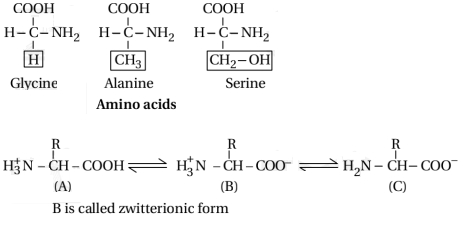
(N/A) $\Rightarrow$ Amino acids are organic compounds containing an amino group and an acidic group as substituents on the same carbon,i.e.,the $\alpha$-carbon. Hence,they are called $\alpha$-amino acids.
$\Rightarrow$ There are four substituent groups occupying the four valency positions of the $\alpha$-carbon. These are a hydrogen atom,a carboxyl group $(-COOH)$,an amino group $(-NH_2)$,and a variable group designated as the $R$ group.
$\Rightarrow$ The $R$ group in these proteinaceous amino acids can be a hydrogen atom (in glycine),a methyl group (in alanine),a hydroxymethyl group (in serine),etc.
$\Rightarrow$ The chemical and physical properties of amino acids are essentially determined by the amino,carboxyl,and the $R$ functional groups.
$\Rightarrow$ Based on the number of amino and carboxyl groups,amino acids can be classified as acidic (e.g.,glutamic acid),basic (e.g.,lysine),or neutral (e.g.,valine). Similarly,there are aromatic amino acids (e.g.,tyrosine,phenylalanine,tryptophan).
$\Rightarrow$ $A$ particular property of amino acids is the ionizable nature of the $-NH_2$ and $-COOH$ groups. Consequently,in solutions of different pH values,the structure of amino acids changes,forming a zwitterionic structure at a specific pH.
$\Rightarrow$ There are four substituent groups occupying the four valency positions of the $\alpha$-carbon. These are a hydrogen atom,a carboxyl group $(-COOH)$,an amino group $(-NH_2)$,and a variable group designated as the $R$ group.
$\Rightarrow$ The $R$ group in these proteinaceous amino acids can be a hydrogen atom (in glycine),a methyl group (in alanine),a hydroxymethyl group (in serine),etc.
$\Rightarrow$ The chemical and physical properties of amino acids are essentially determined by the amino,carboxyl,and the $R$ functional groups.
$\Rightarrow$ Based on the number of amino and carboxyl groups,amino acids can be classified as acidic (e.g.,glutamic acid),basic (e.g.,lysine),or neutral (e.g.,valine). Similarly,there are aromatic amino acids (e.g.,tyrosine,phenylalanine,tryptophan).
$\Rightarrow$ $A$ particular property of amino acids is the ionizable nature of the $-NH_2$ and $-COOH$ groups. Consequently,in solutions of different pH values,the structure of amino acids changes,forming a zwitterionic structure at a specific pH.
0 likes
View Solution320
Easy
Give information on the structural organization of proteins. Mention their general functions.
Solution
(N/A) $\rightarrow$ Proteins are polypeptides. They are linear chains of amino acids linked by peptide bonds.
$\rightarrow$ Each protein is a polymer of amino acids. There are $21$ types of amino acids (e.g.,alanine,cysteine,proline,tryptophan,lysine,etc.).
$\rightarrow$ Protein is a heteropolymer. $A$ homopolymer has only one type of monomer repeating '$n$' number of times.
$\rightarrow$ Certain amino acids are essential for our health and they have to be supplied through our diet. Dietary proteins are the source of essential amino acids.
$\rightarrow$ Amino acids can be essential or non-essential. Essential amino acids are obtained through our food,while non-essential amino acids are those which our body can synthesize.
$\rightarrow$ Proteins carry out many functions in living organisms: some transport nutrients across cell membranes,some fight infectious organisms,some act as hormones,and some function as enzymes.
$\rightarrow$ Some proteins and their functions:
$\rightarrow$ Collagen is the most abundant protein in the animal world,and Ribulose bisphosphate Carboxylase Oxygenase (RuBisCo) is the most abundant protein in the whole of the biosphere.
$\rightarrow$ Each protein is a polymer of amino acids. There are $21$ types of amino acids (e.g.,alanine,cysteine,proline,tryptophan,lysine,etc.).
$\rightarrow$ Protein is a heteropolymer. $A$ homopolymer has only one type of monomer repeating '$n$' number of times.
$\rightarrow$ Certain amino acids are essential for our health and they have to be supplied through our diet. Dietary proteins are the source of essential amino acids.
$\rightarrow$ Amino acids can be essential or non-essential. Essential amino acids are obtained through our food,while non-essential amino acids are those which our body can synthesize.
$\rightarrow$ Proteins carry out many functions in living organisms: some transport nutrients across cell membranes,some fight infectious organisms,some act as hormones,and some function as enzymes.
$\rightarrow$ Some proteins and their functions:
| Protein | Functions |
| Collagen | Intercellular ground substance |
| Trypsin | Enzyme |
| Insulin | Hormone |
| Antibody | Fights infectious agents |
| Receptor | Sensory reception (smell,taste) |
| $GLUT$-$4$ | Enables glucose transport in the cells |
$\rightarrow$ Collagen is the most abundant protein in the animal world,and Ribulose bisphosphate Carboxylase Oxygenase (RuBisCo) is the most abundant protein in the whole of the biosphere.
0 likes
View Solution321
Medium
Describe the primary, secondary, and tertiary structures of proteins. $OR$ Describe the structure of proteins.
Solution
The structure of molecules means different things in different contexts.
$\rightarrow$ In inorganic chemistry, structure invariably refers to molecular formulae (e.g., $NaCl$, $MgCl_2$, etc.).
$\rightarrow$ Organic chemistry represents molecular structure in a two-dimensional form (e.g., benzene, naphthalene, etc.).
$\rightarrow$ Physicists visualize molecules in three dimensions, while biologists describe protein structure at four levels.
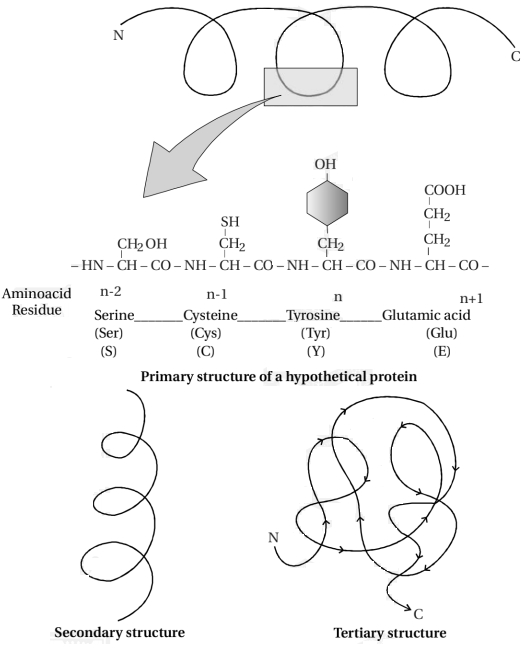
(a) Primary Structure:
The sequence of amino acids in a protein (i.e., positional information such as which amino acid is first, second, and so on) is called the primary structure.
(b) Secondary Structure:
A protein is imagined as a line where the left end represents the first amino acid and the right end represents the last amino acid.
The first amino acid is called the $N$-terminal amino acid, and the last amino acid is called the $C$-terminal amino acid.
The protein chain is folded into a helical structure (similar to a revolving staircase). In proteins, only right-handed helices are observed. Other regions of the chain are folded into different forms, which constitute the secondary structure.
(c) Tertiary Structure:
The long protein chain is further folded upon itself like a hollow woolen ball, giving rise to the tertiary structure. It provides a three-dimensional view of the protein. The tertiary structure is essential for many biological activities of proteins.
(d) Quaternary Structure:
Some proteins consist of more than one polypeptide chain or subunit. These folded subunits are arranged relative to each other (e.g., linear string of spheres, cubes, etc.). This arrangement is called quaternary structure.
Haemoglobin: Human haemoglobin consists of four subunits. Two are identical; hence, there are two $\alpha$-type and two $\beta$-type subunits.
$\rightarrow$ In inorganic chemistry, structure invariably refers to molecular formulae (e.g., $NaCl$, $MgCl_2$, etc.).
$\rightarrow$ Organic chemistry represents molecular structure in a two-dimensional form (e.g., benzene, naphthalene, etc.).
$\rightarrow$ Physicists visualize molecules in three dimensions, while biologists describe protein structure at four levels.
(a) Primary Structure:
The sequence of amino acids in a protein (i.e., positional information such as which amino acid is first, second, and so on) is called the primary structure.
(b) Secondary Structure:
A protein is imagined as a line where the left end represents the first amino acid and the right end represents the last amino acid.
The first amino acid is called the $N$-terminal amino acid, and the last amino acid is called the $C$-terminal amino acid.
The protein chain is folded into a helical structure (similar to a revolving staircase). In proteins, only right-handed helices are observed. Other regions of the chain are folded into different forms, which constitute the secondary structure.
(c) Tertiary Structure:
The long protein chain is further folded upon itself like a hollow woolen ball, giving rise to the tertiary structure. It provides a three-dimensional view of the protein. The tertiary structure is essential for many biological activities of proteins.
(d) Quaternary Structure:
Some proteins consist of more than one polypeptide chain or subunit. These folded subunits are arranged relative to each other (e.g., linear string of spheres, cubes, etc.). This arrangement is called quaternary structure.
Haemoglobin: Human haemoglobin consists of four subunits. Two are identical; hence, there are two $\alpha$-type and two $\beta$-type subunits.
0 likes
View Solution322
Easy
Give scientific reason: Life is not possible without protein.
Solution
(N/A) $\Rightarrow$ Proteins present in the plasma membrane transport materials across it.
$\Rightarrow$ Immunoglobulin proteins provide immunity against harmful pathogens.
$\Rightarrow$ Some proteins act as structural components of hormones.
$\Rightarrow$ Proteins are indispensable components of enzymes,which catalyze metabolic reactions.
$\Rightarrow$ Collagen is the most abundant protein in the animal world,providing structural support.
$\Rightarrow$ Ribulose bisphosphate carboxylase-oxygenase $(RuBisCo)$ is the most abundant protein in the whole biosphere,essential for carbon fixation.
$\Rightarrow$ Proteins are essential for various physiological processes,such as transport (e.g.,hemoglobin for respiratory gases).
$\Rightarrow$ Thus,life is not possible without proteins as they are the building blocks and functional machinery of cells.
$\Rightarrow$ Immunoglobulin proteins provide immunity against harmful pathogens.
$\Rightarrow$ Some proteins act as structural components of hormones.
$\Rightarrow$ Proteins are indispensable components of enzymes,which catalyze metabolic reactions.
$\Rightarrow$ Collagen is the most abundant protein in the animal world,providing structural support.
$\Rightarrow$ Ribulose bisphosphate carboxylase-oxygenase $(RuBisCo)$ is the most abundant protein in the whole biosphere,essential for carbon fixation.
$\Rightarrow$ Proteins are essential for various physiological processes,such as transport (e.g.,hemoglobin for respiratory gases).
$\Rightarrow$ Thus,life is not possible without proteins as they are the building blocks and functional machinery of cells.
0 likes
View Solution323
Easy
Schematically represent primary, secondary and tertiary structures of a hypothetical polymer, for example, a protein.
Solution
(N/A) $ \Rightarrow $ Structure of molecules means different things in different contexts.
$ \Rightarrow $ In inorganic chemistry, the structure refers to the molecular formulae (e.g., $ NaCl, MgCl_2 $, etc.).
$ \Rightarrow $ Organic chemistry uses a two-dimensional view of molecules to represent their structure (e.g., benzene, naphthalene, etc.).
$ \Rightarrow $ Physicists visualize three-dimensional views of molecular structures, while biologists describe protein structure at four levels.
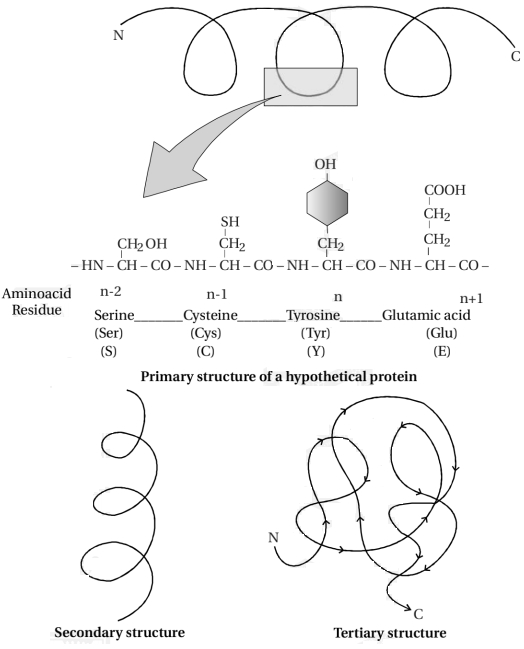
$ \Rightarrow $ $(a)$ Primary Structure: The sequence of amino acids, i.e., the positional information in a protein (which is the first amino acid, which is second, and so on), is called the primary structure.
$ \Rightarrow $ $(b)$ Secondary Structure: $ A $ protein is imagined as a line, where the left end is the first amino acid ($ N $-terminal) and the right end is the last amino acid ($ C $-terminal). The protein thread is folded in the form of a helix (similar to a revolving staircase). In proteins, only right-handed helices are observed. Other regions of the protein thread are folded into other forms, which is called the secondary structure.
$ \Rightarrow $ $(c)$ Tertiary Structure: The long protein chain is folded upon itself like a hollow woolen ball, giving rise to the tertiary structure. It provides a $ 3 $-dimensional view of a protein and is essential for many biological activities.
$ \Rightarrow $ $(d)$ Quaternary Structure: Some proteins are an assembly of more than one polypeptide or subunit. These individual folded polypeptides are arranged with respect to each other (e.g., human haemoglobin consists of $ 4 $ subunits: two $ \alpha $ type and two $ \beta $ type).
$ \Rightarrow $ In inorganic chemistry, the structure refers to the molecular formulae (e.g., $ NaCl, MgCl_2 $, etc.).
$ \Rightarrow $ Organic chemistry uses a two-dimensional view of molecules to represent their structure (e.g., benzene, naphthalene, etc.).
$ \Rightarrow $ Physicists visualize three-dimensional views of molecular structures, while biologists describe protein structure at four levels.
$ \Rightarrow $ $(a)$ Primary Structure: The sequence of amino acids, i.e., the positional information in a protein (which is the first amino acid, which is second, and so on), is called the primary structure.
$ \Rightarrow $ $(b)$ Secondary Structure: $ A $ protein is imagined as a line, where the left end is the first amino acid ($ N $-terminal) and the right end is the last amino acid ($ C $-terminal). The protein thread is folded in the form of a helix (similar to a revolving staircase). In proteins, only right-handed helices are observed. Other regions of the protein thread are folded into other forms, which is called the secondary structure.
$ \Rightarrow $ $(c)$ Tertiary Structure: The long protein chain is folded upon itself like a hollow woolen ball, giving rise to the tertiary structure. It provides a $ 3 $-dimensional view of a protein and is essential for many biological activities.
$ \Rightarrow $ $(d)$ Quaternary Structure: Some proteins are an assembly of more than one polypeptide or subunit. These individual folded polypeptides are arranged with respect to each other (e.g., human haemoglobin consists of $ 4 $ subunits: two $ \alpha $ type and two $ \beta $ type).
0 likes
View Solution324
MediumMCQ
How many polypeptide chains are present in the structure of hemoglobin?
A
Two
B
Four
C
Six
D
Eight
Solution
(B) Hemoglobin is a quaternary protein structure. It consists of $4$ polypeptide chains: $2$ alpha ($\alpha$) chains and $2$ beta ($\beta$) chains. Therefore, the correct answer is $4$.
0 likes
View Solution325
MediumMCQ
How many types of amino acids are found in living organisms?
A
$10$
B
$20$
C
$30$
D
$40$
Solution
(B) $\Rightarrow$ Amino acids are organic compounds containing an amino group and an acidic group as substituents on the same carbon,i.e.,the $\alpha$-carbon. Hence,they are called $\alpha$-amino acids.
$\Rightarrow$ There are four substituent groups occupying the four valency positions of the $\alpha$-carbon. These are hydrogen,a carboxyl group,an amino group,and a variable group designated as the $R$ group.
$\Rightarrow$ Based on the nature of the $R$ group,there are many amino acids,but only $20$ types of amino acids are commonly found in the proteins of living organisms.
$\Rightarrow$ There are four substituent groups occupying the four valency positions of the $\alpha$-carbon. These are hydrogen,a carboxyl group,an amino group,and a variable group designated as the $R$ group.
$\Rightarrow$ Based on the nature of the $R$ group,there are many amino acids,but only $20$ types of amino acids are commonly found in the proteins of living organisms.
0 likes
View Solution326
Medium
Glycine and alanine are different with respect to one substituent on the $\alpha$-carbon. What are the other common substituent groups?
Solution
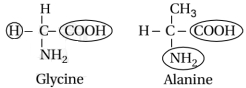
(N/A) The general structure of an amino acid consists of an $\alpha$-carbon atom bonded to four different groups: a hydrogen atom $(H)$,an amino group $(-NH_{2})$,a carboxyl group $(-COOH)$,and a variable $R$-group.
In both glycine and alanine,the common substituent groups attached to the $\alpha$-carbon are the hydrogen atom $(H)$,the amino group $(-NH_{2})$,and the carboxyl group $(-COOH)$.
In both glycine and alanine,the common substituent groups attached to the $\alpha$-carbon are the hydrogen atom $(H)$,the amino group $(-NH_{2})$,and the carboxyl group $(-COOH)$.
0 likes
View Solution327
EasyMCQ
What is the full name of the chemical group represented by $NH_{2}$?
A
Amine group
B
Amide group
C
Amino group
D
Ammonia group
Solution
(C) The chemical group $NH_{2}$ is known as the Amino group.
It is a functional group consisting of a nitrogen atom attached by single bonds to hydrogen atoms,or a carbon atom,or both.
In biology,it is a fundamental component of amino acids,which are the building blocks of proteins.
It is a functional group consisting of a nitrogen atom attached by single bonds to hydrogen atoms,or a carbon atom,or both.
In biology,it is a fundamental component of amino acids,which are the building blocks of proteins.
0 likes
View Solution328
EasyMCQ
Identify the basic amino acid from the following.
A
Valine
B
Tyrosine
C
Glutamic Acid
D
Lysine
Solution
(D) Amino acids are classified based on the number of amino and carboxyl groups in their structure.
$1$. Valine is a neutral,non-polar amino acid.
$2$. Tyrosine is a polar,aromatic amino acid.
$3$. Glutamic acid is an acidic amino acid because it contains an extra carboxyl group.
$4$. Lysine is a basic amino acid because it contains an extra amino group in its side chain.
Therefore,the correct answer is Lysine.
$1$. Valine is a neutral,non-polar amino acid.
$2$. Tyrosine is a polar,aromatic amino acid.
$3$. Glutamic acid is an acidic amino acid because it contains an extra carboxyl group.
$4$. Lysine is a basic amino acid because it contains an extra amino group in its side chain.
Therefore,the correct answer is Lysine.
0 likes
View Solution329
EasyMCQ
Which of the following is the most abundant protein in the animals?
A
Insulin
B
Haemoglobin
C
Collagen
D
Lectin
Solution
(C) Collagen is the most abundant protein in the animal kingdom. It is a structural protein that provides strength and support to various tissues,including skin,tendons,ligaments,and bones.
0 likes
View Solution330
EasyMCQ
Which of the following proteins is the most abundant in animals?
A
Haemoglobin
B
Collagen
C
Lectin
D
Insulin
Solution
(B) Collagen is the most abundant protein in the animal kingdom. It is a structural protein that provides strength and support to various tissues,including skin,tendons,ligaments,and bones. While haemoglobin is abundant in red blood cells,collagen is the most abundant protein overall in the entire animal body.
0 likes
View Solution331
MediumMCQ
What causes proteins to acquire a charge?
A
Monosaccharide chain
B
Nucleotide chain
C
Side chain of amino acids
D
All of the above
Solution
(C) Proteins are polymers of amino acids. Each amino acid has a central carbon atom attached to an amino group $(-NH_2)$,a carboxyl group $(-COOH)$,a hydrogen atom,and a variable side chain ($-R$ group).
The charge on a protein molecule is determined by the ionization of these side chains ($-R$ groups) of the amino acids,as well as the terminal amino and carboxyl groups.
Depending on the $pH$ of the environment,these side chains can gain or lose protons ($H^+$ ions),thereby giving the protein a net positive,negative,or neutral charge.
The charge on a protein molecule is determined by the ionization of these side chains ($-R$ groups) of the amino acids,as well as the terminal amino and carboxyl groups.
Depending on the $pH$ of the environment,these side chains can gain or lose protons ($H^+$ ions),thereby giving the protein a net positive,negative,or neutral charge.
0 likes
View Solution332
MediumMCQ
Which of the following amino acids is basic in nature?
A
Lysine
B
Tyrosine
C
Tryptophan
D
Valine
Solution
(A) Amino acids are classified based on the nature of their $R$-group side chains.
Basic amino acids contain an extra amino group in their side chain,which makes them basic at physiological $pH$.
Lysine,Arginine,and Histidine are examples of basic amino acids.
Tyrosine is an aromatic amino acid,Tryptophan is also aromatic,and Valine is a non-polar,aliphatic amino acid.
Therefore,Lysine is the correct answer.
Basic amino acids contain an extra amino group in their side chain,which makes them basic at physiological $pH$.
Lysine,Arginine,and Histidine are examples of basic amino acids.
Tyrosine is an aromatic amino acid,Tryptophan is also aromatic,and Valine is a non-polar,aliphatic amino acid.
Therefore,Lysine is the correct answer.
0 likes
View Solution333
MediumMCQ
Choose the correct option for human insulin.
A
Lipid
B
Carbohydrate
C
Nucleic acid
D
Protein
Solution
(D) Human insulin is a peptide hormone produced by the beta cells of the pancreatic islets of Langerhans.
It consists of two polypeptide chains,chain $A$ and chain $B$,which are linked together by disulfide bridges.
Since it is composed of amino acids linked by peptide bonds,it is classified as a protein.
It consists of two polypeptide chains,chain $A$ and chain $B$,which are linked together by disulfide bridges.
Since it is composed of amino acids linked by peptide bonds,it is classified as a protein.
0 likes
View Solution334
MediumMCQ
How many disulfide bonds connect the $A$ and $B$ chains of human insulin to each other?
A
One
B
Two
C
Three
D
Four
Solution
(B) Human insulin consists of two short polypeptide chains: chain $A$ and chain $B$,which are linked together by two disulfide bridges (bonds).
Additionally,there is one intra-chain disulfide bond within the $A$ chain,but the question specifically asks for the bonds connecting the $A$ and $B$ chains to each other.
Therefore,the number of inter-chain disulfide bonds is $2$.
Additionally,there is one intra-chain disulfide bond within the $A$ chain,but the question specifically asks for the bonds connecting the $A$ and $B$ chains to each other.
Therefore,the number of inter-chain disulfide bonds is $2$.
0 likes
View Solution335
MediumMCQ
How many disulfide bonds are present in the structure of insulin?
A
One
B
Two
C
Three
D
Four
Solution
(C) Insulin is a peptide hormone composed of two polypeptide chains,chain $A$ and chain $B$,which are linked together by disulfide bonds.
Chain $A$ consists of $21$ amino acids,and chain $B$ consists of $30$ amino acids.
These two chains are connected by $2$ inter-chain disulfide bonds.
Additionally,there is $1$ intra-chain disulfide bond within chain $A$.
Therefore,the total number of disulfide bonds in the mature insulin molecule is $2 + 1 = 3$.
Chain $A$ consists of $21$ amino acids,and chain $B$ consists of $30$ amino acids.
These two chains are connected by $2$ inter-chain disulfide bonds.
Additionally,there is $1$ intra-chain disulfide bond within chain $A$.
Therefore,the total number of disulfide bonds in the mature insulin molecule is $2 + 1 = 3$.
0 likes
View Solution336
EasyMCQ
How many amino acids are present in the structure of insulin?
A
$21$
B
$30$
C
$42$
D
$51$
Solution
(D) Insulin is a peptide hormone composed of two polypeptide chains,referred to as chain $A$ and chain $B$.
Chain $A$ consists of $21$ amino acids,and chain $B$ consists of $30$ amino acids.
These two chains are linked together by disulfide bridges.
Therefore,the total number of amino acids in the structure of insulin is $21 + 30 = 51$ amino acids.
Chain $A$ consists of $21$ amino acids,and chain $B$ consists of $30$ amino acids.
These two chains are linked together by disulfide bridges.
Therefore,the total number of amino acids in the structure of insulin is $21 + 30 = 51$ amino acids.
0 likes
View Solution337
EasyMCQ
Protein on reaction with which yields Ruhemann's purple?
A
Ninhydrin
B
$Cu^{2+}$
C
$H_{2}O_{2}$
D
Benedict's solution
Solution
(A) Ninhydrin is a chemical used to detect ammonia or primary and secondary amines. When proteins or amino acids react with the ninhydrin reagent,they undergo a series of reactions that result in the formation of a deep blue or violet-colored compound known as Ruhemann's purple. This reaction is commonly used in forensic science to detect fingerprints.
0 likes
View Solution338
MediumMCQ
Which one is not a protein?
A
Actin
B
Collagen
C
Albumin
D
Haematin
Solution
(D) $Actin$ is a contractile protein found in muscle fibers.
$Collagen$ is the most abundant structural protein in the animal kingdom.
$Albumin$ is a globular protein found in blood plasma.
$Haematin$ is a chemical compound derived from the oxidation of the heme group in hemoglobin; it is a porphyrin derivative,not a protein.
$Collagen$ is the most abundant structural protein in the animal kingdom.
$Albumin$ is a globular protein found in blood plasma.
$Haematin$ is a chemical compound derived from the oxidation of the heme group in hemoglobin; it is a porphyrin derivative,not a protein.
0 likes
View Solution339
MediumMCQ
An example of a sulphur-containing amino acid is:
A
Lysine
B
Serine
C
Cysteine
D
Tyrosine
Solution
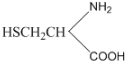
(C) The structure of cysteine is $HS-CH_2-CH(NH_2)-COOH$.
As shown in the structure,cysteine contains a thiol $(-SH)$ group,which makes it a sulphur-containing amino acid.
Other common sulphur-containing amino acids include methionine.
As shown in the structure,cysteine contains a thiol $(-SH)$ group,which makes it a sulphur-containing amino acid.
Other common sulphur-containing amino acids include methionine.
0 likes
View Solution340
MediumMCQ
Proteins are
A
Polypeptides with low molecular weights
B
Polypeptides with high molecular weights
C
Polymers of secondary amines
D
None of these
Solution
(B) Proteins are heteropolymers of amino acids. They are long chains of amino acids linked by peptide bonds,forming polypeptides. Because they consist of a large number of amino acid residues,they possess high molecular weights and are considered macromolecules.
0 likes
View Solution341
MediumMCQ
Proteins mainly contain:
A
$C, H, O$ and $N$
B
Only $C$ and $H$
C
$C, H$ and $O$
D
$N$ and $H$
Solution
(A) Proteins are polymers of amino acids. Each amino acid consists of a central carbon atom bonded to an amino group $(-NH_2)$,a carboxyl group $(-COOH)$,a hydrogen atom,and a variable $R$-group. Therefore,the fundamental elements present in all proteins are Carbon $(C)$,Hydrogen $(H)$,Oxygen $(O)$,and Nitrogen $(N)$.
0 likes
View Solution342
EasyMCQ
Keratin,a structural protein,is present in:
A
Hair
B
Skin
C
Wool
D
All of these
Solution
(D) Keratin is a fibrous structural protein that serves as a key component in the formation of various biological structures in vertebrates.
It is the primary protein found in hair,nails,and the outer layer of the skin (epidermis).
Wool is also composed primarily of keratin fibers.
Therefore,all the given options are correct as they all contain keratin.
It is the primary protein found in hair,nails,and the outer layer of the skin (epidermis).
Wool is also composed primarily of keratin fibers.
Therefore,all the given options are correct as they all contain keratin.
0 likes
View Solution343
EasyMCQ
Which of the following is an example of a conjugated protein?
A
Albumin
B
Globulin
C
Glutelin
D
Glycoprotein
Solution
(D) Conjugated proteins are proteins that contain a non-protein component known as a prosthetic group in addition to their polypeptide chains.
Glycoprotein is a conjugated protein where a carbohydrate (non-protein part) is covalently linked to a protein.
Albumin,Globulin,and Glutelin are examples of simple proteins,which yield only $\alpha$-amino acids upon hydrolysis.
Glycoprotein is a conjugated protein where a carbohydrate (non-protein part) is covalently linked to a protein.
Albumin,Globulin,and Glutelin are examples of simple proteins,which yield only $\alpha$-amino acids upon hydrolysis.
0 likes
View Solution344
MediumMCQ
Which of the following is an amino acid?
A
Glycine
B
Valine
C
Lysine
D
All of these
Solution
(D) Amino acids are organic compounds containing an amino group $(-NH_2)$ and a carboxyl group $(-COOH)$ attached to the same carbon atom (the $\alpha$-carbon). Glycine,Valine,and Lysine are all examples of amino acids that serve as the building blocks of proteins. Therefore,all the given options are correct.
0 likes
View Solution345
MediumMCQ
The destruction of the biological nature and activity of proteins by heat or chemical agents is called:
A
Dehydration
B
Denaturation
C
Denitrogenation
D
Deamination
Solution
(B) Denaturation is the process in which the secondary,tertiary,or quaternary structure of a protein is disrupted by external stress such as heat,pH changes,or chemical agents. This leads to the loss of the protein's biological activity and its specific three-dimensional conformation. During this process,soluble proteins often become insoluble and precipitate.
0 likes
View Solution346
MediumMCQ
All proteins are
A
Simple
B
Biocatalysts
C
Useful
D
Polymers
Solution
(D) Proteins are heteropolymers of amino acids.
They are formed by the polymerization of amino acids linked together by peptide bonds.
Since they consist of long chains of repeating monomeric units (amino acids),they are classified as polymers.
They are formed by the polymerization of amino acids linked together by peptide bonds.
Since they consist of long chains of repeating monomeric units (amino acids),they are classified as polymers.
0 likes
View Solution347
MediumMCQ
Which of the following is a protein?
A
Pepsin
B
Adrenaline
C
$ATP$
D
Glutamine
Solution
(A) Proteins are polymers of amino acids linked by peptide bonds.
$A$. $Pepsin$ is a digestive enzyme,which is a protein.
$B$. $Adrenaline$ is a hormone derived from the amino acid tyrosine,but it is not a protein.
$C$. $ATP$ (Adenosine Triphosphate) is a nucleotide derivative,not a protein.
$D$. $Glutamine$ is an amino acid,not a protein.
$A$. $Pepsin$ is a digestive enzyme,which is a protein.
$B$. $Adrenaline$ is a hormone derived from the amino acid tyrosine,but it is not a protein.
$C$. $ATP$ (Adenosine Triphosphate) is a nucleotide derivative,not a protein.
$D$. $Glutamine$ is an amino acid,not a protein.
0 likes
View Solution348
MediumMCQ
Which of the following is not an amino acid?
A
Glycine
B
Alanine
C
Histidine
D
Benzidine
Solution
(D) An amino acid is an organic compound that contains both an amino group $(-NH_2)$ and a carboxylic acid group $(-COOH)$ attached to the same carbon atom (the $\alpha$-carbon).
Glycine,Alanine,and Histidine are standard amino acids found in proteins.
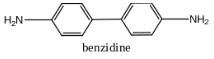
Benzidine is an aromatic amine with the formula $(C_6H_4NH_2)_2$. It contains two amino groups but lacks a carboxylic acid group,therefore it is not an amino acid.
Glycine,Alanine,and Histidine are standard amino acids found in proteins.
Benzidine is an aromatic amine with the formula $(C_6H_4NH_2)_2$. It contains two amino groups but lacks a carboxylic acid group,therefore it is not an amino acid.
0 likes
View Solution349
EasyMCQ
Protein gives a blue colour with
A
Benedict reagent
B
Iodine solution
C
Ninhydrin
D
Biuret reagent
Solution
(C) When protein is heated with a dilute solution of ninhydrin (triketohydrindene hydrate), a blue or violet colour is produced.
Protein $+$ Ninhydrin solution $\xrightarrow{\Delta}$ Blue colour
Protein $+$ Ninhydrin solution $\xrightarrow{\Delta}$ Blue colour
0 likes
View Solution350
MediumMCQ
$A$ substance forms a Zwitter ion. It can have which of the following functional groups?
A
$-NH_{2}, -COOH$
B
$-NH_{2}, -SO_{3}H$
C
Both $(a)$ and $(b)$
D
None of these
Solution
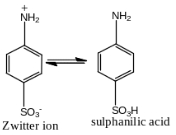
(C) Zwitter ion is a molecule or ion having separate positively and negatively charged groups.
Amino acids,which contain both an amino group $(-NH_{2})$ and a carboxylic acid group $(-COOH)$,exist as Zwitter ions at their isoelectric point.
Similarly,compounds like sulphanilic acid,which contain an amino group $(-NH_{2})$ and a sulphonic acid group $(-SO_{3}H)$,also exist as Zwitter ions due to the internal transfer of a proton from the acidic group to the basic amino group.
Therefore,both combinations can form Zwitter ions.
Amino acids,which contain both an amino group $(-NH_{2})$ and a carboxylic acid group $(-COOH)$,exist as Zwitter ions at their isoelectric point.
Similarly,compounds like sulphanilic acid,which contain an amino group $(-NH_{2})$ and a sulphonic acid group $(-SO_{3}H)$,also exist as Zwitter ions due to the internal transfer of a proton from the acidic group to the basic amino group.
Therefore,both combinations can form Zwitter ions.
0 likes
View SolutionBiomolecules — Proteins · Frequently Asked Questions
1Are these Biomolecules questions useful for JEE and NEET?
Yes. All questions in this section are mapped to JEE Main and NEET exam patterns. Previous year questions from JEE Main, NEET, GUJCET and state-level exams are included with full solutions.
2Can I switch to Hindi or Gujarati for these questions?
Yes. Use the language tabs in the hero section or the sidebar to view the same questions and solutions in English, Hindi or Gujarati.
3How do I generate a question paper from this subtopic?
Use the Vedclass Exam Paper Generator — select the chapter and subtopic, set difficulty, and generate Sets A, B, C, D automatically. First 3 chapters of every subject are free.
Vedclass Products
For Students
Vedclass Test Series
Mock tests in real JEE/NEET style with performance analysis. 5-day free trial.
Start Free TrialFor Teachers
Exam Paper Generator
Generate Set A/B/C/D papers from this chapter in 2 minutes. 3 chapters free.
Try FreeFor Institutes
Online Exam Module
Live online exams with unlimited students, 360° analytics & white-label branding.
See DemoFor Teachers & Institutes
Generate a Biomolecules Exam Paper in 2 Minutes
Select subtopic & difficulty — Sets A, B, C, D auto-generated with No Repeat logic.
First 3 chapters of every subject are free — no payment required.