
A English
Proteins Questions in English
Class 11 Biology · Biomolecules · Proteins
439+
Questions
English
Language
100%
With Solutions
Showing 50 of 439 questions in English
201
MediumMCQ
The primary structure of a protein is determined by which of the following?
A
Number of amino acids
B
Type of amino acids
C
Sequence of amino acids
D
All of the above
Solution
(D) The primary structure of a protein refers to the linear sequence of amino acids in a polypeptide chain.
This sequence is determined by the genetic information encoded in the $DNA$.
It involves the specific number of amino acids,the types of amino acids present,and their specific order or sequence in the chain.
Therefore,all these factors contribute to defining the primary structure of a protein.
This sequence is determined by the genetic information encoded in the $DNA$.
It involves the specific number of amino acids,the types of amino acids present,and their specific order or sequence in the chain.
Therefore,all these factors contribute to defining the primary structure of a protein.
0 likes
View Solution202
MediumMCQ
What kind of structure does a polypeptide chain possess?
A
Helical
B
Helical coiled
C
Helical coiled or pleated sheet
D
Globular
Solution
(C) The secondary structure of proteins refers to the local folding of the polypeptide chain into regular patterns. The two most common types of secondary structures are the $\alpha$-helix (helical) and the $\beta$-pleated sheet (pleated sheet). These structures are stabilized by hydrogen bonds between the amino and carboxyl groups of the polypeptide backbone. Therefore,a polypeptide chain can exhibit a helical coiled structure or a pleated sheet structure.
0 likes
View Solution203
EasyMCQ
In the structure of secondary proteins,the folding of the polypeptide chain is caused by which bond?
A
Covalent bond
B
Ionic bond
C
Hydrogen bond
D
Polar covalent bond
Solution
(C) The secondary structure of a protein refers to the local folded structures that form within a polypeptide due to interactions between atoms of the backbone.
Specifically,the folding of the polypeptide chain into structures like $\alpha$-helices and $\beta$-pleated sheets is primarily stabilized by hydrogen bonds formed between the carbonyl oxygen $(C=O)$ of one amino acid and the amino hydrogen $(N-H)$ of another amino acid in the chain.
Therefore,the correct answer is hydrogen bond.
Specifically,the folding of the polypeptide chain into structures like $\alpha$-helices and $\beta$-pleated sheets is primarily stabilized by hydrogen bonds formed between the carbonyl oxygen $(C=O)$ of one amino acid and the amino hydrogen $(N-H)$ of another amino acid in the chain.
Therefore,the correct answer is hydrogen bond.
0 likes
View Solution204
MediumMCQ
What kind of structure is formed by the folding of adjacent amino acids due to hydrogen bonding?
A
Soft and simple
B
Rigid tubular or helical structure
C
Globular
D
Coiled
Solution
(B) The secondary structure of proteins refers to the local folding of the polypeptide chain into regular patterns.
Hydrogen bonding between the carbonyl oxygen $(C=O)$ and the amide hydrogen $(N-H)$ of the polypeptide backbone stabilizes these structures.
This folding results in the formation of rigid,stable structures such as the $\alpha$-helix (a helical structure) or $\beta$-pleated sheets (a tubular or sheet-like arrangement).
Therefore,the correct description for these structures is a rigid tubular or helical structure.
Hydrogen bonding between the carbonyl oxygen $(C=O)$ and the amide hydrogen $(N-H)$ of the polypeptide backbone stabilizes these structures.
This folding results in the formation of rigid,stable structures such as the $\alpha$-helix (a helical structure) or $\beta$-pleated sheets (a tubular or sheet-like arrangement).
Therefore,the correct description for these structures is a rigid tubular or helical structure.
0 likes
View Solution205
MediumMCQ
The three-dimensional arrangement of a polypeptide chain forms which protein structure?
A
Primary
B
Secondary
C
Tertiary
D
Quaternary
Solution
(C) The structure of proteins is described at four levels:
$1$. Primary structure: The sequence of amino acids in a polypeptide chain.
$2$. Secondary structure: The folding of the polypeptide chain into specific shapes like $\alpha$-helices or $\beta$-pleated sheets,stabilized by hydrogen bonds.
$3$. Tertiary structure: The overall three-dimensional folding and coiling of a single polypeptide chain,which gives it a functional shape.
$4$. Quaternary structure: The arrangement of multiple polypeptide chains (subunits) into a single functional protein complex.
Therefore,the three-dimensional arrangement of a single polypeptide chain corresponds to the tertiary structure.
$1$. Primary structure: The sequence of amino acids in a polypeptide chain.
$2$. Secondary structure: The folding of the polypeptide chain into specific shapes like $\alpha$-helices or $\beta$-pleated sheets,stabilized by hydrogen bonds.
$3$. Tertiary structure: The overall three-dimensional folding and coiling of a single polypeptide chain,which gives it a functional shape.
$4$. Quaternary structure: The arrangement of multiple polypeptide chains (subunits) into a single functional protein complex.
Therefore,the three-dimensional arrangement of a single polypeptide chain corresponds to the tertiary structure.
0 likes
View Solution206
MediumMCQ
What is the three-dimensional structure of an entire protein called?
A
Primary
B
Secondary
C
Tertiary
D
Quaternary
Solution
(C) The primary structure of a protein refers to the linear sequence of amino acids.
Secondary structure refers to the local folding of the polypeptide chain into structures like $\alpha$-helices and $\beta$-pleated sheets.
Tertiary structure represents the overall three-dimensional folding of a single polypeptide chain,which is essential for the biological activity of the protein.
Quaternary structure refers to the arrangement of multiple polypeptide subunits in a multi-subunit protein complex.
Therefore,the three-dimensional structure of an entire polypeptide chain is known as the tertiary structure.
Secondary structure refers to the local folding of the polypeptide chain into structures like $\alpha$-helices and $\beta$-pleated sheets.
Tertiary structure represents the overall three-dimensional folding of a single polypeptide chain,which is essential for the biological activity of the protein.
Quaternary structure refers to the arrangement of multiple polypeptide subunits in a multi-subunit protein complex.
Therefore,the three-dimensional structure of an entire polypeptide chain is known as the tertiary structure.
0 likes
View Solution207
MediumMCQ
Which bonds are present in the formation of quaternary protein structure?
A
Disulfide
B
Hydrogen,disulfide,hydrophobic,and ionic bonds
C
Hydrogen and disulfide
D
Disulfide,hydrophobic,and ionic bonds
Solution
(B) The quaternary structure of a protein refers to the arrangement of multiple polypeptide subunits into a single functional complex.
These subunits are held together by various non-covalent interactions and,in some cases,covalent bonds.
The stabilizing forces include:
$1$. Hydrogen bonds: Formed between polar side chains or backbone atoms.
$2$. Disulfide bonds: Covalent linkages between cysteine residues.
$3$. Hydrophobic interactions: Clustering of non-polar side chains away from the aqueous environment.
$4$. Ionic bonds (salt bridges): Electrostatic attractions between oppositely charged amino acid side chains.
Therefore,all these interactions contribute to the stability of the quaternary structure.
These subunits are held together by various non-covalent interactions and,in some cases,covalent bonds.
The stabilizing forces include:
$1$. Hydrogen bonds: Formed between polar side chains or backbone atoms.
$2$. Disulfide bonds: Covalent linkages between cysteine residues.
$3$. Hydrophobic interactions: Clustering of non-polar side chains away from the aqueous environment.
$4$. Ionic bonds (salt bridges): Electrostatic attractions between oppositely charged amino acid side chains.
Therefore,all these interactions contribute to the stability of the quaternary structure.
0 likes
View Solution208
MediumMCQ
How many polypeptide chains are present in the structure of hemoglobin?
A
$4$
B
$3$
C
$2$
D
$1$
Solution
(A) Hemoglobin is a quaternary protein structure found in red blood cells. It consists of $4$ polypeptide chains: $2$ alpha $(\alpha)$ chains and $2$ beta $(\beta)$ chains. Each chain is associated with a heme group containing iron, which allows the molecule to bind oxygen.
0 likes
View Solution209
EasyMCQ
Hemoglobin consists of two alpha and two beta chains. How many heme groups are present in the structure of hemoglobin?
A
$1$
B
$2$
C
$3$
D
$4$
Solution
(D) Hemoglobin is a quaternary protein consisting of four polypeptide chains: two alpha $(α)$ chains and two beta $(β)$ chains.
Each polypeptide chain is associated with one heme group,which contains an iron $(Fe^{2+})$ ion at its center.
Since there are four polypeptide chains in total,there are four heme groups present in one molecule of hemoglobin.
Therefore,the correct answer is $4$.
Each polypeptide chain is associated with one heme group,which contains an iron $(Fe^{2+})$ ion at its center.
Since there are four polypeptide chains in total,there are four heme groups present in one molecule of hemoglobin.
Therefore,the correct answer is $4$.
0 likes
View Solution210
EasyMCQ
Which protein is responsible for pigmentation in the animal body?
A
Actin
B
Melanin
C
Flagellin
D
Tubulin
Solution
(B) Melanin is a complex polymer derived from the amino acid tyrosine and is responsible for the pigmentation of skin,hair,and eyes in animals.
$Actin$ and $Tubulin$ are cytoskeletal proteins involved in cell structure and movement.
$Flagellin$ is the protein subunit that makes up the bacterial flagellum.
$Actin$ and $Tubulin$ are cytoskeletal proteins involved in cell structure and movement.
$Flagellin$ is the protein subunit that makes up the bacterial flagellum.
0 likes
View Solution211
MediumMCQ
Which of the following are conjugated proteins?
A
Myosin,Chlorophyll
B
Cytochrome,Chlorophyll
C
Actin,Chlorophyll
D
Hemoglobin,Chlorophyll
Solution
(D) Conjugated proteins are proteins that are covalently bonded to a non-protein component called a prosthetic group.
$1$. Hemoglobin is a conjugated protein consisting of the protein globin and the prosthetic group heme (an iron-containing porphyrin ring).
$2$. Cytochrome is also a conjugated protein containing a heme group.
$3$. Chlorophyll is not a protein; it is a pigment molecule.
$4$. Myosin and Actin are simple proteins (contractile proteins) found in muscle fibers.
Therefore,among the given options,Hemoglobin and Cytochrome are examples of conjugated proteins,but since the question asks for a pair and includes chlorophyll (which is not a protein),we must identify the most accurate classification. However,based on standard biological classification,Hemoglobin is the classic example of a conjugated protein.
$1$. Hemoglobin is a conjugated protein consisting of the protein globin and the prosthetic group heme (an iron-containing porphyrin ring).
$2$. Cytochrome is also a conjugated protein containing a heme group.
$3$. Chlorophyll is not a protein; it is a pigment molecule.
$4$. Myosin and Actin are simple proteins (contractile proteins) found in muscle fibers.
Therefore,among the given options,Hemoglobin and Cytochrome are examples of conjugated proteins,but since the question asks for a pair and includes chlorophyll (which is not a protein),we must identify the most accurate classification. However,based on standard biological classification,Hemoglobin is the classic example of a conjugated protein.
0 likes
View Solution212
EasyMCQ
Which of the following proteins is insoluble in any solvent?
A
Hemoglobin
B
Myoglobin
C
Scleroprotein
D
Actin
Solution
(C) Scleroproteins (also known as fibrous proteins) are structural proteins that are insoluble in water and most common organic solvents. Examples include keratin,collagen,and elastin. In contrast,globular proteins like hemoglobin,myoglobin,and actin are generally soluble in water or salt solutions.
0 likes
View Solution213
MediumMCQ
Which of the following amino acids contains a polar and uncharged $R$-group?
A
Alanine
B
Serine
C
Valine
D
Histidine
Solution
(B) Amino acids are classified based on the nature of their $R$-group side chains.
$1$. Alanine $(A)$ has a non-polar,hydrophobic methyl group as its $R$-group.
$2$. Serine $(S)$ contains a hydroxyl group $(-OH)$ in its $R$-group,which makes it polar but uncharged at physiological $pH$.
$3$. Valine $(V)$ has a non-polar,branched hydrocarbon side chain.
$4$. Histidine $(H)$ has an imidazole ring in its $R$-group,which can be positively charged depending on the $pH$.
Therefore,Serine is the correct answer as it is polar and uncharged.
$1$. Alanine $(A)$ has a non-polar,hydrophobic methyl group as its $R$-group.
$2$. Serine $(S)$ contains a hydroxyl group $(-OH)$ in its $R$-group,which makes it polar but uncharged at physiological $pH$.
$3$. Valine $(V)$ has a non-polar,branched hydrocarbon side chain.
$4$. Histidine $(H)$ has an imidazole ring in its $R$-group,which can be positively charged depending on the $pH$.
Therefore,Serine is the correct answer as it is polar and uncharged.
0 likes
View Solution214
MediumMCQ
What type of amino acids are phenylalanine and tyrosine,respectively?
A
With non-polar '$R$' group,with polar and uncharged '$R$' group
B
With polar and uncharged '$R$' group,with non-polar '$R$' group
C
With polar and negatively charged '$R$' group,with polar and positively charged '$R$' group
D
With non-polar '$R$' group,with polar and charged '$R$' group
Solution
(A) Phenylalanine contains a benzyl side chain,which is hydrophobic and non-polar.
Tyrosine contains a phenolic hydroxyl group attached to the benzene ring,which makes it polar and uncharged at physiological $pH$.
Therefore,phenylalanine is an amino acid with a non-polar '$R$' group,and tyrosine is an amino acid with a polar and uncharged '$R$' group.
Tyrosine contains a phenolic hydroxyl group attached to the benzene ring,which makes it polar and uncharged at physiological $pH$.
Therefore,phenylalanine is an amino acid with a non-polar '$R$' group,and tyrosine is an amino acid with a polar and uncharged '$R$' group.
0 likes
View Solution215
MediumMCQ
Which of the following molecules is amphoteric in nature?
A
Glycine
B
Glucose
C
Fructose
D
Starch
Solution
(A) An amphoteric molecule is one that can act as both an acid and a base.
Amino acids,such as $Glycine$,contain both an amino group ($-NH_2$,which is basic) and a carboxyl group ($-COOH$,which is acidic).
In an aqueous solution,$Glycine$ exists as a zwitterion,where the carboxyl group loses a proton $(COO^-)$ and the amino group gains a proton $(NH_3^+)$.
Because of this dual nature,$Glycine$ is amphoteric.
$Glucose$,$Fructose$,and $Starch$ are carbohydrates and do not possess both acidic and basic functional groups in this manner.
Amino acids,such as $Glycine$,contain both an amino group ($-NH_2$,which is basic) and a carboxyl group ($-COOH$,which is acidic).
In an aqueous solution,$Glycine$ exists as a zwitterion,where the carboxyl group loses a proton $(COO^-)$ and the amino group gains a proton $(NH_3^+)$.
Because of this dual nature,$Glycine$ is amphoteric.
$Glucose$,$Fructose$,and $Starch$ are carbohydrates and do not possess both acidic and basic functional groups in this manner.
0 likes
View Solution216
EasyMCQ
If one end of a polypeptide chain contains an $NH_2$ group,what does the other end contain?
A
$-CH_2$
B
$-NH_3$
C
$-COOH$
D
$-CHO$
Solution
(C) polypeptide chain is a polymer of amino acids linked by peptide bonds.
Each amino acid has an amino group $(-NH_2)$ and a carboxyl group $(-COOH)$.
In a polypeptide chain,the amino acid at one end has a free amino group,which is called the $N$-terminal end.
The amino acid at the opposite end has a free carboxyl group,which is called the $C$-terminal end.
Therefore,if one end contains an $NH_2$ group,the other end contains a $-COOH$ group.
Each amino acid has an amino group $(-NH_2)$ and a carboxyl group $(-COOH)$.
In a polypeptide chain,the amino acid at one end has a free amino group,which is called the $N$-terminal end.
The amino acid at the opposite end has a free carboxyl group,which is called the $C$-terminal end.
Therefore,if one end contains an $NH_2$ group,the other end contains a $-COOH$ group.
0 likes
View Solution217
MediumMCQ
In which structure of protein is the fibrous form observed?
A
Primary
B
Quaternary
C
Secondary
D
Tertiary
Solution
(C) Proteins are classified into two types based on their molecular shape: fibrous proteins and globular proteins.
Fibrous proteins are formed when polypeptide chains run parallel and are held together by hydrogen and disulfide bonds.
This structure is characteristic of the secondary structure of proteins,where the polypeptide chains form stable,thread-like structures (e.g.,keratin,collagen).
Therefore,the fibrous form is observed in the secondary structure of proteins.
Fibrous proteins are formed when polypeptide chains run parallel and are held together by hydrogen and disulfide bonds.
This structure is characteristic of the secondary structure of proteins,where the polypeptide chains form stable,thread-like structures (e.g.,keratin,collagen).
Therefore,the fibrous form is observed in the secondary structure of proteins.
0 likes
View Solution218
MediumMCQ
Which bond connects Valine and Cysteine?
A
Glycosidic
B
Peptide
C
Ester
D
Phosphodiester
Solution
(B) Valine and Cysteine are both amino acids.
Amino acids are linked together by a peptide bond to form proteins.
$A$ peptide bond is formed between the carboxyl group $(-COOH)$ of one amino acid and the amino group $(-NH_2)$ of the adjacent amino acid through a dehydration reaction (removal of a water molecule).
Therefore,the correct bond connecting these two amino acids is the peptide bond.
Amino acids are linked together by a peptide bond to form proteins.
$A$ peptide bond is formed between the carboxyl group $(-COOH)$ of one amino acid and the amino group $(-NH_2)$ of the adjacent amino acid through a dehydration reaction (removal of a water molecule).
Therefore,the correct bond connecting these two amino acids is the peptide bond.
0 likes
View Solution219
MediumMCQ
Statement $P$: The quaternary structure of proteins is either globular or fibrous.
Statement $Q$: The three-dimensional arrangement of molecules consisting of a single polypeptide chain is the quaternary structure of proteins.
Statement $Q$: The three-dimensional arrangement of molecules consisting of a single polypeptide chain is the quaternary structure of proteins.
A
Statement $P$ is true,Statement $Q$ is false.
B
Statement $P$ is false,Statement $Q$ is true.
C
Both Statement $P$ and $Q$ are false.
D
Both Statement $P$ and $Q$ are true.
Solution
(C) Statement $P$ is false because the quaternary structure of proteins refers to the spatial arrangement of multiple polypeptide subunits (or monomers) in a multi-subunit complex,not the shape of a single chain.
Statement $Q$ is false because the quaternary structure specifically requires the presence of two or more polypeptide chains (subunits) held together by non-covalent interactions. $A$ single polypeptide chain can only exhibit primary,secondary,and tertiary structures.
Therefore,both statements are incorrect.
Statement $Q$ is false because the quaternary structure specifically requires the presence of two or more polypeptide chains (subunits) held together by non-covalent interactions. $A$ single polypeptide chain can only exhibit primary,secondary,and tertiary structures.
Therefore,both statements are incorrect.
0 likes
View Solution220
MediumMCQ
$P$ - Statement: Hemoglobin is a conjugated protein.
$Q$ - Statement: Hemoglobin is an essential protein for the transport of $O_2$.
$Q$ - Statement: Hemoglobin is an essential protein for the transport of $O_2$.
A
Both statements $P$ and $Q$ are false.
B
Both statements $P$ and $Q$ are true.
C
Both statements $P$ and $Q$ are true. Statement $Q$ is the correct explanation of statement $P$.
D
Both statements $P$ and $Q$ are true. Statement $P$ is the correct explanation of statement $Q$.
Solution
(D) $1$. Hemoglobin is a conjugated protein because it consists of a protein part (globin) and a non-protein prosthetic group (heme,which contains iron).
$2$. Due to the presence of the heme group,hemoglobin has a high affinity for oxygen,making it an essential protein for the transport of $O_2$ in the blood.
$3$. Therefore,both statements are true. Statement $P$ explains why hemoglobin is capable of binding to $O_2$ (the prosthetic group),which makes statement $P$ the correct explanation for statement $Q$.
$2$. Due to the presence of the heme group,hemoglobin has a high affinity for oxygen,making it an essential protein for the transport of $O_2$ in the blood.
$3$. Therefore,both statements are true. Statement $P$ explains why hemoglobin is capable of binding to $O_2$ (the prosthetic group),which makes statement $P$ the correct explanation for statement $Q$.
0 likes
View Solution221
MediumMCQ
Match the following Column-$I$ with Column-$II$ and select the correct option.
| Column-$I$ (Type of Amino Acid) | Column-$II$ (Example) |
| $(A)$ Polar and uncharged $R$ group | $(i)$ Methionine |
| $(B)$ Non-polar $R$ group | $(ii)$ Glutamic acid |
| $(C)$ Polar and negatively charged $R$ group | $(iii)$ Lysine |
| $(D)$ Polar and positively charged $R$ group | $(iv)$ Cysteine |
A
$A-iv, B-iii, C-ii, D-i$
B
$A-i, B-ii, C-iii, D-iv$
C
$A-iv, B-i, C-ii, D-iii$
D
$A-iii, B-ii, C-iv, D-i$
Solution
$(C)$ The classification of amino acids based on their $R$ groups is as follows:
$(A)$ Polar and uncharged $R$ group: Cysteine contains a sulfhydryl group which is polar but uncharged at physiological pH. Thus, $(A-iv)$.
$(B)$ Non-polar $R$ group: Methionine contains a non-polar thioether side chain. Thus, $(B-i)$.
$(C)$ Polar and negatively charged $R$ group: Glutamic acid contains a carboxyl group in its side chain, which is negatively charged at physiological pH. Thus, $(C-ii)$.
$(D)$ Polar and positively charged $R$ group: Lysine contains an amino group in its side chain, which is positively charged at physiological pH. Thus, $(D-iii)$.
Therefore, the correct matching is $A-iv, B-i, C-ii, D-iii$.
$(A)$ Polar and uncharged $R$ group: Cysteine contains a sulfhydryl group which is polar but uncharged at physiological pH. Thus, $(A-iv)$.
$(B)$ Non-polar $R$ group: Methionine contains a non-polar thioether side chain. Thus, $(B-i)$.
$(C)$ Polar and negatively charged $R$ group: Glutamic acid contains a carboxyl group in its side chain, which is negatively charged at physiological pH. Thus, $(C-ii)$.
$(D)$ Polar and positively charged $R$ group: Lysine contains an amino group in its side chain, which is positively charged at physiological pH. Thus, $(D-iii)$.
Therefore, the correct matching is $A-iv, B-i, C-ii, D-iii$.
0 likes
View Solution222
MediumMCQ
Match the items in Column-$I$ with Column-$II$ and select the correct option.
| Column-$I$ | Column-$II$ |
| $(A)$ Immune protein | $(i)$ Haemoglobin |
| $(B)$ Pigment protein | $(ii)$ Chlorophyll |
| $(C)$ Involved in $O_2$ transport | $(iii)$ Melanin |
| $(D)$ Protein essential for photosynthesis | $(iv)$ Immunoglobulin |
| $(E)$ Protein for muscle contraction | $(v)$ Myosin |
A
$A-i, B-ii, C-iii, D-iv, E-v$
B
$A-v, B-iv, C-iii, D-ii, E-i$
C
$A-iv, B-iii, C-i, D-ii, E-v$
D
$A-iii, B-iv, C-v, D-ii, E-v$
Solution
(C) The correct matches are as follows:
$(A)$ Immune protein: Immunoglobulin (Antibodies are proteins that act as immune agents) - $(iv)$
$(B)$ Pigment protein: Melanin (Melanin is a pigment protein responsible for skin color) - $(iii)$
$(C)$ Involved in $O_2$ transport: Haemoglobin (Haemoglobin is a protein that transports oxygen in the blood) - $(i)$
$(D)$ Protein essential for photosynthesis: Chlorophyll (Note: While chlorophyll is a pigment, in the context of protein-pigment complexes in photosynthesis, it is often associated with proteins like those in photosystems) - $(ii)$
$(E)$ Protein for muscle contraction: Myosin (Myosin is a motor protein involved in muscle contraction) - $(v)$
Thus, the correct sequence is $(A-iv, B-iii, C-i, D-ii, E-v)$.
$(A)$ Immune protein: Immunoglobulin (Antibodies are proteins that act as immune agents) - $(iv)$
$(B)$ Pigment protein: Melanin (Melanin is a pigment protein responsible for skin color) - $(iii)$
$(C)$ Involved in $O_2$ transport: Haemoglobin (Haemoglobin is a protein that transports oxygen in the blood) - $(i)$
$(D)$ Protein essential for photosynthesis: Chlorophyll (Note: While chlorophyll is a pigment, in the context of protein-pigment complexes in photosynthesis, it is often associated with proteins like those in photosystems) - $(ii)$
$(E)$ Protein for muscle contraction: Myosin (Myosin is a motor protein involved in muscle contraction) - $(v)$
Thus, the correct sequence is $(A-iv, B-iii, C-i, D-ii, E-v)$.
0 likes
View Solution223
EasyMCQ
Which of the following is a simple protein?
A
Albumin
B
Nucleoprotein
C
Lipoprotein
D
Glycoprotein
Solution
(A) Simple proteins are those that yield only amino acids upon hydrolysis.
Albumin is a classic example of a simple protein found in egg white and blood plasma.
Nucleoproteins,lipoproteins,and glycoproteins are classified as conjugated proteins because they contain a non-protein component (prosthetic group) attached to the protein part.
Albumin is a classic example of a simple protein found in egg white and blood plasma.
Nucleoproteins,lipoproteins,and glycoproteins are classified as conjugated proteins because they contain a non-protein component (prosthetic group) attached to the protein part.
0 likes
View Solution224
MediumMCQ
The diversity observed in protein molecules is primarily due to the diversity of which of the following?
A
Amino groups present on amino acids
B
The $R$ group present in amino acids
C
The sequence of amino acids in the protein
D
Peptide bonds
Solution
(B) Proteins are heteropolymers made of amino acids.
An amino acid consists of a central carbon atom bonded to an amino group $(-NH_2)$,a carboxyl group $(-COOH)$,a hydrogen atom,and a variable side chain known as the $R$ group.
While the amino group,carboxyl group,and hydrogen atom are common to all amino acids,the $R$ group varies among the $20$ different amino acids.
This variation in the $R$ group is responsible for the unique chemical properties of each amino acid,which in turn leads to the structural and functional diversity observed in protein molecules.
An amino acid consists of a central carbon atom bonded to an amino group $(-NH_2)$,a carboxyl group $(-COOH)$,a hydrogen atom,and a variable side chain known as the $R$ group.
While the amino group,carboxyl group,and hydrogen atom are common to all amino acids,the $R$ group varies among the $20$ different amino acids.
This variation in the $R$ group is responsible for the unique chemical properties of each amino acid,which in turn leads to the structural and functional diversity observed in protein molecules.
0 likes
View Solution225
EasyMCQ
Match the following columns correctly.
| Column $I$ | Column $II$ |
|---|---|
| $(a)$ Actin | $(i)$ Transport of respiratory gases |
| $(b)$ Immunoglobulin | $(ii)$ Immunity |
| $(c)$ Melanin | $(iii)$ Pigmentation of the body |
| $(d)$ Hemoglobin | $(iv)$ Muscle movement |
A
$a-iv, b-ii, c-i, d-iii$
B
$a-i, b-iv, c-iii, d-ii$
C
$a-i, b-ii, c-iii, d-iv$
D
$a-iv, b-ii, c-iii, d-i$
Solution
(D) The correct matches are as follows:
$(a)$ Actin is a contractile protein involved in muscle movement: $(a-iv)$.
$(b)$ Immunoglobulin (antibody) is a protein that provides immunity against pathogens: $(b-ii)$.
$(c)$ Melanin is a pigment responsible for the coloration of the skin and body: $(c-iii)$.
$(d)$ Hemoglobin is a respiratory pigment present in red blood cells responsible for the transport of respiratory gases like oxygen: $(d-i)$.
Therefore,the correct sequence is $(a-iv, b-ii, c-iii, d-i)$.
$(a)$ Actin is a contractile protein involved in muscle movement: $(a-iv)$.
$(b)$ Immunoglobulin (antibody) is a protein that provides immunity against pathogens: $(b-ii)$.
$(c)$ Melanin is a pigment responsible for the coloration of the skin and body: $(c-iii)$.
$(d)$ Hemoglobin is a respiratory pigment present in red blood cells responsible for the transport of respiratory gases like oxygen: $(d-i)$.
Therefore,the correct sequence is $(a-iv, b-ii, c-iii, d-i)$.
0 likes
View Solution226
MediumMCQ
Which of the following combine to form proteins?
A
Purines
B
Pyrimidines
C
Amino acids
D
Peptones
Solution
(C) Proteins are heteropolymers made of amino acids.
Amino acids are linked together by peptide bonds to form long polypeptide chains.
These chains fold into specific three-dimensional structures to function as proteins.
Therefore,amino acids are the fundamental building blocks of proteins.
Amino acids are linked together by peptide bonds to form long polypeptide chains.
These chains fold into specific three-dimensional structures to function as proteins.
Therefore,amino acids are the fundamental building blocks of proteins.
0 likes
View Solution227
EasyMCQ
Amino acids are linked by which bond to form primary protein molecules?
A
Glycosidic bond
B
Ester bond
C
Peptide bond
D
Phosphodiester bond
Solution
(C) Proteins are heteropolymers of amino acids.
Amino acids are linked together by a covalent bond known as a $Peptide$ bond.
This bond is formed by the dehydration synthesis reaction between the carboxyl group $(-COOH)$ of one amino acid and the amino group $(-NH_2)$ of the adjacent amino acid.
Therefore,the correct option is $C$.
Amino acids are linked together by a covalent bond known as a $Peptide$ bond.
This bond is formed by the dehydration synthesis reaction between the carboxyl group $(-COOH)$ of one amino acid and the amino group $(-NH_2)$ of the adjacent amino acid.
Therefore,the correct option is $C$.
0 likes
View Solution228
EasyMCQ
In the structure of an enzyme,each amino acid is linked to the next by which bond?
A
Glycosidic
B
Peptide
C
Ester
D
Phosphodiester
Solution
(B) Enzymes are primarily composed of proteins. Proteins are polymers of amino acids. In a protein chain,individual amino acids are joined together by a covalent bond known as a peptide bond. This bond is formed between the carboxyl group $(-COOH)$ of one amino acid and the amino group $(-NH_2)$ of the adjacent amino acid through a dehydration reaction (removal of a water molecule).
0 likes
View Solution229
MediumMCQ
Which of the following statements is correct?
A
There are only $2$ types of enzymes.
B
There are many types of proteins.
C
$DNA$ consists of only four types of molecules.
D
There are $80$ types of chromosomes.
Solution
(B) The correct statement is that there are many types of proteins. Proteins are long chains of amino acids. Due to the vast number of combinations and sequences of amino acids,countless types of proteins exist in living organisms,performing diverse biological functions.
Other options are incorrect because:
$1$. There are thousands of types of enzymes,not just $2$.
$2$. While $DNA$ contains four types of nitrogenous bases,it is a complex macromolecule,and the statement is an oversimplification.
$3$. The number of chromosomes is specific to each species and is not a fixed value of $80$ for all organisms.
Other options are incorrect because:
$1$. There are thousands of types of enzymes,not just $2$.
$2$. While $DNA$ contains four types of nitrogenous bases,it is a complex macromolecule,and the statement is an oversimplification.
$3$. The number of chromosomes is specific to each species and is not a fixed value of $80$ for all organisms.
0 likes
View Solution230
MediumMCQ
Which amino acid contains a non-polar '$R$' group?
A
Tyrosine
B
Tryptophan
C
Histidine
D
Threonine
Solution
(B) Amino acids are classified based on the nature of their '$R$' group.
Non-polar amino acids have hydrophobic '$R$' groups that do not interact with water.
Among the given options:
$1$. Tyrosine contains a phenolic hydroxyl group,making it polar.
$2$. Tryptophan contains an indole ring; while it has a nitrogen atom,it is generally classified as non-polar due to the large hydrophobic aromatic structure.
$3$. Histidine contains an imidazole ring and is basic/polar.
$4$. Threonine contains a hydroxyl group,making it polar.
Therefore,Tryptophan is the correct answer as it is the most non-polar among the choices provided.
Non-polar amino acids have hydrophobic '$R$' groups that do not interact with water.
Among the given options:
$1$. Tyrosine contains a phenolic hydroxyl group,making it polar.
$2$. Tryptophan contains an indole ring; while it has a nitrogen atom,it is generally classified as non-polar due to the large hydrophobic aromatic structure.
$3$. Histidine contains an imidazole ring and is basic/polar.
$4$. Threonine contains a hydroxyl group,making it polar.
Therefore,Tryptophan is the correct answer as it is the most non-polar among the choices provided.
0 likes
View Solution231
MediumMCQ
The amino acid with a polar and uncharged '$R$' group is .......... .
A
Leucine
B
Lysine
C
Glutamine
D
Alanine
Solution
(C) Amino acids are classified based on the nature of their '$R$' group.
$1$. Leucine has a non-polar,hydrophobic '$R$' group.
$2$. Lysine has a positively charged (basic) '$R$' group.
$3$. Glutamine has a polar,uncharged '$R$' group containing an amide functional group.
$4$. Alanine has a non-polar,hydrophobic '$R$' group.
Therefore,the correct answer is Glutamine.
$1$. Leucine has a non-polar,hydrophobic '$R$' group.
$2$. Lysine has a positively charged (basic) '$R$' group.
$3$. Glutamine has a polar,uncharged '$R$' group containing an amide functional group.
$4$. Alanine has a non-polar,hydrophobic '$R$' group.
Therefore,the correct answer is Glutamine.
0 likes
View Solution232
MediumMCQ
Amino acids with polar and negatively charged '$R$' groups are ..........
A
Arginine
B
Asparagine
C
Aspartic acid
D
Alanine
Solution
(C) Amino acids are classified based on the nature of their '$R$' group.
$1$. Arginine is a polar,positively charged amino acid.
$2$. Asparagine is a polar,uncharged amino acid.
$3$. Aspartic acid (aspartate) contains a carboxyl group in its side chain,making it polar and negatively charged at physiological $pH$.
$4$. Alanine has a non-polar,hydrophobic methyl group as its side chain.
Therefore,the correct option is $C$.
$1$. Arginine is a polar,positively charged amino acid.
$2$. Asparagine is a polar,uncharged amino acid.
$3$. Aspartic acid (aspartate) contains a carboxyl group in its side chain,making it polar and negatively charged at physiological $pH$.
$4$. Alanine has a non-polar,hydrophobic methyl group as its side chain.
Therefore,the correct option is $C$.
0 likes
View Solution233
EasyMCQ
Which of the following amino acids contains a polar and positively charged '$R$' group?
A
Arginine
B
Asparagine
C
Aspartic acid
D
Alanine
Solution
(A) Amino acids are classified based on the nature of their '$R$' group.
$1$. Arginine contains a guanidino group in its side chain,which is polar and carries a positive charge at physiological $pH$.
$2$. Asparagine has a polar but uncharged '$R$' group (amide group).
$3$. Aspartic acid has a polar and negatively charged '$R$' group (carboxyl group).
$4$. Alanine has a non-polar,hydrophobic '$R$' group (methyl group).
Therefore,Arginine is the correct answer.
$1$. Arginine contains a guanidino group in its side chain,which is polar and carries a positive charge at physiological $pH$.
$2$. Asparagine has a polar but uncharged '$R$' group (amide group).
$3$. Aspartic acid has a polar and negatively charged '$R$' group (carboxyl group).
$4$. Alanine has a non-polar,hydrophobic '$R$' group (methyl group).
Therefore,Arginine is the correct answer.
0 likes
View Solution234
EasyMCQ
Which structure of a protein consists of a flat,pleated polypeptide chain?
A
Primary
B
Secondary
C
Tertiary
D
Quaternary
Solution
(B) The secondary structure of proteins refers to the local folded structures that form within a polypeptide due to interactions between atoms of the backbone.
There are two main types of secondary structures: the $\alpha$-helix and the $\beta$-pleated sheet.
The $\beta$-pleated sheet consists of polypeptide chains that are held together by hydrogen bonds between the carbonyl oxygen of one chain and the amide hydrogen of an adjacent chain,resulting in a flat,pleated appearance.
There are two main types of secondary structures: the $\alpha$-helix and the $\beta$-pleated sheet.
The $\beta$-pleated sheet consists of polypeptide chains that are held together by hydrogen bonds between the carbonyl oxygen of one chain and the amide hydrogen of an adjacent chain,resulting in a flat,pleated appearance.
0 likes
View Solution235
MediumMCQ
Which bond is primarily present in a helical coiled polypeptide chain?
A
Nitrogen
B
Hydrogen
C
Sulfur
D
Phosphorus
Solution
(B) In a polypeptide chain,the secondary structure,such as the $\alpha$-helix,is stabilized by hydrogen bonds.
These hydrogen bonds form between the carbonyl oxygen $(C=O)$ of one amino acid residue and the amide hydrogen $(N-H)$ of another amino acid residue located further along the chain.
This regular pattern of hydrogen bonding causes the polypeptide chain to coil into a helical shape.
These hydrogen bonds form between the carbonyl oxygen $(C=O)$ of one amino acid residue and the amide hydrogen $(N-H)$ of another amino acid residue located further along the chain.
This regular pattern of hydrogen bonding causes the polypeptide chain to coil into a helical shape.
0 likes
View Solution236
MediumMCQ
What type of structure do fibrous proteins possess?
A
Primary
B
Secondary
C
Tertiary
D
Quaternary
Solution
(B) Fibrous proteins are characterized by long,thin,fiber-like structures. These proteins are formed when polypeptide chains run parallel to each other and are held together by hydrogen and disulfide bonds. This structure is primarily a secondary structure,as it involves the regular folding of the polypeptide chain into a stable,elongated shape.
0 likes
View Solution237
EasyMCQ
What are the types of the four polypeptide chains present in the structure of hemoglobin?
A
All of $\alpha$-type
B
All of $\beta$-type
C
$2\ \alpha$ and $2\ \beta$ types
D
$1\ \alpha$ and $3\ \beta$ types
Solution
(C) Hemoglobin is a quaternary protein structure found in red blood cells. It consists of four polypeptide chains: two $\alpha$-globin chains and two $\beta$-globin chains. These chains are held together by non-covalent interactions to form a functional globular protein capable of binding oxygen.
0 likes
View Solution238
EasyMCQ
Biological diversity of amino acids is due to the presence of . . . . . . .
A
$-NH_2$
B
$-COOH$
C
$H$
D
$R$-group
Solution
(D) Amino acids are organic compounds containing an amino group $(-NH_2)$ and an acidic carboxyl group $(-COOH)$ attached to the same carbon atom,which is called the $\alpha$-carbon.
They are substituted methanes where the four substituent groups occupying the four valency positions are a hydrogen atom $(H)$,a carboxyl group $(-COOH)$,an amino group $(-NH_2)$,and a variable group designated as the $R$-group.
While the amino,carboxyl,and hydrogen groups are common to all amino acids,the $R$-group varies among different amino acids.
This variation in the chemical nature of the $R$-group (which can be a hydrogen atom,a methyl group,a hydroxy-methyl group,etc.) is responsible for the biological diversity and specific properties of different amino acids.
They are substituted methanes where the four substituent groups occupying the four valency positions are a hydrogen atom $(H)$,a carboxyl group $(-COOH)$,an amino group $(-NH_2)$,and a variable group designated as the $R$-group.
While the amino,carboxyl,and hydrogen groups are common to all amino acids,the $R$-group varies among different amino acids.
This variation in the chemical nature of the $R$-group (which can be a hydrogen atom,a methyl group,a hydroxy-methyl group,etc.) is responsible for the biological diversity and specific properties of different amino acids.
0 likes
View Solution239
EasyMCQ
What is released during the formation of a peptide bond?
A
$NH_2$
B
$-COOH$
C
$H_2O$
D
$R$ group
Solution
(C) peptide bond is formed between the carboxyl group $(-COOH)$ of one amino acid and the amino group $(-NH_2)$ of the adjacent amino acid.
During this condensation reaction,a molecule of water $(H_2O)$ is eliminated.
Therefore,the formation of a peptide bond involves the removal of a water molecule.
During this condensation reaction,a molecule of water $(H_2O)$ is eliminated.
Therefore,the formation of a peptide bond involves the removal of a water molecule.
0 likes
View Solution240
EasyMCQ
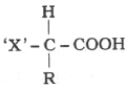
What does the part labeled '$X$' represent in the structural formula shown below?
A
$NH_4$
B
$NH_2$
C
$NO_2$
D
$NO_3$
Solution
(B) The given structural formula represents an amino acid.
An amino acid is an organic compound containing an amino group $(-NH_2)$,a carboxyl group $(-COOH)$,a hydrogen atom,and a variable side chain $(R)$ attached to a central alpha-carbon atom.
In the provided structure,the group labeled '$X$' is the amino group,which is represented as $-NH_2$.
An amino acid is an organic compound containing an amino group $(-NH_2)$,a carboxyl group $(-COOH)$,a hydrogen atom,and a variable side chain $(R)$ attached to a central alpha-carbon atom.
In the provided structure,the group labeled '$X$' is the amino group,which is represented as $-NH_2$.
0 likes
View Solution241
MediumMCQ
Select the correct match for $X$ and $Y$:
| Column $X$ | Column $Y$ |
| $(1)$ Primary protein | $(P)$ Globular or fibrous form |
| $(2)$ Secondary protein | $(Q)$ Three-dimensional arrangement of a single polypeptide chain |
| $(3)$ Tertiary protein | $(R)$ Gene-controlled |
| $(4)$ Quaternary protein | $(S)$ Helical or pleated sheet form |
A
$(1-R), (2-S), (3-Q), (4-P)$
B
$(1-R), (2-S), (3-P), (4-Q)$
C
$(1-S), (2-R), (3-Q), (4-P)$
D
$(1-S), (2-R), (3-P), (4-Q)$
Solution
(A) The correct matching is as follows:
$(1)$ Primary protein: The sequence of amino acids is determined by genetic information (Gene-controlled),so $(1-R)$.
$(2)$ Secondary protein: Polypeptide chains form structures like $\alpha$-helices or $\beta$-pleated sheets,so $(2-S)$.
$(3)$ Tertiary protein: This represents the complex three-dimensional folding of a single polypeptide chain,so $(3-Q)$.
$(4)$ Quaternary protein: This involves the assembly of multiple polypeptide subunits into globular or fibrous functional proteins,so $(4-P)$.
Therefore,the correct sequence is $(1-R), (2-S), (3-Q), (4-P)$.
$(1)$ Primary protein: The sequence of amino acids is determined by genetic information (Gene-controlled),so $(1-R)$.
$(2)$ Secondary protein: Polypeptide chains form structures like $\alpha$-helices or $\beta$-pleated sheets,so $(2-S)$.
$(3)$ Tertiary protein: This represents the complex three-dimensional folding of a single polypeptide chain,so $(3-Q)$.
$(4)$ Quaternary protein: This involves the assembly of multiple polypeptide subunits into globular or fibrous functional proteins,so $(4-P)$.
Therefore,the correct sequence is $(1-R), (2-S), (3-Q), (4-P)$.
0 likes
View Solution242
EasyMCQ
$A$: Each protein molecule is a polymer of amino acids.
$R$: There are $20$ types of amino acids in living cells.
$R$: There are $20$ types of amino acids in living cells.
A
$A$ and $R$ are both true and $R$ is the correct explanation of $A$.
B
$A$ and $R$ are both true,but $R$ is not the correct explanation of $A$.
C
$A$ is true and $R$ is false.
D
$A$ is false and $R$ is true.
Solution
(B) Assertion $A$ is true because proteins are indeed heteropolymers formed by the polymerization of amino acids linked by peptide bonds.
Reason $R$ is also true because there are $20$ standard amino acids that serve as the building blocks for proteins in living organisms.
However,the fact that there are $20$ types of amino acids does not explain why proteins are polymers; rather,it describes the diversity of the monomers that make up the polymer.
Therefore,$R$ is not the correct explanation for $A$.
Reason $R$ is also true because there are $20$ standard amino acids that serve as the building blocks for proteins in living organisms.
However,the fact that there are $20$ types of amino acids does not explain why proteins are polymers; rather,it describes the diversity of the monomers that make up the polymer.
Therefore,$R$ is not the correct explanation for $A$.
0 likes
View Solution243
MediumMCQ
$A$: The properties and types of amino acids vary.
$R$: The chemical structure of amino acids differs due to the $R$ group.
$R$: The chemical structure of amino acids differs due to the $R$ group.
A
$A$ and $R$ are both true and $R$ is the correct explanation of $A$.
B
$A$ and $R$ are both true,but $R$ is not the correct explanation of $A$.
C
$A$ is true and $R$ is false.
D
$A$ is false and $R$ is true.
Solution
(C) Amino acids are organic compounds containing an amino group $(-NH_2)$ and an acidic carboxyl group $(-COOH)$ attached to the same carbon atom,known as the $\alpha$-carbon.
They are substituted methanes where the four substituent groups occupying the four valency positions are a hydrogen atom,a carboxyl group,an amino group,and a variable group designated as the $R$ group.
Based on the nature of the $R$ group,there are many amino acids (e.g.,glycine,alanine,serine).
Therefore,the properties and types of amino acids vary specifically because of the nature of the $R$ group,not because the rest of the chemical structure differs.
Thus,statement $A$ is true,but statement $R$ is false because the basic backbone (amino,carboxyl,and hydrogen on the $\alpha$-carbon) remains the same for all amino acids.
They are substituted methanes where the four substituent groups occupying the four valency positions are a hydrogen atom,a carboxyl group,an amino group,and a variable group designated as the $R$ group.
Based on the nature of the $R$ group,there are many amino acids (e.g.,glycine,alanine,serine).
Therefore,the properties and types of amino acids vary specifically because of the nature of the $R$ group,not because the rest of the chemical structure differs.
Thus,statement $A$ is true,but statement $R$ is false because the basic backbone (amino,carboxyl,and hydrogen on the $\alpha$-carbon) remains the same for all amino acids.
0 likes
View Solution244
MediumMCQ
$A$: Amino acids are amphoteric in nature.
$R$: Amino acids act as electrolytes in solution.
$R$: Amino acids act as electrolytes in solution.
A
$A$ and $R$ are true and $R$ is the correct explanation of $A$.
B
$A$ and $R$ are true,but $R$ is not the correct explanation of $A$.
C
$A$ is true and $R$ is false.
D
$A$ is false and $R$ is true.
Solution
(A) Amino acids contain both an acidic carboxyl group $(-COOH)$ and a basic amino group $(-NH_2)$ in the same molecule.
Due to the presence of both acidic and basic groups,they can react with both acids and bases,making them amphoteric.
In an aqueous solution,the carboxyl group can lose a proton to form a carboxylate ion $(-COO^-)$ and the amino group can accept a proton to form an ammonium ion $(-NH_3^+)$,resulting in a zwitterion.
Because they exist as charged ions (zwitterions) in solution,they behave as electrolytes and can migrate in an electric field.
Therefore,both statements are true,and the fact that they act as electrolytes is a direct consequence of their amphoteric nature (zwitterion formation).
Due to the presence of both acidic and basic groups,they can react with both acids and bases,making them amphoteric.
In an aqueous solution,the carboxyl group can lose a proton to form a carboxylate ion $(-COO^-)$ and the amino group can accept a proton to form an ammonium ion $(-NH_3^+)$,resulting in a zwitterion.
Because they exist as charged ions (zwitterions) in solution,they behave as electrolytes and can migrate in an electric field.
Therefore,both statements are true,and the fact that they act as electrolytes is a direct consequence of their amphoteric nature (zwitterion formation).
0 likes
View Solution245
MediumMCQ
$A$: Hemoglobin is a molecule formed by interactions between four heme groups.
$R$: Hemoglobin is a quaternary protein.
$R$: Hemoglobin is a quaternary protein.
A
$A$ and $R$ are both true and $R$ is the correct explanation of $A$.
B
$A$ and $R$ are both true,but $R$ is not the correct explanation of $A$.
C
$A$ is true and $R$ is false.
D
$A$ is false and $R$ is true.
Solution
(D) Assertion $(A)$ is false because hemoglobin is a protein molecule consisting of four polypeptide chains (two $\alpha$ and two $\beta$ subunits),each associated with a heme group. The interactions occur between the polypeptide chains,not just the heme groups.
Reason $(R)$ is true because hemoglobin exhibits a quaternary structure,which refers to the spatial arrangement of multiple polypeptide subunits in a protein.
Therefore,$A$ is false and $R$ is true.
Reason $(R)$ is true because hemoglobin exhibits a quaternary structure,which refers to the spatial arrangement of multiple polypeptide subunits in a protein.
Therefore,$A$ is false and $R$ is true.
0 likes
View Solution246
MediumMCQ
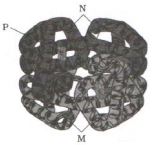
The given figure represents the structure of which molecule?
A
Leghemoglobin
B
Hemoglobin
C
Myoglobin
D
Actin
Solution
(B) The provided figure shows the quaternary structure of a protein consisting of four polypeptide subunits. This specific arrangement of two alpha and two beta subunits is characteristic of the hemoglobin molecule. Hemoglobin is a globular protein that transports oxygen in the blood. Myoglobin,in contrast,is a monomeric protein with a single polypeptide chain. Leghemoglobin is also a monomeric protein found in root nodules. Actin is a structural protein involved in muscle contraction.
0 likes
View Solution247
MediumMCQ
In the given figure,what does the part labeled $P$ represent?
A
Heme group
B
Iron group
C
Lead group
D
Both $(a)$ and $(b)$
Solution
(A) The provided figure represents the structure of hemoglobin. Hemoglobin is a quaternary protein consisting of four polypeptide subunits (two $\alpha$ and two $\beta$ chains). Each subunit contains a prosthetic group called the heme group,which contains an iron $(Fe^{2+})$ ion at its center. In the diagram,$P$ points to one of the polypeptide subunits,while the heme group is associated with these subunits. However,in the context of standard $NCERT$ diagrams for hemoglobin,the subunits are often labeled to show the heme-containing polypeptide chains. Given the options,the heme group is the functional prosthetic group containing iron. Therefore,the most appropriate answer is that $P$ represents the heme group.
0 likes
View Solution248
MediumMCQ
In the given figure,what does the part labeled $M$ indicate?
A
Peptide chain
B
$\gamma$ chain
C
$\alpha$ chain
D
$d$ chain
Solution
(C) The figure represents the quaternary structure of hemoglobin. Hemoglobin is a protein consisting of four polypeptide subunits: two $\alpha$ chains and two $\beta$ chains. In the standard $NCERT$ diagram of hemoglobin,the labels $M$ and $N$ point to the $\beta$ chains,while $P$ points to the $\alpha$ chains. Therefore,$M$ indicates a $\beta$ chain. Since the option provided is $\alpha$ chain,and based on standard textbook diagrams,the question likely intended to ask for the $\alpha$ chain or the labels were swapped. Given the options,if $M$ is intended to be one of the subunits,and $\alpha$ is the only valid polypeptide chain listed besides the generic 'peptide chain',$C$ is the most appropriate choice in many contexts where $M$ and $N$ are $\alpha$ chains.
0 likes
View Solution249
MediumMCQ
In the given figure,what does the part labeled $N$ represent?
A
$\beta$-chain
B
$\gamma$-chain
C
Peptide chain
D
$d$-chain
Solution
(A) The provided figure represents the quaternary structure of the hemoglobin molecule. Hemoglobin is a tetrameric protein consisting of four polypeptide chains: two $\alpha$-chains and two $\beta$-chains. In the standard representation of this diagram,the parts labeled $N$ and $M$ represent the $\beta$-chains,while the parts labeled $P$ represent the $\alpha$-chains. Therefore,the part labeled $N$ represents the $\beta$-chain.
0 likes
View Solution250
MediumMCQ
What type of protein structure is shown in the given figure?
A
Primary
B
Secondary
C
Tertiary
D
Quaternary
Solution
(D) The figure represents the structure of hemoglobin,which is a classic example of a protein with a quaternary structure. $A$ quaternary structure is formed when two or more polypeptide chains (subunits) assemble to form a functional protein complex. In the case of hemoglobin,it consists of four polypeptide subunits (two $\alpha$ and two $\beta$ chains). Therefore,the correct answer is quaternary structure.
0 likes
View SolutionBiomolecules — Proteins · Frequently Asked Questions
1Are these Biomolecules questions useful for JEE and NEET?
Yes. All questions in this section are mapped to JEE Main and NEET exam patterns. Previous year questions from JEE Main, NEET, GUJCET and state-level exams are included with full solutions.
2Can I switch to Hindi or Gujarati for these questions?
Yes. Use the language tabs in the hero section or the sidebar to view the same questions and solutions in English, Hindi or Gujarati.
3How do I generate a question paper from this subtopic?
Use the Vedclass Exam Paper Generator — select the chapter and subtopic, set difficulty, and generate Sets A, B, C, D automatically. First 3 chapters of every subject are free.
Vedclass Products
For Students
Vedclass Test Series
Mock tests in real JEE/NEET style with performance analysis. 5-day free trial.
Start Free TrialFor Teachers
Exam Paper Generator
Generate Set A/B/C/D papers from this chapter in 2 minutes. 3 chapters free.
Try FreeFor Institutes
Online Exam Module
Live online exams with unlimited students, 360° analytics & white-label branding.
See DemoFor Teachers & Institutes
Generate a Biomolecules Exam Paper in 2 Minutes
Select subtopic & difficulty — Sets A, B, C, D auto-generated with No Repeat logic.
First 3 chapters of every subject are free — no payment required.