
A English
Lipid Questions in English
Class 11 Biology · Biomolecules · Lipid
245+
Questions
English
Language
100%
With Solutions
Showing 45 of 245 questions in English
201
MediumMCQ
Fat on hydrolysis gives which alcohol?
A
Glycerol
B
Propanol
C
Butanol
D
Ethanol
Solution
(A) Fats are esters of fatty acids with glycerol.
When fats undergo hydrolysis (saponification) in the presence of an alkali like $NaOH$ or $KOH$,they break down into their constituent components.
The reaction is as follows:
$\text{Fat} + 3H_2O \xrightarrow{\text{Lipase/Alkali}} \text{Glycerol} + 3 \text{Fatty Acids}$.
Since glycerol is a trihydroxy alcohol $(CH_2OH-CHOH-CH_2OH)$,it is the alcohol obtained from the hydrolysis of fats.
When fats undergo hydrolysis (saponification) in the presence of an alkali like $NaOH$ or $KOH$,they break down into their constituent components.
The reaction is as follows:
$\text{Fat} + 3H_2O \xrightarrow{\text{Lipase/Alkali}} \text{Glycerol} + 3 \text{Fatty Acids}$.
Since glycerol is a trihydroxy alcohol $(CH_2OH-CHOH-CH_2OH)$,it is the alcohol obtained from the hydrolysis of fats.
0 likes
View Solution202
EasyMCQ
Which one is a phospholipid?
A
Lecithin
B
Cephalin
C
Kephalin
D
All of these
Solution
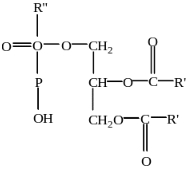
(D) Phospholipids are a crucial class of lipids that contain a phosphate group. They are polar lipids and,similar to triglycerides,are esters of glycerol. In phospholipids,only two fatty acid molecules are esterified to the glycerol backbone at the first and second carbon atoms. The third position of the glycerol is esterified to a phosphoric acid molecule,which is further linked to another alcohol group. Examples of phospholipids include Lecithin,Cephalin,and Kephalin (which is an alternative name for Cephalin). Therefore,all the given options are phospholipids.
0 likes
View Solution203
MediumMCQ
$A$ saturated fatty acid found in oils and fats is:
A
Palmitic acid
B
Linolenic acid
C
Oleic acid
D
Linoleic acid
Solution
(A) saturated fatty acid is one that contains no double bonds between carbon atoms in its hydrocarbon chain.
Palmitic acid $(C_{15}H_{31}COOH)$ is a saturated fatty acid.
Linolenic acid,oleic acid,and linoleic acid are unsaturated fatty acids because they contain one or more double bonds in their carbon chains.
Palmitic acid $(C_{15}H_{31}COOH)$ is a saturated fatty acid.
Linolenic acid,oleic acid,and linoleic acid are unsaturated fatty acids because they contain one or more double bonds in their carbon chains.
0 likes
View Solution204
EasyMCQ
Bees wax is:
A
Tripalmitin
B
Cetyl palmitate
C
Myricyl palmitate
D
Myricyl cerotate
Solution
(C) Bees wax is a natural wax secreted by honey bees. Chemically, it is an ester of a long-chain fatty acid and a long-chain alcohol. Specifically, it is $Myricyl$ $palmitate$, which has the chemical formula $C_{15}H_{31}COOC_{30}H_{61}$.
0 likes
View Solution205
MediumMCQ
The process used in the conversion of triolein to tristearin is:
A
Hydrolysis
B
Hydration
C
Hydrogenation
D
Dehydrogenation
Solution
(C) Triolein is an unsaturated triglyceride containing oleic acid chains, while tristearin is a saturated triglyceride containing stearic acid chains.
The conversion of an unsaturated fat into a saturated fat involves the addition of hydrogen atoms across the double bonds present in the fatty acid chains.
This process is known as hydrogenation and typically requires a metal catalyst such as $Ni$ (nickel).
Reaction: $\text{Triolein} + 3H_2 \xrightarrow{Ni} \text{Tristearin}$
The conversion of an unsaturated fat into a saturated fat involves the addition of hydrogen atoms across the double bonds present in the fatty acid chains.
This process is known as hydrogenation and typically requires a metal catalyst such as $Ni$ (nickel).
Reaction: $\text{Triolein} + 3H_2 \xrightarrow{Ni} \text{Tristearin}$
0 likes
View Solution206
MediumMCQ
What happens when drying oils are exposed to light and moist air?
A
Polymerization
B
Fermentation
C
Hardening
D
Isomerization
Solution
(A) Drying oils are oils that transform into hard solids upon exposure to air and light,such as linseed oil.
These oils contain a high proportion of unsaturated fatty acids,specifically linoleic acid $(C_{17}H_{31}COOH)$ and linolenic acid $(C_{17}H_{29}COOH)$.
When exposed to oxygen and light,these unsaturated bonds undergo oxidative polymerization,leading to the formation of a tough,solid film.
This property is widely utilized in the paint industry,where these oils serve as a vehicle or binder for paints.
These oils contain a high proportion of unsaturated fatty acids,specifically linoleic acid $(C_{17}H_{31}COOH)$ and linolenic acid $(C_{17}H_{29}COOH)$.
When exposed to oxygen and light,these unsaturated bonds undergo oxidative polymerization,leading to the formation of a tough,solid film.
This property is widely utilized in the paint industry,where these oils serve as a vehicle or binder for paints.
0 likes
View Solution207
EasyMCQ
Wool-wax contains:
A
Fatty acid ester
B
Paraffin wax
C
Cholesterol ester
D
None of these
Solution
(C) Wool-wax,also known as lanolin,is a complex mixture of esters.
It is primarily composed of cholesterol esters and other high molecular weight alcohols combined with fatty acids.
Therefore,the correct answer is cholesterol ester.
It is primarily composed of cholesterol esters and other high molecular weight alcohols combined with fatty acids.
Therefore,the correct answer is cholesterol ester.
0 likes
View Solution208
MediumMCQ
During hydrogenation of oils,higher melting point 'vegetable ghee' is formed because:
A
Hydrogen is dissolved in the oil
B
Hydrogen combines with oxygen of the oil
C
Esters of unsaturated fatty acids are reduced to those of saturated acids
D
Hydrogen drives off the impurities from the oil
Solution
(C) Lipids are classified into two types based on their physical state at room temperature: oils and fats.
Oils are glycerides or esters of unsaturated fatty acids,which remain liquid at room temperature due to the presence of double bonds.
Fats are glycerides of saturated fatty acids,which are solid at room temperature.
During the process of hydrogenation,hydrogen gas is added to the unsaturated fatty acid chains in the presence of a catalyst (like $Ni$).
This reaction converts the unsaturated fatty acid esters into saturated fatty acid esters,thereby increasing the melting point and transforming the liquid oil into solid 'vegetable ghee'.
Oils are glycerides or esters of unsaturated fatty acids,which remain liquid at room temperature due to the presence of double bonds.
Fats are glycerides of saturated fatty acids,which are solid at room temperature.
During the process of hydrogenation,hydrogen gas is added to the unsaturated fatty acid chains in the presence of a catalyst (like $Ni$).
This reaction converts the unsaturated fatty acid esters into saturated fatty acid esters,thereby increasing the melting point and transforming the liquid oil into solid 'vegetable ghee'.
0 likes
View Solution209
MediumMCQ
Phospholipids are esters of glycerol with
A
One carboxylic acid residue and two phosphate groups
B
Three phosphate groups
C
Three carboxylic acid residues
D
Two carboxylic acid residues and one phosphate group
Solution
(D) Phospholipids are esters of glycerol with two carboxylic acid residues (fatty acids) and one phosphate group.
In a phospholipid molecule,two hydroxyl groups of the glycerol backbone are esterified with fatty acids,while the third hydroxyl group is esterified with phosphoric acid,which may be further linked to other polar groups.
In a phospholipid molecule,two hydroxyl groups of the glycerol backbone are esterified with fatty acids,while the third hydroxyl group is esterified with phosphoric acid,which may be further linked to other polar groups.
0 likes
View Solution210
MediumMCQ
Linseed oil is:
A
Used in soap formation
B
Drying oil
C
Acts as carrier for paints
D
All of the above
Solution
(D) Linseed oil is classified as a drying oil because it hardens into a solid film upon exposure to air.
This property is due to the high content of unsaturated fatty acids,specifically linoleic acid $(C_{17}H_{31}COOH)$ and linolenic acid $(C_{17}H_{29}COOH)$.
Due to this drying property,it is widely used as a vehicle or carrier for pigments in the paint and varnish industry.
Additionally,like other vegetable oils,it can be used in the production of soaps through the process of saponification.
Therefore,all the given statements are correct.
This property is due to the high content of unsaturated fatty acids,specifically linoleic acid $(C_{17}H_{31}COOH)$ and linolenic acid $(C_{17}H_{29}COOH)$.
Due to this drying property,it is widely used as a vehicle or carrier for pigments in the paint and varnish industry.
Additionally,like other vegetable oils,it can be used in the production of soaps through the process of saponification.
Therefore,all the given statements are correct.
0 likes
View Solution211
MediumMCQ
Which of the following is not strictly a biomacromolecule?
A
Proteins
B
Lipids
C
Polysaccharides
D
Nucleic acid
Solution
(B) Biomacromolecules are defined as chemical compounds found in living organisms that have a molecular weight greater than $10,000$ Da.
Lipids have a molecular weight that does not exceed $800$ Da.
However,during the chemical analysis of tissues,lipids are found in the acid-insoluble fraction along with other macromolecules because they form vesicles that are not water-soluble.
Therefore,lipids are not strictly considered biomacromolecules despite being found in the acid-insoluble fraction.
Lipids have a molecular weight that does not exceed $800$ Da.
However,during the chemical analysis of tissues,lipids are found in the acid-insoluble fraction along with other macromolecules because they form vesicles that are not water-soluble.
Therefore,lipids are not strictly considered biomacromolecules despite being found in the acid-insoluble fraction.
0 likes
View Solution212
MediumMCQ
Lecithin is a
A
Type of wax
B
Phospholipid
C
Oil
D
Simple fatty acid
Solution
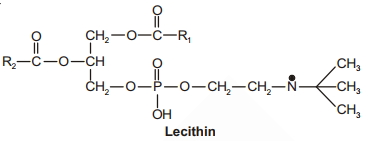
(B) Lecithin is a type of phospholipid. It is composed of a glycerol molecule,a phosphate group,$2$ fatty acid molecules,and choline (a nitrogen-containing alcohol molecule). Phospholipids are essential components of cell membranes.
0 likes
View Solution213
MediumMCQ
Lipids that insulate the nerve fibre are
A
Lecithin
B
Cholesterol
C
Suberin
D
Glycolipids
Solution
(D) The myelin sheath,which acts as an electrical insulator for nerve fibres,is composed of lipids and proteins. Among the lipids,glycolipids (such as cerebrosides) are significant components of the myelin sheath,providing the necessary insulation for efficient nerve impulse conduction.
0 likes
View Solution214
MediumMCQ
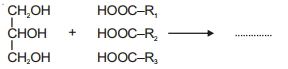
The product of the given reaction would be a
A
Monoglyceride
B
Diglyceride
C
Triglyceride
D
Both $(a)$ and $(c)$
Solution
(C) The reaction shows glycerol reacting with three fatty acid molecules $(R_1COOH, R_2COOH, R_3COOH)$.
When one molecule of glycerol reacts with three molecules of fatty acids,it forms a triglyceride (also known as triacylglycerol) through esterification.
Since three fatty acid chains are attached to the glycerol backbone,the resulting product is a triglyceride.
When one molecule of glycerol reacts with three molecules of fatty acids,it forms a triglyceride (also known as triacylglycerol) through esterification.
Since three fatty acid chains are attached to the glycerol backbone,the resulting product is a triglyceride.
0 likes
View Solution215
EasyMCQ
The given fatty acid is known as $CH_3(CH_2)_7 CH = CH (CH_2)_7 COOH$.
A
Palmitic acid
B
Oleic acid
C
Stearic acid
D
Arachidonic acid
Solution
(B) The chemical formula $CH_3(CH_2)_7 CH = CH (CH_2)_7 COOH$ represents Oleic acid,which is an $18$-carbon monounsaturated fatty acid.
Palmitic acid is a saturated fatty acid with the formula $CH_3(CH_2)_{14}COOH$.
Stearic acid is a saturated fatty acid with the formula $CH_3(CH_2)_{16}COOH$.
Arachidonic acid is a polyunsaturated fatty acid with the formula $CH_3(CH_2)_4CH = CHCH_2CH = CHCH_2CH = CHCH_2CH = CH(CH_2)_3COOH$,containing $20$ carbon atoms.
Palmitic acid is a saturated fatty acid with the formula $CH_3(CH_2)_{14}COOH$.
Stearic acid is a saturated fatty acid with the formula $CH_3(CH_2)_{16}COOH$.
Arachidonic acid is a polyunsaturated fatty acid with the formula $CH_3(CH_2)_4CH = CHCH_2CH = CHCH_2CH = CHCH_2CH = CH(CH_2)_3COOH$,containing $20$ carbon atoms.
0 likes
View Solution216
MediumMCQ
$A$: Linolenic acid is an essential fatty acid.
$R$: Linolenic acid cannot be synthesized in human beings.
$R$: Linolenic acid cannot be synthesized in human beings.
A
Assertion and Reason both are correct and Reason is the correct explanation of Assertion.
B
Assertion and Reason both are correct but Reason is not the correct explanation of Assertion.
C
Assertion is correct,but Reason is incorrect.
D
Both Assertion and Reason are incorrect.
Solution
(A) Essential fatty acids are those fatty acids that cannot be synthesized by the human body and must be obtained through the diet.
Linolenic acid is a type of $PUFA$ (Polyunsaturated Fatty Acid) which is considered an essential fatty acid because humans lack the enzymes required to introduce double bonds at specific positions in the fatty acid chain.
Therefore,both the Assertion and the Reason are correct,and the Reason provides the correct explanation for why Linolenic acid is essential.
Linolenic acid is a type of $PUFA$ (Polyunsaturated Fatty Acid) which is considered an essential fatty acid because humans lack the enzymes required to introduce double bonds at specific positions in the fatty acid chain.
Therefore,both the Assertion and the Reason are correct,and the Reason provides the correct explanation for why Linolenic acid is essential.
0 likes
View Solution217
MediumMCQ
Vitamin-$D$ is synthesized in the skin by the action of sunlight on:
A
Cholesterol
B
$7$-dehydrocholesterol
C
Cephalin cholesterol
D
All of the above
Solution
(B) Vitamin-$D$ is a steroid hormone synthesized from cholesterol derivatives.
Vitamin-$D_{3}$ (cholecalciferol) is synthesized in the skin of animals and humans.
The precursor for this synthesis is $7$-dehydrocholesterol,which is present in the epidermis.
When ultraviolet $(UV)$ rays from sunlight strike the skin,they convert $7$-dehydrocholesterol into cholecalciferol (Vitamin-$D_{3}$).
Vitamin-$D_{3}$ (cholecalciferol) is synthesized in the skin of animals and humans.
The precursor for this synthesis is $7$-dehydrocholesterol,which is present in the epidermis.
When ultraviolet $(UV)$ rays from sunlight strike the skin,they convert $7$-dehydrocholesterol into cholecalciferol (Vitamin-$D_{3}$).
0 likes
View Solution218
EasyMCQ
Camel stores which of the following in its hump?
A
Water for emergency
B
Fat for emergency
C
Both fat and water for emergency
D
Fat and proteins as reserve food for emergency
Solution
(B) The hump of a camel contains stored adipose tissue,which is primarily fat.
When food is scarce,the camel metabolizes this stored fat to provide energy and metabolic water.
This allows the camel to survive for several days without external food or water intake.
Therefore,the hump acts as an energy reserve rather than a water storage tank.
When food is scarce,the camel metabolizes this stored fat to provide energy and metabolic water.
This allows the camel to survive for several days without external food or water intake.
Therefore,the hump acts as an energy reserve rather than a water storage tank.
0 likes
View Solution219
MediumMCQ
The maximum percentage of lipid content in lipoproteins is found in:
A
Chylomicron
B
$HDL$
C
$LDL$
D
None of these
Solution
(A) Lipoproteins are complexes of lipids and proteins that transport lipids in the blood.
Chylomicrons are the largest lipoproteins and have the highest percentage of triglycerides (lipids),making up about $85-90\%$ of their composition.
In contrast,$HDL$ (High-Density Lipoprotein) has the highest protein content and the lowest lipid content.
Chylomicrons are the largest lipoproteins and have the highest percentage of triglycerides (lipids),making up about $85-90\%$ of their composition.
In contrast,$HDL$ (High-Density Lipoprotein) has the highest protein content and the lowest lipid content.
0 likes
View Solution220
MediumMCQ
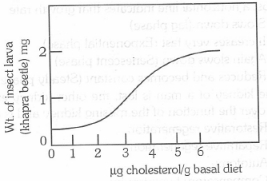
In an experiment,freshly hatched larvae of an insect (Khapra beetle) were reared on a basal diet (complete diet without cholesterol) with increasing amounts of cholesterol. Results obtained are shown in the given graph.
The graph indicates:
The graph indicates:
A
Cholesterol is an essential dietary requirement of Khapra beetle
B
Growth of Khapra beetle is directly proportional to cholesterol concentration
C
Cholesterol concentration of $2 \; \mu g/g$ diet is the optimum level
D
Growth of Khapra beetle is inhibited when cholesterol concentration exceeds $2 \; \mu g/g$ diet
Solution
(A) The graph indicates that cholesterol is an essential dietary requirement for the Khapra beetle because the weight of the insect larva increases with the increase in the amount of cholesterol.
The weight becomes static (plateaus) at approximately $6 \; \mu g$ cholesterol/g basal diet,indicating that after a certain point,additional cholesterol does not further increase growth.
If the growth rate were directly proportional to the cholesterol concentration,the graph would have been a straight line,which is not the case here.
The weight becomes static (plateaus) at approximately $6 \; \mu g$ cholesterol/g basal diet,indicating that after a certain point,additional cholesterol does not further increase growth.
If the growth rate were directly proportional to the cholesterol concentration,the graph would have been a straight line,which is not the case here.
0 likes
View Solution221
MediumMCQ
Under prolonged starvation, the brain receives energy from:
A
Carbohydrates
B
Fats
C
Proteins
D
Acetoacetate
Solution
(D) In well-nourished individuals, glucose is the primary fuel for the brain.
However, during prolonged starvation, the body breaks down fatty acids into ketone bodies, specifically acetoacetate and $\beta$-hydroxybutyrate.
The brain adapts to utilize these ketone bodies, particularly acetoacetate, as an alternative energy source to preserve glucose for other essential functions.
However, during prolonged starvation, the body breaks down fatty acids into ketone bodies, specifically acetoacetate and $\beta$-hydroxybutyrate.
The brain adapts to utilize these ketone bodies, particularly acetoacetate, as an alternative energy source to preserve glucose for other essential functions.
0 likes
View Solution222
EasyMCQ
Cod and shark liver oil is a source of
A
Energetic nutrients
B
Constructive nutrients
C
Energetic and constructive nutrients
D
Protective nutrients
Solution
(D) Cod and shark liver oil are rich in vitamins $A$ and $D$.
These vitamins are essential for the normal functioning of the body,maintaining vision,bone health,and immune system regulation.
Nutrients that protect the body from diseases and maintain health are classified as protective nutrients.
Therefore,cod and shark liver oil are considered sources of protective nutrients.
These vitamins are essential for the normal functioning of the body,maintaining vision,bone health,and immune system regulation.
Nutrients that protect the body from diseases and maintain health are classified as protective nutrients.
Therefore,cod and shark liver oil are considered sources of protective nutrients.
0 likes
View Solution223
MediumMCQ
Following are the statements with reference to 'lipids'.
$(a)$ Lipids having only single bonds are called unsaturated fatty acids.
$(b)$ Lecithin is a phospholipid.
$(c)$ Trihydroxy propane is glycerol.
$(d)$ Palmitic acid has $20$ carbon atoms including carboxyl carbon.
$(e)$ Arachidonic acid has $16$ carbon atoms.
Choose the correct answer from the options given below.
$(a)$ Lipids having only single bonds are called unsaturated fatty acids.
$(b)$ Lecithin is a phospholipid.
$(c)$ Trihydroxy propane is glycerol.
$(d)$ Palmitic acid has $20$ carbon atoms including carboxyl carbon.
$(e)$ Arachidonic acid has $16$ carbon atoms.
Choose the correct answer from the options given below.
A
$(a)$ and $(b)$ only
B
$(c)$ and $(d)$ only
C
$(b)$ and $(c)$ only
D
$(b)$ and $(e)$ only
Solution
(C) Let us analyze each statement:
$(a)$ Lipids having only single bonds are called saturated fatty acids,not unsaturated. Thus,statement $(a)$ is incorrect.
$(b)$ Lecithin is a well-known phospholipid found in cell membranes. Thus,statement $(b)$ is correct.
$(c)$ Glycerol is chemically known as trihydroxy propane $(CH_2OH-CHOH-CH_2OH)$. Thus,statement $(c)$ is correct.
$(d)$ Palmitic acid has $16$ carbon atoms,not $20$. Thus,statement $(d)$ is incorrect.
$(e)$ Arachidonic acid has $20$ carbon atoms,not $16$. Thus,statement $(e)$ is incorrect.
Therefore,statements $(b)$ and $(c)$ are correct.
$(a)$ Lipids having only single bonds are called saturated fatty acids,not unsaturated. Thus,statement $(a)$ is incorrect.
$(b)$ Lecithin is a well-known phospholipid found in cell membranes. Thus,statement $(b)$ is correct.
$(c)$ Glycerol is chemically known as trihydroxy propane $(CH_2OH-CHOH-CH_2OH)$. Thus,statement $(c)$ is correct.
$(d)$ Palmitic acid has $16$ carbon atoms,not $20$. Thus,statement $(d)$ is incorrect.
$(e)$ Arachidonic acid has $20$ carbon atoms,not $16$. Thus,statement $(e)$ is incorrect.
Therefore,statements $(b)$ and $(c)$ are correct.
0 likes
View Solution224
MediumMCQ
Read the following statements on lipids and find out the correct set of statements:
$(a)$ Lecithin found in the plasma membrane is a glycolipid.
$(b)$ Saturated fatty acids possess one or more $C=C$ bonds.
$(c)$ Gingely oil has a lower melting point,hence remains as oil in winter.
$(d)$ Lipids are generally insoluble in water but soluble in some organic solvents.
$(e)$ When fatty acid is esterified with glycerol,monoglycerides are formed.
Choose the correct answer from the options given below:
$(a)$ Lecithin found in the plasma membrane is a glycolipid.
$(b)$ Saturated fatty acids possess one or more $C=C$ bonds.
$(c)$ Gingely oil has a lower melting point,hence remains as oil in winter.
$(d)$ Lipids are generally insoluble in water but soluble in some organic solvents.
$(e)$ When fatty acid is esterified with glycerol,monoglycerides are formed.
Choose the correct answer from the options given below:
A
$(a), (d)$ and $(e)$ only
B
$(c), (d)$ and $(e)$ only
C
$(a), (b)$ and $(d)$ only
D
$(a), (b)$ and $(c)$ only
Solution
(B) Let us analyze each statement:
$(a)$ Incorrect: Lecithin is a phospholipid,not a glycolipid.
$(b)$ Incorrect: Saturated fatty acids do not possess any $C=C$ bonds; they have only single bonds.
$(c)$ Correct: Gingely oil contains unsaturated fatty acids,which have lower melting points,allowing them to remain liquid at lower temperatures.
$(d)$ Correct: Lipids are hydrophobic (insoluble in water) and lipophilic (soluble in organic solvents like ether,chloroform,etc.).
$(e)$ Correct: When one fatty acid molecule is esterified with one glycerol molecule,a monoglyceride is formed.
Therefore,the correct statements are $(c), (d),$ and $(e)$.
$(a)$ Incorrect: Lecithin is a phospholipid,not a glycolipid.
$(b)$ Incorrect: Saturated fatty acids do not possess any $C=C$ bonds; they have only single bonds.
$(c)$ Correct: Gingely oil contains unsaturated fatty acids,which have lower melting points,allowing them to remain liquid at lower temperatures.
$(d)$ Correct: Lipids are hydrophobic (insoluble in water) and lipophilic (soluble in organic solvents like ether,chloroform,etc.).
$(e)$ Correct: When one fatty acid molecule is esterified with one glycerol molecule,a monoglyceride is formed.
Therefore,the correct statements are $(c), (d),$ and $(e)$.
0 likes
View Solution225
DifficultMCQ
Select the correct option based on molecular weight.
A
Triglyceride > Lecithin > Palmitic acid > Glycerol
B
Glycerol > Palmitic acid > Lecithin > Triglyceride
C
Glycerol > Palmitic acid > Triglyceride > Lecithin
D
Lecithin > Triglyceride > Palmitic acid > Glycerol
Solution
(D) To determine the correct order, we compare the molecular weights of the given molecules:
$1$. Glycerol $(C_3H_8O_3)$: Molecular weight $\approx 92 \, g/mol$.
$2$. Palmitic acid $(C_{16}H_{32}O_2)$: Molecular weight $\approx 256 \, g/mol$.
$3$. Triglyceride: Formed by one glycerol and three fatty acids (e.g., palmitic acid), molecular weight $\approx 800+ \, g/mol$.
$4$. Lecithin (Phospholipid): Contains a glycerol backbone, two fatty acids, a phosphate group, and choline, making it larger than a simple triglyceride, molecular weight $\approx 800-900+ \, g/mol$.
Thus, the order of increasing molecular weight is: Glycerol < Palmitic acid < Triglyceride < Lecithin. Therefore, the descending order is Lecithin > Triglyceride > Palmitic acid > Glycerol.
$1$. Glycerol $(C_3H_8O_3)$: Molecular weight $\approx 92 \, g/mol$.
$2$. Palmitic acid $(C_{16}H_{32}O_2)$: Molecular weight $\approx 256 \, g/mol$.
$3$. Triglyceride: Formed by one glycerol and three fatty acids (e.g., palmitic acid), molecular weight $\approx 800+ \, g/mol$.
$4$. Lecithin (Phospholipid): Contains a glycerol backbone, two fatty acids, a phosphate group, and choline, making it larger than a simple triglyceride, molecular weight $\approx 800-900+ \, g/mol$.
Thus, the order of increasing molecular weight is: Glycerol < Palmitic acid < Triglyceride < Lecithin. Therefore, the descending order is Lecithin > Triglyceride > Palmitic acid > Glycerol.
0 likes
View Solution226
MediumMCQ
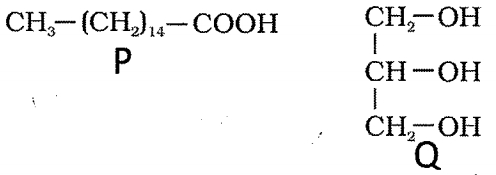
Identify the structures $P$ and $Q$ given below.
A
$P$ = Palmitic acid,$Q$ = Glycerol
B
$P$ = Stearic acid,$Q$ = Glycerol
C
$P$ = Glycerol,$Q$ = Palmitic acid
D
$P$ = Palmitic acid,$Q$ = Glucose
Solution
(A) Structure $P$ is $CH_3-(CH_2)_{14}-COOH$,which is a $16$-carbon fatty acid known as Palmitic acid.
Structure $Q$ is $CH_2OH-CHOH-CH_2OH$,which is a trihydroxy propane known as Glycerol.
Therefore,$P$ is Palmitic acid and $Q$ is Glycerol.
Structure $Q$ is $CH_2OH-CHOH-CH_2OH$,which is a trihydroxy propane known as Glycerol.
Therefore,$P$ is Palmitic acid and $Q$ is Glycerol.
0 likes
View Solution227
MediumMCQ
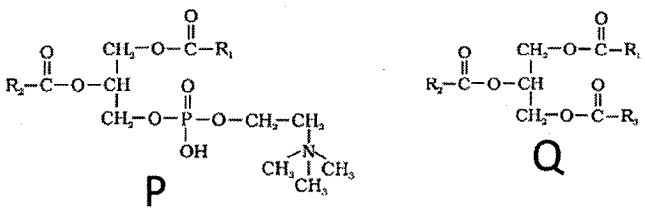
Identify the given structures $P$ and $Q$.
A
$P$ = Triglyceride,$Q$ = Lecithin
B
$P$ = Lecithin,$Q$ = Triglyceride
C
$P$ = Glycerol,$Q$ = Palmitic acid
D
$P$ = Palmitic acid,$Q$ = Glycerol
Solution
(B) Structure $P$ represents a phospholipid,specifically lecithin,which contains a phosphate group attached to the glycerol backbone along with fatty acid chains and a choline group.
Structure $Q$ represents a triglyceride,which is formed by the esterification of three fatty acid chains $(R_1, R_2, R_3)$ with a glycerol molecule.
Structure $Q$ represents a triglyceride,which is formed by the esterification of three fatty acid chains $(R_1, R_2, R_3)$ with a glycerol molecule.
0 likes
View Solution228
MediumMCQ
Which fatty acid is represented by the formula $CH_3-(CH_2)_{16}-COOH$?
A
Palmitic acid
B
Stearic acid
C
Oleic acid
D
Arachidonic acid
Solution
(B) The given chemical formula is $CH_3-(CH_2)_{16}-COOH$.
This formula contains a total of $18$ carbon atoms ($1$ carbon in the methyl group,$16$ carbons in the methylene chain,and $1$ carbon in the carboxyl group).
Fatty acids with $18$ carbon atoms and no double bonds are known as saturated fatty acids.
Stearic acid is a saturated fatty acid with $18$ carbon atoms $(C_{18}H_{36}O_2)$.
Palmitic acid has $16$ carbon atoms,while Oleic and Arachidonic acids are unsaturated fatty acids.
Therefore,the correct option is $B$.
This formula contains a total of $18$ carbon atoms ($1$ carbon in the methyl group,$16$ carbons in the methylene chain,and $1$ carbon in the carboxyl group).
Fatty acids with $18$ carbon atoms and no double bonds are known as saturated fatty acids.
Stearic acid is a saturated fatty acid with $18$ carbon atoms $(C_{18}H_{36}O_2)$.
Palmitic acid has $16$ carbon atoms,while Oleic and Arachidonic acids are unsaturated fatty acids.
Therefore,the correct option is $B$.
0 likes
View Solution229
MediumMCQ
Which bond is present between alcohol and acid in the structure of lipids?
A
Glycosidic bond
B
Phosphodiester bond
C
Ester bond
D
Peptide bond
Solution
(C) Lipids are formed by the esterification of fatty acids (acids) with glycerol (an alcohol).
In this reaction,the hydroxyl group $(-OH)$ of the alcohol reacts with the carboxyl group $(-COOH)$ of the fatty acid to form an ester bond $(-COO-)$ and a molecule of water is released.
Therefore,the bond present between alcohol and acid in lipids is an ester bond.
In this reaction,the hydroxyl group $(-OH)$ of the alcohol reacts with the carboxyl group $(-COOH)$ of the fatty acid to form an ester bond $(-COO-)$ and a molecule of water is released.
Therefore,the bond present between alcohol and acid in lipids is an ester bond.
0 likes
View Solution230
MediumMCQ
Identify the saturated and unsaturated fatty acids from the following list:
$I-$ Acetic acid,$II-$ Methanoic acid
$III-$ Arachidonic acid,$IV-$ Palmitic acid
$V-$ Stearic acid,$VI-$ Oleic acid
Select the correct grouping for Saturated fatty acids and Unsaturated fatty acids.
$I-$ Acetic acid,$II-$ Methanoic acid
$III-$ Arachidonic acid,$IV-$ Palmitic acid
$V-$ Stearic acid,$VI-$ Oleic acid
Select the correct grouping for Saturated fatty acids and Unsaturated fatty acids.
A
$I, II, IV$ $\quad\quad III, V, VI$
B
$I, II, IV, V$ $\quad\quad III, VI$
C
$III, VI$ $\quad\quad I, II, IV, V$
D
$III, V, VI$ $\quad\quad I, II, IV$
Solution
(B) Saturated fatty acids are those that do not contain any double bonds in their carbon chain. These include:
$I-$ Acetic acid $(CH_3COOH)$
$II-$ Methanoic acid $(HCOOH)$
$IV-$ Palmitic acid $(C_{16}H_{32}O_2)$
$V-$ Stearic acid $(C_{18}H_{36}O_2)$
Unsaturated fatty acids contain one or more double bonds in their carbon chain. These include:
$III-$ Arachidonic acid $(C_{20}H_{32}O_2)$
$VI-$ Oleic acid $(C_{18}H_{34}O_2)$
Therefore,the saturated fatty acids are $I, II, IV, V$ and the unsaturated fatty acids are $III, VI$.
$I-$ Acetic acid $(CH_3COOH)$
$II-$ Methanoic acid $(HCOOH)$
$IV-$ Palmitic acid $(C_{16}H_{32}O_2)$
$V-$ Stearic acid $(C_{18}H_{36}O_2)$
Unsaturated fatty acids contain one or more double bonds in their carbon chain. These include:
$III-$ Arachidonic acid $(C_{20}H_{32}O_2)$
$VI-$ Oleic acid $(C_{18}H_{34}O_2)$
Therefore,the saturated fatty acids are $I, II, IV, V$ and the unsaturated fatty acids are $III, VI$.
0 likes
View Solution231
MediumMCQ
Select the incorrect statement from the following.
A
Fats are solid at normal temperature.
B
The melting point of oil is higher than that of fat.
C
Lecithin is a complex lipid found in the cell membrane.
D
Oils are liquid at normal temperature.
Solution
(B) Fats and oils are fatty acid esters of glycerol.
Fats have higher melting points and remain solid at room temperature due to the presence of saturated fatty acids.
Oils have lower melting points and remain liquid at room temperature due to the presence of unsaturated fatty acids.
Therefore,the statement that the melting point of oil is higher than that of fat is incorrect,as oils have lower melting points.
Fats have higher melting points and remain solid at room temperature due to the presence of saturated fatty acids.
Oils have lower melting points and remain liquid at room temperature due to the presence of unsaturated fatty acids.
Therefore,the statement that the melting point of oil is higher than that of fat is incorrect,as oils have lower melting points.
0 likes
View Solution232
MediumMCQ
What is the molecular weight of lipids?
A
Less than $18 \ Da$
B
More than $1000 \ Da$
C
More than $10000 \ Da$
D
Less than $800 \ Da$
Solution
(D) Lipids are not strictly macromolecules because their molecular weight does not exceed $800 \ Da$.
In the analysis of chemical composition,lipids are extracted in the acid-insoluble fraction along with other macromolecules,but they are technically small molecules based on their molecular weight.
In the analysis of chemical composition,lipids are extracted in the acid-insoluble fraction along with other macromolecules,but they are technically small molecules based on their molecular weight.
0 likes
View Solution233
MediumMCQ
In which group are lipids separated during chemical analysis of living tissue?
A
Acid-soluble pool
B
Acid-insoluble fraction
C
Filtrate
D
Both $A$ and $C$
Solution
(B) During the chemical analysis of living tissue,the tissue is ground in trichloroacetic acid $(Cl_3CCOOH)$.
This results in two fractions: the acid-soluble pool (filtrate) and the acid-insoluble fraction (retentate).
Lipids are not strictly macromolecules; however,they are extracted into the acid-insoluble fraction because they form vesicles when the tissue is ground,which are not soluble in the acid and do not pass through the filter paper.
This results in two fractions: the acid-soluble pool (filtrate) and the acid-insoluble fraction (retentate).
Lipids are not strictly macromolecules; however,they are extracted into the acid-insoluble fraction because they form vesicles when the tissue is ground,which are not soluble in the acid and do not pass through the filter paper.
0 likes
View Solution234
MediumMCQ
In a triglyceride,the bond is formed between which two functional groups?
A
Hydroxyl group and acid group
B
Amino group and acid group
C
Hydroxyl group and amino group
D
Hydroxyl group and phosphate group
Solution
(A) triglyceride is an ester derived from glycerol and three fatty acids.
In this process,the $3$ hydroxyl $(-OH)$ groups of the glycerol molecule react with the $3$ carboxyl $(-COOH)$ groups of the fatty acids.
This reaction is an esterification reaction,resulting in the formation of ester bonds between the hydroxyl group of the alcohol (glycerol) and the acid group (carboxyl group) of the fatty acids.
In this process,the $3$ hydroxyl $(-OH)$ groups of the glycerol molecule react with the $3$ carboxyl $(-COOH)$ groups of the fatty acids.
This reaction is an esterification reaction,resulting in the formation of ester bonds between the hydroxyl group of the alcohol (glycerol) and the acid group (carboxyl group) of the fatty acids.
0 likes
View Solution235
EasyMCQ
How is a triglyceride formed?
A
Three glycerol and one fatty acid
B
One glycerol and three amino acids
C
One glycerol and three fatty acids
D
Three glycerol and one amino acid
Solution
(C) triglyceride is a type of lipid formed by the esterification of one glycerol molecule with three fatty acid molecules.
Each of the three hydroxyl $(-OH)$ groups of the glycerol molecule reacts with the carboxyl $(-COOH)$ group of a fatty acid to form an ester bond,releasing three molecules of water $(H_2O)$.
Each of the three hydroxyl $(-OH)$ groups of the glycerol molecule reacts with the carboxyl $(-COOH)$ group of a fatty acid to form an ester bond,releasing three molecules of water $(H_2O)$.
0 likes
View Solution236
MediumMCQ
Lecithin,a small molecular weight organic compound found in living tissues,is an example of:
A
Phospholipids
B
Glycerides
C
Carbohydrates
D
Amino acids
Solution
(A) The correct answer is option $A$.
Lecithin is a type of phospholipid. Phospholipids are lipids that contain a phosphate group and a phosphorylated organic compound in their structure.
They are essential components of the cell membrane,contributing to its fluid mosaic structure.
Option $B$ is incorrect because glycerides are a different group of lipids consisting of glycerol and fatty acids.
Options $C$ and $D$ are incorrect because carbohydrates and amino acids are distinct classes of biomolecules.
Lecithin is a type of phospholipid. Phospholipids are lipids that contain a phosphate group and a phosphorylated organic compound in their structure.
They are essential components of the cell membrane,contributing to its fluid mosaic structure.
Option $B$ is incorrect because glycerides are a different group of lipids consisting of glycerol and fatty acids.
Options $C$ and $D$ are incorrect because carbohydrates and amino acids are distinct classes of biomolecules.
0 likes
View Solution237
MediumMCQ
Consider the following four statements $(a-d)$ and select the option which includes all the correct ones only $:-$
$(a)$ Lipids are generally water insoluble.
$(b)$ The $R$ group could be a methyl $(-CH_3)$ or ethyl $(-C_2H_5)$ or higher number of $-CH_2$ groups ($1$ carbon to $19$ carbons) in fatty acids.
$(c)$ Palmitic acid has $16$ carbons including the carboxyl carbon.
$(d)$ Arachidonic acid has $21$ carbon atoms including the carboxyl carbon.
$(a)$ Lipids are generally water insoluble.
$(b)$ The $R$ group could be a methyl $(-CH_3)$ or ethyl $(-C_2H_5)$ or higher number of $-CH_2$ groups ($1$ carbon to $19$ carbons) in fatty acids.
$(c)$ Palmitic acid has $16$ carbons including the carboxyl carbon.
$(d)$ Arachidonic acid has $21$ carbon atoms including the carboxyl carbon.
A
Statement $(a), (b)$ and $(c)$
B
Statement $(a), (b)$ only
C
Statement $(c), (d)$ only
D
Statement $(a), (c)$ and $(d)$
Solution
(A) Statement $(a)$ is correct because lipids are hydrophobic and generally insoluble in water.
Statement $(b)$ is correct as fatty acids have a carboxyl group attached to an $R$ group,where the $R$ group can be a methyl,ethyl,or higher number of $-CH_2$ groups ($1$ to $19$ carbons).
Statement $(c)$ is correct because Palmitic acid is a saturated fatty acid with $16$ carbons,including the carboxyl carbon.
Statement $(d)$ is incorrect because Arachidonic acid has $20$ carbon atoms,not $21$,including the carboxyl carbon.
Therefore,statements $(a), (b),$ and $(c)$ are correct.
Statement $(b)$ is correct as fatty acids have a carboxyl group attached to an $R$ group,where the $R$ group can be a methyl,ethyl,or higher number of $-CH_2$ groups ($1$ to $19$ carbons).
Statement $(c)$ is correct because Palmitic acid is a saturated fatty acid with $16$ carbons,including the carboxyl carbon.
Statement $(d)$ is incorrect because Arachidonic acid has $20$ carbon atoms,not $21$,including the carboxyl carbon.
Therefore,statements $(a), (b),$ and $(c)$ are correct.
0 likes
View Solution238
DifficultMCQ
Which of the following statements is incorrect?
A
Palmitic acid is a simple lipid.
B
Glycerol is trihydroxy propane.
C
Lipids are amphoteric.
D
Both $A$ and $C$.
Solution
(D) $1$. Palmitic acid is a fatty acid,not a simple lipid. Simple lipids are esters of fatty acids with alcohols (e.g.,triglycerides).
$2$. Glycerol is chemically $CH_2OH-CHOH-CH_2OH$,which is trihydroxy propane.
$3$. Lipids are generally hydrophobic and non-polar,not amphoteric (amphoteric substances can act as both acids and bases,like amino acids).
$4$. Since statements $A$ and $C$ are both incorrect,the correct option is $D$.
$2$. Glycerol is chemically $CH_2OH-CHOH-CH_2OH$,which is trihydroxy propane.
$3$. Lipids are generally hydrophobic and non-polar,not amphoteric (amphoteric substances can act as both acids and bases,like amino acids).
$4$. Since statements $A$ and $C$ are both incorrect,the correct option is $D$.
0 likes
View Solution239
MediumMCQ
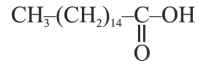
Given below is the structure of $:-$ $CH_3-(CH_2)_{14}-COOH$
A
oleic acid
B
Galactose
C
Arachidonic acid
D
Palmitic acid
Solution
(D) The given chemical structure is $CH_3-(CH_2)_{14}-COOH$.
This formula represents a saturated fatty acid with a total of $16$ carbon atoms ($14$ in the chain + $1$ in the methyl group + $1$ in the carboxyl group).
This specific fatty acid is known as Palmitic acid.
Oleic acid is an unsaturated fatty acid with $18$ carbons.
Arachidonic acid is a polyunsaturated fatty acid with $20$ carbons.
Galactose is a monosaccharide sugar,not a fatty acid.
Therefore,the correct option is $D$.
This formula represents a saturated fatty acid with a total of $16$ carbon atoms ($14$ in the chain + $1$ in the methyl group + $1$ in the carboxyl group).
This specific fatty acid is known as Palmitic acid.
Oleic acid is an unsaturated fatty acid with $18$ carbons.
Arachidonic acid is a polyunsaturated fatty acid with $20$ carbons.
Galactose is a monosaccharide sugar,not a fatty acid.
Therefore,the correct option is $D$.
0 likes
View Solution240
EasyMCQ
Which one of the following lipids is found in the myelin sheath of a neuron?
A
Lecithin
B
Wax
C
Glycolipid
D
Cholesterol
Solution
(C) The myelin sheath is a lipid-rich insulating layer that surrounds the axons of many neurons.
It is composed of approximately $70-80\%$ lipids and $20-30\%$ proteins.
The primary lipids found in the myelin sheath include cholesterol,phospholipids,and glycolipids (specifically galactocerebrosides).
Among the given options,$Glycolipid$ is a major structural component of the myelin sheath,playing a crucial role in nerve impulse conduction and structural integrity.
While cholesterol is also present,glycolipids are characteristic markers of the myelin membrane composition.
It is composed of approximately $70-80\%$ lipids and $20-30\%$ proteins.
The primary lipids found in the myelin sheath include cholesterol,phospholipids,and glycolipids (specifically galactocerebrosides).
Among the given options,$Glycolipid$ is a major structural component of the myelin sheath,playing a crucial role in nerve impulse conduction and structural integrity.
While cholesterol is also present,glycolipids are characteristic markers of the myelin membrane composition.
0 likes
View Solution241
EasyMCQ
Match the lipids given in Column-$I$ with their occurrence in Column-$II$.
| Column-$I$ | Column-$II$ |
|---|---|
| $i$. Cerebrosides | $a$. Most of the cells in animal body |
| $ii$. Waxes | $b$. Dioscorea |
| $iii$. Diosgenin | $c$. Myelin sheath |
| $iv$. Cholesterol | $d$. Sebaceous glands of the skin |
A
$i-c, ii-d, iii-a, iv-b$
B
$i-b, ii-c, iii-d, iv-a$
C
$i-d, ii-c, iii-a, iv-b$
D
$i-c, ii-d, iii-b, iv-a$
Solution
(D) The correct matching is as follows:
$i$. Cerebrosides are glycolipids found in the myelin sheath of nerve fibers.
$ii$. Waxes are esters of long-chain fatty acids and long-chain alcohols,commonly found in the sebaceous glands of the skin.
$iii$. Diosgenin is a steroid sapogenin obtained from the plant Dioscorea.
$iv$. Cholesterol is a fundamental component of the cell membranes in most animal cells.
Therefore,the correct sequence is $i-c, ii-d, iii-b, iv-a$.
$i$. Cerebrosides are glycolipids found in the myelin sheath of nerve fibers.
$ii$. Waxes are esters of long-chain fatty acids and long-chain alcohols,commonly found in the sebaceous glands of the skin.
$iii$. Diosgenin is a steroid sapogenin obtained from the plant Dioscorea.
$iv$. Cholesterol is a fundamental component of the cell membranes in most animal cells.
Therefore,the correct sequence is $i-c, ii-d, iii-b, iv-a$.
0 likes
View Solution242
EasyMCQ
Cerebrosides are . . . . . . .
A
cholesterols
B
phospholipids
C
glycolipids
D
phytosterols
Solution
(C) Cerebrosides are a type of glycosphingolipid found in the cell membranes of the brain and nervous system.
They consist of a ceramide backbone linked to a single sugar residue,typically glucose or galactose.
Because they contain a carbohydrate moiety attached to a lipid,they are classified as glycolipids.
Therefore,the correct option is $C$.
They consist of a ceramide backbone linked to a single sugar residue,typically glucose or galactose.
Because they contain a carbohydrate moiety attached to a lipid,they are classified as glycolipids.
Therefore,the correct option is $C$.
0 likes
View Solution243
EasyMCQ
Sterols are composed of a steroid nucleus and . . . . . . .
A
Looped,twisted and folded back peptide chain
B
$A$ spiral helix of polypeptide chain
C
$A$ double helix of polynucleotide chains
D
$A$ long hydrocarbon side chain
Solution
(D) Sterols are a subgroup of steroids. They consist of a steroid nucleus,which is a tetracyclic carbon skeleton (composed of four fused rings: three cyclohexane rings and one cyclopentane ring),and a long hydrocarbon side chain attached to the $C-17$ position of the nucleus. Therefore,the correct option is $D$.
0 likes
View Solution244
EasyMCQ
Ergosterol is . . . . . . .
A
provitamin $D$
B
provitamin $A$
C
vitamin $B_2$
D
vitamin $B_{12}$
Solution
(A) Ergosterol is a sterol found in the cell membranes of fungi and protozoa.
It serves as a biological precursor to vitamin $D_2$ (ergocalciferol).
When exposed to ultraviolet $(UV)$ light,ergosterol undergoes a photochemical reaction to be converted into vitamin $D_2$.
Therefore,it is classified as a provitamin $D$.
It serves as a biological precursor to vitamin $D_2$ (ergocalciferol).
When exposed to ultraviolet $(UV)$ light,ergosterol undergoes a photochemical reaction to be converted into vitamin $D_2$.
Therefore,it is classified as a provitamin $D$.
0 likes
View Solution245
EasyMCQ
Group of substances with greasy consistency and a long chain of hydrocarbons containing $C$,$H$,and $O$,where the hydrogen to oxygen ratio is greater than $2:1$,are called:
A
Proteins
B
Lipids
C
Sugars
D
Enzymes
Solution
(B) Lipids are organic compounds that are insoluble in water but soluble in organic solvents.
They consist of long hydrocarbon chains containing $C$,$H$,and $O$.
Unlike carbohydrates,where the ratio of hydrogen to oxygen is typically $2:1$,lipids have a much higher proportion of hydrogen relative to oxygen,resulting in a ratio significantly greater than $2:1$.
They are greasy in consistency and serve as important energy storage molecules and structural components of cell membranes.
They consist of long hydrocarbon chains containing $C$,$H$,and $O$.
Unlike carbohydrates,where the ratio of hydrogen to oxygen is typically $2:1$,lipids have a much higher proportion of hydrogen relative to oxygen,resulting in a ratio significantly greater than $2:1$.
They are greasy in consistency and serve as important energy storage molecules and structural components of cell membranes.
0 likes
View SolutionBiomolecules — Lipid · Frequently Asked Questions
1Are these Biomolecules questions useful for JEE and NEET?
Yes. All questions in this section are mapped to JEE Main and NEET exam patterns. Previous year questions from JEE Main, NEET, GUJCET and state-level exams are included with full solutions.
2Can I switch to Hindi or Gujarati for these questions?
Yes. Use the language tabs in the hero section or the sidebar to view the same questions and solutions in English, Hindi or Gujarati.
3How do I generate a question paper from this subtopic?
Use the Vedclass Exam Paper Generator — select the chapter and subtopic, set difficulty, and generate Sets A, B, C, D automatically. First 3 chapters of every subject are free.
Vedclass Products
For Students
Vedclass Test Series
Mock tests in real JEE/NEET style with performance analysis. 5-day free trial.
Start Free TrialFor Teachers
Exam Paper Generator
Generate Set A/B/C/D papers from this chapter in 2 minutes. 3 chapters free.
Try FreeFor Institutes
Online Exam Module
Live online exams with unlimited students, 360° analytics & white-label branding.
See DemoFor Teachers & Institutes
Generate a Biomolecules Exam Paper in 2 Minutes
Select subtopic & difficulty — Sets A, B, C, D auto-generated with No Repeat logic.
First 3 chapters of every subject are free — no payment required.