
A English
Lipid Questions in English
Class 11 Biology · Biomolecules · Lipid
245+
Questions
English
Language
100%
With Solutions
Showing 49 of 245 questions in English
151
MediumMCQ
$A$: Fats are stored in the body as a reserve food material.
$R$: Lipids are high energy-yielding nutrients.
$R$: Lipids are high energy-yielding nutrients.
A
$A$ and $R$ are both true and $R$ is the correct explanation of $A$.
B
$A$ and $R$ are both true,but $R$ is not the correct explanation of $A$.
C
$A$ is true and $R$ is false.
D
$A$ is false and $R$ is true.
Solution
(A) : Fats are stored in the body as adipose tissue,which serves as a reserve food material for the organism during periods of starvation or high energy demand.
$R$: Lipids are high energy-yielding nutrients because they contain a higher proportion of carbon-hydrogen bonds compared to carbohydrates and proteins,allowing them to release more energy upon oxidation ($9.3 \ kcal/g$ compared to $4 \ kcal/g$ for carbohydrates).
Since fats are stored specifically because they are efficient,high-energy reserves,$R$ provides the correct explanation for $A$.
$R$: Lipids are high energy-yielding nutrients because they contain a higher proportion of carbon-hydrogen bonds compared to carbohydrates and proteins,allowing them to release more energy upon oxidation ($9.3 \ kcal/g$ compared to $4 \ kcal/g$ for carbohydrates).
Since fats are stored specifically because they are efficient,high-energy reserves,$R$ provides the correct explanation for $A$.
0 likes
View Solution152
MediumMCQ
$A$: Oleic acid is a long-chain unsaturated fatty acid.
$R$: It contains double bonds between some adjacent carbon atoms.
$R$: It contains double bonds between some adjacent carbon atoms.
A
$A$ and $R$ are both true and $R$ is the correct explanation of $A$.
B
$A$ and $R$ are both true,but $R$ is not the correct explanation of $A$.
C
$A$ is true and $R$ is false.
D
$A$ is false and $R$ is true.
Solution
(A) Oleic acid $(C_{18}H_{34}O_2)$ is a monounsaturated omega-$9$ fatty acid.
It is a long-chain fatty acid consisting of $18$ carbon atoms.
An unsaturated fatty acid is defined by the presence of one or more double bonds between carbon atoms in its hydrocarbon chain.
Since oleic acid contains a double bond between the $9^{th}$ and $10^{th}$ carbon atoms,it is classified as an unsaturated fatty acid.
Therefore,both the assertion $(A)$ and the reason $(R)$ are correct,and $R$ provides the correct explanation for why oleic acid is classified as unsaturated.
It is a long-chain fatty acid consisting of $18$ carbon atoms.
An unsaturated fatty acid is defined by the presence of one or more double bonds between carbon atoms in its hydrocarbon chain.
Since oleic acid contains a double bond between the $9^{th}$ and $10^{th}$ carbon atoms,it is classified as an unsaturated fatty acid.
Therefore,both the assertion $(A)$ and the reason $(R)$ are correct,and $R$ provides the correct explanation for why oleic acid is classified as unsaturated.
0 likes
View Solution153
MediumMCQ
$A$: Lipoproteins are complex lipids and conjugated proteins.
$R$: The structure of lipoproteins is formed by fatty acids,alcohols,and amino acids.
$R$: The structure of lipoproteins is formed by fatty acids,alcohols,and amino acids.
A
$A$ and $R$ are both true and $R$ is the correct explanation of $A$.
B
$A$ and $R$ are both true,but $R$ is not the correct explanation of $A$.
C
$A$ is true and $R$ is false.
D
$A$ is false and $R$ is true.
Solution
(C) Assertion $(A)$ is true because lipoproteins are biochemical assemblies that contain both proteins and lipids,classified as conjugated proteins.
Reason $(R)$ is false because lipoproteins are composed of lipids (like triglycerides,phospholipids,and cholesterol) and proteins (apolipoproteins). They are not formed by the combination of fatty acids,alcohols,and amino acids in the manner described for simple lipids or waxes. Therefore,the correct option is $C$.
Reason $(R)$ is false because lipoproteins are composed of lipids (like triglycerides,phospholipids,and cholesterol) and proteins (apolipoproteins). They are not formed by the combination of fatty acids,alcohols,and amino acids in the manner described for simple lipids or waxes. Therefore,the correct option is $C$.
0 likes
View Solution154
MediumMCQ
$A$: Cholesterol is a lipid that does not contain fatty acids.
$R$: Cholesterol does not contain a $-COOH$ or $>C=O$ group.
$R$: Cholesterol does not contain a $-COOH$ or $>C=O$ group.
A
$A$ and $R$ are both true and $R$ is the correct explanation of $A$.
B
$A$ and $R$ are both true,but $R$ is not the correct explanation of $A$.
C
$A$ is true and $R$ is false.
D
$A$ is false and $R$ is true.
Solution
(A) Cholesterol is a sterol,which is a type of lipid. Unlike triglycerides or phospholipids,cholesterol does not contain fatty acids in its structure.
Therefore,Assertion $(A)$ is true.
Cholesterol is a steroid alcohol. Its chemical structure consists of a tetracyclic carbon skeleton (four fused rings) with a hydroxyl $(-OH)$ group attached to the third carbon.
It does not contain a carboxylic acid $(-COOH)$ group or a ketone $(>C=O)$ group in its basic structure.
Therefore,Reason $(R)$ is true and it correctly explains why cholesterol is classified as a lipid that lacks fatty acids (as fatty acids are characterized by the presence of a $-COOH$ group).
Thus,$A$ and $R$ are both true and $R$ is the correct explanation of $A$.
Therefore,Assertion $(A)$ is true.
Cholesterol is a steroid alcohol. Its chemical structure consists of a tetracyclic carbon skeleton (four fused rings) with a hydroxyl $(-OH)$ group attached to the third carbon.
It does not contain a carboxylic acid $(-COOH)$ group or a ketone $(>C=O)$ group in its basic structure.
Therefore,Reason $(R)$ is true and it correctly explains why cholesterol is classified as a lipid that lacks fatty acids (as fatty acids are characterized by the presence of a $-COOH$ group).
Thus,$A$ and $R$ are both true and $R$ is the correct explanation of $A$.
0 likes
View Solution155
MediumMCQ
Statement $P$: The alcohol molecule in the structure of oil is not glycerol.
Statement $Q$: Steroids do not contain any fatty acids.
Statement $Q$: Steroids do not contain any fatty acids.
A
Both Statement $P$ and $Q$ are false.
B
Statement $P$ is true and Statement $Q$ is false.
C
Statement $P$ is false and Statement $Q$ is true.
D
Both Statement $P$ and $Q$ are true.
Solution
(C) Statement $P$ is false because oils are triglycerides,which are esters formed from glycerol and fatty acids. Therefore,glycerol is the alcohol component in oils.
Statement $Q$ is true because steroids are a class of lipids characterized by a carbon skeleton with four fused rings. Unlike triglycerides or phospholipids,they do not contain fatty acid chains attached to a glycerol backbone.
Statement $Q$ is true because steroids are a class of lipids characterized by a carbon skeleton with four fused rings. Unlike triglycerides or phospholipids,they do not contain fatty acid chains attached to a glycerol backbone.
0 likes
View Solution156
MediumMCQ
Match the following columns correctly:
| Column-$I$ | Column-$II$ |
|---|---|
| $(1)$ Stearic acid | $(a)$ $CH_3-(CH_2)_2COO^-$ |
| $(2)$ Butyric acid | $(b)$ $CH_3-(CH_2)_{16}COO^-$ |
| $(3)$ Palmitic acid | $(c)$ $R-COOH$ |
| $(4)$ Fatty acid | $(d)$ $CH_3(CH_2)_{14}COO^-$ |
A
$(1-a), (2-b), (3-c), (4-d)$
B
$(1-b), (2-c), (3-a), (4-d)$
C
$(1-b), (2-a), (3-d), (4-c)$
D
$(1-c), (2-b), (3-a), (4-d)$
Solution
(C) The chemical structures of the given fatty acids are as follows:
$(1)$ Stearic acid is a saturated fatty acid with $18$ carbon atoms: $CH_3-(CH_2)_{16}COO^-$.
$(2)$ Butyric acid is a short-chain saturated fatty acid with $4$ carbon atoms: $CH_3-(CH_2)_2COO^-$.
$(3)$ Palmitic acid is a saturated fatty acid with $16$ carbon atoms: $CH_3-(CH_2)_{14}COO^-$.
$(4)$ Fatty acids are generally represented by the general formula $R-COOH$,where $R$ is an alkyl group.
Therefore,the correct matching is $(1-b), (2-a), (3-d), (4-c)$.
$(1)$ Stearic acid is a saturated fatty acid with $18$ carbon atoms: $CH_3-(CH_2)_{16}COO^-$.
$(2)$ Butyric acid is a short-chain saturated fatty acid with $4$ carbon atoms: $CH_3-(CH_2)_2COO^-$.
$(3)$ Palmitic acid is a saturated fatty acid with $16$ carbon atoms: $CH_3-(CH_2)_{14}COO^-$.
$(4)$ Fatty acids are generally represented by the general formula $R-COOH$,where $R$ is an alkyl group.
Therefore,the correct matching is $(1-b), (2-a), (3-d), (4-c)$.
0 likes
View Solution157
MediumMCQ
How many fatty acid molecules are present in cortisol?
A
Zero
B
Two
C
Three
D
Many
Solution
(A) Cortisol is a steroid hormone.
Steroids are lipids that are derived from cholesterol.
Unlike triglycerides or phospholipids,steroid hormones like cortisol do not contain fatty acid chains in their chemical structure.
Therefore,the number of fatty acid molecules present in cortisol is zero.
Steroids are lipids that are derived from cholesterol.
Unlike triglycerides or phospholipids,steroid hormones like cortisol do not contain fatty acid chains in their chemical structure.
Therefore,the number of fatty acid molecules present in cortisol is zero.
0 likes
View Solution158
MediumMCQ
The organic substance that helps in maintaining body temperature is .........
A
Lipids
B
Proteins
C
Vitamins
D
Enzymes
Solution
(A) Lipids,specifically fats,act as insulators in the body.
They are stored in the adipose tissue,which helps in conserving body heat and maintaining a constant internal body temperature.
Therefore,lipids play a crucial role in thermoregulation.
They are stored in the adipose tissue,which helps in conserving body heat and maintaining a constant internal body temperature.
Therefore,lipids play a crucial role in thermoregulation.
0 likes
View Solution159
MediumMCQ
$A$: Butter is solid at room temperature.
$R$: It contains long-chain saturated fatty acids.
$R$: It contains long-chain saturated fatty acids.
A
$A$ and $R$ are both true. $R$ is not the correct explanation of $A$.
B
$A$ and $R$ are both true. $R$ is the correct explanation of $A$.
C
$A$ and $R$ are both false.
D
$A$ is false and $R$ is true.
Solution
(B) Butter is a lipid that remains solid at room temperature because it consists primarily of long-chain saturated fatty acids.
Saturated fatty acids have straight hydrocarbon chains that can pack closely together,leading to strong intermolecular forces (van der Waals forces) and a higher melting point.
Therefore,both $A$ and $R$ are true,and $R$ is the correct explanation for $A$.
Saturated fatty acids have straight hydrocarbon chains that can pack closely together,leading to strong intermolecular forces (van der Waals forces) and a higher melting point.
Therefore,both $A$ and $R$ are true,and $R$ is the correct explanation for $A$.
0 likes
View Solution160
MediumMCQ
Which of the following are not polymeric?
A
Proteins
B
Polysaccharides
C
Lipids
D
Nucleic acids
Solution
(C) The correct answer is $C$.
Lipids are generally fatty acid esters of alcohols and related substances,and they do not form long chains of repeating monomeric units in the same way as other macromolecules.
Polysaccharides are polymers of monosaccharides.
Proteins are polymers of amino acids.
Nucleic acids are polymers of nucleotides.
Lipids are generally fatty acid esters of alcohols and related substances,and they do not form long chains of repeating monomeric units in the same way as other macromolecules.
Polysaccharides are polymers of monosaccharides.
Proteins are polymers of amino acids.
Nucleic acids are polymers of nucleotides.
0 likes
View Solution161
MediumMCQ
$A$ typical fat molecule is made up of
A
one glycerol and one fatty acid molecule
B
three glycerol and three fatty acid molecules
C
three glycerol molecules and one fatty acid molecule
D
one glycerol and three fatty acid molecules
Solution
(D) : Neutral or true fats are triglycerides. They are formed by the esterification of three molecules of fatty acids with one molecule of trihydric alcohol,known as glycerol (glycerine or $1,2,3$-trihydroxypropane).
0 likes
View Solution162
MediumMCQ
$A$ phosphoglyceride is always made up of
A
a saturated or unsaturated fatty acid esterified to a glycerol molecule to which a phosphate group is also attached.
B
a saturated or unsaturated fatty acid esterified to a phosphate group which is also attached to a glycerol molecule.
C
only a saturated fatty acid esterified to a glycerol molecule to which a phosphate group is also attached.
D
only an unsaturated fatty acid esterified to a glycerol molecule to which a phosphate group is also attached.
Solution
(A) Phosphoglycerides are complex lipids.
They are formed by the esterification of fatty acids (which can be either saturated or unsaturated) with a glycerol molecule.
Additionally,a phosphate group is attached to the glycerol backbone.
Therefore,the correct structure involves a glycerol molecule,fatty acids,and a phosphate group.
They are formed by the esterification of fatty acids (which can be either saturated or unsaturated) with a glycerol molecule.
Additionally,a phosphate group is attached to the glycerol backbone.
Therefore,the correct structure involves a glycerol molecule,fatty acids,and a phosphate group.
0 likes
View Solution163
MediumMCQ
Which one of the following structural formulae of two organic compounds is correctly identified along with its related function?
A
$B$ : Adenine - $A$ nucleotide that makes up nucleic acids
B
$A$ : Triglyceride - Major source of energy
C
$B$ : Uracil - $A$ component of $DNA$
D
$A$ : Lecithin - $A$ component of cell membrane
Solution
(D) is the structural formula of lecithin.
Lecithin is a phospholipid,which is a major component of the lipid bilayers in cell membranes.
Therefore,the identification of $A$ as lecithin and its function as a component of the cell membrane is correct.
Lecithin is a phospholipid,which is a major component of the lipid bilayers in cell membranes.
Therefore,the identification of $A$ as lecithin and its function as a component of the cell membrane is correct.
0 likes
View Solution164
MediumMCQ
How many carbons does arachidonic acid have?
A
$15$
B
$10$
C
$12$
D
$20$
Solution
(D) Arachidonic acid is a polyunsaturated fatty acid.
It is a $20$-carbon fatty acid chain containing four double bonds.
The chemical formula for arachidonic acid is $C_{20}H_{32}O_2$.
Therefore,the correct number of carbon atoms is $20$.
It is a $20$-carbon fatty acid chain containing four double bonds.
The chemical formula for arachidonic acid is $C_{20}H_{32}O_2$.
Therefore,the correct number of carbon atoms is $20$.
0 likes
View Solution165
MediumMCQ
Palmitic acid has .......... carbons.
A
$20$
B
$16$
C
$18$
D
$15$
Solution
(B) Palmitic acid is a saturated fatty acid commonly found in animals and plants.
It consists of a long hydrocarbon chain with a carboxyl group at one end.
The chemical formula of palmitic acid is $CH_3(CH_2)_{14}COOH$.
Counting the carbons: there are $14$ carbons in the chain,$1$ carbon in the methyl group,and $1$ carbon in the carboxyl group.
Total number of carbons = $1 + 14 + 1 = 16$ carbons.
Therefore,palmitic acid contains $16$ carbon atoms.
It consists of a long hydrocarbon chain with a carboxyl group at one end.
The chemical formula of palmitic acid is $CH_3(CH_2)_{14}COOH$.
Counting the carbons: there are $14$ carbons in the chain,$1$ carbon in the methyl group,and $1$ carbon in the carboxyl group.
Total number of carbons = $1 + 14 + 1 = 16$ carbons.
Therefore,palmitic acid contains $16$ carbon atoms.
0 likes
View Solution166
MediumMCQ
Which of the following statements is correct regarding lipids?
A
They are completely soluble in water.
B
They are generally insoluble in water.
C
They are composed of fatty acids and glycogen.
D
They are long chains of sugars.
Solution
(B) Lipids are a diverse group of organic compounds that include fats,oils,steroids,and waxes.
They are characterized by being hydrophobic,meaning they are generally insoluble in water because they are non-polar molecules.
They are typically composed of fatty acids and glycerol (not glycogen).
Therefore,the correct statement is that they are generally water-insoluble.
They are characterized by being hydrophobic,meaning they are generally insoluble in water because they are non-polar molecules.
They are typically composed of fatty acids and glycerol (not glycogen).
Therefore,the correct statement is that they are generally water-insoluble.
0 likes
View Solution167
MediumMCQ
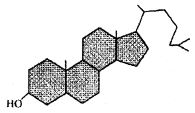
Identify the chemical structure shown in the image.
A
Cholesterol
B
Uracil
C
Lecithin
D
None
Solution
(A) The image displays the characteristic four-ring steroid nucleus (three six-membered rings and one five-membered ring) with a hydroxyl group at the $C-3$ position and a hydrocarbon tail. This is the molecular structure of Cholesterol. Cholesterol is a vital component of animal cell membranes and a precursor for steroid hormones.
0 likes
View Solution168
MediumMCQ
Which of the following statements regarding lipids are correct?
$I$. Water soluble
$II$. Water insoluble
$III$. Some lipids contain phosphorus
$IV$. Found only in the cell membrane
Choose the correct options.
$I$. Water soluble
$II$. Water insoluble
$III$. Some lipids contain phosphorus
$IV$. Found only in the cell membrane
Choose the correct options.
A
Only $I$
B
$II$ and $III$
C
$II$ and $IV$
D
Only $IV$
Solution
(B) Lipids are a diverse group of organic compounds that are generally hydrophobic in nature.
$I$. Lipids are non-polar and hydrophobic,meaning they are water-insoluble. Thus,statement $I$ is incorrect.
$II$. Since they are hydrophobic,they are water-insoluble. Thus,statement $II$ is correct.
$III$. Phospholipids are a class of lipids that contain a phosphate group,such as lecithin. Thus,statement $III$ is correct.
$IV$. Lipids are found in various parts of the cell,including the cytoplasm (as storage droplets) and organelles,not just the cell membrane. Thus,statement $IV$ is incorrect.
Therefore,statements $II$ and $III$ are correct.
$I$. Lipids are non-polar and hydrophobic,meaning they are water-insoluble. Thus,statement $I$ is incorrect.
$II$. Since they are hydrophobic,they are water-insoluble. Thus,statement $II$ is correct.
$III$. Phospholipids are a class of lipids that contain a phosphate group,such as lecithin. Thus,statement $III$ is correct.
$IV$. Lipids are found in various parts of the cell,including the cytoplasm (as storage droplets) and organelles,not just the cell membrane. Thus,statement $IV$ is incorrect.
Therefore,statements $II$ and $III$ are correct.
0 likes
View Solution169
MediumMCQ
Which of the following elements is absent in the structure of lecithin?
A
$P$
B
$C$
C
$N$
D
$S$
Solution
(D) Lecithin is a phospholipid,specifically a phosphatidylcholine.
Its chemical structure consists of a glycerol backbone,two fatty acid chains,a phosphate group,and a choline molecule.
The chemical formula for lecithin is $C_{42}H_{82}NO_8P$.
Analyzing the elements present: $C$ (Carbon),$H$ (Hydrogen),$N$ (Nitrogen),$O$ (Oxygen),and $P$ (Phosphorus) are all present.
Sulfur $(S)$ is not a component of the lecithin molecule.
Therefore,the correct option is $D$.
Its chemical structure consists of a glycerol backbone,two fatty acid chains,a phosphate group,and a choline molecule.
The chemical formula for lecithin is $C_{42}H_{82}NO_8P$.
Analyzing the elements present: $C$ (Carbon),$H$ (Hydrogen),$N$ (Nitrogen),$O$ (Oxygen),and $P$ (Phosphorus) are all present.
Sulfur $(S)$ is not a component of the lecithin molecule.
Therefore,the correct option is $D$.
0 likes
View Solution170
MediumMCQ
$A$ fatty acid has a carboxyl group attached to an $R$ group. The $R$ group could be a
A
Methyl group
B
Ethyl group
C
Higher number of $-CH_2$ groups ($1$ to $19$ carbons)
D
All of the above
Solution
(D) Fatty acids are organic acids that have a carboxyl group $(-COOH)$ attached to an $R$ group.
The $R$ group can be a methyl group $(-CH_3)$,an ethyl group $(-C_2H_5)$,or a higher number of $-CH_2$ groups (ranging from $1$ to $19$ carbons).
For example,palmitic acid has $16$ carbons,and arachidonic acid has $20$ carbons.
Therefore,all the given options are correct representations of the $R$ group in fatty acids.
The $R$ group can be a methyl group $(-CH_3)$,an ethyl group $(-C_2H_5)$,or a higher number of $-CH_2$ groups (ranging from $1$ to $19$ carbons).
For example,palmitic acid has $16$ carbons,and arachidonic acid has $20$ carbons.
Therefore,all the given options are correct representations of the $R$ group in fatty acids.
0 likes
View Solution171
MediumMCQ
$A$ - Glycerol is tri-hydroxy propane and it is a simple lipid.
$R$ - All lipids are simple type.
$R$ - All lipids are simple type.
A
$A$ and $R$ both true
B
$A$ and $R$ both false
C
$A$ true and $R$ false
D
$A$ false and $R$ true
Solution
(C) Assertion $(A)$: Glycerol is chemically $1,2,3$-propanetriol,which is a tri-hydroxy propane. It is considered a simple lipid because it is a fatty acid ester of glycerol. This statement is true.
Reason $(R)$: Lipids are classified into simple lipids (e.g.,fats,oils,waxes),compound lipids (e.g.,phospholipids),and derived lipids (e.g.,steroids). Therefore,not all lipids are simple; many are complex or derived. This statement is false.
Conclusion: $A$ is true and $R$ is false.
Reason $(R)$: Lipids are classified into simple lipids (e.g.,fats,oils,waxes),compound lipids (e.g.,phospholipids),and derived lipids (e.g.,steroids). Therefore,not all lipids are simple; many are complex or derived. This statement is false.
Conclusion: $A$ is true and $R$ is false.
0 likes
View Solution172
EasyMCQ
What is lecithin?
A
Phosphoprotein
B
Glycoprotein
C
Phospholipid
D
Glycerol
Solution
(C) Lecithin is a type of phospholipid found in the cell membranes of plants and animals.
It consists of a glycerol backbone,two fatty acid chains,a phosphate group,and a choline molecule.
Because it contains both a phosphate group and a lipid component,it is classified as a phospholipid.
Therefore,the correct option is $C$.
It consists of a glycerol backbone,two fatty acid chains,a phosphate group,and a choline molecule.
Because it contains both a phosphate group and a lipid component,it is classified as a phospholipid.
Therefore,the correct option is $C$.
0 likes
View Solution173
MediumMCQ
Which of the following fatty acids contains $16$ carbons?
A
Arachidonic acid
B
Glycerol
C
Palmitic acid
D
Cystine
Solution
(C) Fatty acids are carboxylic acids with an $R$ group attached to the $COOH$ group.
Palmitic acid is a saturated fatty acid that contains $16$ carbon atoms,including the carboxyl carbon.
Its chemical formula is $CH_3(CH_2)_{14}COOH$.
Arachidonic acid contains $20$ carbon atoms.
Glycerol is a trihydroxy propane,not a fatty acid.
Cystine is an amino acid,not a fatty acid.
Palmitic acid is a saturated fatty acid that contains $16$ carbon atoms,including the carboxyl carbon.
Its chemical formula is $CH_3(CH_2)_{14}COOH$.
Arachidonic acid contains $20$ carbon atoms.
Glycerol is a trihydroxy propane,not a fatty acid.
Cystine is an amino acid,not a fatty acid.
0 likes
View Solution174
MediumMCQ
What is trihydroxy propane?
A
Fatty acid
B
Methanol
C
Phenol
D
Glycerol
Solution
(D) Trihydroxy propane is the chemical name for $Glycerol$ (also known as $Glycerin$).
Its chemical formula is $C_3H_8O_3$ or $CH_2OH-CHOH-CH_2OH$.
It is a simple polyol compound consisting of a three-carbon chain with three hydroxyl $(-OH)$ groups attached to each carbon atom.
It serves as the backbone for triglycerides,which are the main constituents of body fat and vegetable oil.
Its chemical formula is $C_3H_8O_3$ or $CH_2OH-CHOH-CH_2OH$.
It is a simple polyol compound consisting of a three-carbon chain with three hydroxyl $(-OH)$ groups attached to each carbon atom.
It serves as the backbone for triglycerides,which are the main constituents of body fat and vegetable oil.
0 likes
View Solution175
MediumMCQ
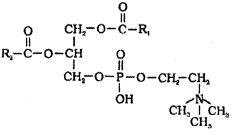
Identify the given figure.
A
Cholesterol
B
Triglycerides
C
Lecithin
D
Adenylic acid
Solution
(C) The provided figure shows a glycerol backbone attached to two fatty acid chains ($R_1$ and $R_2$) and a phosphate group linked to a choline molecule.
This structure is characteristic of a phospholipid,specifically lecithin (phosphatidylcholine).
Lecithin is a common phospholipid found in cell membranes.
This structure is characteristic of a phospholipid,specifically lecithin (phosphatidylcholine).
Lecithin is a common phospholipid found in cell membranes.
0 likes
View Solution176
MediumMCQ
Which fatty acid is responsible for the constant of oil?
A
Oleic acid
B
Linolenic acid
C
Linoleic acid
D
Erucic acid
Solution
(D) The term 'constant of oil' refers to the specific physical and chemical properties of oils,such as the iodine value,which measures the degree of unsaturation. Erucic acid $(C_{22}H_{42}O_2)$ is a monounsaturated omega-$9$ fatty acid found in high concentrations in rapeseed and mustard oils. It is often used as a marker or constant in the analysis of these specific oils to determine their purity and composition.
0 likes
View Solution177
MediumMCQ
Lipids are insoluble in water because lipid molecules are
A
Hydrophilic
B
Hydrophobic
C
Neutral
D
Zwitterions
Solution
(B) Lipids are organic compounds that are non-polar in nature.
Water is a polar solvent.
According to the principle of 'like dissolves like',polar substances dissolve in polar solvents,while non-polar substances dissolve in non-polar solvents.
Since lipid molecules are non-polar,they are repelled by water molecules,a property known as being $Hydrophobic$ (water-fearing).
Therefore,lipids are insoluble in water.
Water is a polar solvent.
According to the principle of 'like dissolves like',polar substances dissolve in polar solvents,while non-polar substances dissolve in non-polar solvents.
Since lipid molecules are non-polar,they are repelled by water molecules,a property known as being $Hydrophobic$ (water-fearing).
Therefore,lipids are insoluble in water.
0 likes
View Solution178
MediumMCQ
Phosphoglycerides are always composed of:
A
Saturated or unsaturated fatty acids,an esterified phosphate group that is also linked to a glycerol molecule.
B
Only saturated fatty acids,an esterified glycerol molecule that is also linked to a phosphate group.
C
Only unsaturated fatty acids,an esterified glycerol molecule that is also linked to a phosphate group.
D
Saturated or unsaturated fatty acids,an esterified glycerol molecule that is also linked to a phosphate group.
Solution
(D) Phosphoglycerides are a type of lipid that acts as a major component of cell membranes.
They consist of a glycerol backbone.
Two fatty acid chains (which can be either saturated or unsaturated) are esterified to the first and second carbons of the glycerol molecule.
The third carbon of the glycerol molecule is esterified to a phosphate group,which may further be linked to other chemical groups (like choline,ethanolamine,etc.).
Therefore,phosphoglycerides are composed of a glycerol molecule,fatty acids (saturated or unsaturated),and a phosphate group.
They consist of a glycerol backbone.
Two fatty acid chains (which can be either saturated or unsaturated) are esterified to the first and second carbons of the glycerol molecule.
The third carbon of the glycerol molecule is esterified to a phosphate group,which may further be linked to other chemical groups (like choline,ethanolamine,etc.).
Therefore,phosphoglycerides are composed of a glycerol molecule,fatty acids (saturated or unsaturated),and a phosphate group.
0 likes
View Solution179
EasyMCQ
$A$ typical fat molecule is composed of:
A
One glycerol and three fatty acid molecules
B
One glycerol and one fatty acid molecule
C
Three glycerol and three fatty acid molecules
D
Three glycerol molecules and one fatty acid molecule
Solution
(A) typical fat molecule,also known as a triglyceride,is formed by the esterification of one molecule of glycerol with three molecules of fatty acids.
In this process,the three hydroxyl $(-OH)$ groups of the glycerol molecule react with the carboxyl $(-COOH)$ groups of three fatty acid molecules,resulting in the formation of three ester bonds and the release of three water molecules.
In this process,the three hydroxyl $(-OH)$ groups of the glycerol molecule react with the carboxyl $(-COOH)$ groups of three fatty acid molecules,resulting in the formation of three ester bonds and the release of three water molecules.
0 likes
View Solution180
MediumMCQ
Which of the following is not a polymeric substance?
A
Nucleic acids
B
Proteins
C
Polysaccharides
D
Lipids
Solution
(D) polymer is a large molecule (macromolecule) composed of many repeating subunits called monomers.
$1$. Nucleic acids are polymers of nucleotides.
$2$. Proteins are polymers of amino acids.
$3$. Polysaccharides are polymers of monosaccharides.
$4$. Lipids,although often grouped with macromolecules,are generally not considered true polymers because they are not formed by the covalent linkage of repeating monomeric units in a long chain. They are typically formed by the condensation of fatty acids and glycerol or other components.
$1$. Nucleic acids are polymers of nucleotides.
$2$. Proteins are polymers of amino acids.
$3$. Polysaccharides are polymers of monosaccharides.
$4$. Lipids,although often grouped with macromolecules,are generally not considered true polymers because they are not formed by the covalent linkage of repeating monomeric units in a long chain. They are typically formed by the condensation of fatty acids and glycerol or other components.
0 likes
View Solution181
MediumMCQ
For patients suffering from high blood cholesterol,physicians recommend the intake of:
A
Pure desi ghee / butter
B
Vegetable oil / groundnut oil
C
Red meat with fat content
D
Vegetable margarine
Solution
(B) High blood cholesterol is primarily caused by the consumption of saturated fats.
Vegetable oils,such as groundnut oil,are rich in unsaturated fatty acids,which help in lowering low-density lipoprotein $(LDL)$ cholesterol levels in the blood.
In contrast,desi ghee,butter,red meat,and margarine contain high levels of saturated fats or trans fats,which increase the risk of cardiovascular diseases by raising cholesterol levels.
Vegetable oils,such as groundnut oil,are rich in unsaturated fatty acids,which help in lowering low-density lipoprotein $(LDL)$ cholesterol levels in the blood.
In contrast,desi ghee,butter,red meat,and margarine contain high levels of saturated fats or trans fats,which increase the risk of cardiovascular diseases by raising cholesterol levels.
0 likes
View Solution182
MediumMCQ
Assertion: Vegetable oils are fats which are present in plant cells in soluble form.
Reason: Vegetable oils occur only in cells of embryo.
Reason: Vegetable oils occur only in cells of embryo.
A
If both Assertion and Reason are correct and the Reason is a correct explanation of the Assertion.
B
If both Assertion and Reason are correct but Reason is not a correct explanation of the Assertion.
C
If the Assertion is correct but Reason is incorrect.
D
If both the Assertion and Reason are incorrect.
Solution
(D) Vegetable oils and fats are present in plant cells in an insoluble form,not a soluble form. Therefore,the Assertion is incorrect.
Vegetable oils are not restricted to the embryo; they are found in various parts of plants such as seeds,fruits (e.g.,olive and palm oil from fleshy pericarp),roots,stems,and leaves. Therefore,the Reason is also incorrect.
Since both the Assertion and the Reason are false,the correct option is $D$.
Vegetable oils are not restricted to the embryo; they are found in various parts of plants such as seeds,fruits (e.g.,olive and palm oil from fleshy pericarp),roots,stems,and leaves. Therefore,the Reason is also incorrect.
Since both the Assertion and the Reason are false,the correct option is $D$.
0 likes
View Solution183
MediumMCQ
Assertion : Unsaturated fats are more reactive compared with the saturated fats.
Reason : Unsaturated fats have only single bonds in their structure.
Reason : Unsaturated fats have only single bonds in their structure.
A
If both Assertion and Reason are correct and the Reason is a correct explanation of the Assertion.
B
If both Assertion and Reason are correct but Reason is not a correct explanation of the Assertion.
C
If the Assertion is correct but Reason is incorrect.
D
If both the Assertion and Reason are incorrect.
Solution
(C) Unsaturated fats contain one or more carbon-carbon double bonds $(C=C)$ in their fatty acid chains,which makes them more chemically reactive compared to saturated fats that contain only single bonds $(C-C)$.
Since unsaturated fats possess double bonds,they are more reactive.
The Reason statement claims that unsaturated fats have only single bonds,which is scientifically incorrect because they are defined by the presence of at least one double bond.
Therefore,the Assertion is correct,but the Reason is incorrect.
Since unsaturated fats possess double bonds,they are more reactive.
The Reason statement claims that unsaturated fats have only single bonds,which is scientifically incorrect because they are defined by the presence of at least one double bond.
Therefore,the Assertion is correct,but the Reason is incorrect.
0 likes
View Solution184
MediumMCQ
Which of the following organic compounds is the main constituent of Lecithin?
A
Arachidonic acid
B
Phospholipid
C
Cholesterol
D
Phosphoprotein
Solution
(B) Lecithin is a type of phospholipid,specifically a phosphatidylcholine.
Phospholipids are complex lipids that contain a phosphate group in addition to fatty acids and an alcohol (usually glycerol).
They are essential components of biological membranes,forming the lipid bilayer.
Therefore,the main constituent or the category to which Lecithin belongs is a phospholipid.
Phospholipids are complex lipids that contain a phosphate group in addition to fatty acids and an alcohol (usually glycerol).
They are essential components of biological membranes,forming the lipid bilayer.
Therefore,the main constituent or the category to which Lecithin belongs is a phospholipid.
0 likes
View Solution185
Medium
Explain the composition of triglyceride.
Solution
(N/A) triglyceride is a type of glyceride formed by the esterification of one molecule of glycerol with three molecules of fatty acids.
It is the primary component of vegetable oils and animal fats.
The general chemical formula of a triglyceride is:
$R_{1}COO-CH_{2}-CH(OOCR_{2})-CH_{2}-OOCR_{3}$
In this structure,$R_{1}, R_{2},$ and $R_{3}$ represent the hydrocarbon chains of the fatty acids. These three fatty acids can be identical or different,depending on the specific triglyceride.
It is the primary component of vegetable oils and animal fats.
The general chemical formula of a triglyceride is:
$R_{1}COO-CH_{2}-CH(OOCR_{2})-CH_{2}-OOCR_{3}$
In this structure,$R_{1}, R_{2},$ and $R_{3}$ represent the hydrocarbon chains of the fatty acids. These three fatty acids can be identical or different,depending on the specific triglyceride.
0 likes
View Solution186
Easy
Provide information regarding the structure of lipids.
Solution
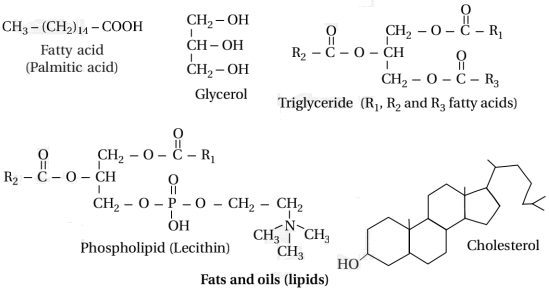
(N/A) $\Rightarrow$ Lipids are generally water-insoluble. They could be simple fatty acids.
$\Rightarrow$ $A$ fatty acid has a carboxyl group attached to an $R$ group.
$\Rightarrow$ The $R$ group could be a methyl $(-CH_{3})$,or ethyl $(-C_{2}H_{5})$ or higher number of $-CH_{2}$ groups ($1$ carbon to $19$ carbons). For example,palmitic acid has $16$ carbons including the carboxyl carbon. Arachidonic acid has $20$ carbon atoms including the carboxyl carbon.
$\Rightarrow$ Fatty acids could be saturated (without double bond) or unsaturated (with one or more $C=C$ double bonds).
$\Rightarrow$ Another simple lipid is glycerol,which is trihydroxy propane.
$\Rightarrow$ Many lipids have both glycerol and fatty acids. Here,the fatty acids are esterified with glycerol. They can be monoglycerides,diglycerides,and triglycerides. These are also called fats and oils based on their melting point.
$\Rightarrow$ Oils have a lower melting point (e.g.,gingelly oil) and hence remain as oil in winters.
$\Rightarrow$ Some lipids have phosphorus and a phosphorylated organic compound in them. These are phospholipids. They are found in the cell membrane. Lecithin is one example. Some tissues,especially neural tissues,have lipids with more complex structures.
$\Rightarrow$ $A$ fatty acid has a carboxyl group attached to an $R$ group.
$\Rightarrow$ The $R$ group could be a methyl $(-CH_{3})$,or ethyl $(-C_{2}H_{5})$ or higher number of $-CH_{2}$ groups ($1$ carbon to $19$ carbons). For example,palmitic acid has $16$ carbons including the carboxyl carbon. Arachidonic acid has $20$ carbon atoms including the carboxyl carbon.
$\Rightarrow$ Fatty acids could be saturated (without double bond) or unsaturated (with one or more $C=C$ double bonds).
$\Rightarrow$ Another simple lipid is glycerol,which is trihydroxy propane.
$\Rightarrow$ Many lipids have both glycerol and fatty acids. Here,the fatty acids are esterified with glycerol. They can be monoglycerides,diglycerides,and triglycerides. These are also called fats and oils based on their melting point.
$\Rightarrow$ Oils have a lower melting point (e.g.,gingelly oil) and hence remain as oil in winters.
$\Rightarrow$ Some lipids have phosphorus and a phosphorylated organic compound in them. These are phospholipids. They are found in the cell membrane. Lecithin is one example. Some tissues,especially neural tissues,have lipids with more complex structures.
0 likes
View Solution187
Easy
Provide the structural formula of cholesterol.
Solution
(N/A) Cholesterol is a type of lipid,specifically a sterol. Its chemical formula is $C_{27}H_{46}O$. Structurally,it consists of a tetracyclic cyclopenta[$a$]phenanthrene skeleton,which includes four fused rings: three six-membered rings $(A, B, C)$ and one five-membered ring $(D)$. It also features a hydroxyl group $(-OH)$ at the $C-3$ position,a double bond between $C-5$ and $C-6$,and an alkyl side chain at the $C-17$ position. The provided image illustrates this characteristic four-ring steroid backbone.
0 likes
View Solution188
Medium
Describe various forms of lipid with a few examples.
Solution
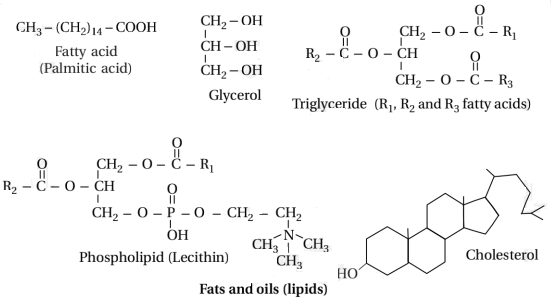
(N/A) Lipids are generally water-insoluble. They could be simple fatty acids.
$A$ fatty acid has a carboxyl group attached to an $R$ group. The $R$ group could be a methyl $(-CH_3)$,or ethyl $(-C_2H_5)$ or higher number of $-CH_2$ groups ($1$ carbon to $19$ carbons). For example,palmitic acid has $16$ carbons including the carboxyl carbon. Arachidonic acid has $20$ carbon atoms including the carboxyl carbon.
Fatty acids could be saturated (without double bond) or unsaturated (with one or more $C=C$ double bonds).
Another simple lipid is glycerol,which is trihydroxy propane.
Many lipids have both glycerol and fatty acids. Here,the fatty acids are esterified with glycerol. They can be monoglycerides,diglycerides,and triglycerides. These are also called fats and oils based on their melting point.
Oils have a lower melting point (e.g.,gingelly oil) and hence remain as oil in winters.
Some lipids have phosphorus and a phosphorylated organic compound in them. These are phospholipids. They are found in the cell membrane. Lecithin is one example. Some tissues,especially neural tissues,have lipids with more complex structures,such as cholesterol.
$A$ fatty acid has a carboxyl group attached to an $R$ group. The $R$ group could be a methyl $(-CH_3)$,or ethyl $(-C_2H_5)$ or higher number of $-CH_2$ groups ($1$ carbon to $19$ carbons). For example,palmitic acid has $16$ carbons including the carboxyl carbon. Arachidonic acid has $20$ carbon atoms including the carboxyl carbon.
Fatty acids could be saturated (without double bond) or unsaturated (with one or more $C=C$ double bonds).
Another simple lipid is glycerol,which is trihydroxy propane.
Many lipids have both glycerol and fatty acids. Here,the fatty acids are esterified with glycerol. They can be monoglycerides,diglycerides,and triglycerides. These are also called fats and oils based on their melting point.
Oils have a lower melting point (e.g.,gingelly oil) and hence remain as oil in winters.
Some lipids have phosphorus and a phosphorylated organic compound in them. These are phospholipids. They are found in the cell membrane. Lecithin is one example. Some tissues,especially neural tissues,have lipids with more complex structures,such as cholesterol.
0 likes
View Solution189
MediumMCQ
What is the difference between oils and fats?
A
Oils have higher melting points than fats.
B
Oils have lower melting points and remain liquid at room temperature,whereas fats have higher melting points.
C
Fats are liquid at room temperature,while oils are solid.
D
There is no chemical difference between oils and fats.
Solution
(B) $\Rightarrow$ Oils have lower melting points (e.g.,gingelly oil) and hence remain as liquids at room temperature and in winters.
$\Rightarrow$ Fats have higher melting points and are generally solid at room temperature.
$\Rightarrow$ Chemically,both are lipids (triglycerides),but the degree of saturation in their fatty acid chains differs; oils typically contain more unsaturated fatty acids,while fats contain more saturated fatty acids.
$\Rightarrow$ Fats have higher melting points and are generally solid at room temperature.
$\Rightarrow$ Chemically,both are lipids (triglycerides),but the degree of saturation in their fatty acid chains differs; oils typically contain more unsaturated fatty acids,while fats contain more saturated fatty acids.
0 likes
View Solution190
MediumMCQ
Why are lipids not considered as macromolecules?
A
They have high molecular weight.
B
They are polymers of amino acids.
C
Their molecular weight does not exceed $800 \ Da$.
D
They are soluble in water.
Solution
(C) $\Rightarrow$ When we grind a tissue,we disrupt the cell structure. Cell membranes and other organelle membranes are broken into pieces and form vesicles,which are not water-soluble.
$\Rightarrow$ These membrane fragments,in the form of vesicles,get separated along with the acid-insoluble pool and are thus found in the macromolecular fraction.
$\Rightarrow$ However,lipids are not strictly macromolecules because their molecular weight does not exceed $800 \ Da$,which is the threshold for the macromolecular fraction.
$\Rightarrow$ These membrane fragments,in the form of vesicles,get separated along with the acid-insoluble pool and are thus found in the macromolecular fraction.
$\Rightarrow$ However,lipids are not strictly macromolecules because their molecular weight does not exceed $800 \ Da$,which is the threshold for the macromolecular fraction.
0 likes
View Solution191
EasyMCQ
What is the property of bitumen?
A
Hydrophilic
B
Hygroscopic
C
Hydrophobic
D
Heat absorbent
Solution
(C) Bitumen is a sticky,black,and highly viscous form of petroleum. It is naturally $Hydrophobic$,meaning it repels water. This property makes it an excellent material for waterproofing and road construction,as it prevents water from penetrating surfaces.
0 likes
View Solution192
EasyMCQ
Which fat-soluble vitamin is necessary for blood clotting?
A
$A$
B
$D$
C
$E$
D
$K$
Solution
(D) The fat-soluble vitamin required for the clotting of blood is vitamin $K$.
This vitamin plays a crucial role in the synthesis of proteins needed for blood coagulation,thereby preventing excessive bleeding.
It is naturally found in green leafy vegetables,broccoli,cauliflower,liver,and eggs.
This vitamin plays a crucial role in the synthesis of proteins needed for blood coagulation,thereby preventing excessive bleeding.
It is naturally found in green leafy vegetables,broccoli,cauliflower,liver,and eggs.
0 likes
View Solution193
EasyMCQ
Which of the following does not contain carbohydrates?
A
Cellulose
B
Wax
C
Starch
D
Wheat flour
Solution
(B) Carbohydrates are polyhydroxy aldehydes or ketones or substances that yield these on hydrolysis.
Cellulose,starch,and wheat flour (which contains starch) are all carbohydrates.
Wax is a lipid,specifically an ester formed from long-chain fatty acids and long-chain alcohols.
Therefore,wax does not contain carbohydrates.
Cellulose,starch,and wheat flour (which contains starch) are all carbohydrates.
Wax is a lipid,specifically an ester formed from long-chain fatty acids and long-chain alcohols.
Therefore,wax does not contain carbohydrates.
0 likes
View Solution194
MediumMCQ
Fats,on alkaline hydrolysis,give
A
Oils
B
Soaps
C
Carbohydrate
D
Glycol + acid
Solution
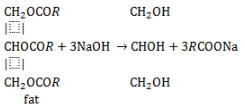
(B) Fats are esters of higher fatty acids with glycerol.
When fats undergo alkaline hydrolysis (saponification) using a strong base like $NaOH$ or $KOH$,they break down into glycerol and the sodium or potassium salts of fatty acids.
These salts of fatty acids are known as soaps.
The reaction is represented as:
$CH_2OCOR-CHOCOR-CH_2OCOR + 3NaOH \rightarrow CH_2OH-CHOH-CH_2OH + 3RCOONa$
(Fat + Base $\rightarrow$ Glycerol + Soap)
When fats undergo alkaline hydrolysis (saponification) using a strong base like $NaOH$ or $KOH$,they break down into glycerol and the sodium or potassium salts of fatty acids.
These salts of fatty acids are known as soaps.
The reaction is represented as:
$CH_2OCOR-CHOCOR-CH_2OCOR + 3NaOH \rightarrow CH_2OH-CHOH-CH_2OH + 3RCOONa$
(Fat + Base $\rightarrow$ Glycerol + Soap)
0 likes
View Solution195
MediumMCQ
Fats and oils belong to the class of:
A
Alcohols
B
Acids
C
Esters
D
Hydrocarbons
Solution
(C) Fats and oils are chemically known as triglycerides.
They are formed by the esterification of glycerol (a trihydroxy alcohol) with three fatty acid molecules.
Since they contain ester functional groups $(R-COO-R')$,they are classified as esters.
They are formed by the esterification of glycerol (a trihydroxy alcohol) with three fatty acid molecules.
Since they contain ester functional groups $(R-COO-R')$,they are classified as esters.
0 likes
View Solution196
EasyMCQ
The sources of fats and oils are:
A
Milk
B
Butter
C
Cheese
D
All of these
Solution
(D) Fats and oils are lipids. Milk contains fat globules,butter is a dairy product consisting of milk fat,and cheese is also a rich source of milk fat. Therefore,all of these are sources of fats and oils.
0 likes
View Solution197
MediumMCQ
Oils are:
A
Phospholipids
B
Liquid fats
C
Steroids
D
All of these
Solution
(B) Oils are triglycerides that remain in a liquid state at room temperature due to the presence of unsaturated fatty acids.
Fats are typically solid at room temperature because they contain saturated fatty acids.
Therefore,oils are essentially liquid fats.
Fats are typically solid at room temperature because they contain saturated fatty acids.
Therefore,oils are essentially liquid fats.
0 likes
View Solution198
EasyMCQ
Ordinary soaps are defined as:
A
$Al$ salts of higher fatty acids
B
$Na$ salts of lower fatty acids
C
$Na$ salts of higher fatty acids
D
$Mg$ salts of lower fatty acids
Solution
(C) Soaps are defined as the $Na$ or $K$ salts of long-chain (higher) fatty acids,such as stearic,palmitic,or oleic acid. These are produced by the process of saponification,where fats or oils are reacted with an alkali like $NaOH$ or $KOH$.
0 likes
View Solution199
MediumMCQ
Fats and oils are formed from:
A
Glycerol and long chain unsaturated acids only
B
Glycerol and long chain saturated acids only
C
Glycerol and long chain saturated and unsaturated acids
D
Ethylene glycol and long chain saturated and unsaturated acids
Solution
(C) Fats and oils are chemically known as triglycerides or triacylglycerols.
They are formed by the esterification of one molecule of glycerol with three molecules of fatty acids.
These fatty acids can be either saturated (having no double bonds) or unsaturated (having one or more double bonds).
Therefore,fats and oils are formed from glycerol and long-chain saturated and unsaturated fatty acids.
They are formed by the esterification of one molecule of glycerol with three molecules of fatty acids.
These fatty acids can be either saturated (having no double bonds) or unsaturated (having one or more double bonds).
Therefore,fats and oils are formed from glycerol and long-chain saturated and unsaturated fatty acids.
0 likes
View SolutionBiomolecules — Lipid · Frequently Asked Questions
1Are these Biomolecules questions useful for JEE and NEET?
Yes. All questions in this section are mapped to JEE Main and NEET exam patterns. Previous year questions from JEE Main, NEET, GUJCET and state-level exams are included with full solutions.
2Can I switch to Hindi or Gujarati for these questions?
Yes. Use the language tabs in the hero section or the sidebar to view the same questions and solutions in English, Hindi or Gujarati.
3How do I generate a question paper from this subtopic?
Use the Vedclass Exam Paper Generator — select the chapter and subtopic, set difficulty, and generate Sets A, B, C, D automatically. First 3 chapters of every subject are free.
Vedclass Products
For Students
Vedclass Test Series
Mock tests in real JEE/NEET style with performance analysis. 5-day free trial.
Start Free TrialFor Teachers
Exam Paper Generator
Generate Set A/B/C/D papers from this chapter in 2 minutes. 3 chapters free.
Try FreeFor Institutes
Online Exam Module
Live online exams with unlimited students, 360° analytics & white-label branding.
See DemoFor Teachers & Institutes
Generate a Biomolecules Exam Paper in 2 Minutes
Select subtopic & difficulty — Sets A, B, C, D auto-generated with No Repeat logic.
First 3 chapters of every subject are free — no payment required.