
A English
Enzymes Questions in English
Class 11 Biology · Biomolecules · Enzymes
358+
Questions
English
Language
100%
With Solutions
Showing 50 of 358 questions in English
301
MediumMCQ
Which class of enzymes catalyzes the covalent bonding of two substrates?
A
Invertase
B
Amylase
C
Glutamate pyruvate transaminase
D
Ligase
Solution
(D) Enzymes are classified into six major classes based on the type of reaction they catalyze.
Ligases are the class of enzymes that catalyze the joining or covalent bonding of two substrate molecules.
For example,$DNA$ ligase joins two fragments of $DNA$ by forming a phosphodiester bond.
Invertase,Amylase,and Glutamate pyruvate transaminase belong to other classes (Hydrolases and Transferases,respectively).
Ligases are the class of enzymes that catalyze the joining or covalent bonding of two substrate molecules.
For example,$DNA$ ligase joins two fragments of $DNA$ by forming a phosphodiester bond.
Invertase,Amylase,and Glutamate pyruvate transaminase belong to other classes (Hydrolases and Transferases,respectively).
0 likes
View Solution302
MediumMCQ
Study the following statements:
$(a)$ The substrate binds to the active site of the enzyme.
$(b)$ Enzymes isolated from thermophilic organisms get denatured at $50^{\circ}C$.
$(c)$ The active site of the enzyme breaks the chemical bonds of the product.
$(d)$ Prosthetic groups are tightly bound to the apoenzyme.
Select the option which includes all correct statements:
$(a)$ The substrate binds to the active site of the enzyme.
$(b)$ Enzymes isolated from thermophilic organisms get denatured at $50^{\circ}C$.
$(c)$ The active site of the enzyme breaks the chemical bonds of the product.
$(d)$ Prosthetic groups are tightly bound to the apoenzyme.
Select the option which includes all correct statements:
A
$(a)$ and $(c)$
B
$(c)$ and $(d)$
C
$(b)$ and $(c)$
D
$(a)$ and $(d)$
Solution
(D) Statement $(a)$ is correct: The substrate binds to the active site of the enzyme to form an enzyme-substrate complex.
Statement $(b)$ is incorrect: Enzymes from thermophilic organisms are stable and remain functional at high temperatures (often up to $80^{\circ}C-90^{\circ}C$), not denatured at $50^{\circ}C$.
Statement $(c)$ is incorrect: The active site of the enzyme breaks the chemical bonds of the substrate to convert it into the product, not the bonds of the product.
Statement $(d)$ is correct: Prosthetic groups are organic compounds that are tightly bound to the apoenzyme (the protein part) to form a functional holoenzyme.
Therefore, statements $(a)$ and $(d)$ are correct.
Statement $(b)$ is incorrect: Enzymes from thermophilic organisms are stable and remain functional at high temperatures (often up to $80^{\circ}C-90^{\circ}C$), not denatured at $50^{\circ}C$.
Statement $(c)$ is incorrect: The active site of the enzyme breaks the chemical bonds of the substrate to convert it into the product, not the bonds of the product.
Statement $(d)$ is correct: Prosthetic groups are organic compounds that are tightly bound to the apoenzyme (the protein part) to form a functional holoenzyme.
Therefore, statements $(a)$ and $(d)$ are correct.
0 likes
View Solution303
EasyMCQ
All enzymes are proteins,except:
A
Trypsin
B
Pepsin
C
Steapsin
D
Ribozyme and Ribonuclease-$P$
Solution
(D) Most enzymes are proteinaceous in nature. However,there are certain $RNA$ molecules that possess catalytic activity and are known as ribozymes. Ribonuclease-$P$ is a well-known example of a ribozyme,which is an $RNA$ enzyme that cleaves $RNA$ molecules. Therefore,ribozyme and ribonuclease-$P$ are exceptions to the rule that all enzymes are proteins.
0 likes
View Solution304
MediumMCQ
Electron transferring enzymes belong to
A
Transferases
B
Oxidoreductases
C
Lyases
D
Isomerases
Solution
(B) Enzymes that catalyze oxidation-reduction reactions,which involve the transfer of electrons from one molecule (the reductant) to another (the oxidant),are classified as $Oxidoreductases$.
Examples include dehydrogenases,reductases,and cytochrome oxidases,which are essential components of the electron transport chain.
Examples include dehydrogenases,reductases,and cytochrome oxidases,which are essential components of the electron transport chain.
0 likes
View Solution305
MediumMCQ
$A$: Hormones are not enzymes,but they can stimulate the release of enzymes.
$R$: Hormones are used up in metabolism,but enzymes can act over and over again.
$R$: Hormones are used up in metabolism,but enzymes can act over and over again.
A
Assertion and Reason both are correct and Reason is the correct explanation of Assertion.
B
Assertion and Reason both are correct but Reason is not the correct explanation of Assertion.
C
Assertion is correct,but Reason is incorrect.
D
Both Assertion and Reason are incorrect.
Solution
(C) Assertion $(A)$ is correct: Hormones are chemical messengers that regulate physiological processes and can stimulate the production or release of enzymes.
Reason $(R)$ is incorrect: Hormones are not necessarily 'used up' in metabolism in the same way as substrates; they act as signaling molecules. Furthermore,the statement that 'enzymes can act over and over again' is true,but the claim that 'hormones are used up in metabolism' is a generalization that does not accurately describe their catalytic or signaling nature compared to enzymes. Therefore,the reason provided is scientifically inaccurate.
Reason $(R)$ is incorrect: Hormones are not necessarily 'used up' in metabolism in the same way as substrates; they act as signaling molecules. Furthermore,the statement that 'enzymes can act over and over again' is true,but the claim that 'hormones are used up in metabolism' is a generalization that does not accurately describe their catalytic or signaling nature compared to enzymes. Therefore,the reason provided is scientifically inaccurate.
0 likes
View Solution306
MediumMCQ
$A$ : Non-competitive inhibitors have no effect on $V_{max}$.
$R$ : In non-competitive inhibition,inhibitor and substrate bind at same sites on the enzyme.
$R$ : In non-competitive inhibition,inhibitor and substrate bind at same sites on the enzyme.
A
Assertion and Reason both are correct and Reason is the correct explanation of Assertion.
B
Assertion and Reason both are correct but Reason is not the correct explanation of Assertion.
C
Assertion is correct,but Reason is incorrect.
D
Both Assertion and Reason are incorrect.
Solution
(D) Non-competitive inhibitors bind to an allosteric site (a site other than the active site) on the enzyme,which changes the conformation of the enzyme such that the active site becomes less effective. This binding does not prevent substrate binding but reduces the catalytic rate,thereby decreasing the maximum velocity $(V_{max})$ of the reaction. Therefore,the Assertion is incorrect. The Reason is also incorrect because,in non-competitive inhibition,the inhibitor and substrate bind at different sites,not the same site. Thus,both Assertion and Reason are incorrect.
0 likes
View Solution307
MediumMCQ
$A$: Allosteric enzymes do not show a typical Michaelis-Menten constant or behavior.
$R$: All enzymes work at the same $pH$.
$R$: All enzymes work at the same $pH$.
A
Assertion and Reason both are correct and Reason is the correct explanation of Assertion.
B
Assertion and Reason both are correct but Reason is not the correct explanation of Assertion.
C
Assertion is correct,but Reason is incorrect.
D
Both Assertion and Reason are incorrect.
Solution
(C) Assertion $(A)$ is correct: Allosteric enzymes exhibit sigmoidal kinetics rather than the hyperbolic kinetics described by the Michaelis-Menten equation. They do not follow standard Michaelis-Menten behavior because their activity is regulated by the binding of effectors at sites other than the active site.
Reason $(R)$ is incorrect: Enzymes are highly specific and have different optimal $pH$ values depending on their structure and the environment in which they function (e.g.,pepsin works at acidic $pH$,while trypsin works at alkaline $pH$).
Reason $(R)$ is incorrect: Enzymes are highly specific and have different optimal $pH$ values depending on their structure and the environment in which they function (e.g.,pepsin works at acidic $pH$,while trypsin works at alkaline $pH$).
0 likes
View Solution308
MediumMCQ
$A$ : $\alpha$-amylase of wheat endosperm has $16$ isoenzymes.
$R$ : In competitive inhibition,$V_{max}$ decreases.
$R$ : In competitive inhibition,$V_{max}$ decreases.
A
Assertion and Reason both are correct and Reason is the correct explanation of Assertion.
B
Assertion and Reason both are correct but Reason is not the correct explanation of Assertion.
C
Assertion is correct,but Reason is incorrect.
D
Both Assertion and Reason are incorrect.
Solution
(C) Assertion: $\alpha$-amylase in wheat endosperm is known to exist in multiple isoenzymic forms,specifically $16$ isoenzymes,which help in the mobilization of starch during germination.
Reason: In competitive inhibition,the inhibitor resembles the substrate and competes for the active site. This increases the $K_m$ value,but the $V_{max}$ remains unchanged because the inhibition can be overcome by increasing the substrate concentration. Therefore,the statement that $V_{max}$ decreases is incorrect.
Reason: In competitive inhibition,the inhibitor resembles the substrate and competes for the active site. This increases the $K_m$ value,but the $V_{max}$ remains unchanged because the inhibition can be overcome by increasing the substrate concentration. Therefore,the statement that $V_{max}$ decreases is incorrect.
0 likes
View Solution309
MediumMCQ
An example of non-competitive inhibition is
A
The inhibition of succinic dehydrogenase by malonate
B
Cyanide action on cytochrome oxidase
C
Sulpha drug on folic acid synthesizing bacteria
D
The inhibition of hexokinase by glucose $6$-phosphate
Solution
(B) In non-competitive inhibition,the inhibitor does not resemble the substrate in structure and does not compete for the active site.
Instead,the inhibitor binds to an allosteric site (a site other than the active site) on the enzyme.
This binding induces a conformational change in the enzyme's structure,rendering the active site non-functional.
Cyanide acts as a non-competitive inhibitor of cytochrome oxidase in the electron transport chain,preventing the final step of cellular respiration.
Instead,the inhibitor binds to an allosteric site (a site other than the active site) on the enzyme.
This binding induces a conformational change in the enzyme's structure,rendering the active site non-functional.
Cyanide acts as a non-competitive inhibitor of cytochrome oxidase in the electron transport chain,preventing the final step of cellular respiration.
0 likes
View Solution310
EasyMCQ
$A$ competitive inhibitor of Succinic Dehydrogenase is
A
Malonate
B
Oxaloacetate
C
$\alpha$-ketoglutarate
D
Malate
Solution
(A) Malonate,an analogue of succinate,is a strong competitive inhibitor of succinate dehydrogenase.
It binds to the active site of the enzyme,thereby blocking the activity of the citric acid cycle.
It binds to the active site of the enzyme,thereby blocking the activity of the citric acid cycle.
0 likes
View Solution311
EasyMCQ
Enzyme sucrase hydrolyses sucrose into
A
Glucose and galactose
B
Glucose and fructose
C
Two molecules of glucose
D
Two molecules of fructose
Solution
(B) Sucrose is a disaccharide composed of glucose and fructose. The enzyme sucrase (also known as invertase) catalyzes the hydrolysis of sucrose into one molecule of glucose and one molecule of fructose.
0 likes
View Solution312
EasyMCQ
The enzyme lactase is responsible for the breakdown of lactose into:
A
Glucose + Fructose
B
Glucose + Galactose
C
Glucose + Glucose
D
Fatty acids + Glycerol
Solution
(B) Lactose is a disaccharide composed of glucose and galactose. The enzyme lactase catalyzes the hydrolysis of lactose into its constituent monosaccharides,glucose and galactose. The reaction is represented as:
Lactose $\xrightarrow{\text{Lactase}}$ Glucose + Galactose.
Lactose $\xrightarrow{\text{Lactase}}$ Glucose + Galactose.
0 likes
View Solution313
MediumMCQ
Lipases,proteases,carbohydrases,and nucleases are types of $.......$ enzymes.
A
Transferases
B
Hydrolases
C
Lyases
D
Isomerases
Solution
(B) Lipases,proteases,carbohydrases,and nucleases are enzymes that catalyze the hydrolysis of their respective substrates (lipids,proteins,carbohydrates,and nucleic acids) by adding water molecules.
These enzymes belong to the class of $Hydrolases$ in the enzyme classification system.
$Hydrolases$ are enzymes that catalyze the cleavage of bonds such as $C-O$,$C-N$,$C-C$,etc.,by the addition of water.
These enzymes belong to the class of $Hydrolases$ in the enzyme classification system.
$Hydrolases$ are enzymes that catalyze the cleavage of bonds such as $C-O$,$C-N$,$C-C$,etc.,by the addition of water.
0 likes
View Solution314
EasyMCQ
Which of these enzymes are not made of protein?
A
Ribozymes
B
Lipase
C
Protease
D
Carbohydrase
Solution
(A) Most enzymes are proteins in nature. However,$Ribozymes$ are catalytic $RNA$ molecules that function as enzymes without being composed of proteins. They are involved in processes like $RNA$ splicing and protein synthesis within the ribosome.
0 likes
View Solution315
MediumMCQ
Select the correct option for the active site.
A
It is present on the enzyme to which the substrate binds.
B
It is present on the substrate to which the enzyme binds.
C
It is present on the product to which the enzyme binds.
D
All of the above.
Solution
(A) The active site of an enzyme is a specific pocket or cleft formed by the tertiary structure of the protein.
It is the region on the surface of the enzyme molecule where the substrate binds to form the enzyme-substrate complex.
Therefore,the active site is present on the enzyme,not on the substrate or the product.
It is the region on the surface of the enzyme molecule where the substrate binds to form the enzyme-substrate complex.
Therefore,the active site is present on the enzyme,not on the substrate or the product.
0 likes
View Solution316
MediumMCQ
Which of the following is true for inorganic catalysts?
A
They work at high temperatures.
B
They work at high pressures.
C
They are not used in biochemical reactions.
D
All of the above.
Solution
(D) Inorganic catalysts typically function efficiently under conditions of high temperature and high pressure. These conditions are often damaging to biological systems,which is why inorganic catalysts are generally not used in biochemical reactions. Furthermore,compared to enzymes (biological catalysts),inorganic catalysts are less efficient and lack specificity. Therefore,all the given options are correct.
0 likes
View Solution317
MediumMCQ
The rate of a chemical reaction can be expressed as $............$.
A
$\frac{\delta p}{\delta t}$
B
$\frac{\delta t}{\delta p}$
C
$\frac{\delta s}{\delta t}$
D
$\frac{\delta t}{\delta s}$
Solution
(A) The rate of a chemical reaction is defined as the change in the concentration of a product $(p)$ or a substrate $(s)$ per unit time $(t)$.
Mathematically,the rate of reaction can be expressed as the change in product concentration over time,which is $\frac{\delta p}{\delta t}$.
Alternatively,it can be expressed as the decrease in substrate concentration over time,which is $-\frac{\delta s}{\delta t}$.
Among the given options,$\frac{\delta p}{\delta t}$ represents the rate of formation of the product,which is a standard way to express the reaction rate.
Mathematically,the rate of reaction can be expressed as the change in product concentration over time,which is $\frac{\delta p}{\delta t}$.
Alternatively,it can be expressed as the decrease in substrate concentration over time,which is $-\frac{\delta s}{\delta t}$.
Among the given options,$\frac{\delta p}{\delta t}$ represents the rate of formation of the product,which is a standard way to express the reaction rate.
0 likes
View Solution318
EasyMCQ
At what rate is the product formed for the reaction given below?
$H_2O + CO_2 \rightleftarrows H_2CO_3$
$H_2O + CO_2 \rightleftarrows H_2CO_3$
A
$200 / \text{hour}$
B
$600,000 / \text{hour}$
C
$200 / \text{second}$
D
$600,000 / \text{second}$
Solution
(D) In the absence of any enzyme, the reaction between $CO_2$ and $H_2O$ to form $H_2CO_3$ is very slow, with about $200$ molecules being formed in an hour.
However, in the presence of the enzyme carbonic anhydrase, the reaction is significantly accelerated.
With the enzyme, the rate of reaction increases dramatically, resulting in the formation of about $600,000$ molecules of $H_2CO_3$ per second.
Therefore, the correct rate of product formation in the presence of the enzyme is $600,000$ molecules per second.
However, in the presence of the enzyme carbonic anhydrase, the reaction is significantly accelerated.
With the enzyme, the rate of reaction increases dramatically, resulting in the formation of about $600,000$ molecules of $H_2CO_3$ per second.
Therefore, the correct rate of product formation in the presence of the enzyme is $600,000$ molecules per second.
0 likes
View Solution319
EasyMCQ
What is the rate of formation of products for the following reaction?
$H_2O + CO_2 \rightleftarrows H_2CO_3$
$H_2O + CO_2 \rightleftarrows H_2CO_3$
A
$200/\text{hour}$
B
$600,000/\text{hour}$
C
$200/\text{second}$
D
$600,000/\text{second}$
Solution
(D) In the absence of any enzyme,the reaction between carbon dioxide and water to form carbonic acid is very slow,with about $200$ molecules being formed in an hour.
However,in the presence of the enzyme carbonic anhydrase,the reaction rate increases dramatically.
With the enzyme,the rate of formation of carbonic acid is about $600,000$ molecules per second.
Therefore,the correct rate of formation of products in the presence of the enzyme is $600,000/\text{second}$.
However,in the presence of the enzyme carbonic anhydrase,the reaction rate increases dramatically.
With the enzyme,the rate of formation of carbonic acid is about $600,000$ molecules per second.
Therefore,the correct rate of formation of products in the presence of the enzyme is $600,000/\text{second}$.
0 likes
View Solution320
MediumMCQ
Identify $P, Q,$ and $R$ in the following descriptions:
$P -$ The component that undergoes transformation in a chemical reaction.
$Q -$ The component formed as a result of transformation in a chemical reaction.
$R -$ The component that remains unchanged after the completion of a chemical reaction.
What are $P, Q,$ and $R$ respectively?
$P -$ The component that undergoes transformation in a chemical reaction.
$Q -$ The component formed as a result of transformation in a chemical reaction.
$R -$ The component that remains unchanged after the completion of a chemical reaction.
What are $P, Q,$ and $R$ respectively?
A
Product,Reactant,Enzyme
B
Reactant,Product,Enzyme
C
Enzyme,Reactant,Product
D
Enzyme,Product,Reactant
Solution
(B) In a biochemical reaction catalyzed by an enzyme:
$1$. The substance that undergoes chemical change is called the $Reactant$ $(P)$.
$2$. The substance formed after the reaction is called the $Product$ $(Q)$.
$3$. The enzyme itself facilitates the reaction but remains chemically unchanged at the end of the process,acting as a catalyst $(R)$.
Therefore,$P$ is $Reactant$,$Q$ is $Product$,and $R$ is $Enzyme$.
$1$. The substance that undergoes chemical change is called the $Reactant$ $(P)$.
$2$. The substance formed after the reaction is called the $Product$ $(Q)$.
$3$. The enzyme itself facilitates the reaction but remains chemically unchanged at the end of the process,acting as a catalyst $(R)$.
Therefore,$P$ is $Reactant$,$Q$ is $Product$,and $R$ is $Enzyme$.
0 likes
View Solution321
MediumMCQ
Select the correct option for the processes given below.
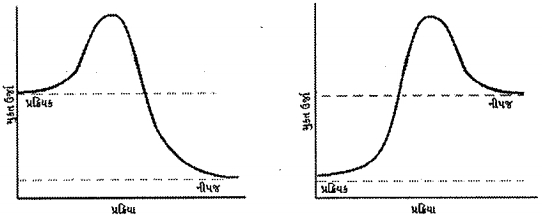
A
Endergonic process,Endergonic process
B
Endergonic process,Exergonic process
C
Exergonic process,Exergonic process
D
Exergonic process,Endergonic process
Solution
(D) In the first graph,the energy level of the substrate (reactant) is higher than the energy level of the product. This indicates that energy is released during the reaction,which characterizes an Exergonic process.
In the second graph,the energy level of the substrate (reactant) is lower than the energy level of the product. This indicates that energy is absorbed during the reaction,which characterizes an Endergonic process.
Therefore,the correct sequence is Exergonic process,Endergonic process.
In the second graph,the energy level of the substrate (reactant) is lower than the energy level of the product. This indicates that energy is absorbed during the reaction,which characterizes an Endergonic process.
Therefore,the correct sequence is Exergonic process,Endergonic process.
0 likes
View Solution322
MediumMCQ
Arrange the steps of the biochemical reaction in sequence:
$I -$ Diffusion of the substrate towards the active site of the enzyme
$II -$ Formation of the transition state structure
$III -$ Release of the product from the active site
$IV -$ Breaking or formation of bonds
$I -$ Diffusion of the substrate towards the active site of the enzyme
$II -$ Formation of the transition state structure
$III -$ Release of the product from the active site
$IV -$ Breaking or formation of bonds
A
$I \rightarrow IV \rightarrow III \rightarrow II$
B
$IV \rightarrow I \rightarrow III \rightarrow II$
C
$I \rightarrow IV \rightarrow II \rightarrow III$
D
$I \rightarrow II \rightarrow IV \rightarrow III$
Solution
(D) The catalytic cycle of an enzyme action can be described in the following steps:
$1$. First,the substrate binds to the active site of the enzyme,fitting into the active site $(I)$.
$2$. The binding of the substrate induces the enzyme to alter its shape,fitting more tightly around the substrate,leading to the formation of the transition state structure $(II)$.
$3$. The active site of the enzyme,now in close proximity to the substrate,breaks the chemical bonds of the substrate and the new enzyme-product complex is formed $(IV)$.
$4$. The enzyme releases the products of the reaction and the free enzyme is ready to bind to another molecule of the substrate $(III)$.
Therefore,the correct sequence is $I \rightarrow II \rightarrow IV \rightarrow III$.
$1$. First,the substrate binds to the active site of the enzyme,fitting into the active site $(I)$.
$2$. The binding of the substrate induces the enzyme to alter its shape,fitting more tightly around the substrate,leading to the formation of the transition state structure $(II)$.
$3$. The active site of the enzyme,now in close proximity to the substrate,breaks the chemical bonds of the substrate and the new enzyme-product complex is formed $(IV)$.
$4$. The enzyme releases the products of the reaction and the free enzyme is ready to bind to another molecule of the substrate $(III)$.
Therefore,the correct sequence is $I \rightarrow II \rightarrow IV \rightarrow III$.
0 likes
View Solution323
MediumMCQ
Activation energy $ = .......... $
A
Energy of transition state $ - $ Energy of reactants
B
Energy of transition state $ - $ Energy of products
C
Energy of transition state $ + $ Energy of reactants
D
Energy of transition state $ + $ Energy of products
Solution
(A) Activation energy $(E_a)$ is defined as the minimum amount of extra energy required by a reactant molecule to get converted into the product.
In a chemical reaction, the reactants must reach a high-energy state known as the transition state (or activated complex) before they can form products.
The activation energy is calculated as the difference between the energy of the transition state and the average energy of the reactants.
Mathematically, $E_a = \text{Energy of transition state} - \text{Energy of reactants}$.
In a chemical reaction, the reactants must reach a high-energy state known as the transition state (or activated complex) before they can form products.
The activation energy is calculated as the difference between the energy of the transition state and the average energy of the reactants.
Mathematically, $E_a = \text{Energy of transition state} - \text{Energy of reactants}$.
0 likes
View Solution324
MediumMCQ
Select the incorrect option regarding enzymes.
A
Enzymes increase the rate of biochemical reactions.
B
The pocket present in the structure of an enzyme is called the active site.
C
Most enzymes are polymers of amino acids.
D
Enzymes increase the activation energy level during biochemical reactions.
Solution
(D) Enzymes are biocatalysts that accelerate the rate of biochemical reactions by lowering the activation energy required for the reaction to proceed.
Option $A$ is correct as enzymes increase the reaction rate.
Option $B$ is correct as the active site is a specific pocket or cleft in the enzyme structure where the substrate binds.
Option $C$ is correct as most enzymes are proteins,which are polymers of amino acids.
Option $D$ is incorrect because enzymes function by decreasing,not increasing,the activation energy level of the reaction.
Option $A$ is correct as enzymes increase the reaction rate.
Option $B$ is correct as the active site is a specific pocket or cleft in the enzyme structure where the substrate binds.
Option $C$ is correct as most enzymes are proteins,which are polymers of amino acids.
Option $D$ is incorrect because enzymes function by decreasing,not increasing,the activation energy level of the reaction.
0 likes
View Solution325
MediumMCQ
Arrange the following steps of enzyme action in the correct order:
$I - E + P$
$II - ES$ complex
$III - EP$ complex
$IV - E + S$
$I - E + P$
$II - ES$ complex
$III - EP$ complex
$IV - E + S$
A
$II \rightarrow IV \rightarrow II \rightarrow III$
B
$IV \rightarrow I \rightarrow II \rightarrow III$
C
$IV \rightarrow II \rightarrow III \rightarrow I$
D
$I \rightarrow III \rightarrow II \rightarrow IV$
Solution
(C) The mechanism of enzyme action follows these steps:
$1$. The enzyme $(E)$ binds with the substrate $(S)$ to form the enzyme-substrate complex $(ES)$: $E + S \rightarrow ES$ $(IV \rightarrow II)$.
$2$. The enzyme converts the substrate into the product,forming the enzyme-product complex $(EP)$: $ES \rightarrow EP$ $(II \rightarrow III)$.
$3$. The enzyme releases the product and becomes free to bind with another substrate molecule: $EP \rightarrow E + P$ $(III \rightarrow I)$.
Therefore,the correct sequence is $IV \rightarrow II \rightarrow III \rightarrow I$.
$1$. The enzyme $(E)$ binds with the substrate $(S)$ to form the enzyme-substrate complex $(ES)$: $E + S \rightarrow ES$ $(IV \rightarrow II)$.
$2$. The enzyme converts the substrate into the product,forming the enzyme-product complex $(EP)$: $ES \rightarrow EP$ $(II \rightarrow III)$.
$3$. The enzyme releases the product and becomes free to bind with another substrate molecule: $EP \rightarrow E + P$ $(III \rightarrow I)$.
Therefore,the correct sequence is $IV \rightarrow II \rightarrow III \rightarrow I$.
0 likes
View Solution326
MediumMCQ
In the given graph representing enzyme kinetics (Michaelis-Menten kinetics),what does $P$ represent?
A
$pH$
B
$\frac{K_m}{2}$
C
$\frac{1}{2} V_{max}$
D
$K_m$
Solution
(C) The graph represents the relationship between substrate concentration $[S]$ and reaction velocity $V$.
In Michaelis-Menten kinetics,$V_{max}$ is the maximum velocity of the reaction.
$K_m$ (Michaelis constant) is defined as the substrate concentration at which the reaction velocity is half of its maximum value $(V = \frac{1}{2} V_{max})$.
In the standard plot of $V$ versus $[S]$,the point $P$ on the $y$-axis corresponds to half of the maximum velocity,which is $\frac{1}{2} V_{max}$.
In Michaelis-Menten kinetics,$V_{max}$ is the maximum velocity of the reaction.
$K_m$ (Michaelis constant) is defined as the substrate concentration at which the reaction velocity is half of its maximum value $(V = \frac{1}{2} V_{max})$.
In the standard plot of $V$ versus $[S]$,the point $P$ on the $y$-axis corresponds to half of the maximum velocity,which is $\frac{1}{2} V_{max}$.
0 likes
View Solution327
EasyMCQ
The protein part of an enzyme is called .......
A
Apoenzyme
B
Cofactor
C
Prosthetic group
D
All of the above
Solution
(A) An enzyme is often composed of a protein portion and a non-protein portion.
The protein portion of an enzyme is known as the $Apoenzyme$.
The non-protein portion is referred to as the $Cofactor$.
When the $Apoenzyme$ and $Cofactor$ combine,they form the active enzyme known as the $Holoenzyme$.
The protein portion of an enzyme is known as the $Apoenzyme$.
The non-protein portion is referred to as the $Cofactor$.
When the $Apoenzyme$ and $Cofactor$ combine,they form the active enzyme known as the $Holoenzyme$.
0 likes
View Solution328
EasyMCQ
Digestive enzymes are included in which of the following classes?
A
Oxidoreductases
B
Transferases
C
Hydrolases
D
Lyases
Solution
(C) Digestive enzymes catalyze the breakdown of complex food molecules into simpler forms by adding water molecules to the chemical bonds. This process is known as hydrolysis. Therefore,digestive enzymes belong to the class of enzymes called Hydrolases.
0 likes
View Solution329
EasyMCQ
What is another name for the class of enzymes known as synthetases?
A
Dehydrogenases
B
Transferases
C
Lyases
D
Ligases
Solution
(D) The enzymes that catalyze the linking together of two compounds are known as ligases. These enzymes are also commonly referred to as synthetases because they facilitate the synthesis of new molecules by joining two substrates together,typically coupled with the hydrolysis of $ATP$ or a similar triphosphate.
0 likes
View Solution330
MediumMCQ
The enzyme $Lactate \text{ } Dehydrogenase$ belongs to which class of enzymes?
A
Dehydrogenases
B
Transferases
C
Lyases
D
Ligases
Solution
(A) Enzymes are classified into six main classes based on the type of reaction they catalyze.
$Lactate \text{ } Dehydrogenase$ catalyzes the oxidation-reduction reaction where $Lactate$ is converted to $Pyruvate$ by removing hydrogen atoms.
According to the International Union of Biochemistry and Molecular Biology $(IUBMB)$, enzymes that catalyze oxidation-reduction reactions are classified as $Oxidoreductases$ (or $Dehydrogenases$).
Therefore, $Lactate \text{ } Dehydrogenase$ belongs to the class of $Dehydrogenases$ (a subclass of $Oxidoreductases$).
$Lactate \text{ } Dehydrogenase$ catalyzes the oxidation-reduction reaction where $Lactate$ is converted to $Pyruvate$ by removing hydrogen atoms.
According to the International Union of Biochemistry and Molecular Biology $(IUBMB)$, enzymes that catalyze oxidation-reduction reactions are classified as $Oxidoreductases$ (or $Dehydrogenases$).
Therefore, $Lactate \text{ } Dehydrogenase$ belongs to the class of $Dehydrogenases$ (a subclass of $Oxidoreductases$).
0 likes
View Solution331
MediumMCQ
Enzymes that catalyze the breakdown of organic compounds in the presence of water are included in which class?
A
Dehydrogenases
B
Transferases
C
Hydrolases
D
Ligases
Solution
(C) Enzymes are classified into six main classes based on the type of reaction they catalyze.
$1$. Hydrolases are enzymes that catalyze the hydrolysis (breakdown) of bonds such as $C-O, C-N, C-C$,etc.,by the addition of water.
$2$. Dehydrogenases catalyze oxidation-reduction reactions.
$3$. Transferases catalyze the transfer of a group between two substrates.
$4$. Ligases catalyze the joining of two compounds.
Therefore,the correct class for enzymes that break down compounds in the presence of water is Hydrolases.
$1$. Hydrolases are enzymes that catalyze the hydrolysis (breakdown) of bonds such as $C-O, C-N, C-C$,etc.,by the addition of water.
$2$. Dehydrogenases catalyze oxidation-reduction reactions.
$3$. Transferases catalyze the transfer of a group between two substrates.
$4$. Ligases catalyze the joining of two compounds.
Therefore,the correct class for enzymes that break down compounds in the presence of water is Hydrolases.
0 likes
View Solution332
MediumMCQ
What type of enzymes are used in the process of digestion?
A
Oxidoreductases
B
Transferases
C
Hydrolases
D
Isomerases
Solution
(C) Digestion involves the breakdown of complex macromolecules (like proteins,carbohydrates,and fats) into simpler absorbable forms by the addition of water.
This reaction is catalyzed by enzymes that break chemical bonds using water,which are classified as Hydrolases.
Therefore,digestive enzymes such as amylases,proteases,and lipases belong to the class of Hydrolases.
This reaction is catalyzed by enzymes that break chemical bonds using water,which are classified as Hydrolases.
Therefore,digestive enzymes such as amylases,proteases,and lipases belong to the class of Hydrolases.
0 likes
View Solution333
MediumMCQ
Which of the following acts as an enzyme?
A
Protein
B
$RNA$
C
$DNA$
D
Both $A$ and $B$
Solution
(D) Most enzymes are proteins in nature. However,certain $RNA$ molecules,known as ribozymes,possess catalytic activity and act as enzymes. For example,$23S$ $rRNA$ in bacteria acts as a ribozyme during peptide bond formation. Therefore,both proteins and $RNA$ can act as enzymes.
0 likes
View Solution334
MediumMCQ
In the enzyme which catalyses the breakdown of:
$H_2O_2 \rightarrow H_2O + O_2$
the prosthetic group is:
$H_2O_2 \rightarrow H_2O + O_2$
the prosthetic group is:
A
Nicotinamide adenine dinucleotide
B
Haem
C
Zinc
D
Niacin
Solution
(B) The reaction $2H_2O_2 \rightarrow 2H_2O + O_2$ is catalyzed by the enzyme catalase.
Catalase is a conjugated protein that requires a prosthetic group to function.
The prosthetic group present in catalase is $Haem$ (an iron-containing porphyrin ring).
Therefore,the correct option is $B$.
Catalase is a conjugated protein that requires a prosthetic group to function.
The prosthetic group present in catalase is $Haem$ (an iron-containing porphyrin ring).
Therefore,the correct option is $B$.
0 likes
View Solution335
MediumMCQ
Malonate inhibits the growth of pathogenic bacteria by inhibiting the activity of
A
Dinitrogenase
B
Succinic dehydrogenase
C
Amylase
D
Lipase
Solution
(B) Option $B$ is the correct answer because malonate is a competitive inhibitor of the enzyme succinate dehydrogenase.
Inhibition of succinate dehydrogenase by malonate occurs due to the close structural resemblance between malonate and the substrate succinate.
Competitive inhibitors are often used in the control of bacterial pathogens.
Inhibition of succinate dehydrogenase by malonate occurs due to the close structural resemblance between malonate and the substrate succinate.
Competitive inhibitors are often used in the control of bacterial pathogens.
0 likes
View Solution336
MediumMCQ
Inhibition of Succinic dehydrogenase enzyme by malonate is a classical example of.
A
Feedback inhibition
B
Competitive inhibition
C
Enzyme activation
D
Cofactor inhibition
Solution
(B) The correct answer is option $B$ because malonate shows close structural similarity with the substrate (succinate) and it competes with the substrate for the active site of the enzyme succinic dehydrogenase.
This type of inhibition,where the inhibitor resembles the substrate in molecular structure and binds to the active site,is known as competitive inhibition.
Options $A$,$C$,and $D$ are incorrect because they do not describe the mechanism where an inhibitor competes with the substrate due to structural similarity.
This type of inhibition,where the inhibitor resembles the substrate in molecular structure and binds to the active site,is known as competitive inhibition.
Options $A$,$C$,and $D$ are incorrect because they do not describe the mechanism where an inhibitor competes with the substrate due to structural similarity.
0 likes
View Solution337
MediumMCQ
Match List $I$ with List $II$ :
Choose the correct answer from the options given below :
| List $I$ | List $II$ |
| $A.$ Lipase | $I.$ Peptide bond |
| $B.$ Nuclease | $II.$ Ester bond |
| $C.$ Protease | $III.$ Glycosidic bond |
| $D.$ Amylase | $IV.$ Phosphodiester bond |
Choose the correct answer from the options given below :
A
$A-III, B-II, C-I, D-IV$
B
$A-II, B-IV, C-I, D-III$
C
$A-IV, B-I, C-III, D-II$
D
$A-IV, B-II, C-III, D-I$
Solution
(B) The correct matching is as follows:
Therefore,the correct sequence is $A-II, B-IV, C-I, D-III$,which corresponds to option $B$.
| $A.$ Lipase | $II.$ Ester bond (Digests lipids) |
| $B.$ Nuclease | $IV.$ Phosphodiester bond (Digests nucleic acids) |
| $C.$ Protease | $I.$ Peptide bond (Digests proteins) |
| $D.$ Amylase | $III.$ Glycosidic bond (Digests carbohydrates/starch) |
Therefore,the correct sequence is $A-II, B-IV, C-I, D-III$,which corresponds to option $B$.
0 likes
View Solution338
MediumMCQ
Regarding the catalytic cycle of an enzyme action,select the correct sequential steps:
$A$. Substrate-enzyme complex formation.
$B$. Free enzyme ready to bind with another substrate.
$C$. Release of products.
$D$. Chemical bonds of the substrate broken.
$E$. Substrate binding to active site.
Choose the correct answer from the options given below:
$A$. Substrate-enzyme complex formation.
$B$. Free enzyme ready to bind with another substrate.
$C$. Release of products.
$D$. Chemical bonds of the substrate broken.
$E$. Substrate binding to active site.
Choose the correct answer from the options given below:
A
$A, E, B, D, C$
B
$B, A, C, D, E$
C
$E, D, C, B, A$
D
$E, A, D, C, B$
Solution
(D) The correct sequence of the catalytic cycle of an enzyme is as follows:
$(1)$ First,the substrate binds to the active site of the enzyme $(E)$.
$(2)$ This leads to the formation of the enzyme-substrate complex $(A)$.
$(3)$ The active site of the enzyme,now in close proximity to the substrate,breaks the chemical bonds of the substrate,forming the enzyme-product complex $(D)$.
$(4)$ The enzyme then releases the products of the reaction $(C)$.
$(5)$ Finally,the free enzyme is ready to bind to another molecule of the substrate to repeat the catalytic cycle $(B)$.
Thus,the correct order is $E, A, D, C, B$.
$(1)$ First,the substrate binds to the active site of the enzyme $(E)$.
$(2)$ This leads to the formation of the enzyme-substrate complex $(A)$.
$(3)$ The active site of the enzyme,now in close proximity to the substrate,breaks the chemical bonds of the substrate,forming the enzyme-product complex $(D)$.
$(4)$ The enzyme then releases the products of the reaction $(C)$.
$(5)$ Finally,the free enzyme is ready to bind to another molecule of the substrate to repeat the catalytic cycle $(B)$.
Thus,the correct order is $E, A, D, C, B$.
0 likes
View Solution339
MediumMCQ
Name the class of enzyme that usually catalyzes the following reaction:
$S-G + S^* \rightarrow S + S^*-G$
Where,
$G \rightarrow$ a group other than hydrogen
$S \rightarrow$ a substrate
$S^* \rightarrow$ another substrate
$S-G + S^* \rightarrow S + S^*-G$
Where,
$G \rightarrow$ a group other than hydrogen
$S \rightarrow$ a substrate
$S^* \rightarrow$ another substrate
A
Hydrolase
B
Lyase
C
Transferase
D
Ligase
Solution
(C) The reaction $S-G + S^* \rightarrow S + S^*-G$ involves the transfer of a functional group $G$ from one substrate $S$ to another substrate $S^*$.
Enzymes that catalyze the transfer of a group other than hydrogen between a pair of substrates are classified as Transferases.
Therefore,the correct class of enzyme is Transferase.
Enzymes that catalyze the transfer of a group other than hydrogen between a pair of substrates are classified as Transferases.
Therefore,the correct class of enzyme is Transferase.
0 likes
View Solution340
EasyMCQ
The protein portion of an enzyme is called:
A
Cofactor
B
Coenzyme
C
Apoenzyme
D
Prosthetic group
Solution
(C) An enzyme is often composed of a protein part and a non-protein part.
The protein portion of an enzyme is known as the $Apoenzyme$.
The non-protein part is called the $Cofactor$.
When the $Apoenzyme$ and $Cofactor$ combine,they form the active enzyme known as the $Holoenzyme$.
Therefore,the correct answer is $Apoenzyme$.
The protein portion of an enzyme is known as the $Apoenzyme$.
The non-protein part is called the $Cofactor$.
When the $Apoenzyme$ and $Cofactor$ combine,they form the active enzyme known as the $Holoenzyme$.
Therefore,the correct answer is $Apoenzyme$.
0 likes
View Solution341
EasyMCQ
Which of the following enzymes catalyzes the joining of $C-S$ bonds?
A
Transferases
B
Oxidoreductases
C
Lyases
D
Ligases
Solution
(D) Enzymes are classified into six major classes based on the type of reaction they catalyze.
Ligases are the enzymes that catalyze the linking together of two compounds,such as $C-O$,$C-S$,$C-N$,or $P-O$ bonds.
Therefore,the enzyme that catalyzes the joining of $C-S$ bonds is a Ligase.
Ligases are the enzymes that catalyze the linking together of two compounds,such as $C-O$,$C-S$,$C-N$,or $P-O$ bonds.
Therefore,the enzyme that catalyzes the joining of $C-S$ bonds is a Ligase.
0 likes
View Solution342
MediumMCQ
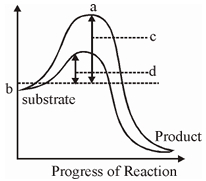
The figure given shows the conversion of substrate into product by an enzyme. In which one of the four options,the components of the reaction labelled $a, b, c, \& \ d$ are identified correctly?
$(i)$ Potential energy
(ii) Transition state
(iii) Activation energy with enzyme
(iv) Activation energy without enzyme
$(i)$ Potential energy
(ii) Transition state
(iii) Activation energy with enzyme
(iv) Activation energy without enzyme
A
$a-ii, b-i, c-iii, d-iv$
B
$a-ii, b-i, c-iv, d-iii$
C
$a-i, b-ii, c-iii, d-iv$
D
$a-i, b-ii, c-iv, d-iii$
Solution
(D) In the given graph representing the progress of an enzymatic reaction:
$1$. The $y$-axis represents the potential energy of the molecules. Thus,$a$ corresponds to $(i)$ Potential energy.
$2$. The peak of the curve represents the transition state of the reaction. Thus,$b$ corresponds to (ii) Transition state.
$3$. The activation energy is the energy required to reach the transition state from the substrate level. The curve with the higher peak represents the reaction without an enzyme,and the curve with the lower peak represents the reaction with an enzyme.
$4$. Therefore,$c$ represents the activation energy without enzyme (iv),and $d$ represents the activation energy with enzyme (iii).
$5$. Matching these: $a-(i), b-(ii), c-(iv), d-(iii)$. This corresponds to option $D$.
$1$. The $y$-axis represents the potential energy of the molecules. Thus,$a$ corresponds to $(i)$ Potential energy.
$2$. The peak of the curve represents the transition state of the reaction. Thus,$b$ corresponds to (ii) Transition state.
$3$. The activation energy is the energy required to reach the transition state from the substrate level. The curve with the higher peak represents the reaction without an enzyme,and the curve with the lower peak represents the reaction with an enzyme.
$4$. Therefore,$c$ represents the activation energy without enzyme (iv),and $d$ represents the activation energy with enzyme (iii).
$5$. Matching these: $a-(i), b-(ii), c-(iv), d-(iii)$. This corresponds to option $D$.
0 likes
View Solution343
MediumMCQ
Enzymes,which catalyse the joining of $C-O, C-S, C-N, P-O$ etc. bonds,are included in which of the following classes?
A
Oxidoreductases
B
Ligases
C
Isomerases
D
Lyases
Solution
(B) Enzymes are classified into six major classes based on the type of reaction they catalyse.
$1$. Oxidoreductases: Catalyse oxidation-reduction reactions.
$2$. Transferases: Catalyse the transfer of a group between substrates.
$3$. Hydrolases: Catalyse the hydrolysis of ester,ether,peptide,or glycosidic bonds.
$4$. Lyases: Catalyse the removal of groups from substrates by mechanisms other than hydrolysis,leaving double bonds.
$5$. Isomerases: Catalyse the interconversion of optical,geometric,or positional isomers.
$6$. Ligases: Catalyse the linking together of two compounds,such as joining $C-O, C-S, C-N, P-O$ etc. bonds.
Therefore,the correct class is Ligases.
$1$. Oxidoreductases: Catalyse oxidation-reduction reactions.
$2$. Transferases: Catalyse the transfer of a group between substrates.
$3$. Hydrolases: Catalyse the hydrolysis of ester,ether,peptide,or glycosidic bonds.
$4$. Lyases: Catalyse the removal of groups from substrates by mechanisms other than hydrolysis,leaving double bonds.
$5$. Isomerases: Catalyse the interconversion of optical,geometric,or positional isomers.
$6$. Ligases: Catalyse the linking together of two compounds,such as joining $C-O, C-S, C-N, P-O$ etc. bonds.
Therefore,the correct class is Ligases.
0 likes
View Solution344
MediumMCQ
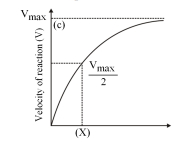
In the graphical representation of Michaelis-Menten kinetics,$X$ represents:
A
Concentration of substrate at which the rate of reaction is $\frac{1}{2} V_{\text{max}}$
B
Concentration of enzyme-substrate complex at which the rate of reaction is $\frac{1}{2} V_{\text{max}}$
C
Concentration of product at which the rate of reaction is $\frac{1}{2} V_{\text{max}}$
D
Concentration of enzyme at which the rate of reaction is $\frac{1}{2} V_{\text{max}}$
Solution
(A) The Michaelis-Menten equation describes the rate of enzymatic reactions by relating the reaction rate $V$ to the substrate concentration $[S]$.
The equation is given by: $V = \frac{V_{\text{max}}[S]}{K_m + [S]}$.
In this equation,$K_m$ (the Michaelis constant) is defined as the substrate concentration at which the reaction rate is exactly half of the maximum velocity $(V_{\text{max}})$.
Looking at the provided graph,the x-axis represents the substrate concentration $[S]$.
The point $X$ on the x-axis corresponds to the velocity $\frac{V_{\text{max}}}{2}$ on the y-axis.
Therefore,$X$ represents the Michaelis constant $(K_m)$,which is the substrate concentration at which the reaction rate is $\frac{1}{2} V_{\text{max}}$.
The equation is given by: $V = \frac{V_{\text{max}}[S]}{K_m + [S]}$.
In this equation,$K_m$ (the Michaelis constant) is defined as the substrate concentration at which the reaction rate is exactly half of the maximum velocity $(V_{\text{max}})$.
Looking at the provided graph,the x-axis represents the substrate concentration $[S]$.
The point $X$ on the x-axis corresponds to the velocity $\frac{V_{\text{max}}}{2}$ on the y-axis.
Therefore,$X$ represents the Michaelis constant $(K_m)$,which is the substrate concentration at which the reaction rate is $\frac{1}{2} V_{\text{max}}$.
0 likes
View Solution345
MediumMCQ
An enzyme obtained from an animal source has been classified by the Enzyme Commission and allocated its unique four-digit number $1.2.1.4$. To which of the following classes does it belong?
A
Lyase
B
Hydrolase
C
Dehydrogenase
D
Isomerase
Solution
(C) The Enzyme Commission $(EC)$ classifies enzymes into six major classes based on the type of reaction they catalyze.
The first digit of the $EC$ number represents the class:
$1.$ Oxidoreductases
$2.$ Transferases
$3.$ Hydrolases
$4.$ Lyases
$5.$ Isomerases
$6.$ Ligases
In the given $EC$ number $1.2.1.4$,the first digit is $1$,which corresponds to the class Oxidoreductases.
Dehydrogenases are a sub-type of Oxidoreductases that catalyze the removal of hydrogen atoms from a substrate.
Therefore,the enzyme belongs to the class of Dehydrogenases.
The first digit of the $EC$ number represents the class:
$1.$ Oxidoreductases
$2.$ Transferases
$3.$ Hydrolases
$4.$ Lyases
$5.$ Isomerases
$6.$ Ligases
In the given $EC$ number $1.2.1.4$,the first digit is $1$,which corresponds to the class Oxidoreductases.
Dehydrogenases are a sub-type of Oxidoreductases that catalyze the removal of hydrogen atoms from a substrate.
Therefore,the enzyme belongs to the class of Dehydrogenases.
0 likes
View Solution346
EasyMCQ
Enzymes that catalyse the removal of groups of atoms from substrate molecules,other than by hydrolysis,leaving double bonds are -
A
transferases
B
ligases
C
hydrolases
D
lyases
Solution
(D) $1$. Transferases shift functional groups from one molecule to another.
$2$. Ligases join two large molecules using the energy obtained from the hydrolysis of an energy-rich compound like $ATP$ or $GTP$.
$3$. Hydrolases use water to break bonds.
$4$. Lyases are enzymes that catalyse the removal of groups of atoms from substrates by mechanisms other than hydrolysis,leaving double bonds.
$2$. Ligases join two large molecules using the energy obtained from the hydrolysis of an energy-rich compound like $ATP$ or $GTP$.
$3$. Hydrolases use water to break bonds.
$4$. Lyases are enzymes that catalyse the removal of groups of atoms from substrates by mechanisms other than hydrolysis,leaving double bonds.
0 likes
View Solution347
EasyMCQ
Given below are the statements regarding enzymes. Choose the correct statements.
$i$. All enzymes are proteinaceous.
$ii$. Enzyme becomes more active at the temperature of $60^{\circ}C$ to $70^{\circ}C$.
$iii$. Enzymes have one or two active sites where substrate binds with the enzyme.
$iv$. Any increase or decrease in specific $pH$,enzyme activity is always enhanced.
$v$. Enzymes remain active to catalyze again after completion of first reaction.
$i$. All enzymes are proteinaceous.
$ii$. Enzyme becomes more active at the temperature of $60^{\circ}C$ to $70^{\circ}C$.
$iii$. Enzymes have one or two active sites where substrate binds with the enzyme.
$iv$. Any increase or decrease in specific $pH$,enzyme activity is always enhanced.
$v$. Enzymes remain active to catalyze again after completion of first reaction.
A
$ii$ and $iv$ only
B
$i$ and $v$ only
C
$i, iii$ and $v$ only
D
$ii, iii$ and $v$ only
Solution
(C) $i$. Most enzymes are proteinaceous in nature,except for ribozymes ($RNA$ enzymes).
$ii$. Enzymes are generally denatured at high temperatures like $60^{\circ}C$ to $70^{\circ}C$,leading to a loss of activity.
$iii$. Enzymes possess specific active sites where the substrate binds to form the enzyme-substrate complex.
$iv$. Enzymes function optimally at a specific $pH$. Any significant increase or decrease in $pH$ from this optimum value leads to a decrease in enzyme activity,not an enhancement.
$v$. Enzymes are not consumed in the reaction; they remain active and can catalyze subsequent reactions after the first one is completed.
Therefore,statements $i, iii,$ and $v$ are correct.
$ii$. Enzymes are generally denatured at high temperatures like $60^{\circ}C$ to $70^{\circ}C$,leading to a loss of activity.
$iii$. Enzymes possess specific active sites where the substrate binds to form the enzyme-substrate complex.
$iv$. Enzymes function optimally at a specific $pH$. Any significant increase or decrease in $pH$ from this optimum value leads to a decrease in enzyme activity,not an enhancement.
$v$. Enzymes are not consumed in the reaction; they remain active and can catalyze subsequent reactions after the first one is completed.
Therefore,statements $i, iii,$ and $v$ are correct.
0 likes
View Solution348
EasyMCQ
Match the types of enzymes in Column-$I$ with examples in Column-$II$ and select the correct option.
| Column $I$ | Column $II$ |
| $i$. Purely proteinaceous enzyme | $a$. Glucokinase |
| $ii$. Conjugated enzyme | $b$. Epimerase |
| $iii$. Transferase enzyme | $c$. Protease |
| $iv$. Isomerase enzyme | $d$. $FMN$ |
A
$i-a, ii-b, iii-c, iv-d$
B
$i-b, ii-a, iii-c, iv-d$
C
$i-c, ii-d, iii-a, iv-b$
D
$i-c, ii-d, iii-b, iv-a$
Solution
(C) The correct matching is as follows:
$1$. Purely proteinaceous enzymes are made entirely of amino acids. Protease is an example of such an enzyme $(i-c)$.
$2$. Conjugated enzymes (holoenzymes) consist of a protein part (apoenzyme) and a non-protein part (cofactor/coenzyme). $FMN$ (Flavin mononucleotide) acts as a coenzyme in such systems $(ii-d)$.
$3$. Transferase enzymes catalyze the transfer of a functional group from one molecule to another. Glucokinase is a transferase that transfers a phosphate group from $ATP$ to glucose $(iii-a)$.
$4$. Isomerase enzymes catalyze structural changes within a molecule. Epimerase is an isomerase that catalyzes the interconversion of epimers $(iv-b)$.
Therefore,the correct sequence is $i-c, ii-d, iii-a, iv-b$.
$1$. Purely proteinaceous enzymes are made entirely of amino acids. Protease is an example of such an enzyme $(i-c)$.
$2$. Conjugated enzymes (holoenzymes) consist of a protein part (apoenzyme) and a non-protein part (cofactor/coenzyme). $FMN$ (Flavin mononucleotide) acts as a coenzyme in such systems $(ii-d)$.
$3$. Transferase enzymes catalyze the transfer of a functional group from one molecule to another. Glucokinase is a transferase that transfers a phosphate group from $ATP$ to glucose $(iii-a)$.
$4$. Isomerase enzymes catalyze structural changes within a molecule. Epimerase is an isomerase that catalyzes the interconversion of epimers $(iv-b)$.
Therefore,the correct sequence is $i-c, ii-d, iii-a, iv-b$.
0 likes
View Solution349
EasyMCQ
The enzymes which act within the cell in which they are synthesized are called . . . . . . .
A
apoenzymes
B
coenzymes
C
endoenzymes
D
exoenzymes
Solution
(C) Enzymes are classified based on their site of action into two types: endoenzymes and exoenzymes.
$1$. Endoenzymes: These are enzymes that function within the cell in which they are synthesized. They catalyze intracellular metabolic reactions.
$2$. Exoenzymes: These are enzymes that are secreted by the cell and function outside the cell in which they are synthesized (e.g.,digestive enzymes).
Therefore,the correct term for enzymes acting within the cell is endoenzymes.
$1$. Endoenzymes: These are enzymes that function within the cell in which they are synthesized. They catalyze intracellular metabolic reactions.
$2$. Exoenzymes: These are enzymes that are secreted by the cell and function outside the cell in which they are synthesized (e.g.,digestive enzymes).
Therefore,the correct term for enzymes acting within the cell is endoenzymes.
0 likes
View Solution350
EasyMCQ
Identify the $INCORRECT$ statement with reference to enzymes.
A
Lock and key analogy for enzyme action is proposed by Emil Fischer.
B
Induced Fit model for enzyme action is proposed by Koshland.
C
Increase in substrate concentration decreases the velocity of enzyme activity.
D
Protease is a purely proteinaceous enzyme.
Solution
(C) An increase in substrate concentration generally leads to an increase in the velocity of enzyme activity until a certain point,called the saturation point,where all enzyme molecules are occupied. This is known as the saturation kinetics of enzyme activity. Therefore,the statement that an increase in substrate concentration decreases the velocity of enzyme activity is incorrect.
0 likes
View SolutionBiomolecules — Enzymes · Frequently Asked Questions
1Are these Biomolecules questions useful for JEE and NEET?
Yes. All questions in this section are mapped to JEE Main and NEET exam patterns. Previous year questions from JEE Main, NEET, GUJCET and state-level exams are included with full solutions.
2Can I switch to Hindi or Gujarati for these questions?
Yes. Use the language tabs in the hero section or the sidebar to view the same questions and solutions in English, Hindi or Gujarati.
3How do I generate a question paper from this subtopic?
Use the Vedclass Exam Paper Generator — select the chapter and subtopic, set difficulty, and generate Sets A, B, C, D automatically. First 3 chapters of every subject are free.
Vedclass Products
For Students
Vedclass Test Series
Mock tests in real JEE/NEET style with performance analysis. 5-day free trial.
Start Free TrialFor Teachers
Exam Paper Generator
Generate Set A/B/C/D papers from this chapter in 2 minutes. 3 chapters free.
Try FreeFor Institutes
Online Exam Module
Live online exams with unlimited students, 360° analytics & white-label branding.
See DemoFor Teachers & Institutes
Generate a Biomolecules Exam Paper in 2 Minutes
Select subtopic & difficulty — Sets A, B, C, D auto-generated with No Repeat logic.
First 3 chapters of every subject are free — no payment required.