
A English
Enzymes Questions in English
Class 11 Biology · Biomolecules · Enzymes
358+
Questions
English
Language
100%
With Solutions
Showing 50 of 358 questions in English
251
MediumMCQ
Enzymes which catalyse oxidoreduction between two substrates $S$ and $S'$ are known as:
A
Hydrolases
B
Lyases
C
Oxidoreductases
D
Transferases
Solution
(C) Enzymes are classified into six classes based on the type of reaction they catalyse.
$1$. Oxidoreductases/Dehydrogenases: These enzymes catalyse oxidoreduction between two substrates $S$ and $S'$ by transferring electrons or hydrogen atoms.
$2$. Transferases: These enzymes catalyse the transfer of a group,other than hydrogen,between a pair of substrates.
$3$. Hydrolases: These enzymes catalyse the hydrolysis of ester,ether,peptide,glycosidic,$C$-$C$,$C$-halide,or $P$-$N$ bonds.
$4$. Lyases: These enzymes catalyse the removal of groups from substrates by mechanisms other than hydrolysis,leaving double bonds.
Therefore,the correct answer is Oxidoreductases.
$1$. Oxidoreductases/Dehydrogenases: These enzymes catalyse oxidoreduction between two substrates $S$ and $S'$ by transferring electrons or hydrogen atoms.
$2$. Transferases: These enzymes catalyse the transfer of a group,other than hydrogen,between a pair of substrates.
$3$. Hydrolases: These enzymes catalyse the hydrolysis of ester,ether,peptide,glycosidic,$C$-$C$,$C$-halide,or $P$-$N$ bonds.
$4$. Lyases: These enzymes catalyse the removal of groups from substrates by mechanisms other than hydrolysis,leaving double bonds.
Therefore,the correct answer is Oxidoreductases.
0 likes
View Solution252
MediumMCQ
Which bond is more revised in enzyme?
A
Glycosidic bond
B
Ester bond
C
Phosphodiester bond
D
Peptide bond
Solution
(D) The question asks about the bond most commonly involved in enzymatic reactions related to the structure of proteins. Enzymes are primarily composed of amino acids linked together by peptide bonds. In the context of protein structure and enzymatic activity,the peptide bond is the most frequently modified or 'revised' bond during the synthesis and degradation processes (such as proteolysis). Therefore,the peptide bond is the most relevant answer in the context of enzyme-catalyzed reactions involving proteins.
0 likes
View Solution253
MediumMCQ
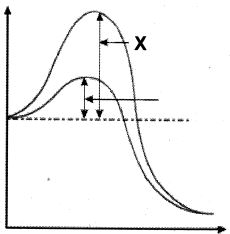
Identify $X$ in the figure below.
A
Potential energy
B
Transition state
C
Activation energy without enzyme
D
Activation energy with enzyme
Solution
(C) The provided graph represents the effect of an enzyme on the activation energy of a chemical reaction.
In this graph,the $y$-axis represents the potential energy of the reactants and products,while the $x$-axis represents the progress of the reaction.
The higher energy barrier represents the activation energy required for the reaction to proceed without the presence of an enzyme.
The lower energy barrier represents the activation energy required when an enzyme is present.
Since $X$ points to the larger energy gap between the ground state of the reactants and the peak of the uncatalyzed reaction curve,it represents the activation energy without an enzyme.
In this graph,the $y$-axis represents the potential energy of the reactants and products,while the $x$-axis represents the progress of the reaction.
The higher energy barrier represents the activation energy required for the reaction to proceed without the presence of an enzyme.
The lower energy barrier represents the activation energy required when an enzyme is present.
Since $X$ points to the larger energy gap between the ground state of the reactants and the peak of the uncatalyzed reaction curve,it represents the activation energy without an enzyme.
0 likes
View Solution254
MediumMCQ
$A$ high fever is dangerous to humans because
A
proteins are used up quickly
B
fats are oxidised
C
Enzymes are denatured
D
$BMR$ is higher
Solution
(C) Enzymes are biological catalysts that are primarily proteinaceous in nature.
These enzymes function optimally within a specific temperature range.
When the body temperature rises significantly during a high fever,the heat energy disrupts the weak hydrogen bonds and other non-covalent interactions that maintain the three-dimensional structure of the enzyme.
This process is known as denaturation,which causes the enzyme to lose its active site and,consequently,its catalytic activity.
Since most metabolic processes in the human body are enzyme-dependent,the denaturation of enzymes can lead to a failure of vital physiological functions,making a high fever dangerous.
These enzymes function optimally within a specific temperature range.
When the body temperature rises significantly during a high fever,the heat energy disrupts the weak hydrogen bonds and other non-covalent interactions that maintain the three-dimensional structure of the enzyme.
This process is known as denaturation,which causes the enzyme to lose its active site and,consequently,its catalytic activity.
Since most metabolic processes in the human body are enzyme-dependent,the denaturation of enzymes can lead to a failure of vital physiological functions,making a high fever dangerous.
0 likes
View Solution255
EasyMCQ
What are enzymes called that have slightly different molecular structures but are functionally identical?
A
Holoenzymes
B
Isoenzymes
C
Apoenzymes
D
Coenzymes
Solution
(B) Isoenzymes (or isozymes) are enzymes that differ in amino acid sequence and molecular structure but catalyze the same chemical reaction.
They often have different kinetic properties (such as different $K_m$ values) or are regulated differently.
For example,lactate dehydrogenase $(LDH)$ exists in different isoenzymic forms in various tissues.
They often have different kinetic properties (such as different $K_m$ values) or are regulated differently.
For example,lactate dehydrogenase $(LDH)$ exists in different isoenzymic forms in various tissues.
0 likes
View Solution256
MediumMCQ
What does an enzyme do?
A
Decreases the reaction time.
B
Increases the reaction time.
C
Increases the activation energy.
D
Decreases the activation energy.
Solution
(D) Enzymes are biological catalysts that speed up chemical reactions in living organisms.
They function by lowering the activation energy $(E_a)$ required for a reaction to proceed.
By reducing the energy barrier,more substrate molecules can reach the transition state at a given temperature,thereby increasing the rate of the reaction.
They function by lowering the activation energy $(E_a)$ required for a reaction to proceed.
By reducing the energy barrier,more substrate molecules can reach the transition state at a given temperature,thereby increasing the rate of the reaction.
0 likes
View Solution257
MediumMCQ
What is common among amylase,rennin,and trypsin?
A
They are all proteins.
B
They are all proteolytic enzymes.
C
They are all produced in the stomach.
D
They all function at a $pH$ less than $7$.
Solution
(A) All enzymes,including amylase,rennin,and trypsin,are proteins in nature. Enzymes are biological catalysts that speed up chemical reactions in living organisms,and their chemical structure is primarily composed of amino acid chains,making them proteins. While rennin and trypsin are proteolytic (protein-digesting) enzymes,amylase is a carbohydrate-digesting enzyme. Therefore,the only common feature among them is that they are all proteins.
0 likes
View Solution258
MediumMCQ
Which of the following statements is incorrect regarding Cytochrome $P450$?
A
It contains iron.
B
It is a colored cell.
C
It plays an important role in metabolism.
D
It is an enzyme involved in oxidation-reduction reactions.
Solution
(B) Cytochrome $P450$ $(CYP)$ is a large and diverse superfamily of hemoproteins (proteins containing a heme cofactor with an iron atom).
They function as monooxygenases and are primarily involved in the metabolism of drugs,toxins,and endogenous compounds in the liver and other tissues.
They are enzymes involved in oxidation-reduction reactions.
The term 'Cytochrome' refers to a pigment-containing protein,not a 'colored cell'. Therefore,the statement that it is a 'colored cell' is incorrect.
They function as monooxygenases and are primarily involved in the metabolism of drugs,toxins,and endogenous compounds in the liver and other tissues.
They are enzymes involved in oxidation-reduction reactions.
The term 'Cytochrome' refers to a pigment-containing protein,not a 'colored cell'. Therefore,the statement that it is a 'colored cell' is incorrect.
0 likes
View Solution259
MediumMCQ
Enzymatic activity is inhibited by which of the following?
A
End product
B
Substrate
C
Enzyme
D
Increase in temperature
Solution
(A) The phenomenon where the end product of a metabolic pathway inhibits the activity of an enzyme that catalyzes an earlier step in the pathway is known as feedback inhibition. This is a common regulatory mechanism in cells to maintain homeostasis and prevent the overproduction of metabolites. Therefore,the end product acts as an inhibitor.
0 likes
View Solution260
MediumMCQ
How is the rate of an enzymatic reaction increased?
A
By forming an enzyme-product complex.
B
By changing the equilibrium point of the reaction.
C
By binding and immediately forming the product.
D
By lowering the activation energy of the reaction.
Solution
(D) Enzymes are biological catalysts that accelerate chemical reactions.
They function by providing an alternative reaction pathway with a lower activation energy $(E_a)$.
By reducing the energy barrier that reactants must overcome to reach the transition state, a larger fraction of molecules can successfully convert into products at a given temperature.
Enzymes do not alter the equilibrium point of a reaction, nor do they change the overall free energy change $(\Delta G)$ of the reaction.
They function by providing an alternative reaction pathway with a lower activation energy $(E_a)$.
By reducing the energy barrier that reactants must overcome to reach the transition state, a larger fraction of molecules can successfully convert into products at a given temperature.
Enzymes do not alter the equilibrium point of a reaction, nor do they change the overall free energy change $(\Delta G)$ of the reaction.
0 likes
View Solution261
MediumMCQ
Hydrolytic enzymes that function at low $pH$ are known as -
A
Proteases
B
$\alpha -$ Amylase
C
Hydrolases
D
Peroxidases
Solution
(A) Hydrolytic enzymes that function at low $pH$ (acidic conditions) are typically classified as acid hydrolases.
Among the given options,proteases (specifically lysosomal proteases like cathepsins) are well-known to function optimally in acidic environments,such as within lysosomes.
While 'Hydrolases' is a broad class of enzymes that catalyze the hydrolysis of chemical bonds,the specific group that functions at low $pH$ is often referred to in the context of acid hydrolases,which include various proteases.
Among the given options,proteases (specifically lysosomal proteases like cathepsins) are well-known to function optimally in acidic environments,such as within lysosomes.
While 'Hydrolases' is a broad class of enzymes that catalyze the hydrolysis of chemical bonds,the specific group that functions at low $pH$ is often referred to in the context of acid hydrolases,which include various proteases.
0 likes
View Solution262
MediumMCQ
Which of the following is used to compare the catalytic efficiency of two different enzymes?
A
Rate of product formation
B
Constant value of $pH$
C
$K_m$ value
D
Molecular size of the enzyme
Solution
(C) The catalytic efficiency of an enzyme is often described by the $K_m$ value (Michaelis constant).
$K_m$ represents the substrate concentration at which the reaction rate is half of the maximum velocity $(V_{max}/2)$.
$A$ lower $K_m$ value indicates a higher affinity of the enzyme for its substrate,meaning the enzyme is more efficient at lower substrate concentrations.
Therefore,$K_m$ is a standard parameter used to compare the catalytic efficiency of different enzymes.
$K_m$ represents the substrate concentration at which the reaction rate is half of the maximum velocity $(V_{max}/2)$.
$A$ lower $K_m$ value indicates a higher affinity of the enzyme for its substrate,meaning the enzyme is more efficient at lower substrate concentrations.
Therefore,$K_m$ is a standard parameter used to compare the catalytic efficiency of different enzymes.
0 likes
View Solution263
MediumMCQ
Enzymes,vitamins,and hormones can be classified into a single category biologically because all of them $........$
A
help in the regulation of metabolism.
B
are synthesized in the body of a living organism.
C
are conjugated proteins.
D
maintain oxidative metabolism.
Solution
(A) Enzymes,vitamins,and hormones are all essential biological molecules that act as regulators of metabolic processes in living organisms.
$1$. Enzymes act as biological catalysts that speed up chemical reactions.
$2$. Vitamins act as co-factors or precursors for co-enzymes required for metabolic pathways.
$3$. Hormones act as chemical messengers that regulate physiological activities and metabolic rates.
Therefore,they are collectively classified as substances that help in the regulation of metabolism.
$1$. Enzymes act as biological catalysts that speed up chemical reactions.
$2$. Vitamins act as co-factors or precursors for co-enzymes required for metabolic pathways.
$3$. Hormones act as chemical messengers that regulate physiological activities and metabolic rates.
Therefore,they are collectively classified as substances that help in the regulation of metabolism.
0 likes
View Solution264
MediumMCQ
Which of the following statements is true regarding enzyme inhibition?
A
Competitive inhibition occurs when the substrate binds completely with the enzyme to form an inhibitory protein.
B
Competitive inhibition occurs when the substrate and the inhibitor compete for the active site of the enzyme.
C
Non-competitive inhibition occurs when a large amount of substrate binds to the enzyme.
D
Non-competitive inhibitors bind irreversibly to the enzyme.
Solution
(B) Competitive inhibition occurs when the substrate and the inhibitor resemble each other in structure and compete for the active site of the enzyme. This inhibition can be overcome by increasing the concentration of the substrate. Non-competitive inhibitors bind to a site other than the active site (allosteric site) and change the conformation of the enzyme,making it less effective or inactive. Some non-competitive inhibitors bind irreversibly to the enzyme,permanently inactivating it.
0 likes
View Solution265
MediumMCQ
Which of the following is a competitive inhibitor of succinic dehydrogenase?
A
Malonate
B
Oxaloacetate
C
$\alpha$-Ketoglutarate
D
Malate
Solution
(A) Succinic dehydrogenase is an enzyme that catalyzes the oxidation of succinate to fumarate in the Krebs cycle.
Malonate is a structural analog of succinate.
Because of its structural similarity,malonate binds to the active site of the succinic dehydrogenase enzyme,thereby preventing the binding of the actual substrate,succinate.
This process is known as competitive inhibition.
Malonate is a structural analog of succinate.
Because of its structural similarity,malonate binds to the active site of the succinic dehydrogenase enzyme,thereby preventing the binding of the actual substrate,succinate.
This process is known as competitive inhibition.
0 likes
View Solution266
MediumMCQ
During an enzymatic reaction,the nature of the transition state of the substrate is -
A
Permanent and stable
B
Transient but stable
C
Permanent but unstable
D
Transient and unstable
Solution
(D) In an enzymatic reaction,the substrate binds to the active site of the enzyme to form an enzyme-substrate complex.
This complex then undergoes a chemical transformation to form a transition state.
The transition state is a high-energy,short-lived (transient),and unstable intermediate structure that exists between the substrate and the product.
Because of its high energy and instability,it rapidly converts into the final product.
This complex then undergoes a chemical transformation to form a transition state.
The transition state is a high-energy,short-lived (transient),and unstable intermediate structure that exists between the substrate and the product.
Because of its high energy and instability,it rapidly converts into the final product.
0 likes
View Solution267
MediumMCQ
Which of the following is incorrect regarding the mechanism of enzyme action?
A
The substrate binds to the active site of the enzyme.
B
Inhibition of succinic dehydrogenase by malonate cannot be reversed by adding a large amount of succinate.
C
$A$ non-competitive inhibitor binds to a site other than the active site where the substrate binds.
D
Malonate is a competitive inhibitor of succinic dehydrogenase.
Solution
(B) The inhibition of succinic dehydrogenase by malonate is a classic example of competitive inhibition.
In competitive inhibition,both the inhibitor (malonate) and the substrate (succinate) compete for the active site of the enzyme.
If the concentration of the substrate (succinate) is significantly increased,it can displace the inhibitor from the active site,and the enzyme activity can be restored.
Therefore,the statement in option $B$ that 'the inhibition cannot be reversed' is incorrect.
In competitive inhibition,both the inhibitor (malonate) and the substrate (succinate) compete for the active site of the enzyme.
If the concentration of the substrate (succinate) is significantly increased,it can displace the inhibitor from the active site,and the enzyme activity can be restored.
Therefore,the statement in option $B$ that 'the inhibition cannot be reversed' is incorrect.
0 likes
View Solution268
EasyMCQ
Which of the following is a non-protein enzyme?
A
Ligase
B
Deoxyribonuclease
C
Lysozyme
D
Ribozyme
Solution
(D) Most enzymes are proteins in nature. However,some nucleic acids,specifically $RNA$ molecules,possess catalytic activity and are known as ribozymes. Ribozymes are non-protein enzymes that can catalyze specific biochemical reactions,such as the cleavage of $RNA$ or the formation of peptide bonds during protein synthesis. Therefore,the correct answer is $D$ (Ribozyme).
0 likes
View Solution269
MediumMCQ
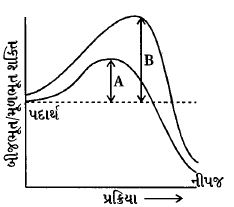
Which of the following correctly represents the given graph?
A
Exothermic reaction energy with $A$ in the presence of an enzyme and $B$ in the absence of an enzyme.
B
Exothermic reaction energy with $A$ in the absence of an enzyme and $B$ in the presence of an enzyme.
C
Endothermic reaction energy with $A$ in the presence of an enzyme and $B$ in the absence of an enzyme.
D
Endothermic reaction energy with $A$ in the absence of an enzyme and $B$ in the presence of an enzyme.
Solution
(A) $1$. The graph shows the potential energy levels of a chemical reaction over the course of the reaction.
$2$. The energy level of the product is lower than that of the substrate,which indicates that this is an exothermic (exergonic) reaction.
$3$. The activation energy is the energy barrier that must be overcome for the reaction to proceed.
$4$. In the presence of an enzyme,the activation energy is lowered. Therefore,the smaller energy barrier $A$ represents the reaction in the presence of an enzyme.
$5$. In the absence of an enzyme,the activation energy is higher. Therefore,the larger energy barrier $B$ represents the reaction in the absence of an enzyme.
$2$. The energy level of the product is lower than that of the substrate,which indicates that this is an exothermic (exergonic) reaction.
$3$. The activation energy is the energy barrier that must be overcome for the reaction to proceed.
$4$. In the presence of an enzyme,the activation energy is lowered. Therefore,the smaller energy barrier $A$ represents the reaction in the presence of an enzyme.
$5$. In the absence of an enzyme,the activation energy is higher. Therefore,the larger energy barrier $B$ represents the reaction in the absence of an enzyme.
0 likes
View Solution270
EasyMCQ
Which of the following statements is correct regarding enzymes?
A
Apoenzyme $=$ Holoenzyme $+$ Coenzyme
B
Holoenzyme $=$ Apoenzyme $+$ Coenzyme
C
Coenzyme $=$ Apoenzyme $+$ Holoenzyme
D
Holoenzyme $=$ Coenzyme $+$ Cofactor
Solution
(B) An enzyme is often composed of a protein part and a non-protein part.
$1$. The protein portion of an enzyme is called the $Apoenzyme$.
$2$. The non-protein portion (cofactor) can be a coenzyme,metal ion,or prosthetic group.
$3$. When the $Apoenzyme$ is combined with its specific cofactor (such as a $Coenzyme$),the complete,catalytically active enzyme is formed,which is known as the $Holoenzyme$.
$4$. Therefore,the correct relationship is $Holoenzyme = Apoenzyme + Coenzyme$ (or more generally,$Holoenzyme = Apoenzyme + Cofactor$).
$1$. The protein portion of an enzyme is called the $Apoenzyme$.
$2$. The non-protein portion (cofactor) can be a coenzyme,metal ion,or prosthetic group.
$3$. When the $Apoenzyme$ is combined with its specific cofactor (such as a $Coenzyme$),the complete,catalytically active enzyme is formed,which is known as the $Holoenzyme$.
$4$. Therefore,the correct relationship is $Holoenzyme = Apoenzyme + Coenzyme$ (or more generally,$Holoenzyme = Apoenzyme + Cofactor$).
0 likes
View Solution271
MediumMCQ
Michaelis constant $K_m$ is equal to:
A
$\frac{K_1}{K_2 - K_3}$
B
$\frac{K_2 + K_3}{K_1}$
C
$\frac{K_2 - K_3}{K_1}$
D
$\frac{K_1 \times K_2}{K_3}$
Solution
(B) In the Michaelis-Menten enzyme kinetics model,the reaction is represented as $E+S \underset{K_2}{\stackrel{K_1}{\rightleftharpoons}} E S \xrightarrow{K_3} E+P$
Here,$K_1$ is the rate constant for the formation of the enzyme-substrate complex,$K_2$ is the rate constant for the dissociation of the complex back into enzyme and substrate,and $K_3$ (often denoted as $k_{cat}$) is the rate constant for the formation of the product.
The Michaelis constant $K_m$ is defined as the substrate concentration at which the reaction rate is half of the maximum velocity $(V_{max})$.
Mathematically,it is expressed as $K_m = \frac{K_2 + K_3}{K_1}$.
Here,$K_1$ is the rate constant for the formation of the enzyme-substrate complex,$K_2$ is the rate constant for the dissociation of the complex back into enzyme and substrate,and $K_3$ (often denoted as $k_{cat}$) is the rate constant for the formation of the product.
The Michaelis constant $K_m$ is defined as the substrate concentration at which the reaction rate is half of the maximum velocity $(V_{max})$.
Mathematically,it is expressed as $K_m = \frac{K_2 + K_3}{K_1}$.
0 likes
View Solution272
MediumMCQ
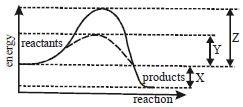
The diagram illustrates energy changes in an enzyme-controlled reaction. Which of the following represents the lowering of the activation energy?
A
$X$
B
$Y$
C
$Z$
D
$Z - Y$
Solution
(D) The energy required to initiate a reaction is known as the activation energy,$E_a$.
The solid curve represents the uncatalysed reaction with an activation energy of $Z$.
The dashed curve represents the enzyme-catalysed reaction with a lower activation energy of $Y$.
Therefore,the reduction or lowering of the activation energy due to the presence of an enzyme is given by the difference between the two,which is $(Z - Y)$.
The solid curve represents the uncatalysed reaction with an activation energy of $Z$.
The dashed curve represents the enzyme-catalysed reaction with a lower activation energy of $Y$.
Therefore,the reduction or lowering of the activation energy due to the presence of an enzyme is given by the difference between the two,which is $(Z - Y)$.
0 likes
View Solution273
DifficultMCQ
The $Km$ value of the enzyme is the value of the substrate concentration at which the reaction reaches to
A
Zero
B
$2\,V_{max}$
C
$1/2\,V_{max}$
D
$1/4\,V_{max}$
Solution
(C) The $Km$ value,also known as the Michaelis constant,is defined as the substrate concentration at which the reaction velocity is exactly half of the maximum velocity $(V_{max})$.
This constant is a measure of the affinity of an enzyme for its substrate.
This constant is a measure of the affinity of an enzyme for its substrate.
0 likes
View Solution274
EasyMCQ
Inorganic catalysts work efficiently at . . . . . . temperature and . . . . . . pressure.
A
high,low
B
low,low
C
low,high
D
high,high
Solution
(D) Inorganic catalysts work efficiently at high temperature and high pressure.
Inorganic catalysts are substances that increase the rate of a chemical reaction without being consumed in the process.
Unlike enzymes (biological catalysts),which are sensitive to heat and denature at high temperatures,inorganic catalysts are stable and often require high thermal energy and pressure to function optimally.
An example of this is the use of iron as a catalyst in the Haber process for the production of ammonia,which operates at high temperature and high pressure.
Inorganic catalysts are substances that increase the rate of a chemical reaction without being consumed in the process.
Unlike enzymes (biological catalysts),which are sensitive to heat and denature at high temperatures,inorganic catalysts are stable and often require high thermal energy and pressure to function optimally.
An example of this is the use of iron as a catalyst in the Haber process for the production of ammonia,which operates at high temperature and high pressure.
0 likes
View Solution275
MediumMCQ
Assertion : Enzymes have active sites and substrates have reactive sites on their surface respectively.
Reason : Active and reactive sites push the enzyme and substrate molecules away from each other.
Reason : Active and reactive sites push the enzyme and substrate molecules away from each other.
A
If both Assertion and Reason are correct and the Reason is a correct explanation of the Assertion.
B
If both Assertion and Reason are correct but Reason is not a correct explanation of the Assertion.
C
If the Assertion is correct but Reason is incorrect.
D
If both the Assertion and Reason are incorrect.
Solution
(C) Enzymes are biocatalysts that increase the speed of a chemical reaction without themselves undergoing any permanent chemical change.
Enzymes possess specific regions known as active sites that bind to the substrate molecules to form an enzyme-substrate complex.
These active sites are designed to attract and hold the substrate,not push them away.
Therefore,the Assertion is correct,but the Reason is incorrect because it describes a repulsive force,whereas the interaction is based on specific binding and attraction.
Enzymes possess specific regions known as active sites that bind to the substrate molecules to form an enzyme-substrate complex.
These active sites are designed to attract and hold the substrate,not push them away.
Therefore,the Assertion is correct,but the Reason is incorrect because it describes a repulsive force,whereas the interaction is based on specific binding and attraction.
0 likes
View Solution276
MediumMCQ
Assertion : Allosteric enzymes show feedback inhibition.
Reason : The inhibitor is competitive.
Reason : The inhibitor is competitive.
A
If both Assertion and Reason are correct and the Reason is a correct explanation of the Assertion.
B
If both Assertion and Reason are correct but Reason is not a correct explanation of the Assertion.
C
If the Assertion is correct but Reason is incorrect.
D
If both the Assertion and Reason are incorrect.
Solution
(C) Feedback inhibition is a type of reversible inhibition observed in allosteric enzymes.
In this process,the end product of a metabolic pathway acts as an inhibitor for an enzyme that functions early in the pathway.
The inhibitor in feedback inhibition is non-competitive,not competitive.
It binds to an allosteric site,which is distinct from the active site,causing a conformational change in the enzyme that reduces its activity.
Therefore,the Assertion is correct,but the Reason is incorrect.
In this process,the end product of a metabolic pathway acts as an inhibitor for an enzyme that functions early in the pathway.
The inhibitor in feedback inhibition is non-competitive,not competitive.
It binds to an allosteric site,which is distinct from the active site,causing a conformational change in the enzyme that reduces its activity.
Therefore,the Assertion is correct,but the Reason is incorrect.
0 likes
View Solution277
MediumMCQ
Assertion : Enzymes lower the activation energy.
Reason : $A$ substrate molecule can be acted upon by a particular enzyme.
Reason : $A$ substrate molecule can be acted upon by a particular enzyme.
A
If both Assertion and Reason are correct and the Reason is a correct explanation of the Assertion.
B
If both Assertion and Reason are correct but Reason is not a correct explanation of the Assertion.
C
If the Assertion is correct but Reason is incorrect.
D
If both the Assertion and Reason are incorrect.
Solution
(B) Activation energy is the minimum amount of energy required for a chemical reaction to proceed. Living systems cannot provide high levels of activation energy for most biochemical reactions.
Enzymes function as biological catalysts that lower the activation energy barrier,allowing reactions to occur at physiological temperatures.
Substrate specificity is a fundamental property of enzymes,meaning a particular enzyme acts only on a specific substrate.
While both statements are scientifically correct,the fact that an enzyme is specific to a substrate does not explain *how* or *why* it lowers the activation energy. Therefore,the Reason is not the correct explanation for the Assertion.
Enzymes function as biological catalysts that lower the activation energy barrier,allowing reactions to occur at physiological temperatures.
Substrate specificity is a fundamental property of enzymes,meaning a particular enzyme acts only on a specific substrate.
While both statements are scientifically correct,the fact that an enzyme is specific to a substrate does not explain *how* or *why* it lowers the activation energy. Therefore,the Reason is not the correct explanation for the Assertion.
0 likes
View Solution278
Medium
Describe the important properties of enzymes.
Solution
(N/A) Properties of enzymes:
$1$. Enzymes are complex macromolecules with high molecular weight.
$2$. They catalyze biochemical reactions in a cell. They help in the breakdown of large molecules into smaller molecules or bring together two smaller molecules to form a larger molecule.
$3$. Enzymes do not initiate a reaction. However,they significantly accelerate the rate of the reaction.
$4$. Enzymes affect the rate of a biochemical reaction,not the direction or equilibrium.
$5$. Most enzymes have a high turnover number. The turnover number is defined as the number of substrate molecules converted into product by one enzyme molecule per unit time. $A$ high turnover number increases the efficiency of the reaction.
$6$. Enzymes are highly specific in their action.
$7$. Enzymatic activity is sensitive to temperature; it generally increases with temperature up to an optimum point,beyond which it decreases due to denaturation.
$8$. Enzymes show maximum activity at an optimum $pH$ range,typically between $6$ and $8$.
$9$. The velocity of an enzymatic reaction increases with an increase in substrate concentration until it reaches a maximum velocity $(V_{max})$.
$1$. Enzymes are complex macromolecules with high molecular weight.
$2$. They catalyze biochemical reactions in a cell. They help in the breakdown of large molecules into smaller molecules or bring together two smaller molecules to form a larger molecule.
$3$. Enzymes do not initiate a reaction. However,they significantly accelerate the rate of the reaction.
$4$. Enzymes affect the rate of a biochemical reaction,not the direction or equilibrium.
$5$. Most enzymes have a high turnover number. The turnover number is defined as the number of substrate molecules converted into product by one enzyme molecule per unit time. $A$ high turnover number increases the efficiency of the reaction.
$6$. Enzymes are highly specific in their action.
$7$. Enzymatic activity is sensitive to temperature; it generally increases with temperature up to an optimum point,beyond which it decreases due to denaturation.
$8$. Enzymes show maximum activity at an optimum $pH$ range,typically between $6$ and $8$.
$9$. The velocity of an enzymatic reaction increases with an increase in substrate concentration until it reaches a maximum velocity $(V_{max})$.
0 likes
View Solution279
Easy
Give generalised information regarding enzymatic organization.
Solution
(N/A) $\rightarrow$ Almost all enzymes are proteins.
$\rightarrow$ There are some nucleic acids that behave like enzymes. These are called ribozymes.
$\rightarrow$ An enzyme can be depicted by a linear diagram. An enzyme,like any protein,has a primary structure,i.e.,the amino acid sequence of the protein.
$\rightarrow$ An enzyme,like any protein,has secondary and tertiary structures. The backbone of the protein chain folds upon itself,the chain criss-crosses itself,and hence,many crevices or pockets are formed.
$\rightarrow$ One such pocket is the 'active site'. An active site of an enzyme is a crevice or pocket into which the substrate fits.
Thus,enzymes,through their active site,catalyse reactions at a higher rate.
$\rightarrow$ Enzyme catalysts differ from inorganic catalysts in many ways. One major difference is that inorganic catalysts work efficiently at high temperatures and high pressures,while enzymes get damaged at high temperatures (above $40^{\circ}C$).
$\rightarrow$ Enzymes isolated from thermophilic organisms that live under extremely high temperatures (e.g.,hot vents and sulphur springs,etc.) are stable and retain their catalytic power at high $(80^{\circ}-90^{\circ}C)$ temperatures. Thermal stability is thus an important quality of such enzymes isolated from thermophilic organisms.
$\rightarrow$ There are some nucleic acids that behave like enzymes. These are called ribozymes.
$\rightarrow$ An enzyme can be depicted by a linear diagram. An enzyme,like any protein,has a primary structure,i.e.,the amino acid sequence of the protein.
$\rightarrow$ An enzyme,like any protein,has secondary and tertiary structures. The backbone of the protein chain folds upon itself,the chain criss-crosses itself,and hence,many crevices or pockets are formed.
$\rightarrow$ One such pocket is the 'active site'. An active site of an enzyme is a crevice or pocket into which the substrate fits.
Thus,enzymes,through their active site,catalyse reactions at a higher rate.
$\rightarrow$ Enzyme catalysts differ from inorganic catalysts in many ways. One major difference is that inorganic catalysts work efficiently at high temperatures and high pressures,while enzymes get damaged at high temperatures (above $40^{\circ}C$).
$\rightarrow$ Enzymes isolated from thermophilic organisms that live under extremely high temperatures (e.g.,hot vents and sulphur springs,etc.) are stable and retain their catalytic power at high $(80^{\circ}-90^{\circ}C)$ temperatures. Thermal stability is thus an important quality of such enzymes isolated from thermophilic organisms.
0 likes
View Solution280
Easy
How do enzymes increase the rate of chemical transformation?
Solution
(N/A) Enzymes are proteins with a three-dimensional structure that includes an 'active site'. They convert a substrate $(S)$ into a product $(P)$ through the reaction: $S \rightarrow P$.
The substrate binds to the enzyme at its 'active site' to form an $ES$ (Enzyme-Substrate) complex. This complex formation is a transient phenomenon.
During the state where the substrate is bound to the enzyme's active site,a new structure is formed,known as the 'transition state'.
After the bond-breaking or bond-forming process is completed,the product is released from the active site.
The pathway of this transformation goes through the transition state structure. There could be many altered structural states between the stable substrate and the product,all of which are unstable.
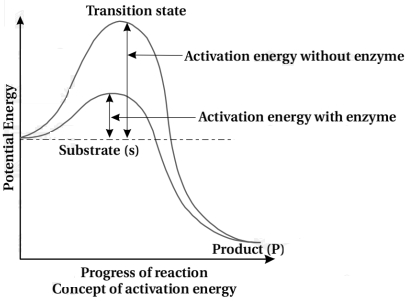
If this is depicted graphically,the $Y$-axis represents the potential energy content,and the $X$-axis represents the progression of the reaction.
There is a difference between the energy level of the substrate $(S)$ and the product $(P)$. If $P$ is at a lower energy level than $S$,the reaction is exothermic,and energy does not need to be supplied to form the product.
However,whether the reaction is exothermic (spontaneous) or endothermic (energy-requiring),the substrate must pass through a higher energy state called the 'transition state'.
The difference in the average energy content of the substrate from that of the transition state is called 'activation energy'.
Enzymes increase the rate of reaction by lowering this activation energy barrier,making the transition of $S$ to $P$ easier.
The substrate binds to the enzyme at its 'active site' to form an $ES$ (Enzyme-Substrate) complex. This complex formation is a transient phenomenon.
During the state where the substrate is bound to the enzyme's active site,a new structure is formed,known as the 'transition state'.
After the bond-breaking or bond-forming process is completed,the product is released from the active site.
The pathway of this transformation goes through the transition state structure. There could be many altered structural states between the stable substrate and the product,all of which are unstable.
If this is depicted graphically,the $Y$-axis represents the potential energy content,and the $X$-axis represents the progression of the reaction.
There is a difference between the energy level of the substrate $(S)$ and the product $(P)$. If $P$ is at a lower energy level than $S$,the reaction is exothermic,and energy does not need to be supplied to form the product.
However,whether the reaction is exothermic (spontaneous) or endothermic (energy-requiring),the substrate must pass through a higher energy state called the 'transition state'.
The difference in the average energy content of the substrate from that of the transition state is called 'activation energy'.
Enzymes increase the rate of reaction by lowering this activation energy barrier,making the transition of $S$ to $P$ easier.
0 likes
View Solution281
Easy
Describe the mechanism of enzyme action.
Solution
(N/A) $\rightarrow$ Each enzyme $(E)$ has a substrate $(S)$ binding site in its molecule. The substrate binds with it to form an enzyme-substrate complex $(ES)$. It soon dissociates into its product $(P)$ and an unchanged enzyme,with an intermediate formation of an enzyme-product complex $(EP)$.
$\rightarrow$ The formation of the $ES$ complex is essential for catalysis.
$E + S \rightleftharpoons ES \longrightarrow EP \longrightarrow E + P$
$\rightarrow$ It can be explained in the following steps:
$\rightarrow$ $(1)$ First,the substrate binds to the active site of the enzyme,fitting into the active site.
$\rightarrow$ $(2)$ The binding of the substrate induces the enzyme to alter its shape,fitting more tightly around the substrate.
$\rightarrow$ $(3)$ The active site of the enzyme,now in close proximity to the substrate,breaks the chemical bonds of the substrate,and a new enzyme-product complex is formed.
$\rightarrow$ $(4)$ The enzyme releases the products of the reaction,and the free enzyme is ready to bind to another molecule of the substrate and run through the catalytic cycle once again.
$\rightarrow$ The formation of the $ES$ complex is essential for catalysis.
$E + S \rightleftharpoons ES \longrightarrow EP \longrightarrow E + P$
$\rightarrow$ It can be explained in the following steps:
$\rightarrow$ $(1)$ First,the substrate binds to the active site of the enzyme,fitting into the active site.
$\rightarrow$ $(2)$ The binding of the substrate induces the enzyme to alter its shape,fitting more tightly around the substrate.
$\rightarrow$ $(3)$ The active site of the enzyme,now in close proximity to the substrate,breaks the chemical bonds of the substrate,and a new enzyme-product complex is formed.
$\rightarrow$ $(4)$ The enzyme releases the products of the reaction,and the free enzyme is ready to bind to another molecule of the substrate and run through the catalytic cycle once again.
0 likes
View Solution282
Easy
Formation of Enzyme-substrate complex $(ES)$ is the first step in the catalysed reactions. Describe the other steps until the formation of the product.
Solution
(N/A) $\Rightarrow$ Each enzyme $(E)$ has a substrate $(S)$ binding site in its molecule where the substrate binds to form an enzyme-substrate complex $(ES)$. It soon dissociates into its product $(P)$ and the unchanged enzyme,with an intermediate formation of an enzyme-product complex $(EP)$.
$\Rightarrow$ The formation of the $ES$ complex is essential for catalysis.
$\Rightarrow$ The reaction sequence is: $E + S \rightleftharpoons ES \longrightarrow EP \longrightarrow E + P$
$\Rightarrow$ It can be explained in the following steps:
$(1)$ First,the substrate binds to the active site of the enzyme,fitting into the active site.
$(2)$ The binding of the substrate induces the enzyme to alter its shape,fitting more tightly around the substrate.
$(3)$ The active site of the enzyme,now in close proximity to the substrate,breaks the chemical bonds of the substrate,and a new enzyme-product complex $(EP)$ is formed.
$(4)$ The enzyme releases the products of the reaction,and the free enzyme is ready to bind to another molecule of the substrate to run through the catalytic cycle once again.
$\Rightarrow$ The formation of the $ES$ complex is essential for catalysis.
$\Rightarrow$ The reaction sequence is: $E + S \rightleftharpoons ES \longrightarrow EP \longrightarrow E + P$
$\Rightarrow$ It can be explained in the following steps:
$(1)$ First,the substrate binds to the active site of the enzyme,fitting into the active site.
$(2)$ The binding of the substrate induces the enzyme to alter its shape,fitting more tightly around the substrate.
$(3)$ The active site of the enzyme,now in close proximity to the substrate,breaks the chemical bonds of the substrate,and a new enzyme-product complex $(EP)$ is formed.
$(4)$ The enzyme releases the products of the reaction,and the free enzyme is ready to bind to another molecule of the substrate to run through the catalytic cycle once again.
0 likes
View Solution283
MediumMCQ
Proteins that possess catalytic activity are called . . . . . . .
A
Hormones
B
Enzymes
C
Vitamins
D
Antibodies
Solution
(B) Proteins that possess catalytic activity are known as enzymes. Enzymes act as biological catalysts that accelerate chemical reactions within living organisms by lowering the activation energy required for the reaction to proceed.
0 likes
View Solution284
EasyMCQ
Which enzyme catalyzes the breaking of bonds without the use of water or oxidation?
A
Hydrolases
B
Lyases
C
Ligases
D
Isomerases
Solution
(B) Lyases are enzymes that catalyze the breaking of various chemical bonds by means other than hydrolysis and oxidation,often forming a new double bond or a new ring structure. Unlike hydrolases,they do not use water to break bonds.
0 likes
View Solution285
Medium
How is a substrate converted into a product?
Solution
(N/A) $\Rightarrow$ The chemical or metabolic conversion refers to a chemical reaction. The chemical substance that is converted into a product is called a 'substrate' $(S)$.
$\Rightarrow$ Enzymes are proteins with complex three-dimensional structures that include an 'active site'. These enzymes bind to the substrate at the active site to form an enzyme-substrate complex,which then facilitates the conversion of the substrate $(S)$ into a product $(P)$.
$\Rightarrow$ This process is symbolically represented as: $S \rightarrow P$.
$\Rightarrow$ Enzymes are proteins with complex three-dimensional structures that include an 'active site'. These enzymes bind to the substrate at the active site to form an enzyme-substrate complex,which then facilitates the conversion of the substrate $(S)$ into a product $(P)$.
$\Rightarrow$ This process is symbolically represented as: $S \rightarrow P$.
0 likes
View Solution286
Medium
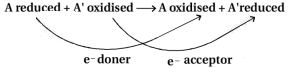
The reaction given below is catalysed by oxidoreductases between two substrates $A$ and $A'$. Complete the reaction: $A \text{ reduced} + A' \text{ oxidised} \longrightarrow$ ?
Solution
(A) Oxidoreductases are enzymes that catalyse oxidoreduction between two substrates $S$ and $S'$ by transferring electrons. The general reaction is: $S \text{ reduced} + S' \text{ oxidised} \longrightarrow S \text{ oxidised} + S' \text{ reduced}$.
In the given case, substrate $A$ is in a reduced state and $A'$ is in an oxidised state. During the reaction, $A$ donates electrons (acts as an electron donor) and becomes oxidised, while $A'$ accepts electrons (acts as an electron acceptor) and becomes reduced.
Therefore, the complete reaction is: $A \text{ reduced} + A' \text{ oxidised} \longrightarrow A \text{ oxidised} + A' \text{ reduced}$.
In the given case, substrate $A$ is in a reduced state and $A'$ is in an oxidised state. During the reaction, $A$ donates electrons (acts as an electron donor) and becomes oxidised, while $A'$ accepts electrons (acts as an electron acceptor) and becomes reduced.
Therefore, the complete reaction is: $A \text{ reduced} + A' \text{ oxidised} \longrightarrow A \text{ oxidised} + A' \text{ reduced}$.
0 likes
View Solution287
Medium
Demonstrate the mechanism of action of transaminases.
Solution
(N/A) Transamination is a biochemical reaction that transfers an amino group from an amino acid to a keto acid. This process is catalyzed by enzymes known as transaminases.
The general reaction is represented as:
$R_1-CH(NH_3^+)-COO^- + R_2-C(=O)-COO^- \xrightarrow{\text{Transaminase}} R_1-C(=O)-COO^- + R_2-CH(NH_3^+)-COO^-$
In this reaction:
$1$. An amino acid $(R_1-CH(NH_3^+)-COO^-)$ reacts with a keto acid $(R_2-C(=O)-COO^-)$.
$2$. The enzyme transaminase facilitates the transfer of the amino group $(-NH_3^+)$ from the first amino acid to the keto acid.
$3$. As a result,the original amino acid is converted into a new keto acid $(R_1-C(=O)-COO^-)$,and the original keto acid is converted into a new amino acid $(R_2-CH(NH_3^+)-COO^-)$.
$4$. This mechanism is crucial for the synthesis of non-essential amino acids in plants and animals.
The general reaction is represented as:
$R_1-CH(NH_3^+)-COO^- + R_2-C(=O)-COO^- \xrightarrow{\text{Transaminase}} R_1-C(=O)-COO^- + R_2-CH(NH_3^+)-COO^-$
In this reaction:
$1$. An amino acid $(R_1-CH(NH_3^+)-COO^-)$ reacts with a keto acid $(R_2-C(=O)-COO^-)$.
$2$. The enzyme transaminase facilitates the transfer of the amino group $(-NH_3^+)$ from the first amino acid to the keto acid.
$3$. As a result,the original amino acid is converted into a new keto acid $(R_1-C(=O)-COO^-)$,and the original keto acid is converted into a new amino acid $(R_2-CH(NH_3^+)-COO^-)$.
$4$. This mechanism is crucial for the synthesis of non-essential amino acids in plants and animals.
0 likes
View Solution288
MediumMCQ
Match the following substrates with their respective enzymes:
| Substrate | Enzyme |
|---|---|
| $(A)$ Ribonucleotide | $(i)$ Chitinase |
| $(B)$ Chitin | $(ii)$ Cellulase |
| $(C)$ Cellulose | $(iii)$ Ribonuclease |
A
$A-i, B-ii, C-iii$
B
$A-iii, B-i, C-ii$
C
$A-iii, B-ii, C-i$
D
$A-ii, B-i, C-iii$
Solution
(B) The correct matching is as follows:
$1$. Ribonucleotide is broken down by the enzyme Ribonuclease $(A-iii)$.
$2$. Chitin is broken down by the enzyme Chitinase $(B-i)$.
$3$. Cellulose is broken down by the enzyme Cellulase $(C-ii)$.
Therefore,the correct sequence is $A-iii, B-i, C-ii$,which corresponds to option $(B)$.
$1$. Ribonucleotide is broken down by the enzyme Ribonuclease $(A-iii)$.
$2$. Chitin is broken down by the enzyme Chitinase $(B-i)$.
$3$. Cellulose is broken down by the enzyme Cellulase $(C-ii)$.
Therefore,the correct sequence is $A-iii, B-i, C-ii$,which corresponds to option $(B)$.
0 likes
View Solution289
EasyMCQ
An enzyme is formed by chemically bonding together which of the following?
A
Lipases
B
Amino acids
C
Carbohydrates
D
Vitamins of $B$ complex group
Solution
(B) Enzymes are biological catalysts that are almost exclusively proteins in nature.
Proteins are polymers formed by the chemical bonding of amino acids through peptide bonds.
Therefore,an enzyme is formed by the polymerization of amino acids.
Proteins are polymers formed by the chemical bonding of amino acids through peptide bonds.
Therefore,an enzyme is formed by the polymerization of amino acids.
0 likes
View Solution290
MediumMCQ
Which statement is not correct for an enzyme?
A
It acts as a biocatalyst
B
Its aqueous solution is colloidal
C
It can catalyse any chemical reaction
D
Its catalytic efficiency is temperature dependent
Solution
(C) Enzymes are highly specific in nature,meaning each enzyme catalyzes only a specific type of reaction or substrate. Therefore,it is incorrect to say that an enzyme can catalyze any chemical reaction.
0 likes
View Solution291
MediumMCQ
Identify the correct statement regarding enzymes.
A
Enzymes are specific biological catalysts that can normally function at very high temperatures $(T > 1000 \; K)$.
B
Enzymes are normally heterogeneous catalysts that are very specific in their action.
C
Enzymes are specific biological catalysts that cannot be poisoned.
D
Enzymes are specific biological catalysts that possess well-defined active sites.
Solution
(D) Enzymes are proteinaceous biological catalysts that possess well-defined active sites,which allow them to bind specifically to substrates.
They function optimally within a narrow temperature range,typically between $25^{\circ}C$ and $40^{\circ}C$,and are sensitive to denaturation at high temperatures.
They can be inhibited or 'poisoned' by specific chemical substances.
Therefore,the statement that they possess well-defined active sites is correct.
They function optimally within a narrow temperature range,typically between $25^{\circ}C$ and $40^{\circ}C$,and are sensitive to denaturation at high temperatures.
They can be inhibited or 'poisoned' by specific chemical substances.
Therefore,the statement that they possess well-defined active sites is correct.
0 likes
View Solution292
MediumMCQ
Proteins which catalyse biochemical reactions in the living world are known as
A
Enzymes
B
Hormones
C
Antibodies
D
Receptor
Solution
(A) Almost all enzymes are proteins that catalyze biochemical reactions in living organisms.
$Hormones$ can be steroids,peptides,or amino acid derivatives.
$Antibodies$ are specialized glycoproteins.
$Receptors$ are proteins involved in sensory reception and signal transduction.
$Hormones$ can be steroids,peptides,or amino acid derivatives.
$Antibodies$ are specialized glycoproteins.
$Receptors$ are proteins involved in sensory reception and signal transduction.
0 likes
View Solution293
MediumMCQ
Metabolic flux is regulated by
A
Enzymes
B
Sugars
C
Phospholipids
D
Sterols
Solution
(A) Metabolic flux refers to the rate at which molecules flow through a metabolic pathway.
This process is primarily controlled and regulated by enzymes,which act as biological catalysts to speed up or slow down specific biochemical reactions within the cell.
By modulating the activity of key rate-limiting enzymes,the cell can effectively control the overall flux of a metabolic pathway.
This process is primarily controlled and regulated by enzymes,which act as biological catalysts to speed up or slow down specific biochemical reactions within the cell.
By modulating the activity of key rate-limiting enzymes,the cell can effectively control the overall flux of a metabolic pathway.
0 likes
View Solution294
EasyMCQ
The most abundant enzyme in the biosphere is
A
$Collagen$
B
$RuBisCO$
C
$Trypsin$
D
$Insulin$
Solution
(B) Ribulose bisphosphate carboxylase-oxygenase $(RuBisCO)$ is the most abundant enzyme in the biosphere. It plays a critical role in the Calvin cycle by catalyzing the fixation of atmospheric $CO_2$ into organic compounds during photosynthesis.
0 likes
View Solution295
MediumMCQ
Bacterial pathogens can be controlled by
A
$p$-amino benzoic acid
B
Malonate
C
Sulphanilamide
D
All of these
Solution
(C) Sulpha drugs are derivatives of sulphanilamide. These drugs act as competitive inhibitors of the enzyme folic acid synthetase in bacteria. They compete with $p$-amino benzoic acid $(PABA)$,which is a natural substrate required by bacteria for the synthesis of folic acid. By inhibiting folic acid synthesis,these drugs effectively control bacterial growth.
0 likes
View Solution296
MediumMCQ
Which of the following statements is correct?
A
Biocatalysts accelerate the rate of a given metabolic reaction.
B
Biocatalysts are generally proteins.
C
Enzyme catalysts differ from inorganic catalysts.
D
All of these.
Solution
(D) Biocatalysts,known as enzymes,are biological molecules that significantly increase the rate of metabolic reactions by lowering the activation energy.
Most enzymes are proteinaceous in nature,although some $RNA$ molecules (ribozymes) also act as biocatalysts.
Enzyme catalysts differ from inorganic catalysts in several ways: enzymes are highly specific,work under mild conditions (temperature and pH),and are much more efficient than inorganic catalysts.
Since all the given statements are correct,the correct option is $D$.
Most enzymes are proteinaceous in nature,although some $RNA$ molecules (ribozymes) also act as biocatalysts.
Enzyme catalysts differ from inorganic catalysts in several ways: enzymes are highly specific,work under mild conditions (temperature and pH),and are much more efficient than inorganic catalysts.
Since all the given statements are correct,the correct option is $D$.
0 likes
View Solution297
MediumMCQ
Which of the following statements is incorrect with respect to inorganic catalysts?
A
They do not occur in living cells
B
They are not specific for any reaction
C
They get damaged at high temperature
D
They work efficiently at high pressure
Solution
(C) Inorganic catalysts work efficiently at high temperatures and high pressures.
In contrast,enzymes (biological catalysts) are proteinaceous in nature and get damaged (denatured) at high temperatures (typically above $40^{\circ}C$),except for those found in thermophilic organisms.
Therefore,the statement that inorganic catalysts get damaged at high temperature is incorrect.
In contrast,enzymes (biological catalysts) are proteinaceous in nature and get damaged (denatured) at high temperatures (typically above $40^{\circ}C$),except for those found in thermophilic organisms.
Therefore,the statement that inorganic catalysts get damaged at high temperature is incorrect.
0 likes
View Solution298
EasyMCQ
Enzymes catalyse biochemical reactions by
A
Lowering the activation energy
B
Increasing the activation energy
C
Changing the equilibrium constant
D
Increasing the temperature
Solution
(A) Enzymes are biological catalysts that speed up biochemical reactions by providing an alternative pathway with a lower activation energy.
By reducing the energy barrier that reactants must overcome to form products,enzymes significantly increase the rate of reaction without being consumed in the process.
By reducing the energy barrier that reactants must overcome to form products,enzymes significantly increase the rate of reaction without being consumed in the process.
0 likes
View Solution299
MediumMCQ
Enzymes catalysing the breakdown of larger molecules into smaller molecules are
A
Hydrolases
B
Isomerases
C
Ligase
D
Both $(A)$ and $(C)$
Solution
(A) Hydrolases are enzymes that catalyze the hydrolysis of bonds,effectively breaking down larger molecules into smaller ones by the addition of water.
Isomerases are enzymes that catalyze the rearrangement of molecular structures to form isomers.
Ligases are enzymes that catalyze the joining of two molecules,such as forming $C-O$,$C-S$,or $C-N$ bonds,by utilizing the energy of $ATP$.
Isomerases are enzymes that catalyze the rearrangement of molecular structures to form isomers.
Ligases are enzymes that catalyze the joining of two molecules,such as forming $C-O$,$C-S$,or $C-N$ bonds,by utilizing the energy of $ATP$.
0 likes
View Solution300
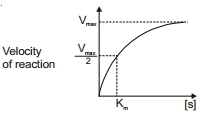
MediumMCQ
The Michaelis constant $(K_m)$ value of an enzyme is the substrate concentration at which the velocity of the reaction is:
A
$V_{max}$
B
$1/3 \; V_{max}$
C
$1/2 \; V_{max}$
D
$1/5 \; V_{max}$
Solution
(C) The Michaelis constant $(K_m)$ is defined as the substrate concentration at which the reaction rate (velocity) is exactly half of the maximum velocity $(V_{max})$.
According to the Michaelis-Menten equation: $v = \frac{V_{max} [S]}{K_m + [S]}$.
When $[S] = K_m$,the equation becomes $v = \frac{V_{max} K_m}{K_m + K_m} = \frac{V_{max} K_m}{2 K_m} = \frac{V_{max}}{2}$.
Therefore,$K_m$ represents the substrate concentration required to achieve half of the maximum reaction velocity.
According to the Michaelis-Menten equation: $v = \frac{V_{max} [S]}{K_m + [S]}$.
When $[S] = K_m$,the equation becomes $v = \frac{V_{max} K_m}{K_m + K_m} = \frac{V_{max} K_m}{2 K_m} = \frac{V_{max}}{2}$.
Therefore,$K_m$ represents the substrate concentration required to achieve half of the maximum reaction velocity.
0 likes
View SolutionBiomolecules — Enzymes · Frequently Asked Questions
1Are these Biomolecules questions useful for JEE and NEET?
Yes. All questions in this section are mapped to JEE Main and NEET exam patterns. Previous year questions from JEE Main, NEET, GUJCET and state-level exams are included with full solutions.
2Can I switch to Hindi or Gujarati for these questions?
Yes. Use the language tabs in the hero section or the sidebar to view the same questions and solutions in English, Hindi or Gujarati.
3How do I generate a question paper from this subtopic?
Use the Vedclass Exam Paper Generator — select the chapter and subtopic, set difficulty, and generate Sets A, B, C, D automatically. First 3 chapters of every subject are free.
Vedclass Products
For Students
Vedclass Test Series
Mock tests in real JEE/NEET style with performance analysis. 5-day free trial.
Start Free TrialFor Teachers
Exam Paper Generator
Generate Set A/B/C/D papers from this chapter in 2 minutes. 3 chapters free.
Try FreeFor Institutes
Online Exam Module
Live online exams with unlimited students, 360° analytics & white-label branding.
See DemoFor Teachers & Institutes
Generate a Biomolecules Exam Paper in 2 Minutes
Select subtopic & difficulty — Sets A, B, C, D auto-generated with No Repeat logic.
First 3 chapters of every subject are free — no payment required.