
A English
Enzymes Questions in English
Class 11 Biology · Biomolecules · Enzymes
358+
Questions
English
Language
100%
With Solutions
Showing 8 of 358 questions in English
351
EasyMCQ
Given below are two statements.
$Statement-I$: Enzyme isomerase catalyzes intramolecular rearrangement of atoms.
$Statement-II$: Oxidation and reduction reactions are catalyzed by enzyme transferase.
In the light of the above statements, choose the correct answer from the options given below.
$Statement-I$: Enzyme isomerase catalyzes intramolecular rearrangement of atoms.
$Statement-II$: Oxidation and reduction reactions are catalyzed by enzyme transferase.
In the light of the above statements, choose the correct answer from the options given below.
A
$Statement-I$ is correct and $Statement-II$ is incorrect.
B
Both $Statement-I$ and $Statement-II$ are correct.
C
Both $Statement-I$ and $Statement-II$ are incorrect.
D
$Statement-I$ is incorrect and $Statement-II$ is correct.
Solution
(A) $Statement-I$ is correct because isomerases catalyze the interconversion of isomers, which involves the intramolecular rearrangement of atoms.
$Statement-II$ is incorrect because oxidation and reduction reactions are catalyzed by oxidoreductases (or dehydrogenases), not by transferases.
Transferases catalyze the transfer of a functional group from one molecule to another.
$Statement-II$ is incorrect because oxidation and reduction reactions are catalyzed by oxidoreductases (or dehydrogenases), not by transferases.
Transferases catalyze the transfer of a functional group from one molecule to another.
0 likes
View Solution352
EasyMCQ
Match Column-$I$ and Column-$II$ with reference to enzymes and select the correct option.
| Column-$I$ | Column-$II$ |
| $a$. Transferase | $i$. Aldolase |
| $b$. Hydrolase | $ii$. Alcohol dehydrogenase |
| $c$. Lyase | $iii$. Sucrase |
| $d$. Oxidoreductase | $iv$. Glucokinase |
A
$a-ii, b-iii, c-i, d-iv$
B
$a-iv, b-i, c-i, d-ii$
C
$a-iv, b-iii, c-i, d-ii$
D
$a-iii, b-i, c-ii, d-iv$
Solution
(C) The correct matching is as follows:
$a$. Transferase: These enzymes catalyze the transfer of a group between substrates. Glucokinase is a transferase that transfers a phosphate group from $ATP$ to glucose.
$b$. Hydrolase: These enzymes catalyze the hydrolysis of bonds like ester,ether,peptide,etc. Sucrase is a hydrolase that breaks down sucrose into glucose and fructose.
$c$. Lyase: These enzymes catalyze the removal of groups from substrates by mechanisms other than hydrolysis,leaving double bonds. Aldolase is a classic example of a lyase.
$d$. Oxidoreductase: These enzymes catalyze oxidoreduction between two substrates. Alcohol dehydrogenase catalyzes the oxidation of alcohols to aldehydes or ketones by transferring electrons to $NAD^+$.
Therefore,the correct match is $a-iv, b-iii, c-i, d-ii$.
$a$. Transferase: These enzymes catalyze the transfer of a group between substrates. Glucokinase is a transferase that transfers a phosphate group from $ATP$ to glucose.
$b$. Hydrolase: These enzymes catalyze the hydrolysis of bonds like ester,ether,peptide,etc. Sucrase is a hydrolase that breaks down sucrose into glucose and fructose.
$c$. Lyase: These enzymes catalyze the removal of groups from substrates by mechanisms other than hydrolysis,leaving double bonds. Aldolase is a classic example of a lyase.
$d$. Oxidoreductase: These enzymes catalyze oxidoreduction between two substrates. Alcohol dehydrogenase catalyzes the oxidation of alcohols to aldehydes or ketones by transferring electrons to $NAD^+$.
Therefore,the correct match is $a-iv, b-iii, c-i, d-ii$.
0 likes
View Solution353
EasyMCQ
The substance upon which an enzyme acts is termed as . . . . . . .
A
prosthetic group
B
exoenzyme
C
endoenzyme
D
substrate
Solution
(D) An enzyme is a biological catalyst that speeds up chemical reactions in living organisms.
In any enzyme-catalyzed reaction,the specific molecule that the enzyme binds to and acts upon is called the $substrate$.
The enzyme binds to the $substrate$ at its active site to form an enzyme-$substrate$ complex,which eventually converts the $substrate$ into the product.
Therefore,the correct term for the substance upon which an enzyme acts is the $substrate$.
In any enzyme-catalyzed reaction,the specific molecule that the enzyme binds to and acts upon is called the $substrate$.
The enzyme binds to the $substrate$ at its active site to form an enzyme-$substrate$ complex,which eventually converts the $substrate$ into the product.
Therefore,the correct term for the substance upon which an enzyme acts is the $substrate$.
0 likes
View Solution354
EasyMCQ
The concept which suggests that the active site of an enzyme is flexible and continually reshapes by its interaction with the substrate is known as . . . . . . .
A
Fluid Mosaic model
B
Lock and key model
C
Induced Fit model
D
Michaelis-Menten constant model
Solution
(C) The $Induced \ Fit$ model,proposed by $Daniel \ Koshland$,suggests that the active site of an enzyme is not a rigid structure.
Instead,it is flexible and undergoes conformational changes upon binding with the substrate.
This interaction ensures a precise fit between the enzyme and the substrate,facilitating the catalytic process.
In contrast,the $Lock \ and \ key$ model suggests a rigid active site that does not change shape.
Instead,it is flexible and undergoes conformational changes upon binding with the substrate.
This interaction ensures a precise fit between the enzyme and the substrate,facilitating the catalytic process.
In contrast,the $Lock \ and \ key$ model suggests a rigid active site that does not change shape.
0 likes
View Solution355
EasyMCQ
Enzymes can react with acidic or basic substances due to their . . . . . . nature.
A
Amorphous
B
Competitive
C
Colloidal
D
Amphoteric
Solution
(D) Enzymes are proteins,and proteins are composed of amino acids.
Amino acids contain both an amino group ($-NH_2$,which is basic) and a carboxyl group ($-COOH$,which is acidic).
Because of the presence of these functional groups,enzymes can act as both acids and bases,a property known as being $Amphoteric$.
Therefore,enzymes can react with both acidic and basic substances.
Amino acids contain both an amino group ($-NH_2$,which is basic) and a carboxyl group ($-COOH$,which is acidic).
Because of the presence of these functional groups,enzymes can act as both acids and bases,a property known as being $Amphoteric$.
Therefore,enzymes can react with both acidic and basic substances.
0 likes
View Solution356
EasyMCQ
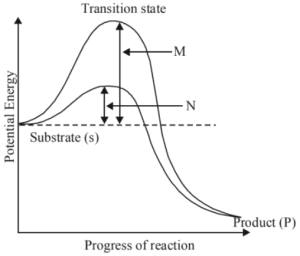
The graph showing the concept of activation energy of an enzyme is given below. Observe the graph and choose the correct option for $M$ and $N$.
A
$M$-High temperature,High activation energy,$N$-Low temperature,Low activation energy
B
$M$-High substrate,High activation energy,$N$-Low substrate,Low activation energy
C
$M$-Activation energy without enzyme,$N$-Activation energy with enzyme
D
$M$-Activation energy with enzyme,$N$-Activation energy without enzyme
Solution
(C) The graph represents the potential energy changes during a chemical reaction.
$M$ represents the activation energy required for the reaction to proceed in the absence of an enzyme,which is higher.
$N$ represents the activation energy required for the reaction to proceed in the presence of an enzyme,which is lower because enzymes lower the activation energy barrier.
Therefore,$M$ is the activation energy without an enzyme and $N$ is the activation energy with an enzyme.
The correct option is $C$.
$M$ represents the activation energy required for the reaction to proceed in the absence of an enzyme,which is higher.
$N$ represents the activation energy required for the reaction to proceed in the presence of an enzyme,which is lower because enzymes lower the activation energy barrier.
Therefore,$M$ is the activation energy without an enzyme and $N$ is the activation energy with an enzyme.
The correct option is $C$.
0 likes
View Solution357
EasyMCQ
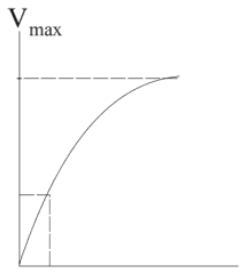
The following graph shows the effect of substrate concentration on enzyme activity. What does the $Y$-axis represent?
A
Temperature
B
Velocity of reaction
C
$pH$
D
Pressure
Solution
(B) The correct answer is $(B)$.
In the Michaelis-Menten enzyme kinetics graph,the $X$-axis represents the substrate concentration $[S]$,and the $Y$-axis represents the velocity of the reaction $(V)$.
As the substrate concentration increases,the velocity of the reaction increases until it reaches a maximum velocity,denoted as $V_{max}$.
In the Michaelis-Menten enzyme kinetics graph,the $X$-axis represents the substrate concentration $[S]$,and the $Y$-axis represents the velocity of the reaction $(V)$.
As the substrate concentration increases,the velocity of the reaction increases until it reaches a maximum velocity,denoted as $V_{max}$.
0 likes
View Solution358
DifficultMCQ
The following reaction depicts the activity of a particular class of enzymes:
$X-Y$ attached to $C-C$ (Substrate) $\xrightarrow{E}$ $X-Y$ + $C=C$ (Product)
Identify the enzyme class '$E$' from the following options:
$X-Y$ attached to $C-C$ (Substrate) $\xrightarrow{E}$ $X-Y$ + $C=C$ (Product)
Identify the enzyme class '$E$' from the following options:
A
Isomerases
B
Ligases
C
Transferases
D
Lyases
Solution
(D) Lyases are enzymes that catalyze the removal of groups from substrates by mechanisms other than hydrolysis,leaving double bonds.
The reaction shown represents the formation of a double bond by the elimination of a group $(X-Y)$,which is a characteristic feature of the Lyases enzyme class.
Therefore,the correct enzyme class is Lyases.
The reaction shown represents the formation of a double bond by the elimination of a group $(X-Y)$,which is a characteristic feature of the Lyases enzyme class.
Therefore,the correct enzyme class is Lyases.
0 likes
View SolutionBiomolecules — Enzymes · Frequently Asked Questions
1Are these Biomolecules questions useful for JEE and NEET?
Yes. All questions in this section are mapped to JEE Main and NEET exam patterns. Previous year questions from JEE Main, NEET, GUJCET and state-level exams are included with full solutions.
2Can I switch to Hindi or Gujarati for these questions?
Yes. Use the language tabs in the hero section or the sidebar to view the same questions and solutions in English, Hindi or Gujarati.
3How do I generate a question paper from this subtopic?
Use the Vedclass Exam Paper Generator — select the chapter and subtopic, set difficulty, and generate Sets A, B, C, D automatically. First 3 chapters of every subject are free.
Vedclass Products
For Students
Vedclass Test Series
Mock tests in real JEE/NEET style with performance analysis. 5-day free trial.
Start Free TrialFor Teachers
Exam Paper Generator
Generate Set A/B/C/D papers from this chapter in 2 minutes. 3 chapters free.
Try FreeFor Institutes
Online Exam Module
Live online exams with unlimited students, 360° analytics & white-label branding.
See DemoFor Teachers & Institutes
Generate a Biomolecules Exam Paper in 2 Minutes
Select subtopic & difficulty — Sets A, B, C, D auto-generated with No Repeat logic.
First 3 chapters of every subject are free — no payment required.