
A English
Enzymes Questions in English
Class 11 Biology · Biomolecules · Enzymes
358+
Questions
English
Language
100%
With Solutions
Showing 50 of 358 questions in English
201
EasyMCQ
When is the enzyme released from the enzyme-substrate complex in its original form?
A
At the start of the reaction
B
When the reaction is in the middle
C
Long after the reaction
D
Only at the end of the reaction
Solution
(D) The mechanism of enzyme action involves the formation of an enzyme-substrate $(ES)$ complex.
$1$. The substrate binds to the active site of the enzyme to form the $ES$ complex.
$2$. The enzyme facilitates the conversion of the substrate into the product $(P)$.
$3$. Once the product is formed,the enzyme-product $(EP)$ complex is created.
$4$. Finally,the enzyme releases the product and returns to its original,unchanged form,ready to bind with another substrate molecule.
Therefore,the enzyme is released in its original form only at the end of the reaction.
$1$. The substrate binds to the active site of the enzyme to form the $ES$ complex.
$2$. The enzyme facilitates the conversion of the substrate into the product $(P)$.
$3$. Once the product is formed,the enzyme-product $(EP)$ complex is created.
$4$. Finally,the enzyme releases the product and returns to its original,unchanged form,ready to bind with another substrate molecule.
Therefore,the enzyme is released in its original form only at the end of the reaction.
0 likes
View Solution202
MediumMCQ
Which enzymes catalyze the transfer of a group other than hydrogen between a pair of substrates?
A
Lyases
B
Ligases
C
Transferases
D
Synthetases
Solution
(C) Enzymes that catalyze the transfer of a group,$G$ (other than hydrogen),between a pair of substrates $S$ and $S'$ are called Transferases. The reaction is represented as: $S-G + S' \rightarrow S + S'-G$. Therefore,the correct option is $C$.
0 likes
View Solution203
EasyMCQ
What is the enzyme called that catalyzes the breakdown of a complex inorganic substance into simpler substances by adding a water molecule?
A
Oxidases
B
Dehydrogenases
C
Transferases
D
Hydrolases
Solution
(D) The enzymes that catalyze the hydrolysis of bonds (such as $C-O, C-N, C-C$,etc.) by adding a water molecule are known as Hydrolases.
These enzymes are responsible for breaking down complex molecules into simpler ones during metabolic processes.
Therefore,the correct option is $D$.
These enzymes are responsible for breaking down complex molecules into simpler ones during metabolic processes.
Therefore,the correct option is $D$.
0 likes
View Solution204
EasyMCQ
Maltose $+$ $H_2O$ $\to$ Glucose $+$ Glucose. Which enzyme is responsible for this reaction?
A
Invertase
B
Maltase
C
Lactase
D
Amylase
Solution
(B) The reaction shows the hydrolysis of the disaccharide Maltose into two molecules of Glucose.
This reaction is catalyzed by the enzyme Maltase.
Invertase catalyzes the hydrolysis of sucrose into glucose and fructose.
Lactase catalyzes the hydrolysis of lactose into glucose and galactose.
Amylase is involved in the breakdown of starch into smaller carbohydrate units.
This reaction is catalyzed by the enzyme Maltase.
Invertase catalyzes the hydrolysis of sucrose into glucose and fructose.
Lactase catalyzes the hydrolysis of lactose into glucose and galactose.
Amylase is involved in the breakdown of starch into smaller carbohydrate units.
0 likes
View Solution205
MediumMCQ
What is the enzyme that catalyzes the removal of hydrogen from a substrate in a reaction called?
A
Dehydrogenase
B
Oxidase
C
Lyases
D
Transferases
Solution
(A) Enzymes are classified based on the type of reaction they catalyze.
$Dehydrogenases$ are enzymes that catalyze the removal of hydrogen atoms from a substrate,often involving the transfer of electrons to a coenzyme like $NAD^+$ or $FAD$.
$Oxidases$ catalyze oxidation reactions involving oxygen.
$Lyases$ catalyze the removal of groups from substrates by mechanisms other than hydrolysis,leaving double bonds.
$Transferases$ catalyze the transfer of a functional group from one molecule to another.
Therefore,the correct answer is $Dehydrogenase$.
$Dehydrogenases$ are enzymes that catalyze the removal of hydrogen atoms from a substrate,often involving the transfer of electrons to a coenzyme like $NAD^+$ or $FAD$.
$Oxidases$ catalyze oxidation reactions involving oxygen.
$Lyases$ catalyze the removal of groups from substrates by mechanisms other than hydrolysis,leaving double bonds.
$Transferases$ catalyze the transfer of a functional group from one molecule to another.
Therefore,the correct answer is $Dehydrogenase$.
0 likes
View Solution206
MediumMCQ
These enzymes catalyze the breakdown of large molecules into smaller units without the addition of water molecules.
A
Dehydrogenases
B
Lyases
C
Oxidases
D
Hexokinases
Solution
(B) The enzymes that catalyze the removal of groups from substrates by mechanisms other than hydrolysis (leaving double bonds) are known as $Lyases$.
Unlike hydrolases,$Lyases$ do not involve the addition of water molecules to break down large molecules into smaller units.
$Dehydrogenases$ are involved in oxidation-reduction reactions.
$Oxidases$ catalyze oxidation reactions.
$Hexokinases$ are transferases that catalyze the phosphorylation of hexose sugars.
Unlike hydrolases,$Lyases$ do not involve the addition of water molecules to break down large molecules into smaller units.
$Dehydrogenases$ are involved in oxidation-reduction reactions.
$Oxidases$ catalyze oxidation reactions.
$Hexokinases$ are transferases that catalyze the phosphorylation of hexose sugars.
0 likes
View Solution207
MediumMCQ
Which type of enzymes catalyze the joining of two molecules by utilizing energy derived from the pyrophosphate bond of $ATP$?
A
Transferases
B
Synthetases (Ligases)
C
Hydrolases
D
Lyases
Solution
(B) Enzymes that catalyze the linking together of two compounds,for example,enzymes which catalyze the joining of $C-O, C-S, C-N, P-O$ etc. bonds,are called Ligases or Synthetases. These enzymes utilize energy derived from the hydrolysis of $ATP$ (specifically the pyrophosphate bond) to facilitate the formation of these chemical bonds.
0 likes
View Solution208
MediumMCQ
Which enzyme is used in the reaction: $\text{Acetic acid} + ATP + Co-A \to \text{Acetyl } Co.A + AMP + PPi$?
A
Acetyl $Co.A$ synthetase
B
Acetyl $Co.A$ kinase
C
Acetyl $Co.A$ aldolase
D
Acetyl $Co.A$ isomerase
Solution
(A) The reaction $\text{Acetic acid} + ATP + Co-A \to \text{Acetyl } Co.A + AMP + PPi$ is catalyzed by the enzyme $\text{Acetyl } Co.A \text{ synthetase}$.
This enzyme belongs to the class of ligases, which catalyze the joining of two molecules by forming a new chemical bond, coupled with the hydrolysis of $ATP$.
This enzyme belongs to the class of ligases, which catalyze the joining of two molecules by forming a new chemical bond, coupled with the hydrolysis of $ATP$.
0 likes
View Solution209
MediumMCQ
In the human body,which of the following requires protein for its activity?
A
Adenylate kinase
B
$NAD$
C
$FAD$
D
$FMN$
Solution
(A) The correct answer is $A$. Adenylate kinase is an enzyme,and enzymes are biological catalysts that are primarily proteinaceous in nature. $NAD$ (Nicotinamide Adenine Dinucleotide),$FAD$ (Flavin Adenine Dinucleotide),and $FMN$ (Flavin Mononucleotide) are coenzymes or prosthetic groups that function as non-protein components required for the activity of certain enzymes,but they are not proteins themselves.
0 likes
View Solution210
EasyMCQ
What are enzymes composed of?
A
Carbohydrates
B
Proteins
C
Hormones
D
Vitamins
Solution
(B) Enzymes are biological catalysts that speed up chemical reactions in living organisms. Almost all enzymes are proteins,which are composed of long chains of amino acids folded into specific three-dimensional shapes. These shapes are crucial for their catalytic activity. While some $RNA$ molecules (ribozymes) can also act as catalysts,the vast majority of enzymes are proteinaceous in nature.
0 likes
View Solution211
EasyMCQ
Based on the equation $E + S \rightarrow E.S \text{ Complex} \rightarrow E + P$,which substance is said to be acted upon?
A
Substrate
B
Enzyme
C
Product
D
None of the above
Solution
(A) In the given enzymatic reaction equation $E + S \rightarrow E.S \text{ Complex} \rightarrow E + P$:
$E$ represents the Enzyme.
$S$ represents the Substrate.
$P$ represents the Product.
$E.S \text{ Complex}$ is the transient enzyme-substrate complex formed during the reaction.
The substance that binds to the active site of the enzyme and undergoes chemical transformation is called the substrate $(S)$. Therefore,the enzyme acts upon the substrate.
$E$ represents the Enzyme.
$S$ represents the Substrate.
$P$ represents the Product.
$E.S \text{ Complex}$ is the transient enzyme-substrate complex formed during the reaction.
The substance that binds to the active site of the enzyme and undergoes chemical transformation is called the substrate $(S)$. Therefore,the enzyme acts upon the substrate.
0 likes
View Solution212
EasyMCQ
Which of the following is an example of an enzyme?
A
$NAD$
B
$FMN$
C
$NADP$
D
Ligase
Solution
(D) Enzymes are biological catalysts that speed up chemical reactions in living organisms.
$NAD$ (Nicotinamide Adenine Dinucleotide),$FMN$ (Flavin Mononucleotide),and $NADP$ (Nicotinamide Adenine Dinucleotide Phosphate) are coenzymes or electron carriers,not enzymes themselves.
Ligase is a class of enzymes that catalyze the joining of two large molecules by forming a new chemical bond.
$NAD$ (Nicotinamide Adenine Dinucleotide),$FMN$ (Flavin Mononucleotide),and $NADP$ (Nicotinamide Adenine Dinucleotide Phosphate) are coenzymes or electron carriers,not enzymes themselves.
Ligase is a class of enzymes that catalyze the joining of two large molecules by forming a new chemical bond.
0 likes
View Solution213
MediumMCQ
Which functional groups are present at the two ends of an enzyme's structure?
A
$-CHO, >C=O$
B
$-COOH, -CHO$
C
$-NH_2, -CH_3$
D
$-NH_2, -COOH$
Solution
(D) Enzymes are primarily composed of amino acids linked together by peptide bonds to form polypeptide chains.
Each amino acid has a central carbon atom bonded to an amino group $(-NH_2)$,a carboxyl group $(-COOH)$,a hydrogen atom,and a variable $R$-group.
In a polypeptide chain,the amino acids are linked such that one end of the chain possesses a free amino group (the $N$-terminus) and the other end possesses a free carboxyl group (the $C$-terminus).
Therefore,the two ends of an enzyme's structure are characterized by the presence of $-NH_2$ and $-COOH$ groups.
Each amino acid has a central carbon atom bonded to an amino group $(-NH_2)$,a carboxyl group $(-COOH)$,a hydrogen atom,and a variable $R$-group.
In a polypeptide chain,the amino acids are linked such that one end of the chain possesses a free amino group (the $N$-terminus) and the other end possesses a free carboxyl group (the $C$-terminus).
Therefore,the two ends of an enzyme's structure are characterized by the presence of $-NH_2$ and $-COOH$ groups.
0 likes
View Solution214
MediumMCQ
Which of the following statements is $NOT$ a characteristic property of enzymes?
A
Enzymes are amphoteric in nature.
B
Each enzyme functions within a specific temperature range.
C
The action of most enzymes is reversible.
D
Each enzyme exhibits maximum activity only at a specific $pH$.
Solution
(C) Enzymes are biocatalysts that speed up chemical reactions.
$1$. Enzymes are proteinaceous in nature and are amphoteric,meaning they can act as both acids and bases.
$2$. Enzymes are highly sensitive to temperature; they function optimally within a specific temperature range.
$3$. Enzymes are sensitive to $pH$; they show maximum activity at an optimum $pH$.
$4$. Regarding reversibility,while some enzymes can catalyze reactions in both directions,the majority of metabolic enzymes are highly specific and often catalyze reactions in a single direction under physiological conditions. Therefore,stating that the action of 'most' enzymes is reversible is incorrect as a general characteristic property.
$1$. Enzymes are proteinaceous in nature and are amphoteric,meaning they can act as both acids and bases.
$2$. Enzymes are highly sensitive to temperature; they function optimally within a specific temperature range.
$3$. Enzymes are sensitive to $pH$; they show maximum activity at an optimum $pH$.
$4$. Regarding reversibility,while some enzymes can catalyze reactions in both directions,the majority of metabolic enzymes are highly specific and often catalyze reactions in a single direction under physiological conditions. Therefore,stating that the action of 'most' enzymes is reversible is incorrect as a general characteristic property.
0 likes
View Solution215
MediumMCQ
Which of the following units have a shape that is complementary to each other,similar to a lock and key?
A
Active site and substrate
B
Active site and product
C
Product and substrate
D
Reactant and product
Solution
(A) The 'Lock and Key' hypothesis,proposed by Emil Fischer,explains the specificity of enzyme action.
According to this model,the enzyme has a specific 'Active site' that is geometrically complementary to the shape of the 'Substrate' molecule.
Just as a specific key fits into a specific lock,the substrate fits into the active site of the enzyme to form an enzyme-substrate complex.
Therefore,the active site and the substrate are the units that are complementary to each other.
According to this model,the enzyme has a specific 'Active site' that is geometrically complementary to the shape of the 'Substrate' molecule.
Just as a specific key fits into a specific lock,the substrate fits into the active site of the enzyme to form an enzyme-substrate complex.
Therefore,the active site and the substrate are the units that are complementary to each other.
0 likes
View Solution216
MediumMCQ
Which of the following equations correctly represents the mechanism of enzyme action?
A
$E + S \rightarrow E + P$
B
$E + S \rightarrow E \cdot S \text{-Complex} \rightarrow E + P$
C
$E + P \rightarrow E \cdot P \text{-Complex} \rightarrow E + P$
D
$P + S \rightarrow E \cdot S \text{-Complex} \rightarrow E + S$
Solution
(B) The mechanism of enzyme action involves the formation of an enzyme-substrate $(E \cdot S)$ complex.
$1$. The enzyme $(E)$ binds to the substrate $(S)$ to form a transient enzyme-substrate complex $(E \cdot S)$.
$2$. This complex then undergoes a chemical reaction to form the enzyme-product $(E \cdot P)$ complex.
$3$. Finally,the enzyme releases the product $(P)$ and returns to its original state,ready to bind with another substrate molecule.
$4$. The simplified representation is: $E + S \rightarrow E \cdot S \text{-Complex} \rightarrow E + P$.
$1$. The enzyme $(E)$ binds to the substrate $(S)$ to form a transient enzyme-substrate complex $(E \cdot S)$.
$2$. This complex then undergoes a chemical reaction to form the enzyme-product $(E \cdot P)$ complex.
$3$. Finally,the enzyme releases the product $(P)$ and returns to its original state,ready to bind with another substrate molecule.
$4$. The simplified representation is: $E + S \rightarrow E \cdot S \text{-Complex} \rightarrow E + P$.
0 likes
View Solution217
EasyMCQ
Which of the following statements is consistent with the function of isomerases?
A
They join two molecules together using energy derived from pyrophosphate bonds.
B
They catalyze the interconversion of optical,geometric,or positional isomers.
C
They break down large molecules into smaller units.
D
They are involved in oxidation and reduction reactions.
Solution
(B) Isomerases are a class of enzymes that catalyze the conversion of a molecule into one of its isomeric forms. This involves the rearrangement of atoms within a single molecule without changing its molecular formula. For example,the conversion of glucose$-6-$phosphate to fructose$-6-$phosphate by phosphoglucose isomerase is a classic reaction catalyzed by an isomerase.
0 likes
View Solution218
MediumMCQ
Which of the following statements is consistent with the function of a synthetase?
A
It breaks down complex organic substances into simpler ones by adding a water molecule.
B
It forms a new molecular structure through the transfer of atoms.
C
It joins two molecules together with the help of $ATP$.
D
It transfers a specific group from one substance to another.
Solution
(C) Synthetases are a class of enzymes that catalyze the joining of two molecules together.
This process is coupled with the hydrolysis of a pyrophosphate bond in $ATP$ or a similar triphosphate.
Therefore,the correct statement is that it joins two molecules together with the help of $ATP$.
This process is coupled with the hydrolysis of a pyrophosphate bond in $ATP$ or a similar triphosphate.
Therefore,the correct statement is that it joins two molecules together with the help of $ATP$.
0 likes
View Solution219
MediumMCQ
Which of the following enzymes remains inactive even in the presence of calcium?
A
Nitric oxide synthase
B
Protein phosphatase
C
Adenylate kinase
D
Fructose isomerase
Solution
(C) The enzyme $Adenylate$ $kinase$ is a phosphotransferase that catalyzes the interconversion of adenine nucleotides. Its activity is primarily dependent on $Mg^{2+}$ ions as a cofactor. Unlike many signaling enzymes or kinases involved in calcium-dependent pathways,$Adenylate$ $kinase$ does not require $Ca^{2+}$ for its catalytic activity,and the presence of calcium does not activate or inhibit it in a regulatory manner compared to its dependence on magnesium. Therefore,it remains inactive in the context of calcium-dependent regulatory mechanisms.
0 likes
View Solution220
MediumMCQ
Statement $P$: Enzymes are biological catalysts.
Statement $Q$: They are produced by living cells in small amounts to catalyze reactions.
Statement $Q$: They are produced by living cells in small amounts to catalyze reactions.
A
Both Statement $P$ and Statement $Q$ are incorrect.
B
Both Statement $P$ and Statement $Q$ are correct.
C
Statement $P$ is correct,Statement $Q$ is incorrect.
D
Statement $P$ is incorrect,Statement $Q$ is correct.
Solution
(B) Statement $P$ is correct because enzymes are proteinaceous substances that act as biological catalysts,accelerating biochemical reactions without being consumed in the process.
Statement $Q$ is also correct because enzymes are synthesized by living cells and are required in very small quantities to effectively catalyze metabolic reactions within the organism.
Statement $Q$ is also correct because enzymes are synthesized by living cells and are required in very small quantities to effectively catalyze metabolic reactions within the organism.
0 likes
View Solution221
MediumMCQ
Enzymes are primarily which type of proteins?
A
Globular proteins
B
Fibrous proteins
C
Structural proteins
D
Nucleoproteins
Solution
(A) Enzymes are biological catalysts that speed up chemical reactions in living organisms.
Structurally,almost all enzymes are globular proteins.
Globular proteins have a complex $3D$ folded structure that creates an active site,which is essential for their catalytic activity.
Fibrous proteins are typically structural (e.g.,collagen,keratin),whereas enzymes require a specific shape to bind to substrates.
Structurally,almost all enzymes are globular proteins.
Globular proteins have a complex $3D$ folded structure that creates an active site,which is essential for their catalytic activity.
Fibrous proteins are typically structural (e.g.,collagen,keratin),whereas enzymes require a specific shape to bind to substrates.
0 likes
View Solution222
MediumMCQ
Identify the class of the enzyme Acetyl $CoA$ synthetase.
A
Hydrolases
B
Lyases
C
Ligases
D
Transferases
Solution
(C) The enzyme Acetyl $CoA$ synthetase catalyzes the reaction: $Acetate + ATP + CoA \rightarrow Acetyl-CoA + AMP + PP_i$.
This reaction involves the joining of two molecules (acetate and $CoA$) coupled with the hydrolysis of $ATP$.
Enzymes that catalyze the joining of two molecules by forming $C-O$,$C-S$,$C-N$,or $C-C$ bonds at the expense of $ATP$ are classified as Ligases.
This reaction involves the joining of two molecules (acetate and $CoA$) coupled with the hydrolysis of $ATP$.
Enzymes that catalyze the joining of two molecules by forming $C-O$,$C-S$,$C-N$,or $C-C$ bonds at the expense of $ATP$ are classified as Ligases.
0 likes
View Solution223
MediumMCQ
Assertion $(A)$: All enzymes are made of proteins.
Reason $(R)$: All proteins act as enzymes.
Reason $(R)$: All proteins act as enzymes.
A
$A$ and $R$ are true and $R$ is the correct explanation of $A$.
B
$A$ and $R$ are true,but $R$ is not the correct explanation of $A$.
C
$A$ is true and $R$ is false.
D
$A$ is false and $R$ is true.
Solution
(C) Assertion $(A)$ is false because while most enzymes are proteins,there are exceptions known as ribozymes ($RNA$ molecules that act as enzymes).
Reason $(R)$ is also false because proteins have various functions such as structural support,transport,and signaling; not all proteins function as enzymes.
Reason $(R)$ is also false because proteins have various functions such as structural support,transport,and signaling; not all proteins function as enzymes.
0 likes
View Solution224
MediumMCQ
$A$: Life is not possible without proteins.
$R$: All enzymes are made of proteins.
$R$: All enzymes are made of proteins.
A
$A$ and $R$ are both true and $R$ is the correct explanation of $A$.
B
$A$ and $R$ are both true, but $R$ is not the correct explanation of $A$.
C
$A$ is true and $R$ is false.
D
$A$ is false and $R$ is true.
Solution
(C) : Proteins are essential for life as they form the structural components of cells, act as hormones, antibodies, and transport molecules. Thus, life is not possible without proteins.
$R$: Most enzymes are proteins (biocatalysts). However, there are exceptions such as ribozymes ($RNA$ molecules that act as enzymes). Therefore, the statement "All enzymes are made of proteins" is technically false.
Conclusion: $A$ is true, but $R$ is false.
$R$: Most enzymes are proteins (biocatalysts). However, there are exceptions such as ribozymes ($RNA$ molecules that act as enzymes). Therefore, the statement "All enzymes are made of proteins" is technically false.
Conclusion: $A$ is true, but $R$ is false.
0 likes
View Solution225
MediumMCQ
$A$: Enzymes have high molecular weight and complex structures.
$R$: Every enzyme possesses all the properties associated with proteins.
$R$: Every enzyme possesses all the properties associated with proteins.
A
$A$ and $R$ are true and $R$ is the correct explanation of $A$.
B
$A$ and $R$ are true,but $R$ is not the correct explanation of $A$.
C
$A$ is true and $R$ is false.
D
$A$ is false and $R$ is true.
Solution
(A) Assertion $(A)$ is true because enzymes are biocatalysts,which are typically large,complex protein molecules with high molecular weights.
Reason $(R)$ is also true because almost all enzymes are proteins (with the exception of ribozymes). As proteins,they exhibit all characteristic properties of proteins,such as specific three-dimensional folding,sensitivity to temperature and pH,and the presence of peptide bonds.
Since enzymes are proteins,their high molecular weight and complex structure are direct consequences of their proteinaceous nature. Therefore,$R$ is the correct explanation of $A$.
Reason $(R)$ is also true because almost all enzymes are proteins (with the exception of ribozymes). As proteins,they exhibit all characteristic properties of proteins,such as specific three-dimensional folding,sensitivity to temperature and pH,and the presence of peptide bonds.
Since enzymes are proteins,their high molecular weight and complex structure are direct consequences of their proteinaceous nature. Therefore,$R$ is the correct explanation of $A$.
0 likes
View Solution226
EasyMCQ
$A$: In a feverish condition,the rate of physiological processes in the body decreases.
$R$: Enzymes are temperature-sensitive.
$R$: Enzymes are temperature-sensitive.
A
$A$ and $R$ are both true and $R$ is the correct explanation of $A$.
B
$A$ and $R$ are both true,but $R$ is not the correct explanation of $A$.
C
$A$ is true and $R$ is false.
D
$A$ is false and $R$ is true.
Solution
(D) Assertion $(A)$ is false because in a feverish condition,the body temperature rises,which typically increases the rate of metabolic reactions up to a certain point,rather than decreasing them. However,if the temperature becomes excessively high,it can denature enzymes.
Reason $(R)$ is true because enzymes are proteins that are highly sensitive to temperature changes. They function optimally at a specific temperature (optimum temperature). High temperatures cause the denaturation of the protein structure,leading to a loss of enzymatic activity.
Reason $(R)$ is true because enzymes are proteins that are highly sensitive to temperature changes. They function optimally at a specific temperature (optimum temperature). High temperatures cause the denaturation of the protein structure,leading to a loss of enzymatic activity.
0 likes
View Solution227
MediumMCQ
$X$: All enzymes act in a unidirectional manner.
$Y$: All enzymes are amphoteric in nature.
$Y$: All enzymes are amphoteric in nature.
A
Both statements $X$ and $Y$ are false.
B
Both statements $X$ and $Y$ are true.
C
Statement $X$ is true and statement $Y$ is false.
D
Statement $Y$ is true and statement $X$ is false.
Solution
(D) Statement $X$ is false because enzymes are biological catalysts that can catalyze reactions in both directions depending on the concentration of substrates and products.
Statement $Y$ is true because enzymes are proteins,and proteins are composed of amino acids. Since amino acids contain both acidic $(-COOH)$ and basic $(-NH_2)$ groups,they exhibit amphoteric properties,meaning they can react with both acids and bases.
Statement $Y$ is true because enzymes are proteins,and proteins are composed of amino acids. Since amino acids contain both acidic $(-COOH)$ and basic $(-NH_2)$ groups,they exhibit amphoteric properties,meaning they can react with both acids and bases.
0 likes
View Solution228
MediumMCQ
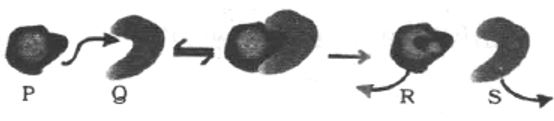
The given equation represents the mechanism of action of which of the following?
A
Enzymes
B
Hormones
C
Vitamins
D
Lipids
Solution
(A) The provided image illustrates the 'Lock and Key' model of enzyme action.
In this model,$P$ represents the substrate,$Q$ represents the enzyme,and the complex formed is the enzyme-substrate complex.
After the reaction,$R$ represents the product and $S$ represents the enzyme,which is released unchanged to catalyze further reactions.
Therefore,the mechanism shown is characteristic of enzymes.
In this model,$P$ represents the substrate,$Q$ represents the enzyme,and the complex formed is the enzyme-substrate complex.
After the reaction,$R$ represents the product and $S$ represents the enzyme,which is released unchanged to catalyze further reactions.
Therefore,the mechanism shown is characteristic of enzymes.
0 likes
View Solution229
EasyMCQ
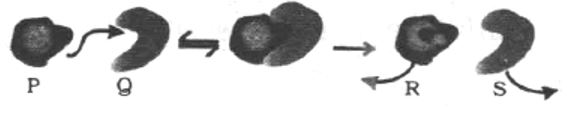
What does $P$ represent in the given figure?
A
Substrate
B
Enzyme
C
Product
D
Co-enzyme
Solution
(A) In the provided diagram,the process illustrates the mechanism of enzyme action.
$P$ represents the substrate molecule that binds to the active site of the enzyme.
$Q$ represents the enzyme.
$R$ represents the product formed after the reaction.
$S$ represents the enzyme released after the reaction is complete.
Therefore,$P$ is the substrate.
$P$ represents the substrate molecule that binds to the active site of the enzyme.
$Q$ represents the enzyme.
$R$ represents the product formed after the reaction.
$S$ represents the enzyme released after the reaction is complete.
Therefore,$P$ is the substrate.
0 likes
View Solution230
MediumMCQ
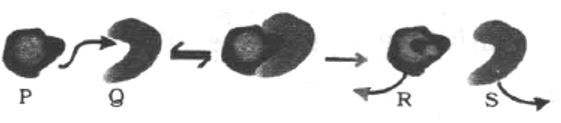
What does $Q$ represent in the given figure?
A
Substrate
B
Enzyme
C
Product
D
Co-enzyme
Solution
(B) In the provided diagram,the process illustrates the mechanism of enzyme action.
$P$ represents the substrate which binds to the active site of the enzyme.
$Q$ represents the enzyme,which has an active site where the substrate binds to form an enzyme-substrate complex.
$R$ represents the product formed after the reaction.
$S$ represents the enzyme released after the reaction,which remains unchanged and can catalyze further reactions.
Therefore,$Q$ represents the enzyme.
$P$ represents the substrate which binds to the active site of the enzyme.
$Q$ represents the enzyme,which has an active site where the substrate binds to form an enzyme-substrate complex.
$R$ represents the product formed after the reaction.
$S$ represents the enzyme released after the reaction,which remains unchanged and can catalyze further reactions.
Therefore,$Q$ represents the enzyme.
0 likes
View Solution231
MediumMCQ
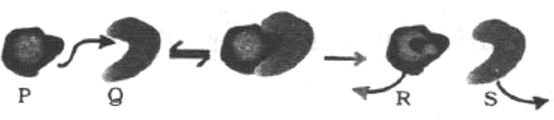
What does $R$ represent in the given figure?
A
Substrate
B
Enzyme
C
Co-enzyme
D
Product
Solution
(D) The provided figure illustrates the mechanism of enzyme action,specifically the 'Lock and Key' or 'Induced Fit' model.
In this process:
$P$ represents the substrate.
$Q$ represents the enzyme.
The complex formed between the enzyme and substrate is the enzyme-substrate complex.
$R$ represents the product formed after the reaction.
$S$ represents the enzyme,which is released unchanged after the reaction to catalyze further substrate molecules.
In this process:
$P$ represents the substrate.
$Q$ represents the enzyme.
The complex formed between the enzyme and substrate is the enzyme-substrate complex.
$R$ represents the product formed after the reaction.
$S$ represents the enzyme,which is released unchanged after the reaction to catalyze further substrate molecules.
0 likes
View Solution232
MediumMCQ
Which of the following statements is correct with reference to enzymes?
A
$Holoenzyme = Apoenzyme + Coenzyme$
B
$Coenzyme = Apoenzyme + Holoenzyme$
C
$Holoenzyme = Coenzyme + Cofactor$
D
$Apoenzyme = Holoenzyme + Coenzyme$
Solution
(A) The correct statement is $Holoenzyme = Apoenzyme + Cofactor$.
An apoenzyme is the protein part of an enzyme,which is inactive on its own.
$A$ cofactor is a non-protein chemical compound that is required for the enzyme's activity.
When an apoenzyme binds with its specific cofactor,it forms a complete,catalytically active enzyme known as a $Holoenzyme$.
Coenzymes are a specific type of organic cofactor that bind loosely to the apoenzyme.
Therefore,$Holoenzyme = Apoenzyme + Coenzyme$ (where coenzyme acts as a cofactor) is the correct representation among the given options.
An apoenzyme is the protein part of an enzyme,which is inactive on its own.
$A$ cofactor is a non-protein chemical compound that is required for the enzyme's activity.
When an apoenzyme binds with its specific cofactor,it forms a complete,catalytically active enzyme known as a $Holoenzyme$.
Coenzymes are a specific type of organic cofactor that bind loosely to the apoenzyme.
Therefore,$Holoenzyme = Apoenzyme + Coenzyme$ (where coenzyme acts as a cofactor) is the correct representation among the given options.
0 likes
View Solution233
EasyMCQ
$A$ non-proteinaceous enzyme is
A
lysozyme
B
ribozyme
C
ligase
D
deoxyribonuclease
Solution
(B) : $A$ ribozyme is a ribonucleic acid $(RNA)$ enzyme that catalyses a chemical reaction in a similar way to that of a protein enzyme.
These are found in ribosomes and are also called catalytic $RNAs.$
These are found in ribosomes and are also called catalytic $RNAs.$
0 likes
View Solution234
MediumMCQ
Which of the following describes the given graph correctly?
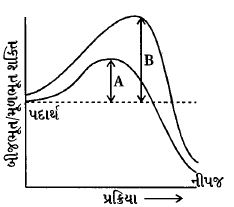
A
Endothermic reaction with energy $A$ in presence of enzyme and $B$ in absence of enzyme.
B
Exothermic reaction with energy $A$ in presence of enzyme and $B$ in absence of enzyme.
C
Endothermic reaction with energy $A$ in absence of enzyme and $B$ in presence of enzyme.
D
Exothermic reaction with energy $A$ in absence of enzyme and $B$ in presence of enzyme.
Solution
(B) The graph shows the energy levels of reactants and products during a chemical reaction.
Since the energy level of the product is lower than that of the reactant,the reaction is exothermic.
Enzymes lower the activation energy of a reaction.
In the graph,$A$ represents the activation energy in the presence of an enzyme (lower peak),and $B$ represents the activation energy in the absence of an enzyme (higher peak).
Therefore,the correct description is an exothermic reaction with energy $A$ in the presence of an enzyme and $B$ in the absence of an enzyme.
Since the energy level of the product is lower than that of the reactant,the reaction is exothermic.
Enzymes lower the activation energy of a reaction.
In the graph,$A$ represents the activation energy in the presence of an enzyme (lower peak),and $B$ represents the activation energy in the absence of an enzyme (higher peak).
Therefore,the correct description is an exothermic reaction with energy $A$ in the presence of an enzyme and $B$ in the absence of an enzyme.
0 likes
View Solution235
MediumMCQ
Which one of the following statements is incorrect?
A
The competitive inhibitor does not affect the rate of breakdown of the enzyme-substrate complex.
B
The presence of the competitive inhibitor decreases the $K_m$ of the enzyme for the substrate.
C
$A$ competitive inhibitor reacts reversibly with the enzyme to form an enzyme-inhibitor complex.
D
In competitive inhibition,the inhibitor molecule is not chemically changed by the enzyme.
Solution
(B) The correct answer is $B$. Competitive inhibition is a reversible process where the inhibitor competes with the normal substrate for the active site of the enzyme.
In competitive inhibition,the inhibitor is structurally similar to the substrate,allowing it to bind to the active site. This binding prevents the substrate from binding,thereby reducing the enzyme's affinity for the substrate.
The $K_m$ value (Michaelis constant) represents the substrate concentration at which the reaction velocity is half of the maximum velocity $(V_{max})$. $A$ higher $K_m$ indicates lower affinity. Since a competitive inhibitor reduces the apparent affinity of the enzyme for the substrate,it increases the $K_m$ value,not decreases it. Therefore,statement $B$ is incorrect.
Statement $A$ is correct because the inhibitor does not affect the catalytic step $(k_{cat})$ once the enzyme-substrate complex is formed. Statement $C$ is correct as the binding is reversible. Statement $D$ is correct because the inhibitor is not a substrate and is not chemically modified by the enzyme.
In competitive inhibition,the inhibitor is structurally similar to the substrate,allowing it to bind to the active site. This binding prevents the substrate from binding,thereby reducing the enzyme's affinity for the substrate.
The $K_m$ value (Michaelis constant) represents the substrate concentration at which the reaction velocity is half of the maximum velocity $(V_{max})$. $A$ higher $K_m$ indicates lower affinity. Since a competitive inhibitor reduces the apparent affinity of the enzyme for the substrate,it increases the $K_m$ value,not decreases it. Therefore,statement $B$ is incorrect.
Statement $A$ is correct because the inhibitor does not affect the catalytic step $(k_{cat})$ once the enzyme-substrate complex is formed. Statement $C$ is correct as the binding is reversible. Statement $D$ is correct because the inhibitor is not a substrate and is not chemically modified by the enzyme.
0 likes
View Solution236
MediumMCQ
Select the option which is not correct with respect to enzyme action.
A
Substrate binds with enzyme at its active site.
B
Addition of lot of succinate does not reverse the inhibition of succinic dehydrogenase by malonate.
C
$A$ non-competitive inhibitor binds the enzyme at a site distinct from that which binds the substrate.
D
Malonate is a competitive inhibitor of succinic dehydrogenase.
Solution
(B) The correct answer is $B$. The inhibition of succinate dehydrogenase by malonate is a classic example of competitive inhibition.
Competitive inhibition is a reversible process where the inhibitor competes with the substrate for the active site of the enzyme.
Because the inhibitor is structurally similar to the substrate,it occupies the active site,preventing the substrate from binding.
Since this binding is temporary and reversible,increasing the concentration of the substrate (succinate) allows it to outcompete the inhibitor (malonate) for the active site,thereby reversing the inhibition.
Therefore,the statement that adding a lot of succinate does not reverse the inhibition is incorrect.
Competitive inhibition is a reversible process where the inhibitor competes with the substrate for the active site of the enzyme.
Because the inhibitor is structurally similar to the substrate,it occupies the active site,preventing the substrate from binding.
Since this binding is temporary and reversible,increasing the concentration of the substrate (succinate) allows it to outcompete the inhibitor (malonate) for the active site,thereby reversing the inhibition.
Therefore,the statement that adding a lot of succinate does not reverse the inhibition is incorrect.
0 likes
View Solution237
MediumMCQ
The transition state structure of the substrate formed during an enzymatic reaction is:
A
transient and unstable
B
permanent and stable
C
transient but stable
D
permanent but unstable
Solution
(A) The transition state is the formation of an unstable intermediate structural state during an enzymatic reaction.
During this process,existing bonds in the substrate are broken and new bonds are established to transform the substrate molecules into products.
This state is transient (short-lived) and highly unstable due to its high energy level.
During this process,existing bonds in the substrate are broken and new bonds are established to transform the substrate molecules into products.
This state is transient (short-lived) and highly unstable due to its high energy level.
0 likes
View Solution238
MediumMCQ
Which of the following statements about enzymes is wrong?
A
Enzymes are denatured at high temperatures.
B
Enzymes are mostly proteins but some are lipids also.
C
Enzymes are highly specific.
D
Enzymes require optimum pH and temperature for maximum activity.
Solution
(B) The correct answer is $B$.
Enzymes are primarily proteinaceous in nature.
Some $RNA$ molecules also act as enzymes,which are known as ribozymes.
There are no known lipids that function as enzymes.
Therefore,the statement that enzymes are lipids is incorrect.
Enzymes are primarily proteinaceous in nature.
Some $RNA$ molecules also act as enzymes,which are known as ribozymes.
There are no known lipids that function as enzymes.
Therefore,the statement that enzymes are lipids is incorrect.
0 likes
View Solution239
MediumMCQ
Three of the following statements about enzymes are correct and one is wrong. Which one is wrong?
A
Enzymes require optimum pH for maximal activity.
B
Enzymes are denatured at high temperature but in certain exceptional organisms they are effective even at temperatures $80^{\circ}C - 90^{\circ}C$.
C
Enzymes are highly specific.
D
Most enzymes are proteins but some are lipids.
Solution
(D) The correct answer is $D$.
Most enzymes are proteins in nature, but some are $RNA$ molecules known as ribozymes.
There are no known lipids that function as enzymes.
Therefore, the statement that 'some enzymes are lipids' is incorrect.
Most enzymes are proteins in nature, but some are $RNA$ molecules known as ribozymes.
There are no known lipids that function as enzymes.
Therefore, the statement that 'some enzymes are lipids' is incorrect.
0 likes
View Solution240
MediumMCQ
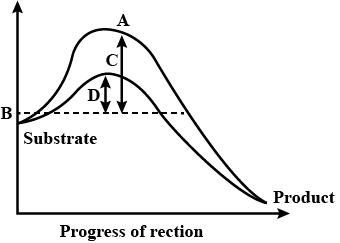
The figure given below shows the conversion of a substrate into product by an enzyme. In which one of the four options $(A-D)$ are the components of the reaction labeled as $A, B, C,$ and $D$ identified correctly?
A
$A$: Potential energy, $B$: Transition state, $C$: Activation energy without enzyme, $D$: Activation energy with enzyme
B
$A$: Transition state, $B$: Potential energy, $C$: Activation energy without enzyme, $D$: Activation energy with enzyme
C
$A$: Potential energy, $B$: Transition state, $C$: Activation energy with enzyme, $D$: Activation energy without enzyme
D
$A$: Activation energy, $B$: Transition state, $C$: Activation energy without enzyme, $D$: Potential energy
Solution
(B) In the given graph representing the progress of an enzymatic reaction:
- $A$ represents the peak of the curve, which is the $Transition \text{ } state$.
- $B$ represents the energy level of the substrate, which is the $Potential \text{ } energy$.
- $C$ represents the energy barrier that must be overcome for the reaction to proceed without an enzyme, known as the $Activation \text{ } energy \text{ } without \text{ } enzyme$.
- $D$ represents the lowered energy barrier when an enzyme is present, known as the $Activation \text{ } energy \text{ } with \text{ } enzyme$.
Therefore, the correct identification is given in option $B$.
- $A$ represents the peak of the curve, which is the $Transition \text{ } state$.
- $B$ represents the energy level of the substrate, which is the $Potential \text{ } energy$.
- $C$ represents the energy barrier that must be overcome for the reaction to proceed without an enzyme, known as the $Activation \text{ } energy \text{ } without \text{ } enzyme$.
- $D$ represents the lowered energy barrier when an enzyme is present, known as the $Activation \text{ } energy \text{ } with \text{ } enzyme$.
Therefore, the correct identification is given in option $B$.
0 likes
View Solution241
EasyMCQ
The enzyme which converts sucrose into glucose and fructose is:
A
Decarboxylase
B
Invertase
C
Oxygenase
D
Peptidase
Solution
(B) The enzyme $Invertase$ (also known as $Sucrase$) catalyzes the hydrolysis of sucrose into its constituent monosaccharides,glucose and fructose. The chemical reaction is represented as:
$Sucrose + H_2O \xrightarrow{Invertase} Glucose + Fructose$.
Therefore,the correct option is $B$.
$Sucrose + H_2O \xrightarrow{Invertase} Glucose + Fructose$.
Therefore,the correct option is $B$.
0 likes
View Solution242
MediumMCQ
Identify the odd one out based on function.
A
Pepsin
B
Trypsin
C
Carbonic anhydrase
D
Dipeptidase
Solution
(C) The enzymes $Pepsin$, $Trypsin$, and $Dipeptidase$ are all involved in the process of protein digestion (proteolytic enzymes).
$Pepsin$ acts in the stomach to break down proteins into peptides.
$Trypsin$ acts in the small intestine to break down proteins into peptides.
$Dipeptidase$ acts in the small intestine to break down dipeptides into amino acids.
$Carbonic \text{ } anhydrase$ is an enzyme that catalyzes the interconversion of carbon dioxide and water to bicarbonate and protons, which is involved in acid-base balance and gas transport, not protein digestion. Therefore, it is the odd one out.
$Pepsin$ acts in the stomach to break down proteins into peptides.
$Trypsin$ acts in the small intestine to break down proteins into peptides.
$Dipeptidase$ acts in the small intestine to break down dipeptides into amino acids.
$Carbonic \text{ } anhydrase$ is an enzyme that catalyzes the interconversion of carbon dioxide and water to bicarbonate and protons, which is involved in acid-base balance and gas transport, not protein digestion. Therefore, it is the odd one out.
0 likes
View Solution243
EasyMCQ
Identify the hydrolase type enzyme.
A
Lipase
B
Protease
C
Carbohydrases
D
All of the above
Solution
(D) Hydrolases are enzymes that catalyze the hydrolysis of chemical bonds.
Lipases catalyze the hydrolysis of lipids (fats).
Proteases catalyze the hydrolysis of proteins.
Carbohydrases catalyze the hydrolysis of carbohydrates.
Since all three types of enzymes mentioned function by adding water to break bonds,they are all classified as hydrolases.
Therefore,the correct answer is $D$.
Lipases catalyze the hydrolysis of lipids (fats).
Proteases catalyze the hydrolysis of proteins.
Carbohydrases catalyze the hydrolysis of carbohydrates.
Since all three types of enzymes mentioned function by adding water to break bonds,they are all classified as hydrolases.
Therefore,the correct answer is $D$.
0 likes
View Solution244
MediumMCQ
Enzymes that catalyse the removal of groups from substrates by mechanisms other than hydrolysis,leaving double bonds,are known as:
A
Transferases
B
Lyases
C
Ligases
D
Isomerases
Solution
(B) Enzymes are classified into six classes based on the type of reaction they catalyse.
$1$. $Lyases$ are enzymes that catalyse the removal of groups from substrates by mechanisms other than hydrolysis,which often results in the formation of double bonds.
$2$. $Transferases$ catalyse the transfer of a group between a pair of substrates.
$3$. $Ligases$ catalyse the linking together of two compounds.
$4$. $Isomerases$ catalyse the interconversion of optical,geometric,or positional isomers.
Therefore,the correct answer is $Lyases$.
$1$. $Lyases$ are enzymes that catalyse the removal of groups from substrates by mechanisms other than hydrolysis,which often results in the formation of double bonds.
$2$. $Transferases$ catalyse the transfer of a group between a pair of substrates.
$3$. $Ligases$ catalyse the linking together of two compounds.
$4$. $Isomerases$ catalyse the interconversion of optical,geometric,or positional isomers.
Therefore,the correct answer is $Lyases$.
0 likes
View Solution245
MediumMCQ
The proteinous part of an enzyme is known as:
A
Apoenzyme
B
Co-enzyme
C
Metal ion
D
Prosthetic group
Solution
(A) An enzyme is often composed of a protein portion and a non-protein portion.
The protein portion of an enzyme is called the $Apoenzyme$.
It is the inactive part of the enzyme that requires a cofactor (such as a co-enzyme,metal ion,or prosthetic group) to become catalytically active.
The complete,active enzyme complex consisting of the $Apoenzyme$ and the cofactor is known as the $Holoenzyme$.
The protein portion of an enzyme is called the $Apoenzyme$.
It is the inactive part of the enzyme that requires a cofactor (such as a co-enzyme,metal ion,or prosthetic group) to become catalytically active.
The complete,active enzyme complex consisting of the $Apoenzyme$ and the cofactor is known as the $Holoenzyme$.
0 likes
View Solution246
EasyMCQ
Those nucleic acids which behave like enzymes are known as
A
Ribozymes
B
Pepzymes
C
Ribosomes
D
Ribose
Solution
(A) Nucleic acids that possess catalytic activity and function as enzymes are called $Ribozymes$.
Most enzymes are proteins,but $Ribozymes$ are $RNA$ molecules that can catalyze specific biochemical reactions,such as the removal of introns during $RNA$ splicing or the formation of peptide bonds during protein synthesis.
Most enzymes are proteins,but $Ribozymes$ are $RNA$ molecules that can catalyze specific biochemical reactions,such as the removal of introns during $RNA$ splicing or the formation of peptide bonds during protein synthesis.
0 likes
View Solution247
MediumMCQ
Choose the type of enzyme involved in the following reaction: $S-G + S' \rightarrow S + S'-G$.
A
Dehydrogenase
B
Transferase
C
Isomerase
D
Ligase
Solution
(B) The given reaction is $S-G + S' \rightarrow S + S'-G$.
In this reaction,a functional group '$G$' is transferred from one substrate '$S$' to another substrate '$S'$'.
Enzymes that catalyze the transfer of a group other than hydrogen between a pair of substrates are classified as Transferases.
Therefore,the correct type of enzyme is Transferase.
In this reaction,a functional group '$G$' is transferred from one substrate '$S$' to another substrate '$S'$'.
Enzymes that catalyze the transfer of a group other than hydrogen between a pair of substrates are classified as Transferases.
Therefore,the correct type of enzyme is Transferase.
0 likes
View Solution248
MediumMCQ
Catalysts made up of protein that control metabolic processes are known as...
A
Enzymes
B
Substances
C
Cofactors
D
Prosthetic groups
Solution
(A) Enzymes are biocatalysts that speed up chemical reactions in living organisms.
Most enzymes are globular proteins,which means they are composed of amino acid chains folded into specific three-dimensional shapes.
These proteins lower the activation energy required for metabolic reactions,thereby controlling the rate of these processes within the cell.
Therefore,the correct answer is $A$.
Most enzymes are globular proteins,which means they are composed of amino acid chains folded into specific three-dimensional shapes.
These proteins lower the activation energy required for metabolic reactions,thereby controlling the rate of these processes within the cell.
Therefore,the correct answer is $A$.
0 likes
View Solution249
MediumMCQ
Which of the following is an enzyme?
A
Collagen
B
Antibody
C
Insulin
D
Trypsin
Solution
(D) $Trypsin$ is a proteolytic enzyme (protease) found in the digestive system of many vertebrates, where it breaks down proteins.
$Collagen$ is a structural protein found in connective tissues.
$Antibody$ is a protein used by the immune system to identify and neutralize foreign objects like bacteria and viruses.
$Insulin$ is a peptide hormone produced by beta cells of the pancreatic islets.
$Collagen$ is a structural protein found in connective tissues.
$Antibody$ is a protein used by the immune system to identify and neutralize foreign objects like bacteria and viruses.
$Insulin$ is a peptide hormone produced by beta cells of the pancreatic islets.
0 likes
View Solution250
EasyMCQ
What is ribozyme?
A
Protein
B
Enzyme
C
Hormone
D
Living state
Solution
(B) ribozyme is an $RNA$ molecule that possesses catalytic activity,meaning it can catalyze specific biochemical reactions.
Most enzymes are proteins,but ribozymes are unique because they are composed of ribonucleic acid $(RNA)$.
Therefore,a ribozyme functions as an enzyme.
Most enzymes are proteins,but ribozymes are unique because they are composed of ribonucleic acid $(RNA)$.
Therefore,a ribozyme functions as an enzyme.
0 likes
View SolutionBiomolecules — Enzymes · Frequently Asked Questions
1Are these Biomolecules questions useful for JEE and NEET?
Yes. All questions in this section are mapped to JEE Main and NEET exam patterns. Previous year questions from JEE Main, NEET, GUJCET and state-level exams are included with full solutions.
2Can I switch to Hindi or Gujarati for these questions?
Yes. Use the language tabs in the hero section or the sidebar to view the same questions and solutions in English, Hindi or Gujarati.
3How do I generate a question paper from this subtopic?
Use the Vedclass Exam Paper Generator — select the chapter and subtopic, set difficulty, and generate Sets A, B, C, D automatically. First 3 chapters of every subject are free.
Vedclass Products
For Students
Vedclass Test Series
Mock tests in real JEE/NEET style with performance analysis. 5-day free trial.
Start Free TrialFor Teachers
Exam Paper Generator
Generate Set A/B/C/D papers from this chapter in 2 minutes. 3 chapters free.
Try FreeFor Institutes
Online Exam Module
Live online exams with unlimited students, 360° analytics & white-label branding.
See DemoFor Teachers & Institutes
Generate a Biomolecules Exam Paper in 2 Minutes
Select subtopic & difficulty — Sets A, B, C, D auto-generated with No Repeat logic.
First 3 chapters of every subject are free — no payment required.