
A English
Mix Examples - Animal Kingdom Questions in English
Class 11 Biology · Animal Kingdom · Mix Examples - Animal Kingdom
431+
Questions
English
Language
100%
With Solutions
Showing 49 of 431 questions in English
251
MediumMCQ
In which phylum is segmentation shown?
A
Chordata
B
Mollusca
C
Both $(A)$ and $(B)$
D
Arthropoda
Solution
(C) Segmentation,also known as metamerism,is a characteristic feature where the body is externally and internally divided into segments with a serial repetition of at least some organs.
Among the given options,$Arthropoda$ and $Chordata$ both exhibit true segmentation.
$Arthropoda$ shows metameric segmentation,and $Chordata$ (specifically in vertebrates) shows segmentation in the form of vertebrae and muscles.
Since the question asks for a phylum where segmentation is shown,and both $Chordata$ and $Arthropoda$ exhibit this trait,the most appropriate answer is that both are correct. However,in standard multiple-choice contexts,if $Arthropoda$ is the primary focus of the subtopic,it is a classic example. Given the options provided,$Chordata$ and $Arthropoda$ are both segmented.
Among the given options,$Arthropoda$ and $Chordata$ both exhibit true segmentation.
$Arthropoda$ shows metameric segmentation,and $Chordata$ (specifically in vertebrates) shows segmentation in the form of vertebrae and muscles.
Since the question asks for a phylum where segmentation is shown,and both $Chordata$ and $Arthropoda$ exhibit this trait,the most appropriate answer is that both are correct. However,in standard multiple-choice contexts,if $Arthropoda$ is the primary focus of the subtopic,it is a classic example. Given the options provided,$Chordata$ and $Arthropoda$ are both segmented.
0 likes
View Solution252
MediumMCQ
Choose the correct pair:
A
Mammal - Poikilotherms
B
Reptile - Homoiothermous
C
Amphibians - Oviparous and external fertilization
D
Aves - Three chambered heart
Solution
(C) $1$. Mammals are $Homoiothermous$ (warm-blooded),not $Poikilotherms$.
$2$. Reptiles are $Poikilotherms$ (cold-blooded),not $Homoiothermous$.
$3$. Amphibians are generally $Oviparous$ and exhibit $external$ $fertilization$ (e.g.,frogs).
$4$. Aves (birds) have a $four-chambered$ heart,not a $three-chambered$ heart.
$2$. Reptiles are $Poikilotherms$ (cold-blooded),not $Homoiothermous$.
$3$. Amphibians are generally $Oviparous$ and exhibit $external$ $fertilization$ (e.g.,frogs).
$4$. Aves (birds) have a $four-chambered$ heart,not a $three-chambered$ heart.
0 likes
View Solution253
MediumMCQ
Select the odd one out:
A
Exocoetus
B
Trygon
C
Hippocampus
D
Pterophyllum
Solution
(B) The correct answer is $B$ (Trygon).
$Exocoetus$ (flying fish),$Hippocampus$ (sea horse),and $Pterophyllum$ (angel fish) are all members of the class $Osteichthyes$ (bony fishes).
$Trygon$ (sting ray) belongs to the class $Chondrichthyes$ (cartilaginous fishes).
Therefore,$Trygon$ is the odd one out as it has a cartilaginous endoskeleton,while the others have a bony endoskeleton.
$Exocoetus$ (flying fish),$Hippocampus$ (sea horse),and $Pterophyllum$ (angel fish) are all members of the class $Osteichthyes$ (bony fishes).
$Trygon$ (sting ray) belongs to the class $Chondrichthyes$ (cartilaginous fishes).
Therefore,$Trygon$ is the odd one out as it has a cartilaginous endoskeleton,while the others have a bony endoskeleton.
0 likes
View Solution254
MediumMCQ
Find the odd one out.
A
Sea lily
B
Sea fan
C
Sea cucumber
D
Sea urchin
Solution
(B) The correct answer is $B$ (Sea fan).
$1$. Sea lily $(Antedon)$,sea cucumber $(Holothuria)$,and sea urchin $(Echinus)$ all belong to the phylum $Echinodermata$.
$2$. Sea fan $(Gorgonia)$ belongs to the phylum $Cnidaria$ (Coelenterata).
$3$. Therefore,the sea fan is the odd one out as it belongs to a different phylum compared to the others.
$1$. Sea lily $(Antedon)$,sea cucumber $(Holothuria)$,and sea urchin $(Echinus)$ all belong to the phylum $Echinodermata$.
$2$. Sea fan $(Gorgonia)$ belongs to the phylum $Cnidaria$ (Coelenterata).
$3$. Therefore,the sea fan is the odd one out as it belongs to a different phylum compared to the others.
0 likes
View Solution255
MediumMCQ
Match the following columns.
Select the correct sequence for $a, b, c, d$.
| $a$. Cellular level of organisation | $1$. Cnidarians |
| $b$. Organ level of organisation | $2$. Platyhelminthes |
| $c$. Organ system level of organisation | $3$. Chordates |
| $d$. Tissue level of organisation | $4$. Porifera |
Select the correct sequence for $a, b, c, d$.
A
$4, 2, 3, 1$
B
$3, 2, 4, 1$
C
$2, 1, 4, 3$
D
$4, 2, 1, 3$
Solution
(A) The levels of organization in the animal kingdom are classified as follows:
$a$. Cellular level of organisation: Found in phylum Porifera $(4)$.
$b$. Organ level of organisation: Found in phylum Platyhelminthes $(2)$.
$c$. Organ system level of organisation: Found in higher phyla like Chordates $(3)$.
$d$. Tissue level of organisation: Found in phylum Cnidaria $(1)$.
Therefore,the correct matching is $a-4, b-2, c-3, d-1$.
$a$. Cellular level of organisation: Found in phylum Porifera $(4)$.
$b$. Organ level of organisation: Found in phylum Platyhelminthes $(2)$.
$c$. Organ system level of organisation: Found in higher phyla like Chordates $(3)$.
$d$. Tissue level of organisation: Found in phylum Cnidaria $(1)$.
Therefore,the correct matching is $a-4, b-2, c-3, d-1$.
0 likes
View Solution256
MediumMCQ
Which one of the following figures shows radial symmetry?
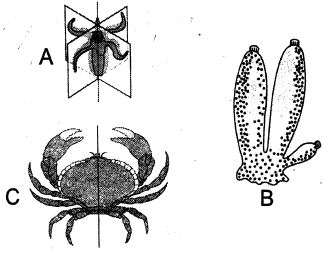
A
$A$
B
$B$
C
$C$
D
All of the above
Solution
(A) Radial symmetry is a type of body symmetry where an organism can be divided into identical halves by any plane passing through the central axis.
In the given figures:
Figure $A$ shows a Hydra,which exhibits radial symmetry.
Figure $B$ shows a sponge,which is generally asymmetrical.
Figure $C$ shows a crab,which exhibits bilateral symmetry.
Therefore,figure $A$ represents radial symmetry.
In the given figures:
Figure $A$ shows a Hydra,which exhibits radial symmetry.
Figure $B$ shows a sponge,which is generally asymmetrical.
Figure $C$ shows a crab,which exhibits bilateral symmetry.
Therefore,figure $A$ represents radial symmetry.
0 likes
View Solution257
MediumMCQ
Choose the false option.
A
Sponges - Asymmetrical
B
Coelenterates - Diploblastic,radial symmetry,non-chordates
C
Chordates - Petromyzon,Ornithorhynchus,Equus
D
Annelid - Pseudocoelomate
Solution
(D) The correct answer is $D$.
$A$. Sponges (Phylum Porifera) are mostly asymmetrical. This is a true statement.
$B$. Coelenterates (Phylum Cnidaria) are diploblastic,exhibit radial symmetry,and are non-chordates. This is a true statement.
$C$. Chordates include organisms like $Petromyzon$ (lamprey),$Ornithorhynchus$ (platypus),and $Equus$ (horse). This is a true statement.
$D$. Annelids (Phylum Annelida) are triploblastic and coelomate (possess a true coelom). They are not pseudocoelomate. Therefore,this statement is false.
$A$. Sponges (Phylum Porifera) are mostly asymmetrical. This is a true statement.
$B$. Coelenterates (Phylum Cnidaria) are diploblastic,exhibit radial symmetry,and are non-chordates. This is a true statement.
$C$. Chordates include organisms like $Petromyzon$ (lamprey),$Ornithorhynchus$ (platypus),and $Equus$ (horse). This is a true statement.
$D$. Annelids (Phylum Annelida) are triploblastic and coelomate (possess a true coelom). They are not pseudocoelomate. Therefore,this statement is false.
0 likes
View Solution258
MediumMCQ
Select the incorrect option with respect to the features present in the three phyla: Arthropoda,Mollusca,and Chordata.
A
Coelom: Absent,Absent,Absent
B
Segmentation: Present,Absent,Present
C
Digestive system: Complete,Complete,Complete
D
Circulatory system: Present,Present,Present
Solution
(A) The correct answer is $A$.
$1$. Arthropoda,Mollusca,and Chordata are all triploblastic animals and possess a true coelom (coelomates). Therefore,stating that the coelom is absent in all three is incorrect.
$2$. Arthropods and Chordates exhibit metameric segmentation,whereas Molluscs are generally unsegmented. Thus,option $B$ is correct.
$3$. All three phyla possess a complete digestive system with a mouth and anus. Thus,option $C$ is correct.
$4$. All three phyla possess a circulatory system (though the type may vary,e.g.,open in Arthropoda and Mollusca,closed in Chordata). Thus,option $D$ is correct.
$1$. Arthropoda,Mollusca,and Chordata are all triploblastic animals and possess a true coelom (coelomates). Therefore,stating that the coelom is absent in all three is incorrect.
$2$. Arthropods and Chordates exhibit metameric segmentation,whereas Molluscs are generally unsegmented. Thus,option $B$ is correct.
$3$. All three phyla possess a complete digestive system with a mouth and anus. Thus,option $C$ is correct.
$4$. All three phyla possess a circulatory system (though the type may vary,e.g.,open in Arthropoda and Mollusca,closed in Chordata). Thus,option $D$ is correct.
0 likes
View Solution259
MediumMCQ
Which pair of animals are not included in mammals?
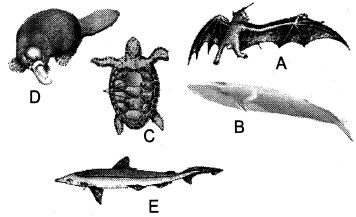
A
$C$ and $E$
B
$A$ and $C$
C
$E$ and $C$
D
$B$ and $E$
Solution
(A) Based on the provided image,the animals are identified as follows:
$A$: Bat (Mammal)
$B$: Whale (Mammal)
$C$: Turtle (Reptile)
$D$: Platypus (Mammal)
$E$: Shark (Fish/Chondrichthyes)
Mammals are characterized by the presence of mammary glands and hair. Among the given options,$C$ (Turtle) is a reptile and $E$ (Shark) is a cartilaginous fish. Therefore,the pair of animals not included in mammals is $C$ and $E$.
$A$: Bat (Mammal)
$B$: Whale (Mammal)
$C$: Turtle (Reptile)
$D$: Platypus (Mammal)
$E$: Shark (Fish/Chondrichthyes)
Mammals are characterized by the presence of mammary glands and hair. Among the given options,$C$ (Turtle) is a reptile and $E$ (Shark) is a cartilaginous fish. Therefore,the pair of animals not included in mammals is $C$ and $E$.
0 likes
View Solution260
MediumMCQ
Based on the given figure showing cross-sections of animals,identify the correct classification for $a, b,$ and $c$ regarding their body cavity (coelom).
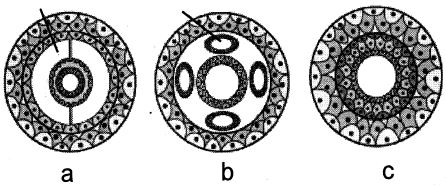
A
$a$ - Aschelminthes,$b$ - Platyhelminthes,$c$ - Arthropoda
B
$a$ - Arthropoda,$b$ - Platyhelminthes,$c$ - Aschelminthes
C
$a$ - Arthropoda,$b$ - Aschelminthes,$c$ - Platyhelminthes
D
$a$ - Platyhelminthes,$b$ - Aschelminthes,$c$ - Arthropoda
Solution
(C) In the provided figure:
$a$ represents a coelomate animal,where the body cavity is lined by mesoderm on both sides. Examples include Arthropoda,Mollusca,Annelida,etc.
$b$ represents a pseudocoelomate animal,where the body cavity is not lined by mesoderm but is present as scattered pouches between the ectoderm and endoderm. The characteristic example is Aschelminthes.
$c$ represents an acoelomate animal,where there is no body cavity between the body wall and the digestive tract. The characteristic example is Platyhelminthes.
Therefore,$a$ is Arthropoda,$b$ is Aschelminthes,and $c$ is Platyhelminthes.
$a$ represents a coelomate animal,where the body cavity is lined by mesoderm on both sides. Examples include Arthropoda,Mollusca,Annelida,etc.
$b$ represents a pseudocoelomate animal,where the body cavity is not lined by mesoderm but is present as scattered pouches between the ectoderm and endoderm. The characteristic example is Aschelminthes.
$c$ represents an acoelomate animal,where there is no body cavity between the body wall and the digestive tract. The characteristic example is Platyhelminthes.
Therefore,$a$ is Arthropoda,$b$ is Aschelminthes,and $c$ is Platyhelminthes.
0 likes
View Solution261
MediumMCQ
Which of the following statements are true or false?
$(i)$ Suckers are found in liver fluke.
$(ii)$ In Arthropods,fertilization is external.
$(iii)$ Chordata is divided into $4$ subphyla.
$(iv)$ Water vascular system is present in Hemichordata.
$(i)$ Suckers are found in liver fluke.
$(ii)$ In Arthropods,fertilization is external.
$(iii)$ Chordata is divided into $4$ subphyla.
$(iv)$ Water vascular system is present in Hemichordata.
A
$(i), (ii)$ true,$(iii), (iv)$ false
B
$(i)$ true,$(ii), (iii), (iv)$ false
C
$(ii), (iii), (iv)$ true,$(i)$ false
D
$(i), (iv)$ true,$(ii), (iii)$ false
Solution
(B) $(i)$ True: Liver fluke (Fasciola hepatica) belongs to Platyhelminthes and possesses suckers for attachment.
$(ii)$ False: In Arthropods,fertilization is generally internal.
$(iii)$ False: Chordata is divided into $3$ subphyla (Urochordata,Cephalochordata,and Vertebrata).
$(iv)$ False: Water vascular system is a characteristic feature of Echinodermata,not Hemichordata.
$(ii)$ False: In Arthropods,fertilization is generally internal.
$(iii)$ False: Chordata is divided into $3$ subphyla (Urochordata,Cephalochordata,and Vertebrata).
$(iv)$ False: Water vascular system is a characteristic feature of Echinodermata,not Hemichordata.
0 likes
View Solution262
MediumMCQ
Match the following:
| Column-$I$ | Column-$II$ |
| $(a)$ Trygon | $(i)$ Echinodermata |
| $(b)$ Ascidia | (ii) Viviparous |
| $(c)$ Asterias | (iii) Chondrichthyes |
| $(d)$ Kangaroo | (iv) Oviparous |
| $(e)$ Penguin | $(v)$ Urochordata |
A
$(a-v), (b-iii), (c-i), (d-ii), (e-iv)$
B
$(a-iii), (b-v), (c-i), (d-iv), (e-ii)$
C
$(a-iii), (b-v), (c-i), (d-ii), (e-iv)$
D
$(a-v), (b-iii), (c-i), (d-iv), (e-ii)$
Solution
(C) The correct matches are as follows:
$(a)$ Trygon is a cartilaginous fish belonging to the class $Chondrichthyes$ (iii).
$(b)$ Ascidia is a member of the subphylum $Urochordata$ $(v)$.
$(c)$ Asterias (starfish) belongs to the phylum $Echinodermata$ $(i)$.
$(d)$ Kangaroo is a mammal that gives birth to relatively undeveloped young,classified as $Viviparous$ (ii).
$(e)$ Penguin is a bird that lays eggs,classified as $Oviparous$ (iv).
Thus,the correct sequence is $(a-iii), (b-v), (c-i), (d-ii), (e-iv)$.
$(a)$ Trygon is a cartilaginous fish belonging to the class $Chondrichthyes$ (iii).
$(b)$ Ascidia is a member of the subphylum $Urochordata$ $(v)$.
$(c)$ Asterias (starfish) belongs to the phylum $Echinodermata$ $(i)$.
$(d)$ Kangaroo is a mammal that gives birth to relatively undeveloped young,classified as $Viviparous$ (ii).
$(e)$ Penguin is a bird that lays eggs,classified as $Oviparous$ (iv).
Thus,the correct sequence is $(a-iii), (b-v), (c-i), (d-ii), (e-iv)$.
0 likes
View Solution263
MediumMCQ
How many classes are present in Gnathostomata?
A
$4$
B
$3$
C
$6$
D
$2$
Solution
(C) The subphylum Vertebrata is divided into two divisions: Agnatha (jawless) and Gnathostomata (jawed).
The division Gnathostomata is further divided into two superclasses: Pisces and Tetrapoda.
$1$. Pisces includes two classes: Chondrichthyes and Osteichthyes.
$2$. Tetrapoda includes four classes: Amphibia,Reptilia,Aves,and Mammalia.
Therefore,there are a total of $2 + 4 = 6$ classes in Gnathostomata.
The division Gnathostomata is further divided into two superclasses: Pisces and Tetrapoda.
$1$. Pisces includes two classes: Chondrichthyes and Osteichthyes.
$2$. Tetrapoda includes four classes: Amphibia,Reptilia,Aves,and Mammalia.
Therefore,there are a total of $2 + 4 = 6$ classes in Gnathostomata.
0 likes
View Solution264
MediumMCQ
Choose the incorrect statement.
A
Annelids possess a double ventral nerve cord.
B
Platyhelminthes have an organ level of organization.
C
Reptiles are poikilotherms.
D
The heart is two-chambered in amphibians.
Solution
(D) The correct answer is $D$.
In amphibians,the heart is three-chambered,consisting of two atria and one ventricle.
Annelids possess a double ventral nerve cord,which is a characteristic feature of their nervous system.
Platyhelminthes (flatworms) exhibit an organ level of organization.
Reptiles are poikilotherms (cold-blooded animals),meaning their body temperature fluctuates with the environment.
In amphibians,the heart is three-chambered,consisting of two atria and one ventricle.
Annelids possess a double ventral nerve cord,which is a characteristic feature of their nervous system.
Platyhelminthes (flatworms) exhibit an organ level of organization.
Reptiles are poikilotherms (cold-blooded animals),meaning their body temperature fluctuates with the environment.
0 likes
View Solution265
MediumMCQ
Which one of the following statements regarding the given animals is correct?
A
Roundworms $(Aschelminthes)$ are pseudocoelomates.
B
Molluscs are acoelomates.
C
Insects are pseudocoelomates.
D
Flatworms $(Platyhelminthes)$ are coelomates.
Solution
(A) $1$. $Aschelminthes$ (Roundworms) possess a body cavity that is not lined by mesoderm,but rather the mesoderm is present as scattered pouches between the ectoderm and endoderm. This type of body cavity is called a pseudocoelom.
$2$. Molluscs are true coelomates,meaning they possess a body cavity lined by mesoderm.
$3$. Insects (Arthropods) are true coelomates.
$4$. $Platyhelminthes$ (Flatworms) are acoelomates,meaning they lack a body cavity.
Therefore,the statement that roundworms are pseudocoelomates is correct.
$2$. Molluscs are true coelomates,meaning they possess a body cavity lined by mesoderm.
$3$. Insects (Arthropods) are true coelomates.
$4$. $Platyhelminthes$ (Flatworms) are acoelomates,meaning they lack a body cavity.
Therefore,the statement that roundworms are pseudocoelomates is correct.
0 likes
View Solution266
MediumMCQ
Which of the following are correctly matched with respect to their taxonomic classification?
A
$Nereis$,spider,scorpion - $Insecta$
B
House fly,butterfly,$Culex$ - $Insecta$
C
Seahorse,sea urchin,sea pen,sea cucumber - $Echinodermata$
D
Flying fish,$Ichthyophis$,whale - $Pisces$ (fish)
Solution
(B) $1$. $Nereis$ belongs to Phylum $Annelida$,while spider and scorpion belong to Class $Arachnida$ (Phylum $Arthropoda$).
$2$. House fly,butterfly,and $Culex$ (mosquito) all belong to Class $Insecta$ (Phylum $Arthropoda$). This is the correct match.
$3$. Seahorse is a fish $(Osteichthyes)$,sea urchin and sea cucumber are $Echinoderms$,but sea pen is a $Cnidarian$.
$4$. Flying fish is a fish $(Pisces)$,$Ichthyophis$ is an amphibian,and whale is a mammal.
$2$. House fly,butterfly,and $Culex$ (mosquito) all belong to Class $Insecta$ (Phylum $Arthropoda$). This is the correct match.
$3$. Seahorse is a fish $(Osteichthyes)$,sea urchin and sea cucumber are $Echinoderms$,but sea pen is a $Cnidarian$.
$4$. Flying fish is a fish $(Pisces)$,$Ichthyophis$ is an amphibian,and whale is a mammal.
0 likes
View Solution267
MediumMCQ
Choose the correct option.
A
Annelida - Exhibit bilateral symmetry,metamerism and coelom.
B
Echinodermata - Exhibit tissue level organisation and radial symmetry.
C
Arthropoda - Exhibit incomplete digestive system and segmentation.
D
Notochord is present on the ventral side in vertebrates.
Solution
(A) Option $A$ is correct. Phylum $Annelida$ exhibits bilateral symmetry,metamerism (true segmentation),and they are coelomate animals.
Option $B$ is incorrect because $Echinodermata$ exhibit organ-system level of organization,not tissue level.
Option $C$ is incorrect because $Arthropoda$ possess a complete digestive system,not an incomplete one.
Option $D$ is incorrect because in vertebrates,the notochord is replaced by a vertebral column,and the nerve cord is dorsal,not ventral.
Option $B$ is incorrect because $Echinodermata$ exhibit organ-system level of organization,not tissue level.
Option $C$ is incorrect because $Arthropoda$ possess a complete digestive system,not an incomplete one.
Option $D$ is incorrect because in vertebrates,the notochord is replaced by a vertebral column,and the nerve cord is dorsal,not ventral.
0 likes
View Solution268
MediumMCQ
List the phyla in the correct order of their placement in classification:
$I$. Chordata
$II$. Annelida
$III$. Arthropoda
$IV$. Platyhelminthes
$V$. Ctenophora
$VI$. Aschelminthes
$I$. Chordata
$II$. Annelida
$III$. Arthropoda
$IV$. Platyhelminthes
$V$. Ctenophora
$VI$. Aschelminthes
A
$VI, I, V, IV, III, II$
B
$II, III, IV, V, VI, I$
C
$V, IV, VI, II, III, I$
D
$III, II, VI, I, V, IV$
Solution
(C) The correct evolutionary order of the given phyla in the animal kingdom classification is as follows:
$1$. $V$. Ctenophora
$2$. $IV$. Platyhelminthes
$3$. $VI$. Aschelminthes (Nematoda)
$4$. $II$. Annelida
$5$. $III$. Arthropoda
$6$. $I$. Chordata
Thus,the correct sequence is $V, IV, VI, II, III, I$.
$1$. $V$. Ctenophora
$2$. $IV$. Platyhelminthes
$3$. $VI$. Aschelminthes (Nematoda)
$4$. $II$. Annelida
$5$. $III$. Arthropoda
$6$. $I$. Chordata
Thus,the correct sequence is $V, IV, VI, II, III, I$.
0 likes
View Solution269
MediumMCQ
Match the following columns:
Select the correct matching sequence:
| Column-$I$ | Column-$II$ |
| $A$. Physalia | $1$. Liver fluke |
| $B$. Taenia | $2$. Sycon |
| $C$. Fasciola | $3$. Tapeworm |
| $D$. Scypha | $4$. Portuguese man-of-war |
Select the correct matching sequence:
A
$2, 1, 3, 4$
B
$4, 3, 1, 2$
C
$1, 3, 2, 4$
D
$1, 2, 3, 4$
Solution
(B) The correct matches are as follows:
$A$. Physalia is commonly known as the Portuguese man-of-war $(A-4)$.
$B$. Taenia is commonly known as the tapeworm $(B-3)$.
$C$. Fasciola is commonly known as the liver fluke $(C-1)$.
$D$. Scypha is a genus of sponges,also known as Sycon $(D-2)$.
Therefore,the correct sequence is $A-4, B-3, C-1, D-2$,which corresponds to option $B$.
$A$. Physalia is commonly known as the Portuguese man-of-war $(A-4)$.
$B$. Taenia is commonly known as the tapeworm $(B-3)$.
$C$. Fasciola is commonly known as the liver fluke $(C-1)$.
$D$. Scypha is a genus of sponges,also known as Sycon $(D-2)$.
Therefore,the correct sequence is $A-4, B-3, C-1, D-2$,which corresponds to option $B$.
0 likes
View Solution270
DifficultMCQ
Fill in the blanks marked in the classification table of $Vertebrata$ from the choices provided below with respect to $A, B, C, D, E$ and $F$ and choose the correct option:
$I$. Pisces
$II$. Osteichthyes
$III$. Agnatha
$IV$. Gnathostomata
$V$. Chondrichthyes
$VI$. Cyclostomata
$A - B - C - D - E - F$
$I$. Pisces
$II$. Osteichthyes
$III$. Agnatha
$IV$. Gnathostomata
$V$. Chondrichthyes
$VI$. Cyclostomata
$A - B - C - D - E - F$
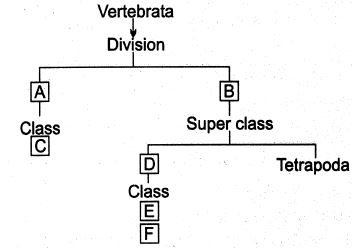
A
$III - IV - VI - I - V - II$
B
$VI - I - V - II - III - IV$
C
$I - VI - IV - II - III - V$
D
$IV - V - III - II - IV - I$
Solution
(A) The classification of $Vertebrata$ is as follows:
$Vertebrata$ is divided into two divisions: $A$ (Agnatha) and $B$ (Gnathostomata).
$A$ (Agnatha) includes the class $C$ (Cyclostomata).
$B$ (Gnathostomata) is divided into two superclasses: $D$ (Pisces) and Tetrapoda.
$D$ (Pisces) is further divided into two classes: $E$ (Chondrichthyes) and $F$ (Osteichthyes).
Matching the given options with the labels:
$A = III$ (Agnatha)
$B = IV$ (Gnathostomata)
$C = VI$ (Cyclostomata)
$D = I$ (Pisces)
$E = V$ (Chondrichthyes)
$F = II$ (Osteichthyes)
Therefore,the correct sequence is $III - IV - VI - I - V - II$.
$Vertebrata$ is divided into two divisions: $A$ (Agnatha) and $B$ (Gnathostomata).
$A$ (Agnatha) includes the class $C$ (Cyclostomata).
$B$ (Gnathostomata) is divided into two superclasses: $D$ (Pisces) and Tetrapoda.
$D$ (Pisces) is further divided into two classes: $E$ (Chondrichthyes) and $F$ (Osteichthyes).
Matching the given options with the labels:
$A = III$ (Agnatha)
$B = IV$ (Gnathostomata)
$C = VI$ (Cyclostomata)
$D = I$ (Pisces)
$E = V$ (Chondrichthyes)
$F = II$ (Osteichthyes)
Therefore,the correct sequence is $III - IV - VI - I - V - II$.
0 likes
View Solution271
MediumMCQ
Which of the following characteristics is not shared by birds and mammals?
A
Viviparity
B
Warm-blooded nature
C
Ossified endoskeleton
D
Breathing using lungs
Solution
(A) Birds and mammals share several characteristics,such as being warm-blooded (homeothermic),having an ossified endoskeleton,and breathing through lungs.
However,birds are oviparous (they lay eggs),whereas most mammals are viviparous (they give birth to live young). Therefore,viviparity is not a characteristic shared by both groups.
However,birds are oviparous (they lay eggs),whereas most mammals are viviparous (they give birth to live young). Therefore,viviparity is not a characteristic shared by both groups.
0 likes
View Solution272
MediumMCQ
Which of the following represents the correct combination without any exception?
Characteristics - Class
Characteristics - Class
A
Mouth ventral,gills without operculum,skin with placoid scales,persistent notochord - Chondrichthyes
B
Sucking and circular mouth,jaws absent,integument without scales,paired appendages - Cyclostomata
C
Body covered with feathers,skin moist and glandular,forelimbs form wings,lungs with air sacs - Aves
D
Mammary gland,hair on body,pinnae,two pairs of limbs - Mammalia
Solution
(A) Option $A$ is correct because Chondrichthyes (cartilaginous fishes) possess a ventral mouth,gills without operculum,placoid scales,and a persistent notochord throughout life.
Option $B$ is incorrect because Cyclostomata lack paired appendages.
Option $C$ is incorrect because the skin of Aves is dry and non-glandular (except for the oil gland at the base of the tail).
Option $D$ is incorrect because while most mammals have pinnae and two pairs of limbs,some mammals like whales (Cetacea) lack pinnae and hind limbs,making it not an exception-less rule.
Option $B$ is incorrect because Cyclostomata lack paired appendages.
Option $C$ is incorrect because the skin of Aves is dry and non-glandular (except for the oil gland at the base of the tail).
Option $D$ is incorrect because while most mammals have pinnae and two pairs of limbs,some mammals like whales (Cetacea) lack pinnae and hind limbs,making it not an exception-less rule.
0 likes
View Solution273
MediumMCQ
The radial symmetry is observed in
$I$. Platyhelminthes $II$. Coelenterates $III$. Aschelminthes $IV$. Annelids $V$. Echinoderms
$I$. Platyhelminthes $II$. Coelenterates $III$. Aschelminthes $IV$. Annelids $V$. Echinoderms
A
$II, III$ and $V$
B
$I, II, III$ and $V$
C
$II, III$ and $I$
D
$II$ and $V$
Solution
(D) Radial symmetry is a type of body symmetry where an organism can be divided into identical halves by any plane passing through the central axis.
In the animal kingdom,radial symmetry is primarily observed in the phyla $Coelenterata$ (Cnidaria),$Ctenophora$,and $Echinodermata$ (specifically in adult forms).
$I$. Platyhelminthes exhibit bilateral symmetry.
$II$. Coelenterates exhibit radial symmetry.
$III$. Aschelminthes exhibit bilateral symmetry.
$IV$. Annelids exhibit bilateral symmetry.
$V$. Echinoderms (adults) exhibit radial symmetry.
Therefore,radial symmetry is observed in $II$ and $V$.
In the animal kingdom,radial symmetry is primarily observed in the phyla $Coelenterata$ (Cnidaria),$Ctenophora$,and $Echinodermata$ (specifically in adult forms).
$I$. Platyhelminthes exhibit bilateral symmetry.
$II$. Coelenterates exhibit radial symmetry.
$III$. Aschelminthes exhibit bilateral symmetry.
$IV$. Annelids exhibit bilateral symmetry.
$V$. Echinoderms (adults) exhibit radial symmetry.
Therefore,radial symmetry is observed in $II$ and $V$.
0 likes
View Solution274
MediumMCQ
In which of the following groups do all members exhibit a larval stage in their life cycle?
A
Frog,Lizard,Cockroach
B
Ascaris,Housefly,Frog
C
Housefly,Earthworm,Mosquito
D
Butterfly,Frog,Mosquito
Solution
(D) larval stage is a distinct juvenile form that many animals undergo before metamorphosis into adults.
$1$. Butterfly: Undergoes complete metamorphosis (Egg $\rightarrow$ Larva/Caterpillar $\rightarrow$ Pupa $\rightarrow$ Adult).
$2$. Frog: The larval stage is known as a tadpole,which is aquatic and undergoes metamorphosis to become an adult frog.
$3$. Mosquito: Undergoes complete metamorphosis (Egg $\rightarrow$ Larva/Wriggler $\rightarrow$ Pupa $\rightarrow$ Adult).
Therefore,all members of the group (Butterfly,Frog,and Mosquito) exhibit a larval stage in their life cycle.
$1$. Butterfly: Undergoes complete metamorphosis (Egg $\rightarrow$ Larva/Caterpillar $\rightarrow$ Pupa $\rightarrow$ Adult).
$2$. Frog: The larval stage is known as a tadpole,which is aquatic and undergoes metamorphosis to become an adult frog.
$3$. Mosquito: Undergoes complete metamorphosis (Egg $\rightarrow$ Larva/Wriggler $\rightarrow$ Pupa $\rightarrow$ Adult).
Therefore,all members of the group (Butterfly,Frog,and Mosquito) exhibit a larval stage in their life cycle.
0 likes
View Solution275
MediumMCQ
What is common between $Ascaris$ $lumbricoides$ and $Anopheles$ $stephensi$?
A
Diapause
B
Metamerism
C
Anaerobic respiration
D
Sexual dimorphism
Solution
(D) $Ascaris$ $lumbricoides$ (roundworm) belongs to the phylum $Aschelminthes$ (Nematoda),and $Anopheles$ $stephensi$ (mosquito) belongs to the phylum $Arthropoda$.
Both of these organisms exhibit sexual dimorphism,meaning the male and female individuals can be morphologically distinguished from each other.
In $Ascaris$,the male is smaller than the female and has a curved posterior end.
In $Anopheles$,the female is larger and possesses different antennae compared to the male.
Therefore,sexual dimorphism is the common feature between them.
Both of these organisms exhibit sexual dimorphism,meaning the male and female individuals can be morphologically distinguished from each other.
In $Ascaris$,the male is smaller than the female and has a curved posterior end.
In $Anopheles$,the female is larger and possesses different antennae compared to the male.
Therefore,sexual dimorphism is the common feature between them.
0 likes
View Solution276
MediumMCQ
Which of the following is a correct match of an animal and its specific characteristic?
A
Taenia $-$ Metamerism
B
Pheretima $-$ Sexual dimorphism
C
Musca $-$ Complete metamorphosis
D
Chameleon $-$ Mimicry
Solution
(C) The correct match is $C$.
$Musca$ (housefly) belongs to the class $Insecta$ and undergoes complete metamorphosis,which includes four stages: egg,larva,pupa,and adult.
$Taenia$ (tapeworm) is an acoelomate and does not show metamerism.
$Pheretima$ (earthworm) is hermaphrodite (bisexual),not showing sexual dimorphism.
$Chameleon$ is known for color change (chromatophores) rather than mimicry as its primary defining characteristic in this context.
$Musca$ (housefly) belongs to the class $Insecta$ and undergoes complete metamorphosis,which includes four stages: egg,larva,pupa,and adult.
$Taenia$ (tapeworm) is an acoelomate and does not show metamerism.
$Pheretima$ (earthworm) is hermaphrodite (bisexual),not showing sexual dimorphism.
$Chameleon$ is known for color change (chromatophores) rather than mimicry as its primary defining characteristic in this context.
0 likes
View Solution277
DifficultMCQ
Which of the following statements is incorrect?
A
Prawns have two pairs of antennae.
B
Cnidoblasts are a characteristic feature of the phylum Cnidaria.
C
In millipedes,each segment has two pairs of appendages.
D
Animals of the phylum Porifera are exclusively marine.
Solution
(D) The correct answer is $D$.
Most animals of the phylum $Porifera$ are marine,but some species like $Spongilla$ are found in freshwater.
Therefore,the statement that 'animals of the phylum $Porifera$ are exclusively marine' is incorrect.
The other statements are correct:
$A$: Prawns belong to the phylum $Arthropoda$ and possess two pairs of antennae.
$B$: $Cnidoblasts$ (or $cnidocytes$) are a characteristic feature of the phylum $Cnidaria$.
$C$: In millipedes,each body segment bears two pairs of appendages.
Most animals of the phylum $Porifera$ are marine,but some species like $Spongilla$ are found in freshwater.
Therefore,the statement that 'animals of the phylum $Porifera$ are exclusively marine' is incorrect.
The other statements are correct:
$A$: Prawns belong to the phylum $Arthropoda$ and possess two pairs of antennae.
$B$: $Cnidoblasts$ (or $cnidocytes$) are a characteristic feature of the phylum $Cnidaria$.
$C$: In millipedes,each body segment bears two pairs of appendages.
0 likes
View Solution278
MediumMCQ
Which of the following is true for $Nereis$,$Scorpion$,$Cockroach$,and $Silverfish$?
A
They all possess jointed appendages.
B
None of them are aquatic.
C
They all possess a dorsal heart.
D
They all belong to the same phylum.
Solution
(C) $Nereis$ belongs to the phylum $Annelida$,while $Scorpion$,$Cockroach$,and $Silverfish$ belong to the phylum $Arthropoda$.
Both $Annelida$ and $Arthropoda$ are characterized by the presence of a dorsal heart.
Therefore,the statement that they all possess a dorsal heart is true for all these organisms.
Thus,the correct option is $C$.
Both $Annelida$ and $Arthropoda$ are characterized by the presence of a dorsal heart.
Therefore,the statement that they all possess a dorsal heart is true for all these organisms.
Thus,the correct option is $C$.
0 likes
View Solution279
MediumMCQ
Which of the following pairs are correct?
| Animal | Morphological Feature |
| $(i)$ Crocodile | $4$-chambered heart |
| $(ii)$ Sea cucumber | Echinodermata (Water vascular system) |
| $(iii)$ Obelia | Metagenesis |
| $(iv)$ Lemur | Thecodont |
A
$(ii), (iii)$ and $(iv)$
B
$(i), (iii)$ and $(iv)$
C
Only $(i)$ and $(ii)$
D
Only $(i)$ and $(iv)$
Solution
(B) Let us analyze each pair:
$(i)$ Crocodile: It belongs to the class Reptilia. Unlike most reptiles, crocodiles possess a $4$-chambered heart. This is correct.
$(ii)$ Sea cucumber: It belongs to the phylum Echinodermata. The term 'Abicharno' (in the original query) is incorrect; the characteristic feature is the water vascular system. Thus, this pair is incorrect.
$(iii)$ Obelia: It exhibits metagenesis (alternation of generations between polyp and medusa forms). This is correct.
$(iv)$ Lemur: It is a mammal. Mammals possess thecodont dentition (teeth embedded in sockets of the jaw bone). This is correct.
Therefore, pairs $(i), (iii),$ and $(iv)$ are correct.
$(i)$ Crocodile: It belongs to the class Reptilia. Unlike most reptiles, crocodiles possess a $4$-chambered heart. This is correct.
$(ii)$ Sea cucumber: It belongs to the phylum Echinodermata. The term 'Abicharno' (in the original query) is incorrect; the characteristic feature is the water vascular system. Thus, this pair is incorrect.
$(iii)$ Obelia: It exhibits metagenesis (alternation of generations between polyp and medusa forms). This is correct.
$(iv)$ Lemur: It is a mammal. Mammals possess thecodont dentition (teeth embedded in sockets of the jaw bone). This is correct.
Therefore, pairs $(i), (iii),$ and $(iv)$ are correct.
0 likes
View Solution280
MediumMCQ
Which of the following represents a correct match of a somatic feature and the animal possessing it?
A
Post-anal tail $-$ Octopus
B
Ventral,solid central nervous system $-$ Leech
C
Pharyngeal gill slits absent in embryo $-$ Garden lizard
D
Ventral heart $-$ Scorpion
Solution
(B) The correct match is $B$.
$1$. The presence of a ventral,solid,and double central nervous system is a characteristic feature of non-chordates like annelids (e.g.,Leech).
$2$. Post-anal tail is a characteristic feature of chordates,not Octopus (a mollusc).
$3$. Pharyngeal gill slits are present in the embryos of all chordates,including reptiles like the Garden lizard.
$4$. $A$ ventral heart is a feature of non-chordates; chordates possess a dorsal heart.
$1$. The presence of a ventral,solid,and double central nervous system is a characteristic feature of non-chordates like annelids (e.g.,Leech).
$2$. Post-anal tail is a characteristic feature of chordates,not Octopus (a mollusc).
$3$. Pharyngeal gill slits are present in the embryos of all chordates,including reptiles like the Garden lizard.
$4$. $A$ ventral heart is a feature of non-chordates; chordates possess a dorsal heart.
0 likes
View Solution281
MediumMCQ
What is common among a parrot,a platypus,and a kangaroo?
A
Homeothermy
B
Teethless jaws
C
Functional post-anal tail
D
Oviparity
Solution
(A) The parrot $(Psittacula)$ is a bird,the platypus $(Ornithorhynchus)$ is an egg-laying mammal,and the kangaroo $(Macropus)$ is a marsupial mammal. All three belong to the class of organisms that maintain a constant body temperature,known as homeotherms or endotherms. Therefore,homeothermy is the common characteristic among them.
0 likes
View Solution282
MediumMCQ
Which one of the following groups of three animals each is correctly matched with their one characteristic morphological feature?
A
Liver fluke,Sea anemone and Sea cucumber - Bilateral symmetry
B
Centipede,Prawn and Sea urchin - Jointed appendages
C
Scorpion,Spider and Cockroach - Ventral solid central nervous system
D
Cockroach,Locust and Tapeworm - Metameric segmentation
Solution
(C) $1$. $A$: Liver fluke (Platyhelminthes) is bilaterally symmetrical,but Sea anemone (Cnidaria) is radially symmetrical and Sea cucumber (Echinodermata) shows pentamerous radial symmetry in adults. Thus,this is incorrect.
$2$. $B$: Centipede and Prawn (Arthropoda) have jointed appendages,but Sea urchin (Echinodermata) does not. Thus,this is incorrect.
$3$. $C$: Scorpion,Spider,and Cockroach all belong to the phylum Arthropoda. $A$ characteristic feature of Arthropods is the presence of a ventral solid central nervous system. Thus,this is correct.
$4$. $D$: Cockroach and Locust (Arthropoda) show metameric segmentation,but Tapeworm (Platyhelminthes) shows pseudometamerism (proglottids),not true metamerism. Thus,this is incorrect.
$2$. $B$: Centipede and Prawn (Arthropoda) have jointed appendages,but Sea urchin (Echinodermata) does not. Thus,this is incorrect.
$3$. $C$: Scorpion,Spider,and Cockroach all belong to the phylum Arthropoda. $A$ characteristic feature of Arthropods is the presence of a ventral solid central nervous system. Thus,this is correct.
$4$. $D$: Cockroach and Locust (Arthropoda) show metameric segmentation,but Tapeworm (Platyhelminthes) shows pseudometamerism (proglottids),not true metamerism. Thus,this is incorrect.
0 likes
View Solution283
MediumMCQ
Which of the following statements is correct for the given animal group?
A
Aschelminthes are pseudocoelomates.
B
Mollusca are acoelomates.
C
Annelida are pseudocoelomates.
D
Platyhelminthes are coelomates.
Solution
(A) $1$. Aschelminthes (Roundworms) possess a body cavity that is not lined by mesoderm,which is known as a pseudocoelom. Thus,they are pseudocoelomates.
$2$. Mollusca are true coelomates (eucoelomates),not acoelomates.
$3$. Annelida are true coelomates,not pseudocoelomates.
$4$. Platyhelminthes (Flatworms) are acoelomates,meaning they lack a body cavity,not coelomates.
$2$. Mollusca are true coelomates (eucoelomates),not acoelomates.
$3$. Annelida are true coelomates,not pseudocoelomates.
$4$. Platyhelminthes (Flatworms) are acoelomates,meaning they lack a body cavity,not coelomates.
0 likes
View Solution284
MediumMCQ
Which of the following statements is true for all four: $Spongilla$,$Leech$,$Dolphin$,and $Penguin$?
A
$Penguin$ is homeothermic,while the other three are poikilothermic.
B
$Leech$ is freshwater,while all others are marine.
C
$Spongilla$ has specialized collar cells.
D
All possess bilateral symmetry.
Solution
(C) Let us analyze the characteristics of the given organisms:
$1$. $Spongilla$ (Freshwater sponge): Phylum $Porifera$,asymmetrical,possesses choanocytes (collar cells).
$2$. $Leech$ $(Hirudinaria)$: Phylum $Annelida$,bilaterally symmetrical,hermaphrodite.
$3$. $Dolphin$: Class $Mammalia$,bilaterally symmetrical,homeothermic.
$4$. $Penguin$: Class $Aves$,bilaterally symmetrical,homeothermic.
Evaluating the options:
- Option $A$: $Penguin$ and $Dolphin$ are homeothermic (warm-blooded),while $Spongilla$ and $Leech$ are poikilothermic (cold-blooded). This statement is incorrect.
- Option $B$: $Spongilla$ and $Leech$ are primarily freshwater,while $Dolphin$ and $Penguin$ are marine. This statement is incorrect.
- Option $C$: $Spongilla$ is a sponge and possesses choanocytes (collar cells),but this is not true for the other three. This statement is incorrect.
- Option $D$: $Spongilla$ is asymmetrical,not bilaterally symmetrical. This statement is incorrect.
Correction: Upon reviewing the provided options,none of the statements are true for all four organisms. However,if the question implies identifying a unique feature of one,$C$ is the only biologically accurate statement regarding $Spongilla$ specifically. Given the standard nature of such questions,if this were a multiple-choice question where one must be selected,there is an error in the question's premise. Assuming the question asks for a true statement about one of them,$C$ is the correct choice.
$1$. $Spongilla$ (Freshwater sponge): Phylum $Porifera$,asymmetrical,possesses choanocytes (collar cells).
$2$. $Leech$ $(Hirudinaria)$: Phylum $Annelida$,bilaterally symmetrical,hermaphrodite.
$3$. $Dolphin$: Class $Mammalia$,bilaterally symmetrical,homeothermic.
$4$. $Penguin$: Class $Aves$,bilaterally symmetrical,homeothermic.
Evaluating the options:
- Option $A$: $Penguin$ and $Dolphin$ are homeothermic (warm-blooded),while $Spongilla$ and $Leech$ are poikilothermic (cold-blooded). This statement is incorrect.
- Option $B$: $Spongilla$ and $Leech$ are primarily freshwater,while $Dolphin$ and $Penguin$ are marine. This statement is incorrect.
- Option $C$: $Spongilla$ is a sponge and possesses choanocytes (collar cells),but this is not true for the other three. This statement is incorrect.
- Option $D$: $Spongilla$ is asymmetrical,not bilaterally symmetrical. This statement is incorrect.
Correction: Upon reviewing the provided options,none of the statements are true for all four organisms. However,if the question implies identifying a unique feature of one,$C$ is the only biologically accurate statement regarding $Spongilla$ specifically. Given the standard nature of such questions,if this were a multiple-choice question where one must be selected,there is an error in the question's premise. Assuming the question asks for a true statement about one of them,$C$ is the correct choice.
0 likes
View Solution285
MediumMCQ
Which one of the following species correctly matches its two characteristics and phylum/class?
| Species | Two Characteristics | Phylum/Class |
|---|---|---|
| $A$. Ascaris | $i$. Body segmented,$ii$. Males and females distinct | Annelida |
| $B$. Salamandra | $i$. Tympanum represents ear,$ii$. External fertilization | Amphibia |
| $C$. Pteropus | $i$. Skin possesses hair,$ii$. Oviparous | Mammalia |
| $D$. Obelia | $i$. Cnidoblasts,$ii$. Organ-level organization | Coelenterata |
A
$A$
B
$B$
C
$C$
D
$D$
Solution
(B) Let's analyze each option:
$A$. $Ascaris$ belongs to the phylum Aschelminthes (Nematoda). It has a non-segmented (pseudocoelomate) body,not a segmented one. Thus,this is incorrect.
$B$. $Salamandra$ belongs to the class Amphibia. Amphibians have a tympanum representing the ear and typically undergo external fertilization. This is a correct match.
$C$. $Pteropus$ (flying fox) belongs to the class Mammalia. While they have hair on their skin,they are viviparous (give birth to young ones),not oviparous. Thus,this is incorrect.
$D$. $Obelia$ belongs to the phylum Coelenterata (Cnidaria). While they possess cnidoblasts,they exhibit tissue-level organization,not organ-level organization. Thus,this is incorrect.
$A$. $Ascaris$ belongs to the phylum Aschelminthes (Nematoda). It has a non-segmented (pseudocoelomate) body,not a segmented one. Thus,this is incorrect.
$B$. $Salamandra$ belongs to the class Amphibia. Amphibians have a tympanum representing the ear and typically undergo external fertilization. This is a correct match.
$C$. $Pteropus$ (flying fox) belongs to the class Mammalia. While they have hair on their skin,they are viviparous (give birth to young ones),not oviparous. Thus,this is incorrect.
$D$. $Obelia$ belongs to the phylum Coelenterata (Cnidaria). While they possess cnidoblasts,they exhibit tissue-level organization,not organ-level organization. Thus,this is incorrect.
0 likes
View Solution286
MediumMCQ
In which of the following is the genus name,two characters,and its phylum mismatched,while the other three are matched correctly?
| Genus Name | Two Characters | Phylum |
|---|---|---|
| $A$. Pila | $(i)$ Segmented body,$(ii)$ Radula in mouth | Mollusca |
| $B$. Asterias | $(i)$ Spiny skin,$(ii)$ Water vascular system | Echinodermata |
| $C$. Sycon | $(i)$ Pore-bearing,$(ii)$ Canal system | Porifera |
| $D$. Periplaneta | $(i)$ Jointed appendages,$(ii)$ Chitinous exoskeleton | Arthropoda |
A
$A$
B
$B$
C
$C$
D
$D$
Solution
(A) Let's analyze each option based on the characteristics of the phylum:
$1$. $A$. Pila (Mollusca): Pila belongs to the phylum Mollusca. While it has a radula (a rasping organ for feeding),its body is unsegmented. Therefore,the character 'segmented body' is incorrect for Mollusca.
$2$. $B$. Asterias (Echinodermata): Asterias belongs to the phylum Echinodermata. It possesses spiny skin (endoskeleton of calcareous ossicles) and a characteristic water vascular system. This is correctly matched.
$3$. $C$. Sycon (Porifera): Sycon belongs to the phylum Porifera. It is characterized by the presence of pores (ostia) and a canal system for water circulation. This is correctly matched.
$4$. $D$. Periplaneta (Arthropoda): Periplaneta (cockroach) belongs to the phylum Arthropoda. It is characterized by jointed appendages and a chitinous exoskeleton. This is correctly matched.
Conclusion: Option $A$ is the mismatched one because Pila does not have a segmented body.
$1$. $A$. Pila (Mollusca): Pila belongs to the phylum Mollusca. While it has a radula (a rasping organ for feeding),its body is unsegmented. Therefore,the character 'segmented body' is incorrect for Mollusca.
$2$. $B$. Asterias (Echinodermata): Asterias belongs to the phylum Echinodermata. It possesses spiny skin (endoskeleton of calcareous ossicles) and a characteristic water vascular system. This is correctly matched.
$3$. $C$. Sycon (Porifera): Sycon belongs to the phylum Porifera. It is characterized by the presence of pores (ostia) and a canal system for water circulation. This is correctly matched.
$4$. $D$. Periplaneta (Arthropoda): Periplaneta (cockroach) belongs to the phylum Arthropoda. It is characterized by jointed appendages and a chitinous exoskeleton. This is correctly matched.
Conclusion: Option $A$ is the mismatched one because Pila does not have a segmented body.
0 likes
View Solution287
MediumMCQ
Match the animal name in Column-$I$,its characteristic in Column-$II$,and its Phylum/Class in Column-$III$ correctly.
Column-$I$ (Animal) | Column-$II$ (Characteristic) | Column-$III$ (Phylum/Class)
$A$. Adamsia | $i$. Radial symmetry | $x$. Porifera
$B$. Petromyzon | $ii$. Ectoparasite | $y$. Cyclostomata
$C$. Ichthyophis | $iii$. Terrestrial | $z$. Reptilia
$D$. Limulus | $iv$. Body covered by chitinous exoskeleton | $w$. Pisces
Column-$I$ (Animal) | Column-$II$ (Characteristic) | Column-$III$ (Phylum/Class)
$A$. Adamsia | $i$. Radial symmetry | $x$. Porifera
$B$. Petromyzon | $ii$. Ectoparasite | $y$. Cyclostomata
$C$. Ichthyophis | $iii$. Terrestrial | $z$. Reptilia
$D$. Limulus | $iv$. Body covered by chitinous exoskeleton | $w$. Pisces
A
$A-i-x$
B
$B-ii-y$
C
$C-iii-z$
D
$D-iv-w$
Solution
(B) The correct matching is as follows:
$1$. $Adamsia$ exhibits radial symmetry and belongs to the Phylum $Cnidaria$ (not Porifera).
$2$. $Petromyzon$ is an ectoparasite on some fishes and belongs to the Class $Cyclostomata$. This is the correct match $(B-ii-y)$.
$3$. $Ichthyophis$ is a limbless amphibian,not a reptile.
$4$. $Limulus$ (King crab) has a chitinous exoskeleton and belongs to the Phylum $Arthropoda$,not Pisces.
Therefore,the only correct combination provided in the options is $B-ii-y$.
$1$. $Adamsia$ exhibits radial symmetry and belongs to the Phylum $Cnidaria$ (not Porifera).
$2$. $Petromyzon$ is an ectoparasite on some fishes and belongs to the Class $Cyclostomata$. This is the correct match $(B-ii-y)$.
$3$. $Ichthyophis$ is a limbless amphibian,not a reptile.
$4$. $Limulus$ (King crab) has a chitinous exoskeleton and belongs to the Phylum $Arthropoda$,not Pisces.
Therefore,the only correct combination provided in the options is $B-ii-y$.
0 likes
View Solution288
MediumMCQ
Which of the following characteristics is $NOT$ shared by birds and mammals?
A
Respiration using lungs
B
Giving birth to live young ones
C
Warm-blooded (homeothermic) nature
D
Bony endoskeleton
Solution
(B) Birds and mammals both possess lungs for respiration,are warm-blooded (homeothermic),and have a bony endoskeleton. However,most mammals are viviparous (giving birth to live young),whereas all birds are oviparous (laying eggs). Therefore,giving birth to live young ones is not a shared characteristic.
0 likes
View Solution289
MediumMCQ
Which of the following sets of animals is correctly matched with its respective phylum/class?
A
Viviparous - Mammalia
B
Mouth with upper and lower jaws - Chordata
C
$3-$chambered heart with one incompletely divided ventricle - Reptilia
D
Cartilaginous endoskeleton - Chondrichthyes
Solution
(C) Let us analyze the options:
$A$. Viviparous animals are found in Mammalia,but not all mammals are viviparous (e.g.,Platypus is oviparous).
$B$. Mouth with jaws (Gnathostomata) is a characteristic of many chordates,but it is not a defining feature of the entire phylum Chordata,as Agnatha (jawless fish) are also chordates.
$C$. Reptiles (except crocodiles) typically possess a $3$-chambered heart with an incompletely divided ventricle. This is a characteristic feature of the class Reptilia.
$D$. Cartilaginous endoskeleton is a characteristic of the class Chondrichthyes,but the option label 'Cartilaginous' is incomplete as a classification term compared to the specific class name.
$A$. Viviparous animals are found in Mammalia,but not all mammals are viviparous (e.g.,Platypus is oviparous).
$B$. Mouth with jaws (Gnathostomata) is a characteristic of many chordates,but it is not a defining feature of the entire phylum Chordata,as Agnatha (jawless fish) are also chordates.
$C$. Reptiles (except crocodiles) typically possess a $3$-chambered heart with an incompletely divided ventricle. This is a characteristic feature of the class Reptilia.
$D$. Cartilaginous endoskeleton is a characteristic of the class Chondrichthyes,but the option label 'Cartilaginous' is incomplete as a classification term compared to the specific class name.
0 likes
View Solution290
MediumMCQ
Match the following organisms with their respective characteristics:
Select the correct option from the following:
| $(a)$ Pila | $(i)$ Flame cells |
| $(b)$ Bombyx | $(ii)$ Comb plates |
| $(c)$ Pleurobrachia | $(iii)$ Radula |
| $(d)$ Taenia | $(iv)$ Malpighian tubules |
Select the correct option from the following:
A
$(a)-(iii), (b)-(ii), (c)-(i), (d)-(iv)$
B
$(a)-(iii), (b)-(iv), (c)-(ii), (d)-(i)$
C
$(a)-(ii), (b)-(iv), (c)-(iii), (d)-(i)$
D
$(a)-(iii), (b)-(ii), (c)-(iv), (d)-(i)$
Solution
(B) $Pila$ is a mollusk that possesses a rasping organ for feeding called a radula $(iii)$.
$(b)$ $Bombyx$ (silkworm) is an arthropod that excretes through Malpighian tubules $(iv)$.
$(c)$ $Pleurobrachia$ belongs to the phylum Ctenophora and is characterized by the presence of eight external rows of ciliated comb plates $(ii)$.
$(d)$ $Taenia$ (tapeworm) is a platyhelminth that uses flame cells for excretion and osmoregulation $(i)$.
Therefore,the correct matching is $(a)-(iii), (b)-(iv), (c)-(ii), (d)-(i)$.
$(b)$ $Bombyx$ (silkworm) is an arthropod that excretes through Malpighian tubules $(iv)$.
$(c)$ $Pleurobrachia$ belongs to the phylum Ctenophora and is characterized by the presence of eight external rows of ciliated comb plates $(ii)$.
$(d)$ $Taenia$ (tapeworm) is a platyhelminth that uses flame cells for excretion and osmoregulation $(i)$.
Therefore,the correct matching is $(a)-(iii), (b)-(iv), (c)-(ii), (d)-(i)$.
0 likes
View Solution291
EasyMCQ
Consider the following features:
$(a)$ Organ system level of organisation
$(b)$ Bilateral symmetry
$(c)$ True coelomates with segmentation of body
Select the correct option of animal groups which possess all the above characteristics.
$(a)$ Organ system level of organisation
$(b)$ Bilateral symmetry
$(c)$ True coelomates with segmentation of body
Select the correct option of animal groups which possess all the above characteristics.
A
Annelida,Arthropoda and Chordata
B
Annelida,Arthropoda and Mollusca
C
Arthropoda,Mollusca and Chordata
D
Annelida,Mollusca and Chordata
Solution
(A) The features provided are:
$1$. Organ system level of organisation: Found in Platyhelminthes to Chordata.
$2$. Bilateral symmetry: Found in Platyhelminthes to Chordata (except adult Echinoderms).
$3$. True coelomates with segmentation of body: This is a specific characteristic of the phyla Annelida,Arthropoda,and Chordata.
- Annelids show metameric segmentation.
- Arthropods show segmentation of the body into head,thorax,and abdomen.
- Chordates show segmentation in the form of metameric muscles and skeletal structures.
Molluscs are coelomates but do not exhibit true body segmentation. Therefore,the correct group is Annelida,Arthropoda,and Chordata.
$1$. Organ system level of organisation: Found in Platyhelminthes to Chordata.
$2$. Bilateral symmetry: Found in Platyhelminthes to Chordata (except adult Echinoderms).
$3$. True coelomates with segmentation of body: This is a specific characteristic of the phyla Annelida,Arthropoda,and Chordata.
- Annelids show metameric segmentation.
- Arthropods show segmentation of the body into head,thorax,and abdomen.
- Chordates show segmentation in the form of metameric muscles and skeletal structures.
Molluscs are coelomates but do not exhibit true body segmentation. Therefore,the correct group is Annelida,Arthropoda,and Chordata.
0 likes
View Solution292
MediumMCQ
Which one of the following animals is correctly matched with its one characteristic and the taxon?
Animal - Characteristic - Taxon
Animal - Characteristic - Taxon
A
Millipede - Ventral nerve cord - Arachnida
B
Duckbill platypus - Oviparous - Mammalia
C
Silverfish - Pectoral and Pelvic fins - Chordata
D
Sea anemone - Triploblastic - Cnidaria
Solution
(B) The correct match is $B$.
$1$. Millipedes belong to the class $Myriapoda$,not $Arachnida$.
$2$. The Duckbill platypus ($Ornithorhynchus$ $anatinus$) is a unique,semi-aquatic,egg-laying $(oviparous)$ mammal belonging to the class $Mammalia$.
$3$. Silverfish is an insect (phylum $Arthropoda$),not a chordate; it lacks pectoral and pelvic fins.
$4$. Sea anemones are members of the phylum $Cnidaria$ and are $diploblastic$,not $triploblastic$.
$1$. Millipedes belong to the class $Myriapoda$,not $Arachnida$.
$2$. The Duckbill platypus ($Ornithorhynchus$ $anatinus$) is a unique,semi-aquatic,egg-laying $(oviparous)$ mammal belonging to the class $Mammalia$.
$3$. Silverfish is an insect (phylum $Arthropoda$),not a chordate; it lacks pectoral and pelvic fins.
$4$. Sea anemones are members of the phylum $Cnidaria$ and are $diploblastic$,not $triploblastic$.
0 likes
View Solution293
MediumMCQ
Which one feature is common to leech,cockroach and scorpion?
A
Ventral nerve cord
B
Nephridia
C
Cephalization
D
Antennae
Solution
(A) The leech (Annelida),cockroach (Arthropoda),and scorpion (Arthropoda) all belong to the phyla of invertebrates that possess a ventral nerve cord.
$1$. Leech belongs to Phylum Annelida,which is characterized by a ventral nerve cord.
$2$. Cockroach and scorpion belong to Phylum Arthropoda,which also possess a ventral nerve cord.
$3$. Nephridia are specific to Annelids.
$4$. Cephalization is not a defining common feature for all three.
$5$. Antennae are present in insects (cockroach) but absent in leeches and scorpions.
$1$. Leech belongs to Phylum Annelida,which is characterized by a ventral nerve cord.
$2$. Cockroach and scorpion belong to Phylum Arthropoda,which also possess a ventral nerve cord.
$3$. Nephridia are specific to Annelids.
$4$. Cephalization is not a defining common feature for all three.
$5$. Antennae are present in insects (cockroach) but absent in leeches and scorpions.
0 likes
View Solution294
MediumMCQ
Based on cellular mechanisms, there are two major types of regeneration found in animals. Which one of the following is the correct example of the type mentioned?
A
Morphallaxis - Regeneration of two transversely cut equal pieces of a $Hydra$ into two small hydras.
B
Epimorphosis - Replacement of old and dead erythrocytes by the new ones.
C
Morphallaxis - Healing up of a wound in the skin.
D
Epimorphosis - Regeneration of crushed and filtered out pieces of a $Planaria$ into as many new $Planarians$.
Solution
(A) Regeneration is broadly classified into two types: $Morphallaxis$ and $Epimorphosis$.
$Morphallaxis$ is a type of regeneration where the lost body parts are replaced by the remodeling of existing tissues with little or no new cellular proliferation. A classic example is the $Hydra$, where a piece cut transversely can reorganize its existing cells to form a complete, smaller $Hydra$.
$Epimorphosis$ involves the replacement of lost parts through significant cellular proliferation and differentiation, such as limb regeneration in salamanders or wound healing in higher vertebrates.
Option $A$ correctly identifies $Morphallaxis$ with the $Hydra$ example, where the organism reorganizes its existing body structure to regenerate.
$Morphallaxis$ is a type of regeneration where the lost body parts are replaced by the remodeling of existing tissues with little or no new cellular proliferation. A classic example is the $Hydra$, where a piece cut transversely can reorganize its existing cells to form a complete, smaller $Hydra$.
$Epimorphosis$ involves the replacement of lost parts through significant cellular proliferation and differentiation, such as limb regeneration in salamanders or wound healing in higher vertebrates.
Option $A$ correctly identifies $Morphallaxis$ with the $Hydra$ example, where the organism reorganizes its existing body structure to regenerate.
0 likes
View Solution295
MediumMCQ
Which one of the following statements is not correct?
A
All echinoderms are viviparous
B
Roundworm has no circulatory system
C
In bony fishes,swim bladder is usually present
D
In cartilaginous fishes,fertilization is internal
Solution
(A) The statement 'All echinoderms are viviparous' is incorrect because animals belonging to the phylum $Echinodermata$ are oviparous,meaning they lay eggs.
Roundworms $(Aschelminthes)$ lack a circulatory system.
Bony fishes $(Osteichthyes)$ typically possess a swim bladder (air bladder) which helps in buoyancy.
Cartilaginous fishes $(Chondrichthyes)$ undergo internal fertilization.
Roundworms $(Aschelminthes)$ lack a circulatory system.
Bony fishes $(Osteichthyes)$ typically possess a swim bladder (air bladder) which helps in buoyancy.
Cartilaginous fishes $(Chondrichthyes)$ undergo internal fertilization.
0 likes
View Solution296
MediumMCQ
Given are the four matches of phyla with their characteristic cells:
$A$. Coelenterata - Nematocytes
$B$. Porifera - Choanocytes
$C$. Ctenophora - Solenocytes
$D$. Platyhelminthes - Nephrocytes
Mark the option that has both correct matches.
$A$. Coelenterata - Nematocytes
$B$. Porifera - Choanocytes
$C$. Ctenophora - Solenocytes
$D$. Platyhelminthes - Nephrocytes
Mark the option that has both correct matches.
A
$A$ and $B$
B
$B$ and $C$
C
$C$ and $D$
D
$B$ and $D$
Solution
(A) Let us analyze the given matches:
$1$. $A$. Coelenterata - Nematocytes: This is correct. Nematocytes (or cnidoblasts) are characteristic cells found in the phylum Coelenterata (Cnidaria) used for anchorage,defense,and capturing prey.
$2$. $B$. Porifera - Choanocytes: This is correct. Choanocytes (collar cells) line the spongocoel and canals in sponges (phylum Porifera) and are responsible for water current generation.
$3$. $C$. Ctenophora - Solenocytes: This is incorrect. Ctenophores possess colloblasts (lasso cells) for prey capture. Solenocytes (flame cells) are typically associated with Platyhelminthes for excretion.
$4$. $D$. Platyhelminthes - Nephrocytes: This is incorrect. Platyhelminthes use flame cells (protonephridia) for excretion and osmoregulation.
Therefore,matches $A$ and $B$ are correct.
$1$. $A$. Coelenterata - Nematocytes: This is correct. Nematocytes (or cnidoblasts) are characteristic cells found in the phylum Coelenterata (Cnidaria) used for anchorage,defense,and capturing prey.
$2$. $B$. Porifera - Choanocytes: This is correct. Choanocytes (collar cells) line the spongocoel and canals in sponges (phylum Porifera) and are responsible for water current generation.
$3$. $C$. Ctenophora - Solenocytes: This is incorrect. Ctenophores possess colloblasts (lasso cells) for prey capture. Solenocytes (flame cells) are typically associated with Platyhelminthes for excretion.
$4$. $D$. Platyhelminthes - Nephrocytes: This is incorrect. Platyhelminthes use flame cells (protonephridia) for excretion and osmoregulation.
Therefore,matches $A$ and $B$ are correct.
0 likes
View Solution297
DifficultMCQ
Which of the following statements are true/false?
$(i)$ In $Torpedo$,the electric organs are capable of generating strong electric shock to paralyze the prey.
$(ii)$ Bony fishes use pectoral,pelvic,dorsal,anal,and caudal fins in swimming.
$(iii)$ Amphibian skin is moist and has thick scales.
$(iv)$ Birds are poikilothermic animals.
$(v)$ The most unique mammalian characteristic is the presence of milk-producing mammary glands by which the young ones are nourished.
$(i)$ In $Torpedo$,the electric organs are capable of generating strong electric shock to paralyze the prey.
$(ii)$ Bony fishes use pectoral,pelvic,dorsal,anal,and caudal fins in swimming.
$(iii)$ Amphibian skin is moist and has thick scales.
$(iv)$ Birds are poikilothermic animals.
$(v)$ The most unique mammalian characteristic is the presence of milk-producing mammary glands by which the young ones are nourished.
A
$(i), (ii)$ and $(iii)$ are true; $(iv), (v)$ are false
B
$(i), (ii)$ and $(v)$ are true; $(iii)$ and $(iv)$ are false
C
$(i), (iv)$ and $(v)$ are true; $(ii)$ and $(iii)$ are false
D
$(i), (ii)$ and $(iv)$ are false; $(iii)$ and $(v)$ are true
Solution
(B) $(i)$ True: $Torpedo$ (electric ray) possesses electric organs to produce electric shocks.
$(ii)$ True: Bony fishes use various fins like pectoral,pelvic,dorsal,anal,and caudal for swimming and balancing.
$(iii)$ False: Amphibian skin is moist and lacks scales (they are scaleless).
$(iv)$ False: Birds are homeothermic (warm-blooded) animals,not poikilothermic.
$(v)$ True: The presence of mammary glands is a unique characteristic of mammals used for nourishing young ones.
Therefore,statements $(i), (ii),$ and $(v)$ are true,while $(iii)$ and $(iv)$ are false.
$(ii)$ True: Bony fishes use various fins like pectoral,pelvic,dorsal,anal,and caudal for swimming and balancing.
$(iii)$ False: Amphibian skin is moist and lacks scales (they are scaleless).
$(iv)$ False: Birds are homeothermic (warm-blooded) animals,not poikilothermic.
$(v)$ True: The presence of mammary glands is a unique characteristic of mammals used for nourishing young ones.
Therefore,statements $(i), (ii),$ and $(v)$ are true,while $(iii)$ and $(iv)$ are false.
0 likes
View Solution298
MediumMCQ
In which one of the following is the genus name,its two characters,and phylum $NOT$ correctly matched?
A
| $A$. Pila | $(i)$ Body segmented,$(ii)$ Mouth with radula,Phylum: Mollusca |
B
| $B$. Asterias | $(i)$ Spiny skinned,$(ii)$ Water vascular system,Phylum: Echinodermata |
C
| $C$. Sycon | $(i)$ Pore bearing,$(ii)$ Canal system,Phylum: Porifera |
D
| $D$. Periplaneta | $(i)$ Jointed appendages,$(ii)$ Chitinous exoskeleton,Phylum: Arthropoda |
Solution
(A) The genus $Pila$ belongs to the phylum $Mollusca$.
$Molluscs$ are characterized by having a soft,unsegmented body with a distinct head,muscular foot,and visceral hump.
Therefore,the character '$(i)$ Body segmented' is incorrect for $Pila$.
While $Pila$ does possess a radula (a rasping organ in the buccal cavity),the body segmentation is not a feature of this phylum.
Thus,option $A$ is the incorrectly matched pair.
$Molluscs$ are characterized by having a soft,unsegmented body with a distinct head,muscular foot,and visceral hump.
Therefore,the character '$(i)$ Body segmented' is incorrect for $Pila$.
While $Pila$ does possess a radula (a rasping organ in the buccal cavity),the body segmentation is not a feature of this phylum.
Thus,option $A$ is the incorrectly matched pair.
0 likes
View Solution299
MediumMCQ
Assertion: Lateral line system is found in fishes and aquatic larval amphibians.
Reason: Lateral line system has receptors of sensory cells derived from ectoderm.
Reason: Lateral line system has receptors of sensory cells derived from ectoderm.
A
If both Assertion and Reason are correct and the Reason is a correct explanation of the Assertion.
B
If both Assertion and Reason are correct but Reason is not a correct explanation of the Assertion.
C
If the Assertion is correct but Reason is incorrect.
D
If both the Assertion and Reason are incorrect.
Solution
(A) The lateral line system is a sensory organ found in fishes and aquatic larval amphibians that helps them detect movement and vibration in the surrounding water.
This system consists of specialized sensory cells called neuromasts,which are derived from the ectoderm.
Since the presence of these ectodermally derived sensory receptors is the reason for the functional existence of the lateral line system in these organisms,the Reason correctly explains the Assertion.
This system consists of specialized sensory cells called neuromasts,which are derived from the ectoderm.
Since the presence of these ectodermally derived sensory receptors is the reason for the functional existence of the lateral line system in these organisms,the Reason correctly explains the Assertion.
0 likes
View SolutionAnimal Kingdom — Mix Examples - Animal Kingdom · Frequently Asked Questions
1Are these Animal Kingdom questions useful for JEE and NEET?
Yes. All questions in this section are mapped to JEE Main and NEET exam patterns. Previous year questions from JEE Main, NEET, GUJCET and state-level exams are included with full solutions.
2Can I switch to Hindi or Gujarati for these questions?
Yes. Use the language tabs in the hero section or the sidebar to view the same questions and solutions in English, Hindi or Gujarati.
3How do I generate a question paper from this subtopic?
Use the Vedclass Exam Paper Generator — select the chapter and subtopic, set difficulty, and generate Sets A, B, C, D automatically. First 3 chapters of every subject are free.
Vedclass Products
For Students
Vedclass Test Series
Mock tests in real JEE/NEET style with performance analysis. 5-day free trial.
Start Free TrialFor Teachers
Exam Paper Generator
Generate Set A/B/C/D papers from this chapter in 2 minutes. 3 chapters free.
Try FreeFor Institutes
Online Exam Module
Live online exams with unlimited students, 360° analytics & white-label branding.
See DemoFor Teachers & Institutes
Generate a Animal Kingdom Exam Paper in 2 Minutes
Select subtopic & difficulty — Sets A, B, C, D auto-generated with No Repeat logic.
First 3 chapters of every subject are free — no payment required.