
A English
Phylum - Ctenophora Questions in English
Class 11 Biology · Animal Kingdom · Phylum - Ctenophora
30+
Questions
English
Language
100%
With Solutions
Showing 30 of 30 questions in English
1
MediumMCQ
The phylum of comb jelly is
A
Mollusca
B
Echinodermata
C
Coelenterata
D
Ctenophora
Solution
(D) $Ctenophora$ is a small phylum of marine animals,which are commonly known as comb jellies or sea walnuts.
These animals possess eight external rows of ciliated comb plates,which help in locomotion.
The name $Ctenophora$ is derived from two Greek words: $ctenos$ = comb and $phora$ = bearing.
These animals possess eight external rows of ciliated comb plates,which help in locomotion.
The name $Ctenophora$ is derived from two Greek words: $ctenos$ = comb and $phora$ = bearing.
0 likes
View Solution2
MediumMCQ
Why is $Ctenophora$ considered a minor phylum?
A
It includes small-sized animals.
B
It includes only a few genera.
C
It does not include animals of economic importance.
D
It was included earlier in $Cnidaria$.
Solution
(B) phylum is considered a 'minor phylum' if it contains a very limited number of species or genera compared to major phyla like $Arthropoda$ or $Chordata$.
$Ctenophora$ is classified as a minor phylum because it comprises only a small number of known genera and species (approximately $100-150$ species).
Therefore,the correct reason is that it includes only a few genera.
$Ctenophora$ is classified as a minor phylum because it comprises only a small number of known genera and species (approximately $100-150$ species).
Therefore,the correct reason is that it includes only a few genera.
0 likes
View Solution3
MediumMCQ
Why is $Ctenophora$ considered a minor phylum?
A
It consists of small-sized animals.
B
It contains only a few species.
C
It does not contain animals of economic importance.
D
Initially,they were included in $Cnidaria$.
Solution
(B) minor phylum is defined as a phylum that contains a relatively small number of species compared to major phyla like $Arthropoda$ or $Mollusca$. $Ctenophora$ (comb jellies) is considered a minor phylum because it comprises only about $100-150$ described species,which is a very low diversity compared to other animal phyla.
0 likes
View Solution4
EasyMCQ
The characteristic feature of $Ctenophora$ is .......
A
Presence of eight external rows of ciliated comb plates for locomotion
B
Absence of cnidoblasts
C
Presence of $lasso$ $cells$ or $colloblasts$ on tentacles for capturing prey
D
All of the above
Solution
(D) The phylum $Ctenophora$,commonly known as sea walnuts or comb jellies,exhibits several unique characteristics:
$1$. They possess eight external rows of ciliated comb plates,which help in locomotion.
$2$. Unlike the phylum $Cnidaria$,they lack cnidoblasts (stinging cells).
$3$. They possess specialized cells called $lasso$ $cells$ or $colloblasts$ on their tentacles,which are used for capturing prey.
Since all these statements are correct,the correct option is $D$.
$1$. They possess eight external rows of ciliated comb plates,which help in locomotion.
$2$. Unlike the phylum $Cnidaria$,they lack cnidoblasts (stinging cells).
$3$. They possess specialized cells called $lasso$ $cells$ or $colloblasts$ on their tentacles,which are used for capturing prey.
Since all these statements are correct,the correct option is $D$.
0 likes
View Solution5
MediumMCQ
Which one of the following groups of animals reproduces only by sexual means?
A
Cnidaria
B
Porifera
C
Protozoa
D
Ctenophora
Solution
(D) : In $Ctenophora$,asexual reproduction is absent. They are monoecious and fertilization is generally external.
In $Cnidaria$,asexual reproduction (budding) is found in the polyps and sexual reproduction is found in the medusa form.
Both asexual and sexual reproduction occur in $Porifera$ (sponges). Asexual reproduction occurs by budding and gemmules.
In $Protozoa$,asexual reproduction takes place by binary fission,budding,etc.,and sexual reproduction takes place by syngamy and conjugation.
In $Cnidaria$,asexual reproduction (budding) is found in the polyps and sexual reproduction is found in the medusa form.
Both asexual and sexual reproduction occur in $Porifera$ (sponges). Asexual reproduction occurs by budding and gemmules.
In $Protozoa$,asexual reproduction takes place by binary fission,budding,etc.,and sexual reproduction takes place by syngamy and conjugation.
0 likes
View Solution6
MediumMCQ
Biradial symmetry and lack of cnidoblasts are the characteristics of
A
Hydra and starfish
B
starfish and sea anemone
C
Ctenoplana and Beroe
D
Aurelia and Paramecium
Solution
(C) : $Ctenophora$ is a small phylum of exclusively marine,invertebrate animals. $Ctenoplana$ and $Beroe$ are examples of $Ctenophora$. They exhibit biradial symmetry,which is a combination of radial and bilateral symmetries. They lack the specialized stinging cells known as cnidoblasts or nematocysts,which are characteristic of the phylum $Cnidaria$ (coelenterates). Although one species,$Haeckelia$ $rubra$,can incorporate stinging cells from its jellyfish prey for defense,it is not a general characteristic of the phylum.
0 likes
View Solution7
MediumMCQ
Which of the following is correct for the phylum that exhibits bioluminescence?
A
Sexes are separate
B
Diploblastic
C
Triploblastic
D
Coelomate
Solution
(B) The phylum that exhibits bioluminescence is $Ctenophora$.
$Ctenophora$ are exclusively marine,radially symmetrical,and diploblastic organisms.
They possess tissue-level organization.
They are hermaphrodite (sexes are not separate).
They are acoelomate.
Therefore,among the given options,'Diploblastic' is the correct characteristic for $Ctenophora$.
$Ctenophora$ are exclusively marine,radially symmetrical,and diploblastic organisms.
They possess tissue-level organization.
They are hermaphrodite (sexes are not separate).
They are acoelomate.
Therefore,among the given options,'Diploblastic' is the correct characteristic for $Ctenophora$.
0 likes
View Solution8
MediumMCQ
Ctenophoras are exclusively marine,$X$,$Y$ organisms with tissue level of organisation.
$X$ - $Y$
$X$ - $Y$
A
Radial symmetrical - Diploblastic
B
Bilateral symmetrical - Triploblastic
C
Radial symmetrical - Triploblastic
D
Bilateral symmetrical - Diploblastic
Solution
(A) Ctenophores (comb jellies) are exclusively marine animals.
They exhibit radial symmetry.
They are diploblastic,meaning they have two germ layers: ectoderm and endoderm.
They possess a tissue level of body organization.
Therefore,$X$ is radial symmetrical and $Y$ is diploblastic.
They exhibit radial symmetry.
They are diploblastic,meaning they have two germ layers: ectoderm and endoderm.
They possess a tissue level of body organization.
Therefore,$X$ is radial symmetrical and $Y$ is diploblastic.
0 likes
View Solution9
MediumMCQ
Bioluminescence is a characteristic of which phylum?
A
Platyhelminthes
B
Ctenophora
C
Aschelminthes
D
Annelida
Solution
(B) Bioluminescence,the property of a living organism to emit light,is a well-known characteristic of the phylum $Ctenophora$.
These organisms are commonly known as sea walnuts or comb jellies.
The light emission is typically a result of chemical reactions within the organism's body.
These organisms are commonly known as sea walnuts or comb jellies.
The light emission is typically a result of chemical reactions within the organism's body.
0 likes
View Solution10
MediumMCQ
Reproduction in $Ctenoplana$ takes place by
A
budding
B
binary fission
C
sexual reproduction
D
multiple fission
Solution
(C) $Ctenoplana$ belongs to the phylum $Ctenophora$.
Members of the phylum $Ctenophora$ are exclusively marine and are known as comb jellies or sea walnuts.
These organisms are hermaphrodite,meaning they possess both male and female reproductive organs.
Reproduction in $Ctenophora$ takes place only by sexual means.
They do not exhibit asexual reproduction like budding or fission.
Members of the phylum $Ctenophora$ are exclusively marine and are known as comb jellies or sea walnuts.
These organisms are hermaphrodite,meaning they possess both male and female reproductive organs.
Reproduction in $Ctenophora$ takes place only by sexual means.
They do not exhibit asexual reproduction like budding or fission.
0 likes
View Solution11
DifficultMCQ
Bilateral symmetry and the absence of cells are characteristics of which of the following?
A
Ctenoplana and Beroe
B
Aurelia and Paramecium
C
Hydra and Starfish
D
Starfish and Sea Anemone
Solution
(A) The question asks for organisms that exhibit bilateral symmetry and the absence of true tissues (often referred to as 'absence of cells' in some contexts,though biologically it implies the lack of tissue-level organization or specific cellular differentiation). However,in the context of the $Animal$ $Kingdom$,$Ctenophora$ (like $Ctenoplana$ and $Beroe$) are known for their radial symmetry. The question likely refers to the absence of true tissue-level organization. $Ctenoplana$ and $Beroe$ belong to the phylum $Ctenophora$. Note: If the question implies 'absence of true tissues',it is a characteristic of $Porifera$. Given the options,$Ctenoplana$ and $Beroe$ are the standard examples for $Ctenophora$.
0 likes
View Solution12
Medium
Explain: $Ctenophora$.
Solution
(N/A) $Ctenophora$,commonly known as sea walnuts or comb jellies,are exclusively marine organisms.
They are diploblastic,radially symmetrical,and have tissue-level organization.
The body bears $8$ external rows of ciliated comb plates,which help in locomotion.
Digestion is both extracellular and intracellular.
Bioluminescence (the property of a living organism to emit light) is well-marked in $Ctenophora$.
Sexes are not separate (hermaphrodite).
Reproduction takes place only by sexual means.
Fertilization is external with indirect development.
Examples include $Pleurobrachia$ and $Ctenoplana$.
They are diploblastic,radially symmetrical,and have tissue-level organization.
The body bears $8$ external rows of ciliated comb plates,which help in locomotion.
Digestion is both extracellular and intracellular.
Bioluminescence (the property of a living organism to emit light) is well-marked in $Ctenophora$.
Sexes are not separate (hermaphrodite).
Reproduction takes place only by sexual means.
Fertilization is external with indirect development.
Examples include $Pleurobrachia$ and $Ctenoplana$.
0 likes
View Solution13
Medium
Write the general characteristics of the phylum Ctenophora.
Solution
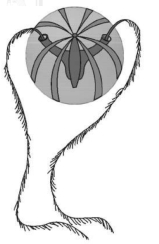
(N/A) $\rightarrow$ Bioluminescence,the property of a living organism to emit light,is well-marked in ctenophores.
$\rightarrow$ Ctenophores,commonly known as sea walnuts or comb jellies,are exclusively marine,radially symmetrical,diploblastic organisms with tissue level of organisation.
$\rightarrow$ The body bears eight external rows of ciliated comb plates,which help in locomotion.
$\rightarrow$ Digestion is both extracellular and intracellular.
$\rightarrow$ Sexes are not separate (hermaphrodite).
$\rightarrow$ Reproduction takes place only by sexual means.
$\rightarrow$ Fertilisation is external with indirect development.
$\rightarrow$ Examples: Pleurobrachia and Ctenoplana.
$\rightarrow$ Ctenophores,commonly known as sea walnuts or comb jellies,are exclusively marine,radially symmetrical,diploblastic organisms with tissue level of organisation.
$\rightarrow$ The body bears eight external rows of ciliated comb plates,which help in locomotion.
$\rightarrow$ Digestion is both extracellular and intracellular.
$\rightarrow$ Sexes are not separate (hermaphrodite).
$\rightarrow$ Reproduction takes place only by sexual means.
$\rightarrow$ Fertilisation is external with indirect development.
$\rightarrow$ Examples: Pleurobrachia and Ctenoplana.
0 likes
View Solution14
Medium
Describe the phylum which shows bioluminescence.
Solution
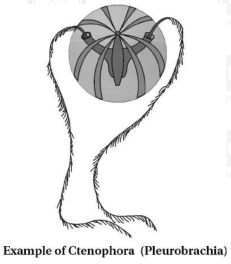
(N/A) $\rightarrow$ Bioluminescence,the property of a living organism to emit light,is a well-marked characteristic of the phylum $Ctenophora$.
$\rightarrow$ $Ctenophores$,commonly known as sea walnuts or comb jellies,are exclusively marine,radially symmetrical,and diploblastic organisms with a tissue level of body organisation.
$\rightarrow$ The body bears eight external rows of ciliated comb plates,which help in locomotion.
$\rightarrow$ Digestion is both extracellular and intracellular.
$\rightarrow$ Sexes are not separate (hermaphrodite).
$\rightarrow$ Reproduction takes place only by sexual means.
$\rightarrow$ Fertilisation is external with indirect development.
$\rightarrow$ Examples: $Pleurobrachia$ and $Ctenoplana$.
$\rightarrow$ $Ctenophores$,commonly known as sea walnuts or comb jellies,are exclusively marine,radially symmetrical,and diploblastic organisms with a tissue level of body organisation.
$\rightarrow$ The body bears eight external rows of ciliated comb plates,which help in locomotion.
$\rightarrow$ Digestion is both extracellular and intracellular.
$\rightarrow$ Sexes are not separate (hermaphrodite).
$\rightarrow$ Reproduction takes place only by sexual means.
$\rightarrow$ Fertilisation is external with indirect development.
$\rightarrow$ Examples: $Pleurobrachia$ and $Ctenoplana$.
0 likes
View Solution15
MediumMCQ
Which statement is incorrect about $Pleurobrachia$?
A
They are diploblastic
B
They have tissue level organisation
C
They have comb plates
D
They are triploblastic
Solution
(D) $Pleurobrachia$ belongs to phylum-$Ctenophora$.
$Ctenophora$ are diploblastic,with tissue level of organisation and presence of comb plates.
Comb plates are a characteristic feature of phylum-$Ctenophora$.
$Pleurobrachia$ are not triploblastic; therefore,the statement that they are triploblastic is incorrect.
$Ctenophora$ are diploblastic,with tissue level of organisation and presence of comb plates.
Comb plates are a characteristic feature of phylum-$Ctenophora$.
$Pleurobrachia$ are not triploblastic; therefore,the statement that they are triploblastic is incorrect.
0 likes
View Solution16
MediumMCQ
The ciliated comb plates in $Pleurobrachia$ are meant for
A
Reproduction
B
Digestion
C
Protection
D
Locomotion
Solution
(D) $Pleurobrachia$ (Sea gooseberry) belongs to the phylum $Ctenophora$.
$Ctenophores$ bear eight external rows of ciliated comb plates.
These comb plates possess cilia that are fused together to form the plates.
The primary function of these ciliated comb plates is to assist in locomotion.
$Ctenophores$ bear eight external rows of ciliated comb plates.
These comb plates possess cilia that are fused together to form the plates.
The primary function of these ciliated comb plates is to assist in locomotion.
0 likes
View Solution17
MediumMCQ
Ctenoplana belongs to a group of animals which are best described as
A
Unicellular with tissue level of organisation
B
Multicellular with radially symmetrical body
C
Multicellular with organ level of organisation
D
Unicellular with bilaterally symmetrical bodies
Solution
(B) $Ctenoplana$ belongs to the phylum $Ctenophora$.
$Ctenophores$ are multicellular animals that exhibit radial symmetry and possess a tissue level of organization.
$Ctenophores$ are multicellular animals that exhibit radial symmetry and possess a tissue level of organization.
0 likes
View Solution18
EasyMCQ
Bioluminescence is well-marked in which of the following phyla?
A
Ctenophora
B
Mollusca
C
Hemichordata
D
Annelida
Solution
(A) Bioluminescence is the property of production and emission of light by a living organism.
This property is well-marked in phylum $Ctenophora$.
Most ctenophores emit light by special light-producing cells called $photocytes$.
This property is well-marked in phylum $Ctenophora$.
Most ctenophores emit light by special light-producing cells called $photocytes$.
0 likes
View Solution19
MediumMCQ
Biradial symmetry and lack of cnidoblasts are the characteristics of
A
Hydra and Aurelia
B
Aurelia and Adamsia
C
Ctenoplana and Pleurobrachia
D
Aurelia and Paramoecium
Solution
(C) Biradial symmetry and the absence of cnidoblasts are the defining characteristics of the phylum $Ctenophora$.
$Ctenoplana$ and $Pleurobrachia$ are members of the phylum $Ctenophora$,commonly known as comb jellies.
Unlike the phylum $Cnidaria$,members of $Ctenophora$ lack cnidoblasts (stinging cells) and instead possess colloblasts for prey capture.
$Ctenoplana$ and $Pleurobrachia$ are members of the phylum $Ctenophora$,commonly known as comb jellies.
Unlike the phylum $Cnidaria$,members of $Ctenophora$ lack cnidoblasts (stinging cells) and instead possess colloblasts for prey capture.
0 likes
View Solution20
EasyMCQ
The presence of a special sense organ,the $statocyst$,at the opposite end of the mouth (aboral end) is a characteristic of:
A
Cnidarians
B
Platyhelminthes
C
Ctenophora
D
Nematodes
Solution
(C) $Ctenophora$ possess a unique sense organ known as the $statocyst$ located at the aboral end,which is the end opposite to the mouth. This is a diagnostic and characteristic feature of the phylum $Ctenophora$.
0 likes
View Solution21
Easy
Define/Explain: Bioluminescence.
Solution
(N/A) $\rightarrow$ Bioluminescence is the property of a living organism to emit light. It is a well-known characteristic of the phylum $Ctenophora$ (comb jellies),where the organism produces and emits light through chemical reactions within its body.
0 likes
View Solution22
Easy
Name an animal that exhibits the phenomenon of bioluminescence and mention the phylum to which it belongs.
Solution
(N/A) The animals that exhibit the phenomenon of bioluminescence are $Pleurobrachia$ and $Ctenoplana$. These animals belong to the phylum $Ctenophora$.
0 likes
View Solution23
MediumMCQ
All organisms of this phylum exhibit bioluminescence.
A
Cnidaria
B
Porifera
C
Ctenophora
D
Platyhelminthes
Solution
(C) Bioluminescence (the property of a living organism to emit light) is a well-marked characteristic of the phylum $Ctenophora$. These organisms are commonly known as sea walnuts or comb jellies. They possess eight external rows of ciliated comb plates which help in locomotion.
0 likes
View Solution24
MediumMCQ
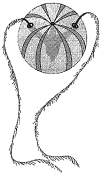
Identify the given organism.
A
Ctenoplana
B
Pleurobrachia
C
Jellyfish
D
Sea fan
Solution
(B) The organism shown in the image is $Pleurobrachia$,which belongs to the phylum $Ctenophora$.
It is characterized by the presence of $8$ external rows of ciliated comb plates,which help in locomotion.
$Pleurobrachia$ is commonly known as the sea gooseberry.
$Ctenoplana$ is another member of this phylum but has a different body shape.
Jellyfish belong to the phylum $Cnidaria$,and sea fans $(Gorgonia)$ also belong to the phylum $Cnidaria$.
It is characterized by the presence of $8$ external rows of ciliated comb plates,which help in locomotion.
$Pleurobrachia$ is commonly known as the sea gooseberry.
$Ctenoplana$ is another member of this phylum but has a different body shape.
Jellyfish belong to the phylum $Cnidaria$,and sea fans $(Gorgonia)$ also belong to the phylum $Cnidaria$.
0 likes
View Solution25
MediumMCQ
Which phylum is known as sea walnuts or comb jellies?
A
Cnidaria
B
Porifera
C
Platyhelminthes
D
Ctenophora
Solution
(D) The phylum $Ctenophora$ is commonly known as sea walnuts or comb jellies.
These organisms are exclusively marine,radially symmetrical,and diploblastic.
They possess eight external rows of ciliated comb plates,which help in locomotion.
These organisms are exclusively marine,radially symmetrical,and diploblastic.
They possess eight external rows of ciliated comb plates,which help in locomotion.
0 likes
View Solution26
MediumMCQ
What is the function of the comb plates present in Ctenophora?
A
Reproduction
B
Locomotion
C
Excretion
D
Digestion
Solution
(B) The phylum $Ctenophora$,commonly known as sea walnuts or comb jellies,possesses eight external rows of ciliated comb plates on the body. These comb plates are specialized structures that help in locomotion by beating in a coordinated manner. Therefore,the primary function of the comb plates is locomotion.
0 likes
View Solution27
EasyMCQ
In Ctenophora,the body bears $....$ external rows of ciliated comb plates,which help in locomotion.
A
$5$
B
$6$
C
$7$
D
$8$
Solution
(D) The phylum $Ctenophora$ is commonly known as sea walnuts or comb jellies.
These organisms possess $8$ external rows of ciliated comb plates on their body.
These comb plates are composed of cilia that beat to facilitate locomotion in the water.
Therefore,the correct number of rows is $8$.
These organisms possess $8$ external rows of ciliated comb plates on their body.
These comb plates are composed of cilia that beat to facilitate locomotion in the water.
Therefore,the correct number of rows is $8$.
0 likes
View Solution28
MediumMCQ
Which type of digestion occurs in Ctenophora?
A
Only extracellular
B
Only intracellular
C
Extracellular and intracellular
D
Absent
Solution
(C) In the phylum $Ctenophora$,digestion is both extracellular and intracellular.
Extracellular digestion occurs in the gastrovascular cavity,while intracellular digestion occurs within the cells lining the cavity.
Extracellular digestion occurs in the gastrovascular cavity,while intracellular digestion occurs within the cells lining the cavity.
0 likes
View Solution29
MediumMCQ
The property of a living organism to emit light is found in $:-$
A
Sycon
B
Pleurobrachia
C
Hydra
D
Taenia
Solution
(B) Bioluminescence is the property of a living organism to emit light.
This phenomenon is a well-known characteristic of the phylum $Ctenophora$.
Among the given options,$Pleurobrachia$ belongs to the phylum $Ctenophora$ (also known as sea walnuts or comb jellies).
$Sycon$ belongs to $Porifera$,$Hydra$ belongs to $Cnidaria$,and $Taenia$ belongs to $Platyhelminthes$.
Therefore,the correct option is $B$.
This phenomenon is a well-known characteristic of the phylum $Ctenophora$.
Among the given options,$Pleurobrachia$ belongs to the phylum $Ctenophora$ (also known as sea walnuts or comb jellies).
$Sycon$ belongs to $Porifera$,$Hydra$ belongs to $Cnidaria$,and $Taenia$ belongs to $Platyhelminthes$.
Therefore,the correct option is $B$.
0 likes
View Solution30
EasyMCQ
Identify the phylum which shows the following characteristics:
$1$. Animals are exclusively marine,radially symmetrical,and diploblastic.
$2$. Body bears eight external rows of ciliated comb plates which help in locomotion.
$3$. Digestion is both extracellular and intracellular.
$4$. Reproduction is only by sexual means.
$1$. Animals are exclusively marine,radially symmetrical,and diploblastic.
$2$. Body bears eight external rows of ciliated comb plates which help in locomotion.
$3$. Digestion is both extracellular and intracellular.
$4$. Reproduction is only by sexual means.
A
Coelenterata
B
Mollusca
C
Arthropoda
D
Ctenophora
Solution
(D) The correct answer is $D$.
Phylum $Ctenophora$ exhibits the following characteristics:
$1$. They are exclusively marine,radially symmetrical,and diploblastic organisms.
$2$. Their body bears eight external rows of ciliated comb plates,which help in locomotion.
$3$. Digestion in these organisms is both extracellular and intracellular.
$4$. Reproduction takes place only by sexual means.
Phylum $Ctenophora$ exhibits the following characteristics:
$1$. They are exclusively marine,radially symmetrical,and diploblastic organisms.
$2$. Their body bears eight external rows of ciliated comb plates,which help in locomotion.
$3$. Digestion in these organisms is both extracellular and intracellular.
$4$. Reproduction takes place only by sexual means.
0 likes
View SolutionAnimal Kingdom — Phylum - Ctenophora · Frequently Asked Questions
1Are these Animal Kingdom questions useful for JEE and NEET?
Yes. All questions in this section are mapped to JEE Main and NEET exam patterns. Previous year questions from JEE Main, NEET, GUJCET and state-level exams are included with full solutions.
2Can I switch to Hindi or Gujarati for these questions?
Yes. Use the language tabs in the hero section or the sidebar to view the same questions and solutions in English, Hindi or Gujarati.
3How do I generate a question paper from this subtopic?
Use the Vedclass Exam Paper Generator — select the chapter and subtopic, set difficulty, and generate Sets A, B, C, D automatically. First 3 chapters of every subject are free.
Vedclass Products
For Students
Vedclass Test Series
Mock tests in real JEE/NEET style with performance analysis. 5-day free trial.
Start Free TrialFor Teachers
Exam Paper Generator
Generate Set A/B/C/D papers from this chapter in 2 minutes. 3 chapters free.
Try FreeFor Institutes
Online Exam Module
Live online exams with unlimited students, 360° analytics & white-label branding.
See DemoFor Teachers & Institutes
Generate a Animal Kingdom Exam Paper in 2 Minutes
Select subtopic & difficulty — Sets A, B, C, D auto-generated with No Repeat logic.
First 3 chapters of every subject are free — no payment required.