
A English
Mix Examples - Animal Kingdom Questions in English
Class 11 Biology · Animal Kingdom · Mix Examples - Animal Kingdom
431+
Questions
English
Language
100%
With Solutions
Showing 50 of 431 questions in English
351
MediumMCQ
Comb jellies are ..................... and jelly fishes are .................. respectively.
A
Echinoderms,Ctenophores
B
Ctenophores,Echinoderms
C
Ctenophores,Cnidarians
D
Cnidarians,Echinoderms
Solution
(C) Comb jellies belong to the phylum $Ctenophora$. They possess eight external rows of ciliated comb plates,which help in locomotion.
Jelly fishes belong to the phylum $Cnidaria$ (also known as $Coelenterata$). They are characterized by the presence of cnidoblasts or cnidocytes.
Jelly fishes belong to the phylum $Cnidaria$ (also known as $Coelenterata$). They are characterized by the presence of cnidoblasts or cnidocytes.
0 likes
View Solution352
EasyMCQ
All of the following are monoecious,except
A
Fasciola
B
Spongilla
C
Ascaris
D
Ctenoplana
Solution
(C) Animals that possess both male and female reproductive organs in the same individual are termed monoecious,bisexual,or hermaphrodite.
$Spongilla$ (freshwater sponge),$Ctenoplana$ (a member of Ctenophora),and $Fasciola$ (liver fluke) are examples of monoecious organisms.
$Ascaris$ (roundworm) is dioecious (unisexual),meaning male and female reproductive organs are present in separate individuals.
$Spongilla$ (freshwater sponge),$Ctenoplana$ (a member of Ctenophora),and $Fasciola$ (liver fluke) are examples of monoecious organisms.
$Ascaris$ (roundworm) is dioecious (unisexual),meaning male and female reproductive organs are present in separate individuals.
0 likes
View Solution353
MediumMCQ
Which of the following fundamental features is common to $Balanoglossus$,$Anopheles$,and $Laccifer$ without any exception?
A
Marine habitat
B
Members of the largest phylum of the animal kingdom
C
Open circulatory system
D
External fertilisation
Solution
(C) $Balanoglossus$ belongs to the phylum $Hemichordata$.
$Anopheles$ belongs to the phylum $Arthropoda$.
$Laccifer$ belongs to the phylum $Arthropoda$.
Both $Hemichordata$ and $Arthropoda$ possess an open circulatory system,without any exception.
$Anopheles$ belongs to the phylum $Arthropoda$.
$Laccifer$ belongs to the phylum $Arthropoda$.
Both $Hemichordata$ and $Arthropoda$ possess an open circulatory system,without any exception.
0 likes
View Solution354
MediumMCQ
Match the animals in Column-$I$ with their common names in Column-$II$.
| Column-$I$ | Column-$II$ |
| $(a)$. Limulus | $(i)$. Tusk shell |
| $(b)$. Ophiura | $(ii)$. Tapeworm |
| $(c)$. Taenia | $(iii)$. Brain coral |
| $(d)$. Meandrina | $(iv)$. King crab |
| $(e)$. Dentalium | $(v)$. Brittle star |
A
$a(v), b(iv), c(ii), d(iii), e(i)$
B
$a(iv), b(v), c(ii), d(iii), e(i)$
C
$a(v), b(ii), c(iii), d(i), e(iv)$
D
$a(iv), b(v), c(iii), d(i), e(ii)$
Solution
$(B)$. Limulus is commonly known as King crab, which is a living fossil.
$(b)$. Ophiura is commonly known as Brittle star, belonging to Phylum Echinodermata.
$(c)$. Taenia is commonly known as Tapeworm, belonging to Phylum Platyhelminthes.
$(d)$. Meandrina is commonly known as Brain coral, belonging to Class Anthozoa, Phylum Cnidaria.
$(e)$. Dentalium is commonly known as Tusk shell, belonging to Class Scaphopoda, Phylum Mollusca.
Therefore, the correct matching is: $a(iv), b(v), c(ii), d(iii), e(i)$.
$(b)$. Ophiura is commonly known as Brittle star, belonging to Phylum Echinodermata.
$(c)$. Taenia is commonly known as Tapeworm, belonging to Phylum Platyhelminthes.
$(d)$. Meandrina is commonly known as Brain coral, belonging to Class Anthozoa, Phylum Cnidaria.
$(e)$. Dentalium is commonly known as Tusk shell, belonging to Class Scaphopoda, Phylum Mollusca.
Therefore, the correct matching is: $a(iv), b(v), c(ii), d(iii), e(i)$.
0 likes
View Solution355
MediumMCQ
In contrast to Annelids,the Platyhelminthes show
A
Absence of body cavity
B
Bilateral symmetry
C
Radial symmetry
D
Presence of pseudocoel
Solution
(A) Platyhelminthes are acoelomate,meaning they lack a body cavity lined with mesoderm.
In contrast,Annelids are true coelomates (schizocoelomates),which means they possess a body cavity that is completely lined by mesoderm.
Therefore,the primary difference regarding the body cavity is the absence of a coelom in Platyhelminthes compared to the presence of a true coelom in Annelids.
In contrast,Annelids are true coelomates (schizocoelomates),which means they possess a body cavity that is completely lined by mesoderm.
Therefore,the primary difference regarding the body cavity is the absence of a coelom in Platyhelminthes compared to the presence of a true coelom in Annelids.
0 likes
View Solution356
MediumMCQ
Column $-II$ below consists of brief descriptions of organisms in column $-I$. Which of the following is an incorrect match between column $-I$ and column $-II$?
| Column $-I$ | Column $-II$ |
| $A$. Millipede | Terrestrial organism with two pairs of jointed appendages attached to each of its many body segments and respires through trachea. |
| $B$. Nereis | Numerous setae on lateral appendages called parapodia. |
| $C$. Taenia solium | Body is covered with cuticle,alimentary canal absent. |
| $D$. Ctenophores | Radially symmetrical,devoid of cnidoblasts,polyp stage present in their life cycle. |
A
Millipede - $A$ terrestrial organism with two pairs of jointed appendages attached to each of its many body segments and respires through trachea.
B
Nereis - Numerous setae on lateral appendages called parapodia.
C
Taenia solium - Body is covered with cuticle,alimentary canal absent.
D
Ctenophores - Radially symmetrical,devoid of cnidoblasts,polyp stage present in their life cycle.
Solution
(D) The incorrect match is option $(D)$.
$1$. Millipede belongs to the class Diplopoda (Phylum Arthropoda). They are terrestrial and possess two pairs of jointed appendages on each body segment,respiring through tracheae. This is a correct match.
$2$. Nereis belongs to the class Polychaeta (Phylum Annelida). They possess numerous setae on lateral appendages called parapodia,which help in swimming. This is a correct match.
$3$. Taenia solium (Tapeworm) belongs to the class Cestoda (Phylum Platyhelminthes). Their body is covered with a thick cuticle,and they lack an alimentary canal as they absorb nutrients directly from the host's intestine. This is a correct match.
$4$. Ctenophores (Phylum Ctenophora) are radially symmetrical and lack cnidoblasts (which are characteristic of Cnidaria). Crucially,they do not have a polyp stage in their life cycle. Therefore,the statement that a polyp stage is present is incorrect.
$1$. Millipede belongs to the class Diplopoda (Phylum Arthropoda). They are terrestrial and possess two pairs of jointed appendages on each body segment,respiring through tracheae. This is a correct match.
$2$. Nereis belongs to the class Polychaeta (Phylum Annelida). They possess numerous setae on lateral appendages called parapodia,which help in swimming. This is a correct match.
$3$. Taenia solium (Tapeworm) belongs to the class Cestoda (Phylum Platyhelminthes). Their body is covered with a thick cuticle,and they lack an alimentary canal as they absorb nutrients directly from the host's intestine. This is a correct match.
$4$. Ctenophores (Phylum Ctenophora) are radially symmetrical and lack cnidoblasts (which are characteristic of Cnidaria). Crucially,they do not have a polyp stage in their life cycle. Therefore,the statement that a polyp stage is present is incorrect.
0 likes
View Solution357
MediumMCQ
The appropriate sequence of numbered animals from column-$II$ matching with the sequence of larvae in column-$I$ is
| Column-$I$ | Column-$II$ |
| $(a)$. Planula | $(i)$. Mussel |
| $(b)$. Glochidium | $(ii)$. Crab |
| $(c)$. Nauplius | $(iii)$. Obelia |
| $(d)$. Cysticercus | $(iv)$. Nereis |
| $(v)$. Taenia solium |
A
$a(iv), b(i), c(ii), d(v)$
B
$a(ii), b(i), c(v), d(iii)$
C
$a(iii), b(i), c(ii), d(v)$
D
$a(i), b(iii), c(ii), d(v)$
Solution
(C) The correct matching sequence is:
$(a)$. Planula larva is the larval stage of $Obelia$ (Phylum Cnidaria).
$(b)$. Glochidium larva is the larval stage of $Mussel$ (Phylum Mollusca).
$(c)$. Nauplius larva is the larval stage of $Crab$ (Phylum Arthropoda).
$(d)$. Cysticercus larva is the larval stage of $Taenia$ $solium$ (Phylum Platyhelminthes).
Therefore,the correct sequence is $a(iii), b(i), c(ii), d(v)$.
$(a)$. Planula larva is the larval stage of $Obelia$ (Phylum Cnidaria).
$(b)$. Glochidium larva is the larval stage of $Mussel$ (Phylum Mollusca).
$(c)$. Nauplius larva is the larval stage of $Crab$ (Phylum Arthropoda).
$(d)$. Cysticercus larva is the larval stage of $Taenia$ $solium$ (Phylum Platyhelminthes).
Therefore,the correct sequence is $a(iii), b(i), c(ii), d(v)$.
0 likes
View Solution358
MediumMCQ
Which of the following statements is incorrect?
A
Receptors for taste are located in the feet of insects
B
The development of echinoderms includes a free-swimming dipleura larva
C
Flame cells in flatworms are for excretion and osmoregulation
D
Alternation of asexual and sexual phases in the life cycle of Hydra is called metagenesis
Solution
(D) The incorrect statement is $D$.
Metagenesis refers to the alternation of generations between the polyp (asexual) and medusa (sexual) forms,which is observed in certain Cnidarians like Obelia.
$Hydra$ does not exhibit metagenesis because it lacks a medusa stage in its life cycle.
Metagenesis refers to the alternation of generations between the polyp (asexual) and medusa (sexual) forms,which is observed in certain Cnidarians like Obelia.
$Hydra$ does not exhibit metagenesis because it lacks a medusa stage in its life cycle.
0 likes
View Solution359
MediumMCQ
$A$: Annelids,arthropods,and molluscs are protostomial coelomates.
$R$: All three phyla include members with bilateral symmetry and a true coelom.
$R$: All three phyla include members with bilateral symmetry and a true coelom.
A
Assertion and Reason both are correct and Reason is the correct explanation of Assertion.
B
Assertion and Reason both are correct but Reason is not the correct explanation of Assertion.
C
Assertion is correct,but Reason is incorrect.
D
Both Assertion and Reason are incorrect.
Solution
(B) Assertion is true: Annelids,arthropods,and molluscs are indeed protostomial coelomates,meaning the blastopore develops into the mouth during embryonic development.
Reason is also true: Members of these three phyla exhibit bilateral symmetry and possess a true coelom (eucoelomates).
However,the fact that they have bilateral symmetry and a true coelom does not explain why they are classified as protostomes. Therefore,the Reason is not the correct explanation for the Assertion.
Reason is also true: Members of these three phyla exhibit bilateral symmetry and possess a true coelom (eucoelomates).
However,the fact that they have bilateral symmetry and a true coelom does not explain why they are classified as protostomes. Therefore,the Reason is not the correct explanation for the Assertion.
0 likes
View Solution360
MediumMCQ
Read the following statements and find out the correct statement.
$a$. Urinary bladder is absent in fishes
$b$. Gambusia fish eradicates mosquito larva
$c$. Ampulla of Lorenzini present in dogfish act as thermoreceptors
$d$. Electric organs are modified muscles
$a$. Urinary bladder is absent in fishes
$b$. Gambusia fish eradicates mosquito larva
$c$. Ampulla of Lorenzini present in dogfish act as thermoreceptors
$d$. Electric organs are modified muscles
A
$b$ and $d$
B
$a$ and $c$
C
$b$ only
D
$a, b, c$ and $d$
Solution
(D) . Urinary bladder is generally absent in most fishes (except some lungfishes).
$b$. $Gambusia$ is a larvivorous fish that feeds on mosquito larvae and is used for biological control of malaria.
$c$. Ampullae of Lorenzini in dogfish $(Scoliodon)$ are electroreceptors,but they also function as thermoreceptors to detect temperature changes.
$d$. Electric organs found in fishes like $Torpedo$ are modified muscle tissues.
Since all the given statements are scientifically correct,the correct option is $d$.
$b$. $Gambusia$ is a larvivorous fish that feeds on mosquito larvae and is used for biological control of malaria.
$c$. Ampullae of Lorenzini in dogfish $(Scoliodon)$ are electroreceptors,but they also function as thermoreceptors to detect temperature changes.
$d$. Electric organs found in fishes like $Torpedo$ are modified muscle tissues.
Since all the given statements are scientifically correct,the correct option is $d$.
0 likes
View Solution361
MediumMCQ
Closed circulatory system is present in
A
Annelids and chordates
B
Arthropods and annelids
C
Arthropods and chordates
D
Molluscs and annelids
Solution
(A) Circulatory patterns are of two types:
$1$. Open Circulatory Pathways: Present in arthropods and molluscs,in which the blood pumped by the heart passes through large vessels into open spaces of the body cavity called sinuses.
$2$. Closed Circulatory Pathways: Annelids and chordates have a closed circulatory system in which the blood pumped by the heart is always circulated through a closed network of blood vessels. This pattern is considered to be more advantageous as the flow of fluid can be more precisely regulated.
$1$. Open Circulatory Pathways: Present in arthropods and molluscs,in which the blood pumped by the heart passes through large vessels into open spaces of the body cavity called sinuses.
$2$. Closed Circulatory Pathways: Annelids and chordates have a closed circulatory system in which the blood pumped by the heart is always circulated through a closed network of blood vessels. This pattern is considered to be more advantageous as the flow of fluid can be more precisely regulated.
0 likes
View Solution362
MediumMCQ
Water circulatory system is found in:
$I.$ Sponge
$II.$ Hydra
$III.$ Annelida
$IV.$ Starfish
$V.$ Arthropoda
Choose the correct option.
$I.$ Sponge
$II.$ Hydra
$III.$ Annelida
$IV.$ Starfish
$V.$ Arthropoda
Choose the correct option.
A
$I, II$ and $III$
B
$III, IV$ and $V$
C
$I, II$ and $IV$
D
$II, IV$ and $V$
Solution
(C) Water acts as a medium for transportation in various organisms:
$1$. In Sponges $(I)$,the water transport system is known as the water canal system.
$2$. In Hydra $(II)$,the gastrovascular cavity serves for the circulation of water and nutrients.
$3$. In Starfish $(IV)$,the water vascular system (ambulacral system) is a characteristic feature used for locomotion,capture,and transport of food.
Therefore,the correct combination is $I, II$ and $IV$.
$1$. In Sponges $(I)$,the water transport system is known as the water canal system.
$2$. In Hydra $(II)$,the gastrovascular cavity serves for the circulation of water and nutrients.
$3$. In Starfish $(IV)$,the water vascular system (ambulacral system) is a characteristic feature used for locomotion,capture,and transport of food.
Therefore,the correct combination is $I, II$ and $IV$.
0 likes
View Solution363
MediumMCQ
Which one of the following is not a living fossil?
A
Peripatus
B
King crab
C
Archaeopteryx
D
Sphenodon
Solution
(C) living fossil is an extant taxon that closely resembles related species known only from the fossil record.
$Archaeopteryx$ is an extinct genus of bird-like dinosaurs that serves as a transitional fossil between non-avian feathered dinosaurs and modern birds.
Since $Archaeopteryx$ is extinct, it cannot be classified as a living fossil.
$Peripatus$, $King \text{ } crab$ $(Limulus)$, and $Sphenodon$ are all examples of living fossils.
$Archaeopteryx$ is an extinct genus of bird-like dinosaurs that serves as a transitional fossil between non-avian feathered dinosaurs and modern birds.
Since $Archaeopteryx$ is extinct, it cannot be classified as a living fossil.
$Peripatus$, $King \text{ } crab$ $(Limulus)$, and $Sphenodon$ are all examples of living fossils.
0 likes
View Solution364
MediumMCQ
Match List-$I$ with List-$II$.
Choose the correct answer from the options given below.
| List-$I$ | List-$II$ |
| $(a)$ Metamerism | $(i)$ Coelenterata |
| $(b)$ Canal system | $(ii)$ Ctenophora |
| $(c)$ Comb plates | $(iii)$ Annelida |
| $(d)$ Cnidoblasts | $(iv)$ Porifera |
Choose the correct answer from the options given below.
A
$(iv)-(iii)-(i)-(ii)$
B
$(iii)-(iv)-(ii)-(i)$
C
$(iii)-(iv)-(i)-(ii)$
D
$(iv)-(i)-(ii)-(iii)$
Solution
(B) The correct matches are as follows:
$(a)$ Metamerism is a characteristic feature of the phylum Annelida $(iii)$.
$(b)$ Canal system (water transport system) is a characteristic feature of the phylum Porifera $(iv)$.
$(c)$ Comb plates are present in the phylum Ctenophora $(ii)$ to help in locomotion.
$(d)$ Cnidoblasts (stinging cells) are characteristic of the phylum Coelenterata (Cnidaria) $(i)$.
Therefore,the correct sequence is $(a)-(iii), (b)-(iv), (c)-(ii), (d)-(i)$.
$(a)$ Metamerism is a characteristic feature of the phylum Annelida $(iii)$.
$(b)$ Canal system (water transport system) is a characteristic feature of the phylum Porifera $(iv)$.
$(c)$ Comb plates are present in the phylum Ctenophora $(ii)$ to help in locomotion.
$(d)$ Cnidoblasts (stinging cells) are characteristic of the phylum Coelenterata (Cnidaria) $(i)$.
Therefore,the correct sequence is $(a)-(iii), (b)-(iv), (c)-(ii), (d)-(i)$.
0 likes
View Solution365
MediumMCQ
Read the following statements.
$(a)$ Metagenesis is observed in Helminths.
$(b)$ Echinoderms are triploblastic and coelomate animals.
$(c)$ Round worms have organ-system level of body organization.
$(d)$ Comb plates present in ctenophores help in digestion.
$(e)$ Water vascular system is characteristic of Echinoderms.
Choose the correct answer from the options given below.
$(a)$ Metagenesis is observed in Helminths.
$(b)$ Echinoderms are triploblastic and coelomate animals.
$(c)$ Round worms have organ-system level of body organization.
$(d)$ Comb plates present in ctenophores help in digestion.
$(e)$ Water vascular system is characteristic of Echinoderms.
Choose the correct answer from the options given below.
A
$(c), (d)$ and $(e)$ are correct
B
$(a), (b)$ and $(c)$ are correct
C
$(a), (d)$ and $(e)$ are correct
D
$(b), (c)$ and $(e)$ are correct
Solution
(D) Statement $(a)$ is incorrect because Metagenesis is observed in Cnidarians (e.g.,Obelia),not in Helminths.
Statement $(b)$ is correct because Echinoderms are triploblastic and coelomate animals.
Statement $(c)$ is correct because Round worms (Aschelminthes) exhibit organ-system level of body organization.
Statement $(d)$ is incorrect because comb plates in Ctenophores help in locomotion,not digestion.
Statement $(e)$ is correct because the water vascular system is a unique characteristic feature of Echinoderms.
Therefore,statements $(b), (c),$ and $(e)$ are correct.
Statement $(b)$ is correct because Echinoderms are triploblastic and coelomate animals.
Statement $(c)$ is correct because Round worms (Aschelminthes) exhibit organ-system level of body organization.
Statement $(d)$ is incorrect because comb plates in Ctenophores help in locomotion,not digestion.
Statement $(e)$ is correct because the water vascular system is a unique characteristic feature of Echinoderms.
Therefore,statements $(b), (c),$ and $(e)$ are correct.
0 likes
View Solution366
MediumMCQ
Match the following:
Choose the correct answer from the options given below.
| List-$I$ | List-$II$ |
|---|---|
| $(a)$ Physalia | $(i)$ Pearl oyster |
| $(b)$ Limulus | $(ii)$ Portuguese Man of War |
| $(c)$ Ancylostoma | $(iii)$ Living fossil |
| $(d)$ Pinctada | $(iv)$ Hookworm |
Choose the correct answer from the options given below.
A
$(ii)-(iii)-(i)-(iv)$
B
$(iv)-(i)-(iii)-(ii)$
C
$(ii)-(iii)-(iv)-(i)$
D
$(i)-(iv)-(iii)-(ii)$
Solution
(C) The correct matches are as follows:
$1$. $(a)$ Physalia is commonly known as the Portuguese Man of War.
$2$. $(b)$ Limulus is known as the King crab,which is a living fossil.
$3$. $(c)$ Ancylostoma is commonly known as the Hookworm.
$4$. $(d)$ Pinctada is commonly known as the Pearl oyster.
Therefore,the correct matching is $(a)-(ii), (b)-(iii), (c)-(iv), (d)-(i)$.
Thus,the correct option is $C$.
$1$. $(a)$ Physalia is commonly known as the Portuguese Man of War.
$2$. $(b)$ Limulus is known as the King crab,which is a living fossil.
$3$. $(c)$ Ancylostoma is commonly known as the Hookworm.
$4$. $(d)$ Pinctada is commonly known as the Pearl oyster.
Therefore,the correct matching is $(a)-(ii), (b)-(iii), (c)-(iv), (d)-(i)$.
Thus,the correct option is $C$.
0 likes
View Solution367
EasyMCQ
The study of lizards is known as:
A
Saurology
B
Serpentology
C
Ophiology
D
Ornithology
Solution
(A) Saurology is the scientific study of lizards.
Serpentology and Ophiology are terms used for the study of snakes.
Ornithology is the study of birds.
Serpentology and Ophiology are terms used for the study of snakes.
Ornithology is the study of birds.
0 likes
View Solution368
MediumMCQ
Members of which group are not deuterostomes?
A
Chordates
B
Echinoderms
C
Arthropods
D
None of these; all are deuterostomes
Solution
(C) Deuterostomes are animals in which the first opening to develop in the embryonic digestive tube is the anus,and the mouth is formed later.
Echinoderms and chordates exhibit a deuterostomic body plan.
In contrast,annelids,arthropods,and molluscs exhibit a protostomic body plan,where the mouth develops first from the blastopore.
Echinoderms and chordates exhibit a deuterostomic body plan.
In contrast,annelids,arthropods,and molluscs exhibit a protostomic body plan,where the mouth develops first from the blastopore.
0 likes
View Solution369
MediumMCQ
Which of the following is the correct matching of an animal,its characteristics,and its taxon?
A
Chameleon: Prehensile tail,dicondylic skull,camouflaging; Taxon: Reptilia
B
Monotremes: Viviparous,hair,external ears or pinnae; Taxon: Mammalia
C
Rana tigrina: No exoskeletal elements,dicondylic skull,eyes have eyelids; Taxon: Amphibia
D
Scoliodon: Placoid scales,viviparous,external fertilization; Taxon: Chondrichthyes
Solution
(C) The correct matching is $C$. $Rana$ $tigrina$ (frog) belongs to the class Amphibia.
$1$. They lack exoskeletal elements (skin is moist and glandular).
$2$. They possess a dicondylic skull (having two occipital condyles).
$3$. They have eyelids to protect their eyes.
Analysis of other options:
- $A$. Chameleon is a reptile,but it has a monocondylic skull.
- $B$. Monotremes are oviparous (egg-laying),not viviparous.
- $D$. $Scoliodon$ (dogfish) exhibits internal fertilization,not external.
$1$. They lack exoskeletal elements (skin is moist and glandular).
$2$. They possess a dicondylic skull (having two occipital condyles).
$3$. They have eyelids to protect their eyes.
Analysis of other options:
- $A$. Chameleon is a reptile,but it has a monocondylic skull.
- $B$. Monotremes are oviparous (egg-laying),not viviparous.
- $D$. $Scoliodon$ (dogfish) exhibits internal fertilization,not external.
0 likes
View Solution370
MediumMCQ
$A$: Piscean scales are similar to reptilian scales in origin.
$R$: Age of the animal can be deduced by lines of growth on both the scales.
$R$: Age of the animal can be deduced by lines of growth on both the scales.
A
Assertion and Reason both are correct and Reason is the correct explanation of Assertion.
B
Assertion and Reason both are correct but Reason is not the correct explanation of Assertion.
C
Assertion is correct,but Reason is incorrect.
D
Both Assertion and Reason are incorrect.
Solution
(C) The Assertion is incorrect because Piscean (fish) scales are of mesodermal origin,whereas reptilian scales are of epidermal origin.
The Reason is correct because the age of both fish and reptiles can be estimated by observing the lines of growth (annuli) present on their scales.
The Reason is correct because the age of both fish and reptiles can be estimated by observing the lines of growth (annuli) present on their scales.
0 likes
View Solution371
Difficult
Provide a comparative summary of the features of all phyla under the Animal Kingdom.
Solution
(N/A) The following table provides a comparative summary of the key characteristics of the various phyla within the Animal Kingdom:
| Phylum | Level of Organisation | Symmetry | Coelom | Segmentation | Digestive System | Circulatory System | Respiratory System | Distinctive Features |
|---|---|---|---|---|---|---|---|---|
| Porifera | Cellular | Various | Absent | Absent | Absent | Absent | Absent | Body with pores and canals in walls |
| Coelenterata | Tissue | Radial | Absent | Absent | Incomplete | Absent | Absent | Cnidoblasts present |
| Ctenophora | Tissue | Radial | Absent | Absent | Incomplete | Absent | Absent | Comb plates for locomotion |
| Platyhelminthes | Organ and Organ System | Bilateral | Absent | Absent | Incomplete | Absent | Absent | Flat body,suckers |
| Aschelminthes | Organ System | Bilateral | Pseudocoelomate | Absent | Complete | Absent | Absent | Often worm-shaped,elongated |
| Annelida | Organ System | Bilateral | Coelomate | Present | Complete | Present | Present | Body segmentation like rings |
| Arthropoda | Organ System | Bilateral | Coelomate | Present | Complete | Present | Present | Exoskeleton of cuticle,joined appendages |
| Mollusca | Organ System | Bilateral | Coelomate | Absent | Complete | Present | Present | External skeleton of shell usually present |
| Echinodermata | Organ System | Radial (Adult) | Coelomate | Absent | Complete | Present | Present | Water vascular system |
| Hemichordata | Organ System | Bilateral | Coelomate | Absent | Complete | Present | Present | Worm-like with proboscis,collar,and trunk |
| Chordata | Organ System | Bilateral | Coelomate | Present | Complete | Present | Present | Notochord,dorsal hollow nerve cord,gill slits |
0 likes
View Solution372
Easy
Give one example each for an animal possessing placoid scales and that with cycloid scales.
Solution
(N/A) $\rightarrow$ Placoid scales are characteristic of cartilaginous fishes (Chondrichthyes),for example,$Scoliodon$ (Dogfish).
$\rightarrow$ Cycloid scales are characteristic of bony fishes (Osteichthyes),for example,$Labeo$ $rohita$ (Rohu).
$\rightarrow$ Cycloid scales are characteristic of bony fishes (Osteichthyes),for example,$Labeo$ $rohita$ (Rohu).
0 likes
View Solution373
Easy
Mention one example each for animals with a chitinous exoskeleton and those covered by a calcareous shell.
Solution
(N/A) $1$. Animals with a chitinous exoskeleton: Arthropods possess a tough, chitinous exoskeleton. An example is the cockroach $(Periplaneta \text{ } americana)$.
$2$. Animals covered by a calcareous shell: Molluscs are typically covered by a hard, calcareous shell. An example is the apple snail $(Pila)$.
$2$. Animals covered by a calcareous shell: Molluscs are typically covered by a hard, calcareous shell. An example is the apple snail $(Pila)$.
0 likes
View Solution374
Easy
Write one example for each of the following in the space provided:
$(a)$ Cold-blooded animal.
$(b)$ Warm-blooded animal.
$(c)$ Animal possessing dry and cornified skin.
$(d)$ Dioecious animal.
$(a)$ Cold-blooded animal.
$(b)$ Warm-blooded animal.
$(c)$ Animal possessing dry and cornified skin.
$(d)$ Dioecious animal.
Solution
(N/A) Cold-blooded animal: Frog (Amphibian).
$(b)$ Warm-blooded animal: Pigeon (Aves).
$(c)$ Animal possessing dry and cornified skin: Snake (Reptile).
$(d)$ Dioecious animal: Ascaris (Roundworm).
$(b)$ Warm-blooded animal: Pigeon (Aves).
$(c)$ Animal possessing dry and cornified skin: Snake (Reptile).
$(d)$ Dioecious animal: Ascaris (Roundworm).
0 likes
View Solution375
Medium
Give an example of the following:
$(a)$ Roundworm
$(b)$ Fish possessing poison sting
$(c)$ $A$ limbless reptile/amphibian
$(d)$ An oviparous mammal
$(a)$ Roundworm
$(b)$ Fish possessing poison sting
$(c)$ $A$ limbless reptile/amphibian
$(d)$ An oviparous mammal
Solution
(N/A) Roundworm: $Ascaris$
$(b)$ Fish possessing poison sting: $Trygon$ (Sting ray)
$(c)$ $A$ limbless amphibian: $Ichthyophis$
$(d)$ An oviparous mammal: $Ornithorhynchus$ (Platypus)
$(b)$ Fish possessing poison sting: $Trygon$ (Sting ray)
$(c)$ $A$ limbless amphibian: $Ichthyophis$
$(d)$ An oviparous mammal: $Ornithorhynchus$ (Platypus)
0 likes
View Solution376
Easy
Provide the appropriate technical term for the following descriptions:
$(a)$ Blood-filled cavity in arthropods.
$(b)$ Free-floating form of cnidaria.
$(c)$ Stinging organ of jellyfish.
$(d)$ Lateral appendages in aquatic annelids.
$(a)$ Blood-filled cavity in arthropods.
$(b)$ Free-floating form of cnidaria.
$(c)$ Stinging organ of jellyfish.
$(d)$ Lateral appendages in aquatic annelids.
Solution
(N/A) Haemocoel: The body cavity of arthropods is filled with blood,known as haemocoel.
$(b)$ Medusa: It is the free-swimming,umbrella-shaped form of cnidarians,such as jellyfish.
$(c)$ Nematocysts: These are specialized stinging cells (cnidoblasts) containing a coiled thread used for defense and prey capture.
$(d)$ Parapodia: These are lateral,fleshy,paddle-like appendages found in aquatic annelids like Nereis,which help in swimming.
$(b)$ Medusa: It is the free-swimming,umbrella-shaped form of cnidarians,such as jellyfish.
$(c)$ Nematocysts: These are specialized stinging cells (cnidoblasts) containing a coiled thread used for defense and prey capture.
$(d)$ Parapodia: These are lateral,fleshy,paddle-like appendages found in aquatic annelids like Nereis,which help in swimming.
0 likes
View Solution377
MediumMCQ
Match the following:
| Animals | Locomotory Organ |
|---|---|
| $(1)$ Octopus | $(i)$ Limbs |
| $(2)$ Crocodile | $(ii)$ Comb plates |
| $(3)$ Catla | $(iii)$ Tentacles |
| $(4)$ Ctenoplana | $(iv)$ Fins |
A
$(1)-(iii), (2)-(i), (3)-(iv), (4)-(ii)$
B
$(1)-(i), (2)-(iii), (3)-(iv), (4)-(ii)$
C
$(1)-(iii), (2)-(iv), (3)-(i), (4)-(ii)$
D
$(1)-(ii), (2)-(i), (3)-(iv), (4)-(iii)$
Solution
(A) The correct matches are as follows:
$(1)$ Octopus: These mollusks use $(iii)$ Tentacles for movement.
$(2)$ Crocodile: These reptiles use $(i)$ Limbs for locomotion.
$(3)$ Catla: This is a bony fish that uses $(iv)$ Fins for swimming.
$(4)$ Ctenoplana: This ctenophore uses $(ii)$ Comb plates for locomotion.
Therefore,the correct sequence is $(1)-(iii), (2)-(i), (3)-(iv), (4)-(ii)$.
$(1)$ Octopus: These mollusks use $(iii)$ Tentacles for movement.
$(2)$ Crocodile: These reptiles use $(i)$ Limbs for locomotion.
$(3)$ Catla: This is a bony fish that uses $(iv)$ Fins for swimming.
$(4)$ Ctenoplana: This ctenophore uses $(ii)$ Comb plates for locomotion.
Therefore,the correct sequence is $(1)-(iii), (2)-(i), (3)-(iv), (4)-(ii)$.
0 likes
View Solution378
Medium
Fill in the blank spaces appropriately in the table below:
| Phylum/Class | Excretory organ | Circulatory system | Respiratory organ |
|---|---|---|---|
| Arthropoda | $...............$ | $...............$ | Lungs/Gills/Tracheal system |
| $...............$ | Nephridia | Closed | Skin/Parapodia |
| $...............$ | Metanephridia | Open | $...............$ |
| Amphibia | $...............$ | Closed | Lung |
Solution
(N/A) The completed table is as follows:
Explanation:
$1$. In $Arthropoda$,excretion occurs via $Malpighian$ $tubules$ and the circulatory system is $open$.
$2$. $Annelida$ are characterized by $Nephridia$ for excretion,a $closed$ circulatory system,and respiration through $skin$ or $parapodia$.
$3$. $Mollusca$ possess $metanephridia$ for excretion,an $open$ circulatory system,and respiration primarily through $gills$ $(ctenidia)$.
$4$. $Amphibia$ utilize $mesonephric$ $kidneys$ for excretion,have a $closed$ circulatory system,and use $lungs$ for respiration.
| Phylum/Class | Excretory organ | Circulatory system | Respiratory organ |
|---|---|---|---|
| Arthropoda | Malpighian tubules | Open | Lungs/Gills/Tracheal system |
| Annelida | Nephridia | Closed | Skin/Parapodia |
| Mollusca | Metanephridia | Open | Gills (Ctenidia) |
| Amphibia | Mesonephric kidneys | Closed | Lung |
Explanation:
$1$. In $Arthropoda$,excretion occurs via $Malpighian$ $tubules$ and the circulatory system is $open$.
$2$. $Annelida$ are characterized by $Nephridia$ for excretion,a $closed$ circulatory system,and respiration through $skin$ or $parapodia$.
$3$. $Mollusca$ possess $metanephridia$ for excretion,an $open$ circulatory system,and respiration primarily through $gills$ $(ctenidia)$.
$4$. $Amphibia$ utilize $mesonephric$ $kidneys$ for excretion,have a $closed$ circulatory system,and use $lungs$ for respiration.
0 likes
View Solution379
MediumMCQ
Identify the type of digestive system in the organisms shown below.
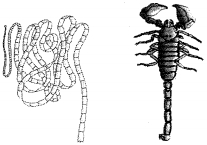
A
Complete $\quad\quad$ Incomplete
B
Complete $\quad\quad$ Complete
C
Incomplete $\quad\quad$ Incomplete
D
Incomplete $\quad\quad$ Complete
Solution
(D) The first organism shown is a tapeworm (Taenia),which belongs to the phylum Platyhelminthes. Organisms in this phylum have an incomplete digestive system (a single opening for both ingestion and egestion).
The second organism shown is a scorpion,which belongs to the phylum Arthropoda. Organisms in this phylum have a complete digestive system (two separate openings for ingestion and egestion).
Therefore,the correct sequence is Incomplete and Complete.
The second organism shown is a scorpion,which belongs to the phylum Arthropoda. Organisms in this phylum have a complete digestive system (two separate openings for ingestion and egestion).
Therefore,the correct sequence is Incomplete and Complete.
0 likes
View Solution380
MediumMCQ
Select the incorrect statement regarding diploblastic organization.
A
It is found in Ctenophora and Cnidaria.
B
An undifferentiated layer called mesoglea is present between the ectoderm and endoderm.
C
Diploblastic animals exhibit tissue-level organization.
D
All options are correct.
Solution
(D) The explanation for diploblastic animals is as follows:
$1$. Diploblastic organization is found in animals of the phyla Ctenophora and Cnidaria (Coelenterata),so option $A$ is correct.
$2$. In these animals,an undifferentiated layer exists between the ectoderm and endoderm,which is called mesoglea,so option $B$ is correct.
$3$. In diploblastic animals,cells are organized into tissues,thus they exhibit tissue-level organization,so option $C$ is also correct.
$4$. The question asks for the 'incorrect' statement. Since all given options are correct,the correct answer is option $D$.
$1$. Diploblastic organization is found in animals of the phyla Ctenophora and Cnidaria (Coelenterata),so option $A$ is correct.
$2$. In these animals,an undifferentiated layer exists between the ectoderm and endoderm,which is called mesoglea,so option $B$ is correct.
$3$. In diploblastic animals,cells are organized into tissues,thus they exhibit tissue-level organization,so option $C$ is also correct.
$4$. The question asks for the 'incorrect' statement. Since all given options are correct,the correct answer is option $D$.
0 likes
View Solution381
EasyMCQ
In which of the following organisms is metamerism (segmentation) observed?
A
Annelida
B
Arthropoda
C
Chordata
D
All of the above
Solution
(D) Metamerism or true segmentation is a characteristic feature where the body is externally and internally divided into segments with a serial repetition of at least some organs.
This phenomenon is observed in the phyla $Annelida$ (e.g.,earthworms),$Arthropoda$ (e.g.,insects),and $Chordata$ (e.g.,humans,where the vertebral column and muscles show metameric arrangement).
Therefore,all the given options exhibit metamerism.
This phenomenon is observed in the phyla $Annelida$ (e.g.,earthworms),$Arthropoda$ (e.g.,insects),and $Chordata$ (e.g.,humans,where the vertebral column and muscles show metameric arrangement).
Therefore,all the given options exhibit metamerism.
0 likes
View Solution382
DifficultMCQ
Select the incorrect option regarding organisms exhibiting metamerism:
A
Organisms with metamerism are triploblastic.
B
Organisms with metamerism possess a closed circulatory system.
C
Organisms with metamerism are coelomates.
D
Organisms with metamerism exhibit radial symmetry.
Solution
(D) Metamerism is a phenomenon where the body is externally and internally divided into segments with a serial repetition of at least some organs.
Organisms exhibiting metamerism (e.g.,Annelida,Arthropoda,Chordata) are triploblastic,coelomate,and exhibit bilateral symmetry.
While Annelids possess a closed circulatory system,Arthropods possess an open circulatory system.
Therefore,the statement that organisms with metamerism possess a closed circulatory system is not universally true.
However,the most fundamentally incorrect statement among the options is that they exhibit radial symmetry,as all metameric animals exhibit bilateral symmetry.
Organisms exhibiting metamerism (e.g.,Annelida,Arthropoda,Chordata) are triploblastic,coelomate,and exhibit bilateral symmetry.
While Annelids possess a closed circulatory system,Arthropods possess an open circulatory system.
Therefore,the statement that organisms with metamerism possess a closed circulatory system is not universally true.
However,the most fundamentally incorrect statement among the options is that they exhibit radial symmetry,as all metameric animals exhibit bilateral symmetry.
0 likes
View Solution383
MediumMCQ
How many of the following phyla exhibit diploblastic and tissue-level organization?
Porifera,Coelenterata (Cnidaria),Ctenophora,Platyhelminthes,Aschelminthes
Porifera,Coelenterata (Cnidaria),Ctenophora,Platyhelminthes,Aschelminthes
A
$1$
B
$2$
C
$3$
D
$4$
Solution
(B) $1$. Porifera: Cellular level of organization,asymmetrical.
$2$. Coelenterata (Cnidaria): Diploblastic,tissue-level of organization.
$3$. Ctenophora: Diploblastic,tissue-level of organization.
$4$. Platyhelminthes: Triploblastic,organ-level of organization.
$5$. Aschelminthes: Triploblastic,organ-system level of organization.
Only Coelenterata and Ctenophora exhibit both diploblastic and tissue-level organization. Therefore,the total count is $2$.
$2$. Coelenterata (Cnidaria): Diploblastic,tissue-level of organization.
$3$. Ctenophora: Diploblastic,tissue-level of organization.
$4$. Platyhelminthes: Triploblastic,organ-level of organization.
$5$. Aschelminthes: Triploblastic,organ-system level of organization.
Only Coelenterata and Ctenophora exhibit both diploblastic and tissue-level organization. Therefore,the total count is $2$.
0 likes
View Solution384
EasyMCQ
Flatworms and roundworms are respectively called ........
A
Platyhelminthes,Aschelminthes
B
Aschelminthes,Platyhelminthes
C
Platyhelminthes,Annelida
D
Annelida,Platyhelminthes
Solution
(A) Flatworms belong to the phylum $Platyhelminthes$ because their body is dorsoventrally flattened.
Roundworms belong to the phylum $Aschelminthes$ (also known as $Nematoda$) because their body is circular in cross-section.
Therefore,flatworms and roundworms are respectively called $Platyhelminthes$ and $Aschelminthes$.
Roundworms belong to the phylum $Aschelminthes$ (also known as $Nematoda$) because their body is circular in cross-section.
Therefore,flatworms and roundworms are respectively called $Platyhelminthes$ and $Aschelminthes$.
0 likes
View Solution385
MediumMCQ
Select the correct option based on the sex of the organisms.
Unisexual organisms $\quad\quad$ Bisexual organisms
Unisexual organisms $\quad\quad$ Bisexual organisms
A
Leech,Earthworm $\quad\quad$ Nereis
B
Earthworm $\quad\quad$ Leech,Nereis
C
Earthworm,Leech $\quad\quad$ Nereis
D
Nereis $\quad\quad$ Earthworm,Leech
Solution
(D) In the phylum $Annelida$, organisms can be either unisexual or bisexual.
$Nereis$ is an aquatic form which is dioecious (unisexual), meaning male and female reproductive organs are present in separate individuals.
Earthworms $(Pheretima)$ and leeches $(Hirudinaria)$ are monoecious (bisexual or hermaphrodite), meaning both male and female reproductive organs are present in the same individual.
Therefore, the correct classification is: Unisexual organisms $(Nereis)$ and Bisexual organisms $(Earthworm, Leech)$.
$Nereis$ is an aquatic form which is dioecious (unisexual), meaning male and female reproductive organs are present in separate individuals.
Earthworms $(Pheretima)$ and leeches $(Hirudinaria)$ are monoecious (bisexual or hermaphrodite), meaning both male and female reproductive organs are present in the same individual.
Therefore, the correct classification is: Unisexual organisms $(Nereis)$ and Bisexual organisms $(Earthworm, Leech)$.
0 likes
View Solution386
MediumMCQ
Identify the animals given below.
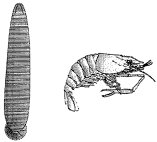
A
Leech $\quad$ Laccifer (Lac insect)
B
Leech $\quad$ Prawn
C
Nereis $\quad$ Prawn
D
Nereis $\quad$ Laccifer (Lac insect)
Solution
(B) The image on the left shows a Leech (Hirudinaria),which belongs to the phylum Annelida.
The image on the right shows a Prawn (Palaemon),which belongs to the phylum Arthropoda.
Therefore,the correct identification is Leech and Prawn.
The image on the right shows a Prawn (Palaemon),which belongs to the phylum Arthropoda.
Therefore,the correct identification is Leech and Prawn.
0 likes
View Solution387
MediumMCQ
How many of the following animals exhibit bilateral symmetry,are triploblastic,and possess a true coelom?
Sepia,Loligo,Sea anemone,Balanoglossus,Dentalium,Sea lily,Chiton,Pearl oyster,Starfish
Sepia,Loligo,Sea anemone,Balanoglossus,Dentalium,Sea lily,Chiton,Pearl oyster,Starfish
A
$3$
B
$4$
C
$5$
D
$6$
Solution
(D) To determine the correct count,let us analyze each animal:
$1$. Sepia (Mollusca): Bilateral,triploblastic,coelomate.
$2$. Loligo (Mollusca): Bilateral,triploblastic,coelomate.
$3$. Sea anemone (Cnidaria): Radial symmetry,diploblastic,acoelomate.
$4$. Balanoglossus (Hemichordata): Bilateral,triploblastic,coelomate.
$5$. Dentalium (Mollusca): Bilateral,triploblastic,coelomate.
$6$. Sea lily (Echinodermata): Radial symmetry (adults),triploblastic,coelomate.
$7$. Chiton (Mollusca): Bilateral,triploblastic,coelomate.
$8$. Pearl oyster (Mollusca): Bilateral,triploblastic,coelomate.
$9$. Starfish (Echinodermata): Radial symmetry (adults),triploblastic,coelomate.
The animals that are bilateral,triploblastic,and coelomate are: Sepia,Loligo,Balanoglossus,Dentalium,Chiton,and Pearl oyster.
Total count = $6$.
$1$. Sepia (Mollusca): Bilateral,triploblastic,coelomate.
$2$. Loligo (Mollusca): Bilateral,triploblastic,coelomate.
$3$. Sea anemone (Cnidaria): Radial symmetry,diploblastic,acoelomate.
$4$. Balanoglossus (Hemichordata): Bilateral,triploblastic,coelomate.
$5$. Dentalium (Mollusca): Bilateral,triploblastic,coelomate.
$6$. Sea lily (Echinodermata): Radial symmetry (adults),triploblastic,coelomate.
$7$. Chiton (Mollusca): Bilateral,triploblastic,coelomate.
$8$. Pearl oyster (Mollusca): Bilateral,triploblastic,coelomate.
$9$. Starfish (Echinodermata): Radial symmetry (adults),triploblastic,coelomate.
The animals that are bilateral,triploblastic,and coelomate are: Sepia,Loligo,Balanoglossus,Dentalium,Chiton,and Pearl oyster.
Total count = $6$.
0 likes
View Solution388
MediumMCQ
In Mollusca, excretion occurs through $......$ and in Hemichordata, it occurs through $......$.
A
Gills, Proboscis gland
B
Radula, Proboscis gland
C
Gills, Water vascular system
D
Radula, Water vascular system
Solution
(A) In the phylum $Mollusca$, excretion is primarily carried out by specialized structures known as kidneys or metanephridia (often referred to as gills or ctenidia in some contexts for respiration, but the excretory organs are metanephridia). However, in the context of standard biology questions regarding these phyla, the excretory organ in $Mollusca$ is often associated with the mantle cavity/kidneys, while in $Hemichordata$, the specific excretory organ is the $Proboscis$ \text{ gland}. Given the options provided, the most accurate pairing for excretory structures is $Gills$ (often associated with the mantle cavity where excretory products are released) and $Proboscis$ \text{ gland} for $Hemichordata$.
0 likes
View Solution389
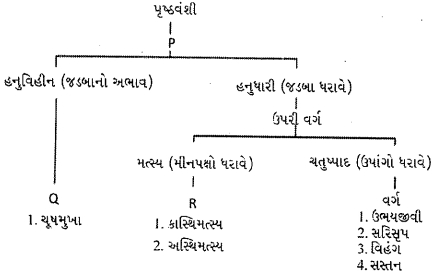
MediumMCQ
Identify the categories $P$,$Q$,and $R$ in the given classification chart of Vertebrata.
A
Subphylum,Superclass,Class
B
Subphylum,Class,Class
C
Division,Superclass,Class
D
Division,Class,Class
Solution
(D) According to the classification of Vertebrata:
$1$. $P$ represents the Subphylum (Vertebrata is a subphylum of Chordata,but in this specific chart context,it divides into Agnatha and Gnathostomata,which are divisions).
$2$. $Q$ represents the Class Cyclostomata (under Agnatha).
$3$. $R$ represents the Classes Chondrichthyes and Osteichthyes (under the Superclass Pisces).
Therefore,$P$ is Division,$Q$ is Class,and $R$ is Class.
$1$. $P$ represents the Subphylum (Vertebrata is a subphylum of Chordata,but in this specific chart context,it divides into Agnatha and Gnathostomata,which are divisions).
$2$. $Q$ represents the Class Cyclostomata (under Agnatha).
$3$. $R$ represents the Classes Chondrichthyes and Osteichthyes (under the Superclass Pisces).
Therefore,$P$ is Division,$Q$ is Class,and $R$ is Class.
0 likes
View Solution390
MediumMCQ
Distinguish the characteristics for Chondrichthyes (Cartilaginous fishes) and Osteichthyes (Bony fishes) from the following list:
$I$ - Air bladder absent,$II$ - Operculum absent,$III$ - Cycloid or ctenoid scales,$IV$ - Placoid scales,$V$ - Ventral mouth,$VI$ - Terminal mouth,$VII$ - Internal fertilization,$VIII$ - External fertilization.
Select the correct grouping for Chondrichthyes and Osteichthyes respectively.
$I$ - Air bladder absent,$II$ - Operculum absent,$III$ - Cycloid or ctenoid scales,$IV$ - Placoid scales,$V$ - Ventral mouth,$VI$ - Terminal mouth,$VII$ - Internal fertilization,$VIII$ - External fertilization.
Select the correct grouping for Chondrichthyes and Osteichthyes respectively.
A
$I, II, IV, V, VII \quad III, VI, VIII$
B
$I, II, III, V, VII \quad IV, VI, VIII$
C
$II, IV, V, VIII \quad I, III, VI, VII$
D
$I, II, III, VI, VIII \quad IV, V, VII$
Solution
(A) Chondrichthyes (Cartilaginous fishes) characteristics:
- $I$: Air bladder is absent (they have to swim constantly to avoid sinking).
- $II$: Operculum (gill cover) is absent.
- $IV$: Placoid scales are present.
- $V$: Mouth is located ventrally.
- $VII$: Internal fertilization occurs.
Thus,the set is $(I, II, IV, V, VII)$.
Osteichthyes (Bony fishes) characteristics:
- $III$: Cycloid or ctenoid scales are present.
- $VI$: Mouth is mostly terminal.
- $VIII$: External fertilization occurs.
Thus,the set is $(III, VI, VIII)$.
Therefore,the correct option is $A$.
- $I$: Air bladder is absent (they have to swim constantly to avoid sinking).
- $II$: Operculum (gill cover) is absent.
- $IV$: Placoid scales are present.
- $V$: Mouth is located ventrally.
- $VII$: Internal fertilization occurs.
Thus,the set is $(I, II, IV, V, VII)$.
Osteichthyes (Bony fishes) characteristics:
- $III$: Cycloid or ctenoid scales are present.
- $VI$: Mouth is mostly terminal.
- $VIII$: External fertilization occurs.
Thus,the set is $(III, VI, VIII)$.
Therefore,the correct option is $A$.
0 likes
View Solution391
MediumMCQ
Which of the following are cold-blooded (poikilothermic) animals?
A
Cyclostomata
B
Chondrichthyes
C
Osteichthyes
D
All of the above
Solution
(D) Cold-blooded or poikilothermic animals are those that cannot regulate their internal body temperature and it fluctuates with the environment.
$1$. Cyclostomata (jawless fishes) are ectothermic.
$2$. Chondrichthyes (cartilaginous fishes) are ectothermic.
$3$. Osteichthyes (bony fishes) are also ectothermic.
Therefore,all the groups mentioned above are cold-blooded.
$1$. Cyclostomata (jawless fishes) are ectothermic.
$2$. Chondrichthyes (cartilaginous fishes) are ectothermic.
$3$. Osteichthyes (bony fishes) are also ectothermic.
Therefore,all the groups mentioned above are cold-blooded.
0 likes
View Solution392
MediumMCQ
Which of the following organisms possess a two-chambered heart?
A
Cyclostomata
B
Chondrichthyes
C
Osteichthyes
D
All of the above
Solution
(D) two-chambered heart,consisting of one atrium and one ventricle,is a characteristic feature of fishes.
$Cyclostomata$ (jawless fishes),$Chondrichthyes$ (cartilaginous fishes),and $Osteichthyes$ (bony fishes) all belong to the superclass $Pisces$.
Therefore,all the organisms listed possess a two-chambered heart.
$Cyclostomata$ (jawless fishes),$Chondrichthyes$ (cartilaginous fishes),and $Osteichthyes$ (bony fishes) all belong to the superclass $Pisces$.
Therefore,all the organisms listed possess a two-chambered heart.
0 likes
View Solution393
MediumMCQ
How many of the following characteristics are common to both Amphibians and Reptiles?
$a$ - Type of fertilization
$b$ - Cold-blooded (Poikilothermic)
$c$ - Development
$d$ - Oviparous
$e$ - Coelomate
$f$ - Bilateral symmetry
$a$ - Type of fertilization
$b$ - Cold-blooded (Poikilothermic)
$c$ - Development
$d$ - Oviparous
$e$ - Coelomate
$f$ - Bilateral symmetry
A
$2$
B
$3$
C
$4$
D
$5$
Solution
(C) Let us analyze the characteristics for both Amphibians and Reptiles:
$a$ - Type of fertilization: Amphibians usually show external fertilization,while Reptiles show internal fertilization. (Not common)
$b$ - Cold-blooded: Both are poikilothermic (ectothermic). (Common)
$c$ - Development: Both show indirect development (larval stages in amphibians,though some reptiles have direct development). (Not strictly common)
$d$ - Oviparous: Both are oviparous. (Common)
$e$ - Coelomate: Both are true coelomates. (Common)
$f$ - Bilateral symmetry: Both exhibit bilateral symmetry. (Common)
The common characteristics are $b, d, e,$ and $f$. Therefore,there are $4$ common characteristics.
$a$ - Type of fertilization: Amphibians usually show external fertilization,while Reptiles show internal fertilization. (Not common)
$b$ - Cold-blooded: Both are poikilothermic (ectothermic). (Common)
$c$ - Development: Both show indirect development (larval stages in amphibians,though some reptiles have direct development). (Not strictly common)
$d$ - Oviparous: Both are oviparous. (Common)
$e$ - Coelomate: Both are true coelomates. (Common)
$f$ - Bilateral symmetry: Both exhibit bilateral symmetry. (Common)
The common characteristics are $b, d, e,$ and $f$. Therefore,there are $4$ common characteristics.
0 likes
View Solution394
MediumMCQ
Match the following columns:
| Column-$I$ (Animal) | Column-$II$ (Genus) |
|---|---|
| $P$. Crow | $I$. Columba |
| $Q$. Pigeon | $II$. Pavo |
| $R$. Parrot | $III$. Psittacula |
| $S$. Ostrich | $IV$. Neophron |
| $T$. Peacock | $V$. Aptenodytes |
| $U$. Penguin | $VI$. Corvus |
| $V$. Vulture | $VII$. Struthio |
A
$(P-VI), (Q-I), (R-II), (S-III), (T-VII), (U-IV), (V-V)$
B
$(P-I), (Q-VI), (R-III), (S-VII), (T-V), (U-II), (V-IV)$
C
$(P-VI), (Q-I), (R-III), (S-VII), (T-II), (U-V), (V-IV)$
D
$(P-II), (Q-I), (R-III), (S-IV), (T-VI), (U-VII), (V-V)$
Solution
(C) The correct scientific names (Genus) for the given animals are as follows:
$P$. Crow: $Corvus$ $(VI)$
$Q$. Pigeon: $Columba$ $(I)$
$R$. Parrot: $Psittacula$ $(III)$
$S$. Ostrich: $Struthio$ $(VII)$
$T$. Peacock: $Pavo$ $(II)$
$U$. Penguin: $Aptenodytes$ $(V)$
$V$. Vulture: $Neophron$ $(IV)$
Therefore,the correct matching is $(P-VI), (Q-I), (R-III), (S-VII), (T-II), (U-V), (V-IV)$.
$P$. Crow: $Corvus$ $(VI)$
$Q$. Pigeon: $Columba$ $(I)$
$R$. Parrot: $Psittacula$ $(III)$
$S$. Ostrich: $Struthio$ $(VII)$
$T$. Peacock: $Pavo$ $(II)$
$U$. Penguin: $Aptenodytes$ $(V)$
$V$. Vulture: $Neophron$ $(IV)$
Therefore,the correct matching is $(P-VI), (Q-I), (R-III), (S-VII), (T-II), (U-V), (V-IV)$.
0 likes
View Solution395
MediumMCQ
How many of the following animals are homeothermic (warm-blooded)?
Rattus,Macropus,Balaenoptera,Columba,Calotes,Crocodilus,Naja,Hyla,Rana,Neophron,Tigris
Rattus,Macropus,Balaenoptera,Columba,Calotes,Crocodilus,Naja,Hyla,Rana,Neophron,Tigris
A
$4$
B
$5$
C
$6$
D
$7$
Solution
(C) Homeothermic (warm-blooded) animals are those that maintain a constant body temperature regardless of the environment. In the given list,mammals and birds are homeothermic.
$1$. $Rattus$ (Rat) - Mammal (Homeothermic)
$2$. $Macropus$ (Kangaroo) - Mammal (Homeothermic)
$3$. $Balaenoptera$ (Blue whale) - Mammal (Homeothermic)
$4$. $Columba$ (Pigeon) - Bird (Homeothermic)
$5$. $Calotes$ (Garden lizard) - Reptile (Poikilothermic)
$6$. $Crocodilus$ (Crocodile) - Reptile (Poikilothermic)
$7$. $Naja$ (Cobra) - Reptile (Poikilothermic)
$8$. $Hyla$ (Tree frog) - Amphibian (Poikilothermic)
$9$. $Rana$ (Frog) - Amphibian (Poikilothermic)
$10$. $Neophron$ (Vulture) - Bird (Homeothermic)
$11$. $Tigris$ (Tiger) - Mammal (Homeothermic)
The homeothermic animals are: $Rattus, Macropus, Balaenoptera, Columba, Neophron, Tigris$.
Total count = $6$.
$1$. $Rattus$ (Rat) - Mammal (Homeothermic)
$2$. $Macropus$ (Kangaroo) - Mammal (Homeothermic)
$3$. $Balaenoptera$ (Blue whale) - Mammal (Homeothermic)
$4$. $Columba$ (Pigeon) - Bird (Homeothermic)
$5$. $Calotes$ (Garden lizard) - Reptile (Poikilothermic)
$6$. $Crocodilus$ (Crocodile) - Reptile (Poikilothermic)
$7$. $Naja$ (Cobra) - Reptile (Poikilothermic)
$8$. $Hyla$ (Tree frog) - Amphibian (Poikilothermic)
$9$. $Rana$ (Frog) - Amphibian (Poikilothermic)
$10$. $Neophron$ (Vulture) - Bird (Homeothermic)
$11$. $Tigris$ (Tiger) - Mammal (Homeothermic)
The homeothermic animals are: $Rattus, Macropus, Balaenoptera, Columba, Neophron, Tigris$.
Total count = $6$.
0 likes
View Solution396
MediumMCQ
Which of the following characteristics are $NOT$ common to both Aves (birds) and Mammalia (mammals)?
$I$ - Homeothermic (warm-blooded) animals.
$II$ - Respire through lungs.
$III$ - Possess a four-chambered heart.
$IV$ - Dioecious (sexes are separate).
$V$ - Possess hair on the skin.
$VI$ - Show internal fertilization.
$VII$ - Possess teeth.
$I$ - Homeothermic (warm-blooded) animals.
$II$ - Respire through lungs.
$III$ - Possess a four-chambered heart.
$IV$ - Dioecious (sexes are separate).
$V$ - Possess hair on the skin.
$VI$ - Show internal fertilization.
$VII$ - Possess teeth.
A
$V, VII$
B
$I, II, III, IV, VI$
C
$I, III, V, VII$
D
$II, IV, VI$
Solution
(A) Aves and Mammals share several characteristics:
$1$. Both are homeothermic (warm-blooded) $(I)$.
$2$. Both respire through lungs $(II)$.
$3$. Both have a four-chambered heart $(III)$.
$4$. Both are dioecious $(IV)$ and exhibit internal fertilization $(VI)$.
However,they differ in the following:
- Mammals possess hair on the skin $(V)$,whereas birds have feathers.
- Mammals typically possess teeth $(VII)$ (thecodont dentition),whereas birds lack teeth and have a beak instead.
Therefore,the characteristics $V$ and $VII$ are not common to both.
$1$. Both are homeothermic (warm-blooded) $(I)$.
$2$. Both respire through lungs $(II)$.
$3$. Both have a four-chambered heart $(III)$.
$4$. Both are dioecious $(IV)$ and exhibit internal fertilization $(VI)$.
However,they differ in the following:
- Mammals possess hair on the skin $(V)$,whereas birds have feathers.
- Mammals typically possess teeth $(VII)$ (thecodont dentition),whereas birds lack teeth and have a beak instead.
Therefore,the characteristics $V$ and $VII$ are not common to both.
0 likes
View Solution397
MediumMCQ
Select the correct option for the following classification: Vertebrate and Invertebrate.
A
Earthworm, Cockroach $\, \quad \,$ Frog
B
Frog $\, \quad \,$ Earthworm, Cockroach
C
Earthworm $\, \quad \,$ Cockroach, Frog
D
Cockroach, Frog $\, \quad \,$ Earthworm
Solution
(B) $1$. Vertebrates are animals that possess a vertebral column or backbone. Among the given options, the frog (an amphibian) is a vertebrate.
$2$. Invertebrates are animals that lack a vertebral column. Earthworms (Annelida) and cockroaches (Arthropoda) are invertebrates.
$3$. Therefore, the correct classification is: Vertebrate $(Frog)$ and Invertebrates $(Earthworm, Cockroach)$.
$4$. This matches option $B$.
$2$. Invertebrates are animals that lack a vertebral column. Earthworms (Annelida) and cockroaches (Arthropoda) are invertebrates.
$3$. Therefore, the correct classification is: Vertebrate $(Frog)$ and Invertebrates $(Earthworm, Cockroach)$.
$4$. This matches option $B$.
0 likes
View Solution398
MediumMCQ
Select the correct option for the circulatory system.
A
Open circulatory system - Arthropoda,Annelida; Closed circulatory system - Mollusca,Chordata
B
Open circulatory system - Mollusca,Chordata; Closed circulatory system - Arthropoda,Annelida
C
Open circulatory system - Arthropoda,Mollusca; Closed circulatory system - Annelida,Chordata
D
Open circulatory system - Annelida,Chordata; Closed circulatory system - Arthropoda,Mollusca
Solution
(C) In an open circulatory system,the blood is pumped out of the heart into sinuses or body cavities (haemocoel). This is found in Arthropoda and most Mollusca (except Cephalopods).
In a closed circulatory system,the blood is circulated through a series of vessels of varying diameters (arteries,veins,and capillaries). This is found in Annelida and Chordata.
Therefore,the correct classification is: Open circulatory system - Arthropoda,Mollusca; Closed circulatory system - Annelida,Chordata.
In a closed circulatory system,the blood is circulated through a series of vessels of varying diameters (arteries,veins,and capillaries). This is found in Annelida and Chordata.
Therefore,the correct classification is: Open circulatory system - Arthropoda,Mollusca; Closed circulatory system - Annelida,Chordata.
0 likes
View Solution399
MediumMCQ
Match List $I$ with List $II$.
Choose the correct answer from the options given below:
| List $I$ | List $II$ |
| $A$. Taenia | $I$. Nephridia |
| $B$. Paramoecium | $II$. Contractile vacuole |
| $C$. Periplaneta | $III$. Flame cells |
| $D$. Pheretima | $IV$. Urecose gland |
Choose the correct answer from the options given below:
A
$A-II, B-I, C-IV, D-III$
B
$A-I, B-II, C-III, D-IV$
C
$A-I, B-II, C-IV, D-III$
D
$A-III, B-II, C-IV, D-I$
Solution
(D) The correct matching is as follows:
$A$. $Taenia$ (Platyhelminthes) uses flame cells $(III)$ for excretion.
$B$. $Paramoecium$ uses contractile vacuoles $(II)$ for osmoregulation and excretion.
$C$. $Periplaneta$ (Cockroach) uses urecose glands $(IV)$ for excretion.
$D$. $Pheretima$ (Earthworm) uses nephridia $(I)$ for excretion.
Therefore, the correct sequence is $A-III, B-II, C-IV, D-I$.
$A$. $Taenia$ (Platyhelminthes) uses flame cells $(III)$ for excretion.
$B$. $Paramoecium$ uses contractile vacuoles $(II)$ for osmoregulation and excretion.
$C$. $Periplaneta$ (Cockroach) uses urecose glands $(IV)$ for excretion.
$D$. $Pheretima$ (Earthworm) uses nephridia $(I)$ for excretion.
Therefore, the correct sequence is $A-III, B-II, C-IV, D-I$.
0 likes
View Solution400
MediumMCQ
Match List $I$ with List $II$ :
Choose the correct answer from the options given below :
| List $I$ | List $II$ |
| $A$. Pleurobrachia | $I$. Mollusca |
| $B$. Radula | $II$. Ctenophora |
| $C$. Stomochord | $III$. Osteichthyes |
| $D$. Air bladder | $IV$. Hemichordata |
Choose the correct answer from the options given below :
A
$A-II, B-I, C-IV, D-III$
B
$A-II, B-IV, C-I, D-III$
C
$A-IV, B-III, C-II, D-I$
D
$A-IV, B-II, C-III, D-I$
Solution
(A) The correct matching is as follows:
$A$. Pleurobrachia: It belongs to the phylum $Ctenophora$.
$B$. Radula: It is a file-like rasping organ for feeding found in the phylum $Mollusca$.
$C$. Stomochord: It is a rudimentary structure similar to the notochord found in the collar region of the phylum $Hemichordata$.
$D$. Air bladder: It is a gas-filled sac found in $Osteichthyes$ (bony fishes) that helps in regulating buoyancy.
Therefore, the correct sequence is $A-II, B-I, C-IV, D-III$.
$A$. Pleurobrachia: It belongs to the phylum $Ctenophora$.
$B$. Radula: It is a file-like rasping organ for feeding found in the phylum $Mollusca$.
$C$. Stomochord: It is a rudimentary structure similar to the notochord found in the collar region of the phylum $Hemichordata$.
$D$. Air bladder: It is a gas-filled sac found in $Osteichthyes$ (bony fishes) that helps in regulating buoyancy.
Therefore, the correct sequence is $A-II, B-I, C-IV, D-III$.
0 likes
View SolutionAnimal Kingdom — Mix Examples - Animal Kingdom · Frequently Asked Questions
1Are these Animal Kingdom questions useful for JEE and NEET?
Yes. All questions in this section are mapped to JEE Main and NEET exam patterns. Previous year questions from JEE Main, NEET, GUJCET and state-level exams are included with full solutions.
2Can I switch to Hindi or Gujarati for these questions?
Yes. Use the language tabs in the hero section or the sidebar to view the same questions and solutions in English, Hindi or Gujarati.
3How do I generate a question paper from this subtopic?
Use the Vedclass Exam Paper Generator — select the chapter and subtopic, set difficulty, and generate Sets A, B, C, D automatically. First 3 chapters of every subject are free.
Vedclass Products
For Students
Vedclass Test Series
Mock tests in real JEE/NEET style with performance analysis. 5-day free trial.
Start Free TrialFor Teachers
Exam Paper Generator
Generate Set A/B/C/D papers from this chapter in 2 minutes. 3 chapters free.
Try FreeFor Institutes
Online Exam Module
Live online exams with unlimited students, 360° analytics & white-label branding.
See DemoFor Teachers & Institutes
Generate a Animal Kingdom Exam Paper in 2 Minutes
Select subtopic & difficulty — Sets A, B, C, D auto-generated with No Repeat logic.
First 3 chapters of every subject are free — no payment required.