
A English
Mix Examples - Animal Kingdom Questions in English
Class 11 Biology · Animal Kingdom · Mix Examples - Animal Kingdom
431+
Questions
English
Language
100%
With Solutions
Showing 50 of 431 questions in English
201
EasyMCQ
Identify the mismatched pair from the following:
A
Diploblastic - Coelenterata
B
Triploblastic - Aschelminthes
C
Pseudocoelomate - Annelida
D
Coelomate - Arthropoda
Solution
(C) The classification of animals is based on germ layers and body cavity (coelom).
$1$. $Diploblastic$ animals have two germ layers (ectoderm and endoderm), e.g., $Coelenterata$ (Cnidaria).
$2$. $Triploblastic$ animals have three germ layers (ectoderm, mesoderm, and endoderm), e.g., $Aschelminthes$ to $Chordata$.
$3$. $Pseudocoelomate$ animals have a false body cavity, e.g., $Aschelminthes$. $Annelida$ are $Eucoelomate$ (true coelomates), not $Pseudocoelomate$.
$4$. $Coelomate$ animals have a true body cavity, e.g., $Arthropoda$.
Therefore, the pair $Pseudocoelomate - Annelida$ is mismatched.
$1$. $Diploblastic$ animals have two germ layers (ectoderm and endoderm), e.g., $Coelenterata$ (Cnidaria).
$2$. $Triploblastic$ animals have three germ layers (ectoderm, mesoderm, and endoderm), e.g., $Aschelminthes$ to $Chordata$.
$3$. $Pseudocoelomate$ animals have a false body cavity, e.g., $Aschelminthes$. $Annelida$ are $Eucoelomate$ (true coelomates), not $Pseudocoelomate$.
$4$. $Coelomate$ animals have a true body cavity, e.g., $Arthropoda$.
Therefore, the pair $Pseudocoelomate - Annelida$ is mismatched.
0 likes
View Solution202
MediumMCQ
Match the following animals with their respective phyla and arrange them in the correct order as per the given list of animals: Animals: $Leucosolenia$,$Opalina$,$Planaria$,$Wuchereria$. Phyla: $Aschelminthes$,$Protozoa$,$Porifera$,$Platyhelminthes$.
A
$Porifera, Protozoa, Platyhelminthes, Aschelminthes$
B
$Protozoa, Porifera, Aschelminthes, Platyhelminthes$
C
$Aschelminthes, Platyhelminthes, Porifera, Protozoa$
D
$Protozoa, Aschelminthes, Platyhelminthes, Porifera$
Solution
(A) The classification of the given animals is as follows:
$1$. $Leucosolenia$ belongs to the phylum $Porifera$.
$2$. $Opalina$ belongs to the phylum $Protozoa$.
$3$. $Planaria$ belongs to the phylum $Platyhelminthes$.
$4$. $Wuchereria$ belongs to the phylum $Aschelminthes$.
Therefore,the correct sequence of phyla corresponding to the order of animals $(Leucosolenia, Opalina, Planaria, Wuchereria)$ is $Porifera, Protozoa, Platyhelminthes, Aschelminthes$.
$1$. $Leucosolenia$ belongs to the phylum $Porifera$.
$2$. $Opalina$ belongs to the phylum $Protozoa$.
$3$. $Planaria$ belongs to the phylum $Platyhelminthes$.
$4$. $Wuchereria$ belongs to the phylum $Aschelminthes$.
Therefore,the correct sequence of phyla corresponding to the order of animals $(Leucosolenia, Opalina, Planaria, Wuchereria)$ is $Porifera, Protozoa, Platyhelminthes, Aschelminthes$.
0 likes
View Solution203
MediumMCQ
Which of the following pairs is mismatched?
A
Hypostome - Hydra
B
Planaria - Flame cells
C
Parapodia - Earthworm
D
Cnidocytes - Cnidarians
Solution
(C) The correct answer is $C$.
$1$. Hypostome is a structure found in $Hydra$ (Phylum $Cnidaria$) at the tip of the hypostome where the mouth is located.
$2$. Flame cells are the specialized excretory structures found in $Planaria$ (Phylum $Platyhelminthes$).
$3$. Parapodia are lateral appendages found in $Nereis$ (Phylum $Annelida$) which help in swimming. Earthworms $(Pheretima)$ possess setae for locomotion,not parapodia.
$4$. Cnidocytes (stinging cells) are a characteristic feature of Phylum $Cnidaria$.
$1$. Hypostome is a structure found in $Hydra$ (Phylum $Cnidaria$) at the tip of the hypostome where the mouth is located.
$2$. Flame cells are the specialized excretory structures found in $Planaria$ (Phylum $Platyhelminthes$).
$3$. Parapodia are lateral appendages found in $Nereis$ (Phylum $Annelida$) which help in swimming. Earthworms $(Pheretima)$ possess setae for locomotion,not parapodia.
$4$. Cnidocytes (stinging cells) are a characteristic feature of Phylum $Cnidaria$.
0 likes
View Solution204
EasyMCQ
Which of the following animals is hermaphrodite (bisexual)?
A
Liver fluke
B
Earthworm
C
Planaria
D
All of the above
Solution
(D) Hermaphrodite or bisexual animals are those that possess both male and female reproductive organs in the same individual.
$1$. Liver fluke ($Fasciola$ $hepatica$) is a trematode that is hermaphrodite.
$2$. Earthworm ($Pheretima$ $posthuma$) is a well-known example of a hermaphrodite organism.
$3$. Planaria is a flatworm that is also hermaphrodite.
Therefore,all the given animals are hermaphrodite.
$1$. Liver fluke ($Fasciola$ $hepatica$) is a trematode that is hermaphrodite.
$2$. Earthworm ($Pheretima$ $posthuma$) is a well-known example of a hermaphrodite organism.
$3$. Planaria is a flatworm that is also hermaphrodite.
Therefore,all the given animals are hermaphrodite.
0 likes
View Solution205
MediumMCQ
Match the following columns correctly and select the appropriate option:
| Column $A$ | Column $B$ | Column $C$ |
| $(1)$ Planaria | $(a)$ Planula | $(e)$ Ostia |
| $(2)$ Hyalonema | $(b)$ Pseudocoelomate | $(f)$ Flame cells |
| $(3)$ Hydra | $(c)$ Platyhelminthes | $(g)$ Polyp |
| $(4)$ Wuchereria | $(d)$ Porifera | $(h)$ Aschelminthes |
A
$(1-c-f), (2-d-e), (3-a-g), (4-b-h)$
B
$(1-a-e), (2-b-f), (3-c-g), (4-d-h)$
C
$(1-c-e), (2-d-h), (3-b-g), (4-a-f)$
D
$(1-d-f), (2-c-e), (3-b-g), (4-a-h)$
Solution
(A) The correct matches are as follows:
$(1)$ Planaria belongs to the phylum Platyhelminthes and possesses flame cells for excretion. Thus, $(1-c-f)$.
$(2)$ Hyalonema belongs to the phylum Porifera and possesses ostia (pores) for water circulation. Thus, $(2-d-e)$.
$(3)$ Hydra is a cnidarian that exhibits the polyp body form and produces a planula larva. Thus, $(3-a-g)$.
$(4)$ Wuchereria belongs to the phylum Aschelminthes and is a pseudocoelomate organism. Thus, $(4-b-h)$.
Therefore, the correct sequence is $(1-c-f), (2-d-e), (3-a-g), (4-b-h)$.
$(1)$ Planaria belongs to the phylum Platyhelminthes and possesses flame cells for excretion. Thus, $(1-c-f)$.
$(2)$ Hyalonema belongs to the phylum Porifera and possesses ostia (pores) for water circulation. Thus, $(2-d-e)$.
$(3)$ Hydra is a cnidarian that exhibits the polyp body form and produces a planula larva. Thus, $(3-a-g)$.
$(4)$ Wuchereria belongs to the phylum Aschelminthes and is a pseudocoelomate organism. Thus, $(4-b-h)$.
Therefore, the correct sequence is $(1-c-f), (2-d-e), (3-a-g), (4-b-h)$.
0 likes
View Solution206
EasyMCQ
Identify the incorrect pair from the following:
A
First phylum to possess a nervous system - $Cnidaria$
B
First phylum to possess a complete digestive tract - $Aschelminthes$
C
First phylum to possess a circulatory system - $Annelida$
D
First phylum to possess a coelom - $Mollusca$
Solution
(D) The correct answer is $D$.
$1$. $Cnidaria$ (Coelenterata) are the first animals to exhibit a primitive nervous system in the form of a nerve net.
$2$. $Aschelminthes$ (Nematoda) are the first to possess a complete alimentary canal with a mouth and anus.
$3$. $Annelida$ are the first to possess a closed circulatory system.
$4$. $Mollusca$ is not the first phylum to possess a coelom; $Annelida$ is the first phylum to exhibit a true coelom (eucoelomate). Therefore,the pair '$Mollusca$' is incorrect.
$1$. $Cnidaria$ (Coelenterata) are the first animals to exhibit a primitive nervous system in the form of a nerve net.
$2$. $Aschelminthes$ (Nematoda) are the first to possess a complete alimentary canal with a mouth and anus.
$3$. $Annelida$ are the first to possess a closed circulatory system.
$4$. $Mollusca$ is not the first phylum to possess a coelom; $Annelida$ is the first phylum to exhibit a true coelom (eucoelomate). Therefore,the pair '$Mollusca$' is incorrect.
0 likes
View Solution207
MediumMCQ
Select the correct option matching the columns $A, B$, and $C$:
| $A$ | $B$ | $C$ |
| $(1)$ Tube feet | $(a)$ Helps in digestion | $(e)$ Mollusca |
| $(2)$ Radula | $(b)$ Helps in balance | $(f)$ Echinodermata |
| $(3)$ Statocyst | $(c)$ Helps in locomotion | $(g)$ Annelida |
| $(4)$ Setae | $(d)$ Water vascular system | $(h)$ Arthropoda |
A
$(1-c-f), (2-a-e), (3-b-h), (4-d-g)$
B
$(1-d-f), (2-a-e), (3-b-h), (4-c-g)$
C
$(1-b-g), (2-a-f), (3-c-e), (4-d-h)$
D
$(1-a-h), (2-c-g), (3-d-f), (4-b-e)$
Solution
(B) The correct matching is as follows:
$(1)$ Tube feet are characteristic of the water vascular system in Echinodermata and help in locomotion: $(1-d-f)$.
$(2)$ Radula is a rasping organ used for feeding (digestion) found in Mollusca: $(2-a-e)$.
$(3)$ Statocyst is a balancing organ found in Arthropoda (e.g., crustaceans): $(3-b-h)$.
$(4)$ Setae are locomotory structures found in Annelida: $(4-c-g)$.
Thus, the correct sequence is $(1-d-f), (2-a-e), (3-b-h), (4-c-g)$.
$(1)$ Tube feet are characteristic of the water vascular system in Echinodermata and help in locomotion: $(1-d-f)$.
$(2)$ Radula is a rasping organ used for feeding (digestion) found in Mollusca: $(2-a-e)$.
$(3)$ Statocyst is a balancing organ found in Arthropoda (e.g., crustaceans): $(3-b-h)$.
$(4)$ Setae are locomotory structures found in Annelida: $(4-c-g)$.
Thus, the correct sequence is $(1-d-f), (2-a-e), (3-b-h), (4-c-g)$.
0 likes
View Solution208
EasyMCQ
Statement $X$: All chordates are not vertebrates.
Reason $Y$: $Balanoglossus$ is not a vertebrate.
Reason $Y$: $Balanoglossus$ is not a vertebrate.
A
Statement $X$ is true and Reason $Y$ is the correct explanation for Statement $X$.
B
Statement $X$ is true,but Reason $Y$ is not the correct explanation for Statement $X$.
C
Statement $X$ is false,but Reason $Y$ is true.
D
Both Statement $X$ and Reason $Y$ are false.
Solution
(A) Statement $X$ is true because the phylum $Chordata$ includes three subphyla: $Urochordata$,$Cephalochordata$,and $Vertebrata$. $Urochordata$ and $Cephalochordata$ are collectively known as protochordates and are not vertebrates.
Reason $Y$ is also true because $Balanoglossus$ belongs to the phylum $Hemichordata$,which was previously considered a subphylum of $Chordata$ but is now classified as a separate phylum. Even if considered within the context of chordate-like organisms,it lacks a vertebral column.
Since $Balanoglossus$ is not a vertebrate,it serves as an example supporting the fact that not all chordate-like organisms are vertebrates. Therefore,Reason $Y$ correctly explains why Statement $X$ is true.
Reason $Y$ is also true because $Balanoglossus$ belongs to the phylum $Hemichordata$,which was previously considered a subphylum of $Chordata$ but is now classified as a separate phylum. Even if considered within the context of chordate-like organisms,it lacks a vertebral column.
Since $Balanoglossus$ is not a vertebrate,it serves as an example supporting the fact that not all chordate-like organisms are vertebrates. Therefore,Reason $Y$ correctly explains why Statement $X$ is true.
0 likes
View Solution209
EasyMCQ
Identify the mismatched pair.
A
Balanoglossus - Hemichordata
B
Ascidia - Urochordata
C
Salpa - Cyclostomata
D
Amphioxus - Cephalochordata
Solution
(C) The classification of the given organisms is as follows:
$1$. $Balanoglossus$ belongs to the phylum $Hemichordata$.
$2$. $Ascidia$ belongs to the subphylum $Urochordata$ (Tunicata).
$3$. $Salpa$ also belongs to the subphylum $Urochordata$,not $Cyclostomata$. $Cyclostomata$ is a class of jawless vertebrates (Agnatha).
$4$. $Amphioxus$ (Branchiostoma) belongs to the subphylum $Cephalochordata$.
Therefore,the pair $Salpa - Cyclostomata$ is mismatched.
$1$. $Balanoglossus$ belongs to the phylum $Hemichordata$.
$2$. $Ascidia$ belongs to the subphylum $Urochordata$ (Tunicata).
$3$. $Salpa$ also belongs to the subphylum $Urochordata$,not $Cyclostomata$. $Cyclostomata$ is a class of jawless vertebrates (Agnatha).
$4$. $Amphioxus$ (Branchiostoma) belongs to the subphylum $Cephalochordata$.
Therefore,the pair $Salpa - Cyclostomata$ is mismatched.
0 likes
View Solution210
EasyMCQ
Which of the following differences between Chondrichthyes (cartilaginous fishes) and Osteichthyes (bony fishes) is incorrect?
A
Chondrichthyes - Endoskeleton is cartilaginous,Osteichthyes - Endoskeleton is bony.
B
Chondrichthyes - Respiration through $5-7$ pairs of gills,Osteichthyes - Respiration through $4$ pairs of gills.
C
Chondrichthyes - Air bladder present,Osteichthyes - Air bladder absent.
D
Chondrichthyes - Caudal fin is heterocercal (unequal),Osteichthyes - Caudal fin is homocercal (equal).
Solution
(C) In Chondrichthyes (cartilaginous fishes),the air bladder (swim bladder) is absent,which forces them to swim constantly to avoid sinking. In contrast,Osteichthyes (bony fishes) possess an air bladder that regulates buoyancy. Therefore,the statement in option $C$ is incorrect because it reverses the presence of the air bladder between the two classes.
0 likes
View Solution211
MediumMCQ
Identify the mismatched pair regarding the endoskeleton of animals.
A
Fibrous and cartilaginous endoskeleton - Cyclostomata
B
Cartilaginous endoskeleton - Chondrichthyes
C
Endoskeleton made of calcium carbonate plates - Echinodermata
D
Bony endoskeleton - Osteichthyes
Solution
(A) $1$. Cyclostomata (e.g.,lampreys and hagfish) possess a cartilaginous cranium and vertebral column,but they do not have a 'fibrous' endoskeleton in the context of typical biological classification; however,the term 'fibrous' is not a standard descriptor for their endoskeleton.
$2$. Chondrichthyes (cartilaginous fishes) have an endoskeleton composed entirely of cartilage.
$3$. Echinoderms possess an endoskeleton consisting of calcareous ossicles (calcium carbonate plates).
$4$. Osteichthyes (bony fishes) have an endoskeleton composed of bone.
$5$. Therefore,the pair 'Fibrous and cartilaginous endoskeleton - Cyclostomata' is considered the mismatched pair as 'fibrous' is not the defining characteristic of their endoskeleton.
$2$. Chondrichthyes (cartilaginous fishes) have an endoskeleton composed entirely of cartilage.
$3$. Echinoderms possess an endoskeleton consisting of calcareous ossicles (calcium carbonate plates).
$4$. Osteichthyes (bony fishes) have an endoskeleton composed of bone.
$5$. Therefore,the pair 'Fibrous and cartilaginous endoskeleton - Cyclostomata' is considered the mismatched pair as 'fibrous' is not the defining characteristic of their endoskeleton.
0 likes
View Solution212
MediumMCQ
Find the mismatched pair regarding the exoskeleton.
A
Exoskeleton made of scales - Amphibians
B
Exoskeleton made of nails,hooves,hair - Mammals
C
Exoskeleton made of feathers and scales - Aves
D
Exoskeleton made of $CaCO_3$ plates - Echinodermata
Solution
(A) $1$. Amphibians typically have moist,glandular skin without an exoskeleton of scales. Scales are characteristic of reptiles (Reptilia) and fish (Pisces).
$2$. Mammals possess an exoskeleton derived from the epidermis,which includes structures like nails,hooves,claws,and hair.
$3$. Aves (birds) have an exoskeleton consisting of feathers and epidermal scales on their legs.
$4$. Echinoderms possess an endoskeleton made of calcareous ossicles ($CaCO_3$ plates),not an exoskeleton. Therefore,option $A$ is the mismatched pair.
$2$. Mammals possess an exoskeleton derived from the epidermis,which includes structures like nails,hooves,claws,and hair.
$3$. Aves (birds) have an exoskeleton consisting of feathers and epidermal scales on their legs.
$4$. Echinoderms possess an endoskeleton made of calcareous ossicles ($CaCO_3$ plates),not an exoskeleton. Therefore,option $A$ is the mismatched pair.
0 likes
View Solution213
EasyMCQ
Identify the organism that is different from others based on the presence of a coelom.
A
Nereis
B
Earthworm
C
Pila
D
Wuchereria
Solution
(D) $Nereis$ (Annelida), $Earthworm$ (Annelida), and $Pila$ (Mollusca) are coelomate animals, meaning they possess a true body cavity (coelom) lined by mesoderm.
$Wuchereria$ (Aschelminthes/Nematoda) is a pseudocoelomate animal, meaning it possesses a false body cavity (pseudocoelom) that is not completely lined by mesoderm.
Therefore, $Wuchereria$ is the odd one out based on the presence of a coelom.
$Wuchereria$ (Aschelminthes/Nematoda) is a pseudocoelomate animal, meaning it possesses a false body cavity (pseudocoelom) that is not completely lined by mesoderm.
Therefore, $Wuchereria$ is the odd one out based on the presence of a coelom.
0 likes
View Solution214
MediumMCQ
In which aspects do organisms of the animal kingdom show diversity?
A
Form
B
Structure
C
Reproduction
D
All of the above
Solution
(D) Organisms in the animal kingdom exhibit a high degree of diversity in various aspects.
$1$. Form: Animals vary significantly in their body shape,size,and symmetry.
$2$. Structure: There is a vast difference in the internal organization,cellular complexity,and organ systems among different phyla.
$3$. Reproduction: Animals show diverse modes of reproduction,including sexual and asexual methods,as well as variations in developmental stages (e.g.,direct vs. indirect development).
Therefore,all the given options are correct.
$1$. Form: Animals vary significantly in their body shape,size,and symmetry.
$2$. Structure: There is a vast difference in the internal organization,cellular complexity,and organ systems among different phyla.
$3$. Reproduction: Animals show diverse modes of reproduction,including sexual and asexual methods,as well as variations in developmental stages (e.g.,direct vs. indirect development).
Therefore,all the given options are correct.
0 likes
View Solution215
EasyMCQ
In which of the following kingdoms do organisms primarily reproduce through sexual methods?
A
Monera
B
Fungi
C
Animalia
D
Plantae
Solution
(C) In the $5$-kingdom classification system,the kingdom $Animalia$ consists of multicellular organisms that primarily exhibit sexual reproduction. While $Fungi$ and $Plantae$ also undergo sexual reproduction,$Animalia$ is characterized by complex sexual life cycles as the primary mode of reproduction across the entire kingdom. $Monera$ reproduces primarily through asexual methods like binary fission.
0 likes
View Solution216
EasyMCQ
Identify the correct sequence of animal phyla in terms of evolution.
A
Cnidaria,Platyhelminthes,Chordata,Mollusca
B
Cnidaria,Annelida,Aschelminthes,Protozoa
C
Cnidaria,Platyhelminthes,Annelida,Echinodermata
D
Cnidaria,Aschelminthes,Echinodermata,Platyhelminthes
Solution
(C) The evolutionary sequence of animal phyla is based on the complexity of body organization,symmetry,and germ layers.
Starting from the simplest to the most complex,the order is: Porifera $\rightarrow$ Cnidaria $\rightarrow$ Platyhelminthes $\rightarrow$ Aschelminthes $\rightarrow$ Annelida $\rightarrow$ Arthropoda $\rightarrow$ Mollusca $\rightarrow$ Echinodermata $\rightarrow$ Hemichordata $\rightarrow$ Chordata.
In option $C$,the sequence $Cnidaria \rightarrow Platyhelminthes \rightarrow Annelida \rightarrow Echinodermata$ follows the correct evolutionary progression from simpler to more complex organisms.
Starting from the simplest to the most complex,the order is: Porifera $\rightarrow$ Cnidaria $\rightarrow$ Platyhelminthes $\rightarrow$ Aschelminthes $\rightarrow$ Annelida $\rightarrow$ Arthropoda $\rightarrow$ Mollusca $\rightarrow$ Echinodermata $\rightarrow$ Hemichordata $\rightarrow$ Chordata.
In option $C$,the sequence $Cnidaria \rightarrow Platyhelminthes \rightarrow Annelida \rightarrow Echinodermata$ follows the correct evolutionary progression from simpler to more complex organisms.
0 likes
View Solution217
EasyMCQ
Which organisms are included as members of the multicellular consumer kingdom?
A
Eukaryotic
B
Terrestrial or aquatic
C
Heterotrophic
D
$(A), (B)$ and $(C)$ all three
Solution
(D) Multicellular consumers,which belong to the kingdom Animalia,are characterized by the following features:
$1$. They are eukaryotic organisms,meaning their cells contain a defined nucleus and membrane-bound organelles.
$2$. They can inhabit diverse environments,including both terrestrial (land) and aquatic (water) habitats.
$3$. They are heterotrophic,meaning they cannot synthesize their own food and must consume other organisms for energy.
Therefore,all the given options are correct characteristics of multicellular consumers.
$1$. They are eukaryotic organisms,meaning their cells contain a defined nucleus and membrane-bound organelles.
$2$. They can inhabit diverse environments,including both terrestrial (land) and aquatic (water) habitats.
$3$. They are heterotrophic,meaning they cannot synthesize their own food and must consume other organisms for energy.
Therefore,all the given options are correct characteristics of multicellular consumers.
0 likes
View Solution218
EasyMCQ
In which of the following do the organisms of the Kingdom Animalia show great diversity?
A
Structure
B
Reproduction
C
Form
D
All of the above $(A), (B)$ and $(C)$
Solution
(D) The Kingdom Animalia consists of organisms that exhibit a wide range of diversity in their body structure,form,and modes of reproduction. From simple unicellular-like organisms (in terms of complexity) to highly complex multicellular organisms,they vary significantly in their morphological features and reproductive strategies. Therefore,all the given options are correct.
0 likes
View Solution219
EasyMCQ
Which of the following is a correctly matched pair?
A
Fish - Aerial
B
Earthworm - Aquatic
C
Bird - Amphibian
D
Horse - Terrestrial
Solution
(D) The correct pair is $Horse - Terrestrial$.
$1$. Fish are aquatic organisms, not aerial.
$2$. Earthworms are primarily terrestrial (soil-dwelling) organisms, not aquatic.
$3$. Birds are avian (aerial) organisms, not amphibians.
$4$. Horses are terrestrial mammals that live on land.
$1$. Fish are aquatic organisms, not aerial.
$2$. Earthworms are primarily terrestrial (soil-dwelling) organisms, not aquatic.
$3$. Birds are avian (aerial) organisms, not amphibians.
$4$. Horses are terrestrial mammals that live on land.
0 likes
View Solution220
MediumMCQ
Assertion $A$: Fishes possess gills,fins,and scales.
Reason $R$: Fishes are a form of taxon.
Which option is correct for Assertion $A$ and Reason $R$?
Reason $R$: Fishes are a form of taxon.
Which option is correct for Assertion $A$ and Reason $R$?
A
$A$ and $R$ are both true and $R$ is the correct explanation of $A$.
B
$A$ and $R$ are both true but $R$ is not the correct explanation of $A$.
C
$A$ is true and $R$ is false.
D
$A$ is false and $R$ is true.
Solution
(B) Assertion $A$ is true because fishes (Pisces) are aquatic organisms characterized by the presence of gills for respiration,fins for locomotion,and scales for protection.
Reason $R$ is true because 'fishes' is a common name used to refer to a group of organisms,and in biological classification,any group of organisms at any level is considered a taxon.
However,the fact that fishes are a taxon does not explain why they possess gills,fins,and scales. The anatomical features are evolutionary adaptations,not a result of being classified as a taxon.
Therefore,both $A$ and $R$ are true,but $R$ is not the correct explanation of $A$.
Reason $R$ is true because 'fishes' is a common name used to refer to a group of organisms,and in biological classification,any group of organisms at any level is considered a taxon.
However,the fact that fishes are a taxon does not explain why they possess gills,fins,and scales. The anatomical features are evolutionary adaptations,not a result of being classified as a taxon.
Therefore,both $A$ and $R$ are true,but $R$ is not the correct explanation of $A$.
0 likes
View Solution221
MediumMCQ
$S$ Statement: Aquatic life,gills,fins,and scales are characteristics of the fish group.
$R$ Reason: External ear (pinna) and hair on the body are characteristics of the mammalian group.
$(a)$ Both $S$ and $R$ are true,$R$ is the correct explanation of $S$.
$(b)$ Both $S$ and $R$ are true,but $R$ is not the correct explanation of $S$.
$(c)$ $S$ is true and $R$ is false.
$(d)$ $S$ is false and $R$ is true.
$(e)$ Both $S$ and $R$ are false.
$R$ Reason: External ear (pinna) and hair on the body are characteristics of the mammalian group.
$(a)$ Both $S$ and $R$ are true,$R$ is the correct explanation of $S$.
$(b)$ Both $S$ and $R$ are true,but $R$ is not the correct explanation of $S$.
$(c)$ $S$ is true and $R$ is false.
$(d)$ $S$ is false and $R$ is true.
$(e)$ Both $S$ and $R$ are false.
A
$a$
B
$b$
C
$c$
D
$d$
Solution
(B) Statement $S$ is true because fishes are aquatic organisms that possess gills for respiration,fins for locomotion,and scales for protection.
Statement $R$ is true because the presence of an external ear (pinna) and hair on the skin are diagnostic features of the class Mammalia.
However,statement $R$ does not explain why fishes have gills or scales; it describes a completely different class of animals. Therefore,both statements are correct,but $R$ is not the correct explanation for $S$.
Statement $R$ is true because the presence of an external ear (pinna) and hair on the skin are diagnostic features of the class Mammalia.
However,statement $R$ does not explain why fishes have gills or scales; it describes a completely different class of animals. Therefore,both statements are correct,but $R$ is not the correct explanation for $S$.
0 likes
View Solution222
EasyMCQ
To which family do pigeons and doves belong?
A
Columbidae
B
Blattidae
C
Ranidae
D
Poaceae
Solution
(A) Pigeons and doves belong to the family $Columbidae$ within the order $Columbiformes$.
$Blattidae$ is the family of cockroaches.
$Ranidae$ is the family of true frogs.
$Poaceae$ is the family of grasses.
$Blattidae$ is the family of cockroaches.
$Ranidae$ is the family of true frogs.
$Poaceae$ is the family of grasses.
0 likes
View Solution223
MediumMCQ
Which of the following is an incorrect pair regarding the classification of organisms?
A
Frog - Amphibia
B
Earthworm - Orthoptera
C
Maize - Monocot
D
Cockroach - Insecta
Solution
(B) The classification of the given organisms is as follows:
$1$. Frog belongs to the class $Amphibia$.
$2$. Earthworm belongs to the phylum $Annelida$ (class $Oligochaeta$), whereas $Orthoptera$ is an order of insects (e.g., grasshoppers). Thus, this pair is incorrect.
$3$. Maize $(Zea \, mays)$ is a monocotyledonous plant $(Monocot)$.
$4$. Cockroach belongs to the class $Insecta$.
Therefore, the incorrect pair is Earthworm - $Orthoptera$.
$1$. Frog belongs to the class $Amphibia$.
$2$. Earthworm belongs to the phylum $Annelida$ (class $Oligochaeta$), whereas $Orthoptera$ is an order of insects (e.g., grasshoppers). Thus, this pair is incorrect.
$3$. Maize $(Zea \, mays)$ is a monocotyledonous plant $(Monocot)$.
$4$. Cockroach belongs to the class $Insecta$.
Therefore, the incorrect pair is Earthworm - $Orthoptera$.
0 likes
View Solution224
MediumMCQ
Choose the correct statement.
A
All mammals are viviparous.
B
All cyclostomes do not possess jaws and paired fins.
C
All reptiles have a three-chambered heart.
D
All pisces have gills covered by an operculum.
Solution
(B) The correct statement is $B$.
$A$: Incorrect,because some mammals like $Ornithorhynchus$ (platypus) and $Tachyglossus$ (echidna (echidna) are oviparous.
$B$: Correct,all cyclostomes are characterized by the absence of jaws and paired fins.
$C$: Incorrect,because crocodiles are reptiles that possess a four-chambered heart.
$D$: Incorrect,because in cartilaginous fish (Chondrichthyes),gills are not covered by an operculum,except in $Chimaera$.
$A$: Incorrect,because some mammals like $Ornithorhynchus$ (platypus) and $Tachyglossus$ (echidna (echidna) are oviparous.
$B$: Correct,all cyclostomes are characterized by the absence of jaws and paired fins.
$C$: Incorrect,because crocodiles are reptiles that possess a four-chambered heart.
$D$: Incorrect,because in cartilaginous fish (Chondrichthyes),gills are not covered by an operculum,except in $Chimaera$.
0 likes
View Solution225
MediumMCQ
Which of the following represents the correct combination without any exception?
| $Option$ | $Characteristics$ |
| $(a)$ | $Cyclostomata$: Sucking and circular mouth; jaws absent, integument without scales; paired appendages. |
| $(b)$ | $Aves$: Body covered with feathers; skin moist and glandular, fore-limbs form wings; lungs with air sacs. |
| $(c)$ | $Mammalia$: Mammary gland; hair on body; pinnae; two pairs of limbs. |
| $(d)$ | $Chondrichthyes$: Mouth ventral; gills without operculum; skin with placoid scales; persistent notochord. |
A
$(a)$ and $(b)$
B
$(b)$ and $(c)$
C
$(c)$ and $(d)$
D
None of the above
Solution
(D) None of the options provided is correct without exceptions.
$1$. In $(a)$, $Cyclostomata$ do not have paired appendages.
$2$. In $(b)$, the skin of $Aves$ is dry and non-glandular (except for the oil gland at the base of the tail).
$3$. In $(c)$, while $Mammalia$ are characterized by mammary glands and hair, not all mammals have pinnae (e.g., monotremes) or two pairs of limbs (e.g., whales and dolphins lack hindlimbs).
$4$. In $(d)$, while $Chondrichthyes$ generally have gills without an operculum, there are exceptions like $Chimaera$ (ratfish), which possesses an operculum.
$1$. In $(a)$, $Cyclostomata$ do not have paired appendages.
$2$. In $(b)$, the skin of $Aves$ is dry and non-glandular (except for the oil gland at the base of the tail).
$3$. In $(c)$, while $Mammalia$ are characterized by mammary glands and hair, not all mammals have pinnae (e.g., monotremes) or two pairs of limbs (e.g., whales and dolphins lack hindlimbs).
$4$. In $(d)$, while $Chondrichthyes$ generally have gills without an operculum, there are exceptions like $Chimaera$ (ratfish), which possesses an operculum.
0 likes
View Solution226
MediumMCQ
Which of the following are correctly matched with respect to their taxonomic classification?
A
House fly,butterfly,tse-tse fly,silver fish $\Rightarrow$ Insecta
B
Spiny anteater,sea urchin,sea cucumber $\Rightarrow$ Echinodermata
C
Flying fish,cuttle fish,silver fish $\Rightarrow$ Pisces
D
Centipede,millipede,spider,scorpion $\Rightarrow$ Insecta
Solution
(A) The correct option is $A$.
$1$. House fly,butterfly,tse-tse fly,and silver fish $(Lepisma)$ all belong to the class $Insecta$ of the phylum $Arthropoda$.
$2$. Spiny anteater $(Echidna)$ is a mammal,while sea urchin and sea cucumber belong to the phylum $Echinodermata$.
$3$. Flying fish $(Exocoetus)$ is a fish $(Pisces)$,but cuttle fish $(Sepia)$ is a mollusc and silver fish is an insect.
$4$. Centipede belongs to class $Chilopoda$,millipede to $Diplopoda$,and both spider and scorpion belong to class $Arachnida$ of the phylum $Arthropoda$.
$1$. House fly,butterfly,tse-tse fly,and silver fish $(Lepisma)$ all belong to the class $Insecta$ of the phylum $Arthropoda$.
$2$. Spiny anteater $(Echidna)$ is a mammal,while sea urchin and sea cucumber belong to the phylum $Echinodermata$.
$3$. Flying fish $(Exocoetus)$ is a fish $(Pisces)$,but cuttle fish $(Sepia)$ is a mollusc and silver fish is an insect.
$4$. Centipede belongs to class $Chilopoda$,millipede to $Diplopoda$,and both spider and scorpion belong to class $Arachnida$ of the phylum $Arthropoda$.
0 likes
View Solution227
MediumMCQ
Which group of animals belong to the same phylum?
A
Prawn,Scorpion,Locusta
B
Sponge,Sea anemone,Starfish
C
Malarial parasite,Amoeba,Mosquito
D
Earthworm,Pinworm,Tapeworm
Solution
(A) : Prawn,Scorpion,and Locusta belong to the phylum Arthropoda.
Other animal classifications are as follows:
Sponge $\rightarrow$ Porifera
Sea anemone $\rightarrow$ Cnidaria (Coelenterata)
Starfish $\rightarrow$ Echinodermata
Malarial parasite,Amoeba $\rightarrow$ Protozoa
Mosquito $\rightarrow$ Arthropoda
Earthworm $\rightarrow$ Annelida
Pinworm $\rightarrow$ Aschelminthes (Nematoda)
Tapeworm $\rightarrow$ Platyhelminthes
Other animal classifications are as follows:
Sponge $\rightarrow$ Porifera
Sea anemone $\rightarrow$ Cnidaria (Coelenterata)
Starfish $\rightarrow$ Echinodermata
Malarial parasite,Amoeba $\rightarrow$ Protozoa
Mosquito $\rightarrow$ Arthropoda
Earthworm $\rightarrow$ Annelida
Pinworm $\rightarrow$ Aschelminthes (Nematoda)
Tapeworm $\rightarrow$ Platyhelminthes
0 likes
View Solution228
MediumMCQ
Match the name of the animal with one characteristic and the phylum/class to which it belongs.
A
$Limulus \implies$ Body covered by chitinous exoskeleton $\implies$ Pisces
B
$Adamsia \implies$ Radially symmetrical $\implies$ Porifera
C
$Petromyzon \implies$ Ectoparasite $\implies$ Cyclostomata
D
$Ichthyophis \implies$ Terrestrial $\implies$ Reptilia
Solution
(C) The correct match is $Petromyzon \implies$ Ectoparasite $\implies$ Cyclostomata.
$1$. $Limulus$ (King crab) belongs to the phylum Arthropoda,not Pisces.
$2$. $Adamsia$ (Sea anemone) belongs to the phylum Cnidaria,not Porifera.
$3$. $Petromyzon$ (Lamprey) is a member of the class Cyclostomata and is known to be an ectoparasite on some fishes.
$4$. $Ichthyophis$ belongs to the class Amphibia,not Reptilia.
$1$. $Limulus$ (King crab) belongs to the phylum Arthropoda,not Pisces.
$2$. $Adamsia$ (Sea anemone) belongs to the phylum Cnidaria,not Porifera.
$3$. $Petromyzon$ (Lamprey) is a member of the class Cyclostomata and is known to be an ectoparasite on some fishes.
$4$. $Ichthyophis$ belongs to the class Amphibia,not Reptilia.
0 likes
View Solution229
MediumMCQ
Which one of the following animals is correctly matched with its one characteristic and the taxon?
A
Millipede $\rightarrow$ Ventral nerve $\rightarrow$ Arachnida
B
Sea anemone $\rightarrow$ Triploblastic $\rightarrow$ Cnidaria
C
Silverfish $\rightarrow$ Pectoral and pelvic fins $\rightarrow$ Chordata
D
Duckbilled platypus $\rightarrow$ Oviparous $\rightarrow$ Mammalia
Solution
(D) The correct option is $D$.
$1$. Duckbilled platypus is an egg-laying mammal (oviparous) belonging to the class $Mammalia$.
$2$. Millipede belongs to the class $Diplopoda$ (phylum $Arthropoda$),not $Arachnida$.
$3$. Sea anemone is $diploblastic$ (having two germ layers),not $triploblastic$.
$4$. Silverfish $(Lepisma)$ is an insect belonging to the phylum $Arthropoda$ (non-chordate),not $Chordata$.
$1$. Duckbilled platypus is an egg-laying mammal (oviparous) belonging to the class $Mammalia$.
$2$. Millipede belongs to the class $Diplopoda$ (phylum $Arthropoda$),not $Arachnida$.
$3$. Sea anemone is $diploblastic$ (having two germ layers),not $triploblastic$.
$4$. Silverfish $(Lepisma)$ is an insect belonging to the phylum $Arthropoda$ (non-chordate),not $Chordata$.
0 likes
View Solution230
MediumMCQ
In which one of the following, the genus name, its two characters and its phylum are not correctly matched, whereas the remaining three are correct?
A
$Pila \implies (i)$ Body unsegmented, $(ii)$ Mouth with radula, Phylum: Mollusca
B
$Asterias \implies (i)$ Spiny skinned, $(ii)$ Water vascular system, Phylum: Echinodermata
C
$Sycon \implies (i)$ Pore bearing, $(ii)$ Canal system, Phylum: Porifera
D
$Periplaneta \implies (i)$ Jointed appendages, $(ii)$ Chitinous exoskeleton, Phylum: Arthropoda
Solution
(A) $Pila$ belongs to the phylum $Mollusca$. The body of molluscs (soft-bodied animals) is unsegmented, typically consisting of a distinct head, a muscular foot, and a visceral hump. Therefore, the character "Body segmented" is incorrect for $Pila$. The presence of a radula in the mouth is a correct characteristic of $Pila$. Since the question asks for the option that is not correctly matched, option $A$ is the correct answer.
0 likes
View Solution231
MediumMCQ
Which one of the following pairs of animals are similar to each other pertaining to the feature stated against them?
A
$Pteropus$ and $Ornithorhynchus \implies$ Viviparity
B
Garden lizard and crocodile $\implies$ Three chambered heart
C
$Ascaris$ and $Ancylostoma \implies$ Metameric segmentation
D
Sea horse and flying fish $\implies$ Cold blooded (poikilothermal)
Solution
(D) : Sea horse $(Hippocampus)$ and flying fish $(Exocoetus)$ both belong to the class $Osteichthyes$ (bony fishes) of the superclass $Pisces$.
Both organisms are cold-blooded (poikilothermal), meaning their body temperature fluctuates with the environment.
$Pteropus$ (flying fox) is a mammal (viviparous), while $Ornithorhynchus$ (platypus) is an egg-laying mammal (oviparous).
Garden lizard is a reptile with a three-chambered heart, but the crocodile is a reptile with a four-chambered heart.
$Ascaris$ and $Ancylostoma$ are roundworms (phylum $Aschelminthes$), which are pseudocoelomates and do not exhibit metameric segmentation.
Both organisms are cold-blooded (poikilothermal), meaning their body temperature fluctuates with the environment.
$Pteropus$ (flying fox) is a mammal (viviparous), while $Ornithorhynchus$ (platypus) is an egg-laying mammal (oviparous).
Garden lizard is a reptile with a three-chambered heart, but the crocodile is a reptile with a four-chambered heart.
$Ascaris$ and $Ancylostoma$ are roundworms (phylum $Aschelminthes$), which are pseudocoelomates and do not exhibit metameric segmentation.
0 likes
View Solution232
MediumMCQ
What will you look for to identify the sex of the following?
A
Female $Ascaris$ - sharply curved posterior end
B
Male frog - a copulatory pad on the first digit of the hind limb
C
Female cockroach - anal cerci
D
Male shark - claspers borne on pelvic fins
Solution
(D) is the correct answer.
In $Ascaris$,the female has a straight tail end,while the male has a ventrally curved tail end.
Anal cerci are present in both male and female cockroaches,whereas anal styles are present only in males.
In frogs,the nuptial or copulatory pad is found on the first digit of the $forelimb$ (not hind limb) in males,which helps in gripping the female during mating.
In male sharks,the pelvic fins are modified into structures called claspers,which are used for copulation. Thus,the presence of claspers is a reliable feature to identify a male shark.
In $Ascaris$,the female has a straight tail end,while the male has a ventrally curved tail end.
Anal cerci are present in both male and female cockroaches,whereas anal styles are present only in males.
In frogs,the nuptial or copulatory pad is found on the first digit of the $forelimb$ (not hind limb) in males,which helps in gripping the female during mating.
In male sharks,the pelvic fins are modified into structures called claspers,which are used for copulation. Thus,the presence of claspers is a reliable feature to identify a male shark.
0 likes
View Solution233
MediumMCQ
In which one of the following is the genus name,its two characters,and its class/phylum correctly matched?
| Genus Name | Two Characters $\&$ Class/Phylum |
|---|---|
| $A$. $Ascaris$ | $(i)$ Body segmented,$(ii)$ Males and females distinct; Phylum: $Annelida$ |
| $B$. $Salamandra$ | $(i)$ $A$ tympanum represents ear,$(ii)$ Fertilization is external; Class: $Amphibia$ |
| $C$. $Pteropus$ | $(i)$ Skin possesses hair,$(ii)$ Oviparous; Class: $Mammalia$ |
| $D$. $Aurelia$ | $(i)$ Cnidoblasts present,$(ii)$ Organ level of organization; Phylum: $Coelenterata$ |
A
$A$ and $B$
B
$B$ and $C$
C
$C$ and $D$
D
None of these
Solution
(D) None of the given options is entirely correct.
$1$. $Ascaris$ belongs to Phylum $Aschelminthes$ $(Nematoda)$. They have an unsegmented body and are dioecious (males and females are distinct). The table incorrectly lists the phylum as $Annelida$.
$2$. $Salamandra$ belongs to Class $Amphibia$. While they are amphibians,fertilization is typically internal in most salamanders. The table incorrectly lists fertilization as external.
$3$. $Pteropus$ (flying fox) belongs to Class $Mammalia$. Mammals possess hair and are viviparous (not oviparous). The table incorrectly lists them as oviparous.
$4$. $Aurelia$ belongs to Phylum $Coelenterata$ $(Cnidaria)$. They possess cnidoblasts,but they exhibit tissue level of organization,not organ level. The table incorrectly lists organ level of organization.
$1$. $Ascaris$ belongs to Phylum $Aschelminthes$ $(Nematoda)$. They have an unsegmented body and are dioecious (males and females are distinct). The table incorrectly lists the phylum as $Annelida$.
$2$. $Salamandra$ belongs to Class $Amphibia$. While they are amphibians,fertilization is typically internal in most salamanders. The table incorrectly lists fertilization as external.
$3$. $Pteropus$ (flying fox) belongs to Class $Mammalia$. Mammals possess hair and are viviparous (not oviparous). The table incorrectly lists them as oviparous.
$4$. $Aurelia$ belongs to Phylum $Coelenterata$ $(Cnidaria)$. They possess cnidoblasts,but they exhibit tissue level of organization,not organ level. The table incorrectly lists organ level of organization.
0 likes
View Solution234
MediumMCQ
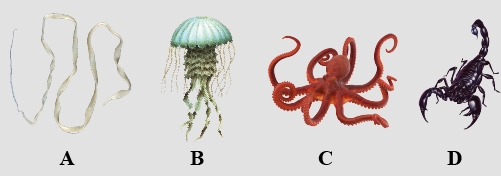
The figures $(A-D)$ show four animals. Select the correct option with respect to a common characteristic of two of these animals.
A
$(A)$ and $(D)$ respire mainly through body wall.
B
$(B)$ and $(C)$ show radial symmetry.
C
$(A)$ and $(B)$ have cnidoblasts for self-defence.
D
$(C)$ and $(D)$ have a true coelom.
Solution
(D) The animals shown are: $(A)$ Tapeworm (Platyhelminthes),$(B)$ Jellyfish (Cnidaria),$(C)$ Octopus (Mollusca),and $(D)$ Scorpion (Arthropoda).
$(A)$ Tapeworm is acoelomate.
$(B)$ Jellyfish is diploblastic and acoelomate.
$(C)$ Octopus is a mollusc and $(D)$ Scorpion is an arthropod. Both molluscs and arthropods are eucoelomates (possess a true coelom).
Therefore,the correct option is $(D)$.
$(A)$ Tapeworm is acoelomate.
$(B)$ Jellyfish is diploblastic and acoelomate.
$(C)$ Octopus is a mollusc and $(D)$ Scorpion is an arthropod. Both molluscs and arthropods are eucoelomates (possess a true coelom).
Therefore,the correct option is $(D)$.
0 likes
View Solution235
MediumMCQ
Which one of the following statements about certain given animals is correct?
A
Roundworms (Aschelminthes) are pseudocoelomates.
B
Molluscs are acoelomates.
C
Insects are pseudocoelomates.
D
Flatworms (Platyhelminthes) are coelomates.
Solution
(A) $Acoelomates$ are animals that lack a body cavity or coelom. Examples include $Porifera$,$Cnidaria$,$Ctenophora$,and $Platyhelminthes$.
In $pseudocoelomates$,the body cavity is a $pseudocoelom$ or false coelom,which is not lined by mesoderm. Examples include $Aschelminthes$.
In $coelomates$,the body cavity is a true coelom,which is lined by mesoderm on both sides. Most phyla from $Annelida$ to $Chordata$ are $coelomates$.
$Molluscs$ and $Insects$ (Arthropoda) are $coelomates$,while $Flatworms$ are $acoelomates$.
Therefore,the statement that $Roundworms$ $(Aschelminthes)$ are $pseudocoelomates$ is correct.
In $pseudocoelomates$,the body cavity is a $pseudocoelom$ or false coelom,which is not lined by mesoderm. Examples include $Aschelminthes$.
In $coelomates$,the body cavity is a true coelom,which is lined by mesoderm on both sides. Most phyla from $Annelida$ to $Chordata$ are $coelomates$.
$Molluscs$ and $Insects$ (Arthropoda) are $coelomates$,while $Flatworms$ are $acoelomates$.
Therefore,the statement that $Roundworms$ $(Aschelminthes)$ are $pseudocoelomates$ is correct.
0 likes
View Solution236
MediumMCQ
Crocodile and penguin are similar to whale and dogfish in which one of the following features?
A
Possess a solid single-stranded central nervous system
B
Lay eggs and guard them till they hatch
C
Possess bony skeleton
D
Have gill slits at some stage
Solution
(D) : Animals belonging to Phylum $Chordata$ are fundamentally characterized by the presence of a notochord,a dorsal hollow nerve cord,and paired pharyngeal gill slits. Crocodile,penguin,whale,and dogfish are all chordates. All of them possess gill slits or have had them during embryonic development. Thus,paired gill slits are present in these animals at some stage of their life cycle.
0 likes
View Solution237
MediumMCQ
Which one of the following groups of animals is bilaterally symmetrical and triploblastic?
A
Aschelminthes (round worms)
B
Ctenophores
C
Sponges
D
Coelenterates (cnidarians)
Solution
(A) The correct answer is $A$.
Aschelminthes (roundworms) are bilaterally symmetrical and triploblastic animals.
They are also pseudocoelomates,meaning they possess a false body cavity.
In contrast,Sponges (Porifera) are asymmetrical,while Ctenophores and Coelenterates (Cnidarians) are radially symmetrical and diploblastic.
Aschelminthes (roundworms) are bilaterally symmetrical and triploblastic animals.
They are also pseudocoelomates,meaning they possess a false body cavity.
In contrast,Sponges (Porifera) are asymmetrical,while Ctenophores and Coelenterates (Cnidarians) are radially symmetrical and diploblastic.
0 likes
View Solution238
MediumMCQ
Which one of the following groups of three animals is correctly matched with their one characteristic morphological feature?
| $Option$ | Animals | Morphological features |
| $(a)$ | Scorpion,spider,cockroach | Ventral solid central nervous system |
| $(b)$ | Cockroach,locust,Taenia | Metameric segmentation |
| $(c)$ | Liver fluke,sea anemone,sea cucumber | Bilateral symmetry |
| $(d)$ | Centipede,prawn,sea urchin | Jointed appendages |
A
$(a)$
B
$(b)$
C
$(c)$
D
$(d)$
Solution
(A) The correct option is $(a)$.
$1$. Scorpion,spider,and cockroach all belong to the Phylum $Arthropoda$. $A$ characteristic feature of arthropods is the presence of a ventral solid central nervous system,which consists of a dorsal brain connected to a double ventral nerve cord.
$2$. In option $(b)$,$Taenia$ (tapeworm) is a Platyhelminth and does not show metameric segmentation.
$3$. In option $(c)$,sea anemone (Cnidaria) exhibits radial symmetry,not bilateral symmetry.
$4$. In option $(d)$,sea urchin (Echinodermata) exhibits radial symmetry in adults and lacks jointed appendages,which are characteristic of arthropods.
$1$. Scorpion,spider,and cockroach all belong to the Phylum $Arthropoda$. $A$ characteristic feature of arthropods is the presence of a ventral solid central nervous system,which consists of a dorsal brain connected to a double ventral nerve cord.
$2$. In option $(b)$,$Taenia$ (tapeworm) is a Platyhelminth and does not show metameric segmentation.
$3$. In option $(c)$,sea anemone (Cnidaria) exhibits radial symmetry,not bilateral symmetry.
$4$. In option $(d)$,sea urchin (Echinodermata) exhibits radial symmetry in adults and lacks jointed appendages,which are characteristic of arthropods.
0 likes
View Solution239
MediumMCQ
Which of the following pairs are correctly matched?
| Animals | Morphological features |
| $(i)$ Crocodile | $4$-chambered heart |
| $(ii)$ Sea urchin | Parapodia |
| $(iii)$ Obelia | Metagenesis |
| $(iv)$ Lemur | Thecodont |
A
$(ii), (iii)$ and $(iv)$
B
only $(i)$ and $(iv)$
C
only $(i)$ and $(ii)$
D
$(i), (iii)$ and $(iv)$
Solution
$(D)$ $(i)$ Crocodile: Reptiles typically have a $3$-chambered heart, but crocodiles are an exception as they possess a $4$-chambered heart. This is correctly matched.
$(ii)$ Sea urchin: Sea urchins belong to the phylum Echinodermata and possess a water vascular system. Parapodia are characteristic of Annelids (e.g., Nereis), not Echinoderms. This is incorrectly matched.
$(iii)$ Obelia: Obelia exhibits metagenesis, which is the alternation of generations between the asexual polyp form and the sexual medusa form. This is correctly matched.
$(iv)$ Lemur: Lemurs are mammals and possess thecodont dentition, where teeth are embedded in the sockets of the jaw bone. This is correctly matched.
Therefore, the correct pairs are $(i), (iii),$ and $(iv)$.
$(ii)$ Sea urchin: Sea urchins belong to the phylum Echinodermata and possess a water vascular system. Parapodia are characteristic of Annelids (e.g., Nereis), not Echinoderms. This is incorrectly matched.
$(iii)$ Obelia: Obelia exhibits metagenesis, which is the alternation of generations between the asexual polyp form and the sexual medusa form. This is correctly matched.
$(iv)$ Lemur: Lemurs are mammals and possess thecodont dentition, where teeth are embedded in the sockets of the jaw bone. This is correctly matched.
Therefore, the correct pairs are $(i), (iii),$ and $(iv)$.
0 likes
View Solution240
MediumMCQ
Which one of the following is a matching pair of a body feature and the animal possessing it?
A
Ventral central nervous system $\Rightarrow$ Leech
B
Pharyngeal gill slits absent in embryo $\Rightarrow$ Chamaeleon
C
Ventral heart $\Rightarrow$ Scorpion
D
Post-anal tail $\Rightarrow$ Octopus
Solution
(A) The correct matching pair is $A$.
$1$. Leech (Annelida) possesses a ventral central nervous system consisting of a nerve ring and a ventral nerve cord with ganglia.
$2$. Pharyngeal gill slits are present in the embryos of all chordates,including Chamaeleon (Reptilia).
$3$. Scorpion (Arthropoda) has a dorsal heart,not a ventral one.
$4$. $A$ post-anal tail is a characteristic feature of chordates; Octopus (Mollusca) is a non-chordate and lacks this feature.
$1$. Leech (Annelida) possesses a ventral central nervous system consisting of a nerve ring and a ventral nerve cord with ganglia.
$2$. Pharyngeal gill slits are present in the embryos of all chordates,including Chamaeleon (Reptilia).
$3$. Scorpion (Arthropoda) has a dorsal heart,not a ventral one.
$4$. $A$ post-anal tail is a characteristic feature of chordates; Octopus (Mollusca) is a non-chordate and lacks this feature.
0 likes
View Solution241
MediumMCQ
What is common between parrot, platypus, and kangaroo?
A
Toothless jaws
B
Functional post-anal tail
C
Oviparity
D
Homoiothermy
Solution
(D) : Homoiothermy is the maintenance by an animal of its internal body temperature at a relatively constant value by using metabolic processes to counteract fluctuations in the temperature of the environment. Homoiothermy occurs in birds and mammals, which are described as endotherms. The heat produced by their tissue metabolism and the heat lost to the environment are balanced by various means to keep body temperature constant: $36-38^{\circ}C$ in mammals and $38-40^{\circ}C$ in birds. The hypothalamus in the brain monitors blood temperature and controls thermoregulation by both nervous and hormonal means. Thus, parrot (bird), platypus (mammal), and kangaroo (mammal) are all homoiothermic animals.
0 likes
View Solution242
MediumMCQ
What is true about $Nereis$,scorpion,cockroach,and silver fish?
A
They all possess a dorsal heart.
B
None of them is aquatic.
C
They all belong to the same phylum.
D
They all have jointed paired appendages.
Solution
(A) $Nereis$,scorpion,cockroach,and silver fish are all invertebrates and possess a dorsal heart.
$Nereis$ is a marine animal,whereas the other animals mentioned are terrestrial.
$Nereis$ belongs to Phylum $Annelida$,while the rest of the animals belong to Phylum $Arthropoda$.
Jointed appendages are a characteristic feature of Phylum $Arthropoda$,which includes scorpion,cockroach,and silver fish,but these are absent in $Nereis$.
$Nereis$ is a marine animal,whereas the other animals mentioned are terrestrial.
$Nereis$ belongs to Phylum $Annelida$,while the rest of the animals belong to Phylum $Arthropoda$.
Jointed appendages are a characteristic feature of Phylum $Arthropoda$,which includes scorpion,cockroach,and silver fish,but these are absent in $Nereis$.
0 likes
View Solution243
MediumMCQ
Metameric segmentation is the characteristic of
A
Mollusca and Chordata
B
Platyhelminthes and Arthropoda
C
Echinodermata and Annelida
D
Annelida and Arthropoda
Solution
(D) The correct answer is $D$.
Metameric segmentation,or metamerism,refers to the linear repetition of body parts along the longitudinal axis of an animal.
This phenomenon is a characteristic feature of the phyla $Annelida$,$Arthropoda$,and $Chordata$.
In $Annelida$,segmentation is clearly visible both externally and internally.
In $Arthropoda$,the body is segmented,although the segments are often fused to form tagmata.
In $Chordata$,metamerism is prominent in the embryonic stage and persists in adult internal structures such as vertebrae,ribs,and nerves.
Metameric segmentation,or metamerism,refers to the linear repetition of body parts along the longitudinal axis of an animal.
This phenomenon is a characteristic feature of the phyla $Annelida$,$Arthropoda$,and $Chordata$.
In $Annelida$,segmentation is clearly visible both externally and internally.
In $Arthropoda$,the body is segmented,although the segments are often fused to form tagmata.
In $Chordata$,metamerism is prominent in the embryonic stage and persists in adult internal structures such as vertebrae,ribs,and nerves.
0 likes
View Solution244
EasyMCQ
$Peripatus$ is a connecting link between
A
$Mollusca$ and $Echinodermata$
B
$Annelida$ and $Arthropoda$
C
$Coelenterata$ and $Porifera$
D
$Ctenophora$ and $Platyhelminthes$
Solution
(B) $Peripatus$ belongs to the phylum $Onychophora$.
It exhibits characteristics of both $Annelida$ (such as segmented body,thin cuticle,and segmental nephridia) and $Arthropoda$ (such as tracheal respiration,open circulatory system,and jointed appendages).
Due to these shared features,$Peripatus$ is considered a connecting link between $Annelida$ and $Arthropoda$.
This serves as a significant morphological and anatomical evidence for the theory of evolution.
It exhibits characteristics of both $Annelida$ (such as segmented body,thin cuticle,and segmental nephridia) and $Arthropoda$ (such as tracheal respiration,open circulatory system,and jointed appendages).
Due to these shared features,$Peripatus$ is considered a connecting link between $Annelida$ and $Arthropoda$.
This serves as a significant morphological and anatomical evidence for the theory of evolution.
0 likes
View Solution245
MediumMCQ
What is correct for fishes,amphibians,reptiles,Aves,and mammals?
A
All are taxa from different phylum.
B
All are included in same class.
C
All are taxa of same kingdom.
D
All are taxa from different kingdom.
Solution
(C) Fishes,amphibians,reptiles,Aves,and mammals are all classes belonging to the phylum Chordata within the kingdom Animalia.
Since they all belong to the same kingdom (Animalia),option $C$ is correct.
They are not in the same class,as each group represents a distinct class (e.g.,Class Pisces,Class Amphibia,Class Reptilia,Class Aves,and Class Mammalia).
Since they all belong to the same kingdom (Animalia),option $C$ is correct.
They are not in the same class,as each group represents a distinct class (e.g.,Class Pisces,Class Amphibia,Class Reptilia,Class Aves,and Class Mammalia).
0 likes
View Solution246
MediumMCQ
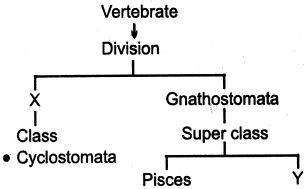
Select the correct option for the labeled part $X$ and $Y$ from the given diagram.
A
Agnatha - Osteichthyes
B
Cyclostomata - Tetrapoda
C
Agnatha - Tetrapoda
D
Cyclostomata - Amphibia
Solution
(C) The division Vertebrata is classified into two divisions based on the presence or absence of jaws:
$1$. $X$ represents Agnatha,which are jawless vertebrates. The class Cyclostomata belongs to this division.
$2$. The other division is Gnathostomata,which are jawed vertebrates. This is further divided into two superclasses: Pisces (bearing fins) and Tetrapoda (bearing limbs).
Therefore,$X$ is Agnatha and $Y$ is Tetrapoda.
$1$. $X$ represents Agnatha,which are jawless vertebrates. The class Cyclostomata belongs to this division.
$2$. The other division is Gnathostomata,which are jawed vertebrates. This is further divided into two superclasses: Pisces (bearing fins) and Tetrapoda (bearing limbs).
Therefore,$X$ is Agnatha and $Y$ is Tetrapoda.
0 likes
View Solution247
MediumMCQ
Reptilia differ from Amphibians in which of the following aspects?
A
Skin
B
Structure of Heart
C
Developing stage
D
All of the above
Solution
(D) Reptilia and Amphibians differ in several key aspects:
$1$. Skin: Amphibians have moist,glandular skin without scales,whereas Reptiles have dry,cornified skin with epidermal scales or scutes.
$2$. Structure of Heart: Most Amphibians have a $3$-chambered heart ($2$ atria and $1$ ventricle),while most Reptiles also have a $3$-chambered heart,but the ventricle is partially divided (except in Crocodiles,which have a $4$-chambered heart).
$3$. Developing stage: Amphibians typically undergo metamorphosis and have an aquatic larval stage (e.g.,tadpole),whereas Reptiles are amniotes,meaning their embryos develop within an egg with specialized membranes,bypassing the aquatic larval stage.
Therefore,all the given options are correct.
$1$. Skin: Amphibians have moist,glandular skin without scales,whereas Reptiles have dry,cornified skin with epidermal scales or scutes.
$2$. Structure of Heart: Most Amphibians have a $3$-chambered heart ($2$ atria and $1$ ventricle),while most Reptiles also have a $3$-chambered heart,but the ventricle is partially divided (except in Crocodiles,which have a $4$-chambered heart).
$3$. Developing stage: Amphibians typically undergo metamorphosis and have an aquatic larval stage (e.g.,tadpole),whereas Reptiles are amniotes,meaning their embryos develop within an egg with specialized membranes,bypassing the aquatic larval stage.
Therefore,all the given options are correct.
0 likes
View Solution248
MediumMCQ
Identify the odd one out.
A
Asterias
B
Echinus
C
Cucumaria
D
Balanoglossus
Solution
(D) $Asterias$ (Starfish),$Echinus$ (Sea urchin),and $Cucumaria$ (Sea cucumber) all belong to the phylum $Echinodermata$.
$Balanoglossus$ (Tongue worm) belongs to the phylum $Hemichordata$.
Therefore,$Balanoglossus$ is the odd one out.
$Balanoglossus$ (Tongue worm) belongs to the phylum $Hemichordata$.
Therefore,$Balanoglossus$ is the odd one out.
0 likes
View Solution249
MediumMCQ
How do all $Platyhelminthes$ differ from $Aschelminthes$?
A
Bilateral symmetry
B
Triploblastic
C
Absence of coelom
D
Internal fertilization
Solution
(C) $1$. $Platyhelminthes$ (flatworms) are acoelomate,meaning they lack a body cavity (coelom).
$2$. $Aschelminthes$ (roundworms) are pseudocoelomate,meaning they possess a false body cavity.
$3$. Both phyla exhibit bilateral symmetry and are triploblastic.
$4$. Both phyla exhibit internal fertilization.
$5$. Therefore,the primary difference among the given options is the absence of a coelom in $Platyhelminthes$ compared to the pseudocoelomate nature of $Aschelminthes$.
$2$. $Aschelminthes$ (roundworms) are pseudocoelomate,meaning they possess a false body cavity.
$3$. Both phyla exhibit bilateral symmetry and are triploblastic.
$4$. Both phyla exhibit internal fertilization.
$5$. Therefore,the primary difference among the given options is the absence of a coelom in $Platyhelminthes$ compared to the pseudocoelomate nature of $Aschelminthes$.
0 likes
View Solution250
MediumMCQ
Make the correct pair:
| $1. \text{ Osculum}$ | $p. \text{ Fasciola}$ |
| $2. \text{ Hypostome}$ | $q. \text{ Ctenoplana}$ |
| $3. \text{ Comb jellies}$ | $r. \text{ Spongilla}$ |
| $4. \text{ Hook and sucker}$ | $s. \text{ Meandrina}$ |
A
$1-r, 2-s, 3-q, 4-p$
B
$1-p, 2-q, 3-r, 4-s$
C
$1-s, 2-p, 3-q, 4-r$
D
$1-q, 2-r, 3-s, 4-p$
Solution
(A) The correct matching is as follows:
$1$. $\text{Osculum}$ is a characteristic feature of sponges (Porifera),such as $\text{Spongilla}$ $(1-r)$.
$2$. $\text{Hypostome}$ is found in corals like $\text{Meandrina}$ $(2-s)$.
$3$. $\text{Comb jellies}$ are members of the phylum Ctenophora,such as $\text{Ctenoplana}$ $(3-q)$.
$4$. $\text{Hook and sucker}$ are parasitic adaptations found in $\text{Fasciola}$ (Liver fluke) $(4-p)$.
Thus,the correct sequence is $1-r, 2-s, 3-q, 4-p$.
$1$. $\text{Osculum}$ is a characteristic feature of sponges (Porifera),such as $\text{Spongilla}$ $(1-r)$.
$2$. $\text{Hypostome}$ is found in corals like $\text{Meandrina}$ $(2-s)$.
$3$. $\text{Comb jellies}$ are members of the phylum Ctenophora,such as $\text{Ctenoplana}$ $(3-q)$.
$4$. $\text{Hook and sucker}$ are parasitic adaptations found in $\text{Fasciola}$ (Liver fluke) $(4-p)$.
Thus,the correct sequence is $1-r, 2-s, 3-q, 4-p$.
0 likes
View SolutionAnimal Kingdom — Mix Examples - Animal Kingdom · Frequently Asked Questions
1Are these Animal Kingdom questions useful for JEE and NEET?
Yes. All questions in this section are mapped to JEE Main and NEET exam patterns. Previous year questions from JEE Main, NEET, GUJCET and state-level exams are included with full solutions.
2Can I switch to Hindi or Gujarati for these questions?
Yes. Use the language tabs in the hero section or the sidebar to view the same questions and solutions in English, Hindi or Gujarati.
3How do I generate a question paper from this subtopic?
Use the Vedclass Exam Paper Generator — select the chapter and subtopic, set difficulty, and generate Sets A, B, C, D automatically. First 3 chapters of every subject are free.
Vedclass Products
For Students
Vedclass Test Series
Mock tests in real JEE/NEET style with performance analysis. 5-day free trial.
Start Free TrialFor Teachers
Exam Paper Generator
Generate Set A/B/C/D papers from this chapter in 2 minutes. 3 chapters free.
Try FreeFor Institutes
Online Exam Module
Live online exams with unlimited students, 360° analytics & white-label branding.
See DemoFor Teachers & Institutes
Generate a Animal Kingdom Exam Paper in 2 Minutes
Select subtopic & difficulty — Sets A, B, C, D auto-generated with No Repeat logic.
First 3 chapters of every subject are free — no payment required.