
A English
Phylum - Hemichordata Questions in English
Class 11 Biology · Animal Kingdom · Phylum - Hemichordata
50+
Questions
English
Language
100%
With Solutions
Showing 50 of 50 questions in English
1
MediumMCQ
Balanoglossus belongs to
A
Hemichordata
B
Cephalochordata
C
Urochordata
D
Cyclostomata
Solution
(A) $Balanoglossus$ is a representative organism of the phylum $Hemichordata$.
In animals of $Hemichordata$,the notochord is a rudimentary,short structure confined to the proboscis region,often referred to as the stomochord,and it is non-homologous to the true notochord found in chordates.
In animals of $Hemichordata$,the notochord is a rudimentary,short structure confined to the proboscis region,often referred to as the stomochord,and it is non-homologous to the true notochord found in chordates.
0 likes
View Solution2
MediumMCQ
Members of $Hemichordata$ are
A
Burrowing animals
B
Exclusively marine
C
Fresh water worms
D
Terrestrial
Solution
(B) The members of the phylum $Hemichordata$ are exclusively marine animals.
They are generally solitary or colonial and mostly live in tubes (tubicolous).
They are generally solitary or colonial and mostly live in tubes (tubicolous).
0 likes
View Solution3
MediumMCQ
In which group of animals is the notochord restricted to the anterior part of the body,known as the proboscis?
A
Hemichordata
B
Urochordata
C
Cephalochordata
D
Chordata
Solution
(A) The phylum $Hemichordata$ was previously considered a subphylum under $Chordata$.
However,it is now placed as a separate phylum.
The animals in this group possess a rudimentary structure in the collar region called the $stomochord$,which is often compared to the notochord.
In $Hemichordates$,this structure is restricted to the anterior part of the body,specifically the proboscis region.
Therefore,the correct group is $Hemichordata$.
However,it is now placed as a separate phylum.
The animals in this group possess a rudimentary structure in the collar region called the $stomochord$,which is often compared to the notochord.
In $Hemichordates$,this structure is restricted to the anterior part of the body,specifically the proboscis region.
Therefore,the correct group is $Hemichordata$.
0 likes
View Solution4
MediumMCQ
Which of the following acts as a connecting link between echinoderms and chordates?
A
Balanoglossus
B
Archaeopteryx
C
Peripatus
D
None of these
Solution
(A) $Balanoglossus$ (a hemichordate) is considered a connecting link between echinoderms and chordates.
It possesses characteristics of both groups,such as a larval stage ($Tornaria$ larva) that resembles the bipinnaria larva of echinoderms,and chordate-like features such as pharyngeal gill slits and a dorsal nerve cord.
It possesses characteristics of both groups,such as a larval stage ($Tornaria$ larva) that resembles the bipinnaria larva of echinoderms,and chordate-like features such as pharyngeal gill slits and a dorsal nerve cord.
0 likes
View Solution5
EasyMCQ
The larva of $Balanoglossus$ is known as:
A
Tornaria
B
Muller’s larva
C
Kentrogen larva
D
Tadpole
Solution
(A) $Balanoglossus$ belongs to the phylum Hemichordata. The characteristic larval stage of $Balanoglossus$ is called the $Tornaria$ larva. This larva is free-swimming and ciliated,showing significant similarities to the bipinnaria larva of echinoderms,which suggests an evolutionary link between the two groups.
0 likes
View Solution6
EasyMCQ
The correct classification of $Balanoglossus$ is:
A
Chordata $\rightarrow$ Vertebrata $\rightarrow$ Enteropneusta
B
Chordata $\rightarrow$ Vertebrata $\rightarrow$ Pterobranchia
C
Chordata $\rightarrow$ Hemichordata $\rightarrow$ Pterobranchia
D
Chordata $\rightarrow$ Hemichordata $\rightarrow$ Enteropneusta
Solution
(D) $Balanoglossus$ belongs to the phylum Hemichordata.
Within the phylum Hemichordata,it is classified under the class Enteropneusta,which are commonly known as acorn worms.
Therefore,the correct classification sequence is Chordata $\rightarrow$ Hemichordata $\rightarrow$ Enteropneusta.
Within the phylum Hemichordata,it is classified under the class Enteropneusta,which are commonly known as acorn worms.
Therefore,the correct classification sequence is Chordata $\rightarrow$ Hemichordata $\rightarrow$ Enteropneusta.
0 likes
View Solution7
MediumMCQ
Which of the following animals is classified as a 'Non-chordate-protochordata' (Hemichordate)?
A
Herdmania
B
Balanoglossus
C
Branchiostoma
D
Botryllus
Solution
(B) The phylum $Hemichordata$ was earlier considered as a sub-phylum under phylum $Chordata$.
However,it is now placed as a separate phylum under the non-chordates.
$Balanoglossus$ is a well-known example of the phylum $Hemichordata$.
$Herdmania$,$Branchiostoma$,and $Botryllus$ are members of the sub-phylum $Urochordata$ or $Cephalochordata$,which are true protochordates.
However,it is now placed as a separate phylum under the non-chordates.
$Balanoglossus$ is a well-known example of the phylum $Hemichordata$.
$Herdmania$,$Branchiostoma$,and $Botryllus$ are members of the sub-phylum $Urochordata$ or $Cephalochordata$,which are true protochordates.
0 likes
View Solution8
MediumMCQ
In which of the following groups are the members exclusively marine?
A
Aquatic vertebrates
B
Tetrapoda
C
Pisces
D
Protochordata
Solution
(D) . $Protochordates$ are primitive chordates. All $Protochordates$ are exclusively marine.
0 likes
View Solution9
EasyMCQ
What is the larval form of Hemichordata called?
A
Trochophore
B
Tornaria
C
Tadpole
D
Ammocoete
Solution
(B) The larval form of $Hemichordata$ (specifically in the class $Enteropneusta$,such as $Balanoglossus$) is known as the $Tornaria$ larva.
This larva is planktonic and bears a striking resemblance to the $Bipinnaria$ larva of $Echinodermata$,which suggests an evolutionary link between the two phyla.
This larva is planktonic and bears a striking resemblance to the $Bipinnaria$ larva of $Echinodermata$,which suggests an evolutionary link between the two phyla.
0 likes
View Solution10
MediumMCQ
Balanoglossus is now classified under which of the following?
A
Chordata
B
Urochordata
C
Cephalochordata
D
Hemichordata
Solution
(D) Earlier,$Balanoglossus$ was considered a part of the phylum $Chordata$ due to the presence of a structure thought to be a notochord. However,later studies revealed that this structure is actually a $stomachochord$ (a rudimentary structure in the proboscis). Consequently,it is now classified under the separate phylum $Hemichordata$.
0 likes
View Solution11
MediumMCQ
The body of $.........$ is divided into three parts.
A
Balanoglossus
B
Amphioxus
C
Herdmania
D
Petromyzon
Solution
(A) The body of $Balanoglossus$ (a member of Phylum Hemichordata) is divided into three distinct parts: a proboscis, a collar, and a trunk. $Amphioxus$ belongs to Cephalochordata, $Herdmania$ belongs to Urochordata, and $Petromyzon$ belongs to Cyclostomata. Therefore, the correct answer is $Balanoglossus$.
0 likes
View Solution12
MediumMCQ
Hemichordates are not considered true chordates because:
A
They do not possess pharyngeal gill slits.
B
Their notochord is not a true notochord.
C
They do not possess a dorsal hollow nerve cord.
D
Both statements $(B)$ and $(C)$ are correct.
Solution
(D) Hemichordates were previously considered a sub-phylum under Phylum Chordata because they possess a structure called the stomochord in the collar region,which was earlier mistaken for a notochord.
However,the stomochord is not a true notochord as it is not mesodermal in origin and does not extend throughout the body length.
Furthermore,true chordates are characterized by the presence of a dorsal hollow nerve cord,which is absent in hemichordates (they possess a dorsal and ventral nerve cord).
Therefore,hemichordates are now placed in a separate phylum,and both statements $(B)$ and $(C)$ are valid reasons for their exclusion from Phylum Chordata.
However,the stomochord is not a true notochord as it is not mesodermal in origin and does not extend throughout the body length.
Furthermore,true chordates are characterized by the presence of a dorsal hollow nerve cord,which is absent in hemichordates (they possess a dorsal and ventral nerve cord).
Therefore,hemichordates are now placed in a separate phylum,and both statements $(B)$ and $(C)$ are valid reasons for their exclusion from Phylum Chordata.
0 likes
View Solution13
EasyMCQ
Which of the following organisms has the smallest sperm?
A
Rabbit
B
Crocodile
C
Balanoglossus
D
Earthworm
Solution
(C) The size of sperm varies significantly across different species. Among the given options,$Balanoglossus$ (a hemichordate) is known to possess the smallest sperm cells. Sperm size is generally related to the reproductive strategy and the environment in which fertilization occurs.
0 likes
View Solution14
EasyMCQ
Which phylum of animals possesses a $U$-shaped digestive tract?
A
Mollusca
B
Hemichordata
C
Annelida
D
Chordata
Solution
(B) The phylum $Hemichordata$ consists of marine animals with an organ-system level of organization. Their body is cylindrical and is composed of an anterior proboscis,a collar,and a long trunk. $A$ characteristic feature of hemichordates is the presence of a $U$-shaped digestive tract,which is adapted for their filter-feeding lifestyle. Therefore,the correct option is $B$.
0 likes
View Solution15
EasyMCQ
Which of the following groups of animals are worm-like,exclusively marine,and usually solitary or colonial?
A
Urochordata
B
Echinodermata
C
Mollusca
D
Hemichordata
Solution
(D) The phylum $Hemichordata$ consists of a small group of worm-like marine animals.
These organisms are characterized by an organ-system level of body organization.
They are bilaterally symmetrical,triploblastic,and coelomate animals.
The body is cylindrical and is composed of an anterior $proboscis$,a $collar$,and a long $trunk$.
They are exclusively marine and can be found living either as solitary individuals or in colonies.
These organisms are characterized by an organ-system level of body organization.
They are bilaterally symmetrical,triploblastic,and coelomate animals.
The body is cylindrical and is composed of an anterior $proboscis$,a $collar$,and a long $trunk$.
They are exclusively marine and can be found living either as solitary individuals or in colonies.
0 likes
View Solution16
EasyMCQ
Which of the following animals are exclusively marine and generally tube-dwelling?
A
Echinodermata
B
Protozoa
C
Mollusca
D
Hemichordata
Solution
(D) The phylum $Hemichordata$ consists of worm-like marine animals.
These organisms are exclusively marine and are often found living in burrows or tubes in the sea floor.
They exhibit organ-system level of organization and are bilaterally symmetrical,triploblastic,and coelomate animals.
Therefore,the correct option is $D$.
These organisms are exclusively marine and are often found living in burrows or tubes in the sea floor.
They exhibit organ-system level of organization and are bilaterally symmetrical,triploblastic,and coelomate animals.
Therefore,the correct option is $D$.
0 likes
View Solution17
EasyMCQ
Which group of animals has a body divisible into proboscis,collar,and trunk?
A
Echinodermata
B
Hemichordata
C
Urochordata
D
Cephalochordata
Solution
(B) The phylum $Hemichordata$ consists of worm-like marine animals with an organ-system level of organization. Their body is cylindrical and is distinctively divided into three parts: a $proboscis$,a $collar$,and a $trunk$.
0 likes
View Solution18
EasyMCQ
Which of the following is the excretory organ of Hemichordata?
A
Flame cells
B
Green glands
C
Proboscis gland
D
Malpighian tubules
Solution
(C) The phylum $Hemichordata$ consists of a small group of worm-like marine animals with an organ-system level of organization.
In $Hemichordata$ (e.g.,$Balanoglossus$),excretion occurs through the $Proboscis$ $gland$ (also known as the $glomerulus$).
Flame cells are excretory structures in $Platyhelminthes$.
Green glands (antennary glands) are excretory organs in $Crustaceans$ (Arthropoda).
Malpighian tubules are the excretory organs in most $Insects$ (Arthropoda).
In $Hemichordata$ (e.g.,$Balanoglossus$),excretion occurs through the $Proboscis$ $gland$ (also known as the $glomerulus$).
Flame cells are excretory structures in $Platyhelminthes$.
Green glands (antennary glands) are excretory organs in $Crustaceans$ (Arthropoda).
Malpighian tubules are the excretory organs in most $Insects$ (Arthropoda).
0 likes
View Solution19
EasyMCQ
Which larva is found in Hemichordata?
A
Tornaria
B
Amphiblastula
C
Parenchymula
D
Planula
Solution
(A) The phylum $Hemichordata$ includes organisms like $Balanoglossus$ (acorn worms).
In their life cycle,they undergo indirect development,which involves a free-swimming larval stage known as the $Tornaria$ larva.
This larva shares structural similarities with the bipinnaria larva of echinoderms,suggesting an evolutionary link between the two groups.
Therefore,the correct option is $A$.
In their life cycle,they undergo indirect development,which involves a free-swimming larval stage known as the $Tornaria$ larva.
This larva shares structural similarities with the bipinnaria larva of echinoderms,suggesting an evolutionary link between the two groups.
Therefore,the correct option is $A$.
0 likes
View Solution20
EasyMCQ
Balanoglossus belongs to which phylum?
A
Urochordata
B
Cephalochordata
C
Hemichordata
D
Vertebrata
Solution
(C) $Balanoglossus$ is a classic example of the phylum $Hemichordata$.
It was previously considered a sub-phylum under $Chordata$ but is now placed as a separate phylum due to the presence of a rudimentary structure in the collar region called the $stomochord$,which is not a true $notochord$.
It was previously considered a sub-phylum under $Chordata$ but is now placed as a separate phylum due to the presence of a rudimentary structure in the collar region called the $stomochord$,which is not a true $notochord$.
0 likes
View Solution21
EasyMCQ
Balanoglossus performs excretion through which of the following structures?
A
Flame cells
B
Nephridia
C
Proboscis gland
D
Malpighian tubules
Solution
(C) Balanoglossus belongs to the phylum Hemichordata.
In Hemichordates,the excretory organ is the proboscis gland,also known as the glomerulus.
Flame cells are found in Platyhelminthes.
Nephridia are the excretory structures in Annelids.
Malpighian tubules are the excretory organs in insects and many other arthropods.
In Hemichordates,the excretory organ is the proboscis gland,also known as the glomerulus.
Flame cells are found in Platyhelminthes.
Nephridia are the excretory structures in Annelids.
Malpighian tubules are the excretory organs in insects and many other arthropods.
0 likes
View Solution22
EasyMCQ
Which group of animals possesses a $U$-shaped digestive tract?
A
Mollusca
B
Hemichordata
C
Annelida
D
Chordata
Solution
(B) The $U$-shaped digestive tract is a characteristic feature of the phylum $Hemichordata$. In these organisms,the mouth and anus are located close to each other,resulting in a $U$-shaped gut. For example,in $Balanoglossus$,the alimentary canal is $U$-shaped.
0 likes
View Solution23
MediumMCQ
The proboscis gland is associated with which of the following?
A
Blood sinus
B
Buccal cavity
C
Blood vessel
D
Digestive system
Solution
(C) The proboscis gland,also known as the glomerulus,is an excretory organ found in Hemichordates (e.g.,Balanoglossus).
It is located in the proboscis region and is associated with the blood vessels (or blood sinus) to filter metabolic wastes from the blood.
Therefore,it is primarily associated with the blood vessel/circulatory system for the purpose of excretion.
It is located in the proboscis region and is associated with the blood vessels (or blood sinus) to filter metabolic wastes from the blood.
Therefore,it is primarily associated with the blood vessel/circulatory system for the purpose of excretion.
0 likes
View Solution24
EasyMCQ
What is the shape of the alimentary canal in Hemichordata?
A
$U$-shaped
B
$V$-shaped
C
$C$-shaped
D
$L$-shaped
Solution
(A) In Hemichordata (e.g.,Balanoglossus),the alimentary canal is $U$-shaped. The mouth is located ventrally,and the anus is located at the posterior end of the body. The digestive tract is complete,consisting of a mouth,pharynx,esophagus,intestine,and anus.
0 likes
View Solution25
MediumMCQ
Which of the following statements is $NOT$ true for Hemichordata?
A
They are known as protochordates.
B
The digestive tract is complete and straight.
C
The circulatory system is simple and closed type.
D
Excretion takes place through the proboscis gland.
Solution
(C) Hemichordates were previously considered a sub-phylum under Phylum Chordata,but they are now placed as a separate phylum.
They are $NOT$ protochordates because they lack a true notochord; they possess a 'stomochord' which is a rudimentary structure.
The digestive tract is complete and straight.
The circulatory system is of the open type,not closed.
Excretion occurs through the proboscis gland.
Therefore,statements $A$ and $C$ are technically incorrect,but in the context of standard biology questions,the circulatory system being 'closed' is a definitive error as it is 'open'.
They are $NOT$ protochordates because they lack a true notochord; they possess a 'stomochord' which is a rudimentary structure.
The digestive tract is complete and straight.
The circulatory system is of the open type,not closed.
Excretion occurs through the proboscis gland.
Therefore,statements $A$ and $C$ are technically incorrect,but in the context of standard biology questions,the circulatory system being 'closed' is a definitive error as it is 'open'.
0 likes
View Solution26
MediumMCQ
Hemichordates are:
A
Worm-like and tube-dwelling.
B
Worm-like,exclusively marine,and tube-dwelling.
C
Worm-like,aquatic,and parasitic.
D
Worm-like,freshwater,and tube-dwelling.
Solution
(B) Hemichordates are a small group of worm-like marine animals. They exhibit organ-system level of organization. They are bilaterally symmetrical,triploblastic,and coelomate animals. $A$ key characteristic of many hemichordates (like Balanoglossus) is that they are tube-dwelling,meaning they live in burrows or tubes in the marine sediment. Therefore,they are described as worm-like,exclusively marine,and tube-dwelling organisms.
0 likes
View Solution27
EasyMCQ
Which type of larva is found in Hemichordata?
A
Tornaria
B
Parenchymula
C
Amphiblastula
D
Planula
Solution
(A) The phylum $Hemichordata$ is characterized by the presence of a specific larval stage known as the $Tornaria$ larva. This larva is free-swimming and ciliated,showing significant similarities to the bipinnaria larva of echinoderms,which suggests an evolutionary link between the two groups. Other options like $Parenchymula$ and $Amphiblastula$ are associated with Porifera,while $Planula$ is characteristic of Cnidaria.
0 likes
View Solution28
MediumMCQ
The phylum $Hemichordata$ is placed between which two phyla?
A
$Echinodermata$,$Chordata$
B
$Urochordata$,$Cephalochordata$
C
$Echinodermata$,$Urochordata$
D
$Cephalochordata$,$Vertebrata$
Solution
(A) The phylum $Hemichordata$ was earlier considered as a sub-phylum under the phylum $Chordata$. However,it is now placed as a separate phylum under the non-chordates. It exhibits characteristics of both $Echinodermata$ (e.g.,larval forms) and $Chordata$ (e.g.,stomochord). Therefore,it is phylogenetically placed between the phylum $Echinodermata$ and the phylum $Chordata$.
0 likes
View Solution29
EasyMCQ
Which organ is responsible for excretion in animals belonging to the phylum Hemichordata?
A
Nephridia
B
Proboscis gland
C
Kidneys
D
Green gland
Solution
(B) In the phylum $Hemichordata$, the body is divided into three parts: proboscis, collar, and trunk.
Excretion in these animals occurs through the $Proboscis$ gland (also known as the glomerulus), which is located in the proboscis region.
$Nephridia$ are found in Annelids, $Kidneys$ are found in Chordates, and $Green$ glands are found in Crustaceans (Arthropods).
Excretion in these animals occurs through the $Proboscis$ gland (also known as the glomerulus), which is located in the proboscis region.
$Nephridia$ are found in Annelids, $Kidneys$ are found in Chordates, and $Green$ glands are found in Crustaceans (Arthropods).
0 likes
View Solution30
MediumMCQ
Which of the following organisms exhibits bilateral symmetry?
A
Sea cucumber
B
Hyalonema
C
Balanoglossus
D
Spongilla
Solution
(C) Bilateral symmetry is a characteristic feature where the body can be divided into identical left and right halves in only one plane.
$1$. Sea cucumber (Echinodermata) exhibits radial symmetry in adults.
$2$. Hyalonema (Porifera) is asymmetrical.
$3$. Balanoglossus (Hemichordata) exhibits bilateral symmetry.
$4$. Spongilla (Porifera) is asymmetrical.
Therefore,the correct option is $C$.
$1$. Sea cucumber (Echinodermata) exhibits radial symmetry in adults.
$2$. Hyalonema (Porifera) is asymmetrical.
$3$. Balanoglossus (Hemichordata) exhibits bilateral symmetry.
$4$. Spongilla (Porifera) is asymmetrical.
Therefore,the correct option is $C$.
0 likes
View Solution31
EasyMCQ
Which animal possesses a proboscis gland for excretion?
A
Leech
B
Pearl oyster
C
Sea cucumber
D
Balanoglossus
Solution
(D) The proboscis gland (also known as the glomerulus) is the excretory organ found in Hemichordates. $Balanoglossus$ is a well-known member of the phylum Hemichordata. Therefore,it uses the proboscis gland for the process of excretion.
0 likes
View Solution32
MediumMCQ
The larva of animals having a proboscis gland as an excretory organ is:
A
Tornaria larva
B
Planula larva
C
Amphiblastula larva
D
Parenchymula larva
Solution
(A) The proboscis gland (also known as the glomerulus) is the excretory organ found in Hemichordates,such as Balanoglossus.
Balanoglossus belongs to the phylum Hemichordata.
The characteristic larva of Hemichordates is the Tornaria larva.
Therefore,the correct option is $A$.
Balanoglossus belongs to the phylum Hemichordata.
The characteristic larva of Hemichordates is the Tornaria larva.
Therefore,the correct option is $A$.
0 likes
View Solution33
EasyMCQ
The body is divided into proboscis,collar,and trunk. This is a characteristic feature of which of the following?
A
Chordata
B
Hemichordata
C
Urochordata
D
Cephalochordata
Solution
(B) The phylum $Hemichordata$ consists of a small group of worm-like marine animals. Their body is cylindrical and is distinctively divided into three parts: an anterior $proboscis$,a collar,and a long trunk. Examples include $Balanoglossus$ and $Saccoglossus$.
0 likes
View Solution34
MediumMCQ
Which of the following characteristics applies to $Balanoglossus$?
A
Dioecious,internal fertilization,planula larva
B
Dioecious,external fertilization,tornaria larva
C
Monoecious,external fertilization,tornaria larva
D
Monoecious,internal fertilization,planula larva
Solution
(B) $Balanoglossus$ belongs to the phylum $Hemichordata$.
$1$. $Balanoglossus$ is dioecious,meaning the sexes are separate.
$2$. Fertilization is external,occurring in the surrounding water.
$3$. The development is indirect,involving a characteristic larval stage known as the $Tornaria$ larva.
$1$. $Balanoglossus$ is dioecious,meaning the sexes are separate.
$2$. Fertilization is external,occurring in the surrounding water.
$3$. The development is indirect,involving a characteristic larval stage known as the $Tornaria$ larva.
0 likes
View Solution35
MediumMCQ
Important characteristic that hemichordates share with chordates is
A
ventral tubular nerve cord
B
pharynx with gill slits
C
pharynx without gill slits
D
absence of notochord
Solution
(B) The correct answer is $B$.
An important characteristic that hemichordates and chordates share is the presence of pharyngeal gill slits.
In hemichordates,these gill slits are dorsal in position,whereas in chordates,they are lateral.
$A$ true notochord is absent in hemichordates; instead,they possess a structure called the stomochord.
The nervous system in hemichordates is intraepidermal,and they possess a ventral nerve cord,which differs from the dorsal hollow nerve cord found in chordates.
An important characteristic that hemichordates and chordates share is the presence of pharyngeal gill slits.
In hemichordates,these gill slits are dorsal in position,whereas in chordates,they are lateral.
$A$ true notochord is absent in hemichordates; instead,they possess a structure called the stomochord.
The nervous system in hemichordates is intraepidermal,and they possess a ventral nerve cord,which differs from the dorsal hollow nerve cord found in chordates.
0 likes
View Solution36
MediumMCQ
Choose the correct pair:
A
Open circulatory system - Annelida
B
Close circulatory system - Protists
C
Open circulatory system - Hemichordata
D
Close circulatory system - Arthropods
Solution
(C) $1$. Annelids (except leeches) typically have a closed circulatory system.
$2$. Protists are unicellular organisms and do not possess a circulatory system.
$3$. Hemichordates possess an open circulatory system.
$4$. Arthropods possess an open circulatory system.
Therefore,the correct pair is Open circulatory system - Hemichordata.
$2$. Protists are unicellular organisms and do not possess a circulatory system.
$3$. Hemichordates possess an open circulatory system.
$4$. Arthropods possess an open circulatory system.
Therefore,the correct pair is Open circulatory system - Hemichordata.
0 likes
View Solution37
MediumMCQ
Which of the following is a common feature shared by Hemichordata and Chordata?
A
Absence of notochord
B
Ventral tubular nerve cord
C
Pharynx with gill slits
D
Pharynx without gill slits
Solution
(C) Hemichordates were previously considered a sub-phylum of Chordata because they possess pharyngeal gill slits,which is a characteristic feature of chordates.
However,they lack a true notochord (they have a stomochord) and their nerve cord is not dorsal and hollow like in chordates.
Therefore,the presence of pharyngeal gill slits is the common feature shared between Hemichordata and Chordata.
However,they lack a true notochord (they have a stomochord) and their nerve cord is not dorsal and hollow like in chordates.
Therefore,the presence of pharyngeal gill slits is the common feature shared between Hemichordata and Chordata.
0 likes
View Solution38
Medium
Write a short note on Hemichordata.
Solution
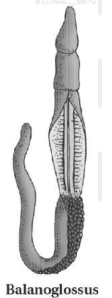
(N/A) $\rightarrow$ Hemichordata was earlier considered as a sub-phylum under phylum Chordata.
$\rightarrow$ But now it is placed as a separate phylum under non-chordates.
$\rightarrow$ This phylum consists of a small group of worm-like marine animals with an organ-system level of organization.
$\rightarrow$ They are bilaterally symmetrical, triploblastic, and coelomate animals.
$\rightarrow$ The body is cylindrical and is composed of an anterior proboscis, a collar, and a long trunk.
$\rightarrow$ The circulatory system is of the open type.
$\rightarrow$ Respiration takes place through gills.
$\rightarrow$ The excretory organ is the proboscis gland.
$\rightarrow$ Sexes are separate.
$\rightarrow$ Fertilization is external.
$\rightarrow$ Development is indirect.
$\rightarrow$ Examples: Balanoglossus and Saccoglossus.
$\rightarrow$ But now it is placed as a separate phylum under non-chordates.
$\rightarrow$ This phylum consists of a small group of worm-like marine animals with an organ-system level of organization.
$\rightarrow$ They are bilaterally symmetrical, triploblastic, and coelomate animals.
$\rightarrow$ The body is cylindrical and is composed of an anterior proboscis, a collar, and a long trunk.
$\rightarrow$ The circulatory system is of the open type.
$\rightarrow$ Respiration takes place through gills.
$\rightarrow$ The excretory organ is the proboscis gland.
$\rightarrow$ Sexes are separate.
$\rightarrow$ Fertilization is external.
$\rightarrow$ Development is indirect.
$\rightarrow$ Examples: Balanoglossus and Saccoglossus.
0 likes
View Solution39
MediumMCQ
Cylindrical-bodied,worm-like marine animals belong to the phylum:
A
Echinodermata
B
Mollusca
C
Coelenterata
D
Hemichordata
Solution
(D) Hemichordates are characterized by a soft,fragile,and worm-like appearance.
Their body is cylindrical in shape and is divided into three distinct parts:
$1$. Proboscis
$2$. Collar
$3$. Trunk
Their body is cylindrical in shape and is divided into three distinct parts:
$1$. Proboscis
$2$. Collar
$3$. Trunk
0 likes
View Solution40
MediumMCQ
The body of hemichordates is divided into
A
Head,muscular foot and visceral hump
B
Head,thorax and abdomen
C
Proboscis,collar and trunk
D
Proboscis and trunk
Solution
(C) The body of hemichordates is cylindrical and is divisible into three distinct regions: an anterior proboscis,a collar,and a long trunk.
0 likes
View Solution41
MediumMCQ
The phylum which was earlier considered as a sub-phylum under $Chordata$ but now placed as a separate phylum in non-chordates is:
A
Urochordata
B
Hemichordata
C
Cephalochordata
D
Vertebrata
Solution
(B) The name $Hemichordata$ literally means 'half chordates' and they act as a link between chordates and non-chordates.
$Hemichordata$ was earlier considered as a sub-phylum under the phylum $Chordata$,but now it is placed as a separate phylum under non-chordates.
$Hemichordata$ was earlier considered as a sub-phylum under the phylum $Chordata$,but now it is placed as a separate phylum under non-chordates.
0 likes
View Solution42
MediumMCQ
Proboscis gland is a/an
A
Endocrine organ
B
Excretory organ
C
Feeding organ
D
Reproductive organ
Solution
(B) Excretion of nitrogenous waste in hemichordates takes place through the proboscis gland.
The gland collects waste from the blood and passes it into the coelom of the proboscis.
From there,it is excreted through the proboscis pore,located at the anterior region of the proboscis.
The gland collects waste from the blood and passes it into the coelom of the proboscis.
From there,it is excreted through the proboscis pore,located at the anterior region of the proboscis.
0 likes
View Solution43
EasyMCQ
Which of the following set of animals belong to phylum Hemichordata?
A
Balanoglossus,Saccoglossus
B
Salpa,Doliolum
C
Petromyzon,Myxine
D
Dentalium,Chaetopleura
Solution
(A) Phylum Hemichordata consists of small group of worm-like marine animals with organ-system level of organization.
Balanoglossus and Saccoglossus are the classic examples of this phylum.
Salpa and Doliolum belong to Urochordata.
Petromyzon and Myxine belong to Cyclostomata (subphylum Vertebrata).
Dentalium and Chaetopleura belong to Mollusca.
Balanoglossus and Saccoglossus are the classic examples of this phylum.
Salpa and Doliolum belong to Urochordata.
Petromyzon and Myxine belong to Cyclostomata (subphylum Vertebrata).
Dentalium and Chaetopleura belong to Mollusca.
0 likes
View Solution44
MediumMCQ
Which of the following is not a character of phylum Hemichordata?
A
Presence of stomochord which is mesodermal in origin
B
Body is cylindrical and composed of anterior proboscis,collar and trunk
C
Circulatory system is open
D
Respiration takes place through gills
Solution
(A) The $stomochord$ in $Hemichordata$ is not mesodermal in origin; it is an ectodermal structure.
Because it is not a true notochord (which is mesodermal),these organisms are classified as non-chordates.
The $stomochord$ is a blind projection arising from the roof of the buccal cavity,also known as the buccal diverticulum.
Therefore,the statement claiming it is mesodermal in origin is incorrect.
Because it is not a true notochord (which is mesodermal),these organisms are classified as non-chordates.
The $stomochord$ is a blind projection arising from the roof of the buccal cavity,also known as the buccal diverticulum.
Therefore,the statement claiming it is mesodermal in origin is incorrect.
0 likes
View Solution45
MediumMCQ
$A$ : In Balanoglossus,proboscis is involved in excretion.
$R$ : Glomerulus is present in proboscis.
$R$ : Glomerulus is present in proboscis.
A
Assertion and Reason both are correct and Reason is the correct explanation of Assertion.
B
Assertion and Reason both are correct but Reason is not the correct explanation of Assertion.
C
Assertion is correct,but Reason is incorrect.
D
Both Assertion and Reason are incorrect.
Solution
(A) Assertion is true: In $Balanoglossus$,the proboscis is involved in excretion.
$Balanoglossus$ belongs to the phylum $Hemichordata$,where the proboscis gland performs the excretory function.
Reason is also true: $A$ glomerulus is present in the proboscis,which is responsible for or mediates the excretory function of the proboscis gland.
Therefore,both Assertion and Reason are correct,and the Reason is the correct explanation for the Assertion.
$Balanoglossus$ belongs to the phylum $Hemichordata$,where the proboscis gland performs the excretory function.
Reason is also true: $A$ glomerulus is present in the proboscis,which is responsible for or mediates the excretory function of the proboscis gland.
Therefore,both Assertion and Reason are correct,and the Reason is the correct explanation for the Assertion.
0 likes
View Solution46
EasyMCQ
The body is divided into parts like proboscis,collar,and trunk.
A
Chordata
B
Hemichordata
C
Echinodermata
D
Mollusca
Solution
(B) The phylum $Hemichordata$ consists of a small group of worm-like marine animals with an organ-system level of organization. Their body is cylindrical and is composed of an anterior $proboscis$,a $collar$,and a long $trunk$.
0 likes
View Solution47
MediumMCQ
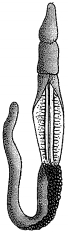
What is the type of fertilization and development in the animal shown below?
A
External,indirect
B
Internal,indirect
C
External,direct
D
Internal,direct
Solution
(A) The animal shown in the image is a Hemichordate,specifically a Balanoglossus (acorn worm).
In the phylum Hemichordata,fertilization is external,meaning it occurs outside the body in the surrounding water.
Development is indirect,which means it involves a larval stage (e.g.,the Tornaria larva) before reaching the adult form.
Therefore,the correct combination is external fertilization and indirect development.
In the phylum Hemichordata,fertilization is external,meaning it occurs outside the body in the surrounding water.
Development is indirect,which means it involves a larval stage (e.g.,the Tornaria larva) before reaching the adult form.
Therefore,the correct combination is external fertilization and indirect development.
0 likes
View Solution48
MediumMCQ
Radial symmetry is $NOT$ found in adults of which phylum?
A
Echinodermata
B
Ctenophora
C
Hemichordata
D
Coelenterata
Solution
(C) The correct answer is $C$ (Hemichordata).
$1$. $Hemichordata$ are bilaterally symmetrical animals.
$2$. $Echinodermata$ adults exhibit radial symmetry (specifically pentamerous radial symmetry),although their larvae are bilaterally symmetrical.
$3$. $Ctenophora$ exhibit radial symmetry.
$4$. $Coelenterata$ (Cnidaria) exhibit radial symmetry.
Therefore,radial symmetry is not found in the adults of $Hemichordata$.
$1$. $Hemichordata$ are bilaterally symmetrical animals.
$2$. $Echinodermata$ adults exhibit radial symmetry (specifically pentamerous radial symmetry),although their larvae are bilaterally symmetrical.
$3$. $Ctenophora$ exhibit radial symmetry.
$4$. $Coelenterata$ (Cnidaria) exhibit radial symmetry.
Therefore,radial symmetry is not found in the adults of $Hemichordata$.
0 likes
View Solution49
MediumMCQ
The excretory organ of hemichordates is:
A
Flame cells
B
Antennal gland
C
Kidneys
D
Proboscis gland
Solution
(D) Hemichordates,such as $Balanoglossus$,possess a specialized structure for excretion known as the $Proboscis$ $gland$ or $Glomerulus$.
This organ is located in the proboscis region and is responsible for filtering metabolic wastes from the blood.
Flame cells are found in Platyhelminthes,Antennal glands are found in Crustaceans,and Kidneys are the primary excretory organs in vertebrates.
This organ is located in the proboscis region and is responsible for filtering metabolic wastes from the blood.
Flame cells are found in Platyhelminthes,Antennal glands are found in Crustaceans,and Kidneys are the primary excretory organs in vertebrates.
0 likes
View Solution50
EasyMCQ
During a field trip,a student observed a marine organism with a worm-like body. The cylindrical body was divided into a proboscis,collar,and a long trunk. The organism may be . . . . . .
A
Pterophyllum
B
Trygon
C
Balanoglossus
D
Ophiura
Solution
(C) . $Balanoglossus$.
During a field trip,a student observed a marine organism with a worm-like body. The cylindrical body of $Balanoglossus$ (a hemichordate) is distinctly divided into three parts: a proboscis,a collar,and a long trunk. Therefore,the organism is $Balanoglossus$.
During a field trip,a student observed a marine organism with a worm-like body. The cylindrical body of $Balanoglossus$ (a hemichordate) is distinctly divided into three parts: a proboscis,a collar,and a long trunk. Therefore,the organism is $Balanoglossus$.
0 likes
View SolutionAnimal Kingdom — Phylum - Hemichordata · Frequently Asked Questions
1Are these Animal Kingdom questions useful for JEE and NEET?
Yes. All questions in this section are mapped to JEE Main and NEET exam patterns. Previous year questions from JEE Main, NEET, GUJCET and state-level exams are included with full solutions.
2Can I switch to Hindi or Gujarati for these questions?
Yes. Use the language tabs in the hero section or the sidebar to view the same questions and solutions in English, Hindi or Gujarati.
3How do I generate a question paper from this subtopic?
Use the Vedclass Exam Paper Generator — select the chapter and subtopic, set difficulty, and generate Sets A, B, C, D automatically. First 3 chapters of every subject are free.
Vedclass Products
For Students
Vedclass Test Series
Mock tests in real JEE/NEET style with performance analysis. 5-day free trial.
Start Free TrialFor Teachers
Exam Paper Generator
Generate Set A/B/C/D papers from this chapter in 2 minutes. 3 chapters free.
Try FreeFor Institutes
Online Exam Module
Live online exams with unlimited students, 360° analytics & white-label branding.
See DemoFor Teachers & Institutes
Generate a Animal Kingdom Exam Paper in 2 Minutes
Select subtopic & difficulty — Sets A, B, C, D auto-generated with No Repeat logic.
First 3 chapters of every subject are free — no payment required.