
A English
Mix Examples - Animal Kingdom Questions in English
Class 11 Biology · Animal Kingdom · Mix Examples - Animal Kingdom
431+
Questions
English
Language
100%
With Solutions
Showing 50 of 431 questions in English
151
EasyMCQ
Which of the following animals exhibits only extracellular digestion?
A
Hydra
B
Earthworm
C
Cockroach
D
Pearl oyster
Solution
(B) Extracellular digestion refers to the process where enzymes are secreted into a cavity or lumen outside the cells to break down food.
In $Hydra$ (Phylum $Cnidaria$), digestion is both extracellular and intracellular.
In $Earthworm$ $(Pheretima)$, $Cockroach$ $(Periplaneta)$, and $Pearl$ $oyster$ $(Pinctada)$, the digestive system is complete with a well-developed alimentary canal.
These organisms exhibit exclusively extracellular digestion within the lumen of the digestive tract.
However, among the given options, $Hydra$ is the one that performs intracellular digestion as well.
Therefore, $Earthworm$, $Cockroach$, and $Pearl$ $oyster$ all exhibit extracellular digestion.
Given the standard context of such questions, $Earthworm$ is the most common example of an organism with a complete digestive tract and extracellular digestion.
In $Hydra$ (Phylum $Cnidaria$), digestion is both extracellular and intracellular.
In $Earthworm$ $(Pheretima)$, $Cockroach$ $(Periplaneta)$, and $Pearl$ $oyster$ $(Pinctada)$, the digestive system is complete with a well-developed alimentary canal.
These organisms exhibit exclusively extracellular digestion within the lumen of the digestive tract.
However, among the given options, $Hydra$ is the one that performs intracellular digestion as well.
Therefore, $Earthworm$, $Cockroach$, and $Pearl$ $oyster$ all exhibit extracellular digestion.
Given the standard context of such questions, $Earthworm$ is the most common example of an organism with a complete digestive tract and extracellular digestion.
0 likes
View Solution152
EasyMCQ
These animals are oviparous or ovoviviparous and exhibit internal fertilization.
A
Arthropoda
B
Pisces
C
Mammalia
D
Both $A$ and $B$
0 likes
View Solution153
MediumMCQ
Which of the following organisms possess the power of regeneration?
A
Platyhelminthes
B
Echinodermata
C
Cnidaria
D
All of the above $(A, B, C)$
Solution
(D) Regeneration is the ability of an organism to regrow lost or damaged body parts.
$1$. Platyhelminthes (e.g.,Planaria) exhibit high regenerative capacity.
$2$. Echinodermata (e.g.,Starfish) can regenerate lost arms or even the entire body from a central disc.
$3$. Cnidaria (e.g.,Hydra) also possess significant regenerative power due to the presence of interstitial cells.
Therefore,all the mentioned phyla exhibit the power of regeneration.
$1$. Platyhelminthes (e.g.,Planaria) exhibit high regenerative capacity.
$2$. Echinodermata (e.g.,Starfish) can regenerate lost arms or even the entire body from a central disc.
$3$. Cnidaria (e.g.,Hydra) also possess significant regenerative power due to the presence of interstitial cells.
Therefore,all the mentioned phyla exhibit the power of regeneration.
0 likes
View Solution154
EasyMCQ
$P$ - Assertion: Circulatory system is present in Annelids.
$Q$ - Reason: Circulatory system is absent in Aschelminthes.
$Q$ - Reason: Circulatory system is absent in Aschelminthes.
A
$P$ (Assertion) and $Q$ (Reason) are both true,and $P$ is the correct explanation of $Q$.
B
$P$ (Assertion) and $Q$ (Reason) are both true,but $P$ is not the correct explanation of $Q$.
C
$P$ (Assertion) is true and $Q$ (Reason) is false.
D
$P$ (Assertion) is false and $Q$ (Reason) is true.
Solution
(B) $1$. Annelids (Phylum Annelida) possess a closed circulatory system,which is a significant evolutionary advancement.
$2$. Aschelminthes (Phylum Nematoda) are pseudocoelomates and lack a well-defined circulatory system.
$3$. Both statements are scientifically correct,but the presence of a circulatory system in Annelids is not the reason for its absence in Aschelminthes. Therefore,$P$ is not the correct explanation of $Q$.
$2$. Aschelminthes (Phylum Nematoda) are pseudocoelomates and lack a well-defined circulatory system.
$3$. Both statements are scientifically correct,but the presence of a circulatory system in Annelids is not the reason for its absence in Aschelminthes. Therefore,$P$ is not the correct explanation of $Q$.
0 likes
View Solution155
EasyMCQ
Match the items in Column-$I$ with Column-$II$ and select the correct option:
| Column-$I$ | Column-$II$ |
| $(A)$ Fish | $(i)$ Two atria and one ventricle |
| $(B)$ Frog | $(ii)$ One atrium and one ventricle |
| $(C)$ Snake | $(iii)$ Two atria and two ventricles |
| $(D)$ Ostrich | $(iv)$ Two atria and incompletely divided ventricle |
A
$(A-ii), (B-i), (C-iv), (D-iii)$
B
$(A-i), (B-ii), (C-iii), (D-iv)$
C
$(A-iv), (B-iii), (C-ii), (D-i)$
D
$(A-iii), (B-ii), (C-i), (D-iv)$
Solution
(A) The correct matching is based on the heart structure of different vertebrates:
$1$. Fish $(A)$ have a two-chambered heart consisting of one atrium and one ventricle $(ii)$.
$2$. Frog $(B)$ (Amphibian) has a three-chambered heart with two atria and one ventricle $(i)$.
$3$. Snake $(C)$ (Reptile) has a three-chambered heart with two atria and an incompletely divided ventricle $(iv)$.
$4$. Ostrich $(D)$ (Aves/Bird) has a four-chambered heart with two atria and two ventricles $(iii)$.
Therefore, the correct sequence is $(A-ii), (B-i), (C-iv), (D-iii)$.
$1$. Fish $(A)$ have a two-chambered heart consisting of one atrium and one ventricle $(ii)$.
$2$. Frog $(B)$ (Amphibian) has a three-chambered heart with two atria and one ventricle $(i)$.
$3$. Snake $(C)$ (Reptile) has a three-chambered heart with two atria and an incompletely divided ventricle $(iv)$.
$4$. Ostrich $(D)$ (Aves/Bird) has a four-chambered heart with two atria and two ventricles $(iii)$.
Therefore, the correct sequence is $(A-ii), (B-i), (C-iv), (D-iii)$.
0 likes
View Solution156
EasyMCQ
Column $-I$ represents the animal class, while Column $-II$ represents the exoskeleton. Choose the correct option:
| Column $-I$ | Column $-II$ |
| $(A)$ Cartilaginous fishes | $(i)$ Cycloid scales |
| $(B)$ Bony fishes | $(ii)$ Epidermal scales |
| $(C)$ Reptiles | $(iii)$ Placoid scales |
A
$(A-ii), (B-i), (C-iii)$
B
$(A-iii), (B-i), (C-ii)$
C
$(A-i), (B-ii), (C-iii)$
D
$(A-i), (B-iii), (C-ii)$
Solution
$(B)$ The correct matching is as follows:
$(A)$ Cartilaginous fishes (Chondrichthyes) possess placoid scales as their exoskeleton, which are derived from the dermis.
$(B)$ Bony fishes (Osteichthyes) possess cycloid or ctenoid scales as their exoskeleton.
$(C)$ Reptiles possess epidermal scales or scutes as their exoskeleton, which are keratinized structures.
Therefore, the correct match is $(A-iii), (B-i), (C-ii)$.
$(A)$ Cartilaginous fishes (Chondrichthyes) possess placoid scales as their exoskeleton, which are derived from the dermis.
$(B)$ Bony fishes (Osteichthyes) possess cycloid or ctenoid scales as their exoskeleton.
$(C)$ Reptiles possess epidermal scales or scutes as their exoskeleton, which are keratinized structures.
Therefore, the correct match is $(A-iii), (B-i), (C-ii)$.
0 likes
View Solution157
MediumMCQ
Column $-I$ represents the phylum and Column $-II$ represents the larval stage. Select the correct option:
| Column $-I$ | Column $-II$ |
| $(A)$ Porifera | $(i)$ Tornaria larva |
| $(B)$ Hemichordata | $(ii)$ Free-swimming larva |
| $(C)$ Cnidaria | $(iii)$ Parenchymula larva |
| $(D)$ Echinodermata | $(iv)$ Planula larva |
A
$(A-iii), (B-i), (C-iv), (D-ii)$
B
$(A-ii), (B-i), (C-iii), (D-iv)$
C
$(A-iii), (B-ii), (C-i), (D-iv)$
D
$(A-iv), (B-i), (C-ii), (D-iii)$
Solution
$(A)$ The correct matches are as follows:
$(A)$ Porifera: The larval stage is known as the Parenchymula larva $(iii)$.
$(B)$ Hemichordata: The characteristic larval stage is the Tornaria larva $(i)$.
$(C)$ Cnidaria: The characteristic larval stage is the Planula larva $(iv)$.
$(D)$ Echinodermata: They possess various free-swimming larval stages $(ii)$ such as Bipinnaria or Auricularia.
Therefore, the correct sequence is $(A-iii), (B-i), (C-iv), (D-ii)$.
$(A)$ Porifera: The larval stage is known as the Parenchymula larva $(iii)$.
$(B)$ Hemichordata: The characteristic larval stage is the Tornaria larva $(i)$.
$(C)$ Cnidaria: The characteristic larval stage is the Planula larva $(iv)$.
$(D)$ Echinodermata: They possess various free-swimming larval stages $(ii)$ such as Bipinnaria or Auricularia.
Therefore, the correct sequence is $(A-iii), (B-i), (C-iv), (D-ii)$.
0 likes
View Solution158
EasyMCQ
What is the exoskeleton of fish made of?
A
Bones
B
Cartilage
C
Scales
D
Hair
Solution
(C) The body of most fishes is covered by scales. These scales serve as an exoskeleton,providing protection to the fish. In bony fishes (Osteichthyes),these are typically cycloid or ctenoid scales,while in cartilaginous fishes (Chondrichthyes),they are placoid scales. Therefore,the correct answer is $C$.
0 likes
View Solution159
EasyMCQ
Column $-I$ contains the organs of locomotion and Column $-II$ contains the phyla in which they are found. Select the correct combination of the two columns:
| Column $-I$ | Column $-II$ |
| $(A)$ Pseudopodia | $(i)$ Mollusca |
| $(B)$ Parapodia | $(ii)$ Chondrichthyes |
| $(C)$ Muscular foot | $(iii)$ Protozoa |
| $(D)$ Fins | $(iv)$ Annelida |
A
$(A - iii), (B - iv), (C - i), (D - ii)$
B
$(A - ii), (B - iv), (C - iii), (D - i)$
C
$(A - ii), (B - i), (C - iv), (D - iii)$
D
$(A - iv), (B - iii), (C - ii), (D - i)$
Solution
(A) The correct matching is as follows:
$(A)$ Pseudopodia are characteristic locomotory structures found in Protozoa (e.g., Amoeba).
$(B)$ Parapodia are lateral appendages used for swimming in Annelida (e.g., Nereis).
$(C)$ Muscular foot is the primary locomotory organ in the phylum Mollusca.
$(D)$ Fins are the locomotory organs found in fishes, including Chondrichthyes (cartilaginous fishes).
Therefore, the correct sequence is $(A - iii), (B - iv), (C - i), (D - ii)$.
$(A)$ Pseudopodia are characteristic locomotory structures found in Protozoa (e.g., Amoeba).
$(B)$ Parapodia are lateral appendages used for swimming in Annelida (e.g., Nereis).
$(C)$ Muscular foot is the primary locomotory organ in the phylum Mollusca.
$(D)$ Fins are the locomotory organs found in fishes, including Chondrichthyes (cartilaginous fishes).
Therefore, the correct sequence is $(A - iii), (B - iv), (C - i), (D - ii)$.
0 likes
View Solution160
EasyMCQ
Which of the following is a correctly matched pair?
A
Jellyfish and Starfish - Radial symmetry
B
Hydra and Shark - Bilateral symmetry
C
Tapeworm and Octopus - Radial symmetry
D
Amoeba and Sea anemone - Asymmetry
Solution
(A) $1$. Jellyfish (Cnidaria) and Starfish (Echinodermata) both exhibit radial symmetry in their adult forms.
$2$. Hydra exhibits radial symmetry,while Shark exhibits bilateral symmetry.
$3$. Tapeworm exhibits bilateral symmetry,while Octopus exhibits bilateral symmetry.
$4$. Amoeba is asymmetrical,but Sea anemone (Cnidaria) exhibits radial symmetry.
Therefore,the correct pair is Jellyfish and Starfish.
$2$. Hydra exhibits radial symmetry,while Shark exhibits bilateral symmetry.
$3$. Tapeworm exhibits bilateral symmetry,while Octopus exhibits bilateral symmetry.
$4$. Amoeba is asymmetrical,but Sea anemone (Cnidaria) exhibits radial symmetry.
Therefore,the correct pair is Jellyfish and Starfish.
0 likes
View Solution161
MediumMCQ
Which feature is common among leech,cockroach,and scorpion?
A
Nephridia
B
Ventral nerve cord
C
Antennae
D
Tentacles
Solution
(B) The common feature among leech (Annelida),cockroach (Arthropoda),and scorpion (Arthropoda) is the presence of a $Ventral$ $nerve$ $cord$.
In these invertebrates,the central nervous system consists of a solid,double,and ventral nerve cord,which is a characteristic feature of most non-chordate animals.
In these invertebrates,the central nervous system consists of a solid,double,and ventral nerve cord,which is a characteristic feature of most non-chordate animals.
0 likes
View Solution162
MediumMCQ
Metamerism is a characteristic feature of which of the following?
A
Annelida and Arthropoda
B
Mollusca and Chordata
C
Platyhelminthes and Arthropoda
D
Echinodermata
Solution
(A) Metamerism is a phenomenon in which the body is externally and internally divided into segments with a serial repetition of at least some organs.
This type of segmentation is a hallmark characteristic of the phylum $Annelida$ (e.g.,earthworms).
In phylum $Arthropoda$,metamerism is also present,although it is often modified by the fusion of segments (tagmatization).
Therefore,$Annelida$ and $Arthropoda$ are the phyla that exhibit metamerism.
This type of segmentation is a hallmark characteristic of the phylum $Annelida$ (e.g.,earthworms).
In phylum $Arthropoda$,metamerism is also present,although it is often modified by the fusion of segments (tagmatization).
Therefore,$Annelida$ and $Arthropoda$ are the phyla that exhibit metamerism.
0 likes
View Solution163
EasyMCQ
Which one of the following groups of three animals is correctly matched with their morphological characteristic?
A
Cockroach,Locust,Tapeworm - Metameric segmentation
B
Liver fluke,Sea anemone,Sea cucumber - Bilateral symmetry
C
Prawn,Scorpion,Locusta - Jointed appendages
D
Scorpion,Cockroach,Spider - Ventral solid central nervous system
Solution
(C) $1$. $A$: Cockroach and Locust are Arthropods showing metamerism,but Tapeworm (Platyhelminthes) is acoelomate and does not show true metameric segmentation.
$2$. $B$: Liver fluke (Platyhelminthes) is bilaterally symmetrical,but Sea anemone (Cnidaria) is radially symmetrical and Sea cucumber (Echinodermata) shows pentamerous radial symmetry in adults.
$3$. $C$: Prawn,Scorpion,and Locusta (Locust) all belong to the Phylum Arthropoda,which is characterized by the presence of jointed appendages.
$4$. $D$: Scorpion,Cockroach,and Spider are all Arthropods. While they possess a ventral solid central nervous system,this is a general characteristic of many invertebrates,but the grouping in $C$ is the most definitive morphological classification based on the phylum-level trait of jointed appendages.
$2$. $B$: Liver fluke (Platyhelminthes) is bilaterally symmetrical,but Sea anemone (Cnidaria) is radially symmetrical and Sea cucumber (Echinodermata) shows pentamerous radial symmetry in adults.
$3$. $C$: Prawn,Scorpion,and Locusta (Locust) all belong to the Phylum Arthropoda,which is characterized by the presence of jointed appendages.
$4$. $D$: Scorpion,Cockroach,and Spider are all Arthropods. While they possess a ventral solid central nervous system,this is a general characteristic of many invertebrates,but the grouping in $C$ is the most definitive morphological classification based on the phylum-level trait of jointed appendages.
0 likes
View Solution164
MediumMCQ
Which of the following groups of three animals is correctly matched with their morphological characteristics?
A
Liver fluke,Sea anemone - Bilateral symmetry and Sea cucumber
B
Centipede,Prawn - Jointed appendages and Sea urchin
C
Scorpion,Spider - Ventral solid central nervous system and Cockroach
D
Cockroach,Locust,Tapeworm - Metamerism
Solution
(B) The correct answer is $B$.
$1$. Centipede and Prawn belong to the phylum $Arthropoda$,which is characterized by the presence of jointed appendages.
$2$. Sea urchin $(Echinus)$ belongs to the phylum $Echinodermata$.
$3$. Liver fluke $(Platyhelminthes)$ is bilaterally symmetrical,but Sea anemone $(Cnidaria)$ is radially symmetrical.
$4$. Scorpion,Spider,and Cockroach belong to $Arthropoda$,which possess a ventral solid central nervous system.
$5$. Tapeworm $(Platyhelminthes)$ does not exhibit metamerism (true segmentation),whereas Cockroach and Locust do.
$1$. Centipede and Prawn belong to the phylum $Arthropoda$,which is characterized by the presence of jointed appendages.
$2$. Sea urchin $(Echinus)$ belongs to the phylum $Echinodermata$.
$3$. Liver fluke $(Platyhelminthes)$ is bilaterally symmetrical,but Sea anemone $(Cnidaria)$ is radially symmetrical.
$4$. Scorpion,Spider,and Cockroach belong to $Arthropoda$,which possess a ventral solid central nervous system.
$5$. Tapeworm $(Platyhelminthes)$ does not exhibit metamerism (true segmentation),whereas Cockroach and Locust do.
0 likes
View Solution165
EasyMCQ
Which of the following species is correctly matched with its two characteristics and phylum/class?
A
Species: $Ascaris$,Characteristics: $(i)$ Segmented body,$(ii)$ Sexes are separate,Phylum: $Annelida$
B
Species: $Salamandra$,Characteristics: $(i)$ Tympanum represents ear,$(ii)$ External fertilization,Class: $Amphibia$
C
Species: $Pteropus$,Characteristics: $(i)$ Hair on skin,$(ii)$ Oviparous,Class: $Mammalia$
D
Species: $Aurelia$,Characteristics: $(i)$ Cnidoblasts,$(ii)$ Organ level of organization,Phylum: $Cnidaria$
Solution
(B) Let's analyze each option:
$A$. $Ascaris$ belongs to Phylum $Aschelminthes$ (roundworms),not $Annelida$. Also,$Ascaris$ has an unsegmented body.
$B$. $Salamandra$ belongs to Class $Amphibia$. They have a tympanum representing the ear and show external fertilization. This is a correct match.
$C$. $Pteropus$ (flying fox) belongs to Class $Mammalia$. While they have hair on their skin,they are viviparous,not oviparous.
$D$. $Aurelia$ belongs to Phylum $Cnidaria$. They possess cnidoblasts,but they exhibit tissue level of organization,not organ level.
$A$. $Ascaris$ belongs to Phylum $Aschelminthes$ (roundworms),not $Annelida$. Also,$Ascaris$ has an unsegmented body.
$B$. $Salamandra$ belongs to Class $Amphibia$. They have a tympanum representing the ear and show external fertilization. This is a correct match.
$C$. $Pteropus$ (flying fox) belongs to Class $Mammalia$. While they have hair on their skin,they are viviparous,not oviparous.
$D$. $Aurelia$ belongs to Phylum $Cnidaria$. They possess cnidoblasts,but they exhibit tissue level of organization,not organ level.
0 likes
View Solution166
EasyMCQ
The given figure shows four animals $A, B, C$ and $D$. Select the correct option regarding the common features shared by any two of them.
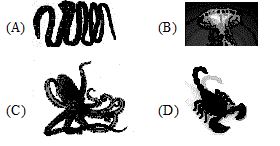
A
$A$ and $D$ respire only through the body wall.
B
$B$ and $C$ show radial symmetry.
C
$A$ and $B$ possess cnidoblasts for protection.
D
$C$ and $D$ possess a true coelom.
Solution
(D) Based on the provided image:
$A$ is a Tapeworm (Platyhelminthes).
$B$ is a Jellyfish (Cnidaria).
$C$ is an Octopus (Mollusca).
$D$ is a Scorpion (Arthropoda).
Analysis of options:
$1$. $A$ (Tapeworm) respires through the body surface,but $D$ (Scorpion) respires through book lungs. Thus,option $A$ is incorrect.
$2$. $B$ (Jellyfish) shows radial symmetry,but $C$ (Octopus) shows bilateral symmetry. Thus,option $B$ is incorrect.
$3$. $A$ (Tapeworm) belongs to Platyhelminthes and does not have cnidoblasts. $B$ (Jellyfish) belongs to Cnidaria and has cnidoblasts. Thus,option $C$ is incorrect.
$4$. Both $C$ (Octopus) and $D$ (Scorpion) are coelomates,meaning they possess a true coelom. Thus,option $D$ is correct.
$A$ is a Tapeworm (Platyhelminthes).
$B$ is a Jellyfish (Cnidaria).
$C$ is an Octopus (Mollusca).
$D$ is a Scorpion (Arthropoda).
Analysis of options:
$1$. $A$ (Tapeworm) respires through the body surface,but $D$ (Scorpion) respires through book lungs. Thus,option $A$ is incorrect.
$2$. $B$ (Jellyfish) shows radial symmetry,but $C$ (Octopus) shows bilateral symmetry. Thus,option $B$ is incorrect.
$3$. $A$ (Tapeworm) belongs to Platyhelminthes and does not have cnidoblasts. $B$ (Jellyfish) belongs to Cnidaria and has cnidoblasts. Thus,option $C$ is incorrect.
$4$. Both $C$ (Octopus) and $D$ (Scorpion) are coelomates,meaning they possess a true coelom. Thus,option $D$ is correct.
0 likes
View Solution167
MediumMCQ
Which of the following pairs is correctly matched?
A
Jellyfish and Starfish - Radial symmetry
B
Hydra and Shark - Bilateral symmetry
C
Tapeworm and Octopus - Radial symmetry
D
Amoeba and Sea anemone - Asymmetry
Solution
(A) $1$. Jellyfish (Cnidaria) and Starfish (Echinodermata,adult) exhibit radial symmetry. This is the correct pair.
$2$. Hydra exhibits radial symmetry,while Shark exhibits bilateral symmetry. Thus,this pair is incorrect.
$3$. Tapeworm exhibits bilateral symmetry,while Octopus exhibits bilateral symmetry. Thus,this pair is incorrect.
$4$. Amoeba exhibits asymmetry,but Sea anemone (Cnidaria) exhibits radial symmetry. Thus,this pair is incorrect.
$2$. Hydra exhibits radial symmetry,while Shark exhibits bilateral symmetry. Thus,this pair is incorrect.
$3$. Tapeworm exhibits bilateral symmetry,while Octopus exhibits bilateral symmetry. Thus,this pair is incorrect.
$4$. Amoeba exhibits asymmetry,but Sea anemone (Cnidaria) exhibits radial symmetry. Thus,this pair is incorrect.
0 likes
View Solution168
MediumMCQ
Which type of asexual reproduction is $NOT$ observed in organisms belonging to the phylum Protozoa?
A
Multiple fission
B
Budding
C
Binary fission
D
Fragmentation
Solution
(D) In the phylum $Protozoa$,asexual reproduction commonly occurs through binary fission,multiple fission,and budding. Fragmentation is a process typically associated with multicellular organisms like sponges,flatworms,or algae,and is not considered a primary mode of asexual reproduction in unicellular protozoans.
0 likes
View Solution169
EasyMCQ
Which of the following pairs is correctly matched?
A
Cnidaria - Exhibit polymorphism
B
Platyhelminthes - Exhibit radial symmetry
C
Annelida - Hemoglobin present in red blood cells
D
Arthropoda - Closed circulatory system
Solution
(A) The correct pair is $A$.
$1$. $Cnidaria$ (Coelenterata) exhibit polymorphism,where they exist in two forms: polyp and medusa.
$2$. $Platyhelminthes$ exhibit bilateral symmetry,not radial symmetry.
$3$. In $Annelida$,hemoglobin is dissolved in the plasma,not present in red blood cells.
$4$. $Arthropoda$ possess an open circulatory system,not a closed one.
$1$. $Cnidaria$ (Coelenterata) exhibit polymorphism,where they exist in two forms: polyp and medusa.
$2$. $Platyhelminthes$ exhibit bilateral symmetry,not radial symmetry.
$3$. In $Annelida$,hemoglobin is dissolved in the plasma,not present in red blood cells.
$4$. $Arthropoda$ possess an open circulatory system,not a closed one.
0 likes
View Solution170
MediumMCQ
Which of the following animals is $NOT$ included in the phylum $Platyhelminthes$?
A
Planaria
B
Tapeworm
C
Filarial worm
D
Liver fluke
Solution
(C) The phylum $Platyhelminthes$ consists of flatworms, which are dorso-ventrally flattened.
Examples include $Planaria$ (Dugesia), $Tapeworm$ $(Taenia)$, and $Liver$ $fluke$ $(Fasciola)$.
$Filarial$ $worm$ $(Wuchereria$ $bancrofti)$ belongs to the phylum $Aschelminthes$ (roundworms), not $Platyhelminthes$.
Therefore, the correct answer is $C$.
Examples include $Planaria$ (Dugesia), $Tapeworm$ $(Taenia)$, and $Liver$ $fluke$ $(Fasciola)$.
$Filarial$ $worm$ $(Wuchereria$ $bancrofti)$ belongs to the phylum $Aschelminthes$ (roundworms), not $Platyhelminthes$.
Therefore, the correct answer is $C$.
0 likes
View Solution171
EasyMCQ
Which pair represents a group of hermaphrodite animals?
A
Porifera-Platyhelminthes
B
Platyhelminthes-Aschelminthes
C
Porifera-Aschelminthes
D
All of the above
Solution
(A) Hermaphrodite (bisexual) animals are those that possess both male and female reproductive organs in the same individual.
In the animal kingdom,members of the phylum $Porifera$ (sponges) are generally hermaphrodites.
Members of the phylum $Platyhelminthes$ (flatworms),such as $Taenia$ (tapeworm),are also hermaphrodites.
However,members of the phylum $Aschelminthes$ (roundworms) are typically dioecious,meaning the sexes are separate.
Therefore,the pair consisting of $Porifera$ and $Platyhelminthes$ represents groups where hermaphroditism is commonly observed.
In the animal kingdom,members of the phylum $Porifera$ (sponges) are generally hermaphrodites.
Members of the phylum $Platyhelminthes$ (flatworms),such as $Taenia$ (tapeworm),are also hermaphrodites.
However,members of the phylum $Aschelminthes$ (roundworms) are typically dioecious,meaning the sexes are separate.
Therefore,the pair consisting of $Porifera$ and $Platyhelminthes$ represents groups where hermaphroditism is commonly observed.
0 likes
View Solution172
MediumMCQ
Which invertebrate animals possess a calcium carbonate skeleton?
A
Arthropoda-Mollusca
B
Mollusca-Porifera
C
Annelida-Mollusca
D
Annelida-Porifera
Solution
(B) The correct answer is $B$.
$1$. Mollusca: Most mollusks have a hard shell made of calcium carbonate $(CaCO_3)$ which serves as an exoskeleton.
$2$. Porifera: Many sponges (Porifera) possess spicules made of calcium carbonate or silica,which form their internal skeletal framework.
$3$. Arthropoda have an exoskeleton made of chitin.
$4$. Annelida generally lack a hard mineralized skeleton.
$1$. Mollusca: Most mollusks have a hard shell made of calcium carbonate $(CaCO_3)$ which serves as an exoskeleton.
$2$. Porifera: Many sponges (Porifera) possess spicules made of calcium carbonate or silica,which form their internal skeletal framework.
$3$. Arthropoda have an exoskeleton made of chitin.
$4$. Annelida generally lack a hard mineralized skeleton.
0 likes
View Solution173
EasyMCQ
Which of the following animals does not belong to the phylum $Mollusca$?
A
$Sepia$
B
$Dentalium$
C
$Leech$
D
$Pinctada$ (Pearl oyster)
Solution
(C) The phylum $Mollusca$ includes animals like $Sepia$ (cuttlefish),$Dentalium$ (tusk shell),and $Pinctada$ (pearl oyster).
$Leech$ (scientific name $Hirudinaria$) belongs to the phylum $Annelida$,not $Mollusca$.
Therefore,the correct answer is $C$.
$Leech$ (scientific name $Hirudinaria$) belongs to the phylum $Annelida$,not $Mollusca$.
Therefore,the correct answer is $C$.
0 likes
View Solution174
MediumMCQ
Which of the following pairs is correctly matched?
A
Earthworm - Pseudopodia
B
Amoeba - Locomotory appendages
C
Brittle star - Tube feet
D
Octopus - Cilia
Solution
(C) The correct pair is $C$.
$1$. Earthworm moves with the help of setae,not pseudopodia.
$2$. Amoeba moves with the help of pseudopodia,not general locomotory appendages.
$3$. Brittle star (Ophiuroidea) belongs to the phylum Echinodermata and uses tube feet (water vascular system) for locomotion.
$4$. Octopus belongs to the phylum Mollusca and uses tentacles/arms for movement,not cilia.
$1$. Earthworm moves with the help of setae,not pseudopodia.
$2$. Amoeba moves with the help of pseudopodia,not general locomotory appendages.
$3$. Brittle star (Ophiuroidea) belongs to the phylum Echinodermata and uses tube feet (water vascular system) for locomotion.
$4$. Octopus belongs to the phylum Mollusca and uses tentacles/arms for movement,not cilia.
0 likes
View Solution175
MediumMCQ
Which pair of animal groups contains the respiratory pigment $Hemocyanin$?
A
$Annelida-Arthropoda$
B
$Annelida-Mollusca$
C
$Arthropoda-Mollusca$
D
All of the above
Solution
(C) $Hemocyanin$ is a copper-containing respiratory pigment that gives blood a blue color when oxygenated.
It is primarily found in the phyla $Arthropoda$ (e.g.,crustaceans,arachnids) and $Mollusca$ (e.g.,cephalopods,gastropods).
Therefore,the correct pair of animal groups that possess $Hemocyanin$ is $Arthropoda-Mollusca$.
It is primarily found in the phyla $Arthropoda$ (e.g.,crustaceans,arachnids) and $Mollusca$ (e.g.,cephalopods,gastropods).
Therefore,the correct pair of animal groups that possess $Hemocyanin$ is $Arthropoda-Mollusca$.
0 likes
View Solution176
MediumMCQ
Match the following columns:
| Column-$I$ | Column-$II$ |
| $I.$ Platyhelminthes | $p.$ Malpighian tubules |
| $II.$ Aschelminthes | $q.$ Renette cells |
| $III.$ Arthropoda | $r.$ Flame cells |
| $IV.$ Annelida | $s.$ Nephridia |
A
$I-r, II-q, III-p, IV-s$
B
$I-r, II-s, III-p, IV-q$
C
$I-s, II-r, III-p, IV-q$
D
$I-s, II-p, III-q, IV-r$
Solution
(A) The correct matches for the excretory structures in different animal phyla are as follows:
$1$. $I.$ Platyhelminthes: These organisms possess specialized cells called $r.$ Flame cells (protonephridia) for excretion and osmoregulation.
$2$. $II.$ Aschelminthes: These organisms possess $q.$ Renette cells (or excretory pores) for the removal of waste.
$3$. $III.$ Arthropoda: These organisms typically use $p.$ Malpighian tubules for excretion.
$4$. $IV.$ Annelida: These organisms use $s.$ Nephridia for the process of excretion.
Therefore, the correct matching sequence is $I-r, II-q, III-p, IV-s$.
$1$. $I.$ Platyhelminthes: These organisms possess specialized cells called $r.$ Flame cells (protonephridia) for excretion and osmoregulation.
$2$. $II.$ Aschelminthes: These organisms possess $q.$ Renette cells (or excretory pores) for the removal of waste.
$3$. $III.$ Arthropoda: These organisms typically use $p.$ Malpighian tubules for excretion.
$4$. $IV.$ Annelida: These organisms use $s.$ Nephridia for the process of excretion.
Therefore, the correct matching sequence is $I-r, II-q, III-p, IV-s$.
0 likes
View Solution177
EasyMCQ
Which group of animals consists of poikilothermic (cold-blooded) animals?
A
Hagfish,Ray-fish,Chameleon,Ostrich
B
Kangaroo,Penguin,Labeo,Catla
C
Chameleon,Turtle,Frog,Labeo,Hagfish
D
Turtle,Crow,Chameleon,Catla,Chameleon
Solution
(C) Poikilothermic or cold-blooded animals are those that cannot regulate their internal body temperature and change it according to the environment.
$1$. $Chameleon$ (Reptile),$Turtle$ (Reptile),$Frog$ (Amphibian),$Labeo$ (Fish),and $Hagfish$ (Cyclostomata) are all poikilothermic.
$2$. $Ostrich$,$Penguin$,and $Crow$ are birds (Aves),which are homeothermic (warm-blooded).
$3$. $Kangaroo$ is a mammal,which is also homeothermic.
Therefore,the group containing only poikilothermic animals is $Chameleon$,$Turtle$,$Frog$,$Labeo$,and $Hagfish$.
$1$. $Chameleon$ (Reptile),$Turtle$ (Reptile),$Frog$ (Amphibian),$Labeo$ (Fish),and $Hagfish$ (Cyclostomata) are all poikilothermic.
$2$. $Ostrich$,$Penguin$,and $Crow$ are birds (Aves),which are homeothermic (warm-blooded).
$3$. $Kangaroo$ is a mammal,which is also homeothermic.
Therefore,the group containing only poikilothermic animals is $Chameleon$,$Turtle$,$Frog$,$Labeo$,and $Hagfish$.
0 likes
View Solution178
EasyMCQ
Match the following columns:
| Column-$I$ | Column-$II$ |
| $I.$ Hepatopancreas | $p.$ Mollusca |
| $II.$ Digestive tract with digestive glands | $q.$ Arthropoda |
| $III.$ Digestive tube straight or coiled | $r.$ Hemichordata |
| $IV.$ Straight or $U$-shaped digestive tract | $s.$ Echinodermata |
A
$I-q, II-p, III-s, IV-r$
B
$I-q, II-s, III-p, IV-r$
C
$I-r, II-s, III-p, IV-q$
D
$I-r, II-p, III-s, IV-q$
Solution
(A) The correct matching is as follows:
$1$. Hepatopancreas is a characteristic digestive gland found in Arthropoda $(I-q)$.
$2$. Digestive tract with digestive glands is characteristic of Mollusca $(II-p)$.
$3$. Digestive tube that is straight or coiled is found in Echinodermata $(III-s)$.
$4$. Straight or $U$-shaped digestive tract is characteristic of Hemichordata $(IV-r)$.
Thus, the correct sequence is $I-q, II-p, III-s, IV-r$.
$1$. Hepatopancreas is a characteristic digestive gland found in Arthropoda $(I-q)$.
$2$. Digestive tract with digestive glands is characteristic of Mollusca $(II-p)$.
$3$. Digestive tube that is straight or coiled is found in Echinodermata $(III-s)$.
$4$. Straight or $U$-shaped digestive tract is characteristic of Hemichordata $(IV-r)$.
Thus, the correct sequence is $I-q, II-p, III-s, IV-r$.
0 likes
View Solution179
MediumMCQ
Match the following columns:
| Column-$I$ | Column-$II$ |
| $I$. Choanocytes | $p$. Cnidaria |
| $II$. Cnidoblasts | $q$. Platyhelminthes |
| $III$. Flame cells | $r$. Porifera |
| $s$. Aschelminthes |
A
$I-s, II-p, III-q$
B
$I-r, II-p, III-q$
C
$I-q, II-p, III-s$
D
$I-r, II-p, III-s$
Solution
(B) $I$. Choanocytes (collar cells) are characteristic cells found in the phylum Porifera (sponges).
$II$. Cnidoblasts (stinging cells) are characteristic cells found in the phylum Cnidaria (Coelenterata).
$III$. Flame cells are specialized excretory cells found in the phylum Platyhelminthes (flatworms).
Therefore, the correct matching is $I-r, II-p, III-q$.
$II$. Cnidoblasts (stinging cells) are characteristic cells found in the phylum Cnidaria (Coelenterata).
$III$. Flame cells are specialized excretory cells found in the phylum Platyhelminthes (flatworms).
Therefore, the correct matching is $I-r, II-p, III-q$.
0 likes
View Solution180
EasyMCQ
Which of the following options represents hermaphrodite (bisexual) animals?
A
Tapeworm,Hydra,Leech
B
Earthworm,Leech,Roundworm
C
Prawn,Earthworm,Tapeworm
D
Hydra,Wuchereria,Earthworm
Solution
(A) Hermaphrodite or bisexual animals are those that possess both male and female reproductive organs in the same individual.
$1$. Tapeworm (Platyhelminthes),Hydra (Cnidaria),and Leech (Annelida) are all hermaphrodites.
$2$. Roundworm (Ascaris) and Wuchereria are dioecious (unisexual).
$3$. Prawn is also dioecious.
Therefore,the correct option is $A$.
$1$. Tapeworm (Platyhelminthes),Hydra (Cnidaria),and Leech (Annelida) are all hermaphrodites.
$2$. Roundworm (Ascaris) and Wuchereria are dioecious (unisexual).
$3$. Prawn is also dioecious.
Therefore,the correct option is $A$.
0 likes
View Solution181
EasyMCQ
Sea Anemone and Sea Lily belong to which phyla respectively?
A
Echinodermata and Mollusca
B
Cnidaria and Echinodermata
C
Mollusca and Cnidaria
D
Echinodermata and Cnidaria
Solution
(B) Sea Anemone (scientific name $Adamsia$) belongs to the phylum $Cnidaria$ (also known as $Coelenterata$).
Sea Lily (scientific name $Antedon$) belongs to the phylum $Echinodermata$.
Therefore,the correct sequence is $Cnidaria$ and $Echinodermata$.
Sea Lily (scientific name $Antedon$) belongs to the phylum $Echinodermata$.
Therefore,the correct sequence is $Cnidaria$ and $Echinodermata$.
0 likes
View Solution182
EasyMCQ
Match the following columns:
| Column-$I$ | Column-$II$ |
| $I.$ Skin without scales | $p.$ $Catla$ |
| $II.$ Placoid scales | $q.$ $Hagfish$ |
| $III.$ Cycloid scales | $r.$ $Chameleon$ |
| $IV.$ Epidermal scales | $s.$ $Ray-fish$ |
A
$I-q, II-s, III-p, IV-r$
B
$I-r, II-s, III-p, IV-q$
C
$I-r, II-p, III-s, IV-q$
D
$I-q, II-p, III-s, IV-r$
Solution
(A) $I.$ Skin without scales: $Hagfish$ $(Myxine)$ belongs to Cyclostomata, which are characterized by smooth, scaleless skin.
$II.$ Placoid scales: $Ray-fish$ $(Chondrichthyes)$ possess placoid scales.
$III.$ Cycloid scales: $Catla$ $(Osteichthyes)$ possess cycloid or ctenoid scales.
$IV.$ Epidermal scales: $Chameleon$ (Reptilia) possess dry and cornified skin with epidermal scales or scutes.
Therefore, the correct matching is $I-q, II-s, III-p, IV-r$.
$II.$ Placoid scales: $Ray-fish$ $(Chondrichthyes)$ possess placoid scales.
$III.$ Cycloid scales: $Catla$ $(Osteichthyes)$ possess cycloid or ctenoid scales.
$IV.$ Epidermal scales: $Chameleon$ (Reptilia) possess dry and cornified skin with epidermal scales or scutes.
Therefore, the correct matching is $I-q, II-s, III-p, IV-r$.
0 likes
View Solution183
MediumMCQ
Which of the following options represents the correct ascending order of complexity in animal body organization?
A
Opalina - Vaucheria - Lamprey - Seahorse
B
Opalina - Lamprey - Vaucheria - Seahorse
C
Lamprey - Opalina - Seahorse - Vaucheria
D
Vaucheria - Opalina - Lamprey - Seahorse
Solution
(A) The complexity of organisms increases from unicellular protists to multicellular plants/animals and then to complex vertebrates.
$1$. $Opalina$ is a unicellular ciliate protist.
$2$. $Vaucheria$ is a multicellular alga (though often studied in botany,in this context,it represents a simple multicellular organization compared to animals).
$3$. $Lamprey$ is a primitive jawless vertebrate (Agnatha).
$4$. $Seahorse$ is a complex bony fish (Osteichthyes).
Therefore,the correct ascending order of complexity is $Opalina < Vaucheria < Lamprey < Seahorse$.
$1$. $Opalina$ is a unicellular ciliate protist.
$2$. $Vaucheria$ is a multicellular alga (though often studied in botany,in this context,it represents a simple multicellular organization compared to animals).
$3$. $Lamprey$ is a primitive jawless vertebrate (Agnatha).
$4$. $Seahorse$ is a complex bony fish (Osteichthyes).
Therefore,the correct ascending order of complexity is $Opalina < Vaucheria < Lamprey < Seahorse$.
0 likes
View Solution184
MediumMCQ
Match the following columns:
| Column-$I$ | Column-$II$ |
| $(1)$ Reptilia | $(A)$ Jellyfish |
| $(2)$ Porifera | $(B)$ Leech |
| $(3)$ Coelenterata | $(C)$ Hyalonema |
| $(4)$ Annelida | $(D)$ Crocodile |
A
$1-D, 2-C, 3-A, 4-B$
B
$1-C, 2-D, 3-B, 4-A$
C
$1-D, 2-A, 3-B, 4-C$
D
$1-B, 2-A, 3-D, 4-C$
Solution
(A) The correct matches are as follows:
$(1)$ Reptilia: Crocodile is a member of the class Reptilia.
$(2)$ Porifera: Hyalonema is a genus of glass sponges belonging to the phylum Porifera.
$(3)$ Coelenterata (Cnidaria): Jellyfish (Aurelia) belongs to the phylum Coelenterata.
$(4)$ Annelida: Leech (Hirudinaria) is a segmented worm belonging to the phylum Annelida.
Therefore, the correct sequence is $1-D, 2-C, 3-A, 4-B$.
$(1)$ Reptilia: Crocodile is a member of the class Reptilia.
$(2)$ Porifera: Hyalonema is a genus of glass sponges belonging to the phylum Porifera.
$(3)$ Coelenterata (Cnidaria): Jellyfish (Aurelia) belongs to the phylum Coelenterata.
$(4)$ Annelida: Leech (Hirudinaria) is a segmented worm belonging to the phylum Annelida.
Therefore, the correct sequence is $1-D, 2-C, 3-A, 4-B$.
0 likes
View Solution185
MediumMCQ
Which is the correct match based on the characteristics of animals?
| Column-$I$ | Column-$II$ (Phylum) | Column-$III$ (Example) |
|---|---|---|
| $I$. Water canal system | $a$. Porifera | $p$. Sea lily |
| $II$. Proboscis | $b$. Hemichordata | $q$. Sepia |
| $III$. Water vascular system | $c$. Mollusca | $r$. Sycon |
| $IV$. Shell | $d$. Echinodermata | $s$. Balanoglossus |
A
$I-a-s, II-c-r, III-d-p, IV-b-q$
B
$I-b-p, II-c-q, III-d-s, IV-a-r$
C
$I-d-s, II-b-p, III-c-r, IV-a-q$
D
$I-a-r, II-b-s, III-d-p, IV-c-q$
Solution
(D) The correct matches are as follows:
$1$. Water canal system is a characteristic feature of Phylum Porifera,and an example is Sycon $(I-a-r)$.
$2$. Proboscis is a characteristic feature of Phylum Hemichordata,and an example is Balanoglossus $(II-b-s)$.
$3$. Water vascular system is a characteristic feature of Phylum Echinodermata,and an example is Sea lily $(III-d-p)$.
$4$. Shell (calcareous) is a characteristic feature of Phylum Mollusca,and an example is Sepia $(IV-c-q)$.
Therefore,the correct sequence is $I-a-r, II-b-s, III-d-p, IV-c-q$.
$1$. Water canal system is a characteristic feature of Phylum Porifera,and an example is Sycon $(I-a-r)$.
$2$. Proboscis is a characteristic feature of Phylum Hemichordata,and an example is Balanoglossus $(II-b-s)$.
$3$. Water vascular system is a characteristic feature of Phylum Echinodermata,and an example is Sea lily $(III-d-p)$.
$4$. Shell (calcareous) is a characteristic feature of Phylum Mollusca,and an example is Sepia $(IV-c-q)$.
Therefore,the correct sequence is $I-a-r, II-b-s, III-d-p, IV-c-q$.
0 likes
View Solution186
EasyMCQ
Which of the following statements is incorrect?
A
In rats,a diaphragm separates the thorax and abdomen.
B
In chameleons,the body is covered by epidermal scales and dry skin.
C
In Catla,the operculum is absent.
D
In crows,air sacs are connected to the lungs.
Solution
(C) The correct answer is $C$.
$1$. Rats are mammals,and they possess a diaphragm that separates the thoracic cavity from the abdominal cavity. This is a correct statement.
$2$. Chameleons are reptiles,and their body is covered by dry and cornified skin with epidermal scales or scutes. This is a correct statement.
$3$. Catla is a bony fish $(Osteichthyes)$. Bony fishes possess four pairs of gills which are covered by an operculum on each side. Therefore,the statement that the operculum is absent in Catla is incorrect.
$4$. Crows are birds $(Aves)$. Birds have lungs that are supplemented by air sacs to facilitate respiration and reduce body weight for flight. This is a correct statement.
$1$. Rats are mammals,and they possess a diaphragm that separates the thoracic cavity from the abdominal cavity. This is a correct statement.
$2$. Chameleons are reptiles,and their body is covered by dry and cornified skin with epidermal scales or scutes. This is a correct statement.
$3$. Catla is a bony fish $(Osteichthyes)$. Bony fishes possess four pairs of gills which are covered by an operculum on each side. Therefore,the statement that the operculum is absent in Catla is incorrect.
$4$. Crows are birds $(Aves)$. Birds have lungs that are supplemented by air sacs to facilitate respiration and reduce body weight for flight. This is a correct statement.
0 likes
View Solution187
EasyMCQ
Which of the following organisms possess a four-chambered heart?
A
Chelonia
B
Crocodilia
C
Amphibia
D
Birds and Crocodilia
Solution
(D) Most reptiles possess a three-chambered heart,consisting of two atria and one partially divided ventricle.
However,members of the order $Crocodilia$ (such as crocodiles and alligators) possess a completely four-chambered heart,similar to birds and mammals.
Birds $(Aves)$ also possess a four-chambered heart.
Therefore,both birds and crocodilians have a four-chambered heart.
However,members of the order $Crocodilia$ (such as crocodiles and alligators) possess a completely four-chambered heart,similar to birds and mammals.
Birds $(Aves)$ also possess a four-chambered heart.
Therefore,both birds and crocodilians have a four-chambered heart.
0 likes
View Solution188
MediumMCQ
Select the correct match for $X$ and $Y$:
| Column $X$ | Column $Y$ |
| $(1)$ Platyhelminthes | $(P)$ Malpighian tubules |
| $(2)$ Aschelminthes | $(Q)$ Nephridia |
| $(3)$ Arthropoda | $(R)$ Flame cells |
| $(4)$ Annelida | $(S)$ Renette cells |
A
$(1-R), (2-S), (3-P), (4-Q)$
B
$(1-R), (2-S), (3-Q), (4-P)$
C
$(1-S), (2-R), (3-P), (4-Q)$
D
$(1-R), (2-P), (3-S), (4-Q)$
Solution
(A) The correct matching of excretory structures in different animal phyla is as follows:
$1$. Platyhelminthes: Excretion occurs through specialized cells called Flame cells $(R)$.
$2$. Aschelminthes: Excretion occurs through Renette cells $(S)$.
$3$. Arthropoda: Excretion occurs through Malpighian tubules $(P)$.
$4$. Annelida: Excretion occurs through Nephridia $(Q)$.
Therefore, the correct sequence is $(1-R), (2-S), (3-P), (4-Q)$.
$1$. Platyhelminthes: Excretion occurs through specialized cells called Flame cells $(R)$.
$2$. Aschelminthes: Excretion occurs through Renette cells $(S)$.
$3$. Arthropoda: Excretion occurs through Malpighian tubules $(P)$.
$4$. Annelida: Excretion occurs through Nephridia $(Q)$.
Therefore, the correct sequence is $(1-R), (2-S), (3-P), (4-Q)$.
0 likes
View Solution189
MediumMCQ
Select the correct match for Column $X$ and Column $Y$:
| Column $X$ | Column $Y$ |
| $(1)$ Aves | $(A)$ Endoskeleton made of cartilage |
| $(2)$ Amphibia | $(B)$ Left aortic arch |
| $(3)$ Chondrichthyes | $(C)$ First homeothermic animals |
| $(4)$ Mammalia | $(D)$ Metamorphosis |
A
$(1-D), (2-C), (3-A), (4-B)$
B
$(1-C), (2-D), (3-B), (4-A)$
C
$(1-C), (2-D), (3-A), (4-B)$
D
$(1-B), (2-D), (3-A), (4-C)$
Solution
$(C)$ The correct matches are as follows:
$(1)$ Aves are the first homeothermic (warm-blooded) animals, matching $(C)$.
$(2)$ Amphibians undergo metamorphosis during their life cycle, matching $(D)$.
$(3)$ Chondrichthyes (cartilaginous fishes) have an endoskeleton made entirely of cartilage, matching $(A)$.
$(4)$ Mammals possess a left aortic arch in their systemic circulation, matching $(B)$.
Therefore, the correct sequence is $(1-C), (2-D), (3-A), (4-B)$.
$(1)$ Aves are the first homeothermic (warm-blooded) animals, matching $(C)$.
$(2)$ Amphibians undergo metamorphosis during their life cycle, matching $(D)$.
$(3)$ Chondrichthyes (cartilaginous fishes) have an endoskeleton made entirely of cartilage, matching $(A)$.
$(4)$ Mammals possess a left aortic arch in their systemic circulation, matching $(B)$.
Therefore, the correct sequence is $(1-C), (2-D), (3-A), (4-B)$.
0 likes
View Solution190
MediumMCQ
Select the correct match for $X$ and $Y$:
| Column $X$ | Column $Y$ |
| $(1)$ Green gland | $(P)$ Mollusca |
| $(2)$ Digestive tract with digestive glands | $(Q)$ Arthropoda |
| $(3)$ Straight or coiled alimentary canal | $(R)$ Hemichordata |
| $(4)$ Straight or $U$-shaped digestive tract | $(S)$ Echinodermata |
A
$(1-Q), (2-P), (3-S), (4-R)$
B
$(1-Q), (2-S), (3-P), (4-R)$
C
$(1-R), (2-S), (3-P), (4-Q)$
D
$(1-R), (2-P), (3-S), (4-Q)$
Solution
(A) The correct matches are as follows:
$(1)$ Green gland: These are excretory organs found in Arthropoda (e.g., prawns). So, $(1-Q)$.
$(2)$ Digestive tract with digestive glands: This is a characteristic feature of Mollusca. So, $(2-P)$.
$(3)$ Straight or coiled alimentary canal: This is observed in Echinodermata. So, $(3-S)$.
$(4)$ Straight or $U$-shaped digestive tract: This is a characteristic feature of Hemichordata. So, $(4-R)$.
Therefore, the correct sequence is $(1-Q), (2-P), (3-S), (4-R)$.
$(1)$ Green gland: These are excretory organs found in Arthropoda (e.g., prawns). So, $(1-Q)$.
$(2)$ Digestive tract with digestive glands: This is a characteristic feature of Mollusca. So, $(2-P)$.
$(3)$ Straight or coiled alimentary canal: This is observed in Echinodermata. So, $(3-S)$.
$(4)$ Straight or $U$-shaped digestive tract: This is a characteristic feature of Hemichordata. So, $(4-R)$.
Therefore, the correct sequence is $(1-Q), (2-P), (3-S), (4-R)$.
0 likes
View Solution191
EasyMCQ
Select the correct match for $X$ and $Y$:
| Column $X$ (Phylum) | Column $Y$ (Example) |
| $(1)$ Protozoa | $(P)$ Bath sponge |
| $(2)$ Coelenterata | $(Q)$ Liver fluke |
| $(3)$ Porifera | $(R)$ Jellyfish |
| $(4)$ Platyhelminthes | $(S)$ Opalina |
A
$(1-S), (2-R), (3-P), (4-Q)$
B
$(1-R), (2-S), (3-P), (4-Q)$
C
$(1-Q), (2-P), (3-S), (4-R)$
D
$(1-S), (2-P), (3-Q), (4-R)$
Solution
(A) The correct matching is as follows:
$(1)$ Protozoa: $Opalina$ $(S)$ is a ciliate protozoan.
$(2)$ Coelenterata (Cnidaria): $Jellyfish$ $(R)$ belongs to this phylum.
$(3)$ Porifera: $Bath sponge$ $(P)$ (Spongia) is a member of Porifera.
$(4)$ Platyhelminthes: $Liver fluke$ $(Q)$ (Fasciola) belongs to this phylum.
Therefore, the correct sequence is $(1-S), (2-R), (3-P), (4-Q)$.
$(1)$ Protozoa: $Opalina$ $(S)$ is a ciliate protozoan.
$(2)$ Coelenterata (Cnidaria): $Jellyfish$ $(R)$ belongs to this phylum.
$(3)$ Porifera: $Bath sponge$ $(P)$ (Spongia) is a member of Porifera.
$(4)$ Platyhelminthes: $Liver fluke$ $(Q)$ (Fasciola) belongs to this phylum.
Therefore, the correct sequence is $(1-S), (2-R), (3-P), (4-Q)$.
0 likes
View Solution192
MediumMCQ
Select the correct match for $X$ and $Y$:
| Column $X$ | Column $Y$ |
| $(1)$ Skin without scales | $(P)$ Catla |
| $(2)$ Placoid scales | $(Q)$ Hagfish |
| $(3)$ Cycloid scales | $(R)$ Chameleon |
| $(4)$ Epidermal scales | $(S)$ Ray-fish |
A
$(1-Q), (2-S), (3-P), (4-R)$
B
$(1-R), (2-S), (3-P), (4-Q)$
C
$(1-R), (2-P), (3-S), (4-Q)$
D
$(1-Q), (2-P), (3-S), (4-R)$
Solution
(A) The correct matches are as follows:
$(1)$ Skin without scales: Hagfish $(Q)$ belongs to Cyclostomata, which are characterized by smooth, scale-less skin.
$(2)$ Placoid scales: Ray-fish $(S)$ belongs to Chondrichthyes (cartilaginous fishes), which possess placoid scales.
$(3)$ Cycloid scales: Catla $(P)$ belongs to Osteichthyes (bony fishes), which typically possess cycloid or ctenoid scales.
$(4)$ Epidermal scales: Chameleon $(R)$ belongs to Reptilia, which are characterized by dry, cornified skin with epidermal scales or scutes.
Therefore, the correct matching is $(1-Q), (2-S), (3-P), (4-R)$.
$(1)$ Skin without scales: Hagfish $(Q)$ belongs to Cyclostomata, which are characterized by smooth, scale-less skin.
$(2)$ Placoid scales: Ray-fish $(S)$ belongs to Chondrichthyes (cartilaginous fishes), which possess placoid scales.
$(3)$ Cycloid scales: Catla $(P)$ belongs to Osteichthyes (bony fishes), which typically possess cycloid or ctenoid scales.
$(4)$ Epidermal scales: Chameleon $(R)$ belongs to Reptilia, which are characterized by dry, cornified skin with epidermal scales or scutes.
Therefore, the correct matching is $(1-Q), (2-S), (3-P), (4-R)$.
0 likes
View Solution193
DifficultMCQ
Select the correct match for Column $X$, Column $Y$, and Column $Z$:
| Column $X$ | Column $Y$ | Column $Z$ |
| $(1)$ Water vascular system | $(A)$ Porifera | $(p)$ Starfish |
| $(2)$ Proboscis | $(B)$ Hemichordata | $(q)$ Sepia |
| $(3)$ Canal system | $(C)$ Mollusca | $(r)$ Hyalonema |
| $(4)$ Shell | $(D)$ Echinodermata | $(s)$ Balanoglossus |
A
$(1-D-p), (2-B-s), (3-A-r), (4-C-q)$
B
$(1-B-p), (2-C-q), (3-D-s), (4-A-r)$
C
$(1-D-s), (2-B-p), (3-C-r), (4-A-q)$
D
$(1-D-p), (2-B-s), (3-A-r), (4-C-q)$
Solution
(A) The correct matches are as follows:
$1$. Water vascular system is a characteristic feature of Echinodermata $(D)$ and is found in Starfish $(p)$.
$2$. Proboscis is a characteristic feature of Hemichordata $(B)$ and is found in Balanoglossus $(s)$.
$3$. Canal system is a characteristic feature of Porifera $(A)$ and is found in Hyalonema $(r)$.
$4$. Shell is a characteristic feature of Mollusca $(C)$ and is found in Sepia $(q)$.
Therefore, the correct sequence is $(1-D-p), (2-B-s), (3-A-r), (4-C-q)$.
$1$. Water vascular system is a characteristic feature of Echinodermata $(D)$ and is found in Starfish $(p)$.
$2$. Proboscis is a characteristic feature of Hemichordata $(B)$ and is found in Balanoglossus $(s)$.
$3$. Canal system is a characteristic feature of Porifera $(A)$ and is found in Hyalonema $(r)$.
$4$. Shell is a characteristic feature of Mollusca $(C)$ and is found in Sepia $(q)$.
Therefore, the correct sequence is $(1-D-p), (2-B-s), (3-A-r), (4-C-q)$.
0 likes
View Solution194
MediumMCQ
$A$: Annelids and Arthropods exhibit bilateral symmetry.
$R$: In Annelids and Arthropods,the body can be divided into identical halves through any plane passing through the central axis.
$R$: In Annelids and Arthropods,the body can be divided into identical halves through any plane passing through the central axis.
A
$A$ and $R$ are true and $R$ is the correct explanation of $A$.
B
$A$ and $R$ are true,but $R$ is not the correct explanation of $A$.
C
$A$ is true and $R$ is false.
D
$A$ is false and $R$ is true.
Solution
(C) Assertion $(A)$ is true because Annelids and Arthropods possess bilateral symmetry,meaning their bodies can be divided into identical left and right halves only in one plane.
Reason $(R)$ is false because the definition provided in $R$ describes radial symmetry,not bilateral symmetry. Radial symmetry occurs when any plane passing through the central axis divides the organism into identical halves,which is characteristic of Cnidarians,Ctenophores,and adult Echinoderms,not Annelids or Arthropods.
Reason $(R)$ is false because the definition provided in $R$ describes radial symmetry,not bilateral symmetry. Radial symmetry occurs when any plane passing through the central axis divides the organism into identical halves,which is characteristic of Cnidarians,Ctenophores,and adult Echinoderms,not Annelids or Arthropods.
0 likes
View Solution195
EasyMCQ
$A$: In $Aves$ and $Mammals$, the heart is four-chambered.
$R$: In $Mammals$, the aortic arch curves to the left.
$R$: In $Mammals$, the aortic arch curves to the left.
A
$A$ and $R$ are both true and $R$ is the correct explanation of $A$.
B
$A$ and $R$ are both true, but $R$ is not the correct explanation of $A$.
C
$A$ is true and $R$ is false.
D
$A$ is false and $R$ is true.
Solution
(B) Statement $A$ is true: Both $Aves$ (birds) and $Mammals$ possess a four-chambered heart, consisting of two atria and two ventricles, which prevents the mixing of oxygenated and deoxygenated blood.
Statement $R$ is true: In $Mammals$, the systemic aortic arch curves to the left (left aortic arch), whereas in $Aves$, it curves to the right (right aortic arch).
However, the fact that the aortic arch curves to the left in mammals is an anatomical characteristic of mammals, but it does not explain why the heart is four-chambered. Therefore, $R$ is not the correct explanation of $A$.
Statement $R$ is true: In $Mammals$, the systemic aortic arch curves to the left (left aortic arch), whereas in $Aves$, it curves to the right (right aortic arch).
However, the fact that the aortic arch curves to the left in mammals is an anatomical characteristic of mammals, but it does not explain why the heart is four-chambered. Therefore, $R$ is not the correct explanation of $A$.
0 likes
View Solution196
EasyMCQ
$A$: All higher animals from $Annelida$ onwards possess an organized circulatory system.
$R$: Coelomate organization is observed from $Annelida$ onwards.
$R$: Coelomate organization is observed from $Annelida$ onwards.
A
$A$ and $R$ are both true.
B
$A$ and $R$ are both false.
C
$A$ is true and $R$ is false.
D
$A$ is false and $R$ is true.
Solution
(A) $1$. $Annelida$ is the first phylum to exhibit a closed circulatory system,which is a characteristic feature of higher animals.
$2$. $Annelida$ is also the first phylum to show a true coelom (eucoelomate condition),which is a significant evolutionary advancement.
$3$. Both statements $A$ and $R$ are scientifically correct as per the evolutionary classification of the animal kingdom.
$2$. $Annelida$ is also the first phylum to show a true coelom (eucoelomate condition),which is a significant evolutionary advancement.
$3$. Both statements $A$ and $R$ are scientifically correct as per the evolutionary classification of the animal kingdom.
0 likes
View Solution197
MediumMCQ
The circulatory system shown in the given figure is found in which of the following animals?
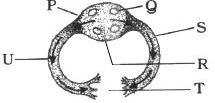
A
Cockroach
B
Grasshopper
C
Peripatus
D
All of the above $(A, B, C)$
Solution
(D) The provided figure illustrates an open circulatory system,specifically showing the tubular heart and ostia characteristic of arthropods.
Cockroaches (Periplaneta americana),grasshoppers,and Peripatus are all members of the phylum Arthropoda (or Onychophora in the case of Peripatus,which shares similar circulatory features).
These organisms possess an open circulatory system where blood flows into open spaces called sinuses.
Therefore,the circulatory system shown is found in all the listed animals.
Cockroaches (Periplaneta americana),grasshoppers,and Peripatus are all members of the phylum Arthropoda (or Onychophora in the case of Peripatus,which shares similar circulatory features).
These organisms possess an open circulatory system where blood flows into open spaces called sinuses.
Therefore,the circulatory system shown is found in all the listed animals.
0 likes
View Solution198
MediumMCQ
The circulatory system shown in the given figure is found in which of the following animals?
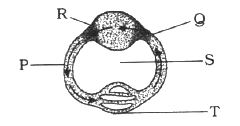
A
Earthworm
B
Cephalopods (e.g.,Octopus)
C
Rabbit
D
All of the above
Solution
(D) The provided figure illustrates a closed circulatory system,where blood is confined within vessels.
Earthworms (Annelida) possess a closed circulatory system.
Cephalopods (like Octopus and Squid) are unique among mollusks as they also possess a closed circulatory system.
Vertebrates like rabbits also possess a closed circulatory system.
Therefore,all the listed organisms exhibit a closed circulatory system.
Earthworms (Annelida) possess a closed circulatory system.
Cephalopods (like Octopus and Squid) are unique among mollusks as they also possess a closed circulatory system.
Vertebrates like rabbits also possess a closed circulatory system.
Therefore,all the listed organisms exhibit a closed circulatory system.
0 likes
View Solution199
EasyMCQ
Select the correct option for the matching pairs:
| Level of Organization | Phylum |
| $(1)$ Tissue level | $(a)$ Platyhelminthes |
| $(2)$ Organ level | $(b)$ Porifera |
| $(3)$ Organ system level | $(c)$ Coelenterata |
| $(4)$ Cellular level | $(d)$ Arthropoda |
A
$ (1-c), (2-a), (3-d), (4-b) $
B
$ (1-b), (2-a), (3-c), (4-d) $
C
$ (1-b), (2-d), (3-c), (4-a) $
D
$ (1-c), (2-b), (3-d), (4-a) $
Solution
(A) The levels of organization in animals are classified as follows:
$(1)$ Tissue level of organization is found in Phylum Coelenterata (Cnidaria).
$(2)$ Organ level of organization is found in Phylum Platyhelminthes.
$(3)$ Organ system level of organization is found in Phylum Arthropoda.
$(4)$ Cellular level of organization is found in Phylum Porifera.
Therefore,the correct matching is $(1-c), (2-a), (3-d), (4-b)$.
$(1)$ Tissue level of organization is found in Phylum Coelenterata (Cnidaria).
$(2)$ Organ level of organization is found in Phylum Platyhelminthes.
$(3)$ Organ system level of organization is found in Phylum Arthropoda.
$(4)$ Cellular level of organization is found in Phylum Porifera.
Therefore,the correct matching is $(1-c), (2-a), (3-d), (4-b)$.
0 likes
View Solution200
EasyMCQ
Select the correct option for the following matches:
| $(1)$ Diploblastic | $(a)$ Protozoa to Echinodermata |
| $(2)$ Coelomate | $(b)$ Platyhelminthes to Chordata |
| $(3)$ Triploblastic | $(c)$ Coelenterata |
| $(4)$ Invertebrates | $(d)$ Annelida to Chordata |
A
$(1-b), (2-c), (3-d), (4-a)$
B
$(1-d), (2-c), (3-a), (4-b)$
C
$(1-b), (2-d), (3-c), (4-a)$
D
$(1-c), (2-d), (3-b), (4-a)$
Solution
(D) $(1)$ Diploblastic animals are those with two germ layers (ectoderm and endoderm), e.g., Coelenterata (Cnidaria). So, $(1-c)$.
$(2)$ Coelomate animals are those with a true body cavity, which appears from Annelida to Chordata. So, $(2-d)$.
$(3)$ Triploblastic animals have three germ layers (ectoderm, mesoderm, and endoderm), which includes Platyhelminthes to Chordata. So, $(3-b)$.
$(4)$ Invertebrates include animals from Protozoa to Echinodermata (non-chordates). So, $(4-a)$.
Therefore, the correct matching is $(1-c), (2-d), (3-b), (4-a)$.
$(2)$ Coelomate animals are those with a true body cavity, which appears from Annelida to Chordata. So, $(2-d)$.
$(3)$ Triploblastic animals have three germ layers (ectoderm, mesoderm, and endoderm), which includes Platyhelminthes to Chordata. So, $(3-b)$.
$(4)$ Invertebrates include animals from Protozoa to Echinodermata (non-chordates). So, $(4-a)$.
Therefore, the correct matching is $(1-c), (2-d), (3-b), (4-a)$.
0 likes
View SolutionAnimal Kingdom — Mix Examples - Animal Kingdom · Frequently Asked Questions
1Are these Animal Kingdom questions useful for JEE and NEET?
Yes. All questions in this section are mapped to JEE Main and NEET exam patterns. Previous year questions from JEE Main, NEET, GUJCET and state-level exams are included with full solutions.
2Can I switch to Hindi or Gujarati for these questions?
Yes. Use the language tabs in the hero section or the sidebar to view the same questions and solutions in English, Hindi or Gujarati.
3How do I generate a question paper from this subtopic?
Use the Vedclass Exam Paper Generator — select the chapter and subtopic, set difficulty, and generate Sets A, B, C, D automatically. First 3 chapters of every subject are free.
Vedclass Products
For Students
Vedclass Test Series
Mock tests in real JEE/NEET style with performance analysis. 5-day free trial.
Start Free TrialFor Teachers
Exam Paper Generator
Generate Set A/B/C/D papers from this chapter in 2 minutes. 3 chapters free.
Try FreeFor Institutes
Online Exam Module
Live online exams with unlimited students, 360° analytics & white-label branding.
See DemoFor Teachers & Institutes
Generate a Animal Kingdom Exam Paper in 2 Minutes
Select subtopic & difficulty — Sets A, B, C, D auto-generated with No Repeat logic.
First 3 chapters of every subject are free — no payment required.