
A English
Mix Examples - Animal Kingdom Questions in English
Class 11 Biology · Animal Kingdom · Mix Examples - Animal Kingdom
431+
Questions
English
Language
100%
With Solutions
Showing 50 of 431 questions in English
301
MediumMCQ
Assertion: All birds,except the ones like koel (cuckoo),build nests for retiring and taking rest during night time (day time for nocturnal).
Reason: Koel lays its eggs in the nests of tailor bird.
Reason: Koel lays its eggs in the nests of tailor bird.
A
If both Assertion and Reason are correct and the Reason is a correct explanation of the Assertion.
B
If both Assertion and Reason are correct but Reason is not a correct explanation of the Assertion.
C
If the Assertion is correct but Reason is incorrect.
D
If both the Assertion and Reason are incorrect.
Solution
(D) The Assertion is incorrect because birds generally build nests primarily for laying eggs and rearing their young,not specifically for resting or sleeping at night. Many birds roost on branches or in cavities without building nests for that purpose.
The Reason is also incorrect because the Koel (Eudynamys scolopaceus) is a brood parasite that typically lays its eggs in the nest of a crow,not a tailor bird.
Therefore,both the Assertion and the Reason are incorrect.
The Reason is also incorrect because the Koel (Eudynamys scolopaceus) is a brood parasite that typically lays its eggs in the nest of a crow,not a tailor bird.
Therefore,both the Assertion and the Reason are incorrect.
0 likes
View Solution302
MediumMCQ
Match the following genera with their respective phylum:
Select the correct option:
| $(a)$ Ophiura | $(i)$ Mollusca |
| $(b)$ Physalia | $(ii)$ Platyhelminthes |
| $(c)$ Pinctada | $(iii)$ Echinodermata |
| $(d)$ Planaria | $(iv)$ Coelenterata |
Select the correct option:
A
$(a)-(iv), (b)-(i), (c)-(iii), (d)-(ii)$
B
$(a)-(iii), (b)-(iv), (c)-(i), (d)-(ii)$
C
$(a)-(i), (b)-(iii), (c)-(iv), (d)-(ii)$
D
$(a)-(iii), (b)-(iv), (c)-(ii), (d)-(i)$
Solution
(B) The correct matches are as follows:
$1$. $Ophiura$ (Brittle star) belongs to the phylum $Echinodermata$ $(a-iii)$.
$2$. $Physalia$ (Portuguese man-of-war) belongs to the phylum $Coelenterata$ (also known as $Cnidaria$) $(b-iv)$.
$3$. $Pinctada$ (Pearl oyster) belongs to the phylum $Mollusca$ $(c-i)$.
$4$. $Planaria$ (Flatworm) belongs to the phylum $Platyhelminthes$ $(d-ii)$.
Therefore, the correct sequence is $(a-iii), (b-iv), (c-i), (d-ii)$.
$1$. $Ophiura$ (Brittle star) belongs to the phylum $Echinodermata$ $(a-iii)$.
$2$. $Physalia$ (Portuguese man-of-war) belongs to the phylum $Coelenterata$ (also known as $Cnidaria$) $(b-iv)$.
$3$. $Pinctada$ (Pearl oyster) belongs to the phylum $Mollusca$ $(c-i)$.
$4$. $Planaria$ (Flatworm) belongs to the phylum $Platyhelminthes$ $(d-ii)$.
Therefore, the correct sequence is $(a-iii), (b-iv), (c-i), (d-ii)$.
0 likes
View Solution303
Medium
Match the following:
| $(a)$ Operculum | $(i)$ Ctenophora |
| $(b)$ Parapodia | $(ii)$ Mollusca |
| $(c)$ Scales | $(iii)$ Porifera |
| $(d)$ Comb plates | $(iv)$ Reptilia |
| $(e)$ Radula | $(v)$ Annelida |
| $(f)$ Hairs | $(vi)$ Cyclostomata and Chondrichthyes |
| $(g)$ Choanocytes | $(vii)$ Mammalia |
| $(h)$ Gill slits | $(viii)$ Osteichthyes |
Solution
(A) The correct matches are as follows:
| $(a)$ Operculum | $(viii)$ Osteichthyes |
| $(b)$ Parapodia | $(v)$ Annelida |
| $(c)$ Scales | $(iv)$ Reptilia |
| $(d)$ Comb plates | $(i)$ Ctenophora |
| $(e)$ Radula | $(ii)$ Mollusca |
| $(f)$ Hairs | $(vii)$ Mammalia |
| $(g)$ Choanocytes | $(iii)$ Porifera |
| $(h)$ Gill slits | $(vi)$ Cyclostomata and Chondrichthyes |
0 likes
View Solution304
Easy
Prepare a list of some animals that are found parasitic on human beings.
Solution
(N/A) Parasitic animals are organisms that live on or inside the human body and derive nutrients from it. Some common examples include:
| $S.No.$ | Organism and Phylum |
|---|---|
| $(1)$ | $Taenia solium$ (Platyhelminthes) |
| $(2)$ | $Fasciola hepatica$ (Platyhelminthes) |
| $(3)$ | $Ascaris lumbricoides$ (Aschelminthes) |
| $(4)$ | $Wuchereria bancrofti$ (Aschelminthes) |
| $(5)$ | $Ancylostoma$ (Aschelminthes) |
0 likes
View Solution305
MediumMCQ
What is the difference between direct and indirect development? Explain.
A
Direct development involves a larval stage.
B
Indirect development involves a larval stage.
C
Direct development occurs only in plants.
D
Indirect development occurs only in mammals.
Solution
(B) Direct Development: In this type of development, the organism hatching from the egg resembles the adult parent. There is no larval stage involved. Example: $Mammals$.
Indirect Development: In this type of development, the organism hatching from the egg does not resemble the adult parent. It passes through one or more larval stages before reaching the adult form. Examples: $Porifera$, $Arthropoda$.
Indirect Development: In this type of development, the organism hatching from the egg does not resemble the adult parent. It passes through one or more larval stages before reaching the adult form. Examples: $Porifera$, $Arthropoda$.
0 likes
View Solution306
Medium
Differentiate between Chondrichthyes and Osteichthyes.
Solution
(N/A)
| Chondrichthyes | Osteichthyes |
|---|---|
| $(1)$ Exclusively marine. | $(1)$ Both marine and freshwater. |
| $(2)$ Skin covered with placoid scales. | $(2)$ Skin covered with cycloid or ctenoid scales. |
| $(3)$ Caudal fin is heterocercal. | $(3)$ Caudal fin is homocercal. |
| $(4)$ Endoskeleton is cartilaginous. | $(4)$ Endoskeleton is bony. |
| $(5)$ $5-7$ pairs of gills; operculum absent. | $(5)$ $4$ pairs of gills; operculum present. |
| $(6)$ Fertilization is internal. | $(6)$ Fertilization is external. |
| $(7)$ Mouth is ventral. | $(7)$ Mouth is terminal. |
| $(8)$ Examples: $Scoliodon$ (shark),$Pristis$ (sawfish). | $(8)$ Examples: $Hippocampus$ (sea horse),$Labeo$ (rohu). |
0 likes
View Solution307
Medium
Provide a comparative outline of the main characteristics of each phylum in the Animal Kingdom.
Solution
(N/A) The following table provides a comparative summary of the key characteristics of various animal phyla:
| Phylum | Level of Organization | Symmetry | Coelom | Segmentation | Digestive System | Circulatory System | Respiratory System | Distinctive Features |
|---|---|---|---|---|---|---|---|---|
| Porifera | Cellular | Various | Absent | Absent | Absent | Absent | Absent | Body with pores and canal system |
| Cnidaria | Tissue | Radial | Absent | Absent | Incomplete | Absent | Absent | Cnidoblasts present |
| Ctenophora | Tissue | Radial | Absent | Absent | Incomplete | Absent | Absent | Comb plates for locomotion |
| Platyhelminthes | Organ/Organ-system | Bilateral | Absent | Absent | Incomplete | Absent | Absent | Flat body,suckers |
| Aschelminthes | Organ-system | Bilateral | Pseudocoelomate | Absent | Complete | Absent | Absent | Often worm-shaped,elongated |
| Annelida | Organ-system | Bilateral | Coelomate | Present | Complete | Present | Present | Metameric segmentation |
| Arthropoda | Organ-system | Bilateral | Coelomate | Present | Complete | Present | Present | Exoskeleton of chitin,jointed appendages |
| Mollusca | Organ-system | Bilateral | Coelomate | Absent | Complete | Present | Present | External shell usually present |
| Echinodermata | Organ-system | Radial | Coelomate | Absent | Complete | Present | Present | Water vascular system |
| Hemichordata | Organ-system | Bilateral | Coelomate | Absent | Complete | Present | Present | Proboscis,collar,and trunk |
| Chordata | Organ-system | Bilateral | Coelomate | Present | Complete | Present | Present | Notochord,dorsal hollow nerve cord,gill slits |
0 likes
View Solution308
MediumMCQ
Differentiate between Phylum Platyhelminthes and Phylum Aschelminthes.
A
Body shape: Platyhelminthes are dorso-ventrally flattened; Aschelminthes are circular in cross-section.
B
Coelom: Both are acoelomate and pseudocoelomate respectively.
C
Digestive system: Platyhelminthes have an incomplete digestive system; Aschelminthes have a complete digestive system.
D
Excretion: Platyhelminthes use flame cells; Aschelminthes use a renette cell or excretory pore.
Solution
(A-D) The differences between Phylum $Platyhelminthes$ and Phylum $Aschelminthes$ are as follows:
$1$. Body Shape: $Platyhelminthes$ are dorso-ventrally flattened (flatworms),whereas $Aschelminthes$ are circular in cross-section (roundworms).
$2$. Coelom: $Platyhelminthes$ are acoelomate (lack a body cavity),while $Aschelminthes$ are pseudocoelomate (possess a false body cavity).
$3$. Digestive System: $Platyhelminthes$ possess an incomplete digestive system (single opening serving as both mouth and anus),while $Aschelminthes$ possess a complete digestive system with a well-developed muscular pharynx.
$4$. Excretory Organs: $Platyhelminthes$ utilize specialized cells called flame cells for osmoregulation and excretion. $Aschelminthes$ utilize an excretory pore or renette cells for the removal of body wastes.
$1$. Body Shape: $Platyhelminthes$ are dorso-ventrally flattened (flatworms),whereas $Aschelminthes$ are circular in cross-section (roundworms).
$2$. Coelom: $Platyhelminthes$ are acoelomate (lack a body cavity),while $Aschelminthes$ are pseudocoelomate (possess a false body cavity).
$3$. Digestive System: $Platyhelminthes$ possess an incomplete digestive system (single opening serving as both mouth and anus),while $Aschelminthes$ possess a complete digestive system with a well-developed muscular pharynx.
$4$. Excretory Organs: $Platyhelminthes$ utilize specialized cells called flame cells for osmoregulation and excretion. $Aschelminthes$ utilize an excretory pore or renette cells for the removal of body wastes.
0 likes
View Solution309
Medium
Define the following terms:
$(i)$ Poikilothermous
$(ii)$ Homoiothermous
$(i)$ Poikilothermous
$(ii)$ Homoiothermous
Solution
(N/A) $(i)$ Poikilothermous: These are animals that do not maintain a constant body temperature and change their body temperature according to the surrounding environment. They are also known as cold-blooded animals.
$(ii)$ Homoiothermous: These are animals that maintain a constant body temperature regardless of the surrounding environment. They are also known as warm-blooded animals.
$(ii)$ Homoiothermous: These are animals that maintain a constant body temperature regardless of the surrounding environment. They are also known as warm-blooded animals.
0 likes
View Solution310
EasyMCQ
Identify the location and function of the following structures:
$(i)$ Comb plates
$(ii)$ Flame cells
$(i)$ Comb plates
$(ii)$ Flame cells
A
Comb plates: Found in Ctenophora,used for locomotion. Flame cells: Found in Platyhelminthes,used for osmoregulation and excretion.
B
Comb plates: Found in Cnidaria,used for digestion. Flame cells: Found in Annelida,used for respiration.
C
Comb plates: Found in Porifera,used for water transport. Flame cells: Found in Nematoda,used for reproduction.
D
Comb plates: Found in Echinodermata,used for protection. Flame cells: Found in Mollusca,used for circulation.
Solution
(A) $(i)$ Comb plates:
Location: Present in the phylum $Ctenophora$.
Function: They are ciliated structures that help in locomotion.
$(ii)$ Flame cells:
Location: Present in the phylum $Platyhelminthes$.
Function: They are specialized cells that help in osmoregulation and excretion.
Location: Present in the phylum $Ctenophora$.
Function: They are ciliated structures that help in locomotion.
$(ii)$ Flame cells:
Location: Present in the phylum $Platyhelminthes$.
Function: They are specialized cells that help in osmoregulation and excretion.
0 likes
View Solution311
Medium
State the location and function of the following:
$(i)$ Nephridia
$(ii)$ Mantle cavity
$(i)$ Nephridia
$(ii)$ Mantle cavity
Solution
(N/A) $(i)$ Location: In Phylum $Annelida$.
Function: Excretory organs.
$(ii)$ Location: In Phylum $Mollusca$.
Function: Contains feather-like gills for respiration and excretion.
Function: Excretory organs.
$(ii)$ Location: In Phylum $Mollusca$.
Function: Contains feather-like gills for respiration and excretion.
0 likes
View Solution312
Medium
Identify the location and function of the following structures:
$(i)$ Water vascular system
$(ii)$ Cloaca
$(i)$ Water vascular system
$(ii)$ Cloaca
Solution
(A) $(i)$ Water vascular system:
Location: It is a characteristic feature of the phylum $Echinodermata$.
Function: It plays a vital role in locomotion,capture and transport of food,and respiration.
$(ii)$ Cloaca:
Location: It is found in the posterior part of the body in amphibians,reptiles,birds,and some fishes.
Function: It serves as a common chamber for the opening of the digestive,reproductive,and urinary tracts.
Location: It is a characteristic feature of the phylum $Echinodermata$.
Function: It plays a vital role in locomotion,capture and transport of food,and respiration.
$(ii)$ Cloaca:
Location: It is found in the posterior part of the body in amphibians,reptiles,birds,and some fishes.
Function: It serves as a common chamber for the opening of the digestive,reproductive,and urinary tracts.
0 likes
View Solution313
MediumMCQ
Classify the following animals based on their body symmetry (radial or bilateral): Coelenterates,Ctenophores,Annelids,Arthropods,and Echinoderms.
A
Radial: Coelenterates,Ctenophores,Echinoderms; Bilateral: Annelids,Arthropods
B
Radial: Annelids,Arthropods; Bilateral: Coelenterates,Ctenophores,Echinoderms
C
Radial: Coelenterates,Annelids; Bilateral: Ctenophores,Arthropods,Echinoderms
D
Radial: Echinoderms,Annelids; Bilateral: Coelenterates,Ctenophores,Arthropods
Solution
(A) The body symmetry of animals is determined by the arrangement of body parts around a central axis.
$1$. Radial symmetry: In this type of symmetry,any plane passing through the central axis of the body divides the organism into two identical halves. Examples include Coelenterates,Ctenophores,and adult Echinoderms.
$2$. Bilateral symmetry: In this type of symmetry,the body can be divided into identical left and right halves in only one plane. Examples include Annelids and Arthropods.
$1$. Radial symmetry: In this type of symmetry,any plane passing through the central axis of the body divides the organism into two identical halves. Examples include Coelenterates,Ctenophores,and adult Echinoderms.
$2$. Bilateral symmetry: In this type of symmetry,the body can be divided into identical left and right halves in only one plane. Examples include Annelids and Arthropods.
0 likes
View Solution314
Medium
Match the following columns:
| Column-$I$ | Column-$II$ |
| $(a)$ Amphibia | $(1)$ Air bladder |
| $(b)$ Mammalia | $(2)$ Cartilaginous notochord |
| $(c)$ Chondrichthyes | $(3)$ Mammary gland |
| $(d)$ Osteichthyes | $(4)$ Pneumatic bones |
| $(e)$ Cyclostomata | $(5)$ Dual habitat |
| $(f)$ Aves | $(6)$ Jawless,circular,sucking mouth |
Solution
(A) The correct matching is: $(a-5, b-3, c-2, d-1, e-6, f-4)$.
$(a)$ Amphibia - Dual habitat: They are adapted to live on both land and water.
$(b)$ Mammalia - Mammary gland: They possess milk-producing glands to nourish their young ones.
$(c)$ Chondrichthyes - Cartilaginous notochord: They have a persistent cartilaginous endoskeleton.
$(d)$ Osteichthyes - Air bladder: They possess an air bladder which regulates buoyancy.
$(e)$ Cyclostomata - Jawless,circular,sucking mouth: They have a circular mouth without jaws,used for suction.
$(f)$ Aves - Pneumatic bones: They have hollow,air-filled bones that reduce body weight for flight.
$(a)$ Amphibia - Dual habitat: They are adapted to live on both land and water.
$(b)$ Mammalia - Mammary gland: They possess milk-producing glands to nourish their young ones.
$(c)$ Chondrichthyes - Cartilaginous notochord: They have a persistent cartilaginous endoskeleton.
$(d)$ Osteichthyes - Air bladder: They possess an air bladder which regulates buoyancy.
$(e)$ Cyclostomata - Jawless,circular,sucking mouth: They have a circular mouth without jaws,used for suction.
$(f)$ Aves - Pneumatic bones: They have hollow,air-filled bones that reduce body weight for flight.
0 likes
View Solution315
Medium
Match the following and select the correct option:
| Animal | Characteristics |
| $(a)$ Pila | $(1)$ Jointed appendages |
| $(b)$ Cockroach | $(2)$ Perching |
| $(c)$ Asterias | $(3)$ Water vascular system |
| $(d)$ Torpedo | $(4)$ Electric organ |
| $(e)$ Parrot | $(5)$ Presence of shell |
| $(f)$ Dog fish | $(6)$ Placoid scales |
Solution
(A-5, B-1, C-3, D-4, E-2, F-6) The correct matches are as follows:
$(a)$ Pila belongs to the phylum Mollusca and is characterized by the $(5)$ Presence of shell.
$(b)$ Cockroach belongs to the phylum Arthropoda and is characterized by $(1)$ Jointed appendages.
$(c)$ Asterias (Starfish) belongs to the phylum Echinodermata and is characterized by the $(3)$ Water vascular system.
$(d)$ Torpedo is a cartilaginous fish that possesses a $(4)$ Electric organ.
$(e)$ Parrot is a bird (Aves) characterized by $(2)$ Perching behavior.
$(f)$ Dog fish (Scoliodon) is a cartilaginous fish characterized by the presence of $(6)$ Placoid scales.
Therefore,the correct sequence is: $(a-5, b-1, c-3, d-4, e-2, f-6)$.
$(a)$ Pila belongs to the phylum Mollusca and is characterized by the $(5)$ Presence of shell.
$(b)$ Cockroach belongs to the phylum Arthropoda and is characterized by $(1)$ Jointed appendages.
$(c)$ Asterias (Starfish) belongs to the phylum Echinodermata and is characterized by the $(3)$ Water vascular system.
$(d)$ Torpedo is a cartilaginous fish that possesses a $(4)$ Electric organ.
$(e)$ Parrot is a bird (Aves) characterized by $(2)$ Perching behavior.
$(f)$ Dog fish (Scoliodon) is a cartilaginous fish characterized by the presence of $(6)$ Placoid scales.
Therefore,the correct sequence is: $(a-5, b-1, c-3, d-4, e-2, f-6)$.
0 likes
View Solution316
Easy
Give the characteristic features of the following,citing one example of each:
$(a)$ Chondrichthyes and Osteichthyes
$(b)$ Urochordata and Cephalochordata
$(a)$ Chondrichthyes and Osteichthyes
$(b)$ Urochordata and Cephalochordata
Solution
(N/A) Chondrichthyes and Osteichthyes:
Chondrichthyes:
- They are marine animals with a streamlined body and cartilaginous endoskeleton.
- The mouth is located ventrally.
- The notochord is persistent throughout life.
- Gill slits are separate and without an operculum (gill cover).
- The skin is tough,containing minute placoid scales.
- Teeth are modified placoid scales that are backwardly directed.
- Their jaws are very powerful.
- These animals are predaceous.
- Due to the absence of an air bladder,they have to swim constantly to avoid sinking.
- The heart is two-chambered (one auricle and one ventricle).
- Some of them have electric organs (e.g.,$Torpedo$) and some possess a poison sting (e.g.,$Trygon$).
- They are cold-blooded (poikilothermous) animals.
- Sexes are separate. In males,pelvic fins bear claspers.
- They have internal fertilization and many are viviparous.
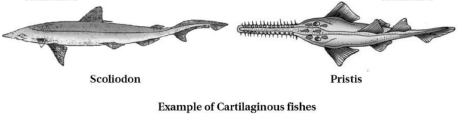
- Examples: $Scoliodon$ (Dog fish),$Pristis$ (Saw fish).
Osteichthyes:
- They include both marine and freshwater fishes with a bony endoskeleton.
- The body is streamlined. Mouth is mostly terminal.
- They have four pairs of gills which are covered by an operculum on each side.
- Skin is covered with cycloid/ctenoid scales.
- Air bladder is present which regulates buoyancy.
- Heart is two-chambered.
- They are cold-blooded animals.
- Sexes are separate. Fertilization is usually external. They are mostly oviparous and development is direct.
- Examples: $Hippocampus$ (Sea horse),$Labeo$ (Rohu).
$(b)$ Urochordata and Cephalochordata:
Urochordata (Tunicata):
- Notochord is present only in the larval tail.
- Examples: $Ascidia$,$Salpa$,$Doliolum$.
Cephalochordata:
- Notochord extends from head to tail region and is persistent throughout their life.
- Examples: $Branchiostoma$ (Amphioxus or Lancelet).
Chondrichthyes:
- They are marine animals with a streamlined body and cartilaginous endoskeleton.
- The mouth is located ventrally.
- The notochord is persistent throughout life.
- Gill slits are separate and without an operculum (gill cover).
- The skin is tough,containing minute placoid scales.
- Teeth are modified placoid scales that are backwardly directed.
- Their jaws are very powerful.
- These animals are predaceous.
- Due to the absence of an air bladder,they have to swim constantly to avoid sinking.
- The heart is two-chambered (one auricle and one ventricle).
- Some of them have electric organs (e.g.,$Torpedo$) and some possess a poison sting (e.g.,$Trygon$).
- They are cold-blooded (poikilothermous) animals.
- Sexes are separate. In males,pelvic fins bear claspers.
- They have internal fertilization and many are viviparous.
- Examples: $Scoliodon$ (Dog fish),$Pristis$ (Saw fish).
Osteichthyes:
- They include both marine and freshwater fishes with a bony endoskeleton.
- The body is streamlined. Mouth is mostly terminal.
- They have four pairs of gills which are covered by an operculum on each side.
- Skin is covered with cycloid/ctenoid scales.
- Air bladder is present which regulates buoyancy.
- Heart is two-chambered.
- They are cold-blooded animals.
- Sexes are separate. Fertilization is usually external. They are mostly oviparous and development is direct.
- Examples: $Hippocampus$ (Sea horse),$Labeo$ (Rohu).
$(b)$ Urochordata and Cephalochordata:
Urochordata (Tunicata):
- Notochord is present only in the larval tail.
- Examples: $Ascidia$,$Salpa$,$Doliolum$.
Cephalochordata:
- Notochord extends from head to tail region and is persistent throughout their life.
- Examples: $Branchiostoma$ (Amphioxus or Lancelet).
0 likes
View Solution317
Easy
Mention two similarities between:
$(a)$ Aves and mammals
$(b)$ $A$ frog and crocodile
$(c)$ $A$ turtle and Pila
$(a)$ Aves and mammals
$(b)$ $A$ frog and crocodile
$(c)$ $A$ turtle and Pila
Solution
(N/A) Aves and mammals: Both are warm-blooded (homeothermic) animals and possess a four-chambered heart.
$(b)$ $A$ frog and crocodile: Both can live in both terrestrial and aquatic habitats. Both utilize lungs for respiration.
$(c)$ $A$ turtle and Pila: Both possess a hard protective shell covering their body. Both are oviparous (egg-laying) animals.
$(b)$ $A$ frog and crocodile: Both can live in both terrestrial and aquatic habitats. Both utilize lungs for respiration.
$(c)$ $A$ turtle and Pila: Both possess a hard protective shell covering their body. Both are oviparous (egg-laying) animals.
0 likes
View Solution318
Medium
Give the names of the following:
$(a)$ $A$ limbless animal
$(b)$ $A$ cold-blooded animal
$(c)$ $A$ warm-blooded animal
$(d)$ An animal possessing dry and cornified skin
$(e)$ An animal having a canal system and spicules
$(f)$ An animal with cnidoblasts
$(a)$ $A$ limbless animal
$(b)$ $A$ cold-blooded animal
$(c)$ $A$ warm-blooded animal
$(d)$ An animal possessing dry and cornified skin
$(e)$ An animal having a canal system and spicules
$(f)$ An animal with cnidoblasts
Solution
(N/A) Ichthyophis (a limbless amphibian).
$(b)$ Frog (an ectothermic or cold-blooded animal).
$(c)$ Parrot (an endothermic or warm-blooded animal).
$(d)$ Python (a reptile with dry and cornified skin).
$(e)$ Sycon (a sponge belonging to Phylum Porifera).
$(f)$ Obelia (a cnidarian possessing cnidoblasts).
$(b)$ Frog (an ectothermic or cold-blooded animal).
$(c)$ Parrot (an endothermic or warm-blooded animal).
$(d)$ Python (a reptile with dry and cornified skin).
$(e)$ Sycon (a sponge belonging to Phylum Porifera).
$(f)$ Obelia (a cnidarian possessing cnidoblasts).
0 likes
View Solution319
Medium
Give an example of the following:
$(a)$ $A$ viviparous animal
$(b)$ $A$ fish possessing a poison sting
$(c)$ $A$ fish possessing an electric organ
$(d)$ An organ which regulates buoyancy
$(e)$ An animal which exhibits alternation of generation
$(f)$ An oviparous animal with mammary glands
$(a)$ $A$ viviparous animal
$(b)$ $A$ fish possessing a poison sting
$(c)$ $A$ fish possessing an electric organ
$(d)$ An organ which regulates buoyancy
$(e)$ An animal which exhibits alternation of generation
$(f)$ An oviparous animal with mammary glands
Solution
(N/A) Chimpanzee (or any mammal like Human or Whale).
$(b)$ Stingray (Trygon).
$(c)$ Electric ray (Torpedo).
$(d)$ Air bladder (Swim bladder).
$(e)$ Obelia.
$(f)$ Platypus (Ornithorhynchus).
$(b)$ Stingray (Trygon).
$(c)$ Electric ray (Torpedo).
$(d)$ Air bladder (Swim bladder).
$(e)$ Obelia.
$(f)$ Platypus (Ornithorhynchus).
0 likes
View Solution320
EasyMCQ
What does the term 'Frugivorous' mean?
A
Feeding on insects
B
Feeding on fruits
C
Feeding on nectar
D
Feeding on blood
Solution
(B) The term 'Frugivorous' refers to organisms that primarily feed on fruits.
Examples of frugivorous animals include monkeys,fruit bats,and certain species of birds like hornbills.
Examples of frugivorous animals include monkeys,fruit bats,and certain species of birds like hornbills.
0 likes
View Solution321
Medium
Comment upon the habitats and external features of animals belonging to class Amphibia and Reptilia.
Solution
(N/A) Amphibia:
- As the name indicates (Gr.,Amphi: dual,bios: life),amphibians can live in aquatic as well as terrestrial habitats.
- Most of them have two pairs of limbs.
- Body is divisible into head and trunk.
- Tail may be present in some.
- The amphibian skin is moist (without scales).
- The eyes have eyelids.
- $A$ tympanum represents the ear.
- Alimentary canal,urinary and reproductive tracts open into a common chamber called cloaca which opens to the exterior.
- Respiration is by gills,lungs and through skin.
- The heart is three-chambered (two auricles and one ventricle).
- These are cold-blooded (poikilothermous) animals.
- Sexes are separate.
- Fertilisation is external.
- They are oviparous and development is direct or indirect.
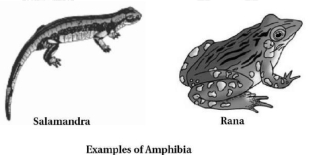
- Examples: Bufo (Toad),Rana (Frog),Hyla (Tree frog),Salamandra (Salamander),Ichthyophis (Limbless amphibia).
Reptilia:
- The class name refers to their creeping or crawling mode of locomotion (Latin,repere or reptum: to creep or crawl).
- They are mostly terrestrial animals and their body is covered by dry and cornified skin,epidermal scales or scutes.
- They do not have external ear openings. Tympanum represents ear.
- Limbs,when present,are two pairs.
- Heart is usually three-chambered,but four-chambered in crocodiles.
- Reptiles are poikilotherms.
- Snakes and lizards shed their scales as skin cast.
- Sexes are separate.
- Fertilisation is internal.
- They are oviparous and development is direct.
- Examples: Chelone (Turtle),Testudo (Tortoise),Chameleon (Tree lizard),Calotes (Garden lizard),Crocodilus (Crocodile),Alligator (Alligator),Hemidactylus (Wall lizard),Poisonous snakes - Naja (Cobra),Bangarus (Krait),Vipera (Viper).
- As the name indicates (Gr.,Amphi: dual,bios: life),amphibians can live in aquatic as well as terrestrial habitats.
- Most of them have two pairs of limbs.
- Body is divisible into head and trunk.
- Tail may be present in some.
- The amphibian skin is moist (without scales).
- The eyes have eyelids.
- $A$ tympanum represents the ear.
- Alimentary canal,urinary and reproductive tracts open into a common chamber called cloaca which opens to the exterior.
- Respiration is by gills,lungs and through skin.
- The heart is three-chambered (two auricles and one ventricle).
- These are cold-blooded (poikilothermous) animals.
- Sexes are separate.
- Fertilisation is external.
- They are oviparous and development is direct or indirect.
- Examples: Bufo (Toad),Rana (Frog),Hyla (Tree frog),Salamandra (Salamander),Ichthyophis (Limbless amphibia).
Reptilia:
- The class name refers to their creeping or crawling mode of locomotion (Latin,repere or reptum: to creep or crawl).
- They are mostly terrestrial animals and their body is covered by dry and cornified skin,epidermal scales or scutes.
- They do not have external ear openings. Tympanum represents ear.
- Limbs,when present,are two pairs.
- Heart is usually three-chambered,but four-chambered in crocodiles.
- Reptiles are poikilotherms.
- Snakes and lizards shed their scales as skin cast.
- Sexes are separate.
- Fertilisation is internal.
- They are oviparous and development is direct.
- Examples: Chelone (Turtle),Testudo (Tortoise),Chameleon (Tree lizard),Calotes (Garden lizard),Crocodilus (Crocodile),Alligator (Alligator),Hemidactylus (Wall lizard),Poisonous snakes - Naja (Cobra),Bangarus (Krait),Vipera (Viper).
0 likes
View Solution322
MediumMCQ
Identify the correct terms for the following analogy-based questions:
$(i)$ Porifera : Asymmetrical :: Cnidaria : .........
$(ii)$ Annelida : Coelomate :: Platyhelminthes : ......
$(i)$ Porifera : Asymmetrical :: Cnidaria : .........
$(ii)$ Annelida : Coelomate :: Platyhelminthes : ......
A
$(i)$ Radial symmetry,$(ii)$ Acoelomate
B
$(i)$ Bilateral symmetry,$(ii)$ Pseudocoelomate
C
$(i)$ Radial symmetry,$(ii)$ Pseudocoelomate
D
$(i)$ Bilateral symmetry,$(ii)$ Acoelomate
Solution
(A) $(i)$ Cnidarians exhibit radial symmetry,whereas Poriferans are mostly asymmetrical. Therefore,the correct term is radial symmetry.
$(ii)$ Annelids are true coelomates,whereas Platyhelminthes (flatworms) lack a body cavity and are therefore acoelomates.
$(ii)$ Annelids are true coelomates,whereas Platyhelminthes (flatworms) lack a body cavity and are therefore acoelomates.
0 likes
View Solution323
EasyMCQ
Identify the correct terms for the following analogy-based questions:
$(i)$ In Porifera: Water exits through Osculum :: In Cnidaria: ......
(ii) Ctenophora: Comb plates :: Aschelminthes: ......
$(i)$ In Porifera: Water exits through Osculum :: In Cnidaria: ......
(ii) Ctenophora: Comb plates :: Aschelminthes: ......
A
$(i)$ Hypostome,(ii) Flame cells
B
$(i)$ Hypostome,(ii) Excretory pore
C
$(i)$ Osculum,(ii) Nephridia
D
$(i)$ Mouth,(ii) Flame cells
Solution
(B) $(i)$ In Cnidaria,the body has a single opening called the hypostome (or mouth) through which water and food enter and waste exits. Thus,the correct term is hypostome.
(ii) In Aschelminthes (roundworms),the excretory system consists of an excretory pore that removes body wastes from the body cavity. Thus,the correct term is excretory pore.
(ii) In Aschelminthes (roundworms),the excretory system consists of an excretory pore that removes body wastes from the body cavity. Thus,the correct term is excretory pore.
0 likes
View Solution324
MediumMCQ
Identify the correct terms for the following analogy-based questions:
$(i)$ Aquatic Annelids : Parapodia :: Arthropods : ....
$(ii)$ Annelids : Nephridia :: Arthropods : ....
$(i)$ Aquatic Annelids : Parapodia :: Arthropods : ....
$(ii)$ Annelids : Nephridia :: Arthropods : ....
A
$(i)$ Jointed appendages,$(ii)$ Malpighian tubules
B
$(i)$ Setae,$(ii)$ Flame cells
C
$(i)$ Parapodia,$(ii)$ Green glands
D
$(i)$ Jointed appendages,$(ii)$ Nephridia
Solution
(A) $(i)$ In aquatic annelids like Nereis,lateral appendages called parapodia are present,which help in swimming. Similarly,in arthropods,the characteristic feature is the presence of jointed appendages.
$(ii)$ In annelids,the excretory organs are nephridia. In arthropods,the primary excretory organs are Malpighian tubules.
$(ii)$ In annelids,the excretory organs are nephridia. In arthropods,the primary excretory organs are Malpighian tubules.
0 likes
View Solution325
EasyMCQ
Identify the correct terms for the following analogy-based questions:
$(i)$ Porifera : Choanocytes :: Platyhelminthes : ....
$(ii)$ Chondrichthyes : Placoid scales :: Osteichthyes : ....
$(i)$ Porifera : Choanocytes :: Platyhelminthes : ....
$(ii)$ Chondrichthyes : Placoid scales :: Osteichthyes : ....
A
$(i)$ Flame cells,$(ii)$ Cycloid scales
B
$(i)$ Cnidoblasts,$(ii)$ Ctenoid scales
C
$(i)$ Nephridia,$(ii)$ Placoid scales
D
$(i)$ Choanocytes,$(ii)$ Ctenoid scales
Solution
(A) $(i)$ In Porifera,the body wall contains specialized cells called Choanocytes (collar cells). Similarly,in Platyhelminthes,the specialized cells for excretion and osmoregulation are called Flame cells (protonephridia).
$(ii)$ Chondrichthyes (cartilaginous fishes) possess Placoid scales. Similarly,Osteichthyes (bony fishes) possess Cycloid or Ctenoid scales.
$(ii)$ Chondrichthyes (cartilaginous fishes) possess Placoid scales. Similarly,Osteichthyes (bony fishes) possess Cycloid or Ctenoid scales.
0 likes
View Solution326
EasyMCQ
Choose the correct option for the following statements:
$(i)$ Metamerism is a characteristic feature of $Annelida$ / $Arthropoda$.
$(ii)$ Internal buds in sponges are called $Gemmules$ / $Gemmi$.
$(i)$ Metamerism is a characteristic feature of $Annelida$ / $Arthropoda$.
$(ii)$ Internal buds in sponges are called $Gemmules$ / $Gemmi$.
A
$Annelida, Gemmules$
B
$Arthropoda, Gemmi$
C
$Annelida, Gemmi$
D
$Arthropoda, Gemmules$
Solution
(A) $(i)$ Metamerism (true segmentation) is a characteristic feature of the phylum $Annelida$,where the body is externally and internally divided into segments called metameres.
$(ii)$ In sponges $(Porifera)$,asexual reproduction occurs through internal buds known as $Gemmules$,which help in perennation and dispersal.
$(ii)$ In sponges $(Porifera)$,asexual reproduction occurs through internal buds known as $Gemmules$,which help in perennation and dispersal.
0 likes
View Solution327
MediumMCQ
Choose the correct option for the following statements:
$(i)$ Birds are oviparous / viviparous animals showing internal fertilization.
$(ii)$ In cartilaginous fishes,gill slits are without operculum / with operculum.
$(i)$ Birds are oviparous / viviparous animals showing internal fertilization.
$(ii)$ In cartilaginous fishes,gill slits are without operculum / with operculum.
A
$(i)$ Oviparous,$(ii)$ Without operculum
B
$(i)$ Viviparous,$(ii)$ With operculum
C
$(i)$ Oviparous,$(ii)$ With operculum
D
$(i)$ Viviparous,$(ii)$ Without operculum
Solution
(A) $(i)$ Birds are oviparous animals that lay eggs,which is a characteristic feature of the class $Aves$.
$(ii)$ Cartilaginous fishes (class $Chondrichthyes$) are characterized by having $5-7$ pairs of gill slits that are separate and without an operculum (gill cover).
Therefore,the correct combination is $(i)$ Oviparous and $(ii)$ Without operculum.
$(ii)$ Cartilaginous fishes (class $Chondrichthyes$) are characterized by having $5-7$ pairs of gill slits that are separate and without an operculum (gill cover).
Therefore,the correct combination is $(i)$ Oviparous and $(ii)$ Without operculum.
0 likes
View Solution328
EasyMCQ
Choose the correct option from the following statements:
$(i)$ $Pleurobrachia$ and $Ctenoplana$ are examples of the phylum $Ctenophora$.
$(ii)$ $Spongilla$ is a freshwater sponge.
$(i)$ $Pleurobrachia$ and $Ctenoplana$ are examples of the phylum $Ctenophora$.
$(ii)$ $Spongilla$ is a freshwater sponge.
A
$(i)$ is true,$(ii)$ is false
B
$(i)$ is false,$(ii)$ is true
C
Both $(i)$ and $(ii)$ are true
D
Both $(i)$ and $(ii)$ are false
Solution
(C) $(i)$ $Pleurobrachia$ and $Ctenoplana$ are well-known examples of the phylum $Ctenophora$ (comb jellies).
$(ii)$ $Spongilla$ is a well-known example of a freshwater sponge,whereas $Sycon$ $(Scypha)$ and $Euspongia$ ($Bath$ $sponge$) are typically marine.
$(ii)$ $Spongilla$ is a well-known example of a freshwater sponge,whereas $Sycon$ $(Scypha)$ and $Euspongia$ ($Bath$ $sponge$) are typically marine.
0 likes
View Solution329
MediumMCQ
Select the correct option for the following statements:
$(i)$ Platyhelminthes are pseudocoelomate / acoelomate.
$(ii)$ Cnidarians are radially symmetrical / asymmetrical.
$(i)$ Platyhelminthes are pseudocoelomate / acoelomate.
$(ii)$ Cnidarians are radially symmetrical / asymmetrical.
A
$(i)$ Acoelomate,$(ii)$ Radially symmetrical
B
$(i)$ Pseudocoelomate,$(ii)$ Asymmetrical
C
$(i)$ Acoelomate,$(ii)$ Asymmetrical
D
$(i)$ Pseudocoelomate,$(ii)$ Radially symmetrical
Solution
(A) $(i)$ Platyhelminthes (flatworms) are acoelomate,meaning they lack a body cavity.
$(ii)$ Cnidarians (coelenterates) exhibit radial symmetry,where the body can be divided into identical halves by any plane passing through the central axis.
$(ii)$ Cnidarians (coelenterates) exhibit radial symmetry,where the body can be divided into identical halves by any plane passing through the central axis.
0 likes
View Solution330
EasyMCQ
Match the following columns and select the correct option.
Column $-I$ | Column $-II$
$(a)$ $6-15$ pairs of gill slits | $(i)$ Trygon
$(b)$ Heterocercal caudal fin | $(ii)$ Cyclostomes
$(c)$ Air Bladder | $(iii)$ Chondrichthyes
$(d)$ Poison sting | $(iv)$ Osteichthyes
Column $-I$ | Column $-II$
$(a)$ $6-15$ pairs of gill slits | $(i)$ Trygon
$(b)$ Heterocercal caudal fin | $(ii)$ Cyclostomes
$(c)$ Air Bladder | $(iii)$ Chondrichthyes
$(d)$ Poison sting | $(iv)$ Osteichthyes
A
$(i), (iv), (iii), (ii)$
B
$(ii), (iii), (iv), (i)$
C
$(iii), (iv), (i), (ii)$
D
$(iv), (iii), (iv), (i)$
Solution
(B) $6-15$ pairs of gill slits are a characteristic feature of Cyclostomes $(ii)$.
$(b)$ Heterocercal caudal fin is a characteristic feature of Chondrichthyes $(iii)$.
$(c)$ Air Bladder is present in Osteichthyes $(iv)$ to regulate buoyancy.
$(d)$ Poison sting is found in Trygon $(i)$,which belongs to Chondrichthyes.
Therefore,the correct matching is $(a)-(ii), (b)-(iii), (c)-(iv), (d)-(i)$.
$(b)$ Heterocercal caudal fin is a characteristic feature of Chondrichthyes $(iii)$.
$(c)$ Air Bladder is present in Osteichthyes $(iv)$ to regulate buoyancy.
$(d)$ Poison sting is found in Trygon $(i)$,which belongs to Chondrichthyes.
Therefore,the correct matching is $(a)-(ii), (b)-(iii), (c)-(iv), (d)-(i)$.
0 likes
View Solution331
MediumMCQ
Match the following columns and select the correct option.
$(a)\quad(b)\quad(c)\quad(d)$
| Column-$I$ | Column-$II$ |
| $(a)$ Gregarious,polyphagous pest | $(i)$ Asterias |
| $(b)$ Adult with radial symmetry and larva with bilateral symmetry | $(ii)$ Scorpion |
| $(c)$ Book lungs | $(iii)$ Ctenoplana |
| $(d)$ Bioluminescence | $(iv)$ Locusta |
$(a)\quad(b)\quad(c)\quad(d)$
A
$(ii)\quad(i)\quad(iii)\quad(iv)$
B
$(i)\quad(iii)\quad(ii)\quad(iv)$
C
$(iv)\quad(i)\quad(ii)\quad(iii)$
D
$(iii)\quad(ii)\quad(i)\quad(iv)$
Solution
(C) The correct matching is as follows:
$(a)$ Gregarious,polyphagous pest: $(iv)$ $Locusta$ (Locusts are known for their swarming behavior and feeding on various crops).
$(b)$ Adult with radial symmetry and larva with bilateral symmetry: $(i)$ $Asterias$ (Echinoderms like starfish exhibit radial symmetry in adults but bilateral symmetry in larvae).
$(c)$ Book lungs: $(ii)$ $Scorpion$ (Scorpions are arachnids that use book lungs for respiration).
$(d)$ Bioluminescence: $(iii)$ $Ctenoplana$ (Ctenophores are well-known for the property of bioluminescence).
Therefore,the correct sequence is $(a)-(iv), (b)-(i), (c)-(ii), (d)-(iii)$,which corresponds to option $(C)$.
$(a)$ Gregarious,polyphagous pest: $(iv)$ $Locusta$ (Locusts are known for their swarming behavior and feeding on various crops).
$(b)$ Adult with radial symmetry and larva with bilateral symmetry: $(i)$ $Asterias$ (Echinoderms like starfish exhibit radial symmetry in adults but bilateral symmetry in larvae).
$(c)$ Book lungs: $(ii)$ $Scorpion$ (Scorpions are arachnids that use book lungs for respiration).
$(d)$ Bioluminescence: $(iii)$ $Ctenoplana$ (Ctenophores are well-known for the property of bioluminescence).
Therefore,the correct sequence is $(a)-(iv), (b)-(i), (c)-(ii), (d)-(iii)$,which corresponds to option $(C)$.
0 likes
View Solution332
MediumMCQ
Match the following columns and select the correct option:
| Column-$I$ | Column-$II$ |
|---|---|
| $(a)$ Gregarious pest | $(i)$ Asterias |
| $(b)$ Radial symmetry in adults and bilateral symmetry in larvae | $(ii)$ Scorpion |
| $(c)$ Book lungs | $(iii)$ Ctenoplana |
| $(d)$ Bioluminescence | $(iv)$ Locusta |
A
$(i), (iii), (ii), (iv)$
B
$(iv), (i), (ii), (iii)$
C
$(iii), (ii), (i), (iv)$
D
$(ii), (i), (iii), (iv)$
Solution
(B) The correct matches are as follows:
$(a)$ Gregarious pest: $(iv)$ Locusta (a type of locust).
$(b)$ Radial symmetry in adults and bilateral symmetry in larvae: $(i)$ Asterias (Starfish,belonging to Echinodermata).
$(c)$ Book lungs: $(ii)$ Scorpion (Arthropoda,Arachnida).
$(d)$ Bioluminescence: $(iii)$ Ctenoplana (Ctenophora).
Therefore,the correct sequence is $(a)-(iv), (b)-(i), (c)-(ii), (d)-(iii)$.
$(a)$ Gregarious pest: $(iv)$ Locusta (a type of locust).
$(b)$ Radial symmetry in adults and bilateral symmetry in larvae: $(i)$ Asterias (Starfish,belonging to Echinodermata).
$(c)$ Book lungs: $(ii)$ Scorpion (Arthropoda,Arachnida).
$(d)$ Bioluminescence: $(iii)$ Ctenoplana (Ctenophora).
Therefore,the correct sequence is $(a)-(iv), (b)-(i), (c)-(ii), (d)-(iii)$.
0 likes
View Solution333
MediumMCQ
Match the following columns and select the correct option:
$(a)\quad (b)\quad (c)\quad (d)$
| $(a)$ $6-15$ pairs of gill slits | $(i)$ $Trygon$ |
| $(b)$ Heterocercal caudal fin | $(ii)$ $Petromyzon$ |
| $(c)$ Air bladder | $(iii)$ $Chondrichthyes$ |
| $(d)$ Poison sting | $(iv)$ $Osteichthyes$ |
$(a)\quad (b)\quad (c)\quad (d)$
A
$(ii)\quad (iii)\quad (iv)\quad (i)$
B
$(iii)\quad (iv)\quad (i)\quad (ii)$
C
$(iv)\quad (ii)\quad (iii)\quad (i)$
D
$(i)\quad (iv)\quad (iii)\quad (ii)$
Solution
(A) $6-15$ pairs of gill slits are characteristic of $Petromyzon$ (Cyclostomata).
$(b)$ Heterocercal caudal fin is a characteristic feature of cartilaginous fishes $(Chondrichthyes)$.
$(c)$ Air bladder is present in bony fishes $(Osteichthyes)$ to regulate buoyancy.
$(d)$ Poison sting is found in $Trygon$ (Sting ray),which belongs to $Chondrichthyes$.
Therefore,the correct matching is $(a)-(ii), (b)-(iii), (c)-(iv), (d)-(i)$.
$(b)$ Heterocercal caudal fin is a characteristic feature of cartilaginous fishes $(Chondrichthyes)$.
$(c)$ Air bladder is present in bony fishes $(Osteichthyes)$ to regulate buoyancy.
$(d)$ Poison sting is found in $Trygon$ (Sting ray),which belongs to $Chondrichthyes$.
Therefore,the correct matching is $(a)-(ii), (b)-(iii), (c)-(iv), (d)-(i)$.
0 likes
View Solution334
MediumMCQ
Which of the following is $NOT$ an endoparasite?
A
Tapeworm
B
Amphidrus
C
Plasmodium
D
Entamoeba
Solution
(B) An endoparasite is an organism that lives inside the body of its host.
$A$. Tapeworm (Platyhelminthes) lives in the intestine of humans.
$B$. Amphidrus is not a recognized endoparasite; it is likely a distractor or a misspelling of a non-parasitic organism.
$C$. Plasmodium is an intracellular parasite that causes malaria in humans.
$D$. Entamoeba histolytica is an intestinal parasite that causes amoebiasis.
Therefore,Amphidrus is the correct answer as it is not an endoparasite.
$A$. Tapeworm (Platyhelminthes) lives in the intestine of humans.
$B$. Amphidrus is not a recognized endoparasite; it is likely a distractor or a misspelling of a non-parasitic organism.
$C$. Plasmodium is an intracellular parasite that causes malaria in humans.
$D$. Entamoeba histolytica is an intestinal parasite that causes amoebiasis.
Therefore,Amphidrus is the correct answer as it is not an endoparasite.
0 likes
View Solution335
MediumMCQ
Which of the following is not a subspecies of tiger?
A
Bali
B
Javan
C
Liger
D
Caspian
Solution
(C) The tiger $(Panthera \text{ } tigris)$ has several recognized subspecies, including the Bali tiger $(P. \text{ } t. \text{ } balica)$, Javan tiger $(P. \text{ } t. \text{ } sondaica)$, and Caspian tiger $(P. \text{ } t. \text{ } virgata)$.
$A$ Liger is a hybrid offspring of a male lion $(Panthera \text{ } leo)$ and a female tiger $(Panthera \text{ } tigris)$.
Therefore, a Liger is not a subspecies of a tiger, but rather a cross-species hybrid.
$A$ Liger is a hybrid offspring of a male lion $(Panthera \text{ } leo)$ and a female tiger $(Panthera \text{ } tigris)$.
Therefore, a Liger is not a subspecies of a tiger, but rather a cross-species hybrid.
0 likes
View Solution336
MediumMCQ
Match the following group of organisms with their respective distinctive characteristics and select the correct option:
| Organisms | Characteristics |
|---|---|
| $(a)$ Platyhelminthes | $(i)$ Cylindrical body with no segmentation |
| $(b)$ Echinoderms | $(ii)$ Warm-blooded animals with direct development |
| $(c)$ Hemichordates | $(iii)$ Bilateral symmetry with incomplete digestive system |
| $(d)$ Aves | $(iv)$ Radial symmetry with indirect development |
A
$(a)-(i), (b)-(ii), (c)-(iii), (d)-(iv)$
B
$(a)-(iii), (b)-(iv), (c)-(i), (d)-(ii)$
C
$(a)-(ii), (b)-(iii), (c)-(iv), (d)-(i)$
D
$(a)-(iv), (b)-(i), (c)-(ii), (d)-(iii)$
Solution
(B) The correct matching is as follows:
$(a)$ Platyhelminthes: $(iii)$ Bilateral symmetry with an incomplete digestive system (single opening).
$(b)$ Echinoderms: $(iv)$ Radial symmetry (in adults) with indirect development (larval stage present).
$(c)$ Hemichordates: $(i)$ Cylindrical body with no segmentation (proboscis,collar,and trunk).
$(d)$ Aves: $(ii)$ Warm-blooded animals (homeotherms) with direct development.
Therefore,the correct sequence is $(a)-(iii), (b)-(iv), (c)-(i), (d)-(ii)$.
$(a)$ Platyhelminthes: $(iii)$ Bilateral symmetry with an incomplete digestive system (single opening).
$(b)$ Echinoderms: $(iv)$ Radial symmetry (in adults) with indirect development (larval stage present).
$(c)$ Hemichordates: $(i)$ Cylindrical body with no segmentation (proboscis,collar,and trunk).
$(d)$ Aves: $(ii)$ Warm-blooded animals (homeotherms) with direct development.
Therefore,the correct sequence is $(a)-(iii), (b)-(iv), (c)-(i), (d)-(ii)$.
0 likes
View Solution337
EasyMCQ
Match the following columns and select the correct option:
| Column $I$ | Column $II$ |
|---|---|
| $(a)$ Aptenodytes | $(i)$ Flying fox |
| $(b)$ Pteropus | $(ii)$ Angel fish |
| $(c)$ Pterophyllum | $(iii)$ Lamprey |
| $(d)$ Petromyzon | $(iv)$ Penguin |
A
$(a)-(ii), (b)-(i), (c)-(iv), (d)-(iii)$
B
$(a)-(iii), (b)-(iv), (c)-(ii), (d)-(i)$
C
$(a)-(iii), (b)-(iv), (c)-(i), (d)-(ii)$
D
$(a)-(iv), (b)-(i), (c)-(ii), (d)-(iii)$
Solution
(D) The correct matching is as follows:
$(a)$ $Aptenodytes$ is commonly known as the Penguin,which belongs to the class $Aves$.
$(b)$ $Pteropus$ is commonly known as the Flying fox,which belongs to the class $Mammalia$.
$(c)$ $Pterophyllum$ is commonly known as the Angel fish,which belongs to the class $Osteichthyes$.
$(d)$ $Petromyzon$ is commonly known as the Lamprey,which belongs to the class $Cyclostomata$.
Therefore,the correct sequence is $(a)-(iv), (b)-(i), (c)-(ii), (d)-(iii)$. Thus,option $(D)$ is correct.
$(a)$ $Aptenodytes$ is commonly known as the Penguin,which belongs to the class $Aves$.
$(b)$ $Pteropus$ is commonly known as the Flying fox,which belongs to the class $Mammalia$.
$(c)$ $Pterophyllum$ is commonly known as the Angel fish,which belongs to the class $Osteichthyes$.
$(d)$ $Petromyzon$ is commonly known as the Lamprey,which belongs to the class $Cyclostomata$.
Therefore,the correct sequence is $(a)-(iv), (b)-(i), (c)-(ii), (d)-(iii)$. Thus,option $(D)$ is correct.
0 likes
View Solution338
MediumMCQ
Choose the correct difference between $Pristis$ and $Catla$.
A
$3$-chambered heart $-$ $2$-chambered heart
B
Small placoid scales $-$ Large placoid scales
C
Ventral mouth $-$ Terminal mouth
D
Swim bladder present $-$ Swim bladder absent
Solution
(C) $Pristis$ (Sawfish) belongs to the class $Chondrichthyes$ (cartilaginous fishes),which typically possess a ventral mouth.
$Catla$ (Carp) belongs to the class $Osteichthyes$ (bony fishes),which typically possess a terminal mouth.
Therefore,the correct difference is that $Pristis$ has a ventral mouth,while $Catla$ has a terminal mouth.
$Catla$ (Carp) belongs to the class $Osteichthyes$ (bony fishes),which typically possess a terminal mouth.
Therefore,the correct difference is that $Pristis$ has a ventral mouth,while $Catla$ has a terminal mouth.
0 likes
View Solution339
MediumMCQ
Choose the correct option representing the organisms belonging to their respective classes.
A
Amphibia: Frog,Salamander,Bufo,Ichthyophis
B
Reptiles: Lizard,Turtle,Hyla,Ichthyophis
C
Birds: Pigeon,Parrot,Balaenoptera,Flying fox
D
Arthropods: Apis,Ancylostoma,Laccifer,Nereis
Solution
(A) The correct option is $A$.
$1$. Amphibia includes animals like Frog (Rana),Salamander,Bufo (Toad),and Ichthyophis (limbless amphibian).
$2$. Option $B$ is incorrect because Hyla is an amphibian,not a reptile.
$3$. Option $C$ is incorrect because Balaenoptera (Blue whale) and Flying fox (Pteropus) are mammals,not birds.
$4$. Option $D$ is incorrect because Ancylostoma (hookworm) is an Aschelminthes and Nereis is an Annelid,not Arthropods.
$1$. Amphibia includes animals like Frog (Rana),Salamander,Bufo (Toad),and Ichthyophis (limbless amphibian).
$2$. Option $B$ is incorrect because Hyla is an amphibian,not a reptile.
$3$. Option $C$ is incorrect because Balaenoptera (Blue whale) and Flying fox (Pteropus) are mammals,not birds.
$4$. Option $D$ is incorrect because Ancylostoma (hookworm) is an Aschelminthes and Nereis is an Annelid,not Arthropods.
0 likes
View Solution340
MediumMCQ
Reptiles are different from amphibians in
A
The skin
B
Structure of the heart
C
Development stages
D
All of these
Solution
(D) Reptiles differ from amphibians in several key aspects:
$1$. Skin: Amphibians possess smooth,moist skin that lacks scales,whereas reptiles have dry,cornified skin covered by epidermal scales or scutes.
$2$. Heart Structure: Most amphibians have a $3$-chambered heart ($2$ atria and $1$ ventricle). In contrast,most reptiles have a $3$-chambered heart,but it is partially divided,and crocodilians possess a $4$-chambered heart,representing a more advanced circulatory system.
$3$. Development Stages: Amphibians typically undergo metamorphosis,often involving an aquatic larval stage (e.g.,tadpole). Reptiles exhibit direct development,where the young resemble the adults and do not undergo a larval stage.
$1$. Skin: Amphibians possess smooth,moist skin that lacks scales,whereas reptiles have dry,cornified skin covered by epidermal scales or scutes.
$2$. Heart Structure: Most amphibians have a $3$-chambered heart ($2$ atria and $1$ ventricle). In contrast,most reptiles have a $3$-chambered heart,but it is partially divided,and crocodilians possess a $4$-chambered heart,representing a more advanced circulatory system.
$3$. Development Stages: Amphibians typically undergo metamorphosis,often involving an aquatic larval stage (e.g.,tadpole). Reptiles exhibit direct development,where the young resemble the adults and do not undergo a larval stage.
0 likes
View Solution341
MediumMCQ
Find the odd example.
A
Sea lily
B
Sea fan
C
Sea cucumber
D
Sea urchin
Solution
(B) Sea fan $(Gorgonia)$ belongs to phylum $Coelenterata$ (Cnidaria),whereas sea lily $(Antedon)$,sea cucumber $(Cucumaria)$,and sea urchin $(Echinus)$ belong to phylum $Echinodermata$.
0 likes
View Solution342
MediumMCQ
Choose the group of parasitic animals.
A
$Wuchereria - Pheretima - Nereis$
B
$Liverfluke - Dugesia - Ascaris$
C
$Fasciola - Taenia - Ancylostoma$
D
$Wuchereria - Fasciola - Dugesia$
Solution
(C) $Dugesia$ (Planaria) is a free-living flatworm.
$Pheretima$ (earthworm) and $Nereis$ are free-living annelids.
$Fasciola$ (liver fluke),$Taenia$ (tapeworm),and $Ancylostoma$ (hookworm) are all parasitic organisms.
Therefore,the group consisting entirely of parasitic animals is $Fasciola - Taenia - Ancylostoma$.
$Pheretima$ (earthworm) and $Nereis$ are free-living annelids.
$Fasciola$ (liver fluke),$Taenia$ (tapeworm),and $Ancylostoma$ (hookworm) are all parasitic organisms.
Therefore,the group consisting entirely of parasitic animals is $Fasciola - Taenia - Ancylostoma$.
0 likes
View Solution343
MediumMCQ
Select the correct statement.
A
Birds are poikilothermic.
B
Flatworms are coelomic animals.
C
Earthworm is metamerically segmented.
D
Fishes are radially symmetrical.
Solution
(C) The correct statement is that the earthworm ($Pheretima$ $posthuma$) is metamerically segmented.
Earthworms belong to the phylum $Annelida$,which is characterized by true metameric segmentation.
Birds are homeothermic (warm-blooded),not poikilothermic.
Flatworms $(Platyhelminthes)$ are acoelomate,not coelomic.
Fishes are bilaterally symmetrical,not radially symmetrical.
Earthworms belong to the phylum $Annelida$,which is characterized by true metameric segmentation.
Birds are homeothermic (warm-blooded),not poikilothermic.
Flatworms $(Platyhelminthes)$ are acoelomate,not coelomic.
Fishes are bilaterally symmetrical,not radially symmetrical.
0 likes
View Solution344
MediumMCQ
Which of the following is not correctly matched?
A
Sycon - Canal system
B
Starfish - Radial symmetry
C
Ascaris - Flame cell
D
Prawn - Haemocoel
Solution
(C) Flame cells are the specialized excretory structures found in the phylum Platyhelminthes (flatworms).
$Ascaris$ belongs to the phylum Aschelminthes (roundworms), which uses a renette cell or an excretory pore system for excretion, not flame cells.
Therefore, the pair $Ascaris - \text{Flame cell}$ is incorrectly matched.
$Ascaris$ belongs to the phylum Aschelminthes (roundworms), which uses a renette cell or an excretory pore system for excretion, not flame cells.
Therefore, the pair $Ascaris - \text{Flame cell}$ is incorrectly matched.
0 likes
View Solution345
EasyMCQ
Solenocytes and nephridia are respectively found in
A
Platyhelminthes and Annelida
B
Annelida and Nematoda
C
Cnidaria and Mollusca
D
Mollusca and Echinodermata
Solution
(A) Solenocytes (also known as flame cells) are specialized excretory structures found in Platyhelminthes.
Nephridia are the tubular excretory organs found in Annelida.
Both structures serve the function of excretion and osmoregulation in their respective phyla.
Nephridia are the tubular excretory organs found in Annelida.
Both structures serve the function of excretion and osmoregulation in their respective phyla.
0 likes
View Solution346
MediumMCQ
The point by which $Annelida$ advanced over $Nematoda$ is
A
True coelom
B
Metameric segmentation
C
Closed circulation
D
All of the above
Solution
(D) $Annelida$ represents a significant evolutionary advancement over $Nematoda$ due to several key features:
$1$. $Annelids$ possess a true coelom (eucoelom),which is a body cavity lined by mesoderm,whereas $Nematodes$ have a pseudocoelom.
$2$. $Annelids$ exhibit metameric segmentation,meaning their body is divided into repeating segments both externally and internally.
$3$. $Annelids$ possess a closed circulatory system,which is more efficient than the fluid-filled body cavity transport seen in $Nematodes$.
Therefore,all the listed features represent advancements.
$1$. $Annelids$ possess a true coelom (eucoelom),which is a body cavity lined by mesoderm,whereas $Nematodes$ have a pseudocoelom.
$2$. $Annelids$ exhibit metameric segmentation,meaning their body is divided into repeating segments both externally and internally.
$3$. $Annelids$ possess a closed circulatory system,which is more efficient than the fluid-filled body cavity transport seen in $Nematodes$.
Therefore,all the listed features represent advancements.
0 likes
View Solution347
MediumMCQ
Which of the following groups of animals have the following features?
$I.$ Diploblastic
$II.$ Acoelomate
$III.$ Radial symmetry
$I.$ Diploblastic
$II.$ Acoelomate
$III.$ Radial symmetry
A
Planaria,Physalia,Aurelia
B
Taenia,Fasciola,Wuchereria
C
Adamsia,Beroe,Meandrina
D
Fasciola,Sycon,Sea walnut
Solution
(C) The features mentioned (Diploblastic,Acoelomate,and Radial symmetry) are characteristic of the phyla $Coelenterata$ (Cnidaria) and $Ctenophora$.
$1.$ $Adamsia$ (Sea anemone) belongs to the phylum $Coelenterata$.
$2.$ $Beroe$ belongs to the phylum $Ctenophora$.
$3.$ $Meandrina$ (Brain coral) belongs to the phylum $Coelenterata$.
All these organisms exhibit radial symmetry,are diploblastic,and lack a body cavity (acoelomate).
$1.$ $Adamsia$ (Sea anemone) belongs to the phylum $Coelenterata$.
$2.$ $Beroe$ belongs to the phylum $Ctenophora$.
$3.$ $Meandrina$ (Brain coral) belongs to the phylum $Coelenterata$.
All these organisms exhibit radial symmetry,are diploblastic,and lack a body cavity (acoelomate).
0 likes
View Solution348
MediumMCQ
Features common to the animals belonging to class-$Amphibia$ and class-$Reptilia$ are
A
Presence of scales with internal fertilization and usually four-chambered heart
B
Presence of tympanum,poikilotherms and usually three-chambered heart
C
Presence of cloaca,oviparous and external fertilization
D
Skin is moist
Solution
(B) Class-$Amphibia$ and class-$Reptilia$ share the following features:
$1$. Both classes possess a tympanum,which represents the ear.
$2$. Animals of both classes are cold-blooded or poikilotherms.
$3$. They usually have a three-chambered heart,with the exception of crocodiles in class-$Reptilia$ which have a four-chambered heart.
$1$. Both classes possess a tympanum,which represents the ear.
$2$. Animals of both classes are cold-blooded or poikilotherms.
$3$. They usually have a three-chambered heart,with the exception of crocodiles in class-$Reptilia$ which have a four-chambered heart.
0 likes
View Solution349
MediumMCQ
The only incorrectly matched pair is
A
Porifera - Cellular level
B
Cnidaria - Tissue level
C
Annelida - Organ level
D
Mollusca - Organ system level
Solution
(C) The levels of organization in the animal kingdom are classified as follows:
$1$. Porifera exhibit a cellular level of organization.
$2$. Cnidaria and Ctenophora exhibit a tissue level of organization.
$3$. Platyhelminthes and higher phyla exhibit an organ or organ-system level of organization.
$4$. Annelida, Arthropoda, Mollusca, Echinodermata, and Chordata exhibit an organ-system level of organization.
Therefore, the pair $Annelida - \text{Organ level}$ is incorrect because Annelida possesses an organ-system level of organization.
$1$. Porifera exhibit a cellular level of organization.
$2$. Cnidaria and Ctenophora exhibit a tissue level of organization.
$3$. Platyhelminthes and higher phyla exhibit an organ or organ-system level of organization.
$4$. Annelida, Arthropoda, Mollusca, Echinodermata, and Chordata exhibit an organ-system level of organization.
Therefore, the pair $Annelida - \text{Organ level}$ is incorrect because Annelida possesses an organ-system level of organization.
0 likes
View Solution350
MediumMCQ
The only incorrectly matched pair is:
| Phylum | Level of organisation |
|---|
A
$Porifera$ - Cellular level
B
$Cnidaria$ - Tissue level
C
$Annelida$ - Organ level only
D
$Mollusca$ - Organ system level
Solution
(C) $Porifera$ exhibits cellular level of organization.
$Cnidaria$ exhibits tissue level of organization.
$Annelida$ exhibits organ-system level of organization,not just organ level.
$Mollusca$ exhibits organ-system level of organization.
Therefore,the incorrectly matched pair is $Annelida$ - Organ level only.
$Cnidaria$ exhibits tissue level of organization.
$Annelida$ exhibits organ-system level of organization,not just organ level.
$Mollusca$ exhibits organ-system level of organization.
Therefore,the incorrectly matched pair is $Annelida$ - Organ level only.
0 likes
View SolutionAnimal Kingdom — Mix Examples - Animal Kingdom · Frequently Asked Questions
1Are these Animal Kingdom questions useful for JEE and NEET?
Yes. All questions in this section are mapped to JEE Main and NEET exam patterns. Previous year questions from JEE Main, NEET, GUJCET and state-level exams are included with full solutions.
2Can I switch to Hindi or Gujarati for these questions?
Yes. Use the language tabs in the hero section or the sidebar to view the same questions and solutions in English, Hindi or Gujarati.
3How do I generate a question paper from this subtopic?
Use the Vedclass Exam Paper Generator — select the chapter and subtopic, set difficulty, and generate Sets A, B, C, D automatically. First 3 chapters of every subject are free.
Vedclass Products
For Students
Vedclass Test Series
Mock tests in real JEE/NEET style with performance analysis. 5-day free trial.
Start Free TrialFor Teachers
Exam Paper Generator
Generate Set A/B/C/D papers from this chapter in 2 minutes. 3 chapters free.
Try FreeFor Institutes
Online Exam Module
Live online exams with unlimited students, 360° analytics & white-label branding.
See DemoFor Teachers & Institutes
Generate a Animal Kingdom Exam Paper in 2 Minutes
Select subtopic & difficulty — Sets A, B, C, D auto-generated with No Repeat logic.
First 3 chapters of every subject are free — no payment required.