
A English
Basic of classification Questions in English
Class 11 Biology · Animal Kingdom · Basic of classification
160+
Questions
English
Language
100%
With Solutions
Showing 48 of 160 questions in English
1
MediumMCQ
Aristotle classified the animals into two groups. Mark the correct one.
A
Vertebrata and invertebrata
B
Chordata and non-chordata
C
Protozoa and metazoa
D
Enaima and anaima
Solution
(D) Aristotle was the first to provide a scientific basis for classification. He classified animals into two groups based on the presence or absence of red blood cells.
$1$. $Enaima$: Animals with red blood (equivalent to vertebrates).
$2$. $Anaima$: Animals without red blood (equivalent to invertebrates).
$1$. $Enaima$: Animals with red blood (equivalent to vertebrates).
$2$. $Anaima$: Animals without red blood (equivalent to invertebrates).
0 likes
View Solution2
MediumMCQ
The main basis of classification of the phylum $Protozoa$ is:
A
Size
B
Locomotory organelle
C
Shape
D
Number of nuclei
Solution
(B) The phylum $Protozoa$ is classified primarily based on the presence and type of locomotory organelles.
Based on these structures,they are divided into four major groups: $Amoeboid$ (pseudopodia),$Flagellated$ (flagella),$Ciliated$ (cilia),and $Sporozoans$ (no locomotory organelle in the adult stage).
Based on these structures,they are divided into four major groups: $Amoeboid$ (pseudopodia),$Flagellated$ (flagella),$Ciliated$ (cilia),and $Sporozoans$ (no locomotory organelle in the adult stage).
0 likes
View Solution3
MediumMCQ
Animals having a well-marked digestive cavity are included under:
A
Parazoa
B
Enterozoa
C
Mesozoa
D
Metazoa
Solution
(B) Animals are broadly classified into two groups based on the presence or absence of a digestive cavity.
$1$. $Parazoa$: These are multicellular animals that lack a well-defined digestive cavity or tissues (e.g.,Porifera).
$2$. $Enterozoa$: These are animals that possess a well-marked digestive cavity (enteron) where extracellular digestion occurs. This group includes all multicellular animals except sponges,such as Cnidaria,Platyhelminthes,and higher phyla.
Therefore,animals with a well-marked digestive cavity are classified as $Enterozoa$.
$1$. $Parazoa$: These are multicellular animals that lack a well-defined digestive cavity or tissues (e.g.,Porifera).
$2$. $Enterozoa$: These are animals that possess a well-marked digestive cavity (enteron) where extracellular digestion occurs. This group includes all multicellular animals except sponges,such as Cnidaria,Platyhelminthes,and higher phyla.
Therefore,animals with a well-marked digestive cavity are classified as $Enterozoa$.
0 likes
View Solution4
MediumMCQ
The digestive system is considered complete when:
A
All the digestive glands are present
B
Both anus and mouth are present
C
Digestion occurs in the cavity of the digestive tract
D
Digestion occurs in the individual cells lining the digestive tract
Solution
(B) digestive system is termed complete when the digestive tract has two separate openings: a mouth for ingestion and an anus for egestion. This type of digestive system is found in animals ranging from $Aschelminthes$ (roundworms) to $Mammalia$.
0 likes
View Solution5
EasyMCQ
Symmetry found in $Volvox$ is
A
Radial
B
Biradial
C
Bilateral
D
Spherical
Solution
(D) In spherical symmetry,the body of an organism can be divided into equal halves by any plane passing through the center.
Organisms that exhibit spherical symmetry possess a spherical shape.
$Volvox$ is a classic example of an organism that exhibits spherical symmetry.
Organisms that exhibit spherical symmetry possess a spherical shape.
$Volvox$ is a classic example of an organism that exhibits spherical symmetry.
0 likes
View Solution6
MediumMCQ
Radial symmetry is often exhibited by animals having
A
One opening of alimentary canal
B
Aquatic mode of living
C
Benthos/sedentary nature
D
Ciliary mode of feeding
Solution
(C) Radial symmetry is a body plan where the organism can be divided into identical halves by any plane passing through the central axis. This type of symmetry is most commonly observed in animals that are sessile (sedentary) or slow-moving,such as Cnidarians and adult Echinoderms. Being sedentary allows these animals to interact with their environment from all directions equally,making radial symmetry an evolutionary advantage for such a lifestyle.
0 likes
View Solution7
MediumMCQ
Choose the correct combination:
A
$Annelida$ and $Porifera$ are Phyla.
B
$Oligochaeta$ and $Arthropoda$ are Phyla.
C
$Mollusca$ and $Hydrozoa$ are Classes.
D
$Aves$ and $Chordata$ are Classes.
Solution
(A) In biological classification,$Annelida$ and $Porifera$ are both recognized as distinct Phyla within the Kingdom $Animalia$.
$Oligochaeta$ is a class within the phylum $Annelida$,not a phylum itself.
$Mollusca$ is a phylum,while $Hydrozoa$ is a class within the phylum $Cnidaria$.
$Aves$ is a class,but $Chordata$ is a phylum.
Therefore,the only correct combination where both terms represent the same taxonomic rank (Phyla) is $Annelida$ and $Porifera$.
$Oligochaeta$ is a class within the phylum $Annelida$,not a phylum itself.
$Mollusca$ is a phylum,while $Hydrozoa$ is a class within the phylum $Cnidaria$.
$Aves$ is a class,but $Chordata$ is a phylum.
Therefore,the only correct combination where both terms represent the same taxonomic rank (Phyla) is $Annelida$ and $Porifera$.
0 likes
View Solution8
MediumMCQ
Organisms attached to a substratum generally possess:
A
Asymmetrical body
B
Radial symmetry
C
One single opening of the digestive canal
D
Cilia on the surface to create water current
Solution
(B) Organisms that are sessile or attached to a substratum, such as those in the phylum $Cnidaria$ (e.g., $Hydra$, $Sea$ $anemone$) or $Porifera$, often exhibit radial symmetry. Radial symmetry is an evolutionary adaptation for sessile organisms, as it allows them to interact with their environment and capture food from all directions equally, since they cannot move to hunt or escape.
0 likes
View Solution9
MediumMCQ
What is characteristic of deuterostomes?
A
Spiral cleavage,blastopore becoming mouth
B
Radial cleavage,blastopore becoming anus
C
Spiral cleavage,blastopore becoming anus
D
Radial cleavage,blastopore becoming mouth
Solution
(B) Deuterostomes are animals in which the blastopore,the first opening formed during gastrulation,develops into the anus,while the mouth develops from a second opening.
Additionally,deuterostomes typically exhibit radial cleavage during early embryonic development.
In contrast,protostomes exhibit spiral cleavage and the blastopore develops into the mouth.
Additionally,deuterostomes typically exhibit radial cleavage during early embryonic development.
In contrast,protostomes exhibit spiral cleavage and the blastopore develops into the mouth.
0 likes
View Solution10
MediumMCQ
The coelom is the body cavity between the alimentary canal and the body wall,which is lined by:
A
Ectoderm and endoderm
B
Mesoderm and ectoderm
C
Ectoderm on both sides
D
Mesoderm on both sides
Solution
(D) The coelom is a fluid-filled body cavity that lies between the body wall and the digestive tract (alimentary canal).
It is specifically defined as a cavity that is lined on all sides by the mesoderm.
If the body cavity is lined by mesoderm on both sides,the organism is considered a true coelomate (eucoelomate).
It is specifically defined as a cavity that is lined on all sides by the mesoderm.
If the body cavity is lined by mesoderm on both sides,the organism is considered a true coelomate (eucoelomate).
0 likes
View Solution11
MediumMCQ
The coelom produced by the splitting of the mesoderm is known as:
A
Hydrocoel
B
Enterocoel
C
Schizocoel
D
None of the above
Solution
(C) The coelom is a fluid-filled body cavity that is lined by the mesoderm.
When the coelom is formed by the splitting of the mesodermal layer during embryonic development,it is called a $Schizocoel$.
This type of coelom formation is characteristic of protostomes,such as annelids,mollusks,and arthropods.
In contrast,an $Enterocoel$ is formed by the outpocketing of the embryonic gut (archenteron),which is typical of deuterostomes like echinoderms and chordates.
When the coelom is formed by the splitting of the mesodermal layer during embryonic development,it is called a $Schizocoel$.
This type of coelom formation is characteristic of protostomes,such as annelids,mollusks,and arthropods.
In contrast,an $Enterocoel$ is formed by the outpocketing of the embryonic gut (archenteron),which is typical of deuterostomes like echinoderms and chordates.
0 likes
View Solution12
EasyMCQ
On the basis of organization,animals are grouped into
A
Metazoa and Eumetazoa
B
Protozoa and Metazoa
C
Protozoa and Parazoa
D
Parazoa and Metazoa
Solution
(B) The entire animal kingdom is classified into two sub-kingdoms: $Protozoa$ and $Metazoa$.
Unicellular animals are placed in $Protozoa$,while multicellular animals are included in $Metazoa$.
Unicellular animals are placed in $Protozoa$,while multicellular animals are included in $Metazoa$.
0 likes
View Solution13
MediumMCQ
$A$ true coelom is lined by which of the following germ layers?
A
Mesoderm
B
Ectoderm and endoderm
C
Ectoderm
D
Endoderm
Solution
(A) true coelom is a body cavity that is completely lined by the mesoderm.
In triploblastic animals,the mesoderm splits to form the coelomic cavity,which separates the gut wall from the body wall.
This characteristic is a key feature used in the classification of animals.
In triploblastic animals,the mesoderm splits to form the coelomic cavity,which separates the gut wall from the body wall.
This characteristic is a key feature used in the classification of animals.
0 likes
View Solution14
MediumMCQ
Which of the following phyla are included in the group $Enterozoa$?
A
$Annelida$,$Mollusca$,$Porifera$
B
$Echinodermata$,$Hemichordata$,$Porifera$
C
$Mollusca$,$Arthropoda$,$Hemichordata$
D
$Porifera$,$Mollusca$,$Arthropoda$
Solution
(C) The animal kingdom is broadly divided into two groups based on the presence or absence of a digestive cavity: $Parazoa$ and $Enterozoa$.
$1$. $Parazoa$: Includes organisms that lack a true digestive cavity or tissues,specifically the phylum $Porifera$ (sponges).
$2$. $Enterozoa$: Includes all multicellular animals that possess a digestive cavity (gut) and true tissues. This group encompasses all phyla from $Cnidaria$ to $Chordata$.
Among the given options,$Mollusca$,$Arthropoda$,and $Hemichordata$ are all members of the $Enterozoa$ group,as they possess a well-defined digestive system and tissue-level organization.
$1$. $Parazoa$: Includes organisms that lack a true digestive cavity or tissues,specifically the phylum $Porifera$ (sponges).
$2$. $Enterozoa$: Includes all multicellular animals that possess a digestive cavity (gut) and true tissues. This group encompasses all phyla from $Cnidaria$ to $Chordata$.
Among the given options,$Mollusca$,$Arthropoda$,and $Hemichordata$ are all members of the $Enterozoa$ group,as they possess a well-defined digestive system and tissue-level organization.
0 likes
View Solution15
MediumMCQ
The symmetry found in an animal which can be divided into two similar halves by one plane only is:
A
Radial
B
Biradial
C
Spherical
D
Bilateral
Solution
(D) Bilateral symmetry is a type of body organization where the body of an animal can be divided into two identical left and right halves by only a single longitudinal plane passing through the central axis.
This is characteristic of most higher animals,including humans,insects,and chordates.
This is characteristic of most higher animals,including humans,insects,and chordates.
0 likes
View Solution16
MediumMCQ
Body cavity lined by mesoderm is called
A
Coelenteron
B
Pseudocoel
C
Coelom
D
Blastocoel
Solution
(C) The body cavity which is lined by the mesoderm on all sides is known as the $Coelom$.
Animals possessing a $Coelom$ are called $Coelomates$ (e.g.,annelids,molluscs,arthropods,echinoderms,hemichordates,and chordates).
In some animals,the body cavity is not lined by mesoderm,instead,the mesoderm is present as scattered pouches in between the ectoderm and endoderm; such a body cavity is called a $Pseudocoel$ (e.g.,aschelminthes).
Animals possessing a $Coelom$ are called $Coelomates$ (e.g.,annelids,molluscs,arthropods,echinoderms,hemichordates,and chordates).
In some animals,the body cavity is not lined by mesoderm,instead,the mesoderm is present as scattered pouches in between the ectoderm and endoderm; such a body cavity is called a $Pseudocoel$ (e.g.,aschelminthes).
0 likes
View Solution17
EasyMCQ
Solenocytes and nephridia are respectively found in
A
Platyhelminthes and Annelids
B
Annelids and Nematoda
C
Cnidaria and Mollusca
D
Mollusca and Echinodermata
Solution
(A) Solenocytes,also known as flame cells or protonephridia,are the specialized excretory structures found in the phylum $Platyhelminthes$.
Nephridia are the tubular excretory organs found in the phylum $Annelida$.
Therefore,solenocytes and nephridia are respectively found in $Platyhelminthes$ and $Annelids$.
Nephridia are the tubular excretory organs found in the phylum $Annelida$.
Therefore,solenocytes and nephridia are respectively found in $Platyhelminthes$ and $Annelids$.
0 likes
View Solution18
MediumMCQ
The term for the body cavity present in triploblastic animals is
A
Haemocoel
B
Pseudocoelom
C
Coelom
D
All the above
Solution
(C) The correct answer is $C$.
Triploblastic animals possess three germ layers: the ectoderm,mesoderm,and endoderm.
$A$ true coelom is defined as a body cavity that is lined by the mesoderm and arises within the embryonic mesoderm during development.
Triploblastic animals possess three germ layers: the ectoderm,mesoderm,and endoderm.
$A$ true coelom is defined as a body cavity that is lined by the mesoderm and arises within the embryonic mesoderm during development.
0 likes
View Solution19
MediumMCQ
The coelom is a body cavity found between:
A
Ectoderm and Endoderm
B
Mesoderm and Endoderm
C
Body wall and ectoderm
D
Mesoderm and body wall
Solution
(D) The coelom is a fluid-filled body cavity that is lined by the mesoderm.
In triploblastic animals,the body wall is formed by the ectoderm and the gut wall is formed by the endoderm.
The coelom is specifically defined as the cavity that lies between the body wall (ectoderm) and the gut wall (endoderm),and it is completely lined by the mesoderm.
Therefore,the coelom is the space situated between the body wall and the alimentary canal (gut wall),which is derived from the mesoderm.
In triploblastic animals,the body wall is formed by the ectoderm and the gut wall is formed by the endoderm.
The coelom is specifically defined as the cavity that lies between the body wall (ectoderm) and the gut wall (endoderm),and it is completely lined by the mesoderm.
Therefore,the coelom is the space situated between the body wall and the alimentary canal (gut wall),which is derived from the mesoderm.
0 likes
View Solution20
EasyMCQ
In spiral cleavage,the turn of the spiral may be:
A
Clockwise
B
Anticlockwise
C
$(a)$ and $(b)$ both
D
None of these
Solution
(C) In spiral cleavage,the orientation of the blastomeres can vary.
When the turn of the spiral is clockwise,it is termed as $dextral$.
When the turn of the spiral is anticlockwise,it is termed as $sinistral$.
Therefore,both clockwise and anticlockwise turns are possible in spiral cleavage.
When the turn of the spiral is clockwise,it is termed as $dextral$.
When the turn of the spiral is anticlockwise,it is termed as $sinistral$.
Therefore,both clockwise and anticlockwise turns are possible in spiral cleavage.
0 likes
View Solution21
EasyMCQ
Archenteron is lined with
A
Ectoderm
B
Mesoderm
C
Endoderm
D
Mesoderm and endoderm
Solution
(C) The archenteron is the primitive gut cavity formed during gastrulation. It is lined by the endoderm,which eventually gives rise to the lining of the digestive tract and associated organs.
0 likes
View Solution22
MediumMCQ
Coelom is found between the cavity of
A
Ectoderm and endoderm
B
Mesoderm and ectoderm
C
Body wall and ectoderm
D
Mesoderm and body wall
Solution
(D) The coelom is a fluid-filled body cavity that is completely lined by mesoderm. It is situated between the body wall (ectoderm and associated muscles) and the gut wall (endoderm and associated muscles). Therefore,it is found between the mesoderm of the body wall and the mesoderm of the gut wall. Among the given options,the most accurate description is that it lies between the mesoderm and the body wall (or specifically,the mesoderm lining the body wall and the mesoderm lining the gut).
0 likes
View Solution23
MediumMCQ
When the mouth develops from the blastopore,the organism is called:
A
Deuterostomia
B
Protostomia
C
Blastostomia
D
None of these
Solution
(B) In $Protostomia$,the mouth is derived from the blastopore of the embryo,while the anus is formed at the opposite end.
In contrast,in $Deuterostomia$,the anus is derived from the blastopore,and the mouth is formed later at the opposite end.
Therefore,the correct classification for an organism where the mouth develops from the blastopore is $Protostomia$.
In contrast,in $Deuterostomia$,the anus is derived from the blastopore,and the mouth is formed later at the opposite end.
Therefore,the correct classification for an organism where the mouth develops from the blastopore is $Protostomia$.
0 likes
View Solution24
EasyMCQ
$A$ true coelom is a body cavity that is located between the body wall and the alimentary canal. It is lined by:
A
Mesoderm on one side and ectoderm on the other side
B
Endoderm on one side and ectoderm on the other side
C
Mesoderm on both the sides
D
Ectoderm on both the sides
Solution
(C) true coelom,or eucoelom,is a fluid-filled body cavity that is completely lined by mesoderm on both sides. This mesodermal lining allows for the separation of the body wall from the gut,facilitating independent movement and the development of complex organ systems. In contrast,a pseudocoelom is only partially lined by mesoderm.
0 likes
View Solution25
EasyMCQ
True coelom develops as a split in
A
Mesoderm
B
Endoderm
C
Ectoderm
D
Between ectoderm and endoderm
Solution
(A) true coelom is a body cavity that is completely lined by mesoderm. In schizocoelous development,the coelom is formed by the splitting of the mesodermal layer. Therefore,the true coelom develops as a split in the mesoderm.
0 likes
View Solution26
EasyMCQ
Which of the following kingdoms lacks a cell wall?
A
Plantae
B
Animalia
C
Fungi
D
Monera
Solution
(B) The kingdom $Animalia$ consists of multicellular organisms that are heterotrophic and eukaryotic. $A$ defining characteristic of animal cells is the complete absence of a cell wall,which distinguishes them from plants,fungi,and many protists. In contrast,$Plantae$ have cell walls made of cellulose,$Fungi$ have cell walls made of chitin,and $Monera$ (bacteria) have cell walls made of peptidoglycan.
0 likes
View Solution27
EasyMCQ
They do not perform photosynthesis and primarily obtain nutrition through ingestion.
A
Protista
B
Fungi
C
Plantae
D
Animalia
Solution
(D) The organisms that do not perform photosynthesis and obtain nutrition primarily through ingestion (holozoic nutrition) are classified under the kingdom $Animalia$.
$1$. $Protista$ includes diverse organisms,some of which are photosynthetic (like algae) and some are heterotrophic.
$2$. $Fungi$ are heterotrophic but obtain nutrition through absorption (saprophytic),not ingestion.
$3$. $Plantae$ are primarily photosynthetic.
$4$. $Animalia$ are heterotrophic and ingest their food.
$1$. $Protista$ includes diverse organisms,some of which are photosynthetic (like algae) and some are heterotrophic.
$2$. $Fungi$ are heterotrophic but obtain nutrition through absorption (saprophytic),not ingestion.
$3$. $Plantae$ are primarily photosynthetic.
$4$. $Animalia$ are heterotrophic and ingest their food.
0 likes
View Solution28
EasyMCQ
Which of the following is $NOT$ a basis for the classification of animals?
A
Levels of organization
B
Germ layers
C
Coelom
D
Reproduction
Solution
(D) The classification of animals is based on fundamental features such as:
$1$. Levels of organization (Cellular,Tissue,Organ,Organ-system level).
$2$. Symmetry (Asymmetrical,Radial,Bilateral).
$3$. Diploblastic and triploblastic organization (Germ layers).
$4$. Coelom (Acoelomate,Pseudocoelomate,Coelomate).
$5$. Segmentation and Notochord.
Reproduction is a biological process and is not considered a primary taxonomic criterion for the classification of animals in the kingdom Animalia.
$1$. Levels of organization (Cellular,Tissue,Organ,Organ-system level).
$2$. Symmetry (Asymmetrical,Radial,Bilateral).
$3$. Diploblastic and triploblastic organization (Germ layers).
$4$. Coelom (Acoelomate,Pseudocoelomate,Coelomate).
$5$. Segmentation and Notochord.
Reproduction is a biological process and is not considered a primary taxonomic criterion for the classification of animals in the kingdom Animalia.
0 likes
View Solution29
EasyMCQ
If the digestive tract is open at only one end,it is called ......... .
A
an incomplete digestive tract.
B
a partially complete digestive tract.
C
a complete digestive tract.
D
an open digestive tract.
Solution
(A) In the animal kingdom,digestive systems are classified based on the number of openings.
An incomplete digestive system has only a single opening to the outside of the body that serves as both the mouth and the anus.
This type of digestive tract is characteristic of organisms like $Cnidarians$ and $Platyhelminthes$.
In contrast,a complete digestive system has two separate openings,a mouth and an anus.
An incomplete digestive system has only a single opening to the outside of the body that serves as both the mouth and the anus.
This type of digestive tract is characteristic of organisms like $Cnidarians$ and $Platyhelminthes$.
In contrast,a complete digestive system has two separate openings,a mouth and an anus.
0 likes
View Solution30
EasyMCQ
What is the type of digestive tract called in an animal that has a mouth at the anterior end and an anus at the posterior end?
A
Closed
B
Branched
C
Complete
D
Incomplete
Solution
(C) In animals,the digestive system can be classified based on the number of openings.
$1$. If the digestive tract has only a single opening to the outside of the body that serves as both mouth and anus,it is called an 'incomplete' digestive system.
$2$. If the digestive tract has two openings,a mouth at the anterior end and an anus at the posterior end,it is called a 'complete' digestive system.
Therefore,an animal with a mouth at the anterior end and an anus at the posterior end possesses a complete digestive system.
$1$. If the digestive tract has only a single opening to the outside of the body that serves as both mouth and anus,it is called an 'incomplete' digestive system.
$2$. If the digestive tract has two openings,a mouth at the anterior end and an anus at the posterior end,it is called a 'complete' digestive system.
Therefore,an animal with a mouth at the anterior end and an anus at the posterior end possesses a complete digestive system.
0 likes
View Solution31
EasyMCQ
The classification of animals is $NOT$ based on which of the following?
A
Symmetry
B
Germ layers
C
Coelom
D
Segmentation
Solution
(NONE) The fundamental basis of animal classification includes several key features such as:
$1$. Arrangement of cells.
$2$. Body symmetry.
$3$. Nature of coelom (body cavity).
$4$. Patterns of digestive,circulatory,or reproductive systems.
$5$. Germ layers (diploblastic or triploblastic).
$6$. Segmentation (metamerism).
$7$. Notochord.
Since all the options provided $(A, B, C, D)$ are standard criteria used for the classification of animals in the $NCERT$ textbook,this question implies that all listed factors are indeed used. However,if this is a multiple-choice question where one must be excluded,it is important to note that all these are fundamental criteria. If the question implies which is $NOT$ a primary basis compared to others,all are equally significant. Given the standard curriculum,all options listed are valid bases for animal classification.
$1$. Arrangement of cells.
$2$. Body symmetry.
$3$. Nature of coelom (body cavity).
$4$. Patterns of digestive,circulatory,or reproductive systems.
$5$. Germ layers (diploblastic or triploblastic).
$6$. Segmentation (metamerism).
$7$. Notochord.
Since all the options provided $(A, B, C, D)$ are standard criteria used for the classification of animals in the $NCERT$ textbook,this question implies that all listed factors are indeed used. However,if this is a multiple-choice question where one must be excluded,it is important to note that all these are fundamental criteria. If the question implies which is $NOT$ a primary basis compared to others,all are equally significant. Given the standard curriculum,all options listed are valid bases for animal classification.
0 likes
View Solution32
EasyMCQ
Which of the following is one of the criteria used for the classification of the animal kingdom?
A
Length
B
Weight
C
Pollution
D
Body symmetry
Solution
(D) The classification of the animal kingdom is based on several fundamental features such as:
$1$. Levels of organization (cellular, tissue, organ, or organ system level).
$2$. Body symmetry (asymmetry, radial symmetry, or bilateral symmetry).
$3$. Nature of coelom (acoelomate, pseudocoelomate, or coelomate).
$4$. Patterns of digestive, circulatory, or reproductive systems.
$5$. Segmentation and presence of notochord.
Among the given options, $Body \text{ } symmetry$ is a fundamental criterion used for classification.
$1$. Levels of organization (cellular, tissue, organ, or organ system level).
$2$. Body symmetry (asymmetry, radial symmetry, or bilateral symmetry).
$3$. Nature of coelom (acoelomate, pseudocoelomate, or coelomate).
$4$. Patterns of digestive, circulatory, or reproductive systems.
$5$. Segmentation and presence of notochord.
Among the given options, $Body \text{ } symmetry$ is a fundamental criterion used for classification.
0 likes
View Solution33
EasyMCQ
$A$ complete digestive tract is defined as ........
A
$A$ digestive tract opening at only one end
B
Anus at the anterior end and mouth at the posterior end
C
Anus at only one end
D
Mouth at the anterior end and anus at the posterior end
Solution
(D) complete digestive tract is characterized by the presence of two separate openings for the intake of food and the elimination of waste.
Specifically,it has a mouth at the anterior end for ingestion and an anus at the posterior end for egestion.
This arrangement allows for a one-way flow of food through the alimentary canal,which is a significant evolutionary advancement seen in higher invertebrates and all vertebrates.
Specifically,it has a mouth at the anterior end for ingestion and an anus at the posterior end for egestion.
This arrangement allows for a one-way flow of food through the alimentary canal,which is a significant evolutionary advancement seen in higher invertebrates and all vertebrates.
0 likes
View Solution34
EasyMCQ
What is the basis of animal classification?
A
Levels of organization and symmetry
B
Germ layers and coelom
C
Body plan and segmentation
D
All of the above $(A), (B), (C)$
Solution
(D) The classification of animals is based on several fundamental features,which include:
$1$. Levels of organization (cellular,tissue,organ,and organ system level).
$2$. Symmetry (asymmetrical,radial,or bilateral).
$3$. Germ layers (diploblastic or triploblastic).
$4$. Coelom (acoelomate,pseudocoelomate,or coelomate).
$5$. Body plan and segmentation (metamerism).
Since all these features are used to classify animals,the correct answer is $(D)$.
$1$. Levels of organization (cellular,tissue,organ,and organ system level).
$2$. Symmetry (asymmetrical,radial,or bilateral).
$3$. Germ layers (diploblastic or triploblastic).
$4$. Coelom (acoelomate,pseudocoelomate,or coelomate).
$5$. Body plan and segmentation (metamerism).
Since all these features are used to classify animals,the correct answer is $(D)$.
0 likes
View Solution35
EasyMCQ
Assertion $A$: Annelids and Arthropods exhibit bilateral symmetry.
Reason $R$: In Annelids and Arthropods,the animal body is divided into equal parts along radial directions.
Which option is correct for Assertion $A$ and Reason $R$?
Reason $R$: In Annelids and Arthropods,the animal body is divided into equal parts along radial directions.
Which option is correct for Assertion $A$ and Reason $R$?
A
$A$ and $R$ are both true and $R$ is the correct explanation of $A$.
B
$A$ and $R$ are both true but $R$ is not the correct explanation of $A$.
C
$A$ is true and $R$ is false.
D
$A$ is false and $R$ is true.
Solution
(C) Assertion $A$ is true because both Annelids and Arthropods possess bilateral symmetry,meaning their bodies can be divided into identical left and right halves only in one plane.
Reason $R$ is false because radial symmetry involves dividing the body into identical parts along any plane passing through the central axis,which is not the case for these phyla. They exhibit bilateral symmetry,not radial symmetry.
Reason $R$ is false because radial symmetry involves dividing the body into identical parts along any plane passing through the central axis,which is not the case for these phyla. They exhibit bilateral symmetry,not radial symmetry.
0 likes
View Solution36
EasyMCQ
What type of body symmetry is found in cockroaches, fish, and humans?
A
Bilateral
B
Asymmetry
C
Radial
D
Pentaradial
Solution
(A) Body symmetry refers to the arrangement of body parts along the main axis of the body.
$1$. In $Bilateral$ symmetry, the body can be divided into identical left and right halves through only one plane.
$2$. Cockroaches (Phylum $Arthropoda$), fish (Phylum $Chordata$), and humans (Phylum $Chordata$) all exhibit $Bilateral$ symmetry.
$3$. Therefore, the correct option is $A$.
$1$. In $Bilateral$ symmetry, the body can be divided into identical left and right halves through only one plane.
$2$. Cockroaches (Phylum $Arthropoda$), fish (Phylum $Chordata$), and humans (Phylum $Chordata$) all exhibit $Bilateral$ symmetry.
$3$. Therefore, the correct option is $A$.
0 likes
View Solution37
MediumMCQ
Which type of symmetry is exhibited when an animal's body can be divided into two identical halves by only one plane?
A
Asymmetry
B
Radial symmetry
C
Bilateral symmetry
D
Biradial symmetry
Solution
(C) When an animal's body can be divided into two identical left and right halves through only one single plane, it is known as $Bilateral symmetry$.
In this type of symmetry, the body parts are arranged along a central axis, and the organism has distinct dorsal, ventral, anterior, and posterior sides.
Examples include most invertebrates (like annelids and arthropods) and all vertebrates.
In this type of symmetry, the body parts are arranged along a central axis, and the organism has distinct dorsal, ventral, anterior, and posterior sides.
Examples include most invertebrates (like annelids and arthropods) and all vertebrates.
0 likes
View Solution38
EasyMCQ
What is the type of symmetry called when any plane passing through the central axis of the body does not divide the animal into identical halves?
A
Bilateral
B
Asymmetry
C
Radial
D
Biradial
Solution
(B) In animal classification,symmetry refers to the arrangement of body parts.
$1$. Asymmetry: When any plane passing through the center of the body does not divide the animal into identical halves,it is called asymmetry.
$2$. Radial Symmetry: When any plane passing through the central axis of the body divides the organism into two identical halves.
$3$. Bilateral Symmetry: When the body can be divided into identical left and right halves in only one plane.
Therefore,the correct answer is Asymmetry.
$1$. Asymmetry: When any plane passing through the center of the body does not divide the animal into identical halves,it is called asymmetry.
$2$. Radial Symmetry: When any plane passing through the central axis of the body divides the organism into two identical halves.
$3$. Bilateral Symmetry: When the body can be divided into identical left and right halves in only one plane.
Therefore,the correct answer is Asymmetry.
0 likes
View Solution39
EasyMCQ
The type of symmetry in which the body of an animal can be divided into two identical left and right halves by only one plane is called:
A
Bilateral symmetry
B
Radial symmetry
C
Asymmetry
D
None of these
Solution
(A) In $Bilateral$ $symmetry$,the body of an animal can be divided into two identical left and right halves through only one single plane.
This type of symmetry is characteristic of most higher animals,including humans and many invertebrates.
Radial symmetry involves division through any plane passing through the central axis,while Asymmetry means the body cannot be divided into equal halves at all.
This type of symmetry is characteristic of most higher animals,including humans and many invertebrates.
Radial symmetry involves division through any plane passing through the central axis,while Asymmetry means the body cannot be divided into equal halves at all.
0 likes
View Solution40
EasyMCQ
What is it called when any plane passing through the central axis of the body divides the organism into more than two identical halves?
A
Radial symmetry
B
Bilateral symmetry
C
Asymmetry
D
None of these
Solution
(A) When any plane passing through the central axis of the body divides the organism into two identical halves,it is called radial symmetry. This is a characteristic feature of organisms like coelenterates,ctenophores,and echinoderms (adults).
0 likes
View Solution41
EasyMCQ
What is it called when any plane passing through the central axis of the body does not divide the animal into identical halves?
A
Radial symmetry
B
Radial
C
Asymmetry
D
Bilateral symmetry
Solution
(C) In animal classification,symmetry refers to the arrangement of body parts.
$1$. Asymmetry: When any plane passing through the center of the body does not divide it into two identical halves,it is called asymmetry (e.g.,Sponges).
$2$. Radial symmetry: When any plane passing through the central axis of the body divides the organism into identical halves.
$3$. Bilateral symmetry: When the body can be divided into identical left and right halves in only one plane.
Therefore,the correct answer is Asymmetry.
$1$. Asymmetry: When any plane passing through the center of the body does not divide it into two identical halves,it is called asymmetry (e.g.,Sponges).
$2$. Radial symmetry: When any plane passing through the central axis of the body divides the organism into identical halves.
$3$. Bilateral symmetry: When the body can be divided into identical left and right halves in only one plane.
Therefore,the correct answer is Asymmetry.
0 likes
View Solution42
EasyMCQ
What is bilateral symmetry?
A
Symmetry in which the body can be divided into two identical left and right halves by only one plane.
B
Symmetry in which any plane passing through the central axis of the body divides the organism into more than two identical halves.
C
Symmetry in which any plane passing through the central axis does not divide the body into identical halves.
D
Asymmetry of both lateral sides.
Solution
(A) Bilateral symmetry is a type of body symmetry where the body of an animal can be divided into two identical left and right halves by only one single plane passing through the central axis. This is characteristic of most triploblastic animals,such as annelids,arthropods,and chordates.
0 likes
View Solution43
EasyMCQ
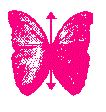
What does the given figure represent?
A
Radial symmetry
B
Asymmetry
C
Bilateral symmetry
D
Radial asymmetry
Solution
(C) The figure shows a butterfly with an arrow passing through its center,dividing it into two identical left and right halves.
This type of body organization,where the body can be divided into identical left and right halves in only one plane,is known as bilateral symmetry.
Therefore,the correct option is $C$.
This type of body organization,where the body can be divided into identical left and right halves in only one plane,is known as bilateral symmetry.
Therefore,the correct option is $C$.
0 likes
View Solution44
EasyMCQ
In diploblastic animals,what is present between the two germ layers?
A
Cellular mesoglea
B
Pseudocoelom
C
Undifferentiated mesoglea
D
Mesoderm
Solution
(C) Diploblastic animals are organisms that develop from two germ layers: an outer ectoderm and an inner endoderm.
Between these two layers,an undifferentiated,jelly-like layer called mesoglea is present.
This layer is non-cellular or acellular in nature,which distinguishes it from the true mesoderm found in triploblastic animals.
Between these two layers,an undifferentiated,jelly-like layer called mesoglea is present.
This layer is non-cellular or acellular in nature,which distinguishes it from the true mesoderm found in triploblastic animals.
0 likes
View Solution45
MediumMCQ
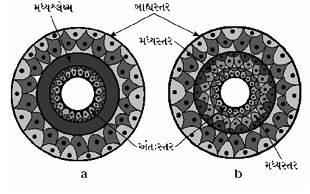
Which of the following is the correct option for the animal groups corresponding to the organization shown in the figure?
A
$A$: Cnidaria,$B$: Platyhelminthes
B
$A$: Platyhelminthes,$B$: Aschelminthes
C
$A$: Aschelminthes,$B$: Annelida
D
$A$: Annelida,$B$: Cnidaria
Solution
(A) The figure shows the germinal layers in animals.
Figure $a$ shows two germinal layers: an outer ectoderm (bahyastar) and an inner endoderm (antastar),with an undifferentiated layer called mesoglea (madhyashleshma) in between. This is characteristic of diploblastic animals,such as Cnidaria.
Figure $b$ shows three germinal layers: an outer ectoderm,a middle mesoderm (madhyastar),and an inner endoderm. This is characteristic of triploblastic animals,such as Platyhelminthes and higher phyla.
Therefore,$A$ represents diploblastic animals (Cnidaria) and $B$ represents triploblastic animals (Platyhelminthes).
Figure $a$ shows two germinal layers: an outer ectoderm (bahyastar) and an inner endoderm (antastar),with an undifferentiated layer called mesoglea (madhyashleshma) in between. This is characteristic of diploblastic animals,such as Cnidaria.
Figure $b$ shows three germinal layers: an outer ectoderm,a middle mesoderm (madhyastar),and an inner endoderm. This is characteristic of triploblastic animals,such as Platyhelminthes and higher phyla.
Therefore,$A$ represents diploblastic animals (Cnidaria) and $B$ represents triploblastic animals (Platyhelminthes).
0 likes
View Solution46
EasyMCQ
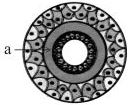
What does '$a$' represent in the given figure?
A
Ectoderm
B
Mesoderm
C
Endoderm
D
Mesoglea
Solution
(C) The provided figure represents a cross-section of a diploblastic organism,such as a cnidarian.
In diploblastic animals,the body is composed of two germinal layers: an external ectoderm and an internal endoderm.
Between these two layers,an undifferentiated layer called the mesoglea is present.
In the diagram,'$a$' points to the innermost layer of cells,which is the endoderm.
In diploblastic animals,the body is composed of two germinal layers: an external ectoderm and an internal endoderm.
Between these two layers,an undifferentiated layer called the mesoglea is present.
In the diagram,'$a$' points to the innermost layer of cells,which is the endoderm.
0 likes
View Solution47
EasyMCQ
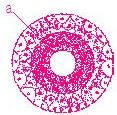
In the given figure, what does the part labeled "a" represent?
A
Ectoderm
B
Mesoderm
C
Mesoglea
D
Endoderm
Solution
(A) The provided figure represents a cross-section of a diploblastic animal, such as a member of the phylum Cnidaria.
In diploblastic animals, the body consists of two germinal layers: an external layer called the ectoderm and an internal layer called the endoderm.
Between these two layers, an undifferentiated layer called the mesoglea is present.
In the diagram, the label "a" points to the outer layer, which is the ectoderm.
In diploblastic animals, the body consists of two germinal layers: an external layer called the ectoderm and an internal layer called the endoderm.
Between these two layers, an undifferentiated layer called the mesoglea is present.
In the diagram, the label "a" points to the outer layer, which is the ectoderm.
0 likes
View Solution48
EasyMCQ
What type of body organization is shown in the given figure?
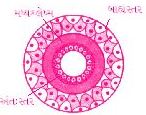
A
Diploblastic
B
Triploblastic
C
Ablastic
D
Monoblastic
Solution
(A) The provided figure shows two distinct germinal layers: an outer layer called the ectoderm (bahyastar) and an inner layer called the endoderm (antastar),separated by an undifferentiated layer called the mesoglea (madhyashleshma). Animals in which the cells are arranged in two embryonic layers,an external ectoderm and an internal endoderm,are called diploblastic animals. Therefore,the correct answer is diploblastic.
0 likes
View SolutionAnimal Kingdom — Basic of classification · Frequently Asked Questions
1Are these Animal Kingdom questions useful for JEE and NEET?
Yes. All questions in this section are mapped to JEE Main and NEET exam patterns. Previous year questions from JEE Main, NEET, GUJCET and state-level exams are included with full solutions.
2Can I switch to Hindi or Gujarati for these questions?
Yes. Use the language tabs in the hero section or the sidebar to view the same questions and solutions in English, Hindi or Gujarati.
3How do I generate a question paper from this subtopic?
Use the Vedclass Exam Paper Generator — select the chapter and subtopic, set difficulty, and generate Sets A, B, C, D automatically. First 3 chapters of every subject are free.
Vedclass Products
For Students
Vedclass Test Series
Mock tests in real JEE/NEET style with performance analysis. 5-day free trial.
Start Free TrialFor Teachers
Exam Paper Generator
Generate Set A/B/C/D papers from this chapter in 2 minutes. 3 chapters free.
Try FreeFor Institutes
Online Exam Module
Live online exams with unlimited students, 360° analytics & white-label branding.
See DemoFor Teachers & Institutes
Generate a Animal Kingdom Exam Paper in 2 Minutes
Select subtopic & difficulty — Sets A, B, C, D auto-generated with No Repeat logic.
First 3 chapters of every subject are free — no payment required.