
A English
Secondary growth Questions in English
Class 11 Biology · Anatomy of Flowering Plants · Secondary growth
396+
Questions
English
Language
100%
With Solutions
Showing 46 of 396 questions in English
351
MediumMCQ
$A$: Bark is all the tissues outside the vascular cambium.
$R$: Bark is formed due to the activity of phellogen only.
$R$: Bark is formed due to the activity of phellogen only.
A
Assertion and Reason both are correct and Reason is the correct explanation of Assertion.
B
Assertion and Reason both are correct but Reason is not the correct explanation of Assertion.
C
Assertion is correct,but Reason is incorrect.
D
Both Assertion and Reason are incorrect.
Solution
(C) Bark is a non-technical term that refers to all tissues exterior to the vascular cambium,including secondary phloem.
Therefore,the Assertion is correct.
Reason states that bark is formed only due to the activity of phellogen (cork cambium).
However,bark also includes secondary phloem,which is produced by the vascular cambium,not the phellogen.
Thus,the Reason is incorrect.
Therefore,the Assertion is correct.
Reason states that bark is formed only due to the activity of phellogen (cork cambium).
However,bark also includes secondary phloem,which is produced by the vascular cambium,not the phellogen.
Thus,the Reason is incorrect.
0 likes
View Solution352
MediumMCQ
$A$: Complementary cells are cut-off by phellogen towards the outside.
$R$: Phellogen is partially secondary in origin.
$R$: Phellogen is partially secondary in origin.
A
Assertion and Reason both are correct and Reason is the correct explanation of Assertion.
B
Assertion and Reason both are correct but Reason is not the correct explanation of Assertion.
C
Assertion is correct,but Reason is incorrect.
D
Both Assertion and Reason are incorrect.
Solution
(C) The Assertion is correct because phellogen (cork cambium) cuts off cells towards the outside,which differentiate into complementary cells (forming lenticels) and cork (phellem).
However,the Reason is incorrect because phellogen is entirely secondary in origin,as it arises from the dedifferentiation of permanent tissues like cortical cells or pericycle cells during secondary growth.
However,the Reason is incorrect because phellogen is entirely secondary in origin,as it arises from the dedifferentiation of permanent tissues like cortical cells or pericycle cells during secondary growth.
0 likes
View Solution353
MediumMCQ
Increase in the girth of plant (organ) takes place by
A
Vascular cambium
B
Cork cambium
C
Both $(a)$ and $(b)$
D
Root and shoot apical meristem
Solution
(C) Increase in the girth of plants $(organ)$ takes place by vascular and cork cambium.
Root Apical Meristem $(RAM)$,Shoot Apical Meristem $(SAM)$,and intercalary meristem are responsible for the primary growth of plants and they principally contribute to the elongation of the plants along their axis.
In dicotyledons and gymnosperms,the lateral meristems,vascular cambium,and cork cambium appear later in life. These are the meristems that cause an increase in the girth of the organ in which they are active. This is known as the secondary growth of the plant.
Root Apical Meristem $(RAM)$,Shoot Apical Meristem $(SAM)$,and intercalary meristem are responsible for the primary growth of plants and they principally contribute to the elongation of the plants along their axis.
In dicotyledons and gymnosperms,the lateral meristems,vascular cambium,and cork cambium appear later in life. These are the meristems that cause an increase in the girth of the organ in which they are active. This is known as the secondary growth of the plant.
0 likes
View Solution354
MediumMCQ
Increase in the girth of a plant is known as:
A
Primary growth
B
Apical meristem
C
Intercalary meristem
D
Secondary growth
Solution
(D) The increase in the diameter or girth of a plant is known as secondary growth.
Secondary growth is primarily caused by the activity of lateral meristems,such as the vascular cambium and cork cambium.
In contrast,primary growth refers to the increase in the length of the plant body,which is brought about by the activity of apical meristems.
Secondary growth is primarily caused by the activity of lateral meristems,such as the vascular cambium and cork cambium.
In contrast,primary growth refers to the increase in the length of the plant body,which is brought about by the activity of apical meristems.
0 likes
View Solution355
MediumMCQ
Grafting is attempted in those plants which show:
A
Adventitious roots
B
Buds
C
Foliage leaves and herbaceous stems
D
Secondary growth
Solution
(D) Grafting is a horticultural technique where tissues from one plant are inserted into those of another so that the two sets of vascular tissues may join together.
For successful grafting,it is essential that the vascular cambium of both the scion and the stock are in close contact.
Secondary growth,which involves the activity of the vascular cambium,is necessary to facilitate the union of the vascular tissues of the two plants.
Therefore,grafting is typically attempted in dicotyledonous plants that exhibit secondary growth.
For successful grafting,it is essential that the vascular cambium of both the scion and the stock are in close contact.
Secondary growth,which involves the activity of the vascular cambium,is necessary to facilitate the union of the vascular tissues of the two plants.
Therefore,grafting is typically attempted in dicotyledonous plants that exhibit secondary growth.
0 likes
View Solution356
MediumMCQ
The grafting method can be used in which of the following?
A
In all tracheophytes
B
Only in gymnospermic plants
C
In cambium containing eustelic plants
D
Only in atactostelic plants
Solution
(C) Grafting is a horticultural technique where tissues of plants are joined so as to continue their growth together.
For successful grafting,the vascular cambium of the stock and the scion must be aligned so that they can fuse.
Eustelic plants (typically dicots and gymnosperms) possess a ring of vascular bundles with cambium,which allows for secondary growth and the necessary vascular connection for grafting.
Atactostelic plants (monocots) lack cambium and therefore cannot undergo secondary growth,making grafting impossible.
For successful grafting,the vascular cambium of the stock and the scion must be aligned so that they can fuse.
Eustelic plants (typically dicots and gymnosperms) possess a ring of vascular bundles with cambium,which allows for secondary growth and the necessary vascular connection for grafting.
Atactostelic plants (monocots) lack cambium and therefore cannot undergo secondary growth,making grafting impossible.
0 likes
View Solution357
EasyMCQ
Cork is obtained from:
A
Quercus suber
B
Pinus roxburghii
C
Cedrus deodara
D
Mangifera indica
Solution
(A) Cork is a secondary tissue that is formed by the phellogen (cork cambium) in woody plants. It is commercially obtained from the bark of the tree $Quercus$ $suber$, which is commonly known as the cork oak.
0 likes
View Solution358
EasyMCQ
Jute fibres are obtained from the
A
Secondary phloem
B
Pith
C
Xylem
D
Endodermis
Solution
(A) Jute is a rough, weaving fibre primarily used for making gunny bags, carpets, and curtains.
It is obtained from $Corchorus capsularis$ or $Corchorus olitorius$ (family: $Tiliaceae$).
The fibres are extracted from the secondary phloem of the plant stem through a process called retting, which involves soaking the stems in still water to allow microbial action to break down the tissues surrounding the fibres.
It is obtained from $Corchorus capsularis$ or $Corchorus olitorius$ (family: $Tiliaceae$).
The fibres are extracted from the secondary phloem of the plant stem through a process called retting, which involves soaking the stems in still water to allow microbial action to break down the tissues surrounding the fibres.
0 likes
View Solution359
MediumMCQ
Match List-$I$ with List-$II$:
Choose the correct answer from the options given below:
| List-$I$ | List-$II$ |
|---|---|
| $(a)$ Lenticels | $(i)$ Phellogen |
| $(b)$ Cork cambium | $(ii)$ Suberin deposition |
| $(c)$ Secondary cortex | $(iii)$ Gaseous exchange |
| $(d)$ Cork | $(iv)$ Phelloderm |
Choose the correct answer from the options given below:
A
$(a)-(iii), (b)-(i), (c)-(iv), (d)-(ii)$
B
$(a)-(ii), (b)-(i), (c)-(iv), (d)-(iii)$
C
$(a)-(iii), (b)-(iv), (c)-(i), (d)-(ii)$
D
$(a)-(i), (b)-(iii), (c)-(ii), (d)-(iv)$
Solution
(A) The correct matching is as follows:
$(a)$ Lenticels are lens-shaped openings in the bark that facilitate $(iii)$ Gaseous exchange.
$(b)$ Cork cambium is also known as $(i)$ Phellogen.
$(c)$ Secondary cortex is also known as $(iv)$ Phelloderm.
$(d)$ Cork cells are dead and possess $(ii)$ Suberin deposition in their cell walls.
Thus,the correct sequence is $(a)-(iii), (b)-(i), (c)-(iv), (d)-(ii)$.
$(a)$ Lenticels are lens-shaped openings in the bark that facilitate $(iii)$ Gaseous exchange.
$(b)$ Cork cambium is also known as $(i)$ Phellogen.
$(c)$ Secondary cortex is also known as $(iv)$ Phelloderm.
$(d)$ Cork cells are dead and possess $(ii)$ Suberin deposition in their cell walls.
Thus,the correct sequence is $(a)-(iii), (b)-(i), (c)-(iv), (d)-(ii)$.
1 likes
View Solution360
MediumMCQ
Select the correct pair.
A
Large colorless empty cells in the epidermis of grass leaves $-$ Subsidiary cells
B
In dicot leaves,vascular bundles are surrounded by large thick-walled cells $-$ Conjunctive tissue
C
Cells of medullary rays that form part of cambial ring $-$ Interfascicular cambium
D
Loose parenchyma cells rupturing the epidermis and forming a lens-shaped opening in bark $-$ Spongy parenchyma
Solution
(C) Option $A$ is incorrect because large colorless empty cells in the epidermis of grass leaves are called Bulliform cells.
Option $B$ is incorrect because in dicot leaves,vascular bundles are surrounded by a layer of thick-walled cells called the bundle sheath,not conjunctive tissue.
Option $C$ is correct because the cells of medullary rays that become meristematic and form part of the cambial ring are known as interfascicular cambium.
Option $D$ is incorrect because loose parenchyma cells that rupture the epidermis to form lens-shaped openings in the bark are called complementary cells,which constitute lenticels.
Option $B$ is incorrect because in dicot leaves,vascular bundles are surrounded by a layer of thick-walled cells called the bundle sheath,not conjunctive tissue.
Option $C$ is correct because the cells of medullary rays that become meristematic and form part of the cambial ring are known as interfascicular cambium.
Option $D$ is incorrect because loose parenchyma cells that rupture the epidermis to form lens-shaped openings in the bark are called complementary cells,which constitute lenticels.
0 likes
View Solution361
Medium
Explain the difference between heartwood and sapwood.
Solution
(N/A) $\Rightarrow$ Heartwood: In old trees,the greater part of secondary xylem is dark brown due to the deposition of organic compounds like tannins,resins,oils,gums,aromatic substances,and essential oils in the central or innermost layers of the stem. These substances make it hard,durable,and resistant to the attacks of microorganisms and insects. This region comprises dead elements with highly lignified walls and is called heartwood. Heartwood does not conduct water but provides mechanical support to the tree.
$\Rightarrow$ Sapwood: The peripheral region of secondary xylem is lighter in color and is known as sapwood. It is involved in the conduction of water and minerals from the root to the leaves.
$\Rightarrow$ Sapwood: The peripheral region of secondary xylem is lighter in color and is known as sapwood. It is involved in the conduction of water and minerals from the root to the leaves.
0 likes
View Solution362
Medium
Differentiate between Heartwood and Sapwood.
Solution
(N/A)
| Heartwood | Sapwood |
|---|---|
| $(1)$ It is the central,darker,and harder part of the secondary xylem in old trees. | $(1)$ It is the peripheral,lighter,and softer part of the secondary xylem. |
| $(2)$ Its vessels are blocked by tyloses and filled with tannins,resins,oils,and gums. | $(2)$ Its vessels are functional and contain living cells,tubes,and fibers. |
| $(3)$ It is highly durable and resistant to microbial attack. | $(3)$ It is less durable and susceptible to microbial attack. |
| $(4)$ It provides mechanical support to the stem. | $(4)$ It is involved in the conduction of water and minerals. |
| $(5)$ It does not conduct water. | $(5)$ It actively conducts water and nutrients. |
0 likes
View Solution363
MediumMCQ
What constitutes the cambial ring?
A
Intrafascicular cambium only
B
Interfascicular cambium only
C
Intrafascicular and interfascicular cambium
D
Cork cambium and vascular cambium
Solution
(C) The cambial ring is formed by the union of two types of meristematic tissues:
$1$. Intrafascicular cambium: This is the primary cambium present within the vascular bundles,located between the xylem and phloem.
$2$. Interfascicular cambium: This is a secondary meristem that arises from the medullary rays between two vascular bundles.
Together,these two form a continuous ring known as the cambial ring,which is responsible for secondary growth in dicot stems.
$1$. Intrafascicular cambium: This is the primary cambium present within the vascular bundles,located between the xylem and phloem.
$2$. Interfascicular cambium: This is a secondary meristem that arises from the medullary rays between two vascular bundles.
Together,these two form a continuous ring known as the cambial ring,which is responsible for secondary growth in dicot stems.
0 likes
View Solution364
Medium
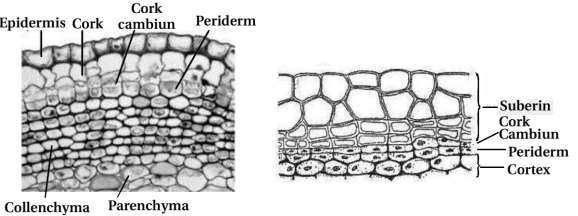
Give one basic functional difference between phellogen and phelloderm.
Solution
(N/A) Phellogen (cork cambium) is a meristematic tissue,meaning its cells are actively dividing to produce new cells.
In contrast,phelloderm (secondary cortex) is a permanent tissue,meaning its cells have differentiated and are no longer actively dividing.
In contrast,phelloderm (secondary cortex) is a permanent tissue,meaning its cells have differentiated and are no longer actively dividing.
0 likes
View Solution365
MediumMCQ
Arrange the following in the sequence you would find them in a plant starting from the periphery: phellem,phellogen,phelloderm.
A
Phellem,phellogen,phelloderm
B
Phelloderm,phellogen,phellem
C
Phellogen,phellem,phelloderm
D
Phelloderm,phellem,phellogen
Solution
(A) The periderm consists of three layers: phellem (cork),phellogen (cork cambium),and phelloderm (secondary cortex).
Starting from the periphery (outer side) towards the center,the sequence is:
$1$. $Phellem$ (Cork): This is the outermost layer formed by the phellogen.
$2$. $Phellogen$ (Cork cambium): This is the meristematic layer located between the phellem and phelloderm.
$3$. $Phelloderm$ (Secondary cortex): This is the innermost layer formed by the phellogen.
Therefore,the correct sequence from the periphery is $Phellem \rightarrow Phellogen \rightarrow Phelloderm$.
Starting from the periphery (outer side) towards the center,the sequence is:
$1$. $Phellem$ (Cork): This is the outermost layer formed by the phellogen.
$2$. $Phellogen$ (Cork cambium): This is the meristematic layer located between the phellem and phelloderm.
$3$. $Phelloderm$ (Secondary cortex): This is the innermost layer formed by the phellogen.
Therefore,the correct sequence from the periphery is $Phellem \rightarrow Phellogen \rightarrow Phelloderm$.
0 likes
View Solution366
MediumMCQ
If one debarks a tree,what parts of the plant are being removed?
A
Secondary xylem
B
Secondary phloem and periderm
C
Primary xylem
D
Vascular cambium
Solution
(B) Debarking a tree involves the removal of all tissues external to the vascular cambium.
This includes the secondary phloem and the periderm.
The periderm consists of the phellem (cork),phellogen (cork cambium),and phelloderm.
Therefore,the correct answer is the secondary phloem and periderm.
This includes the secondary phloem and the periderm.
The periderm consists of the phellem (cork),phellogen (cork cambium),and phelloderm.
Therefore,the correct answer is the secondary phloem and periderm.
0 likes
View Solution367
Medium
Define/Explain: Secondary growth.
Solution
(N/A) In the stems and roots of dicot plants,after the completion of the primary structure of the organs,the activity of lateral meristems,known as cambium,leads to the addition of new cells,which increases the girth of the concerned organ. This process is called secondary growth.
0 likes
View Solution368
Medium
Give a scientific reason: Grafting is not possible in monocots.
Solution
(N/A) Monocot plants possess closed vascular bundles. These bundles do not have cambium. Cambium is a meristematic tissue. In grafting,the union of the stock and scion takes place through the activity of this meristematic tissue. Since monocots lack cambium,they cannot form a successful graft union. Hence,grafting is not possible in monocots.
0 likes
View Solution369
DifficultMCQ
In old trees,the greater part of secondary xylem is dark brown and resistant to insect attack due to:
$(a)$ secretion of secondary metabolites and their deposition in the lumen of vessels.
$(b)$ deposition of organic compounds like tannins and resins in the central layers of stem.
$(c)$ deposition of suberin and aromatic substances in the outer layer of stem.
$(d)$ deposition of tannins,gum,resin and aromatic substances in the peripheral layers of stem.
$(e)$ presence of parenchyma cells,functionally active xylem elements and essential oils.
Choose the correct answer from the options given below:
$(a)$ secretion of secondary metabolites and their deposition in the lumen of vessels.
$(b)$ deposition of organic compounds like tannins and resins in the central layers of stem.
$(c)$ deposition of suberin and aromatic substances in the outer layer of stem.
$(d)$ deposition of tannins,gum,resin and aromatic substances in the peripheral layers of stem.
$(e)$ presence of parenchyma cells,functionally active xylem elements and essential oils.
Choose the correct answer from the options given below:
A
$(c)$ and $(d)$ Only
B
$(d)$ and $(e)$ Only
C
$(b)$ and $(d)$ Only
D
$(a)$ and $(b)$ Only
Solution
(D) In old trees,the central or innermost layers of the stem consist of dead elements with highly lignified walls,known as heartwood.
$1$. The heartwood is dark brown due to the deposition of organic compounds such as tannins,resins,oils,gums,aromatic substances,and essential oils in the central layers of the stem.
$2$. These substances make the heartwood hard,durable,and resistant to the attack of microorganisms and insects.
$3$. Statement $(a)$ is correct as secondary metabolites are deposited in the lumen of vessels,blocking them.
$4$. Statement $(b)$ is correct as these organic compounds are deposited in the central layers (heartwood).
$5$. Statements $(c)$ and $(d)$ are incorrect because these depositions occur in the central layers,not the outer or peripheral layers.
$6$. Statement $(e)$ is incorrect because heartwood consists of dead elements,not functionally active xylem elements.
Therefore,statements $(a)$ and $(b)$ are correct.
$1$. The heartwood is dark brown due to the deposition of organic compounds such as tannins,resins,oils,gums,aromatic substances,and essential oils in the central layers of the stem.
$2$. These substances make the heartwood hard,durable,and resistant to the attack of microorganisms and insects.
$3$. Statement $(a)$ is correct as secondary metabolites are deposited in the lumen of vessels,blocking them.
$4$. Statement $(b)$ is correct as these organic compounds are deposited in the central layers (heartwood).
$5$. Statements $(c)$ and $(d)$ are incorrect because these depositions occur in the central layers,not the outer or peripheral layers.
$6$. Statement $(e)$ is incorrect because heartwood consists of dead elements,not functionally active xylem elements.
Therefore,statements $(a)$ and $(b)$ are correct.
0 likes
View Solution370
MediumMCQ
The anatomy of springwood shows some peculiar features. Identify the correct set of statements about springwood.
$(a)$ It is also called as the earlywood
$(b)$ In spring season cambium produces xylem elements with narrow vessels
$(c)$ It is lighter in colour
$(d)$ The springwood along with autumnwood shows alternate concentric rings forming annual rings
$(e)$ It has lower density
Choose the correct answer from the options given below:
$(a)$ It is also called as the earlywood
$(b)$ In spring season cambium produces xylem elements with narrow vessels
$(c)$ It is lighter in colour
$(d)$ The springwood along with autumnwood shows alternate concentric rings forming annual rings
$(e)$ It has lower density
Choose the correct answer from the options given below:
A
$(a), (c), (d)$ and $(e)$ Only
B
$(a), (b)$ and $(d)$ Only
C
$(c), (d)$ and $(e)$ Only
D
$(a), (b), (d)$ and $(e)$ Only
Solution
(A) Springwood,also known as earlywood,is formed during the spring season when cambium is very active.
$(a)$ Correct: It is indeed called earlywood.
$(b)$ Incorrect: In the spring season,the cambium is very active and produces a large number of xylary elements having vessels with wider cavities.
$(c)$ Correct: Springwood is lighter in colour.
$(d)$ Correct: The springwood and autumnwood together form annual rings in a tree.
$(e)$ Correct: Due to the presence of wider vessels,it has a lower density compared to autumnwood.
Therefore,the correct statements are $(a), (c), (d),$ and $(e)$.
$(a)$ Correct: It is indeed called earlywood.
$(b)$ Incorrect: In the spring season,the cambium is very active and produces a large number of xylary elements having vessels with wider cavities.
$(c)$ Correct: Springwood is lighter in colour.
$(d)$ Correct: The springwood and autumnwood together form annual rings in a tree.
$(e)$ Correct: Due to the presence of wider vessels,it has a lower density compared to autumnwood.
Therefore,the correct statements are $(a), (c), (d),$ and $(e)$.
0 likes
View Solution371
MediumMCQ
Wood is $.....................$
A
Primary phloem
B
Secondary phloem
C
Primary xylem
D
Secondary xylem
Solution
(D) Wood is the common name for secondary xylem in plants.
During secondary growth,the vascular cambium produces secondary xylem towards the inner side and secondary phloem towards the outer side.
The secondary xylem accumulates over time and forms the bulk of the woody stem or root,which is referred to as wood.
During secondary growth,the vascular cambium produces secondary xylem towards the inner side and secondary phloem towards the outer side.
The secondary xylem accumulates over time and forms the bulk of the woody stem or root,which is referred to as wood.
0 likes
View Solution372
MediumMCQ
The age of a tree can be estimated by counting the . . . . . . .
A
Vascular cambium
B
Annual rings
C
Cork cambium
D
Secondary xylem
Solution
(B) The age of a tree is determined by counting the annual rings present in the secondary xylem of the stem.
In temperate regions,the cambium is active during the spring season and inactive during the winter season.
This differential activity leads to the formation of distinct rings known as annual rings.
Each annual ring represents one year of growth of the tree.
In temperate regions,the cambium is active during the spring season and inactive during the winter season.
This differential activity leads to the formation of distinct rings known as annual rings.
Each annual ring represents one year of growth of the tree.
0 likes
View Solution373
MediumMCQ
This wood is light in color,has low density,and consists of a large number of xylem elements with wide vessels.
A
Spring wood
B
Autumn wood
C
Heartwood
D
Sapwood
Solution
(A) $1$. Spring wood (also known as early wood) is formed during the spring season when the activity of the cambium is very high.
$2$. Due to high cambial activity,it produces a large number of xylem elements having vessels with wide cavities.
$3$. The wood formed is light in color and has a lower density compared to autumn wood.
$4$. In contrast,autumn wood (late wood) is formed during the winter or autumn season,has fewer xylem elements,and narrower vessels,resulting in darker,denser wood.
$2$. Due to high cambial activity,it produces a large number of xylem elements having vessels with wide cavities.
$3$. The wood formed is light in color and has a lower density compared to autumn wood.
$4$. In contrast,autumn wood (late wood) is formed during the winter or autumn season,has fewer xylem elements,and narrower vessels,resulting in darker,denser wood.
0 likes
View Solution374
MediumMCQ
This wood is dark in color,has high density,and contains fewer,narrower vessels.
A
Spring wood
B
Autumn wood
C
Heartwood
D
Sapwood
Solution
(B) The wood formed during the autumn season is known as autumn wood or late wood.
It is characterized by a darker color,higher density,and the presence of fewer and narrower vessels compared to spring wood,which is formed during the favorable conditions of spring.
It is characterized by a darker color,higher density,and the presence of fewer and narrower vessels compared to spring wood,which is formed during the favorable conditions of spring.
0 likes
View Solution375
MediumMCQ
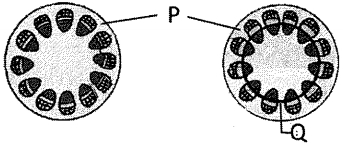
Identify $P$ and $Q$ in the given structures.
A
Epidermis,Cork cambium
B
Epidermis,Interfascicular cambium
C
Cortex,Interfascicular cambium
D
Cortex,Cork cambium
Solution
(C) In the given diagram,the structure $P$ represents the cortex region of the stem.
$Q$ represents the interfascicular cambium,which develops from the medullary rays between the vascular bundles during secondary growth in dicot stems.
Therefore,$P$ is the cortex and $Q$ is the interfascicular cambium.
$Q$ represents the interfascicular cambium,which develops from the medullary rays between the vascular bundles during secondary growth in dicot stems.
Therefore,$P$ is the cortex and $Q$ is the interfascicular cambium.
0 likes
View Solution376
MediumMCQ
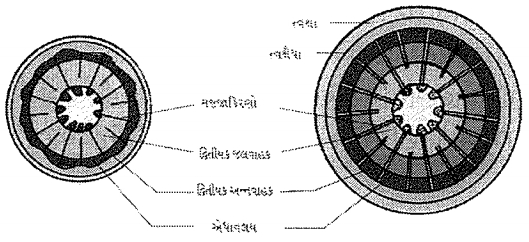
What do the following figures represent?
A
Secondary growth in monocot root
B
Secondary growth in monocot stem
C
Secondary growth in dicot root
D
Secondary growth in dicot stem
Solution
(C) The provided figure illustrates the process of secondary growth in a dicot root.
Secondary growth in dicot roots occurs due to the activity of the vascular cambium and the cork cambium.
The vascular cambium originates from the tissue located just below the phloem bundles,a portion of the pericycle tissue,above the protoxylem,forming a complete,wavy ring which later becomes circular.
This cambium cuts off secondary xylem towards the inner side and secondary phloem towards the outer side.
This leads to an increase in the girth of the root,which is characteristic of dicotyledonous plants.
Secondary growth in dicot roots occurs due to the activity of the vascular cambium and the cork cambium.
The vascular cambium originates from the tissue located just below the phloem bundles,a portion of the pericycle tissue,above the protoxylem,forming a complete,wavy ring which later becomes circular.
This cambium cuts off secondary xylem towards the inner side and secondary phloem towards the outer side.
This leads to an increase in the girth of the root,which is characteristic of dicotyledonous plants.
0 likes
View Solution377
MediumMCQ
Which of the following is incorrect regarding heartwood?
A
It is dark brown in color.
B
It contains dead elements with highly lignified walls.
C
It is resistant to the attack of microorganisms and insects.
D
It contains organic compounds like tannins,resins,oils,gums,aromatic substances,and essential oils.
Solution
(NONE) Heartwood is the central,non-functional part of the secondary xylem that is dark brown in color due to the deposition of organic compounds.
It consists of dead elements with highly lignified walls.
It is highly resistant to the attack of microorganisms and insects due to the presence of tannins,resins,oils,gums,aromatic substances,and essential oils.
Since all the given statements ($A$,$B$,$C$,and $D$) are actually correct characteristics of heartwood,there is no incorrect statement among the options provided. However,if this is a multiple-choice question where one must be selected,it is important to note that all these are standard features of heartwood as per $NCERT$.
It consists of dead elements with highly lignified walls.
It is highly resistant to the attack of microorganisms and insects due to the presence of tannins,resins,oils,gums,aromatic substances,and essential oils.
Since all the given statements ($A$,$B$,$C$,and $D$) are actually correct characteristics of heartwood,there is no incorrect statement among the options provided. However,if this is a multiple-choice question where one must be selected,it is important to note that all these are standard features of heartwood as per $NCERT$.
0 likes
View Solution378
MediumMCQ
Which of the following statements is incorrect regarding sapwood?
A
Peripheral region of secondary xylem.
B
Light in color.
C
Involved in the conduction of water and minerals from root to leaf.
D
None of these.
Solution
(D) Sapwood (alburnum) is the peripheral region of the secondary xylem.
It is light in color.
It is physiologically active and is involved in the conduction of water and minerals from the root to the leaf.
Since all the given statements ($A$,$B$,and $C$) are correct,the statement that is incorrect is 'None of these'.
It is light in color.
It is physiologically active and is involved in the conduction of water and minerals from the root to the leaf.
Since all the given statements ($A$,$B$,and $C$) are correct,the statement that is incorrect is 'None of these'.
0 likes
View Solution379
MediumMCQ
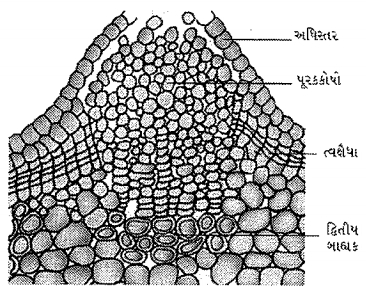
What does the following figure represent?
A
Lenticel
B
Stomata
C
Hydathode
D
All of the above
Solution
(A) The provided figure shows a lenticel.
Lenticels are lens-shaped openings found in the bark of woody stems and roots.
They are formed during secondary growth when the cork cambium (phellogen) produces loosely arranged parenchymatous cells called complementary cells instead of cork cells at certain regions.
These cells rupture the epidermis,creating a pore that facilitates gaseous exchange between the internal tissues of the stem and the external atmosphere.
Lenticels are lens-shaped openings found in the bark of woody stems and roots.
They are formed during secondary growth when the cork cambium (phellogen) produces loosely arranged parenchymatous cells called complementary cells instead of cork cells at certain regions.
These cells rupture the epidermis,creating a pore that facilitates gaseous exchange between the internal tissues of the stem and the external atmosphere.
0 likes
View Solution380
MediumMCQ
The $phellogen$ (cork cambium) develops from $...................$.
A
Cortex
B
Epidermis
C
Phelloderm
D
Vascular cambium
Solution
(A) During secondary growth in dicot stems,the cortical cells located just below the epidermis undergo dedifferentiation to form a meristematic tissue known as the $phellogen$ or cork cambium.
This $phellogen$ is a couple of layers thick and is made of narrow,thin-walled,and nearly rectangular cells.
Therefore,the $phellogen$ develops from the dedifferentiation of the cortical cells (cortex).
This $phellogen$ is a couple of layers thick and is made of narrow,thin-walled,and nearly rectangular cells.
Therefore,the $phellogen$ develops from the dedifferentiation of the cortical cells (cortex).
0 likes
View Solution381
MediumMCQ
Bark $= .....................$
A
Secondary phloem $+$ Periderm
B
All tissues outside the vascular cambium
C
Secondary phloem $+$ Phelloderm $+$ Phellem $+$ Phellogen
D
All of the above
Solution
(D) The term $Bark$ is a non-technical term that refers to all tissues exterior to the vascular cambium.
It includes secondary phloem and the periderm (which consists of phellogen, phellem, and phelloderm).
Since secondary phloem is outside the vascular cambium, and the periderm is also formed outside the vascular cambium, all the options provided describe the components of bark correctly.
Therefore, the correct answer is $All$ $of$ $the$ $above$.
It includes secondary phloem and the periderm (which consists of phellogen, phellem, and phelloderm).
Since secondary phloem is outside the vascular cambium, and the periderm is also formed outside the vascular cambium, all the options provided describe the components of bark correctly.
Therefore, the correct answer is $All$ $of$ $the$ $above$.
0 likes
View Solution382
MediumMCQ
Identify the correct statement$(s)$ regarding lenticels.
A
Formed by the rupture of phellogen (cork cambium) cells.
B
Lens-shaped structures.
C
Facilitate the exchange of gases between the atmosphere and internal tissues.
D
All of the above.
0 likes
View Solution383
DifficultMCQ
Which of the following represents the correct sequence of layers from the center towards the periphery in a dicot stem?
A
Secondary phloem $\rightarrow$ Vascular cambium $\rightarrow$ Wood (Secondary xylem) $\rightarrow$ Phelloderm $\rightarrow$ Cork cambium $\rightarrow$ Cork
B
Secondary phloem $\rightarrow$ Vascular cambium $\rightarrow$ Wood (Secondary xylem) $\rightarrow$ Cork $\rightarrow$ Cork cambium $\rightarrow$ Phelloderm
C
Wood (Secondary xylem) $\rightarrow$ Vascular cambium $\rightarrow$ Secondary phloem $\rightarrow$ Cork $\rightarrow$ Cork cambium $\rightarrow$ Phelloderm
D
Wood (Secondary xylem) $\rightarrow$ Vascular cambium $\rightarrow$ Secondary phloem $\rightarrow$ Phelloderm $\rightarrow$ Cork cambium $\rightarrow$ Cork
Solution
(D) In a dicot stem undergoing secondary growth,the arrangement of tissues from the center (pith/xylem) towards the periphery (bark) is as follows:
$1$. The innermost layer is the Wood or Secondary Xylem.
$2$. Next is the Vascular Cambium.
$3$. Outside the vascular cambium is the Secondary Phloem.
$4$. Further towards the periphery,the periderm is formed,which consists of Phelloderm (inner),Cork Cambium (middle),and Cork (outermost).
Therefore,the correct sequence is: Wood (Secondary xylem) $\rightarrow$ Vascular cambium $\rightarrow$ Secondary phloem $\rightarrow$ Phelloderm $\rightarrow$ Cork cambium $\rightarrow$ Cork.
$1$. The innermost layer is the Wood or Secondary Xylem.
$2$. Next is the Vascular Cambium.
$3$. Outside the vascular cambium is the Secondary Phloem.
$4$. Further towards the periphery,the periderm is formed,which consists of Phelloderm (inner),Cork Cambium (middle),and Cork (outermost).
Therefore,the correct sequence is: Wood (Secondary xylem) $\rightarrow$ Vascular cambium $\rightarrow$ Secondary phloem $\rightarrow$ Phelloderm $\rightarrow$ Cork cambium $\rightarrow$ Cork.
0 likes
View Solution384
MediumMCQ
Select the incorrect statement from the following.
A
The cells of the phellem (cork) become suberized and form an impermeable structure to water.
B
The cells of the phelloderm are parenchymatous.
C
The phellem is composed of thick-walled square cells.
D
The phellogen is included in the secondary meristematic tissue.
Solution
(C) Analysis of the given statements:
$A$. The cells of the phellem (cork) undergo suberization,which makes them impermeable to water. This statement is correct.
$B$. The phelloderm (secondary cortex) consists of parenchymatous cells. This statement is correct.
$C$. The cells of the phellem are dead and have thick walls due to the deposition of suberin. While they are often rectangular or square in cross-section,the primary characteristic is that they are dead and suberized. The statement implying they are just 'thick-walled square cells' is often considered incorrect in the context of describing their living/dead status or specific morphology compared to other tissues. However,in standard biology,the phellem cells are dead at maturity. Thus,this statement is the most inaccurate among the choices provided.
$D$. The phellogen (cork cambium) is a secondary meristematic tissue that gives rise to the phellem and phelloderm. This statement is correct.
Therefore,the incorrect statement is $C$.
$A$. The cells of the phellem (cork) undergo suberization,which makes them impermeable to water. This statement is correct.
$B$. The phelloderm (secondary cortex) consists of parenchymatous cells. This statement is correct.
$C$. The cells of the phellem are dead and have thick walls due to the deposition of suberin. While they are often rectangular or square in cross-section,the primary characteristic is that they are dead and suberized. The statement implying they are just 'thick-walled square cells' is often considered incorrect in the context of describing their living/dead status or specific morphology compared to other tissues. However,in standard biology,the phellem cells are dead at maturity. Thus,this statement is the most inaccurate among the choices provided.
$D$. The phellogen (cork cambium) is a secondary meristematic tissue that gives rise to the phellem and phelloderm. This statement is correct.
Therefore,the incorrect statement is $C$.
0 likes
View Solution385
DifficultMCQ
In this organ,the vascular cambium is initially wavy and later becomes circular.
A
Monocot stem
B
Dicot stem
C
Monocot root
D
Dicot root
Solution
(B) In $Dicot$ stems,the vascular cambium is present in patches between the primary xylem and primary phloem,which is known as intrafascicular cambium. During secondary growth,the cells of medullary rays adjoining these intrafascicular cambia become meristematic and form interfascicular cambium. Thus,a continuous ring of vascular cambium is formed. Initially,this ring appears wavy because it originates from different sources,but it soon becomes circular due to the activity of the cambium.
0 likes
View Solution386
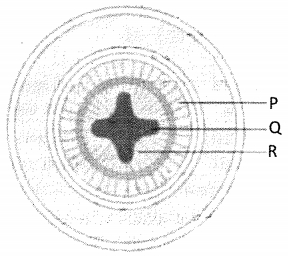
MediumMCQ
What are $P, Q$ and $R$ in the given anatomical structure?
A
Primary xylem,Primary phloem,Secondary xylem
B
Secondary phloem,Primary xylem,Secondary xylem
C
Secondary xylem,Primary xylem,Primary phloem
D
Secondary xylem,Secondary phloem,Primary phloem
Solution
(C) In the provided diagram of a dicot root undergoing secondary growth:
$P$ represents the Secondary xylem,which is formed by the vascular cambium towards the inner side.
$Q$ represents the Primary xylem,which is located at the center of the root.
$R$ represents the Primary phloem,which is pushed outwards due to the formation of secondary tissues.
$P$ represents the Secondary xylem,which is formed by the vascular cambium towards the inner side.
$Q$ represents the Primary xylem,which is located at the center of the root.
$R$ represents the Primary phloem,which is pushed outwards due to the formation of secondary tissues.
0 likes
View Solution387
MediumMCQ
Identify the meristems responsible for primary growth and secondary growth from the following list:
$I -$ Cork cambium,$II -$ Apical meristem,$III -$ Vascular cambium,$IV -$ Intercalary meristem,$V -$ Lateral meristem
Choose the correct option for primary growth and secondary growth respectively.
$I -$ Cork cambium,$II -$ Apical meristem,$III -$ Vascular cambium,$IV -$ Intercalary meristem,$V -$ Lateral meristem
Choose the correct option for primary growth and secondary growth respectively.
A
$I, III, IV \quad II, V$
B
$II, V \quad I, III, IV$
C
$I, III, V \quad II, IV$
D
$II, IV \quad I, III, V$
Solution
(D) Primary growth in plants is primarily responsible for the elongation of the plant body (increase in length). This is brought about by the activity of apical meristems and intercalary meristems.
Secondary growth involves an increase in the girth or diameter of the plant body. This is brought about by the activity of lateral meristems,which include the vascular cambium and the cork cambium.
Therefore:
- Primary growth: $II$ (Apical meristem) and $IV$ (Intercalary meristem).
- Secondary growth: $I$ (Cork cambium),$III$ (Vascular cambium),and $V$ (Lateral meristem).
The correct sequence is $II, IV$ for primary growth and $I, III, V$ for secondary growth.
Secondary growth involves an increase in the girth or diameter of the plant body. This is brought about by the activity of lateral meristems,which include the vascular cambium and the cork cambium.
Therefore:
- Primary growth: $II$ (Apical meristem) and $IV$ (Intercalary meristem).
- Secondary growth: $I$ (Cork cambium),$III$ (Vascular cambium),and $V$ (Lateral meristem).
The correct sequence is $II, IV$ for primary growth and $I, III, V$ for secondary growth.
0 likes
View Solution388
MediumMCQ
Longitudinal growth of the plant axis $- P$
Increase in thickness of the plant axis $- Q$
Select the correct option for $P$ and $Q$.
Increase in thickness of the plant axis $- Q$
Select the correct option for $P$ and $Q$.
A
Secondary growth,Secondary growth
B
Primary growth,Primary growth
C
Primary growth,Secondary growth
D
Secondary growth,Primary growth
Solution
(C) $1$. Primary growth in plants is responsible for the increase in the length of the plant axis (longitudinal growth),which is primarily driven by the activity of apical meristems.
$2$. Secondary growth is responsible for the increase in the girth or thickness of the plant axis,which is driven by the activity of lateral meristems (vascular cambium and cork cambium).
$3$. Therefore,$P$ corresponds to Primary growth and $Q$ corresponds to Secondary growth.
$2$. Secondary growth is responsible for the increase in the girth or thickness of the plant axis,which is driven by the activity of lateral meristems (vascular cambium and cork cambium).
$3$. Therefore,$P$ corresponds to Primary growth and $Q$ corresponds to Secondary growth.
0 likes
View Solution389
MediumMCQ
Which of the following is responsible for secondary growth?
A
Lateral meristem
B
Vascular cambium
C
Cork cambium
D
All of the above
Solution
(D) Secondary growth refers to the increase in the girth or diameter of the plant body.
It is primarily caused by the activity of lateral meristems.
Lateral meristems include the vascular cambium,which produces secondary xylem and secondary phloem,and the cork cambium (phellogen),which produces periderm.
Since both vascular cambium and cork cambium are types of lateral meristems,all the given options are responsible for secondary growth.
It is primarily caused by the activity of lateral meristems.
Lateral meristems include the vascular cambium,which produces secondary xylem and secondary phloem,and the cork cambium (phellogen),which produces periderm.
Since both vascular cambium and cork cambium are types of lateral meristems,all the given options are responsible for secondary growth.
0 likes
View Solution390
MediumMCQ
Initiation of lateral roots and vascular cambium during secondary growth takes place in cells of:
A
Epiblema
B
Cortex
C
Endodermis
D
Pericycle
Solution
(D) The $Pericycle$ is a layer of cells located between the $Endodermis$ and the vascular tissue in plant roots.
During the formation of lateral roots,cells of the $Pericycle$ undergo division to form the root primordium.
Similarly,during secondary growth in dicot roots,the $Pericycle$ cells located opposite to the protoxylem divide to form a portion of the vascular cambium ring.
Therefore,the $Pericycle$ is responsible for the initiation of both lateral roots and the vascular cambium.
During the formation of lateral roots,cells of the $Pericycle$ undergo division to form the root primordium.
Similarly,during secondary growth in dicot roots,the $Pericycle$ cells located opposite to the protoxylem divide to form a portion of the vascular cambium ring.
Therefore,the $Pericycle$ is responsible for the initiation of both lateral roots and the vascular cambium.
0 likes
View Solution391
MediumMCQ
Given below are two statements: One is labelled as Assertion $A$ and the other is labelled as Reason $R$:
Assertion $A$: Late wood has fewer xylary elements with narrow vessels.
Reason $R$: Cambium is less active in winters.
In the light of the above statements,choose the correct answer from the options given below:
Assertion $A$: Late wood has fewer xylary elements with narrow vessels.
Reason $R$: Cambium is less active in winters.
In the light of the above statements,choose the correct answer from the options given below:
A
$A$ is false but $R$ is true
B
Both $A$ and $R$ are true and $R$ is the correct explanation of $A$
C
Both $A$ and $R$ are true but $R$ is $NOT$ the correct explanation of $A$
D
$A$ is true but $R$ is false
Solution
(B) During the winter season,the activity of the vascular cambium is reduced due to environmental conditions.
Because the cambium is less active,it produces fewer xylary elements that possess narrow vessels.
This type of wood formed during the winter is known as autumn wood or late wood.
Therefore,both Assertion $A$ and Reason $R$ are true,and Reason $R$ correctly explains Assertion $A$.
Because the cambium is less active,it produces fewer xylary elements that possess narrow vessels.
This type of wood formed during the winter is known as autumn wood or late wood.
Therefore,both Assertion $A$ and Reason $R$ are true,and Reason $R$ correctly explains Assertion $A$.
0 likes
View Solution392
MediumMCQ
Identify the correct statements:
$A$. Lenticels are the lens-shaped openings permitting the exchange of gases.
$B$. Bark formed early in the season is called hard bark.
$C$. Bark is a technical term that refers to all tissues exterior to vascular cambium.
$D$. Bark refers to periderm and secondary phloem.
$E$. Phellogen is single-layered in thickness.
Choose the correct answer from the options given below:
$A$. Lenticels are the lens-shaped openings permitting the exchange of gases.
$B$. Bark formed early in the season is called hard bark.
$C$. Bark is a technical term that refers to all tissues exterior to vascular cambium.
$D$. Bark refers to periderm and secondary phloem.
$E$. Phellogen is single-layered in thickness.
Choose the correct answer from the options given below:
A
$B$ and $C$ only
B
$B, C$ and $E$ only
C
$A$ and $D$ only
D
$A, B$ and $D$ only
Solution
(C) Statement $A$ is correct: Lenticels are lens-shaped openings that allow the exchange of gases between the external atmosphere and the internal tissues of the stem.
Statement $B$ is incorrect: Bark formed early in the season is called early or soft bark,while bark formed towards the end of the season is called late or hard bark.
Statement $C$ is incorrect: Bark is a non-technical term that refers to all tissues exterior to the vascular cambium.
Statement $D$ is correct: Bark refers to a number of tissue types,including periderm and secondary phloem.
Statement $E$ is incorrect: Phellogen (cork cambium) is generally a couple of layers thick.
Therefore,statements $A$ and $D$ are correct.
Statement $B$ is incorrect: Bark formed early in the season is called early or soft bark,while bark formed towards the end of the season is called late or hard bark.
Statement $C$ is incorrect: Bark is a non-technical term that refers to all tissues exterior to the vascular cambium.
Statement $D$ is correct: Bark refers to a number of tissue types,including periderm and secondary phloem.
Statement $E$ is incorrect: Phellogen (cork cambium) is generally a couple of layers thick.
Therefore,statements $A$ and $D$ are correct.
0 likes
View Solution393
MediumMCQ
In dicot stem,the cells of cambium present between the primary xylem and primary phloem is $..........$
A
Interfascicular cambium
B
Cork cambium
C
Vascular cambium
D
Intrafascicular cambium
Solution
(D) In a dicot stem,the vascular bundles are open,meaning they contain cambium between the primary xylem and primary phloem.
This specific strip of cambium that is present within the vascular bundle is known as the intrafascicular cambium.
Later,during secondary growth,cells of medullary rays adjoining the intrafascicular cambium become meristematic to form the interfascicular cambium.
Together,the intrafascicular and interfascicular cambium form a complete ring known as the vascular cambium.
This specific strip of cambium that is present within the vascular bundle is known as the intrafascicular cambium.
Later,during secondary growth,cells of medullary rays adjoining the intrafascicular cambium become meristematic to form the interfascicular cambium.
Together,the intrafascicular and interfascicular cambium form a complete ring known as the vascular cambium.
0 likes
View Solution394
EasyMCQ
Cambium is essential for grafting in plants because
A
cambia of both stock and scion fuse together
B
cambium produces new leaves
C
cambium produces new roots
D
cambium helps in the production of flowers
Solution
(A) Grafting is a horticultural technique where tissues of plants are joined so as to continue their growth together.
For successful grafting,the vascular cambium of the $stock$ (the rooted plant) and the $scion$ (the shoot to be grafted) must be brought into direct contact.
The cambium cells are meristematic and actively divide to produce new vascular tissues ($xylem$ and $phloem$),which allows the $stock$ and $scion$ to fuse and establish a functional vascular connection.
Without this fusion of cambial layers,the $scion$ will not receive water and nutrients from the $stock$ and will eventually die.
For successful grafting,the vascular cambium of the $stock$ (the rooted plant) and the $scion$ (the shoot to be grafted) must be brought into direct contact.
The cambium cells are meristematic and actively divide to produce new vascular tissues ($xylem$ and $phloem$),which allows the $stock$ and $scion$ to fuse and establish a functional vascular connection.
Without this fusion of cambial layers,the $scion$ will not receive water and nutrients from the $stock$ and will eventually die.
0 likes
View Solution395
EasyMCQ
Grafting cannot be done to monocots because they lack
A
Cambium
B
Vascular bundle
C
Ground tissue
D
Parenchymatous tissue
Solution
(A) Grafting is a horticultural technique where tissues of plants are joined so as to continue their growth together.
For successful grafting,the vascular cambium of both the scion and the stock must be placed in contact with each other to allow for the formation of new vascular tissues (xylem and phloem) that connect the two parts.
Monocots do not possess a vascular cambium (they have closed vascular bundles),which prevents secondary growth and the necessary tissue fusion required for successful grafting.
Therefore,grafting is not possible in monocots.
For successful grafting,the vascular cambium of both the scion and the stock must be placed in contact with each other to allow for the formation of new vascular tissues (xylem and phloem) that connect the two parts.
Monocots do not possess a vascular cambium (they have closed vascular bundles),which prevents secondary growth and the necessary tissue fusion required for successful grafting.
Therefore,grafting is not possible in monocots.
0 likes
View Solution396
EasyMCQ
When the vascular cambium is present between the xylem and phloem,then the vascular bundle is called,
A
Closed
B
Exarch
C
Open
D
Endarch
Solution
(C) The correct answer is $C$.
When the vascular cambium is present between the xylem and phloem,the vascular bundle is known as an open vascular bundle.
This type of vascular bundle is characteristic of dicotyledonous stems,as it allows for secondary growth.
When the vascular cambium is present between the xylem and phloem,the vascular bundle is known as an open vascular bundle.
This type of vascular bundle is characteristic of dicotyledonous stems,as it allows for secondary growth.
0 likes
View SolutionAnatomy of Flowering Plants — Secondary growth · Frequently Asked Questions
1Are these Anatomy of Flowering Plants questions useful for JEE and NEET?
Yes. All questions in this section are mapped to JEE Main and NEET exam patterns. Previous year questions from JEE Main, NEET, GUJCET and state-level exams are included with full solutions.
2Can I switch to Hindi or Gujarati for these questions?
Yes. Use the language tabs in the hero section or the sidebar to view the same questions and solutions in English, Hindi or Gujarati.
3How do I generate a question paper from this subtopic?
Use the Vedclass Exam Paper Generator — select the chapter and subtopic, set difficulty, and generate Sets A, B, C, D automatically. First 3 chapters of every subject are free.
Vedclass Products
For Students
Vedclass Test Series
Mock tests in real JEE/NEET style with performance analysis. 5-day free trial.
Start Free TrialFor Teachers
Exam Paper Generator
Generate Set A/B/C/D papers from this chapter in 2 minutes. 3 chapters free.
Try FreeFor Institutes
Online Exam Module
Live online exams with unlimited students, 360° analytics & white-label branding.
See DemoFor Teachers & Institutes
Generate a Anatomy of Flowering Plants Exam Paper in 2 Minutes
Select subtopic & difficulty — Sets A, B, C, D auto-generated with No Repeat logic.
First 3 chapters of every subject are free — no payment required.