
A English
Mix Examples- Anatomy of Flowering Plants Questions in English
Class 11 Biology · Anatomy of Flowering Plants · Mix Examples- Anatomy of Flowering Plants
31+
Questions
English
Language
100%
With Solutions
Showing 31 of 31 questions in English
1
MediumMCQ
The branch of botany that deals with the study of the internal organization of plants is:
A
Physiology
B
Ecology
C
Anatomy
D
Cytology
Solution
(C) . Anatomy is the branch of botany that deals with the study of the internal structure of plants.
$N. Grew$ is known as the father of plant anatomy $(1682)$ and he coined the terms tissue and parenchyma.
$N. Grew$ is known as the father of plant anatomy $(1682)$ and he coined the terms tissue and parenchyma.
0 likes
View Solution2
MediumMCQ
The primary plant body is made up of:
A
Meristematic tissues
B
Simple tissues
C
Complex tissues
D
All the above
Solution
(D) The primary plant body is formed by the activity of apical meristems.
It consists of various types of tissues that differentiate from these meristems.
$1$. Meristematic tissues are responsible for the continuous division and growth of the plant.
$2$. Simple tissues (like parenchyma,collenchyma,and sclerenchyma) provide structural support and storage.
$3$. Complex tissues (like xylem and phloem) are involved in the transport of water,minerals,and food.
Therefore,the primary plant body is composed of all these tissue types working together to maintain plant functions.
It consists of various types of tissues that differentiate from these meristems.
$1$. Meristematic tissues are responsible for the continuous division and growth of the plant.
$2$. Simple tissues (like parenchyma,collenchyma,and sclerenchyma) provide structural support and storage.
$3$. Complex tissues (like xylem and phloem) are involved in the transport of water,minerals,and food.
Therefore,the primary plant body is composed of all these tissue types working together to maintain plant functions.
0 likes
View Solution3
MediumMCQ
Presence of vessels in the wood is:
A
$A$ primitive character
B
An advanced character
C
$A$ vestigial character
D
None of the above
Solution
(B) The presence of vessels is considered an advanced character in plants. Vessels are characteristic features of angiosperms (flowering plants),which are evolutionarily more advanced compared to gymnosperms and pteridophytes that typically lack vessels in their xylem.
0 likes
View Solution4
MediumMCQ
Which of the following are vessel-less angiosperms?
A
Hydrilla
B
Trochodendron
C
Tetracentron
D
All of the above
Solution
(D) Angiosperms are typically characterized by the presence of vessels in their xylem. However,there are a few primitive angiosperms that lack vessels. $Trochodendron$,$Tetracentron$,and $Amborella$ are well-known examples of vessel-less angiosperms. While $Hydrilla$ is an aquatic angiosperm,it also exhibits a reduction or absence of vessels due to its submerged habitat. Therefore,all the given options represent plants that are considered vessel-less or have highly reduced vessel elements.
0 likes
View Solution5
MediumMCQ
Pith cells are found in
A
Epidermis
B
Endodermis
C
Pericycle
D
None of the above
Solution
(D) Pith,also known as medulla,is a tissue in the stems of vascular plants. It is composed of soft,spongy parenchyma cells which store and transport nutrients throughout the plant. In dicot stems,the pith is located in the central part of the stem,surrounded by the vascular bundles. Since the given options (Epidermis,Endodermis,Pericycle) are layers of the stem cortex or stele and do not represent the pith itself,the correct answer is that pith cells are found in the central region of the stem,not in the listed options.
0 likes
View Solution6
MediumMCQ
Star-shaped crystals found in $Dioscorea$ are known as:
A
Druses
B
Cystolith
C
Lithocysts
D
None of the above
Solution
(A) In plant anatomy,crystals of calcium oxalate are common inclusions within cells.
$Druses$ are star-shaped or spherical clusters of calcium oxalate crystals.
These are commonly found in various plant species,including $Dioscorea$ (yam).
$Cystoliths$ are calcium carbonate deposits found in specialized cells called $Lithocysts$,which are distinct from the star-shaped $Druses$.
$Druses$ are star-shaped or spherical clusters of calcium oxalate crystals.
These are commonly found in various plant species,including $Dioscorea$ (yam).
$Cystoliths$ are calcium carbonate deposits found in specialized cells called $Lithocysts$,which are distinct from the star-shaped $Druses$.
0 likes
View Solution7
MediumMCQ
Which of the following shows physiological xerophytic characters?
A
Potamogeton
B
Aponogeton
C
Rhizophora
D
All the above
Solution
(C) Physiological xerophytes are plants that grow in habitats where water is available but is difficult to absorb due to high salt concentration or low temperature. These plants exhibit xerophytic adaptations to prevent water loss. $Rhizophora$ is a mangrove plant that grows in saline soil (halophyte). Since high salt concentration creates physiological drought,$Rhizophora$ exhibits physiological xerophytic characters to manage water uptake and transpiration.
0 likes
View Solution8
MediumMCQ
Which one is not a trait of xerophytes?
A
Thick cuticle
B
Sunken stomata
C
Aerenchyma
D
Well developed mechanical tissue
Solution
(C) $Aerenchyma$ is a specialized tissue containing large air spaces,which is a characteristic feature of hydrophytes (aquatic plants) to provide buoyancy and facilitate gas exchange. In contrast,xerophytes (plants adapted to dry environments) possess features like thick cuticles,sunken stomata,and well-developed mechanical tissues to minimize water loss and provide structural support.
0 likes
View Solution9
MediumMCQ
In botany,from the perspective of evolution and phylogeny,which plant structure can be used to represent changes?
A
Anatomy
B
Morphology
C
Internal structure
D
Both anatomy and morphology
Solution
(D) In botany,both $Morphology$ (external structure) and $Anatomy$ (internal structure) are crucial for understanding the evolutionary history and phylogeny of plants. $Morphology$ provides insights into adaptations to the environment,while $Anatomy$ reveals structural modifications that reflect evolutionary relationships and common ancestry. Therefore,both are used to represent changes in the context of plant evolution.
0 likes
View Solution10
EasyMCQ
The branch of botany that deals with the internal study of plants is called .........
A
Cytology
B
Anatomy
C
Physiology
D
Ecology
Solution
(B) The branch of biology that deals with the internal structure of organisms is known as $Anatomy$.
$Cytology$ is the study of cells.
$Physiology$ is the study of the functions of living organisms and their parts.
$Ecology$ is the study of the relationship between organisms and their environment.
Therefore,the study of the internal structure of plants is called $Anatomy$.
$Cytology$ is the study of cells.
$Physiology$ is the study of the functions of living organisms and their parts.
$Ecology$ is the study of the relationship between organisms and their environment.
Therefore,the study of the internal structure of plants is called $Anatomy$.
0 likes
View Solution11
MediumMCQ
Read the following four statements $(A-D)$:
$(A)$ Both photophosphorylation and oxidative phosphorylation involve uphill transport of protons across the membrane.
$(B)$ In dicot stems,a new cambium originates from cells of pericycle at the time of secondary growth.
$(C)$ Stamens in flowers of Gloriosa and Petunia are polyandrous.
$(D)$ Symbiotic nitrogen fixers occur in free-living state also in soil.
How many of the above statements are right?
$(A)$ Both photophosphorylation and oxidative phosphorylation involve uphill transport of protons across the membrane.
$(B)$ In dicot stems,a new cambium originates from cells of pericycle at the time of secondary growth.
$(C)$ Stamens in flowers of Gloriosa and Petunia are polyandrous.
$(D)$ Symbiotic nitrogen fixers occur in free-living state also in soil.
How many of the above statements are right?
A
Two
B
Three
C
Four
D
One
Solution
(A) Incorrect: Photophosphorylation and oxidative phosphorylation involve the movement of protons from the lumen/intermembrane space to the stroma/matrix,which is a downhill movement (down the electrochemical gradient) through $ATP$ synthase.
$(B)$ Incorrect: In dicot stems,the intrafascicular cambium is present,and the interfascicular cambium originates from medullary ray cells,not the pericycle. Pericycle involvement in cambium formation is specific to dicot roots.
$(C)$ Correct: Polyandrous condition refers to the presence of free stamens. Both Gloriosa and Petunia exhibit this condition.
$(D)$ Correct: Symbiotic nitrogen fixers like $Rhizobium$ and $Frankia$ can exist in a free-living state in the soil as aerobes and only fix nitrogen when they establish a symbiotic relationship.
Therefore,statements $(C)$ and $(D)$ are correct. The total number of correct statements is $2$.
$(B)$ Incorrect: In dicot stems,the intrafascicular cambium is present,and the interfascicular cambium originates from medullary ray cells,not the pericycle. Pericycle involvement in cambium formation is specific to dicot roots.
$(C)$ Correct: Polyandrous condition refers to the presence of free stamens. Both Gloriosa and Petunia exhibit this condition.
$(D)$ Correct: Symbiotic nitrogen fixers like $Rhizobium$ and $Frankia$ can exist in a free-living state in the soil as aerobes and only fix nitrogen when they establish a symbiotic relationship.
Therefore,statements $(C)$ and $(D)$ are correct. The total number of correct statements is $2$.
0 likes
View Solution12
MediumMCQ
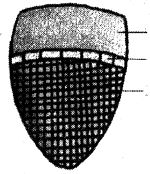
Identify the vascular bundle shown in the figure.
A
Radial vascular bundle
B
Conjoint open vascular bundle
C
Conjoint closed vascular bundle
D
None
Solution
(B) The provided figure shows a vascular bundle consisting of xylem and phloem arranged together in the same radius,which is characteristic of a conjoint vascular bundle.
Between the xylem and phloem,a strip of cambium is present,which indicates that it is an 'open' vascular bundle.
Such bundles are typically found in dicot stems,where the cambium allows for secondary growth.
Therefore,the figure represents a conjoint open vascular bundle.
Between the xylem and phloem,a strip of cambium is present,which indicates that it is an 'open' vascular bundle.
Such bundles are typically found in dicot stems,where the cambium allows for secondary growth.
Therefore,the figure represents a conjoint open vascular bundle.
0 likes
View Solution13
MediumMCQ
Match the following:
| Column-$I$ | Column-$II$ |
|---|---|
| $(a)$ Dicot leaf | $(p)$ Polyarch |
| $(b)$ Dicot stem | $(q)$ Palisade and spongy mesophyll |
| $(c)$ Monocot root | $(r)$ Endarch |
| $(d)$ Monocot leaf | $(s)$ Bulliform cell |
A
$a-r, b-s, c-p, d-q$
B
$a-p, b-r, c-s, d-q$
C
$a-s, b-q, c-p, d-r$
D
$a-q, b-r, c-p, d-s$
Solution
(D) The correct matches are as follows:
$(a)$ Dicot leaf: Contains differentiated mesophyll tissue into $(q)$ Palisade and spongy mesophyll.
$(b)$ Dicot stem: Characterized by vascular bundles with $(r)$ Endarch xylem.
$(c)$ Monocot root: Typically exhibits $(p)$ Polyarch condition (many xylem bundles).
$(d)$ Monocot leaf: Contains specialized motor cells known as $(s)$ Bulliform cells.
Therefore,the correct sequence is $a-q, b-r, c-p, d-s$.
$(a)$ Dicot leaf: Contains differentiated mesophyll tissue into $(q)$ Palisade and spongy mesophyll.
$(b)$ Dicot stem: Characterized by vascular bundles with $(r)$ Endarch xylem.
$(c)$ Monocot root: Typically exhibits $(p)$ Polyarch condition (many xylem bundles).
$(d)$ Monocot leaf: Contains specialized motor cells known as $(s)$ Bulliform cells.
Therefore,the correct sequence is $a-q, b-r, c-p, d-s$.
0 likes
View Solution14
MediumMCQ
Which of the following statement$(s)$ is/are true?
$(A)$ Uneven thickening of cell wall is characteristic of sclerenchyma.
$(B)$ Periblem forms cortex of the stem and the root.
$(C)$ Tracheids are the chief water transporting elements in gymnosperms.
$(D)$ Companion cell is devoid of nucleus at maturity.
$(E)$ The commercial cork is obtained from $Quercus$ $suber$.
$(A)$ Uneven thickening of cell wall is characteristic of sclerenchyma.
$(B)$ Periblem forms cortex of the stem and the root.
$(C)$ Tracheids are the chief water transporting elements in gymnosperms.
$(D)$ Companion cell is devoid of nucleus at maturity.
$(E)$ The commercial cork is obtained from $Quercus$ $suber$.
A
$B, C$ and $E$ only
B
$A, B$ and $C$ only
C
$B, D$ and $E$ only
D
$A, C$ and $E$ only
Solution
(A) Let us analyze each statement:
$(A)$ Incorrect: Uneven thickening of the cell wall is a characteristic feature of collenchyma,not sclerenchyma.
$(B)$ Correct: According to the histogen theory,the periblem gives rise to the cortex of the stem and root.
$(C)$ Correct: Tracheids are the primary water-conducting elements in gymnosperms,as vessels are generally absent.
$(D)$ Incorrect: Companion cells possess a nucleus at maturity; it is the sieve tube elements that are devoid of a nucleus at maturity.
$(E)$ Correct: Commercial cork is obtained from the bark of the oak tree known as $Quercus$ $suber$.
Therefore,statements $(B), (C),$ and $(E)$ are true.
$(A)$ Incorrect: Uneven thickening of the cell wall is a characteristic feature of collenchyma,not sclerenchyma.
$(B)$ Correct: According to the histogen theory,the periblem gives rise to the cortex of the stem and root.
$(C)$ Correct: Tracheids are the primary water-conducting elements in gymnosperms,as vessels are generally absent.
$(D)$ Incorrect: Companion cells possess a nucleus at maturity; it is the sieve tube elements that are devoid of a nucleus at maturity.
$(E)$ Correct: Commercial cork is obtained from the bark of the oak tree known as $Quercus$ $suber$.
Therefore,statements $(B), (C),$ and $(E)$ are true.
0 likes
View Solution15
MediumMCQ
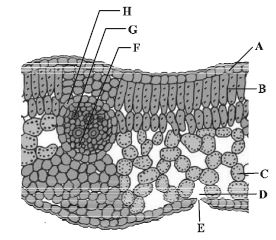
$T.S.$ of a dicot leaf is given below. Certain parts have been indicated by alphabets. Choose the correct option.
A
$A -$ Epidermis,$B -$ Spongy parenchyma,$C -$ Palisade parenchyma,$D -$ Stomata,$E -$ Guard cells,$F -$ Phloem,$G -$ Metaxylem,$H -$ Protoxylem
B
$A -$ Epidermis,$B -$ Palisade parenchyma,$C -$ Spongy parenchyma,$D -$ Sub-stomatal cavity,$E -$ Stoma,$F -$ Phloem,$G -$ Metaxylem,$H -$ Bundle sheath
C
$A -$ Epidermis,$B -$ Palisade parenchyma,$C -$ Spongy parenchyma,$D -$ Stomata,$E -$ Guard cells,$F -$ Epidermis,$G -$ Xylem,$H -$ Phloem
D
$A -$ Epidermis,$B -$ Palisade parenchyma,$C -$ Spongy parenchyma,$D -$ Stomata,$E -$ Guard cells,$F -$ Phloem,$G -$ Metaxylem,$H -$ Protoxylem
Solution
(D) Based on the anatomical structure of a dicot leaf:
$A$ represents the upper epidermis.
$B$ represents the palisade parenchyma,which consists of elongated cells located below the upper epidermis.
$C$ represents the spongy parenchyma,which consists of loosely arranged cells with intercellular spaces.
$D$ represents the sub-stomatal cavity (air space).
$E$ represents the stoma (pore).
$F$ represents the phloem,which is located towards the lower side of the vascular bundle.
$G$ represents the metaxylem,which consists of larger vessels.
$H$ represents the protoxylem,which consists of smaller vessels located towards the upper side.
Therefore,option $D$ is the correct identification of the labeled parts.
$A$ represents the upper epidermis.
$B$ represents the palisade parenchyma,which consists of elongated cells located below the upper epidermis.
$C$ represents the spongy parenchyma,which consists of loosely arranged cells with intercellular spaces.
$D$ represents the sub-stomatal cavity (air space).
$E$ represents the stoma (pore).
$F$ represents the phloem,which is located towards the lower side of the vascular bundle.
$G$ represents the metaxylem,which consists of larger vessels.
$H$ represents the protoxylem,which consists of smaller vessels located towards the upper side.
Therefore,option $D$ is the correct identification of the labeled parts.
0 likes
View Solution16
Difficult
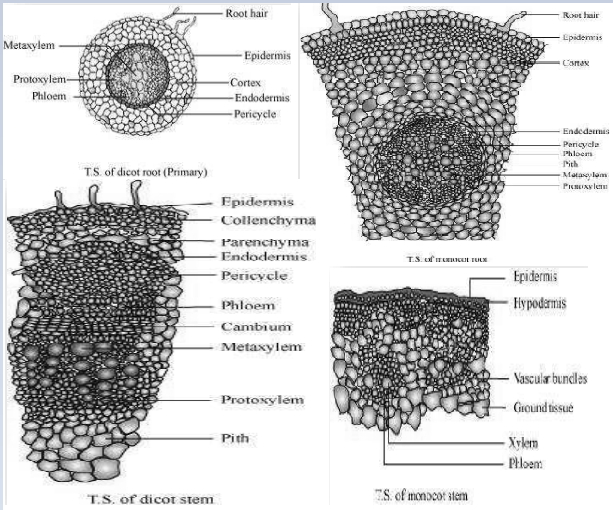
Draw illustrations to highlight the anatomical differences between:
$(a)$ Monocot root and dicot root
$(b)$ Monocot stem and dicot stem
$(a)$ Monocot root and dicot root
$(b)$ Monocot stem and dicot stem
Solution
(N/A) The anatomical differences are as follows:
$(a)$ Monocot root vs. Dicot root:
- In dicot roots,the vascular bundles are usually $2$ to $4$ (diarch to tetrarch),whereas in monocot roots,they are polyarch (more than $6$).
- Dicot roots show secondary growth,while monocot roots do not.
- Pith is small or absent in dicot roots,but large and well-developed in monocot roots.
$(b)$ Monocot stem vs. Dicot stem:
- In dicot stems,vascular bundles are arranged in a ring,whereas in monocot stems,they are scattered throughout the ground tissue.
- Dicot stems have a distinct cortex,endodermis,pericycle,and pith,whereas these are not clearly differentiated in monocot stems.
- Vascular bundles in dicot stems are open (possess cambium),while in monocot stems,they are closed (lack cambium).
$(a)$ Monocot root vs. Dicot root:
- In dicot roots,the vascular bundles are usually $2$ to $4$ (diarch to tetrarch),whereas in monocot roots,they are polyarch (more than $6$).
- Dicot roots show secondary growth,while monocot roots do not.
- Pith is small or absent in dicot roots,but large and well-developed in monocot roots.
$(b)$ Monocot stem vs. Dicot stem:
- In dicot stems,vascular bundles are arranged in a ring,whereas in monocot stems,they are scattered throughout the ground tissue.
- Dicot stems have a distinct cortex,endodermis,pericycle,and pith,whereas these are not clearly differentiated in monocot stems.
- Vascular bundles in dicot stems are open (possess cambium),while in monocot stems,they are closed (lack cambium).
1 likes
View Solution17
Difficult
How is the study of plant anatomy useful to us?
Solution
(N/A) The study of plant anatomy helps us to understand the structural adaptations of plants with respect to diverse environmental conditions.
It also helps us to distinguish between monocots,dicots,and gymnosperms.
Such a study is closely linked to plant physiology,which aids in the improvement of food crops.
The study of plant structure allows us to predict the strength and quality of wood,which is useful in utilizing it to its full potential.
Furthermore,the study of various plant fibres,such as jute and flax,helps in their commercial exploitation and industrial application.
It also helps us to distinguish between monocots,dicots,and gymnosperms.
Such a study is closely linked to plant physiology,which aids in the improvement of food crops.
The study of plant structure allows us to predict the strength and quality of wood,which is useful in utilizing it to its full potential.
Furthermore,the study of various plant fibres,such as jute and flax,helps in their commercial exploitation and industrial application.
0 likes
View Solution18
Medium
Explain plant anatomy and its importance.
Solution
(N/A) $\rightarrow$ The study of the internal structure of plants is known as anatomy.
$\rightarrow$ Plants are composed of cells as the basic unit. These cells are organized into tissues,which in turn form organs.
$\rightarrow$ Different organs within a plant exhibit variations in their internal structure.
$\rightarrow$ Within angiosperms,monocots and dicots show significant anatomical differences.
$\rightarrow$ Internal structures also demonstrate adaptations to diverse environmental conditions.
$\rightarrow$ Importance: Anatomy helps in understanding how plants function,how they transport water and nutrients,how they provide mechanical support,and how they adapt to different habitats.
$\rightarrow$ Plants are composed of cells as the basic unit. These cells are organized into tissues,which in turn form organs.
$\rightarrow$ Different organs within a plant exhibit variations in their internal structure.
$\rightarrow$ Within angiosperms,monocots and dicots show significant anatomical differences.
$\rightarrow$ Internal structures also demonstrate adaptations to diverse environmental conditions.
$\rightarrow$ Importance: Anatomy helps in understanding how plants function,how they transport water and nutrients,how they provide mechanical support,and how they adapt to different habitats.
0 likes
View Solution19
Easy
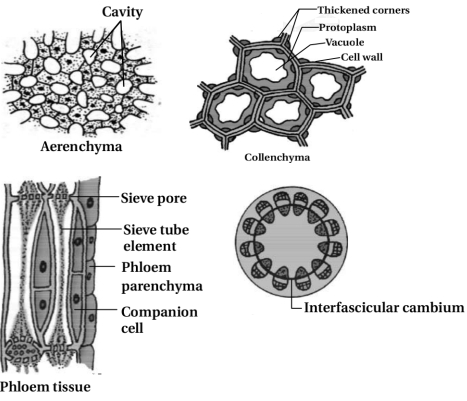
Write the precise function of:
$(a)$ Sieve tube
$(b)$ Interfascicular cambium
$(c)$ Collenchyma
$(d)$ Aerenchyma
$(a)$ Sieve tube
$(b)$ Interfascicular cambium
$(c)$ Collenchyma
$(d)$ Aerenchyma
Solution
(N/A) Sieve tube: It is a component of the phloem tissue. Its primary function is the translocation of synthesized food (sugars) from source to sink throughout the plant body.
$(b)$ Interfascicular cambium: It is a type of secondary meristematic tissue that develops from medullary ray cells located between vascular bundles. Its function is to facilitate secondary growth in dicot stems and roots by producing secondary xylem and secondary phloem.
$(c)$ Collenchyma: It provides mechanical support to the growing parts of the plant,such as young stems and petioles of leaves. It allows for flexibility and tensile strength due to the uneven thickening of cell walls at the corners.
$(d)$ Aerenchyma: It is a specialized type of parenchyma tissue containing large air cavities. Its primary function is to provide buoyancy to aquatic plants,allowing them to float,and to facilitate gas exchange in submerged conditions.
$(b)$ Interfascicular cambium: It is a type of secondary meristematic tissue that develops from medullary ray cells located between vascular bundles. Its function is to facilitate secondary growth in dicot stems and roots by producing secondary xylem and secondary phloem.
$(c)$ Collenchyma: It provides mechanical support to the growing parts of the plant,such as young stems and petioles of leaves. It allows for flexibility and tensile strength due to the uneven thickening of cell walls at the corners.
$(d)$ Aerenchyma: It is a specialized type of parenchyma tissue containing large air cavities. Its primary function is to provide buoyancy to aquatic plants,allowing them to float,and to facilitate gas exchange in submerged conditions.
0 likes
View Solution20
Easy
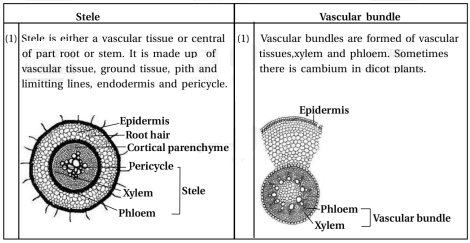
Distinguish between the following: Stele and vascular bundle.
Solution
(N/A) The differences between Stele and Vascular bundle are as follows:
| Feature | Stele | Vascular bundle |
| :--- | :--- | :--- |
| Definition | It is the central part of the root or stem,internal to the endodermis. | It is a strand of conducting tissue consisting of xylem and phloem. |
| Components | It includes the pericycle,vascular bundles,and pith. | It consists of xylem and phloem,and sometimes cambium in dicots. |
| Scope | It represents the entire central core of the plant axis. | It is a specific unit of the conducting system found within the stele. |
| Feature | Stele | Vascular bundle |
| :--- | :--- | :--- |
| Definition | It is the central part of the root or stem,internal to the endodermis. | It is a strand of conducting tissue consisting of xylem and phloem. |
| Components | It includes the pericycle,vascular bundles,and pith. | It consists of xylem and phloem,and sometimes cambium in dicots. |
| Scope | It represents the entire central core of the plant axis. | It is a specific unit of the conducting system found within the stele. |
0 likes
View Solution21
Medium
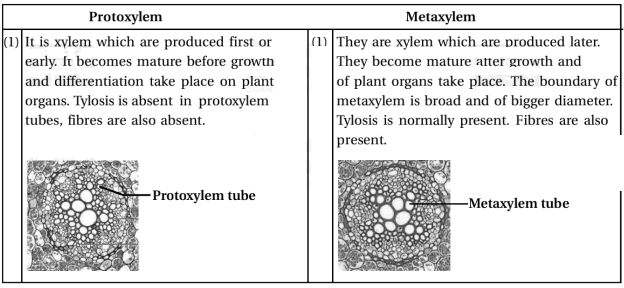
Distinguish between the following: Protoxylem and metaxylem.
Solution
(N/A) The differences between protoxylem and metaxylem are as follows:
| Feature | Protoxylem | Metaxylem |
| :--- | :--- | :--- |
| Formation | It is the first-formed primary xylem. | It is the later-formed primary xylem. |
| Maturation | It matures before the growth and differentiation of plant organs. | It matures after the growth and differentiation of plant organs. |
| Vessel Diameter | It has vessels with a smaller diameter. | It has vessels with a larger diameter. |
| Tyloses | Tyloses are generally absent. | Tyloses are generally present. |
| Fibres | Xylem fibres are typically absent. | Xylem fibres are typically present. |
| Feature | Protoxylem | Metaxylem |
| :--- | :--- | :--- |
| Formation | It is the first-formed primary xylem. | It is the later-formed primary xylem. |
| Maturation | It matures before the growth and differentiation of plant organs. | It matures after the growth and differentiation of plant organs. |
| Vessel Diameter | It has vessels with a smaller diameter. | It has vessels with a larger diameter. |
| Tyloses | Tyloses are generally absent. | Tyloses are generally present. |
| Fibres | Xylem fibres are typically absent. | Xylem fibres are typically present. |
0 likes
View Solution22
MediumMCQ
Select the correct options from the following:
$(i)$ Sapwood / Heartwood appears dark brown in color.
$(ii)$ Generally,pith is absent in Dicot root / Monocot root.
$(i)$ Sapwood / Heartwood appears dark brown in color.
$(ii)$ Generally,pith is absent in Dicot root / Monocot root.
A
Heartwood,Dicot root
B
Sapwood,Dicot root
C
Heartwood,Monocot root
D
Sapwood,Monocot root
Solution
(A) $(i)$ Heartwood is the inner,older part of the secondary xylem that is dark brown in color due to the deposition of organic compounds like tannins,resins,oils,gums,aromatic substances,and essential oils.
$(ii)$ In Dicot roots,the pith is either small or completely absent,whereas in Monocot roots,the pith is large and well-developed.
$(ii)$ In Dicot roots,the pith is either small or completely absent,whereas in Monocot roots,the pith is large and well-developed.
0 likes
View Solution23
MediumMCQ
Match the following:
| Column-$I$ | Column-$II$ |
|---|---|
| $(a)$. Hypodermis in dicot stem | $(i)$. Absent |
| $(b)$. Pericycle in dicot stem | $(ii)$. Parenchymatous |
| $(c)$. Ground tissue in monocot stem | $(iii)$. Collenchymatous |
| $(d)$. Phloem parenchyma in monocot stem | $(iv)$. Sclerenchymatous |
A
$a(iv), b(i), c(iii), d(ii)$
B
$a(i), b(ii), c(iv), d(iii)$
C
$a(iii), b(iv), c(ii), d(i)$
D
$a(ii), b(iii), c(i), d(iv)$
Solution
(C) The correct matches are as follows:
$(a)$. Hypodermis in dicot stem is made of collenchyma cells,providing mechanical support. Thus,$(a)-(iii)$.
$(b)$. Pericycle in dicot stem is typically sclerenchymatous (often present as semi-lunar patches above phloem). Thus,$(b)-(iv)$.
$(c)$. Ground tissue in monocot stem is undifferentiated and parenchymatous. Thus,$(c)-(ii)$.
$(d)$. Phloem parenchyma is absent in monocot stems. Thus,$(d)-(i)$.
Therefore,the correct sequence is $a(iii), b(iv), c(ii), d(i)$.
$(a)$. Hypodermis in dicot stem is made of collenchyma cells,providing mechanical support. Thus,$(a)-(iii)$.
$(b)$. Pericycle in dicot stem is typically sclerenchymatous (often present as semi-lunar patches above phloem). Thus,$(b)-(iv)$.
$(c)$. Ground tissue in monocot stem is undifferentiated and parenchymatous. Thus,$(c)-(ii)$.
$(d)$. Phloem parenchyma is absent in monocot stems. Thus,$(d)-(i)$.
Therefore,the correct sequence is $a(iii), b(iv), c(ii), d(i)$.
0 likes
View Solution24
MediumMCQ
Members of $Winteraceae$,$Tetracentraceae$ and $Trochodendraceae$:
A
Do not have tracheids
B
Do not have albuminous cells
C
Do not have vessels
D
More than one option is correct
Solution
(D) The families $Winteraceae$,$Tetracentraceae$,and $Trochodendraceae$ are considered primitive angiosperms.
These plants lack vessel elements in their xylem,which is a characteristic feature usually associated with gymnosperms.
Additionally,they do not possess albuminous cells (which are specialized parenchyma cells in gymnosperms analogous to companion cells in angiosperms).
Since both statements $B$ and $C$ are correct,the correct answer is $D$.
These plants lack vessel elements in their xylem,which is a characteristic feature usually associated with gymnosperms.
Additionally,they do not possess albuminous cells (which are specialized parenchyma cells in gymnosperms analogous to companion cells in angiosperms).
Since both statements $B$ and $C$ are correct,the correct answer is $D$.
0 likes
View Solution25
MediumMCQ
$A$ : Bast fibres are collenchymatous fibres.
$R$ : Fibres are absent in secondary phloem.
$R$ : Fibres are absent in secondary phloem.
A
Assertion and Reason both are correct and also correct explanation.
B
Assertion and Reason both are correct but not explanation of assertion.
C
Assertion is correct,but Reason is incorrect.
D
Both Assertion and Reason are incorrect.
Solution
(D) Bast fibres are phloem fibres,which are composed of sclerenchymatous cells,not collenchymatous cells. Therefore,the Assertion is incorrect.
Fibres are commonly present in the secondary phloem of many plants. Therefore,the Reason is also incorrect.
Thus,both Assertion and Reason are incorrect.
Fibres are commonly present in the secondary phloem of many plants. Therefore,the Reason is also incorrect.
Thus,both Assertion and Reason are incorrect.
0 likes
View Solution26
MediumMCQ
In plants,the cells in the interior parts are:
A
Dead for mechanical support and conduction
B
Live for storage and transport
C
Dead for protection
D
Both $(a)$ and $(b)$
Solution
(D) In woody plants,the interior parts of the stem consist of dead cells such as xylem vessels and tracheids,which provide mechanical support and facilitate the conduction of water and minerals.
Additionally,living cells are present in the inner layers (like the cambium and parenchyma) which are responsible for storage and transport of nutrients.
Therefore,the interior of a plant contains both dead cells for support/conduction and living cells for storage/transport.
Additionally,living cells are present in the inner layers (like the cambium and parenchyma) which are responsible for storage and transport of nutrients.
Therefore,the interior of a plant contains both dead cells for support/conduction and living cells for storage/transport.
0 likes
View Solution27
EasyMCQ
Match List-$I$ with List-$II$:
Select the correct answer from the options given below:
| List-$I$ | List-$II$ |
|---|---|
| $(a)$ Cells with the capacity to divide actively | $(i)$ Vascular tissue |
| $(b)$ $A$ tissue where all cells are similar in structure and function | $(ii)$ Meristem |
| $(c)$ Tissue having different types of cells | $(iii)$ Sclereid |
| $(d)$ Dead cells with highly thickened walls and narrow lumen | $(iv)$ Simple tissue |
Select the correct answer from the options given below:
A
$(a)-(i), (b)-(ii), (c)-(iii), (d)-(iv)$
B
$(a)-(iv), (b)-(iii), (c)-(ii), (d)-(i)$
C
$(a)-(ii), (b)-(iv), (c)-(i), (d)-(iii)$
D
$(a)-(iii), (b)-(ii), (c)-(iv), (d)-(i)$
Solution
(C) Cells with the capacity to divide actively are known as Meristem $(ii)$.
$(b)$ $A$ tissue where all cells are similar in structure and function is called a Simple tissue $(iv)$.
$(c)$ $A$ tissue having different types of cells is a Complex tissue,such as Vascular tissue $(i)$.
$(d)$ Dead cells with highly thickened walls and narrow lumen are Sclereids $(iii)$.
Therefore,the correct matching is $(a)-(ii), (b)-(iv), (c)-(i), (d)-(iii)$.
$(b)$ $A$ tissue where all cells are similar in structure and function is called a Simple tissue $(iv)$.
$(c)$ $A$ tissue having different types of cells is a Complex tissue,such as Vascular tissue $(i)$.
$(d)$ Dead cells with highly thickened walls and narrow lumen are Sclereids $(iii)$.
Therefore,the correct matching is $(a)-(ii), (b)-(iv), (c)-(i), (d)-(iii)$.
0 likes
View Solution28
DifficultMCQ
The process of extraction of separated $DNA$ strands from gel is called elution.
$(a)$ In roots,xylem and phloem in a vascular bundle are arranged in an alternate manner along the different radii.
$(b)$ Conjoint closed vascular bundles do not possess cambium.
$(c)$ In open vascular bundles,cambium is present in between xylem and phloem.
$(d)$ The vascular bundles of dicotyledonous stem possess endarch protoxylem.
$(e)$ In monocotyledonous root,usually there are more than six xylem bundles present.
Choose the correct answer from the options given below:
$(a)$ In roots,xylem and phloem in a vascular bundle are arranged in an alternate manner along the different radii.
$(b)$ Conjoint closed vascular bundles do not possess cambium.
$(c)$ In open vascular bundles,cambium is present in between xylem and phloem.
$(d)$ The vascular bundles of dicotyledonous stem possess endarch protoxylem.
$(e)$ In monocotyledonous root,usually there are more than six xylem bundles present.
Choose the correct answer from the options given below:
A
$(b), (c), (d)$ and $(e)$ Only
B
$(a), (b), (c)$ and $(d)$ Only
C
$(a), (c), (d)$ and $(e)$ Only
D
$(a), (b)$ and $(d)$ Only
Solution
(A) The statement regarding $DNA$ elution is a general fact in biotechnology,but the question asks to evaluate the statements $(a)$ through $(e)$ related to plant anatomy:
$(a)$ In roots,xylem and phloem are arranged in an alternate manner on different radii (radial vascular bundles). This is correct.
$(b)$ Conjoint closed vascular bundles lack cambium,which is correct.
$(c)$ In open vascular bundles,cambium is present between xylem and phloem,which is correct.
$(d)$ Dicotyledonous stems have vascular bundles with endarch protoxylem,which is correct.
$(e)$ Monocotyledonous roots are polyarch,meaning they typically have more than six xylem bundles,which is correct.
Since all statements $(a), (b), (c), (d),$ and $(e)$ are correct,and no option includes all five,we re-evaluate the provided options. Given the standard structure of such questions,if the question implies selecting the set of correct statements,and all are correct,the provided options might be incomplete. However,based on the provided choices,$(a), (b), (c), (d),$ and $(e)$ are all anatomically accurate. If we must choose the most comprehensive set,there is an error in the options provided by the source. Assuming the question intended to test all,all are correct.
$(a)$ In roots,xylem and phloem are arranged in an alternate manner on different radii (radial vascular bundles). This is correct.
$(b)$ Conjoint closed vascular bundles lack cambium,which is correct.
$(c)$ In open vascular bundles,cambium is present between xylem and phloem,which is correct.
$(d)$ Dicotyledonous stems have vascular bundles with endarch protoxylem,which is correct.
$(e)$ Monocotyledonous roots are polyarch,meaning they typically have more than six xylem bundles,which is correct.
Since all statements $(a), (b), (c), (d),$ and $(e)$ are correct,and no option includes all five,we re-evaluate the provided options. Given the standard structure of such questions,if the question implies selecting the set of correct statements,and all are correct,the provided options might be incomplete. However,based on the provided choices,$(a), (b), (c), (d),$ and $(e)$ are all anatomically accurate. If we must choose the most comprehensive set,there is an error in the options provided by the source. Assuming the question intended to test all,all are correct.
0 likes
View Solution29
MediumMCQ
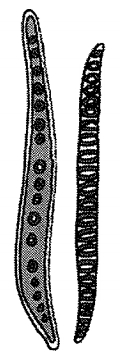
In which plant group is the structure shown below found?
A
Pteridophytes
B
Gymnosperms
C
Angiosperms
D
All of the above
Solution
(D) The image shows tracheids,which are elongated,tube-like cells with tapering ends and lignified walls.
Tracheids are the primary water-conducting elements in Pteridophytes and Gymnosperms.
In Angiosperms,while vessels are the primary conducting elements,tracheids are also present.
Therefore,tracheids are found in all three groups: Pteridophytes,Gymnosperms,and Angiosperms.
Tracheids are the primary water-conducting elements in Pteridophytes and Gymnosperms.
In Angiosperms,while vessels are the primary conducting elements,tracheids are also present.
Therefore,tracheids are found in all three groups: Pteridophytes,Gymnosperms,and Angiosperms.
0 likes
View Solution30
MediumMCQ
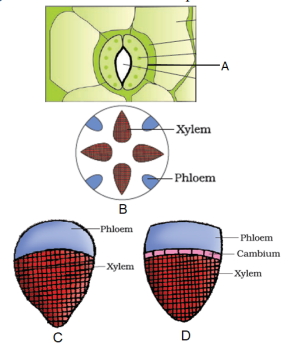
Identify the $(A), (B), (C)$ and $(D)$ in the given figures and select the correct option $:-$
A
$A \rightarrow$ Guard cells,$B \rightarrow$ Conjoint closed,$C \rightarrow$ Conjoint open,$D \rightarrow$ Radial condition
B
$A \rightarrow$ Subsidiary cells,$B \rightarrow$ Conjoint closed,$C \rightarrow$ Conjoint open,$D \rightarrow$ Conjoint condition
C
$A \rightarrow$ Guard cells,$B \rightarrow$ Radial condition,$C \rightarrow$ Conjoint closed,$D \rightarrow$ Conjoint Bicollateral
D
$A \rightarrow$ Guard cells,$B \rightarrow$ Radial condition,$C \rightarrow$ Conjoint closed,$D \rightarrow$ Conjoint open
Solution
(D) Based on the provided figures:
$1$. $(A)$ represents the Guard cells of a stoma.
$2$. $(B)$ shows Xylem and Phloem arranged in an alternating manner on different radii,which is characteristic of the Radial vascular bundle.
$3$. $(C)$ shows a Conjoint vascular bundle where Xylem and Phloem are on the same radius,and there is no cambium present between them,making it a Conjoint closed vascular bundle.
$4$. $(D)$ shows a Conjoint vascular bundle with a strip of cambium present between Xylem and Phloem,making it a Conjoint open vascular bundle.
Therefore,the correct identification is $A \rightarrow$ Guard cells,$B \rightarrow$ Radial condition,$C \rightarrow$ Conjoint closed,$D \rightarrow$ Conjoint open.
$1$. $(A)$ represents the Guard cells of a stoma.
$2$. $(B)$ shows Xylem and Phloem arranged in an alternating manner on different radii,which is characteristic of the Radial vascular bundle.
$3$. $(C)$ shows a Conjoint vascular bundle where Xylem and Phloem are on the same radius,and there is no cambium present between them,making it a Conjoint closed vascular bundle.
$4$. $(D)$ shows a Conjoint vascular bundle with a strip of cambium present between Xylem and Phloem,making it a Conjoint open vascular bundle.
Therefore,the correct identification is $A \rightarrow$ Guard cells,$B \rightarrow$ Radial condition,$C \rightarrow$ Conjoint closed,$D \rightarrow$ Conjoint open.
0 likes
View Solution31
EasyMCQ
Match the Column-$I$ with Column-$II$ and choose the correct option:
| Column-$I$ (characteristics of vascular bundle) | Column-$II$ (Transverse section) |
| $A$. Radial,tetrarch,cambial ring between xylem and phloem at later stages | $i$. $T.S$ of monocot stem |
| $B$. Conjoint,open and endarch | $ii$. $T.S$ of dicot root |
| $C$. Radial,Polyarch,large pith without cambial ring | $iii$. $T.S$ of monocot root |
| $D$. Conjoint,closed with sclerenchymatous bundle sheath | $iv$. $T.S$ of dicot stem |
A
$A-ii, B-iv, C-iii, D-i$
B
$A-iii, B-iv, C-i, D-ii$
C
$A-i, B-ii, C-iii, D-iv$
D
$A-ii, B-iii, C-iv, D-i$
Solution
$(A)$. Radial,tetrarch,cambial ring between xylem and phloem at later stages corresponds to $T.S$ of dicot root $(A-ii)$.
$B$. Conjoint,open and endarch vascular bundles are characteristic of dicot stem $(B-iv)$.
$C$. Radial,polyarch,large pith without cambial ring is characteristic of monocot root $(C-iii)$.
$D$. Conjoint,closed with sclerenchymatous bundle sheath is characteristic of monocot stem $(D-i)$.
Therefore,the correct matching is $A-ii, B-iv, C-iii, D-i$.
$B$. Conjoint,open and endarch vascular bundles are characteristic of dicot stem $(B-iv)$.
$C$. Radial,polyarch,large pith without cambial ring is characteristic of monocot root $(C-iii)$.
$D$. Conjoint,closed with sclerenchymatous bundle sheath is characteristic of monocot stem $(D-i)$.
Therefore,the correct matching is $A-ii, B-iv, C-iii, D-i$.
0 likes
View SolutionAnatomy of Flowering Plants — Mix Examples- Anatomy of Flowering Plants · Frequently Asked Questions
1Are these Anatomy of Flowering Plants questions useful for JEE and NEET?
Yes. All questions in this section are mapped to JEE Main and NEET exam patterns. Previous year questions from JEE Main, NEET, GUJCET and state-level exams are included with full solutions.
2Can I switch to Hindi or Gujarati for these questions?
Yes. Use the language tabs in the hero section or the sidebar to view the same questions and solutions in English, Hindi or Gujarati.
3How do I generate a question paper from this subtopic?
Use the Vedclass Exam Paper Generator — select the chapter and subtopic, set difficulty, and generate Sets A, B, C, D automatically. First 3 chapters of every subject are free.
Vedclass Products
For Students
Vedclass Test Series
Mock tests in real JEE/NEET style with performance analysis. 5-day free trial.
Start Free TrialFor Teachers
Exam Paper Generator
Generate Set A/B/C/D papers from this chapter in 2 minutes. 3 chapters free.
Try FreeFor Institutes
Online Exam Module
Live online exams with unlimited students, 360° analytics & white-label branding.
See DemoFor Teachers & Institutes
Generate a Anatomy of Flowering Plants Exam Paper in 2 Minutes
Select subtopic & difficulty — Sets A, B, C, D auto-generated with No Repeat logic.
First 3 chapters of every subject are free — no payment required.