
A English
Internal structure of leaf Questions in English
Class 11 Biology · Anatomy of Flowering Plants · Internal structure of leaf
84+
Questions
English
Language
100%
With Solutions
Showing 50 of 84 questions in English
1
MediumMCQ
In $Pinus$ needle,vascular bundles are:
A
Bicollateral
B
Collateral and closed
C
Collateral and open
D
Concentric
Solution
(C) In $Pinus$ needle,the vascular bundles are collateral and open.
Collateral means xylem and phloem are arranged on the same radius,with xylem towards the adaxial side and phloem towards the abaxial side.
Open means the vascular bundles contain cambium between the xylem and phloem,which allows for secondary growth.
Collateral means xylem and phloem are arranged on the same radius,with xylem towards the adaxial side and phloem towards the abaxial side.
Open means the vascular bundles contain cambium between the xylem and phloem,which allows for secondary growth.
0 likes
View Solution2
MediumMCQ
Isobilateral leaf is found in
A
Dicots
B
Monocots
C
Hydrophytes
D
Xerophytes
Solution
(B) In an isobilateral leaf,both the adaxial and abaxial surfaces are uniform in color and show a similar internal structure.
Both surfaces receive an equal amount of light. This type of leaf is characteristic of monocotyledonous plants,such as $Maize$.
Both surfaces receive an equal amount of light. This type of leaf is characteristic of monocotyledonous plants,such as $Maize$.
0 likes
View Solution3
MediumMCQ
Which of the following is not a characteristic of xerophytic plants?
A
Thick cuticle
B
Developed root system
C
Aerenchyma
D
Sunken stomata
Solution
(C) $Aerenchyma$ is a characteristic feature of hydrophytes (aquatic plants),which helps in buoyancy and gas exchange. Xerophytic plants (plants adapted to dry environments) typically possess features like a thick cuticle,well-developed root systems,and sunken stomata to minimize water loss.
0 likes
View Solution4
MediumMCQ
Starch is mainly manufactured by
A
Palisade parenchyma
B
Spongy parenchyma
C
Guard cells
D
Vascular bundle
Solution
(A) Starch is mainly manufactured by the $Palisade$ $parenchyma$.
These are elongated,columnar cells that lack intercellular spaces.
They contain a high density of chloroplasts,which are the primary sites for photosynthesis,leading to the production of starch.
They are typically arranged in one or two layers beneath the upper epidermis in dorsiventral leaves.
These are elongated,columnar cells that lack intercellular spaces.
They contain a high density of chloroplasts,which are the primary sites for photosynthesis,leading to the production of starch.
They are typically arranged in one or two layers beneath the upper epidermis in dorsiventral leaves.
0 likes
View Solution5
EasyMCQ
$A$ dorsiventral leaf has:
A
Stomata on both sides
B
Stomata on the lower surface
C
Stomata on the upper surface
D
No stomata
Solution
(B) The correct answer is $B$.
Dorsiventral leaves are characteristic of dicotyledonous plants.
In these leaves,the two surfaces (upper and lower) are morphologically distinct.
Stomata are primarily present on the lower epidermis to reduce water loss through transpiration.
Dorsiventral leaves are characteristic of dicotyledonous plants.
In these leaves,the two surfaces (upper and lower) are morphologically distinct.
Stomata are primarily present on the lower epidermis to reduce water loss through transpiration.
0 likes
View Solution6
MediumMCQ
Between which of the contiguous cells is the middle lamella absent?
A
Between two guard cells
B
Between two subsidiary cells
C
Between guard cells and subsidiary cells
D
Between all epidermal cells
Solution
(A) The middle lamella is a layer of pectin that cements the cell walls of adjacent plant cells together.
However,in the case of the stomatal apparatus,the guard cells are specialized cells that must change shape to open and close the stoma.
To facilitate this movement,the middle lamella is absent between the guard cells,allowing them to separate and form the stomatal pore.
Therefore,the correct answer is between two guard cells.
However,in the case of the stomatal apparatus,the guard cells are specialized cells that must change shape to open and close the stoma.
To facilitate this movement,the middle lamella is absent between the guard cells,allowing them to separate and form the stomatal pore.
Therefore,the correct answer is between two guard cells.
0 likes
View Solution7
MediumMCQ
Multiple epidermis on the dorsal and ventral sides of the leaf is found in:
A
Zea mays
B
Ficus benghalensis
C
Mangifera indica
D
Nerium oleander
Solution
(D) $Nerium \ oleander$ is a xerophytic plant. In this plant,a multiple epidermis (multiseriate epidermis) is present on both the dorsal and ventral sides of the leaf. This structural adaptation helps in reducing the rate of transpiration and prevents excessive water loss from the leaves.
0 likes
View Solution8
EasyMCQ
Which of the following have sunken stomata?
A
Nerium
B
Mangifera
C
Hydrilla
D
Zea mays
Solution
(A) Sunken stomata are found in xerophytic plants. This is an anatomical adaptation to reduce the rate of transpiration by creating a humid microenvironment within the stomatal pit. Among the given options,$Nerium$ is a classic example of a xerophyte that possesses sunken stomata.
0 likes
View Solution9
MediumMCQ
In a monocot leaf:
A
Bulliform cells are absent from the epidermis
B
Veins form a network
C
Mesophyll is well differentiated into these parts
D
Mesophyll is not differentiated into palisade and spongy parenchyma
Solution
(D) In a monocot leaf,the mesophyll tissue located between the upper and lower epidermis is not differentiated into palisade and spongy parenchyma. Instead,all the mesophyll cells are similar in structure and function.
0 likes
View Solution10
MediumMCQ
The correct situation of mesophyll in an isobilateral grass leaf is shown by:
A
Palisade towards adaxial surface
B
Palisade towards abaxial surface
C
Undifferentiated mesophyll
D
Palisade along both the surfaces
Solution
(C) In an isobilateral leaf,such as those found in monocots like grasses,the mesophyll is not differentiated into palisade and spongy parenchyma.
Instead,the mesophyll consists of undifferentiated,thin-walled,isodiametric cells containing chloroplasts.
Therefore,the correct situation is that the mesophyll is undifferentiated.
Instead,the mesophyll consists of undifferentiated,thin-walled,isodiametric cells containing chloroplasts.
Therefore,the correct situation is that the mesophyll is undifferentiated.
0 likes
View Solution11
MediumMCQ
In a vertical section of a dorsiventral leaf,the protoxylem in its midrib bundle:
A
Faces the dorsal epidermis of the leaf
B
Faces the ventral epidermis of the leaf
C
Is not distinct
D
Is surrounded by metaxylem
Solution
(A) In a dorsiventral leaf (typical of dicots),the vascular bundles are collateral. In the midrib bundle,the xylem is located towards the adaxial (dorsal) surface,while the phloem is located towards the abaxial (ventral) surface. Within the xylem,the protoxylem elements are situated towards the adaxial epidermis (dorsal side),and the metaxylem elements are situated towards the abaxial side. Therefore,the protoxylem faces the dorsal epidermis.
0 likes
View Solution12
MediumMCQ
In leaves,the protoxylem elements:
A
Face towards the abaxial surface
B
Face towards the adaxial surface
C
Are surrounded by metaxylem elements
D
Are scattered in the vascular bundle
Solution
(B) In the leaves of dicotyledonous plants,the vascular bundles are collateral and closed.
In these bundles,the xylem is located towards the adaxial (upper) surface,while the phloem is located towards the abaxial (lower) surface.
Within the xylem,the protoxylem elements are directed towards the adaxial surface,which is characteristic of the endarch condition in leaves.
In these bundles,the xylem is located towards the adaxial (upper) surface,while the phloem is located towards the abaxial (lower) surface.
Within the xylem,the protoxylem elements are directed towards the adaxial surface,which is characteristic of the endarch condition in leaves.
0 likes
View Solution13
MediumMCQ
Palisade tissue is present on both sides of the leaf of
A
Helianthus
B
Nerium
C
Wheat
D
Maize
Solution
(B) The leaf of $Nerium$ is isobilateral in its distribution of mesophyll tissue,but it is specifically known as an isolateral or equifacial leaf where palisade parenchyma is present on both the upper and lower surfaces of the leaf. This is an adaptation to reduce water loss in xerophytic conditions.
0 likes
View Solution14
MediumMCQ
In a dorsiventral leaf,the location of palisade tissue and phloem respectively are:
A
Abaxial and abaxial
B
Adaxial and abaxial
C
Adaxial and adaxial
D
Abaxial and adaxial
Solution
(B) In a dorsiventral leaf (typical of dicots),the internal structure is differentiated into two surfaces: the upper surface (adaxial) and the lower surface (abaxial).
$1$. The palisade parenchyma (palisade tissue) is located towards the upper surface,i.e.,the adaxial side,to maximize light absorption for photosynthesis.
$2$. In the vascular bundles of the leaf,the xylem is located towards the adaxial side (upper side),while the phloem is located towards the abaxial side (lower side).
Therefore,the palisade tissue is adaxial and the phloem is abaxial.
$1$. The palisade parenchyma (palisade tissue) is located towards the upper surface,i.e.,the adaxial side,to maximize light absorption for photosynthesis.
$2$. In the vascular bundles of the leaf,the xylem is located towards the adaxial side (upper side),while the phloem is located towards the abaxial side (lower side).
Therefore,the palisade tissue is adaxial and the phloem is abaxial.
0 likes
View Solution15
MediumMCQ
In an isobilateral leaf,more plastids are found in:
A
Upper epidermis
B
Lower epidermis
C
Mesophyll cells
D
Pericycle
Solution
(C) In an isobilateral leaf (typically found in monocots),the mesophyll is not differentiated into palisade and spongy parenchyma. The mesophyll cells are the primary sites of photosynthesis and contain numerous chloroplasts (plastids) to facilitate this process.
0 likes
View Solution16
EasyMCQ
The largest number of chloroplasts is found in:
A
Palisade tissue
B
Spongy tissue
C
Transfusion tissue
D
Bundle sheath cells
Solution
(A) The $Palisade$ tissue consists of elongated,columnar cells arranged vertically,which are densely packed without intercellular spaces. These cells contain the highest concentration of chloroplasts within the leaf to maximize light absorption for photosynthesis. Therefore,they are the primary sites for photosynthetic activity.
0 likes
View Solution17
MediumMCQ
The function of bulliform cells is to
A
Absorb water on the leaf epidermis
B
Contain various enzymes for photosynthesis
C
Reduce the rate of transpiration
D
Support the epidermal cells where they are present
Solution
(C) Bulliform cells are large,bubble-shaped epidermal cells found in groups on the upper surface of leaves of many monocots,such as grasses.
During periods of water stress or drought,these cells lose water and become flaccid.
This loss of turgor pressure causes the leaves to roll inwards,which reduces the surface area exposed to the atmosphere.
By rolling the leaves,the plant effectively reduces the rate of transpiration,thereby conserving water.
Therefore,the correct option is $(c)$.
During periods of water stress or drought,these cells lose water and become flaccid.
This loss of turgor pressure causes the leaves to roll inwards,which reduces the surface area exposed to the atmosphere.
By rolling the leaves,the plant effectively reduces the rate of transpiration,thereby conserving water.
Therefore,the correct option is $(c)$.
0 likes
View Solution18
MediumMCQ
The vestigial stomata are present in
A
Floating hydrophyte
B
Submerged hydrophyte
C
Both $(a)$ and $(b)$
D
None of the above
Solution
(B) In submerged hydrophytes,stomata are either completely absent or,if present,they are non-functional and vestigial.
This is because submerged plants absorb water and gases directly through their body surface,making stomata unnecessary for gas exchange or transpiration.
Therefore,the correct answer is $(b)$.
This is because submerged plants absorb water and gases directly through their body surface,making stomata unnecessary for gas exchange or transpiration.
Therefore,the correct answer is $(b)$.
0 likes
View Solution19
EasyMCQ
$Potamogeton$ possesses:
A
Functional stomata
B
More functional stomata
C
Non-functional stomata
D
Oat type stomata
Solution
(C) $Potamogeton$ is a submerged aquatic plant. In submerged hydrophytes,stomata are either completely absent or,if present,they are non-functional (vestigial). Therefore,$Potamogeton$ possesses non-functional stomata.
0 likes
View Solution20
MediumMCQ
In $Vallisneria$,stomata are
A
Present on upper epidermis of leaf
B
Present on lower epidermis of leaf
C
Present on both the epidermis of leaf
D
Not present
Solution
(D) $Vallisneria$ is a submerged aquatic plant. In submerged hydrophytes,the entire plant body remains under water. Since the plant is in direct contact with water,gaseous exchange occurs through the general body surface by diffusion. Therefore,stomata are absent in $Vallisneria$ as they are not required for transpiration or gaseous exchange.
0 likes
View Solution21
EasyMCQ
Sunken stomata are adaptations of which category of plants?
A
Hydrophytes
B
Sciophytes
C
Xerophytes
D
Halophytes
Solution
(C) Sunken stomata are a specialized anatomical adaptation that helps in reducing the rate of stomatal transpiration.
When stomata are situated in deep pits or grooves and are sometimes protected by epidermal hairs,the rate of water loss through transpiration is significantly decreased.
This adaptation is crucial for plants living in water-scarce environments to conserve moisture.
Therefore,such adaptations are characteristic of $Xerophytes$.
When stomata are situated in deep pits or grooves and are sometimes protected by epidermal hairs,the rate of water loss through transpiration is significantly decreased.
This adaptation is crucial for plants living in water-scarce environments to conserve moisture.
Therefore,such adaptations are characteristic of $Xerophytes$.
0 likes
View Solution22
MediumMCQ
Bulliform cells in grass leaves show
A
Growth movements
B
Tropic movements
C
Nastic movements
D
Turgor movements
Solution
(D) Bulliform cells are large,bubble-shaped epidermal cells present in the upper epidermis of grass leaves.
These cells are thin-walled and contain a large vacuole.
When water is abundant,they become turgid,causing the leaf to unfold.
When water is scarce,they lose water and become flaccid,causing the leaf to roll inward to reduce the surface area and minimize transpiration.
This reversible change in shape due to changes in turgor pressure is known as turgor movement.
These cells are thin-walled and contain a large vacuole.
When water is abundant,they become turgid,causing the leaf to unfold.
When water is scarce,they lose water and become flaccid,causing the leaf to roll inward to reduce the surface area and minimize transpiration.
This reversible change in shape due to changes in turgor pressure is known as turgor movement.
0 likes
View Solution23
MediumMCQ
Many types of grass leaves have the ability to roll or unroll because they .....
A
are very thin
B
are isobilateral
C
possess specialized motor cells
D
have parallel vascular bundles
Solution
(C) In grasses,certain adaxial epidermal cells along the veins modify themselves into large,empty,colourless cells called bulliform cells or motor cells. When these cells in the leaves have absorbed water and are turgid,they make the leaf surface exposed. When they are flaccid due to water stress,they make the leaves curl inwards to minimize water loss.
0 likes
View Solution24
MediumMCQ
In which of the following is the mesophyll differentiated into palisade and spongy parenchyma?
A
Isobilateral leaf
B
Dorsiventral leaf
C
Both
D
None of these
Solution
(B) In a dorsiventral leaf (typically found in dicotyledonous plants),the mesophyll is differentiated into two types of cells: palisade parenchyma and spongy parenchyma.
Palisade parenchyma is located on the adaxial (upper) side and consists of vertically placed,elongated cells.
Spongy parenchyma is located on the abaxial (lower) side and consists of oval or round cells with large intercellular spaces.
In contrast,isobilateral leaves (typically found in monocotyledonous plants) do not show this differentiation,as the mesophyll cells are similar throughout.
Palisade parenchyma is located on the adaxial (upper) side and consists of vertically placed,elongated cells.
Spongy parenchyma is located on the abaxial (lower) side and consists of oval or round cells with large intercellular spaces.
In contrast,isobilateral leaves (typically found in monocotyledonous plants) do not show this differentiation,as the mesophyll cells are similar throughout.
0 likes
View Solution25
MediumMCQ
Bulliform cells are .......
A
Empty,colorless epidermal cells of the leaf
B
Prokaryotic cells
C
Eukaryotic cells of the stem
D
Bulbous parenchymatous cells of the root
Solution
(A) Bulliform cells,also known as motor cells,are large,bubble-shaped epidermal cells found in groups on the upper surface of the leaves of many monocots,such as grasses.
These cells are empty and colorless because they lack chloroplasts.
When these cells absorb water and become turgid,the leaf surface expands.
When they lose water due to stress (like drought),they become flaccid,causing the leaf to curl inward to minimize water loss through transpiration.
These cells are empty and colorless because they lack chloroplasts.
When these cells absorb water and become turgid,the leaf surface expands.
When they lose water due to stress (like drought),they become flaccid,causing the leaf to curl inward to minimize water loss through transpiration.
0 likes
View Solution26
DifficultMCQ
In leaves,the position of protoxylem and protophloem are respectively:
A
Abaxial and Adaxial
B
Adaxial and Abaxial
C
Both Adaxial
D
Both Abaxial
Solution
(B) In the vascular bundles of a leaf,the xylem and phloem are arranged in a specific orientation.
$1$. The xylem is located towards the adaxial (upper) surface of the leaf.
$2$. The phloem is located towards the abaxial (lower) surface of the leaf.
$3$. Within the xylem,the protoxylem (the first formed xylem) is oriented towards the adaxial side.
$4$. Within the phloem,the protophloem (the first formed phloem) is oriented towards the abaxial side.
Therefore,the protoxylem is adaxial and the protophloem is abaxial.
$1$. The xylem is located towards the adaxial (upper) surface of the leaf.
$2$. The phloem is located towards the abaxial (lower) surface of the leaf.
$3$. Within the xylem,the protoxylem (the first formed xylem) is oriented towards the adaxial side.
$4$. Within the phloem,the protophloem (the first formed phloem) is oriented towards the abaxial side.
Therefore,the protoxylem is adaxial and the protophloem is abaxial.
0 likes
View Solution27
DifficultMCQ
In a leaf,the position of protoxylem is:
A
Adaxial
B
Abaxial
C
Surrounding the metaxylem
D
Lateral
Solution
(A) In the vascular bundles of a dicot leaf,the xylem is located towards the adaxial (upper) surface,while the phloem is located towards the abaxial (lower) surface. Within the xylem,the protoxylem elements are situated towards the adaxial side,and the metaxylem elements are situated towards the abaxial side. Therefore,the correct position of the protoxylem is adaxial.
0 likes
View Solution28
MediumMCQ
What type of vascular bundles are found in leaves?
A
Amphivasal and open
B
Conjoint and open
C
Conjoint and closed
D
Radial and exarch
Solution
(C) In leaves, the vascular bundles are $conjoint$, $collateral$, and $closed$.
$Conjoint$ means that xylem and phloem are present on the same radius.
$Closed$ means that there is no cambium present between the xylem and phloem, which prevents secondary growth.
Therefore, the correct option is $C$.
$Conjoint$ means that xylem and phloem are present on the same radius.
$Closed$ means that there is no cambium present between the xylem and phloem, which prevents secondary growth.
Therefore, the correct option is $C$.
0 likes
View Solution29
MediumMCQ
In which plant is the palisade tissue present on both sides of the leaf?
A
Nerium
B
Eucalyptus
C
Both $(A)$ and $(B)$
D
None of these
Solution
(C) In most dicot leaves,the mesophyll is differentiated into palisade parenchyma (adaxial) and spongy parenchyma (abaxial),which is known as dorsiventral leaf anatomy.
However,in certain plants like $Nerium$ and $Eucalyptus$,the leaves are isobilateral or adapted to xerophytic conditions where the palisade tissue is present on both the upper and lower surfaces of the leaf to maximize photosynthetic efficiency and minimize water loss.
Therefore,both $Nerium$ and $Eucalyptus$ exhibit this characteristic.
However,in certain plants like $Nerium$ and $Eucalyptus$,the leaves are isobilateral or adapted to xerophytic conditions where the palisade tissue is present on both the upper and lower surfaces of the leaf to maximize photosynthetic efficiency and minimize water loss.
Therefore,both $Nerium$ and $Eucalyptus$ exhibit this characteristic.
0 likes
View Solution30
EasyMCQ
Bulliform cells are found in:
A
Sunflower seeds
B
Wheat leaves
C
Pea pods
D
Potato tubers
Solution
(B) Bulliform cells,also known as motor cells,are large,bubble-shaped epidermal cells found in groups on the upper surface of the leaves of many monocots,such as grasses (e.g.,wheat,maize,rice).
These cells are thin-walled and contain large vacuoles filled with water.
When water availability is low,these cells lose water and become flaccid,which causes the leaves to curl inwards to minimize water loss through transpiration.
Therefore,they are found in wheat leaves.
These cells are thin-walled and contain large vacuoles filled with water.
When water availability is low,these cells lose water and become flaccid,which causes the leaves to curl inwards to minimize water loss through transpiration.
Therefore,they are found in wheat leaves.
0 likes
View Solution31
MediumMCQ
In many grasses,what is the significance of the presence of bulliform cells in the upper epidermis of leaves?
A
To increase the surface area of the leaf
B
To store large amounts of water
C
To minimize water loss by reducing the surface area of the leaf
D
To possess unicellular trichomes
Solution
(C) In many monocotyledonous plants like grasses,the adaxial (upper) epidermal cells along the veins modify themselves into large,empty,colorless cells called bulliform cells.
When these cells absorb water and become turgid,the leaf surface is exposed.
However,when they become flaccid due to water stress,they make the leaves curl inwards to minimize the surface area exposed to the atmosphere.
This mechanism helps in reducing the rate of transpiration,thereby conserving water during dry conditions.
When these cells absorb water and become turgid,the leaf surface is exposed.
However,when they become flaccid due to water stress,they make the leaves curl inwards to minimize the surface area exposed to the atmosphere.
This mechanism helps in reducing the rate of transpiration,thereby conserving water during dry conditions.
0 likes
View Solution32
MediumMCQ
Palisade parenchyma is absent in the leaves of .....
A
Gram
B
Sorghum
C
Mustard
D
Soybean
Solution
(B) Palisade parenchyma is a type of mesophyll tissue found in the leaves of dicotyledonous plants. It consists of elongated cells arranged vertically below the upper epidermis. Monocotyledonous plants,such as $Sorghum$ (a grass),typically have isobilateral leaves where the mesophyll is not differentiated into palisade and spongy parenchyma. Therefore,palisade parenchyma is absent in $Sorghum$ leaves.
0 likes
View Solution33
MediumMCQ
In a leaf,on which side is the phloem located?
A
Adaxial
B
Abaxial
C
Lateral
D
Both adaxial and abaxial
Solution
(B) In the vascular bundles of a dorsiventral leaf (like a dicot leaf),the xylem is generally located towards the adaxial (upper) surface,while the phloem is located towards the abaxial (lower) surface. This arrangement ensures efficient transport of water and nutrients within the leaf tissue.
0 likes
View Solution34
MediumMCQ
Palisade parenchyma is absent in leaves of
A
mustard
B
soybean
C
gram
D
Sorghum
Solution
(D) : Palisade parenchyma is absent in the leaves of $Sorghum$.
$Sorghum$ is a monocot plant.
In monocot leaves (isobilateral leaves),the mesophyll tissue is not differentiated into palisade and spongy parenchyma,unlike in dicot leaves (dorsiventral leaves) where these two layers are distinct.
$Sorghum$ is a monocot plant.
In monocot leaves (isobilateral leaves),the mesophyll tissue is not differentiated into palisade and spongy parenchyma,unlike in dicot leaves (dorsiventral leaves) where these two layers are distinct.
0 likes
View Solution35
EasyMCQ
Usually the lower surface of a $...$ leaf has a greater number of stomata while in a $...$ leaf they are about equal on both surfaces.
A
Monocotyledonous,dicotyledonous
B
Dicotyledonous,monocotyledonous
C
Gymnosperms,monocotyledonous
D
None of the above
Solution
(B) In $Dicotyledonous$ (dorsiventral) leaves, stomata are typically more abundant on the abaxial (lower) surface compared to the adaxial (upper) surface to reduce water loss.
In $Monocotyledonous$ (isobilateral) leaves, the stomata are present in approximately equal numbers on both the adaxial and abaxial surfaces.
Therefore, the correct sequence is $Dicotyledonous$ and $Monocotyledonous$.
In $Monocotyledonous$ (isobilateral) leaves, the stomata are present in approximately equal numbers on both the adaxial and abaxial surfaces.
Therefore, the correct sequence is $Dicotyledonous$ and $Monocotyledonous$.
0 likes
View Solution36
EasyMCQ
Bulliform cells are present in.....
A
Dicotyledonous leaf
B
Monocotyledonous leaf
C
Monocotyledonous root
D
Monocotyledonous stem
Solution
(B) Bulliform cells,also known as motor cells,are large,bubble-shaped epidermal cells present in groups on the upper surface of the leaves of many monocots,such as grasses.
These cells are thin-walled and contain large vacuoles filled with water.
When water availability is low,these cells lose turgidity,causing the leaves to curl inwards to minimize water loss through transpiration.
Therefore,bulliform cells are a characteristic feature of monocotyledonous leaves.
These cells are thin-walled and contain large vacuoles filled with water.
When water availability is low,these cells lose turgidity,causing the leaves to curl inwards to minimize water loss through transpiration.
Therefore,bulliform cells are a characteristic feature of monocotyledonous leaves.
0 likes
View Solution37
MediumMCQ
In a dicot leaf:
A
The abaxial epidermis generally bears more stomata.
B
The adaxial epidermis bears more stomata.
C
Both epidermis have a similar number of stomata.
D
Stomata are absent in both epidermis.
Solution
(A) In a typical dicotyledonous (dicot) leaf,the leaf is dorsiventral,meaning the adaxial (upper) and abaxial (lower) surfaces are different.
Stomata are generally present in higher numbers on the abaxial (lower) surface compared to the adaxial (upper) surface.
This adaptation helps in reducing the rate of transpiration by keeping the stomata away from direct sunlight.
Stomata are generally present in higher numbers on the abaxial (lower) surface compared to the adaxial (upper) surface.
This adaptation helps in reducing the rate of transpiration by keeping the stomata away from direct sunlight.
0 likes
View Solution38
MediumMCQ
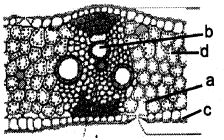
Identify $a, b, c, d$ from the given figure of a leaf cross-section:
A
Stoma - Air cavity - Substomal cavity - Palisade mesophyll
B
Stoma - Phloem - Substomal cavity - Mesophyll
C
Abaxial epidermis - Phloem - Substomal cavity - Spongy mesophyll
D
Substomatal cavity - Xylem - Abaxial epidermis - Mesophyll
Solution
(D) Based on the anatomical structure of a dorsiventral leaf:
$a$ points to the substomatal cavity (air cavity located just above the stoma).
$b$ points to the xylem vessels within the vascular bundle.
$c$ points to the abaxial epidermis (lower epidermis).
$d$ points to the spongy mesophyll tissue.
However,looking at the provided options and the standard diagrammatic representation of a leaf cross-section,the most accurate identification based on the labels is:
$a$: Substomatal cavity
$b$: Xylem
$c$: Abaxial epidermis
$d$: Spongy mesophyll
Therefore,option $D$ is the correct choice.
$a$ points to the substomatal cavity (air cavity located just above the stoma).
$b$ points to the xylem vessels within the vascular bundle.
$c$ points to the abaxial epidermis (lower epidermis).
$d$ points to the spongy mesophyll tissue.
However,looking at the provided options and the standard diagrammatic representation of a leaf cross-section,the most accurate identification based on the labels is:
$a$: Substomatal cavity
$b$: Xylem
$c$: Abaxial epidermis
$d$: Spongy mesophyll
Therefore,option $D$ is the correct choice.
0 likes
View Solution39
MediumMCQ
In monocotyledonous leaves:
A
Mesophyll is not differentiated into palisade and spongy parenchyma.
B
Mesophyll is differentiated into palisade and spongy parenchyma.
C
Stomata are present on only one surface.
D
Bulliform cells are absent.
Solution
(A) In monocotyledonous (isobilateral) leaves,the mesophyll tissue is not differentiated into palisade and spongy parenchyma. Both types of cells are similar in structure and function. In contrast,dicotyledonous (dorsiventral) leaves show a clear differentiation of mesophyll into palisade and spongy parenchyma. Therefore,option $A$ is the correct statement.
0 likes
View Solution40
MediumMCQ
In dicot leaf,vascular bundles are surrounded by......
A
Air cavities
B
Bundle sheath cells
C
Cuticle
D
Bulliform cells
Solution
(B) In a dicot leaf,the vascular bundles are embedded in the mesophyll tissue.
Each vascular bundle is surrounded by a layer of thick-walled parenchymatous cells known as the bundle sheath cells.
These cells provide structural support and are involved in the transport of materials between the vascular tissue and the mesophyll cells.
Each vascular bundle is surrounded by a layer of thick-walled parenchymatous cells known as the bundle sheath cells.
These cells provide structural support and are involved in the transport of materials between the vascular tissue and the mesophyll cells.
0 likes
View Solution41
MediumMCQ
Which of the following is absent in a monocot leaf?
A
Palisade mesophyll
B
Vascular tissue
C
Epidermis
D
Chloroplast
Solution
(A) In a monocot leaf (isobilateral leaf),the mesophyll is not differentiated into palisade and spongy parenchyma. Both sides of the leaf have similar mesophyll cells. In contrast,a dicot leaf (dorsiventral leaf) shows a clear differentiation of mesophyll into palisade and spongy parenchyma. Therefore,palisade mesophyll is absent in a monocot leaf.
0 likes
View Solution42
MediumMCQ
Which of the following is true for a monocot leaf?
A
Reticulate venation
B
Absence of bulliform cells in the epidermis
C
Mesophyll is not differentiated into palisade and spongy parenchyma
D
Well-differentiated mesophyll
Solution
(C) In monocot leaves,the mesophyll is not differentiated into palisade and spongy parenchyma. Instead,it consists of undifferentiated parenchyma cells. Additionally,monocot leaves often possess bulliform cells (motor cells) in the upper epidermis,which help in leaf rolling during water stress. Reticulate venation is a characteristic of dicot leaves,while monocot leaves typically show parallel venation.
0 likes
View Solution43
MediumMCQ
In which of the following leaves is the palisade parenchyma absent?
A
Mustard
B
Soybean
C
Gram
D
Sugarcane
Solution
(D) The leaves of dicotyledonous plants typically exhibit dorsiventral anatomy,where the mesophyll is differentiated into palisade parenchyma and spongy parenchyma.
Mustard,soybean,and gram are all dicotyledonous plants,so they possess palisade parenchyma in their leaves.
Sugarcane is a monocotyledonous plant.
Monocot leaves are isobilateral,meaning the mesophyll is not differentiated into palisade and spongy parenchyma; instead,it consists of undifferentiated parenchyma cells.
Therefore,palisade parenchyma is absent in the leaves of sugarcane.
Mustard,soybean,and gram are all dicotyledonous plants,so they possess palisade parenchyma in their leaves.
Sugarcane is a monocotyledonous plant.
Monocot leaves are isobilateral,meaning the mesophyll is not differentiated into palisade and spongy parenchyma; instead,it consists of undifferentiated parenchyma cells.
Therefore,palisade parenchyma is absent in the leaves of sugarcane.
0 likes
View Solution44
MediumMCQ
Many types of grass leaves have the ability to roll or unroll because they contain ........
A
are very thin.
B
are isobilateral.
C
contain specialized bulliform cells.
D
have parallel vascular bundles.
Solution
(C) In grasses,certain epidermal cells along the veins modify themselves into large,empty,colorless cells known as $ \text{bulliform cells} $.
When these cells are turgid due to water absorption,the leaf surface is exposed.
When there is water stress,these cells lose water and become flaccid,causing the leaf to roll inwards to minimize water loss through transpiration.
When these cells are turgid due to water absorption,the leaf surface is exposed.
When there is water stress,these cells lose water and become flaccid,causing the leaf to roll inwards to minimize water loss through transpiration.
0 likes
View Solution45
MediumMCQ
Assertion: Bulliform cells are useful in the unrolling of leaf.
Reason: Bulliform cells store water.
Reason: Bulliform cells store water.
A
If both Assertion and Reason are correct and the Reason is a correct explanation of the Assertion.
B
If both Assertion and Reason are correct but Reason is not a correct explanation of the Assertion.
C
If the Assertion is correct but Reason is incorrect.
D
If both the Assertion and Reason are incorrect.
Solution
(A) In isobilateral leaves,the upper epidermis contains specialized cells known as bulliform or motor cells.
These cells are large,empty,and colorless,and they are capable of storing water.
When the plant has sufficient water,these cells become turgid,which helps in the unrolling of the leaf.
Conversely,during water stress,these cells lose water and become flaccid,causing the leaf to roll inward to minimize water loss.
Therefore,both the Assertion and the Reason are correct,and the Reason correctly explains why bulliform cells are involved in the movement of the leaf.
These cells are large,empty,and colorless,and they are capable of storing water.
When the plant has sufficient water,these cells become turgid,which helps in the unrolling of the leaf.
Conversely,during water stress,these cells lose water and become flaccid,causing the leaf to roll inward to minimize water loss.
Therefore,both the Assertion and the Reason are correct,and the Reason correctly explains why bulliform cells are involved in the movement of the leaf.
0 likes
View Solution46
Difficult
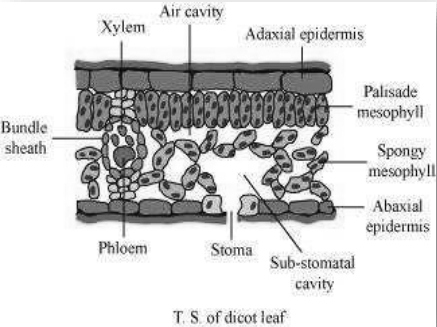
Describe the internal structure of a dorsiventral leaf with the help of labelled diagrams.
Solution
(N/A) Dorsiventral leaves are typically found in dicotyledonous plants. The vertical section ($T$.$S$.) of a dorsiventral leaf shows three distinct parts:
$[1]$ Epidermis:
It is present on both the upper surface (adaxial epidermis) and the lower surface (abaxial epidermis). The epidermis on the outside is covered with a thick cuticle. The abaxial epidermis generally bears more stomata than the adaxial epidermis.
$[2]$ Mesophyll:
Mesophyll is the tissue present between the adaxial and abaxial epidermises. It is differentiated into two types of parenchyma:
$(a)$ Palisade parenchyma: Composed of tall,vertically elongated,and compactly placed cells.
$(b)$ Spongy parenchyma: Comprising oval or round,loosely arranged cells with large intercellular spaces and air cavities.
Mesophyll contains chloroplasts,which are the sites of photosynthesis.
$[3]$ Vascular system:
The vascular bundles are conjoint,collateral,and closed. They are surrounded by a thick layer of bundle-sheath cells.
$[1]$ Epidermis:
It is present on both the upper surface (adaxial epidermis) and the lower surface (abaxial epidermis). The epidermis on the outside is covered with a thick cuticle. The abaxial epidermis generally bears more stomata than the adaxial epidermis.
$[2]$ Mesophyll:
Mesophyll is the tissue present between the adaxial and abaxial epidermises. It is differentiated into two types of parenchyma:
$(a)$ Palisade parenchyma: Composed of tall,vertically elongated,and compactly placed cells.
$(b)$ Spongy parenchyma: Comprising oval or round,loosely arranged cells with large intercellular spaces and air cavities.
Mesophyll contains chloroplasts,which are the sites of photosynthesis.
$[3]$ Vascular system:
The vascular bundles are conjoint,collateral,and closed. They are surrounded by a thick layer of bundle-sheath cells.
0 likes
View Solution47
Easy
Describe the internal structure of a dorsiventral (dicotyledonous) leaf.
Solution
(N/A) The internal structure of a dorsiventral leaf (e.g.,sunflower leaf) consists of three main parts: $(1)$ Epidermis,$(2)$ Mesophyll tissue,and $(3)$ Vascular bundles.
$(1)$ Epidermis: The leaf has two layers of epidermis:
$(i)$ Adaxial (upper) epidermis: $A$ single layer of parenchymatous cells covered by a cuticle. It usually has fewer stomata.
$(ii)$ Abaxial (lower) epidermis: $A$ single layer of parenchymatous cells. It bears a large number of stomata for gaseous exchange.
$(2)$ Mesophyll Tissue: The tissue between the upper and lower epidermis is called mesophyll,which performs photosynthesis. It is differentiated into two types:
$(i)$ Palisade parenchyma: Adaxially placed,consisting of elongated cells arranged vertically and parallel to each other. They contain numerous chloroplasts.
$(ii)$ Spongy parenchyma: Located below the palisade cells,these are oval or round and loosely arranged with large intercellular spaces and air cavities.
$(3)$ Vascular Bundles: These are conjoint,collateral,and closed. They are surrounded by a layer of thick-walled bundle sheath cells. In the vascular bundle,xylem is located towards the adaxial side (upper surface) and phloem is located towards the abaxial side (lower surface). The size of the vascular bundles depends on the size of the veins.
$(1)$ Epidermis: The leaf has two layers of epidermis:
$(i)$ Adaxial (upper) epidermis: $A$ single layer of parenchymatous cells covered by a cuticle. It usually has fewer stomata.
$(ii)$ Abaxial (lower) epidermis: $A$ single layer of parenchymatous cells. It bears a large number of stomata for gaseous exchange.
$(2)$ Mesophyll Tissue: The tissue between the upper and lower epidermis is called mesophyll,which performs photosynthesis. It is differentiated into two types:
$(i)$ Palisade parenchyma: Adaxially placed,consisting of elongated cells arranged vertically and parallel to each other. They contain numerous chloroplasts.
$(ii)$ Spongy parenchyma: Located below the palisade cells,these are oval or round and loosely arranged with large intercellular spaces and air cavities.
$(3)$ Vascular Bundles: These are conjoint,collateral,and closed. They are surrounded by a layer of thick-walled bundle sheath cells. In the vascular bundle,xylem is located towards the adaxial side (upper surface) and phloem is located towards the abaxial side (lower surface). The size of the vascular bundles depends on the size of the veins.
0 likes
View Solution48
Easy
Describe the internal structure of a sunflower leaf.
Solution
(N/A) The sunflower leaf is a dorsiventral leaf,which means its upper and lower surfaces are different. Its internal structure consists of three main parts:
$1$. Epidermis: It covers both the upper (adaxial) and lower (abaxial) surfaces. It is covered by a waxy cuticle. Stomata are more abundant on the lower surface.
$2$. Mesophyll: This tissue is located between the upper and lower epidermis and is differentiated into two types of parenchyma cells:
$(a)$ Palisade parenchyma: Located below the upper epidermis,these are elongated,vertically arranged cells rich in chloroplasts for photosynthesis.
$(b)$ Spongy parenchyma: Located below the palisade cells,these are oval or round cells with large intercellular spaces for gaseous exchange.
$3$. Vascular System: It consists of vascular bundles found in the veins and midrib. Each bundle is surrounded by a layer of thick-walled bundle sheath cells. Xylem is located towards the upper side,and phloem is located towards the lower side.
$1$. Epidermis: It covers both the upper (adaxial) and lower (abaxial) surfaces. It is covered by a waxy cuticle. Stomata are more abundant on the lower surface.
$2$. Mesophyll: This tissue is located between the upper and lower epidermis and is differentiated into two types of parenchyma cells:
$(a)$ Palisade parenchyma: Located below the upper epidermis,these are elongated,vertically arranged cells rich in chloroplasts for photosynthesis.
$(b)$ Spongy parenchyma: Located below the palisade cells,these are oval or round cells with large intercellular spaces for gaseous exchange.
$3$. Vascular System: It consists of vascular bundles found in the veins and midrib. Each bundle is surrounded by a layer of thick-walled bundle sheath cells. Xylem is located towards the upper side,and phloem is located towards the lower side.
0 likes
View Solution49
Medium
Describe the internal structure of an Isobilateral (Monocotyledonous) leaf.
Solution
(N/A) $\rightarrow$ The leaf of maize is flat and long. The cells produced in the mid-leaf are of the same type. Structurally,the leaf of maize is called an Isobilateral leaf.
$\rightarrow$ When a thin section of a maize leaf is stained with safranin and viewed under a microscope,the following layers are observed: $(1)$ Epidermis,$(2)$ Mesophyll tissue,$(3)$ Vascular bundles.
$(1)$ Epidermis: In the leaf,two epidermis layers are seen.
$\rightarrow$ Upper Epidermis: It forms the uppermost or adaxial layer. It is a single-layered tissue made up of parenchymatous cells. Its outer surface is covered with a protective layer of cuticle.
$\rightarrow$ In the adaxial layer,at certain distances,Bulliform cells are arranged in long rows. These cells are in groups of $5$ to $7$.
$\rightarrow$ These cells are comparatively larger than other epidermal cells. They lack a thick protective cuticle on their outer wall,which is very thin. Generally,unicellular slanting small trichomes are located on both sides of these cells. These trichomes help in moisture absorption from the atmosphere.
$\rightarrow$ The presence of bulliform cells distinguishes the adaxial layer from the abaxial layer. In a humid atmosphere,bulliform cells absorb water,become turgid,and expose the leaf surface. In a dry atmosphere,due to water stress,they become flaccid,causing the leaves to curl inwards to minimize water loss. Thus,these cells are also called motor cells.
$(2)$ Mesophyll Tissue: Since the leaf possesses an isobilateral structure,there is no differentiation into palisade and spongy parenchyma.
$\rightarrow$ All cells are alike and possess an equal amount of chloroplasts.
$\rightarrow$ The mesophyll consists of cells that are round or oval with intercellular spaces. Air-filled sacs are seen clearly below the stomata,which are called respiratory cavities.
$(3)$ Vascular Bundles: Maize is a monocot plant with parallel venation; therefore,vascular bundles are cut vertically and are located at equal distances from each other.
$\rightarrow$ Vascular bundles are conjoint,collateral,and closed.
$\rightarrow$ Vascular bundles are of both large and small types. The xylem is located towards the adaxial layer,and the phloem is located towards the abaxial layer.
$\rightarrow$ Each vascular bundle is surrounded by a sclerenchymatous bundle sheath. This sheath extends to both the adaxial and abaxial layers,providing mechanical strength to the leaves.
$\rightarrow$ When a thin section of a maize leaf is stained with safranin and viewed under a microscope,the following layers are observed: $(1)$ Epidermis,$(2)$ Mesophyll tissue,$(3)$ Vascular bundles.
$(1)$ Epidermis: In the leaf,two epidermis layers are seen.
$\rightarrow$ Upper Epidermis: It forms the uppermost or adaxial layer. It is a single-layered tissue made up of parenchymatous cells. Its outer surface is covered with a protective layer of cuticle.
$\rightarrow$ In the adaxial layer,at certain distances,Bulliform cells are arranged in long rows. These cells are in groups of $5$ to $7$.
$\rightarrow$ These cells are comparatively larger than other epidermal cells. They lack a thick protective cuticle on their outer wall,which is very thin. Generally,unicellular slanting small trichomes are located on both sides of these cells. These trichomes help in moisture absorption from the atmosphere.
$\rightarrow$ The presence of bulliform cells distinguishes the adaxial layer from the abaxial layer. In a humid atmosphere,bulliform cells absorb water,become turgid,and expose the leaf surface. In a dry atmosphere,due to water stress,they become flaccid,causing the leaves to curl inwards to minimize water loss. Thus,these cells are also called motor cells.
$(2)$ Mesophyll Tissue: Since the leaf possesses an isobilateral structure,there is no differentiation into palisade and spongy parenchyma.
$\rightarrow$ All cells are alike and possess an equal amount of chloroplasts.
$\rightarrow$ The mesophyll consists of cells that are round or oval with intercellular spaces. Air-filled sacs are seen clearly below the stomata,which are called respiratory cavities.
$(3)$ Vascular Bundles: Maize is a monocot plant with parallel venation; therefore,vascular bundles are cut vertically and are located at equal distances from each other.
$\rightarrow$ Vascular bundles are conjoint,collateral,and closed.
$\rightarrow$ Vascular bundles are of both large and small types. The xylem is located towards the adaxial layer,and the phloem is located towards the abaxial layer.
$\rightarrow$ Each vascular bundle is surrounded by a sclerenchymatous bundle sheath. This sheath extends to both the adaxial and abaxial layers,providing mechanical strength to the leaves.
0 likes
View Solution50
Easy
Describe the internal structure of a maize leaf.
Solution
(N/A) $\rightarrow$ The leaf of maize is flat and long. The cells produced in the mid-leaf are of the same type. Structurally,the maize leaf is called an isobilateral leaf.
$\rightarrow$ When a thin section of a maize leaf is stained with safranin and viewed under a microscope,the following layers are observed: $(1)$ Epidermis,$(2)$ Mesophyll tissue,$(3)$ Vascular bundles.
$(1)$ Epidermis: In the leaf,two layers of epidermis are seen.
$\rightarrow$ Upper Epidermis: It forms the uppermost or adaxial layer. It is a single-layered tissue made up of parenchymatous cells. Its outer surface is covered with a protective layer of cuticle.
$\rightarrow$ In the adaxial layer,at certain distances,Bulliform cells are arranged in long rows. These cells are found in groups of $5$ to $7$.
$\rightarrow$ These cells are comparatively larger than other epidermal cells. They lack a thick protective cuticle on their outer wall,making them very thin. Generally,small,unicellular,slanting trichomes are located on both sides of these cells. These trichomes help in moisture absorption; hence,they are called moisture-absorbing trichomes.
$\rightarrow$ The presence of bulliform cells distinguishes the adaxial layer from the abaxial layer. In a humid atmosphere,bulliform cells absorb water,become turgid,and expose the leaf surface. In a dry atmosphere,due to water stress,they become flaccid,causing the leaves to curl inwards to minimize water loss. Thus,these cells are also called motor cells. Because they are round and bubble-like,they are termed bulliform cells.
$(2)$ Mesophyll Tissue: Since the leaf possesses an isobilateral structure,there is no differentiation into palisade and spongy parenchyma.
$\rightarrow$ All cells are alike and contain an equal amount of chloroplasts.
$\rightarrow$ Only palisade-like tissue is located between both epidermis layers in the maize leaf. These cells are round or oval with intercellular spaces. Air-filled sacs are seen clearly below the stomata,which are called respiratory cavities.
$(3)$ Vascular Bundles: Maize is a monocot plant with parallel venation; therefore,vascular bundles are cut vertically in a cross-section. They are located at equal distances from each other.
$\rightarrow$ Vascular bundles are conjoint,collateral,and closed.
$\rightarrow$ Vascular bundles are of both large and small types. The xylem is located towards the adaxial layer,and the phloem tissue is located towards the abaxial layer.
$\rightarrow$ Each vascular bundle is surrounded by a sclerenchymatous bundle sheath. This sheath extends to both the adaxial and abaxial layers,providing structural strength to the leaves.
$\rightarrow$ When a thin section of a maize leaf is stained with safranin and viewed under a microscope,the following layers are observed: $(1)$ Epidermis,$(2)$ Mesophyll tissue,$(3)$ Vascular bundles.
$(1)$ Epidermis: In the leaf,two layers of epidermis are seen.
$\rightarrow$ Upper Epidermis: It forms the uppermost or adaxial layer. It is a single-layered tissue made up of parenchymatous cells. Its outer surface is covered with a protective layer of cuticle.
$\rightarrow$ In the adaxial layer,at certain distances,Bulliform cells are arranged in long rows. These cells are found in groups of $5$ to $7$.
$\rightarrow$ These cells are comparatively larger than other epidermal cells. They lack a thick protective cuticle on their outer wall,making them very thin. Generally,small,unicellular,slanting trichomes are located on both sides of these cells. These trichomes help in moisture absorption; hence,they are called moisture-absorbing trichomes.
$\rightarrow$ The presence of bulliform cells distinguishes the adaxial layer from the abaxial layer. In a humid atmosphere,bulliform cells absorb water,become turgid,and expose the leaf surface. In a dry atmosphere,due to water stress,they become flaccid,causing the leaves to curl inwards to minimize water loss. Thus,these cells are also called motor cells. Because they are round and bubble-like,they are termed bulliform cells.
$(2)$ Mesophyll Tissue: Since the leaf possesses an isobilateral structure,there is no differentiation into palisade and spongy parenchyma.
$\rightarrow$ All cells are alike and contain an equal amount of chloroplasts.
$\rightarrow$ Only palisade-like tissue is located between both epidermis layers in the maize leaf. These cells are round or oval with intercellular spaces. Air-filled sacs are seen clearly below the stomata,which are called respiratory cavities.
$(3)$ Vascular Bundles: Maize is a monocot plant with parallel venation; therefore,vascular bundles are cut vertically in a cross-section. They are located at equal distances from each other.
$\rightarrow$ Vascular bundles are conjoint,collateral,and closed.
$\rightarrow$ Vascular bundles are of both large and small types. The xylem is located towards the adaxial layer,and the phloem tissue is located towards the abaxial layer.
$\rightarrow$ Each vascular bundle is surrounded by a sclerenchymatous bundle sheath. This sheath extends to both the adaxial and abaxial layers,providing structural strength to the leaves.
0 likes
View SolutionAnatomy of Flowering Plants — Internal structure of leaf · Frequently Asked Questions
1Are these Anatomy of Flowering Plants questions useful for JEE and NEET?
Yes. All questions in this section are mapped to JEE Main and NEET exam patterns. Previous year questions from JEE Main, NEET, GUJCET and state-level exams are included with full solutions.
2Can I switch to Hindi or Gujarati for these questions?
Yes. Use the language tabs in the hero section or the sidebar to view the same questions and solutions in English, Hindi or Gujarati.
3How do I generate a question paper from this subtopic?
Use the Vedclass Exam Paper Generator — select the chapter and subtopic, set difficulty, and generate Sets A, B, C, D automatically. First 3 chapters of every subject are free.
Vedclass Products
For Students
Vedclass Test Series
Mock tests in real JEE/NEET style with performance analysis. 5-day free trial.
Start Free TrialFor Teachers
Exam Paper Generator
Generate Set A/B/C/D papers from this chapter in 2 minutes. 3 chapters free.
Try FreeFor Institutes
Online Exam Module
Live online exams with unlimited students, 360° analytics & white-label branding.
See DemoFor Teachers & Institutes
Generate a Anatomy of Flowering Plants Exam Paper in 2 Minutes
Select subtopic & difficulty — Sets A, B, C, D auto-generated with No Repeat logic.
First 3 chapters of every subject are free — no payment required.