
A English
Secondary growth Questions in English
Class 11 Biology · Anatomy of Flowering Plants · Secondary growth
396+
Questions
English
Language
100%
With Solutions
Showing 50 of 396 questions in English
251
MediumMCQ
Which of the statements given below is not true about the formation of Annual Rings in trees?
A
Annual ring is a combination of spring wood and autumn wood produced in a year.
B
Differential activity of cambium causes light and dark bands of tissue - early and late wood respectively.
C
Activity of cambium depends upon variation in climate.
D
Annual rings are not prominent in trees of temperate region.
Solution
(D) Annual rings are formed due to the differential activity of the vascular cambium throughout the year,which is influenced by seasonal climatic variations.
In temperate regions,the cambium is very active during the spring season,producing a large number of xylem elements with wide vessels,known as spring wood or early wood,which is lighter in color.
In the autumn season,the cambium becomes less active and produces fewer xylem elements with narrow vessels,known as autumn wood or late wood,which is darker in color.
These two bands together constitute an annual ring.
Therefore,annual rings are highly prominent in trees of temperate regions where distinct seasonal variations occur.
Thus,the statement that 'Annual rings are not prominent in trees of temperate region' is incorrect.
In temperate regions,the cambium is very active during the spring season,producing a large number of xylem elements with wide vessels,known as spring wood or early wood,which is lighter in color.
In the autumn season,the cambium becomes less active and produces fewer xylem elements with narrow vessels,known as autumn wood or late wood,which is darker in color.
These two bands together constitute an annual ring.
Therefore,annual rings are highly prominent in trees of temperate regions where distinct seasonal variations occur.
Thus,the statement that 'Annual rings are not prominent in trees of temperate region' is incorrect.
0 likes
View Solution252
MediumMCQ
Grafting is successful in dicots but not in monocots because the dicots have
A
vascular bundles arranged in a ring
B
cambium for secondary growth
C
vessels with elements arranged end to end
D
cork cambium
Solution
(B) Grafting is a horticultural technique whereby tissues from one plant are inserted into those of another so that the sets of vascular tissues may join together.
Grafting is successful in dicots because their vascular bundles are arranged in a ring and possess cambium,which allows for secondary growth and the fusion of vascular tissues between the scion and the stock.
Grafting is successful in dicots because their vascular bundles are arranged in a ring and possess cambium,which allows for secondary growth and the fusion of vascular tissues between the scion and the stock.
0 likes
View Solution253
DifficultMCQ
Assertion: Cambium is a lateral meristem and causes growth in width.
Reason: Cambium is made up of fusiform and ray initials in the stem.
Reason: Cambium is made up of fusiform and ray initials in the stem.
A
If both Assertion and Reason are correct and the Reason is a correct explanation of the Assertion.
B
If both Assertion and Reason are correct but Reason is not a correct explanation of the Assertion.
C
If the Assertion is correct but Reason is incorrect.
D
If both the Assertion and Reason are incorrect.
Solution
(A) The Assertion is correct because the vascular cambium is a lateral meristem responsible for secondary growth,which increases the girth (width) of the stem.
The Reason is also correct because the vascular cambium consists of two types of cells: fusiform initials,which give rise to the axial system (tracheary elements,fibers,and axial parenchyma),and ray initials,which give rise to the radial system (vascular rays).
Since the presence of these specific initials is the structural basis that allows the cambium to function as a lateral meristem and produce secondary tissues,the Reason correctly explains the Assertion.
The Reason is also correct because the vascular cambium consists of two types of cells: fusiform initials,which give rise to the axial system (tracheary elements,fibers,and axial parenchyma),and ray initials,which give rise to the radial system (vascular rays).
Since the presence of these specific initials is the structural basis that allows the cambium to function as a lateral meristem and produce secondary tissues,the Reason correctly explains the Assertion.
0 likes
View Solution254
MediumMCQ
Assertion : In woody stems,the amount of heart wood continues to increase year after year.
Reason : The cambial activity continues uninterrupted.
Reason : The cambial activity continues uninterrupted.
A
If both Assertion and Reason are correct and the Reason is a correct explanation of the Assertion.
B
If both Assertion and Reason are correct but Reason is not a correct explanation of the Assertion.
C
If the Assertion is correct but Reason is incorrect.
D
If both the Assertion and Reason are incorrect.
Solution
(A) In woody trees,the central portion of the stem is dark in color. It is hard and tough due to the deposition of resins,tannins,gums,and the formation of tyloses. This central hard portion is called heartwood. It is formed by secondary growth. Due to cambial activity,the older secondary xylem becomes non-functional and forms heartwood or duramen. As the tree grows,more secondary xylem is produced,and the older layers are converted into heartwood,causing its amount to increase year after year. Therefore,both the Assertion and the Reason are correct,and the Reason is the correct explanation of the Assertion.
0 likes
View Solution255
MediumMCQ
Assertion: In the stem,the pericycle takes an active part in secondary growth.
Reason: In dicots,the pericycle has the capacity to produce lateral roots.
Reason: In dicots,the pericycle has the capacity to produce lateral roots.
A
If both Assertion and Reason are correct and the Reason is a correct explanation of the Assertion.
B
If both Assertion and Reason are correct but Reason is not a correct explanation of the Assertion.
C
If the Assertion is correct but Reason is incorrect.
D
If both the Assertion and Reason are incorrect.
Solution
(D) The Assertion is incorrect because,in the stems of dicotyledonous plants,the pericycle generally does not participate in secondary growth; secondary growth is primarily driven by the vascular cambium and cork cambium.
The Reason is correct because the pericycle in dicot roots is indeed responsible for the initiation of lateral roots.
Therefore,the Assertion is incorrect,but the Reason is correct.
The Reason is correct because the pericycle in dicot roots is indeed responsible for the initiation of lateral roots.
Therefore,the Assertion is incorrect,but the Reason is correct.
0 likes
View Solution256
MediumMCQ
In the dicot root,the vascular cambium originates from:
A
Tissue located below the phloem bundles and a portion of pericycle tissue above protoxylem.
B
Cortical region
C
Parenchyma between endodermis and pericycle.
D
Intrafascicular and interfascicular tissue in a ring.
Solution
(A) In dicot roots,the vascular cambium is secondary in origin.
It develops from the thin-walled parenchymatous cells located just below the phloem bundles.
Additionally,a portion of the pericycle tissue located above the protoxylem also participates in the formation of the vascular cambium.
These cells become meristematic and form a continuous wavy ring,which later becomes circular.
It develops from the thin-walled parenchymatous cells located just below the phloem bundles.
Additionally,a portion of the pericycle tissue located above the protoxylem also participates in the formation of the vascular cambium.
These cells become meristematic and form a continuous wavy ring,which later becomes circular.
0 likes
View Solution257
Medium
Cork cambium forms tissues that form the cork. Do you agree with this statement? Explain.
Solution
(A) Yes,$I$ agree with this statement. During secondary growth in dicot stems and roots,the outer epidermal layer is ruptured. To protect the inner tissues,the cork cambium (or $Phellogen$) develops from the cortical region. It consists of thin-walled,rectangular cells that divide on both sides. The cells cut off towards the outside differentiate into cork $(Phellem)$,which is impervious to water due to the deposition of suberin. The cells cut off towards the inside differentiate into the secondary cortex $(Phelloderm)$. Thus,the cork cambium is responsible for producing the cork tissue.
0 likes
View Solution258
Difficult
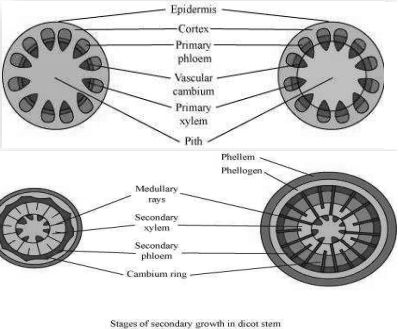
Explain the process of secondary growth in stems of woody angiosperms with the help of schematic diagrams. What is its significance?
Solution
(N/A) Secondary growth in woody dicot stems involves the formation of a continuous vascular cambium ring. The intrafascicular cambium (present within vascular bundles) and the interfascicular cambium (formed from medullary rays) join to form this ring.
The cambium ring becomes active and begins to cut off new cells on both sides. Cells cut off towards the periphery differentiate into secondary phloem,while those cut off towards the center (pith) differentiate into secondary xylem. The secondary xylem is produced in much larger quantities than the secondary phloem,which pushes the primary phloem and cortex outwards,eventually causing them to crush.
Additionally,the cork cambium (phellogen) develops in the cortex,producing phellem (cork) towards the outside and phelloderm towards the inside,collectively forming the periderm.
Significance:
$1$. It increases the girth (diameter) of the stem.
$2$. It provides additional mechanical support to the plant.
$3$. It increases the conducting capacity of xylem and phloem to support the growing canopy of leaves.
The cambium ring becomes active and begins to cut off new cells on both sides. Cells cut off towards the periphery differentiate into secondary phloem,while those cut off towards the center (pith) differentiate into secondary xylem. The secondary xylem is produced in much larger quantities than the secondary phloem,which pushes the primary phloem and cortex outwards,eventually causing them to crush.
Additionally,the cork cambium (phellogen) develops in the cortex,producing phellem (cork) towards the outside and phelloderm towards the inside,collectively forming the periderm.
Significance:
$1$. It increases the girth (diameter) of the stem.
$2$. It provides additional mechanical support to the plant.
$3$. It increases the conducting capacity of xylem and phloem to support the growing canopy of leaves.
0 likes
View Solution259
Medium
What is periderm? How does periderm formation take place in dicot stem?
Solution
(N/A) Periderm is a collective term for the $3$ layers: phellogen,phellem,and phelloderm.
During secondary growth in dicot stems,the increasing pressure from the vascular cambium causes the outer epidermal and cortical layers to rupture. To replace these protective layers,certain cells of the cortex become meristematic,forming the cork cambium or $phellogen$.
The $phellogen$ consists of narrow,thin-walled,and rectangular cells. It undergoes periclinal divisions to cut off cells on both sides:
$1$. The cells cut off towards the outside differentiate into $phellem$ (cork). These cells become dead and suberized,making them impervious to water.
$2$. The cells cut off towards the inside differentiate into $phelloderm$ (secondary cortex),which consists of living parenchymatous cells.
Together,$phellogen$,$phellem$,and $phelloderm$ constitute the $periderm$.
During secondary growth in dicot stems,the increasing pressure from the vascular cambium causes the outer epidermal and cortical layers to rupture. To replace these protective layers,certain cells of the cortex become meristematic,forming the cork cambium or $phellogen$.
The $phellogen$ consists of narrow,thin-walled,and rectangular cells. It undergoes periclinal divisions to cut off cells on both sides:
$1$. The cells cut off towards the outside differentiate into $phellem$ (cork). These cells become dead and suberized,making them impervious to water.
$2$. The cells cut off towards the inside differentiate into $phelloderm$ (secondary cortex),which consists of living parenchymatous cells.
Together,$phellogen$,$phellem$,and $phelloderm$ constitute the $periderm$.
0 likes
View Solution260
Easy
What is meant by secondary growth? What are its types?
Solution
(N/A) $\rightarrow$ Primary Growth: The increase in the length of the root and stem due to the activity of apical meristems is called primary growth.
$\rightarrow$ Secondary Growth: The increase in the girth or thickness of the plant body,occurring after the completion of primary growth in dicotyledonous plants,is known as secondary growth.
$\rightarrow$ Types of Secondary Growth: Secondary growth is primarily facilitated by two types of lateral meristems:
$1$. Vascular cambium: Responsible for the production of secondary xylem and secondary phloem.
$2$. Cork cambium (Phellogen): Responsible for the production of periderm (cork and secondary cortex).
$\rightarrow$ Secondary Growth: The increase in the girth or thickness of the plant body,occurring after the completion of primary growth in dicotyledonous plants,is known as secondary growth.
$\rightarrow$ Types of Secondary Growth: Secondary growth is primarily facilitated by two types of lateral meristems:
$1$. Vascular cambium: Responsible for the production of secondary xylem and secondary phloem.
$2$. Cork cambium (Phellogen): Responsible for the production of periderm (cork and secondary cortex).
0 likes
View Solution261
Medium
Describe the vascular cambium responsible for secondary growth in detail.
Solution
(N/A) $\rightarrow$ Vascular Cambium: The meristematic layer responsible for the formation of two conducting tissues,xylem and phloem,is called the vascular cambium.
$\rightarrow$ In young stems,it is present in patches as a single layer between the xylem and phloem. Later,it forms a complete ring.
$(a)$ Formation of Cambial Ring: In dicot stems,the cells of the cambium present between primary xylem and primary phloem are known as intrafascicular cambium. The cells of medullary rays adjoining these intrafascicular cambium become meristematic and form the interfascicular cambium. Thus,a continuous ring of cambium is formed.
$(b)$ Activity of Cambial Ring: The cambial ring becomes active and begins to cut off new cells towards both the inner and outer sides.
$\rightarrow$ The cells cut off towards the pith mature into secondary xylem,and the cells cut off towards the periphery mature into secondary phloem.
$\rightarrow$ The cambium is generally more active on the inner side than on the outer side. As a result,the amount of secondary xylem produced is more than secondary phloem,and it soon forms a compact mass. At this point,secondary xylem becomes the main part of the stem.
$\rightarrow$ The primary and secondary phloem get gradually crushed due to the continued formation and accumulation of secondary xylem.
$\rightarrow$ The primary xylem,however,remains more or less intact in or around the center.
$\rightarrow$ In young stems,it is present in patches as a single layer between the xylem and phloem. Later,it forms a complete ring.
$(a)$ Formation of Cambial Ring: In dicot stems,the cells of the cambium present between primary xylem and primary phloem are known as intrafascicular cambium. The cells of medullary rays adjoining these intrafascicular cambium become meristematic and form the interfascicular cambium. Thus,a continuous ring of cambium is formed.
$(b)$ Activity of Cambial Ring: The cambial ring becomes active and begins to cut off new cells towards both the inner and outer sides.
$\rightarrow$ The cells cut off towards the pith mature into secondary xylem,and the cells cut off towards the periphery mature into secondary phloem.
$\rightarrow$ The cambium is generally more active on the inner side than on the outer side. As a result,the amount of secondary xylem produced is more than secondary phloem,and it soon forms a compact mass. At this point,secondary xylem becomes the main part of the stem.
$\rightarrow$ The primary and secondary phloem get gradually crushed due to the continued formation and accumulation of secondary xylem.
$\rightarrow$ The primary xylem,however,remains more or less intact in or around the center.
0 likes
View Solution262
Easy
Describe the contribution of cork cambium in secondary growth.
Solution
(N/A) $\rightarrow$ As the stem increases in girth due to the activity of the vascular cambium,the outer cortical and epidermal layers break and need to be replaced to provide new protective cell layers. Consequently,a meristematic tissue called cork cambium or phellogen develops in the cortex region.
$\rightarrow$ Phellogen is a couple of layers thick and consists of narrow,thin-walled,and nearly rectangular cells. Phellogen cuts off cells on both sides.
$\rightarrow$ The outer cells differentiate into cork or phellem,while the inner cells differentiate into secondary cortex or phelloderm.
$\rightarrow$ The cork is impervious to water due to suberin deposition in the cell walls.
$\rightarrow$ The cells of the secondary cortex are parenchymatous.
$\rightarrow$ Phellogen,phellem,and phelloderm are collectively known as periderm.
$\rightarrow$ Due to the activity of the cork cambium,pressure builds up on the remaining layers peripheral to the phellogen,and ultimately these layers die and slough off.
$\rightarrow$ Bark: Bark is a non-technical term that refers to all tissues exterior to the vascular cambium,including secondary phloem.
$\rightarrow$ Early and Late Bark: Bark refers to a number of tissue types,namely periderm and secondary phloem. Bark formed early in the season is called early or soft bark. Towards the end of the season,late or hard bark is formed.
$\rightarrow$ Lenticels: In certain regions,the phellogen cuts off closely arranged parenchymatous cells on the outer side instead of cork cells. These parenchymatous cells soon rupture the epidermis,forming a lens-shaped opening called lenticels.
$\rightarrow$ Phellogen is a couple of layers thick and consists of narrow,thin-walled,and nearly rectangular cells. Phellogen cuts off cells on both sides.
$\rightarrow$ The outer cells differentiate into cork or phellem,while the inner cells differentiate into secondary cortex or phelloderm.
$\rightarrow$ The cork is impervious to water due to suberin deposition in the cell walls.
$\rightarrow$ The cells of the secondary cortex are parenchymatous.
$\rightarrow$ Phellogen,phellem,and phelloderm are collectively known as periderm.
$\rightarrow$ Due to the activity of the cork cambium,pressure builds up on the remaining layers peripheral to the phellogen,and ultimately these layers die and slough off.
$\rightarrow$ Bark: Bark is a non-technical term that refers to all tissues exterior to the vascular cambium,including secondary phloem.
$\rightarrow$ Early and Late Bark: Bark refers to a number of tissue types,namely periderm and secondary phloem. Bark formed early in the season is called early or soft bark. Towards the end of the season,late or hard bark is formed.
$\rightarrow$ Lenticels: In certain regions,the phellogen cuts off closely arranged parenchymatous cells on the outer side instead of cork cells. These parenchymatous cells soon rupture the epidermis,forming a lens-shaped opening called lenticels.
0 likes
View Solution263
Easy
Explain the process of secondary growth in roots.
Solution
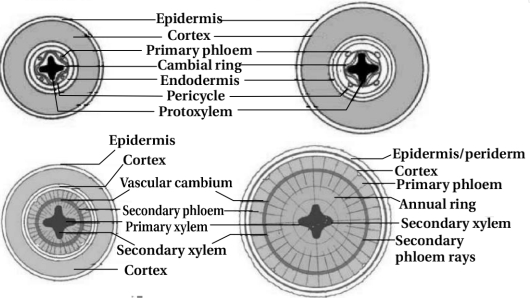
(N/A) $\rightarrow$ In the dicot root,the vascular cambium is completely secondary in origin. It originates from the tissue located just below the phloem bundles,a portion of pericycle tissue,above the protoxylem,forming a complete and continuous wavy ring,which later becomes circular.
$\rightarrow$ Further events are similar to those already described above for a dicotyledon stem. The cambial ring becomes active and begins to cut off new cells,both towards the inner and outer sides. The cells cut off towards the center mature into secondary xylem,and the cells cut off towards the periphery mature into secondary phloem. The cambium is generally more active on the inner side than on the outer side. As a result,the amount of secondary xylem produced is more than secondary phloem and soon forms a compact mass.
$\rightarrow$ Further events are similar to those already described above for a dicotyledon stem. The cambial ring becomes active and begins to cut off new cells,both towards the inner and outer sides. The cells cut off towards the center mature into secondary xylem,and the cells cut off towards the periphery mature into secondary phloem. The cambium is generally more active on the inner side than on the outer side. As a result,the amount of secondary xylem produced is more than secondary phloem and soon forms a compact mass.
0 likes
View Solution264
Easy
Write a note on spring wood and autumn wood.
Solution
(N/A) $\rightarrow$ In the spring season,the cambium is very active and produces a large number of xylary elements having vessels with wider cavities.
$\rightarrow$ In the spring season,the number of leaves increases,so for efficient water transport,a larger number of vessels are required.
$\rightarrow$ The wood formed during this season is called spring wood or early wood.
$\rightarrow$ Spring wood is lighter in color and has a lower density.
$\rightarrow$ Autumn wood: In winter (or autumn),the cambium is less active and forms xylary elements that have narrow vessels; this wood is called autumn wood or late wood.
$\rightarrow$ Autumn wood is darker and has a higher density.
$\rightarrow$ Annual Rings: Spring wood and autumn wood appear as alternate concentric rings,which constitute the annual ring. Annual rings seen in a cut stem provide an estimate of the age of the tree.
$\rightarrow$ In the spring season,the number of leaves increases,so for efficient water transport,a larger number of vessels are required.
$\rightarrow$ The wood formed during this season is called spring wood or early wood.
$\rightarrow$ Spring wood is lighter in color and has a lower density.
$\rightarrow$ Autumn wood: In winter (or autumn),the cambium is less active and forms xylary elements that have narrow vessels; this wood is called autumn wood or late wood.
$\rightarrow$ Autumn wood is darker and has a higher density.
$\rightarrow$ Annual Rings: Spring wood and autumn wood appear as alternate concentric rings,which constitute the annual ring. Annual rings seen in a cut stem provide an estimate of the age of the tree.
0 likes
View Solution265
EasyMCQ
Define bark.
A
All tissues outside the vascular cambium.
B
All tissues outside the cork cambium.
C
Only the periderm.
D
Only the secondary phloem.
Solution
(A) Bark is a non-technical term that refers to all tissues exterior to the vascular cambium,including secondary phloem.
Bark refers to a number of tissue types,such as periderm and secondary phloem. Bark that is formed early in the season is called early bark or soft bark,while bark formed at the end of the season is called late bark or hard bark.
Bark refers to a number of tissue types,such as periderm and secondary phloem. Bark that is formed early in the season is called early bark or soft bark,while bark formed at the end of the season is called late bark or hard bark.
0 likes
View Solution266
Easy
Describe the activity of the cambial ring.
Solution
(N/A) The cambial ring becomes active and begins to cut off new cells,both towards the inner and the outer sides.
The cells cut off towards the pith mature into secondary xylem,and the cells cut off towards the periphery mature into secondary phloem.
The cambium is generally more active on the inner side than on the outer side. As a result,the amount of secondary xylem produced is more than the secondary phloem,and it forms a compact mass.
Due to the continuous formation and accumulation of secondary xylem,pressure is exerted,which gradually crushes the primary and secondary phloem.
The primary xylem,however,remains more or less intact in or around the center.
At some places,the cambium forms a narrow band of parenchyma,which passes through the secondary xylem and the secondary phloem in the radial directions. These are the secondary medullary rays.
The cells cut off towards the pith mature into secondary xylem,and the cells cut off towards the periphery mature into secondary phloem.
The cambium is generally more active on the inner side than on the outer side. As a result,the amount of secondary xylem produced is more than the secondary phloem,and it forms a compact mass.
Due to the continuous formation and accumulation of secondary xylem,pressure is exerted,which gradually crushes the primary and secondary phloem.
The primary xylem,however,remains more or less intact in or around the center.
At some places,the cambium forms a narrow band of parenchyma,which passes through the secondary xylem and the secondary phloem in the radial directions. These are the secondary medullary rays.
0 likes
View Solution267
Easy
Explain the structure and function of the cork cambium (phellogen).
Solution
(N/A) As the stem continues to increase in girth due to the activity of the vascular cambium,the outer cortical and epidermal layers get broken and need to be replaced to provide new protective cell layers. Hence,sooner or later,another meristematic tissue develops in the cortex region,called the cork cambium or $Phellogen$.
$Phellogen$ is a couple of layers thick. It is made of narrow,thin-walled,and nearly rectangular cells. The $Phellogen$ cuts off cells on both sides.
The cells cut off on the outer side differentiate into cork or $Phellem$,while the cells cut off on the inner side differentiate into secondary cortex or $Phelloderm$.
The cells of $Phellem$ are impervious to water due to the deposition of suberin in their cell walls.
The cells of the secondary cortex are parenchymatous.
$Phellogen$,$Phellem$,and $Phelloderm$ are collectively known as the $Periderm$.
Due to the activity of the cork cambium,pressure builds up on the remaining layers peripheral to the $Phellogen$,and these layers eventually die and slough off.
$Phellogen$ is a couple of layers thick. It is made of narrow,thin-walled,and nearly rectangular cells. The $Phellogen$ cuts off cells on both sides.
The cells cut off on the outer side differentiate into cork or $Phellem$,while the cells cut off on the inner side differentiate into secondary cortex or $Phelloderm$.
The cells of $Phellem$ are impervious to water due to the deposition of suberin in their cell walls.
The cells of the secondary cortex are parenchymatous.
$Phellogen$,$Phellem$,and $Phelloderm$ are collectively known as the $Periderm$.
Due to the activity of the cork cambium,pressure builds up on the remaining layers peripheral to the $Phellogen$,and these layers eventually die and slough off.
0 likes
View Solution268
Medium
Give differences: Heartwood and Sapwood.
Solution
(N/A)
| Heartwood | Sapwood |
| $(1)$ In old trees where secondary growth takes place in sufficient amount,the central region is called Heartwood. | $(1)$ The outer region of secondary wood that possesses young xylem cells is called Sapwood. |
| $(2)$ Its cells are filled with tannins,resins,and other substances. | $(2)$ It consists of living cells,vessels,and fibers. |
| $(3)$ It is durable and dark in color. | $(3)$ It is soft and light in color. |
| $(4)$ It provides mechanical strength to the stem. | $(4)$ It is involved in the conduction of water and minerals. |
| $(5)$ It does not conduct water. | $(5)$ It conducts water and minerals and stores food. |
0 likes
View Solution269
Medium
Define the following terms:
$(i)$ Early wood
$(ii)$ Late wood
$(i)$ Early wood
$(ii)$ Late wood
Solution
(N/A) $(i)$ Early wood: During the spring season,the cambium is highly active and produces a large number of xylary elements with vessels having wider cavities. This wood is known as spring wood or early wood.
$(ii)$ Late wood: During the winter season,the cambium is less active and forms fewer xylary elements with narrow vessels. This wood is called late wood or autumn wood.
$(ii)$ Late wood: During the winter season,the cambium is less active and forms fewer xylary elements with narrow vessels. This wood is called late wood or autumn wood.
0 likes
View Solution270
Medium
Define the following terms:
$(i)$ Conjoint vascular bundles
$(ii)$ Secondary growth
$(i)$ Conjoint vascular bundles
$(ii)$ Secondary growth
Solution
(N/A) $(i)$ $A$ vascular bundle in which xylem and phloem are situated at the same radius is called a conjoint vascular bundle.
$(ii)$ The increase in the girth or diameter of the plant body due to the formation of secondary tissues (secondary xylem and secondary phloem) by the activity of lateral meristems (vascular cambium and cork cambium) is known as secondary growth.
$(ii)$ The increase in the girth or diameter of the plant body due to the formation of secondary tissues (secondary xylem and secondary phloem) by the activity of lateral meristems (vascular cambium and cork cambium) is known as secondary growth.
0 likes
View Solution271
Easy
Identify the location and function of the following:
$(i)$ Fascicular cambium
$(ii)$ Pericycle
$(i)$ Fascicular cambium
$(ii)$ Pericycle
Solution
(N/A) $(i)$ Fascicular cambium:
Location: It is located between the primary xylem and primary phloem in the vascular bundles of dicot stems.
Function: It is responsible for secondary growth by producing secondary xylem and secondary phloem.
$(ii)$ Pericycle:
Location: It is a layer of cells situated just inside the endodermis in roots and stems.
Function: In roots,it is responsible for the initiation of lateral roots and contributes to the formation of the vascular cambium and cork cambium during secondary growth.
Location: It is located between the primary xylem and primary phloem in the vascular bundles of dicot stems.
Function: It is responsible for secondary growth by producing secondary xylem and secondary phloem.
$(ii)$ Pericycle:
Location: It is a layer of cells situated just inside the endodermis in roots and stems.
Function: In roots,it is responsible for the initiation of lateral roots and contributes to the formation of the vascular cambium and cork cambium during secondary growth.
0 likes
View Solution272
Medium
What is the commercial source of cork? How is it formed in the plant?
Solution
(N/A) $\Rightarrow$ Commercially,cork is obtained from the cork cambium (phellogen) of the plant,specifically from the species $Quercus$ $suber$. The cork used for bottle stoppers is derived from this tissue.
$\Rightarrow$ Cork is formed through the activity of the cork cambium. The cells of the cork cambium divide periclinally (parallel to the surface) to cut off cells both towards the inside and the outside.
$\Rightarrow$ The cells cut off towards the outside differentiate into cork or phellem. These cells become suberized (deposition of suberin) and die at maturity.
$\Rightarrow$ These cells are radially arranged in compact rows without intercellular spaces. The presence of suberin makes the cork impermeable to water and gases,providing protection to the underlying tissues.
$\Rightarrow$ Cork is formed through the activity of the cork cambium. The cells of the cork cambium divide periclinally (parallel to the surface) to cut off cells both towards the inside and the outside.
$\Rightarrow$ The cells cut off towards the outside differentiate into cork or phellem. These cells become suberized (deposition of suberin) and die at maturity.
$\Rightarrow$ These cells are radially arranged in compact rows without intercellular spaces. The presence of suberin makes the cork impermeable to water and gases,providing protection to the underlying tissues.
0 likes
View Solution273
Easy
$A$ transverse section of the trunk of a tree shows concentric rings which are known as growth rings. How are these rings formed? What is the significance of these rings?
Solution
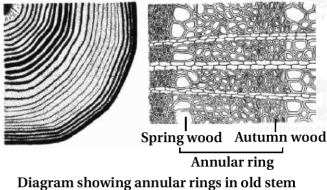
$\Rightarrow$ Concentric rings,also known as annual rings,are formed due to the activity of the vascular cambium during secondary growth in dicotyledonous trees.
$\Rightarrow$ In the spring season,the cambium is very active and produces a large number of xylem elements with wider vessels,forming 'spring wood' or 'early wood'. In the winter season,the cambium is less active and produces fewer xylem elements with narrow vessels,forming 'autumn wood' or 'late wood'.
$\Rightarrow$ The combination of one band of spring wood and one band of autumn wood constitutes an annual ring. By counting the number of these annual rings,the age of the tree can be estimated. This field of study is known as dendrochronology.
$\Rightarrow$ In the spring season,the cambium is very active and produces a large number of xylem elements with wider vessels,forming 'spring wood' or 'early wood'. In the winter season,the cambium is less active and produces fewer xylem elements with narrow vessels,forming 'autumn wood' or 'late wood'.
$\Rightarrow$ The combination of one band of spring wood and one band of autumn wood constitutes an annual ring. By counting the number of these annual rings,the age of the tree can be estimated. This field of study is known as dendrochronology.
0 likes
View Solution274
Medium
Trunks of some of the aged tree species appear to be composed of several fused trunks. Is it a physiological or anatomical abnormality? Explain in detail.
Solution
(N/A) $\Rightarrow$ It is an anatomical abnormality. It is an irregular type of secondary growth where the regular fascicular cambium or cork cambium does not function under normal conditions.
$\Rightarrow$ In the case of old tree trunks,irregular secondary growth is produced by the activity of the cortex and the formation of anomalous vascular bundles.
$\Rightarrow$ Consequently,these extra or subsidiary vascular bundles create an appearance as if the trunk is formed by the fusion of several smaller trunks.
$\Rightarrow$ In the case of old tree trunks,irregular secondary growth is produced by the activity of the cortex and the formation of anomalous vascular bundles.
$\Rightarrow$ Consequently,these extra or subsidiary vascular bundles create an appearance as if the trunk is formed by the fusion of several smaller trunks.
0 likes
View Solution275
Medium
Palm is a monocotyledonous plant,yet it increases in girth. Why and how?
Solution
(N/A) Although palm is a monocotyledonous plant,it exhibits an increase in girth. This occurs because of the division and expansion of parenchymatous cells within the ground tissue. This repeated division and subsequent enlargement of cells increase the girth of the stem. This specific type of growth is known as $diffused$ $secondary$ $growth$.
0 likes
View Solution276
Medium
Distinguish between the following: Interfascicular cambium and intrafascicular cambium.
Solution
(N/A) The differences between intrafascicular cambium and interfascicular cambium are as follows:
$1$. Intrafascicular cambium is present within the vascular bundles,between the xylem and phloem,and is primary in origin.
$2$. Interfascicular cambium arises from the medullary rays (parenchymatous cells) located between the vascular bundles and is secondary in origin.
$3$. Both types of cambium together form a complete ring of cambium known as the vascular cambium ring,which is responsible for secondary growth in dicot stems.
$1$. Intrafascicular cambium is present within the vascular bundles,between the xylem and phloem,and is primary in origin.
$2$. Interfascicular cambium arises from the medullary rays (parenchymatous cells) located between the vascular bundles and is secondary in origin.
$3$. Both types of cambium together form a complete ring of cambium known as the vascular cambium ring,which is responsible for secondary growth in dicot stems.
0 likes
View Solution277
EasyMCQ
Complete the following analogy-type questions:
$(i)$ Cells of cambium between vascular bundles : Intrafascicular cambium :: Cells of medullary rays : .....
$(ii)$ Cambium cells dividing towards the pith : Secondary xylem :: Cambium cells dividing towards the periphery : .......
$(i)$ Cells of cambium between vascular bundles : Intrafascicular cambium :: Cells of medullary rays : .....
$(ii)$ Cambium cells dividing towards the pith : Secondary xylem :: Cambium cells dividing towards the periphery : .......
A
Interfascicular cambium,Secondary phloem
B
Interfascicular cambium,Primary phloem
C
Intrafascicular cambium,Secondary phloem
D
Interfascicular cambium,Primary xylem
Solution
(A) $(i)$ The cambium present between the vascular bundles is known as the interfascicular cambium,which arises from the dedifferentiation of medullary ray cells.
$(ii)$ The vascular cambium divides to produce secondary xylem towards the pith (inner side) and secondary phloem towards the periphery (outer side).
$(ii)$ The vascular cambium divides to produce secondary xylem towards the pith (inner side) and secondary phloem towards the periphery (outer side).
0 likes
View Solution278
MediumMCQ
Complete the following analogy-type questions:
$(i)$ Wood formed during spring season : Early wood :: Wood formed during winter season : .........
$(ii)$ Bark formed early in the season : Early bark :: Bark formed at the end of the season : ..........
$(i)$ Wood formed during spring season : Early wood :: Wood formed during winter season : .........
$(ii)$ Bark formed early in the season : Early bark :: Bark formed at the end of the season : ..........
A
Late wood,Late bark
B
Late wood,Hard bark
C
Autumn wood,Late bark
D
Spring wood,Early bark
Solution
(B) $(i)$ In the spring season,the cambium is very active and produces a large number of xylary elements having vessels with wider cavities,known as early wood or spring wood. In winter,the cambium is less active and forms fewer xylary elements with narrow vessels,known as late wood or autumn wood.
$(ii)$ Bark that is formed early in the season is called early or soft bark. Bark that is formed at the end of the season is called late or hard bark.
$(ii)$ Bark that is formed early in the season is called early or soft bark. Bark that is formed at the end of the season is called late or hard bark.
0 likes
View Solution279
MediumMCQ
Choose the correct options for the following statements:
$(i)$ Interfascicular cambium is a primary / secondary meristematic tissue.
$(ii)$ Secondary growth does not occur in monocot / dicot stems.
$(i)$ Interfascicular cambium is a primary / secondary meristematic tissue.
$(ii)$ Secondary growth does not occur in monocot / dicot stems.
A
$(i)$ Primary,$(ii)$ Monocot
B
$(i)$ Secondary,$(ii)$ Monocot
C
$(i)$ Secondary,$(ii)$ Dicot
D
$(i)$ Primary,$(ii)$ Dicot
Solution
(B) $(i)$ Interfascicular cambium is formed from the dedifferentiation of permanent parenchyma cells during secondary growth,hence it is a secondary meristematic tissue.
$(ii)$ Secondary growth is a characteristic feature of dicot stems and roots. Monocot stems lack vascular cambium and therefore do not exhibit secondary growth.
$(ii)$ Secondary growth is a characteristic feature of dicot stems and roots. Monocot stems lack vascular cambium and therefore do not exhibit secondary growth.
0 likes
View Solution280
Medium
Give an explanation about cork cambium.
Solution
(N/A) $\Rightarrow$ As the stem continues to increase in girth due to the activity of the vascular cambium,the outer cortical and epidermal layers get broken and need to be replaced to provide new protective cell layers.
$\Rightarrow$ Hence,sooner or later,another meristematic tissue called cork cambium or phellogen develops in the cortex region.
$\Rightarrow$ It is a couple of layers thick and is made of narrow,thin-walled,and nearly rectangular cells.
$\Rightarrow$ The phellogen cuts off cells on both sides; the outer cells differentiate into cork (phellem) and the inner cells differentiate into secondary cortex (phelloderm).
$\Rightarrow$ Hence,sooner or later,another meristematic tissue called cork cambium or phellogen develops in the cortex region.
$\Rightarrow$ It is a couple of layers thick and is made of narrow,thin-walled,and nearly rectangular cells.
$\Rightarrow$ The phellogen cuts off cells on both sides; the outer cells differentiate into cork (phellem) and the inner cells differentiate into secondary cortex (phelloderm).
0 likes
View Solution281
MediumMCQ
How do we compute the age of a living tree?
A
By counting the number of leaves
B
By counting the number of annual rings
C
By measuring the height of the tree
D
By analyzing the soil nutrients
Solution
(B) The age of a living tree is calculated by counting the number of annual rings present in the trunk. Each ring typically represents one year of growth. This scientific method of dating tree rings is known as $Dendrochronology$.
0 likes
View Solution282
EasyMCQ
Identify the incorrect statement.
A
Due to deposition of tannins,resins,oils,etc.,heartwood is dark in colour.
B
Heartwood does not conduct water but gives mechanical support.
C
Sapwood is involved in the conduction of water and minerals from root to leaf.
D
Sapwood is the innermost secondary xylem and is lighter in colour.
Solution
(D) The incorrect statement is that sapwood is the innermost secondary xylem. In reality,heartwood is the innermost,non-functional region of the secondary xylem,while sapwood is the peripheral,functional region. Sapwood is lighter in colour and is involved in the conduction of water and minerals,whereas heartwood is darker due to the deposition of organic compounds like tannins,resins,and oils,and provides only mechanical support.
0 likes
View Solution283
MediumMCQ
Identify the incorrect statement among the following:
A
Heartwood does not conduct water but provides mechanical support.
B
Sapwood conducts water and minerals from roots to leaves.
C
Sapwood is the innermost secondary xylem and is light in color.
D
Heartwood is dark in color due to the deposition of tannins,resins,oils,etc.
Solution
(C) Heartwood is the central,non-functional part of the secondary xylem,which is dark in color due to the deposition of organic compounds like tannins,resins,and oils. It provides mechanical support but does not conduct water.
Sapwood is the peripheral,functional part of the secondary xylem,which is light in color and is responsible for the conduction of water and minerals from the roots to the leaves.
Therefore,the statement 'Sapwood is the innermost secondary xylem and is light in color' is incorrect because sapwood is the peripheral (outer) part,while heartwood is the innermost part.
Sapwood is the peripheral,functional part of the secondary xylem,which is light in color and is responsible for the conduction of water and minerals from the roots to the leaves.
Therefore,the statement 'Sapwood is the innermost secondary xylem and is light in color' is incorrect because sapwood is the peripheral (outer) part,while heartwood is the innermost part.
0 likes
View Solution284
EasyMCQ
Which of the following statements about cork cambium is incorrect?
A
It is a couple of layers thick
B
It forms secondary cortex on its outerside
C
It forms a part of periderm
D
It is responsible for the formation of lenticels
Solution
(B) Cork cambium $(Phellogen)$ is a dedifferentiated tissue,making it a secondary meristem.
It is a couple of layers thick and cuts off cork $(Phellem)$ towards the outer side and secondary cortex $(Phelloderm)$ towards the inner side.
Therefore,the statement that it forms secondary cortex on its outer side is incorrect,as it forms secondary cortex on the inner side.
$Phellem + Phellogen + Phelloderm$ together constitute the periderm.
It is a couple of layers thick and cuts off cork $(Phellem)$ towards the outer side and secondary cortex $(Phelloderm)$ towards the inner side.
Therefore,the statement that it forms secondary cortex on its outer side is incorrect,as it forms secondary cortex on the inner side.
$Phellem + Phellogen + Phelloderm$ together constitute the periderm.
0 likes
View Solution285
MediumMCQ
Complementary cells are associated with
A
Lenticels
B
Hydathodes
C
Rhytidome
D
Bark
Solution
(A) Complementary cells are thin-walled,loosely arranged parenchymatous cells found in the lenticels. These cells facilitate the exchange of gases between the internal tissues of the stem and the external atmosphere.
0 likes
View Solution286
MediumMCQ
In which of the following,there is no differentiation of bark,sapwood,and heartwood?
A
Ashok
B
Neem
C
Mango
D
Date palm
Solution
(D) In $Date \ palm$ $(Phoenix \ sp.)$,there is no secondary growth. Consequently,the differentiation of wood into bark,sapwood,and heartwood is not present,as these structures are characteristic of plants that undergo secondary growth.
0 likes
View Solution287
MediumMCQ
Which tissue gives rise to secondary growth?
A
Apical meristem
B
Adventitious roots
C
Germinating seed
D
Vascular cambium
Solution
(D) Secondary growth refers to the increase in the girth or diameter of the plant body. This process is primarily facilitated by the activity of lateral meristems. The vascular cambium is a type of lateral meristem that produces secondary xylem and secondary phloem,leading to an increase in the thickness of the stem and root.
0 likes
View Solution288
MediumMCQ
In old trees,the greater part of secondary xylem is dark brown due to the
A
Deposition of inorganic material
B
Deposition of organic material
C
Activity of cambium
D
Activity of secondary xylem
Solution
(B) In old trees,the greater part of secondary xylem is dark brown due to the deposition of organic compounds like tannins,resins,oils,gums,aromatic substances,and essential oils in the central or innermost layers of the stem.
These substances make the wood hard,durable,and resistant to the attacks of microorganisms and insects.
This region comprises dead elements with highly lignified walls and is called heartwood.
These substances make the wood hard,durable,and resistant to the attacks of microorganisms and insects.
This region comprises dead elements with highly lignified walls and is called heartwood.
0 likes
View Solution289
MediumMCQ
Periderm includes
A
Phellem,phelloderm,plerome
B
Phellem,phellogen,dermatogen
C
Phellem,phellogen,phelloderm
D
Phellem,phellogen,cortex
Solution
(C) The periderm is a protective tissue formed during secondary growth in plants.
It consists of three distinct layers:
$1$. $Phellem$ (cork): The outer layer formed by the phellogen.
$2$. $Phellogen$ (cork cambium): The meristematic layer that produces the phellem and phelloderm.
$3$. $Phelloderm$ (secondary cortex): The inner layer formed by the phellogen.
Therefore,the correct composition of the periderm is $Phellem$,$Phellogen$,and $Phelloderm$.
It consists of three distinct layers:
$1$. $Phellem$ (cork): The outer layer formed by the phellogen.
$2$. $Phellogen$ (cork cambium): The meristematic layer that produces the phellem and phelloderm.
$3$. $Phelloderm$ (secondary cortex): The inner layer formed by the phellogen.
Therefore,the correct composition of the periderm is $Phellem$,$Phellogen$,and $Phelloderm$.
0 likes
View Solution290
EasyMCQ
Cambium is present in between
A
Phloem and xylem
B
Permanent mature cells
C
Collenchyma and sclerenchyma
D
Collenchyma and parenchyma
Solution
(A) In dicotyledonous stems,the vascular bundles contain a layer of meristematic tissue between the xylem and phloem known as the intrafascicular cambium. This cambium is responsible for secondary growth. In contrast,monocotyledonous plants possess closed vascular bundles where no cambium is present between the xylem and phloem,preventing secondary growth.
0 likes
View Solution291
MediumMCQ
Early wood is formed in dicot plants during
A
Spring season
B
Winter season
C
Autumn season
D
Summer season
Solution
(A) The activity of the cambium is under the control of many physiological and environmental factors. In temperate regions,the climatic conditions are not uniform throughout the year. In the spring season,the cambium is very active and produces a large number of xylary elements having vessels with wider cavities. The wood formed during this season is called spring wood or early wood.
0 likes
View Solution292
MediumMCQ
The activity of cambium in plants is under the control of
A
Many physiological factors
B
Many environmental factors
C
Only water availability
D
Both $(a)$ and $(b)$
Solution
(D) The correct answer is $(d)$.
The activity of the cambium is influenced by a complex interaction of many physiological and environmental factors.
In temperate regions,climatic conditions vary significantly throughout the year.
During the spring season,the cambium is highly active and produces a large number of xylary elements with vessels that have wider cavities,resulting in the formation of spring wood or early wood.
Conversely,during winter,the cambium is less active and produces fewer xylary elements with narrow vessels,forming autumn wood or late wood.
The activity of the cambium is influenced by a complex interaction of many physiological and environmental factors.
In temperate regions,climatic conditions vary significantly throughout the year.
During the spring season,the cambium is highly active and produces a large number of xylary elements with vessels that have wider cavities,resulting in the formation of spring wood or early wood.
Conversely,during winter,the cambium is less active and produces fewer xylary elements with narrow vessels,forming autumn wood or late wood.
0 likes
View Solution293
MediumMCQ
Cambium activity is highest in
A
Autumn
B
Spring
C
Winter
D
Rain
Solution
(B) The cambium activity is observed in temperate trees during two seasons of the year.
In the spring season,cambium activity is highest,resulting in the formation of a larger amount of wood due to the long duration of the favourable period.
This type of wood is known as spring wood or early wood.
In the autumn season,cambium activity is reduced,resulting in the formation of a dark-coloured,narrow band of autumn wood or late wood.
The two types of wood jointly constitute the annual rings or growth rings.
In the spring season,cambium activity is highest,resulting in the formation of a larger amount of wood due to the long duration of the favourable period.
This type of wood is known as spring wood or early wood.
In the autumn season,cambium activity is reduced,resulting in the formation of a dark-coloured,narrow band of autumn wood or late wood.
The two types of wood jointly constitute the annual rings or growth rings.
0 likes
View Solution294
MediumMCQ
$A$ continuous ring of cambium is formed by:
A
Intrafascicular cambium
B
Interfascicular cambium
C
Lateral meristem
D
Both $(a)$ and $(b)$
Solution
(D) In dicot stems,the cambium present between the primary xylem and primary phloem is called intrafascicular cambium. During secondary growth,the cells of medullary rays,at the level of intrafascicular cambium,become meristematic and form the interfascicular cambium. These two types of cambium join together to form a complete and continuous cambial ring,which is responsible for secondary growth.
0 likes
View Solution295
MediumMCQ
Aerating pores are present at places on the cork cambium. These are called
A
Pneumatophores
B
Hydathodes
C
Lenticels
D
Stomata
Solution
(C) At certain regions,the phellogen (cork cambium) cuts off closely arranged parenchymatous cells on the outer side instead of cork cells.
These parenchymatous cells soon rupture the epidermis,forming lens-shaped openings called lenticels.
Lenticels permit the exchange of gases between the outer atmosphere and the internal tissue of the stem.
These occur in most woody trees.
These parenchymatous cells soon rupture the epidermis,forming lens-shaped openings called lenticels.
Lenticels permit the exchange of gases between the outer atmosphere and the internal tissue of the stem.
These occur in most woody trees.
0 likes
View Solution296
MediumMCQ
Cork is used as a stopper for bottles,for shock absorption,and for insulation because of:
A
It is light and compressible
B
It is non-reactive
C
It is sufficiently resistant to fire
D
All of the above
Solution
(D) Cork is a secondary tissue formed during secondary growth in plants. It possesses unique properties that make it highly useful.
$1$. It is light and compressible,which allows it to act as an effective shock absorber and a tight stopper for bottles.
$2$. It is non-reactive,meaning it does not easily react with the contents of the bottle.
$3$. It is sufficiently resistant to fire,which adds to its utility in insulation.
Due to these combined properties,it is widely used for these purposes.
$1$. It is light and compressible,which allows it to act as an effective shock absorber and a tight stopper for bottles.
$2$. It is non-reactive,meaning it does not easily react with the contents of the bottle.
$3$. It is sufficiently resistant to fire,which adds to its utility in insulation.
Due to these combined properties,it is widely used for these purposes.
0 likes
View Solution297
MediumMCQ
Heartwood and sapwood of dicot plants are respectively called as:
A
Duraman and alburnum
B
Alburnum and duraman
C
Alburnum and phellogen
D
Duraman and phellogen
Solution
(A) In dicot plants,the secondary xylem is differentiated into two regions:
$1$. The central,darker,and harder part is known as heartwood or $Duraman$. It is non-functional and provides mechanical support.
$2$. The peripheral,lighter-colored,and softer part is known as sapwood or $Alburnum$. It is functional and involved in the conduction of water and minerals.
$1$. The central,darker,and harder part is known as heartwood or $Duraman$. It is non-functional and provides mechanical support.
$2$. The peripheral,lighter-colored,and softer part is known as sapwood or $Alburnum$. It is functional and involved in the conduction of water and minerals.
0 likes
View Solution298
EasyMCQ
The cork cambium,cork and secondary cortex are collectively called
A
Phellogen
B
Periderm
C
Phellem
D
Phelloderm
Solution
(B) The $Periderm$ is a secondary protective structure that replaces the epidermis in older stems and roots.
It is composed of three distinct layers:
$1$. Cork cambium $(Phellogen)$: The lateral meristematic tissue.
$2$. Cork $(Phellem)$: The outer layer produced by the cork cambium.
$3$. Secondary cortex $(Phelloderm)$: The inner layer produced by the cork cambium.
Therefore,the collective term for these three tissues is $Periderm$.
It is composed of three distinct layers:
$1$. Cork cambium $(Phellogen)$: The lateral meristematic tissue.
$2$. Cork $(Phellem)$: The outer layer produced by the cork cambium.
$3$. Secondary cortex $(Phelloderm)$: The inner layer produced by the cork cambium.
Therefore,the collective term for these three tissues is $Periderm$.
0 likes
View Solution299
MediumMCQ
Wood is
A
Primary phloem
B
Primary xylem
C
Secondary xylem
D
Secondary phloem
Solution
(C) Wood is technically defined as the secondary xylem produced by the vascular cambium during secondary growth in plants.
It is often categorized into spring wood and autumn wood based on the activity of the cambium,which forms annual rings.
As the plant matures,the secondary xylem may differentiate into heartwood (duramen) and sapwood (alburnum).
Therefore,wood is essentially the accumulation of secondary xylem.
It is often categorized into spring wood and autumn wood based on the activity of the cambium,which forms annual rings.
As the plant matures,the secondary xylem may differentiate into heartwood (duramen) and sapwood (alburnum).
Therefore,wood is essentially the accumulation of secondary xylem.
0 likes
View Solution300
EasyMCQ
Estimation of the age of the tree is done by
A
Counting the epidermal rings
B
Measuring the pith diameter
C
Counting the annual rings
D
Counting the late woods only
Solution
(C) The spring wood is lighter in color and has a lower density,whereas the autumn wood is darker and has a higher density.
These two kinds of wood appear as alternate concentric rings,which together constitute an annual ring.
Annual rings seen in a cross-section of a stem provide an estimate of the age of the tree.
These two kinds of wood appear as alternate concentric rings,which together constitute an annual ring.
Annual rings seen in a cross-section of a stem provide an estimate of the age of the tree.
0 likes
View SolutionAnatomy of Flowering Plants — Secondary growth · Frequently Asked Questions
1Are these Anatomy of Flowering Plants questions useful for JEE and NEET?
Yes. All questions in this section are mapped to JEE Main and NEET exam patterns. Previous year questions from JEE Main, NEET, GUJCET and state-level exams are included with full solutions.
2Can I switch to Hindi or Gujarati for these questions?
Yes. Use the language tabs in the hero section or the sidebar to view the same questions and solutions in English, Hindi or Gujarati.
3How do I generate a question paper from this subtopic?
Use the Vedclass Exam Paper Generator — select the chapter and subtopic, set difficulty, and generate Sets A, B, C, D automatically. First 3 chapters of every subject are free.
Vedclass Products
For Students
Vedclass Test Series
Mock tests in real JEE/NEET style with performance analysis. 5-day free trial.
Start Free TrialFor Teachers
Exam Paper Generator
Generate Set A/B/C/D papers from this chapter in 2 minutes. 3 chapters free.
Try FreeFor Institutes
Online Exam Module
Live online exams with unlimited students, 360° analytics & white-label branding.
See DemoFor Teachers & Institutes
Generate a Anatomy of Flowering Plants Exam Paper in 2 Minutes
Select subtopic & difficulty — Sets A, B, C, D auto-generated with No Repeat logic.
First 3 chapters of every subject are free — no payment required.