
A English
Secondary growth Questions in English
Class 11 Biology · Anatomy of Flowering Plants · Secondary growth
396+
Questions
English
Language
100%
With Solutions
Showing 50 of 396 questions in English
301
MediumMCQ
Periderm is produced from
A
Cork cambium
B
Procambium
C
Secondary cortex
D
Vascular cambium
Solution
(A) The periderm consists of three layers: phellem (cork),phellogen (cork cambium),and phelloderm.
The phellogen (cork cambium) is a meristematic tissue that develops in the cortex,epidermis,or phloem.
It produces phellem (cork) towards the outside and phelloderm (secondary cortex) towards the inside.
Therefore,the entire periderm is produced by the activity of the cork cambium (phellogen).
The phellogen (cork cambium) is a meristematic tissue that develops in the cortex,epidermis,or phloem.
It produces phellem (cork) towards the outside and phelloderm (secondary cortex) towards the inside.
Therefore,the entire periderm is produced by the activity of the cork cambium (phellogen).
0 likes
View Solution302
MediumMCQ
In an annual ring,the light coloured part is known as
A
Early wood
B
Late wood
C
Heartwood
D
Sapwood
Solution
(A) Spring wood and autumn wood formed in a single year together constitute an annual ring.
The spring wood,also known as $Early \ wood$,is lighter in colour and has a lower density because the cambium is very active during the spring season.
The autumn wood,also known as $Late \ wood$,is darker in colour and has a higher density due to the reduced activity of the cambium.
Therefore,the light-coloured part of an annual ring is the $Early \ wood$.
The spring wood,also known as $Early \ wood$,is lighter in colour and has a lower density because the cambium is very active during the spring season.
The autumn wood,also known as $Late \ wood$,is darker in colour and has a higher density due to the reduced activity of the cambium.
Therefore,the light-coloured part of an annual ring is the $Early \ wood$.
0 likes
View Solution303
MediumMCQ
Narrow bands of parenchymatous tissue which pass through the secondary xylem and phloem radially are called
A
Pith
B
Stele
C
Primary medullary rays
D
Secondary medullary rays
Solution
(D) During secondary growth in dicot stems,the vascular cambium produces secondary xylem towards the inside and secondary phloem towards the outside. In addition to these,the vascular cambium also produces some narrow bands of parenchymatous cells that pass through the secondary xylem and secondary phloem in a radial direction. These are known as secondary medullary rays.
0 likes
View Solution304
MediumMCQ
The secondary meristem initiates
A
Basal growth
B
Transverse growth
C
Radial growth
D
Vertical growth
Solution
(C) The secondary meristem,such as the vascular cambium and cork cambium,is responsible for increasing the girth or diameter of the plant stem and root. This increase in thickness is known as radial growth or secondary growth.
0 likes
View Solution305
MediumMCQ
What is/are true about heartwood?
$I.$ It does not help in water conduction.
$II.$ It is also called alburnum.
$III.$ It is dark in colour but very soft.
$IV.$ It has tracheary elements,which are filled with tannin,resin,etc.
$I.$ It does not help in water conduction.
$II.$ It is also called alburnum.
$III.$ It is dark in colour but very soft.
$IV.$ It has tracheary elements,which are filled with tannin,resin,etc.
A
$II, III$ and $IV$
B
$I$ and $IV$
C
$II$ and $IV$
D
$I, II$ and $III$
Solution
(B) Heartwood,also known as $duramen$,is the central,non-functional part of the secondary xylem.
Statement $I$ is true because heartwood does not conduct water due to the deposition of organic compounds.
Statement $II$ is false because alburnum refers to sapwood,not heartwood.
Statement $III$ is false because heartwood is dark in colour but very hard and durable,not soft.
Statement $IV$ is true because the tracheary elements in heartwood are filled with tannins,resins,oils,gums,and aromatic substances,which make it resistant to microbial attack.
Statement $I$ is true because heartwood does not conduct water due to the deposition of organic compounds.
Statement $II$ is false because alburnum refers to sapwood,not heartwood.
Statement $III$ is false because heartwood is dark in colour but very hard and durable,not soft.
Statement $IV$ is true because the tracheary elements in heartwood are filled with tannins,resins,oils,gums,and aromatic substances,which make it resistant to microbial attack.
0 likes
View Solution306
MediumMCQ
During secondary growth of plants,stem phellogen cuts off cells on both sides. The outer cells get differentiated into ...$A$... and the inner cells get differentiated into ...$B$... cortex.
Choose the correct combination of $A$ and $B$ with reference to the above statement.
Choose the correct combination of $A$ and $B$ with reference to the above statement.
A
$A-$ cork; $B-$ phellem
B
$A-$ secondary cortex; $B-$ phelloderm
C
$A-$ secondary cortex; $B-$ primary cortex
D
$A-$ cork/phellem; $B-$ secondary cortex
Solution
(D) During secondary growth,the phellogen (cork cambium) acts as a meristematic tissue that cuts off cells on both sides.
The cells produced on the outer side differentiate into cork (also known as phellem),which is impervious to water due to the deposition of suberin.
The cells produced on the inner side differentiate into secondary cortex (also known as phelloderm),which consists of parenchymatous cells.
Therefore,$A$ is cork/phellem and $B$ is secondary cortex.
The cells produced on the outer side differentiate into cork (also known as phellem),which is impervious to water due to the deposition of suberin.
The cells produced on the inner side differentiate into secondary cortex (also known as phelloderm),which consists of parenchymatous cells.
Therefore,$A$ is cork/phellem and $B$ is secondary cortex.
0 likes
View Solution307
EasyMCQ
Tyloses,an outgrowth from ray or axial parenchyma cells into the lumen of a vessel,which partially or completely blocks the cavity,are present in:
A
Periderm
B
Heartwood
C
Sapwood
D
Secondary cortex
Solution
(B) Tyloses are balloon-like outgrowths of xylem parenchyma cells that penetrate into the lumen of adjacent xylem vessels through pits.
These structures are characteristic of heartwood,where they block the vessel cavity,rendering the wood more durable and resistant to decay.
They are not typically found in functional sapwood.
These structures are characteristic of heartwood,where they block the vessel cavity,rendering the wood more durable and resistant to decay.
They are not typically found in functional sapwood.
0 likes
View Solution308
MediumMCQ
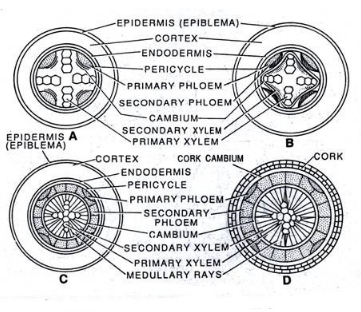
In any dicot root having secondary growth,the cork is the
A
Outer to endodermis and inner to primary cortex
B
Inner to endodermis and outer to primary phloem
C
Inner to endodermis and outer to primary xylem
D
Outer to endodermis and outer to primary phloem
Solution
(D) In a dicot root,secondary growth involves the formation of a cork cambium (phellogen) in the cortical region.
This cork cambium produces cork (phellem) towards the outside and secondary cortex (phelloderm) towards the inside.
Since the cork cambium originates in the cortex (which is outside the endodermis),the resulting cork layer is also located outside the endodermis.
Furthermore,the cork is situated outside the primary phloem,as the primary phloem is located deeper within the root,just outside the vascular cambium.
This cork cambium produces cork (phellem) towards the outside and secondary cortex (phelloderm) towards the inside.
Since the cork cambium originates in the cortex (which is outside the endodermis),the resulting cork layer is also located outside the endodermis.
Furthermore,the cork is situated outside the primary phloem,as the primary phloem is located deeper within the root,just outside the vascular cambium.
0 likes
View Solution309
MediumMCQ
In dicot stem,secondary xylem lies towards the ...$A$... and secondary phloem lies towards the ...$B$.... Choose the correct combination of options for $A$ and $B$.
A
$A-$ pith; $B-$ periphery
B
$A-$ periphery; $B-$ pith
C
$A-$ periphery; $B-$ laterally
D
$A-$ pith; $B-$ laterally
Solution
(A) The vascular cambium ring becomes active and begins to cut off new cells both towards the inner and the outer sides.
Cells cut off towards the pith (inner side) mature into secondary xylem.
Cells cut off towards the periphery (outer side) mature into secondary phloem.
Cells cut off towards the pith (inner side) mature into secondary xylem.
Cells cut off towards the periphery (outer side) mature into secondary phloem.
0 likes
View Solution310
MediumMCQ
Intrafascicular cambium is present in between the
A
Primary xylem and secondary xylem
B
Secondary phloem and primary xylem
C
Primary xylem and primary phloem
D
Primary xylem and secondary phloem
Solution
(C) In dicot stems,the cells of cambium present between the primary xylem and primary phloem are known as intrafascicular cambium.
These cells remain meristematic and contribute to secondary growth.
The cells of medullary rays,adjoining these intrafascicular cambium,become meristematic to form the interfascicular cambium.
Together,these form a continuous ring of cambium.
These cells remain meristematic and contribute to secondary growth.
The cells of medullary rays,adjoining these intrafascicular cambium,become meristematic to form the interfascicular cambium.
Together,these form a continuous ring of cambium.
0 likes
View Solution311
EasyMCQ
Duramen is present in
A
Inner region of secondary wood
B
Part of sapwood
C
Outer region of secondary wood
D
Region of pericycle
Solution
(A) After certain years of growth,the xylem elements of the stems of a number of trees develop a dark brown coloration,especially in the central or innermost layers.
This region comprises dead elements with highly lignified walls and is called heartwood or duramen.
It is present in the inner region of secondary wood.
This region comprises dead elements with highly lignified walls and is called heartwood or duramen.
It is present in the inner region of secondary wood.
0 likes
View Solution312
MediumMCQ
Identify the correct order of the components with reference to their arrangement from outer side to inner side in a woody dicot stem.
$I.$ Secondary cortex
$II.$ Autumn wood
$III.$ Secondary phloem
$IV.$ Phellem
$I.$ Secondary cortex
$II.$ Autumn wood
$III.$ Secondary phloem
$IV.$ Phellem
A
$II, III, I$ and $IV$
B
$III, IV, II$ and $I$
C
$IV, I, III$ and $II$
D
$I, II, IV$ and $III$
Solution
(C) In a woody dicot stem,the arrangement of tissues from the outer side to the inner side is as follows:
$1.$ $Phellem$ (Cork): This is the outermost layer formed by the phellogen.
$2.$ $Secondary$ $cortex$ $(Phelloderm)$: This is formed by the phellogen towards the inner side.
$3.$ $Secondary$ $phloem$: This is formed by the vascular cambium towards the outer side.
$4.$ $Autumn$ $wood$: This is a part of the secondary xylem formed by the vascular cambium towards the inner side.
Therefore,the correct sequence from outer to inner is $IV, I, III, II$.
$1.$ $Phellem$ (Cork): This is the outermost layer formed by the phellogen.
$2.$ $Secondary$ $cortex$ $(Phelloderm)$: This is formed by the phellogen towards the inner side.
$3.$ $Secondary$ $phloem$: This is formed by the vascular cambium towards the outer side.
$4.$ $Autumn$ $wood$: This is a part of the secondary xylem formed by the vascular cambium towards the inner side.
Therefore,the correct sequence from outer to inner is $IV, I, III, II$.
0 likes
View Solution313
MediumMCQ
Growth rings are absent or not sharply demarcated in the trees of
A
Temperate deciduous
B
Tropical evergreen
C
Temperate evergreen
D
Tropical deciduous
Solution
(B) Annual growth rings are formed due to the differential activity of the vascular cambium,which is influenced by seasonal variations in climate.
In temperate regions,there are distinct seasonal changes,leading to the formation of clear annual rings.
In tropical evergreen forests,the climate remains relatively uniform throughout the year without significant seasonal fluctuations.
Consequently,the activity of the vascular cambium remains constant,and distinct growth rings are either absent or not sharply demarcated.
In temperate regions,there are distinct seasonal changes,leading to the formation of clear annual rings.
In tropical evergreen forests,the climate remains relatively uniform throughout the year without significant seasonal fluctuations.
Consequently,the activity of the vascular cambium remains constant,and distinct growth rings are either absent or not sharply demarcated.
0 likes
View Solution314
MediumMCQ
$I.$ It is resistant to microorganisms
$II.$ It comprises dead elements
$III.$ It comprises highly lignified cell wall
$IV.$ It is the peripheral part
$V.$ It is dark and tough
Which of the above property does not belong to heartwood?
$II.$ It comprises dead elements
$III.$ It comprises highly lignified cell wall
$IV.$ It is the peripheral part
$V.$ It is dark and tough
Which of the above property does not belong to heartwood?
A
$I$ and $II$
B
Only $IV$
C
Only $V$
D
$III$ and $I$
Solution
(B) The correct answer is $IV$.
Heartwood is the central,innermost part of the secondary xylem in old trees. It is dark brown due to the deposition of organic compounds like tannins,resins,oils,gums,aromatic substances,and essential oils. These substances make it hard,durable,and resistant to the attacks of microorganisms and insects. It consists of dead elements with highly lignified cell walls. In contrast,the peripheral part of the secondary xylem is known as sapwood,which is lighter in color and involved in the conduction of water and minerals. Therefore,statement $IV$ (It is the peripheral part) does not describe heartwood.
Heartwood is the central,innermost part of the secondary xylem in old trees. It is dark brown due to the deposition of organic compounds like tannins,resins,oils,gums,aromatic substances,and essential oils. These substances make it hard,durable,and resistant to the attacks of microorganisms and insects. It consists of dead elements with highly lignified cell walls. In contrast,the peripheral part of the secondary xylem is known as sapwood,which is lighter in color and involved in the conduction of water and minerals. Therefore,statement $IV$ (It is the peripheral part) does not describe heartwood.
0 likes
View Solution315
MediumMCQ
Diffused porous woods are characteristic of plants growing in
A
Temperate climate
B
Tropics
C
Alpine region
D
Cold winter regions
Solution
(B) In tropical regions, there is no sharp distinction between seasons, which leads to a continuous and uniform activity of the cambium throughout the year.
In diffused porous wood, the vessels are of similar size and are distributed uniformly throughout the growth ring, including both early wood and late wood.
This is a characteristic feature of plants growing in tropical climates, such as $Syzygium \text{ } cumini$.
In diffused porous wood, the vessels are of similar size and are distributed uniformly throughout the growth ring, including both early wood and late wood.
This is a characteristic feature of plants growing in tropical climates, such as $Syzygium \text{ } cumini$.
0 likes
View Solution316
MediumMCQ
Cambium activity is
A
More active towards the periphery of stem
B
More active towards the lateral sides of stem
C
More active towards the inner side of stem
D
Same on the both sides
Solution
(C) The vascular cambium is generally more active on the inner side than on the outer side.
As a result,the amount of secondary xylem produced towards the center is significantly more than the secondary phloem produced towards the periphery.
This differential activity leads to the formation of a compact mass of secondary xylem,which constitutes the bulk of the wood.
As a result,the amount of secondary xylem produced towards the center is significantly more than the secondary phloem produced towards the periphery.
This differential activity leads to the formation of a compact mass of secondary xylem,which constitutes the bulk of the wood.
0 likes
View Solution317
MediumMCQ
The cork is impervious to water due to
A
Lignin deposition in the cell wall
B
Compactness of cell
C
Suberin deposition in the cell wall
D
All of the above
Solution
(C) The cork,also known as $phellem$,is a protective tissue formed during secondary growth.
Its cells are dead and have walls that are heavily thickened with $suberin$,a fatty substance.
$Suberin$ is hydrophobic in nature,which makes the cork cells impervious to water and gases,thereby preventing water loss from the plant body.
Its cells are dead and have walls that are heavily thickened with $suberin$,a fatty substance.
$Suberin$ is hydrophobic in nature,which makes the cork cells impervious to water and gases,thereby preventing water loss from the plant body.
0 likes
View Solution318
MediumMCQ
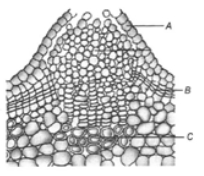
In the given diagram of a lenticel,identify the labels $A, B,$ and $C$ from the given options.
A
$A-$ Epidermis,$B-$ Cork cambium,$C-$ Secondary cortex
B
$A-$ Stomata,$B-$ Cork cambium,$C-$ Secondary cortex
C
$A-$ Stomata,$B-$ Cork cambium,$C-$ Endodermis
D
$A-$ Epidermis,$B-$ Cork cambium,$C-$ Endodermis
Solution
(A) lenticel is a porous tissue consisting of cells with large intercellular spaces in the periderm of the secondarily thickened organs and the bark of woody stems and roots of dicotyledonous flowering plants.
In the provided diagram:
$A$ points to the Epidermis (or the remains of the epidermis).
$B$ points to the Cork cambium (phellogen),which is responsible for producing the complementary cells of the lenticel.
$C$ points to the Secondary cortex (phelloderm).
Therefore,the correct labeling is $A-$ Epidermis,$B-$ Cork cambium,$C-$ Secondary cortex.
In the provided diagram:
$A$ points to the Epidermis (or the remains of the epidermis).
$B$ points to the Cork cambium (phellogen),which is responsible for producing the complementary cells of the lenticel.
$C$ points to the Secondary cortex (phelloderm).
Therefore,the correct labeling is $A-$ Epidermis,$B-$ Cork cambium,$C-$ Secondary cortex.
0 likes
View Solution319
MediumMCQ
Vascular cambium of stem is
A
Partly primary and partly secondary meristem
B
Primary meristem
C
Secondary meristem
D
Intercalary meristem
Solution
(A) The vascular cambium in the stem is considered to be partly primary and partly secondary in origin.
$1$. The intrafascicular cambium,which is present between the xylem and phloem of the vascular bundles,is primary in origin as it originates from the procambium.
$2$. The interfascicular cambium,which develops from the medullary rays during secondary growth,is secondary in origin.
Therefore,the complete vascular cambium ring is formed by the combination of both primary and secondary meristematic tissues.
$1$. The intrafascicular cambium,which is present between the xylem and phloem of the vascular bundles,is primary in origin as it originates from the procambium.
$2$. The interfascicular cambium,which develops from the medullary rays during secondary growth,is secondary in origin.
Therefore,the complete vascular cambium ring is formed by the combination of both primary and secondary meristematic tissues.
0 likes
View Solution320
MediumMCQ
Select the wrong statements.
$I.$ Primary and secondary phloem gets crushed during secondary growth.
$II.$ During secondary growth,primary xylem remains more or less intact.
$I.$ Primary and secondary phloem gets crushed during secondary growth.
$II.$ During secondary growth,primary xylem remains more or less intact.
A
$I$ is correct and $II$ is incorrect.
B
$II$ is correct and $I$ is incorrect.
C
Both are incorrect.
D
Both are correct.
Solution
(D) During secondary growth in dicot stems,the vascular cambium becomes active and produces secondary xylem towards the inner side and secondary phloem towards the outer side.
As the secondary xylem accumulates,it exerts pressure on the primary xylem,which remains more or less intact in the center of the stem.
Conversely,the primary phloem is pushed outward and eventually gets crushed due to the continuous formation and accumulation of secondary phloem and secondary xylem.
Therefore,statement $I$ is correct because primary phloem is crushed,but secondary phloem is generally not crushed as it is newly formed. However,in the context of standard biology questions,statement $I$ is often considered correct regarding the crushing of primary phloem,and statement $II$ is correct regarding the primary xylem. Since both statements are factually correct,there is no 'wrong' statement among the choices provided.
As the secondary xylem accumulates,it exerts pressure on the primary xylem,which remains more or less intact in the center of the stem.
Conversely,the primary phloem is pushed outward and eventually gets crushed due to the continuous formation and accumulation of secondary phloem and secondary xylem.
Therefore,statement $I$ is correct because primary phloem is crushed,but secondary phloem is generally not crushed as it is newly formed. However,in the context of standard biology questions,statement $I$ is often considered correct regarding the crushing of primary phloem,and statement $II$ is correct regarding the primary xylem. Since both statements are factually correct,there is no 'wrong' statement among the choices provided.
0 likes
View Solution321
MediumMCQ
$I.$ Annual rings are formed as a result of seasonal environmental conditions.
$II.$ Tracheids/vessel elements are larger during periods when water is abundant.
$III.$ Tracheids/vessel elements have thicker walls during periods of water deprivation.
$IV.$ Wood formed in previous years is always darker than newer wood.
Select the combination of correct statements from the options given below.
$II.$ Tracheids/vessel elements are larger during periods when water is abundant.
$III.$ Tracheids/vessel elements have thicker walls during periods of water deprivation.
$IV.$ Wood formed in previous years is always darker than newer wood.
Select the combination of correct statements from the options given below.
A
$I$ and $II$
B
$II$ and $IV$
C
$I, II$ and $III$
D
$II, III$ and $IV$
Solution
(C) $I.$ Annual rings are indeed formed due to seasonal variations in the activity of the vascular cambium,which is influenced by environmental conditions. This statement is correct.
$II.$ During spring (favorable conditions),the cambium is very active and produces a large number of xylem elements with vessels having wider cavities. This statement is correct.
$III.$ In autumn or winter (water deprivation/less favorable conditions),the cambium is less active and produces fewer xylem elements with narrow vessels and thicker walls. This statement is correct.
$IV.$ While heartwood (older wood) is generally darker than sapwood (newer wood) due to the deposition of organic compounds like tannins,resins,and oils,it is not a universal rule that wood formed in previous years is always darker than newer wood in all species. However,in the context of standard biology curriculum regarding annual rings,statements $I, II,$ and $III$ are the primary characteristics of seasonal wood formation.
$II.$ During spring (favorable conditions),the cambium is very active and produces a large number of xylem elements with vessels having wider cavities. This statement is correct.
$III.$ In autumn or winter (water deprivation/less favorable conditions),the cambium is less active and produces fewer xylem elements with narrow vessels and thicker walls. This statement is correct.
$IV.$ While heartwood (older wood) is generally darker than sapwood (newer wood) due to the deposition of organic compounds like tannins,resins,and oils,it is not a universal rule that wood formed in previous years is always darker than newer wood in all species. However,in the context of standard biology curriculum regarding annual rings,statements $I, II,$ and $III$ are the primary characteristics of seasonal wood formation.
0 likes
View Solution322
MediumMCQ
From the plants given below,select the monocots having secondary growth in their stem.
A
Yucca
B
Wheat
C
Aloe
D
Both $(A)$ and $(C)$
Solution
(D) Generally,secondary growth does not occur in monocot stems because they lack a vascular cambium.
However,there are some exceptions to this rule,such as $Yucca$ and $Aloe$,which exhibit anomalous secondary growth in their stems due to the activity of a secondary meristem.
However,there are some exceptions to this rule,such as $Yucca$ and $Aloe$,which exhibit anomalous secondary growth in their stems due to the activity of a secondary meristem.
0 likes
View Solution323
MediumMCQ
The woody axis of flowering plants is produced by
A
Apical meristem
B
Primary meristem
C
Intercalary meristem
D
Secondary meristem
Solution
(D) The woody axis or the increase in girth (diameter) of flowering plants is caused by secondary growth.
Secondary growth is facilitated by the activity of secondary meristems,which include the vascular cambium and cork cambium.
Apical meristem and intercalary meristem are both types of primary meristems,which are responsible for the primary growth or increase in the length of the plant axis.
Secondary growth is facilitated by the activity of secondary meristems,which include the vascular cambium and cork cambium.
Apical meristem and intercalary meristem are both types of primary meristems,which are responsible for the primary growth or increase in the length of the plant axis.

0 likes
View Solution324
MediumMCQ
The presence of cambium in the vascular bundles provides them the ability to
A
Radially transport the food
B
Form secondary tissues
C
Prevent water loss due to transpiration
D
Conduct photosynthesis
Solution
(B) The presence of cambium in the vascular bundles allows them to undergo secondary growth. These vascular bundles are known as $Open$ vascular bundles. The cambium is a meristematic tissue that divides to form secondary xylem and secondary phloem,which are secondary tissues.
0 likes
View Solution325
MediumMCQ
The tissue which participates in the secondary growth is
A
Lateral meristem
B
Apical meristem
C
Intercalary meristem
D
Primary meristem
Solution
(A) The tissue that participates in secondary growth is the lateral meristem.
Lateral meristems,such as the vascular cambium and cork cambium,are responsible for increasing the girth or diameter of the plant body.
In contrast,apical and intercalary meristems are responsible for the primary growth,which involves increasing the length of the plant.
Lateral meristems,such as the vascular cambium and cork cambium,are responsible for increasing the girth or diameter of the plant body.
In contrast,apical and intercalary meristems are responsible for the primary growth,which involves increasing the length of the plant.
0 likes
View Solution326
MediumMCQ
The cambial ring is generally
A
More active on the inner side than on the outer
B
More active on the outer side than on the inner
C
Equally active towards both sides
D
Equally inactive towards both sides
Solution
(A) The cambial ring is generally more active on the inner side than on the outer side.
As a result,it produces a larger amount of secondary xylem towards the center and a smaller amount of secondary phloem towards the periphery.
This differential activity is responsible for the formation of the bulk of the wood in plants.
As a result,it produces a larger amount of secondary xylem towards the center and a smaller amount of secondary phloem towards the periphery.
This differential activity is responsible for the formation of the bulk of the wood in plants.
0 likes
View Solution327
MediumMCQ
In a dicot stem,the interfascicular cambium strip arises
A
Between xylem and phloem
B
From medullary rays
C
From pith
D
From pericycle
Solution
(B) In a dicot stem,the interfascicular cambium is formed by the dedifferentiation of the parenchymatous cells of the medullary rays located between the vascular bundles. These cells regain their meristematic property to form a continuous cambial ring.
0 likes
View Solution328
MediumMCQ
The wood is,in fact,a
A
Primary xylem
B
Primary phloem
C
Secondary xylem
D
Secondary phloem
Solution
(C) Wood is technically defined as the secondary xylem produced by the activity of the vascular cambium in dicotyledonous plants. During secondary growth,the vascular cambium cuts off cells towards the inner side,which mature into secondary xylem,forming the bulk of the woody stem.
0 likes
View Solution329
MediumMCQ
An annual ring is formed by
A
Two consecutive rings of spring wood
B
Two alternate rings of spring wood and autumn wood
C
Two consecutive rings of autumn wood
D
Two alternate rings of sapwood and heartwood
Solution
(B) In temperate regions,the climatic conditions are not uniform throughout the year. During the spring season,the cambium is very active and produces a large number of xylem elements with vessels having wider cavities,known as spring wood or early wood. In winter,the cambium is less active and produces fewer xylem elements with narrow vessels,known as autumn wood or late wood. One annual ring consists of one band of spring wood and one band of autumn wood formed in a single year.
0 likes
View Solution330
MediumMCQ
Growth rings are generally well marked in trees growing in
A
Mumbai
B
Chennai
C
Shimla
D
Kolkata
Solution
(C) Growth rings are formed due to the differential activity of the vascular cambium in response to seasonal variations in climate.
In temperate regions like Shimla,the climate changes significantly throughout the year,leading to the formation of distinct spring wood (early wood) and autumn wood (late wood),which together form a growth ring.
In contrast,tropical and coastal regions like Mumbai,Chennai,and Kolkata experience a relatively uniform,hot,and humid climate throughout the year,which does not result in the formation of distinct growth rings.
In temperate regions like Shimla,the climate changes significantly throughout the year,leading to the formation of distinct spring wood (early wood) and autumn wood (late wood),which together form a growth ring.
In contrast,tropical and coastal regions like Mumbai,Chennai,and Kolkata experience a relatively uniform,hot,and humid climate throughout the year,which does not result in the formation of distinct growth rings.
0 likes
View Solution331
EasyMCQ
Which of the following is the function of heartwood?
A
Mechanical support
B
Radial conduction of water and minerals
C
Lateral conduction of food
D
Minimise water loss in water stress
Solution
(A) Heartwood is the central,non-functional part of the secondary xylem. It consists of dead elements with highly lignified walls. Due to the deposition of organic compounds like tannins,resins,oils,gums,aromatic substances,and essential oils in the central layers of the stem,it becomes hard,durable,and resistant to the attacks of microorganisms and insects. Its primary function is to provide mechanical support to the stem.
0 likes
View Solution332
MediumMCQ
The heartwood cannot conduct water because of
A
Peripheral location in the stems
B
Suberized cell walls
C
Central location in the stems
D
Deposition of organic compounds
Solution
(D) The heartwood consists of dead elements with highly lignified walls. In the heartwood,the xylem vessels and tracheids are blocked by the deposition of organic compounds like tannins,resins,oils,gums,aromatic substances,and essential oils.
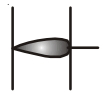
Additionally,tyloses (balloon-like outgrowths of xylem parenchyma cells into the vessel lumen through pit cavities) further block the xylem elements,preventing the conduction of water.
Additionally,tyloses (balloon-like outgrowths of xylem parenchyma cells into the vessel lumen through pit cavities) further block the xylem elements,preventing the conduction of water.
0 likes
View Solution333
MediumMCQ
Besides phellem and phellogen,the root periderm comprises of:
A
Secondary cortex
B
Phelloderm
C
Bark
D
More than one option is correct
Solution
(D) The periderm is composed of three layers: phellem (cork),phellogen (cork cambium),and phelloderm (secondary cortex).
Since phelloderm is another name for the secondary cortex,both options $A$ and $B$ are correct.
Therefore,the correct answer is $D$.
Since phelloderm is another name for the secondary cortex,both options $A$ and $B$ are correct.
Therefore,the correct answer is $D$.
0 likes
View Solution334
MediumMCQ
The feature which is common to both heartwood and sapwood is
A
Both are the regions of secondary xylem
B
Both are involved in the conduction of water
C
Both comprise dead elements with accumulation of aromatic compounds
D
Both are located in the central layers of the stem
Solution
(A) Both heartwood and sapwood are regions of secondary xylem.
Sapwood is the peripheral region of secondary xylem that is involved in the conduction of water and minerals.
Heartwood is the central,dark-colored region of secondary xylem that does not conduct water due to the deposition of organic compounds like tannins,resins,oils,gums,aromatic substances,and essential oils in the vessels.
These substances make the heartwood hard,durable,and resistant to the attacks of microorganisms and insects.
Sapwood is the peripheral region of secondary xylem that is involved in the conduction of water and minerals.
Heartwood is the central,dark-colored region of secondary xylem that does not conduct water due to the deposition of organic compounds like tannins,resins,oils,gums,aromatic substances,and essential oils in the vessels.
These substances make the heartwood hard,durable,and resistant to the attacks of microorganisms and insects.
0 likes
View Solution335
MediumMCQ
In a stem which is covered by periderm and in which stomata are absent,gaseous exchange takes place through
A
Bulliform cells
B
Lenticels
C
Pneumatophores
D
Trichomes
Solution
(B) Lenticels are lens-shaped openings found in the periderm of woody stems that allow for gaseous exchange.
Bulliform cells are specialized epidermal cells in grasses that help in leaf rolling to reduce water loss.
Pneumatophores are specialized roots found in plants growing in swampy areas,which help in respiration.
Trichomes are epidermal outgrowths on the stem that primarily serve to reduce transpiration and protect the plant.
Bulliform cells are specialized epidermal cells in grasses that help in leaf rolling to reduce water loss.
Pneumatophores are specialized roots found in plants growing in swampy areas,which help in respiration.
Trichomes are epidermal outgrowths on the stem that primarily serve to reduce transpiration and protect the plant.
0 likes
View Solution336
MediumMCQ
Bark refers to all tissues exterior to the
A
Cork cambium
B
Pericycle
C
Vascular cambium
D
Periderm
Solution
(C) Bark is a non-technical term used to describe all tissues located exterior to the vascular cambium.
It includes secondary phloem,primary phloem,cortex,pericycle,and the periderm (cork cambium,cork,and secondary cortex).
Therefore,all tissues outside the vascular cambium are collectively referred to as bark.
It includes secondary phloem,primary phloem,cortex,pericycle,and the periderm (cork cambium,cork,and secondary cortex).
Therefore,all tissues outside the vascular cambium are collectively referred to as bark.
0 likes
View Solution337
MediumMCQ
Which of the following is true for the dicot roots?
A
Both vascular and cork cambium are responsible for the secondary growth
B
Vascular cambium arises during the primary growth
C
They do not show secondary growth just like monocot roots
D
Cork cambium develops during the primary growth
Solution
(A) In dicot roots,secondary growth occurs due to the activity of the vascular cambium and the cork cambium.
Both vascular cambium and cork cambium are secondary meristems that develop only after the completion of primary growth.
Therefore,the statement that both are responsible for secondary growth is correct.
Both vascular cambium and cork cambium are secondary meristems that develop only after the completion of primary growth.
Therefore,the statement that both are responsible for secondary growth is correct.
0 likes
View Solution338
EasyMCQ
The site of origin of lateral roots and the formation of cork cambium are features related to:
A
Endodermis
B
Pericycle
C
Hypodermis
D
Pith rays
Solution
(B) In dicot roots,the cells of the pericycle undergo division to initiate the formation of lateral roots.
Additionally,during secondary growth,the pericycle cells also contribute to the formation of the cork cambium (phellogen) in the root.
Additionally,during secondary growth,the pericycle cells also contribute to the formation of the cork cambium (phellogen) in the root.
0 likes
View Solution339
MediumMCQ
Vascular cambium is a meristematic layer that cuts off:
A
Primary xylem and primary phloem
B
Xylem vessels and xylem tracheids
C
Primary xylem and secondary xylem
D
Secondary xylem,secondary phloem and medullary rays
Solution
(D) The vascular cambium is a lateral meristem responsible for secondary growth in dicotyledonous plants.
It divides periclinally to produce secondary xylem towards the inner side and secondary phloem towards the outer side.
Additionally,it produces parenchyma cells that form medullary rays (also known as vascular rays) which facilitate radial conduction of water and food.
Therefore,it cuts off secondary xylem,secondary phloem,and medullary rays.
It divides periclinally to produce secondary xylem towards the inner side and secondary phloem towards the outer side.
Additionally,it produces parenchyma cells that form medullary rays (also known as vascular rays) which facilitate radial conduction of water and food.
Therefore,it cuts off secondary xylem,secondary phloem,and medullary rays.
0 likes
View Solution340
MediumMCQ
Derivatives of the secondary meristem in the stelar region are
A
Phellem and phelloderm
B
Alburnum and primary phloem
C
Duramen and alburnum
D
Primary xylem and secondary phloem
Solution
(C) The secondary meristem in the stelar region is the vascular cambium. The vascular cambium is responsible for the production of secondary vascular tissues. It cuts off cells towards the inner side to form secondary xylem (wood) and towards the outer side to form secondary phloem. Alburnum is another term for sapwood,which consists of functional secondary xylem. Duramen is heartwood,which is non-functional secondary xylem. Therefore,the derivatives of the vascular cambium include secondary xylem (which forms alburnum and duramen) and secondary phloem.
0 likes
View Solution341
MediumMCQ
What is the position of the oldest secondary phloem?
A
Just outside the pericycle
B
Just outside the vascular cambium
C
Just below the pericycle
D
Below the vascular cambium
Solution
(C) During secondary growth,the vascular cambium produces secondary xylem towards the inside and secondary phloem towards the outside.
As new layers of secondary phloem are continuously added by the vascular cambium,the older layers are pushed further outward.
Therefore,the oldest secondary phloem is located at the periphery,just below the pericycle (or primary phloem),while the youngest secondary phloem is found just outside the vascular cambium.
As new layers of secondary phloem are continuously added by the vascular cambium,the older layers are pushed further outward.
Therefore,the oldest secondary phloem is located at the periphery,just below the pericycle (or primary phloem),while the youngest secondary phloem is found just outside the vascular cambium.
0 likes
View Solution342
MediumMCQ
The youngest layer of secondary xylem in the wood of a dicot plant is located:
A
Between pith and primary xylem
B
Just outside vascular cambium
C
Just inside vascular cambium
D
Just inside cork cambium
Solution
(C) In dicot stems,the vascular cambium is responsible for secondary growth.
As the vascular cambium divides,it adds secondary xylem towards the inner side and secondary phloem towards the outer side.
The cells of the secondary xylem that are produced most recently are located closest to the vascular cambium.
Therefore,the youngest layer of secondary xylem is found just inside the vascular cambium,while the oldest layer is found near the primary xylem or pith.
As the vascular cambium divides,it adds secondary xylem towards the inner side and secondary phloem towards the outer side.
The cells of the secondary xylem that are produced most recently are located closest to the vascular cambium.
Therefore,the youngest layer of secondary xylem is found just inside the vascular cambium,while the oldest layer is found near the primary xylem or pith.
0 likes
View Solution343
MediumMCQ
$A$. Heartwood is durable,dark,and central in position.
$B$. Tyloses are balloon-like structures of xylem parenchyma in vessel lumen.
$C$. Late wood is formed during spring season.
$B$. Tyloses are balloon-like structures of xylem parenchyma in vessel lumen.
$C$. Late wood is formed during spring season.
A
All are correct
B
Only $A$ is correct
C
Only $B$ is incorrect
D
Only $C$ is incorrect
Solution
(D) . Heartwood (duramen) is the central,dead,and dark-colored part of the secondary xylem,which is highly durable due to the deposition of tannins,resins,and oils. This statement is correct.
$B$. Tyloses are outgrowths of xylem parenchyma cells into the lumen of vessels through pits,appearing as balloon-like structures. This statement is correct.
$C$. Late wood (autumn wood) is formed during the autumn or winter season when cambium activity is less,resulting in narrower and darker vessels. Spring wood is formed during the spring season. Therefore,statement $C$ is incorrect.
$B$. Tyloses are outgrowths of xylem parenchyma cells into the lumen of vessels through pits,appearing as balloon-like structures. This statement is correct.
$C$. Late wood (autumn wood) is formed during the autumn or winter season when cambium activity is less,resulting in narrower and darker vessels. Spring wood is formed during the spring season. Therefore,statement $C$ is incorrect.
0 likes
View Solution344
MediumMCQ
Which of the following is responsible for the formation of cork cambium?
A
Interfascicular cambium
B
Intrafascicular cambium
C
Cork cambium
D
Secondary cortex
Solution
(C) Cork cambium,also known as phellogen,is a secondary meristematic tissue. It develops in the extrastelar region of the stem during secondary growth. It arises due to the process of dedifferentiation of the cortical cells (parenchyma cells) located just below the epidermis.
0 likes
View Solution345
MediumMCQ
Seasonal activity of vascular cambium is influenced by many factors,except
A
Geographical location of plant
B
Relative humidity and temperature
C
Photoperiod and water supply
D
Leaf orientation
Solution
(D) The activity of the vascular cambium is highly dependent on environmental and physiological factors. Factors such as $A$,$B$,and $C$ directly influence the rate of cambial activity,which leads to the formation of annual rings in temperate regions. However,leaf orientation does not have a direct or significant influence on the seasonal activity of the vascular cambium.
0 likes
View Solution346
MediumMCQ
When secondary growth is initiated in a dicot stem,what will happen first?
A
The cells of the cambium divide periclinally to form xylem mother cells.
B
Interfascicular cambium joins with intrafascicular cambium.
C
Parenchymatous cells present between vascular bundles become meristematic.
D
Pith gets obliterated.
Solution
(C) The first step in the initiation of secondary growth in a dicot stem is the dedifferentiation of the parenchymatous cells of the medullary rays located between the vascular bundles. These cells become meristematic and form the interfascicular cambium. This newly formed interfascicular cambium then connects with the existing intrafascicular cambium to form a complete,continuous cambial ring.
0 likes
View Solution347
MediumMCQ
Vascular cambium of dicot root is purely secondary in origin and arises from:
A
Cells of conjunctive parenchyma just below phloem
B
Cells of pericycle just outside protoxylem
C
Cells of parenchyma between xylem and phloem
D
More than one option is correct
Solution
(D) In dicot roots,the vascular cambium is secondary in origin. It develops from the cells of the conjunctive parenchyma located just below the phloem bundles and the cells of the pericycle located just outside the protoxylem points. These two groups of cells become meristematic to form a continuous wavy ring of vascular cambium.
0 likes
View Solution348
MediumMCQ
Select the wrong statement regarding secondary phloem.
A
Arises due to the activity of procambium.
B
Occurs during secondary growth.
C
No distinction between protophloem and metaphloem.
D
Secondary permanent tissue.
Solution
(A) Secondary phloem is formed by the activity of the vascular cambium during secondary growth. It is a secondary permanent tissue. Unlike primary phloem,which differentiates into protophloem and metaphloem,secondary phloem does not show such a distinction. Therefore,the statement that it arises due to the activity of the procambium is incorrect,as the procambium is responsible for the formation of primary vascular tissues.
0 likes
View Solution349
MediumMCQ
Lenticels are formed due to rupture in the epidermis because of pressure exerted by
A
Epithem cells
B
Tyloses
C
Complementary cells
D
Phellem
Solution
(C) During secondary growth,the cork cambium (phellogen) produces thin-walled,loosely arranged parenchymatous cells on its outer side instead of cork cells at certain places. These are called complementary cells. The rapid division and increase in the number of these complementary cells exert pressure on the epidermis,causing it to rupture and form a lens-shaped opening known as a lenticel.
0 likes
View Solution350
MediumMCQ
$A$ : The oldest layer of sapwood lies just outside the vascular cambium.
$R$ : Sapwood contains actively conducting vessels and occupies the central part of the stem.
$R$ : Sapwood contains actively conducting vessels and occupies the central part of the stem.
A
Assertion and Reason both are correct and Reason is the correct explanation of Assertion.
B
Assertion and Reason both are correct but Reason is not the correct explanation of Assertion.
C
Assertion is correct,but Reason is incorrect.
D
Both Assertion and Reason are incorrect.
Solution
(D) The Assertion is incorrect because the oldest layer of sapwood is found near the heartwood,not just outside the vascular cambium. The youngest layer of sapwood is located just outside the vascular cambium.
The Reason is incorrect because sapwood is the peripheral,living part of the secondary xylem,while the central part of the stem is occupied by heartwood (duramen),which is non-conducting and dead.
The Reason is incorrect because sapwood is the peripheral,living part of the secondary xylem,while the central part of the stem is occupied by heartwood (duramen),which is non-conducting and dead.
0 likes
View SolutionAnatomy of Flowering Plants — Secondary growth · Frequently Asked Questions
1Are these Anatomy of Flowering Plants questions useful for JEE and NEET?
Yes. All questions in this section are mapped to JEE Main and NEET exam patterns. Previous year questions from JEE Main, NEET, GUJCET and state-level exams are included with full solutions.
2Can I switch to Hindi or Gujarati for these questions?
Yes. Use the language tabs in the hero section or the sidebar to view the same questions and solutions in English, Hindi or Gujarati.
3How do I generate a question paper from this subtopic?
Use the Vedclass Exam Paper Generator — select the chapter and subtopic, set difficulty, and generate Sets A, B, C, D automatically. First 3 chapters of every subject are free.
Vedclass Products
For Students
Vedclass Test Series
Mock tests in real JEE/NEET style with performance analysis. 5-day free trial.
Start Free TrialFor Teachers
Exam Paper Generator
Generate Set A/B/C/D papers from this chapter in 2 minutes. 3 chapters free.
Try FreeFor Institutes
Online Exam Module
Live online exams with unlimited students, 360° analytics & white-label branding.
See DemoFor Teachers & Institutes
Generate a Anatomy of Flowering Plants Exam Paper in 2 Minutes
Select subtopic & difficulty — Sets A, B, C, D auto-generated with No Repeat logic.
First 3 chapters of every subject are free — no payment required.