
A English
Textbook - Metals and Non-metals Questions in English
Class 10 Science · Metals and Non-metals · Textbook - Metals and Non-metals
34+
Questions
English
Language
100%
With Solutions
Showing 34 of 34 questions in English
1
Medium
Give an example of a metal which:
$(i)$ is a liquid at room temperature.
$(ii)$ can be easily cut with a knife.
$(iii)$ is the best conductor of heat.
$(iv)$ is a poor conductor of heat.
$(i)$ is a liquid at room temperature.
$(ii)$ can be easily cut with a knife.
$(iii)$ is the best conductor of heat.
$(iv)$ is a poor conductor of heat.
Solution
(N/A) $(i)$ Metal that exists in a liquid state at room temperature $\to$ Mercury $(Hg)$.
$(ii)$ Metal that can be easily cut with a knife $\to$ Sodium $(Na)$ or Potassium $(K)$.
$(iii)$ Metal that is the best conductor of heat $\to$ Silver $(Ag)$.
$(iv)$ Metals that are poor conductors of heat $\to$ Mercury $(Hg)$ and Lead $(Pb)$.
$(ii)$ Metal that can be easily cut with a knife $\to$ Sodium $(Na)$ or Potassium $(K)$.
$(iii)$ Metal that is the best conductor of heat $\to$ Silver $(Ag)$.
$(iv)$ Metals that are poor conductors of heat $\to$ Mercury $(Hg)$ and Lead $(Pb)$.
0 likes
View Solution2
Easy
Explain the meanings of malleable and ductile.
Solution
(N/A) Malleable: Substances that can be beaten into thin sheets are called malleable. For example,most metals are malleable.
Ductile: Substances that can be drawn into thin wires are called ductile. For example,most metals are ductile.
Ductile: Substances that can be drawn into thin wires are called ductile. For example,most metals are ductile.
0 likes
View Solution3
EasyMCQ
Why is sodium kept immersed in kerosene oil?
A
To prevent it from reacting with oxygen and moisture in the air.
B
To keep it cool and prevent melting.
C
To increase its reactivity.
D
To make it easier to cut.
Solution
(A) Sodium $(Na)$ and potassium $(K)$ are highly reactive metals.
They react vigorously and explosively when exposed to air (oxygen) and water (moisture).
If kept in the open,they react with atmospheric oxygen and moisture,which can lead to accidental fires.
Therefore,to prevent these reactions and ensure safety,sodium is stored immersed in kerosene oil,as it does not react with kerosene.
They react vigorously and explosively when exposed to air (oxygen) and water (moisture).
If kept in the open,they react with atmospheric oxygen and moisture,which can lead to accidental fires.
Therefore,to prevent these reactions and ensure safety,sodium is stored immersed in kerosene oil,as it does not react with kerosene.
0 likes
View Solution4
Medium
Write equations for the reactions of:
$(i)$ Iron with steam
$(ii)$ Calcium and potassium with water
$(i)$ Iron with steam
$(ii)$ Calcium and potassium with water
Solution
(N/A) $(i)$ $3Fe_{(s)} + 4H_2O_{(g)} \rightarrow Fe_3O_{4(s)} + 4H_{2(g)}$
$(ii)$ Calcium with water: $Ca_{(s)} + 2H_2O_{(l)} \rightarrow Ca(OH)_{2(aq)} + H_{2(g)} + \text{Heat}$
$(iii)$ Potassium with water: $2K_{(s)} + 2H_2O_{(l)} \rightarrow 2KOH_{(aq)} + H_{2(g)} + \text{Heat}$
$(ii)$ Calcium with water: $Ca_{(s)} + 2H_2O_{(l)} \rightarrow Ca(OH)_{2(aq)} + H_{2(g)} + \text{Heat}$
$(iii)$ Potassium with water: $2K_{(s)} + 2H_2O_{(l)} \rightarrow 2KOH_{(aq)} + H_{2(g)} + \text{Heat}$
0 likes
View Solution5
Difficult
Samples of four metals $A$,$B$,$C$ and $D$ were taken and added to the following solutions one by one. The results obtained have been tabulated as follows.
Use the table above to answer the following questions about metals $A$,$B$,$C$ and $D$:
$(i)$ Which is the most reactive metal?
$(ii)$ What would you observe if $B$ is added to a solution of Copper $(II)$ sulphate?
$(iii)$ Arrange the metals $A$,$B$,$C$ and $D$ in the order of decreasing reactivity.
| Metal | Iron $(II)$ sulphate | Copper $(II)$ sulphate | Zinc sulphate | Silver nitrate |
| $A$ | No reaction | Displacement | No reaction | Displacement |
| $B$ | Displacement | Displacement | No reaction | Displacement |
| $C$ | No reaction | No reaction | No reaction | Displacement |
| $D$ | No reaction | No reaction | No reaction | No reaction |
Use the table above to answer the following questions about metals $A$,$B$,$C$ and $D$:
$(i)$ Which is the most reactive metal?
$(ii)$ What would you observe if $B$ is added to a solution of Copper $(II)$ sulphate?
$(iii)$ Arrange the metals $A$,$B$,$C$ and $D$ in the order of decreasing reactivity.
Solution
(B) Based on the displacement reactions:
$1$. $B$ displaces iron,copper,and silver,but not zinc. Thus,$B$ is more reactive than iron,copper,and silver,but less reactive than zinc.
$2$. $A$ displaces copper and silver,but not iron or zinc. Thus,$A$ is more reactive than copper and silver,but less reactive than iron.
$3$. $C$ displaces only silver. Thus,$C$ is more reactive than silver,but less reactive than iron,copper,and zinc.
$4$. $D$ does not displace any of the metals. Thus,$D$ is the least reactive.
$(i)$ The most reactive metal is $B$.
$(ii)$ If $B$ is added to a solution of Copper $(II)$ sulphate,$B$ will displace copper from the solution,resulting in a color change (typically the blue solution turns colorless or pale green depending on the metal salt formed).
$(iii)$ The order of decreasing reactivity is $B > A > C > D$.
$1$. $B$ displaces iron,copper,and silver,but not zinc. Thus,$B$ is more reactive than iron,copper,and silver,but less reactive than zinc.
$2$. $A$ displaces copper and silver,but not iron or zinc. Thus,$A$ is more reactive than copper and silver,but less reactive than iron.
$3$. $C$ displaces only silver. Thus,$C$ is more reactive than silver,but less reactive than iron,copper,and zinc.
$4$. $D$ does not displace any of the metals. Thus,$D$ is the least reactive.
$(i)$ The most reactive metal is $B$.
$(ii)$ If $B$ is added to a solution of Copper $(II)$ sulphate,$B$ will displace copper from the solution,resulting in a color change (typically the blue solution turns colorless or pale green depending on the metal salt formed).
$(iii)$ The order of decreasing reactivity is $B > A > C > D$.
0 likes
View Solution6
Medium
Which gas is produced when dilute hydrochloric acid is added to a reactive metal? Write the chemical reaction when iron reacts with dilute $H_2SO_4$.
Solution
(N/A) Hydrogen gas $(H_2)$ is evolved when dilute hydrochloric acid $(HCl)$ is added to a reactive metal.
When iron $(Fe)$ reacts with dilute sulphuric acid $(H_2SO_4)$,iron$(II)$ sulphate $(FeSO_4)$ is formed along with the evolution of hydrogen gas $(H_2)$.
The chemical equation is:
$Fe(s) + H_2SO_4(aq) \longrightarrow FeSO_4(aq) + H_2(g)$
When iron $(Fe)$ reacts with dilute sulphuric acid $(H_2SO_4)$,iron$(II)$ sulphate $(FeSO_4)$ is formed along with the evolution of hydrogen gas $(H_2)$.
The chemical equation is:
$Fe(s) + H_2SO_4(aq) \longrightarrow FeSO_4(aq) + H_2(g)$
0 likes
View Solution7
Medium
What would you observe when zinc is added to a solution of iron $(II)$ sulphate? Write the chemical reaction that takes place.
Solution
(N/A) Zinc is more reactive than iron. Therefore,when zinc is added to a solution of iron $(II)$ sulphate,it displaces iron from the solution,resulting in the formation of zinc sulphate and iron metal.
The chemical reaction is:
$Zn_{(s)} + FeSO_{4(aq)} \to ZnSO_{4(aq)} + Fe_{(s)}$
The chemical reaction is:
$Zn_{(s)} + FeSO_{4(aq)} \to ZnSO_{4(aq)} + Fe_{(s)}$
1 likes
View Solution8
Medium
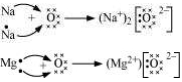
$(i)$ Write the electron-dot structures for sodium,oxygen,and magnesium.
$(ii)$ Show the formation of $Na_{2}O$ and $MgO$ by the transfer of electrons.
$(iii)$ What are the ions present in these compounds?
$(ii)$ Show the formation of $Na_{2}O$ and $MgO$ by the transfer of electrons.
$(iii)$ What are the ions present in these compounds?
Solution
(N/A) $(i)$ The representation of elements with valence electrons as dots around the element symbol is referred to as the electron-dot structure.
$(a)$ Sodium $(2, 8, 1) = Na^{\bullet}$
$(b)$ Oxygen $(2, 6) = :\ddot{O}:$
$(c)$ Magnesium $(2, 8, 2) = Mg^{\bullet\bullet}$
$(ii)$ Formation of $Na_{2}O$:
$2Na^{\bullet} + :\ddot{O}: \rightarrow (Na^{+})_{2}[:\ddot{O}:]^{2-}$
Formation of $MgO$:
$Mg^{\bullet\bullet} + :\ddot{O}: \rightarrow (Mg^{2+})[:\ddot{O}:]^{2-}$
$(iii)$ The ions present in $Na_{2}O$ are $Na^{+}$ and $O^{2-}$ ions,and in $MgO$ are $Mg^{2+}$ and $O^{2-}$ ions.
$(a)$ Sodium $(2, 8, 1) = Na^{\bullet}$
$(b)$ Oxygen $(2, 6) = :\ddot{O}:$
$(c)$ Magnesium $(2, 8, 2) = Mg^{\bullet\bullet}$
$(ii)$ Formation of $Na_{2}O$:
$2Na^{\bullet} + :\ddot{O}: \rightarrow (Na^{+})_{2}[:\ddot{O}:]^{2-}$
Formation of $MgO$:
$Mg^{\bullet\bullet} + :\ddot{O}: \rightarrow (Mg^{2+})[:\ddot{O}:]^{2-}$
$(iii)$ The ions present in $Na_{2}O$ are $Na^{+}$ and $O^{2-}$ ions,and in $MgO$ are $Mg^{2+}$ and $O^{2-}$ ions.
0 likes
View Solution9
Easy
Why do ionic compounds have high melting points?
Solution
(N/A) Ionic compounds are formed by the transfer of electrons between atoms,resulting in the formation of positively charged cations and negatively charged anions.
These oppositely charged ions are held together by strong electrostatic forces of attraction.
To melt an ionic compound,a significant amount of energy is required to overcome these strong inter-ionic forces.
Consequently,ionic compounds exhibit high melting points.
These oppositely charged ions are held together by strong electrostatic forces of attraction.
To melt an ionic compound,a significant amount of energy is required to overcome these strong inter-ionic forces.
Consequently,ionic compounds exhibit high melting points.
0 likes
View Solution10
Medium
Define the following terms:
$(i)$ Mineral
$(ii)$ Ore
$(iii)$ Gangue
$(i)$ Mineral
$(ii)$ Ore
$(iii)$ Gangue
Solution
(N/A) $(i)$ Mineral: Most elements occur in nature in a combined state as minerals. The chemical composition of minerals is fixed.
$(ii)$ Ore: Minerals from which metals can be extracted profitably are known as ores.
$(iii)$ Gangue: The impurities (sand,silt,soil,gravel,etc.) present in the ore are called gangue.
$(ii)$ Ore: Minerals from which metals can be extracted profitably are known as ores.
$(iii)$ Gangue: The impurities (sand,silt,soil,gravel,etc.) present in the ore are called gangue.
0 likes
View Solution11
EasyMCQ
Name two metals which are found in nature in the free state.
A
Gold and Silver
B
Sodium and Potassium
C
Iron and Aluminum
D
Magnesium and Calcium
Solution
(A) Metals that are at the bottom of the reactivity series are least reactive and are found in nature in the free (native) state because they do not react easily with oxygen,moisture,or other chemicals in the atmosphere.
Examples of such metals include $Gold$ $(Au)$,$Silver$ $(Ag)$,and $Platinum$ $(Pt)$.
Examples of such metals include $Gold$ $(Au)$,$Silver$ $(Ag)$,and $Platinum$ $(Pt)$.
0 likes
View Solution12
DifficultMCQ
What chemical process is used for obtaining a metal from its oxide?
A
Oxidation
B
Reduction
C
Electrolysis
D
Calcination
Solution
(B) The chemical process used for obtaining a metal from its oxide is reduction. In this process,metal oxides are reduced by using suitable reducing agents such as carbon or by highly reactive metals to displace the metals from their oxides.
For example,zinc oxide is reduced to metallic zinc by heating with carbon:
$ZnO_{(s)} + C_{(s)} \xrightarrow{\Delta} Zn_{(s)} + CO_{(g)}$
Manganese dioxide is reduced to manganese by treating it with aluminium powder. In this case,aluminium acts as a reducing agent and displaces manganese from its oxide:
$3MnO_{2(s)} + 4Al_{(s)} \to 3Mn_{(l)} + 2Al_2O_{3(s)} + \text{Heat}$
Oxides of highly reactive metals are reduced by electrolytic reduction.
For example,zinc oxide is reduced to metallic zinc by heating with carbon:
$ZnO_{(s)} + C_{(s)} \xrightarrow{\Delta} Zn_{(s)} + CO_{(g)}$
Manganese dioxide is reduced to manganese by treating it with aluminium powder. In this case,aluminium acts as a reducing agent and displaces manganese from its oxide:
$3MnO_{2(s)} + 4Al_{(s)} \to 3Mn_{(l)} + 2Al_2O_{3(s)} + \text{Heat}$
Oxides of highly reactive metals are reduced by electrolytic reduction.
0 likes
View Solution13
Medium
Metallic oxides of zinc,magnesium,and copper were heated with the following metals. In which cases will you find displacement reactions taking place?
Solution
(D) displacement reaction occurs when a more reactive metal displaces a less reactive metal from its oxide. Based on the reactivity series $(Mg > Zn > Cu)$:
Displacement reactions occur when:
$1$. $Mg$ is heated with $ZnO$ $(Mg + ZnO \rightarrow MgO + Zn)$
$2$. $Zn$ is heated with $CuO$ $(Zn + CuO \rightarrow ZnO + Cu)$
$3$. $Mg$ is heated with $CuO$ $(Mg + CuO \rightarrow MgO + Cu)$
| Metal | Zinc $(Zn)$ | Magnesium $(Mg)$ | Copper $(Cu)$ |
| Zinc oxide $(ZnO)$ | No reaction | Displacement | No reaction |
| Magnesium oxide $(MgO)$ | No reaction | No reaction | No reaction |
| Copper oxide $(CuO)$ | Displacement | Displacement | No reaction |
Displacement reactions occur when:
$1$. $Mg$ is heated with $ZnO$ $(Mg + ZnO \rightarrow MgO + Zn)$
$2$. $Zn$ is heated with $CuO$ $(Zn + CuO \rightarrow ZnO + Cu)$
$3$. $Mg$ is heated with $CuO$ $(Mg + CuO \rightarrow MgO + Cu)$
0 likes
View Solution14
EasyMCQ
Which metals do not corrode easily?
A
Highly reactive metals
B
Less reactive metals
C
Alkali metals
D
All metals
Solution
(B) The reactivity of a metal is directly proportional to its tendency to corrode.
Metals that are less reactive,such as gold,silver,and platinum,do not react easily with atmospheric oxygen,moisture,or other chemicals.
Therefore,these metals are highly resistant to corrosion and do not corrode easily.
Metals that are less reactive,such as gold,silver,and platinum,do not react easily with atmospheric oxygen,moisture,or other chemicals.
Therefore,these metals are highly resistant to corrosion and do not corrode easily.
0 likes
View Solution15
Easy
What are alloys?
Solution
(N/A) Alloys are homogeneous mixtures of two or more elements.
The elements can be two metals,or a metal and a non-metal.
An alloy is formed by first melting the primary metal and then dissolving the other elements in it.
For example,$Steel$ is an alloy of $Iron$ and $Carbon$.
The elements can be two metals,or a metal and a non-metal.
An alloy is formed by first melting the primary metal and then dissolving the other elements in it.
For example,$Steel$ is an alloy of $Iron$ and $Carbon$.
0 likes
View Solution16
MediumMCQ
Which of the following pairs will give displacement reactions?
A
$NaCl$ solution and copper metal
B
$MgCl_{2}$ solution and aluminium metal
C
$FeSO_{4}$ solution and silver metal
D
$AgNO_{3}$ solution and copper metal
Solution
(D) displacement reaction occurs when a more reactive metal displaces a less reactive metal from its salt solution.
According to the reactivity series,copper $(Cu)$ is more reactive than silver $(Ag)$.
Therefore,copper can displace silver from silver nitrate $(AgNO_{3})$ solution.
The chemical reaction is: $Cu(s) + 2AgNO_{3}(aq) \rightarrow Cu(NO_{3})_{2}(aq) + 2Ag(s)$.
In the other options,the metal added is less reactive than the metal present in the salt solution,so no displacement reaction will occur.
According to the reactivity series,copper $(Cu)$ is more reactive than silver $(Ag)$.
Therefore,copper can displace silver from silver nitrate $(AgNO_{3})$ solution.
The chemical reaction is: $Cu(s) + 2AgNO_{3}(aq) \rightarrow Cu(NO_{3})_{2}(aq) + 2Ag(s)$.
In the other options,the metal added is less reactive than the metal present in the salt solution,so no displacement reaction will occur.
0 likes
View Solution17
EasyMCQ
Which of the following methods is suitable for preventing an iron frying pan from rusting?
A
Applying a coating of zinc
B
Applying grease
C
Applying paint
D
All of the above
Solution
(A) The correct method is applying a coating of zinc (galvanization).
While applying grease or paint can prevent iron from rusting in general,these methods are not suitable for an iron frying pan.
When the pan is heated during cooking or washed repeatedly,the layers of grease or paint would be destroyed or contaminate the food.
Galvanization (coating with zinc) provides a more durable protective layer that is better suited for metallic cookware.
While applying grease or paint can prevent iron from rusting in general,these methods are not suitable for an iron frying pan.
When the pan is heated during cooking or washed repeatedly,the layers of grease or paint would be destroyed or contaminate the food.
Galvanization (coating with zinc) provides a more durable protective layer that is better suited for metallic cookware.
0 likes
View Solution18
MediumMCQ
An element reacts with oxygen to give a compound with a high melting point. This compound is also soluble in water. The element is likely to be
A
carbon
B
calcium
C
silicon
D
iron
Solution
(B) The element is likely to be calcium $(Ca)$.
Calcium reacts with oxygen to form calcium oxide $(CaO)$,which is an ionic compound.
Ionic compounds typically have high melting points due to strong electrostatic forces of attraction between ions.
Calcium oxide $(CaO)$ reacts with water to form calcium hydroxide $(Ca(OH)_2)$,which is soluble in water.
Calcium reacts with oxygen to form calcium oxide $(CaO)$,which is an ionic compound.
Ionic compounds typically have high melting points due to strong electrostatic forces of attraction between ions.
Calcium oxide $(CaO)$ reacts with water to form calcium hydroxide $(Ca(OH)_2)$,which is soluble in water.
0 likes
View Solution19
MediumMCQ
Food cans are coated with tin and not with zinc because
A
zinc is costlier than tin.
B
zinc has a higher melting point than tin.
C
zinc is more reactive than tin.
D
zinc is less reactive than tin.
Solution
(C) Food cans are coated with tin instead of zinc because zinc is more reactive than tin.
When food (which often contains organic acids) comes into contact with a zinc coating,the zinc reacts with the acids to form toxic zinc salts,which can contaminate the food.
In contrast,tin is less reactive than zinc and does not react easily with food acids,making it a safer choice for preserving food.
When food (which often contains organic acids) comes into contact with a zinc coating,the zinc reacts with the acids to form toxic zinc salts,which can contaminate the food.
In contrast,tin is less reactive than zinc and does not react easily with food acids,making it a safer choice for preserving food.
0 likes
View Solution20
Medium
You are given a hammer,a battery,a bulb,wires,and a switch.
$(a)$ How could you use them to distinguish between samples of metals and non-metals?
$(b)$ Assess the usefulness of these tests in distinguishing between metals and non-metals.
$(a)$ How could you use them to distinguish between samples of metals and non-metals?
$(b)$ Assess the usefulness of these tests in distinguishing between metals and non-metals.
.jpg)
Solution
(N/A) With the hammer,we can beat the sample. If it can be beaten into thin sheets (i.e.,it is malleable),then it is a metal; otherwise,it is a non-metal.
Similarly,we can use the battery,bulb,wires,and a switch to set up an electrical circuit with the sample. If the sample conducts electricity,the bulb will glow,indicating it is a metal; otherwise,it is a non-metal.
$(b)$ These tests are useful in distinguishing between metals and non-metals because they are based on fundamental physical properties such as malleability and electrical conductivity. These tests are simple,quick,and do not involve any complex chemical reactions.
Similarly,we can use the battery,bulb,wires,and a switch to set up an electrical circuit with the sample. If the sample conducts electricity,the bulb will glow,indicating it is a metal; otherwise,it is a non-metal.
$(b)$ These tests are useful in distinguishing between metals and non-metals because they are based on fundamental physical properties such as malleability and electrical conductivity. These tests are simple,quick,and do not involve any complex chemical reactions.
0 likes
View Solution21
Medium
What are amphoteric oxides? Give two examples of amphoteric oxides.
Solution
(N/A) Amphoteric oxides are those metal oxides which react with both acids as well as bases to produce salts and water.
These oxides exhibit dual nature,showing both acidic and basic properties.
Examples: Aluminium oxide $(Al_2O_3)$ and Zinc oxide $(ZnO)$.
These oxides exhibit dual nature,showing both acidic and basic properties.
Examples: Aluminium oxide $(Al_2O_3)$ and Zinc oxide $(ZnO)$.
0 likes
View Solution22
Easy
Name two metals which will displace hydrogen from dilute acids,and two metals which will not.
Solution
(N/A) Metals that are more reactive than hydrogen in the reactivity series can displace it from dilute acids. Examples of such metals are $Sodium$ $(Na)$ and $Magnesium$ $(Mg)$.
Metals that are less reactive than hydrogen cannot displace it from dilute acids. Examples of such metals are $Copper$ $(Cu)$ and $Silver$ $(Ag)$.
Metals that are less reactive than hydrogen cannot displace it from dilute acids. Examples of such metals are $Copper$ $(Cu)$ and $Silver$ $(Ag)$.
0 likes
View Solution23
MediumMCQ
In the electrolytic refining of a metal $M$,what would you take as the anode,the cathode,and the electrolyte?
A
Anode: Pure metal $M$,Cathode: Impure metal $M$,Electrolyte: Salt solution of metal $M$
B
Anode: Impure metal $M$,Cathode: Pure metal $M$,Electrolyte: Salt solution of metal $M$
C
Anode: Impure metal $M$,Cathode: Impure metal $M$,Electrolyte: Pure metal $M$
D
Anode: Pure metal $M$,Cathode: Pure metal $M$,Electrolyte: Impure metal $M$
Solution
(B) In the electrolytic refining of a metal $M$:
$1$. Anode: $A$ block of impure metal $M$ is used as the anode.
$2$. Cathode: $A$ thin strip of pure metal $M$ is used as the cathode.
$3$. Electrolyte: An aqueous solution of a soluble salt of the metal $M$ is used as the electrolyte.
During electrolysis,the pure metal from the anode dissolves into the electrolyte,and an equivalent amount of pure metal from the electrolyte deposits on the cathode.
$1$. Anode: $A$ block of impure metal $M$ is used as the anode.
$2$. Cathode: $A$ thin strip of pure metal $M$ is used as the cathode.
$3$. Electrolyte: An aqueous solution of a soluble salt of the metal $M$ is used as the electrolyte.
During electrolysis,the pure metal from the anode dissolves into the electrolyte,and an equivalent amount of pure metal from the electrolyte deposits on the cathode.
0 likes
View Solution24
Difficult
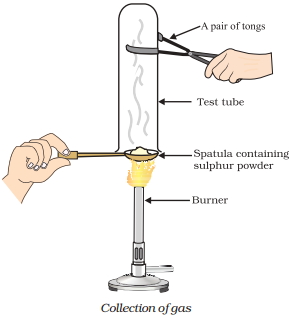
Pratyush took sulphur powder on a spatula and heated it. He collected the gas evolved by inverting a test tube over it,as shown in the figure below.
$(a)$ What will be the action of the gas on
$(i)$ dry litmus paper?
$(ii)$ moist litmus paper?
$(b)$ Write a balanced chemical equation for the reaction taking place.
$(a)$ What will be the action of the gas on
$(i)$ dry litmus paper?
$(ii)$ moist litmus paper?
$(b)$ Write a balanced chemical equation for the reaction taking place.
Solution
(N/A) $(i)$ There will be no action on dry litmus paper.
$(ii)$ Since the gas is sulphur dioxide $(SO_2)$,it turns moist blue litmus paper to red because sulphur dioxide reacts with moisture to form sulphurous acid.
$(b)$ $S_{(s)} + O_{2(g)} \to SO_{2(g)}$
$SO_{2(g)} + H_2O_{(l)} \to H_2SO_{3(aq)}$
$(ii)$ Since the gas is sulphur dioxide $(SO_2)$,it turns moist blue litmus paper to red because sulphur dioxide reacts with moisture to form sulphurous acid.
$(b)$ $S_{(s)} + O_{2(g)} \to SO_{2(g)}$
$SO_{2(g)} + H_2O_{(l)} \to H_2SO_{3(aq)}$
0 likes
View Solution25
Medium
State two ways to prevent the rusting of iron.
Solution
(N/A) Two ways to prevent the rusting of iron are:
$(i)$ Oiling,greasing,or painting: By applying oil,grease,or paint,the surface becomes waterproof,and the moisture and oxygen present in the air cannot come into direct contact with the iron. Hence,rusting is prevented.
$(ii)$ Galvanisation: An iron article is coated with a layer of zinc metal,which prevents the iron from coming into contact with oxygen and moisture. Hence,rusting is prevented.
$(i)$ Oiling,greasing,or painting: By applying oil,grease,or paint,the surface becomes waterproof,and the moisture and oxygen present in the air cannot come into direct contact with the iron. Hence,rusting is prevented.
$(ii)$ Galvanisation: An iron article is coated with a layer of zinc metal,which prevents the iron from coming into contact with oxygen and moisture. Hence,rusting is prevented.
0 likes
View Solution26
EasyMCQ
What type of oxides are formed when non-metals combine with oxygen?
A
Basic oxides
B
Acidic oxides
C
Amphoteric oxides
D
Neutral oxides
Solution
(B) Non-metals react with oxygen to form acidic oxides.
For example:
${S_{(s)}} + {O_{2(g)}} \to {SO_{2(g)}}$ (which is acidic in nature).
When these oxides are dissolved in water,they form acids. For instance,${SO_2} + H_2O \to H_2SO_3$ (sulfurous acid).
For example:
${S_{(s)}} + {O_{2(g)}} \to {SO_{2(g)}}$ (which is acidic in nature).
When these oxides are dissolved in water,they form acids. For instance,${SO_2} + H_2O \to H_2SO_3$ (sulfurous acid).
0 likes
View Solution27
Easy
Give reasons: Platinum,gold,and silver are used to make jewellery.
Solution
(N/A) Platinum,gold,and silver are used to make jewellery due to the following reasons:
$1$. Lustre: These metals possess a high degree of metallic lustre,which makes them attractive and suitable for ornaments.
$2$. Low Reactivity: They are noble metals and are very less reactive. They do not react with air,water,or acids under normal conditions,which prevents them from corroding or tarnishing easily.
$3$. Malleability and Ductility: These metals are highly malleable and ductile,allowing them to be easily shaped into intricate designs.
$1$. Lustre: These metals possess a high degree of metallic lustre,which makes them attractive and suitable for ornaments.
$2$. Low Reactivity: They are noble metals and are very less reactive. They do not react with air,water,or acids under normal conditions,which prevents them from corroding or tarnishing easily.
$3$. Malleability and Ductility: These metals are highly malleable and ductile,allowing them to be easily shaped into intricate designs.
0 likes
View Solution28
Medium
You must have seen tarnished copper vessels being cleaned with lemon or tamarind juice. Explain why these sour substances are effective in cleaning the vessels.
Solution
(N/A) Copper reacts with moist carbon dioxide in the air to form copper carbonate,which results in the copper vessel losing its shiny brown surface and forming a green layer of copper carbonate.
The citric acid present in lemon or tamarind juice neutralizes the basic copper carbonate and dissolves the layer.
This is why tarnished copper vessels are cleaned with lemon or tamarind juice to restore the characteristic lustre of the copper surface.
The citric acid present in lemon or tamarind juice neutralizes the basic copper carbonate and dissolves the layer.
This is why tarnished copper vessels are cleaned with lemon or tamarind juice to restore the characteristic lustre of the copper surface.
0 likes
View Solution29
Difficult
Differentiate between metal and non-metal on the basis of their chemical properties.
Solution
(A)
| Metal | Non-metal |
| Metals are electropositive. | Non-metals are electronegative. |
| They react with oxygen to form basic oxides. $4Na + O_2 \longrightarrow 2Na_2O$. These typically form ionic bonds. | They react with oxygen to form acidic or neutral oxides. $C + O_2 \longrightarrow CO_2$. These typically form covalent bonds. |
| They react with water to form oxides or hydroxides and hydrogen gas. $2Na + 2H_2O \longrightarrow 2NaOH + H_2 \uparrow$. | They generally do not react with water. |
| They react with dilute acids to form salt and hydrogen gas. $2Na + 2HCl \longrightarrow 2NaCl + H_2 \uparrow$. | They do not react with dilute acids as they cannot displace hydrogen. |
| They act as reducing agents because they easily lose electrons. $Na \longrightarrow Na^+ + e^-$. | They act as oxidizing agents because they gain electrons. $Cl_2 + 2e^- \longrightarrow 2Cl^-$. |
0 likes
View Solution30
Medium
$A$ man went door to door posing as a goldsmith. He promised to bring back the glitter of old and dull gold ornaments. An unsuspecting lady gave a set of gold bangles to him which he dipped in a particular solution. The bangles sparkled like new but their weight was reduced drastically. The lady was upset but after a futile argument the man beat a hasty retreat. Can you play the detective to find out the nature of the solution he had used?
Solution
(A) The man must have used $Aqua$ $Regia$ to clean the ornaments.
$Aqua$ $Regia$ is a freshly prepared mixture of concentrated $HCl$ and concentrated $HNO_3$ in a $3:1$ ratio.
It is a highly corrosive and fuming liquid capable of dissolving noble metals like gold.
When the gold bangles were dipped in this solution,the outer layer of the gold was dissolved,exposing the fresh,shiny inner layer,which made the bangles look new.
However,because the outer layer of gold was dissolved into the solution,the total weight of the bangles was significantly reduced.
$Aqua$ $Regia$ is a freshly prepared mixture of concentrated $HCl$ and concentrated $HNO_3$ in a $3:1$ ratio.
It is a highly corrosive and fuming liquid capable of dissolving noble metals like gold.
When the gold bangles were dipped in this solution,the outer layer of the gold was dissolved,exposing the fresh,shiny inner layer,which made the bangles look new.
However,because the outer layer of gold was dissolved into the solution,the total weight of the bangles was significantly reduced.
0 likes
View Solution31
Medium
Give reasons why copper is used to make hot water tanks and not steel (an alloy of iron).
Solution
(N/A) Copper does not react with cold water,hot water,or steam.
However,iron reacts with steam.
If the hot water tanks are made of steel (an alloy of iron),the iron present in the steel would react vigorously with the steam formed from the hot water.
$3Fe(s) + 4H_2O(g) \to Fe_3O_4(s) + 4H_2(g)$
This reaction would lead to the corrosion and degradation of the tank.
That is why copper is used to make hot water tanks,and not steel.
However,iron reacts with steam.
If the hot water tanks are made of steel (an alloy of iron),the iron present in the steel would react vigorously with the steam formed from the hot water.
$3Fe(s) + 4H_2O(g) \to Fe_3O_4(s) + 4H_2(g)$
This reaction would lead to the corrosion and degradation of the tank.
That is why copper is used to make hot water tanks,and not steel.
0 likes
View Solution32
Medium
Give reasons: $Sodium$,$potassium$,and $lithium$ are stored under oil.
Solution
(N/A) $Sodium$,$potassium$,and $lithium$ are highly reactive metals that react vigorously with both air and water. To prevent them from coming into contact with atmospheric oxygen and moisture,which could lead to spontaneous combustion or oxidation,they are stored immersed in kerosene oil.
0 likes
View Solution33
Medium
Give reasons: Aluminium is a highly reactive metal,yet it is used to make utensils for cooking.
Solution
(N/A) Although aluminium is a highly reactive metal,it is resistant to corrosion.
This is because aluminium reacts with oxygen present in the air to form a thin,protective layer of aluminium oxide $(Al_2O_3)$.
This oxide layer is very stable and non-porous,which prevents further oxidation and corrosion of the underlying metal.
Additionally,aluminium is lightweight,durable,and an excellent conductor of heat,making it an ideal material for manufacturing cooking utensils.
This is because aluminium reacts with oxygen present in the air to form a thin,protective layer of aluminium oxide $(Al_2O_3)$.
This oxide layer is very stable and non-porous,which prevents further oxidation and corrosion of the underlying metal.
Additionally,aluminium is lightweight,durable,and an excellent conductor of heat,making it an ideal material for manufacturing cooking utensils.
0 likes
View Solution34
EasyMCQ
Give reasons: Carbonate and sulphide ores are usually converted into oxides during the process of extraction.
A
Oxides are more stable than carbonates and sulphides.
B
Metals can be easily extracted from their oxides rather than from their carbonates and sulphides.
C
Carbonates and sulphides are highly reactive.
D
Oxides are easier to transport.
Solution
(B) Carbonate and sulphide ores are usually converted into oxides during the process of extraction because it is thermodynamically and chemically easier to reduce metal oxides to pure metals using reducing agents like carbon or through electrolysis compared to reducing carbonates or sulphides directly. Metal oxides are more amenable to reduction processes.
0 likes
View SolutionMetals and Non-metals — Textbook - Metals and Non-metals · Frequently Asked Questions
1Are these Metals and Non-metals questions useful for JEE and NEET?
Yes. All questions in this section are mapped to JEE Main and NEET exam patterns. Previous year questions from JEE Main, NEET, GUJCET and state-level exams are included with full solutions.
2Can I switch to Hindi or Gujarati for these questions?
Yes. Use the language tabs in the hero section or the sidebar to view the same questions and solutions in English, Hindi or Gujarati.
3How do I generate a question paper from this subtopic?
Use the Vedclass Exam Paper Generator — select the chapter and subtopic, set difficulty, and generate Sets A, B, C, D automatically. First 3 chapters of every subject are free.
Vedclass Products
For Students
Vedclass Test Series
Mock tests in real JEE/NEET style with performance analysis. 5-day free trial.
Start Free TrialFor Teachers
Exam Paper Generator
Generate Set A/B/C/D papers from this chapter in 2 minutes. 3 chapters free.
Try FreeFor Institutes
Online Exam Module
Live online exams with unlimited students, 360° analytics & white-label branding.
See DemoFor Teachers & Institutes
Generate a Metals and Non-metals Exam Paper in 2 Minutes
Select subtopic & difficulty — Sets A, B, C, D auto-generated with No Repeat logic.
First 3 chapters of every subject are free — no payment required.