
A English
Mix Examples - Metals and Non-metals Questions in English
Class 10 Science · Metals and Non-metals · Mix Examples - Metals and Non-metals
412+
Questions
English
Language
100%
With Solutions
Showing 50 of 412 questions in English
1
EasyMCQ
Which of the following properties is generally not shown by metals?
A
Dullness
B
Sonorous in nature
C
Electrical conduction
D
Ductility
Solution
(A) Metals are elements that typically exhibit properties such as luster (shininess),high electrical and thermal conductivity,ductility (ability to be drawn into wires),and malleability (ability to be beaten into sheets).
They are also sonorous,meaning they produce a ringing sound when struck.
Dullness is a characteristic property of non-metals,not metals.
Therefore,metals generally do not show dullness.
They are also sonorous,meaning they produce a ringing sound when struck.
Dullness is a characteristic property of non-metals,not metals.
Therefore,metals generally do not show dullness.
0 likes
View Solution2
EasyMCQ
The ability of metals to be drawn into thin wire is known as
A
malleability
B
ductility
C
sonorousity
D
conductivity
Solution
(B) The property of metals by which they can be drawn into thin wires is called $ductility$.
$Malleability$ is the property of being beaten into thin sheets.
$Sonorousity$ refers to the property of producing a ringing sound when struck.
$Conductivity$ refers to the ability to conduct heat or electricity.
Therefore, the correct option is $B$.
$Malleability$ is the property of being beaten into thin sheets.
$Sonorousity$ refers to the property of producing a ringing sound when struck.
$Conductivity$ refers to the ability to conduct heat or electricity.
Therefore, the correct option is $B$.
0 likes
View Solution3
MediumMCQ
Aluminium is used for making cooking utensils. Which of the following properties of aluminium are responsible for the same?
$(i)$ Good thermal conductivity
$(ii)$ Good electrical conductivity
$(iii)$ Ductility
$(iv)$ High melting point
$(i)$ Good thermal conductivity
$(ii)$ Good electrical conductivity
$(iii)$ Ductility
$(iv)$ High melting point
A
$(i)$ and $(ii)$
B
$(i)$ and $(iii)$
C
$(i)$ and $(iv)$
D
$(ii)$ and $(iii)$
Solution
(C) Aluminium is widely used for making cooking utensils due to the following reasons:
$1$. Good thermal conductivity: It allows heat to pass through the utensil quickly and evenly,which is essential for cooking food.
$2$. High melting point: It ensures that the utensil does not melt or deform when exposed to the high temperatures required for cooking.
Therefore,properties $(i)$ and $(iv)$ are responsible for its use in cooking utensils.
$1$. Good thermal conductivity: It allows heat to pass through the utensil quickly and evenly,which is essential for cooking food.
$2$. High melting point: It ensures that the utensil does not melt or deform when exposed to the high temperatures required for cooking.
Therefore,properties $(i)$ and $(iv)$ are responsible for its use in cooking utensils.
0 likes
View Solution4
EasyMCQ
Which one of the following metals does not react with cold as well as hot water?
A
$Na$
B
$Ca$
C
$Mg$
D
$Fe$
Solution
(D) The reactivity of metals with water depends on their position in the reactivity series.
$Na$ (Sodium) reacts vigorously with cold water.
$Ca$ (Calcium) reacts with cold water,though less violently than sodium.
$Mg$ (Magnesium) does not react with cold water but reacts with hot water to form magnesium hydroxide and hydrogen gas.
$Fe$ (Iron) does not react with either cold or hot water. However,it reacts with steam to form iron oxide $(Fe_3O_4)$ and hydrogen gas.
$Na$ (Sodium) reacts vigorously with cold water.
$Ca$ (Calcium) reacts with cold water,though less violently than sodium.
$Mg$ (Magnesium) does not react with cold water but reacts with hot water to form magnesium hydroxide and hydrogen gas.
$Fe$ (Iron) does not react with either cold or hot water. However,it reacts with steam to form iron oxide $(Fe_3O_4)$ and hydrogen gas.
0 likes
View Solution5
MediumMCQ
Which of the following oxide$(s)$ of iron would be obtained on prolonged reaction of iron with steam?
A
$Fe_{3}O_{4}$
B
$Fe_{2}O_{3}$
C
$FeO$
D
$Fe_{2}O_{3}$ and $Fe_{3}O_{4}$
Solution
(A) When iron reacts with steam (water vapor) for a prolonged period,it forms iron($II$,$III$) oxide and releases hydrogen gas.
The balanced chemical equation for this reaction is:
$3Fe(s) + 4H_{2}O(g) \rightarrow Fe_{3}O_{4}(s) + 4H_{2}(g)$
Thus,the oxide obtained is $Fe_{3}O_{4}$.
The balanced chemical equation for this reaction is:
$3Fe(s) + 4H_{2}O(g) \rightarrow Fe_{3}O_{4}(s) + 4H_{2}(g)$
Thus,the oxide obtained is $Fe_{3}O_{4}$.
0 likes
View Solution6
MediumMCQ
What happens when calcium is treated with water?
A
$(i)$ and $(iv)$
B
$(iii)$ and $(iv)$
C
$(i)$ and $(ii)$
D
$(ii)$ and $(iv)$
Solution
(B) When calcium reacts with water,it does not react violently like sodium or potassium.
Instead,it reacts less violently with water.
The chemical reaction is: $Ca(s) + 2H_2O(l) \rightarrow Ca(OH)_2(aq) + H_2(g)$.
During this reaction,the hydrogen gas produced forms bubbles that stick to the surface of the calcium metal,causing it to float.
Therefore,statements $(iii)$ and $(iv)$ are correct.
Instead,it reacts less violently with water.
The chemical reaction is: $Ca(s) + 2H_2O(l) \rightarrow Ca(OH)_2(aq) + H_2(g)$.
During this reaction,the hydrogen gas produced forms bubbles that stick to the surface of the calcium metal,causing it to float.
Therefore,statements $(iii)$ and $(iv)$ are correct.
0 likes
View Solution7
MediumMCQ
Generally, metals react with acids to produce salt and hydrogen gas. Which of the following acids does not produce hydrogen gas when reacting with most metals (except $Mn$ and $Mg$)?
A
$H_2SO_4$
B
$HCl$
C
$HNO_3$
D
All of these
Solution
(C) Generally, metals react with dilute acids to produce salt and hydrogen gas $(M + \text{dilute acid} \rightarrow \text{salt} + H_2)$.
However, nitric acid $(HNO_3)$ is a strong oxidizing agent.
When a metal reacts with $HNO_3$, the hydrogen gas produced is oxidized to water $(H_2O)$ by the acid, and the acid itself gets reduced to nitrogen oxides $(N_2O, NO, NO_2)$.
Therefore, $HNO_3$ does not evolve hydrogen gas with most metals.
Exceptions are magnesium $(Mg)$ and manganese $(Mn)$, which react with very dilute nitric acid to evolve hydrogen gas.
However, nitric acid $(HNO_3)$ is a strong oxidizing agent.
When a metal reacts with $HNO_3$, the hydrogen gas produced is oxidized to water $(H_2O)$ by the acid, and the acid itself gets reduced to nitrogen oxides $(N_2O, NO, NO_2)$.
Therefore, $HNO_3$ does not evolve hydrogen gas with most metals.
Exceptions are magnesium $(Mg)$ and manganese $(Mn)$, which react with very dilute nitric acid to evolve hydrogen gas.
0 likes
View Solution8
MediumMCQ
The composition of aqua-regia is
A
$\text{Dil. HCl} : \text{Conc. HNO}_3 = 3:1$
B
$\text{Conc. HCl} : \text{Dil. HNO}_3 = 3:1$
C
$\text{Dil. HCl} : \text{Dil. HNO}_3 = 3:1$
D
$\text{Conc. HCl} : \text{Conc. HNO}_3 = 3:1$
Solution
(D) Aqua-regia is a freshly prepared mixture of concentrated hydrochloric acid $(HCl)$ and concentrated nitric acid $(HNO_3)$.
It is prepared in the ratio of $3:1$ by volume.
Therefore,the correct composition is $3$ parts of concentrated $HCl$ and $1$ part of concentrated $HNO_3$.
It is prepared in the ratio of $3:1$ by volume.
Therefore,the correct composition is $3$ parts of concentrated $HCl$ and $1$ part of concentrated $HNO_3$.
0 likes
View Solution9
MediumMCQ
Which of the following are not ionic compounds?
$(i)$ $KCl$
$(ii)$ $HCl$
$(iii)$ $CCl_4$
$(iv)$ $NaCl$
$(i)$ $KCl$
$(ii)$ $HCl$
$(iii)$ $CCl_4$
$(iv)$ $NaCl$
A
$(ii)$ and $(iii)$
B
$(i)$ and $(ii)$
C
$(iii)$ and $(iv)$
D
$(i)$ and $(iii)$
Solution
(A) Ionic compounds are formed by the transfer of electrons from a metal to a non-metal, resulting in strong electrostatic forces of attraction between ions.
$(i)$ $KCl$ ($\text{Potassium}$ $\text{Chloride}$) is an ionic compound because it consists of $K^+$ and $Cl^-$ ions.
$(ii)$ $HCl$ ($\text{Hydrogen}$ $\text{Chloride}$) is a covalent compound because it is formed by the sharing of electrons between $H$ and $Cl$ atoms.
$(iii)$ $CCl_4$ ($\text{Carbon}$ $\text{Tetrachloride}$) is a covalent compound because it is formed by the sharing of electrons between $C$ and $Cl$ atoms.
$(iv)$ $NaCl$ ($\text{Sodium}$ $\text{Chloride}$) is an ionic compound because it consists of $Na^+$ and $Cl^-$ ions.
Therefore, $(ii)$ and $(iii)$ are not ionic compounds.
$(i)$ $KCl$ ($\text{Potassium}$ $\text{Chloride}$) is an ionic compound because it consists of $K^+$ and $Cl^-$ ions.
$(ii)$ $HCl$ ($\text{Hydrogen}$ $\text{Chloride}$) is a covalent compound because it is formed by the sharing of electrons between $H$ and $Cl$ atoms.
$(iii)$ $CCl_4$ ($\text{Carbon}$ $\text{Tetrachloride}$) is a covalent compound because it is formed by the sharing of electrons between $C$ and $Cl$ atoms.
$(iv)$ $NaCl$ ($\text{Sodium}$ $\text{Chloride}$) is an ionic compound because it consists of $Na^+$ and $Cl^-$ ions.
Therefore, $(ii)$ and $(iii)$ are not ionic compounds.
0 likes
View Solution10
EasyMCQ
Which one of the following properties is not generally exhibited by ionic compounds?
A
Solubility in water
B
Electrical conductivity in solid state
C
High melting and boiling points
D
Electrical conductivity in molten state
Solution
(B) Ionic compounds are formed by the strong electrostatic force of attraction between oppositely charged ions.
In the solid state,these ions are held in a rigid crystal lattice structure and are not free to move.
Therefore,ionic compounds do not conduct electricity in the solid state.
However,when dissolved in water or in a molten state,the crystal lattice breaks down,allowing the ions to move freely,which enables them to conduct electricity.
Additionally,ionic compounds generally have high melting and boiling points due to the strong inter-ionic forces and are typically soluble in water.
In the solid state,these ions are held in a rigid crystal lattice structure and are not free to move.
Therefore,ionic compounds do not conduct electricity in the solid state.
However,when dissolved in water or in a molten state,the crystal lattice breaks down,allowing the ions to move freely,which enables them to conduct electricity.
Additionally,ionic compounds generally have high melting and boiling points due to the strong inter-ionic forces and are typically soluble in water.
0 likes
View Solution11
MediumMCQ
Which of the following metals exist in their native state in nature?
$(i)$ $Cu$
$(ii)$ $Au$
$(iii)$ $Zn$
$(iv)$ $Ag$
$(i)$ $Cu$
$(ii)$ $Au$
$(iii)$ $Zn$
$(iv)$ $Ag$
A
$(i)$ and $(ii)$
B
$(ii)$ and $(iii)$
C
$(ii)$ and $(iv)$
D
$(iii)$ and $(iv)$
Solution
(C) Metals that are very low in the reactivity series are found in their native (free) state in nature because they are highly unreactive.
$Au$ (Gold) and $Ag$ (Silver) are noble metals and are found in their native state.
$Cu$ (Copper) can be found in its native state,but it is more commonly found in combined states (like sulfides or oxides).
$Zn$ (Zinc) is moderately reactive and is always found in combined states (like $ZnS$ or $ZnO$).
Therefore,among the given options,$Au$ and $Ag$ are the metals that primarily exist in their native state.
$Au$ (Gold) and $Ag$ (Silver) are noble metals and are found in their native state.
$Cu$ (Copper) can be found in its native state,but it is more commonly found in combined states (like sulfides or oxides).
$Zn$ (Zinc) is moderately reactive and is always found in combined states (like $ZnS$ or $ZnO$).
Therefore,among the given options,$Au$ and $Ag$ are the metals that primarily exist in their native state.
0 likes
View Solution12
MediumMCQ
Metals are refined by using different methods. Which of the following metals are refined by electrolytic refining?
$(i)$ $Au$
$(ii)$ $Cu$
$(iii)$ $Na$
$(iv)$ $K$
$(i)$ $Au$
$(ii)$ $Cu$
$(iii)$ $Na$
$(iv)$ $K$
A
$(iii)$ and $(iv)$
B
$(i)$ and $(iii)$
C
$(ii)$ and $(iii)$
D
$(i)$ and $(ii)$
Solution
(D) Electrolytic refining is a process used to purify metals that are obtained from their ores.
Many metals like $Cu$,$Zn$,$Sn$,$Ni$,$Ag$,and $Au$ are refined electrolytically.
In this process,the impure metal is made the anode and a thin strip of pure metal is made the cathode.
Highly reactive metals like $Na$,$K$,$Ca$,and $Mg$ are obtained by the electrolytic reduction of their molten chlorides or oxides,not by electrolytic refining of the impure metal.
Therefore,among the given options,$Cu$ and $Au$ are refined by electrolytic refining.
Thus,the correct pair is $(i)$ and $(ii)$.
Many metals like $Cu$,$Zn$,$Sn$,$Ni$,$Ag$,and $Au$ are refined electrolytically.
In this process,the impure metal is made the anode and a thin strip of pure metal is made the cathode.
Highly reactive metals like $Na$,$K$,$Ca$,and $Mg$ are obtained by the electrolytic reduction of their molten chlorides or oxides,not by electrolytic refining of the impure metal.
Therefore,among the given options,$Cu$ and $Au$ are refined by electrolytic refining.
Thus,the correct pair is $(i)$ and $(ii)$.
0 likes
View Solution13
MediumMCQ
Silver articles become black on prolonged exposure to air. This is due to the formation of
A
$Ag_2S$
B
$Ag_2O$
C
$Ag_2N$
D
$Ag_2S$ and $Ag_3N$
Solution
(A) Silver articles react with sulfur compounds present in the air, such as hydrogen sulfide $(H_2S)$, to form a coating of silver sulfide $(Ag_2S)$.
This process is a form of corrosion known as tarnishing.
The chemical reaction is: $2Ag + H_2S \rightarrow Ag_2S + H_2$.
Therefore, the black layer formed on silver is $Ag_2S$.
This process is a form of corrosion known as tarnishing.
The chemical reaction is: $2Ag + H_2S \rightarrow Ag_2S + H_2$.
Therefore, the black layer formed on silver is $Ag_2S$.
0 likes
View Solution14
EasyMCQ
Galvanisation is a method of protecting iron from rusting by coating it with a thin layer of:
A
Gallium
B
Zinc
C
Aluminium
D
Silver
Solution
(B) Galvanisation is a metallurgical process used to prevent the corrosion of iron or steel.
In this process,a protective layer of $Zinc$ is applied to the surface of the iron.
$Zinc$ is more reactive than iron,so it acts as a sacrificial anode,corroding in preference to the iron and thereby protecting the underlying metal from rusting.
In this process,a protective layer of $Zinc$ is applied to the surface of the iron.
$Zinc$ is more reactive than iron,so it acts as a sacrificial anode,corroding in preference to the iron and thereby protecting the underlying metal from rusting.
0 likes
View Solution15
EasyMCQ
Stainless steel is a very useful material in our daily life. In stainless steel,iron is mixed with:
A
$Ni$ and $Cu$
B
$Cu$ and $Cr$
C
$Ni$ and $Cr$
D
$Cu$ and $Au$
Solution
(C) Stainless steel is an alloy of iron.
It is primarily composed of iron $(Fe)$,chromium $(Cr)$,and nickel $(Ni)$.
Chromium is added to provide corrosion resistance,while nickel is added to improve the mechanical properties and durability of the steel.
Therefore,the correct combination is $Ni$ and $Cr$.
It is primarily composed of iron $(Fe)$,chromium $(Cr)$,and nickel $(Ni)$.
Chromium is added to provide corrosion resistance,while nickel is added to improve the mechanical properties and durability of the steel.
Therefore,the correct combination is $Ni$ and $Cr$.
0 likes
View Solution16
MediumMCQ
If copper is kept open in air,it slowly loses its shining brown surface and gains a green coating. It is due to the formation of
A
$CuSO_4$
B
$CuO$
C
$Cu(NO_3)_2$
D
$CuCO_3.Cu(OH)_2$
Solution
(D) When copper is exposed to moist air for a long time,it reacts with atmospheric carbon dioxide,oxygen,and water vapor.
This reaction leads to the formation of a green-colored layer on the surface of the copper metal.
This green substance is a mixture of copper carbonate and copper hydroxide,chemically represented as $CuCO_3.Cu(OH)_2$,which is commonly known as basic copper carbonate.
This reaction leads to the formation of a green-colored layer on the surface of the copper metal.
This green substance is a mixture of copper carbonate and copper hydroxide,chemically represented as $CuCO_3.Cu(OH)_2$,which is commonly known as basic copper carbonate.
0 likes
View Solution17
EasyMCQ
Generally,metals are solid in nature. Which one of the following metals is found in liquid state at room temperature?
A
$Hg$
B
$Fe$
C
$Cr$
D
$Na$
Solution
(A) Most metals exist as solids at room temperature due to their strong metallic bonding.
However,Mercury $(Hg)$ is a unique metal that exists in a liquid state at room temperature $(25^{\circ}C)$.
This is due to the weak metallic bonding between mercury atoms,which allows them to move past each other easily at room temperature.
However,Mercury $(Hg)$ is a unique metal that exists in a liquid state at room temperature $(25^{\circ}C)$.
This is due to the weak metallic bonding between mercury atoms,which allows them to move past each other easily at room temperature.
0 likes
View Solution18
MediumMCQ
Which of the following metals are obtained by electrolysis of their chlorides in molten state?
$(i)$ $Na$
$(ii)$ $Ca$
$(iii)$ $Fe$
$(iv)$ $Cu$
$(i)$ $Na$
$(ii)$ $Ca$
$(iii)$ $Fe$
$(iv)$ $Cu$
A
$(i)$ and $(iv)$
B
$(i)$ and $(ii)$
C
$(i)$ and $(iii)$
D
$(iii)$ and $(iv)$
Solution
(B) Highly reactive metals like sodium $(Na)$ and calcium $(Ca)$ are placed at the top of the reactivity series.
These metals have a very high affinity for oxygen and cannot be reduced by carbon or other common reducing agents.
Therefore,they are extracted from their ores (usually chlorides) by the process of electrolytic reduction in the molten state.
Sodium is obtained by the electrolysis of molten sodium chloride $(NaCl)$,and calcium is obtained by the electrolysis of molten calcium chloride $(CaCl_2)$.
Iron $(Fe)$ and copper $(Cu)$ are less reactive and are typically extracted by reduction with carbon or by other metallurgical processes.
Thus,the correct metals obtained by the electrolysis of their molten chlorides are $(i)$ and $(ii)$.
These metals have a very high affinity for oxygen and cannot be reduced by carbon or other common reducing agents.
Therefore,they are extracted from their ores (usually chlorides) by the process of electrolytic reduction in the molten state.
Sodium is obtained by the electrolysis of molten sodium chloride $(NaCl)$,and calcium is obtained by the electrolysis of molten calcium chloride $(CaCl_2)$.
Iron $(Fe)$ and copper $(Cu)$ are less reactive and are typically extracted by reduction with carbon or by other metallurgical processes.
Thus,the correct metals obtained by the electrolysis of their molten chlorides are $(i)$ and $(ii)$.
0 likes
View Solution19
EasyMCQ
Generally,non-metals are not lustrous. Which of the following non-metal is lustrous?
A
Sulphur
B
Oxygen
C
Iodine
D
Nitrogen
Solution
(C) Most non-metals are dull in appearance and do not possess metallic luster.
However,$Iodine$ is an exception among non-metals.
Although it is a non-metal,it exhibits a characteristic shiny or lustrous appearance in its solid state.
Therefore,the correct option is $C$.
However,$Iodine$ is an exception among non-metals.
Although it is a non-metal,it exhibits a characteristic shiny or lustrous appearance in its solid state.
Therefore,the correct option is $C$.
0 likes
View Solution20
MediumMCQ
Which one of the following four metals would be displaced from the solution of its salts by the other three metals?
A
$Mg$
B
$Cu$
C
$Zn$
D
$Ag$
Solution
(D) According to the reactivity series of metals,the order of reactivity is $Mg > Zn > Cu > Ag$.
$A$ metal higher in the reactivity series can displace a metal lower in the series from its salt solution.
Since $Ag$ (Silver) is the least reactive among the given metals,it will be displaced from its salt solution by all the other three metals ($Mg$,$Zn$,and $Cu$).
$A$ metal higher in the reactivity series can displace a metal lower in the series from its salt solution.
Since $Ag$ (Silver) is the least reactive among the given metals,it will be displaced from its salt solution by all the other three metals ($Mg$,$Zn$,and $Cu$).
0 likes
View Solution21
DifficultMCQ
$2 \, mL$ each of concentrated $HCl$,$HNO_3$,and a mixture of concentrated $HCl$ and concentrated $HNO_3$ in the ratio of $3:1$ were taken in test tubes labeled as $A$,$B$,and $C$. $A$ small piece of metal was put in each test tube. No change occurred in test tubes $A$ and $B$,but the metal dissolved in test tube $C$. The metal could be:
A
$Au$
B
$Al$
C
$Cu$
D
$Pt$
Solution
(A) The mixture of concentrated $HCl$ and concentrated $HNO_3$ in a $3:1$ ratio is known as Aqua regia.
Aqua regia is a highly corrosive,fuming liquid that is capable of dissolving noble metals like gold $(Au)$ and platinum $(Pt)$.
In the given scenario,the metal did not react with individual acids in test tubes $A$ and $B$ but dissolved in the mixture in test tube $C$.
Since gold $(Au)$ is a noble metal that does not react with concentrated $HCl$ or $HNO_3$ individually but dissolves in Aqua regia,the metal is gold $(Au)$.
Aqua regia is a highly corrosive,fuming liquid that is capable of dissolving noble metals like gold $(Au)$ and platinum $(Pt)$.
In the given scenario,the metal did not react with individual acids in test tubes $A$ and $B$ but dissolved in the mixture in test tube $C$.
Since gold $(Au)$ is a noble metal that does not react with concentrated $HCl$ or $HNO_3$ individually but dissolves in Aqua regia,the metal is gold $(Au)$.
0 likes
View Solution22
EasyMCQ
An alloy is
A
an element
B
a homogeneous mixture
C
a compound
D
a heterogeneous mixture
Solution
(B) An alloy is a homogeneous mixture of two or more metals,or a metal and a non-metal.
It is prepared by first melting the primary metal and then dissolving the other elements in it in definite proportions.
Since the components are uniformly distributed throughout the mixture,it is classified as a homogeneous mixture.
It is prepared by first melting the primary metal and then dissolving the other elements in it in definite proportions.
Since the components are uniformly distributed throughout the mixture,it is classified as a homogeneous mixture.
0 likes
View Solution23
MediumMCQ
An electrolytic cell consists of
$(i)$ positively charged cathode
$(ii)$ negatively charged anode
$(iii)$ positively charged anode
$(iv)$ negatively charged cathode
$(i)$ positively charged cathode
$(ii)$ negatively charged anode
$(iii)$ positively charged anode
$(iv)$ negatively charged cathode
A
$(i)$ and $(ii)$
B
$(i)$ and $(iii)$
C
$(iii)$ and $(iv)$
D
$(ii)$ and $(iv)$
Solution
(C) In an electrolytic cell,electrical energy is converted into chemical energy.
By definition,the electrode connected to the positive terminal of the battery is the anode,which is positively charged.
The electrode connected to the negative terminal of the battery is the cathode,which is negatively charged.
Therefore,an electrolytic cell consists of a positively charged anode $(iii)$ and a negatively charged cathode $(iv)$.
By definition,the electrode connected to the positive terminal of the battery is the anode,which is positively charged.
The electrode connected to the negative terminal of the battery is the cathode,which is negatively charged.
Therefore,an electrolytic cell consists of a positively charged anode $(iii)$ and a negatively charged cathode $(iv)$.
0 likes
View Solution24
MediumMCQ
During the electrolytic refining of zinc,it gets
A
remains in the solution
B
deposited on anode
C
deposited on cathode as well as anode
D
deposited on cathode
Solution
(D) In the electrolytic refining of metals like zinc,an impure metal rod is used as the anode and a pure metal strip is used as the cathode.
An electrolyte solution containing a salt of the metal (e.g.,zinc sulfate) is used.
When an electric current is passed through the electrolyte,the metal from the impure anode dissolves into the solution as metal ions $(Zn^{2+})$.
These metal ions then migrate towards the cathode,where they gain electrons and get reduced to form pure metal,which deposits on the cathode.
Therefore,during the electrolytic refining of zinc,pure zinc is deposited on the cathode.
An electrolyte solution containing a salt of the metal (e.g.,zinc sulfate) is used.
When an electric current is passed through the electrolyte,the metal from the impure anode dissolves into the solution as metal ions $(Zn^{2+})$.
These metal ions then migrate towards the cathode,where they gain electrons and get reduced to form pure metal,which deposits on the cathode.
Therefore,during the electrolytic refining of zinc,pure zinc is deposited on the cathode.
0 likes
View Solution25
EasyMCQ
An element $A$ is soft and can be cut with a knife. It is very reactive to air and cannot be kept open in air. It reacts vigorously with water. Identify the element from the following:
A
$Na$
B
$Mg$
C
$P$
D
$Ca$
Solution
(A) The properties described are characteristic of alkali metals.
$1$. Alkali metals like sodium $(Na)$ and potassium $(K)$ are soft enough to be cut with a knife.
$2$. They are highly reactive with oxygen in the air,forming oxides,and are therefore stored under kerosene to prevent contact with air and moisture.
$3$. They react vigorously with water to produce hydrogen gas and metal hydroxides.
$4$. Among the given options,$Na$ (Sodium) fits all these criteria perfectly.
$1$. Alkali metals like sodium $(Na)$ and potassium $(K)$ are soft enough to be cut with a knife.
$2$. They are highly reactive with oxygen in the air,forming oxides,and are therefore stored under kerosene to prevent contact with air and moisture.
$3$. They react vigorously with water to produce hydrogen gas and metal hydroxides.
$4$. Among the given options,$Na$ (Sodium) fits all these criteria perfectly.
0 likes
View Solution26
EasyMCQ
Alloys are homogeneous mixtures of a metal with a metal or non-metal. Which among the following alloys contains a non-metal as one of its constituents?
A
Brass
B
Steel
C
Amalgam
D
Bronze
Solution
(B) An alloy is a homogeneous mixture of two or more metals,or a metal and a non-metal.
$1$. Brass is an alloy of copper $(Cu)$ and zinc $(Zn)$,both of which are metals.
$2$. Steel is an alloy of iron $(Fe)$ and carbon $(C)$. Carbon is a non-metal.
$3$. Amalgam is an alloy of mercury $(Hg)$ with another metal.
$4$. Bronze is an alloy of copper $(Cu)$ and tin $(Sn)$,both of which are metals.
Therefore,steel is the alloy that contains a non-metal (carbon) as one of its constituents.
$1$. Brass is an alloy of copper $(Cu)$ and zinc $(Zn)$,both of which are metals.
$2$. Steel is an alloy of iron $(Fe)$ and carbon $(C)$. Carbon is a non-metal.
$3$. Amalgam is an alloy of mercury $(Hg)$ with another metal.
$4$. Bronze is an alloy of copper $(Cu)$ and tin $(Sn)$,both of which are metals.
Therefore,steel is the alloy that contains a non-metal (carbon) as one of its constituents.
0 likes
View Solution27
MediumMCQ
Which among the following statements is incorrect for magnesium metal?
A
It burns in oxygen with a dazzling white flame.
B
It reacts with hot water to form magnesium hydroxide and evolves hydrogen gas.
C
It reacts with cold water to form magnesium oxide and evolves hydrogen gas.
D
It reacts with steam to form magnesium hydroxide and evolves hydrogen gas.
Solution
(C) Magnesium $(Mg)$ is a moderately reactive metal.
$1$. It burns in oxygen with a dazzling white flame to form magnesium oxide $(2Mg + O_2 \rightarrow 2MgO)$. This statement is correct.
$2$. Magnesium does not react with cold water. It reacts with hot water to form magnesium hydroxide and hydrogen gas $(Mg + 2H_2O \text{ (hot)} \rightarrow Mg(OH)_2 + H_2)$. This makes option $C$ incorrect because it claims reaction with cold water.
$3$. Magnesium reacts with steam to form magnesium oxide and hydrogen gas $(Mg + H_2O \text{ (steam)} \rightarrow MgO + H_2)$. Note: Option $D$ is also technically incorrect as it states magnesium hydroxide is formed with steam, but option $C$ is the most fundamentally incorrect statement regarding cold water reactivity.
$1$. It burns in oxygen with a dazzling white flame to form magnesium oxide $(2Mg + O_2 \rightarrow 2MgO)$. This statement is correct.
$2$. Magnesium does not react with cold water. It reacts with hot water to form magnesium hydroxide and hydrogen gas $(Mg + 2H_2O \text{ (hot)} \rightarrow Mg(OH)_2 + H_2)$. This makes option $C$ incorrect because it claims reaction with cold water.
$3$. Magnesium reacts with steam to form magnesium oxide and hydrogen gas $(Mg + H_2O \text{ (steam)} \rightarrow MgO + H_2)$. Note: Option $D$ is also technically incorrect as it states magnesium hydroxide is formed with steam, but option $C$ is the most fundamentally incorrect statement regarding cold water reactivity.
0 likes
View Solution28
EasyMCQ
Which among the following alloys contains mercury as one of its constituents?
A
Stainless steel
B
Alnico
C
Solder
D
Zinc amalgam
Solution
(D) An alloy is a homogeneous mixture of two or more metals,or a metal and a non-metal.
An amalgam is a specific type of alloy where one of the constituents is mercury $(Hg)$.
Among the given options,Zinc amalgam is an alloy of zinc $(Zn)$ and mercury $(Hg)$.
Stainless steel is an alloy of iron,chromium,and nickel.
Alnico is an alloy of aluminum,nickel,and cobalt.
Solder is an alloy of lead $(Pb)$ and tin $(Sn)$.
An amalgam is a specific type of alloy where one of the constituents is mercury $(Hg)$.
Among the given options,Zinc amalgam is an alloy of zinc $(Zn)$ and mercury $(Hg)$.
Stainless steel is an alloy of iron,chromium,and nickel.
Alnico is an alloy of aluminum,nickel,and cobalt.
Solder is an alloy of lead $(Pb)$ and tin $(Sn)$.
0 likes
View Solution29
MediumMCQ
Reaction between $X$ and $Y$ forms compound $Z$. $X$ loses an electron and $Y$ gains an electron. Which of the following properties is not shown by $Z$?
A
Has low melting point
B
Has high melting point
C
Conducts electricity in molten state
D
Occurs as solid
Solution
(A) When $X$ loses an electron and $Y$ gains an electron,an ionic bond is formed between them,resulting in an ionic compound $Z$.
Ionic compounds are characterized by strong electrostatic forces of attraction between oppositely charged ions.
Due to these strong forces,ionic compounds typically have high melting and boiling points.
They exist as solids at room temperature and are generally hard.
They conduct electricity when dissolved in water or in a molten state because the ions become free to move.
Therefore,the property 'Has low melting point' is not shown by ionic compound $Z$.
Ionic compounds are characterized by strong electrostatic forces of attraction between oppositely charged ions.
Due to these strong forces,ionic compounds typically have high melting and boiling points.
They exist as solids at room temperature and are generally hard.
They conduct electricity when dissolved in water or in a molten state because the ions become free to move.
Therefore,the property 'Has low melting point' is not shown by ionic compound $Z$.
0 likes
View Solution30
DifficultMCQ
The electronic configurations of three elements $X$, $Y$, and $Z$ are $X: {2, 8}$, $Y: {2, 8, 7}$, and $Z: {2, 8, 2}$. Which of the following is correct?
A
$X$ is a metal
B
$Y$ is a non-metal and $Z$ is a metal
C
$Z$ is a non-metal
D
$Y$ is a metal
Solution
(B) $1$. Analyze the electronic configuration of each element:
- $X$ has $2, 8$ electrons. Its valence shell is full (octet complete), so $X$ is a noble gas (Neon).
- $Y$ has $2, 8, 7$ electrons. It has $7$ valence electrons, meaning it needs $1$ electron to complete its octet. Elements that gain electrons are non-metals (Chlorine).
- $Z$ has $2, 8, 2$ electrons. It has $2$ valence electrons, which it can easily lose to achieve a stable configuration. Elements that lose electrons are metals (Magnesium).
$2$. Evaluate the options:
- Option $A$: $X$ is a noble gas, not a metal.
- Option $B$: $Y$ is a non-metal and $Z$ is a metal. This is correct.
- Option $C$: $Z$ is a metal, not a non-metal.
- Option $D$: $Y$ is a non-metal, not a metal.
Therefore, the correct statement is that $Y$ is a non-metal and $Z$ is a metal.
- $X$ has $2, 8$ electrons. Its valence shell is full (octet complete), so $X$ is a noble gas (Neon).
- $Y$ has $2, 8, 7$ electrons. It has $7$ valence electrons, meaning it needs $1$ electron to complete its octet. Elements that gain electrons are non-metals (Chlorine).
- $Z$ has $2, 8, 2$ electrons. It has $2$ valence electrons, which it can easily lose to achieve a stable configuration. Elements that lose electrons are metals (Magnesium).
$2$. Evaluate the options:
- Option $A$: $X$ is a noble gas, not a metal.
- Option $B$: $Y$ is a non-metal and $Z$ is a metal. This is correct.
- Option $C$: $Z$ is a metal, not a non-metal.
- Option $D$: $Y$ is a non-metal, not a metal.
Therefore, the correct statement is that $Y$ is a non-metal and $Z$ is a metal.
0 likes
View Solution31
MediumMCQ
Although metals form basic oxides,which of the following metals form an amphoteric oxide?
A
$Na$
B
$Ca$
C
$Al$
D
$Cu$
Solution
(C) Most metal oxides are basic in nature because they react with acids to form salt and water.
However,some metal oxides,such as aluminum oxide $(Al_2O_3)$ and zinc oxide $(ZnO)$,show both acidic and basic behavior.
These are known as amphoteric oxides.
They react with both acids and bases to produce salt and water.
Among the given options,$Al$ (Aluminum) forms an amphoteric oxide $(Al_2O_3)$,while $Na$ and $Ca$ form basic oxides,and $Cu$ forms a basic oxide.
However,some metal oxides,such as aluminum oxide $(Al_2O_3)$ and zinc oxide $(ZnO)$,show both acidic and basic behavior.
These are known as amphoteric oxides.
They react with both acids and bases to produce salt and water.
Among the given options,$Al$ (Aluminum) forms an amphoteric oxide $(Al_2O_3)$,while $Na$ and $Ca$ form basic oxides,and $Cu$ forms a basic oxide.
0 likes
View Solution32
MediumMCQ
Generally,non-metals are not conductors of electricity. Which of the following is a good conductor of electricity?
A
Diamond
B
Fullerene
C
Sulphur
D
Graphite
Solution
(D) Non-metals are typically poor conductors of electricity because they lack free electrons.
However,$Graphite$,an allotrope of carbon,is an exception.
In $Graphite$,each carbon atom is bonded to three other carbon atoms in the same plane,leaving one valence electron free per carbon atom.
These free electrons allow $Graphite$ to conduct electricity effectively.
Therefore,$Graphite$ is a good conductor of electricity.
However,$Graphite$,an allotrope of carbon,is an exception.
In $Graphite$,each carbon atom is bonded to three other carbon atoms in the same plane,leaving one valence electron free per carbon atom.
These free electrons allow $Graphite$ to conduct electricity effectively.
Therefore,$Graphite$ is a good conductor of electricity.
0 likes
View Solution33
EasyMCQ
Electrical wires have a coating of an insulating material. The material generally used is
A
$PVC$
B
Graphite
C
Sulphur
D
All can be used
Solution
(A) Electrical wires are coated with insulating materials to prevent electric shocks and short circuits.
$PVC$ ($Polyvinyl$ $Chloride$) is a widely used plastic polymer that acts as an excellent electrical insulator.
Graphite is a conductor of electricity,and Sulphur is a brittle non-metal that does not possess the flexible,insulating properties required for wire coating.
Therefore,$PVC$ is the correct material used for this purpose.
$PVC$ ($Polyvinyl$ $Chloride$) is a widely used plastic polymer that acts as an excellent electrical insulator.
Graphite is a conductor of electricity,and Sulphur is a brittle non-metal that does not possess the flexible,insulating properties required for wire coating.
Therefore,$PVC$ is the correct material used for this purpose.
0 likes
View Solution34
MediumMCQ
Which of the following non-metals is a liquid?
A
Carbon
B
Bromine
C
Phosphorus
D
Sulphur
Solution
(B) Most non-metals exist as solids or gases at room temperature.
Bromine is the only non-metal that exists in a liquid state at room temperature.
Carbon,phosphorus,and sulphur are all solid non-metals under standard conditions.
Bromine is the only non-metal that exists in a liquid state at room temperature.
Carbon,phosphorus,and sulphur are all solid non-metals under standard conditions.
0 likes
View Solution35
EasyMCQ
Which of the following can undergo a chemical reaction?
A
$MgSO_4 + Fe$
B
$ZnSO_4 + Fe$
C
$CuSO_4 + Fe$
D
$MgSO_4 + Pb$
Solution
(C) chemical reaction will occur if a more reactive metal displaces a less reactive metal from its salt solution.
According to the reactivity series,the order of reactivity is $Mg > Zn > Fe > Pb > Cu$.
In option $C$,$Fe$ is more reactive than $Cu$,so $Fe$ can displace $Cu$ from $CuSO_4$ solution to form $FeSO_4$ and $Cu$.
The reaction is: $Fe(s) + CuSO_4(aq) \rightarrow FeSO_4(aq) + Cu(s)$.
In other options $(A, B, D)$,the metal added is less reactive than the metal present in the salt solution,so no reaction will occur.
According to the reactivity series,the order of reactivity is $Mg > Zn > Fe > Pb > Cu$.
In option $C$,$Fe$ is more reactive than $Cu$,so $Fe$ can displace $Cu$ from $CuSO_4$ solution to form $FeSO_4$ and $Cu$.
The reaction is: $Fe(s) + CuSO_4(aq) \rightarrow FeSO_4(aq) + Cu(s)$.
In other options $(A, B, D)$,the metal added is less reactive than the metal present in the salt solution,so no reaction will occur.
0 likes
View Solution36
MediumMCQ
Which one of the following figures correctly describes the process of electrolytic refining?
A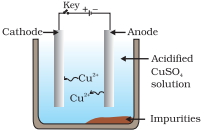
B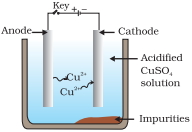
C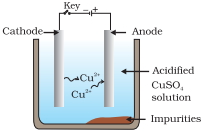
D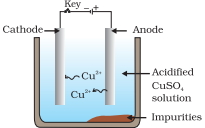
Solution
(A) In the process of electrolytic refining of copper:
$1$. An impure copper rod is used as the anode (connected to the positive terminal of the battery).
$2$. $A$ thin strip of pure copper is used as the cathode (connected to the negative terminal of the battery).
$3$. An acidified copper sulfate $(CuSO_4)$ solution is used as the electrolyte.
$4$. On passing electric current,pure copper from the anode dissolves into the electrolyte,and an equivalent amount of pure copper from the electrolyte deposits on the cathode.
$5$. The impurities from the anode settle down at the bottom of the tank as 'anode mud'.
$6$. Figure $A$ correctly depicts this setup with the anode connected to the positive terminal and the cathode to the negative terminal.
$1$. An impure copper rod is used as the anode (connected to the positive terminal of the battery).
$2$. $A$ thin strip of pure copper is used as the cathode (connected to the negative terminal of the battery).
$3$. An acidified copper sulfate $(CuSO_4)$ solution is used as the electrolyte.
$4$. On passing electric current,pure copper from the anode dissolves into the electrolyte,and an equivalent amount of pure copper from the electrolyte deposits on the cathode.
$5$. The impurities from the anode settle down at the bottom of the tank as 'anode mud'.
$6$. Figure $A$ correctly depicts this setup with the anode connected to the positive terminal and the cathode to the negative terminal.
0 likes
View Solution37
Medium
Iqbal treated a lustrous,divalent element $M$ with sodium hydroxide. He observed the formation of bubbles in the reaction mixture. He made the same observations when this element was treated with hydrochloric acid. Suggest how can he identify the produced gas. Write chemical equations for both the reactions.
Solution
(N/A) The produced gas can be identified by bringing a burning matchstick near the mouth of the reaction vessel; it will produce a 'pop' sound,which confirms the presence of hydrogen gas $(H_2)$.
The chemical equation for the reaction with sodium hydroxide is:
$M + 2NaOH \rightarrow Na_2MO_2 + H_2 \uparrow$
The chemical equation for the reaction with hydrochloric acid is:
$M + 2HCl \rightarrow MCl_2 + H_2 \uparrow$
Since the element $M$ reacts with both acids and bases to release hydrogen gas,the element $M$ is an amphoteric metal (such as Zinc).
The chemical equation for the reaction with sodium hydroxide is:
$M + 2NaOH \rightarrow Na_2MO_2 + H_2 \uparrow$
The chemical equation for the reaction with hydrochloric acid is:
$M + 2HCl \rightarrow MCl_2 + H_2 \uparrow$
Since the element $M$ reacts with both acids and bases to release hydrogen gas,the element $M$ is an amphoteric metal (such as Zinc).
0 likes
View Solution38
Medium
During the extraction of metals,electrolytic refining is used to obtain pure metals.
$(a)$ Which material will be used as the anode and cathode for the refining of silver metal by this process?
$(b)$ Suggest a suitable electrolyte as well.
$(c)$ In this electrolytic cell,where do we get pure silver after passing an electric current?
$(a)$ Which material will be used as the anode and cathode for the refining of silver metal by this process?
$(b)$ Suggest a suitable electrolyte as well.
$(c)$ In this electrolytic cell,where do we get pure silver after passing an electric current?
Solution
(N/A) Anode: Impure silver rod.
Cathode: Pure silver strip.
$(b)$ Electrolyte: An aqueous solution of a silver salt,such as silver nitrate $(AgNO_{3})$ acidified with dilute nitric acid $(HNO_{3})$.
$(c)$ After passing an electric current,pure silver is deposited at the cathode.
Cathode: Pure silver strip.
$(b)$ Electrolyte: An aqueous solution of a silver salt,such as silver nitrate $(AgNO_{3})$ acidified with dilute nitric acid $(HNO_{3})$.
$(c)$ After passing an electric current,pure silver is deposited at the cathode.
0 likes
View Solution39
EasyMCQ
Why should metal sulphides and carbonates be converted to metal oxides during the process of metal extraction?
A
Metal oxides are more stable than sulphides and carbonates.
B
It is easier to reduce metal oxides to pure metal than to reduce sulphides or carbonates.
C
Metal oxides are more reactive than sulphides and carbonates.
D
Metal oxides are easier to purify by electrolysis.
Solution
(B) In the process of metal extraction,it is thermodynamically and chemically easier to reduce metal oxides to pure metal using reducing agents like carbon or through electrolytic reduction compared to reducing metal sulphides or carbonates directly. Therefore,sulphides are converted to oxides by roasting,and carbonates are converted to oxides by calcination before the final reduction step.
0 likes
View Solution40
EasyMCQ
Generally,when metals are treated with mineral acids,hydrogen gas is liberated,but when metals (except $Mn$ and $Mg$) are treated with $HNO_3$,hydrogen is not liberated. Why?
A
Because $HNO_3$ is a strong reducing agent.
B
Because $HNO_3$ is a strong oxidising agent.
C
Because $HNO_3$ is a weak acid.
D
Because $HNO_3$ reacts with metals to form metal nitrides.
Solution
(B) When metals react with most mineral acids (like $HCl$ or $H_2SO_4$),hydrogen gas $(H_2)$ is evolved.
However,$HNO_3$ (nitric acid) is a very strong oxidising agent.
When a metal reacts with $HNO_3$,the hydrogen gas produced is immediately oxidised to water $(H_2O)$ by the nitric acid.
Consequently,the metal itself gets reduced to its corresponding nitrate salt,and the nitric acid is reduced to nitrogen oxides such as $N_2O$,$NO$,or $NO_2$.
However,$HNO_3$ (nitric acid) is a very strong oxidising agent.
When a metal reacts with $HNO_3$,the hydrogen gas produced is immediately oxidised to water $(H_2O)$ by the nitric acid.
Consequently,the metal itself gets reduced to its corresponding nitrate salt,and the nitric acid is reduced to nitrogen oxides such as $N_2O$,$NO$,or $NO_2$.
0 likes
View Solution41
Medium
Compound $X$ and aluminium are used to join railway tracks.
$(a)$ Identify the compound $X$.
$(b)$ Name the reaction.
$(c)$ Write down its chemical reaction.
$(a)$ Identify the compound $X$.
$(b)$ Name the reaction.
$(c)$ Write down its chemical reaction.
Solution
(N/A) The compound $X$ is Iron$(III)$ oxide, represented as $Fe_{2}O_{3}$.
$(b)$ This reaction is known as the Thermite reaction.
$(c)$ The chemical equation for the reaction is:
$Fe_{2}O_{3}(s) + 2Al(s) \rightarrow 2Fe(l) + Al_{2}O_{3}(s) + \text{Heat}$
$(b)$ This reaction is known as the Thermite reaction.
$(c)$ The chemical equation for the reaction is:
$Fe_{2}O_{3}(s) + 2Al(s) \rightarrow 2Fe(l) + Al_{2}O_{3}(s) + \text{Heat}$
0 likes
View Solution42
DifficultMCQ
When a metal $X$ is treated with cold water, it gives a basic salt $Y$ with molecular formula $XOH$ (molecular mass $= 40$) and liberates a gas $Z$ which easily catches fire. Identify $X$, $Y$, and $Z$, and write the chemical reaction involved.
A
$X$ = Na, $Y$ = NaOH, $Z$ = $H_2$
B
$X$ = $K$, $Y$ = $KOH$, $Z$ = $H_2$
C
$X$ = Mg, $Y$ = Mg$(OH)_2$, $Z$ = $H_2$
D
$X$ = Ca, $Y$ = Ca$(OH)_2$, $Z$ = $H_2$
Solution
(A) $1$. Given that the molecular formula of the salt $Y$ is $XOH$ and its molecular mass is $40$.
$2$. The atomic mass of $O$ is $16$ and $H$ is $1$. Therefore, $X + 16 + 1 = 40$, which gives $X = 23$. The element with atomic mass $23$ is Sodium $(Na)$.
$3$. Thus, $X$ is $Na$, $Y$ is $NaOH$, and the gas $Z$ liberated is Hydrogen $(H_2)$, which is highly flammable.
$4$. The balanced chemical equation is: $2Na(s) + 2H_2O(l) \rightarrow 2NaOH(aq) + H_2(g) + \text{Heat energy}$.
$2$. The atomic mass of $O$ is $16$ and $H$ is $1$. Therefore, $X + 16 + 1 = 40$, which gives $X = 23$. The element with atomic mass $23$ is Sodium $(Na)$.
$3$. Thus, $X$ is $Na$, $Y$ is $NaOH$, and the gas $Z$ liberated is Hydrogen $(H_2)$, which is highly flammable.
$4$. The balanced chemical equation is: $2Na(s) + 2H_2O(l) \rightarrow 2NaOH(aq) + H_2(g) + \text{Heat energy}$.
0 likes
View Solution43
MediumMCQ
$A$ non-metal $X$ exists in two different forms $Y$ and $Z$. $Y$ is the hardest natural substance, whereas $Z$ is a good conductor of electricity. Identify $X$, $Y$ and $Z$.
A
$X = \text{Carbon}, Y = \text{Diamond}, Z = \text{Graphite}$
B
$X = \text{Sulfur}, Y = \text{Diamond}, Z = \text{Graphite}$
C
$X = \text{Carbon}, Y = \text{Graphite}, Z = \text{Diamond}$
D
$X = \text{Phosphorus}, Y = \text{Diamond}, Z = \text{Graphite}$
Solution
(A) The non-metal $X$ is Carbon, which exhibits allotropy.
$Y$ is Diamond, which is the hardest natural substance known.
$Z$ is Graphite, which is a good conductor of electricity due to the presence of free electrons.
Therefore, $X = \text{Carbon}, Y = \text{Diamond}, Z = \text{Graphite}$.
$Y$ is Diamond, which is the hardest natural substance known.
$Z$ is Graphite, which is a good conductor of electricity due to the presence of free electrons.
Therefore, $X = \text{Carbon}, Y = \text{Diamond}, Z = \text{Graphite}$.
0 likes
View Solution44
Medium
The following reaction takes place when aluminium powder is heated with $MnO_2$:
$3MnO_2(s) + 4Al(s) \rightarrow 3Mn(l) + 2Al_2O_3(l) + \text{Heat}$
$(a)$ Is aluminium getting reduced?
$(b)$ Is $MnO_2$ getting oxidised?
$3MnO_2(s) + 4Al(s) \rightarrow 3Mn(l) + 2Al_2O_3(l) + \text{Heat}$
$(a)$ Is aluminium getting reduced?
$(b)$ Is $MnO_2$ getting oxidised?
Solution
(N/A) No, aluminium is not getting reduced. Since oxygen is added to aluminium, it is getting oxidised to form aluminium oxide $(Al_2O_3)$.
$(b)$ No, $MnO_2$ is not getting oxidised. Since manganese has lost oxygen, $MnO_2$ is getting reduced to manganese $(Mn)$.
$(b)$ No, $MnO_2$ is not getting oxidised. Since manganese has lost oxygen, $MnO_2$ is getting reduced to manganese $(Mn)$.
0 likes
View Solution45
Medium
What are the constituents of solder alloy? Which property of solder makes it suitable for welding electrical wires?
Solution
(N/A) Solder is an alloy composed of lead $(Pb)$ and tin $(Sn)$.
The primary property that makes solder suitable for welding electrical wires is its low melting point,which allows it to melt easily at relatively low temperatures without damaging the delicate electrical components.
The primary property that makes solder suitable for welding electrical wires is its low melting point,which allows it to melt easily at relatively low temperatures without damaging the delicate electrical components.
0 likes
View Solution46
Medium
$A$ metal $A$,which is used in the thermite process,when heated with oxygen gives an oxide $B$,which is amphoteric in nature. Identify $A$ and $B$. Write down the reactions of oxide $B$ with $HCl$ and $NaOH$.
Solution
(A) The metal $A$ used in the thermite process is Aluminum $(Al)$.
When Aluminum is heated with oxygen,it forms Aluminum oxide $(Al_{2}O_{3})$,which is oxide $B$.
Aluminum oxide is amphoteric,meaning it reacts with both acids and bases.
$A = Al$
$B = Al_{2}O_{3}$
Reaction with $HCl$ (acid):
$Al_{2}O_{3} + 6HCl \rightarrow 2AlCl_{3} + 3H_{2}O$
Reaction with $NaOH$ (base):
$Al_{2}O_{3} + 2NaOH \rightarrow 2NaAlO_{2} + H_{2}O$
When Aluminum is heated with oxygen,it forms Aluminum oxide $(Al_{2}O_{3})$,which is oxide $B$.
Aluminum oxide is amphoteric,meaning it reacts with both acids and bases.
$A = Al$
$B = Al_{2}O_{3}$
Reaction with $HCl$ (acid):
$Al_{2}O_{3} + 6HCl \rightarrow 2AlCl_{3} + 3H_{2}O$
Reaction with $NaOH$ (base):
$Al_{2}O_{3} + 2NaOH \rightarrow 2NaAlO_{2} + H_{2}O$
0 likes
View Solution47
Medium
$A$ metal that exists as a liquid at room temperature is obtained by heating its sulphide in the presence of air. Identify the metal and its ore and give the reaction involved.
Solution
(N/A) Mercury is the only metal that exists as a liquid at room temperature. It is obtained from its sulphide ore,known as cinnabar $(HgS)$,by heating it in the presence of air (roasting).
The chemical reactions involved are as follows:
$1$. Heating cinnabar in air to form mercury$(II)$ oxide:
$2HgS + 3O_2 \xrightarrow{\text{Heat}} 2HgO + 2SO_2$
$2$. Further heating of mercury$(II)$ oxide to obtain mercury metal:
$2HgO \xrightarrow{\text{Heat}} 2Hg + O_2$
The chemical reactions involved are as follows:
$1$. Heating cinnabar in air to form mercury$(II)$ oxide:
$2HgS + 3O_2 \xrightarrow{\text{Heat}} 2HgO + 2SO_2$
$2$. Further heating of mercury$(II)$ oxide to obtain mercury metal:
$2HgO \xrightarrow{\text{Heat}} 2Hg + O_2$
0 likes
View Solution48
Medium
Give the formulae of the stable binary compounds that would be formed by the combination of the following pairs of elements:
$(a)$ $Mg$ and $N_{2}$
$(b)$ $Li$ and $O_{2}$
$(c)$ $Al$ and $Cl_{2}$
$(d)$ $K$ and $O_{2}$
$(a)$ $Mg$ and $N_{2}$
$(b)$ $Li$ and $O_{2}$
$(c)$ $Al$ and $Cl_{2}$
$(d)$ $K$ and $O_{2}$
Solution
(A) To determine the formula of a binary compound,we balance the valencies of the combining elements:
$(a)$ $Mg$ has a valency of $+2$ and $N$ has a valency of $-3$. By criss-crossing the valencies,we get $Mg_{3}N_{2}$ (Magnesium nitride).
$(b)$ $Li$ has a valency of $+1$ and $O$ has a valency of $-2$. By criss-crossing the valencies,we get $Li_{2}O$ (Lithium oxide).
$(c)$ $Al$ has a valency of $+3$ and $Cl$ has a valency of $-1$. By criss-crossing the valencies,we get $AlCl_{3}$ (Aluminium chloride).
$(d)$ $K$ has a valency of $+1$ and $O$ has a valency of $-2$. By criss-crossing the valencies,we get $K_{2}O$ (Potassium oxide).
$(a)$ $Mg$ has a valency of $+2$ and $N$ has a valency of $-3$. By criss-crossing the valencies,we get $Mg_{3}N_{2}$ (Magnesium nitride).
$(b)$ $Li$ has a valency of $+1$ and $O$ has a valency of $-2$. By criss-crossing the valencies,we get $Li_{2}O$ (Lithium oxide).
$(c)$ $Al$ has a valency of $+3$ and $Cl$ has a valency of $-1$. By criss-crossing the valencies,we get $AlCl_{3}$ (Aluminium chloride).
$(d)$ $K$ has a valency of $+1$ and $O$ has a valency of $-2$. By criss-crossing the valencies,we get $K_{2}O$ (Potassium oxide).
0 likes
View Solution49
Medium
What happens when
$(a)$ $ZnCO_{3}$ is heated in the absence of oxygen?
$(b)$ $A$ mixture of $Cu_{2}O$ and $Cu_{2}S$ is heated?
$(a)$ $ZnCO_{3}$ is heated in the absence of oxygen?
$(b)$ $A$ mixture of $Cu_{2}O$ and $Cu_{2}S$ is heated?
Solution
(N/A) It undergoes calcination. The chemical reaction is:
$ZnCO_{3} \xrightarrow{\text{Heat}} ZnO + CO_{2}$
$(b)$ It undergoes auto-reduction,forming copper metal and sulphur dioxide gas:
$2Cu_{2}O + Cu_{2}S \xrightarrow{\text{Heat}} 6Cu + SO_{2}$
$ZnCO_{3} \xrightarrow{\text{Heat}} ZnO + CO_{2}$
$(b)$ It undergoes auto-reduction,forming copper metal and sulphur dioxide gas:
$2Cu_{2}O + Cu_{2}S \xrightarrow{\text{Heat}} 6Cu + SO_{2}$
0 likes
View Solution50
Medium
$A$ non-metal $A$ is an important constituent of our food and forms two oxides $B$ and $C$. Oxide $B$ is toxic,whereas $C$ causes global warming.
$(a)$ Identify $A$,$B$,and $C$.
$(b)$ To which Group of the Periodic Table does $A$ belong?
$(a)$ Identify $A$,$B$,and $C$.
$(b)$ To which Group of the Periodic Table does $A$ belong?
Solution
(N/A) is carbon $(C)$,$B$ is carbon monoxide $(CO)$,and $C$ is carbon dioxide $(CO_2)$.
$(b)$ Carbon $(A)$ has an atomic number of $6$,with an electronic configuration of $2, 4$. It belongs to Group-$14$ of the Periodic Table.
$(b)$ Carbon $(A)$ has an atomic number of $6$,with an electronic configuration of $2, 4$. It belongs to Group-$14$ of the Periodic Table.
0 likes
View SolutionMetals and Non-metals — Mix Examples - Metals and Non-metals · Frequently Asked Questions
1Are these Metals and Non-metals questions useful for JEE and NEET?
Yes. All questions in this section are mapped to JEE Main and NEET exam patterns. Previous year questions from JEE Main, NEET, GUJCET and state-level exams are included with full solutions.
2Can I switch to Hindi or Gujarati for these questions?
Yes. Use the language tabs in the hero section or the sidebar to view the same questions and solutions in English, Hindi or Gujarati.
3How do I generate a question paper from this subtopic?
Use the Vedclass Exam Paper Generator — select the chapter and subtopic, set difficulty, and generate Sets A, B, C, D automatically. First 3 chapters of every subject are free.
Vedclass Products
For Students
Vedclass Test Series
Mock tests in real JEE/NEET style with performance analysis. 5-day free trial.
Start Free TrialFor Teachers
Exam Paper Generator
Generate Set A/B/C/D papers from this chapter in 2 minutes. 3 chapters free.
Try FreeFor Institutes
Online Exam Module
Live online exams with unlimited students, 360° analytics & white-label branding.
See DemoFor Teachers & Institutes
Generate a Metals and Non-metals Exam Paper in 2 Minutes
Select subtopic & difficulty — Sets A, B, C, D auto-generated with No Repeat logic.
First 3 chapters of every subject are free — no payment required.