
A English
Mix Examples - Metals and Non-metals Questions in English
Class 10 Science · Metals and Non-metals · Mix Examples - Metals and Non-metals
412+
Questions
English
Language
100%
With Solutions
Showing 50 of 412 questions in English
51
Easy
Give two examples each of metals that are good conductors and poor conductors of heat,respectively.
Solution
(N/A) Good conductors of heat: Silver $(Ag)$ and Copper $(Cu)$.
$(b)$ Poor conductors of heat: Lead $(Pb)$ and Mercury $(Hg)$.
$(b)$ Poor conductors of heat: Lead $(Pb)$ and Mercury $(Hg)$.
0 likes
View Solution52
Medium
Name one metal and one non-metal that exist in liquid state at room temperature. Also,name two metals having a melting point less than $310\ K$ $(37\ ^\circ C)$.
Solution
(N/A) The metal that exists in a liquid state at room temperature is Mercury $(Hg)$.
The non-metal that exists in a liquid state at room temperature is Bromine $(Br)$.
Two metals that have a melting point less than $310\ K$ $(37\ ^\circ C)$ are Cesium $(Cs)$ and Gallium $(Ga)$.
The non-metal that exists in a liquid state at room temperature is Bromine $(Br)$.
Two metals that have a melting point less than $310\ K$ $(37\ ^\circ C)$ are Cesium $(Cs)$ and Gallium $(Ga)$.
0 likes
View Solution53
Difficult
An element $A$ reacts with water to form a compound $B$ which is used in white washing. The compound $B$ on heating forms an oxide $C$ which on treatment with water gives back $B$. Identify $A$,$B$ and $C$ and give the reactions involved.
Solution
(A) The element $A$ is Calcium $(Ca)$.
When $Ca$ reacts with water,it forms Calcium hydroxide $(Ca(OH)_2)$,which is compound $B$ and is used for white washing.
Reaction: $Ca(s) + 2H_2O(l) \rightarrow Ca(OH)_2(aq) + H_2(g)$
When $Ca(OH)_2$ is heated,it decomposes to form Calcium oxide $(CaO)$,which is oxide $C$.
Reaction: $Ca(OH)_2(s) \xrightarrow{\text{Heat}} CaO(s) + H_2O(g)$
When $CaO$ is treated with water,it gives back $Ca(OH)_2$.
Reaction: $CaO(s) + H_2O(l) \rightarrow Ca(OH)_2(aq)$
Therefore,$A = Ca$,$B = Ca(OH)_2$,and $C = CaO$.
When $Ca$ reacts with water,it forms Calcium hydroxide $(Ca(OH)_2)$,which is compound $B$ and is used for white washing.
Reaction: $Ca(s) + 2H_2O(l) \rightarrow Ca(OH)_2(aq) + H_2(g)$
When $Ca(OH)_2$ is heated,it decomposes to form Calcium oxide $(CaO)$,which is oxide $C$.
Reaction: $Ca(OH)_2(s) \xrightarrow{\text{Heat}} CaO(s) + H_2O(g)$
When $CaO$ is treated with water,it gives back $Ca(OH)_2$.
Reaction: $CaO(s) + H_2O(l) \rightarrow Ca(OH)_2(aq)$
Therefore,$A = Ca$,$B = Ca(OH)_2$,and $C = CaO$.
0 likes
View Solution54
Difficult
An alkali metal $A$ gives a compound $B$ (molecular mass $= 40$) on reacting with water. The compound $B$ gives a soluble compound $C$ on treatment with aluminium oxide. Identify $A$,$B$ and $C$ and give the reaction involved.
Solution
(A) The alkali metal $A$ is Sodium $(Na)$.
When $Na$ reacts with water,it forms Sodium hydroxide $(NaOH)$ as compound $B$.
The molecular mass of $NaOH = 23 + 16 + 1 = 40$.
When $NaOH$ $(B)$ reacts with aluminium oxide $(Al_{2}O_{3})$,it forms Sodium aluminate $(NaAlO_{2})$ as compound $C$,which is soluble in water.
The reactions are:
$2Na + 2H_{2}O \rightarrow 2NaOH + H_{2}$
$Al_{2}O_{3} + 2NaOH \rightarrow 2NaAlO_{2} + H_{2}O$
When $Na$ reacts with water,it forms Sodium hydroxide $(NaOH)$ as compound $B$.
The molecular mass of $NaOH = 23 + 16 + 1 = 40$.
When $NaOH$ $(B)$ reacts with aluminium oxide $(Al_{2}O_{3})$,it forms Sodium aluminate $(NaAlO_{2})$ as compound $C$,which is soluble in water.
The reactions are:
$2Na + 2H_{2}O \rightarrow 2NaOH + H_{2}$
$Al_{2}O_{3} + 2NaOH \rightarrow 2NaAlO_{2} + H_{2}O$
0 likes
View Solution55
Medium
Give the reactions involved during the extraction of zinc from its ore by:
$(a)$ Roasting of zinc ore
$(b)$ Calcination of zinc ore
$(a)$ Roasting of zinc ore
$(b)$ Calcination of zinc ore
Solution
(N/A) Roasting is the process of heating a sulphide ore in the presence of excess air. The reaction for zinc sulphide $(ZnS)$ is:
$2ZnS(s) + 3O_2(g) \xrightarrow{\text{Heat}} 2ZnO(s) + 2SO_2(g)$
$(b)$ Calcination is the process of heating a carbonate ore in the absence or limited supply of air. The reaction for zinc carbonate $(ZnCO_3)$ is:
$ZnCO_3(s) \xrightarrow{\text{Heat}} ZnO(s) + CO_2(g)$
$2ZnS(s) + 3O_2(g) \xrightarrow{\text{Heat}} 2ZnO(s) + 2SO_2(g)$
$(b)$ Calcination is the process of heating a carbonate ore in the absence or limited supply of air. The reaction for zinc carbonate $(ZnCO_3)$ is:
$ZnCO_3(s) \xrightarrow{\text{Heat}} ZnO(s) + CO_2(g)$
0 likes
View Solution56
Medium
$A$ metal $M$ does not liberate hydrogen from acids but reacts with oxygen to give a black coloured product. Identify $M$ and the black coloured product,and also explain the reaction of $M$ with oxygen.
Solution
(N/A) The metal $M$ is Copper $(Cu)$.
Copper is less reactive than hydrogen in the reactivity series,so it does not displace hydrogen from dilute acids.
When copper is heated in the presence of oxygen,it undergoes oxidation to form Copper$(II)$ oxide $(CuO)$,which is a black-coloured substance.
The chemical reaction is:
$2Cu(s) + O_2(g) \rightarrow 2CuO(s)$ (Black product)
Copper is less reactive than hydrogen in the reactivity series,so it does not displace hydrogen from dilute acids.
When copper is heated in the presence of oxygen,it undergoes oxidation to form Copper$(II)$ oxide $(CuO)$,which is a black-coloured substance.
The chemical reaction is:
$2Cu(s) + O_2(g) \rightarrow 2CuO(s)$ (Black product)
0 likes
View Solution57
Easy
An element forms an oxide $A_{2}O_{3}$ which is acidic in nature. Identify $A$ as a metal or non-metal.
Solution
(B) Non-metals typically form acidic oxides when they react with oxygen. Since the oxide $A_{2}O_{3}$ is acidic in nature,the element $A$ must be a non-metal.
0 likes
View Solution58
Medium
$A$ solution of $CuSO_{4}$ was kept in an iron pot. After a few days,the iron pot was found to have a number of holes in it. Explain the reason in terms of reactivity. Write the equation of the reaction involved.
Solution
(N/A) $Fe$ is more reactive than $Cu$. According to the reactivity series,$Fe$ can displace $Cu$ from its salt solution.
When $CuSO_{4}$ solution is kept in an iron pot,$Fe$ reacts with $CuSO_{4}$ to form $FeSO_{4}$ and $Cu$ is deposited.
This reaction causes the iron pot to corrode,leading to the formation of holes.
The chemical equation for this displacement reaction is:
$Fe(s) + CuSO_{4}(aq) \rightarrow FeSO_{4}(aq) + Cu(s)$
When $CuSO_{4}$ solution is kept in an iron pot,$Fe$ reacts with $CuSO_{4}$ to form $FeSO_{4}$ and $Cu$ is deposited.
This reaction causes the iron pot to corrode,leading to the formation of holes.
The chemical equation for this displacement reaction is:
$Fe(s) + CuSO_{4}(aq) \rightarrow FeSO_{4}(aq) + Cu(s)$
0 likes
View Solution59
Difficult
A non-metal $A$, which is the largest constituent of air, when heated with $H_2$ in a $1 : 3$ ratio in the presence of a catalyst $(Fe)$, gives a gas $B$. On heating with $O_2$, it gives an oxide $C$. If this oxide is passed into water in the presence of air, it gives an acid $D$, which acts as a strong oxidising agent.
$(a)$ Identify $A$, $B$, $C$, and $D$.
$(b)$ To which group of the periodic table does this non-metal belong?
$(a)$ Identify $A$, $B$, $C$, and $D$.
$(b)$ To which group of the periodic table does this non-metal belong?
Solution
$(A) A = N_2$ (Nitrogen), $B = NH_3$ (Ammonia), $C = NO$ (Nitric oxide), $D = HNO_3$ (Nitric acid).
Step $1$: Nitrogen $(N_2)$ is the most abundant gas in the atmosphere.
Step $2$: Haber's process: $N_2 + 3H_2 \xrightarrow{Fe} 2NH_3$ (Gas $B$).
Step $3$: Catalytic oxidation: $N_2 + O_2 \rightarrow 2NO$ (Oxide $C$).
Step $4$: Formation of acid: $4NO + 3O_2 + 2H_2O \rightarrow 4HNO_3$ (Acid $D$).
$(b)$ Nitrogen $(N_2)$ belongs to Group $15$ of the Periodic Table.
Step $1$: Nitrogen $(N_2)$ is the most abundant gas in the atmosphere.
Step $2$: Haber's process: $N_2 + 3H_2 \xrightarrow{Fe} 2NH_3$ (Gas $B$).
Step $3$: Catalytic oxidation: $N_2 + O_2 \rightarrow 2NO$ (Oxide $C$).
Step $4$: Formation of acid: $4NO + 3O_2 + 2H_2O \rightarrow 4HNO_3$ (Acid $D$).
$(b)$ Nitrogen $(N_2)$ belongs to Group $15$ of the Periodic Table.
0 likes
View Solution60
Medium
Give the steps involved in the extraction of metals of low and medium reactivity from their respective sulphide ores.
Solution
(N/A) For metals of low reactivity:
Sulphide ore $\xrightarrow{\text{Roasting}}$ Metal $\xrightarrow{\text{Refining}}$ Pure metal
For metals of medium reactivity:
Sulphide ore $\xrightarrow{\text{Roasting}}$ Metal oxide $\xrightarrow{\text{Reduction}}$ Metal $\xrightarrow{\text{Refining}}$ Pure metal
$1$. Roasting: The sulphide ore is heated strongly in the presence of excess air to convert it into metal oxide (for medium reactivity) or directly into metal (for low reactivity).
$2$. Reduction: The metal oxide obtained is reduced to metal using a suitable reducing agent like carbon.
$3$. Refining: The crude metal obtained is purified through various methods like electrolytic refining.
Sulphide ore $\xrightarrow{\text{Roasting}}$ Metal $\xrightarrow{\text{Refining}}$ Pure metal
For metals of medium reactivity:
Sulphide ore $\xrightarrow{\text{Roasting}}$ Metal oxide $\xrightarrow{\text{Reduction}}$ Metal $\xrightarrow{\text{Refining}}$ Pure metal
$1$. Roasting: The sulphide ore is heated strongly in the presence of excess air to convert it into metal oxide (for medium reactivity) or directly into metal (for low reactivity).
$2$. Reduction: The metal oxide obtained is reduced to metal using a suitable reducing agent like carbon.
$3$. Refining: The crude metal obtained is purified through various methods like electrolytic refining.
0 likes
View Solution61
Medium
Explain the following:
$(a)$ The reactivity of $Al$ decreases if it is dipped in $HNO_3$.
$(b)$ Carbon cannot reduce the oxides of $Na$ or $Mg$.
$(a)$ The reactivity of $Al$ decreases if it is dipped in $HNO_3$.
$(b)$ Carbon cannot reduce the oxides of $Na$ or $Mg$.
Solution
(N/A) When $Al$ is dipped in $HNO_3$,a thin,protective,and non-reactive layer of aluminum oxide $(Al_2O_3)$ forms on its surface. This layer prevents further reaction of the metal with the acid,thereby decreasing its reactivity.
$(b)$ $Na$ and $Mg$ are highly reactive metals that have a much stronger affinity for oxygen than carbon does. Therefore,carbon cannot displace oxygen from $Na_2O$ or $MgO$ to reduce them to their respective metals.
$(b)$ $Na$ and $Mg$ are highly reactive metals that have a much stronger affinity for oxygen than carbon does. Therefore,carbon cannot displace oxygen from $Na_2O$ or $MgO$ to reduce them to their respective metals.
0 likes
View Solution62
Medium
Explain the following:
$(a)$ $NaCl$ is not a conductor of electricity in solid state,whereas it does conduct electricity in aqueous solution as well as in molten state.
$(b)$ Iron articles are galvanised.
$(c)$ Metals like $Na, K, Ca$ and $Mg$ are never found in their free state in nature.
$(a)$ $NaCl$ is not a conductor of electricity in solid state,whereas it does conduct electricity in aqueous solution as well as in molten state.
$(b)$ Iron articles are galvanised.
$(c)$ Metals like $Na, K, Ca$ and $Mg$ are never found in their free state in nature.
Solution
(A) In solid $NaCl$,the movement of ions is not possible due to its rigid structure. However,in aqueous solution or molten state,the electrostatic forces of attraction are overcome,allowing the ions to move freely and conduct electricity.
$(b)$ Iron articles are galvanised to protect them from corrosion (rusting). Galvanisation involves coating iron with a thin layer of zinc,which is more reactive than iron and prevents the iron from coming into contact with oxygen and moisture.
$(c)$ Metals like $Na, K, Ca$ and $Mg$ are highly reactive. They readily react with other elements such as oxygen,sulfur,and carbon present in the environment to form compounds like oxides,sulfides,or carbonates,and therefore are never found in their free elemental state in nature.
$(b)$ Iron articles are galvanised to protect them from corrosion (rusting). Galvanisation involves coating iron with a thin layer of zinc,which is more reactive than iron and prevents the iron from coming into contact with oxygen and moisture.
$(c)$ Metals like $Na, K, Ca$ and $Mg$ are highly reactive. They readily react with other elements such as oxygen,sulfur,and carbon present in the environment to form compounds like oxides,sulfides,or carbonates,and therefore are never found in their free elemental state in nature.
0 likes
View Solution63
Medium
$(i)$ Given below are the steps for the extraction of copper from its ore. Write the reactions involved:
$(a)$ Roasting of copper $(I)$ sulphide
$(b)$ Reduction of copper $(I)$ oxide with copper $(I)$ sulphide
$(c)$ Electrolytic refining
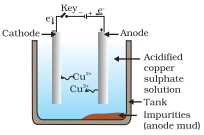
$(ii)$ Draw a neat and well-labelled diagram for the electrolytic refining of copper.
$(a)$ Roasting of copper $(I)$ sulphide
$(b)$ Reduction of copper $(I)$ oxide with copper $(I)$ sulphide
$(c)$ Electrolytic refining
$(ii)$ Draw a neat and well-labelled diagram for the electrolytic refining of copper.
Solution
(N/A) $(i)$ $(a)$ Roasting of sulphide ore:
$2Cu_2S(s) + 3O_2(g) \xrightarrow{\Delta} 2Cu_2O(s) + 2SO_2(g)$
$(b)$ Reduction of copper $(I)$ oxide:
$2Cu_2O(s) + Cu_2S(s) \xrightarrow{\Delta} 6Cu(s) + SO_2(g)$
This reaction is known as auto-reduction.
$(c)$ Reaction for electrolytic refining:
At cathode: $Cu^{2+}(aq) + 2e^- \rightarrow Cu(s)$
At anode: $Cu(s) \rightarrow Cu^{2+}(aq) + 2e^-$
$(ii)$ The diagram for the electrolytic refining of copper shows an electrolytic tank containing acidified copper sulphate solution,an impure copper anode,a pure copper cathode,and the collection of anode mud at the bottom.
$2Cu_2S(s) + 3O_2(g) \xrightarrow{\Delta} 2Cu_2O(s) + 2SO_2(g)$
$(b)$ Reduction of copper $(I)$ oxide:
$2Cu_2O(s) + Cu_2S(s) \xrightarrow{\Delta} 6Cu(s) + SO_2(g)$
This reaction is known as auto-reduction.
$(c)$ Reaction for electrolytic refining:
At cathode: $Cu^{2+}(aq) + 2e^- \rightarrow Cu(s)$
At anode: $Cu(s) \rightarrow Cu^{2+}(aq) + 2e^-$
$(ii)$ The diagram for the electrolytic refining of copper shows an electrolytic tank containing acidified copper sulphate solution,an impure copper anode,a pure copper cathode,and the collection of anode mud at the bottom.
0 likes
View Solution64
Medium
Of the three metals $X, Y$ and $Z$,$X$ reacts with cold water,$Y$ with hot water,and $Z$ with steam only. Identify $X, Y$ and $Z$ and also arrange them in the order of increasing reactivity.
Solution
(A) $X$ is an alkali metal,such as $Na$ or $K$,which is highly reactive and reacts with cold water.
$Y$ is an alkaline earth metal,such as $Mg$ or $Ca$,which reacts with hot water.
$Z$ is a metal like $Fe$ (iron),which reacts only with steam.
The order of increasing reactivity is $Z < Y < X$,which corresponds to $Fe < Mg < Na$.
$Y$ is an alkaline earth metal,such as $Mg$ or $Ca$,which reacts with hot water.
$Z$ is a metal like $Fe$ (iron),which reacts only with steam.
The order of increasing reactivity is $Z < Y < X$,which corresponds to $Fe < Mg < Na$.
0 likes
View Solution65
Difficult
An element $A$ burns with a golden yellow flame in air. It reacts with another element $B$ (atomic number $17$) to give a product $C$. An aqueous solution of product $C$ on electrolysis gives a compound $D$ and liberates hydrogen. Identify $A$,$B$,$C$,and $D$. Also,write down the equations for the reactions involved.
Solution
(A) $A = Na$ (Sodium),$B = Cl_2$ (Chlorine),$C = NaCl$ (Sodium chloride),$D = NaOH$ (Sodium hydroxide).
$1$. Reaction of $A$ with $B$: $2Na(s) + Cl_2(g) \rightarrow 2NaCl(s)$.
$2$. Electrolysis of aqueous solution of $C$ (Chlor-alkali process): $2NaCl(aq) + 2H_2O(l) \rightarrow 2NaOH(aq) + Cl_2(g) + H_2(g)$.
$1$. Reaction of $A$ with $B$: $2Na(s) + Cl_2(g) \rightarrow 2NaCl(s)$.
$2$. Electrolysis of aqueous solution of $C$ (Chlor-alkali process): $2NaCl(aq) + 2H_2O(l) \rightarrow 2NaOH(aq) + Cl_2(g) + H_2(g)$.
0 likes
View Solution66
Difficult
Two ores $A$ and $B$ were taken. On heating, ore $A$ gives $CO_2$, whereas ore $B$ gives $SO_2$. What steps will you take to convert them into metals?
Solution
(N/A) Since ore $A$ releases $CO_2$ upon heating, it is a carbonate ore. Carbonate ores are converted into metal oxides by the process of $Calcination$ (heating in limited supply of air).
$MCO_3 \xrightarrow{Calcination} MO + CO_2$
Then, the metal oxide is reduced to metal using a reducing agent like carbon:
$MO + C \xrightarrow{Reduction} M + CO$
Since ore $B$ releases $SO_2$ upon heating, it is a sulfide ore. Sulfide ores are converted into metal oxides by the process of $Roasting$ (heating in excess supply of air).
$2MS + 3O_2 \xrightarrow{Roasting} 2MO + 2SO_2$
Then, the metal oxide is reduced to metal using a reducing agent like carbon:
$MO + C \rightarrow M + CO$
$MCO_3 \xrightarrow{Calcination} MO + CO_2$
Then, the metal oxide is reduced to metal using a reducing agent like carbon:
$MO + C \xrightarrow{Reduction} M + CO$
Since ore $B$ releases $SO_2$ upon heating, it is a sulfide ore. Sulfide ores are converted into metal oxides by the process of $Roasting$ (heating in excess supply of air).
$2MS + 3O_2 \xrightarrow{Roasting} 2MO + 2SO_2$
Then, the metal oxide is reduced to metal using a reducing agent like carbon:
$MO + C \rightarrow M + CO$
0 likes
View Solution67
EasyMCQ
Give one most suitable word for the following statements.
$(a)$ Metal oxides which show basic as well as acidic behaviour.
$(b)$ Iodine,a non-metal is shining.
$(a)$ Metal oxides which show basic as well as acidic behaviour.
$(b)$ Iodine,a non-metal is shining.
A
Amphoteric oxide
B
Lustrous
C
Malleable
D
Ductile
Solution
(A) Metal oxides that react with both acids and bases to produce salt and water are called Amphoteric oxides. Examples include $Al_2O_3$ and $ZnO$.
$(b)$ Although most non-metals are dull,Iodine is an exception as it possesses a metallic sheen or luster,hence it is described as Lustrous.
$(b)$ Although most non-metals are dull,Iodine is an exception as it possesses a metallic sheen or luster,hence it is described as Lustrous.
0 likes
View Solution68
Easy
Write the chemical equation for the reaction taking place when steam is passed over hot aluminium.
Solution
(N/A) When steam is passed over hot aluminium,it reacts to form aluminium oxide and hydrogen gas.
The balanced chemical equation for this reaction is:
$2Al(s) + 3H_2O(g) \rightarrow Al_2O_3(s) + 3H_2(g) \uparrow$
In this reaction,aluminium metal reacts with steam (gaseous water) at high temperatures to produce aluminium oxide and hydrogen gas.
The balanced chemical equation for this reaction is:
$2Al(s) + 3H_2O(g) \rightarrow Al_2O_3(s) + 3H_2(g) \uparrow$
In this reaction,aluminium metal reacts with steam (gaseous water) at high temperatures to produce aluminium oxide and hydrogen gas.
0 likes
View Solution69
MediumMCQ
What happens when carbon dioxide is dissolved in water at high pressure?
A
It forms carbonic acid.
B
It forms carbon monoxide.
C
It forms sodium carbonate.
D
It forms calcium carbonate.
Solution
(A) When carbon dioxide $(CO_2)$ is dissolved in water under high pressure,it reacts with water to form carbonic acid $(H_2CO_3)$.
The chemical equation for this reaction is:
$CO_2(g) + H_2O(l) \rightarrow H_2CO_3(aq)$
The chemical equation for this reaction is:
$CO_2(g) + H_2O(l) \rightarrow H_2CO_3(aq)$
0 likes
View Solution70
Easy
Give a reason why electrical wires are coated with plastic.
Solution
(N/A) Electrical wires are typically made of copper,which is an excellent conductor of electricity. However,copper is reactive and can undergo corrosion when exposed to moist air containing carbon dioxide,leading to the formation of a green layer of copper carbonate. Furthermore,copper is a metal and poses a risk of electric shock if touched directly. Plastic acts as an insulator,preventing electric shocks and protecting the metal wire from environmental corrosion.
0 likes
View Solution71
Medium
Give the composition of the alloys brass and bronze.
Solution
(N/A) Brass is an alloy composed of Copper $(Cu)$ and Zinc $(Zn)$.
Bronze is an alloy composed of Copper $(Cu)$ and Tin $(Sn)$.
Bronze is an alloy composed of Copper $(Cu)$ and Tin $(Sn)$.
0 likes
View Solution72
EasyMCQ
What is the chemical formula of rust?
A
$Fe_2O_3$
B
$Fe_2O_3 \cdot xH_2O$
C
$FeO \cdot xH_2O$
D
$Fe_3O_4$
Solution
(B) Rust is chemically known as hydrated iron$(III)$ oxide.
When iron reacts with oxygen and moisture in the air,it forms a reddish-brown substance called rust.
The general chemical formula for rust is $Fe_2O_3 \cdot xH_2O$,where $x$ represents a variable number of water molecules.
When iron reacts with oxygen and moisture in the air,it forms a reddish-brown substance called rust.
The general chemical formula for rust is $Fe_2O_3 \cdot xH_2O$,where $x$ represents a variable number of water molecules.
0 likes
View Solution73
Easy
An alloy has a low melting point and is,therefore,used for electrical fuses. Name the alloy and write its constituents.
Solution
(N/A) The alloy used for electrical fuses is $Solder$. Its constituents are $Lead$ $(Pb)$ and $Tin$ $(Sn)$.
0 likes
View Solution74
Easy
Name one metal and one non-metal that are found in a liquid state at room temperature.
Solution
(N/A) The metal that exists in a liquid state at room temperature is $Mercury$ $(Hg)$.
The non-metal that exists in a liquid state at room temperature is $Bromine$ $(Br_2)$.
The non-metal that exists in a liquid state at room temperature is $Bromine$ $(Br_2)$.
0 likes
View Solution75
Easy
Name two metals which react with dilute $HNO_{3}$ to evolve $H_{2}$ gas.
Solution
(N/A) Generally,metals do not evolve $H_{2}$ gas when reacting with dilute $HNO_{3}$ because it is a strong oxidizing agent that oxidizes the produced $H_{2}$ to water. However,magnesium $(Mg)$ and manganese $(Mn)$ are exceptions that react with very dilute $HNO_{3}$ to evolve $H_{2}$ gas.
0 likes
View Solution76
Easy
Why can oxides of highly reactive metals not be reduced by carbon?
Solution
(N/A) Highly reactive metals (such as $Na, Mg, Ca, Al$) have a much stronger affinity for oxygen than carbon does. Because their bond with oxygen is significantly more stable,carbon is unable to displace the metal from its oxide. Therefore,these metals are extracted from their ores by electrolytic reduction rather than carbon reduction.
0 likes
View Solution77
Easy
What is formed when sodium absorbs moisture from air? Give the chemical equation as well.
Solution
(N/A) When sodium $(Na)$ is exposed to air,it reacts with moisture $(H_2O)$ present in the air to form sodium hydroxide $(NaOH)$ and releases hydrogen gas $(H_2)$.
The chemical equation for this reaction is:
$2Na(s) + 2H_2O(l) \longrightarrow 2NaOH(aq) + H_2(g)$
The chemical equation for this reaction is:
$2Na(s) + 2H_2O(l) \longrightarrow 2NaOH(aq) + H_2(g)$
0 likes
View Solution78
EasyMCQ
Why are sulphide and carbonate ores converted into oxides?
A
Oxides are more stable than sulphides and carbonates.
B
It is easier to reduce metal oxides to pure metal than their sulphides or carbonates.
C
Sulphide and carbonate ores are highly reactive.
D
Oxides are easier to mine from the earth.
Solution
(B) The extraction of metals from their sulphide and carbonate ores is difficult because these compounds are chemically stable and do not easily release the metal.
However,metal oxides are much easier to reduce to pure metal using reducing agents like carbon or through electrolytic reduction.
Therefore,sulphide ores are first converted into oxides by roasting (heating in the presence of excess air),and carbonate ores are converted into oxides by calcination (heating in the absence or limited supply of air).
However,metal oxides are much easier to reduce to pure metal using reducing agents like carbon or through electrolytic reduction.
Therefore,sulphide ores are first converted into oxides by roasting (heating in the presence of excess air),and carbonate ores are converted into oxides by calcination (heating in the absence or limited supply of air).
0 likes
View Solution79
Medium
From amongst the metals sodium,calcium,aluminium,copper and magnesium,name the metal:
$(i)$ which reacts with water only on boiling,and
$(ii)$ another which does not react even with steam.
$(i)$ which reacts with water only on boiling,and
$(ii)$ another which does not react even with steam.
Solution
(B) $(i)$ Magnesium $(Mg)$ reacts with hot water or steam only when it is in a heated state or boiling,as it forms magnesium hydroxide and hydrogen gas.
$(ii)$ Copper $(Cu)$ is a less reactive metal (placed below hydrogen in the reactivity series) and does not react with water or steam at all.
$(ii)$ Copper $(Cu)$ is a less reactive metal (placed below hydrogen in the reactivity series) and does not react with water or steam at all.
0 likes
View Solution80
Medium
Name any one metal which reacts neither with cold water nor with hot water but reacts with heated steam to produce hydrogen gas.
Solution
(IRON) Iron $(Fe)$,aluminium $(Al)$,and zinc $(Zn)$ do not react with either cold or hot water. They react with steam to form metal oxide and hydrogen gas. For example,the reaction of iron with steam is:
$3Fe(s) + 4H_2O(g) \longrightarrow Fe_3O_4(s) + 4H_2(g)$
$3Fe(s) + 4H_2O(g) \longrightarrow Fe_3O_4(s) + 4H_2(g)$
0 likes
View Solution81
Easy
Name two metals which have very low melting points.
Solution
(N/A) The two metals that have very low melting points are:
$(i)$ Caesium $(Cs)$
$(ii)$ Gallium $(Ga)$
These metals are so sensitive to heat that they can melt in the palm of a human hand.
$(i)$ Caesium $(Cs)$
$(ii)$ Gallium $(Ga)$
These metals are so sensitive to heat that they can melt in the palm of a human hand.
0 likes
View Solution82
Easy
Name a non-metal which is lustrous and a metal which is non-lustrous.
Solution
(N/A) Iodine is a non-metal that exhibits luster (lustrous).
Sodium or Potassium are examples of metals that appear dull (non-lustrous) when exposed to air due to the formation of an oxide layer,or more commonly,metals like Iron in its powdered or oxidized form are considered non-lustrous.
Sodium or Potassium are examples of metals that appear dull (non-lustrous) when exposed to air due to the formation of an oxide layer,or more commonly,metals like Iron in its powdered or oxidized form are considered non-lustrous.
0 likes
View Solution83
Medium
Write the balanced chemical equation for the reaction of aluminium when heated in air. Also,write the name of the product.
Solution
(N/A) When aluminium is heated in air,it reacts with oxygen to form aluminium oxide.
The balanced chemical equation is: $4 Al + 3 O_{2} \rightarrow 2 Al_{2}O_{3}$.
The product formed is aluminium oxide $(Al_{2}O_{3})$.
The balanced chemical equation is: $4 Al + 3 O_{2} \rightarrow 2 Al_{2}O_{3}$.
The product formed is aluminium oxide $(Al_{2}O_{3})$.
0 likes
View Solution84
EasyMCQ
Why do ionic compounds not conduct electricity in the solid state?
A
They have a rigid crystal structure.
B
Ions are not free to move.
C
Both $A$ and $B$.
D
They are covalent in nature.
Solution
(C) Ionic compounds consist of ions held together by strong electrostatic forces of attraction in a rigid crystal lattice.
In the solid state,these ions are fixed in their positions and are not free to move.
Since the conduction of electricity requires the movement of charged particles (ions),ionic compounds cannot conduct electricity in the solid state.
They only conduct electricity when molten or dissolved in water,as the ions become free to move in these states.
In the solid state,these ions are fixed in their positions and are not free to move.
Since the conduction of electricity requires the movement of charged particles (ions),ionic compounds cannot conduct electricity in the solid state.
They only conduct electricity when molten or dissolved in water,as the ions become free to move in these states.
0 likes
View Solution85
Medium
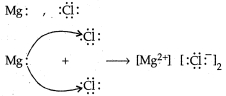
Write the electron dot structures of magnesium and chlorine and show the formation of magnesium chloride by the transfer of electrons.
Solution
(N/A) The atomic number of magnesium $(Mg)$ is $12$, and its electronic configuration is $2, 8, 2$. It has $2$ valence electrons.
The atomic number of chlorine $(Cl)$ is $17$, and its electronic configuration is $2, 8, 7$. It has $7$ valence electrons.
To form magnesium chloride $(MgCl_2)$, the magnesium atom loses $2$ electrons to achieve a stable octet configuration, forming a $Mg^{2+}$ ion.
Each of the two chlorine atoms gains $1$ electron from the magnesium atom to complete their octets, forming two $Cl^-$ ions.
The electron dot structure and transfer process are as follows:
$Mg: + 2 \cdot \ddot{Cl}: \rightarrow [Mg^{2+}] [: \ddot{Cl}:^-]_2$
The atomic number of chlorine $(Cl)$ is $17$, and its electronic configuration is $2, 8, 7$. It has $7$ valence electrons.
To form magnesium chloride $(MgCl_2)$, the magnesium atom loses $2$ electrons to achieve a stable octet configuration, forming a $Mg^{2+}$ ion.
Each of the two chlorine atoms gains $1$ electron from the magnesium atom to complete their octets, forming two $Cl^-$ ions.
The electron dot structure and transfer process are as follows:
$Mg: + 2 \cdot \ddot{Cl}: \rightarrow [Mg^{2+}] [: \ddot{Cl}:^-]_2$
0 likes
View Solution86
EasyMCQ
Why is sodium chloride soluble in water but not soluble in kerosene?
A
Water is a polar solvent,while kerosene is a non-polar solvent.
B
Sodium chloride is a covalent compound.
C
Kerosene is a polar solvent.
D
Sodium chloride does not dissociate in water.
Solution
(A) Sodium chloride $(NaCl)$ is an ionic compound consisting of $Na^+$ and $Cl^-$ ions held together by strong electrostatic forces of attraction.
Water is a polar solvent with a high dielectric constant,which helps in overcoming the electrostatic forces of attraction between the ions,allowing $NaCl$ to dissociate and dissolve.
Conversely,kerosene is a non-polar organic solvent.
It lacks the ability to provide the necessary energy to break the strong ionic bonds in $NaCl$,and therefore,$NaCl$ remains insoluble in it.
Water is a polar solvent with a high dielectric constant,which helps in overcoming the electrostatic forces of attraction between the ions,allowing $NaCl$ to dissociate and dissolve.
Conversely,kerosene is a non-polar organic solvent.
It lacks the ability to provide the necessary energy to break the strong ionic bonds in $NaCl$,and therefore,$NaCl$ remains insoluble in it.
0 likes
View Solution87
Medium
Give a reason to explain:
$(i)$ Why do aluminium sheets not corrode easily?
$(ii)$ Why is a copper vessel covered with a green coating in the rainy season?
$(i)$ Why do aluminium sheets not corrode easily?
$(ii)$ Why is a copper vessel covered with a green coating in the rainy season?
Solution
(N/A) $(i)$ Aluminium does not corrode easily because,upon exposure to air,its surface forms a thin,protective,and non-reactive layer of aluminium oxide $(Al_2O_3)$. This layer prevents further oxidation of the metal.
$(ii)$ Copper vessels develop a green coating in the rainy season because copper reacts with moist carbon dioxide $(CO_2)$ and water vapor in the air to form a mixture of copper carbonate $(CuCO_3)$ and copper hydroxide $(Cu(OH)_2)$,which is green in color.
$(ii)$ Copper vessels develop a green coating in the rainy season because copper reacts with moist carbon dioxide $(CO_2)$ and water vapor in the air to form a mixture of copper carbonate $(CuCO_3)$ and copper hydroxide $(Cu(OH)_2)$,which is green in color.
0 likes
View Solution88
Medium
$A$ compound $Z$ is formed by the transfer of electrons from a metal $X$ to a non-metal $Y$. Identify the type of bond formed in the compound. List three general properties of the compounds formed by such type of bonds.
Solution
(IONIC BOND) The bond formed by the transfer of electrons from a metal to a non-metal is an $Ionic$ bond.
The general properties of ionic compounds are:
$(i)$ They are usually crystalline solids due to strong electrostatic forces of attraction.
$(ii)$ They have high melting and boiling points.
$(iii)$ They are generally soluble in water but insoluble in organic solvents like kerosene or petrol.
$(iv)$ They conduct electricity in their molten state or in aqueous solution because the ions become free to move.
The general properties of ionic compounds are:
$(i)$ They are usually crystalline solids due to strong electrostatic forces of attraction.
$(ii)$ They have high melting and boiling points.
$(iii)$ They are generally soluble in water but insoluble in organic solvents like kerosene or petrol.
$(iv)$ They conduct electricity in their molten state or in aqueous solution because the ions become free to move.
0 likes
View Solution89
Medium
Give reasons for the following:
$(a)$ School bells are made of metals.
$(b)$ Electrical wires are made of copper.
$(a)$ School bells are made of metals.
$(b)$ Electrical wires are made of copper.
Solution
(N/A) Metals are sonorous,meaning they produce a ringing sound when struck. Therefore,they are used to make school bells.
$(b)$ Copper is an excellent conductor of electricity with low electrical resistance. Therefore,it is used for making electrical wires.
$(b)$ Copper is an excellent conductor of electricity with low electrical resistance. Therefore,it is used for making electrical wires.
0 likes
View Solution90
Medium
Out of the two metals $P$ and $Q$, $P$ is less reactive than $Q$. Suggest an activity to arrange these metals in the order of their decreasing reactivity. Support your answer with a suitable chemical equation.
Solution
(N/A) Activity: Take a small amount of the salt solution of metal $P$ in a test tube and add metal $Q$ to it. Since metal $Q$ is more reactive than metal $P$, it will displace metal $P$ from its salt solution.
Chemical equation:
Metal $Q + \text{Salt solution of } P \rightarrow \text{Salt solution of } Q + \text{Metal } P$
Chemical equation:
Metal $Q + \text{Salt solution of } P \rightarrow \text{Salt solution of } Q + \text{Metal } P$
0 likes
View Solution91
Easy
Define an alloy. How is an alloy prepared?
Solution
(N/A) An alloy is a homogeneous mixture of two or more metals or a metal and a non-metal.
It is prepared by first melting the primary metal and then dissolving the other elements in it in definite proportions.
It is prepared by first melting the primary metal and then dissolving the other elements in it in definite proportions.
0 likes
View Solution92
EasyMCQ
What happens to potassium and sodium if they are kept in the open? Why are they immersed in kerosene?
A
They react with oxygen and moisture in the air and catch fire.
B
They become inert and lose their metallic properties.
C
They turn into oxides and become stable.
D
They react with nitrogen and form nitrides.
Solution
(A) Sodium and potassium are highly reactive metals.
When kept in the open,they react vigorously with oxygen and moisture present in the atmosphere to form their respective oxides and hydroxides,releasing a large amount of heat.
This heat is sufficient to ignite the metal,causing it to catch fire.
Therefore,to prevent these reactions and accidental fires,they are stored immersed in kerosene oil,as they do not react with it.
When kept in the open,they react vigorously with oxygen and moisture present in the atmosphere to form their respective oxides and hydroxides,releasing a large amount of heat.
This heat is sufficient to ignite the metal,causing it to catch fire.
Therefore,to prevent these reactions and accidental fires,they are stored immersed in kerosene oil,as they do not react with it.
0 likes
View Solution93
Easy
Why is hydrogen gas not evolved when a metal reacts with nitric acid?
Solution
(N/A) Nitric acid $(HNO_{3})$ is a strong oxidizing agent. When a metal reacts with it,the hydrogen gas $(H_{2})$ produced is immediately oxidized to water $(H_{2}O)$ by the nitric acid. Simultaneously,the nitric acid itself gets reduced to various nitrogen oxides,such as nitrous oxide $(N_{2}O)$,nitric oxide $(NO)$,or nitrogen dioxide $(NO_{2})$.
0 likes
View Solution94
Medium
Why is iron galvanised with zinc? Can it be galvanised with copper? If not,why?
Solution
(N/A) Iron is galvanised with zinc to protect it from rusting. This is because zinc is more reactive (more electropositive) than iron,so it forms a protective layer that prevents corrosion. Copper is less reactive (less electropositive) than iron. Therefore,iron cannot be galvanised with copper because copper would actually accelerate the corrosion of iron if the coating were damaged.
0 likes
View Solution95
Medium
Differentiate between roasting and calcination and give examples.
Solution
(N/A)
| Roasting | Calcination |
| $1.$ In this,the ore is heated in the presence of excess air. | $1.$ In this,the ore is heated in the absence or limited supply of air. |
| $2.$ It is primarily done for sulphide ores. | $2.$ It is primarily done for carbonate ores. |
| $3.$ $SO_2$ gas is evolved. | $3.$ $CO_2$ gas is evolved. |
| $4.$ Example: $2ZnS + 3O_2 \xrightarrow{\text{heat}} 2ZnO + 2SO_2$ | $4.$ Example: $ZnCO_3 \xrightarrow{\text{heat}} ZnO + CO_2$ |
0 likes
View Solution96
Medium
Name the ore of mercury. How is mercury extracted from its ore?
Solution
(N/A) The primary ore of mercury is $HgS$,known as Cinnabar.
Extraction process:
$1$. Roasting: The ore $HgS$ is first heated in the presence of excess air to convert it into mercuric oxide $(HgO)$.
$2HgS + 3O_2 \xrightarrow{\Delta} 2HgO + 2SO_2$
$2$. Reduction: Mercuric oxide $(HgO)$ is then reduced to metallic mercury $(Hg)$ by further heating,as it is unstable at high temperatures.
$2HgO \xrightarrow{\Delta} 2Hg + O_2$
Extraction process:
$1$. Roasting: The ore $HgS$ is first heated in the presence of excess air to convert it into mercuric oxide $(HgO)$.
$2HgS + 3O_2 \xrightarrow{\Delta} 2HgO + 2SO_2$
$2$. Reduction: Mercuric oxide $(HgO)$ is then reduced to metallic mercury $(Hg)$ by further heating,as it is unstable at high temperatures.
$2HgO \xrightarrow{\Delta} 2Hg + O_2$
0 likes
View Solution97
Medium
How is copper obtained from $Cu_{2}S$? Give reactions.
Solution
(N/A) Copper is obtained from copper$(I)$ sulfide $(Cu_{2}S)$ through a process known as self-reduction or auto-reduction by heating it in the presence of air.
First,a portion of the copper$(I)$ sulfide is converted into copper$(I)$ oxide by heating it in air:
$2Cu_{2}S + 3O_{2} \xrightarrow{\Delta} 2Cu_{2}O + 2SO_{2}$
Then,the remaining copper$(I)$ sulfide reacts with the copper$(I)$ oxide formed to produce metallic copper:
$2Cu_{2}O + Cu_{2}S \xrightarrow{\Delta} 6Cu + SO_{2}$
First,a portion of the copper$(I)$ sulfide is converted into copper$(I)$ oxide by heating it in air:
$2Cu_{2}S + 3O_{2} \xrightarrow{\Delta} 2Cu_{2}O + 2SO_{2}$
Then,the remaining copper$(I)$ sulfide reacts with the copper$(I)$ oxide formed to produce metallic copper:
$2Cu_{2}O + Cu_{2}S \xrightarrow{\Delta} 6Cu + SO_{2}$
0 likes
View Solution98
Medium
Give reasons for the following:
$(i)$ Metals conduct electricity.
$(ii)$ Non-metals in general do not displace hydrogen from dilute acids.
$(iii)$ Aluminium easily combines with oxygen but still it can be used for making kitchen utensils.
$(i)$ Metals conduct electricity.
$(ii)$ Non-metals in general do not displace hydrogen from dilute acids.
$(iii)$ Aluminium easily combines with oxygen but still it can be used for making kitchen utensils.
Solution
(N/A) $(i)$ Metals contain free electrons that can move throughout the metallic lattice,allowing them to conduct electricity.
$(ii)$ Non-metals are electron acceptors. To displace hydrogen from dilute acids,electrons must be supplied to the $H^+$ ions of the acid. Since non-metals cannot donate electrons,they cannot displace hydrogen.
$(iii)$ Aluminium reacts with oxygen to form a thin,protective layer of aluminium oxide $(Al_2O_3)$ on its surface. This layer is non-reactive and prevents further oxidation of the underlying metal,making it suitable for kitchen utensils.
$(ii)$ Non-metals are electron acceptors. To displace hydrogen from dilute acids,electrons must be supplied to the $H^+$ ions of the acid. Since non-metals cannot donate electrons,they cannot displace hydrogen.
$(iii)$ Aluminium reacts with oxygen to form a thin,protective layer of aluminium oxide $(Al_2O_3)$ on its surface. This layer is non-reactive and prevents further oxidation of the underlying metal,making it suitable for kitchen utensils.
0 likes
View Solution99
Medium
Explain why calcium metal starts floating on the surface of water after reacting with it. Write the chemical equation for the reaction.
Solution
(N/A) Calcium reacts with water to form calcium hydroxide and hydrogen gas. The hydrogen gas produced during the reaction forms bubbles that stick to the surface of the calcium metal,causing it to float.
$Ca(s) + 2H_2O(l) \to Ca(OH)_2(aq) + H_2(g)$
$Ca(s) + 2H_2O(l) \to Ca(OH)_2(aq) + H_2(g)$
0 likes
View Solution100
MediumMCQ
When a metal $X$ is treated with cold water,it gives a basic salt $Y$ with molecular formula $XOH$ (Molecular mass $= 40$) and liberates a gas $Z$ which easily catches fire. Identify $X, Y, Z$.
A
$X = Na, Y = NaOH, Z = H_2$
B
$X = K, Y = KOH, Z = H_2$
C
$X = Ca, Y = Ca(OH)_2, Z = H_2$
D
$X = Mg, Y = Mg(OH)_2, Z = H_2$
Solution
(A) $(i)$ The molecular formula of $Y$ is $XOH$ and its molecular mass is $40$. The atomic mass of $O$ is $16$ and $H$ is $1$. Thus,$X + 16 + 1 = 40$,which gives $X = 23$. The element with atomic mass $23$ is Sodium $(Na)$.
$(ii)$ When sodium $(Na)$ reacts with cold water,it forms sodium hydroxide $(NaOH)$ and releases hydrogen gas $(H_2)$.
$(iii)$ Hydrogen gas $(H_2)$ is highly flammable and catches fire easily.
$(iv)$ Therefore,$X = Na$,$Y = NaOH$,and $Z = H_2$.
$(ii)$ When sodium $(Na)$ reacts with cold water,it forms sodium hydroxide $(NaOH)$ and releases hydrogen gas $(H_2)$.
$(iii)$ Hydrogen gas $(H_2)$ is highly flammable and catches fire easily.
$(iv)$ Therefore,$X = Na$,$Y = NaOH$,and $Z = H_2$.
0 likes
View SolutionMetals and Non-metals — Mix Examples - Metals and Non-metals · Frequently Asked Questions
1Are these Metals and Non-metals questions useful for JEE and NEET?
Yes. All questions in this section are mapped to JEE Main and NEET exam patterns. Previous year questions from JEE Main, NEET, GUJCET and state-level exams are included with full solutions.
2Can I switch to Hindi or Gujarati for these questions?
Yes. Use the language tabs in the hero section or the sidebar to view the same questions and solutions in English, Hindi or Gujarati.
3How do I generate a question paper from this subtopic?
Use the Vedclass Exam Paper Generator — select the chapter and subtopic, set difficulty, and generate Sets A, B, C, D automatically. First 3 chapters of every subject are free.
Vedclass Products
For Students
Vedclass Test Series
Mock tests in real JEE/NEET style with performance analysis. 5-day free trial.
Start Free TrialFor Teachers
Exam Paper Generator
Generate Set A/B/C/D papers from this chapter in 2 minutes. 3 chapters free.
Try FreeFor Institutes
Online Exam Module
Live online exams with unlimited students, 360° analytics & white-label branding.
See DemoFor Teachers & Institutes
Generate a Metals and Non-metals Exam Paper in 2 Minutes
Select subtopic & difficulty — Sets A, B, C, D auto-generated with No Repeat logic.
First 3 chapters of every subject are free — no payment required.