
A English
Mix Examples - Metals and Non-metals Questions in English
Class 10 Science · Metals and Non-metals · Mix Examples - Metals and Non-metals
412+
Questions
English
Language
100%
With Solutions
Showing 50 of 412 questions in English
101
Medium
Name the following:
$(a)$ $A$ metal which is preserved in kerosene.
$(b)$ $A$ lustrous coloured non-metal.
$(c)$ $A$ metal which can melt while kept on palm.
$(d)$ $A$ metal which is a poor conductor of heat.
$(a)$ $A$ metal which is preserved in kerosene.
$(b)$ $A$ lustrous coloured non-metal.
$(c)$ $A$ metal which can melt while kept on palm.
$(d)$ $A$ metal which is a poor conductor of heat.
Solution
(N/A) Sodium $(Na)$ is a highly reactive metal that reacts vigorously with oxygen and moisture in the air,so it is stored in kerosene to prevent reaction.
$(b)$ Iodine $(I_2)$ is a non-metal that possesses a characteristic lustrous appearance and is purple-black in colour.
$(c)$ Gallium $(Ga)$ and Caesium $(Cs)$ have very low melting points and melt when held in the palm of a human hand.
$(d)$ Lead $(Pb)$ and Mercury $(Hg)$ are metals that are poor conductors of heat compared to other metals like copper or silver.
$(b)$ Iodine $(I_2)$ is a non-metal that possesses a characteristic lustrous appearance and is purple-black in colour.
$(c)$ Gallium $(Ga)$ and Caesium $(Cs)$ have very low melting points and melt when held in the palm of a human hand.
$(d)$ Lead $(Pb)$ and Mercury $(Hg)$ are metals that are poor conductors of heat compared to other metals like copper or silver.
0 likes
View Solution102
Easy
Why do ionic compounds have high melting points? State the reason.
Solution
(N/A) Ionic compounds are formed by the transfer of electrons between atoms,resulting in the formation of positively charged cations and negatively charged anions.
These oppositely charged ions are held together by very strong electrostatic forces of attraction.
Because of these strong inter-ionic forces,a significant amount of energy is required to break the crystal lattice and overcome these forces,which results in high melting and boiling points.
These oppositely charged ions are held together by very strong electrostatic forces of attraction.
Because of these strong inter-ionic forces,a significant amount of energy is required to break the crystal lattice and overcome these forces,which results in high melting and boiling points.
0 likes
View Solution103
MediumMCQ
$A$ metal $M$ forms an oxide having the formula $M_{2}O_{3}$. It dissolves in both dilute sulphuric acid and dilute sodium hydroxide solution. Identify the metal and write the chemical equations for the reactions involved.
A
Aluminium $(Al)$
B
Iron $(Fe)$
C
Copper $(Cu)$
D
Zinc $(Zn)$
Solution
(A) The metal $M$ is Aluminium $(Al)$.
The oxide $Al_{2}O_{3}$ is amphoteric in nature,meaning it reacts with both acids and bases.
Reaction with dilute sulphuric acid:
$Al_{2}O_{3}(s) + 3H_{2}SO_{4}(aq) \rightarrow Al_{2}(SO_{4})_{3}(aq) + 3H_{2}O(l)$
Reaction with dilute sodium hydroxide solution:
$Al_{2}O_{3}(s) + 2NaOH(aq) + 3H_{2}O(l) \rightarrow 2Na[Al(OH)_{4}](aq)$ (or Sodium aluminate $2NaAlO_{2} + H_{2}O$)
The oxide $Al_{2}O_{3}$ is amphoteric in nature,meaning it reacts with both acids and bases.
Reaction with dilute sulphuric acid:
$Al_{2}O_{3}(s) + 3H_{2}SO_{4}(aq) \rightarrow Al_{2}(SO_{4})_{3}(aq) + 3H_{2}O(l)$
Reaction with dilute sodium hydroxide solution:
$Al_{2}O_{3}(s) + 2NaOH(aq) + 3H_{2}O(l) \rightarrow 2Na[Al(OH)_{4}](aq)$ (or Sodium aluminate $2NaAlO_{2} + H_{2}O$)
0 likes
View Solution104
Medium
State the conditions under which the following metals react with water. Write the equation for each reaction:
$(a)$ $Na$
$(b)$ $Mg$
$(c)$ $Fe$
$(a)$ $Na$
$(b)$ $Mg$
$(c)$ $Fe$
Solution
(N/A) $Na$ reacts vigorously with cold water.
$2Na(s) + 2H_2O(l) \rightarrow 2NaOH(aq) + H_2(g)$
$(b)$ $Mg$ does not react with cold water but reacts with hot water.
$Mg(s) + 2H_2O(l) \rightarrow Mg(OH)_2(aq) + H_2(g)$
$(c)$ $Fe$ does not react with cold or hot water but reacts with steam.
$3Fe(s) + 4H_2O(g) \rightarrow Fe_3O_4(s) + 4H_2(g)$
$2Na(s) + 2H_2O(l) \rightarrow 2NaOH(aq) + H_2(g)$
$(b)$ $Mg$ does not react with cold water but reacts with hot water.
$Mg(s) + 2H_2O(l) \rightarrow Mg(OH)_2(aq) + H_2(g)$
$(c)$ $Fe$ does not react with cold or hot water but reacts with steam.
$3Fe(s) + 4H_2O(g) \rightarrow Fe_3O_4(s) + 4H_2(g)$
0 likes
View Solution105
Difficult
$(a)$ $A$ substance $X$,an oxide of a metal,is used extensively in the cement industry. This element is found in our bones also. On treatment with water,it forms a solution which turns red litmus blue. Identify $X$ and also write the chemical reaction involved.
$(b)$ Choose a metal from the following metals which reacts only with hot water: Sodium,magnesium,iron. Mention the products formed during the reaction.
$(b)$ Choose a metal from the following metals which reacts only with hot water: Sodium,magnesium,iron. Mention the products formed during the reaction.
Solution
(N/A) The element found in bones is Calcium $(Ca)$. The oxide of this metal used in the cement industry is Calcium oxide $(CaO)$,also known as quicklime.
When $CaO$ reacts with water,it forms Calcium hydroxide $(Ca(OH)_2)$,which is basic in nature and turns red litmus blue.
The chemical reaction is: $CaO(s) + H_2O(l) \rightarrow Ca(OH)_2(aq)$.
$(b)$ Among the given metals,Magnesium $(Mg)$ reacts only with hot water.
The products formed are Magnesium hydroxide $(Mg(OH)_2)$ and Hydrogen gas $(H_2)$.
The chemical reaction is: $Mg(s) + 2H_2O(l) \rightarrow Mg(OH)_2(aq) + H_2(g)$.
When $CaO$ reacts with water,it forms Calcium hydroxide $(Ca(OH)_2)$,which is basic in nature and turns red litmus blue.
The chemical reaction is: $CaO(s) + H_2O(l) \rightarrow Ca(OH)_2(aq)$.
$(b)$ Among the given metals,Magnesium $(Mg)$ reacts only with hot water.
The products formed are Magnesium hydroxide $(Mg(OH)_2)$ and Hydrogen gas $(H_2)$.
The chemical reaction is: $Mg(s) + 2H_2O(l) \rightarrow Mg(OH)_2(aq) + H_2(g)$.
0 likes
View Solution106
Medium
Write chemical equations for the reactions taking place when:
$(i)$ Iron reacts with steam.
$(ii)$ Magnesium $(Mg)$ reacts with dilute $HCl$.
$(iii)$ Copper is heated in air.
$(i)$ Iron reacts with steam.
$(ii)$ Magnesium $(Mg)$ reacts with dilute $HCl$.
$(iii)$ Copper is heated in air.
Solution
(N/A) $(i)$ $3Fe(s) + 4H_2O(g) \rightarrow Fe_3O_4(s) + 4H_2(g)$
$(ii)$ $Mg(s) + 2HCl(aq) \rightarrow MgCl_2(aq) + H_2(g)$
$(iii)$ $2Cu(s) + O_2(g) \xrightarrow{\Delta} 2CuO(s)$
$(ii)$ $Mg(s) + 2HCl(aq) \rightarrow MgCl_2(aq) + H_2(g)$
$(iii)$ $2Cu(s) + O_2(g) \xrightarrow{\Delta} 2CuO(s)$
0 likes
View Solution107
Medium
How can metals be differentiated from non-metals on the basis of any three chemical properties?
Solution
(N/A)
| Metals | Non-Metals |
|---|---|
| $1$. Burn in air to form metal oxides which are basic in nature. | $1$. Burn in air to form non-metal oxides which are acidic in nature. |
| $2$. React with acids to form salt and hydrogen gas. | $2$. They are electron acceptors,so they cannot produce hydrogen gas from acids. |
| $3$. Metals form ionic compounds with non-metals. $e.g., NaCl$. | $3$. Non-metals form covalent compounds with other non-metals. $e.g., CCl_4$. |
0 likes
View Solution108
Medium
Name two metals in each of the following cases:
$(i)$ Metals that are stored in kerosene.
$(ii)$ Metals that are alloyed with iron to make stainless steel.
$(iii)$ Metals which are highly malleable and ductile.
$(i)$ Metals that are stored in kerosene.
$(ii)$ Metals that are alloyed with iron to make stainless steel.
$(iii)$ Metals which are highly malleable and ductile.
Solution
(N/A) $(i)$ Sodium $(Na)$ and potassium $(K)$ are highly reactive metals that react vigorously with moisture and oxygen in the air,so they are stored in kerosene to prevent reaction.
$(ii)$ Nickel $(Ni)$ and chromium $(Cr)$ are added to iron $(Fe)$ to produce stainless steel,which is resistant to corrosion.
$(iii)$ Gold $(Au)$ and silver $(Ag)$ are the most malleable and ductile metals,allowing them to be beaten into thin sheets and drawn into thin wires.
$(ii)$ Nickel $(Ni)$ and chromium $(Cr)$ are added to iron $(Fe)$ to produce stainless steel,which is resistant to corrosion.
$(iii)$ Gold $(Au)$ and silver $(Ag)$ are the most malleable and ductile metals,allowing them to be beaten into thin sheets and drawn into thin wires.
0 likes
View Solution109
Medium
Write chemical equations for the reactions taking place when:
$(i)$ iron is strongly heated in air.
$(ii)$ lead carbonate is calcined.
$(iii)$ chromium oxide $(Cr_{2}O_{3})$ is heated with aluminium powder.
$(i)$ iron is strongly heated in air.
$(ii)$ lead carbonate is calcined.
$(iii)$ chromium oxide $(Cr_{2}O_{3})$ is heated with aluminium powder.
Solution
(N/A) $(i)$ Iron does not burn in air even on strong heating. At high temperature,it combines with oxygen of the air to form $Fe_{3}O_{4}$.
$3Fe(s) + 2O_{2}(g) \xrightarrow{\text{Heat}} Fe_{3}O_{4}(s)$
$(ii)$ Calcination of lead carbonate involves heating the ore in the absence of air.
$PbCO_{3}(s) \xrightarrow{\text{Heat}} PbO(s) + CO_{2}(g)$
$(iii)$ This is a thermite reaction where aluminium acts as a reducing agent.
$Cr_{2}O_{3}(s) + 2Al(s) \rightarrow Al_{2}O_{3}(s) + 2Cr(l) + \text{Heat}$
$3Fe(s) + 2O_{2}(g) \xrightarrow{\text{Heat}} Fe_{3}O_{4}(s)$
$(ii)$ Calcination of lead carbonate involves heating the ore in the absence of air.
$PbCO_{3}(s) \xrightarrow{\text{Heat}} PbO(s) + CO_{2}(g)$
$(iii)$ This is a thermite reaction where aluminium acts as a reducing agent.
$Cr_{2}O_{3}(s) + 2Al(s) \rightarrow Al_{2}O_{3}(s) + 2Cr(l) + \text{Heat}$
0 likes
View Solution110
Difficult
$A, B$ and $C$ are three elements which undergo chemical reactions according to the following equations:
$A_{2}O_{3} + 2B \rightarrow B_{2}O_{3} + 2A$
$3CSO_{4} + 2B \rightarrow B_{2}(SO_{4})_{3} + 3C$
$3CO + 2A \rightarrow A_{2}O_{3} + 3C$
$(a)$ Which element is the most reactive?
$(b)$ Which element is the least reactive?
$(c)$ What is the type of reactions listed above?
$A_{2}O_{3} + 2B \rightarrow B_{2}O_{3} + 2A$
$3CSO_{4} + 2B \rightarrow B_{2}(SO_{4})_{3} + 3C$
$3CO + 2A \rightarrow A_{2}O_{3} + 3C$
$(a)$ Which element is the most reactive?
$(b)$ Which element is the least reactive?
$(c)$ What is the type of reactions listed above?
Solution
(N/A) The most reactive element is $B$ because it displaces both $A$ and $C$ from their respective compounds.
$(b)$ The least reactive element is $C$ because it is displaced by both $A$ and $B$ in the given reactions.
$(c)$ These are displacement reactions,specifically single displacement reactions.
$(b)$ The least reactive element is $C$ because it is displaced by both $A$ and $B$ in the given reactions.
$(c)$ These are displacement reactions,specifically single displacement reactions.
0 likes
View Solution111
Medium
$(i)$ Arrange the following metals in the order of their decreasing activities: Aluminium, Gold, Sodium, Copper.
$(ii)$ Give the reaction of aluminium powder with manganese dioxide on heating.
$(ii)$ Give the reaction of aluminium powder with manganese dioxide on heating.
Solution
(N/A) $(i)$ The order of decreasing reactivity is: Sodium > Aluminium > Copper > Gold.
$(ii)$ When aluminium powder is heated with manganese dioxide, a thermite reaction occurs, producing manganese metal and aluminium oxide: $4Al(s) + 3MnO_2(s) \xrightarrow{\Delta} 3Mn(l) + 2Al_2O_3(s) + \text{Heat}$.
$(ii)$ When aluminium powder is heated with manganese dioxide, a thermite reaction occurs, producing manganese metal and aluminium oxide: $4Al(s) + 3MnO_2(s) \xrightarrow{\Delta} 3Mn(l) + 2Al_2O_3(s) + \text{Heat}$.
0 likes
View Solution112
Medium
List three properties of sodium in which it differs from the general physical properties of most metals.
Solution
(N/A) $(i)$ Sodium is so soft that it can be cut with a knife.
$(ii)$ It has a low density compared to most metals.
$(iii)$ It has a low melting point.
$(ii)$ It has a low density compared to most metals.
$(iii)$ It has a low melting point.
0 likes
View Solution113
Medium
Describe ionic compounds on the basis of the following properties:
$(i)$ Strong force of attraction between positive and negative ions:
$(ii)$ Solubility of compounds in water.
$(iii)$ Electrical conductivity.
$(i)$ Strong force of attraction between positive and negative ions:
$(ii)$ Solubility of compounds in water.
$(iii)$ Electrical conductivity.
Solution
(N/A) $(i)$ Due to the strong electrostatic force of attraction between the oppositely charged ions,ionic compounds exist as solids. They are generally brittle and break into pieces when pressure is applied.
$(ii)$ Ionic compounds are generally soluble in water because the polar water molecules break the ionic bonds.
$(iii)$ Ionic compounds do not conduct electricity in the solid state because the ions are held in a fixed lattice. However,they conduct electricity in the aqueous or molten state because the ions become free to move.
$(ii)$ Ionic compounds are generally soluble in water because the polar water molecules break the ionic bonds.
$(iii)$ Ionic compounds do not conduct electricity in the solid state because the ions are held in a fixed lattice. However,they conduct electricity in the aqueous or molten state because the ions become free to move.
0 likes
View Solution114
Medium
$(i)$ Name a metal which does not stick to glass.
$(ii)$ Name the metal which is commonly used in thermite welding.
$(iii)$ What is the nature of zinc oxide?
$(ii)$ Name the metal which is commonly used in thermite welding.
$(iii)$ What is the nature of zinc oxide?
Solution
(N/A) $(i)$ Mercury $(Hg)$ is a metal that does not stick to glass due to its high surface tension and weak adhesive forces with glass.
$(ii)$ Aluminium $(Al)$ is the metal commonly used in thermite welding because it acts as a strong reducing agent when reacting with metal oxides.
$(iii)$ Zinc oxide $(ZnO)$ is amphoteric in nature,meaning it reacts with both acids and bases to form salt and water.
$(ii)$ Aluminium $(Al)$ is the metal commonly used in thermite welding because it acts as a strong reducing agent when reacting with metal oxides.
$(iii)$ Zinc oxide $(ZnO)$ is amphoteric in nature,meaning it reacts with both acids and bases to form salt and water.
0 likes
View Solution115
Medium
$(a)$ 'Sodium is a highly reactive metal and it cannot be obtained from its oxide by heating with carbon'. Give reason.
$(b)$ How can sodium be obtained from sodium chloride?
$(b)$ How can sodium be obtained from sodium chloride?
Solution
(N/A) Sodium is a highly reactive metal with a very high affinity for oxygen. Carbon is a weaker reducing agent than sodium,so it cannot reduce sodium oxide to sodium metal.
$(b)$ Sodium is obtained from molten sodium chloride $(NaCl)$ by the process of electrolytic reduction (electrolysis). During this process,sodium ions $(Na^+)$ are reduced at the cathode to form metallic sodium $(Na)$.
$(b)$ Sodium is obtained from molten sodium chloride $(NaCl)$ by the process of electrolytic reduction (electrolysis). During this process,sodium ions $(Na^+)$ are reduced at the cathode to form metallic sodium $(Na)$.
0 likes
View Solution116
Medium
$(i)$ Define the term 'anode mud'. Name the electrode made of pure metal.
$(ii)$ Give the reactions taking place at cathode and at anode during the electrolytic refining of copper.
$(ii)$ Give the reactions taking place at cathode and at anode during the electrolytic refining of copper.
Solution
(N/A) $(i)$ The insoluble impurities that settle down at the bottom of the anode during electrolytic refining are known as 'anode mud'. The cathode is made of a thin strip of pure metal.
$(ii)$ During the electrolytic refining of copper:
At anode: $Cu(s) \rightarrow Cu^{2+}(aq) + 2e^-$
At cathode: $Cu^{2+}(aq) + 2e^- \rightarrow Cu(s)$
$(ii)$ During the electrolytic refining of copper:
At anode: $Cu(s) \rightarrow Cu^{2+}(aq) + 2e^-$
At cathode: $Cu^{2+}(aq) + 2e^- \rightarrow Cu(s)$
0 likes
View Solution117
Medium
Name two metals which are purified by electrolytic refining. Mention the anode,cathode and the electrolyte used in the refining process. At which electrode would the pure metal be deposited?
Solution
(N/A) Two metals purified by electrolytic refining are $Copper$ $(Cu)$ and $Zinc$ $(Zn)$.
In the electrolytic refining process:
$1$. The $Anode$ is made of an impure block of the metal.
$2$. The $Cathode$ is made of a thin strip of pure metal.
$3$. The $Electrolyte$ is an aqueous solution of a salt of the metal being refined.
The pure metal is deposited on the $Cathode$.
In the electrolytic refining process:
$1$. The $Anode$ is made of an impure block of the metal.
$2$. The $Cathode$ is made of a thin strip of pure metal.
$3$. The $Electrolyte$ is an aqueous solution of a salt of the metal being refined.
The pure metal is deposited on the $Cathode$.
0 likes
View Solution118
Medium
Write the balanced chemical equation for each of the following cases:
$(a)$ Magnesium is treated with very dilute $HNO_3$.
$(b)$ Aluminium powder is added to $Fe_2O_3$.
$(c)$ Zinc sulphide is roasted.
$(a)$ Magnesium is treated with very dilute $HNO_3$.
$(b)$ Aluminium powder is added to $Fe_2O_3$.
$(c)$ Zinc sulphide is roasted.
Solution
(N/A) Magnesium reacts with very dilute nitric acid to produce magnesium nitrate and hydrogen gas:
$Mg(s) + 2HNO_3(aq) \longrightarrow Mg(NO_3)_2(aq) + H_2(g)$
$(b)$ Aluminium powder reacts with iron$(III)$ oxide in a thermite reaction to produce iron and aluminium oxide:
$Fe_2O_3(s) + 2Al(s) \longrightarrow 2Fe(l) + Al_2O_3(s) + \text{Heat}$
$(c)$ Zinc sulphide is roasted in the presence of oxygen to produce zinc oxide and sulphur dioxide gas:
$2ZnS(s) + 3O_2(g) \xrightarrow{\Delta} 2ZnO(s) + 2SO_2(g)$
$Mg(s) + 2HNO_3(aq) \longrightarrow Mg(NO_3)_2(aq) + H_2(g)$
$(b)$ Aluminium powder reacts with iron$(III)$ oxide in a thermite reaction to produce iron and aluminium oxide:
$Fe_2O_3(s) + 2Al(s) \longrightarrow 2Fe(l) + Al_2O_3(s) + \text{Heat}$
$(c)$ Zinc sulphide is roasted in the presence of oxygen to produce zinc oxide and sulphur dioxide gas:
$2ZnS(s) + 3O_2(g) \xrightarrow{\Delta} 2ZnO(s) + 2SO_2(g)$
0 likes
View Solution119
Medium
$(a)$ Consider the following chemical equation:
$Fe_{2}O_{3} + 2Al \rightarrow Al_{2}O_{3} + 2Fe$
Name two categories in which you can place this reaction.
$(b)$ Define the term 'Oxidation' of a substance and name the substance oxidised and the oxidising agent in the above reaction.
$Fe_{2}O_{3} + 2Al \rightarrow Al_{2}O_{3} + 2Fe$
Name two categories in which you can place this reaction.
$(b)$ Define the term 'Oxidation' of a substance and name the substance oxidised and the oxidising agent in the above reaction.
Solution
(N/A) The two categories for this reaction are:
$(i)$ Displacement reaction (specifically,a thermite reaction).
$(ii)$ Redox reaction (reduction-oxidation reaction).
$(b)$ Oxidation is defined as the addition of oxygen to a substance or the removal of hydrogen from a substance.
In the given reaction:
- Aluminium $(Al)$ is oxidised because it gains oxygen to form $Al_{2}O_{3}$.
- Iron$(III)$ oxide $(Fe_{2}O_{3})$ is the oxidising agent because it provides oxygen to aluminium.
$(i)$ Displacement reaction (specifically,a thermite reaction).
$(ii)$ Redox reaction (reduction-oxidation reaction).
$(b)$ Oxidation is defined as the addition of oxygen to a substance or the removal of hydrogen from a substance.
In the given reaction:
- Aluminium $(Al)$ is oxidised because it gains oxygen to form $Al_{2}O_{3}$.
- Iron$(III)$ oxide $(Fe_{2}O_{3})$ is the oxidising agent because it provides oxygen to aluminium.
0 likes
View Solution120
Medium
What is thermit reaction? How is it used to join the railway tracks or cracked machine parts?
Solution
(N/A) The reaction which is highly exothermic and in which metal is produced in the molten state is known as the thermit reaction.
Consider the following displacement reaction:
$Fe_{2}O_{3}(s) + 2Al(s) \xrightarrow{\text{Heat}} Al_{2}O_{3}(s) + 2Fe(l) + \text{Heat}$
In this reaction,when iron $(III)$ oxide $(Fe_{2}O_{3})$ is heated with aluminium powder $(Al)$,the amount of heat evolved is so large that the iron $(Fe)$ metal is produced in a molten state.
This molten iron flows into the gaps of the railway tracks or cracked machine parts and,upon cooling,solidifies to join them together.
Consider the following displacement reaction:
$Fe_{2}O_{3}(s) + 2Al(s) \xrightarrow{\text{Heat}} Al_{2}O_{3}(s) + 2Fe(l) + \text{Heat}$
In this reaction,when iron $(III)$ oxide $(Fe_{2}O_{3})$ is heated with aluminium powder $(Al)$,the amount of heat evolved is so large that the iron $(Fe)$ metal is produced in a molten state.
This molten iron flows into the gaps of the railway tracks or cracked machine parts and,upon cooling,solidifies to join them together.
0 likes
View Solution121
Medium
$(a)$ Show the formation of $MgO$ by the transfer of electrons.
$(b)$ Name the cation and anion.
$(c)$ Write three properties of ionic compounds.
$(b)$ Name the cation and anion.
$(c)$ Write three properties of ionic compounds.
Solution
(N/A) Formation of $MgO$:
$Mg (2, 8, 2) \to Mg^{2+} + 2e^-$
$O (2, 6) + 2e^- \to O^{2-}$
$Mg^{2+} + O^{2-} \to MgO$
$(b)$ $(i)$ Cation: Magnesium ion $(Mg^{2+})$.
$(ii)$ Anion: Oxide ion $(O^{2-})$.
$(c)$ Properties of ionic compounds:
$(i)$ They are generally crystalline solids and are soluble in water.
$(ii)$ They have high melting and boiling points due to strong electrostatic forces of attraction.
$(iii)$ They conduct electricity in the molten state or in aqueous solution because the ions are free to move.
$Mg (2, 8, 2) \to Mg^{2+} + 2e^-$
$O (2, 6) + 2e^- \to O^{2-}$
$Mg^{2+} + O^{2-} \to MgO$
$(b)$ $(i)$ Cation: Magnesium ion $(Mg^{2+})$.
$(ii)$ Anion: Oxide ion $(O^{2-})$.
$(c)$ Properties of ionic compounds:
$(i)$ They are generally crystalline solids and are soluble in water.
$(ii)$ They have high melting and boiling points due to strong electrostatic forces of attraction.
$(iii)$ They conduct electricity in the molten state or in aqueous solution because the ions are free to move.
0 likes
View Solution122
Medium
Account for the following:
$(a)$ Aluminium is more reactive than iron,but its corrosion is less than iron.
$(b)$ Hydrogen gas is not evolved when zinc metal reacts with dilute $HNO_3$.
$(c)$ Carbon is not used for reducing aluminium from aluminium oxide.
$(a)$ Aluminium is more reactive than iron,but its corrosion is less than iron.
$(b)$ Hydrogen gas is not evolved when zinc metal reacts with dilute $HNO_3$.
$(c)$ Carbon is not used for reducing aluminium from aluminium oxide.
Solution
(N/A) Aluminium forms a strong,non-porous,and protective layer of aluminium oxide $(Al_2O_3)$ on its surface upon exposure to air. This layer does not peel off easily and prevents further oxidation or corrosion of the underlying metal.
$(b)$ Dilute $HNO_3$ is a strong oxidising agent. When it reacts with metals like zinc,it oxidises the hydrogen gas produced during the reaction into water $(H_2O)$ and itself gets reduced to nitrogen oxides (such as $N_2O$,$NO$,or $NO_2$).
$(c)$ Aluminium has a much higher affinity for oxygen than carbon does. Therefore,carbon cannot effectively remove oxygen from aluminium oxide $(Al_2O_3)$ to produce aluminium metal. Consequently,electrolytic reduction is used instead of carbon reduction.
$(b)$ Dilute $HNO_3$ is a strong oxidising agent. When it reacts with metals like zinc,it oxidises the hydrogen gas produced during the reaction into water $(H_2O)$ and itself gets reduced to nitrogen oxides (such as $N_2O$,$NO$,or $NO_2$).
$(c)$ Aluminium has a much higher affinity for oxygen than carbon does. Therefore,carbon cannot effectively remove oxygen from aluminium oxide $(Al_2O_3)$ to produce aluminium metal. Consequently,electrolytic reduction is used instead of carbon reduction.
0 likes
View Solution123
Medium
$(a)$ Why does calcium start floating when added to water?
$(b)$ Most metals do not release hydrogen gas when reacting with nitric acid. Why?
$(c)$ Write the chemical equation for the reaction of iron with steam. Name the compound of iron obtained.
$(b)$ Most metals do not release hydrogen gas when reacting with nitric acid. Why?
$(c)$ Write the chemical equation for the reaction of iron with steam. Name the compound of iron obtained.
Solution
(A) Calcium starts floating when added to water because the bubbles of hydrogen gas formed during the reaction stick to the surface of the metal,making it buoyant.
$(b)$ Nitric acid $(HNO_{3})$ is a strong oxidizing agent. When it reacts with metals,it oxidizes the hydrogen gas produced to water $(H_{2}O)$ and itself gets reduced to nitrogen oxides $(N_{2}O, NO, NO_{2})$.
$(c)$ The chemical equation is: $3Fe(s) + 4H_{2}O(g) \rightarrow Fe_{3}O_{4}(s) + 4H_{2}(g)$.
The compound obtained is iron($II$,$III$) oxide,also known as ferroferric oxide $(Fe_{3}O_{4})$.
$(b)$ Nitric acid $(HNO_{3})$ is a strong oxidizing agent. When it reacts with metals,it oxidizes the hydrogen gas produced to water $(H_{2}O)$ and itself gets reduced to nitrogen oxides $(N_{2}O, NO, NO_{2})$.
$(c)$ The chemical equation is: $3Fe(s) + 4H_{2}O(g) \rightarrow Fe_{3}O_{4}(s) + 4H_{2}(g)$.
The compound obtained is iron($II$,$III$) oxide,also known as ferroferric oxide $(Fe_{3}O_{4})$.
0 likes
View Solution124
Medium
Define alloys. List the properties of alloys that make them useful over pure metals. Explain this fact with suitable examples.
Solution
(N/A) An alloy is a homogeneous mixture of two or more metals,or a metal and a non-metal,which cannot be separated into its components by physical methods.
Properties that make alloys more useful than pure metals:
$(i)$ Alloys are often harder and stronger than their constituent pure metals.
$(ii)$ They are more resistant to corrosion.
$(iii)$ Their electrical conductivity is generally lower than that of pure metals.
$(iv)$ Their melting point is lower than that of pure metals.
Examples:
$(a)$ Brass (an alloy of $Cu$ and $Zn$) and Bronze (an alloy of $Cu$ and $Sn$) are not good conductors of electricity,whereas pure copper is an excellent conductor used in electrical circuits.
$(b)$ Solder (an alloy of $Pb$ and $Sn$) has a very low melting point,making it ideal for welding electrical wires together.
Properties that make alloys more useful than pure metals:
$(i)$ Alloys are often harder and stronger than their constituent pure metals.
$(ii)$ They are more resistant to corrosion.
$(iii)$ Their electrical conductivity is generally lower than that of pure metals.
$(iv)$ Their melting point is lower than that of pure metals.
Examples:
$(a)$ Brass (an alloy of $Cu$ and $Zn$) and Bronze (an alloy of $Cu$ and $Sn$) are not good conductors of electricity,whereas pure copper is an excellent conductor used in electrical circuits.
$(b)$ Solder (an alloy of $Pb$ and $Sn$) has a very low melting point,making it ideal for welding electrical wires together.
0 likes
View Solution125
Medium
$(a)$ What type of ores are calcined? Illustrate by giving a suitable example.
$(b)$ In what form is the calcined ore obtained,and how can it be reduced? Give chemical equations of the reduction process involved for the example provided by you.
$(c)$ Name two metals used as reducing agents by displacing metals of lower reactivity from their compounds.
$(b)$ In what form is the calcined ore obtained,and how can it be reduced? Give chemical equations of the reduction process involved for the example provided by you.
$(c)$ Name two metals used as reducing agents by displacing metals of lower reactivity from their compounds.
Solution
(N/A) Carbonate ores are subjected to calcination.
Example: Zinc carbonate $(ZnCO_{3})$ is calcined to form zinc oxide $(ZnO)$.
$ZnCO_{3}(s) \xrightarrow{\text{Heat}} ZnO(s) + CO_{2}(g)$
$(b)$ The calcined ore is obtained in the form of a metal oxide. It can be reduced to the metal using a reducing agent like carbon (coke) or by electrolytic reduction.
For the example of zinc oxide $(ZnO)$:
$ZnO(s) + C(s) \rightarrow Zn(s) + CO(g)$
$(c)$ Two metals used as reducing agents are Aluminum $(Al)$ and Sodium $(Na)$.
Example: Zinc carbonate $(ZnCO_{3})$ is calcined to form zinc oxide $(ZnO)$.
$ZnCO_{3}(s) \xrightarrow{\text{Heat}} ZnO(s) + CO_{2}(g)$
$(b)$ The calcined ore is obtained in the form of a metal oxide. It can be reduced to the metal using a reducing agent like carbon (coke) or by electrolytic reduction.
For the example of zinc oxide $(ZnO)$:
$ZnO(s) + C(s) \rightarrow Zn(s) + CO(g)$
$(c)$ Two metals used as reducing agents are Aluminum $(Al)$ and Sodium $(Na)$.
0 likes
View Solution126
Difficult
$(a)$ An ore on heating in air gives sulphur dioxide gas. Name the method in each metallurgical step that will be required to extract this metal from its ore.
$(b)$ State which of the following reactions will take place or not,giving a suitable reason for each.
$Zn(s) + CuSO_4(aq) \rightarrow ZnSO_4(aq) + Cu(s)$
$Fe(s) + ZnSO_4(aq) \rightarrow FeSO_4(aq) + Zn(s)$
$(b)$ State which of the following reactions will take place or not,giving a suitable reason for each.
$Zn(s) + CuSO_4(aq) \rightarrow ZnSO_4(aq) + Cu(s)$
$Fe(s) + ZnSO_4(aq) \rightarrow FeSO_4(aq) + Zn(s)$
Solution
(A) Since the ore releases $SO_2$ gas upon heating in air,it is a sulphide ore.
The steps of metallurgy are as follows:
$(i)$ Concentration of ore: Usually done by the froth floatation process for sulphide ores.
$(ii)$ Roasting: The concentrated sulphide ore is heated strongly in the presence of excess air to convert it into metal oxide.
$(iii)$ Reduction: The metal oxide is reduced to the metal by heating with a reducing agent like carbon or by self-reduction.
$(b)$ $(i)$ $Zn(s) + CuSO_4(aq) \rightarrow ZnSO_4(aq) + Cu(s)$ : This reaction will take place because $Zn$ is more reactive than $Cu$ and can displace it from its salt solution.
$(ii)$ $Fe(s) + ZnSO_4(aq) \rightarrow FeSO_4(aq) + Zn(s)$ : This reaction will not take place because $Fe$ is less reactive than $Zn$ and cannot displace $Zn$ from its salt solution.
The steps of metallurgy are as follows:
$(i)$ Concentration of ore: Usually done by the froth floatation process for sulphide ores.
$(ii)$ Roasting: The concentrated sulphide ore is heated strongly in the presence of excess air to convert it into metal oxide.
$(iii)$ Reduction: The metal oxide is reduced to the metal by heating with a reducing agent like carbon or by self-reduction.
$(b)$ $(i)$ $Zn(s) + CuSO_4(aq) \rightarrow ZnSO_4(aq) + Cu(s)$ : This reaction will take place because $Zn$ is more reactive than $Cu$ and can displace it from its salt solution.
$(ii)$ $Fe(s) + ZnSO_4(aq) \rightarrow FeSO_4(aq) + Zn(s)$ : This reaction will not take place because $Fe$ is less reactive than $Zn$ and cannot displace $Zn$ from its salt solution.
0 likes
View Solution127
Medium
Provide one exception for each of the following general statements:
$(i)$ Metals are lustrous.
$(ii)$ Metals are solids at room temperature.
$(iii)$ Metals have high melting points.
$(iv)$ Non-metals are non-lustrous.
$(v)$ Non-metals are insulators or non-conductors of electricity.
$(i)$ Metals are lustrous.
$(ii)$ Metals are solids at room temperature.
$(iii)$ Metals have high melting points.
$(iv)$ Non-metals are non-lustrous.
$(v)$ Non-metals are insulators or non-conductors of electricity.
Solution
(N/A) $(i)$ Lead is a metal that is not lustrous.
$(ii)$ Mercury is a metal that exists as a liquid at room temperature.
$(iii)$ Gallium and Caesium are metals that have very low melting points.
$(iv)$ Iodine is a non-metal that is lustrous.
$(v)$ Graphite (an allotrope of carbon) is a non-metal that is a good conductor of electricity.
$(ii)$ Mercury is a metal that exists as a liquid at room temperature.
$(iii)$ Gallium and Caesium are metals that have very low melting points.
$(iv)$ Iodine is a non-metal that is lustrous.
$(v)$ Graphite (an allotrope of carbon) is a non-metal that is a good conductor of electricity.
0 likes
View Solution128
Difficult
What happens when:
$(i)$ $A$ piece of calcium is dropped in water.
$(ii)$ Sodium is kept exposed in air.
$(iii)$ Iron nail is dipped in copper sulphate solution.
$(iv)$ Potassium is dropped in cold water.
$(v)$ Carbon dioxide is compressed in water at high pressure.
Give chemical equations involved in all the above reactions and balance them.
$(i)$ $A$ piece of calcium is dropped in water.
$(ii)$ Sodium is kept exposed in air.
$(iii)$ Iron nail is dipped in copper sulphate solution.
$(iv)$ Potassium is dropped in cold water.
$(v)$ Carbon dioxide is compressed in water at high pressure.
Give chemical equations involved in all the above reactions and balance them.
Solution
(N/A) $(i)$ Calcium starts floating because the bubbles of hydrogen gas formed stick to its surface.
$Ca(s) + 2H_2O(l) \longrightarrow Ca(OH)_2(aq) + H_2(g)$
$(ii)$ In dry air,sodium reacts with oxygen to form sodium oxide. In moist air,it reacts with water vapor to form sodium hydroxide.
$4Na(s) + O_2(g) \longrightarrow 2Na_2O(s)$ (In dry air)
$2Na(s) + 2H_2O(l) \longrightarrow 2NaOH(aq) + H_2(g) + \text{Heat}$ (In moist air)
$(iii)$ Iron displaces copper from copper sulphate solution due to higher reactivity.
$Fe(s) + CuSO_4(aq) \longrightarrow FeSO_4(aq) + Cu(s)$
$(iv)$ Potassium reacts violently with cold water,releasing hydrogen gas and heat.
$2K(s) + 2H_2O(l) \longrightarrow 2KOH(aq) + H_2(g) + \text{Heat}$
$(v)$ Carbon dioxide dissolves in water under high pressure to form carbonic acid.
$CO_2(g) + H_2O(l) \longrightarrow H_2CO_3(aq)$
$Ca(s) + 2H_2O(l) \longrightarrow Ca(OH)_2(aq) + H_2(g)$
$(ii)$ In dry air,sodium reacts with oxygen to form sodium oxide. In moist air,it reacts with water vapor to form sodium hydroxide.
$4Na(s) + O_2(g) \longrightarrow 2Na_2O(s)$ (In dry air)
$2Na(s) + 2H_2O(l) \longrightarrow 2NaOH(aq) + H_2(g) + \text{Heat}$ (In moist air)
$(iii)$ Iron displaces copper from copper sulphate solution due to higher reactivity.
$Fe(s) + CuSO_4(aq) \longrightarrow FeSO_4(aq) + Cu(s)$
$(iv)$ Potassium reacts violently with cold water,releasing hydrogen gas and heat.
$2K(s) + 2H_2O(l) \longrightarrow 2KOH(aq) + H_2(g) + \text{Heat}$
$(v)$ Carbon dioxide dissolves in water under high pressure to form carbonic acid.
$CO_2(g) + H_2O(l) \longrightarrow H_2CO_3(aq)$
0 likes
View Solution129
Medium
Write the chemical equations for the reactions of zinc granules with:
$(i)$ Sulphuric acid
$(ii)$ Hydrochloric acid
$(iii)$ Aluminium chloride
$(iv)$ Sodium hydroxide
$(v)$ Nitric acid
$(i)$ Sulphuric acid
$(ii)$ Hydrochloric acid
$(iii)$ Aluminium chloride
$(iv)$ Sodium hydroxide
$(v)$ Nitric acid
Solution
(N/A) $(i)$ Zinc reacts with sulphuric acid to form zinc sulphate and hydrogen gas: $Zn(s) + H_{2}SO_{4}(aq) \rightarrow ZnSO_{4}(aq) + H_{2}(g)$
$(ii)$ Zinc reacts with hydrochloric acid to form zinc chloride and hydrogen gas: $Zn(s) + 2HCl(aq) \rightarrow ZnCl_{2}(aq) + H_{2}(g)$
$(iii)$ Zinc is less reactive than aluminium,so it cannot displace aluminium from aluminium chloride: $Zn(s) + AlCl_{3}(aq) \rightarrow \text{No reaction}$
$(iv)$ Zinc reacts with sodium hydroxide to form sodium zincate and hydrogen gas: $Zn(s) + 2NaOH(aq) \rightarrow Na_{2}ZnO_{2}(aq) + H_{2}(g)$
$(v)$ Zinc reacts with concentrated nitric acid to form zinc nitrate,nitrogen dioxide,and water: $Zn(s) + 4HNO_{3}(conc.) \rightarrow Zn(NO_{3})_{2}(aq) + 2NO_{2}(g) + 2H_{2}O(l)$
$(ii)$ Zinc reacts with hydrochloric acid to form zinc chloride and hydrogen gas: $Zn(s) + 2HCl(aq) \rightarrow ZnCl_{2}(aq) + H_{2}(g)$
$(iii)$ Zinc is less reactive than aluminium,so it cannot displace aluminium from aluminium chloride: $Zn(s) + AlCl_{3}(aq) \rightarrow \text{No reaction}$
$(iv)$ Zinc reacts with sodium hydroxide to form sodium zincate and hydrogen gas: $Zn(s) + 2NaOH(aq) \rightarrow Na_{2}ZnO_{2}(aq) + H_{2}(g)$
$(v)$ Zinc reacts with concentrated nitric acid to form zinc nitrate,nitrogen dioxide,and water: $Zn(s) + 4HNO_{3}(conc.) \rightarrow Zn(NO_{3})_{2}(aq) + 2NO_{2}(g) + 2H_{2}O(l)$
0 likes
View Solution130
Medium
Give reasons for the following:
$(i)$ Ionic compounds have high melting and boiling points.
$(ii)$ Ionic compounds are soluble in water.
$(iii)$ Ionic compounds are solid and somewhat hard.
$(iv)$ Ionic compounds conduct electricity in the molten state.
$(v)$ Metals have a tendency to lose electrons.
$(i)$ Ionic compounds have high melting and boiling points.
$(ii)$ Ionic compounds are soluble in water.
$(iii)$ Ionic compounds are solid and somewhat hard.
$(iv)$ Ionic compounds conduct electricity in the molten state.
$(v)$ Metals have a tendency to lose electrons.
Solution
(N/A) $(i)$ Ionic compounds have high melting and boiling points because a considerable amount of energy is required to break the strong inter-ionic electrostatic forces of attraction.
$(ii)$ Ionic compounds are soluble in water because the polar water molecules interact with the ions,overcoming the lattice energy and causing them to dissociate.
$(iii)$ They are solids and somewhat hard because of the strong electrostatic force of attraction between the oppositely charged ions,which holds them in a rigid crystal lattice structure.
$(iv)$ Ionic compounds conduct electricity in the molten state because the heat overcomes the electrostatic forces,allowing the ions to become free to move and carry charge.
$(v)$ Metals have a tendency to lose electrons to attain a stable,completely filled valence shell configuration (noble gas configuration).
$(ii)$ Ionic compounds are soluble in water because the polar water molecules interact with the ions,overcoming the lattice energy and causing them to dissociate.
$(iii)$ They are solids and somewhat hard because of the strong electrostatic force of attraction between the oppositely charged ions,which holds them in a rigid crystal lattice structure.
$(iv)$ Ionic compounds conduct electricity in the molten state because the heat overcomes the electrostatic forces,allowing the ions to become free to move and carry charge.
$(v)$ Metals have a tendency to lose electrons to attain a stable,completely filled valence shell configuration (noble gas configuration).
0 likes
View Solution131
Medium
Name the metal which:
$(a)$ becomes blackish after a certain time.
$(b)$ develops a green coating on exposure to air.
$(c)$ does not corrode at all.
$(d)$ is used in making steel.
$(e)$ is non-lustrous.
$(a)$ becomes blackish after a certain time.
$(b)$ develops a green coating on exposure to air.
$(c)$ does not corrode at all.
$(d)$ is used in making steel.
$(e)$ is non-lustrous.
Solution
(N/A) Silver: It reacts with sulfur compounds in the air to form a black layer of silver sulfide.
$(b)$ Copper: It reacts with moist carbon dioxide in the air to form a green layer of basic copper carbonate.
$(c)$ Platinum: It is a noble metal and is highly resistant to corrosion.
$(d)$ Nickel or Chromium: These are added to iron to make stainless steel.
$(e)$ Sodium: It is a soft,reactive metal that does not exhibit the typical metallic luster because it reacts rapidly with air and moisture.
$(b)$ Copper: It reacts with moist carbon dioxide in the air to form a green layer of basic copper carbonate.
$(c)$ Platinum: It is a noble metal and is highly resistant to corrosion.
$(d)$ Nickel or Chromium: These are added to iron to make stainless steel.
$(e)$ Sodium: It is a soft,reactive metal that does not exhibit the typical metallic luster because it reacts rapidly with air and moisture.
0 likes
View Solution132
Difficult
$A$ metal $E$ is stored under kerosene oil. When a small piece of it is left open in the air,it catches fire. When the product formed is dissolved in water,it turns red litmus blue.
$(i)$ Name the metal $E$.
$(ii)$ Write the chemical equations for the reaction when it is exposed to air and when the product is dissolved in water.
$(iii)$ Explain the process by which the metal is obtained from its molten chloride.
$(i)$ Name the metal $E$.
$(ii)$ Write the chemical equations for the reaction when it is exposed to air and when the product is dissolved in water.
$(iii)$ Explain the process by which the metal is obtained from its molten chloride.
Solution
(A) $(i)$ The metal $E$ is Sodium $(Na)$.
$(ii)$ Reaction with air: $4Na + O_{2} \rightarrow 2Na_{2}O$.
Reaction with water: $Na_{2}O + H_{2}O \rightarrow 2NaOH$.
$(iii)$ Sodium is obtained from molten sodium chloride $(NaCl)$ by the process of electrolytic reduction (electrolysis). In this process,an electric current is passed through the molten salt.
At cathode: $Na^{+} + e^{-} \rightarrow Na$ (Reduction).
At anode: $2Cl^{-} \rightarrow Cl_{2} + 2e^{-}$ (Oxidation).
$(ii)$ Reaction with air: $4Na + O_{2} \rightarrow 2Na_{2}O$.
Reaction with water: $Na_{2}O + H_{2}O \rightarrow 2NaOH$.
$(iii)$ Sodium is obtained from molten sodium chloride $(NaCl)$ by the process of electrolytic reduction (electrolysis). In this process,an electric current is passed through the molten salt.
At cathode: $Na^{+} + e^{-} \rightarrow Na$ (Reduction).
At anode: $2Cl^{-} \rightarrow Cl_{2} + 2e^{-}$ (Oxidation).
0 likes
View Solution133
Medium
Give reasons for the following:
$(i)$ Gold and platinum are used in jewellery.
$(ii)$ Copper cannot displace hydrogen from dilute acids.
$(iii)$ Stainless steel does not rust easily.
$(iv)$ Metals can be given different shapes according to our needs.
$(v)$ Zinc does not give hydrogen gas on reacting with $HNO_3$.
$(i)$ Gold and platinum are used in jewellery.
$(ii)$ Copper cannot displace hydrogen from dilute acids.
$(iii)$ Stainless steel does not rust easily.
$(iv)$ Metals can be given different shapes according to our needs.
$(v)$ Zinc does not give hydrogen gas on reacting with $HNO_3$.
Solution
(N/A) $(i)$ Gold and platinum are noble metals that are highly lustrous and resistant to corrosion,making them ideal for jewellery.
$(ii)$ Copper is less reactive than hydrogen in the reactivity series,so it cannot displace hydrogen from dilute acids.
$(iii)$ Stainless steel is an alloy of iron with chromium and nickel,which forms a protective oxide layer that prevents rusting.
$(iv)$ Metals are malleable (can be beaten into sheets) and ductile (can be drawn into wires),allowing them to be shaped as required.
$(v)$ $HNO_3$ is a strong oxidizing agent. When it reacts with metals,it oxidizes the produced hydrogen gas $(H_2)$ into water $(H_2O)$ instead of releasing it.
$(ii)$ Copper is less reactive than hydrogen in the reactivity series,so it cannot displace hydrogen from dilute acids.
$(iii)$ Stainless steel is an alloy of iron with chromium and nickel,which forms a protective oxide layer that prevents rusting.
$(iv)$ Metals are malleable (can be beaten into sheets) and ductile (can be drawn into wires),allowing them to be shaped as required.
$(v)$ $HNO_3$ is a strong oxidizing agent. When it reacts with metals,it oxidizes the produced hydrogen gas $(H_2)$ into water $(H_2O)$ instead of releasing it.
0 likes
View Solution134
Medium
$(a)$ Carbon cannot be used as a reducing agent to obtain $Mg$ from $MgO$. Why?
$(b)$ How is sodium obtained from molten sodium chloride? Give the equations of the reactions.
$(c)$ How is copper obtained from its sulphide ore? Give the equations of the reactions.
$(b)$ How is sodium obtained from molten sodium chloride? Give the equations of the reactions.
$(c)$ How is copper obtained from its sulphide ore? Give the equations of the reactions.
Solution
(N/A) $Mg$ has a higher affinity for oxygen than carbon does,meaning $MgO$ is more stable than $CO_2$ at the temperatures required for reduction.
$(b)$ Sodium is obtained by the electrolytic reduction of molten sodium chloride $(NaCl)$.
At cathode: $2Na^+ + 2e^- \rightarrow 2Na$
At anode: $2Cl^- \rightarrow Cl_2 + 2e^-$
$(c)$ Copper is obtained from its sulphide ore $(Cu_2S)$ by roasting followed by self-reduction:
$2Cu_2S + 3O_2 \rightarrow 2Cu_2O + 2SO_2$
$2Cu_2O + Cu_2S \rightarrow 6Cu + SO_2$
$(b)$ Sodium is obtained by the electrolytic reduction of molten sodium chloride $(NaCl)$.
At cathode: $2Na^+ + 2e^- \rightarrow 2Na$
At anode: $2Cl^- \rightarrow Cl_2 + 2e^-$
$(c)$ Copper is obtained from its sulphide ore $(Cu_2S)$ by roasting followed by self-reduction:
$2Cu_2S + 3O_2 \rightarrow 2Cu_2O + 2SO_2$
$2Cu_2O + Cu_2S \rightarrow 6Cu + SO_2$
0 likes
View Solution135
Medium
$(a)$ Write the chemical name of the coating that forms on silver and copper articles when these are left exposed to moist air.
$(b)$ Explain what is galvanisation? What purpose is served by it?
$(c)$ Define an alloy. How are alloys prepared? How do the properties of iron change when:
$(i)$ small quantity of carbon,
$(ii)$ nickel and chromium are mixed with it.
$(b)$ Explain what is galvanisation? What purpose is served by it?
$(c)$ Define an alloy. How are alloys prepared? How do the properties of iron change when:
$(i)$ small quantity of carbon,
$(ii)$ nickel and chromium are mixed with it.
Solution
(A-D) The coating on silver is silver sulphide $(Ag_2S)$ and on copper is basic copper carbonate $(CuCO_3 \cdot Cu(OH)_2)$.
$(b)$ Galvanisation is a method of protecting steel and iron from rusting by coating them with a thin layer of zinc. The purpose is to prevent corrosion,as the zinc layer acts as a sacrificial anode and protects the underlying metal even if the coating is scratched.
$(c)$ An alloy is a homogeneous mixture of two or more metals or a metal and a non-metal. It is prepared by melting the primary metal and then dissolving the other elements in it in a definite proportion,followed by cooling to room temperature.
$(i)$ When a small quantity of carbon is mixed with iron,it becomes hard and strong.
$(ii)$ When nickel and chromium are mixed with iron,it becomes stainless steel,which is hard and does not rust.
$(b)$ Galvanisation is a method of protecting steel and iron from rusting by coating them with a thin layer of zinc. The purpose is to prevent corrosion,as the zinc layer acts as a sacrificial anode and protects the underlying metal even if the coating is scratched.
$(c)$ An alloy is a homogeneous mixture of two or more metals or a metal and a non-metal. It is prepared by melting the primary metal and then dissolving the other elements in it in a definite proportion,followed by cooling to room temperature.
$(i)$ When a small quantity of carbon is mixed with iron,it becomes hard and strong.
$(ii)$ When nickel and chromium are mixed with iron,it becomes stainless steel,which is hard and does not rust.
0 likes
View Solution136
Medium
$(i)$ Explain the steps for extraction of copper from its sulphide ore. Write the balanced equations involved in the process.
$(ii)$ What is meant by refining of metals? Draw a diagram of electrolytic refining of copper and name the substances used as cathode, anode, and the electrolyte.
$(ii)$ What is meant by refining of metals? Draw a diagram of electrolytic refining of copper and name the substances used as cathode, anode, and the electrolyte.
Solution
(N/A) $(i)$ Extraction of copper from its sulphide ore $(Cu_2S)$:
$(a)$ Roasting: The sulphide ore is heated in the presence of excess air to convert it into copper$(I)$ oxide.
$2Cu_2S(s) + 3O_2(g) \xrightarrow{\text{heat}} 2Cu_2O(s) + 2SO_2(g)$
$(b)$ Reduction: The copper$(I)$ oxide is then heated with more copper$(I)$ sulphide to obtain copper metal.
$2Cu_2O(s) + Cu_2S(s) \xrightarrow{\text{heat}} 6Cu(s) + SO_2(g)$
$(ii)$ Refining of metals: It is the process of removing impurities from the crude metal obtained after reduction to get pure metal.
Electrolytic refining of copper:
Anode: Impure copper block.
Cathode: Pure copper strip.
Electrolyte: Acidified copper sulphate solution $(CuSO_4 + H_2SO_4)$.
$(a)$ Roasting: The sulphide ore is heated in the presence of excess air to convert it into copper$(I)$ oxide.
$2Cu_2S(s) + 3O_2(g) \xrightarrow{\text{heat}} 2Cu_2O(s) + 2SO_2(g)$
$(b)$ Reduction: The copper$(I)$ oxide is then heated with more copper$(I)$ sulphide to obtain copper metal.
$2Cu_2O(s) + Cu_2S(s) \xrightarrow{\text{heat}} 6Cu(s) + SO_2(g)$
$(ii)$ Refining of metals: It is the process of removing impurities from the crude metal obtained after reduction to get pure metal.
Electrolytic refining of copper:
Anode: Impure copper block.
Cathode: Pure copper strip.
Electrolyte: Acidified copper sulphate solution $(CuSO_4 + H_2SO_4)$.
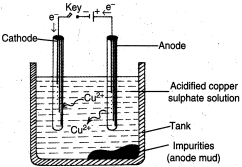
0 likes
View Solution137
Medium
$(a)$ List two differences between calcination and roasting in tabular form.
$(b)$ Which method will you use to reduce the following? Explain by giving a suitable example.
$(i)$ Oxides of less reactive metals.
$(ii)$ Oxides of moderately reactive metals.
$(iii)$ Oxides of highly reactive metals.
$(b)$ Which method will you use to reduce the following? Explain by giving a suitable example.
$(i)$ Oxides of less reactive metals.
$(ii)$ Oxides of moderately reactive metals.
$(iii)$ Oxides of highly reactive metals.
Solution
(N/A)
$(b)$ $(i)$ Self-reduction: Less reactive metals like mercury $(Hg)$ or copper $(Cu)$ can be reduced by heating alone.
$2HgO \xrightarrow{\text{heat}} 2Hg + O_2$
$2Cu_2O + Cu_2S \xrightarrow{\text{heat}} 6Cu + SO_2$
$(ii)$ Reduction using carbon or displacement: Moderately reactive metals are reduced by heating with carbon or using highly reactive metals like aluminum $(Al)$ in thermite reactions.
$ZnO + C \rightarrow Zn + CO$
$Fe_2O_3 + 2Al \rightarrow 2Fe + Al_2O_3 + \text{Heat}$
$(iii)$ Electrolytic reduction: Highly reactive metals (e.g.,$Na, Mg, Ca$) are extracted by the electrolysis of their molten chlorides because they have a high affinity for oxygen.
| Roasting | Calcination |
|---|---|
| Heating in the presence of excess air. Done for sulphide ores. | Heating in a limited supply of air. Done for carbonate ores. |
$(b)$ $(i)$ Self-reduction: Less reactive metals like mercury $(Hg)$ or copper $(Cu)$ can be reduced by heating alone.
$2HgO \xrightarrow{\text{heat}} 2Hg + O_2$
$2Cu_2O + Cu_2S \xrightarrow{\text{heat}} 6Cu + SO_2$
$(ii)$ Reduction using carbon or displacement: Moderately reactive metals are reduced by heating with carbon or using highly reactive metals like aluminum $(Al)$ in thermite reactions.
$ZnO + C \rightarrow Zn + CO$
$Fe_2O_3 + 2Al \rightarrow 2Fe + Al_2O_3 + \text{Heat}$
$(iii)$ Electrolytic reduction: Highly reactive metals (e.g.,$Na, Mg, Ca$) are extracted by the electrolysis of their molten chlorides because they have a high affinity for oxygen.
0 likes
View Solution138
Medium
Give reasons for the following:
$(a)$ Generally,metals are not found in their free state.
$(b)$ Metals are good conductors of heat.
$(a)$ Generally,metals are not found in their free state.
$(b)$ Metals are good conductors of heat.
Solution
(N/A) Metals are chemically reactive in nature. They readily react with oxygen,sulfur,and other elements to form compounds such as oxides,sulfides,halides,carbonates,and sulfates. Due to this high reactivity,they are rarely found in their free (native) state in nature.
$(b)$ Metals are good conductors of heat because they possess free electrons. These free electrons move throughout the metallic lattice,effectively transferring kinetic energy from hotter regions to cooler regions,which facilitates the rapid conduction of heat.
$(b)$ Metals are good conductors of heat because they possess free electrons. These free electrons move throughout the metallic lattice,effectively transferring kinetic energy from hotter regions to cooler regions,which facilitates the rapid conduction of heat.
0 likes
View Solution139
Medium
An element $A$ forms two oxides $AO$ and $AO_2$. The oxide $AO$ is neutral,whereas the oxide $AO_2$ is acidic in nature. Would you call element $A$ a metal or a non-metal?
Solution
(B) Element $A$ is a non-metal because non-metal oxides are typically acidic or neutral in nature.
$AO$ (e.g.,$CO$ - Carbon monoxide) is a neutral oxide.
$AO_2$ (e.g.,$CO_2$ - Carbon dioxide) is an acidic oxide.
Since metals generally form basic oxides,the formation of neutral and acidic oxides confirms that $A$ is a non-metal.
$AO$ (e.g.,$CO$ - Carbon monoxide) is a neutral oxide.
$AO_2$ (e.g.,$CO_2$ - Carbon dioxide) is an acidic oxide.
Since metals generally form basic oxides,the formation of neutral and acidic oxides confirms that $A$ is a non-metal.
0 likes
View Solution140
Easy
Write the names and symbols of the constituents present in the following alloys:
$(a)$ Brass
$(b)$ Bronze
$(c)$ Solder
$(a)$ Brass
$(b)$ Bronze
$(c)$ Solder
Solution
(N/A) The constituents of the given alloys are as follows:
$(a)$ Brass: It is an alloy of Copper $(Cu)$ and Zinc $(Zn)$.
$(b)$ Bronze: It is an alloy of Copper $(Cu)$ and Tin $(Sn)$.
$(c)$ Solder: It is an alloy of Lead $(Pb)$ and Tin $(Sn)$.
$(a)$ Brass: It is an alloy of Copper $(Cu)$ and Zinc $(Zn)$.
$(b)$ Bronze: It is an alloy of Copper $(Cu)$ and Tin $(Sn)$.
$(c)$ Solder: It is an alloy of Lead $(Pb)$ and Tin $(Sn)$.
0 likes
View Solution141
Medium
When a copper wire is left in silver nitrate solution,it is observed that the solution turns bluish green.
$(a)$ Explain the observation.
$(b)$ Write the balanced chemical equation to represent the change taking place.
$(a)$ Explain the observation.
$(b)$ Write the balanced chemical equation to represent the change taking place.
Solution
(N/A) Copper is more reactive than silver. In the reactivity series,it is placed above silver. So,copper displaces silver from its salt.
Observation:
$(i)$ The colour of the solution turns bluish green due to the formation of copper nitrate.
$(ii)$ $A$ greyish-white deposit of silver is observed on the surface of the copper wire.
$(b)$ The balanced chemical equation is:
$Cu(s) + 2AgNO_3(aq) \to Cu(NO_3)_2(aq) + 2Ag(s)$
Observation:
$(i)$ The colour of the solution turns bluish green due to the formation of copper nitrate.
$(ii)$ $A$ greyish-white deposit of silver is observed on the surface of the copper wire.
$(b)$ The balanced chemical equation is:
$Cu(s) + 2AgNO_3(aq) \to Cu(NO_3)_2(aq) + 2Ag(s)$
0 likes
View Solution142
Medium
Explain the following statements:
$(a)$ Most metal oxides are insoluble in water but some of these dissolve in water. What are these oxides and their solutions in water called?
$(b)$ At ordinary temperature,the surfaces of metals such as magnesium,aluminium,and zinc are covered with a thin layer. What is the composition of this layer? State its importance.
$(c)$ Some alkali metals can be cut with a knife.
$(a)$ Most metal oxides are insoluble in water but some of these dissolve in water. What are these oxides and their solutions in water called?
$(b)$ At ordinary temperature,the surfaces of metals such as magnesium,aluminium,and zinc are covered with a thin layer. What is the composition of this layer? State its importance.
$(c)$ Some alkali metals can be cut with a knife.
Solution
(N/A) Most metal oxides are basic in nature. Metal oxides that are soluble in water are called basic oxides,and their aqueous solutions are known as alkalis.
$(b)$ Metals like magnesium,aluminium,and zinc react with atmospheric oxygen to form a thin,protective oxide layer on their surface. This layer is composed of the metal oxide. Its importance lies in the fact that it prevents further oxidation and corrosion of the underlying metal.
$(c)$ Alkali metals like $Li$ (Lithium),$Na$ (Sodium),and $K$ (Potassium) have a low density and weak metallic bonding due to their high electropositive character,making them soft enough to be cut with a knife.
$(b)$ Metals like magnesium,aluminium,and zinc react with atmospheric oxygen to form a thin,protective oxide layer on their surface. This layer is composed of the metal oxide. Its importance lies in the fact that it prevents further oxidation and corrosion of the underlying metal.
$(c)$ Alkali metals like $Li$ (Lithium),$Na$ (Sodium),and $K$ (Potassium) have a low density and weak metallic bonding due to their high electropositive character,making them soft enough to be cut with a knife.
0 likes
View Solution143
Difficult
$(a)$ When calcium metal is added to water,the gas evolved does not catch fire,but the same gas evolved on adding potassium metal to water catches fire. Explain why?
$(b)$ Name a metal for each case:
$(i)$ It displaces hydrogen gas from nitric acid.
$(ii)$ It does not react with any physical state of water.
$(iii)$ It does not react with cold as well as hot water but reacts with steam.
$(b)$ Name a metal for each case:
$(i)$ It displaces hydrogen gas from nitric acid.
$(ii)$ It does not react with any physical state of water.
$(iii)$ It does not react with cold as well as hot water but reacts with steam.
Solution
(N/A) The rate of formation of hydrogen gas bubbles is slow with calcium (less violent) in comparison to that with potassium (more violent). The rate of hydrogen gas evolution is faster in the case of potassium,which generates enough heat to ignite the hydrogen gas.
$Ca + 2H_2O \rightarrow Ca(OH)_2 + H_2 \uparrow$
(The reaction is less vigorous,so the hydrogen gas does not catch fire.)
$(b)$ $(i)$ $Mg$ (Magnesium) or $Mn$ (Manganese).
$(ii)$ $Cu$ (Copper),$Hg$ (Mercury),$Ag$ (Silver),or $Au$ (Gold).
$(iii)$ $Fe$ (Iron),$Zn$ (Zinc),or $Al$ (Aluminium).
$Ca + 2H_2O \rightarrow Ca(OH)_2 + H_2 \uparrow$
(The reaction is less vigorous,so the hydrogen gas does not catch fire.)
$(b)$ $(i)$ $Mg$ (Magnesium) or $Mn$ (Manganese).
$(ii)$ $Cu$ (Copper),$Hg$ (Mercury),$Ag$ (Silver),or $Au$ (Gold).
$(iii)$ $Fe$ (Iron),$Zn$ (Zinc),or $Al$ (Aluminium).
0 likes
View Solution144
Medium
Distinguish between the following:
$(i)$ Electrolytic reduction and electrolytic refining
$(ii)$ Mineral and ore
$(iii)$ Alloys and amalgams
$(i)$ Electrolytic reduction and electrolytic refining
$(ii)$ Mineral and ore
$(iii)$ Alloys and amalgams
Solution
(N/A) $(i)$
$(ii)$ Minerals are naturally occurring elements or compounds in the Earth's crust. Ores are those minerals from which metals can be extracted profitably and conveniently.
$(iii)$ An alloy is a homogeneous mixture of two or more metals or a metal and a non-metal. An amalgam is a specific type of alloy in which one of the components is mercury $(Hg)$.
| Electrolytic reduction | Electrolytic refining |
| It is a process of obtaining metals from their molten chlorides or oxides by electrolysis. The metals are deposited at the cathode,whereas chlorine or oxygen is liberated at the anode. | It is a process of refining impure metals obtained by any reduction process. The impure metal is taken as the anode,pure metal as the cathode,and a metal salt solution as the electrolyte. |
$(ii)$ Minerals are naturally occurring elements or compounds in the Earth's crust. Ores are those minerals from which metals can be extracted profitably and conveniently.
$(iii)$ An alloy is a homogeneous mixture of two or more metals or a metal and a non-metal. An amalgam is a specific type of alloy in which one of the components is mercury $(Hg)$.
0 likes
View Solution145
Medium
State three reasons for the following fact:
$(a)$ Sulphur is a non-metal.
One of the reasons must be supported with a chemical equation.
$(a)$ Sulphur is a non-metal.
One of the reasons must be supported with a chemical equation.
Solution
(N/A) Sulphur $(S)$ is a non-metal because:
$1.$ It is brittle in its solid state and possesses low melting and boiling points.
$2.$ It is an electronegative element that forms anions $(S^{2-})$ and acts as a poor conductor of heat and electricity.
$3.$ It reacts with oxygen to form acidic oxides,which dissolve in water to produce acids.
Chemical equation:
$(a) S(s) + O_2(g) \rightarrow SO_2(g)$
$(b) SO_2(g) + H_2O(l) \rightarrow H_2SO_3(aq)$
These properties are characteristic of non-metals,confirming that sulphur is a non-metal.
$1.$ It is brittle in its solid state and possesses low melting and boiling points.
$2.$ It is an electronegative element that forms anions $(S^{2-})$ and acts as a poor conductor of heat and electricity.
$3.$ It reacts with oxygen to form acidic oxides,which dissolve in water to produce acids.
Chemical equation:
$(a) S(s) + O_2(g) \rightarrow SO_2(g)$
$(b) SO_2(g) + H_2O(l) \rightarrow H_2SO_3(aq)$
These properties are characteristic of non-metals,confirming that sulphur is a non-metal.
0 likes
View Solution146
Medium
State three reasons for the following fact: $(a)$ Magnesium is a metal. One of the reasons must be supported with a chemical equation.
Solution
(N/A) Magnesium $(Mg)$ is considered a metal due to the following reasons:
$1.$ Magnesium is a hard solid with a high melting and boiling point,which are characteristic physical properties of metals.
$2.$ Magnesium atoms lose two electrons to form electropositive $(Mg^{2+})$ ions and act as good conductors of heat and electricity.
$3.$ Magnesium reacts with oxygen to form a basic oxide,which dissolves in water to form a base. This is a characteristic chemical property of metals.
Chemical equations:
$(a) 2Mg(s) + O_2(g) \rightarrow 2MgO(s)$
$(b) MgO(s) + H_2O(l) \rightarrow Mg(OH)_2(aq)$
Since magnesium exhibits these metallic properties,it is classified as a metal.
$1.$ Magnesium is a hard solid with a high melting and boiling point,which are characteristic physical properties of metals.
$2.$ Magnesium atoms lose two electrons to form electropositive $(Mg^{2+})$ ions and act as good conductors of heat and electricity.
$3.$ Magnesium reacts with oxygen to form a basic oxide,which dissolves in water to form a base. This is a characteristic chemical property of metals.
Chemical equations:
$(a) 2Mg(s) + O_2(g) \rightarrow 2MgO(s)$
$(b) MgO(s) + H_2O(l) \rightarrow Mg(OH)_2(aq)$
Since magnesium exhibits these metallic properties,it is classified as a metal.
0 likes
View Solution147
Medium
Give reasons for the following:
$(a)$ We can store copper sulphate solution in a silver vessel but not silver nitrate solution in a copper vessel.
$(b)$ The reaction of zinc with dilute nitric acid does not produce hydrogen gas.
$(c)$ Food cans are coated with tin rather than zinc.
$(a)$ We can store copper sulphate solution in a silver vessel but not silver nitrate solution in a copper vessel.
$(b)$ The reaction of zinc with dilute nitric acid does not produce hydrogen gas.
$(c)$ Food cans are coated with tin rather than zinc.
Solution
(A) We can store copper sulphate in a silver vessel because silver is less reactive than copper,so no displacement reaction occurs. However,we cannot store silver nitrate solution in a copper vessel because copper is more reactive than silver and will displace silver from its salt solution.
$Cu(s) + 2AgNO_{3}(aq) \rightarrow Cu(NO_{3})_{2}(aq) + 2Ag(s)$
$(b)$ Nitric acid $(HNO_{3})$ is a strong oxidizing agent. When zinc reacts with dilute $HNO_{3}$,the hydrogen gas produced is immediately oxidized to water $(H_{2}O)$,while the nitric acid itself gets reduced to nitrogen oxides like $N_{2}O$,$NO$,or $NO_{2}$.
$(c)$ Tin is less reactive than zinc. Zinc is more reactive and can easily react with organic acids present in food,potentially contaminating it. Tin provides a protective,non-reactive layer that preserves the food.
$Cu(s) + 2AgNO_{3}(aq) \rightarrow Cu(NO_{3})_{2}(aq) + 2Ag(s)$
$(b)$ Nitric acid $(HNO_{3})$ is a strong oxidizing agent. When zinc reacts with dilute $HNO_{3}$,the hydrogen gas produced is immediately oxidized to water $(H_{2}O)$,while the nitric acid itself gets reduced to nitrogen oxides like $N_{2}O$,$NO$,or $NO_{2}$.
$(c)$ Tin is less reactive than zinc. Zinc is more reactive and can easily react with organic acids present in food,potentially contaminating it. Tin provides a protective,non-reactive layer that preserves the food.
0 likes
View Solution148
Medium
Give reasons for the following:
$(i)$ Carbon can reduce zinc oxide to zinc but not calcium oxide to calcium.
$(ii)$ Copper and aluminium wires are usually used for electricity transmission.
$(i)$ Carbon can reduce zinc oxide to zinc but not calcium oxide to calcium.
$(ii)$ Copper and aluminium wires are usually used for electricity transmission.
Solution
(N/A) $(i)$ Carbon acts as a reducing agent. In the reactivity series,zinc is less reactive than carbon,so carbon can displace oxygen from zinc oxide to form zinc metal:
$ZnO(s) + C(s) \rightarrow Zn(s) + CO(g)$
However,calcium is much more reactive than carbon and has a very high affinity for oxygen. Therefore,carbon cannot reduce calcium oxide to calcium.
$(ii)$ Copper and aluminium are used for electricity transmission because they possess high electrical conductivity and low electrical resistance,which minimizes energy loss during transmission.
$ZnO(s) + C(s) \rightarrow Zn(s) + CO(g)$
However,calcium is much more reactive than carbon and has a very high affinity for oxygen. Therefore,carbon cannot reduce calcium oxide to calcium.
$(ii)$ Copper and aluminium are used for electricity transmission because they possess high electrical conductivity and low electrical resistance,which minimizes energy loss during transmission.
0 likes
View Solution149
Medium
Give reasons for the following:
$(i)$ Alloys are used in electrical heating devices rather than pure metals.
$(ii)$ Gold ornaments look new even after several years of use.
$(iii)$ An iron grill should be painted frequently.
$(i)$ Alloys are used in electrical heating devices rather than pure metals.
$(ii)$ Gold ornaments look new even after several years of use.
$(iii)$ An iron grill should be painted frequently.
Solution
(N/A) $(i)$ Alloys generally have higher electrical resistivity than their constituent pure metals. This property allows them to produce more heat when current passes through them. Additionally,they do not oxidize (burn) readily at high temperatures.
$(ii)$ Gold is a noble metal and is highly resistant to corrosion. It does not react with oxygen,moisture,or atmospheric gases,which is why it retains its luster for years.
$(iii)$ Iron reacts with oxygen and moisture present in the air to form hydrated iron$(III)$ oxide,commonly known as rust. Painting the grill creates a protective barrier that prevents the iron from coming into contact with air and moisture,thereby preventing rusting.
$(ii)$ Gold is a noble metal and is highly resistant to corrosion. It does not react with oxygen,moisture,or atmospheric gases,which is why it retains its luster for years.
$(iii)$ Iron reacts with oxygen and moisture present in the air to form hydrated iron$(III)$ oxide,commonly known as rust. Painting the grill creates a protective barrier that prevents the iron from coming into contact with air and moisture,thereby preventing rusting.
0 likes
View Solution150
EasyMCQ
Why does a magnesium ribbon start floating when it is placed in hot water?
A
It reacts with water to form magnesium oxide and hydrogen gas.
B
Bubbles of hydrogen gas stick to its surface, making it buoyant.
C
The magnesium ribbon melts in hot water.
D
It reacts with water to form magnesium hydroxide and oxygen gas.
Solution
(B) Magnesium reacts with hot water to produce magnesium hydroxide and hydrogen gas $(Mg + 2H_2O \rightarrow Mg(OH)_2 + H_2)$.
As the reaction proceeds, small bubbles of hydrogen gas are produced.
These bubbles of hydrogen gas stick to the surface of the magnesium ribbon.
Due to the buoyancy provided by these gas bubbles, the magnesium ribbon starts floating on the surface of the water.
As the reaction proceeds, small bubbles of hydrogen gas are produced.
These bubbles of hydrogen gas stick to the surface of the magnesium ribbon.
Due to the buoyancy provided by these gas bubbles, the magnesium ribbon starts floating on the surface of the water.
0 likes
View SolutionMetals and Non-metals — Mix Examples - Metals and Non-metals · Frequently Asked Questions
1Are these Metals and Non-metals questions useful for JEE and NEET?
Yes. All questions in this section are mapped to JEE Main and NEET exam patterns. Previous year questions from JEE Main, NEET, GUJCET and state-level exams are included with full solutions.
2Can I switch to Hindi or Gujarati for these questions?
Yes. Use the language tabs in the hero section or the sidebar to view the same questions and solutions in English, Hindi or Gujarati.
3How do I generate a question paper from this subtopic?
Use the Vedclass Exam Paper Generator — select the chapter and subtopic, set difficulty, and generate Sets A, B, C, D automatically. First 3 chapters of every subject are free.
Vedclass Products
For Students
Vedclass Test Series
Mock tests in real JEE/NEET style with performance analysis. 5-day free trial.
Start Free TrialFor Teachers
Exam Paper Generator
Generate Set A/B/C/D papers from this chapter in 2 minutes. 3 chapters free.
Try FreeFor Institutes
Online Exam Module
Live online exams with unlimited students, 360° analytics & white-label branding.
See DemoFor Teachers & Institutes
Generate a Metals and Non-metals Exam Paper in 2 Minutes
Select subtopic & difficulty — Sets A, B, C, D auto-generated with No Repeat logic.
First 3 chapters of every subject are free — no payment required.