
A English
Mix Examples - Metals and Non-metals Questions in English
Class 10 Science · Metals and Non-metals · Mix Examples - Metals and Non-metals
412+
Questions
English
Language
100%
With Solutions
Showing 50 of 412 questions in English
151
EasyMCQ
Non-metals form two types of oxides. Choose these two types from the following oxides:
$SO_2, NO_2, CO, H_2O, N_2O$
$SO_2, NO_2, CO, H_2O, N_2O$
A
Acidic and Basic
B
Acidic and Neutral
C
Basic and Amphoteric
D
Neutral and Amphoteric
Solution
(B) Non-metals typically form acidic or neutral oxides.
$1$. Acidic oxides: These react with water to form acids. Among the given,$SO_2$ and $NO_2$ are acidic oxides.
$2$. Neutral oxides: These do not react with acids or bases to form salts. Among the given,$CO$,$H_2O$,and $N_2O$ are neutral oxides.
$1$. Acidic oxides: These react with water to form acids. Among the given,$SO_2$ and $NO_2$ are acidic oxides.
$2$. Neutral oxides: These do not react with acids or bases to form salts. Among the given,$CO$,$H_2O$,and $N_2O$ are neutral oxides.
0 likes
View Solution152
EasyMCQ
Which kind of impurities are present in the ores? What are these impurities collectively known as?
A
Soil and sand; Gangue
B
Metals and non-metals; Alloy
C
Minerals and rocks; Ore
D
Salts and acids; Slag
Solution
(A) Ores are naturally occurring minerals from which metals can be extracted profitably.
These ores are usually contaminated with earthy impurities such as soil,sand,and rocky materials.
These unwanted impurities present in the ore are collectively known as $Gangue$.
These ores are usually contaminated with earthy impurities such as soil,sand,and rocky materials.
These unwanted impurities present in the ore are collectively known as $Gangue$.
0 likes
View Solution153
Medium
What is meant by anodising? How is it done?
Solution
(N/A) Anodising is an electrolytic process used to increase the thickness of the natural oxide layer on the surface of metal parts,typically aluminium.
During this process,a clean aluminium article is made the anode and is electrolysed with dilute sulphuric acid.
The oxygen gas evolved at the anode reacts with the aluminium to form a thicker,protective aluminium oxide layer,which makes the metal resistant to corrosion.
During this process,a clean aluminium article is made the anode and is electrolysed with dilute sulphuric acid.
The oxygen gas evolved at the anode reacts with the aluminium to form a thicker,protective aluminium oxide layer,which makes the metal resistant to corrosion.
0 likes
View Solution154
Medium
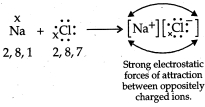
Write the electron-dot structure for sodium and chlorine atoms. How do these form a chemical bond? Name the type of bond so formed. Why does a compound so formed have a high melting point?
Solution
(N/A) Electron-dot structure of sodium: $Na \cdot$
Electron-dot structure of chlorine atom: $: \ddot{Cl} \cdot$
Sodium $(Na)$ has $1$ valence electron. It loses this electron to attain the stable electronic configuration of the nearest noble gas,neon $(Ne)$.
Chlorine $(Cl)$ has $7$ valence electrons. It gains the electron lost by sodium to complete its octet and achieve the stable electronic configuration of the nearest noble gas,argon $(Ar)$.
The electrostatic force of attraction between the positively charged sodium ion $(Na^+)$ and the negatively charged chloride ion $(Cl^-)$ results in the formation of an ionic bond (also called an electrovalent bond).
Compounds formed by ionic bonds have high melting points because a large amount of energy is required to break the strong electrostatic forces of attraction between the oppositely charged ions.
Electron-dot structure of chlorine atom: $: \ddot{Cl} \cdot$
Sodium $(Na)$ has $1$ valence electron. It loses this electron to attain the stable electronic configuration of the nearest noble gas,neon $(Ne)$.
Chlorine $(Cl)$ has $7$ valence electrons. It gains the electron lost by sodium to complete its octet and achieve the stable electronic configuration of the nearest noble gas,argon $(Ar)$.
The electrostatic force of attraction between the positively charged sodium ion $(Na^+)$ and the negatively charged chloride ion $(Cl^-)$ results in the formation of an ionic bond (also called an electrovalent bond).
Compounds formed by ionic bonds have high melting points because a large amount of energy is required to break the strong electrostatic forces of attraction between the oppositely charged ions.
0 likes
View Solution155
MediumMCQ
What will happen when:
$(i)$ Magnesium is treated with very dilute nitric acid?
$(ii)$ Steam is passed over red hot iron?
$(i)$ Magnesium is treated with very dilute nitric acid?
$(ii)$ Steam is passed over red hot iron?
A
Magnesium produces hydrogen gas; Iron produces iron oxide and hydrogen gas.
B
Magnesium produces nitrogen dioxide; Iron produces iron oxide.
C
Magnesium produces nitric oxide; Iron produces iron hydroxide.
D
Magnesium produces ammonia; Iron produces iron nitrate.
Solution
(A) $(i)$ Magnesium reacts with very dilute nitric acid to produce magnesium nitrate and hydrogen gas.
$Mg(s) + 2HNO_3(aq) \longrightarrow Mg(NO_3)_2(aq) + H_2(g)$
$(ii)$ Steam reacts with red hot iron to form iron $(II, III)$ oxide and hydrogen gas.
$3Fe(s) + 4H_2O(g) \longrightarrow Fe_3O_4(s) + 4H_2(g)$
$Mg(s) + 2HNO_3(aq) \longrightarrow Mg(NO_3)_2(aq) + H_2(g)$
$(ii)$ Steam reacts with red hot iron to form iron $(II, III)$ oxide and hydrogen gas.
$3Fe(s) + 4H_2O(g) \longrightarrow Fe_3O_4(s) + 4H_2(g)$
0 likes
View Solution156
Medium
Give reasons for the following:
$(i)$ Most metals conduct electricity well.
$(ii)$ The reaction of iron $(III)$ oxide,$Fe_{2}O_{3}$,with heated aluminium is used to join cracked machine parts.
$(iii)$ Sodium,potassium,and lithium are stored under oil.
$(i)$ Most metals conduct electricity well.
$(ii)$ The reaction of iron $(III)$ oxide,$Fe_{2}O_{3}$,with heated aluminium is used to join cracked machine parts.
$(iii)$ Sodium,potassium,and lithium are stored under oil.
Solution
(N/A) $(i)$ Metals conduct electricity because they possess free electrons that are mobile. Consequently,they offer minimal resistance to the flow of electric current.
$(ii)$ The reaction between iron $(III)$ oxide $(Fe_{2}O_{3})$ and aluminium is highly exothermic. The heat released is sufficient to produce molten iron,which fills the cracks in machine parts. This is known as the thermite reaction:
$Fe_{2}O_{3}(s) + 2Al(s) \xrightarrow{\text{Heat}} 2Fe(l) + Al_{2}O_{3}(s)$
$(iii)$ These metals are stored under oil for two primary reasons:
$(a)$ They are highly reactive and can spontaneously catch fire upon contact with atmospheric oxygen.
$(b)$ They react readily with moisture and carbon dioxide in the air,forming a layer of oxides or carbonates on their surface.
$(ii)$ The reaction between iron $(III)$ oxide $(Fe_{2}O_{3})$ and aluminium is highly exothermic. The heat released is sufficient to produce molten iron,which fills the cracks in machine parts. This is known as the thermite reaction:
$Fe_{2}O_{3}(s) + 2Al(s) \xrightarrow{\text{Heat}} 2Fe(l) + Al_{2}O_{3}(s)$
$(iii)$ These metals are stored under oil for two primary reasons:
$(a)$ They are highly reactive and can spontaneously catch fire upon contact with atmospheric oxygen.
$(b)$ They react readily with moisture and carbon dioxide in the air,forming a layer of oxides or carbonates on their surface.
0 likes
View Solution157
Difficult
State reasons for the following:
$(i)$ Metals are good conductors of heat.
$(ii)$ Addition of some silver to pure gold for making ornaments.
$(iii)$ Inability of non-metals to displace hydrogen from dilute sulphuric acid.
$(i)$ Metals are good conductors of heat.
$(ii)$ Addition of some silver to pure gold for making ornaments.
$(iii)$ Inability of non-metals to displace hydrogen from dilute sulphuric acid.
Solution
(N/A) $(i)$ When a metal is heated,its atoms gain energy and vibrate more vigorously. This energy is transferred to the free electrons,which move through the metal lattice. These electrons transfer their kinetic energy to other atoms and electrons throughout the structure,making metals good conductors of heat.
$(ii)$ Pure gold,known as $24$ carat gold,is extremely soft and malleable. It is not suitable for making jewellery as it would easily deform. Therefore,a small amount of silver or copper is added to create an alloy,which makes the gold harder and more durable.
$(iii)$ Non-metals are electronegative and act as electron acceptors. To displace hydrogen from dilute acids,a substance must be able to donate electrons to $H^{+}$ ions to form $H_2$ gas. Since non-metals cannot provide electrons,they are unable to displace hydrogen from dilute sulphuric acid.
$(ii)$ Pure gold,known as $24$ carat gold,is extremely soft and malleable. It is not suitable for making jewellery as it would easily deform. Therefore,a small amount of silver or copper is added to create an alloy,which makes the gold harder and more durable.
$(iii)$ Non-metals are electronegative and act as electron acceptors. To displace hydrogen from dilute acids,a substance must be able to donate electrons to $H^{+}$ ions to form $H_2$ gas. Since non-metals cannot provide electrons,they are unable to displace hydrogen from dilute sulphuric acid.
0 likes
View Solution158
EasyMCQ
Which of the following pairs will give displacement reactions?
A
$NaCl$ solution and copper metal
B
$MgCl_2$ solution and aluminium metal
C
$FeSO_4$ solution and silver metal
D
$AgNO_3$ solution and copper metal
Solution
(D) displacement reaction occurs when a more reactive metal displaces a less reactive metal from its salt solution.
According to the reactivity series of metals,copper $(Cu)$ is more reactive than silver $(Ag)$.
Therefore,copper can displace silver from its salt solution $(AgNO_3)$.
The chemical equation is: $Cu(s) + 2AgNO_3(aq) \rightarrow Cu(NO_3)_2(aq) + 2Ag(s)$.
In other options,the metal added is less reactive than the metal present in the salt solution,so no reaction will occur.
According to the reactivity series of metals,copper $(Cu)$ is more reactive than silver $(Ag)$.
Therefore,copper can displace silver from its salt solution $(AgNO_3)$.
The chemical equation is: $Cu(s) + 2AgNO_3(aq) \rightarrow Cu(NO_3)_2(aq) + 2Ag(s)$.
In other options,the metal added is less reactive than the metal present in the salt solution,so no reaction will occur.
0 likes
View Solution159
EasyMCQ
Which of the following methods is suitable for preventing an iron frying pan from rusting?
A
All of these.
B
Applying paint
C
Applying a coating of zinc
D
Applying grease
Solution
(A) To prevent an iron frying pan from rusting,we must consider the nature of the object.
Applying paint or grease is not suitable for a frying pan because these substances are not food-safe and would contaminate the food during cooking.
Applying a coating of zinc (galvanization) is also generally avoided for cooking utensils because zinc can react with acidic foods and leach into them,which is harmful.
However,in the context of standard multiple-choice questions regarding rust prevention,if we must choose the most appropriate method for a cooking surface,we often look for methods that do not involve toxic coatings.
Actually,none of the options provided are ideal for a frying pan. However,if this is a standard textbook question,it often expects 'Applying a coating of zinc' as a general rust prevention method,but for a frying pan,the most practical method is keeping it dry or seasoning it with oil. Given the options,if we must select one,'Applying a coating of zinc' is a standard method for iron,though not for frying pans. If the question implies general iron objects,all would work. Given the specific mention of a 'frying pan',this question is technically flawed as none are ideal. Assuming the question asks for general rust prevention: 'All of these' is the most logical choice for general iron items.
Applying paint or grease is not suitable for a frying pan because these substances are not food-safe and would contaminate the food during cooking.
Applying a coating of zinc (galvanization) is also generally avoided for cooking utensils because zinc can react with acidic foods and leach into them,which is harmful.
However,in the context of standard multiple-choice questions regarding rust prevention,if we must choose the most appropriate method for a cooking surface,we often look for methods that do not involve toxic coatings.
Actually,none of the options provided are ideal for a frying pan. However,if this is a standard textbook question,it often expects 'Applying a coating of zinc' as a general rust prevention method,but for a frying pan,the most practical method is keeping it dry or seasoning it with oil. Given the options,if we must select one,'Applying a coating of zinc' is a standard method for iron,though not for frying pans. If the question implies general iron objects,all would work. Given the specific mention of a 'frying pan',this question is technically flawed as none are ideal. Assuming the question asks for general rust prevention: 'All of these' is the most logical choice for general iron items.
0 likes
View Solution160
MediumMCQ
An element reacts with oxygen to give a compound with a high melting point. This compound is also soluble in water. The element is likely to be:
A
Carbon
B
Calcium
C
Silicon
D
Iron
Solution
(B) $1$. Carbon forms $CO_2$,which is a gas at room temperature and has a low melting point.
$2$. Calcium reacts with oxygen to form $CaO$ (calcium oxide),which is an ionic compound with a very high melting point. $CaO$ is soluble in water,forming calcium hydroxide $(Ca(OH)_2)$.
$3$. Silicon forms $SiO_2$,which is a covalent network solid with a high melting point but is insoluble in water.
$4$. Iron forms $Fe_2O_3$,which has a high melting point but is insoluble in water.
$5$. Therefore,the element is Calcium.
$2$. Calcium reacts with oxygen to form $CaO$ (calcium oxide),which is an ionic compound with a very high melting point. $CaO$ is soluble in water,forming calcium hydroxide $(Ca(OH)_2)$.
$3$. Silicon forms $SiO_2$,which is a covalent network solid with a high melting point but is insoluble in water.
$4$. Iron forms $Fe_2O_3$,which has a high melting point but is insoluble in water.
$5$. Therefore,the element is Calcium.
0 likes
View Solution161
EasyMCQ
Food cans are coated with tin and not with zinc because:
A
Zinc is costlier than tin
B
Zinc has a higher melting point than tin
C
Zinc is more reactive than tin
D
Zinc is less reactive than tin.
Solution
(C) Food cans are coated with tin because zinc is more reactive than tin.
When food (which often contains organic acids) comes into contact with a zinc coating,the zinc can react with the acids to form toxic metal salts,which can contaminate the food.
Tin is less reactive than zinc and does not react easily with the acids present in food,making it a safer choice for coating food containers.
When food (which often contains organic acids) comes into contact with a zinc coating,the zinc can react with the acids to form toxic metal salts,which can contaminate the food.
Tin is less reactive than zinc and does not react easily with the acids present in food,making it a safer choice for coating food containers.
0 likes
View Solution162
EasyMCQ
The electrical conductivity and melting point of an alloy is:
A
Electrical conductivity is less and melting point is more than that of pure metal.
B
More than that of pure metal.
C
Equal to that of pure metal.
D
Less than that of pure metal.
Solution
(D) An alloy is a homogeneous mixture of two or more metals or a metal and a non-metal.
When an alloy is formed,the regular arrangement of atoms in the pure metal lattice is disrupted by the addition of other atoms.
This disruption hinders the movement of free electrons,which are responsible for electrical conduction,thereby decreasing the electrical conductivity compared to the pure metal.
Additionally,the presence of foreign atoms creates lattice distortions that require more energy to overcome during the phase transition from solid to liquid,which typically results in a lower melting point compared to the pure metal (though this can vary,the general property of alloys is lower conductivity and lower melting point than the base metal).
When an alloy is formed,the regular arrangement of atoms in the pure metal lattice is disrupted by the addition of other atoms.
This disruption hinders the movement of free electrons,which are responsible for electrical conduction,thereby decreasing the electrical conductivity compared to the pure metal.
Additionally,the presence of foreign atoms creates lattice distortions that require more energy to overcome during the phase transition from solid to liquid,which typically results in a lower melting point compared to the pure metal (though this can vary,the general property of alloys is lower conductivity and lower melting point than the base metal).
0 likes
View Solution163
EasyMCQ
Brass is an alloy of
A
Copper and zinc
B
Copper and tin
C
Copper and nickel
D
Copper and lead
Solution
(A) Brass is a metallic alloy that primarily consists of $Copper$ $(Cu)$ and $Zinc$ $(Zn)$.
It typically contains about $60-80\%$ copper and $20-40\%$ zinc,depending on the desired properties.
Copper and tin form bronze,while copper and nickel form cupronickel.
It typically contains about $60-80\%$ copper and $20-40\%$ zinc,depending on the desired properties.
Copper and tin form bronze,while copper and nickel form cupronickel.
0 likes
View Solution164
MediumMCQ
Solder is an alloy of lead and tin. It has a:
A
Low melting point and is used for welding heavy iron machinery.
B
Low melting point and is used for welding electrical wires together.
C
High melting point and is used for welding electrical wires together.
D
High melting point and is used for welding heavy iron machinery.
Solution
(B) Solder is an alloy composed of lead $(Pb)$ and tin $(Sn)$.
It is characterized by a very low melting point compared to the pure metals from which it is made.
Due to this low melting point,it is specifically used for soldering or joining electrical wires together in circuits,as it can be easily melted with a soldering iron without damaging the delicate components or insulation of the wires.
It is characterized by a very low melting point compared to the pure metals from which it is made.
Due to this low melting point,it is specifically used for soldering or joining electrical wires together in circuits,as it can be easily melted with a soldering iron without damaging the delicate components or insulation of the wires.
0 likes
View Solution165
EasyMCQ
Galvanisation is a method of protecting:
A
Steel and copper from rusting
B
Steel and silver from rusting
C
Steel and iron from rusting
D
Steel and tin from rusting.
Solution
(C) Galvanisation is a process of applying a protective layer of zinc to steel or iron to prevent rusting.
Rusting is the oxidation of iron in the presence of oxygen and moisture.
By coating the surface with zinc,the metal is protected from direct contact with the atmosphere,thereby preventing corrosion.
Rusting is the oxidation of iron in the presence of oxygen and moisture.
By coating the surface with zinc,the metal is protected from direct contact with the atmosphere,thereby preventing corrosion.
0 likes
View Solution166
EasyMCQ
The metals which are mixed with iron to make stainless steel are:
A
Copper and nickel
B
Copper and silver
C
Copper and chromium
D
Nickel and chromium
Solution
(D) Stainless steel is an alloy of iron.
To improve its properties,such as corrosion resistance and hardness,iron is mixed with other metals.
The primary metals added to iron to produce stainless steel are $Nickel$ and $Chromium$.
Carbon is also added in small amounts to increase the strength of the alloy.
To improve its properties,such as corrosion resistance and hardness,iron is mixed with other metals.
The primary metals added to iron to produce stainless steel are $Nickel$ and $Chromium$.
Carbon is also added in small amounts to increase the strength of the alloy.
0 likes
View Solution167
EasyMCQ
Bronze is an alloy of:
A
Copper and tin
B
Copper and lead
C
Copper and zinc
D
Copper and nickel
Solution
(A) Bronze is a metallic alloy consisting primarily of copper,usually with tin as the main additive.
It typically contains about $88\%$ copper and $12\%$ tin.
Other elements such as aluminum,manganese,nickel,or zinc are sometimes added to produce different properties.
Therefore,the correct composition is copper and tin.
It typically contains about $88\%$ copper and $12\%$ tin.
Other elements such as aluminum,manganese,nickel,or zinc are sometimes added to produce different properties.
Therefore,the correct composition is copper and tin.
0 likes
View Solution168
MediumMCQ
Which of the following metals are obtained by electrolysis of their molten chlorides?
$(i) Na, (ii) Ca, (iii) Fe, (iv) Cu$
$(i) Na, (ii) Ca, (iii) Fe, (iv) Cu$
A
$(i)$ and $(iv)$
B
$(i)$ and $(ii)$
C
$(i)$ and $(iii)$
D
$(iii)$ and $(iv)$
Solution
(B) Highly reactive metals such as Sodium $(Na)$ and Calcium $(Ca)$ are placed at the top of the reactivity series.
These metals have a very high affinity for oxygen and cannot be reduced by carbon or other common reducing agents.
Therefore,they are extracted by the electrolytic reduction of their molten chloride salts (e.g.,$NaCl$ and $CaCl_2$).
Metals like Iron $(Fe)$ and Copper $(Cu)$ are less reactive and are typically extracted by reduction with carbon or other chemical methods.
Thus,only $(i)$ and $(ii)$ are obtained by the electrolysis of their molten chlorides.
These metals have a very high affinity for oxygen and cannot be reduced by carbon or other common reducing agents.
Therefore,they are extracted by the electrolytic reduction of their molten chloride salts (e.g.,$NaCl$ and $CaCl_2$).
Metals like Iron $(Fe)$ and Copper $(Cu)$ are less reactive and are typically extracted by reduction with carbon or other chemical methods.
Thus,only $(i)$ and $(ii)$ are obtained by the electrolysis of their molten chlorides.
0 likes
View Solution169
MediumMCQ
Which among the following statements is incorrect for magnesium metal?
A
It burns in oxygen with a dazzling white flame.
B
It reacts with hot water to form magnesium hydroxide and evolves hydrogen gas.
C
It reacts with cold water to form magnesium oxide and evolves hydrogen gas.
D
It reacts with steam to form magnesium hydroxide and evolves hydrogen gas.
Solution
(C) Magnesium $(Mg)$ does not react with cold water. It reacts with hot water to form magnesium hydroxide $(Mg(OH)_2)$ and hydrogen gas $(H_2)$. It also reacts with steam to form magnesium oxide $(MgO)$ and hydrogen gas $(H_2)$. Therefore,the statement that it reacts with cold water to form magnesium oxide is incorrect.
0 likes
View Solution170
MediumMCQ
An electrolytic cell consists of:
$(i)$ Positively charged cathode
$(ii)$ Negatively charged anode
$(iii)$ Positively charged anode
$(iv)$ Negatively charged cathode
$(i)$ Positively charged cathode
$(ii)$ Negatively charged anode
$(iii)$ Positively charged anode
$(iv)$ Negatively charged cathode
A
$(i)$ and $(ii)$
B
$(ii)$ and $(iv)$
C
$(i)$ and $(iii)$
D
$(iii)$ and $(iv)$
Solution
(D) In an electrolytic cell,electrical energy is used to drive a non-spontaneous chemical reaction.
By definition,the electrode where reduction occurs is the cathode,and in an electrolytic cell,the cathode is connected to the negative terminal of the external power source,making it negatively charged.
The electrode where oxidation occurs is the anode,and in an electrolytic cell,the anode is connected to the positive terminal of the external power source,making it positively charged.
Therefore,the correct characteristics are $(iii)$ Positively charged anode and $(iv)$ Negatively charged cathode.
By definition,the electrode where reduction occurs is the cathode,and in an electrolytic cell,the cathode is connected to the negative terminal of the external power source,making it negatively charged.
The electrode where oxidation occurs is the anode,and in an electrolytic cell,the anode is connected to the positive terminal of the external power source,making it positively charged.
Therefore,the correct characteristics are $(iii)$ Positively charged anode and $(iv)$ Negatively charged cathode.
0 likes
View Solution171
MediumMCQ
During the electrolytic refining of zinc,it gets :
A
Deposited on cathode
B
Deposited on anode
C
Deposited on cathode as well as anode
D
Remains in the solution.
Solution
(A) In the process of electrolytic refining of metals like zinc,an impure metal rod is used as the anode and a thin strip of pure metal is used as the cathode.
When an electric current is passed through the electrolyte (a salt solution of the metal),the impure metal from the anode dissolves into the electrolyte.
Simultaneously,an equivalent amount of pure metal from the electrolyte is deposited on the cathode.
Therefore,during the electrolytic refining of zinc,pure zinc gets deposited on the cathode.
When an electric current is passed through the electrolyte (a salt solution of the metal),the impure metal from the anode dissolves into the electrolyte.
Simultaneously,an equivalent amount of pure metal from the electrolyte is deposited on the cathode.
Therefore,during the electrolytic refining of zinc,pure zinc gets deposited on the cathode.
0 likes
View Solution172
EasyMCQ
An element $A$ is soft and can be cut with a knife. It is very reactive to air and cannot be kept open in air. It reacts vigorously with water. Identify the element from the following:
A
$Mg$
B
$Na$
C
$P$
D
$Ca$
Solution
(B) The properties described are characteristic of alkali metals.
$1$. Alkali metals like $Na$ (Sodium) and $K$ (Potassium) are soft enough to be cut with a knife.
$2$. They are highly reactive with oxygen in the air,forming oxides,and thus are stored in kerosene to prevent contact with air and moisture.
$3$. They react vigorously with water to produce hydrogen gas and metal hydroxides.
Among the given options,$Na$ (Sodium) fits all these criteria.
$1$. Alkali metals like $Na$ (Sodium) and $K$ (Potassium) are soft enough to be cut with a knife.
$2$. They are highly reactive with oxygen in the air,forming oxides,and thus are stored in kerosene to prevent contact with air and moisture.
$3$. They react vigorously with water to produce hydrogen gas and metal hydroxides.
Among the given options,$Na$ (Sodium) fits all these criteria.
0 likes
View Solution173
MediumMCQ
Which one of the following properties is not generally exhibited by ionic compounds?
A
Solubility in water
B
High melting and boiling points
C
Electrical conductivity in solid state
D
Electrical conductivity in molten state
Solution
(C) Ionic compounds are formed by the electrostatic attraction between oppositely charged ions.
In the solid state,these ions are held in a rigid crystal lattice structure and are not free to move.
Because electrical conductivity requires the movement of charged particles,ionic compounds do not conduct electricity in the solid state.
However,when dissolved in water or in a molten state,the crystal lattice breaks down,allowing the ions to move freely,which enables them to conduct electricity.
Therefore,the property not exhibited by ionic compounds is electrical conductivity in the solid state.
In the solid state,these ions are held in a rigid crystal lattice structure and are not free to move.
Because electrical conductivity requires the movement of charged particles,ionic compounds do not conduct electricity in the solid state.
However,when dissolved in water or in a molten state,the crystal lattice breaks down,allowing the ions to move freely,which enables them to conduct electricity.
Therefore,the property not exhibited by ionic compounds is electrical conductivity in the solid state.
0 likes
View Solution174
MediumMCQ
Which of the following metals exist in their native state in nature?
$(i)$ $Au$
$(ii)$ $Cu$
$(iii)$ $Ag$
$(iv)$ $Fe$
$(i)$ $Au$
$(ii)$ $Cu$
$(iii)$ $Ag$
$(iv)$ $Fe$
A
$(i)$ and $(ii)$
B
$(ii)$ and $(iii)$
C
$(i)$ and $(iii)$
D
$(ii)$ and $(iv)$
Solution
(C) Metals that are very low in the reactivity series are found in their native (free) state in nature because they are highly unreactive.
These metals include gold $(Au)$,silver $(Ag)$,and platinum $(Pt)$.
In the given list:
$(i)$ $Au$ (Gold) is a noble metal and exists in a native state.
$(ii)$ $Cu$ (Copper) is found in both native and combined states (as sulfides or oxides).
$(iii)$ $Ag$ (Silver) is a noble metal and exists in a native state.
$(iv)$ $Fe$ (Iron) is highly reactive and is always found in a combined state (as oxides,carbonates,or sulfides).
Therefore,$(i)$ and $(iii)$ are the correct metals that exist in their native state.
These metals include gold $(Au)$,silver $(Ag)$,and platinum $(Pt)$.
In the given list:
$(i)$ $Au$ (Gold) is a noble metal and exists in a native state.
$(ii)$ $Cu$ (Copper) is found in both native and combined states (as sulfides or oxides).
$(iii)$ $Ag$ (Silver) is a noble metal and exists in a native state.
$(iv)$ $Fe$ (Iron) is highly reactive and is always found in a combined state (as oxides,carbonates,or sulfides).
Therefore,$(i)$ and $(iii)$ are the correct metals that exist in their native state.
0 likes
View Solution175
MediumMCQ
Metals are refined by using different methods. Which of the following metals are refined by electrolytic refining?
$(i)$ $Au$
$(ii)$ $Cu$
$(iii)$ $Na$
$(iv)$ $K$
$(i)$ $Au$
$(ii)$ $Cu$
$(iii)$ $Na$
$(iv)$ $K$
A
$(i)$ and $(ii)$
B
$(i)$ and $(iii)$
C
$(ii)$ and $(iii)$
D
$(iii)$ and $(iv)$
Solution
(A) Electrolytic refining is a process used to purify metals that are obtained from their ores.
Metals like copper $(Cu)$,gold $(Au)$,silver $(Ag)$,and zinc $(Zn)$ are commonly refined using the electrolytic refining method.
In this process,an impure metal is made the anode,and a pure strip of the same metal is made the cathode.
Metals like sodium $(Na)$ and potassium $(K)$ are highly reactive and are extracted by the electrolytic reduction of their molten chlorides,not by electrolytic refining of the metal itself.
Therefore,$(i)$ $Au$ and $(ii)$ $Cu$ are the metals refined by electrolytic refining.
Metals like copper $(Cu)$,gold $(Au)$,silver $(Ag)$,and zinc $(Zn)$ are commonly refined using the electrolytic refining method.
In this process,an impure metal is made the anode,and a pure strip of the same metal is made the cathode.
Metals like sodium $(Na)$ and potassium $(K)$ are highly reactive and are extracted by the electrolytic reduction of their molten chlorides,not by electrolytic refining of the metal itself.
Therefore,$(i)$ $Au$ and $(ii)$ $Cu$ are the metals refined by electrolytic refining.
0 likes
View Solution176
MediumMCQ
Silver articles become black on prolonged exposure to air. This is due to the formation of:
A
$Ag_{3}N$
B
$Ag_{2}S$
C
$Ag_{2}O$
D
$Ag_{2}S$ and $Ag_{3}N$
Solution
(B) When silver articles are exposed to air for a long time, they react with sulfur compounds present in the air, such as hydrogen sulfide $(H_{2}S)$.
This chemical reaction leads to the formation of a black coating of silver sulfide $(Ag_{2}S)$ on the surface of the silver.
The chemical equation for this process is: $2Ag + H_{2}S \rightarrow Ag_{2}S + H_{2}$ (or more accurately in the presence of oxygen: $4Ag + 2H_{2}S + O_{2} \rightarrow 2Ag_{2}S + 2H_{2}O$).
This chemical reaction leads to the formation of a black coating of silver sulfide $(Ag_{2}S)$ on the surface of the silver.
The chemical equation for this process is: $2Ag + H_{2}S \rightarrow Ag_{2}S + H_{2}$ (or more accurately in the presence of oxygen: $4Ag + 2H_{2}S + O_{2} \rightarrow 2Ag_{2}S + 2H_{2}O$).
0 likes
View Solution177
EasyMCQ
Galvanisation is a method of protecting iron from rusting by coating with a thin layer of :
A
Gallium
B
Aluminium
C
Zinc
D
Silver
Solution
(C) Galvanisation is a metallurgical process used to prevent the corrosion of iron or steel.
In this process,a thin layer of $Zinc$ is applied to the surface of the iron or steel object.
$Zinc$ is more reactive than iron,so it acts as a sacrificial anode,protecting the underlying iron from oxidation even if the coating is scratched.
Therefore,the correct answer is $Zinc$.
In this process,a thin layer of $Zinc$ is applied to the surface of the iron or steel object.
$Zinc$ is more reactive than iron,so it acts as a sacrificial anode,protecting the underlying iron from oxidation even if the coating is scratched.
Therefore,the correct answer is $Zinc$.
0 likes
View Solution178
Easy
State whether the following statement is true or false:
Non-metals react with acids to produce a salt and hydrogen gas.
Non-metals react with acids to produce a salt and hydrogen gas.
Solution
(FALSE) The statement is False.
Non-metals generally do not react with dilute acids to produce hydrogen gas. This is because non-metals are electron acceptors and cannot displace hydrogen ions $(H^+)$ from acids to form hydrogen gas $(H_2)$. Metals,on the other hand,are electron donors and can displace hydrogen from acids.
Non-metals generally do not react with dilute acids to produce hydrogen gas. This is because non-metals are electron acceptors and cannot displace hydrogen ions $(H^+)$ from acids to form hydrogen gas $(H_2)$. Metals,on the other hand,are electron donors and can displace hydrogen from acids.
0 likes
View Solution179
Medium
State whether the following statement is true or false:
At ordinary temperature,the surfaces of metals such as magnesium,aluminium,zinc,lead,etc.,are covered with a thin layer of oxide which prevents the metal from further oxidation.
At ordinary temperature,the surfaces of metals such as magnesium,aluminium,zinc,lead,etc.,are covered with a thin layer of oxide which prevents the metal from further oxidation.
Solution
(TRUE) The statement is True.
When metals like magnesium $(Mg)$,aluminium $(Al)$,zinc $(Zn)$,and lead $(Pb)$ are exposed to air at ordinary temperatures,they react with atmospheric oxygen to form a thin,protective layer of their respective metal oxides on their surface.
This oxide layer is non-porous and adheres strongly to the metal surface,acting as a barrier that prevents further oxidation or corrosion of the underlying metal.
When metals like magnesium $(Mg)$,aluminium $(Al)$,zinc $(Zn)$,and lead $(Pb)$ are exposed to air at ordinary temperatures,they react with atmospheric oxygen to form a thin,protective layer of their respective metal oxides on their surface.
This oxide layer is non-porous and adheres strongly to the metal surface,acting as a barrier that prevents further oxidation or corrosion of the underlying metal.
0 likes
View Solution180
Easy
State whether the following statement is true or false:
Iron does not burn on heating,but iron filings burn vigorously when sprinkled in the flame of a burner.
Iron does not burn on heating,but iron filings burn vigorously when sprinkled in the flame of a burner.
Solution
(TRUE) The statement is True.
Explanation: When a solid piece of iron is heated,it does not burn because the surface area exposed to oxygen is small. However,when iron is in the form of fine filings,the surface area exposed to oxygen is significantly increased. This allows for a rapid reaction with oxygen in the flame,causing the iron filings to burn vigorously.
Explanation: When a solid piece of iron is heated,it does not burn because the surface area exposed to oxygen is small. However,when iron is in the form of fine filings,the surface area exposed to oxygen is significantly increased. This allows for a rapid reaction with oxygen in the flame,causing the iron filings to burn vigorously.
0 likes
View Solution181
Easy
State whether the following statement is true or false:
Copper does not burn in air, but the hot metal is coated with a black-coloured layer of copper $(II)$ oxide.
Copper does not burn in air, but the hot metal is coated with a black-coloured layer of copper $(II)$ oxide.
Solution
(TRUE) The statement is True.
When copper is heated in air, it does not burn (i.e., it does not produce a flame). However, it reacts with atmospheric oxygen to form copper $(II)$ oxide, which appears as a black-coloured layer on the surface of the metal.
The chemical reaction is: $2Cu(s) + O_2(g) \xrightarrow{\Delta} 2CuO(s)$ (Copper $(II)$ oxide).
When copper is heated in air, it does not burn (i.e., it does not produce a flame). However, it reacts with atmospheric oxygen to form copper $(II)$ oxide, which appears as a black-coloured layer on the surface of the metal.
The chemical reaction is: $2Cu(s) + O_2(g) \xrightarrow{\Delta} 2CuO(s)$ (Copper $(II)$ oxide).
0 likes
View Solution182
Easy
Write true or false for the following statement:
Silver and gold react with oxygen at high temperatures.
Silver and gold react with oxygen at high temperatures.
Solution
(FALSE) False.
Silver $(Ag)$ and gold $(Au)$ are noble metals located at the bottom of the reactivity series. They are highly unreactive and do not react with oxygen even at high temperatures to form oxides.
Silver $(Ag)$ and gold $(Au)$ are noble metals located at the bottom of the reactivity series. They are highly unreactive and do not react with oxygen even at high temperatures to form oxides.
0 likes
View Solution183
Easy
Write true or false for the following statement:
Hydrogen gas is evolved when a metal reacts with nitric acid.
Hydrogen gas is evolved when a metal reacts with nitric acid.
Solution
(FALSE) False.
Nitric acid $(HNO_3)$ is a strong oxidizing agent.
When a metal reacts with $HNO_3$,the hydrogen gas produced is oxidized to water $(H_2O)$ by the nitric acid,and the nitric acid itself gets reduced to nitrogen oxides such as $N_2O$,$NO$,or $NO_2$.
Therefore,hydrogen gas is generally not evolved during this reaction,except in the case of very dilute nitric acid reacting with magnesium $(Mg)$ or manganese $(Mn)$.
Nitric acid $(HNO_3)$ is a strong oxidizing agent.
When a metal reacts with $HNO_3$,the hydrogen gas produced is oxidized to water $(H_2O)$ by the nitric acid,and the nitric acid itself gets reduced to nitrogen oxides such as $N_2O$,$NO$,or $NO_2$.
Therefore,hydrogen gas is generally not evolved during this reaction,except in the case of very dilute nitric acid reacting with magnesium $(Mg)$ or manganese $(Mn)$.
0 likes
View Solution184
Easy
State whether the following statement is true or false:
Copper reacts vigorously with dilute $HCl$.
Copper reacts vigorously with dilute $HCl$.
Solution
(FALSE) The statement is False.
Copper $(Cu)$ is a less reactive metal than hydrogen in the reactivity series. Therefore,it cannot displace hydrogen from dilute hydrochloric acid $(HCl)$. Consequently,no reaction occurs between copper and dilute $HCl$.
Copper $(Cu)$ is a less reactive metal than hydrogen in the reactivity series. Therefore,it cannot displace hydrogen from dilute hydrochloric acid $(HCl)$. Consequently,no reaction occurs between copper and dilute $HCl$.
0 likes
View Solution185
Medium
State whether the following statement is true or false:
$A$ solution of an ionic compound in water contains ions,which move to the opposite electrodes when electricity is passed through the solution.
$A$ solution of an ionic compound in water contains ions,which move to the opposite electrodes when electricity is passed through the solution.
Solution
(TRUE) True.
Ionic compounds are composed of ions (cations and anions) held together by strong electrostatic forces of attraction.
When an ionic compound is dissolved in water,these forces are weakened,allowing the ions to become free to move.
When electricity is passed through this aqueous solution,the cations (positively charged ions) move towards the cathode (negatively charged electrode) and the anions (negatively charged ions) move towards the anode (positively charged electrode),thereby conducting electricity.
Ionic compounds are composed of ions (cations and anions) held together by strong electrostatic forces of attraction.
When an ionic compound is dissolved in water,these forces are weakened,allowing the ions to become free to move.
When electricity is passed through this aqueous solution,the cations (positively charged ions) move towards the cathode (negatively charged electrode) and the anions (negatively charged ions) move towards the anode (positively charged electrode),thereby conducting electricity.
0 likes
View Solution186
Easy
State whether the following statement is true or false:
The elements or compounds,which occur naturally in the earth's crust,are known as minerals.
The elements or compounds,which occur naturally in the earth's crust,are known as minerals.
Solution
(TRUE) The statement is True.
Minerals are naturally occurring inorganic substances found in the earth's crust. They have a definite chemical composition and a crystalline structure. Elements or compounds that occur naturally in the earth's crust are indeed defined as minerals.
Minerals are naturally occurring inorganic substances found in the earth's crust. They have a definite chemical composition and a crystalline structure. Elements or compounds that occur naturally in the earth's crust are indeed defined as minerals.
0 likes
View Solution187
Easy
State whether the following statement is true or false:
Those minerals which contain a very high percentage of a particular metal and from which the metal can be profitably extracted are called ores.
Those minerals which contain a very high percentage of a particular metal and from which the metal can be profitably extracted are called ores.
Solution
(TRUE) True.
An ore is a type of rock that contains sufficient minerals with important elements,including metals,that can be economically extracted from the rock.
While all ores are minerals,not all minerals are ores,because some minerals may contain a metal but it may not be profitable or feasible to extract it.
An ore is a type of rock that contains sufficient minerals with important elements,including metals,that can be economically extracted from the rock.
While all ores are minerals,not all minerals are ores,because some minerals may contain a metal but it may not be profitable or feasible to extract it.
0 likes
View Solution188
EasyMCQ
What is the chemical formula of alumina?
A
$Al_{2}O_{3}$
B
$Al_{2}O_{3} \cdot 2H_{2}O$
C
$Al_{2}O_{3} \cdot H_{2}O$
D
$NaAlO_{2}$
Solution
(A) Alumina is the common name for aluminum oxide.
Its chemical formula is $Al_{2}O_{3}$.
It is a naturally occurring oxide of aluminum and is the primary ore of aluminum, known as bauxite when impure.
Its chemical formula is $Al_{2}O_{3}$.
It is a naturally occurring oxide of aluminum and is the primary ore of aluminum, known as bauxite when impure.
0 likes
View Solution189
EasyMCQ
Which of the following reactions is called roasting?
A
$ZnCO_{3(s)} \xrightarrow{\Delta} ZnO_{(s)} + CO_{2(g)}$
B
$2ZnS_{(s)} + 3O_{2(g)} \xrightarrow{\Delta} 2ZnO_{(s)} + 2SO_{2(g)}$
C
$ZnO_{(s)} + C_{(s)} \xrightarrow{\Delta} Zn_{(s)} + CO_{(g)}$
D
$Zn_{(s)} + H_2O_{(g)} \xrightarrow{\Delta} ZnO_{(s)} + H_{2(g)}$
Solution
(B) Roasting is a metallurgical process in which a sulfide ore is heated strongly in the presence of excess air to convert it into its oxide form.
In the reaction $2ZnS_{(s)} + 3O_{2(g)} \xrightarrow{\Delta} 2ZnO_{(s)} + 2SO_{2(g)}$,zinc sulfide $(ZnS)$ is heated in the presence of oxygen to form zinc oxide $(ZnO)$ and sulfur dioxide $(SO_2)$.
Therefore,this reaction represents roasting.
Option $A$ represents calcination (heating carbonate ore in limited air).
Option $C$ represents reduction of metal oxide using carbon.
Option $D$ represents the reaction of metal with steam.
In the reaction $2ZnS_{(s)} + 3O_{2(g)} \xrightarrow{\Delta} 2ZnO_{(s)} + 2SO_{2(g)}$,zinc sulfide $(ZnS)$ is heated in the presence of oxygen to form zinc oxide $(ZnO)$ and sulfur dioxide $(SO_2)$.
Therefore,this reaction represents roasting.
Option $A$ represents calcination (heating carbonate ore in limited air).
Option $C$ represents reduction of metal oxide using carbon.
Option $D$ represents the reaction of metal with steam.
0 likes
View Solution190
EasyMCQ
Which of the following is an alloy?
A
Silver
B
Gallium
C
$22$ carat gold
D
$24$ carat gold
Solution
(C) An alloy is a homogeneous mixture of two or more metals,or a metal and a non-metal.
$24$ carat gold is pure gold,which is very soft and cannot be used for making jewellery.
To make it hard,it is alloyed with small amounts of silver or copper.
$22$ carat gold consists of $22$ parts of pure gold and $2$ parts of either copper or silver,making it an alloy.
$24$ carat gold is pure gold,which is very soft and cannot be used for making jewellery.
To make it hard,it is alloyed with small amounts of silver or copper.
$22$ carat gold consists of $22$ parts of pure gold and $2$ parts of either copper or silver,making it an alloy.
0 likes
View Solution191
EasyMCQ
During which reaction is dihydrogen gas not produced under normal conditions?
A
Metal $+$ Dilute sulphuric acid
B
Metal $+$ Dilute hydrochloric acid
C
Metal $+$ Dilute nitric acid
D
Metal $+$ Water
Solution
(C) When metals react with dilute sulphuric acid or dilute hydrochloric acid,they typically displace hydrogen to form metal salts and release dihydrogen gas $(H_2)$.
However,dilute nitric acid $(HNO_3)$ is a strong oxidizing agent.
When a metal reacts with dilute $HNO_3$,the hydrogen gas produced is immediately oxidized to water $(H_2O)$ by the nitric acid,which itself gets reduced to nitrogen oxides $(N_2O, NO, NO_2)$.
Therefore,dihydrogen gas is not evolved in this reaction under normal conditions.
However,dilute nitric acid $(HNO_3)$ is a strong oxidizing agent.
When a metal reacts with dilute $HNO_3$,the hydrogen gas produced is immediately oxidized to water $(H_2O)$ by the nitric acid,which itself gets reduced to nitrogen oxides $(N_2O, NO, NO_2)$.
Therefore,dihydrogen gas is not evolved in this reaction under normal conditions.
0 likes
View Solution192
EasyMCQ
In which of the following,is a displacement reaction possible?
A
Solution of $NaCl +$ Coin of copper
B
Solution of $MgCl_2 +$ Coin of aluminium
C
Solution of $FeSO_4 +$ Coin of silver
D
Solution of $AgNO_3 +$ Coin of copper
Solution
(D) displacement reaction occurs when a more reactive metal displaces a less reactive metal from its salt solution.
According to the reactivity series of metals,the order of reactivity is $Mg > Al > Fe > Cu > Ag$.
In option $A$,$Cu$ is less reactive than $Na$,so no reaction occurs.
In option $B$,$Al$ is less reactive than $Mg$,so no reaction occurs.
In option $C$,$Ag$ is less reactive than $Fe$,so no reaction occurs.
In option $D$,$Cu$ is more reactive than $Ag$. Therefore,$Cu$ can displace $Ag$ from the $AgNO_3$ solution,resulting in the reaction: $Cu(s) + 2AgNO_3(aq) \rightarrow Cu(NO_3)_2(aq) + 2Ag(s)$.
According to the reactivity series of metals,the order of reactivity is $Mg > Al > Fe > Cu > Ag$.
In option $A$,$Cu$ is less reactive than $Na$,so no reaction occurs.
In option $B$,$Al$ is less reactive than $Mg$,so no reaction occurs.
In option $C$,$Ag$ is less reactive than $Fe$,so no reaction occurs.
In option $D$,$Cu$ is more reactive than $Ag$. Therefore,$Cu$ can displace $Ag$ from the $AgNO_3$ solution,resulting in the reaction: $Cu(s) + 2AgNO_3(aq) \rightarrow Cu(NO_3)_2(aq) + 2Ag(s)$.
0 likes
View Solution193
EasyMCQ
Which of the following reactions is not possible?
A
$Zn_{(s)} + CuSO_{4(aq)} \longrightarrow ZnSO_{4(aq)} + Cu_{(s)}$
B
$Zn_{(s)} + FeSO_{4(aq)} \longrightarrow ZnSO_{4(aq)} + Fe_{(s)}$
C
$Fe_{(s)} + CuSO_{4(aq)} \longrightarrow FeSO_{4(aq)} + Cu_{(s)}$
D
$Cu_{(s)} + FeSO_{4(aq)} \longrightarrow CuSO_{4(aq)} + Fe_{(s)}$
Solution
(D) chemical reaction is possible if a more reactive metal displaces a less reactive metal from its salt solution. According to the reactivity series of metals,the order is $Zn > Fe > Cu$.
$1$. In option $A$,$Zn$ is more reactive than $Cu$,so it displaces $Cu$. This reaction is possible.
$2$. In option $B$,$Zn$ is more reactive than $Fe$,so it displaces $Fe$. This reaction is possible.
$3$. In option $C$,$Fe$ is more reactive than $Cu$,so it displaces $Cu$. This reaction is possible.
$4$. In option $D$,$Cu$ is less reactive than $Fe$. Therefore,$Cu$ cannot displace $Fe$ from $FeSO_4$ solution. This reaction is not possible.
$1$. In option $A$,$Zn$ is more reactive than $Cu$,so it displaces $Cu$. This reaction is possible.
$2$. In option $B$,$Zn$ is more reactive than $Fe$,so it displaces $Fe$. This reaction is possible.
$3$. In option $C$,$Fe$ is more reactive than $Cu$,so it displaces $Cu$. This reaction is possible.
$4$. In option $D$,$Cu$ is less reactive than $Fe$. Therefore,$Cu$ cannot displace $Fe$ from $FeSO_4$ solution. This reaction is not possible.
0 likes
View Solution194
EasyMCQ
Which process is used to obtain metal from metal oxide?
A
Liquation
B
Reduction
C
Calcination
D
Roasting
Solution
(B) The process of obtaining a metal from its metal oxide is known as reduction.
Metal oxides are compounds where metal is in an oxidized state.
To extract the pure metal,oxygen must be removed from the metal oxide.
This removal of oxygen is chemically defined as reduction.
Common reducing agents like carbon (coke),carbon monoxide,or more reactive metals (like aluminum in the thermite process) are used to perform this reduction.
Metal oxides are compounds where metal is in an oxidized state.
To extract the pure metal,oxygen must be removed from the metal oxide.
This removal of oxygen is chemically defined as reduction.
Common reducing agents like carbon (coke),carbon monoxide,or more reactive metals (like aluminum in the thermite process) are used to perform this reduction.
0 likes
View Solution195
EasyMCQ
Which of the following statements is incorrect?
A
Corrosion of iron takes place by contact with air and water.
B
The melting points and boiling points of metals are low.
C
The method to convert carbonate containing ore to metal oxide is called calcination.
D
The displacement of less active metals from their solution takes place by more active metal.
Solution
(B) Statement $B$ is incorrect because metals generally have high melting and boiling points due to strong metallic bonding.
Statement $A$ is correct as iron rusts in the presence of moisture and oxygen.
Statement $C$ is correct as calcination is the process of heating carbonate ores in limited supply of air.
Statement $D$ is correct as a more reactive metal displaces a less reactive metal from its salt solution.
Statement $A$ is correct as iron rusts in the presence of moisture and oxygen.
Statement $C$ is correct as calcination is the process of heating carbonate ores in limited supply of air.
Statement $D$ is correct as a more reactive metal displaces a less reactive metal from its salt solution.
0 likes
View Solution196
EasyMCQ
Which alloy is used to solder electric wires?
A
Copper $+$ Zinc
B
Aluminium $+$ Magnesium
C
Lead $+$ Tin
D
Copper $+$ Tin
Solution
(C) Solder is an alloy that is primarily used for joining metal components,especially in electrical circuits.
It is composed of two main metals: Lead $(Pb)$ and Tin $(Sn)$.
This alloy has a low melting point,which allows it to be melted easily using a soldering iron to create a permanent electrical connection between wires and components.
It is composed of two main metals: Lead $(Pb)$ and Tin $(Sn)$.
This alloy has a low melting point,which allows it to be melted easily using a soldering iron to create a permanent electrical connection between wires and components.
0 likes
View Solution197
EasyMCQ
Which metal is available in the highest proportion on the earth's crust?
A
Iron
B
Copper
C
Aluminium
D
Silver
Solution
(C) The earth's crust is composed of various elements. Among all metals, $Aluminium$ is the most abundant metal, accounting for approximately $8.1\%$ of the earth's crust by weight. $Iron$ is the second most abundant metal, making up about $5.0\%$ of the crust. Therefore, the correct answer is $Aluminium$.
0 likes
View Solution198
EasyMCQ
Which metal is used in thermometers?
A
Silver
B
Mercury
C
Sodium
D
Copper
Solution
(B) Mercury $(Hg)$ is the metal used in thermometers.
It is a liquid at room temperature and has a high coefficient of thermal expansion,which allows it to expand and contract uniformly with temperature changes.
Additionally,it has a high boiling point and does not stick to the glass walls of the thermometer,making it ideal for measuring temperature accurately.
It is a liquid at room temperature and has a high coefficient of thermal expansion,which allows it to expand and contract uniformly with temperature changes.
Additionally,it has a high boiling point and does not stick to the glass walls of the thermometer,making it ideal for measuring temperature accurately.
0 likes
View Solution199
EasyMCQ
Which of the following substances is hygroscopic?
A
Cryolite
B
Feldspar
C
Anhydrous calcium chloride
D
Slag
Solution
(C) hygroscopic substance is one that absorbs moisture from the atmosphere.
Anhydrous calcium chloride $(CaCl_2)$ is a well-known drying agent (desiccant) because it readily absorbs water vapor from the air,making it hygroscopic.
Cryolite,Feldspar,and Slag do not possess this property under normal atmospheric conditions.
Anhydrous calcium chloride $(CaCl_2)$ is a well-known drying agent (desiccant) because it readily absorbs water vapor from the air,making it hygroscopic.
Cryolite,Feldspar,and Slag do not possess this property under normal atmospheric conditions.
0 likes
View Solution200
EasyMCQ
Which of the following metals is the lightest?
A
Copper
B
Silver
C
Lead
D
Magnesium
Solution
(D) To determine which metal is the lightest, we compare their densities:
$1$. Copper $(Cu)$: Density $\approx 8.96 \, g/cm^3$
$2$. Silver $(Ag)$: Density $\approx 10.49 \, g/cm^3$
$3$. Lead $(Pb)$: Density $\approx 11.34 \, g/cm^3$
$4$. Magnesium $(Mg)$: Density $\approx 1.74 \, g/cm^3$
Comparing these values, Magnesium has the lowest density among the given options, making it the lightest metal.
$1$. Copper $(Cu)$: Density $\approx 8.96 \, g/cm^3$
$2$. Silver $(Ag)$: Density $\approx 10.49 \, g/cm^3$
$3$. Lead $(Pb)$: Density $\approx 11.34 \, g/cm^3$
$4$. Magnesium $(Mg)$: Density $\approx 1.74 \, g/cm^3$
Comparing these values, Magnesium has the lowest density among the given options, making it the lightest metal.
0 likes
View SolutionMetals and Non-metals — Mix Examples - Metals and Non-metals · Frequently Asked Questions
1Are these Metals and Non-metals questions useful for JEE and NEET?
Yes. All questions in this section are mapped to JEE Main and NEET exam patterns. Previous year questions from JEE Main, NEET, GUJCET and state-level exams are included with full solutions.
2Can I switch to Hindi or Gujarati for these questions?
Yes. Use the language tabs in the hero section or the sidebar to view the same questions and solutions in English, Hindi or Gujarati.
3How do I generate a question paper from this subtopic?
Use the Vedclass Exam Paper Generator — select the chapter and subtopic, set difficulty, and generate Sets A, B, C, D automatically. First 3 chapters of every subject are free.
Vedclass Products
For Students
Vedclass Test Series
Mock tests in real JEE/NEET style with performance analysis. 5-day free trial.
Start Free TrialFor Teachers
Exam Paper Generator
Generate Set A/B/C/D papers from this chapter in 2 minutes. 3 chapters free.
Try FreeFor Institutes
Online Exam Module
Live online exams with unlimited students, 360° analytics & white-label branding.
See DemoFor Teachers & Institutes
Generate a Metals and Non-metals Exam Paper in 2 Minutes
Select subtopic & difficulty — Sets A, B, C, D auto-generated with No Repeat logic.
First 3 chapters of every subject are free — no payment required.