
A English
Mix Examples - Carbon and its Compounds Questions in English
Class 10 Science · Carbon and its Compounds · Mix Examples - Carbon and its Compounds
298+
Questions
English
Language
100%
With Solutions
Showing 50 of 298 questions in English
101
Medium
Why are detergents preferred over soaps for washing clothes in hard water? Explain.
Solution
(N/A) Detergents are preferred over soaps for washing clothes in hard water because:
$(i)$ They do not form insoluble precipitates (scum) with calcium and magnesium ions present in hard water.
$(ii)$ They are effective in both soft and hard water and produce more lather.
$(iii)$ They have a stronger cleansing action compared to soaps.
$(i)$ They do not form insoluble precipitates (scum) with calcium and magnesium ions present in hard water.
$(ii)$ They are effective in both soft and hard water and produce more lather.
$(iii)$ They have a stronger cleansing action compared to soaps.
0 likes
View Solution102
MediumMCQ
What happens when ethyl alcohol and acetic acid react with each other in the presence of conc. $H_{2}SO_{4}$?
A
It forms an aldehyde.
B
It forms a sweet-smelling ester.
C
It forms a ketone.
D
It forms an ether.
Solution
(B) When $C_{2}H_{5}OH$ reacts with $CH_{3}COOH$,i.e.,ethanol with ethanoic acid,in the presence of concentrated $H_{2}SO_{4}$,a sweet-smelling ester is formed. This reaction is known as esterification.
The chemical equation is:
$CH_{3}COOH + C_{2}H_{5}OH \xrightarrow{Conc. H_{2}SO_{4}} CH_{3}COOC_{2}H_{5} + H_{2}O$
In this reaction,$CH_{3}COOC_{2}H_{5}$ is ethyl ethanoate,which is an ester.
The chemical equation is:
$CH_{3}COOH + C_{2}H_{5}OH \xrightarrow{Conc. H_{2}SO_{4}} CH_{3}COOC_{2}H_{5} + H_{2}O$
In this reaction,$CH_{3}COOC_{2}H_{5}$ is ethyl ethanoate,which is an ester.
0 likes
View Solution103
Medium
Name the functional group of the following compounds:
$(i) \ R-COOH$
$(ii) \ R-COOR'$
$(iii) \ R-OH$
$(iv) \ R-X$
$(i) \ R-COOH$
$(ii) \ R-COOR'$
$(iii) \ R-OH$
$(iv) \ R-X$
Solution
(N/A) $(i)$ The functional group $-COOH$ is known as the Carboxylic acid group.
$(ii)$ The functional group $-COOR'$ is known as the Ester group.
$(iii)$ The functional group $-OH$ is known as the Alcohol group.
$(iv)$ The functional group $-X$ (where $X = F, Cl, Br, I$) is known as the Halide group,and the compound is called an Alkyl halide or Haloalkane.
$(ii)$ The functional group $-COOR'$ is known as the Ester group.
$(iii)$ The functional group $-OH$ is known as the Alcohol group.
$(iv)$ The functional group $-X$ (where $X = F, Cl, Br, I$) is known as the Halide group,and the compound is called an Alkyl halide or Haloalkane.
0 likes
View Solution104
Medium
What is hydrogenation? What is its industrial application?
Solution
(N/A) Hydrogenation is the chemical reaction involving the addition of hydrogen to unsaturated hydrocarbons (such as alkenes or alkynes) in the presence of a catalyst,such as palladium $(Pd)$,platinum $(Pt)$,or nickel $(Ni)$,to produce saturated hydrocarbons.
Example: $CH_2=CH_2$ (Ethene) $+ H_2 \xrightarrow{Ni} CH_3-CH_3$ (Ethane).
Industrial Application: This reaction is widely used in the food industry for the hydrogenation of liquid vegetable oils to produce solid fats like vanaspati ghee.
Example: $CH_2=CH_2$ (Ethene) $+ H_2 \xrightarrow{Ni} CH_3-CH_3$ (Ethane).
Industrial Application: This reaction is widely used in the food industry for the hydrogenation of liquid vegetable oils to produce solid fats like vanaspati ghee.
0 likes
View Solution105
Medium
What happens when (Give equations also):
$(i)$ Methane reacts with excess of chlorine in the presence of diffused sunlight.
$(ii)$ Ethanol undergoes combustion.
$(iii)$ Ethyl alcohol reacts with acidified potassium dichromate.
$(i)$ Methane reacts with excess of chlorine in the presence of diffused sunlight.
$(ii)$ Ethanol undergoes combustion.
$(iii)$ Ethyl alcohol reacts with acidified potassium dichromate.
Solution
(N/A) $(i)$ Methane reacts with excess chlorine in the presence of diffused sunlight to form carbon tetrachloride and hydrogen chloride:
$CH_{4} + 4Cl_{2} \xrightarrow{\text{Diffused sunlight}} CCl_{4} + 4HCl$
$(ii)$ Ethanol undergoes complete combustion to produce carbon dioxide,water,and energy (heat and light):
$CH_{3}CH_{2}OH + 3O_{2} \longrightarrow 2CO_{2} + 3H_{2}O + \text{Heat and light}$
$(iii)$ Ethyl alcohol (ethanol) is oxidized by acidified potassium dichromate $(K_{2}Cr_{2}O_{7})$ to form ethanoic acid:
$CH_{3}CH_{2}OH + 2[O] \xrightarrow{\text{Acidified } K_{2}Cr_{2}O_{7}} CH_{3}COOH + H_{2}O$
$CH_{4} + 4Cl_{2} \xrightarrow{\text{Diffused sunlight}} CCl_{4} + 4HCl$
$(ii)$ Ethanol undergoes complete combustion to produce carbon dioxide,water,and energy (heat and light):
$CH_{3}CH_{2}OH + 3O_{2} \longrightarrow 2CO_{2} + 3H_{2}O + \text{Heat and light}$
$(iii)$ Ethyl alcohol (ethanol) is oxidized by acidified potassium dichromate $(K_{2}Cr_{2}O_{7})$ to form ethanoic acid:
$CH_{3}CH_{2}OH + 2[O] \xrightarrow{\text{Acidified } K_{2}Cr_{2}O_{7}} CH_{3}COOH + H_{2}O$
0 likes
View Solution106
Medium
List four characteristics of homologous series.
Solution
(N/A) $(i)$ All members of a homologous series contain the same functional group.
$(ii)$ They exhibit similar chemical properties due to the presence of the same functional group.
$(iii)$ There is a regular gradation in physical properties such as melting point,boiling point,and density with an increase in molecular mass.
$(iv)$ Any two successive members of the series differ by a $-CH_2$ unit or a molecular mass of $14u$.
$(ii)$ They exhibit similar chemical properties due to the presence of the same functional group.
$(iii)$ There is a regular gradation in physical properties such as melting point,boiling point,and density with an increase in molecular mass.
$(iv)$ Any two successive members of the series differ by a $-CH_2$ unit or a molecular mass of $14u$.
0 likes
View Solution107
Medium
Carbon does not form ionic compounds. Why?
Solution
(N/A) To form an ionic bond,carbon would either need to lose $4e^-$ to form a $C^{4+}$ ion or gain $4e^-$ to form a $C^{4-}$ ion.
$1$. Losing $4e^-$ requires a very large amount of energy to overcome the strong nuclear attraction,which is not energetically favorable.
$2$. Gaining $4e^-$ would result in $10e^-$ being held by only $6$ protons in the nucleus,which creates significant instability due to the difficulty of the nucleus in holding such a large number of electrons.
Therefore,carbon does not form ionic compounds and instead forms covalent bonds by sharing electrons.
$1$. Losing $4e^-$ requires a very large amount of energy to overcome the strong nuclear attraction,which is not energetically favorable.
$2$. Gaining $4e^-$ would result in $10e^-$ being held by only $6$ protons in the nucleus,which creates significant instability due to the difficulty of the nucleus in holding such a large number of electrons.
Therefore,carbon does not form ionic compounds and instead forms covalent bonds by sharing electrons.
0 likes
View Solution108
Easy
What are soaps? Why do they form scum with hard water?
Solution
(N/A) Soaps are defined as the sodium or potassium salts of long-chain carboxylic acids (higher fatty acids).
When soap is added to hard water,the calcium $(Ca^{2+})$ and magnesium $(Mg^{2+})$ ions present in the water react with the soap molecules.
This reaction results in the formation of insoluble precipitates known as scum (calcium or magnesium stearate).
Because these insoluble salts do not dissolve,they interfere with the cleaning action of soap and form a sticky residue.
When soap is added to hard water,the calcium $(Ca^{2+})$ and magnesium $(Mg^{2+})$ ions present in the water react with the soap molecules.
This reaction results in the formation of insoluble precipitates known as scum (calcium or magnesium stearate).
Because these insoluble salts do not dissolve,they interfere with the cleaning action of soap and form a sticky residue.
0 likes
View Solution109
Medium
Write three different chemical reactions showing the conversion of ethanoic acid to sodium ethanoate. Write balanced chemical equations in each case. Write the name of the reactants and the products other than ethanoic acid and sodium ethanoate in each case.
Solution
(N/A) The three chemical reactions for the conversion of ethanoic acid $(CH_{3}COOH)$ to sodium ethanoate $(CH_{3}COONa)$ are as follows:
$1$. Reaction with Sodium Hydroxide (Neutralization):
$CH_{3}COOH + NaOH \rightarrow CH_{3}COONa + H_{2}O$
Reactant: Sodium hydroxide $(NaOH)$; Product: Water $(H_{2}O)$.
$2$. Reaction with Sodium Carbonate:
$2CH_{3}COOH + Na_{2}CO_{3} \rightarrow 2CH_{3}COONa + H_{2}O + CO_{2}$
Reactant: Sodium carbonate $(Na_{2}CO_{3})$; Products: Water $(H_{2}O)$ and Carbon dioxide $(CO_{2})$.
$3$. Reaction with Sodium Bicarbonate:
$CH_{3}COOH + NaHCO_{3} \rightarrow CH_{3}COONa + H_{2}O + CO_{2}$
Reactant: Sodium bicarbonate $(NaHCO_{3})$; Products: Water $(H_{2}O)$ and Carbon dioxide $(CO_{2})$.
$1$. Reaction with Sodium Hydroxide (Neutralization):
$CH_{3}COOH + NaOH \rightarrow CH_{3}COONa + H_{2}O$
Reactant: Sodium hydroxide $(NaOH)$; Product: Water $(H_{2}O)$.
$2$. Reaction with Sodium Carbonate:
$2CH_{3}COOH + Na_{2}CO_{3} \rightarrow 2CH_{3}COONa + H_{2}O + CO_{2}$
Reactant: Sodium carbonate $(Na_{2}CO_{3})$; Products: Water $(H_{2}O)$ and Carbon dioxide $(CO_{2})$.
$3$. Reaction with Sodium Bicarbonate:
$CH_{3}COOH + NaHCO_{3} \rightarrow CH_{3}COONa + H_{2}O + CO_{2}$
Reactant: Sodium bicarbonate $(NaHCO_{3})$; Products: Water $(H_{2}O)$ and Carbon dioxide $(CO_{2})$.
0 likes
View Solution110
Medium
Write any three physical properties and three uses of ethanol.
Solution
(N/A) Three physical properties of ethanol:
$(i)$ Ethanol is a liquid at room temperature.
$(ii)$ It is a good solvent.
$(iii)$ It is a colourless liquid with a pleasant smell.
Three uses of ethanol:
$(i)$ It is used as an active ingredient in all alcoholic drinks.
$(ii)$ It is used in medicines such as tincture of iodine,cough syrups,and tonics.
$(iii)$ It is used as a solvent in the manufacturing of perfumes and paints.
$(i)$ Ethanol is a liquid at room temperature.
$(ii)$ It is a good solvent.
$(iii)$ It is a colourless liquid with a pleasant smell.
Three uses of ethanol:
$(i)$ It is used as an active ingredient in all alcoholic drinks.
$(ii)$ It is used in medicines such as tincture of iodine,cough syrups,and tonics.
$(iii)$ It is used as a solvent in the manufacturing of perfumes and paints.
0 likes
View Solution111
Difficult
On dropping a small piece of sodium in a test tube containing carbon compound $X$ with molecular formula $C_{2}H_{6}O$,a brisk effervescence is observed and a gas $Y$ is produced. On bringing a burning splinter at the mouth of the test tube,the gas evolved burns with a pop sound. Identify $X$ and $Y$. Also,write the chemical equation for the reaction. Write the name and structure of the product formed when you heat $X$ with excess concentrated sulphuric acid.
Solution
(A) $X$ is Ethanol $(C_{2}H_{5}OH)$ and $Y$ is Hydrogen gas $(H_{2})$.
The chemical equation for the reaction is:
$2C_{2}H_{5}OH + 2Na \longrightarrow 2C_{2}H_{5}ONa + H_{2} \uparrow$
When $X$ (ethanol) is heated with excess concentrated sulphuric acid $(H_{2}SO_{4})$ at $443 \ K$,it undergoes dehydration to form Ethene $(C_{2}H_{4})$.
The name of the product is Ethene.
The structure of Ethene is $CH_{2}=CH_{2}$.
The chemical equation for the reaction is:
$2C_{2}H_{5}OH + 2Na \longrightarrow 2C_{2}H_{5}ONa + H_{2} \uparrow$
When $X$ (ethanol) is heated with excess concentrated sulphuric acid $(H_{2}SO_{4})$ at $443 \ K$,it undergoes dehydration to form Ethene $(C_{2}H_{4})$.
The name of the product is Ethene.
The structure of Ethene is $CH_{2}=CH_{2}$.
0 likes
View Solution112
Medium
Explain the following reactions with chemical equations:
$(i)$ Oxidation
$(ii)$ Hydrogenation
$(iii)$ Substitution
$(i)$ Oxidation
$(ii)$ Hydrogenation
$(iii)$ Substitution
Solution
(N/A) $(i)$ Oxidation: Alcohols are converted into carboxylic acids in the presence of an oxidizing agent such as acidified $K_2Cr_2O_7$.
$CH_3CH_2OH \xrightarrow[Acidified]{K_2Cr_2O_7} CH_3COOH$
$(ii)$ Hydrogenation: Unsaturated hydrocarbons (like ethene) react with hydrogen in the presence of a catalyst like $Ni$ or $Pd$ to form saturated hydrocarbons.
$CH_2 = CH_2 + H_2 \xrightarrow[\Delta]{Ni} CH_3 - CH_3$
$(iii)$ Substitution: Saturated hydrocarbons (like methane) react with chlorine in the presence of sunlight to form chloroalkanes.
$CH_4 + Cl_2 \xrightarrow{Sunlight} CH_3Cl + HCl$
$CH_3CH_2OH \xrightarrow[Acidified]{K_2Cr_2O_7} CH_3COOH$
$(ii)$ Hydrogenation: Unsaturated hydrocarbons (like ethene) react with hydrogen in the presence of a catalyst like $Ni$ or $Pd$ to form saturated hydrocarbons.
$CH_2 = CH_2 + H_2 \xrightarrow[\Delta]{Ni} CH_3 - CH_3$
$(iii)$ Substitution: Saturated hydrocarbons (like methane) react with chlorine in the presence of sunlight to form chloroalkanes.
$CH_4 + Cl_2 \xrightarrow{Sunlight} CH_3Cl + HCl$
0 likes
View Solution113
Medium
Give a name to the reaction which takes place between ethanoic acid and ethanol in the presence of concentrated sulphuric acid. Write the chemical reaction and the name of the product obtained.
Solution
(N/A) The reaction is known as $Esterification$.
The chemical reaction is:
$CH_3COOH + C_2H_5OH \xrightarrow{Conc. H_2SO_4} CH_3COOC_2H_5 + H_2O$
The product obtained is $Ethyl \ ethanoate$ (an ester).
The chemical reaction is:
$CH_3COOH + C_2H_5OH \xrightarrow{Conc. H_2SO_4} CH_3COOC_2H_5 + H_2O$
The product obtained is $Ethyl \ ethanoate$ (an ester).
0 likes
View Solution114
Medium
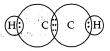
Draw the electron-dot structure for ethyne. $A$ mixture of ethyne and oxygen is burnt for welding. In your opinion,why cannot we use a mixture of ethyne and air for this purpose?
Solution
(N/A) The electron-dot structure of ethyne $(C_2H_2)$ shows a triple bond between the two carbon atoms and a single bond between each carbon and hydrogen atom.
In pure oxygen,ethyne undergoes complete combustion,which releases a large amount of heat,attaining the high temperature required for welding.
In contrast,air contains a lower percentage of oxygen compared to pure oxygen. When ethyne is burnt in air,it undergoes incomplete combustion,which produces a sooty flame and does not generate the high temperature necessary for welding.
In pure oxygen,ethyne undergoes complete combustion,which releases a large amount of heat,attaining the high temperature required for welding.
In contrast,air contains a lower percentage of oxygen compared to pure oxygen. When ethyne is burnt in air,it undergoes incomplete combustion,which produces a sooty flame and does not generate the high temperature necessary for welding.
0 likes
View Solution115
MediumMCQ
What is meant by homologous series of carbon compounds? Classify the following carbon compounds into two homologous series and name them.
$C_{3}H_{4}, C_{3}H_{6}, C_{4}H_{6}, C_{4}H_{8}, C_{5}H_{8}, C_{5}H_{10}$
$C_{3}H_{4}, C_{3}H_{6}, C_{4}H_{6}, C_{4}H_{8}, C_{5}H_{8}, C_{5}H_{10}$
A
Alkynes and Alkanes
B
Alkenes and Alkanes
C
Alkynes and Alkenes
D
Alkanes and Alkenes
Solution
(C) homologous series is a group of organic compounds having the same functional group and similar chemical properties,in which the successive members differ by a $-CH_{2}$ group.
$1$. Alkynes: These follow the general formula $C_{n}H_{2n-2}$. The compounds $C_{3}H_{4}, C_{4}H_{6}, C_{5}H_{8}$ belong to this series.
$2$. Alkenes: These follow the general formula $C_{n}H_{2n}$. The compounds $C_{3}H_{6}, C_{4}H_{8}, C_{5}H_{10}$ belong to this series.
$1$. Alkynes: These follow the general formula $C_{n}H_{2n-2}$. The compounds $C_{3}H_{4}, C_{4}H_{6}, C_{5}H_{8}$ belong to this series.
$2$. Alkenes: These follow the general formula $C_{n}H_{2n}$. The compounds $C_{3}H_{6}, C_{4}H_{8}, C_{5}H_{10}$ belong to this series.
0 likes
View Solution116
Medium
Write the name and general formula of a chain of hydrocarbons in which an addition reaction with hydrogen is possible. State the essential condition for an addition reaction. Stating this condition,write a chemical equation giving the name of the reactant and the product of the reaction.
Solution
(A) The hydrocarbons in which an addition reaction with hydrogen is possible are known as $Alkene$s. Their general formula is $C_nH_{2n}$.
The essential condition for an addition reaction is the presence of a multiple bond (double or triple bond) between carbon atoms and the use of a catalyst such as $Ni$,$Pd$,or $Pt$.
Chemical equation (Hydrogenation of Ethene):
$CH_2=CH_2 + H_2 \xrightarrow{Ni/Pd/Pt} CH_3-CH_3$
Reactant: $Ethene$
Product: $Ethane$
The essential condition for an addition reaction is the presence of a multiple bond (double or triple bond) between carbon atoms and the use of a catalyst such as $Ni$,$Pd$,or $Pt$.
Chemical equation (Hydrogenation of Ethene):
$CH_2=CH_2 + H_2 \xrightarrow{Ni/Pd/Pt} CH_3-CH_3$
Reactant: $Ethene$
Product: $Ethane$
0 likes
View Solution117
Medium
Why should we prefer vegetable oils over animal fats for cooking food? Give a balanced chemical equation for the reaction for hydrogenation of vegetable oils. Name the catalysts in this reaction.
Solution
(N/A) Vegetable oils generally contain unsaturated fatty acids,which are considered healthier for the human body compared to animal fats,which are rich in saturated fatty acids. Saturated fats are associated with higher risks of cardiovascular diseases.
The hydrogenation reaction of vegetable oils is represented as:
$R_2C = CR_2 + H_2 \xrightarrow{Ni/Pd/Pt} R_2CH - CR_2H$
The catalysts used in this reaction are typically finely divided $Ni$ (Nickel),$Pd$ (Palladium),or $Pt$ (Platinum).
The hydrogenation reaction of vegetable oils is represented as:
$R_2C = CR_2 + H_2 \xrightarrow{Ni/Pd/Pt} R_2CH - CR_2H$
The catalysts used in this reaction are typically finely divided $Ni$ (Nickel),$Pd$ (Palladium),or $Pt$ (Platinum).
0 likes
View Solution118
Medium
Convert $CH_{4}$ into $CCl_{4}$ by substituting hydrogen atoms with chlorine atoms in successive reactions. Why is this reaction referred to as a substitution reaction?
Solution
(N/A) The conversion of $CH_{4}$ to $CCl_{4}$ occurs through the following successive steps in the presence of sunlight:
$1$. $CH_{4} + Cl_{2} \xrightarrow{\text{Sunlight}} CH_{3}Cl + HCl$
$2$. $CH_{3}Cl + Cl_{2} \xrightarrow{\text{Sunlight}} CH_{2}Cl_{2} + HCl$
$3$. $CH_{2}Cl_{2} + Cl_{2} \xrightarrow{\text{Sunlight}} CHCl_{3} + HCl$
$4$. $CHCl_{3} + Cl_{2} \xrightarrow{\text{Sunlight}} CCl_{4} + HCl$
This reaction is referred to as a substitution reaction because one or more hydrogen atoms of the hydrocarbon are replaced (substituted) by another atom or group of atoms (in this case,chlorine atoms).
$1$. $CH_{4} + Cl_{2} \xrightarrow{\text{Sunlight}} CH_{3}Cl + HCl$
$2$. $CH_{3}Cl + Cl_{2} \xrightarrow{\text{Sunlight}} CH_{2}Cl_{2} + HCl$
$3$. $CH_{2}Cl_{2} + Cl_{2} \xrightarrow{\text{Sunlight}} CHCl_{3} + HCl$
$4$. $CHCl_{3} + Cl_{2} \xrightarrow{\text{Sunlight}} CCl_{4} + HCl$
This reaction is referred to as a substitution reaction because one or more hydrogen atoms of the hydrocarbon are replaced (substituted) by another atom or group of atoms (in this case,chlorine atoms).
0 likes
View Solution119
Difficult
$A$ carboxylic acid (molecular formula $C_{2}H_{4}O_{2}$) reacts with an alcohol in the presence of an acid catalyst to form a compound $'X'$. The alcohol on oxidation with alkaline $KMnO_{4}$ followed by acidification gives the same carboxylic acid $C_{2}H_{4}O_{2}$. Write the name and structure of $(i)$ carboxylic acid,$(ii)$ alcohol,and $(iii)$ the compound $'X'$.
Solution
(N/A) $(i)$ Carboxylic acid: Ethanoic acid $(CH_{3}COOH)$. Structure: $CH_{3}-C(=O)OH$.
$(ii)$ Alcohol: Ethanol $(CH_{3}CH_{2}OH)$. Structure: $CH_{3}-CH_{2}-OH$.
$(iii)$ Compound $'X'$: Ethyl ethanoate $(CH_{3}COOC_{2}H_{5})$. Structure: $CH_{3}-C(=O)-O-CH_{2}-CH_{3}$.
Explanation: The reaction between ethanoic acid and ethanol in the presence of an acid catalyst is an esterification reaction,producing the ester ethyl ethanoate $('X')$.
$(ii)$ Alcohol: Ethanol $(CH_{3}CH_{2}OH)$. Structure: $CH_{3}-CH_{2}-OH$.
$(iii)$ Compound $'X'$: Ethyl ethanoate $(CH_{3}COOC_{2}H_{5})$. Structure: $CH_{3}-C(=O)-O-CH_{2}-CH_{3}$.
Explanation: The reaction between ethanoic acid and ethanol in the presence of an acid catalyst is an esterification reaction,producing the ester ethyl ethanoate $('X')$.
0 likes
View Solution120
Medium
State the meaning of functional group in a carbon compound. Write the functional group present in $(i)$ ethanol and $(ii)$ ethanoic acid and also draw their structures.
Solution
(N/A) An atom or a group of atoms that determines the chemical properties of organic compounds is called a functional group. They confer specific properties to the compound,regardless of the length and nature of the carbon chain.
| Organic compound | Functional group and Structure |
|---|---|
| $(i)$ Ethanol | Alcohol group $(-OH)$: $CH_{3}-CH_{2}-OH$ |
| $(ii)$ Ethanoic acid | Carboxylic acid group $(-COOH)$: $CH_{3}-C(=O)OH$ |
0 likes
View Solution121
Medium
$(i)$ Distinguish between saturated hydrocarbons and unsaturated hydrocarbons with the help of the combustion process.
$(ii)$ Write the chemical names of $C_{4}H_{10}$ and $C_{2}H_{2}$ and draw their structures.
$(ii)$ Write the chemical names of $C_{4}H_{10}$ and $C_{2}H_{2}$ and draw their structures.
Solution
(N/A)
$(ii)$ $(a)$ The chemical name of $C_{4}H_{10}$ is Butane. Its structure is: $CH_{3}-CH_{2}-CH_{2}-CH_{3}$.
$(b)$ The chemical name of $C_{2}H_{2}$ is Ethyne. Its structure is: $H-C\equiv C-H$.
| Saturated hydrocarbons | Unsaturated hydrocarbons |
|---|---|
| $1.$ Saturated hydrocarbons burn with a clean blue flame because they have a higher hydrogen-to-carbon ratio,allowing for complete combustion. | $1.$ Unsaturated hydrocarbons burn with a yellow,sooty flame due to a higher carbon-to-hydrogen ratio,which leads to incomplete combustion. |
| $2.$ They undergo complete combustion,producing only $CO_{2}$ and $H_{2}O$ as products. | $2.$ They undergo incomplete combustion,producing unburnt carbon particles (soot) in addition to $CO_{2}$ and $H_{2}O$. |
$(ii)$ $(a)$ The chemical name of $C_{4}H_{10}$ is Butane. Its structure is: $CH_{3}-CH_{2}-CH_{2}-CH_{3}$.
$(b)$ The chemical name of $C_{2}H_{2}$ is Ethyne. Its structure is: $H-C\equiv C-H$.
0 likes
View Solution122
Medium
Define oxidising agents. Explain its role in the oxidation of alcohols to acids. Write the oxidation reaction of ethanol.
Solution
(N/A) $(i)$ Substances that are capable of adding oxygen to other substances are known as oxidising agents.
$(ii)$ Alkaline potassium permanganate $(KMnO_4)$ or acidified potassium dichromate $(K_2Cr_2O_7)$ act as oxidising agents because they provide oxygen to oxidise alcohols into carboxylic acids.
$(iii)$ The oxidation reaction of ethanol is:
$CH_3CH_2OH \xrightarrow[\text{Acidified } K_2Cr_2O_7]{\text{Alkaline } KMnO_4} CH_3COOH$
$(ii)$ Alkaline potassium permanganate $(KMnO_4)$ or acidified potassium dichromate $(K_2Cr_2O_7)$ act as oxidising agents because they provide oxygen to oxidise alcohols into carboxylic acids.
$(iii)$ The oxidation reaction of ethanol is:
$CH_3CH_2OH \xrightarrow[\text{Acidified } K_2Cr_2O_7]{\text{Alkaline } KMnO_4} CH_3COOH$
0 likes
View Solution123
Medium
Why are vegetable oils considered healthy compared to vegetable ghee? How are vegetable oils converted into vegetable ghee? Name and define the process involved.
Solution
(N/A) $(i)$ Vegetable oils contain unsaturated fatty acids,whereas vegetable ghee contains saturated fatty acids,which are considered harmful to health.
$(ii)$ Vegetable oils are converted into vegetable ghee by the addition of hydrogen in the presence of catalysts such as palladium $(Pd)$ or nickel $(Ni)$.
$(iii)$ The process involved is known as Hydrogenation (an addition reaction). It is defined as the chemical process of adding hydrogen atoms to the carbon-carbon double bonds of an organic compound to convert it into a saturated compound.
$(ii)$ Vegetable oils are converted into vegetable ghee by the addition of hydrogen in the presence of catalysts such as palladium $(Pd)$ or nickel $(Ni)$.
$(iii)$ The process involved is known as Hydrogenation (an addition reaction). It is defined as the chemical process of adding hydrogen atoms to the carbon-carbon double bonds of an organic compound to convert it into a saturated compound.
0 likes
View Solution124
Medium
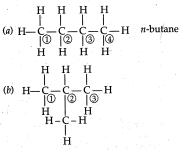
Define the term 'structural isomerism'. Explain why propane cannot exhibit this property. Draw the structures of possible isomers of butane,$C_{4}H_{10}$.
Solution
(N/A) $(i)$ Structural isomerism is the phenomenon in which compounds have the same molecular formula but different structural arrangements of atoms.
$(ii)$ Propane $(C_{3}H_{8})$ cannot exhibit structural isomerism because it contains only three carbon atoms. With only three carbon atoms,there is only one possible way to arrange them in a chain,meaning no alternative structural arrangement can be formed.
$(iii)$ Butane $(C_{4}H_{10})$ has two structural isomers:
$(a)$ $n$-butane: $A$ straight-chain structure where four carbon atoms are linked in a single row.
$(b)$ Isobutane ($2$-methylpropane): $A$ branched-chain structure where three carbon atoms form the main chain and one carbon atom is attached as a branch to the central carbon atom.
$(ii)$ Propane $(C_{3}H_{8})$ cannot exhibit structural isomerism because it contains only three carbon atoms. With only three carbon atoms,there is only one possible way to arrange them in a chain,meaning no alternative structural arrangement can be formed.
$(iii)$ Butane $(C_{4}H_{10})$ has two structural isomers:
$(a)$ $n$-butane: $A$ straight-chain structure where four carbon atoms are linked in a single row.
$(b)$ Isobutane ($2$-methylpropane): $A$ branched-chain structure where three carbon atoms form the main chain and one carbon atom is attached as a branch to the central carbon atom.
0 likes
View Solution125
Medium
$(i)$ What is vinegar? State its one use.
$(ii)$ Which gas is produced when dilute ethanoic acid is added to sodium bicarbonate? How will you test the presence of this gas?
$(ii)$ Which gas is produced when dilute ethanoic acid is added to sodium bicarbonate? How will you test the presence of this gas?
Solution
(N/A) $(i)$ $A$ $5-8 \%$ solution of acetic acid in water is known as vinegar. Its use: It is commonly used as a preservative in pickles and various food items.
$(ii)$ When dilute ethanoic acid is added to sodium bicarbonate,carbon dioxide $(CO_2)$ gas is produced. Test: This gas turns lime water milky and extinguishes a burning splinter.
$(ii)$ When dilute ethanoic acid is added to sodium bicarbonate,carbon dioxide $(CO_2)$ gas is produced. Test: This gas turns lime water milky and extinguishes a burning splinter.
0 likes
View Solution126
Medium
Why are homologous series of carbon compounds so called? Write the chemical formula of two consecutive members of a homologous series and state the part of these compounds that determines their $(i)$ physical properties,and (ii) chemical properties.
Solution
(N/A) homologous series is a group of organic compounds having the same functional group and similar chemical properties,in which all successive members differ by a $-CH_2$ unit.
Two consecutive members of the homologous series of alcohols are:
$(i)$ Methanol: $CH_3OH$
(ii) Ethanol: $C_2H_5OH$
$(i)$ The physical properties (such as melting point,boiling point,and solubility) of the compounds in a homologous series are determined by the length of the carbon chain (molecular mass).
(ii) The chemical properties of the compounds in a homologous series are determined by the functional group present in the molecule.
Two consecutive members of the homologous series of alcohols are:
$(i)$ Methanol: $CH_3OH$
(ii) Ethanol: $C_2H_5OH$
$(i)$ The physical properties (such as melting point,boiling point,and solubility) of the compounds in a homologous series are determined by the length of the carbon chain (molecular mass).
(ii) The chemical properties of the compounds in a homologous series are determined by the functional group present in the molecule.
0 likes
View Solution127
MediumMCQ
$(a)$ Write chemical equations for the reactions of ethanoic acid with:
$(i)$ Sodium
$(ii)$ Sodium carbonate
$(iii)$ Ethanol in the presence of conc. $H_{2}SO_{4}$.
$(b)$ State the role of concentrated sulphuric acid in the esterification reaction.
$(c)$ Write one use of ethanoic acid.
$(i)$ Sodium
$(ii)$ Sodium carbonate
$(iii)$ Ethanol in the presence of conc. $H_{2}SO_{4}$.
$(b)$ State the role of concentrated sulphuric acid in the esterification reaction.
$(c)$ Write one use of ethanoic acid.
A
$N$/$A$
B
$N$/$A$
C
$N$/$A$
D
$N$/$A$
Solution
(N/A) $(a) (i)$ $2CH_{3}COOH + 2Na \rightarrow 2CH_{3}COONa + H_{2} \uparrow$
$(ii)$ $2CH_{3}COOH + Na_{2}CO_{3} \rightarrow 2CH_{3}COONa + H_{2}O + CO_{2} \uparrow$
$(iii)$ $CH_{3}COOH + C_{2}H_{5}OH \xrightarrow{\text{conc. } H_{2}SO_{4}} CH_{3}COOC_{2}H_{5} + H_{2}O$
$(b)$ Concentrated sulphuric acid acts as a dehydrating agent. It removes the water molecule formed during the reaction,which shifts the equilibrium forward,thereby increasing the yield of the ester.
$(c)$ Ethanoic acid is used as a preservative in pickles and for making vinegar.
$(ii)$ $2CH_{3}COOH + Na_{2}CO_{3} \rightarrow 2CH_{3}COONa + H_{2}O + CO_{2} \uparrow$
$(iii)$ $CH_{3}COOH + C_{2}H_{5}OH \xrightarrow{\text{conc. } H_{2}SO_{4}} CH_{3}COOC_{2}H_{5} + H_{2}O$
$(b)$ Concentrated sulphuric acid acts as a dehydrating agent. It removes the water molecule formed during the reaction,which shifts the equilibrium forward,thereby increasing the yield of the ester.
$(c)$ Ethanoic acid is used as a preservative in pickles and for making vinegar.
0 likes
View Solution128
Medium
$(a)$ Soaps cannot be used with hard water. Why?
$(b)$ Give the chemical composition of detergents.
$(c)$ Give one advantage of detergents over soaps.
$(b)$ Give the chemical composition of detergents.
$(c)$ Give one advantage of detergents over soaps.
Solution
(N/A) Hard water contains calcium $(Ca^{2+})$ and magnesium $(Mg^{2+})$ salts. These ions react with soap molecules to form an insoluble substance known as scum,which prevents the soap from forming a lather.
$(b)$ Detergents are generally the ammonium or sulphonate salts of long-chain carboxylic acids.
$(c)$ The main advantage is that detergents do not form insoluble precipitates (scum) with the calcium and magnesium ions present in hard water,allowing them to remain effective for cleaning even in hard water.
$(b)$ Detergents are generally the ammonium or sulphonate salts of long-chain carboxylic acids.
$(c)$ The main advantage is that detergents do not form insoluble precipitates (scum) with the calcium and magnesium ions present in hard water,allowing them to remain effective for cleaning even in hard water.
0 likes
View Solution129
Medium
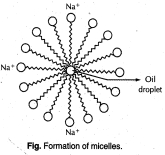
With the help of a diagram,explain the cleansing action of soap.
Solution
(N/A) soap molecule consists of two parts: a long hydrocarbon chain which is hydrophobic (water-repelling) and an ionic head which is hydrophilic (water-attracting).
When soap is dissolved in water,the hydrophobic tails attach themselves to the oil or dirt particles,while the hydrophilic heads point outwards into the water.
This arrangement forms a spherical structure known as a micelle.
The hydrophobic tails trap the oil droplet in the center,and the hydrophilic heads,being negatively charged,repel each other,keeping the dirt suspended in the water as an emulsion.
This allows the dirt to be easily rinsed away from the clothes during washing.
When soap is dissolved in water,the hydrophobic tails attach themselves to the oil or dirt particles,while the hydrophilic heads point outwards into the water.
This arrangement forms a spherical structure known as a micelle.
The hydrophobic tails trap the oil droplet in the center,and the hydrophilic heads,being negatively charged,repel each other,keeping the dirt suspended in the water as an emulsion.
This allows the dirt to be easily rinsed away from the clothes during washing.
0 likes
View Solution130
Medium
An organic compound $A$ of molecular formula $C_{2}H_{4}$ on reduction gives another compound $B$ of molecular formula $C_{2}H_{6}$. $B$ on reaction with chlorine in the presence of sunlight gives $C$ of molecular formula $C_{2}H_{5}Cl$.
$(a)$ Name the compounds $A, B$ and $C$.
$(b)$ Write the chemical equation for the conversion of $A$ to $B$ and name the type of reaction.
$(a)$ Name the compounds $A, B$ and $C$.
$(b)$ Write the chemical equation for the conversion of $A$ to $B$ and name the type of reaction.
Solution
(A) is ethene $[CH_{2}=CH_{2}]$.
$B$ is ethane $[CH_{3}-CH_{3}]$.
$C$ is chloroethane $[CH_{3}-CH_{2}-Cl]$.
$(b)$ The chemical equation for the conversion of $A$ to $B$ is:
$CH_{2}=CH_{2} + H_{2} \xrightarrow{Ni/Pd/Pt} CH_{3}-CH_{3}$
Type of reaction: Hydrogenation (Addition reaction).
$B$ is ethane $[CH_{3}-CH_{3}]$.
$C$ is chloroethane $[CH_{3}-CH_{2}-Cl]$.
$(b)$ The chemical equation for the conversion of $A$ to $B$ is:
$CH_{2}=CH_{2} + H_{2} \xrightarrow{Ni/Pd/Pt} CH_{3}-CH_{3}$
Type of reaction: Hydrogenation (Addition reaction).
0 likes
View Solution131
Medium
Complete the following chemical reactions and write the chemical name of the products obtained.
$(i)$ $CH_{2}=CH_{2} + H_{2}O \longrightarrow$
$(ii)$ $CH_{3}COOH + NaOH \longrightarrow$
$(iii)$ $CH_{3}CH_{2}OH \xrightarrow{H_{2}SO_{4}} $
$(iv)$ $HCOOH + Na \longrightarrow$
$(v)$ $C_{2}H_{5}OH \xrightarrow{\text{Alk. } KMnO_{4}} $
$(i)$ $CH_{2}=CH_{2} + H_{2}O \longrightarrow$
$(ii)$ $CH_{3}COOH + NaOH \longrightarrow$
$(iii)$ $CH_{3}CH_{2}OH \xrightarrow{H_{2}SO_{4}} $
$(iv)$ $HCOOH + Na \longrightarrow$
$(v)$ $C_{2}H_{5}OH \xrightarrow{\text{Alk. } KMnO_{4}} $
Solution
(N/A) $(i)$ $CH_{2}=CH_{2} + H_{2}O \longrightarrow C_{2}H_{5}OH$ (Ethanol)
$(ii)$ $CH_{3}COOH + NaOH \longrightarrow CH_{3}COONa$ (Sodium acetate) $+ H_{2}O$
$(iii)$ $CH_{3}CH_{2}OH \xrightarrow{H_{2}SO_{4}} CH_{2}=CH_{2}$ (Ethene) $+ H_{2}O$
$(iv)$ $HCOOH + Na \longrightarrow HCOONa$ (Sodium formate) $+ \frac{1}{2}H_{2}$
$(v)$ $C_{2}H_{5}OH \xrightarrow{\text{Alk. } KMnO_{4}} CH_{3}COOH$ (Ethanoic acid)
$(ii)$ $CH_{3}COOH + NaOH \longrightarrow CH_{3}COONa$ (Sodium acetate) $+ H_{2}O$
$(iii)$ $CH_{3}CH_{2}OH \xrightarrow{H_{2}SO_{4}} CH_{2}=CH_{2}$ (Ethene) $+ H_{2}O$
$(iv)$ $HCOOH + Na \longrightarrow HCOONa$ (Sodium formate) $+ \frac{1}{2}H_{2}$
$(v)$ $C_{2}H_{5}OH \xrightarrow{\text{Alk. } KMnO_{4}} CH_{3}COOH$ (Ethanoic acid)
0 likes
View Solution132
Difficult
Both soap and detergent are some type of salts. What is the difference between them? Describe in brief the cleansing action of soap. Why do soaps not form lather in hard water? List two problems that arise due to the use of detergents instead of soaps.
Solution
(A) Soaps are $Na^+$ or $K^+$ salts of long-chain carboxylic acids.
Detergents are ammonium or sulphonate salts of long-chain hydrocarbons.
Cleansing action of soap: $A$ soap molecule has two parts: a hydrophilic (water-loving) ionic head and a hydrophobic (water-repelling) hydrocarbon tail. The tail attaches to oily dirt,while the head remains in water. This forms a structure called a $micelle$. When rinsed,the $micelle$ is washed away,carrying the dirt with it.
Soaps do not form lather in hard water because they react with $Ca^{2+}$ and $Mg^{2+}$ ions present in hard water to form an insoluble precipitate known as $scum$.
Problems due to the use of detergents:
$1$. Most detergents are non-biodegradable,leading to water and soil pollution.
$2$. They can cause skin irritation or allergic reactions in some individuals.
Detergents are ammonium or sulphonate salts of long-chain hydrocarbons.
Cleansing action of soap: $A$ soap molecule has two parts: a hydrophilic (water-loving) ionic head and a hydrophobic (water-repelling) hydrocarbon tail. The tail attaches to oily dirt,while the head remains in water. This forms a structure called a $micelle$. When rinsed,the $micelle$ is washed away,carrying the dirt with it.
Soaps do not form lather in hard water because they react with $Ca^{2+}$ and $Mg^{2+}$ ions present in hard water to form an insoluble precipitate known as $scum$.
Problems due to the use of detergents:
$1$. Most detergents are non-biodegradable,leading to water and soil pollution.
$2$. They can cause skin irritation or allergic reactions in some individuals.
0 likes
View Solution133
Medium
$(a)$ Differentiate between soap and detergent.
$(b)$ Explain why soaps form scum with hard water,whereas detergents do not.
$(b)$ Explain why soaps form scum with hard water,whereas detergents do not.
Solution
(N/A)
$(b)$ Hard water contains $Ca^{2+}$ and $Mg^{2+}$ ions. These ions react with the long-chain fatty acid part of the soap to form insoluble precipitates known as scum,which hinders the cleaning process. Detergents,however,form soluble salts with these ions,so they do not form scum and work effectively in hard water.
Chemical reaction: $2C_{17}H_{35}COONa + Ca^{2+} (Mg^{2+}) \longrightarrow (C_{17}H_{35}COO)_{2}Ca (Mg) + 2Na^{+}$
| $Soaps$ | $Detergents$ |
|---|---|
| $(i)$ $Soaps$ are sodium or potassium salts of long-chain carboxylic acids. | $(i)$ $Detergents$ are ammonium or sulphonate salts of long-chain carboxylic acids. |
| $(ii)$ $Soaps$ have lesser cleansing action compared to detergents. | $(ii)$ $Detergents$ have better cleansing action compared to soaps. |
| $(iii)$ $Soaps$ are made from animal or plant fats. | $(iii)$ $Detergents$ are made from petrochemicals. |
| $(iv)$ $Soaps$ are biodegradable. | $(iv)$ $Detergents$ are generally non-biodegradable. |
$(b)$ Hard water contains $Ca^{2+}$ and $Mg^{2+}$ ions. These ions react with the long-chain fatty acid part of the soap to form insoluble precipitates known as scum,which hinders the cleaning process. Detergents,however,form soluble salts with these ions,so they do not form scum and work effectively in hard water.
Chemical reaction: $2C_{17}H_{35}COONa + Ca^{2+} (Mg^{2+}) \longrightarrow (C_{17}H_{35}COO)_{2}Ca (Mg) + 2Na^{+}$
0 likes
View Solution134
Medium
$(a)$ How is vinegar made?
$(b)$ What is glacial acetic acid? What is its melting point?
$(c)$ Why are carboxylic acids called weak acids?
$(d)$ Write the name and the formula of the two compounds formed when the ester $CH_{3}COOC_{2}H_{5}$ undergoes saponification.
$(b)$ What is glacial acetic acid? What is its melting point?
$(c)$ Why are carboxylic acids called weak acids?
$(d)$ Write the name and the formula of the two compounds formed when the ester $CH_{3}COOC_{2}H_{5}$ undergoes saponification.
Solution
(D) Vinegar is made by the fermentation of ethanol using bacteria like $Acetobacter$ $aceti$,which produces a $5-8\%$ aqueous solution of acetic acid.
$(b)$ Pure ethanoic acid (acetic acid) is known as glacial acetic acid because it freezes into an ice-like solid at temperatures below $290 \ K$.
$(c)$ Carboxylic acids are called weak acids because they do not ionize completely in an aqueous solution; they only partially dissociate into ions.
$(d)$ When the ester $CH_{3}COOC_{2}H_{5}$ (ethyl ethanoate) undergoes saponification,it reacts with a base (like $NaOH$) to form:
$1.$ Sodium ethanoate $(CH_{3}COONa)$
$2.$ Ethanol $(C_{2}H_{5}OH)$
$(b)$ Pure ethanoic acid (acetic acid) is known as glacial acetic acid because it freezes into an ice-like solid at temperatures below $290 \ K$.
$(c)$ Carboxylic acids are called weak acids because they do not ionize completely in an aqueous solution; they only partially dissociate into ions.
$(d)$ When the ester $CH_{3}COOC_{2}H_{5}$ (ethyl ethanoate) undergoes saponification,it reacts with a base (like $NaOH$) to form:
$1.$ Sodium ethanoate $(CH_{3}COONa)$
$2.$ Ethanol $(C_{2}H_{5}OH)$
0 likes
View Solution135
Medium
Identify the compounds $A$ to $E$ in the following reaction sequence:
$(i)$ $CH_3CH_2OH \xrightarrow[dil. HCl]{KMnO_4/KOH} (A) + H_2O$
$(ii)$ $CH_3CH_2OH + A \xrightarrow[\Delta]{Conc. H_2SO_4} B + H_2O$
$(iii)$ $B + NaOH \rightarrow C + CH_3CH_2OH$
$(iv)$ $A + NaHCO_3 \rightarrow C + D + H_2O$
$(v)$ $CH_3CH_2OH + E \rightarrow CH_3CH_2ONa + H_2$
$(i)$ $CH_3CH_2OH \xrightarrow[dil. HCl]{KMnO_4/KOH} (A) + H_2O$
$(ii)$ $CH_3CH_2OH + A \xrightarrow[\Delta]{Conc. H_2SO_4} B + H_2O$
$(iii)$ $B + NaOH \rightarrow C + CH_3CH_2OH$
$(iv)$ $A + NaHCO_3 \rightarrow C + D + H_2O$
$(v)$ $CH_3CH_2OH + E \rightarrow CH_3CH_2ONa + H_2$
Solution
(A) $(i)$ Ethanol $(CH_3CH_2OH)$ undergoes oxidation with alkaline $KMnO_4$ to form Ethanoic acid $(A = CH_3COOH)$.
$(ii)$ Ethanol reacts with Ethanoic acid $(A)$ in the presence of concentrated $H_2SO_4$ to form Ethyl ethanoate $(B = CH_3COOCH_2CH_3)$ and water.
$(iii)$ Ethyl ethanoate $(B)$ undergoes saponification with $NaOH$ to form Sodium ethanoate $(C = CH_3COONa)$ and Ethanol.
$(iv)$ Ethanoic acid $(A)$ reacts with $NaHCO_3$ to form Sodium ethanoate $(C)$,Carbon dioxide $(D = CO_2)$,and water.
$(v)$ Ethanol reacts with Sodium $(E = Na)$ to form Sodium ethoxide $(CH_3CH_2ONa)$ and Hydrogen gas.
$(ii)$ Ethanol reacts with Ethanoic acid $(A)$ in the presence of concentrated $H_2SO_4$ to form Ethyl ethanoate $(B = CH_3COOCH_2CH_3)$ and water.
$(iii)$ Ethyl ethanoate $(B)$ undergoes saponification with $NaOH$ to form Sodium ethanoate $(C = CH_3COONa)$ and Ethanol.
$(iv)$ Ethanoic acid $(A)$ reacts with $NaHCO_3$ to form Sodium ethanoate $(C)$,Carbon dioxide $(D = CO_2)$,and water.
$(v)$ Ethanol reacts with Sodium $(E = Na)$ to form Sodium ethoxide $(CH_3CH_2ONa)$ and Hydrogen gas.
0 likes
View Solution136
Medium
What are soaps chemically? How do they differ from synthetic detergents? Explain the mechanism and the cleansing action of soap.
Solution
(N/A) Chemical Nature: Soaps are the sodium or potassium salts of long-chain fatty acids (e.g.,stearic acid).
Difference from Synthetic Detergents: Soaps are effective only in soft water and form scum in hard water. Synthetic detergents are ammonium or sulphonate salts of long-chain carboxylic acids and are effective in both soft and hard water.
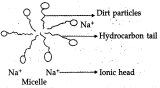
Cleansing Action (Micelle Formation): Soap molecules have two parts: a hydrophilic ionic head and a hydrophobic hydrocarbon tail.
When soap is dissolved in water,the hydrophobic tails attach to the dirt (oil/grease) particles,while the hydrophilic heads remain in the water.
This forms a spherical structure called a micelle,with the dirt trapped in the center.
The ionic heads on the surface of the micelle repel each other due to like charges,keeping the micelles suspended in water as a colloid,which is then washed away with the water.
Difference from Synthetic Detergents: Soaps are effective only in soft water and form scum in hard water. Synthetic detergents are ammonium or sulphonate salts of long-chain carboxylic acids and are effective in both soft and hard water.
Cleansing Action (Micelle Formation): Soap molecules have two parts: a hydrophilic ionic head and a hydrophobic hydrocarbon tail.
When soap is dissolved in water,the hydrophobic tails attach to the dirt (oil/grease) particles,while the hydrophilic heads remain in the water.
This forms a spherical structure called a micelle,with the dirt trapped in the center.
The ionic heads on the surface of the micelle repel each other due to like charges,keeping the micelles suspended in water as a colloid,which is then washed away with the water.
0 likes
View Solution137
Medium
$(a)$ What are hydrocarbons?
$(b)$ Write the structural difference between saturated and unsaturated hydrocarbons.
$(b)$ Write the structural difference between saturated and unsaturated hydrocarbons.
Solution
(N/A) Hydrocarbons are organic compounds consisting entirely of carbon and hydrogen atoms linked by covalent bonds.
$(b)$ The structural difference is that saturated hydrocarbons contain only single covalent bonds between carbon atoms (e.g.,alkanes),whereas unsaturated hydrocarbons contain at least one double or triple covalent bond between carbon atoms (e.g.,alkenes or alkynes).
$(b)$ The structural difference is that saturated hydrocarbons contain only single covalent bonds between carbon atoms (e.g.,alkanes),whereas unsaturated hydrocarbons contain at least one double or triple covalent bond between carbon atoms (e.g.,alkenes or alkynes).
0 likes
View Solution138
Medium
$(a)$ Why is hard water not suitable for washing clothes with soap?
$(b)$ Why does micelle formation take place when soap is added to water?
$(c)$ What is saponification?
$(b)$ Why does micelle formation take place when soap is added to water?
$(c)$ What is saponification?
Solution
(N/A) Hard water contains dissolved salts of calcium and magnesium. When soap is added to hard water,it reacts with these ions to form an insoluble precipitate known as scum. This prevents the formation of lather,making it ineffective for cleaning.
$(b)$ Soap molecules have a dual nature: a hydrophilic (water-loving) head and a hydrophobic (water-repelling) hydrocarbon tail. When added to water,the hydrophobic tails cluster together to avoid water,while the hydrophilic heads face outward toward the water,resulting in the formation of spherical structures called micelles.
$(c)$ Saponification is the chemical process in which an ester is reacted with an alkali (like sodium hydroxide) to produce soap (a salt of a fatty acid) and alcohol (glycerol).
$(b)$ Soap molecules have a dual nature: a hydrophilic (water-loving) head and a hydrophobic (water-repelling) hydrocarbon tail. When added to water,the hydrophobic tails cluster together to avoid water,while the hydrophilic heads face outward toward the water,resulting in the formation of spherical structures called micelles.
$(c)$ Saponification is the chemical process in which an ester is reacted with an alkali (like sodium hydroxide) to produce soap (a salt of a fatty acid) and alcohol (glycerol).
0 likes
View Solution139
Medium
$(a)$ Complete the following equations:
$(i)$ $CH_4 + 2O_2 \longrightarrow CO_2 + 2H_2O + \text{Heat} + \text{Light}$
$(ii)$ $CH_3COOH + C_2H_5OH \xrightarrow{\text{Acid}} CH_3COOC_2H_5 + H_2O$
$(iii)$ $CH_3CH_2OH \xrightarrow[\text{443 K}]{\text{Conc. } H_2SO_4} CH_2=CH_2 + H_2O$
$(i)$ $CH_4 + 2O_2 \longrightarrow CO_2 + 2H_2O + \text{Heat} + \text{Light}$
$(ii)$ $CH_3COOH + C_2H_5OH \xrightarrow{\text{Acid}} CH_3COOC_2H_5 + H_2O$
$(iii)$ $CH_3CH_2OH \xrightarrow[\text{443 K}]{\text{Conc. } H_2SO_4} CH_2=CH_2 + H_2O$
Solution
(A) $(i)$ Combustion of methane in excess oxygen produces carbon dioxide, water, heat, and light: $CH_4 + 2O_2 \longrightarrow CO_2 + 2H_2O + \text{Heat} + \text{Light}$.
$(ii)$ Esterification reaction between ethanoic acid and ethanol in the presence of an acid catalyst produces ethyl ethanoate (ester) and water: $CH_3COOH + C_2H_5OH \xrightarrow{\text{Acid}} CH_3COOC_2H_5 + H_2O$.
$(iii)$ Dehydration of ethanol using concentrated sulfuric acid at $443 \text{ K}$ produces ethene and water: $CH_3CH_2OH \xrightarrow[\text{443 K}]{\text{Conc. } H_2SO_4} CH_2=CH_2 + H_2O$.
$(ii)$ Esterification reaction between ethanoic acid and ethanol in the presence of an acid catalyst produces ethyl ethanoate (ester) and water: $CH_3COOH + C_2H_5OH \xrightarrow{\text{Acid}} CH_3COOC_2H_5 + H_2O$.
$(iii)$ Dehydration of ethanol using concentrated sulfuric acid at $443 \text{ K}$ produces ethene and water: $CH_3CH_2OH \xrightarrow[\text{443 K}]{\text{Conc. } H_2SO_4} CH_2=CH_2 + H_2O$.
0 likes
View Solution140
Easy
Write the name of the next homologue of $CH_{3}OH$ and $HCOOH$.
Solution
(N/A) homologous series is a group of organic compounds having the same functional group and similar chemical properties,where each successive member differs by a $CH_{2}$ unit.
$1$. For $CH_{3}OH$ (Methanol),the next homologue is obtained by adding a $CH_{2}$ group,which results in $C_{2}H_{5}OH$ (Ethanol).
$2$. For $HCOOH$ (Methanoic acid),the next homologue is obtained by adding a $CH_{2}$ group,which results in $CH_{3}COOH$ (Ethanoic acid).
$1$. For $CH_{3}OH$ (Methanol),the next homologue is obtained by adding a $CH_{2}$ group,which results in $C_{2}H_{5}OH$ (Ethanol).
$2$. For $HCOOH$ (Methanoic acid),the next homologue is obtained by adding a $CH_{2}$ group,which results in $CH_{3}COOH$ (Ethanoic acid).
0 likes
View Solution141
EasyMCQ
How do the boiling point and melting point of hydrocarbons change with an increase in molecular mass?
A
They increase.
B
They decrease.
C
They remain constant.
D
They first increase and then decrease.
Solution
(A) As the molecular mass of hydrocarbons increases,the intermolecular forces of attraction (van der Waals forces) between the molecules also increase.
Due to these stronger intermolecular forces,more energy is required to overcome them,which leads to an increase in both the boiling point and the melting point of the hydrocarbons.
Due to these stronger intermolecular forces,more energy is required to overcome them,which leads to an increase in both the boiling point and the melting point of the hydrocarbons.
0 likes
View Solution142
Medium
Define homologous series of organic compounds. Mention any two characteristics of homologous series.
Solution
(N/A) homologous series is a group of organic compounds having the same functional group and similar chemical properties,in which the successive members differ by a $CH_2$ unit.
Characteristics:
$(i)$ All members of a homologous series can be represented by the same general molecular formula.
(ii) Any two adjacent members of the series differ by one carbon atom and two hydrogen atoms,i.e.,a $CH_2$ unit in their molecular formula.
Characteristics:
$(i)$ All members of a homologous series can be represented by the same general molecular formula.
(ii) Any two adjacent members of the series differ by one carbon atom and two hydrogen atoms,i.e.,a $CH_2$ unit in their molecular formula.
0 likes
View Solution143
Easy
Describe a chemical test to distinguish between ethanol and ethanoic acid.
Solution
(N/A) To distinguish between ethanol and ethanoic acid,the Sodium Hydrogen Carbonate $(NaHCO_3)$ test is used.
Procedure: Take a small amount of both substances in separate test tubes and add a pinch of solid $NaHCO_3$ to each.
Observation: Ethanoic acid reacts with $NaHCO_3$ to produce brisk effervescence due to the evolution of $CO_2$ gas.
Conclusion: Ethanol does not react with $NaHCO_3$ and shows no effervescence,thus allowing us to distinguish between the two.
Procedure: Take a small amount of both substances in separate test tubes and add a pinch of solid $NaHCO_3$ to each.
Observation: Ethanoic acid reacts with $NaHCO_3$ to produce brisk effervescence due to the evolution of $CO_2$ gas.
Conclusion: Ethanol does not react with $NaHCO_3$ and shows no effervescence,thus allowing us to distinguish between the two.
0 likes
View Solution144
EasyMCQ
Identify the functional group present in Pentanone.
A
Alcohol
B
Aldehyde
C
Ketone
D
Carboxylic acid
Solution
(C) The suffix '-one' in the name 'Pentanone' indicates the presence of a ketone functional group. $A$ ketone is characterized by a carbonyl group $(C=O)$ bonded to two carbon atoms.
0 likes
View Solution145
Medium
$(i)$ How will you bring about the following reactions? Write the concerned chemical equations:
$(a)$ Ethanol to Ethene.
$(b)$ Ethanol to Ethanoic acid.
$(a)$ Ethanol to Ethene.
$(b)$ Ethanol to Ethanoic acid.
Solution
(N/A) Ethanol undergoes dehydration in the presence of hot concentrated sulfuric acid $(H_2SO_4)$ at $443 \ K$ to form ethene:
$CH_3CH_2OH \xrightarrow[Conc. H_2SO_4]{443 \ K} CH_2=CH_2 + H_2O$
$(b)$ Ethanol undergoes oxidation in the presence of alkaline potassium permanganate $(KMnO_4)$ or acidified potassium dichromate $(K_2Cr_2O_7)$ to form ethanoic acid:
$CH_3CH_2OH \xrightarrow[alk. KMnO_4]{Oxidation} CH_3COOH$
$CH_3CH_2OH \xrightarrow[Conc. H_2SO_4]{443 \ K} CH_2=CH_2 + H_2O$
$(b)$ Ethanol undergoes oxidation in the presence of alkaline potassium permanganate $(KMnO_4)$ or acidified potassium dichromate $(K_2Cr_2O_7)$ to form ethanoic acid:
$CH_3CH_2OH \xrightarrow[alk. KMnO_4]{Oxidation} CH_3COOH$
0 likes
View Solution146
Medium
$(i)$ Give one example with a chemical equation for the following reactions:
$(a)$ Substitution reaction.
$(b)$ Saponification reaction.
$(c)$ Combustion reaction.
$(a)$ Substitution reaction.
$(b)$ Saponification reaction.
$(c)$ Combustion reaction.
Solution
(N/A) Substitution reaction: Methane reacts with chlorine in the presence of sunlight to form chloromethane and hydrogen chloride.
$CH_4 + Cl_2 \xrightarrow{\text{Sunlight}} CH_3Cl + HCl$
$(b)$ Saponification reaction: Ethyl acetate reacts with sodium hydroxide to form ethanol and sodium acetate.
$CH_3COOC_2H_5 + NaOH \longrightarrow C_2H_5OH + CH_3COONa$
$(c)$ Combustion reaction: Methane burns in oxygen to produce carbon dioxide,water,and heat energy.
$CH_4 + 2O_2 \longrightarrow CO_2 + 2H_2O + \text{Heat} + \text{Light}$
$CH_4 + Cl_2 \xrightarrow{\text{Sunlight}} CH_3Cl + HCl$
$(b)$ Saponification reaction: Ethyl acetate reacts with sodium hydroxide to form ethanol and sodium acetate.
$CH_3COOC_2H_5 + NaOH \longrightarrow C_2H_5OH + CH_3COONa$
$(c)$ Combustion reaction: Methane burns in oxygen to produce carbon dioxide,water,and heat energy.
$CH_4 + 2O_2 \longrightarrow CO_2 + 2H_2O + \text{Heat} + \text{Light}$
0 likes
View Solution147
Medium
Write the name and structure of an alcohol with three carbon atoms in its molecule.
Solution
(N/A) The alcohol with three carbon atoms is $Propanol$ (specifically $Propan-1-ol$).
The chemical formula is $C_{3}H_{7}OH$.
The structural formula is:
$CH_{3}-CH_{2}-CH_{2}-OH$
The chemical formula is $C_{3}H_{7}OH$.
The structural formula is:
$CH_{3}-CH_{2}-CH_{2}-OH$
0 likes
View Solution148
EasyMCQ
Mention the functional group which always occurs at the terminal position of a carbon chain of an organic compound.
A
Alcoholic group
B
Aldehydic group
C
Ketonic group
D
Carboxyl group
Solution
(B, D) The functional groups that always occur at the terminal position of a carbon chain are the Aldehydic group $(-CHO)$ and the Carboxyl group $(-COOH)$.
In these groups,the carbon atom is already bonded to an oxygen atom via a double bond and to a hydrogen atom (in aldehydes) or a hydroxyl group (in carboxylic acids),leaving only one valency available for the carbon chain,which forces them to be at the end of the chain.
In these groups,the carbon atom is already bonded to an oxygen atom via a double bond and to a hydrogen atom (in aldehydes) or a hydroxyl group (in carboxylic acids),leaving only one valency available for the carbon chain,which forces them to be at the end of the chain.
0 likes
View Solution149
MediumMCQ
Write the name and formula of the $2^{nd}$ member of the homologous series having the general formula $C_{n}H_{2n-2}$.
A
Propyne,$C_{3}H_{4}$
B
Butyne,$C_{4}H_{6}$
C
Ethyne,$C_{2}H_{2}$
D
Pentyne,$C_{5}H_{8}$
Solution
(A) The general formula $C_{n}H_{2n-2}$ represents the homologous series of alkynes.
For the $1^{st}$ member,$n = 2$,which is Ethyne $(C_{2}H_{2})$.
For the $2^{nd}$ member,$n = 3$,which is Propyne.
The chemical formula for Propyne is $C_{3}H_{4}$.
For the $1^{st}$ member,$n = 2$,which is Ethyne $(C_{2}H_{2})$.
For the $2^{nd}$ member,$n = 3$,which is Propyne.
The chemical formula for Propyne is $C_{3}H_{4}$.
0 likes
View Solution150
Medium
Mention four characteristics which change with increasing molecular mass in a homologous series.
Solution
(N/A) In a homologous series,as the molecular mass increases,the following characteristics change:
$(a)$ Melting and boiling points increase gradually due to the increase in intermolecular forces.
$(b)$ Physical properties such as density and solubility in a particular solvent show a regular gradation.
$(c)$ Molecular mass increases,which leads to a change in the physical state (e.g.,from gas to liquid to solid).
$(d)$ The chemical properties remain similar,but the intensity of reactions may vary slightly due to the change in the carbon chain length.
$(a)$ Melting and boiling points increase gradually due to the increase in intermolecular forces.
$(b)$ Physical properties such as density and solubility in a particular solvent show a regular gradation.
$(c)$ Molecular mass increases,which leads to a change in the physical state (e.g.,from gas to liquid to solid).
$(d)$ The chemical properties remain similar,but the intensity of reactions may vary slightly due to the change in the carbon chain length.
0 likes
View SolutionCarbon and its Compounds — Mix Examples - Carbon and its Compounds · Frequently Asked Questions
1Are these Carbon and its Compounds questions useful for JEE and NEET?
Yes. All questions in this section are mapped to JEE Main and NEET exam patterns. Previous year questions from JEE Main, NEET, GUJCET and state-level exams are included with full solutions.
2Can I switch to Hindi or Gujarati for these questions?
Yes. Use the language tabs in the hero section or the sidebar to view the same questions and solutions in English, Hindi or Gujarati.
3How do I generate a question paper from this subtopic?
Use the Vedclass Exam Paper Generator — select the chapter and subtopic, set difficulty, and generate Sets A, B, C, D automatically. First 3 chapters of every subject are free.
Vedclass Products
For Students
Vedclass Test Series
Mock tests in real JEE/NEET style with performance analysis. 5-day free trial.
Start Free TrialFor Teachers
Exam Paper Generator
Generate Set A/B/C/D papers from this chapter in 2 minutes. 3 chapters free.
Try FreeFor Institutes
Online Exam Module
Live online exams with unlimited students, 360° analytics & white-label branding.
See DemoFor Teachers & Institutes
Generate a Carbon and its Compounds Exam Paper in 2 Minutes
Select subtopic & difficulty — Sets A, B, C, D auto-generated with No Repeat logic.
First 3 chapters of every subject are free — no payment required.