
A English
Textbook - Carbon and its Compounds Questions in English
Class 10 Science · Carbon and its Compounds · Textbook - Carbon and its Compounds
30+
Questions
English
Language
100%
With Solutions
Showing 30 of 30 questions in English
1
Medium
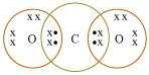
What would be the electron dot structure of carbon dioxide which has the formula $CO_2$?
Solution
(N/A) The electron dot structure of $CO_2$ is formed by the sharing of electrons between one carbon atom and two oxygen atoms.
Carbon has $4$ valence electrons,and each oxygen atom has $6$ valence electrons.
To achieve a stable octet configuration,the carbon atom shares $2$ electrons with each of the two oxygen atoms,resulting in two double bonds.
This sharing is represented by the electron dot structure where the shared pairs of electrons are placed between the atoms:
(Image: $1067-$s1)
Carbon has $4$ valence electrons,and each oxygen atom has $6$ valence electrons.
To achieve a stable octet configuration,the carbon atom shares $2$ electrons with each of the two oxygen atoms,resulting in two double bonds.
This sharing is represented by the electron dot structure where the shared pairs of electrons are placed between the atoms:
(Image: $1067-$s1)
0 likes
View Solution2
Medium
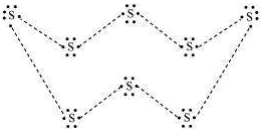
What would be the electron dot structure of a molecule of sulphur which is made up of eight atoms of sulphur?
Solution
(N/A) sulphur molecule consists of eight atoms of sulphur $(S_8)$ joined together in a puckered ring structure.
Each sulphur atom has $6$ valence electrons and requires $2$ more electrons to complete its octet.
Therefore,each sulphur atom forms two single covalent bonds with two adjacent sulphur atoms.
The electron dot structure shows each sulphur atom sharing two electrons with its neighbors,resulting in a crown-shaped ring.
Each sulphur atom has $6$ valence electrons and requires $2$ more electrons to complete its octet.
Therefore,each sulphur atom forms two single covalent bonds with two adjacent sulphur atoms.
The electron dot structure shows each sulphur atom sharing two electrons with its neighbors,resulting in a crown-shaped ring.
0 likes
View Solution3
MediumMCQ
How many structural isomers can you draw for pentane?
A
$2$
B
$3$
C
$4$
D
$5$
Solution
(B) Three structural isomers are possible for pentane $(C_{5}H_{12})$:
$(i)$ $n$-pentane: $CH_{3}-CH_{2}-CH_{2}-CH_{2}-CH_{3}$
$(ii)$ Isopentane ($2$-methylbutane): $CH_{3}-CH(CH_{3})-CH_{2}-CH_{3}$
$(iii)$ Neopentane ($2$,$2$-dimethylpropane): $C(CH_{3})_{4}$
$(i)$ $n$-pentane: $CH_{3}-CH_{2}-CH_{2}-CH_{2}-CH_{3}$
$(ii)$ Isopentane ($2$-methylbutane): $CH_{3}-CH(CH_{3})-CH_{2}-CH_{3}$
$(iii)$ Neopentane ($2$,$2$-dimethylpropane): $C(CH_{3})_{4}$
0 likes
View Solution4
MediumMCQ
What are the two properties of carbon which lead to the huge number of carbon compounds we see around us?
A
Catenation and Tetravalency
B
Isomerism and Allotropy
C
Electronegativity and Ionization
D
Hybridization and Polarity
Solution
(A) The two unique properties of carbon that lead to the formation of a vast number of carbon compounds are:
$(i)$ Catenation: It is the unique ability of carbon atoms to form strong covalent bonds with other carbon atoms,resulting in the formation of long chains,branched chains,or ring structures.
$(ii)$ Tetravalency: Carbon has a valency of $4$,which allows it to form covalent bonds with four other atoms of carbon or atoms of other monovalent elements like hydrogen,oxygen,nitrogen,or halogens.
$(i)$ Catenation: It is the unique ability of carbon atoms to form strong covalent bonds with other carbon atoms,resulting in the formation of long chains,branched chains,or ring structures.
$(ii)$ Tetravalency: Carbon has a valency of $4$,which allows it to form covalent bonds with four other atoms of carbon or atoms of other monovalent elements like hydrogen,oxygen,nitrogen,or halogens.
0 likes
View Solution5
Medium
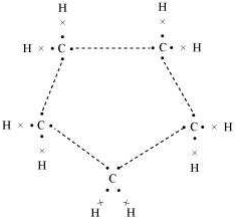
What will be the formula and electron dot structure of cyclopentane?
Solution
(N/A) The chemical formula for cyclopentane is $C_5H_{10}$.
Cyclopentane is a cyclic hydrocarbon with five carbon atoms arranged in a ring. Each carbon atom is bonded to two other carbon atoms and two hydrogen atoms.
The electron dot structure represents the sharing of electrons between atoms to form covalent bonds. In the structure,each carbon atom shares electrons with two adjacent carbon atoms and two hydrogen atoms to complete its octet,while each hydrogen atom shares an electron to complete its duplet.
[Image Description: $A$ pentagonal ring of five carbon atoms,where each carbon is bonded to two hydrogen atoms.]
Cyclopentane is a cyclic hydrocarbon with five carbon atoms arranged in a ring. Each carbon atom is bonded to two other carbon atoms and two hydrogen atoms.
The electron dot structure represents the sharing of electrons between atoms to form covalent bonds. In the structure,each carbon atom shares electrons with two adjacent carbon atoms and two hydrogen atoms to complete its octet,while each hydrogen atom shares an electron to complete its duplet.
[Image Description: $A$ pentagonal ring of five carbon atoms,where each carbon is bonded to two hydrogen atoms.]
0 likes
View Solution6
Difficult
Draw the structures for the following compounds:
$(i)$ Ethanoic acid
$(ii)$ Bromopentane
Are structural isomers possible for bromopentane?
$(i)$ Ethanoic acid
$(ii)$ Bromopentane
Are structural isomers possible for bromopentane?
Solution
(N/A) $(i)$ Ethanoic acid $(CH_{3}COOH)$:
$H-C(H)(H)-C(=O)-OH$
$(ii)$ Yes,structural isomers are possible for bromopentane $(C_{5}H_{11}Br)$. Three common isomers are:
$1$. $1$-Bromopentane: $CH_{3}-CH_{2}-CH_{2}-CH_{2}-CH_{2}-Br$
$2$. $2$-Bromopentane: $CH_{3}-CH_{2}-CH_{2}-CH(Br)-CH_{3}$
$3$. $3$-Bromopentane: $CH_{3}-CH_{2}-CH(Br)-CH_{2}-CH_{3}$
$H-C(H)(H)-C(=O)-OH$
$(ii)$ Yes,structural isomers are possible for bromopentane $(C_{5}H_{11}Br)$. Three common isomers are:
$1$. $1$-Bromopentane: $CH_{3}-CH_{2}-CH_{2}-CH_{2}-CH_{2}-Br$
$2$. $2$-Bromopentane: $CH_{3}-CH_{2}-CH_{2}-CH(Br)-CH_{3}$
$3$. $3$-Bromopentane: $CH_{3}-CH_{2}-CH(Br)-CH_{2}-CH_{3}$
0 likes
View Solution7
Medium
Draw the structures for the following compounds:
$(i)$ Butanone
$(ii)$ Hexanal
$(i)$ Butanone
$(ii)$ Hexanal
Solution
(N/A) $(i)$ Butanone: $CH_{3}CH_{2}COCH_{3}$
Structure: $CH_{3}-CH_{2}-C(=O)-CH_{3}$
$(ii)$ Hexanal: $CH_{3}CH_{2}CH_{2}CH_{2}CH_{2}CHO$
Structure: $CH_{3}-CH_{2}-CH_{2}-CH_{2}-CH_{2}-CHO$
Structure: $CH_{3}-CH_{2}-C(=O)-CH_{3}$
$(ii)$ Hexanal: $CH_{3}CH_{2}CH_{2}CH_{2}CH_{2}CHO$
Structure: $CH_{3}-CH_{2}-CH_{2}-CH_{2}-CH_{2}-CHO$
0 likes
View Solution8
Medium
Why is the conversion of ethanol to ethanoic acid an oxidation reaction?
Solution
(N/A) The chemical reaction is represented as: $\text{CH}_3\text{CH}_2\text{OH} \xrightarrow{[O]} \text{CH}_3\text{COOH}$.
An oxidation reaction is defined as the addition of oxygen or the removal of hydrogen from a substance.
In the conversion of ethanol $(\text{CH}_3\text{CH}_2\text{OH})$ to ethanoic acid $(\text{CH}_3\text{COOH})$, an oxygen atom is added to the molecule.
Since oxygen is added to ethanol to form ethanoic acid, this process is classified as an oxidation reaction.
An oxidation reaction is defined as the addition of oxygen or the removal of hydrogen from a substance.
In the conversion of ethanol $(\text{CH}_3\text{CH}_2\text{OH})$ to ethanoic acid $(\text{CH}_3\text{COOH})$, an oxygen atom is added to the molecule.
Since oxygen is added to ethanol to form ethanoic acid, this process is classified as an oxidation reaction.
0 likes
View Solution9
Medium
$A$ mixture of oxygen and ethyne is burnt for welding. Can you tell why a mixture of ethyne and air is not used?
Solution
(N/A) The chemical reaction for the combustion of ethyne is: $2HC \equiv CH + 5O_2 \to 4CO_2 + 2H_2O + \text{Heat}$.
When ethyne is burnt in air,it produces a sooty flame due to incomplete combustion caused by the limited supply of oxygen in the air.
However,when ethyne is burnt with pure oxygen,it undergoes complete combustion,producing a clean,high-temperature flame reaching approximately $3000 \, ^\circ C$.
This oxy-acetylene flame provides the necessary heat for welding metals.
It is not possible to attain such a high temperature using only air,which is why a mixture of ethyne and air is not used for welding.
When ethyne is burnt in air,it produces a sooty flame due to incomplete combustion caused by the limited supply of oxygen in the air.
However,when ethyne is burnt with pure oxygen,it undergoes complete combustion,producing a clean,high-temperature flame reaching approximately $3000 \, ^\circ C$.
This oxy-acetylene flame provides the necessary heat for welding metals.
It is not possible to attain such a high temperature using only air,which is why a mixture of ethyne and air is not used for welding.
0 likes
View Solution10
MediumMCQ
How would you distinguish experimentally between an alcohol and a carboxylic acid?
A
By adding sodium carbonate solution.
B
By adding sodium hydroxide solution.
C
By adding water.
D
By adding sodium chloride solution.
Solution
(A) We can distinguish between an alcohol and a carboxylic acid based on their reaction with carbonates and hydrogen carbonates.
Carboxylic acids react with metal carbonates and metal hydrogen carbonates to evolve $CO_2$ gas,which turns lime water milky.
Reaction: $\text{Metal Carbonate} / \text{Metal Hydrogen carbonate} + \text{Carboxylic acid} \rightarrow \text{Salt} + \text{Water} + \text{Carbon dioxide}$.
Alcohols,on the other hand,do not react with carbonates or hydrogen carbonates,so no gas is evolved.
Carboxylic acids react with metal carbonates and metal hydrogen carbonates to evolve $CO_2$ gas,which turns lime water milky.
Reaction: $\text{Metal Carbonate} / \text{Metal Hydrogen carbonate} + \text{Carboxylic acid} \rightarrow \text{Salt} + \text{Water} + \text{Carbon dioxide}$.
Alcohols,on the other hand,do not react with carbonates or hydrogen carbonates,so no gas is evolved.
0 likes
View Solution11
EasyMCQ
What are oxidising agents?
A
Substances that remove oxygen from other substances.
B
Substances that add oxygen to other substances.
C
Substances that remove hydrogen from other substances.
D
Both $(B)$ and $(C)$.
Solution
(D) Oxidising agents are substances that have the ability to add oxygen to other substances or remove hydrogen from them during a chemical reaction.
Examples include alkaline potassium permanganate $(KMnO_4)$ and acidified potassium dichromate $(K_2Cr_2O_7)$.
These substances facilitate the oxidation process by providing oxygen to the reactant.
Examples include alkaline potassium permanganate $(KMnO_4)$ and acidified potassium dichromate $(K_2Cr_2O_7)$.
These substances facilitate the oxidation process by providing oxygen to the reactant.
0 likes
View Solution12
Medium
Would you be able to check if water is hard by using a detergent?
Solution
(NO) Detergents are ammonium or sulphonate salts of long-chain carboxylic acids. Unlike soap,they do not react with calcium $(Ca^{2+})$ and magnesium $(Mg^{2+})$ ions present in hard water to form scum. They produce a good amount of lather regardless of whether the water is hard or soft. This means that detergents perform equally well in both soft and hard water. Therefore,detergents cannot be used to check whether water is hard or not.
0 likes
View Solution13
Medium
People use a variety of methods to wash clothes. Usually after adding the soap,they 'beat' the clothes on a stone,or beat it with a paddle,scrub with a brush or the mixture is agitated in a washing machine. Why is agitation necessary to get clean clothes?
Solution
(N/A) soap molecule has two parts,namely hydrophobic and hydrophilic. With the help of these,it attaches to the grease or dirt particle and forms a cluster called a micelle. These micelles remain suspended as a colloid. To remove these micelles (which entrap the dirt),it is necessary to agitate the clothes to dislodge them from the fabric surface.
0 likes
View Solution14
MediumMCQ
Ethane,with the molecular formula $C_2H_6$,has:
A
$6$ covalent bonds.
B
$7$ covalent bonds.
C
$8$ covalent bonds.
D
$9$ covalent bonds.
Solution
(B) The molecular formula of ethane is $C_2H_6$.
In this molecule,there is one $C-C$ single bond.
Each carbon atom is bonded to three hydrogen atoms,forming three $C-H$ bonds per carbon atom.
Therefore,there are $6$ $C-H$ bonds and $1$ $C-C$ bond.
Total number of covalent bonds = $6 + 1 = 7$.
In this molecule,there is one $C-C$ single bond.
Each carbon atom is bonded to three hydrogen atoms,forming three $C-H$ bonds per carbon atom.
Therefore,there are $6$ $C-H$ bonds and $1$ $C-C$ bond.
Total number of covalent bonds = $6 + 1 = 7$.
0 likes
View Solution15
EasyMCQ
Butanone is a four-carbon compound with the functional group
A
carboxylic acid.
B
aldehyde.
C
ketone.
D
alcohol.
Solution
(C) Butanone is a $4$-carbon ketone with the chemical formula $CH_3COCH_2CH_3$.
The suffix '-one' in the name 'butanone' indicates the presence of a ketone functional group $(>C=O)$.
The suffix '-one' in the name 'butanone' indicates the presence of a ketone functional group $(>C=O)$.
0 likes
View Solution16
EasyMCQ
While cooking,if the bottom of the vessel is getting blackened on the outside,it means that
A
the food is not cooked completely.
B
the fuel is wet.
C
the fuel is burning completely.
D
the fuel is not burning completely.
Solution
(D) When fuel does not burn completely,it produces soot (carbon particles) due to incomplete combustion. This soot deposits on the bottom of the cooking vessel,causing it to turn black.
0 likes
View Solution17
Medium
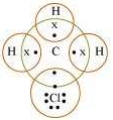
Explain the nature of the covalent bond using the bond formation in $CH_3Cl$.
Solution
(N/A) Carbon can neither lose four of its electrons nor gain four electrons as both the processes require a large amount of energy and would make the system unstable. Therefore,it completes its octet by sharing its four electrons with other carbon atoms or with atoms of other elements. The bonds that are formed by sharing electrons are known as covalent bonds. In covalent bonding,both the atoms share the valence electrons,i.e.,the shared electrons belong to the valence shells of both the atoms.
Here,carbon requires $4$ electrons to complete its octet,while each hydrogen atom requires one electron to complete its duplet. Also,chlorine requires one electron to complete its octet. Therefore,all of these share the electrons and as a result,carbon forms $3$ bonds with hydrogen and one with chlorine to form $CH_3Cl$.
Here,carbon requires $4$ electrons to complete its octet,while each hydrogen atom requires one electron to complete its duplet. Also,chlorine requires one electron to complete its octet. Therefore,all of these share the electrons and as a result,carbon forms $3$ bonds with hydrogen and one with chlorine to form $CH_3Cl$.
0 likes
View Solution18
Medium
Draw the electron dot structures for:
$(a)$ Ethanoic acid
$(b)$ $H_2S$
$(a)$ Ethanoic acid
$(b)$ $H_2S$
Solution
(N/A) The electron dot structure of ethanoic acid $(CH_3COOH)$ involves sharing of electrons between carbon,hydrogen,and oxygen atoms to complete their octets/duplets.
(See the provided image for the structural representation).
$(b)$ The electron dot structure of hydrogen sulfide $(H_2S)$ involves the sulfur atom sharing one electron each with two hydrogen atoms to form two covalent bonds,completing the octet of sulfur and the duplet of hydrogen.
(See the provided image for the structural representation).
(See the provided image for the structural representation).
$(b)$ The electron dot structure of hydrogen sulfide $(H_2S)$ involves the sulfur atom sharing one electron each with two hydrogen atoms to form two covalent bonds,completing the octet of sulfur and the duplet of hydrogen.
(See the provided image for the structural representation).
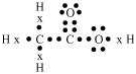
0 likes
View Solution19
Medium
Draw the electron dot structures for
$(a)$ propanone
$(b)$ $F_2$
$(a)$ propanone
$(b)$ $F_2$
Solution
(N/A) Propanone: The chemical formula of propanone is $CH_3COCH_3$. In this structure,the central carbon atom is double-bonded to an oxygen atom and single-bonded to two other carbon atoms. Each of these two carbon atoms is further bonded to three hydrogen atoms.
(Image provided in the original context shows the electron sharing between atoms.)
$(b)$ $F_2$: Fluorine has $7$ valence electrons. To achieve a stable octet,two fluorine atoms share one pair of electrons,forming a single covalent bond.
(Image provided in the original context shows the electron sharing between atoms.)
$(b)$ $F_2$: Fluorine has $7$ valence electrons. To achieve a stable octet,two fluorine atoms share one pair of electrons,forming a single covalent bond.
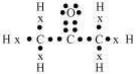
0 likes
View Solution20
Medium
What is a homologous series? Explain with an example.
Solution
(N/A) homologous series is a group of organic compounds that have the same functional group and similar chemical properties,and in which successive members differ by a $-CH_2$ unit.
For example,the alkane series is a homologous series with the general formula $C_nH_{2n+2}$.
$1$. Methane: $CH_4$
$2$. Ethane: $C_2H_6$ (or $CH_3CH_3$)
$3$. Propane: $C_3H_8$ (or $CH_3CH_2CH_3$)
$4$. Butane: $C_4H_{10}$ (or $CH_3CH_2CH_2CH_3$)
In this series,each successive member differs by a $-CH_2$ group,which corresponds to a molecular mass difference of $14 \ u$.
For example,the alkane series is a homologous series with the general formula $C_nH_{2n+2}$.
$1$. Methane: $CH_4$
$2$. Ethane: $C_2H_6$ (or $CH_3CH_3$)
$3$. Propane: $C_3H_8$ (or $CH_3CH_2CH_3$)
$4$. Butane: $C_4H_{10}$ (or $CH_3CH_2CH_2CH_3$)
In this series,each successive member differs by a $-CH_2$ group,which corresponds to a molecular mass difference of $14 \ u$.
0 likes
View Solution21
Difficult
How can ethanol and ethanoic acid be differentiated on the basis of their physical and chemical properties?
Solution
(N/A) Physical Properties:
$1$. Odour: Ethanol has a pleasant,characteristic alcoholic odour,whereas ethanoic acid has a pungent,vinegar-like smell.
$2$. Melting Point: The melting point of ethanoic acid is $17\,^{\circ}C$,which is below room temperature,causing it to freeze in winter. Ethanol has a much lower melting point $(-114\,^{\circ}C)$ and remains liquid at room temperature.
Chemical Properties:
$1$. Reaction with Carbonates/Hydrogencarbonates: Ethanoic acid reacts with metal carbonates and metal hydrogencarbonates to evolve $CO_{2}$ gas,which turns lime water milky. Ethanol does not react with these compounds.
Reaction:
$2CH_{3}COOH + Na_{2}CO_{3} \longrightarrow 2CH_{3}COONa + H_{2}O + CO_{2} \uparrow$
$CH_{3}CH_{2}OH + Na_{2}CO_{3} \longrightarrow \text{No reaction}$
$1$. Odour: Ethanol has a pleasant,characteristic alcoholic odour,whereas ethanoic acid has a pungent,vinegar-like smell.
$2$. Melting Point: The melting point of ethanoic acid is $17\,^{\circ}C$,which is below room temperature,causing it to freeze in winter. Ethanol has a much lower melting point $(-114\,^{\circ}C)$ and remains liquid at room temperature.
Chemical Properties:
$1$. Reaction with Carbonates/Hydrogencarbonates: Ethanoic acid reacts with metal carbonates and metal hydrogencarbonates to evolve $CO_{2}$ gas,which turns lime water milky. Ethanol does not react with these compounds.
Reaction:
$2CH_{3}COOH + Na_{2}CO_{3} \longrightarrow 2CH_{3}COONa + H_{2}O + CO_{2} \uparrow$
$CH_{3}CH_{2}OH + Na_{2}CO_{3} \longrightarrow \text{No reaction}$
0 likes
View Solution22
MediumMCQ
Why does micelle formation take place when soap is added to water? Will a micelle be formed in other solvents such as ethanol also?
A
Soap molecules form micelles in water due to their amphiphilic nature.
B
Micelles are spherical aggregates of soap molecules.
C
Micelles will not form in ethanol because the hydrocarbon chain is soluble in ethanol.
D
Micelles form in all solvents regardless of polarity.
Solution
(A) Micelles are formed when soap is added to water because soap molecules are amphiphilic,containing a hydrophobic hydrocarbon tail and a hydrophilic ionic head.
In water,the hydrophobic tails cluster together to avoid contact with water,while the hydrophilic heads face outward,forming a spherical structure called a micelle.
Micelles will not be formed in other solvents like ethanol.
This is because the hydrocarbon chains of soap molecules are soluble in organic solvents like ethanol,preventing the aggregation required to form micelles.
In water,the hydrophobic tails cluster together to avoid contact with water,while the hydrophilic heads face outward,forming a spherical structure called a micelle.
Micelles will not be formed in other solvents like ethanol.
This is because the hydrocarbon chains of soap molecules are soluble in organic solvents like ethanol,preventing the aggregation required to form micelles.
0 likes
View Solution23
Medium
Why are carbon and its compounds used as fuels for most applications?
Solution
(N/A) Most carbon compounds release a significant amount of heat and light when burned in air.
Saturated hydrocarbons burn with a clean flame and produce no smoke.
Carbon compounds used as fuels possess high calorific values,meaning they release a large amount of energy per unit mass.
Due to these properties,carbon and its compounds are widely used as fuels for most applications.
Saturated hydrocarbons burn with a clean flame and produce no smoke.
Carbon compounds used as fuels possess high calorific values,meaning they release a large amount of energy per unit mass.
Due to these properties,carbon and its compounds are widely used as fuels for most applications.
0 likes
View Solution24
Medium
Explain the formation of scum when hard water is treated with soap.
Solution
(N/A) Soap does not work properly in hard water. Soap is a sodium or potassium salt of long-chain fatty acids. Hard water contains dissolved salts of calcium $(Ca^{2+})$ and magnesium $(Mg^{2+})$. When soap is added to hard water,the calcium and magnesium ions present in the water displace the sodium or potassium ions from the soap molecules. This reaction results in the formation of an insoluble white precipitate known as scum. Because of this reaction,a significant amount of soap is wasted before any lather can be formed.
0 likes
View Solution25
EasyMCQ
What change will you observe if you test soap with litmus paper (red and blue)?
A
Red litmus turns blue,blue litmus remains blue.
B
Red litmus remains red,blue litmus turns red.
C
Red litmus turns blue,blue litmus turns red.
D
Red litmus remains red,blue litmus remains blue.
Solution
(A) Soap is basic in nature because it is a salt of a strong base and a weak acid.
Basic substances turn red litmus paper blue.
Blue litmus paper does not change its colour in a basic solution.
Therefore,red litmus will turn blue,and blue litmus will remain blue.
Basic substances turn red litmus paper blue.
Blue litmus paper does not change its colour in a basic solution.
Therefore,red litmus will turn blue,and blue litmus will remain blue.
0 likes
View Solution26
Medium
What is hydrogenation? What is its industrial application?
Solution
(N/A) Hydrogenation is the chemical process of adding hydrogen to a molecule. In organic chemistry,it typically involves the addition of hydrogen to unsaturated hydrocarbons (containing double or triple bonds) in the presence of catalysts like palladium $(Pd)$ or nickel $(Ni)$ to produce saturated hydrocarbons.
The general reaction is:
$R_2C=CR_2 + H_2 \xrightarrow{Ni \text{ catalyst}} R_2CH-CHR_2$
Its primary industrial application is the hydrogenation of vegetable oils. Vegetable oils contain long chains of unsaturated fatty acids. By hydrogenating these oils in the presence of a nickel catalyst,they are converted into saturated fats,which are solid at room temperature,commonly known as vanaspati ghee (hydrogenated vegetable fat).
The general reaction is:
$R_2C=CR_2 + H_2 \xrightarrow{Ni \text{ catalyst}} R_2CH-CHR_2$
Its primary industrial application is the hydrogenation of vegetable oils. Vegetable oils contain long chains of unsaturated fatty acids. By hydrogenating these oils in the presence of a nickel catalyst,they are converted into saturated fats,which are solid at room temperature,commonly known as vanaspati ghee (hydrogenated vegetable fat).
0 likes
View Solution27
MediumMCQ
Which of the following hydrocarbons undergo addition reactions:
$C_{2}H_{6}, C_{3}H_{8}, C_{3}H_{6}, C_{2}H_{2}$ and $CH_{4}$?
$C_{2}H_{6}, C_{3}H_{8}, C_{3}H_{6}, C_{2}H_{2}$ and $CH_{4}$?
A
$C_{2}H_{6}$ and $C_{3}H_{8}$
B
$C_{3}H_{6}$ and $C_{2}H_{2}$
C
$CH_{4}$ and $C_{2}H_{6}$
D
$C_{2}H_{2}$ and $CH_{4}$
Solution
(B) Addition reactions are characteristic of unsaturated hydrocarbons,which contain at least one double or triple bond between carbon atoms.
$1$. $C_{2}H_{6}$ (Ethane) and $C_{3}H_{8}$ (Propane) are alkanes (saturated hydrocarbons).
$2$. $CH_{4}$ (Methane) is an alkane (saturated hydrocarbon).
$3$. $C_{3}H_{6}$ (Propene) is an alkene (unsaturated hydrocarbon).
$4$. $C_{2}H_{2}$ (Ethyne) is an alkyne (unsaturated hydrocarbon).
Therefore,$C_{3}H_{6}$ and $C_{2}H_{2}$ undergo addition reactions.
$1$. $C_{2}H_{6}$ (Ethane) and $C_{3}H_{8}$ (Propane) are alkanes (saturated hydrocarbons).
$2$. $CH_{4}$ (Methane) is an alkane (saturated hydrocarbon).
$3$. $C_{3}H_{6}$ (Propene) is an alkene (unsaturated hydrocarbon).
$4$. $C_{2}H_{2}$ (Ethyne) is an alkyne (unsaturated hydrocarbon).
Therefore,$C_{3}H_{6}$ and $C_{2}H_{2}$ undergo addition reactions.
0 likes
View Solution28
Easy
Give a test that can be used to differentiate between saturated and unsaturated hydrocarbons.
Solution
(N/A) The bromine water test is commonly used to differentiate between saturated and unsaturated hydrocarbons.
When bromine water (a reddish-brown liquid) is added to an unsaturated hydrocarbon,the bromine reacts with the double or triple bonds,causing the reddish-brown color to disappear (decolorize).
In contrast,saturated hydrocarbons do not react with bromine water under normal conditions,so the reddish-brown color remains unchanged.
When bromine water (a reddish-brown liquid) is added to an unsaturated hydrocarbon,the bromine reacts with the double or triple bonds,causing the reddish-brown color to disappear (decolorize).
In contrast,saturated hydrocarbons do not react with bromine water under normal conditions,so the reddish-brown color remains unchanged.
2 likes
View Solution29
Medium
Explain the mechanism of the cleaning action of soaps.
Solution
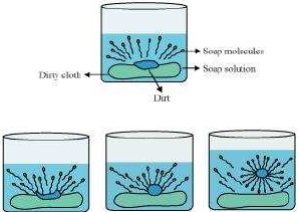
(N/A) Cleansing action of soaps:
$1$. Soap molecules consist of two parts: a long hydrocarbon chain which is hydrophobic (water-repelling) and an ionic head which is hydrophilic (water-attracting).
$2$. When soap is dissolved in water,the hydrophobic ends attach themselves to the dirt particles,which are typically oily or greasy in nature.
$3$. The hydrophilic ends remain pointed outwards towards the water.
$4$. These molecules arrange themselves in a spherical structure called a 'micelle',with the dirt trapped at the center.
$5$. The negatively charged ionic heads create a repulsive force between micelles,preventing them from re-attaching to the cloth.
$6$. Finally,the dirt is rinsed away along with the water,leaving the cloth clean.
$1$. Soap molecules consist of two parts: a long hydrocarbon chain which is hydrophobic (water-repelling) and an ionic head which is hydrophilic (water-attracting).
$2$. When soap is dissolved in water,the hydrophobic ends attach themselves to the dirt particles,which are typically oily or greasy in nature.
$3$. The hydrophilic ends remain pointed outwards towards the water.
$4$. These molecules arrange themselves in a spherical structure called a 'micelle',with the dirt trapped at the center.
$5$. The negatively charged ionic heads create a repulsive force between micelles,preventing them from re-attaching to the cloth.
$6$. Finally,the dirt is rinsed away along with the water,leaving the cloth clean.
1 likes
View Solution30
MediumMCQ
How would you name the following compounds?
$(i)$ $CH_3-CH_2-Br$
$(ii)$ $H-CHO$
$(iii)$ $CH_3-CH_2-CH_2-CH_2-C \equiv CH$
$(i)$ $CH_3-CH_2-Br$
$(ii)$ $H-CHO$
$(iii)$ $CH_3-CH_2-CH_2-CH_2-C \equiv CH$
A
Bromoethane,Methanal,Hex$-1-$yne
B
Bromoethane,Ethanal,Hex$-1-$yne
C
Chloroethane,Methanal,Hex$-1-$yne
D
Bromoethane,Methanal,Hex$-2-$yne
Solution
(A) The $IUPAC$ naming rules are applied as follows:
$(i)$ $CH_3-CH_2-Br$: This is a two-carbon chain with a bromine substituent. The prefix for bromine is 'bromo' and the alkane is 'ethane'. Thus,it is named Bromoethane.
$(ii)$ $H-CHO$: This is a one-carbon aldehyde. The prefix for one carbon is 'meth-' and the suffix for aldehyde is '-al'. Thus,it is named Methanal.
$(iii)$ $CH_3-CH_2-CH_2-CH_2-C \equiv CH$: This is a six-carbon chain with a triple bond at the first position. The prefix for six carbons is 'hex-' and the suffix for an alkyne is '-yne'. Since the triple bond starts at the first carbon,it is named Hex$-1-$yne.
$(i)$ $CH_3-CH_2-Br$: This is a two-carbon chain with a bromine substituent. The prefix for bromine is 'bromo' and the alkane is 'ethane'. Thus,it is named Bromoethane.
$(ii)$ $H-CHO$: This is a one-carbon aldehyde. The prefix for one carbon is 'meth-' and the suffix for aldehyde is '-al'. Thus,it is named Methanal.
$(iii)$ $CH_3-CH_2-CH_2-CH_2-C \equiv CH$: This is a six-carbon chain with a triple bond at the first position. The prefix for six carbons is 'hex-' and the suffix for an alkyne is '-yne'. Since the triple bond starts at the first carbon,it is named Hex$-1-$yne.
0 likes
View SolutionCarbon and its Compounds — Textbook - Carbon and its Compounds · Frequently Asked Questions
1Are these Carbon and its Compounds questions useful for JEE and NEET?
Yes. All questions in this section are mapped to JEE Main and NEET exam patterns. Previous year questions from JEE Main, NEET, GUJCET and state-level exams are included with full solutions.
2Can I switch to Hindi or Gujarati for these questions?
Yes. Use the language tabs in the hero section or the sidebar to view the same questions and solutions in English, Hindi or Gujarati.
3How do I generate a question paper from this subtopic?
Use the Vedclass Exam Paper Generator — select the chapter and subtopic, set difficulty, and generate Sets A, B, C, D automatically. First 3 chapters of every subject are free.
Vedclass Products
For Students
Vedclass Test Series
Mock tests in real JEE/NEET style with performance analysis. 5-day free trial.
Start Free TrialFor Teachers
Exam Paper Generator
Generate Set A/B/C/D papers from this chapter in 2 minutes. 3 chapters free.
Try FreeFor Institutes
Online Exam Module
Live online exams with unlimited students, 360° analytics & white-label branding.
See DemoFor Teachers & Institutes
Generate a Carbon and its Compounds Exam Paper in 2 Minutes
Select subtopic & difficulty — Sets A, B, C, D auto-generated with No Repeat logic.
First 3 chapters of every subject are free — no payment required.