
A English
Mix Examples - Carbon and its Compounds Questions in English
Class 10 Science · Carbon and its Compounds · Mix Examples - Carbon and its Compounds
298+
Questions
English
Language
100%
With Solutions
Showing 50 of 298 questions in English
151
Medium
An element is a main constituent of paper,diamond and clothes etc. It forms covalent bonds with itself and other elements.
$(a)$ Identify the element.
$(b)$ Write the electron dot structure of its oxide.
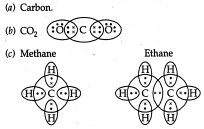
$(c)$ Draw the electron dot structure of methane and ethane.
$(a)$ Identify the element.
$(b)$ Write the electron dot structure of its oxide.
$(c)$ Draw the electron dot structure of methane and ethane.
Solution
(N/A) The element is Carbon $(C)$.
$(b)$ The oxide of carbon is Carbon dioxide $(CO_2)$. The electron dot structure involves carbon sharing two pairs of electrons with each of the two oxygen atoms to complete its octet.
$(c)$ Methane $(CH_4)$ has one carbon atom bonded to four hydrogen atoms. Ethane $(C_2H_6)$ has two carbon atoms bonded to each other and to three hydrogen atoms each.
$(b)$ The oxide of carbon is Carbon dioxide $(CO_2)$. The electron dot structure involves carbon sharing two pairs of electrons with each of the two oxygen atoms to complete its octet.
$(c)$ Methane $(CH_4)$ has one carbon atom bonded to four hydrogen atoms. Ethane $(C_2H_6)$ has two carbon atoms bonded to each other and to three hydrogen atoms each.
0 likes
View Solution152
Medium
State the two properties of carbon which make it unique among other elements. State the two uses of carbon which are based on its unique property.
Solution
(A) Two properties of carbon that make it unique among other elements are:
$(i)$ Catenation: Carbon has the unique ability to form strong covalent bonds with other carbon atoms,resulting in the formation of long chains,branched chains,or ring structures.
$(ii)$ Tetravalency: Carbon has a valency of $4$,allowing it to form stable bonds with four other atoms of carbon or other monovalent elements like hydrogen,oxygen,nitrogen,or halogens.
Two uses of carbon based on its properties are:
$(i)$ Graphite (an allotrope of carbon) is used in pencil leads and as a dry lubricant due to its layered structure and weak inter-layer forces.
$(ii)$ Diamond (an allotrope of carbon) is used in cutting and drilling tools because of its extremely hard,three-dimensional tetrahedral crystal lattice structure.
$(i)$ Catenation: Carbon has the unique ability to form strong covalent bonds with other carbon atoms,resulting in the formation of long chains,branched chains,or ring structures.
$(ii)$ Tetravalency: Carbon has a valency of $4$,allowing it to form stable bonds with four other atoms of carbon or other monovalent elements like hydrogen,oxygen,nitrogen,or halogens.
Two uses of carbon based on its properties are:
$(i)$ Graphite (an allotrope of carbon) is used in pencil leads and as a dry lubricant due to its layered structure and weak inter-layer forces.
$(ii)$ Diamond (an allotrope of carbon) is used in cutting and drilling tools because of its extremely hard,three-dimensional tetrahedral crystal lattice structure.
0 likes
View Solution153
Medium
Write the chemical equations for the reactions of ethanoic acid with the following:
$(a)$ Sodium
$(b)$ Sodium hydroxide
$(c)$ Ethanol
Also,write the name of one main product for each reaction.
$(a)$ Sodium
$(b)$ Sodium hydroxide
$(c)$ Ethanol
Also,write the name of one main product for each reaction.
Solution
(N/A) $(i)$ Reaction with Sodium:
$2CH_{3}COOH + 2Na \longrightarrow 2CH_{3}COONa + H_{2}$
Main product: Sodium ethanoate.
$(ii)$ Reaction with Sodium hydroxide:
$CH_{3}COOH + NaOH \longrightarrow CH_{3}COONa + H_{2}O$
Main product: Sodium ethanoate.
$(iii)$ Reaction with Ethanol:
$CH_{3}COOH + C_{2}H_{5}OH \xrightarrow{acid} CH_{3}COOC_{2}H_{5} + H_{2}O$
Main product: Ethyl ethanoate (ester).
$2CH_{3}COOH + 2Na \longrightarrow 2CH_{3}COONa + H_{2}$
Main product: Sodium ethanoate.
$(ii)$ Reaction with Sodium hydroxide:
$CH_{3}COOH + NaOH \longrightarrow CH_{3}COONa + H_{2}O$
Main product: Sodium ethanoate.
$(iii)$ Reaction with Ethanol:
$CH_{3}COOH + C_{2}H_{5}OH \xrightarrow{acid} CH_{3}COOC_{2}H_{5} + H_{2}O$
Main product: Ethyl ethanoate (ester).
0 likes
View Solution154
MediumMCQ
What are oxidising agents? State two oxidising agents. Write one chemical equation using an oxidising agent.
A
Substances that add oxygen to other substances.
B
Alkaline $KMnO_4$ and acidified $K_2Cr_2O_7$.
C
$CH_3CH_2OH + [O] \xrightarrow[\text{Acidified } K_2Cr_2O_7 + \text{Heat}]{\text{Alkaline } KMnO_4 + \text{Heat}} CH_3COOH$
Solution
(N/A) Substances that are capable of adding oxygen to other substances or removing hydrogen from them are known as oxidising agents.
Two common examples of oxidising agents are:
$1$. Alkaline potassium permanganate $(KMnO_4)$
$2$. Acidified potassium dichromate $(K_2Cr_2O_7)$
Chemical equation for the oxidation of ethanol to ethanoic acid using an oxidising agent:
$CH_3CH_2OH \xrightarrow[\text{Acidified } K_2Cr_2O_7 + \text{Heat}]{\text{Alkaline } KMnO_4 + \text{Heat}} CH_3COOH$
Two common examples of oxidising agents are:
$1$. Alkaline potassium permanganate $(KMnO_4)$
$2$. Acidified potassium dichromate $(K_2Cr_2O_7)$
Chemical equation for the oxidation of ethanol to ethanoic acid using an oxidising agent:
$CH_3CH_2OH \xrightarrow[\text{Acidified } K_2Cr_2O_7 + \text{Heat}]{\text{Alkaline } KMnO_4 + \text{Heat}} CH_3COOH$
0 likes
View Solution155
Medium
$A$ hydrocarbon,$C_{2}H_{4}$,decolorizes bromine water.
$(i)$ Name the hydrocarbon.
$(ii)$ Mention the family to which it belongs.
$(iii)$ Write the chemical equation of the reaction of this hydrocarbon with hydrogen.
$(i)$ Name the hydrocarbon.
$(ii)$ Mention the family to which it belongs.
$(iii)$ Write the chemical equation of the reaction of this hydrocarbon with hydrogen.
Solution
(A) $(i)$ The hydrocarbon is Ethene.
$(ii)$ It belongs to the Alkene family.
$(iii)$ The reaction of Ethene with Hydrogen in the presence of a catalyst (like Nickel or Palladium) results in the formation of Ethane:
$C_{2}H_{4} + H_{2} \xrightarrow{Ni/Pd} C_{2}H_{6}$
$(ii)$ It belongs to the Alkene family.
$(iii)$ The reaction of Ethene with Hydrogen in the presence of a catalyst (like Nickel or Palladium) results in the formation of Ethane:
$C_{2}H_{4} + H_{2} \xrightarrow{Ni/Pd} C_{2}H_{6}$
0 likes
View Solution156
Medium
List three physical properties of covalent compounds and give reason for each.
Solution
(N/A) $(i)$ Covalent compounds have low melting and boiling points because the intermolecular forces between them are weak.
$(ii)$ Generally,these are poor conductors of electricity because the electrons are shared between atoms and no free charged particles (ions) are formed.
$(iii)$ Generally,covalent compounds are soluble in organic solvents,such as ether or benzene,and are insoluble in water. This is because these compounds are typically non-polar and follow the principle of 'like dissolves like',meaning they dissolve in non-polar solvents.
$(ii)$ Generally,these are poor conductors of electricity because the electrons are shared between atoms and no free charged particles (ions) are formed.
$(iii)$ Generally,covalent compounds are soluble in organic solvents,such as ether or benzene,and are insoluble in water. This is because these compounds are typically non-polar and follow the principle of 'like dissolves like',meaning they dissolve in non-polar solvents.
0 likes
View Solution157
Medium
An organic compound $'A'$ has a molecular formula $C_{2}H_{6}O$. $'A'$ on oxidation gives compound $'B'$,which produces effervescence with baking soda.
$(i)$ Identify $'A'$ and $'B'$.
$(ii)$ Write the chemical reaction of $'B'$ with baking soda.
$(i)$ Identify $'A'$ and $'B'$.
$(ii)$ Write the chemical reaction of $'B'$ with baking soda.
Solution
(A) $(i)$ $'A'$ is Ethanol $(CH_{3}CH_{2}OH)$ and $'B'$ is Ethanoic acid $(CH_{3}COOH)$.
$(ii)$ The reaction of Ethanoic acid with baking soda $(NaHCO_{3})$ is:
$CH_{3}COOH + NaHCO_{3} \longrightarrow CH_{3}COONa + CO_{2} \uparrow + H_{2}O$
This reaction releases carbon dioxide gas,which causes the observed effervescence.
$(ii)$ The reaction of Ethanoic acid with baking soda $(NaHCO_{3})$ is:
$CH_{3}COOH + NaHCO_{3} \longrightarrow CH_{3}COONa + CO_{2} \uparrow + H_{2}O$
This reaction releases carbon dioxide gas,which causes the observed effervescence.
0 likes
View Solution158
Medium
An atom of an element contains six electrons in its valence shell. This element is the second major component of air. It exists as a diatomic molecule.
$(i)$ Identify the element.
$(ii)$ Show the bond formed between two atoms of this element.
$(iii)$ Write the nature of the bond between the two atoms.
$(i)$ Identify the element.
$(ii)$ Show the bond formed between two atoms of this element.
$(iii)$ Write the nature of the bond between the two atoms.
Solution
(N/A) $(i)$ The element is Oxygen $(O)$.
$(ii)$ The bond formation between two oxygen atoms is shown in the figure.
$(iii)$ The nature of the bond is a double covalent bond,as each oxygen atom shares two electrons to complete its octet.
$(ii)$ The bond formation between two oxygen atoms is shown in the figure.
$(iii)$ The nature of the bond is a double covalent bond,as each oxygen atom shares two electrons to complete its octet.

0 likes
View Solution159
Medium
An aldehyde as well as a ketone can be represented by the same molecular formula,say $C_{3}H_{6}O$. Write their structures and name them. State the relation between the two in the language of science.
Solution
(N/A) For the molecular formula $C_{3}H_{6}O$,the two isomers are:
$1$. Propanal (Aldehyde): The structure is $CH_{3}-CH_{2}-CHO$.
$2$. Propanone (Ketone): The structure is $CH_{3}-CO-CH_{3}$.
Relation: These two compounds are functional isomers because they possess the same molecular formula but contain different functional groups (aldehyde group $-CHO$ and ketone group $>C=O$).
$1$. Propanal (Aldehyde): The structure is $CH_{3}-CH_{2}-CHO$.
$2$. Propanone (Ketone): The structure is $CH_{3}-CO-CH_{3}$.
Relation: These two compounds are functional isomers because they possess the same molecular formula but contain different functional groups (aldehyde group $-CHO$ and ketone group $>C=O$).
0 likes
View Solution160
Medium
$(a)$ Give chemical tests to detect the presence of:
$(i)$ Ethanol
$(ii)$ Ethanoic acid
$(b)$ Why is ethanoic acid called glacial acetic acid?
$(i)$ Ethanol
$(ii)$ Ethanoic acid
$(b)$ Why is ethanoic acid called glacial acetic acid?
Solution
(N/A) $(i)$ Ethanol test (Reaction with Sodium metal):
Ethanol reacts with sodium metal to evolve hydrogen gas,which can be tested by bringing a burning splinter near the gas,producing a 'pop' sound.
$2 CH_3CH_2OH + 2 Na \rightarrow 2 CH_3CH_2ONa + H_2 \uparrow$
$(ii)$ Ethanoic acid test (Esterification reaction):
Ethanoic acid reacts with ethanol in the presence of an acid catalyst to form an ester,which has a sweet,fruity smell.
$CH_3COOH + CH_3CH_2OH \xrightarrow{H^+} CH_3COOCH_2CH_3 + H_2O$
$(b)$ Pure ethanoic acid has a melting point of $290 \, K$. In cold climates,it often freezes into an ice-like solid during winter,which is why it is known as glacial acetic acid.
Ethanol reacts with sodium metal to evolve hydrogen gas,which can be tested by bringing a burning splinter near the gas,producing a 'pop' sound.
$2 CH_3CH_2OH + 2 Na \rightarrow 2 CH_3CH_2ONa + H_2 \uparrow$
$(ii)$ Ethanoic acid test (Esterification reaction):
Ethanoic acid reacts with ethanol in the presence of an acid catalyst to form an ester,which has a sweet,fruity smell.
$CH_3COOH + CH_3CH_2OH \xrightarrow{H^+} CH_3COOCH_2CH_3 + H_2O$
$(b)$ Pure ethanoic acid has a melting point of $290 \, K$. In cold climates,it often freezes into an ice-like solid during winter,which is why it is known as glacial acetic acid.
0 likes
View Solution161
Medium
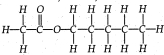
The structural formula of an ester is shown in the image. Write the structural formula of the acid and the alcohol from which it might be prepared. Name the process of formation of ester.
Solution
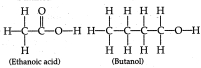
(N/A) The given ester is pentyl ethanoate. It is prepared from ethanoic acid $(CH_3COOH)$ and pentan$-1-$ol $(CH_3CH_2CH_2CH_2CH_2OH)$.
The structural formula of ethanoic acid is:
$H-C(H)(H)-C(=O)-O-H$
The structural formula of pentan$-1-$ol is:
$H-C(H)(H)-C(H)(H)-C(H)(H)-C(H)(H)-C(H)(H)-O-H$
The process of formation of an ester from a carboxylic acid and an alcohol in the presence of an acid catalyst is called esterification.
The structural formula of ethanoic acid is:
$H-C(H)(H)-C(=O)-O-H$
The structural formula of pentan$-1-$ol is:
$H-C(H)(H)-C(H)(H)-C(H)(H)-C(H)(H)-C(H)(H)-O-H$
The process of formation of an ester from a carboxylic acid and an alcohol in the presence of an acid catalyst is called esterification.
0 likes
View Solution162
Medium
Explain how covalent bonds are formed. Mention physical properties of covalent compounds. Draw the electron dot structure of $CCl_{4}$.
Solution
(N/A) covalent bond is formed when two atoms share valence electrons to achieve a stable noble gas electronic configuration,as they cannot gain or lose electrons from their outermost shell.
Physical properties of covalent compounds include:
$(i)$ They are generally poor conductors of electricity.
$(ii)$ They have low boiling and melting points due to weak intermolecular forces.
$(iii)$ They are generally soluble in organic solvents.
$(iv)$ They are typically found in liquid or gaseous states at room temperature.
In $CCl_{4}$,carbon has $4$ valence electrons and each of the four chlorine atoms has $7$ valence electrons. Carbon shares one electron with each of the four chlorine atoms to complete its octet,and each chlorine atom completes its octet by sharing one electron with carbon.
Physical properties of covalent compounds include:
$(i)$ They are generally poor conductors of electricity.
$(ii)$ They have low boiling and melting points due to weak intermolecular forces.
$(iii)$ They are generally soluble in organic solvents.
$(iv)$ They are typically found in liquid or gaseous states at room temperature.
In $CCl_{4}$,carbon has $4$ valence electrons and each of the four chlorine atoms has $7$ valence electrons. Carbon shares one electron with each of the four chlorine atoms to complete its octet,and each chlorine atom completes its octet by sharing one electron with carbon.

0 likes
View Solution163
Medium
Give names of the following:
$(a)$ An alcohol containing $4$ carbon atoms.
$(b)$ An acid with $5$ carbon atoms.
$(c)$ Simplest ketone. Define functional group in a carbon compound. Mention names of any three functional groups with their formulae and example.
$(a)$ An alcohol containing $4$ carbon atoms.
$(b)$ An acid with $5$ carbon atoms.
$(c)$ Simplest ketone. Define functional group in a carbon compound. Mention names of any three functional groups with their formulae and example.
Solution
(N/A) Butanol.
$(b)$ Pentanoic acid.
$(c)$ Propan-$2$-one. An atom or group of atoms attached to the carbon chain by replacing one or more hydrogen atoms,which acts as a reactive site in the molecule and decides the chemical properties of the compound,is called a functional group.
$(b)$ Pentanoic acid.
$(c)$ Propan-$2$-one. An atom or group of atoms attached to the carbon chain by replacing one or more hydrogen atoms,which acts as a reactive site in the molecule and decides the chemical properties of the compound,is called a functional group.
| Functional Group | Formula and Example |
|---|---|
| $1.$ Aldehyde | Formula: $-CHO$,Example: Ethanal $(CH_3CHO)$ |
| $2.$ Ketone | Formula: $>C=O$,Example: Propanone $(CH_3COCH_3)$ |
| $3.$ Carboxylic acid | Formula: $-COOH$,Example: Ethanoic acid $(CH_3COOH)$ |
0 likes
View Solution164
Medium
An organic compound burns with a sooty flame. Is it a saturated or an unsaturated compound?
Solution
(B) It is an unsaturated compound.
Reason: Unsaturated compounds have a higher percentage of carbon compared to saturated compounds.
Thus,unsaturated compounds undergo incomplete combustion in the presence of air,producing a yellow flame with a significant amount of black smoke (soot).
Reason: Unsaturated compounds have a higher percentage of carbon compared to saturated compounds.
Thus,unsaturated compounds undergo incomplete combustion in the presence of air,producing a yellow flame with a significant amount of black smoke (soot).
0 likes
View Solution165
Medium
Why is hard water not suitable for washing clothes with soap?
Solution
(N/A) Hard water contains dissolved salts of calcium and magnesium,specifically their bicarbonates,chlorides,and sulphates. When soap (which consists of sodium or potassium salts of long-chain fatty acids) is added to hard water,these calcium and magnesium ions react with the soap molecules to form insoluble precipitates known as scum. Because the soap molecules are consumed in this chemical reaction to form scum,they are no longer available to form micelles and perform the cleansing action on clothes.
0 likes
View Solution166
EasyMCQ
Ethane,with the molecular formula $C_{2}H_{6}$,has
A
$6$ covalent bonds
B
$9$ covalent bonds
C
$8$ covalent bonds
D
$7$ covalent bonds
Solution
(D) The molecular formula of ethane is $C_{2}H_{6}$.
In ethane,there are two carbon atoms linked by a single covalent bond $(C-C)$.
Each carbon atom is further bonded to three hydrogen atoms by single covalent bonds $(C-H)$.
Total bonds = $1$ ($C-C$ bond) + $6$ ($C-H$ bonds) = $7$ covalent bonds.
Therefore,ethane has $7$ covalent bonds.
In ethane,there are two carbon atoms linked by a single covalent bond $(C-C)$.
Each carbon atom is further bonded to three hydrogen atoms by single covalent bonds $(C-H)$.
Total bonds = $1$ ($C-C$ bond) + $6$ ($C-H$ bonds) = $7$ covalent bonds.
Therefore,ethane has $7$ covalent bonds.
0 likes
View Solution167
EasyMCQ
Butanone is a four-carbon compound with the functional group:
A
Ketone
B
Aldehyde
C
Carboxylic acid
D
Alcohol
Solution
(A) Butanone has the chemical formula $CH_3COCH_2CH_3$.
The suffix '-one' in the $IUPAC$ name indicates the presence of a ketone functional group $(>C=O)$.
In butanone,the carbonyl group is attached to two carbon atoms,which is the characteristic structure of a ketone.
The suffix '-one' in the $IUPAC$ name indicates the presence of a ketone functional group $(>C=O)$.
In butanone,the carbonyl group is attached to two carbon atoms,which is the characteristic structure of a ketone.
0 likes
View Solution168
EasyMCQ
While cooking,if the bottom of the vessel is getting blackened on the outside,it means that:
A
The food is not cooked completely
B
The fuel is not burning completely
C
The fuel is wet
D
The fuel is burning completely.
Solution
(B) When a fuel burns,it releases energy. If the supply of oxygen is insufficient,the combustion is incomplete. Incomplete combustion of hydrocarbons produces carbon particles (soot),which deposit on the bottom of the cooking vessel,causing it to turn black. Therefore,the blackening of the vessel indicates that the fuel is not burning completely.
0 likes
View Solution169
EasyMCQ
Alcohols may be represented by the general formula:
A
$C_{n}H_{2n+2}-OH$
B
$C_{n}H_{2n}-OH$
C
$C_{n}H_{2n+1}-OH$
D
$C_{n}H_{2n-1}-OH$
Solution
(C) Alcohols are organic compounds containing a hydroxyl $(-OH)$ functional group attached to a saturated carbon atom.
The general formula for an alkane is $C_{n}H_{2n+2}$.
When one hydrogen atom is replaced by an $-OH$ group,the alkyl group becomes $C_{n}H_{2n+1}$.
Therefore,the general formula for a monohydric alcohol is $C_{n}H_{2n+1}-OH$.
The general formula for an alkane is $C_{n}H_{2n+2}$.
When one hydrogen atom is replaced by an $-OH$ group,the alkyl group becomes $C_{n}H_{2n+1}$.
Therefore,the general formula for a monohydric alcohol is $C_{n}H_{2n+1}-OH$.
0 likes
View Solution170
EasyMCQ
Ethanoic acid can be obtained from ethanol by the process of:
A
Reduction
B
Hydrogenation
C
Hydrolysis
D
Oxidation
Solution
(D) The conversion of ethanol $(CH_3CH_2OH)$ to ethanoic acid $(CH_3COOH)$ involves the addition of oxygen or the removal of hydrogen.
This chemical process is known as oxidation.
In the presence of oxidizing agents like alkaline potassium permanganate $(KMnO_4)$ or acidified potassium dichromate $(K_2Cr_2O_7)$, ethanol is oxidized to ethanoic acid.
The reaction is: $CH_3CH_2OH + 2[O] \xrightarrow{alkaline KMnO_4/heat} CH_3COOH + H_2O$.
This chemical process is known as oxidation.
In the presence of oxidizing agents like alkaline potassium permanganate $(KMnO_4)$ or acidified potassium dichromate $(K_2Cr_2O_7)$, ethanol is oxidized to ethanoic acid.
The reaction is: $CH_3CH_2OH + 2[O] \xrightarrow{alkaline KMnO_4/heat} CH_3COOH + H_2O$.
0 likes
View Solution171
EasyMCQ
Alkynes may be represented by the general formula:
A
$C_{n}H_{2n-2}$
B
$C_{n}H_{2n+2}$
C
$C_{n}H_{2n+1}$
D
$C_{n}H_{2n-1}$
Solution
(A) Alkynes are unsaturated hydrocarbons that contain at least one carbon-carbon triple bond.
The general formula for alkanes is $C_{n}H_{2n+2}$.
The general formula for alkenes is $C_{n}H_{2n}$.
The general formula for alkynes is $C_{n}H_{2n-2}$,where $n$ is the number of carbon atoms $(n \ge 2)$.
The general formula for alkanes is $C_{n}H_{2n+2}$.
The general formula for alkenes is $C_{n}H_{2n}$.
The general formula for alkynes is $C_{n}H_{2n-2}$,where $n$ is the number of carbon atoms $(n \ge 2)$.
0 likes
View Solution172
EasyMCQ
The number of electron pairs shared by the two carbon atoms which are bonded by a triple bond are:
A
One pair
B
Three pairs
C
Two pairs
D
Six pairs
Solution
(B) triple bond is formed when two atoms share three pairs of electrons between them.
In a triple bond,each carbon atom contributes three electrons to the shared pool,resulting in a total of $3$ shared electron pairs.
Therefore,the number of electron pairs shared by two carbon atoms bonded by a triple bond is $3$ pairs.
In a triple bond,each carbon atom contributes three electrons to the shared pool,resulting in a total of $3$ shared electron pairs.
Therefore,the number of electron pairs shared by two carbon atoms bonded by a triple bond is $3$ pairs.
0 likes
View Solution173
EasyMCQ
The oxidising agent which can oxidise ethanol to ethanoic acid is:
A
Alkaline $K_{2}Cr_{2}O_{7}$
B
Alkaline $KClO_{3}$
C
Alkaline $KMnO_{4}$
D
Alkaline $CrO_{3}$
Solution
(C) Ethanol $(CH_{3}CH_{2}OH)$ can be oxidised to ethanoic acid $(CH_{3}COOH)$ using strong oxidising agents.
Alkaline potassium permanganate $(KMnO_{4})$ is a common oxidising agent used in laboratory settings to convert alcohols into carboxylic acids.
While acidic potassium dichromate $(K_{2}Cr_{2}O_{7})$ is also a strong oxidising agent,the question specifically asks for an alkaline agent,making alkaline $KMnO_{4}$ the correct choice.
Alkaline potassium permanganate $(KMnO_{4})$ is a common oxidising agent used in laboratory settings to convert alcohols into carboxylic acids.
While acidic potassium dichromate $(K_{2}Cr_{2}O_{7})$ is also a strong oxidising agent,the question specifically asks for an alkaline agent,making alkaline $KMnO_{4}$ the correct choice.
0 likes
View Solution174
EasyMCQ
The class of organic compounds which gives effervescence with $NaHCO_3$ solution is:
A
Aldehydes
B
Carboxylic acids
C
Esters
D
Alkanes
Solution
(B) Carboxylic acids react with sodium bicarbonate $(NaHCO_3)$ to produce carbon dioxide $(CO_2)$ gas.
This reaction is characterized by the evolution of gas bubbles,known as effervescence.
The chemical equation for this reaction is: $RCOOH + NaHCO_3 \rightarrow RCOONa + H_2O + CO_2 \uparrow$.
This test is commonly used to distinguish carboxylic acids from other organic compounds like alcohols or aldehydes,which do not react with $NaHCO_3$ to release $CO_2$.
This reaction is characterized by the evolution of gas bubbles,known as effervescence.
The chemical equation for this reaction is: $RCOOH + NaHCO_3 \rightarrow RCOONa + H_2O + CO_2 \uparrow$.
This test is commonly used to distinguish carboxylic acids from other organic compounds like alcohols or aldehydes,which do not react with $NaHCO_3$ to release $CO_2$.
0 likes
View Solution175
MediumMCQ
Which of the following is the correct representation of the electron dot structure of nitrogen $(N_2)$?
A
$:N \vdots \vdots N:$
B
$:\ddot{N}::\ddot{N}:$
C
$:\ddot{N} \vdots \ddot{N}:$
D
$:\ddot{N}:\ddot{N}:$
Solution
(C) The atomic number of nitrogen $(N)$ is $7$. Its electronic configuration is $2, 5$.
To achieve a stable octet,each nitrogen atom needs $3$ more electrons.
Therefore,two nitrogen atoms share $3$ pairs of electrons between them to form a triple covalent bond.
Each nitrogen atom has one lone pair of electrons remaining.
The correct electron dot structure is represented by showing $3$ shared pairs of electrons between the two $N$ atoms and one lone pair on each $N$ atom,which is $:N \vdots N:$. Among the given options,the structure representing $3$ shared pairs (triple bond) and one lone pair on each atom is correctly depicted in option $C$.
To achieve a stable octet,each nitrogen atom needs $3$ more electrons.
Therefore,two nitrogen atoms share $3$ pairs of electrons between them to form a triple covalent bond.
Each nitrogen atom has one lone pair of electrons remaining.
The correct electron dot structure is represented by showing $3$ shared pairs of electrons between the two $N$ atoms and one lone pair on each $N$ atom,which is $:N \vdots N:$. Among the given options,the structure representing $3$ shared pairs (triple bond) and one lone pair on each atom is correctly depicted in option $C$.
0 likes
View Solution176
EasyMCQ
The structural formula of ethyne is:
A
$H_{3}C - C \equiv CH$
B
$H - C \equiv C - H$
C
$H_{2}C = CH_{2}$
D
Solution
(B) Ethyne,also known as acetylene,has the chemical formula $C_{2}H_{2}$.
It consists of two carbon atoms connected by a triple bond,with each carbon atom also bonded to a single hydrogen atom.
The structural formula is $H - C \equiv C - H$.
Option $B$ correctly represents this structure.
It consists of two carbon atoms connected by a triple bond,with each carbon atom also bonded to a single hydrogen atom.
The structural formula is $H - C \equiv C - H$.
Option $B$ correctly represents this structure.
0 likes
View Solution177
MediumMCQ
Chlorine reacts with saturated hydrocarbons at room temperature in the :
A
absence of sunlight
B
presence of water
C
presence of sunlight
D
presence of hydrochloric acid
Solution
(C) Saturated hydrocarbons (alkanes) are generally unreactive towards many reagents.
However, they undergo a substitution reaction with chlorine in the presence of sunlight (ultraviolet light).
This reaction is known as a free-radical substitution reaction.
For example, methane reacts with chlorine in the presence of sunlight to form chloromethane and hydrogen chloride: $CH_4 + Cl_2 \xrightarrow{\text{sunlight}} CH_3Cl + HCl$.
However, they undergo a substitution reaction with chlorine in the presence of sunlight (ultraviolet light).
This reaction is known as a free-radical substitution reaction.
For example, methane reacts with chlorine in the presence of sunlight to form chloromethane and hydrogen chloride: $CH_4 + Cl_2 \xrightarrow{\text{sunlight}} CH_3Cl + HCl$.
0 likes
View Solution178
MediumMCQ
Carbon forms four covalent bonds by sharing its four valence electrons with four univalent atoms,e.g.,hydrogen. After the formation of four bonds,carbon attains the electronic configuration of:
A
helium
B
argon
C
krypton
D
neon
Solution
(D) Carbon has an atomic number of $6$. Its electronic configuration is $2, 4$.
To achieve a stable octet,carbon shares its $4$ valence electrons with other atoms to form $4$ covalent bonds.
By sharing $4$ electrons,carbon gains $4$ additional electrons in its valence shell,resulting in a total of $8$ valence electrons ($2 + 4 + 4 = 10$ total electrons).
The electronic configuration becomes $2, 8$,which is the configuration of the noble gas neon ($Ne$,atomic number $10$).
To achieve a stable octet,carbon shares its $4$ valence electrons with other atoms to form $4$ covalent bonds.
By sharing $4$ electrons,carbon gains $4$ additional electrons in its valence shell,resulting in a total of $8$ valence electrons ($2 + 4 + 4 = 10$ total electrons).
The electronic configuration becomes $2, 8$,which is the configuration of the noble gas neon ($Ne$,atomic number $10$).
0 likes
View Solution179
MediumMCQ
The correct electron dot structure of a water molecule is:
A
$H:\underset{\centerdot \,\centerdot }{\overset{\centerdot \,\centerdot }{\mathop{O}}}\,:H$
B
$H:\underset{\centerdot \,\centerdot }{\overset{\centerdot \,\centerdot }{\mathop{O}}}\,\centerdot H$
C
$H\centerdot \underset{\centerdot \,\centerdot }{\overset{\centerdot \,\centerdot }{\mathop{O}}}\,\centerdot H$
D
$H:O:H$
Solution
(A) water molecule $(H_2O)$ consists of one oxygen atom bonded to two hydrogen atoms.
Oxygen has $6$ valence electrons and requires $2$ more to complete its octet.
Each hydrogen atom has $1$ valence electron and requires $1$ more to complete its duplet.
Oxygen shares one electron with each hydrogen atom,forming two covalent bonds.
This leaves two lone pairs of electrons on the oxygen atom.
The correct electron dot structure represents the shared pairs as colons $(:)$ and shows the lone pairs on the oxygen atom as two pairs of dots.
Thus,the structure is $H:\underset{\centerdot \,\centerdot }{\overset{\centerdot \,\centerdot }{\mathop{O}}}\,:H$.
Oxygen has $6$ valence electrons and requires $2$ more to complete its octet.
Each hydrogen atom has $1$ valence electron and requires $1$ more to complete its duplet.
Oxygen shares one electron with each hydrogen atom,forming two covalent bonds.
This leaves two lone pairs of electrons on the oxygen atom.
The correct electron dot structure represents the shared pairs as colons $(:)$ and shows the lone pairs on the oxygen atom as two pairs of dots.
Thus,the structure is $H:\underset{\centerdot \,\centerdot }{\overset{\centerdot \,\centerdot }{\mathop{O}}}\,:H$.
0 likes
View Solution180
MediumMCQ
Which of the following is not a straight chain hydrocarbon?
A
$CH_3-CH_2-CH_2-CH_2-CH_2-CH_3$ ($2$-methylpentane)
B
$CH_3-CH(CH_3)-CH_2-CH_2-CH_3$ ($2$-methylpentane)
C
$CH_3-CH_2-CH_2-CH_2-CH_2-CH_3$ (n-hexane)
D
$CH_3-CH_2-CH_2-CH_2-CH_3$ (n-pentane)
Solution
(A) straight chain hydrocarbon is one where carbon atoms are linked in a single continuous chain without any branching.
Option $A$ represents a branched structure ($2$-methylpentane).
Option $B$ represents a branched structure ($2$-methylpentane).
Option $C$ represents a branched structure ($3$-methylhexane).
Option $D$ represents a straight chain hydrocarbon (n-pentane).
Since the question asks for the structure that is $NOT$ a straight chain,and options $A, B,$ and $C$ are all branched,the question implies identifying the branched ones. However,based on standard chemistry nomenclature,$D$ is the only straight chain. If the question asks which is $NOT$ straight,$A, B,$ and $C$ are correct. Given the typical format of such questions,$A$ is a clear example of a branched chain.
Option $A$ represents a branched structure ($2$-methylpentane).
Option $B$ represents a branched structure ($2$-methylpentane).
Option $C$ represents a branched structure ($3$-methylhexane).
Option $D$ represents a straight chain hydrocarbon (n-pentane).
Since the question asks for the structure that is $NOT$ a straight chain,and options $A, B,$ and $C$ are all branched,the question implies identifying the branched ones. However,based on standard chemistry nomenclature,$D$ is the only straight chain. If the question asks which is $NOT$ straight,$A, B,$ and $C$ are correct. Given the typical format of such questions,$A$ is a clear example of a branched chain.
0 likes
View Solution181
MediumMCQ
Which among the following are unsaturated hydrocarbons?
$(i)$ $H_3C-CH_2-CH_2-CH_3$
$(ii)$ $H_3C-C\equiv C-CH_3$
$(iii)$ $H_3C-CH(CH_3)-CH_3$
$(iv)$ $H_3C-C(CH_3)=CH_2$
$(i)$ $H_3C-CH_2-CH_2-CH_3$
$(ii)$ $H_3C-C\equiv C-CH_3$
$(iii)$ $H_3C-CH(CH_3)-CH_3$
$(iv)$ $H_3C-C(CH_3)=CH_2$
A
$(i)$ and $(iii)$
B
$(ii)$ and $(iii)$
C
$(ii)$ and $(iv)$
D
$(iii)$ and $(iv)$
Solution
(C) Unsaturated hydrocarbons are those that contain at least one carbon-carbon double bond $(C=C)$ or triple bond $(C\equiv C)$.
$(i)$ $H_3C-CH_2-CH_2-CH_3$ is Butane,which is a saturated hydrocarbon (alkane).
$(ii)$ $H_3C-C\equiv C-CH_3$ is But$-2-$yne,which contains a triple bond,so it is unsaturated.
$(iii)$ $H_3C-CH(CH_3)-CH_3$ is Isobutane ($2$-methylpropane),which is a saturated hydrocarbon (alkane).
$(iv)$ $H_3C-C(CH_3)=CH_2$ is $2-$methylpropene,which contains a double bond,so it is unsaturated.
Therefore,$(ii)$ and $(iv)$ are unsaturated hydrocarbons.
$(i)$ $H_3C-CH_2-CH_2-CH_3$ is Butane,which is a saturated hydrocarbon (alkane).
$(ii)$ $H_3C-C\equiv C-CH_3$ is But$-2-$yne,which contains a triple bond,so it is unsaturated.
$(iii)$ $H_3C-CH(CH_3)-CH_3$ is Isobutane ($2$-methylpropane),which is a saturated hydrocarbon (alkane).
$(iv)$ $H_3C-C(CH_3)=CH_2$ is $2-$methylpropene,which contains a double bond,so it is unsaturated.
Therefore,$(ii)$ and $(iv)$ are unsaturated hydrocarbons.
0 likes
View Solution182
MediumMCQ
Pentane has the molecular formula $C_{5}H_{12}$. It has:
A
$5$ covalent bonds
B
$12$ covalent bonds
C
$17$ covalent bonds
D
$16$ covalent bonds
Solution
(D) The molecular formula of pentane is $C_{5}H_{12}$.
To find the number of covalent bonds,we can use the structural formula of pentane.
Pentane is an alkane with a straight chain of $5$ carbon atoms.
Each carbon atom is bonded to other atoms via single covalent bonds.
There are $4$ $C-C$ bonds between the $5$ carbon atoms.
Each carbon atom is also bonded to hydrogen atoms to satisfy its valency of $4$.
Specifically,the $3$ terminal carbon atoms are bonded to $3$ hydrogen atoms each ($3 \times 3 = 9$ bonds),and the $2$ internal carbon atoms are bonded to $2$ hydrogen atoms each ($2 \times 2 = 4$ bonds). However,in a chain of $5$ carbons $(C-C-C-C-C)$,there are $4$ $C-C$ bonds and $12$ $C-H$ bonds.
Total covalent bonds = (Number of $C-C$ bonds) + (Number of $C-H$ bonds) = $4 + 12 = 16$ covalent bonds.
Alternatively,for any alkane with $n$ carbon atoms,the total number of covalent bonds is given by the formula $3n + 1$.
For pentane,$n = 5$,so total bonds = $3(5) + 1 = 15 + 1 = 16$.
To find the number of covalent bonds,we can use the structural formula of pentane.
Pentane is an alkane with a straight chain of $5$ carbon atoms.
Each carbon atom is bonded to other atoms via single covalent bonds.
There are $4$ $C-C$ bonds between the $5$ carbon atoms.
Each carbon atom is also bonded to hydrogen atoms to satisfy its valency of $4$.
Specifically,the $3$ terminal carbon atoms are bonded to $3$ hydrogen atoms each ($3 \times 3 = 9$ bonds),and the $2$ internal carbon atoms are bonded to $2$ hydrogen atoms each ($2 \times 2 = 4$ bonds). However,in a chain of $5$ carbons $(C-C-C-C-C)$,there are $4$ $C-C$ bonds and $12$ $C-H$ bonds.
Total covalent bonds = (Number of $C-C$ bonds) + (Number of $C-H$ bonds) = $4 + 12 = 16$ covalent bonds.
Alternatively,for any alkane with $n$ carbon atoms,the total number of covalent bonds is given by the formula $3n + 1$.
For pentane,$n = 5$,so total bonds = $3(5) + 1 = 15 + 1 = 16$.
0 likes
View Solution183
EasyMCQ
Ethanol reacts with sodium and forms two products. These are:
A
sodium ethoxide and hydrogen
B
sodium ethanoate and oxygen
C
sodium ethanoate and hydrogen
D
sodium ethoxide and oxygen
Solution
(A) When ethanol $(C_2H_5OH)$ reacts with sodium metal $(Na)$,it undergoes a substitution reaction where the hydrogen atom of the hydroxyl group is replaced by sodium.
This reaction produces sodium ethoxide $(C_2H_5ONa)$ and releases hydrogen gas $(H_2)$.
The balanced chemical equation is: $2C_2H_5OH + 2Na \rightarrow 2C_2H_5ONa + H_2 \uparrow$.
This reaction produces sodium ethoxide $(C_2H_5ONa)$ and releases hydrogen gas $(H_2)$.
The balanced chemical equation is: $2C_2H_5OH + 2Na \rightarrow 2C_2H_5ONa + H_2 \uparrow$.
0 likes
View Solution184
EasyMCQ
Vinegar is a solution of :
A
$5 \%-8 \%$ acetic acid in alcohol
B
$5 \%-8 \%$ acetic acid in water
C
$50 \%-60 \%$ acetic acid in alcohol
D
$50 \%-60 \%$ acetic acid in water
Solution
(B) Vinegar is a common household substance used as a preservative and flavoring agent.
It is chemically defined as a dilute solution of acetic acid $(CH_3COOH)$.
Specifically,vinegar typically contains $5 \%-8 \%$ acetic acid dissolved in water.
Therefore,the correct option is $B$.
It is chemically defined as a dilute solution of acetic acid $(CH_3COOH)$.
Specifically,vinegar typically contains $5 \%-8 \%$ acetic acid dissolved in water.
Therefore,the correct option is $B$.
0 likes
View Solution185
MediumMCQ
Which of the following does not belong to the same homologous series?
A
$CH_{4}$
B
$C_{2}H_{6}$
C
$C_{4}H_{8}$
D
$C_{3}H_{8}$
Solution
(C) homologous series is a group of organic compounds having the same functional group and similar chemical properties,where each successive member differs by a $CH_{2}$ unit.
For alkanes,the general formula is $C_{n}H_{2n+2}$.
$CH_{4}$ $(n=1)$ follows $C_{n}H_{2n+2}$.
$C_{2}H_{6}$ $(n=2)$ follows $C_{n}H_{2n+2}$.
$C_{3}H_{8}$ $(n=3)$ follows $C_{n}H_{2n+2}$.
$C_{4}H_{8}$ follows the general formula $C_{n}H_{2n}$,which represents an alkene.
Therefore,$C_{4}H_{8}$ belongs to a different homologous series.
For alkanes,the general formula is $C_{n}H_{2n+2}$.
$CH_{4}$ $(n=1)$ follows $C_{n}H_{2n+2}$.
$C_{2}H_{6}$ $(n=2)$ follows $C_{n}H_{2n+2}$.
$C_{3}H_{8}$ $(n=3)$ follows $C_{n}H_{2n+2}$.
$C_{4}H_{8}$ follows the general formula $C_{n}H_{2n}$,which represents an alkene.
Therefore,$C_{4}H_{8}$ belongs to a different homologous series.
0 likes
View Solution186
EasyMCQ
The name of the compound $CH_{3}-CH_{2}-CHO$ is
A
Ethanal
B
Propanone
C
Ethanol
D
Propanal
Solution
(D) The given compound is $CH_{3}-CH_{2}-CHO$.
This compound contains a chain of $3$ carbon atoms.
The functional group present is the aldehyde group $(-CHO)$.
For a $3$-carbon chain,the prefix is 'prop-'.
Since it is an aldehyde,the suffix '-al' is added to the alkane name.
Therefore,the $IUPAC$ name is Propanal.
This compound contains a chain of $3$ carbon atoms.
The functional group present is the aldehyde group $(-CHO)$.
For a $3$-carbon chain,the prefix is 'prop-'.
Since it is an aldehyde,the suffix '-al' is added to the alkane name.
Therefore,the $IUPAC$ name is Propanal.
0 likes
View Solution187
EasyMCQ
The heteroatoms present in $CH_{3}-CH_{2}-O-CH_{2}-CH_{2}Cl$ are:
$(i)$ oxygen
$(ii)$ carbon
$(iii)$ hydrogen
$(iv)$ chlorine
$(i)$ oxygen
$(ii)$ carbon
$(iii)$ hydrogen
$(iv)$ chlorine
A
$(i)$ and $(iv)$
B
$(ii)$ and $(iii)$
C
$(iii)$ and $(iv)$
D
$(i)$ and $(ii)$
Solution
(A) In organic chemistry,a heteroatom is any atom other than carbon or hydrogen present in an organic molecule.
The given molecule is $CH_{3}-CH_{2}-O-CH_{2}-CH_{2}Cl$.
$1$. Carbon $(C)$ and Hydrogen $(H)$ are the basic elements of the organic backbone.
$2$. Oxygen $(O)$ is a heteroatom because it is not carbon or hydrogen.
$3$. Chlorine $(Cl)$ is a heteroatom because it is not carbon or hydrogen.
Therefore,the heteroatoms present are oxygen $(i)$ and chlorine $(iv)$.
The given molecule is $CH_{3}-CH_{2}-O-CH_{2}-CH_{2}Cl$.
$1$. Carbon $(C)$ and Hydrogen $(H)$ are the basic elements of the organic backbone.
$2$. Oxygen $(O)$ is a heteroatom because it is not carbon or hydrogen.
$3$. Chlorine $(Cl)$ is a heteroatom because it is not carbon or hydrogen.
Therefore,the heteroatoms present are oxygen $(i)$ and chlorine $(iv)$.
0 likes
View Solution188
EasyMCQ
The first member of the alkyne homologous series is:
A
ethene
B
ethyne
C
propyne
D
methane
Solution
(B) The general formula for the alkyne homologous series is $C_nH_{2n-2}$,where $n$ represents the number of carbon atoms.
For the first member,we set $n = 2$ because a triple bond requires at least two carbon atoms.
Substituting $n = 2$ into the formula: $C_2H_{2(2)-2} = C_2H_{4-2} = C_2H_2$.
This compound is known as ethyne (also called acetylene).
Therefore,the first member of the alkyne series is ethyne.
For the first member,we set $n = 2$ because a triple bond requires at least two carbon atoms.
Substituting $n = 2$ into the formula: $C_2H_{2(2)-2} = C_2H_{4-2} = C_2H_2$.
This compound is known as ethyne (also called acetylene).
Therefore,the first member of the alkyne series is ethyne.
0 likes
View Solution189
Easy
State whether the following statement is true or false:
Scum is formed due to the reaction of soap with calcium and magnesium salts present in hard water.
Scum is formed due to the reaction of soap with calcium and magnesium salts present in hard water.
Solution
(TRUE) The statement is True.
Soap consists of sodium or potassium salts of long-chain fatty acids.
When soap is added to hard water,which contains dissolved calcium $(Ca^{2+})$ and magnesium $(Mg^{2+})$ ions,these ions react with the soap molecules.
This reaction leads to the formation of an insoluble precipitate known as scum (or curd),which makes it difficult for soap to form a lather.
Soap consists of sodium or potassium salts of long-chain fatty acids.
When soap is added to hard water,which contains dissolved calcium $(Ca^{2+})$ and magnesium $(Mg^{2+})$ ions,these ions react with the soap molecules.
This reaction leads to the formation of an insoluble precipitate known as scum (or curd),which makes it difficult for soap to form a lather.
0 likes
View Solution190
Easy
State whether the following statement is true or false:
Alcohols react with sodium to evolve carbon dioxide.
Alcohols react with sodium to evolve carbon dioxide.
Solution
(FALSE) The statement is False.
When alcohols (such as ethanol) react with sodium metal,they produce sodium alkoxide and hydrogen gas $(H_2)$,not carbon dioxide $(CO_2)$.
The chemical equation for the reaction is:
$2CH_3CH_2OH + 2Na \rightarrow 2CH_3CH_2ONa + H_2 \uparrow$
When alcohols (such as ethanol) react with sodium metal,they produce sodium alkoxide and hydrogen gas $(H_2)$,not carbon dioxide $(CO_2)$.
The chemical equation for the reaction is:
$2CH_3CH_2OH + 2Na \rightarrow 2CH_3CH_2ONa + H_2 \uparrow$
0 likes
View Solution191
EasyMCQ
State whether the following statement is true or false:
Heating ethanol at $443 \,K$ with excess concentrated sulphuric acid results in the dehydration of ethanol to give ethene.
Heating ethanol at $443 \,K$ with excess concentrated sulphuric acid results in the dehydration of ethanol to give ethene.
A
True
B
False
Solution
(A) The statement is True.
When ethanol $(CH_3CH_2OH)$ is heated with excess concentrated sulphuric acid $(H_2SO_4)$ at $443 \,K$,it undergoes dehydration.
The concentrated sulphuric acid acts as a dehydrating agent,removing a water molecule from the ethanol.
The chemical reaction is: $CH_3CH_2OH \xrightarrow[443 \,K]{Conc. H_2SO_4} CH_2=CH_2 + H_2O$ (ethene).
When ethanol $(CH_3CH_2OH)$ is heated with excess concentrated sulphuric acid $(H_2SO_4)$ at $443 \,K$,it undergoes dehydration.
The concentrated sulphuric acid acts as a dehydrating agent,removing a water molecule from the ethanol.
The chemical reaction is: $CH_3CH_2OH \xrightarrow[443 \,K]{Conc. H_2SO_4} CH_2=CH_2 + H_2O$ (ethene).
0 likes
View Solution192
Easy
Write true or false for the following statement:
Esters are most commonly formed by the reaction of an aldehyde with ketones.
Esters are most commonly formed by the reaction of an aldehyde with ketones.
Solution
(B) The statement is False.
Esters are typically formed by the process of esterification,which involves the reaction between a carboxylic acid and an alcohol in the presence of an acid catalyst (such as concentrated $H_2SO_4$).
Aldehydes and ketones do not react with each other to form esters.
Esters are typically formed by the process of esterification,which involves the reaction between a carboxylic acid and an alcohol in the presence of an acid catalyst (such as concentrated $H_2SO_4$).
Aldehydes and ketones do not react with each other to form esters.
0 likes
View Solution193
Easy
Write true or false for the following statement:
Esters react in the presence of an acid or a base to give back the alcohol and carboxylic acid.
Esters react in the presence of an acid or a base to give back the alcohol and carboxylic acid.
Solution
(TRUE) The statement is True.
This reaction is known as saponification (when using a base) or acid-catalyzed hydrolysis.
$1$. In the presence of an acid,the reaction is a reversible hydrolysis where the ester reacts with water to form the corresponding carboxylic acid and alcohol.
$2$. In the presence of a base (like $NaOH$),the reaction is known as saponification,which is irreversible. The ester reacts with the base to form a carboxylate salt (soap) and alcohol. The carboxylic acid can then be obtained by acidifying the salt.
This reaction is known as saponification (when using a base) or acid-catalyzed hydrolysis.
$1$. In the presence of an acid,the reaction is a reversible hydrolysis where the ester reacts with water to form the corresponding carboxylic acid and alcohol.
$2$. In the presence of a base (like $NaOH$),the reaction is known as saponification,which is irreversible. The ester reacts with the base to form a carboxylate salt (soap) and alcohol. The carboxylic acid can then be obtained by acidifying the salt.
0 likes
View Solution194
Easy
State whether the following statement is true or false:
Carbon, in its all allotropic forms, burns in oxygen to give nitrogen dioxide along with the release of heat and light.
Carbon, in its all allotropic forms, burns in oxygen to give nitrogen dioxide along with the release of heat and light.
Solution
(B) The statement is False.
Carbon, in its various allotropic forms (such as diamond, graphite, or charcoal), burns in oxygen to produce carbon dioxide $(CO_2)$, not nitrogen dioxide $(NO_2)$.
The chemical reaction is: $C(s) + O_2(g) \rightarrow CO_2(g) + \text{Heat} + \text{Light}$.
Carbon, in its various allotropic forms (such as diamond, graphite, or charcoal), burns in oxygen to produce carbon dioxide $(CO_2)$, not nitrogen dioxide $(NO_2)$.
The chemical reaction is: $C(s) + O_2(g) \rightarrow CO_2(g) + \text{Heat} + \text{Light}$.
0 likes
View Solution195
Medium
Write true or false for the following statement:
Saturated hydrocarbons will generally give a clean flame,while unsaturated carbon compounds will give a yellow flame with lots of black smoke.
Saturated hydrocarbons will generally give a clean flame,while unsaturated carbon compounds will give a yellow flame with lots of black smoke.
Solution
(TRUE) The statement is $True$.
$1$. Saturated hydrocarbons (alkanes) contain a higher proportion of hydrogen relative to carbon,which allows for complete combustion in the presence of sufficient oxygen,resulting in a clean,blue flame.
$2$. Unsaturated hydrocarbons (alkenes and alkynes) have a higher percentage of carbon. Due to the incomplete combustion of these compounds,unburnt carbon particles are produced,which glow yellow and produce black smoke.
$1$. Saturated hydrocarbons (alkanes) contain a higher proportion of hydrogen relative to carbon,which allows for complete combustion in the presence of sufficient oxygen,resulting in a clean,blue flame.
$2$. Unsaturated hydrocarbons (alkenes and alkynes) have a higher percentage of carbon. Due to the incomplete combustion of these compounds,unburnt carbon particles are produced,which glow yellow and produce black smoke.
0 likes
View Solution196
Easy
State whether the following statement is true or false:
Animal fats generally contain saturated fatty acids,which are said to be good for health.
Animal fats generally contain saturated fatty acids,which are said to be good for health.
Solution
(FALSE) The statement is False.
Animal fats generally contain saturated fatty acids,which are associated with an increased risk of cardiovascular diseases and are considered less healthy compared to unsaturated fatty acids. Unsaturated fatty acids,typically found in vegetable oils,are generally considered better for heart health.
Animal fats generally contain saturated fatty acids,which are associated with an increased risk of cardiovascular diseases and are considered less healthy compared to unsaturated fatty acids. Unsaturated fatty acids,typically found in vegetable oils,are generally considered better for heart health.
0 likes
View Solution197
Easy
Write true or false for the following statement:
Two pairs of electrons are shared between two nitrogen atoms to form a nitrogen molecule.
Two pairs of electrons are shared between two nitrogen atoms to form a nitrogen molecule.
Solution
(FALSE) False. $A$ nitrogen molecule $(N_2)$ is formed by the sharing of three pairs of electrons between two nitrogen atoms,resulting in a triple covalent bond $(N \equiv N)$.
0 likes
View Solution198
Easy
Write true or false for the following statement:
Like mineral acids,ethanoic acid reacts with a base such as sodium hydroxide to give salt (sodium ethanoate or sodium acetate) and water.
Like mineral acids,ethanoic acid reacts with a base such as sodium hydroxide to give salt (sodium ethanoate or sodium acetate) and water.
Solution
(TRUE) True. Ethanoic acid $(CH_3COOH)$ is a weak organic acid. When it reacts with a strong base like sodium hydroxide $(NaOH)$,it undergoes a neutralization reaction to form sodium ethanoate $(CH_3COONa)$ and water $(H_2O)$. The chemical equation is: $CH_3COOH + NaOH \rightarrow CH_3COONa + H_2O$.
0 likes
View Solution199
EasyMCQ
What is the compound having $(-CHO)$ functional group called?
A
Amide
B
Aldehyde
C
Ketone
D
Alcohol
Solution
(B) The functional group $(-CHO)$ is known as the aldehyde group.
Compounds containing this group are classified as aldehydes.
Amides contain the $(-CONH_2)$ group,ketones contain the $(>C=O)$ group,and alcohols contain the $(-OH)$ group.
Compounds containing this group are classified as aldehydes.
Amides contain the $(-CONH_2)$ group,ketones contain the $(>C=O)$ group,and alcohols contain the $(-OH)$ group.
0 likes
View Solution200
EasyMCQ
Which functional group is present in carboxylic acid?
A
$>C=O$
B
$-COOH$
C
$-CHO$
D
$-OH$
Solution
(B) The functional group present in carboxylic acid is the carboxyl group,which is represented by the formula $-COOH$.
In this group,a carbon atom is double-bonded to an oxygen atom and single-bonded to a hydroxyl group $(-OH)$.
In this group,a carbon atom is double-bonded to an oxygen atom and single-bonded to a hydroxyl group $(-OH)$.
0 likes
View SolutionCarbon and its Compounds — Mix Examples - Carbon and its Compounds · Frequently Asked Questions
1Are these Carbon and its Compounds questions useful for JEE and NEET?
Yes. All questions in this section are mapped to JEE Main and NEET exam patterns. Previous year questions from JEE Main, NEET, GUJCET and state-level exams are included with full solutions.
2Can I switch to Hindi or Gujarati for these questions?
Yes. Use the language tabs in the hero section or the sidebar to view the same questions and solutions in English, Hindi or Gujarati.
3How do I generate a question paper from this subtopic?
Use the Vedclass Exam Paper Generator — select the chapter and subtopic, set difficulty, and generate Sets A, B, C, D automatically. First 3 chapters of every subject are free.
Vedclass Products
For Students
Vedclass Test Series
Mock tests in real JEE/NEET style with performance analysis. 5-day free trial.
Start Free TrialFor Teachers
Exam Paper Generator
Generate Set A/B/C/D papers from this chapter in 2 minutes. 3 chapters free.
Try FreeFor Institutes
Online Exam Module
Live online exams with unlimited students, 360° analytics & white-label branding.
See DemoFor Teachers & Institutes
Generate a Carbon and its Compounds Exam Paper in 2 Minutes
Select subtopic & difficulty — Sets A, B, C, D auto-generated with No Repeat logic.
First 3 chapters of every subject are free — no payment required.