
A English
Mix Examples - Carbon and its Compounds Questions in English
Class 10 Science · Carbon and its Compounds · Mix Examples - Carbon and its Compounds
298+
Questions
English
Language
100%
With Solutions
Showing 50 of 298 questions in English
1
EasyMCQ
Carbon exists in the atmosphere in the form of
A
carbon monoxide in traces and carbon dioxide
B
carbon monoxide only
C
carbon dioxide only
D
coal
Solution
(A) Carbon is present in the Earth's atmosphere primarily as $CO_2$ (carbon dioxide).
While $CO_2$ is the most abundant form,carbon monoxide $(CO)$ is also present in the atmosphere in trace amounts due to incomplete combustion of fossil fuels and other natural processes.
Therefore,carbon exists in the atmosphere in the form of carbon monoxide in traces and carbon dioxide.
While $CO_2$ is the most abundant form,carbon monoxide $(CO)$ is also present in the atmosphere in trace amounts due to incomplete combustion of fossil fuels and other natural processes.
Therefore,carbon exists in the atmosphere in the form of carbon monoxide in traces and carbon dioxide.
0 likes
View Solution2
MediumMCQ
Which of the following statements are usually correct for carbon compounds?
$(i)$ Are good conductors of electricity
$(ii)$ Are poor conductors of electricity
$(iii)$ Have strong forces of attraction between their molecules
$(iv)$ Do not have strong forces of attraction between their molecules
$(i)$ Are good conductors of electricity
$(ii)$ Are poor conductors of electricity
$(iii)$ Have strong forces of attraction between their molecules
$(iv)$ Do not have strong forces of attraction between their molecules
A
$(i)$ and $(iii)$
B
$(ii)$ and $(iv)$
C
$(i)$ and $(iv)$
D
$(ii)$ and $(iii)$
Solution
(B) Carbon compounds are covalent compounds formed by the sharing of electrons.
$(i)$ They do not contain charged particles (ions) and are therefore poor conductors of electricity. Thus,statement $(ii)$ is correct and $(i)$ is incorrect.
$(ii)$ Due to the covalent nature of the bonds,the forces of attraction between the molecules are not very strong. Consequently,they have low melting and boiling points. Thus,statement $(iv)$ is correct and $(iii)$ is incorrect.
Therefore,statements $(ii)$ and $(iv)$ are correct.
$(i)$ They do not contain charged particles (ions) and are therefore poor conductors of electricity. Thus,statement $(ii)$ is correct and $(i)$ is incorrect.
$(ii)$ Due to the covalent nature of the bonds,the forces of attraction between the molecules are not very strong. Consequently,they have low melting and boiling points. Thus,statement $(iv)$ is correct and $(iii)$ is incorrect.
Therefore,statements $(ii)$ and $(iv)$ are correct.
0 likes
View Solution3
EasyMCQ
$A$ molecule of ammonia $(NH_3)$ has
A
only triple bonds
B
only double bonds
C
only single bonds
D
two double bonds and one single bond
Solution
(C) In an ammonia molecule $(NH_3)$,the central nitrogen atom $(N)$ has $5$ valence electrons.
It forms three covalent bonds with three hydrogen atoms $(H)$ to complete its octet.
Each $N-H$ bond is a single covalent bond formed by the sharing of one pair of electrons.
Therefore,the ammonia molecule contains only three single bonds and one lone pair of electrons on the nitrogen atom.
It forms three covalent bonds with three hydrogen atoms $(H)$ to complete its octet.
Each $N-H$ bond is a single covalent bond formed by the sharing of one pair of electrons.
Therefore,the ammonia molecule contains only three single bonds and one lone pair of electrons on the nitrogen atom.
0 likes
View Solution4
EasyMCQ
Buckminsterfullerene is an allotropic form of
A
phosphorus
B
sulphur
C
tin
D
carbon
Solution
(D) Buckminsterfullerene is a spherical molecule with the formula $C_{60}$.
It is one of the well-known allotropes of carbon,consisting of $60$ carbon atoms arranged in a structure resembling a soccer ball (a truncated icosahedron).
Other common allotropes of carbon include diamond and graphite.
It is one of the well-known allotropes of carbon,consisting of $60$ carbon atoms arranged in a structure resembling a soccer ball (a truncated icosahedron).
Other common allotropes of carbon include diamond and graphite.
0 likes
View Solution5
MediumMCQ
Which of the following are correct structural isomers of butane $(C_4H_{10})$?
$(i)$ $n$-butane: $CH_3-CH_2-CH_2-CH_3$
(ii) Isobutane ($2$-methylpropane): $CH_3-CH(CH_3)-CH_3$
(iii) Cyclobutane: $A$ four-carbon ring structure $(C_4H_8)$
(iv) Ethane dimer: Not a valid isomer of butane.
$(i)$ $n$-butane: $CH_3-CH_2-CH_2-CH_3$
(ii) Isobutane ($2$-methylpropane): $CH_3-CH(CH_3)-CH_3$
(iii) Cyclobutane: $A$ four-carbon ring structure $(C_4H_8)$
(iv) Ethane dimer: Not a valid isomer of butane.
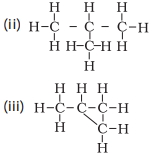
A
$(i)$ and $(ii)$
B
$(ii)$ and $(iv)$
C
$(i)$ and $(iii)$
D
$(iii)$ and $(iv)$
Solution
(A) Butane has the molecular formula $C_4H_{10}$.
Structural isomers are compounds with the same molecular formula but different structural arrangements.
$(i)$ $n$-butane is a straight-chain isomer of butane $(C_4H_{10})$.
(ii) Isobutane ($2$-methylpropane) is a branched-chain isomer of butane $(C_4H_{10})$.
(iii) Cyclobutane has the formula $C_4H_8$,so it is not an isomer of butane.
(iv) The structure shown is not a valid isomer of butane.
Therefore,$(i)$ and $(ii)$ are the correct structural isomers of butane.
Structural isomers are compounds with the same molecular formula but different structural arrangements.
$(i)$ $n$-butane is a straight-chain isomer of butane $(C_4H_{10})$.
(ii) Isobutane ($2$-methylpropane) is a branched-chain isomer of butane $(C_4H_{10})$.
(iii) Cyclobutane has the formula $C_4H_8$,so it is not an isomer of butane.
(iv) The structure shown is not a valid isomer of butane.
Therefore,$(i)$ and $(ii)$ are the correct structural isomers of butane.
0 likes
View Solution6
MediumMCQ
$CH_3-CH_2-OH \xrightarrow{\text{Alkaline } KMnO_4 + \text{Heat}} CH_3-COOH$
In the above given reaction,alkaline $KMnO_4$ acts as:
In the above given reaction,alkaline $KMnO_4$ acts as:
A
reducing agent
B
oxidising agent
C
catalyst
D
dehydrating agent
Solution
(B) In the given reaction,ethanol $(CH_3-CH_2-OH)$ is converted into ethanoic acid $(CH_3-COOH)$.
This process involves the addition of oxygen to the alcohol group.
Alkaline $KMnO_4$ (Potassium permanganate) is a strong oxidizing agent that provides oxygen for this oxidation reaction.
Therefore,it acts as an oxidising agent.
This process involves the addition of oxygen to the alcohol group.
Alkaline $KMnO_4$ (Potassium permanganate) is a strong oxidizing agent that provides oxygen for this oxidation reaction.
Therefore,it acts as an oxidising agent.
0 likes
View Solution7
MediumMCQ
Oils on treating with hydrogen in the presence of palladium or nickel catalyst form fats. This is an example of
A
Displacement reaction
B
Substitution reaction
C
Addition reaction
D
Oxidation reaction
Solution
(C) The process of converting unsaturated vegetable oils into saturated fats by reacting them with hydrogen in the presence of a catalyst like nickel $(Ni)$ or palladium $(Pd)$ is known as hydrogenation.
In this reaction,hydrogen atoms are added across the carbon-carbon double bonds $(C=C)$ of the unsaturated oil molecules to form single bonds $(C-C)$.
Since hydrogen is being added to the reactant to form a new product,this is classified as an addition reaction.
In this reaction,hydrogen atoms are added across the carbon-carbon double bonds $(C=C)$ of the unsaturated oil molecules to form single bonds $(C-C)$.
Since hydrogen is being added to the reactant to form a new product,this is classified as an addition reaction.
0 likes
View Solution8
EasyMCQ
In which of the following compounds,$-OH$ is the functional group?
A
Butanone
B
Butanal
C
Butanoic acid
D
Butanol
Solution
(D) The functional group $-OH$ represents an alcohol.
In the given options:
$1$. Butanone is a ketone with the functional group $C=O$.
$2$. Butanal is an aldehyde with the functional group $-CHO$.
$3$. Butanoic acid is a carboxylic acid with the functional group $-COOH$.
$4$. Butanol is an alcohol with the functional group $-OH$.
Therefore,the correct option is $D$.
In the given options:
$1$. Butanone is a ketone with the functional group $C=O$.
$2$. Butanal is an aldehyde with the functional group $-CHO$.
$3$. Butanoic acid is a carboxylic acid with the functional group $-COOH$.
$4$. Butanol is an alcohol with the functional group $-OH$.
Therefore,the correct option is $D$.
0 likes
View Solution9
EasyMCQ
The soap molecule has a
A
hydrophilic head and a hydrophobic tail
B
hydrophobic head and a hydrophilic tail
C
hydrophobic head and a hydrophobic tail
D
hydrophilic head and a hydrophilic tail
Solution
(A) soap molecule consists of two parts: a long hydrocarbon chain and an ionic end.
$1$. The ionic end is hydrophilic,meaning it is water-attracting (water-loving).
$2$. The long hydrocarbon chain is hydrophobic,meaning it is water-repelling (water-fearing).
Therefore,the soap molecule has a hydrophilic head and a hydrophobic tail.
$1$. The ionic end is hydrophilic,meaning it is water-attracting (water-loving).
$2$. The long hydrocarbon chain is hydrophobic,meaning it is water-repelling (water-fearing).
Therefore,the soap molecule has a hydrophilic head and a hydrophobic tail.
0 likes
View Solution10
MediumMCQ
Which of the following is the correct representation of the electron dot structure of nitrogen $(N_2)$?
A
$\overset{\centerdot \centerdot }{:N} :: \overset{\centerdot \centerdot }{N:}$
B
$:N \vdots N:$
C
$\overset{\centerdot \centerdot }{:N} \vdots \overset{\centerdot \centerdot }{N:}$
D
$\overset{\centerdot }{:N} : : : \overset{\centerdot }{N:}$
Solution
(B) The atomic number of nitrogen $(N)$ is $7$,and its electronic configuration is $2, 5$.
To achieve a stable octet,each nitrogen atom needs $3$ more electrons.
Therefore,two nitrogen atoms share $3$ pairs of electrons between them to form a triple covalent bond.
In the electron dot structure,the $3$ shared pairs are represented by $3$ dots between the two $N$ atoms,and the remaining lone pair on each nitrogen is represented by $2$ dots.
Thus,the correct representation is $:N \vdots N:$.
To achieve a stable octet,each nitrogen atom needs $3$ more electrons.
Therefore,two nitrogen atoms share $3$ pairs of electrons between them to form a triple covalent bond.
In the electron dot structure,the $3$ shared pairs are represented by $3$ dots between the two $N$ atoms,and the remaining lone pair on each nitrogen is represented by $2$ dots.
Thus,the correct representation is $:N \vdots N:$.
0 likes
View Solution11
MediumMCQ
The structural formula of ethyne is:
A
$H_2C=CH_2$
B
$CH_3-C\equiv CH$
C
$H-C\equiv C-H$
D
$C_2H_6$
Solution
(C) Ethyne,also known as acetylene,is the simplest alkyne with the chemical formula $C_2H_2$.
It consists of two carbon atoms connected by a triple bond,with each carbon atom bonded to one hydrogen atom.
The structural formula is represented as $H-C\equiv C-H$.
It consists of two carbon atoms connected by a triple bond,with each carbon atom bonded to one hydrogen atom.
The structural formula is represented as $H-C\equiv C-H$.
0 likes
View Solution12
MediumMCQ
Identify the unsaturated compounds from the following:
$(i)$ Propane
$(ii)$ Propene
$(iii)$ Propyne
$(iv)$ Chloropropane
$(i)$ Propane
$(ii)$ Propene
$(iii)$ Propyne
$(iv)$ Chloropropane
A
$(i)$ and $(ii)$
B
$(ii)$ and $(iv)$
C
$(iii)$ and $(iv)$
D
$(ii)$ and $(iii)$
Solution
(D) Unsaturated compounds are those hydrocarbons that contain at least one carbon-carbon double bond $(C=C)$ or triple bond $(C≡C)$.
$(i)$ Propane $(C_3H_8)$ is an alkane,which is a saturated hydrocarbon.
$(ii)$ Propene $(C_3H_6)$ contains a double bond,making it an unsaturated hydrocarbon.
$(iii)$ Propyne $(C_3H_4)$ contains a triple bond,making it an unsaturated hydrocarbon.
$(iv)$ Chloropropane $(C_3H_7Cl)$ is a substituted alkane,which is saturated.
Therefore,$(ii)$ and $(iii)$ are unsaturated compounds.
$(i)$ Propane $(C_3H_8)$ is an alkane,which is a saturated hydrocarbon.
$(ii)$ Propene $(C_3H_6)$ contains a double bond,making it an unsaturated hydrocarbon.
$(iii)$ Propyne $(C_3H_4)$ contains a triple bond,making it an unsaturated hydrocarbon.
$(iv)$ Chloropropane $(C_3H_7Cl)$ is a substituted alkane,which is saturated.
Therefore,$(ii)$ and $(iii)$ are unsaturated compounds.
0 likes
View Solution13
EasyMCQ
Chlorine reacts with saturated hydrocarbons at room temperature in the:
A
presence of sunlight
B
absence of sunlight
C
presence of water
D
presence of hydrochloric acid
Solution
(A) Saturated hydrocarbons (alkanes) are generally unreactive in most conditions. However,they undergo substitution reactions with halogens like chlorine in the presence of sunlight (ultraviolet light).
This reaction is known as a free-radical substitution reaction.
For example,methane reacts with chlorine in the presence of sunlight to form chloromethane and hydrogen chloride: $CH_4 + Cl_2 \xrightarrow{sunlight} CH_3Cl + HCl$.
This reaction is known as a free-radical substitution reaction.
For example,methane reacts with chlorine in the presence of sunlight to form chloromethane and hydrogen chloride: $CH_4 + Cl_2 \xrightarrow{sunlight} CH_3Cl + HCl$.
0 likes
View Solution14
MediumMCQ
In the soap micelles,
A
the ionic end of soap is in the interior of the cluster and the carbon chain is out of the cluster.
B
the ionic end of soap is on the surface of the cluster while the carbon chain is in the interior of the cluster.
C
both ionic end and carbon chain are in the interior of the cluster.
D
both ionic end and carbon chain are on the exterior of the cluster.
Solution
(B) Soap molecules are sodium or potassium salts of long-chain carboxylic acids.
Each soap molecule has two parts: a long hydrocarbon chain (hydrophobic tail) and an ionic head (hydrophilic head).
When soap is dissolved in water,the hydrophobic tails cluster together to avoid contact with water,forming the interior of the micelle.
The hydrophilic ionic heads face outward towards the water,forming the surface of the micelle.
Therefore,the ionic end is on the surface,and the carbon chain is in the interior of the cluster.
Each soap molecule has two parts: a long hydrocarbon chain (hydrophobic tail) and an ionic head (hydrophilic head).
When soap is dissolved in water,the hydrophobic tails cluster together to avoid contact with water,forming the interior of the micelle.
The hydrophilic ionic heads face outward towards the water,forming the surface of the micelle.
Therefore,the ionic end is on the surface,and the carbon chain is in the interior of the cluster.
0 likes
View Solution15
MediumMCQ
Pentane has the molecular formula $C_5H_{12}$. It has
A
$5$ covalent bonds
B
$12$ covalent bonds
C
$16$ covalent bonds
D
$17$ covalent bonds
Solution
(C) The molecular formula of pentane is $C_5H_{12}$.
In pentane,there are $5$ carbon atoms linked together in a chain by $4$ $C-C$ single covalent bonds.
Each carbon atom is bonded to hydrogen atoms to satisfy its valency of $4$.
There are $12$ $C-H$ single covalent bonds.
Total number of covalent bonds = (Number of $C-C$ bonds) + (Number of $C-H$ bonds) = $4 + 12 = 16$ covalent bonds.
In pentane,there are $5$ carbon atoms linked together in a chain by $4$ $C-C$ single covalent bonds.
Each carbon atom is bonded to hydrogen atoms to satisfy its valency of $4$.
There are $12$ $C-H$ single covalent bonds.
Total number of covalent bonds = (Number of $C-C$ bonds) + (Number of $C-H$ bonds) = $4 + 12 = 16$ covalent bonds.
0 likes
View Solution16
MediumMCQ
The structural formula of benzene is:
A
B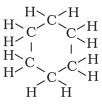
C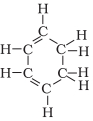
D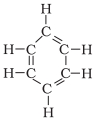
Solution
(D) Benzene $(C_6H_6)$ is an aromatic hydrocarbon with a cyclic structure.
It consists of a six-carbon ring with alternating single and double bonds.
Each carbon atom in the ring is bonded to one hydrogen atom.
Option $D$ correctly represents this structure,showing the alternating double bonds and the correct valency for each carbon atom.
It consists of a six-carbon ring with alternating single and double bonds.
Each carbon atom in the ring is bonded to one hydrogen atom.
Option $D$ correctly represents this structure,showing the alternating double bonds and the correct valency for each carbon atom.
0 likes
View Solution17
EasyMCQ
Ethanol reacts with sodium and forms two products. These are
A
sodium ethoxide and hydrogen
B
sodium ethanoate and oxygen
C
sodium ethanoate and hydrogen
D
sodium ethoxide and oxygen
Solution
(A) When ethanol $(C_2H_5OH)$ reacts with sodium metal $(Na)$,it undergoes a substitution reaction where the hydrogen atom of the hydroxyl group is replaced by sodium.
The chemical equation for this reaction is:
$2C_2H_5OH + 2Na \rightarrow 2C_2H_5ONa + H_2 \uparrow$
In this reaction,$C_2H_5ONa$ (sodium ethoxide) and $H_2$ (hydrogen gas) are formed.
Therefore,the correct products are sodium ethoxide and hydrogen.
The chemical equation for this reaction is:
$2C_2H_5OH + 2Na \rightarrow 2C_2H_5ONa + H_2 \uparrow$
In this reaction,$C_2H_5ONa$ (sodium ethoxide) and $H_2$ (hydrogen gas) are formed.
Therefore,the correct products are sodium ethoxide and hydrogen.
0 likes
View Solution18
MediumMCQ
The correct structural formula of butanoic acid is
A
$CH_2=CH-CH_2-COOH$
B
$CH_3-CH_2-CH_2-COOH$
C
$CH_3-CH_2-CH_2-CH_2-OH$
D
$CH_3-CH_2-CH_2-CH_2-CH_2-COOH$
Solution
(B) Butanoic acid is a carboxylic acid with a four-carbon chain. The general formula for a carboxylic acid is $R-COOH$. For butanoic acid,the chain length is $n=4$. The structure is $CH_3-CH_2-CH_2-COOH$. Option $B$ correctly represents this structure,where the carbon atoms are bonded in a linear chain and the terminal carbon is part of the carboxyl group $(-COOH)$.
0 likes
View Solution19
EasyMCQ
Vinegar is a solution of
A
$50 \%-60 \%$ acetic acid in alcohol
B
$5 \%-8 \%$ acetic acid in alcohol
C
$5 \%-8 \%$ acetic acid in water
D
$50 \%-60 \%$ acetic acid in water
Solution
(C) Vinegar is a common household substance used for cooking and preservation.
It is chemically defined as a dilute solution of acetic acid $(CH_3COOH)$.
The standard concentration of acetic acid in vinegar typically ranges from $5 \%$ to $8 \%$ by volume.
The solvent used in this solution is water.
Therefore,vinegar is a $5 \%-8 \%$ solution of acetic acid in water.
It is chemically defined as a dilute solution of acetic acid $(CH_3COOH)$.
The standard concentration of acetic acid in vinegar typically ranges from $5 \%$ to $8 \%$ by volume.
The solvent used in this solution is water.
Therefore,vinegar is a $5 \%-8 \%$ solution of acetic acid in water.
0 likes
View Solution20
MediumMCQ
Mineral acids are stronger acids than carboxylic acids because:
$(i)$ Mineral acids are completely ionised.
$(ii)$ Carboxylic acids are completely ionised.
$(iii)$ Mineral acids are partially ionised.
$(iv)$ Carboxylic acids are partially ionised.
$(i)$ Mineral acids are completely ionised.
$(ii)$ Carboxylic acids are completely ionised.
$(iii)$ Mineral acids are partially ionised.
$(iv)$ Carboxylic acids are partially ionised.
A
$(iii)$ and $(iv)$
B
$(ii)$ and $(iii)$
C
$(i)$ and $(ii)$
D
$(i)$ and $(iv)$
Solution
(D) Mineral acids (such as $HCl$,$H_2SO_4$,$HNO_3$) are strong acids because they dissociate completely into ions in an aqueous solution.
Carboxylic acids (such as $CH_3COOH$) are weak acids because they dissociate only partially into ions in an aqueous solution.
Therefore,statement $(i)$ (mineral acids are completely ionised) and statement $(iv)$ (carboxylic acids are partially ionised) correctly explain why mineral acids are stronger than carboxylic acids.
Thus,the correct option is $(i)$ and $(iv)$.
Carboxylic acids (such as $CH_3COOH$) are weak acids because they dissociate only partially into ions in an aqueous solution.
Therefore,statement $(i)$ (mineral acids are completely ionised) and statement $(iv)$ (carboxylic acids are partially ionised) correctly explain why mineral acids are stronger than carboxylic acids.
Thus,the correct option is $(i)$ and $(iv)$.
0 likes
View Solution21
EasyMCQ
Carbon forms four covalent bonds by sharing its four valence electrons with four univalent atoms,e.g. hydrogen. After the formation of four bonds,carbon attains the electronic configuration of
A
neon
B
helium
C
argon
D
krypton
Solution
(A) Carbon has an atomic number of $6$. Its electronic configuration is $(2, 4)$.
To achieve a stable octet,carbon shares its $4$ valence electrons with other atoms to form $4$ covalent bonds.
By sharing $4$ electrons,carbon gains $4$ additional electrons in its valence shell,making the total number of electrons in the valence shell $4 + 4 = 8$.
This results in a total of $2 + 8 = 10$ electrons,which corresponds to the electronic configuration of neon ($10$ electrons: $2, 8$).
To achieve a stable octet,carbon shares its $4$ valence electrons with other atoms to form $4$ covalent bonds.
By sharing $4$ electrons,carbon gains $4$ additional electrons in its valence shell,making the total number of electrons in the valence shell $4 + 4 = 8$.
This results in a total of $2 + 8 = 10$ electrons,which corresponds to the electronic configuration of neon ($10$ electrons: $2, 8$).
0 likes
View Solution22
EasyMCQ
The correct electron dot structure of a water molecule is
A
$H\centerdot \underset{\centerdot \,\,\centerdot }{\overset{\centerdot \,\,\centerdot }{\mathop{O}}}\,\centerdot H$
B
$H:\underset{\centerdot \,\,\centerdot }{\overset{\centerdot \,\,\centerdot }{\mathop{O}}}\,:H$
C
$H:\underset{\centerdot \,\,\centerdot }{\overset{\centerdot \,\,\centerdot }{\mathop{O}}}\,\centerdot H$
D
$H:O:H$
0 likes
View Solution23
MediumMCQ
Which of the following is not a straight chain hydrocarbon?
A
$CH_3-CH_2-CH_2-CH_2-CH_2-CH_3$ (represented as a branched structure)
B
$CH_3-CH_2-CH_2-CH_2-CH_2-CH_3$
C
$(CH_3)_2CH-CH_2-CH_2-CH_3$
D
$CH_3-CH_2-CH_2-CH_2-CH_2-CH_3$ (represented as a branched structure)
Solution
(C) straight chain hydrocarbon is one where carbon atoms are linked in a single continuous line without any side chains or branches.
Option $B$ represents $n$-hexane,which is a straight chain.
Option $A$ is $CH_3-CH_2-CH_2-CH_2-CH_2-CH_3$,which is $n$-hexane (straight chain).
Option $C$ is $2$-methylpentane,which has a methyl group attached to the second carbon,making it a branched chain hydrocarbon.
Option $D$ is also a representation of a straight chain hydrocarbon.
Therefore,option $C$ is the correct answer as it is a branched chain hydrocarbon.
Option $B$ represents $n$-hexane,which is a straight chain.
Option $A$ is $CH_3-CH_2-CH_2-CH_2-CH_2-CH_3$,which is $n$-hexane (straight chain).
Option $C$ is $2$-methylpentane,which has a methyl group attached to the second carbon,making it a branched chain hydrocarbon.
Option $D$ is also a representation of a straight chain hydrocarbon.
Therefore,option $C$ is the correct answer as it is a branched chain hydrocarbon.
0 likes
View Solution24
MediumMCQ
Which among the following are unsaturated hydrocarbons?
$(i) H_3C - CH_2 - CH_2 - CH_3$
$(ii) H_3C - C \equiv C - CH_3$
$(iii) H_3C - CH(CH_3) - CH_3$
$(iv) H_3C - C(CH_3) = CH_2$
$(i) H_3C - CH_2 - CH_2 - CH_3$
$(ii) H_3C - C \equiv C - CH_3$
$(iii) H_3C - CH(CH_3) - CH_3$
$(iv) H_3C - C(CH_3) = CH_2$
A
$(i)$ and $(iii)$
B
$(ii)$ and $(iii)$
C
$(iii)$ and $(iv)$
D
$(ii)$ and $(iv)$
Solution
(D) Unsaturated hydrocarbons are those that contain at least one carbon-carbon double bond $(C=C)$ or triple bond $(C \equiv C)$.
$(i) H_3C - CH_2 - CH_2 - CH_3$ is Butane,a saturated hydrocarbon (alkane).
$(ii) H_3C - C \equiv C - CH_3$ is But$-2-$yne,which contains a carbon-carbon triple bond,making it unsaturated.
$(iii) H_3C - CH(CH_3) - CH_3$ is Isobutane ($2$-methylpropane),a saturated hydrocarbon (alkane).
$(iv) H_3C - C(CH_3) = CH_2$ is $2-$methylpropene,which contains a carbon-carbon double bond,making it unsaturated.
Therefore,$(ii)$ and $(iv)$ are unsaturated hydrocarbons.
$(i) H_3C - CH_2 - CH_2 - CH_3$ is Butane,a saturated hydrocarbon (alkane).
$(ii) H_3C - C \equiv C - CH_3$ is But$-2-$yne,which contains a carbon-carbon triple bond,making it unsaturated.
$(iii) H_3C - CH(CH_3) - CH_3$ is Isobutane ($2$-methylpropane),a saturated hydrocarbon (alkane).
$(iv) H_3C - C(CH_3) = CH_2$ is $2-$methylpropene,which contains a carbon-carbon double bond,making it unsaturated.
Therefore,$(ii)$ and $(iv)$ are unsaturated hydrocarbons.
0 likes
View Solution25
MediumMCQ
Which of the following does not belong to the same homologous series?
A
$C_4H_8$
B
$C_2H_6$
C
$C_3H_8$
D
$CH_4$
Solution
(A) homologous series is a group of organic compounds having the same functional group and similar chemical properties,where each successive member differs by a $CH_2$ unit.
Compounds with the general formula $C_nH_{2n+2}$ belong to the alkane series.
Checking the given options:
$B) C_2H_6$ follows $C_nH_{2n+2}$ ($n=2$,$2(2)+2=6$).
$C) C_3H_8$ follows $C_nH_{2n+2}$ ($n=3$,$2(3)+2=8$).
$D) CH_4$ follows $C_nH_{2n+2}$ ($n=1$,$2(1)+2=4$).
$A) C_4H_8$ follows the general formula $C_nH_{2n}$,which represents the alkene series.
Therefore,$C_4H_8$ does not belong to the same homologous series as the others.
Compounds with the general formula $C_nH_{2n+2}$ belong to the alkane series.
Checking the given options:
$B) C_2H_6$ follows $C_nH_{2n+2}$ ($n=2$,$2(2)+2=6$).
$C) C_3H_8$ follows $C_nH_{2n+2}$ ($n=3$,$2(3)+2=8$).
$D) CH_4$ follows $C_nH_{2n+2}$ ($n=1$,$2(1)+2=4$).
$A) C_4H_8$ follows the general formula $C_nH_{2n}$,which represents the alkene series.
Therefore,$C_4H_8$ does not belong to the same homologous series as the others.
0 likes
View Solution26
MediumMCQ
The name of the compound $CH_{3}-CH_{2}-CHO$ is
A
Propanone
B
Propanal
C
Ethanol
D
Ethanal
Solution
(B) The given compound is $CH_{3}-CH_{2}-CHO$.
This molecule contains a chain of $3$ carbon atoms.
The functional group present is the aldehyde group $(-CHO)$.
For an aldehyde with $3$ carbon atoms,the parent alkane is propane.
Replacing the terminal '$e$' of propane with '$al$' gives the name propanal.
Therefore,the correct name is propanal.
This molecule contains a chain of $3$ carbon atoms.
The functional group present is the aldehyde group $(-CHO)$.
For an aldehyde with $3$ carbon atoms,the parent alkane is propane.
Replacing the terminal '$e$' of propane with '$al$' gives the name propanal.
Therefore,the correct name is propanal.
0 likes
View Solution27
MediumMCQ
Which of the following are the heteroatoms present in $CH_{3}-CH_{2}-O-CH_{2}-CH_{2}Cl$?
$(i)$ Oxygen
$(ii)$ Carbon
$(iii)$ Hydrogen
$(iv)$ Chlorine
$(i)$ Oxygen
$(ii)$ Carbon
$(iii)$ Hydrogen
$(iv)$ Chlorine
A
$(i)$ and $(ii)$
B
$(ii)$ and $(iii)$
C
$(i)$ and $(iv)$
D
$(iii)$ and $(iv)$
Solution
(C) In organic chemistry,atoms other than carbon and hydrogen present in a molecule are known as heteroatoms.
In the given compound $CH_{3}-CH_{2}-O-CH_{2}-CH_{2}Cl$:
$1$. Carbon $(C)$ and Hydrogen $(H)$ are the basic elements forming the hydrocarbon chain.
$2$. Oxygen $(O)$ and Chlorine $(Cl)$ are atoms other than carbon and hydrogen.
Therefore,Oxygen and Chlorine are the heteroatoms present in the molecule.
Thus,the correct option is $(i)$ and $(iv)$.
In the given compound $CH_{3}-CH_{2}-O-CH_{2}-CH_{2}Cl$:
$1$. Carbon $(C)$ and Hydrogen $(H)$ are the basic elements forming the hydrocarbon chain.
$2$. Oxygen $(O)$ and Chlorine $(Cl)$ are atoms other than carbon and hydrogen.
Therefore,Oxygen and Chlorine are the heteroatoms present in the molecule.
Thus,the correct option is $(i)$ and $(iv)$.
0 likes
View Solution28
MediumMCQ
Which of the following represents a saponification reaction?
A
$CH_3COONa + NaOH \xrightarrow{CaO} CH_4 + Na_2CO_3$
B
$CH_3COOH + C_2H_5OH \xrightarrow{H_2SO_4} CH_3COOC_2H_5 + H_2O$
C
$2CH_3COOH + 2Na \rightarrow 2CH_3COONa + H_2$
D
$CH_3COOC_2H_5 + NaOH \rightarrow CH_3COONa + C_2H_5OH$
Solution
(D) Saponification is the process of alkaline hydrolysis of an ester to produce a soap (carboxylate salt) and an alcohol.
In this reaction,an ester $(CH_3COOC_2H_5)$ reacts with a strong base $(NaOH)$ to form sodium acetate $(CH_3COONa)$ and ethanol $(C_2H_5OH)$.
Option $D$ correctly represents this reaction: $CH_3COOC_2H_5 + NaOH \rightarrow CH_3COONa + C_2H_5OH$.
In this reaction,an ester $(CH_3COOC_2H_5)$ reacts with a strong base $(NaOH)$ to form sodium acetate $(CH_3COONa)$ and ethanol $(C_2H_5OH)$.
Option $D$ correctly represents this reaction: $CH_3COOC_2H_5 + NaOH \rightarrow CH_3COONa + C_2H_5OH$.
0 likes
View Solution29
EasyMCQ
The first member of the alkyne homologous series is:
A
Ethyne
B
Ethene
C
Propyne
D
Methane
Solution
(A) The general formula for the alkyne homologous series is $C_nH_{2n-2}$,where $n$ is the number of carbon atoms.
For the first member,we set $n = 2$ because a triple bond requires at least two carbon atoms.
Substituting $n = 2$ into the formula: $C_2H_{2(2)-2} = C_2H_2$.
$C_2H_2$ is known as ethyne (also called acetylene).
Therefore,the first member of the alkyne series is ethyne.
For the first member,we set $n = 2$ because a triple bond requires at least two carbon atoms.
Substituting $n = 2$ into the formula: $C_2H_{2(2)-2} = C_2H_2$.
$C_2H_2$ is known as ethyne (also called acetylene).
Therefore,the first member of the alkyne series is ethyne.
0 likes
View Solution30
Easy
Draw the electron dot structure of ethyne and also draw its structural formula.
Solution
(N/A) The chemical formula of ethyne is $C_2H_2$.
In ethyne, there is a triple bond between the two carbon atoms and a single bond between each carbon atom and a hydrogen atom.
Electron dot structure: $H : C \vdots \vdots C : H$
Structural formula: $H - C \equiv C - H$
In ethyne, there is a triple bond between the two carbon atoms and a single bond between each carbon atom and a hydrogen atom.
Electron dot structure: $H : C \vdots \vdots C : H$
Structural formula: $H - C \equiv C - H$
0 likes
View Solution31
MediumMCQ
Write the names of the following compounds:
$(a)$ $CH_3-CH_2-CH_2-CH_2-COOH$
$(b)$ $CH_3-CH_2-C \equiv CH$
$(a)$ $CH_3-CH_2-CH_2-CH_2-COOH$
$(b)$ $CH_3-CH_2-C \equiv CH$
A
$(a)$ Pentanone,$(b)$ Butine
B
$(a)$ Pentanone,$(b)$ Butyne
C
$(a)$ Pentanoic acid,$(b)$ Butyne
D
$(a)$ Pentanoic acid,$(b)$ Butene
Solution
(C) The compound $CH_3-CH_2-CH_2-CH_2-COOH$ contains $5$ carbon atoms in the main chain and a carboxylic acid functional group $(-COOH)$. Therefore,its $IUPAC$ name is Pentanoic acid.
$(b)$ The compound $CH_3-CH_2-C \equiv CH$ contains $4$ carbon atoms in the main chain and a triple bond between the $3^{rd}$ and $4^{th}$ carbon atoms. Therefore,its $IUPAC$ name is But$-1-$yne or simply Butyne.
$(b)$ The compound $CH_3-CH_2-C \equiv CH$ contains $4$ carbon atoms in the main chain and a triple bond between the $3^{rd}$ and $4^{th}$ carbon atoms. Therefore,its $IUPAC$ name is But$-1-$yne or simply Butyne.
0 likes
View Solution32
MediumMCQ
Write the $IUPAC$ names of the following compounds:
$(a)$ $CH_3-CH_2-CH_2-CH_2-CH_2-CH_2-CHO$
$(b)$ $CH_3-CH_2-CH_2-CH_2-CH_2-OH$
$(a)$ $CH_3-CH_2-CH_2-CH_2-CH_2-CH_2-CHO$
$(b)$ $CH_3-CH_2-CH_2-CH_2-CH_2-OH$
A
$(a)$ Heptanone,$(b)$ Pentenal
B
$(a)$ Heptanal,$(b)$ Pentenal
C
$(a)$ Heptanol,$(b)$ Pentanol
D
$(a)$ Heptanal,$(b)$ Pentanol
Solution
(D) The given structure is $CH_3-CH_2-CH_2-CH_2-CH_2-CH_2-CHO$. It contains $7$ carbon atoms and an aldehyde functional group $(-CHO)$. Therefore,the $IUPAC$ name is Heptanal.
$(b)$ The given structure is $CH_3-CH_2-CH_2-CH_2-CH_2-OH$. It contains $5$ carbon atoms and an alcohol functional group $(-OH)$. Therefore,the $IUPAC$ name is Pentanol.
$(b)$ The given structure is $CH_3-CH_2-CH_2-CH_2-CH_2-OH$. It contains $5$ carbon atoms and an alcohol functional group $(-OH)$. Therefore,the $IUPAC$ name is Pentanol.
0 likes
View Solution33
MediumMCQ
Identify and name the functional groups present in the following compounds:
$(a)$ $CH_3-CH_2-CH_2-OH$
$(b)$ $CH_3-CH_2-COOH$
$(a)$ $CH_3-CH_2-CH_2-OH$
$(b)$ $CH_3-CH_2-COOH$
A
Alcohol and Carboxylic acid
B
Aldehyde and Ketone
C
Ether and Ester
D
Amine and Amide
Solution
(A) The structure $CH_3-CH_2-CH_2-OH$ contains the $-OH$ group,which is the functional group for alcohols. Therefore,it is an alcohol (propanol).
$(b)$ The structure $CH_3-CH_2-COOH$ contains the $-COOH$ group,which is the functional group for carboxylic acids. Therefore,it is a carboxylic acid (propanoic acid).
$(b)$ The structure $CH_3-CH_2-COOH$ contains the $-COOH$ group,which is the functional group for carboxylic acids. Therefore,it is a carboxylic acid (propanoic acid).
0 likes
View Solution34
Medium
Identify and name the functional groups present in the following compounds.
$(a)$ $CH_3-CO-CH_2-CH_3$
$(b)$ $CH_3-CH_2-CH=CH_2$
$(a)$ $CH_3-CO-CH_2-CH_3$
$(b)$ $CH_3-CH_2-CH=CH_2$
Solution
(A) The structure $CH_3-CO-CH_2-CH_3$ contains a carbonyl group bonded to two carbon atoms,which is characteristic of a $\text{Ketone}$ functional group.
$(b)$ The structure $CH_3-CH_2-CH=CH_2$ contains a carbon-carbon double bond,which is characteristic of an $\text{Alkene}$ functional group.
$(b)$ The structure $CH_3-CH_2-CH=CH_2$ contains a carbon-carbon double bond,which is characteristic of an $\text{Alkene}$ functional group.
0 likes
View Solution35
Difficult
$A$ compound $X$ is formed by the reaction of a carboxylic acid $C_{2}H_{4}O_{2}$ and an alcohol in the presence of a few drops of $H_{2}SO_{4}$. The alcohol,upon oxidation with alkaline $KMnO_{4}$ followed by acidification,gives the same carboxylic acid as used in this reaction. Give the names and structures of $(a)$ carboxylic acid,$(b)$ alcohol,and $(c)$ the compound $X$. Also,write the chemical reaction.
Solution
(A) The carboxylic acid is ethanoic acid $(CH_{3}COOH)$.
$(b)$ The alcohol is ethanol $(C_{2}H_{5}OH)$.
$(c)$ The compound $X$ is ethyl ethanoate $(CH_{3}COOC_{2}H_{5})$.
The reaction is an esterification reaction:
$CH_{3}COOH + C_{2}H_{5}OH \xrightarrow{H_{2}SO_{4}} CH_{3}COOC_{2}H_{5} + H_{2}O$
$(b)$ The alcohol is ethanol $(C_{2}H_{5}OH)$.
$(c)$ The compound $X$ is ethyl ethanoate $(CH_{3}COOC_{2}H_{5})$.
The reaction is an esterification reaction:
$CH_{3}COOH + C_{2}H_{5}OH \xrightarrow{H_{2}SO_{4}} CH_{3}COOC_{2}H_{5} + H_{2}O$
0 likes
View Solution36
EasyMCQ
Why are detergents better cleansing agents than soaps? Explain.
A
Detergents are cheaper.
B
Detergents work effectively in both hard and soft water.
C
Detergents are biodegradable.
D
Detergents produce more foam.
Solution
(B) Detergents are considered better cleansing agents than soaps because they can function effectively in both hard and soft water.
Soaps react with calcium $(Ca^{2+})$ and magnesium $(Mg^{2+})$ ions present in hard water to form insoluble precipitates known as scum,which reduces their cleaning efficiency.
In contrast,the charged ends of detergent molecules do not form insoluble precipitates with these ions,allowing them to maintain their cleansing action even in hard water.
Soaps react with calcium $(Ca^{2+})$ and magnesium $(Mg^{2+})$ ions present in hard water to form insoluble precipitates known as scum,which reduces their cleaning efficiency.
In contrast,the charged ends of detergent molecules do not form insoluble precipitates with these ions,allowing them to maintain their cleansing action even in hard water.
0 likes
View Solution37
Medium
Identify the functional groups present in the following compounds:
$(a) CH_3COCH_2CH_2CH_2CH_3$
$(b) CH_3CH_2CH_2COOH$
$(c) CH_3CH_2CH_2CH_2CHO$
$(d) CH_3CH_2OH$
$(a) CH_3COCH_2CH_2CH_2CH_3$
$(b) CH_3CH_2CH_2COOH$
$(c) CH_3CH_2CH_2CH_2CHO$
$(d) CH_3CH_2OH$
Solution
(A) $(a) CH_3COCH_2CH_2CH_2CH_3$ contains a ketone group $(-CO-)$.
$(b) CH_3CH_2CH_2COOH$ contains a carboxylic acid group $(-COOH)$.
$(c) CH_3CH_2CH_2CH_2CHO$ contains an aldehyde group $(-CHO)$.
$(d) CH_3CH_2OH$ contains an alcohol group $(-OH)$.
$(b) CH_3CH_2CH_2COOH$ contains a carboxylic acid group $(-COOH)$.
$(c) CH_3CH_2CH_2CH_2CHO$ contains an aldehyde group $(-CHO)$.
$(d) CH_3CH_2OH$ contains an alcohol group $(-OH)$.
0 likes
View Solution38
Medium
How is ethene prepared from ethanol? Give the reaction involved in it.
Solution
(N/A) Ethanol,when heated with excess concentrated sulphuric acid $(H_{2}SO_{4})$ at $443\, K$,undergoes dehydration to produce ethene.
The chemical reaction is as follows:
$CH_{3}CH_{2}OH \xrightarrow[443\, K]{\text{Hot conc. } H_{2}SO_{4}} CH_{2}=CH_{2} + H_{2}O$
The chemical reaction is as follows:
$CH_{3}CH_{2}OH \xrightarrow[443\, K]{\text{Hot conc. } H_{2}SO_{4}} CH_{2}=CH_{2} + H_{2}O$
0 likes
View Solution39
Easy
Intake of small quantity of methanol can be lethal. Comment.
Solution
(N/A) Methanol is oxidized to methanal in the liver.
Methanal reacts rapidly with the components of cells.
It causes the protoplasm to coagulate.
It also affects the optic nerve,causing blindness.
Methanal reacts rapidly with the components of cells.
It causes the protoplasm to coagulate.
It also affects the optic nerve,causing blindness.
0 likes
View Solution40
Medium
$A$ gas is evolved when ethanol reacts with sodium. Name the gas evolved and also write the balanced chemical equation of the reaction involved.
Solution
(N/A) When ethanol $(CH_{3}CH_{2}OH)$ reacts with sodium metal $(Na)$,it forms sodium ethoxide $(CH_{3}CH_{2}ONa)$ and releases hydrogen gas $(H_{2})$.
The balanced chemical equation for this reaction is:
$2CH_{3}CH_{2}OH + 2Na \rightarrow 2CH_{3}CH_{2}ONa + H_{2}$
The balanced chemical equation for this reaction is:
$2CH_{3}CH_{2}OH + 2Na \rightarrow 2CH_{3}CH_{2}ONa + H_{2}$
0 likes
View Solution41
Medium
Ethene is formed when ethanol at $443\, K$ is heated with excess of concentrated sulphuric acid. What is the role of sulphuric acid in this reaction? Write the balanced chemical equation of this reaction.
Solution
(N/A) In this reaction,concentrated sulphuric acid acts as a dehydrating agent,which removes a water molecule from the ethanol molecule.
The balanced chemical equation is:
$CH_3CH_2OH \xrightarrow[443\, K]{\text{Hot conc. } H_2SO_4} CH_2=CH_2 + H_2O$
The balanced chemical equation is:
$CH_3CH_2OH \xrightarrow[443\, K]{\text{Hot conc. } H_2SO_4} CH_2=CH_2 + H_2O$
0 likes
View Solution42
Medium
Carbon,a Group $14$ element in the Periodic Table,is known to form compounds with many elements. Write an example of a compound formed with:
$(a)$ Chlorine (Group $17$ of Periodic Table)
$(b)$ Oxygen (Group $16$ of Periodic Table)
$(a)$ Chlorine (Group $17$ of Periodic Table)
$(b)$ Oxygen (Group $16$ of Periodic Table)
Solution
(N/A) Carbon tetrachloride $(CCl_4)$ is formed when carbon reacts with chlorine.
$(b)$ Carbon dioxide $(CO_2)$ is formed when carbon reacts with oxygen.
$(b)$ Carbon dioxide $(CO_2)$ is formed when carbon reacts with oxygen.
0 likes
View Solution43
Medium
In electron dot structure,the valence shell electrons are represented by crosses or dots.
$(a)$ The atomic number of chlorine is $17$. Write its electronic configuration.
$(b)$ Draw the electron dot structure of chlorine molecule $(Cl_2)$.
$(a)$ The atomic number of chlorine is $17$. Write its electronic configuration.
$(b)$ Draw the electron dot structure of chlorine molecule $(Cl_2)$.
Solution
(N/A) The atomic number of chlorine is $17$. Its electronic configuration is $2, 8, 7$ in $K, L, M$ shells respectively.
$(b)$ Each chlorine atom has $7$ valence electrons. To complete its octet,each chlorine atom shares one electron with another chlorine atom,forming a single covalent bond. The electron dot structure is as follows:
:Cl:Cl: (with $6$ dots around each Cl and $2$ shared dots in the middle)
$(b)$ Each chlorine atom has $7$ valence electrons. To complete its octet,each chlorine atom shares one electron with another chlorine atom,forming a single covalent bond. The electron dot structure is as follows:
:Cl:Cl: (with $6$ dots around each Cl and $2$ shared dots in the middle)

0 likes
View Solution44
Easy
Catenation is the ability of an atom to form bonds with other atoms of the same element. It is exhibited by both carbon and silicon. Compare the ability of catenation of the two elements. Give reasons.
Solution
(N/A) Carbon exhibits catenation to a much greater extent than silicon.
This is primarily due to the smaller atomic size of carbon,which allows for the formation of strong and stable $C-C$ covalent bonds.
In contrast,silicon has a larger atomic size,which results in longer and weaker $Si-Si$ bonds,making them less stable compared to $C-C$ bonds.
Additionally,the high bond energy of the $C-C$ bond contributes to the extensive catenation observed in carbon compounds.
This is primarily due to the smaller atomic size of carbon,which allows for the formation of strong and stable $C-C$ covalent bonds.
In contrast,silicon has a larger atomic size,which results in longer and weaker $Si-Si$ bonds,making them less stable compared to $C-C$ bonds.
Additionally,the high bond energy of the $C-C$ bond contributes to the extensive catenation observed in carbon compounds.
0 likes
View Solution45
Easy
Unsaturated hydrocarbons contain multiple bonds between two $C$ atoms and show addition reactions. Give the test to distinguish ethane from ethene.
Solution
(N/A) Ethane $(C_2H_6)$ is a saturated hydrocarbon,while ethene $(C_2H_4)$ is an unsaturated hydrocarbon.
$1$. Bromine Water Test: When ethene is passed through bromine water (reddish-brown color),it reacts to form $1,2-$dibromoethane,causing the bromine water to decolorize. Ethane does not react with bromine water,so the color remains unchanged.
$2$. Baeyer's Test: Ethene reacts with alkaline $KMnO_4$ (purple color) to form ethylene glycol,causing the purple color to disappear. Ethane does not react with alkaline $KMnO_4$.
$1$. Bromine Water Test: When ethene is passed through bromine water (reddish-brown color),it reacts to form $1,2-$dibromoethane,causing the bromine water to decolorize. Ethane does not react with bromine water,so the color remains unchanged.
$2$. Baeyer's Test: Ethene reacts with alkaline $KMnO_4$ (purple color) to form ethylene glycol,causing the purple color to disappear. Ethane does not react with alkaline $KMnO_4$.
0 likes
View Solution46
MediumMCQ
Match the reactions given in Column $(A)$ with the names given in Column $(B).$
| Column $(A)$ | Column $(B)$ |
| $(a)$ $CH_{3}OH + CH_{3}COOH \xrightarrow{H^{+}} CH_{3}COOCH_{3} + H_{2}O$ | $(i)$ Addition reaction |
| $(b)$ $CH_{2}=CH_{2} + H_{2} \xrightarrow{Ni} CH_{3}-CH_{3}$ | $(ii)$ Substitution reaction |
| $(c)$ $CH_{4} + Cl_{2} \xrightarrow{\text{Sunlight}} CH_{3}Cl + HCl$ | $(iii)$ Neutralisation reaction |
| $(d)$ $CH_{3}COOH + NaOH \longrightarrow CH_{3}COONa + H_{2}O$ | $(iv)$ Esterification reaction |
A
$(a)-(iv), (b)-(iii), (c)-(ii), (d)-(i)$
B
$(a)-(iv), (b)-(i), (c)-(ii), (d)-(iii)$
C
$(a)-(ii), (b)-(i), (c)-(iii), (d)-(iv)$
D
$(a)-(iii), (b)-(ii), (c)-(i), (d)-(iv)$
Solution
(B) The correct matches are as follows:
$(a)$ $CH_{3}OH + CH_{3}COOH \xrightarrow{H^{+}} CH_{3}COOCH_{3} + H_{2}O$ is an Esterification reaction $(iv)$, where an alcohol and a carboxylic acid react to form an ester.
$(b)$ $CH_{2}=CH_{2} + H_{2} \xrightarrow{Ni} CH_{3}-CH_{3}$ is an Addition reaction $(i)$, where hydrogen is added across the double bond of an unsaturated hydrocarbon.
$(c)$ $CH_{4} + Cl_{2} \xrightarrow{\text{Sunlight}} CH_{3}Cl + HCl$ is a Substitution reaction $(ii)$, where a hydrogen atom in methane is replaced by a chlorine atom.
$(d)$ $CH_{3}COOH + NaOH \longrightarrow CH_{3}COONa + H_{2}O$ is a Neutralisation reaction $(iii)$, where an acid reacts with a base to form salt and water.
Therefore, the correct sequence is $(a)-(iv), (b)-(i), (c)-(ii), (d)-(iii)$.
$(a)$ $CH_{3}OH + CH_{3}COOH \xrightarrow{H^{+}} CH_{3}COOCH_{3} + H_{2}O$ is an Esterification reaction $(iv)$, where an alcohol and a carboxylic acid react to form an ester.
$(b)$ $CH_{2}=CH_{2} + H_{2} \xrightarrow{Ni} CH_{3}-CH_{3}$ is an Addition reaction $(i)$, where hydrogen is added across the double bond of an unsaturated hydrocarbon.
$(c)$ $CH_{4} + Cl_{2} \xrightarrow{\text{Sunlight}} CH_{3}Cl + HCl$ is a Substitution reaction $(ii)$, where a hydrogen atom in methane is replaced by a chlorine atom.
$(d)$ $CH_{3}COOH + NaOH \longrightarrow CH_{3}COONa + H_{2}O$ is a Neutralisation reaction $(iii)$, where an acid reacts with a base to form salt and water.
Therefore, the correct sequence is $(a)-(iv), (b)-(i), (c)-(ii), (d)-(iii)$.
0 likes
View Solution47
Medium
Write the structural formulae of all the isomers of hexane $(C_6H_{14})$.
Solution
(N/A) Hexane $(C_6H_{14})$ has five structural isomers:
$(a)$ $n$-Hexane: $CH_3-CH_2-CH_2-CH_2-CH_2-CH_3$
$(b)$ $2$-Methylpentane: $CH_3-CH(CH_3)-CH_2-CH_2-CH_3$
$(c)$ $3$-Methylpentane: $CH_3-CH_2-CH(CH_3)-CH_2-CH_3$
$(d)$ $2,2$-Dimethylbutane: $CH_3-C(CH_3)_2-CH_2-CH_3$
$(e)$ $2,3$-Dimethylbutane: $CH_3-CH(CH_3)-CH(CH_3)-CH_3$
$(a)$ $n$-Hexane: $CH_3-CH_2-CH_2-CH_2-CH_2-CH_3$
$(b)$ $2$-Methylpentane: $CH_3-CH(CH_3)-CH_2-CH_2-CH_3$
$(c)$ $3$-Methylpentane: $CH_3-CH_2-CH(CH_3)-CH_2-CH_3$
$(d)$ $2,2$-Dimethylbutane: $CH_3-C(CH_3)_2-CH_2-CH_3$
$(e)$ $2,3$-Dimethylbutane: $CH_3-CH(CH_3)-CH(CH_3)-CH_3$
0 likes
View Solution48
Medium
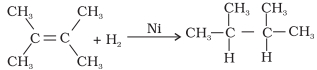
What is the role of the metal or reagents written on the arrows in the given chemical reactions?
$(a)$
$(b)$ $CH_{3}COOH + CH_{3}CH_{2}OH \xrightarrow{Conc. H_{2}SO_{4}} CH_{3}COOC_{2}H_{5} + H_{2}O$
$(c)$ $CH_{3}CH_{2}OH \xrightarrow[Heat]{Alkaline KMnO_{4}} CH_{3}COOH$
$(a)$
$(b)$ $CH_{3}COOH + CH_{3}CH_{2}OH \xrightarrow{Conc. H_{2}SO_{4}} CH_{3}COOC_{2}H_{5} + H_{2}O$
$(c)$ $CH_{3}CH_{2}OH \xrightarrow[Heat]{Alkaline KMnO_{4}} CH_{3}COOH$
Solution
(N/A) $Ni$ (Nickel) acts as a catalyst in the hydrogenation reaction.
$(b)$ Concentrated $H_{2}SO_{4}$ (Sulfuric acid) acts as a dehydrating agent and a catalyst in the esterification reaction.
$(c)$ Alkaline $KMnO_{4}$ (Potassium permanganate) acts as an oxidizing agent.
$(b)$ Concentrated $H_{2}SO_{4}$ (Sulfuric acid) acts as a dehydrating agent and a catalyst in the esterification reaction.
$(c)$ Alkaline $KMnO_{4}$ (Potassium permanganate) acts as an oxidizing agent.
0 likes
View Solution49
Medium
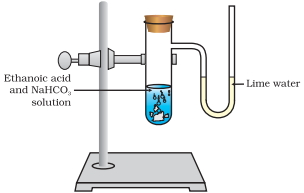
$A$ salt $X$ is formed and a gas is evolved when ethanoic acid reacts with sodium hydrogencarbonate. Name the salt $X$ and the gas evolved. Describe an activity and draw the diagram of the apparatus to prove that the evolved gas is the one which you have named. Also,write the chemical equation of the reaction involved.
Solution
(N/A) The chemical equation for the reaction is:
$CH_{3}COOH + NaHCO_{3} \rightarrow CH_{3}COONa + H_{2}O + CO_{2}$
$X$ is sodium ethanoate $(CH_{3}COONa)$.
The gas evolved is carbon dioxide $(CO_{2})$.
Activity:
$1$. Take a test tube and add a small amount of sodium hydrogencarbonate $(NaHCO_{3})$ to it.
$2$. Add a few drops of ethanoic acid $(CH_{3}COOH)$ to the test tube.
$3$. You will observe effervescence due to the evolution of a gas.
$4$. Pass this gas through a delivery tube into another test tube containing lime water $(Ca(OH)_{2})$.
$5$. The lime water will turn milky,which confirms that the evolved gas is carbon dioxide $(CO_{2})$.
Chemical reaction with lime water:
$Ca(OH)_{2} + CO_{2} \rightarrow CaCO_{3} + H_{2}O$
$CH_{3}COOH + NaHCO_{3} \rightarrow CH_{3}COONa + H_{2}O + CO_{2}$
$X$ is sodium ethanoate $(CH_{3}COONa)$.
The gas evolved is carbon dioxide $(CO_{2})$.
Activity:
$1$. Take a test tube and add a small amount of sodium hydrogencarbonate $(NaHCO_{3})$ to it.
$2$. Add a few drops of ethanoic acid $(CH_{3}COOH)$ to the test tube.
$3$. You will observe effervescence due to the evolution of a gas.
$4$. Pass this gas through a delivery tube into another test tube containing lime water $(Ca(OH)_{2})$.
$5$. The lime water will turn milky,which confirms that the evolved gas is carbon dioxide $(CO_{2})$.
Chemical reaction with lime water:
$Ca(OH)_{2} + CO_{2} \rightarrow CaCO_{3} + H_{2}O$
0 likes
View Solution50
Easy
What are hydrocarbons? Give examples.
Solution
(N/A) Hydrocarbons are organic compounds consisting entirely of carbon and hydrogen atoms. They serve as the fundamental building blocks of organic chemistry.
Examples include:
$1$. Methane $(CH_4)$
$2$. Ethane $(C_2H_6)$
$3$. Propane $(C_3H_8)$
Examples include:
$1$. Methane $(CH_4)$
$2$. Ethane $(C_2H_6)$
$3$. Propane $(C_3H_8)$
0 likes
View SolutionCarbon and its Compounds — Mix Examples - Carbon and its Compounds · Frequently Asked Questions
1Are these Carbon and its Compounds questions useful for JEE and NEET?
Yes. All questions in this section are mapped to JEE Main and NEET exam patterns. Previous year questions from JEE Main, NEET, GUJCET and state-level exams are included with full solutions.
2Can I switch to Hindi or Gujarati for these questions?
Yes. Use the language tabs in the hero section or the sidebar to view the same questions and solutions in English, Hindi or Gujarati.
3How do I generate a question paper from this subtopic?
Use the Vedclass Exam Paper Generator — select the chapter and subtopic, set difficulty, and generate Sets A, B, C, D automatically. First 3 chapters of every subject are free.
Vedclass Products
For Students
Vedclass Test Series
Mock tests in real JEE/NEET style with performance analysis. 5-day free trial.
Start Free TrialFor Teachers
Exam Paper Generator
Generate Set A/B/C/D papers from this chapter in 2 minutes. 3 chapters free.
Try FreeFor Institutes
Online Exam Module
Live online exams with unlimited students, 360° analytics & white-label branding.
See DemoFor Teachers & Institutes
Generate a Carbon and its Compounds Exam Paper in 2 Minutes
Select subtopic & difficulty — Sets A, B, C, D auto-generated with No Repeat logic.
First 3 chapters of every subject are free — no payment required.