
A English
Mix Examples - Carbon and its Compounds Questions in English
Class 10 Science · Carbon and its Compounds · Mix Examples - Carbon and its Compounds
298+
Questions
English
Language
100%
With Solutions
Showing 50 of 298 questions in English
51
Medium
Give the structural differences between saturated and unsaturated hydrocarbons with two examples each.
Solution
(N/A) Saturated hydrocarbons contain only carbon-carbon single bonds $(C-C)$.
Unsaturated hydrocarbons contain at least one carbon-carbon double $(C=C)$ or triple $(C\equiv C)$ bond.
Examples of Saturated hydrocarbons:
$1$. Methane $(CH_4)$: $H-C(H)(H)-H$
$2$. Ethane $(C_2H_6)$: $H_3C-CH_3$
Examples of Unsaturated hydrocarbons:
$1$. Ethene $(C_2H_4)$: $H_2C=CH_2$
$2$. Ethyne $(C_2H_2)$: $HC\equiv CH$
Unsaturated hydrocarbons contain at least one carbon-carbon double $(C=C)$ or triple $(C\equiv C)$ bond.
Examples of Saturated hydrocarbons:
$1$. Methane $(CH_4)$: $H-C(H)(H)-H$
$2$. Ethane $(C_2H_6)$: $H_3C-CH_3$
Examples of Unsaturated hydrocarbons:
$1$. Ethene $(C_2H_4)$: $H_2C=CH_2$
$2$. Ethyne $(C_2H_2)$: $HC\equiv CH$
0 likes
View Solution52
Medium
What is a functional group? Give examples of four different functional groups.
Solution
(N/A) functional group is an atom or a group of atoms joined in a specific manner that is responsible for the characteristic chemical properties of organic compounds.
Examples of four different functional groups are:
$1$. Hydroxyl group: $-OH$
$2$. Aldehyde group: $-CHO$
$3$. Carboxylic acid group: $-COOH$
$4$. Ketone group: $>C=O$
Examples of four different functional groups are:
$1$. Hydroxyl group: $-OH$
$2$. Aldehyde group: $-CHO$
$3$. Carboxylic acid group: $-COOH$
$4$. Ketone group: $>C=O$
0 likes
View Solution53
Medium
Name the reaction which is commonly used in the conversion of vegetable oils to fats. Explain the reaction involved in detail.
Solution
(N/A) The reaction used for the conversion of vegetable oils to fats is known as $Hydrogenation$.
$Hydrogenation$ is a chemical reaction in which hydrogen gas is added to unsaturated hydrocarbons (like vegetable oils containing double bonds) in the presence of a catalyst,such as $Nickel$ $(Ni)$,$Palladium$ $(Pd)$,or $Platinum$ $(Pt)$,to form saturated hydrocarbons (fats).
General reaction:
$R_2C=CR_2 + H_2 \xrightarrow{Ni \text{ catalyst}} R_2CH-CHR_2$
In this process,the $C=C$ double bond in the unsaturated oil molecule breaks,and two hydrogen atoms are added across the carbons,converting the liquid oil into a solid or semi-solid fat.
$Hydrogenation$ is a chemical reaction in which hydrogen gas is added to unsaturated hydrocarbons (like vegetable oils containing double bonds) in the presence of a catalyst,such as $Nickel$ $(Ni)$,$Palladium$ $(Pd)$,or $Platinum$ $(Pt)$,to form saturated hydrocarbons (fats).
General reaction:
$R_2C=CR_2 + H_2 \xrightarrow{Ni \text{ catalyst}} R_2CH-CHR_2$
In this process,the $C=C$ double bond in the unsaturated oil molecule breaks,and two hydrogen atoms are added across the carbons,converting the liquid oil into a solid or semi-solid fat.
0 likes
View Solution54
Medium
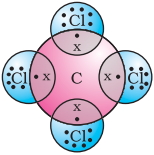
Write the chemical formula and draw the electron dot structure of carbon tetrachloride.
Solution
(N/A) The chemical formula of carbon tetrachloride is $CCl_4$.
In this molecule,one carbon atom shares its $4$ valence electrons with $4$ chlorine atoms,each contributing one electron to form $4$ covalent bonds.
Each chlorine atom completes its octet by sharing one electron with carbon,and the carbon atom completes its octet by sharing its $4$ electrons with the $4$ chlorine atoms.
The electron dot structure is as follows:
(The central Carbon atom is surrounded by four Chlorine atoms,with one shared pair of electrons between the Carbon and each Chlorine atom.)
In this molecule,one carbon atom shares its $4$ valence electrons with $4$ chlorine atoms,each contributing one electron to form $4$ covalent bonds.
Each chlorine atom completes its octet by sharing one electron with carbon,and the carbon atom completes its octet by sharing its $4$ electrons with the $4$ chlorine atoms.
The electron dot structure is as follows:
(The central Carbon atom is surrounded by four Chlorine atoms,with one shared pair of electrons between the Carbon and each Chlorine atom.)
0 likes
View Solution55
Medium
What is saponification? Write the reaction involved in this process.
Solution
(N/A) Saponification is the chemical process of converting an ester into a soap (a salt of a carboxylic acid) and an alcohol by treating it with an alkali like sodium hydroxide $(NaOH)$.
The general reaction is:
$CH_3COOC_2H_5 + NaOH \rightarrow CH_3COONa + C_2H_5OH$
(Ethyl acetate + Sodium hydroxide $\rightarrow$ Sodium acetate + Ethanol)
The general reaction is:
$CH_3COOC_2H_5 + NaOH \rightarrow CH_3COONa + C_2H_5OH$
(Ethyl acetate + Sodium hydroxide $\rightarrow$ Sodium acetate + Ethanol)
0 likes
View Solution56
Medium
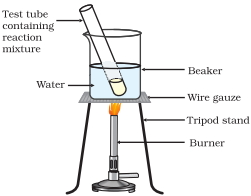
Esters are sweet-smelling substances and are used in making perfumes. Suggest an activity and the reaction involved for the preparation of an ester with a well-labeled diagram.
Solution
(N/A) Activity:
$1$. Take $1 \, mL$ of ethanol (absolute alcohol) and $1 \, mL$ of glacial acetic acid in a test tube.
$2$. Add a few drops of concentrated sulphuric acid to the mixture.
$3$. Warm the mixture in a water-bath at about $60 \, ^\circ C$ for at least $15 \, \text{min}$ as shown in the diagram. (Note: It should not be heated directly on a flame because ethanol is highly flammable).
$4$. Pour the contents into a beaker containing $20-50 \, mL$ of water and smell the resulting mixture. $A$ sweet,fruity smell indicates the formation of an ester.
Reaction:
$CH_3COOH + CH_3CH_2OH \xrightarrow{Conc. H_2SO_4} CH_3COOCH_2CH_3 + H_2O$
(Ethanoic acid + Ethanol $\rightarrow$ Ethyl ethanoate + Water)
$1$. Take $1 \, mL$ of ethanol (absolute alcohol) and $1 \, mL$ of glacial acetic acid in a test tube.
$2$. Add a few drops of concentrated sulphuric acid to the mixture.
$3$. Warm the mixture in a water-bath at about $60 \, ^\circ C$ for at least $15 \, \text{min}$ as shown in the diagram. (Note: It should not be heated directly on a flame because ethanol is highly flammable).
$4$. Pour the contents into a beaker containing $20-50 \, mL$ of water and smell the resulting mixture. $A$ sweet,fruity smell indicates the formation of an ester.
Reaction:
$CH_3COOH + CH_3CH_2OH \xrightarrow{Conc. H_2SO_4} CH_3COOCH_2CH_3 + H_2O$
(Ethanoic acid + Ethanol $\rightarrow$ Ethyl ethanoate + Water)
0 likes
View Solution57
Difficult
$A$ compound $C$ (molecular formula $C_2H_4O_2$) reacts with $Na$ metal to form a compound $R$ and evolves a gas which burns with a pop sound. Compound $C$ on treatment with an alcohol $A$ in the presence of an acid forms a sweet-smelling compound $S$ (molecular formula $C_3H_6O_2$). On addition of $NaOH$ to $C$,it also gives $R$ and water. $S$ on treatment with $NaOH$ solution gives back $R$ and $A$. Identify $C$,$R$,$A$,$S$ and write down the reactions involved.
Solution
(A) is Ethanoic acid $(CH_3COOH)$.
$R$ is Sodium acetate $(CH_3COONa)$ and the gas evolved is Hydrogen $(H_2)$.
$A$ is Methanol $(CH_3OH)$.
$S$ is Methyl acetate $(CH_3COOCH_3)$.
$(a)$ Reaction with $Na$ metal:
$2CH_3COOH + 2Na \to 2CH_3COONa + H_2 \uparrow$
$(b)$ Esterification reaction:
$CH_3COOH + CH_3OH \xrightarrow{Conc. H_2SO_4} CH_3COOCH_3 + H_2O$
$(c)$ Reaction with $NaOH$ (Neutralization):
$CH_3COOH + NaOH \to CH_3COONa + H_2O$
$(d)$ Saponification reaction:
$CH_3COOCH_3 + NaOH \to CH_3COONa + CH_3OH$
$R$ is Sodium acetate $(CH_3COONa)$ and the gas evolved is Hydrogen $(H_2)$.
$A$ is Methanol $(CH_3OH)$.
$S$ is Methyl acetate $(CH_3COOCH_3)$.
$(a)$ Reaction with $Na$ metal:
$2CH_3COOH + 2Na \to 2CH_3COONa + H_2 \uparrow$
$(b)$ Esterification reaction:
$CH_3COOH + CH_3OH \xrightarrow{Conc. H_2SO_4} CH_3COOCH_3 + H_2O$
$(c)$ Reaction with $NaOH$ (Neutralization):
$CH_3COOH + NaOH \to CH_3COONa + H_2O$
$(d)$ Saponification reaction:
$CH_3COOCH_3 + NaOH \to CH_3COONa + CH_3OH$
0 likes
View Solution58
Medium
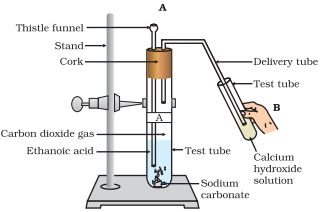
Look at the figure and answer the following questions:
$(a)$ What change would you observe in the calcium hydroxide solution taken in tube $B$?
$(b)$ Write the chemical reactions involved in test tubes $A$ and $B$ respectively.
$(a)$ What change would you observe in the calcium hydroxide solution taken in tube $B$?
$(b)$ Write the chemical reactions involved in test tubes $A$ and $B$ respectively.
Solution
(N/A) The calcium hydroxide solution will turn milky due to the formation of calcium carbonate.
$(b)$ The chemical reactions are as follows:
In test tube $A$: Ethanoic acid reacts with sodium carbonate to produce carbon dioxide gas.
$2CH_{3}COOH + Na_{2}CO_{3} \rightarrow 2CH_{3}COONa + H_{2}O + CO_{2}$
In test tube $B$: Carbon dioxide gas reacts with calcium hydroxide (lime water) to form calcium carbonate,which makes the solution milky.
$Ca(OH)_{2} + CO_{2} \rightarrow CaCO_{3} + H_{2}O$
Note: If excess $CO_{2}$ is passed through the solution,the milkiness disappears due to the formation of soluble calcium bicarbonate.
$CaCO_{3} + H_{2}O + CO_{2} \rightarrow Ca(HCO_{3})_{2}$
$(b)$ The chemical reactions are as follows:
In test tube $A$: Ethanoic acid reacts with sodium carbonate to produce carbon dioxide gas.
$2CH_{3}COOH + Na_{2}CO_{3} \rightarrow 2CH_{3}COONa + H_{2}O + CO_{2}$
In test tube $B$: Carbon dioxide gas reacts with calcium hydroxide (lime water) to form calcium carbonate,which makes the solution milky.
$Ca(OH)_{2} + CO_{2} \rightarrow CaCO_{3} + H_{2}O$
Note: If excess $CO_{2}$ is passed through the solution,the milkiness disappears due to the formation of soluble calcium bicarbonate.
$CaCO_{3} + H_{2}O + CO_{2} \rightarrow Ca(HCO_{3})_{2}$
0 likes
View Solution59
Medium
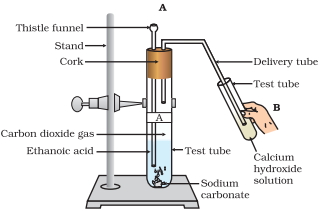
Look at the figure and answer the following questions:
$(a)$ If ethanol is used instead of ethanoic acid,would you expect the same change?
$(b)$ How can a solution of lime water be prepared in the laboratory?
$(a)$ If ethanol is used instead of ethanoic acid,would you expect the same change?
$(b)$ How can a solution of lime water be prepared in the laboratory?
Solution
(N/A) As $C_2H_5OH$ (ethanol) and $Na_2CO_3$ (sodium carbonate) do not react with each other,a similar change (effervescence due to $CO_2$ evolution) is not expected.
$C_2H_5OH + Na_2CO_3 \rightarrow$ No reaction
$(b)$ Lime water (calcium hydroxide solution) is prepared in the laboratory by dissolving a small amount of calcium oxide $(CaO)$ in water. The mixture is stirred and then allowed to settle. The clear supernatant liquid is then decanted or filtered to obtain the lime water solution.
$C_2H_5OH + Na_2CO_3 \rightarrow$ No reaction
$(b)$ Lime water (calcium hydroxide solution) is prepared in the laboratory by dissolving a small amount of calcium oxide $(CaO)$ in water. The mixture is stirred and then allowed to settle. The clear supernatant liquid is then decanted or filtered to obtain the lime water solution.
0 likes
View Solution60
Medium
How would you bring about the following conversions? Name the process and write the reaction involved.
$(a)$ Ethanol to ethene.
$(b)$ Propanol to propanoic acid.
Write the reactions.
$(a)$ Ethanol to ethene.
$(b)$ Propanol to propanoic acid.
Write the reactions.
Solution
(N/A) This conversion is achieved by the dehydration of ethanol using hot concentrated $H_2SO_4$,which acts as a dehydrating agent.
Reaction: $CH_3CH_2OH \xrightarrow[conc. H_2SO_4]{Hot} CH_2=CH_2 + H_2O$
$(b)$ This conversion is achieved by the oxidation of propanol using an oxidizing agent such as alkaline $KMnO_4$ or acidified $K_2Cr_2O_7$.
Reaction: $CH_3CH_2CH_2OH \xrightarrow[Heat]{Alk. KMnO_4} CH_3CH_2COOH$
Reaction: $CH_3CH_2OH \xrightarrow[conc. H_2SO_4]{Hot} CH_2=CH_2 + H_2O$
$(b)$ This conversion is achieved by the oxidation of propanol using an oxidizing agent such as alkaline $KMnO_4$ or acidified $K_2Cr_2O_7$.
Reaction: $CH_3CH_2CH_2OH \xrightarrow[Heat]{Alk. KMnO_4} CH_3CH_2COOH$
0 likes
View Solution61
Medium
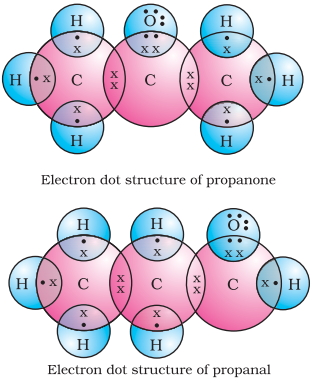
Draw the possible isomers of the compound with molecular formula $C_3H_6O$ and also give their electron dot structures.
Solution
(N/A) The molecular formula $C_3H_6O$ corresponds to two functional isomers:
$1$. Propanone $(CH_3COCH_3)$: $A$ ketone.
$2$. Propanal $(CH_3CH_2CHO)$: An aldehyde.
The electron dot structures are as follows:
- For Propanone: The central carbon atom is double-bonded to an oxygen atom and single-bonded to two methyl groups.
- For Propanal: The terminal carbon atom is double-bonded to an oxygen atom and single-bonded to a hydrogen atom and an ethyl group.
$1$. Propanone $(CH_3COCH_3)$: $A$ ketone.
$2$. Propanal $(CH_3CH_2CHO)$: An aldehyde.
The electron dot structures are as follows:
- For Propanone: The central carbon atom is double-bonded to an oxygen atom and single-bonded to two methyl groups.
- For Propanal: The terminal carbon atom is double-bonded to an oxygen atom and single-bonded to a hydrogen atom and an ethyl group.
0 likes
View Solution62
Medium
Explain the given reactions with examples:
$(a)$ Hydrogenation reaction
$(b)$ Oxidation reaction
$(c)$ Substitution reaction
$(a)$ Hydrogenation reaction
$(b)$ Oxidation reaction
$(c)$ Substitution reaction
Solution
(N/A) Hydrogenation reaction: Unsaturated hydrocarbons add hydrogen in the presence of a nickel $(Ni)$ catalyst to form saturated hydrocarbons. Example: Ethene to Ethane.
$CH_2=CH_2 + H_2 \xrightarrow{Ni} CH_3-CH_3$
$(b)$ Oxidation reaction: Alcohols can be oxidized to carboxylic acids in the presence of oxidizing agents like alkaline potassium permanganate $(KMnO_4)$ or acidified potassium dichromate $(K_2Cr_2O_7)$ upon heating. Example: Ethanol to Ethanoic acid.
$CH_3CH_2OH \xrightarrow[Heat]{Alk. KMnO_4} CH_3COOH$
$(c)$ Substitution reaction: Saturated hydrocarbons are largely unreactive,but in the presence of sunlight $(hv)$,chlorine can replace hydrogen atoms one by one. Example: Methane to Chloromethane.
$CH_4 + Cl_2 \xrightarrow{hv} CH_3Cl + HCl$
$CH_2=CH_2 + H_2 \xrightarrow{Ni} CH_3-CH_3$
$(b)$ Oxidation reaction: Alcohols can be oxidized to carboxylic acids in the presence of oxidizing agents like alkaline potassium permanganate $(KMnO_4)$ or acidified potassium dichromate $(K_2Cr_2O_7)$ upon heating. Example: Ethanol to Ethanoic acid.
$CH_3CH_2OH \xrightarrow[Heat]{Alk. KMnO_4} CH_3COOH$
$(c)$ Substitution reaction: Saturated hydrocarbons are largely unreactive,but in the presence of sunlight $(hv)$,chlorine can replace hydrogen atoms one by one. Example: Methane to Chloromethane.
$CH_4 + Cl_2 \xrightarrow{hv} CH_3Cl + HCl$
0 likes
View Solution63
Medium
Explain the given reactions with examples:
$(a)$ Saponification reaction
$(b)$ Combustion reaction
$(a)$ Saponification reaction
$(b)$ Combustion reaction
Solution
(N/A) Saponification: It is the process of making soap by the alkaline hydrolysis of an ester. When an ester like ethyl acetate reacts with sodium hydroxide, it produces sodium acetate and ethanol.
$CH_{3}COOC_{2}H_{5} + NaOH \rightarrow CH_{3}COONa + C_{2}H_{5}OH$
$(b)$ Combustion: It is the process of burning a carbon compound in the presence of oxygen to release energy in the form of heat and light. For example, the combustion of methane:
$CH_{4} + 2O_{2} \rightarrow CO_{2} + 2H_{2}O + \text{Heat and Light}$
$CH_{3}COOC_{2}H_{5} + NaOH \rightarrow CH_{3}COONa + C_{2}H_{5}OH$
$(b)$ Combustion: It is the process of burning a carbon compound in the presence of oxygen to release energy in the form of heat and light. For example, the combustion of methane:
$CH_{4} + 2O_{2} \rightarrow CO_{2} + 2H_{2}O + \text{Heat and Light}$
0 likes
View Solution64
Difficult
An organic compound $A$ on heating with concentrated $H_2SO_4$ forms a compound $B$, which on addition of one mole of hydrogen in the presence of $Ni$ forms a compound $C$. One mole of compound $C$ on combustion forms two moles of $CO_2$ and $3$ moles of $H_2O$. Identify the compounds $A$, $B$, and $C$ and write the chemical equations of the reactions involved.
Solution
(A) Since one mole of compound $C$ gives $2$ moles of $CO_2$ and $3$ moles of $H_2O$, its molecular formula is $C_2H_6$ (Ethane).
Compound $C$ is obtained by the hydrogenation of compound $B$, so $B$ must be $C_2H_4$ (Ethene).
Compound $B$ is formed by the dehydration of compound $A$ using concentrated $H_2SO_4$, which indicates $A$ is an alcohol, specifically $C_2H_5OH$ (Ethanol).
Reaction $1$: $C_2H_5OH \xrightarrow{\text{Hot conc. } H_2SO_4} C_2H_4 + H_2O$
Reaction $2$: $C_2H_4 + H_2 \xrightarrow{Ni} C_2H_6$
Reaction $3$: $2C_2H_6 + 7O_2 \to 4CO_2 + 6H_2O + \text{Heat and light}$
Compound $C$ is obtained by the hydrogenation of compound $B$, so $B$ must be $C_2H_4$ (Ethene).
Compound $B$ is formed by the dehydration of compound $A$ using concentrated $H_2SO_4$, which indicates $A$ is an alcohol, specifically $C_2H_5OH$ (Ethanol).
Reaction $1$: $C_2H_5OH \xrightarrow{\text{Hot conc. } H_2SO_4} C_2H_4 + H_2O$
Reaction $2$: $C_2H_4 + H_2 \xrightarrow{Ni} C_2H_6$
Reaction $3$: $2C_2H_6 + 7O_2 \to 4CO_2 + 6H_2O + \text{Heat and light}$
0 likes
View Solution65
EasyMCQ
$A$ colourless gas '$X$' has a formula $C_{3}H_{6}$. It decolourises bromine water. Write the chemical name of '$X$'.
A
Propane
B
Propene
C
Propyne
D
Cyclopropane
Solution
(B) The chemical formula $C_{3}H_{6}$ corresponds to the general formula $C_{n}H_{2n}$,which is characteristic of alkenes.
Alkenes are unsaturated hydrocarbons containing a carbon-carbon double bond.
Bromine water is a standard test for unsaturation; it turns from reddish-brown to colourless in the presence of alkenes or alkynes.
Since the compound is an alkene with $3$ carbon atoms,its name is propene $\left(H_{3}C-CH=CH_{2}\right)$.
Alkenes are unsaturated hydrocarbons containing a carbon-carbon double bond.
Bromine water is a standard test for unsaturation; it turns from reddish-brown to colourless in the presence of alkenes or alkynes.
Since the compound is an alkene with $3$ carbon atoms,its name is propene $\left(H_{3}C-CH=CH_{2}\right)$.
0 likes
View Solution66
Easy
Write the name and structure of an aldehyde with four carbon atoms in its molecule.
Solution
(N/A) The aldehyde with four carbon atoms is known as Butanal.
Its structural formula is $CH_{3}-CH_{2}-CH_{2}-CHO$.
Its structural formula is $CH_{3}-CH_{2}-CH_{2}-CHO$.
0 likes
View Solution67
Easy
Draw the structural formula of methanoic acid.
Solution
(N/A) Methanoic acid is the simplest carboxylic acid with the chemical formula $HCOOH$.
Its structural formula consists of a carbon atom double-bonded to an oxygen atom,single-bonded to a hydroxyl group $(-OH)$,and single-bonded to a hydrogen atom.
The structure is represented as:
$H - C(=O) - OH$
Its structural formula consists of a carbon atom double-bonded to an oxygen atom,single-bonded to a hydroxyl group $(-OH)$,and single-bonded to a hydrogen atom.
The structure is represented as:
$H - C(=O) - OH$
0 likes
View Solution68
EasyMCQ
$A$ molecule of ammonia has the formula $NH_{3}$. Predict the total number of bonds present around the nitrogen atom.
A
$1$
B
$2$
C
$3$
D
$4$
Solution
(C) The nitrogen atom in an ammonia molecule $(NH_{3})$ has an atomic number of $7$,with an electronic configuration of $2, 5$. To achieve a stable octet,nitrogen requires $3$ more electrons. It shares these $3$ electrons with $3$ hydrogen atoms,forming $3$ covalent bonds. Therefore,there are $3$ bonds present around the nitrogen atom.
0 likes
View Solution69
EasyMCQ
Write the number of covalent bonds in the molecule of ethane.
A
$5$
B
$6$
C
$7$
D
$8$
Solution
(C) The chemical formula of ethane is $C_2H_6$.
In an ethane molecule,there is one $C-C$ single covalent bond.
There are six $C-H$ single covalent bonds (three for each carbon atom).
Therefore,the total number of covalent bonds in ethane is $1 + 6 = 7$.
In an ethane molecule,there is one $C-C$ single covalent bond.
There are six $C-H$ single covalent bonds (three for each carbon atom).
Therefore,the total number of covalent bonds in ethane is $1 + 6 = 7$.
0 likes
View Solution70
EasyMCQ
Unsaturated hydrocarbons produce a yellow flame with a large amount of black smoke when burnt in oxygen. Give the reason.
A
High hydrogen content
B
Incomplete combustion due to high carbon percentage
C
Presence of triple bonds only
D
Complete combustion
Solution
(B) Unsaturated hydrocarbons (like alkenes and alkynes) have a higher percentage of carbon compared to saturated hydrocarbons.
When they burn in air,the oxygen available is often insufficient for complete combustion.
Due to the high carbon content,the carbon atoms do not get fully oxidized to $CO_2$,leading to the formation of unburnt carbon particles (soot).
These incandescent carbon particles glow with a yellow flame and are released as black smoke.
When they burn in air,the oxygen available is often insufficient for complete combustion.
Due to the high carbon content,the carbon atoms do not get fully oxidized to $CO_2$,leading to the formation of unburnt carbon particles (soot).
These incandescent carbon particles glow with a yellow flame and are released as black smoke.
0 likes
View Solution71
Easy
Write the molecular formula of an alcohol that can be derived from butane.
Solution
(N/A) Butane has the chemical formula $C_{4}H_{10}$.
When one hydrogen atom is replaced by a hydroxyl group $(-OH)$,it forms an alcohol.
The molecular formula for butanol is $C_{4}H_{9}OH$ or $CH_{3}CH_{2}CH_{2}CH_{2}OH$.
When one hydrogen atom is replaced by a hydroxyl group $(-OH)$,it forms an alcohol.
The molecular formula for butanol is $C_{4}H_{9}OH$ or $CH_{3}CH_{2}CH_{2}CH_{2}OH$.
0 likes
View Solution72
EasyMCQ
Carbon has four electrons in its valence shell. How does carbon attain stable electronic configuration?
A
By losing four electrons
B
By gaining four electrons
C
By sharing four electrons with other atoms
D
By transferring four electrons to other atoms
Solution
(C) Carbon has an atomic number of $6$ and an electronic configuration of $(2, 4)$.
It has $4$ electrons in its outermost shell.
To attain a stable noble gas configuration (octet),it requires $4$ more electrons.
Since it is difficult to lose or gain $4$ electrons due to energy constraints,carbon achieves stability by sharing its $4$ valence electrons with other atoms to form covalent bonds.
It has $4$ electrons in its outermost shell.
To attain a stable noble gas configuration (octet),it requires $4$ more electrons.
Since it is difficult to lose or gain $4$ electrons due to energy constraints,carbon achieves stability by sharing its $4$ valence electrons with other atoms to form covalent bonds.
0 likes
View Solution73
Easy
The formula of citric acid is shown below:
$\begin{matrix}
\,\,\,\,\,COOH \\
|\,\,\,\,\,\,\, \\
CH_{2}\, \\
|\,\,\,\,\, \\
HO-C-COOH \\
|\,\,\,\,\, \\
\,CH_{2} \\
|\,\,\,\,\, \\
\,\,\,\,\,\,COOH \\
\end{matrix}$
State the name of the $-COOH$ functional group present in citric acid.
$\begin{matrix}
\,\,\,\,\,COOH \\
|\,\,\,\,\,\,\, \\
CH_{2}\, \\
|\,\,\,\,\, \\
HO-C-COOH \\
|\,\,\,\,\, \\
\,CH_{2} \\
|\,\,\,\,\, \\
\,\,\,\,\,\,COOH \\
\end{matrix}$
State the name of the $-COOH$ functional group present in citric acid.
Solution
(N/A) The functional group $-COOH$ present in citric acid is known as the Carboxylic acid group. It is a characteristic functional group found in organic acids,where a carbon atom is double-bonded to an oxygen atom and single-bonded to a hydroxyl group $(-OH)$.
0 likes
View Solution74
Easy
Give the formula and name of the alkane which contains four carbon atoms in each molecule.
Solution
(N/A) The general formula for an alkane is $C_{n}H_{2n+2}$,where $n$ is the number of carbon atoms.
Given that the molecule contains $n = 4$ carbon atoms.
Substituting $n = 4$ into the formula: $C_{4}H_{2(4)+2} = C_{4}H_{8+2} = C_{4}H_{10}$.
The alkane with four carbon atoms is named Butane.
Given that the molecule contains $n = 4$ carbon atoms.
Substituting $n = 4$ into the formula: $C_{4}H_{2(4)+2} = C_{4}H_{8+2} = C_{4}H_{10}$.
The alkane with four carbon atoms is named Butane.
0 likes
View Solution75
Easy
Name the functional group present in the following compounds:
$(i)$ $CH_{3}-CH_{2}-CH_{2}-COOH$
$(ii)$ $CH_{3}-CO-CH_{2}-CH_{3}$
$(i)$ $CH_{3}-CH_{2}-CH_{2}-COOH$
$(ii)$ $CH_{3}-CO-CH_{2}-CH_{3}$
Solution
(N/A) $(i)$ The compound $CH_{3}-CH_{2}-CH_{2}-COOH$ contains the $-COOH$ group,which is a Carboxylic acid functional group.
$(ii)$ The compound $CH_{3}-CO-CH_{2}-CH_{3}$ contains the $C=O$ group bonded to two carbon atoms,which is a Ketone functional group.
$(ii)$ The compound $CH_{3}-CO-CH_{2}-CH_{3}$ contains the $C=O$ group bonded to two carbon atoms,which is a Ketone functional group.
0 likes
View Solution76
Easy
State the valency of each carbon atom in $(i)$ an alkane and $(ii)$ an alkyne.
Solution
(4) $(i)$ In an alkane,each carbon atom is bonded to four other atoms through single covalent bonds,so its valency is $4$.
$(ii)$ In an alkyne,each carbon atom involved in the triple bond is bonded to two other atoms,maintaining a total valency of $4$.
$(ii)$ In an alkyne,each carbon atom involved in the triple bond is bonded to two other atoms,maintaining a total valency of $4$.
0 likes
View Solution77
Easy
Write the molecular formula of benzene and state the number of double bonds in its structure.
Solution
(N/A) $(i)$ The molecular formula of benzene is $C_{6}H_{6}$.
$(ii)$ It contains three double bonds in its structure.
$(ii)$ It contains three double bonds in its structure.
0 likes
View Solution78
Easy
List two characteristic features of carbon which,when put together,give rise to a large number of carbon compounds.
Solution
(N/A) The two characteristic features of carbon that lead to the formation of a vast number of carbon compounds are:
$(i)$ Catenation: The unique ability of carbon atoms to form bonds with other carbon atoms,giving rise to large molecules (chains,branched chains,or rings).
$(ii)$ Tetravalency: Carbon has a valency of $4$,which allows it to bond with four other atoms of carbon or atoms of other monovalent elements like hydrogen,oxygen,nitrogen,sulfur,chlorine,etc.
$(i)$ Catenation: The unique ability of carbon atoms to form bonds with other carbon atoms,giving rise to large molecules (chains,branched chains,or rings).
$(ii)$ Tetravalency: Carbon has a valency of $4$,which allows it to bond with four other atoms of carbon or atoms of other monovalent elements like hydrogen,oxygen,nitrogen,sulfur,chlorine,etc.
0 likes
View Solution79
Easy
The molecular formula of $A$ is $C_{10}H_{18}$ and $B$ is $C_{18}H_{36}$. Name the homologous series to which they belong.
Solution
(A) For $A$ $(C_{10}H_{18})$: The general formula for an alkyne is $C_nH_{2n-2}$. Here,$n = 10$,so $2n - 2 = 2(10) - 2 = 18$. Thus,$A$ belongs to the alkyne homologous series.
For $B$ $(C_{18}H_{36})$: The general formula for an alkene is $C_nH_{2n}$. Here,$n = 18$,so $2n = 2(18) = 36$. Thus,$B$ belongs to the alkene homologous series.
For $B$ $(C_{18}H_{36})$: The general formula for an alkene is $C_nH_{2n}$. Here,$n = 18$,so $2n = 2(18) = 36$. Thus,$B$ belongs to the alkene homologous series.
0 likes
View Solution80
Medium
Write the names of the next homologues of $CH_{3}CH_{2}OH$ and $HCOOH$.
Solution
(N/A) homologous series is a group of organic compounds having the same functional group and similar chemical properties,where each successive member differs by a $CH_{2}$ unit.
$1$. For $CH_{3}CH_{2}OH$ (Ethanol),the next homologue is obtained by adding a $CH_{2}$ group,which results in $CH_{3}CH_{2}CH_{2}OH$ (Propan$-1-$ol).
$2$. For $HCOOH$ (Methanoic acid),the next homologue is obtained by adding a $CH_{2}$ group,which results in $CH_{3}COOH$ (Ethanoic acid).
Therefore,the next homologues are Propanol and Ethanoic acid respectively.
$1$. For $CH_{3}CH_{2}OH$ (Ethanol),the next homologue is obtained by adding a $CH_{2}$ group,which results in $CH_{3}CH_{2}CH_{2}OH$ (Propan$-1-$ol).
$2$. For $HCOOH$ (Methanoic acid),the next homologue is obtained by adding a $CH_{2}$ group,which results in $CH_{3}COOH$ (Ethanoic acid).
Therefore,the next homologues are Propanol and Ethanoic acid respectively.
0 likes
View Solution81
Medium
How would you name the following compounds?
$(i)$ $CH_{3}-CH_{2}-CH=CH_{2}$
$(ii)$ $CH_{3}-CH_{2}-CH_{2}-C(CH_{3})_{2}-CH_{3}$
$(iii)$ $CH_{3}-CH_{2}-CHO$
$(iv)$ $CH_{3}-CH(OH)-CH_{3}$
$(i)$ $CH_{3}-CH_{2}-CH=CH_{2}$
$(ii)$ $CH_{3}-CH_{2}-CH_{2}-C(CH_{3})_{2}-CH_{3}$
$(iii)$ $CH_{3}-CH_{2}-CHO$
$(iv)$ $CH_{3}-CH(OH)-CH_{3}$
Solution
(A-D) $(i)$ The compound $CH_{3}-CH_{2}-CH=CH_{2}$ has four carbon atoms and a double bond,so it is named But-$1$-ene.
$(ii)$ The compound $CH_{3}-CH_{2}-CH_{2}-C(CH_{3})_{2}-CH_{3}$ has a five-carbon chain with two methyl groups at the second position from the end,so it is named $2,2$-Dimethylpentane.
$(iii)$ The compound $CH_{3}-CH_{2}-CHO$ has three carbon atoms and an aldehyde functional group,so it is named Propanal.
$(iv)$ The compound $CH_{3}-CH(OH)-CH_{3}$ has three carbon atoms and an alcohol functional group at the second carbon,so it is named Propan-$2$-ol.
$(ii)$ The compound $CH_{3}-CH_{2}-CH_{2}-C(CH_{3})_{2}-CH_{3}$ has a five-carbon chain with two methyl groups at the second position from the end,so it is named $2,2$-Dimethylpentane.
$(iii)$ The compound $CH_{3}-CH_{2}-CHO$ has three carbon atoms and an aldehyde functional group,so it is named Propanal.
$(iv)$ The compound $CH_{3}-CH(OH)-CH_{3}$ has three carbon atoms and an alcohol functional group at the second carbon,so it is named Propan-$2$-ol.
0 likes
View Solution82
EasyMCQ
Will micelle formation take place when soap is dissolved in an organic solvent?
A
Yes,it will form.
B
No,it will not form.
C
It depends on the temperature.
D
It depends on the concentration of soap.
Solution
(B) Micelle formation will not take place when soap is dissolved in an organic solvent.
Soap molecules consist of a hydrophobic hydrocarbon tail and a hydrophilic ionic head.
In an aqueous solution,the hydrophobic tails aggregate to avoid water,while the hydrophilic heads interact with water,leading to micelle formation.
In an organic solvent,the hydrophobic tails are soluble,so there is no driving force for the molecules to aggregate into a micelle structure.
Soap molecules consist of a hydrophobic hydrocarbon tail and a hydrophilic ionic head.
In an aqueous solution,the hydrophobic tails aggregate to avoid water,while the hydrophilic heads interact with water,leading to micelle formation.
In an organic solvent,the hydrophobic tails are soluble,so there is no driving force for the molecules to aggregate into a micelle structure.
0 likes
View Solution83
Easy
Explain why washing clothes with hard water is not effective.
Solution
(N/A) Hard water contains dissolved salts of calcium $(Ca^{2+})$ and magnesium $(Mg^{2+})$ ions. When soap is added to hard water,these ions react with the soap molecules to form an insoluble precipitate known as scum. Because the soap is consumed in forming this scum,it is unable to form a lather with the water,which is necessary for cleaning clothes. Consequently,a large amount of soap is wasted,and the cleaning process becomes ineffective.
0 likes
View Solution84
EasyMCQ
What happens when a small piece of sodium is dropped into ethanol?
A
It reacts vigorously to form sodium ethoxide and hydrogen gas.
B
It forms sodium hydroxide and ethane.
C
It does not react with ethanol.
D
It forms sodium carbonate and water.
Solution
(A) When a small piece of sodium metal is added to ethanol,it reacts to produce sodium ethoxide and hydrogen gas. The hydrogen gas is released as bubbles.
$2Na + 2C_{2}H_{5}OH \to 2C_{2}H_{5}ONa + H_{2} \uparrow$
$2Na + 2C_{2}H_{5}OH \to 2C_{2}H_{5}ONa + H_{2} \uparrow$
0 likes
View Solution85
Easy
Draw the structure of the simplest ketone.
Solution
(N/A) The simplest ketone is acetone,also known as propanone. Its chemical formula is $CH_3COCH_3$. The structure consists of a central carbonyl group $(C=O)$ bonded to two methyl groups $(CH_3)$.
Structure:
$CH_3 - C(=O) - CH_3$
Structure:
$CH_3 - C(=O) - CH_3$
0 likes
View Solution86
Medium
What will you observe on adding a $5\%$ alkaline potassium permanganate solution drop by drop to some warm ethanol taken in a test tube? Write the name of the compound formed during the above chemical reaction.
Solution
(N/A) When $5\%$ alkaline $KMnO_4$ solution is added drop by drop to warm ethanol,the initial pink colour of the potassium permanganate solution disappears. This happens because the alkaline $KMnO_4$ acts as an oxidising agent and oxidises ethanol to ethanoic acid. The chemical reaction is: $CH_3CH_2OH + [O] \xrightarrow{\text{alkaline } KMnO_4} CH_3COOH + H_2O$. The name of the compound formed is Ethanoic acid.
0 likes
View Solution87
Medium
"Saturated hydrocarbons burn with a blue flame while unsaturated hydrocarbons burn with a sooty flame". Why?
Solution
(N/A) Saturated hydrocarbons contain a lower percentage of carbon and have a higher hydrogen-to-carbon ratio, which allows for complete combustion in the presence of sufficient oxygen, resulting in a clean blue flame.
In contrast, unsaturated hydrocarbons have a higher percentage of carbon and a lower hydrogen-to-carbon ratio.
Due to this, they do not undergo complete combustion even in the presence of sufficient oxygen, leading to the formation of unburnt carbon particles.
These unburnt carbon particles glow and make the flame sooty or yellow.
In contrast, unsaturated hydrocarbons have a higher percentage of carbon and a lower hydrogen-to-carbon ratio.
Due to this, they do not undergo complete combustion even in the presence of sufficient oxygen, leading to the formation of unburnt carbon particles.
These unburnt carbon particles glow and make the flame sooty or yellow.
0 likes
View Solution88
EasyMCQ
How is scum formed?
A
By the reaction of soap with soft water.
B
By the reaction of soap with hard water containing calcium and magnesium salts.
C
By the reaction of detergent with distilled water.
D
By the reaction of soap with oil and grease.
Solution
(B) When soap reacts with hard water,the minerals present in the water,specifically calcium and magnesium ions,react with the soap molecules.
This reaction results in the formation of an insoluble white curdy precipitate known as scum.
Because the soap is consumed in forming this scum,it significantly reduces the cleaning efficiency of the soap.
This reaction results in the formation of an insoluble white curdy precipitate known as scum.
Because the soap is consumed in forming this scum,it significantly reduces the cleaning efficiency of the soap.
0 likes
View Solution89
Medium
Draw the electron dot structure of ethane,$C_{2}H_{6}$.
Solution
(N/A) To draw the electron dot structure of ethane $(C_{2}H_{6})$:
$1$. Ethane consists of two carbon atoms bonded together by a single covalent bond.
$2$. Each carbon atom is further bonded to three hydrogen atoms.
$3$. Carbon has $4$ valence electrons and hydrogen has $1$ valence electron.
$4$. Each carbon atom shares one electron with the other carbon atom and one electron with each of the three hydrogen atoms to complete its octet.
$5$. The structure is represented as:
$H \quad H$
$| \quad |$
$H-C-C-H$
$| \quad |$
$H \quad H$
The electron dot structure is:
$H \quad H$
$.. \quad ..$
$H : C : C : H$
$.. \quad ..$
$H \quad H$
$1$. Ethane consists of two carbon atoms bonded together by a single covalent bond.
$2$. Each carbon atom is further bonded to three hydrogen atoms.
$3$. Carbon has $4$ valence electrons and hydrogen has $1$ valence electron.
$4$. Each carbon atom shares one electron with the other carbon atom and one electron with each of the three hydrogen atoms to complete its octet.
$5$. The structure is represented as:
$H \quad H$
$| \quad |$
$H-C-C-H$
$| \quad |$
$H \quad H$
The electron dot structure is:
$H \quad H$
$.. \quad ..$
$H : C : C : H$
$.. \quad ..$
$H \quad H$
0 likes
View Solution90
Easy
Why do carbon compounds not conduct electricity?
Solution
(N/A) Carbon compounds are generally covalent in nature,meaning they are formed by the sharing of electrons between atoms. Because they do not dissociate into ions or charged particles when dissolved in water or in a molten state,they lack the free charge carriers necessary to conduct electricity.
0 likes
View Solution91
EasyMCQ
Which two of the following compounds belong to the same homologous series?
$C_{2}H_{6}O, C_{2}H_{6}O_{2}, C_{2}H_{6}, CH_{4}O$
$C_{2}H_{6}O, C_{2}H_{6}O_{2}, C_{2}H_{6}, CH_{4}O$
A
$C_{2}H_{6}O$ and $C_{2}H_{6}O_{2}$
B
$C_{2}H_{6}O$ and $CH_{4}O$
C
$C_{2}H_{6}$ and $CH_{4}O$
D
$C_{2}H_{6}O_{2}$ and $C_{2}H_{6}$
Solution
(B) homologous series is a group of organic compounds having the same functional group and similar chemical properties,where each successive member differs by a $CH_{2}$ unit.
$1$. $C_{2}H_{6}O$ can represent ethanol $(C_{2}H_{5}OH)$.
$2$. $CH_{4}O$ represents methanol $(CH_{3}OH)$.
Both compounds contain the same functional group,which is the hydroxyl group $(-OH)$.
Since they belong to the alcohol homologous series,$C_{2}H_{6}O$ and $CH_{4}O$ are the correct pair.
$1$. $C_{2}H_{6}O$ can represent ethanol $(C_{2}H_{5}OH)$.
$2$. $CH_{4}O$ represents methanol $(CH_{3}OH)$.
Both compounds contain the same functional group,which is the hydroxyl group $(-OH)$.
Since they belong to the alcohol homologous series,$C_{2}H_{6}O$ and $CH_{4}O$ are the correct pair.
0 likes
View Solution92
EasyMCQ
How did ethanoic acid get its name as glacial acetic acid?
A
It has a high boiling point.
B
It freezes in cold climates to form ice-like crystals.
C
It is found in glaciers.
D
It reacts with ice.
Solution
(B) The melting point of pure ethanoic acid is $290 \,K$ $(17 \,^{\circ}C)$.
Because this temperature is close to room temperature in cold climates,it often freezes during winter.
When it freezes,it forms solid,ice-like flakes or crystals,which is why it is commonly referred to as glacial acetic acid.
Because this temperature is close to room temperature in cold climates,it often freezes during winter.
When it freezes,it forms solid,ice-like flakes or crystals,which is why it is commonly referred to as glacial acetic acid.
0 likes
View Solution93
Medium
What is the difference between two consecutive members in a homologous series of alkanes in terms of:
$(i)$ molecular mass.
$(ii)$ number of atoms of elements.
$(i)$ molecular mass.
$(ii)$ number of atoms of elements.
Solution
(N/A) In a homologous series of alkanes,each successive member differs from the previous one by a $-CH_2-$ group.
$(i)$ The difference in molecular mass is calculated as: $(1 \times 12) + (2 \times 1) = 14 \ u$.
$(ii)$ The difference in the number of atoms is one carbon atom and two hydrogen atoms,represented by the group $-CH_2-$.
$(i)$ The difference in molecular mass is calculated as: $(1 \times 12) + (2 \times 1) = 14 \ u$.
$(ii)$ The difference in the number of atoms is one carbon atom and two hydrogen atoms,represented by the group $-CH_2-$.
0 likes
View Solution94
Medium
State reasons to explain why covalent compounds:
$(i)$ are bad conductors of electricity?
$(ii)$ have low melting and boiling points?
$(i)$ are bad conductors of electricity?
$(ii)$ have low melting and boiling points?
Solution
(N/A) $(i)$ Covalent compounds are bad conductors of electricity because the bonding in these compounds does not give rise to any charged ions.
$(ii)$ Covalently bonded molecules have strong covalent bonds within the molecule,but the intermolecular forces of attraction between the molecules are very weak,which results in low melting and boiling points.
$(ii)$ Covalently bonded molecules have strong covalent bonds within the molecule,but the intermolecular forces of attraction between the molecules are very weak,which results in low melting and boiling points.
0 likes
View Solution95
Medium
$C_{3}H_{6}$,$C_{4}H_{8}$,and $C_{5}H_{10}$ belong to the same homologous series.
$(i)$ Define homologous series.
$(ii)$ Why are the melting and boiling points of $C_{5}H_{10}$ higher than $C_{4}H_{8}$?
$(iii)$ Arrange these hydrocarbons in order of increasing boiling points.
$(i)$ Define homologous series.
$(ii)$ Why are the melting and boiling points of $C_{5}H_{10}$ higher than $C_{4}H_{8}$?
$(iii)$ Arrange these hydrocarbons in order of increasing boiling points.
Solution
(N/A) $(i)$ $A$ homologous series is a group of organic compounds having the same functional group and similar chemical properties,in which all successive members differ by a $-CH_{2}$ unit.
$(ii)$ The melting and boiling points of $C_{5}H_{10}$ are higher than those of $C_{4}H_{8}$ because the molecular mass of $C_{5}H_{10}$ is greater than that of $C_{4}H_{8}$. As molecular mass increases,the intermolecular forces of attraction increase,requiring more energy to overcome them.
$(iii)$ The order of increasing boiling points is: $C_{3}H_{6} < C_{4}H_{8} < C_{5}H_{10}$.
$(ii)$ The melting and boiling points of $C_{5}H_{10}$ are higher than those of $C_{4}H_{8}$ because the molecular mass of $C_{5}H_{10}$ is greater than that of $C_{4}H_{8}$. As molecular mass increases,the intermolecular forces of attraction increase,requiring more energy to overcome them.
$(iii)$ The order of increasing boiling points is: $C_{3}H_{6} < C_{4}H_{8} < C_{5}H_{10}$.
0 likes
View Solution96
Medium
The general formula of three compounds $A, B$ and $C$ is $C_{n}H_{2n}$. $B$ has the highest boiling point and $C$ has the lowest boiling point.
$(i)$ Mention the type of compound $A, B$ and $C$.
$(ii)$ Which of these has the minimum number of carbon atoms?
$(iii)$ Name the homologous series to which $A, B$ and $C$ belong.
$(i)$ Mention the type of compound $A, B$ and $C$.
$(ii)$ Which of these has the minimum number of carbon atoms?
$(iii)$ Name the homologous series to which $A, B$ and $C$ belong.
Solution
(C) $(i)$ Compounds $A, B$ and $C$ are unsaturated hydrocarbons containing a carbon-carbon double bond.
$(ii)$ The boiling point of members of a homologous series increases with an increase in molecular mass (i.e.,an increase in the number of carbon atoms). Since compound $C$ has the lowest boiling point,it must have the minimum number of carbon atoms.
$(iii)$ The general formula $C_{n}H_{2n}$ represents the homologous series of alkenes.
$(ii)$ The boiling point of members of a homologous series increases with an increase in molecular mass (i.e.,an increase in the number of carbon atoms). Since compound $C$ has the lowest boiling point,it must have the minimum number of carbon atoms.
$(iii)$ The general formula $C_{n}H_{2n}$ represents the homologous series of alkenes.
0 likes
View Solution97
Easy
List two characteristics of covalent compounds.
Solution
(N/A) $(i)$ Covalent compounds have low melting and boiling points.
$(ii)$ Covalent compounds do not conduct electricity.
$(ii)$ Covalent compounds do not conduct electricity.
0 likes
View Solution98
Easy
Name an element,other than carbon,which exhibits the property of catenation up to seven or eight atoms. Are these compounds stable?
Solution
(N/A) $(i)$ Silicon is the element that exhibits the property of catenation up to seven or eight atoms.
$(ii)$ No,these compounds are not stable because they are highly reactive,especially in the presence of oxygen or moisture,due to the weak $Si-Si$ bond compared to the $C-C$ bond.
$(ii)$ No,these compounds are not stable because they are highly reactive,especially in the presence of oxygen or moisture,due to the weak $Si-Si$ bond compared to the $C-C$ bond.
0 likes
View Solution99
EasyMCQ
Select alkenes and alkynes from the following:
$C_{2}H_{4}, C_{3}H_{4}, C_{2}H_{2}, C_{4}H_{8}$
$C_{2}H_{4}, C_{3}H_{4}, C_{2}H_{2}, C_{4}H_{8}$
A
$C_{2}H_{4}, C_{4}H_{8}$ are alkenes; $C_{3}H_{4}, C_{2}H_{2}$ are alkynes
B
$C_{2}H_{4}, C_{2}H_{2}$ are alkenes; $C_{3}H_{4}, C_{4}H_{8}$ are alkynes
C
$C_{3}H_{4}, C_{4}H_{8}$ are alkenes; $C_{2}H_{4}, C_{2}H_{2}$ are alkynes
D
$C_{2}H_{2}, C_{4}H_{8}$ are alkenes; $C_{2}H_{4}, C_{3}H_{4}$ are alkynes
Solution
(A) Alkenes follow the general formula $C_{n}H_{2n}$.
$C_{2}H_{4}$ $(n=2)$ and $C_{4}H_{8}$ $(n=4)$ fit this formula,so they are alkenes.
Alkynes follow the general formula $C_{n}H_{2n-2}$.
$C_{3}H_{4}$ $(n=3)$ and $C_{2}H_{2}$ $(n=2)$ fit this formula,so they are alkynes.
$C_{2}H_{4}$ $(n=2)$ and $C_{4}H_{8}$ $(n=4)$ fit this formula,so they are alkenes.
Alkynes follow the general formula $C_{n}H_{2n-2}$.
$C_{3}H_{4}$ $(n=3)$ and $C_{2}H_{2}$ $(n=2)$ fit this formula,so they are alkynes.
0 likes
View Solution100
Medium
What happens when: $(i)$ ethanol is burnt in air and $(ii)$ it is oxidized? Write the corresponding reaction equations.
Solution
(N/A) $(i)$ When ethanol is burnt in air,it undergoes combustion to produce carbon dioxide,water,and energy.
$CH_{3}CH_{2}OH + 3O_{2} \longrightarrow 2CO_{2} + 3H_{2}O + \text{Energy}$
$(ii)$ When ethanol is oxidized using oxidizing agents like alkaline $KMnO_{4}$ or acidified $K_{2}Cr_{2}O_{7}$,it is converted into ethanoic acid.
$CH_{3}CH_{2}OH \xrightarrow[\text{Acidified } K_{2}Cr_{2}O_{7}]{\text{Alkaline } KMnO_{4}} CH_{3}COOH$
$CH_{3}CH_{2}OH + 3O_{2} \longrightarrow 2CO_{2} + 3H_{2}O + \text{Energy}$
$(ii)$ When ethanol is oxidized using oxidizing agents like alkaline $KMnO_{4}$ or acidified $K_{2}Cr_{2}O_{7}$,it is converted into ethanoic acid.
$CH_{3}CH_{2}OH \xrightarrow[\text{Acidified } K_{2}Cr_{2}O_{7}]{\text{Alkaline } KMnO_{4}} CH_{3}COOH$
0 likes
View SolutionCarbon and its Compounds — Mix Examples - Carbon and its Compounds · Frequently Asked Questions
1Are these Carbon and its Compounds questions useful for JEE and NEET?
Yes. All questions in this section are mapped to JEE Main and NEET exam patterns. Previous year questions from JEE Main, NEET, GUJCET and state-level exams are included with full solutions.
2Can I switch to Hindi or Gujarati for these questions?
Yes. Use the language tabs in the hero section or the sidebar to view the same questions and solutions in English, Hindi or Gujarati.
3How do I generate a question paper from this subtopic?
Use the Vedclass Exam Paper Generator — select the chapter and subtopic, set difficulty, and generate Sets A, B, C, D automatically. First 3 chapters of every subject are free.
Vedclass Products
For Students
Vedclass Test Series
Mock tests in real JEE/NEET style with performance analysis. 5-day free trial.
Start Free TrialFor Teachers
Exam Paper Generator
Generate Set A/B/C/D papers from this chapter in 2 minutes. 3 chapters free.
Try FreeFor Institutes
Online Exam Module
Live online exams with unlimited students, 360° analytics & white-label branding.
See DemoFor Teachers & Institutes
Generate a Carbon and its Compounds Exam Paper in 2 Minutes
Select subtopic & difficulty — Sets A, B, C, D auto-generated with No Repeat logic.
First 3 chapters of every subject are free — no payment required.