
A English
Textbook - Real Numbers Questions in English
Class 10 Mathematics · Real Numbers · Textbook - Real Numbers
61+
Questions
English
Language
100%
With Solutions
Showing 50 of 61 questions in English
1
Easy
Use Euclid's algorithm to find the $HCF$ of $4052$ and $12576$.
Solution
(N/A) Since $12576 > 4052,$ we apply the division lemma to $12576$ and $4052$ to get:
$12576 = 4052 \times 3 + 420$
Since the remainder $420 \neq 0,$ we apply the division lemma to $4052$ and $420$ to get:
$4052 = 420 \times 9 + 272$
Since the remainder $272 \neq 0,$ we apply the division lemma to $420$ and $272$ to get:
$420 = 272 \times 1 + 148$
Since the remainder $148 \neq 0,$ we apply the division lemma to $272$ and $148$ to get:
$272 = 148 \times 1 + 124$
Since the remainder $124 \neq 0,$ we apply the division lemma to $148$ and $124$ to get:
$148 = 124 \times 1 + 24$
Since the remainder $24 \neq 0,$ we apply the division lemma to $124$ and $24$ to get:
$124 = 24 \times 5 + 4$
Since the remainder $4 \neq 0,$ we apply the division lemma to $24$ and $4$ to get:
$24 = 4 \times 6 + 0$
The remainder is now $0,$ so the procedure stops. The divisor at this stage is $4.$ Therefore,the $HCF$ of $12576$ and $4052$ is $4.$
$12576 = 4052 \times 3 + 420$
Since the remainder $420 \neq 0,$ we apply the division lemma to $4052$ and $420$ to get:
$4052 = 420 \times 9 + 272$
Since the remainder $272 \neq 0,$ we apply the division lemma to $420$ and $272$ to get:
$420 = 272 \times 1 + 148$
Since the remainder $148 \neq 0,$ we apply the division lemma to $272$ and $148$ to get:
$272 = 148 \times 1 + 124$
Since the remainder $124 \neq 0,$ we apply the division lemma to $148$ and $124$ to get:
$148 = 124 \times 1 + 24$
Since the remainder $24 \neq 0,$ we apply the division lemma to $124$ and $24$ to get:
$124 = 24 \times 5 + 4$
Since the remainder $4 \neq 0,$ we apply the division lemma to $24$ and $4$ to get:
$24 = 4 \times 6 + 0$
The remainder is now $0,$ so the procedure stops. The divisor at this stage is $4.$ Therefore,the $HCF$ of $12576$ and $4052$ is $4.$
0 likes
View Solution2
Medium
Show that every positive even integer is of the form $2q$,and that every positive odd integer is of the form $2q+1$,where $q$ is some integer.
Solution
(N/A) Let $a$ be any positive integer and $b=2$. By Euclid's division lemma,for any positive integer $a$ and divisor $b=2$,there exist unique integers $q$ and $r$ such that $a = bq + r$,where $0 \leq r < b$.
Since $b=2$,the possible values for the remainder $r$ are $0$ and $1$ (i.e.,$0 \leq r < 2$).
Case $1$: If $r=0$,then $a = 2q + 0 = 2q$. Since $2q$ is divisible by $2$,$a$ is an even integer.
Case $2$: If $r=1$,then $a = 2q + 1$. Since $2q$ is even,$2q+1$ is not divisible by $2$,so $a$ is an odd integer.
Thus,every positive even integer is of the form $2q$ and every positive odd integer is of the form $2q+1$.
Since $b=2$,the possible values for the remainder $r$ are $0$ and $1$ (i.e.,$0 \leq r < 2$).
Case $1$: If $r=0$,then $a = 2q + 0 = 2q$. Since $2q$ is divisible by $2$,$a$ is an even integer.
Case $2$: If $r=1$,then $a = 2q + 1$. Since $2q$ is even,$2q+1$ is not divisible by $2$,so $a$ is an odd integer.
Thus,every positive even integer is of the form $2q$ and every positive odd integer is of the form $2q+1$.
0 likes
View Solution3
Medium
Show that any positive odd integer is of the form $4q+1$ or $4q+3,$ where $q$ is some integer.
Solution
(N/A) Let $a$ be any positive odd integer. According to Euclid's division algorithm,for any two positive integers $a$ and $b$,there exist unique integers $q$ and $r$ such that $a = bq + r$,where $0 \leq r < b$.
Here,we take $b = 4$. Thus,$a = 4q + r$,where $0 \leq r < 4$.
The possible values for the remainder $r$ are $0, 1, 2,$ and $3$.
This means $a$ can be expressed as $4q, 4q+1, 4q+2,$ or $4q+3$.
Since $a$ is an odd integer,it cannot be divisible by $2$.
- $4q = 2(2q)$,which is divisible by $2$ (even).
- $4q+2 = 2(2q+1)$,which is divisible by $2$ (even).
Therefore,$a$ cannot be $4q$ or $4q+2$.
Hence,any positive odd integer must be of the form $4q+1$ or $4q+3$.
Here,we take $b = 4$. Thus,$a = 4q + r$,where $0 \leq r < 4$.
The possible values for the remainder $r$ are $0, 1, 2,$ and $3$.
This means $a$ can be expressed as $4q, 4q+1, 4q+2,$ or $4q+3$.
Since $a$ is an odd integer,it cannot be divisible by $2$.
- $4q = 2(2q)$,which is divisible by $2$ (even).
- $4q+2 = 2(2q+1)$,which is divisible by $2$ (even).
Therefore,$a$ cannot be $4q$ or $4q+2$.
Hence,any positive odd integer must be of the form $4q+1$ or $4q+3$.
0 likes
View Solution4
MediumMCQ
$A$ sweetseller has $420$ kaju barfis and $130$ badam barfis. She wants to stack them in such a way that each stack has the same number,and they take up the least area of the tray. What is the number of barfis that can be placed in each stack for this purpose?
A
$12$
B
$14$
C
$5$
D
$10$
Solution
(D) To minimize the area of the tray,we need to maximize the number of barfis in each stack. This is equivalent to finding the Highest Common Factor $(HCF)$ of $420$ and $130$.
Using Euclid's division algorithm:
$420 = 130 \times 3 + 30$
$130 = 30 \times 4 + 10$
$30 = 10 \times 3 + 0$
The $HCF$ of $420$ and $130$ is $10$.
Therefore,the sweetseller can place $10$ barfis in each stack to minimize the area occupied on the tray.
Using Euclid's division algorithm:
$420 = 130 \times 3 + 30$
$130 = 30 \times 4 + 10$
$30 = 10 \times 3 + 0$
The $HCF$ of $420$ and $130$ is $10$.
Therefore,the sweetseller can place $10$ barfis in each stack to minimize the area occupied on the tray.
0 likes
View Solution5
MediumMCQ
Use Euclid's division algorithm to find the $HCF$ of $135$ and $225$.
A
$45$
B
$30$
C
$25$
D
$35$
Solution
(A) To find the $HCF$ of $135$ and $225$ using Euclid's division algorithm:
Since $225 > 135$,we apply the division lemma to $225$ and $135$ to obtain:
$225 = 135 \times 1 + 90$
Since the remainder $90 \neq 0$,we apply the division lemma to $135$ and $90$ to obtain:
$135 = 90 \times 1 + 45$
Now,we consider the new divisor $90$ and the new remainder $45$,and apply the division lemma to obtain:
$90 = 45 \times 2 + 0$
Since the remainder is $0$,the process stops.
Since the divisor at this stage is $45$,the $HCF$ of $135$ and $225$ is $45$.
Since $225 > 135$,we apply the division lemma to $225$ and $135$ to obtain:
$225 = 135 \times 1 + 90$
Since the remainder $90 \neq 0$,we apply the division lemma to $135$ and $90$ to obtain:
$135 = 90 \times 1 + 45$
Now,we consider the new divisor $90$ and the new remainder $45$,and apply the division lemma to obtain:
$90 = 45 \times 2 + 0$
Since the remainder is $0$,the process stops.
Since the divisor at this stage is $45$,the $HCF$ of $135$ and $225$ is $45$.
0 likes
View Solution6
EasyMCQ
Use Euclid's division algorithm to find the $HCF$ of $196$ and $38220$.
A
$186$
B
$196$
C
$180$
D
$179$
Solution
(B) To find the $HCF$ of $196$ and $38220$ using Euclid's division algorithm:
Since $38220 > 196$,we apply Euclid's division lemma to $38220$ and $196$:
$38220 = 196 \times 195 + 0$
Since the remainder is $0$,the process stops.
The divisor at this stage is $196$.
Therefore,the $HCF$ of $196$ and $38220$ is $196$.
Since $38220 > 196$,we apply Euclid's division lemma to $38220$ and $196$:
$38220 = 196 \times 195 + 0$
Since the remainder is $0$,the process stops.
The divisor at this stage is $196$.
Therefore,the $HCF$ of $196$ and $38220$ is $196$.
0 likes
View Solution7
MediumMCQ
Use Euclid's division algorithm to find the $HCF$ of $867$ and $255$.
A
$33$
B
$42$
C
$51$
D
$62$
Solution
(C) Given numbers are $867$ and $255$.
Since $867 > 255$,we apply Euclid's division lemma to $867$ and $255$ to obtain:
$867 = 255 \times 3 + 102$
Since the remainder $102 \neq 0$,we apply the division lemma to $255$ and $102$ to obtain:
$255 = 102 \times 2 + 51$
Since the remainder $51 \neq 0$,we apply the division lemma to $102$ and $51$ to obtain:
$102 = 51 \times 2 + 0$
Since the remainder is $0$,the process stops.
The divisor at this stage is $51$.
Therefore,the $HCF$ of $867$ and $255$ is $51$.
Since $867 > 255$,we apply Euclid's division lemma to $867$ and $255$ to obtain:
$867 = 255 \times 3 + 102$
Since the remainder $102 \neq 0$,we apply the division lemma to $255$ and $102$ to obtain:
$255 = 102 \times 2 + 51$
Since the remainder $51 \neq 0$,we apply the division lemma to $102$ and $51$ to obtain:
$102 = 51 \times 2 + 0$
Since the remainder is $0$,the process stops.
The divisor at this stage is $51$.
Therefore,the $HCF$ of $867$ and $255$ is $51$.
0 likes
View Solution8
Difficult
Show that any positive odd integer is of the form $6q+1$,$6q+3$,or $6q+5$,where $q$ is some integer.
Solution
(N/A) According to Euclid's Division Lemma,for any two positive integers $a$ and $b$,there exist unique integers $q$ and $r$ such that $a = bq + r$,where $0 \leq r < b$.
Let $a$ be any positive odd integer and $b = 6$.
Substituting $b = 6$ in the lemma,we get $a = 6q + r$,where $0 \leq r < 6$.
This means the possible values for $r$ are $0, 1, 2, 3, 4, 5$.
If $r = 0$,then $a = 6q = 2(3q)$,which is even.
If $r = 1$,then $a = 6q + 1 = 2(3q) + 1$,which is odd.
If $r = 2$,then $a = 6q + 2 = 2(3q + 1)$,which is even.
If $r = 3$,then $a = 6q + 3 = 2(3q + 1) + 1$,which is odd.
If $r = 4$,then $a = 6q + 4 = 2(3q + 2)$,which is even.
If $r = 5$,then $a = 6q + 5 = 2(3q + 2) + 1$,which is odd.
Since $a$ is a positive odd integer,it cannot be of the form $6q, 6q+2,$ or $6q+4$. Thus,any positive odd integer must be of the form $6q+1, 6q+3,$ or $6q+5$.
Let $a$ be any positive odd integer and $b = 6$.
Substituting $b = 6$ in the lemma,we get $a = 6q + r$,where $0 \leq r < 6$.
This means the possible values for $r$ are $0, 1, 2, 3, 4, 5$.
If $r = 0$,then $a = 6q = 2(3q)$,which is even.
If $r = 1$,then $a = 6q + 1 = 2(3q) + 1$,which is odd.
If $r = 2$,then $a = 6q + 2 = 2(3q + 1)$,which is even.
If $r = 3$,then $a = 6q + 3 = 2(3q + 1) + 1$,which is odd.
If $r = 4$,then $a = 6q + 4 = 2(3q + 2)$,which is even.
If $r = 5$,then $a = 6q + 5 = 2(3q + 2) + 1$,which is odd.
Since $a$ is a positive odd integer,it cannot be of the form $6q, 6q+2,$ or $6q+4$. Thus,any positive odd integer must be of the form $6q+1, 6q+3,$ or $6q+5$.
0 likes
View Solution9
MediumMCQ
An army contingent of $616$ members is to march behind an army band of $32$ members in a parade. The two groups are to march in the same number of columns. What is the maximum number of columns in which they can march?
A
$8$
B
$10$
C
$6$
D
$4$
Solution
(A) The maximum number of columns in which they can march is given by the $HCF$ of $616$ and $32$.
We use Euclid's division algorithm to find the $HCF$:
$616 = 32 \times 19 + 8$
$32 = 8 \times 4 + 0$
Since the remainder is $0$,the $HCF$ of $616$ and $32$ is $8$.
Therefore,the maximum number of columns in which they can march is $8$.
We use Euclid's division algorithm to find the $HCF$:
$616 = 32 \times 19 + 8$
$32 = 8 \times 4 + 0$
Since the remainder is $0$,the $HCF$ of $616$ and $32$ is $8$.
Therefore,the maximum number of columns in which they can march is $8$.
0 likes
View Solution10
Difficult
Use Euclid's division lemma to show that the square of any positive integer is either of the form $3m$ or $3m+1$ for some integer $m$.
Solution
(N/A) Let $a$ be any positive integer and $b=3$.
By Euclid's division lemma,$a = 3q + r$,where $q \geq 0$ and $r \in \{0, 1, 2\}$.
Case $1$: If $r=0$,then $a = 3q$. Squaring both sides,$a^2 = (3q)^2 = 9q^2 = 3(3q^2) = 3m$,where $m = 3q^2$.
Case $2$: If $r=1$,then $a = 3q+1$. Squaring both sides,$a^2 = (3q+1)^2 = 9q^2 + 6q + 1 = 3(3q^2 + 2q) + 1 = 3m + 1$,where $m = 3q^2 + 2q$.
Case $3$: If $r=2$,then $a = 3q+2$. Squaring both sides,$a^2 = (3q+2)^2 = 9q^2 + 12q + 4 = 9q^2 + 12q + 3 + 1 = 3(3q^2 + 4q + 1) + 1 = 3m + 1$,where $m = 3q^2 + 4q + 1$.
Thus,the square of any positive integer is always of the form $3m$ or $3m+1$.
By Euclid's division lemma,$a = 3q + r$,where $q \geq 0$ and $r \in \{0, 1, 2\}$.
Case $1$: If $r=0$,then $a = 3q$. Squaring both sides,$a^2 = (3q)^2 = 9q^2 = 3(3q^2) = 3m$,where $m = 3q^2$.
Case $2$: If $r=1$,then $a = 3q+1$. Squaring both sides,$a^2 = (3q+1)^2 = 9q^2 + 6q + 1 = 3(3q^2 + 2q) + 1 = 3m + 1$,where $m = 3q^2 + 2q$.
Case $3$: If $r=2$,then $a = 3q+2$. Squaring both sides,$a^2 = (3q+2)^2 = 9q^2 + 12q + 4 = 9q^2 + 12q + 3 + 1 = 3(3q^2 + 4q + 1) + 1 = 3m + 1$,where $m = 3q^2 + 4q + 1$.
Thus,the square of any positive integer is always of the form $3m$ or $3m+1$.
0 likes
View Solution11
Difficult
Use Euclid's division lemma to show that the cube of any positive integer is of the form $9m, 9m+1$ or $9m+8$.
Solution
(N/A) Let $a$ be any positive integer and $b=3$.
By Euclid's division lemma,$a = 3q + r$,where $q \geq 0$ and $0 \leq r < 3$.
Therefore,$a$ can be $3q, 3q+1$,or $3q+2$.
Case $1$: If $a = 3q$,then $a^3 = (3q)^3 = 27q^3 = 9(3q^3) = 9m$,where $m = 3q^3$.
Case $2$: If $a = 3q+1$,then $a^3 = (3q+1)^3 = 27q^3 + 27q^2 + 9q + 1 = 9(3q^3 + 3q^2 + q) + 1 = 9m + 1$,where $m = 3q^3 + 3q^2 + q$.
Case $3$: If $a = 3q+2$,then $a^3 = (3q+2)^3 = 27q^3 + 54q^2 + 36q + 8 = 9(3q^3 + 6q^2 + 4q) + 8 = 9m + 8$,where $m = 3q^3 + 6q^2 + 4q$.
Thus,the cube of any positive integer is of the form $9m, 9m+1$,or $9m+8$.
By Euclid's division lemma,$a = 3q + r$,where $q \geq 0$ and $0 \leq r < 3$.
Therefore,$a$ can be $3q, 3q+1$,or $3q+2$.
Case $1$: If $a = 3q$,then $a^3 = (3q)^3 = 27q^3 = 9(3q^3) = 9m$,where $m = 3q^3$.
Case $2$: If $a = 3q+1$,then $a^3 = (3q+1)^3 = 27q^3 + 27q^2 + 9q + 1 = 9(3q^3 + 3q^2 + q) + 1 = 9m + 1$,where $m = 3q^3 + 3q^2 + q$.
Case $3$: If $a = 3q+2$,then $a^3 = (3q+2)^3 = 27q^3 + 54q^2 + 36q + 8 = 9(3q^3 + 6q^2 + 4q) + 8 = 9m + 8$,where $m = 3q^3 + 6q^2 + 4q$.
Thus,the cube of any positive integer is of the form $9m, 9m+1$,or $9m+8$.
0 likes
View Solution12
MediumMCQ
Consider the numbers $4^{n}$,where $n$ is a natural number. Check whether there is any value of $n$ for which $4^{n}$ ends with the digit zero.
A
Yes,for $n=0$
B
Yes,for $n=5$
C
No,there is no such value of $n$
D
Yes,for $n=10$
Solution
(C) If the number $4^{n}$ for any natural number $n$ were to end with the digit zero,it would be divisible by $5$.
This implies that the prime factorization of $4^{n}$ must contain the prime number $5$.
However,we can write $4^{n} = (2^{2})^{n} = 2^{2n}$.
The only prime factor in the prime factorization of $4^{n}$ is $2$.
According to the Fundamental Theorem of Arithmetic,this prime factorization is unique.
Since $5$ is not a factor of $4^{n}$,there is no natural number $n$ for which $4^{n}$ ends with the digit zero.
This implies that the prime factorization of $4^{n}$ must contain the prime number $5$.
However,we can write $4^{n} = (2^{2})^{n} = 2^{2n}$.
The only prime factor in the prime factorization of $4^{n}$ is $2$.
According to the Fundamental Theorem of Arithmetic,this prime factorization is unique.
Since $5$ is not a factor of $4^{n}$,there is no natural number $n$ for which $4^{n}$ ends with the digit zero.
0 likes
View Solution13
Medium
Find the $LCM$ and $HCF$ of $6$ and $20$ by the prime factorisation method.
Solution
(N/A) First,we find the prime factorisation of the given numbers:
$6 = 2^1 \times 3^1$
$20 = 2^2 \times 5^1$
To find the $HCF$,we take the product of the smallest power of each common prime factor:
$HCF(6, 20) = 2^1 = 2$
To find the $LCM$,we take the product of the greatest power of each prime factor involved in the numbers:
$LCM(6, 20) = 2^2 \times 3^1 \times 5^1 = 4 \times 3 \times 5 = 60$
Thus,the $HCF$ is $2$ and the $LCM$ is $60$.
$6 = 2^1 \times 3^1$
$20 = 2^2 \times 5^1$
To find the $HCF$,we take the product of the smallest power of each common prime factor:
$HCF(6, 20) = 2^1 = 2$
To find the $LCM$,we take the product of the greatest power of each prime factor involved in the numbers:
$LCM(6, 20) = 2^2 \times 3^1 \times 5^1 = 4 \times 3 \times 5 = 60$
Thus,the $HCF$ is $2$ and the $LCM$ is $60$.
1 likes
View Solution14
DifficultMCQ
Find the $HCF$ of $96$ and $404$ by the prime factorisation method. Hence,find their $LCM$.
A
$9590$
B
$9696$
C
$9793$
D
$8686$
Solution
(B) The prime factorisation of $96$ and $404$ is as follows:
$96 = 2^5 \times 3$
$404 = 2^2 \times 101$
The $HCF$ is the product of the smallest power of each common prime factor in the numbers:
$HCF(96, 404) = 2^2 = 4$
Using the relationship $LCM(a, b) \times HCF(a, b) = a \times b$:
$LCM(96, 404) = \frac{96 \times 404}{HCF(96, 404)}$
$LCM(96, 404) = \frac{96 \times 404}{4}$
$LCM(96, 404) = 96 \times 101 = 9696$
$96 = 2^5 \times 3$
$404 = 2^2 \times 101$
The $HCF$ is the product of the smallest power of each common prime factor in the numbers:
$HCF(96, 404) = 2^2 = 4$
Using the relationship $LCM(a, b) \times HCF(a, b) = a \times b$:
$LCM(96, 404) = \frac{96 \times 404}{HCF(96, 404)}$
$LCM(96, 404) = \frac{96 \times 404}{4}$
$LCM(96, 404) = 96 \times 101 = 9696$
1 likes
View Solution15
MediumMCQ
Find the $HCF$ and $LCM$ of $6, 72$ and $120$ using the prime factorisation method.
A
$2; 377$
B
$3; 345$
C
$6; 360$
D
$1; 356$
Solution
(C) We have the prime factorisation of the numbers:
$6 = 2^1 \times 3^1$
$72 = 2^3 \times 3^2$
$120 = 2^3 \times 3^1 \times 5^1$
To find the $HCF$,we take the product of the smallest power of each common prime factor:
$HCF(6, 72, 120) = 2^1 \times 3^1 = 6$
To find the $LCM$,we take the product of the greatest power of each prime factor involved in the numbers:
$LCM(6, 72, 120) = 2^3 \times 3^2 \times 5^1 = 8 \times 9 \times 5 = 360$
Thus,the $HCF$ is $6$ and the $LCM$ is $360$.
$6 = 2^1 \times 3^1$
$72 = 2^3 \times 3^2$
$120 = 2^3 \times 3^1 \times 5^1$
To find the $HCF$,we take the product of the smallest power of each common prime factor:
$HCF(6, 72, 120) = 2^1 \times 3^1 = 6$
To find the $LCM$,we take the product of the greatest power of each prime factor involved in the numbers:
$LCM(6, 72, 120) = 2^3 \times 3^2 \times 5^1 = 8 \times 9 \times 5 = 360$
Thus,the $HCF$ is $6$ and the $LCM$ is $360$.
1 likes
View Solution16
EasyMCQ
Express $140$ as a product of its prime factors.
A
$2^{2} \times 5 \times 7$
B
$2 \times 5^{2} \times 7$
C
$2^{2} \times 5^{2} \times 7$
D
$2 \times 5 \times 7^{2}$
Solution
(A) To express $140$ as a product of its prime factors,we perform prime factorization:
$140 = 2 \times 70$
$70 = 2 \times 35$
$35 = 5 \times 7$
Therefore,$140 = 2 \times 2 \times 5 \times 7 = 2^{2} \times 5 \times 7$.
$140 = 2 \times 70$
$70 = 2 \times 35$
$35 = 5 \times 7$
Therefore,$140 = 2 \times 2 \times 5 \times 7 = 2^{2} \times 5 \times 7$.
0 likes
View Solution17
EasyMCQ
Express $156$ as a product of its prime factors.
A
$2^{2} \times 3 \times 13$
B
$2 \times 3^{2} \times 13$
C
$2^{2} \times 3^{2} \times 13$
D
$2 \times 3 \times 13^{2}$
Solution
(A) To express $156$ as a product of its prime factors,we perform prime factorization:
$156 = 2 \times 78$
$78 = 2 \times 39$
$39 = 3 \times 13$
Combining these,we get: $156 = 2 \times 2 \times 3 \times 13$
Therefore,the prime factorization is $2^{2} \times 3 \times 13$.
$156 = 2 \times 78$
$78 = 2 \times 39$
$39 = 3 \times 13$
Combining these,we get: $156 = 2 \times 2 \times 3 \times 13$
Therefore,the prime factorization is $2^{2} \times 3 \times 13$.
0 likes
View Solution18
EasyMCQ
Express $3825$ as a product of its prime factors.
A
$3^{2} \times 5^{3} \times 17$
B
$3^{2} \times 5^{2} \times 17$
C
$3^{3} \times 5^{2} \times 17$
D
$3^{2} \times 5^{2} \times 19$
Solution
(B) To express $3825$ as a product of its prime factors,we perform prime factorization:
$3825 \div 3 = 1275$
$1275 \div 3 = 425$
$425 \div 5 = 85$
$85 \div 5 = 17$
$17 \div 17 = 1$
Thus,$3825 = 3 \times 3 \times 5 \times 5 \times 17 = 3^{2} \times 5^{2} \times 17$.
$3825 \div 3 = 1275$
$1275 \div 3 = 425$
$425 \div 5 = 85$
$85 \div 5 = 17$
$17 \div 17 = 1$
Thus,$3825 = 3 \times 3 \times 5 \times 5 \times 17 = 3^{2} \times 5^{2} \times 17$.
0 likes
View Solution19
EasyMCQ
Express $5005$ as a product of its prime factors.
A
$5 \times 7 \times 11 \times 13$
B
$5 \times 7 \times 13 \times 17$
C
$5 \times 11 \times 13 \times 17$
D
$7 \times 11 \times 13 \times 17$
Solution
(A) To express $5005$ as a product of its prime factors,we perform prime factorization:
$5005$ is divisible by $5$: $5005 = 5 \times 1001$
$1001$ is divisible by $7$: $1001 = 7 \times 143$
$143$ is divisible by $11$: $143 = 11 \times 13$
$13$ is a prime number.
Therefore,the prime factorization of $5005$ is $5 \times 7 \times 11 \times 13$.
$5005$ is divisible by $5$: $5005 = 5 \times 1001$
$1001$ is divisible by $7$: $1001 = 7 \times 143$
$143$ is divisible by $11$: $143 = 11 \times 13$
$13$ is a prime number.
Therefore,the prime factorization of $5005$ is $5 \times 7 \times 11 \times 13$.
0 likes
View Solution20
EasyMCQ
Express $7429$ as a product of its prime factors.
A
$17 \times 19 \times 23$
B
$17 \times 19 \times 29$
C
$13 \times 19 \times 23$
D
$17 \times 23 \times 29$
Solution
(A) To find the prime factors of $7429$,we test divisibility by prime numbers starting from the smallest.
$1$. $7429$ is not divisible by $2, 3, 5, 7, 11,$ or $13$.
$2$. Dividing $7429$ by $17$: $7429 \div 17 = 437$.
$3$. Now,we find the prime factors of $437$. Testing divisibility by $19$: $437 \div 19 = 23$.
$4$. Since $23$ is a prime number,the prime factorization is complete.
Therefore,$7429 = 17 \times 19 \times 23$.
$1$. $7429$ is not divisible by $2, 3, 5, 7, 11,$ or $13$.
$2$. Dividing $7429$ by $17$: $7429 \div 17 = 437$.
$3$. Now,we find the prime factors of $437$. Testing divisibility by $19$: $437 \div 19 = 23$.
$4$. Since $23$ is a prime number,the prime factorization is complete.
Therefore,$7429 = 17 \times 19 \times 23$.
0 likes
View Solution21
MediumMCQ
Find the $LCM$ and $HCF$ of the following pairs of integers and verify that $LCM \times HCF =$ product of the two numbers $26$ and $91$.
A
$2366$
B
$2400$
C
$2256$
D
$2175$
Solution
(A) First,find the prime factorization of the given numbers:
$26 = 2 \times 13$
$91 = 7 \times 13$
The $HCF$ is the product of the smallest power of each common prime factor:
$HCF = 13$
The $LCM$ is the product of the greatest power of each prime factor involved:
$LCM = 2 \times 7 \times 13 = 182$
Now,verify the relationship:
Product of the two numbers $= 26 \times 91 = 2366$
$HCF \times LCM = 13 \times 182 = 2366$
Since $2366 = 2366$,the relationship $LCM \times HCF =$ product of the two numbers is verified.
$26 = 2 \times 13$
$91 = 7 \times 13$
The $HCF$ is the product of the smallest power of each common prime factor:
$HCF = 13$
The $LCM$ is the product of the greatest power of each prime factor involved:
$LCM = 2 \times 7 \times 13 = 182$
Now,verify the relationship:
Product of the two numbers $= 26 \times 91 = 2366$
$HCF \times LCM = 13 \times 182 = 2366$
Since $2366 = 2366$,the relationship $LCM \times HCF =$ product of the two numbers is verified.
0 likes
View Solution22
MediumMCQ
Find the $LCM$ and $HCF$ of the following pairs of integers and verify that $LCM \times HCF =$ product of the two numbers $510$ and $92$.
A
$44860$
B
$46920$
C
$42560$
D
$41589$
Solution
(B) First,find the prime factorization of the given numbers:
$510 = 2 \times 3 \times 5 \times 17$
$92 = 2^2 \times 23 = 2 \times 2 \times 23$
To find the $HCF$,take the product of the smallest power of each common prime factor:
$HCF = 2^1 = 2$
To find the $LCM$,take the product of the highest power of each prime factor involved:
$LCM = 2^2 \times 3 \times 5 \times 17 \times 23 = 4 \times 3 \times 5 \times 17 \times 23 = 23460$
Now,verify the relationship:
Product of the two numbers $= 510 \times 92 = 46920$
$HCF \times LCM = 2 \times 23460 = 46920$
Since $46920 = 46920$,the relationship $LCM \times HCF =$ product of the two numbers is verified.
$510 = 2 \times 3 \times 5 \times 17$
$92 = 2^2 \times 23 = 2 \times 2 \times 23$
To find the $HCF$,take the product of the smallest power of each common prime factor:
$HCF = 2^1 = 2$
To find the $LCM$,take the product of the highest power of each prime factor involved:
$LCM = 2^2 \times 3 \times 5 \times 17 \times 23 = 4 \times 3 \times 5 \times 17 \times 23 = 23460$
Now,verify the relationship:
Product of the two numbers $= 510 \times 92 = 46920$
$HCF \times LCM = 2 \times 23460 = 46920$
Since $46920 = 46920$,the relationship $LCM \times HCF =$ product of the two numbers is verified.
0 likes
View Solution23
DifficultMCQ
Find the $LCM$ and $HCF$ of the following pairs of integers and verify that $LCM \times HCF =$ product of the two numbers $336$ and $54$.
A
$18001$
B
$18045$
C
$18144$
D
$17916$
Solution
(C) First,find the prime factorization of the numbers:
$336 = 2^4 \times 3 \times 7$
$54 = 2 \times 3^3$
$HCF$ is the product of the smallest power of each common prime factor:
$HCF = 2^1 \times 3^1 = 6$
$LCM$ is the product of the greatest power of each prime factor involved:
$LCM = 2^4 \times 3^3 \times 7 = 16 \times 27 \times 7 = 3024$
Now,verify the relationship:
Product of the two numbers $= 336 \times 54 = 18144$
$LCM \times HCF = 3024 \times 6 = 18144$
Since $18144 = 18144$,the relationship is verified.
$336 = 2^4 \times 3 \times 7$
$54 = 2 \times 3^3$
$HCF$ is the product of the smallest power of each common prime factor:
$HCF = 2^1 \times 3^1 = 6$
$LCM$ is the product of the greatest power of each prime factor involved:
$LCM = 2^4 \times 3^3 \times 7 = 16 \times 27 \times 7 = 3024$
Now,verify the relationship:
Product of the two numbers $= 336 \times 54 = 18144$
$LCM \times HCF = 3024 \times 6 = 18144$
Since $18144 = 18144$,the relationship is verified.
0 likes
View Solution24
MediumMCQ
Find the $LCM$ and $HCF$ of the following integers by applying the prime factorisation method: $12, 15$ and $21$.
A
$263$
B
$245$
C
$436$
D
$420$
Solution
(D) To find the $LCM$ and $HCF$ of $12, 15$ and $21$ using the prime factorisation method:
Step $1$: Find the prime factors of each number.
$12 = 2^{2} \times 3$
$15 = 3 \times 5$
$21 = 3 \times 7$
Step $2$: The $HCF$ is the product of the smallest power of each common prime factor.
The only common prime factor is $3$,and its smallest power is $3^{1}$.
Therefore,$HCF = 3$.
Step $3$: The $LCM$ is the product of the greatest power of each prime factor involved.
The prime factors involved are $2, 3, 5$ and $7$.
The greatest powers are $2^{2}, 3^{1}, 5^{1}$ and $7^{1}$.
$LCM = 2^{2} \times 3^{1} \times 5^{1} \times 7^{1} = 4 \times 3 \times 5 \times 7 = 420$.
Step $1$: Find the prime factors of each number.
$12 = 2^{2} \times 3$
$15 = 3 \times 5$
$21 = 3 \times 7$
Step $2$: The $HCF$ is the product of the smallest power of each common prime factor.
The only common prime factor is $3$,and its smallest power is $3^{1}$.
Therefore,$HCF = 3$.
Step $3$: The $LCM$ is the product of the greatest power of each prime factor involved.
The prime factors involved are $2, 3, 5$ and $7$.
The greatest powers are $2^{2}, 3^{1}, 5^{1}$ and $7^{1}$.
$LCM = 2^{2} \times 3^{1} \times 5^{1} \times 7^{1} = 4 \times 3 \times 5 \times 7 = 420$.
0 likes
View Solution25
EasyMCQ
Find the $LCM$ and $HCF$ of the following integers by applying the prime factorisation method: $17, 23$ and $29$.
A
$11339$
B
$10356$
C
$12256$
D
$11562$
Solution
(A) To find the $LCM$ and $HCF$ of $17, 23$ and $29$ using the prime factorisation method:
Step $1$: Write the prime factorisation of each number.
$17 = 1 \times 17$
$23 = 1 \times 23$
$29 = 1 \times 29$
Step $2$: Find the $HCF$.
The $HCF$ is the product of the smallest power of each common prime factor in the numbers.
Since there are no common prime factors other than $1$,$HCF = 1$.
Step $3$: Find the $LCM$.
The $LCM$ is the product of the greatest power of each prime factor involved in the numbers.
$LCM = 17 \times 23 \times 29 = 11339$.
Thus,the $HCF$ is $1$ and the $LCM$ is $11339$.
Step $1$: Write the prime factorisation of each number.
$17 = 1 \times 17$
$23 = 1 \times 23$
$29 = 1 \times 29$
Step $2$: Find the $HCF$.
The $HCF$ is the product of the smallest power of each common prime factor in the numbers.
Since there are no common prime factors other than $1$,$HCF = 1$.
Step $3$: Find the $LCM$.
The $LCM$ is the product of the greatest power of each prime factor involved in the numbers.
$LCM = 17 \times 23 \times 29 = 11339$.
Thus,the $HCF$ is $1$ and the $LCM$ is $11339$.
0 likes
View Solution26
MediumMCQ
Find the $LCM$ and $HCF$ of the following integers by applying the prime factorisation method: $8, 9$ and $25$.
A
$1750$
B
$1800$
C
$1689$
D
$1200$
Solution
(B) To find the $LCM$ and $HCF$ of $8, 9$ and $25$ using the prime factorisation method:
Step $1$: Write the prime factorisation of each number:
$8 = 2 \times 2 \times 2 = 2^3$
$9 = 3 \times 3 = 3^2$
$25 = 5 \times 5 = 5^2$
Step $2$: Find the $HCF$ (Highest Common Factor):
The $HCF$ is the product of the smallest power of each common prime factor. Since there are no common prime factors other than $1$,the $HCF = 1$.
Step $3$: Find the $LCM$ (Least Common Multiple):
The $LCM$ is the product of the greatest power of each prime factor involved:
$LCM = 2^3 \times 3^2 \times 5^2$
$LCM = 8 \times 9 \times 25$
$LCM = 72 \times 25 = 1800$
Thus,the $LCM$ is $1800$ and the $HCF$ is $1$.
Step $1$: Write the prime factorisation of each number:
$8 = 2 \times 2 \times 2 = 2^3$
$9 = 3 \times 3 = 3^2$
$25 = 5 \times 5 = 5^2$
Step $2$: Find the $HCF$ (Highest Common Factor):
The $HCF$ is the product of the smallest power of each common prime factor. Since there are no common prime factors other than $1$,the $HCF = 1$.
Step $3$: Find the $LCM$ (Least Common Multiple):
The $LCM$ is the product of the greatest power of each prime factor involved:
$LCM = 2^3 \times 3^2 \times 5^2$
$LCM = 8 \times 9 \times 25$
$LCM = 72 \times 25 = 1800$
Thus,the $LCM$ is $1800$ and the $HCF$ is $1$.
0 likes
View Solution27
MediumMCQ
Given that $HCF (306, 657) = 9$,find $LCM (306, 657)$.
A
$22546$
B
$20386$
C
$22338$
D
$20541$
Solution
(C) We are given that $HCF (306, 657) = 9$.
We know the fundamental relationship between two numbers,their $HCF$,and their $LCM$:
$LCM (a, b) \times HCF (a, b) = a \times b$
Substituting the given values:
$LCM (306, 657) \times 9 = 306 \times 657$
To find the $LCM$,divide the product of the numbers by their $HCF$:
$LCM (306, 657) = \frac{306 \times 657}{9}$
First,divide $306$ by $9$:
$306 \div 9 = 34$
Now,multiply the result by $657$:
$LCM (306, 657) = 34 \times 657 = 22338$
Therefore,the $LCM (306, 657)$ is $22338$.
We know the fundamental relationship between two numbers,their $HCF$,and their $LCM$:
$LCM (a, b) \times HCF (a, b) = a \times b$
Substituting the given values:
$LCM (306, 657) \times 9 = 306 \times 657$
To find the $LCM$,divide the product of the numbers by their $HCF$:
$LCM (306, 657) = \frac{306 \times 657}{9}$
First,divide $306$ by $9$:
$306 \div 9 = 34$
Now,multiply the result by $657$:
$LCM (306, 657) = 34 \times 657 = 22338$
Therefore,the $LCM (306, 657)$ is $22338$.
0 likes
View Solution28
Medium
Check whether $6^{n}$ can end with the digit $0$ for any natural number $n$.
Solution
(N/A) If any number ends with the digit $0,$ it must be divisible by $10.$ This implies that it must also be divisible by both $2$ and $5,$ since $10 = 2 \times 5.$
The prime factorisation of $6^{n}$ is $(2 \times 3)^{n} = 2^{n} \times 3^{n}.$
It can be observed that the prime factor $5$ is not present in the prime factorisation of $6^{n}.$
Since $5$ is not a factor of $6^{n},$ $6^{n}$ is not divisible by $5$ for any natural number $n.$
Therefore,$6^{n}$ cannot end with the digit $0$ for any natural number $n.$
The prime factorisation of $6^{n}$ is $(2 \times 3)^{n} = 2^{n} \times 3^{n}.$
It can be observed that the prime factor $5$ is not present in the prime factorisation of $6^{n}.$
Since $5$ is not a factor of $6^{n},$ $6^{n}$ is not divisible by $5$ for any natural number $n.$
Therefore,$6^{n}$ cannot end with the digit $0$ for any natural number $n.$
0 likes
View Solution29
Difficult
Explain why $7 \times 11 \times 13+13$ and $7 \times 6 \times 5 \times 4 \times 3 \times 2 \times 1+5$ are composite numbers.
Solution
(N/A) Numbers are of two types: prime and composite. Prime numbers have only two factors,$1$ and the number itself,whereas composite numbers have more than two factors.
For the first expression:
$7 \times 11 \times 13+13 = 13 \times (7 \times 11 + 1) = 13 \times (77 + 1) = 13 \times 78 = 13 \times 13 \times 6$.
Since this expression has factors other than $1$ and itself (specifically $6, 13, 78$),it is a composite number.
For the second expression:
$7 \times 6 \times 5 \times 4 \times 3 \times 2 \times 1+5 = 5 \times (7 \times 6 \times 4 \times 3 \times 2 \times 1 + 1) = 5 \times (1008 + 1) = 5 \times 1009$.
Since $1009$ is a prime number,the expression has factors $5$ and $1009$ (besides $1$ and the number itself). Therefore,it is a composite number.
For the first expression:
$7 \times 11 \times 13+13 = 13 \times (7 \times 11 + 1) = 13 \times (77 + 1) = 13 \times 78 = 13 \times 13 \times 6$.
Since this expression has factors other than $1$ and itself (specifically $6, 13, 78$),it is a composite number.
For the second expression:
$7 \times 6 \times 5 \times 4 \times 3 \times 2 \times 1+5 = 5 \times (7 \times 6 \times 4 \times 3 \times 2 \times 1 + 1) = 5 \times (1008 + 1) = 5 \times 1009$.
Since $1009$ is a prime number,the expression has factors $5$ and $1009$ (besides $1$ and the number itself). Therefore,it is a composite number.
1 likes
View Solution30
MediumMCQ
There is a circular path around a sports field. Sonia takes $18$ minutes to drive one round of the field,while Ravi takes $12$ minutes for the same. Suppose they both start at the same point and at the same time,and go in the same direction. After how many minutes will they meet again at the starting point?
A
$30$
B
$36$
C
$28$
D
$47$
Solution
(B) To find the time when Sonia and Ravi will meet again at the starting point,we need to find the Least Common Multiple $(LCM)$ of the time taken by them to complete one round.
Sonia takes $18$ minutes and Ravi takes $12$ minutes.
Prime factorization of $18 = 2 \times 3^2$.
Prime factorization of $12 = 2^2 \times 3$.
$LCM(18, 12) = 2^2 \times 3^2 = 4 \times 9 = 36$.
Therefore,they will meet again at the starting point after $36$ minutes.
Sonia takes $18$ minutes and Ravi takes $12$ minutes.
Prime factorization of $18 = 2 \times 3^2$.
Prime factorization of $12 = 2^2 \times 3$.
$LCM(18, 12) = 2^2 \times 3^2 = 4 \times 9 = 36$.
Therefore,they will meet again at the starting point after $36$ minutes.
0 likes
View Solution31
Difficult
Prove that $\sqrt{3}$ is irrational.
Solution
(N/A) Let us assume,to the contrary,that $\sqrt{3}$ is rational.
That is,we can find integers $a$ and $b$ $(b \neq 0)$ such that $\sqrt{3} = \frac{a}{b}$.
Suppose $a$ and $b$ have a common factor other than $1$. Then we can divide by the common factor and assume that $a$ and $b$ are coprime.
So,$b\sqrt{3} = a$.
Squaring on both sides,we get $3b^2 = a^2$.
This implies that $a^2$ is divisible by $3$,and by the fundamental theorem of arithmetic,$a$ is also divisible by $3$.
So,we can write $a = 3c$ for some integer $c$.
Substituting $a = 3c$ in $3b^2 = a^2$,we get $3b^2 = (3c)^2 = 9c^2$,which simplifies to $b^2 = 3c^2$.
This means that $b^2$ is divisible by $3$,and consequently,$b$ is also divisible by $3$.
Therefore,$a$ and $b$ have at least $3$ as a common factor.
But this contradicts the fact that $a$ and $b$ are coprime.
This contradiction has arisen because of our incorrect assumption that $\sqrt{3}$ is rational. Hence,we conclude that $\sqrt{3}$ is irrational.
That is,we can find integers $a$ and $b$ $(b \neq 0)$ such that $\sqrt{3} = \frac{a}{b}$.
Suppose $a$ and $b$ have a common factor other than $1$. Then we can divide by the common factor and assume that $a$ and $b$ are coprime.
So,$b\sqrt{3} = a$.
Squaring on both sides,we get $3b^2 = a^2$.
This implies that $a^2$ is divisible by $3$,and by the fundamental theorem of arithmetic,$a$ is also divisible by $3$.
So,we can write $a = 3c$ for some integer $c$.
Substituting $a = 3c$ in $3b^2 = a^2$,we get $3b^2 = (3c)^2 = 9c^2$,which simplifies to $b^2 = 3c^2$.
This means that $b^2$ is divisible by $3$,and consequently,$b$ is also divisible by $3$.
Therefore,$a$ and $b$ have at least $3$ as a common factor.
But this contradicts the fact that $a$ and $b$ are coprime.
This contradiction has arisen because of our incorrect assumption that $\sqrt{3}$ is rational. Hence,we conclude that $\sqrt{3}$ is irrational.
1 likes
View Solution32
Medium
Show that $5-\sqrt{3}$ is irrational.
Solution
(N/A) Let us assume,to the contrary,that $5-\sqrt{3}$ is rational.
That is,we can find coprime integers $a$ and $b$ $(b \neq 0)$ such that $5-\sqrt{3} = \frac{a}{b}$.
Rearranging the equation,we get $5 - \frac{a}{b} = \sqrt{3}$,which simplifies to $\sqrt{3} = \frac{5b - a}{b}$.
Since $a$ and $b$ are integers,$\frac{5b - a}{b}$ is a rational number. This implies that $\sqrt{3}$ is rational.
However,this contradicts the established fact that $\sqrt{3}$ is an irrational number.
This contradiction has arisen because of our incorrect assumption that $5-\sqrt{3}$ is rational.
Therefore,we conclude that $5-\sqrt{3}$ is irrational.
That is,we can find coprime integers $a$ and $b$ $(b \neq 0)$ such that $5-\sqrt{3} = \frac{a}{b}$.
Rearranging the equation,we get $5 - \frac{a}{b} = \sqrt{3}$,which simplifies to $\sqrt{3} = \frac{5b - a}{b}$.
Since $a$ and $b$ are integers,$\frac{5b - a}{b}$ is a rational number. This implies that $\sqrt{3}$ is rational.
However,this contradicts the established fact that $\sqrt{3}$ is an irrational number.
This contradiction has arisen because of our incorrect assumption that $5-\sqrt{3}$ is rational.
Therefore,we conclude that $5-\sqrt{3}$ is irrational.
1 likes
View Solution33
Medium
Show that $3 \sqrt{2}$ is irrational.
Solution
(N/A) Let us assume,to the contrary,that $3 \sqrt{2}$ is rational.
That is,we can find coprime integers $a$ and $b$ $(b \neq 0)$ such that $3 \sqrt{2} = \frac{a}{b}$.
Rearranging the equation,we get $\sqrt{2} = \frac{a}{3b}$.
Since $3$,$a$,and $b$ are integers,$\frac{a}{3b}$ must be a rational number,which implies that $\sqrt{2}$ is rational.
However,this contradicts the established fact that $\sqrt{2}$ is irrational.
Therefore,our initial assumption is false,and we conclude that $3 \sqrt{2}$ is irrational.
That is,we can find coprime integers $a$ and $b$ $(b \neq 0)$ such that $3 \sqrt{2} = \frac{a}{b}$.
Rearranging the equation,we get $\sqrt{2} = \frac{a}{3b}$.
Since $3$,$a$,and $b$ are integers,$\frac{a}{3b}$ must be a rational number,which implies that $\sqrt{2}$ is rational.
However,this contradicts the established fact that $\sqrt{2}$ is irrational.
Therefore,our initial assumption is false,and we conclude that $3 \sqrt{2}$ is irrational.
0 likes
View Solution34
Difficult
Prove that $\sqrt{5}$ is irrational.
Solution
(N/A) Assume that $\sqrt{5}$ is a rational number.
Therefore,we can find two integers $a$ and $b$ $(b \neq 0)$ such that $\sqrt{5} = \frac{a}{b}$,where $a$ and $b$ are co-prime (i.e.,their only common factor is $1$).
Squaring both sides,we get $a^2 = 5b^2$.
This implies that $a^2$ is divisible by $5$,and by the Fundamental Theorem of Arithmetic,$a$ is also divisible by $5$.
Let $a = 5k$ for some integer $k$.
Substituting this into the equation $a^2 = 5b^2$,we get $(5k)^2 = 5b^2$,which simplifies to $25k^2 = 5b^2$,or $b^2 = 5k^2$.
This implies that $b^2$ is divisible by $5$,and consequently,$b$ is also divisible by $5$.
Since both $a$ and $b$ are divisible by $5$,they have a common factor of $5$,which contradicts our initial assumption that $a$ and $b$ are co-prime.
Therefore,our assumption that $\sqrt{5}$ is rational is false,and we conclude that $\sqrt{5}$ is irrational.
Therefore,we can find two integers $a$ and $b$ $(b \neq 0)$ such that $\sqrt{5} = \frac{a}{b}$,where $a$ and $b$ are co-prime (i.e.,their only common factor is $1$).
Squaring both sides,we get $a^2 = 5b^2$.
This implies that $a^2$ is divisible by $5$,and by the Fundamental Theorem of Arithmetic,$a$ is also divisible by $5$.
Let $a = 5k$ for some integer $k$.
Substituting this into the equation $a^2 = 5b^2$,we get $(5k)^2 = 5b^2$,which simplifies to $25k^2 = 5b^2$,or $b^2 = 5k^2$.
This implies that $b^2$ is divisible by $5$,and consequently,$b$ is also divisible by $5$.
Since both $a$ and $b$ are divisible by $5$,they have a common factor of $5$,which contradicts our initial assumption that $a$ and $b$ are co-prime.
Therefore,our assumption that $\sqrt{5}$ is rational is false,and we conclude that $\sqrt{5}$ is irrational.
0 likes
View Solution35
Medium
Prove that $3+2 \sqrt{5}$ is irrational.
Solution
(N/A) Assume that $3+2 \sqrt{5}$ is a rational number.
Therefore,we can find two integers $a$ and $b$ $(b \neq 0)$ such that $3+2 \sqrt{5} = \frac{a}{b}$.
Subtracting $3$ from both sides,we get $2 \sqrt{5} = \frac{a}{b} - 3$.
Simplifying the right side,$2 \sqrt{5} = \frac{a-3b}{b}$.
Dividing by $2$,we get $\sqrt{5} = \frac{a-3b}{2b}$.
Since $a$ and $b$ are integers,$\frac{a-3b}{2b}$ is a rational number. This implies that $\sqrt{5}$ is rational.
However,this contradicts the established fact that $\sqrt{5}$ is an irrational number.
This contradiction has arisen because of our incorrect assumption that $3+2 \sqrt{5}$ is rational.
Therefore,we conclude that $3+2 \sqrt{5}$ is irrational.
Therefore,we can find two integers $a$ and $b$ $(b \neq 0)$ such that $3+2 \sqrt{5} = \frac{a}{b}$.
Subtracting $3$ from both sides,we get $2 \sqrt{5} = \frac{a}{b} - 3$.
Simplifying the right side,$2 \sqrt{5} = \frac{a-3b}{b}$.
Dividing by $2$,we get $\sqrt{5} = \frac{a-3b}{2b}$.
Since $a$ and $b$ are integers,$\frac{a-3b}{2b}$ is a rational number. This implies that $\sqrt{5}$ is rational.
However,this contradicts the established fact that $\sqrt{5}$ is an irrational number.
This contradiction has arisen because of our incorrect assumption that $3+2 \sqrt{5}$ is rational.
Therefore,we conclude that $3+2 \sqrt{5}$ is irrational.
0 likes
View Solution36
DifficultMCQ
Prove that $\frac{1}{\sqrt{2}}$ is an irrational number.
A
Rational
B
Irrational
C
Integer
D
None of these
Solution
(B) Assume that $\frac{1}{\sqrt{2}}$ is a rational number.
Therefore,we can find two integers $a$ and $b$ $(b \neq 0)$ such that $\frac{1}{\sqrt{2}} = \frac{a}{b}$.
By rearranging the terms,we get $\sqrt{2} = \frac{b}{a}$.
Since $a$ and $b$ are integers,$\frac{b}{a}$ is a rational number.
This implies that $\sqrt{2}$ is a rational number.
However,this contradicts the established fact that $\sqrt{2}$ is an irrational number.
Therefore,our initial assumption is false,and $\frac{1}{\sqrt{2}}$ must be an irrational number.
Therefore,we can find two integers $a$ and $b$ $(b \neq 0)$ such that $\frac{1}{\sqrt{2}} = \frac{a}{b}$.
By rearranging the terms,we get $\sqrt{2} = \frac{b}{a}$.
Since $a$ and $b$ are integers,$\frac{b}{a}$ is a rational number.
This implies that $\sqrt{2}$ is a rational number.
However,this contradicts the established fact that $\sqrt{2}$ is an irrational number.
Therefore,our initial assumption is false,and $\frac{1}{\sqrt{2}}$ must be an irrational number.
0 likes
View Solution37
Difficult
Prove that $7 \sqrt{5}$ is an irrational number.
Solution
(N/A) Assume that $7 \sqrt{5}$ is a rational number.
Therefore,we can find two integers $a$ and $b$ $(b \neq 0)$ such that $7 \sqrt{5} = \frac{a}{b}$.
Rearranging the equation,we get $\sqrt{5} = \frac{a}{7b}$.
Since $a$ and $b$ are integers,$\frac{a}{7b}$ is a rational number.
This implies that $\sqrt{5}$ must also be a rational number.
However,this contradicts the established fact that $\sqrt{5}$ is an irrational number.
Therefore,our initial assumption that $7 \sqrt{5}$ is rational is incorrect.
Hence,$7 \sqrt{5}$ is an irrational number.
Therefore,we can find two integers $a$ and $b$ $(b \neq 0)$ such that $7 \sqrt{5} = \frac{a}{b}$.
Rearranging the equation,we get $\sqrt{5} = \frac{a}{7b}$.
Since $a$ and $b$ are integers,$\frac{a}{7b}$ is a rational number.
This implies that $\sqrt{5}$ must also be a rational number.
However,this contradicts the established fact that $\sqrt{5}$ is an irrational number.
Therefore,our initial assumption that $7 \sqrt{5}$ is rational is incorrect.
Hence,$7 \sqrt{5}$ is an irrational number.
0 likes
View Solution38
Medium
Prove that $6+\sqrt{2}$ is an irrational number.
Solution
(N/A) Assume that $6+\sqrt{2}$ is a rational number.
Therefore,we can find two integers $a$ and $b$ $(b \neq 0)$ such that $6+\sqrt{2} = \frac{a}{b}$.
Rearranging the equation,we get $\sqrt{2} = \frac{a}{b} - 6$.
Since $a$ and $b$ are integers,$\frac{a}{b} - 6 = \frac{a-6b}{b}$ is a rational number.
This implies that $\sqrt{2}$ is a rational number.
However,this contradicts the established fact that $\sqrt{2}$ is an irrational number.
This contradiction has arisen due to our incorrect assumption that $6+\sqrt{2}$ is rational.
Therefore,we conclude that $6+\sqrt{2}$ is an irrational number.
Therefore,we can find two integers $a$ and $b$ $(b \neq 0)$ such that $6+\sqrt{2} = \frac{a}{b}$.
Rearranging the equation,we get $\sqrt{2} = \frac{a}{b} - 6$.
Since $a$ and $b$ are integers,$\frac{a}{b} - 6 = \frac{a-6b}{b}$ is a rational number.
This implies that $\sqrt{2}$ is a rational number.
However,this contradicts the established fact that $\sqrt{2}$ is an irrational number.
This contradiction has arisen due to our incorrect assumption that $6+\sqrt{2}$ is rational.
Therefore,we conclude that $6+\sqrt{2}$ is an irrational number.
0 likes
View Solution39
MediumMCQ
Without actually performing the long division,state whether the following rational number will have a terminating decimal expansion or a non-terminating repeating decimal expansion: $\frac{13}{3125}$.
A
Terminating decimal expansion
B
Non-terminating repeating decimal expansion
C
Non-terminating non-repeating decimal expansion
D
None of the above
Solution
(A) To determine if a rational number $\frac{p}{q}$ has a terminating decimal expansion,we check the prime factorization of the denominator $q$.
If $q$ is of the form $2^n \times 5^m$,where $n$ and $m$ are non-negative integers,then the decimal expansion is terminating.
Given the fraction $\frac{13}{3125}$,the denominator is $3125$.
Prime factorization of $3125 = 5 \times 5 \times 5 \times 5 \times 5 = 5^5$.
This can be written as $2^0 \times 5^5$,which is in the form $2^n \times 5^m$ (where $n=0$ and $m=5$).
Since the denominator is of the form $2^n \times 5^m$,the decimal expansion of $\frac{13}{3125}$ is terminating.
If $q$ is of the form $2^n \times 5^m$,where $n$ and $m$ are non-negative integers,then the decimal expansion is terminating.
Given the fraction $\frac{13}{3125}$,the denominator is $3125$.
Prime factorization of $3125 = 5 \times 5 \times 5 \times 5 \times 5 = 5^5$.
This can be written as $2^0 \times 5^5$,which is in the form $2^n \times 5^m$ (where $n=0$ and $m=5$).
Since the denominator is of the form $2^n \times 5^m$,the decimal expansion of $\frac{13}{3125}$ is terminating.
0 likes
View Solution40
MediumMCQ
Without actually performing the long division,state whether the following rational number will have a terminating decimal expansion or a non-terminating repeating decimal expansion: $\frac{17}{8}$.
A
Terminating decimal expansion
B
Non-terminating repeating decimal expansion
C
Both $A$ and $B$
D
None of these
Solution
(A) To determine if a rational number $\frac{p}{q}$ has a terminating decimal expansion,we examine the prime factorization of the denominator $q$.
If $q$ is of the form $2^n \times 5^m$,where $n$ and $m$ are non-negative integers,then the decimal expansion is terminating.
Given the rational number $\frac{17}{8}$.
The denominator is $8$.
Prime factorization of $8 = 2 \times 2 \times 2 = 2^3$.
We can write $8 = 2^3 \times 5^0$.
Since the denominator is of the form $2^n \times 5^m$,the decimal expansion of $\frac{17}{8}$ is terminating.
If $q$ is of the form $2^n \times 5^m$,where $n$ and $m$ are non-negative integers,then the decimal expansion is terminating.
Given the rational number $\frac{17}{8}$.
The denominator is $8$.
Prime factorization of $8 = 2 \times 2 \times 2 = 2^3$.
We can write $8 = 2^3 \times 5^0$.
Since the denominator is of the form $2^n \times 5^m$,the decimal expansion of $\frac{17}{8}$ is terminating.
0 likes
View Solution41
EasyMCQ
Without actually performing the long division,state whether the following rational number will have a terminating decimal expansion or a non-terminating repeating decimal expansion: $\frac{64}{455}$.
A
Terminating decimal expansion
B
Non-terminating repeating decimal expansion
C
Non-terminating non-repeating decimal expansion
D
None of these
Solution
(B) To determine if a rational number $\frac{p}{q}$ has a terminating decimal expansion,the prime factorization of the denominator $q$ must be of the form $2^{m} \times 5^{n}$,where $m$ and $n$ are non-negative integers.
Given the rational number $\frac{64}{455}$.
First,find the prime factorization of the denominator $455$:
$455 = 5 \times 7 \times 13$.
Since the prime factorization of the denominator $455$ contains factors other than $2$ and $5$ (specifically $7$ and $13$),the rational number $\frac{64}{455}$ does not have a terminating decimal expansion.
Therefore,the decimal expansion of $\frac{64}{455}$ is non-terminating repeating.
Given the rational number $\frac{64}{455}$.
First,find the prime factorization of the denominator $455$:
$455 = 5 \times 7 \times 13$.
Since the prime factorization of the denominator $455$ contains factors other than $2$ and $5$ (specifically $7$ and $13$),the rational number $\frac{64}{455}$ does not have a terminating decimal expansion.
Therefore,the decimal expansion of $\frac{64}{455}$ is non-terminating repeating.
0 likes
View Solution42
EasyMCQ
Without actually performing the long division,state whether the following rational number will have a terminating decimal expansion or a non-terminating repeating decimal expansion: $\frac{15}{1600}$.
A
Terminating decimal expansion
B
Non-terminating repeating decimal expansion
C
Non-terminating non-repeating decimal expansion
D
None of these
Solution
(A) To determine if a rational number $\frac{p}{q}$ has a terminating decimal expansion,we check the prime factorization of the denominator $q$.
If $q$ is of the form $2^{m} \times 5^{n}$,where $m$ and $n$ are non-negative integers,then the decimal expansion is terminating.
Given fraction: $\frac{15}{1600}$.
First,simplify the fraction: $\frac{15}{1600} = \frac{3}{320}$.
Now,find the prime factorization of the denominator $320$:
$320 = 32 \times 10 = 2^{5} \times 2 \times 5 = 2^{6} \times 5^{1}$.
Since the denominator is in the form $2^{m} \times 5^{n}$ (where $m=6$ and $n=1$),the decimal expansion of $\frac{15}{1600}$ is terminating.
If $q$ is of the form $2^{m} \times 5^{n}$,where $m$ and $n$ are non-negative integers,then the decimal expansion is terminating.
Given fraction: $\frac{15}{1600}$.
First,simplify the fraction: $\frac{15}{1600} = \frac{3}{320}$.
Now,find the prime factorization of the denominator $320$:
$320 = 32 \times 10 = 2^{5} \times 2 \times 5 = 2^{6} \times 5^{1}$.
Since the denominator is in the form $2^{m} \times 5^{n}$ (where $m=6$ and $n=1$),the decimal expansion of $\frac{15}{1600}$ is terminating.
0 likes
View Solution43
EasyMCQ
Without actually performing the long division,state whether the following rational number will have a terminating decimal expansion or a non-terminating repeating decimal expansion: $\frac{29}{343}$.
A
Terminating decimal expansion
B
Non-terminating repeating decimal expansion
C
Non-terminating non-repeating decimal expansion
D
None of these
Solution
(B) To determine if a rational number $\frac{p}{q}$ has a terminating decimal expansion,the prime factorization of the denominator $q$ must be in the form $2^{m} \times 5^{n}$,where $m$ and $n$ are non-negative integers.
Given the rational number $\frac{29}{343}$:
The denominator is $343$.
Prime factorization of $343 = 7 \times 7 \times 7 = 7^{3}$.
Since the prime factorization of the denominator is $7^{3}$,which is not in the form $2^{m} \times 5^{n}$,the decimal expansion of $\frac{29}{343}$ is non-terminating repeating.
Given the rational number $\frac{29}{343}$:
The denominator is $343$.
Prime factorization of $343 = 7 \times 7 \times 7 = 7^{3}$.
Since the prime factorization of the denominator is $7^{3}$,which is not in the form $2^{m} \times 5^{n}$,the decimal expansion of $\frac{29}{343}$ is non-terminating repeating.
0 likes
View Solution44
MediumMCQ
Without actually performing the long division,state whether the following rational number will have a terminating decimal expansion or a non-terminating repeating decimal expansion: $\frac{23}{2^{3} \times 5^{2}}$
A
Terminating decimal expansion
B
Non-terminating repeating decimal expansion
C
Non-terminating non-repeating decimal expansion
D
None of these
Solution
(A) To determine if a rational number $\frac{p}{q}$ has a terminating decimal expansion,we examine the prime factorization of the denominator $q$.
If the denominator $q$ is of the form $2^{m} \times 5^{n}$,where $m$ and $n$ are non-negative integers,then the rational number has a terminating decimal expansion.
In the given expression $\frac{23}{2^{3} \times 5^{2}}$,the denominator is $2^{3} \times 5^{2}$.
Here,$m = 3$ and $n = 2$,which are non-negative integers.
Since the denominator is in the form $2^{m} \times 5^{n}$,the rational number $\frac{23}{2^{3} \times 5^{2}}$ has a terminating decimal expansion.
If the denominator $q$ is of the form $2^{m} \times 5^{n}$,where $m$ and $n$ are non-negative integers,then the rational number has a terminating decimal expansion.
In the given expression $\frac{23}{2^{3} \times 5^{2}}$,the denominator is $2^{3} \times 5^{2}$.
Here,$m = 3$ and $n = 2$,which are non-negative integers.
Since the denominator is in the form $2^{m} \times 5^{n}$,the rational number $\frac{23}{2^{3} \times 5^{2}}$ has a terminating decimal expansion.
0 likes
View Solution45
MediumMCQ
Without actually performing the long division,state whether the following rational number will have a terminating decimal expansion or a non-terminating repeating decimal expansion: $\frac{129}{2^{2} \cdot 5^{7} \cdot 7^{5}}$
A
Terminating decimal expansion
B
Non-terminating repeating decimal expansion
C
Both $A$ and $B$
D
None of these
Solution
(B) rational number $\frac{p}{q}$ has a terminating decimal expansion if the prime factorization of the denominator $q$ is of the form $2^{m} \cdot 5^{n}$,where $m$ and $n$ are non-negative integers.
In the given rational number $\frac{129}{2^{2} \cdot 5^{7} \cdot 7^{5}}$,the denominator is $q = 2^{2} \cdot 5^{7} \cdot 7^{5}$.
Since the prime factorization of the denominator contains a factor other than $2$ or $5$ (which is $7^{5}$),the decimal expansion is non-terminating repeating.
In the given rational number $\frac{129}{2^{2} \cdot 5^{7} \cdot 7^{5}}$,the denominator is $q = 2^{2} \cdot 5^{7} \cdot 7^{5}$.
Since the prime factorization of the denominator contains a factor other than $2$ or $5$ (which is $7^{5}$),the decimal expansion is non-terminating repeating.
0 likes
View Solution46
EasyMCQ
Without actually performing the long division,state whether the following rational number will have a terminating decimal expansion or a non-terminating repeating decimal expansion: $\frac{6}{15}$
A
Terminating decimal expansion
B
Non-terminating repeating decimal expansion
C
Both $A$ and $B$
D
None of these
Solution
(A) First,simplify the fraction to its lowest terms:
$\frac{6}{15} = \frac{2 \times 3}{5 \times 3} = \frac{2}{5}$
$A$ rational number $\frac{p}{q}$ has a terminating decimal expansion if the prime factorization of the denominator $q$ is of the form $2^n \times 5^m$,where $n$ and $m$ are non-negative integers.
Here,the denominator is $5$,which can be written as $2^0 \times 5^1$.
Since the denominator is in the form $2^n \times 5^m$,the decimal expansion of $\frac{6}{15}$ is terminating.
$\frac{6}{15} = \frac{2 \times 3}{5 \times 3} = \frac{2}{5}$
$A$ rational number $\frac{p}{q}$ has a terminating decimal expansion if the prime factorization of the denominator $q$ is of the form $2^n \times 5^m$,where $n$ and $m$ are non-negative integers.
Here,the denominator is $5$,which can be written as $2^0 \times 5^1$.
Since the denominator is in the form $2^n \times 5^m$,the decimal expansion of $\frac{6}{15}$ is terminating.
0 likes
View Solution47
MediumMCQ
Without actually performing the long division,state whether the following rational number will have a terminating decimal expansion or a non-terminating repeating decimal expansion: $\frac{35}{50}$.
A
Terminating decimal expansion
B
Non-terminating repeating decimal expansion
C
Both $A$ and $B$
D
None of these
Solution
(A) To determine if a rational number $\frac{p}{q}$ has a terminating decimal expansion,we check if the prime factorization of the denominator $q$ is of the form $2^{m} \times 5^{n}$,where $m$ and $n$ are non-negative integers.
Given the rational number $\frac{35}{50}$,we first simplify it to its lowest form:
$\frac{35}{50} = \frac{7 \times 5}{10 \times 5} = \frac{7}{10}$.
The denominator is $10$.
The prime factorization of $10$ is $2^{1} \times 5^{1}$.
Since the denominator is of the form $2^{m} \times 5^{n}$ (where $m=1$ and $n=1$),the rational number $\frac{35}{50}$ has a terminating decimal expansion.
Given the rational number $\frac{35}{50}$,we first simplify it to its lowest form:
$\frac{35}{50} = \frac{7 \times 5}{10 \times 5} = \frac{7}{10}$.
The denominator is $10$.
The prime factorization of $10$ is $2^{1} \times 5^{1}$.
Since the denominator is of the form $2^{m} \times 5^{n}$ (where $m=1$ and $n=1$),the rational number $\frac{35}{50}$ has a terminating decimal expansion.
0 likes
View Solution48
MediumMCQ
Without actually performing the long division,state whether the following rational number will have a terminating decimal expansion or a non-terminating repeating decimal expansion: $\frac{77}{210}$.
A
Terminating decimal expansion
B
Non-terminating repeating decimal expansion
C
Non-terminating non-repeating decimal expansion
D
None of these
Solution
(B) To determine if a rational number $\frac{p}{q}$ has a terminating decimal expansion,we check if the prime factorization of the denominator $q$ is of the form $2^n \times 5^m$,where $n$ and $m$ are non-negative integers.
First,simplify the fraction $\frac{77}{210}$ by dividing both numerator and denominator by their greatest common divisor,which is $7$:
$\frac{77 \div 7}{210 \div 7} = \frac{11}{30}$.
Now,find the prime factorization of the denominator $30$:
$30 = 2 \times 3 \times 5$.
Since the prime factorization of the denominator contains a factor $3$ (other than $2$ and $5$),the rational number $\frac{11}{30}$ has a non-terminating repeating decimal expansion.
First,simplify the fraction $\frac{77}{210}$ by dividing both numerator and denominator by their greatest common divisor,which is $7$:
$\frac{77 \div 7}{210 \div 7} = \frac{11}{30}$.
Now,find the prime factorization of the denominator $30$:
$30 = 2 \times 3 \times 5$.
Since the prime factorization of the denominator contains a factor $3$ (other than $2$ and $5$),the rational number $\frac{11}{30}$ has a non-terminating repeating decimal expansion.
0 likes
View Solution49
Medium
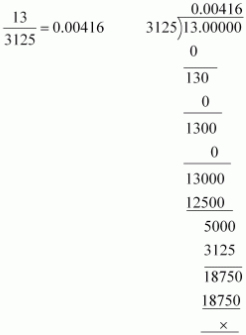
Write down the decimal expansion of the rational number $\frac{13}{3125}$.
Solution
(0.00416) To find the decimal expansion of $\frac{13}{3125}$,we can perform long division or express the denominator as a power of $10$.
Step $1$: Prime factorization of the denominator $3125 = 5^5$.
Step $2$: To make the denominator a power of $10$,multiply the numerator and denominator by $2^5 = 32$.
$\frac{13}{3125} = \frac{13 \times 2^5}{5^5 \times 2^5} = \frac{13 \times 32}{(5 \times 2)^5} = \frac{416}{10^5} = \frac{416}{100000} = 0.00416$.
Step $1$: Prime factorization of the denominator $3125 = 5^5$.
Step $2$: To make the denominator a power of $10$,multiply the numerator and denominator by $2^5 = 32$.
$\frac{13}{3125} = \frac{13 \times 2^5}{5^5 \times 2^5} = \frac{13 \times 32}{(5 \times 2)^5} = \frac{416}{10^5} = \frac{416}{100000} = 0.00416$.
0 likes
View Solution50
Medium
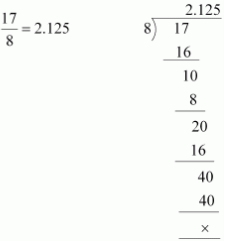
Write down the decimal expansion of the rational number $\frac{17}{8}$.
Solution
(N/A) To find the decimal expansion of $\frac{17}{8}$,we perform long division:
$1$. Divide $17$ by $8$.
$2$. $8 \times 2 = 16$,so $17 - 16 = 1$.
$3$. Place a decimal point in the quotient and add a $0$ to the remainder,making it $10$.
$4$. $8 \times 1 = 8$,so $10 - 8 = 2$.
$5$. Add another $0$ to the remainder,making it $20$.
$6$. $8 \times 2 = 16$,so $20 - 16 = 4$.
$7$. Add another $0$ to the remainder,making it $40$.
$8$. $8 \times 5 = 40$,so $40 - 40 = 0$.
Thus,$\frac{17}{8} = 2.125$.
$1$. Divide $17$ by $8$.
$2$. $8 \times 2 = 16$,so $17 - 16 = 1$.
$3$. Place a decimal point in the quotient and add a $0$ to the remainder,making it $10$.
$4$. $8 \times 1 = 8$,so $10 - 8 = 2$.
$5$. Add another $0$ to the remainder,making it $20$.
$6$. $8 \times 2 = 16$,so $20 - 16 = 4$.
$7$. Add another $0$ to the remainder,making it $40$.
$8$. $8 \times 5 = 40$,so $40 - 40 = 0$.
Thus,$\frac{17}{8} = 2.125$.
0 likes
View SolutionReal Numbers — Textbook - Real Numbers · Frequently Asked Questions
1Are these Real Numbers questions useful for JEE and NEET?
Yes. All questions in this section are mapped to JEE Main and NEET exam patterns. Previous year questions from JEE Main, NEET, GUJCET and state-level exams are included with full solutions.
2Can I switch to Hindi or Gujarati for these questions?
Yes. Use the language tabs in the hero section or the sidebar to view the same questions and solutions in English, Hindi or Gujarati.
3How do I generate a question paper from this subtopic?
Use the Vedclass Exam Paper Generator — select the chapter and subtopic, set difficulty, and generate Sets A, B, C, D automatically. First 3 chapters of every subject are free.
Vedclass Products
For Students
Vedclass Test Series
Mock tests in real JEE/NEET style with performance analysis. 5-day free trial.
Start Free TrialFor Teachers
Exam Paper Generator
Generate Set A/B/C/D papers from this chapter in 2 minutes. 3 chapters free.
Try FreeFor Institutes
Online Exam Module
Live online exams with unlimited students, 360° analytics & white-label branding.
See DemoFor Teachers & Institutes
Generate a Real Numbers Exam Paper in 2 Minutes
Select subtopic & difficulty — Sets A, B, C, D auto-generated with No Repeat logic.
First 3 chapters of every subject are free — no payment required.