
A English
Textbook - Real Numbers Questions in English
Class 10 Mathematics · Real Numbers · Textbook - Real Numbers
61+
Questions
English
Language
100%
With Solutions
Showing 11 of 61 questions in English
51
DifficultMCQ
Determine whether the rational number $\frac{64}{455}$ has a terminating or non-terminating repeating decimal expansion. If it is terminating,write down its decimal expansion.
A
Terminating,$0.140659...$
B
Non-terminating repeating
C
Terminating,$0.1406$
D
Terminating,$0.14$
Solution
(B) To determine if a rational number $\frac{p}{q}$ has a terminating decimal expansion,we check the prime factorization of the denominator $q$.
If $q = 2^n \times 5^m$,where $n$ and $m$ are non-negative integers,the decimal expansion is terminating.
Here,$q = 455$.
Prime factorization of $455 = 5 \times 7 \times 13$.
Since the prime factorization contains factors other than $2$ and $5$ (specifically $7$ and $13$),the decimal expansion of $\frac{64}{455}$ is non-terminating repeating.
If $q = 2^n \times 5^m$,where $n$ and $m$ are non-negative integers,the decimal expansion is terminating.
Here,$q = 455$.
Prime factorization of $455 = 5 \times 7 \times 13$.
Since the prime factorization contains factors other than $2$ and $5$ (specifically $7$ and $13$),the decimal expansion of $\frac{64}{455}$ is non-terminating repeating.
0 likes
View Solution52
Medium
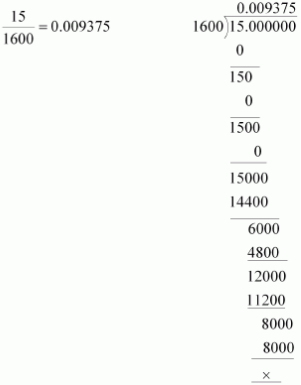
Write down the decimal expansion of the rational number $\frac{15}{1600}$.
Solution
(N/A) To find the decimal expansion of $\frac{15}{1600}$,we perform long division:
$1$. Divide $15$ by $1600$.
$2$. Since $15 < 1600$,we place a decimal point and add zeros to $15$ to make it $15.000000$.
$3$. $1600$ goes into $15000$ nine times $(1600 \times 9 = 14400)$,leaving a remainder of $600$.
$4$. Bring down $0$ to make it $6000$. $1600$ goes into $6000$ three times $(1600 \times 3 = 4800)$,leaving a remainder of $1200$.
$5$. Bring down $0$ to make it $12000$. $1600$ goes into $12000$ seven times $(1600 \times 7 = 11200)$,leaving a remainder of $800$.
$6$. Bring down $0$ to make it $8000$. $1600$ goes into $8000$ five times $(1600 \times 5 = 8000)$,leaving a remainder of $0$.
Thus,the decimal expansion of $\frac{15}{1600}$ is $0.009375$.
$1$. Divide $15$ by $1600$.
$2$. Since $15 < 1600$,we place a decimal point and add zeros to $15$ to make it $15.000000$.
$3$. $1600$ goes into $15000$ nine times $(1600 \times 9 = 14400)$,leaving a remainder of $600$.
$4$. Bring down $0$ to make it $6000$. $1600$ goes into $6000$ three times $(1600 \times 3 = 4800)$,leaving a remainder of $1200$.
$5$. Bring down $0$ to make it $12000$. $1600$ goes into $12000$ seven times $(1600 \times 7 = 11200)$,leaving a remainder of $800$.
$6$. Bring down $0$ to make it $8000$. $1600$ goes into $8000$ five times $(1600 \times 5 = 8000)$,leaving a remainder of $0$.
Thus,the decimal expansion of $\frac{15}{1600}$ is $0.009375$.
0 likes
View Solution53
MediumMCQ
Write down the decimal expansion of the rational number $\frac{29}{343}$.
A
$0.0845$
B
$0.084548$
C
$0.0845481$
D
Non-terminating repeating
Solution
(D) To determine if the rational number $\frac{29}{343}$ has a terminating decimal expansion,we examine the prime factorization of the denominator.
$1$. The denominator is $343 = 7^3$.
$2$. $A$ rational number $\frac{p}{q}$ has a terminating decimal expansion if and only if the prime factorization of $q$ is of the form $2^n \times 5^m$,where $n$ and $m$ are non-negative integers.
$3$. Since the prime factorization of $343$ is $7^3$,which does not contain factors of $2$ or $5$,the decimal expansion is non-terminating and repeating.
$4$. Therefore,$\frac{29}{343}$ does not have a terminating decimal expansion.
$1$. The denominator is $343 = 7^3$.
$2$. $A$ rational number $\frac{p}{q}$ has a terminating decimal expansion if and only if the prime factorization of $q$ is of the form $2^n \times 5^m$,where $n$ and $m$ are non-negative integers.
$3$. Since the prime factorization of $343$ is $7^3$,which does not contain factors of $2$ or $5$,the decimal expansion is non-terminating and repeating.
$4$. Therefore,$\frac{29}{343}$ does not have a terminating decimal expansion.
0 likes
View Solution54
Medium
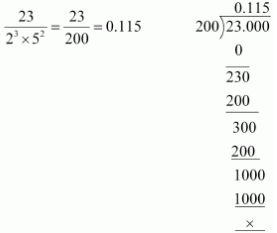
Write down the decimal expansion of the rational number $\frac{23}{2^{3} 5^{2}}$.
Solution
(N/A) To find the decimal expansion of the rational number $\frac{23}{2^{3} 5^{2}}$,we first simplify the denominator:
$\frac{23}{2^{3} \times 5^{2}} = \frac{23}{8 \times 25} = \frac{23}{200}$
Now,we perform the division of $23$ by $200$:
$23 \div 200 = 0.115$
Alternatively,we can make the powers of $2$ and $5$ equal:
$\frac{23}{2^{3} \times 5^{2}} = \frac{23 \times 5}{2^{3} \times 5^{2} \times 5} = \frac{115}{2^{3} \times 5^{3}} = \frac{115}{(2 \times 5)^{3}} = \frac{115}{10^{3}} = \frac{115}{1000} = 0.115$
$\frac{23}{2^{3} \times 5^{2}} = \frac{23}{8 \times 25} = \frac{23}{200}$
Now,we perform the division of $23$ by $200$:
$23 \div 200 = 0.115$
Alternatively,we can make the powers of $2$ and $5$ equal:
$\frac{23}{2^{3} \times 5^{2}} = \frac{23 \times 5}{2^{3} \times 5^{2} \times 5} = \frac{115}{2^{3} \times 5^{3}} = \frac{115}{(2 \times 5)^{3}} = \frac{115}{10^{3}} = \frac{115}{1000} = 0.115$
0 likes
View Solution55
MediumMCQ
Write down the decimal expansion of the rational number $\frac{129}{2^{2} 5^{7} 7^{5}}$.
A
$0.0000008256$
B
$0.000008256$
C
Non-terminating
D
$0.00008256$
Solution
(C) rational number $\frac{p}{q}$ has a terminating decimal expansion if the prime factorization of the denominator $q$ is of the form $2^n 5^m$,where $n$ and $m$ are non-negative integers.
In the given rational number $\frac{129}{2^{2} 5^{7} 7^{5}}$,the denominator contains a factor of $7^5$ in addition to $2$ and $5$.
Since the prime factorization of the denominator includes a prime factor other than $2$ or $5$ (which is $7$),the decimal expansion of this rational number is non-terminating and repeating.
Therefore,it does not have a terminating decimal expansion.
In the given rational number $\frac{129}{2^{2} 5^{7} 7^{5}}$,the denominator contains a factor of $7^5$ in addition to $2$ and $5$.
Since the prime factorization of the denominator includes a prime factor other than $2$ or $5$ (which is $7$),the decimal expansion of this rational number is non-terminating and repeating.
Therefore,it does not have a terminating decimal expansion.
0 likes
View Solution56
Easy
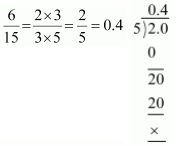
Write down the decimal expansion of the rational number $\frac{6}{15}$.
Solution
(N/A) To find the decimal expansion of the rational number $\frac{6}{15}$,we first simplify the fraction by dividing both the numerator and the denominator by their greatest common divisor,which is $3$.
$\frac{6}{15} = \frac{2 \times 3}{5 \times 3} = \frac{2}{5}$.
Now,we convert $\frac{2}{5}$ into a decimal by dividing $2$ by $5$:
$2 \div 5 = 0.4$.
Thus,the decimal expansion of $\frac{6}{15}$ is $0.4$.
$\frac{6}{15} = \frac{2 \times 3}{5 \times 3} = \frac{2}{5}$.
Now,we convert $\frac{2}{5}$ into a decimal by dividing $2$ by $5$:
$2 \div 5 = 0.4$.
Thus,the decimal expansion of $\frac{6}{15}$ is $0.4$.
0 likes
View Solution57
Easy
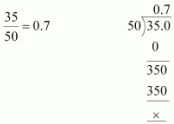
Write down the decimal expansion of the rational number $\frac{35}{50}$.
Solution
(N/A) To find the decimal expansion of the rational number $\frac{35}{50}$,we can perform long division or simplify the fraction first.
Method $1$: Long Division
Divide $35$ by $50$:
$35 \div 50 = 0.7$
Method $2$: Converting to a denominator of power of $10$
$\frac{35}{50} = \frac{35 \times 2}{50 \times 2} = \frac{70}{100} = 0.7$
Thus,the decimal expansion of $\frac{35}{50}$ is $0.7$.
Method $1$: Long Division
Divide $35$ by $50$:
$35 \div 50 = 0.7$
Method $2$: Converting to a denominator of power of $10$
$\frac{35}{50} = \frac{35 \times 2}{50 \times 2} = \frac{70}{100} = 0.7$
Thus,the decimal expansion of $\frac{35}{50}$ is $0.7$.
0 likes
View Solution58
MediumMCQ
Determine whether the rational number $\frac{77}{210}$ has a terminating or non-terminating repeating decimal expansion. If it is terminating,write down its decimal expansion.
A
Terminating,$0.3666...$
B
Non-terminating repeating,$0.3666...$
C
Terminating,$0.36$
D
Non-terminating,$0.366$
Solution
(B) First,simplify the fraction $\frac{77}{210}$ by dividing both numerator and denominator by their greatest common divisor,which is $7$.
$\frac{77 \div 7}{210 \div 7} = \frac{11}{30}$.
Next,find the prime factorization of the denominator $30$:
$30 = 2 \times 3 \times 5$.
$A$ rational number has a terminating decimal expansion if and only if the prime factorization of its denominator (in simplest form) is of the form $2^n \times 5^m$,where $n$ and $m$ are non-negative integers.
Since the denominator $30$ contains a factor of $3$ (which is not $2$ or $5$),the decimal expansion of $\frac{11}{30}$ is non-terminating and repeating.
Performing the division $11 \div 30$ gives $0.3666...$ or $0.3\overline{6}$.
$\frac{77 \div 7}{210 \div 7} = \frac{11}{30}$.
Next,find the prime factorization of the denominator $30$:
$30 = 2 \times 3 \times 5$.
$A$ rational number has a terminating decimal expansion if and only if the prime factorization of its denominator (in simplest form) is of the form $2^n \times 5^m$,where $n$ and $m$ are non-negative integers.
Since the denominator $30$ contains a factor of $3$ (which is not $2$ or $5$),the decimal expansion of $\frac{11}{30}$ is non-terminating and repeating.
Performing the division $11 \div 30$ gives $0.3666...$ or $0.3\overline{6}$.
0 likes
View Solution59
Easy
The following real number has a decimal expansion as given below. Decide whether it is rational or not. If it is rational,and of the form $\frac{p}{q},$ what can you say about the prime factors of $q$?
$43.123456789$
$43.123456789$
Solution
(A) The given number is $43.123456789$.
Since this number has a terminating decimal expansion,it is a rational number.
It can be expressed in the form $\frac{p}{q}$,where $p$ and $q$ are integers and $q \neq 0$.
For a rational number to have a terminating decimal expansion,the prime factorization of the denominator $q$ must be of the form $2^{m} \times 5^{n}$,where $m$ and $n$ are non-negative integers.
Therefore,the prime factors of $q$ are only $2$ or $5$ or both.
Since this number has a terminating decimal expansion,it is a rational number.
It can be expressed in the form $\frac{p}{q}$,where $p$ and $q$ are integers and $q \neq 0$.
For a rational number to have a terminating decimal expansion,the prime factorization of the denominator $q$ must be of the form $2^{m} \times 5^{n}$,where $m$ and $n$ are non-negative integers.
Therefore,the prime factors of $q$ are only $2$ or $5$ or both.
0 likes
View Solution60
Medium
The following real number has a decimal expansion as given below. Decide whether it is rational or not. If it is rational and of the form $\frac{p}{q}$,what can you say about the prime factors of $q$?
$0.120120012000120000 \ldots$
$0.120120012000120000 \ldots$
Solution
(N/A) The given decimal expansion is $0.120120012000120000 \ldots$
$1$. $A$ number is rational if its decimal expansion is either terminating or non-terminating recurring.
$2$. $A$ number is irrational if its decimal expansion is non-terminating and non-recurring.
$3$. In the given number $0.120120012000120000 \ldots$,the pattern of digits does not repeat in a fixed block,and it does not terminate.
$4$. Since the decimal expansion is non-terminating and non-recurring,the given number is an irrational number.
$5$. Because it is irrational,it cannot be expressed in the form $\frac{p}{q}$ where $p$ and $q$ are integers and $q \neq 0$.
$1$. $A$ number is rational if its decimal expansion is either terminating or non-terminating recurring.
$2$. $A$ number is irrational if its decimal expansion is non-terminating and non-recurring.
$3$. In the given number $0.120120012000120000 \ldots$,the pattern of digits does not repeat in a fixed block,and it does not terminate.
$4$. Since the decimal expansion is non-terminating and non-recurring,the given number is an irrational number.
$5$. Because it is irrational,it cannot be expressed in the form $\frac{p}{q}$ where $p$ and $q$ are integers and $q \neq 0$.
0 likes
View Solution61
Medium
The following real number has a decimal expansion as given below. Decide whether it is rational or not. If it is rational,and of the form $\frac{p}{q}$,what can you say about the prime factors of $q$?
$43. \overline{123456789}$
$43. \overline{123456789}$
Solution
(N/A) The given number is $43. \overline{123456789}$.
Since the decimal expansion is non-terminating and repeating (recurring),the given number is a rational number.
$A$ rational number has a terminating decimal expansion if and only if the prime factorization of its denominator $q$ is of the form $2^m \times 5^n$,where $m$ and $n$ are non-negative integers.
Since this decimal expansion is non-terminating repeating,the denominator $q$ must have prime factors other than $2$ or $5$.
Since the decimal expansion is non-terminating and repeating (recurring),the given number is a rational number.
$A$ rational number has a terminating decimal expansion if and only if the prime factorization of its denominator $q$ is of the form $2^m \times 5^n$,where $m$ and $n$ are non-negative integers.
Since this decimal expansion is non-terminating repeating,the denominator $q$ must have prime factors other than $2$ or $5$.
0 likes
View SolutionReal Numbers — Textbook - Real Numbers · Frequently Asked Questions
1Are these Real Numbers questions useful for JEE and NEET?
Yes. All questions in this section are mapped to JEE Main and NEET exam patterns. Previous year questions from JEE Main, NEET, GUJCET and state-level exams are included with full solutions.
2Can I switch to Hindi or Gujarati for these questions?
Yes. Use the language tabs in the hero section or the sidebar to view the same questions and solutions in English, Hindi or Gujarati.
3How do I generate a question paper from this subtopic?
Use the Vedclass Exam Paper Generator — select the chapter and subtopic, set difficulty, and generate Sets A, B, C, D automatically. First 3 chapters of every subject are free.
Vedclass Products
For Students
Vedclass Test Series
Mock tests in real JEE/NEET style with performance analysis. 5-day free trial.
Start Free TrialFor Teachers
Exam Paper Generator
Generate Set A/B/C/D papers from this chapter in 2 minutes. 3 chapters free.
Try FreeFor Institutes
Online Exam Module
Live online exams with unlimited students, 360° analytics & white-label branding.
See DemoFor Teachers & Institutes
Generate a Real Numbers Exam Paper in 2 Minutes
Select subtopic & difficulty — Sets A, B, C, D auto-generated with No Repeat logic.
First 3 chapters of every subject are free — no payment required.