
A English
Textbook - Pair of Linear Equations in Two Variables Questions in English
Class 10 Mathematics · Pair of Linear Equations in Two Variables · Textbook - Pair of Linear Equations in Two Variables
98+
Questions
English
Language
100%
With Solutions
Showing 50 of 98 questions in English
1
Medium
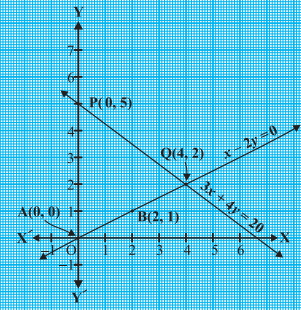
Let us take the example: Akhila goes to a fair with ₹ $20$ and wants to have rides on the Giant Wheel and play Hoopla. Represent this situation algebraically and graphically (geometrically).
Solution
(N/A) The pair of equations formed is:
$y = \frac{1}{2}x$
i.e.,$x - 2y = 0$ ......$(1)$
$3x + 4y = 20$ ......$(2)$
Let us represent these equations graphically. For this,we need at least two solutions for each equation. We give these solutions in the tables below:
Recall from Class $IX$ that there are infinitely many solutions for each linear equation. So,each of you can choose any two values,which may not be the ones we have chosen. When one of the variables is zero,the equation reduces to a linear equation in one variable,which can be solved easily. For instance,putting $x = 0$ in Equation $(2)$,we get $4y = 20$,i.e.,$y = 5$. Similarly,putting $y = 0$ in Equation $(2)$,we get $3x = 20$,i.e.,$x = \frac{20}{3}$. But as $\frac{20}{3}$ is not an integer,it will not be easy to plot exactly on the graph paper. So,we choose $y = 2$,which gives $x = 4$,an integral value.
Plot the points $A(0, 0), B(2, 1)$ and $P(0, 5), Q(4, 2)$ corresponding to the solutions in the tables. Now draw the lines $AB$ and $PQ$,representing the equations $x - 2y = 0$ and $3x + 4y = 20$.
$y = \frac{1}{2}x$
i.e.,$x - 2y = 0$ ......$(1)$
$3x + 4y = 20$ ......$(2)$
Let us represent these equations graphically. For this,we need at least two solutions for each equation. We give these solutions in the tables below:
| $x$ | $0$ | $2$ |
| $y = \frac{x}{2}$ | $0$ | $1$ |
| $x$ | $0$ | $\frac{20}{3}$ | $4$ |
| $y = \frac{20 - 3x}{4}$ | $5$ | $0$ | $2$ |
Recall from Class $IX$ that there are infinitely many solutions for each linear equation. So,each of you can choose any two values,which may not be the ones we have chosen. When one of the variables is zero,the equation reduces to a linear equation in one variable,which can be solved easily. For instance,putting $x = 0$ in Equation $(2)$,we get $4y = 20$,i.e.,$y = 5$. Similarly,putting $y = 0$ in Equation $(2)$,we get $3x = 20$,i.e.,$x = \frac{20}{3}$. But as $\frac{20}{3}$ is not an integer,it will not be easy to plot exactly on the graph paper. So,we choose $y = 2$,which gives $x = 4$,an integral value.
Plot the points $A(0, 0), B(2, 1)$ and $P(0, 5), Q(4, 2)$ corresponding to the solutions in the tables. Now draw the lines $AB$ and $PQ$,representing the equations $x - 2y = 0$ and $3x + 4y = 20$.
0 likes
View Solution2
Medium
Romila went to a stationery shop and purchased $2$ pencils and $3$ erasers for ₹ $9$. Her friend Sonali saw the new variety of pencils and erasers with Romila,and she also bought $4$ pencils and $6$ erasers of the same kind for ₹ $18$. Represent this situation algebraically and graphically.
Solution
(N/A) Let the cost of $1$ pencil be ₹ $x$ and the cost of $1$ eraser be ₹ $y$. The algebraic representation is given by the following equations:
$2x + 3y = 9$ $.......(1)$
$4x + 6y = 18$ $.......(2)$
To represent these graphically,we find points for each line:
For equation $(1)$,$y = \frac{9 - 2x}{3}$:
For equation $(2)$,$y = \frac{18 - 4x}{6}$:
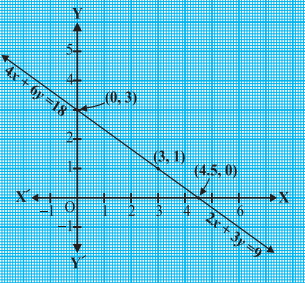
When we plot these points on a graph,we observe that both lines coincide. This is because the two equations are equivalent,as equation $(2)$ is simply $2$ times equation $(1)$.
$2x + 3y = 9$ $.......(1)$
$4x + 6y = 18$ $.......(2)$
To represent these graphically,we find points for each line:
For equation $(1)$,$y = \frac{9 - 2x}{3}$:
| $x$ | $0$ | $4.5$ |
| $y$ | $3$ | $0$ |
For equation $(2)$,$y = \frac{18 - 4x}{6}$:
| $x$ | $0$ | $3$ |
| $y$ | $3$ | $1$ |
When we plot these points on a graph,we observe that both lines coincide. This is because the two equations are equivalent,as equation $(2)$ is simply $2$ times equation $(1)$.
0 likes
View Solution3
Medium
Two rails are represented by the equations $x+2y-4=0$ and $2x+4y-12=0$. Represent this situation geometrically.
Solution
(N/A) To represent the equations geometrically,we find two solutions for each equation.
For the equation $x+2y-4=0$:
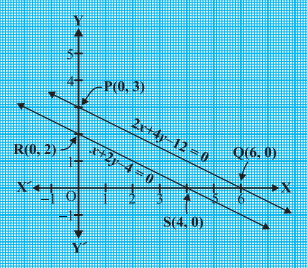
We plot the points $R(0, 2)$ and $S(4, 0)$ to get the line representing $x+2y-4=0$.
For the equation $2x+4y-12=0$:
We plot the points $P(0, 3)$ and $Q(6, 0)$ to get the line representing $2x+4y-12=0$.
Observing the graph,we see that the two lines do not intersect anywhere,which means they are parallel to each other.
For the equation $x+2y-4=0$:
| $x$ | $0$ | $4$ |
| $y = \frac{4-x}{2}$ | $2$ | $0$ |
We plot the points $R(0, 2)$ and $S(4, 0)$ to get the line representing $x+2y-4=0$.
For the equation $2x+4y-12=0$:
| $x$ | $0$ | $6$ |
| $y = \frac{12-2x}{4}$ | $3$ | $0$ |
We plot the points $P(0, 3)$ and $Q(6, 0)$ to get the line representing $2x+4y-12=0$.
Observing the graph,we see that the two lines do not intersect anywhere,which means they are parallel to each other.
0 likes
View Solution4
Difficult
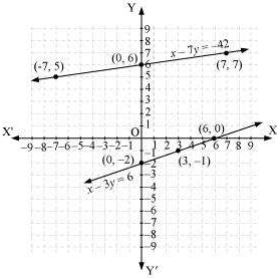
Aftab tells his daughter,"Seven years ago,$I$ was seven times as old as you were then. Also,three years from now,$I$ shall be three times as old as you will be." Represent this situation algebraically and graphically.
Solution
(N/A) Let the present age of Aftab be $x$ and the present age of his daughter be $y$.
Seven years ago:
Age of Aftab $= x - 7$
Age of his daughter $= y - 7$
According to the problem,$(x - 7) = 7(y - 7) \implies x - 7 = 7y - 49 \implies x - 7y = -42$ $...(1)$
Three years from now:
Age of Aftab $= x + 3$
Age of his daughter $= y + 3$
According to the problem,$(x + 3) = 3(y + 3) \implies x + 3 = 3y + 9 \implies x - 3y = 6$ $...(2)$
Algebraic representation:
$x - 7y = -42$
$x - 3y = 6$
For $x - 7y = -42$,we have $x = 7y - 42$:
For $x - 3y = 6$,we have $x = 3y + 6$:
Seven years ago:
Age of Aftab $= x - 7$
Age of his daughter $= y - 7$
According to the problem,$(x - 7) = 7(y - 7) \implies x - 7 = 7y - 49 \implies x - 7y = -42$ $...(1)$
Three years from now:
Age of Aftab $= x + 3$
Age of his daughter $= y + 3$
According to the problem,$(x + 3) = 3(y + 3) \implies x + 3 = 3y + 9 \implies x - 3y = 6$ $...(2)$
Algebraic representation:
$x - 7y = -42$
$x - 3y = 6$
For $x - 7y = -42$,we have $x = 7y - 42$:
| $x$ | $-7$ | $0$ | $7$ |
| $y$ | $5$ | $6$ | $7$ |
For $x - 3y = 6$,we have $x = 3y + 6$:
| $x$ | $6$ | $3$ | $0$ |
| $y$ | $0$ | $-1$ | $-2$ |
0 likes
View Solution5
Difficult
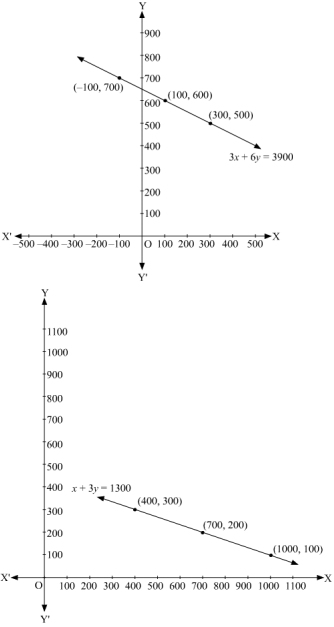
The coach of a cricket team buys $3$ bats and $6$ balls for ₹ $3900$. Later,she buys another bat and $3$ more balls of the same kind for ₹ $1300$. Represent this situation algebraically and geometrically.
Solution
(N/A) Let the cost of a bat be ₹ $x$ and the cost of a ball be ₹ $y$.
According to the problem,the algebraic representation is:
$3x + 6y = 3900$
$x + 3y = 1300$
For the first equation,$3x + 6y = 3900$,we can simplify it to $x + 2y = 1300$,so $x = 1300 - 2y$.
| $x$ | $300$ | $100$ | $-100$ |
| $y$ | $500$ | $600$ | $700$ |
For the second equation,$x + 3y = 1300$,we have $x = 1300 - 3y$.
| $x$ | $400$ | $700$ | $1000$ |
| $y$ | $300$ | $200$ | $100$ |
The geometric representation is shown in the provided graph.
According to the problem,the algebraic representation is:
$3x + 6y = 3900$
$x + 3y = 1300$
For the first equation,$3x + 6y = 3900$,we can simplify it to $x + 2y = 1300$,so $x = 1300 - 2y$.
| $x$ | $300$ | $100$ | $-100$ |
| $y$ | $500$ | $600$ | $700$ |
For the second equation,$x + 3y = 1300$,we have $x = 1300 - 3y$.
| $x$ | $400$ | $700$ | $1000$ |
| $y$ | $300$ | $200$ | $100$ |
The geometric representation is shown in the provided graph.
0 likes
View Solution6
Medium
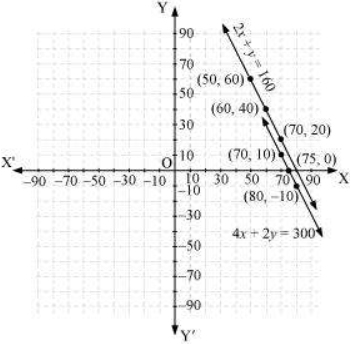
The cost of $2\, kg$ of apples and $1\, kg$ of grapes on a day was found to be ₹ $160$. After a month,the cost of $4\, kg$ of apples and $2\, kg$ of grapes is ₹ $300$. Represent the situation algebraically and geometrically.
Solution
(N/A) Let the cost of $1\, kg$ of apples be ₹ $x$ and the cost of $1\, kg$ of grapes be ₹ $y$.
According to the question,the algebraic representation is:
$2x + y = 160$
$4x + 2y = 300$
For the equation $2x + y = 160$,we have $y = 160 - 2x$. The solution table is:
For the equation $4x + 2y = 300$,we have $y = \frac{300 - 4x}{2} = 150 - 2x$. The solution table is:
The graphical representation shows two parallel lines,indicating that the system has no solution.
According to the question,the algebraic representation is:
$2x + y = 160$
$4x + 2y = 300$
For the equation $2x + y = 160$,we have $y = 160 - 2x$. The solution table is:
| $x$ | $50$ | $60$ | $70$ |
| $y$ | $60$ | $40$ | $20$ |
For the equation $4x + 2y = 300$,we have $y = \frac{300 - 4x}{2} = 150 - 2x$. The solution table is:
| $x$ | $70$ | $80$ | $75$ |
| $y$ | $10$ | $-10$ | $0$ |
The graphical representation shows two parallel lines,indicating that the system has no solution.
0 likes
View Solution7
Difficult
Check graphically whether the pair of equations
$x+3y=6$ $...(1)$
and $2x-3y=12$ $...(2)$
is consistent. If so,solve them graphically.
$x+3y=6$ $...(1)$
and $2x-3y=12$ $...(2)$
is consistent. If so,solve them graphically.
Solution
(N/A) Let us draw the graphs of the Equations $(1)$ and $(2).$ For this,we find two solutions for each of the equations,which are given in the tables below:
For Equation $(1): x+3y=6$
For Equation $(2): 2x-3y=12$
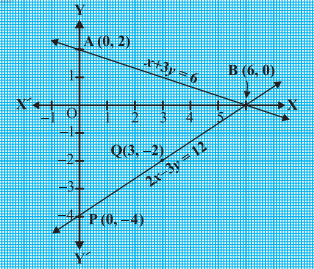
Plot the points $A(0, 2), B(6, 0)$ for line $(1)$ and $P(0, -4), Q(3, -2)$ for line $(2)$ on graph paper. Join the points to form the lines $AB$ and $PQ$.
We observe that there is a point $B(6, 0)$ common to both the lines $AB$ and $PQ.$ Since the lines intersect at a point,the pair of linear equations is consistent. The solution is $x=6$ and $y=0.$
For Equation $(1): x+3y=6$
| $x$ | $0$ | $6$ |
| $y = \frac{6-x}{3}$ | $2$ | $0$ |
For Equation $(2): 2x-3y=12$
| $x$ | $0$ | $3$ |
| $y = \frac{2x-12}{3}$ | $-4$ | $-2$ |
Plot the points $A(0, 2), B(6, 0)$ for line $(1)$ and $P(0, -4), Q(3, -2)$ for line $(2)$ on graph paper. Join the points to form the lines $AB$ and $PQ$.
We observe that there is a point $B(6, 0)$ common to both the lines $AB$ and $PQ.$ Since the lines intersect at a point,the pair of linear equations is consistent. The solution is $x=6$ and $y=0.$
0 likes
View Solution8
Medium
Graphically,find whether the following pair of equations has no solution,unique solution or infinitely many solutions.
$5x - 8y + 1 = 0$ $...(1)$
$3x - \frac{24}{5}y + \frac{3}{5} = 6$ $...(2)$
$5x - 8y + 1 = 0$ $...(1)$
$3x - \frac{24}{5}y + \frac{3}{5} = 6$ $...(2)$
Solution
(A) Given equations are:
$5x - 8y + 1 = 0$ $...(1)$
$3x - \frac{24}{5}y + \frac{3}{5} = 6$ $...(2)$
Multiply Equation $(2)$ by $\frac{5}{3}$:
$\frac{5}{3} \times (3x - \frac{24}{5}y + \frac{3}{5}) = \frac{5}{3} \times 6$
$5x - 8y + 1 = 10$
Wait,let us re-examine Equation $(2)$ as given: $3x - \frac{24}{5}y + \frac{3}{5} = 6$.
Multiplying by $\frac{5}{3}$ gives $5x - 8y + 1 = 10$,which simplifies to $5x - 8y - 9 = 0$.
Comparing $5x - 8y + 1 = 0$ and $5x - 8y - 9 = 0$,the coefficients of $x$ and $y$ are the same,but the constants are different.
Therefore,the lines are parallel and have no solution.
$5x - 8y + 1 = 0$ $...(1)$
$3x - \frac{24}{5}y + \frac{3}{5} = 6$ $...(2)$
Multiply Equation $(2)$ by $\frac{5}{3}$:
$\frac{5}{3} \times (3x - \frac{24}{5}y + \frac{3}{5}) = \frac{5}{3} \times 6$
$5x - 8y + 1 = 10$
Wait,let us re-examine Equation $(2)$ as given: $3x - \frac{24}{5}y + \frac{3}{5} = 6$.
Multiplying by $\frac{5}{3}$ gives $5x - 8y + 1 = 10$,which simplifies to $5x - 8y - 9 = 0$.
Comparing $5x - 8y + 1 = 0$ and $5x - 8y - 9 = 0$,the coefficients of $x$ and $y$ are the same,but the constants are different.
Therefore,the lines are parallel and have no solution.
0 likes
View Solution9
DifficultMCQ
Champa went to a 'Sale' to purchase some pants and skirts. When her friends asked her how many of each she had bought,she answered,"The number of skirts is two less than twice the number of pants purchased. Also,the number of skirts is four less than four times the number of pants purchased". Help her friends to find how many pants and skirts Champa bought.
A
$1$ pant,$0$ skirts
B
$2$ pants,$2$ skirts
C
$0$ pants,$1$ skirt
D
$1$ pant,$2$ skirts
Solution
(A) Let us denote the number of pants by $x$ and the number of skirts by $y$.
According to the problem,the equations formed are:
$y = 2x - 2$ $...(1)$
$y = 4x - 4$ $...(2)$
To solve this pair of linear equations graphically,we find two solutions for each equation:
For equation $(1)$,$y = 2x - 2$:
For equation $(2)$,$y = 4x - 4$:
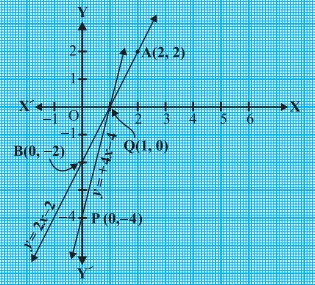
Plotting these points on a graph and drawing the lines,we find that the two lines intersect at the point $(1, 0)$.
Thus,the solution is $x = 1$ and $y = 0$.
Therefore,Champa purchased $1$ pant and $0$ skirts.
According to the problem,the equations formed are:
$y = 2x - 2$ $...(1)$
$y = 4x - 4$ $...(2)$
To solve this pair of linear equations graphically,we find two solutions for each equation:
For equation $(1)$,$y = 2x - 2$:
| $x$ | $2$ | $0$ |
| $y$ | $2$ | $-2$ |
For equation $(2)$,$y = 4x - 4$:
| $x$ | $0$ | $1$ |
| $y$ | $-4$ | $0$ |
Plotting these points on a graph and drawing the lines,we find that the two lines intersect at the point $(1, 0)$.
Thus,the solution is $x = 1$ and $y = 0$.
Therefore,Champa purchased $1$ pant and $0$ skirts.
0 likes
View Solution10
Difficult
Form the pair of linear equations in the following problems,and find their solutions graphically.
$10$ students of Class $X$ took part in a Mathematics quiz. If the number of girls is $4$ more than the number of boys,find the number of boys and girls who took part in the quiz.
$10$ students of Class $X$ took part in a Mathematics quiz. If the number of girls is $4$ more than the number of boys,find the number of boys and girls who took part in the quiz.
Solution
(N/A) Let the number of girls be $x$ and the number of boys be $y$.
According to the question,the algebraic representation is:
$x + y = 10$
$x - y = 4$
For $x + y = 10$,we have $x = 10 - y$:
For $x - y = 4$,we have $x = 4 + y$:
By plotting these points on a graph,we observe that the lines intersect at the point $(7, 3)$.
Therefore,the number of girls is $7$ and the number of boys is $3$.
According to the question,the algebraic representation is:
$x + y = 10$
$x - y = 4$
For $x + y = 10$,we have $x = 10 - y$:
| $x$ | $5$ | $4$ | $6$ |
| $y$ | $5$ | $6$ | $4$ |
For $x - y = 4$,we have $x = 4 + y$:
| $x$ | $5$ | $4$ | $3$ |
| $y$ | $1$ | $0$ | $-1$ |
By plotting these points on a graph,we observe that the lines intersect at the point $(7, 3)$.
Therefore,the number of girls is $7$ and the number of boys is $3$.
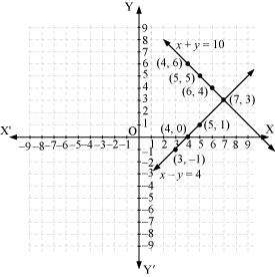
0 likes
View Solution11
Easy
Form the pair of linear equations in the following problems,and find their solutions graphically.
$5$ pencils and $7$ pens together cost ₹ $50$,whereas $7$ pencils and $5$ pens together cost ₹ $46$. Find the cost of one pencil and that of one pen.
$5$ pencils and $7$ pens together cost ₹ $50$,whereas $7$ pencils and $5$ pens together cost ₹ $46$. Find the cost of one pencil and that of one pen.
Solution
(N/A) Let the cost of $1$ pencil be ₹ $x$ and the cost of $1$ pen be ₹ $y$.
According to the question,the algebraic representation is:
$5x + 7y = 50$
$7x + 5y = 46$
For $5x + 7y = 50$,we have $x = \frac{50 - 7y}{5}$.
For $7x + 5y = 46$,we have $x = \frac{46 - 5y}{7}$.
By plotting these points on a graph,we observe that the lines intersect at the point $(3, 5)$.
Therefore,the cost of one pencil is ₹ $3$ and the cost of one pen is ₹ $5$.
According to the question,the algebraic representation is:
$5x + 7y = 50$
$7x + 5y = 46$
For $5x + 7y = 50$,we have $x = \frac{50 - 7y}{5}$.
| $x$ | $3$ | $10$ | $-4$ |
| $y$ | $5$ | $0$ | $10$ |
For $7x + 5y = 46$,we have $x = \frac{46 - 5y}{7}$.
| $x$ | $8$ | $3$ | $-2$ |
| $y$ | $-2$ | $5$ | $12$ |
By plotting these points on a graph,we observe that the lines intersect at the point $(3, 5)$.
Therefore,the cost of one pencil is ₹ $3$ and the cost of one pen is ₹ $5$.
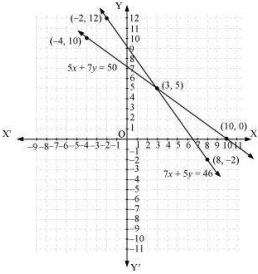
0 likes
View Solution12
EasyMCQ
On comparing the ratios $\frac{a_{1}}{a_{2}}, \frac{b_{1}}{b_{2}}$ and $\frac{c_{1}}{c_{2}},$ find out whether the lines representing the following pairs of linear equations intersect at a point,are parallel,or are coincident:
$5x - 4y + 8 = 0$
$7x + 6y - 9 = 0$
$5x - 4y + 8 = 0$
$7x + 6y - 9 = 0$
A
Intersect at a point
B
Parallel
C
Coincident
D
None of these
Solution
(A) Given equations are:
$5x - 4y + 8 = 0$
$7x + 6y - 9 = 0$
Comparing these equations with the standard form $a_{1}x + b_{1}y + c_{1} = 0$ and $a_{2}x + b_{2}y + c_{2} = 0$,we obtain:
$a_{1} = 5, b_{1} = -4, c_{1} = 8$
$a_{2} = 7, b_{2} = 6, c_{2} = -9$
Now,calculating the ratios:
$\frac{a_{1}}{a_{2}} = \frac{5}{7}$
$\frac{b_{1}}{b_{2}} = \frac{-4}{6} = -\frac{2}{3}$
Since $\frac{a_{1}}{a_{2}} \neq \frac{b_{1}}{b_{2}}$,the lines representing the given pair of linear equations intersect at exactly one point.
$5x - 4y + 8 = 0$
$7x + 6y - 9 = 0$
Comparing these equations with the standard form $a_{1}x + b_{1}y + c_{1} = 0$ and $a_{2}x + b_{2}y + c_{2} = 0$,we obtain:
$a_{1} = 5, b_{1} = -4, c_{1} = 8$
$a_{2} = 7, b_{2} = 6, c_{2} = -9$
Now,calculating the ratios:
$\frac{a_{1}}{a_{2}} = \frac{5}{7}$
$\frac{b_{1}}{b_{2}} = \frac{-4}{6} = -\frac{2}{3}$
Since $\frac{a_{1}}{a_{2}} \neq \frac{b_{1}}{b_{2}}$,the lines representing the given pair of linear equations intersect at exactly one point.
1 likes
View Solution13
EasyMCQ
On comparing the ratios $\frac{a_{1}}{a_{2}}, \frac{b_{1}}{b_{2}}$ and $\frac{c_{1}}{c_{2}},$ find out whether the lines representing the following pairs of linear equations intersect at a point,are parallel,or are coincident:
$9x + 3y + 12 = 0$
$18x + 6y + 24 = 0$
$9x + 3y + 12 = 0$
$18x + 6y + 24 = 0$
A
Intersect at a point
B
Parallel
C
Coincident
D
None of these
Solution
(C) Given equations are:
$9x + 3y + 12 = 0$
$18x + 6y + 24 = 0$
Comparing these equations with the standard form $a_{1}x + b_{1}y + c_{1} = 0$ and $a_{2}x + b_{2}y + c_{2} = 0$,we get:
$a_{1} = 9, b_{1} = 3, c_{1} = 12$
$a_{2} = 18, b_{2} = 6, c_{2} = 24$
Now,calculating the ratios:
$\frac{a_{1}}{a_{2}} = \frac{9}{18} = \frac{1}{2}$
$\frac{b_{1}}{b_{2}} = \frac{3}{6} = \frac{1}{2}$
$\frac{c_{1}}{c_{2}} = \frac{12}{24} = \frac{1}{2}$
Since $\frac{a_{1}}{a_{2}} = \frac{b_{1}}{b_{2}} = \frac{c_{1}}{c_{2}}$,the lines representing the given pair of equations are coincident,and there are infinitely many solutions.
$9x + 3y + 12 = 0$
$18x + 6y + 24 = 0$
Comparing these equations with the standard form $a_{1}x + b_{1}y + c_{1} = 0$ and $a_{2}x + b_{2}y + c_{2} = 0$,we get:
$a_{1} = 9, b_{1} = 3, c_{1} = 12$
$a_{2} = 18, b_{2} = 6, c_{2} = 24$
Now,calculating the ratios:
$\frac{a_{1}}{a_{2}} = \frac{9}{18} = \frac{1}{2}$
$\frac{b_{1}}{b_{2}} = \frac{3}{6} = \frac{1}{2}$
$\frac{c_{1}}{c_{2}} = \frac{12}{24} = \frac{1}{2}$
Since $\frac{a_{1}}{a_{2}} = \frac{b_{1}}{b_{2}} = \frac{c_{1}}{c_{2}}$,the lines representing the given pair of equations are coincident,and there are infinitely many solutions.
0 likes
View Solution14
MediumMCQ
On comparing the ratios $\frac{a_{1}}{a_{2}}, \frac{b_{1}}{b_{2}}$ and $\frac{c_{1}}{c_{2}},$ find out whether the lines representing the following pairs of linear equations intersect at a point,are parallel or coincident:
$6x - 3y + 10 = 0$
$2x - y + 9 = 0$
$6x - 3y + 10 = 0$
$2x - y + 9 = 0$
A
Intersect at a point
B
Parallel
C
Coincident
D
None of these
Solution
(B) Given equations are:
$6x - 3y + 10 = 0$
$2x - y + 9 = 0$
Comparing these equations with the standard form $a_{1}x + b_{1}y + c_{1} = 0$ and $a_{2}x + b_{2}y + c_{2} = 0$,we get:
$a_{1} = 6, b_{1} = -3, c_{1} = 10$
$a_{2} = 2, b_{2} = -1, c_{2} = 9$
Now,calculating the ratios:
$\frac{a_{1}}{a_{2}} = \frac{6}{2} = \frac{3}{1} = 3$
$\frac{b_{1}}{b_{2}} = \frac{-3}{-1} = \frac{3}{1} = 3$
$\frac{c_{1}}{c_{2}} = \frac{10}{9}$
Since $\frac{a_{1}}{a_{2}} = \frac{b_{1}}{b_{2}} \neq \frac{c_{1}}{c_{2}}$,the lines representing the given pair of equations are parallel to each other. Therefore,these lines will never intersect at any point,and there is no solution for the given pair of equations.
$6x - 3y + 10 = 0$
$2x - y + 9 = 0$
Comparing these equations with the standard form $a_{1}x + b_{1}y + c_{1} = 0$ and $a_{2}x + b_{2}y + c_{2} = 0$,we get:
$a_{1} = 6, b_{1} = -3, c_{1} = 10$
$a_{2} = 2, b_{2} = -1, c_{2} = 9$
Now,calculating the ratios:
$\frac{a_{1}}{a_{2}} = \frac{6}{2} = \frac{3}{1} = 3$
$\frac{b_{1}}{b_{2}} = \frac{-3}{-1} = \frac{3}{1} = 3$
$\frac{c_{1}}{c_{2}} = \frac{10}{9}$
Since $\frac{a_{1}}{a_{2}} = \frac{b_{1}}{b_{2}} \neq \frac{c_{1}}{c_{2}}$,the lines representing the given pair of equations are parallel to each other. Therefore,these lines will never intersect at any point,and there is no solution for the given pair of equations.
0 likes
View Solution15
Medium
On comparing the ratios $\frac{a_{1}}{a_{2}}, \frac{b_{1}}{b_{2}}$ and $\frac{c_{1}}{c_{2}},$ find out whether the following pair of linear equations are consistent or inconsistent.
$3x + 2y = 5; \quad 2x - 3y = 7$
$3x + 2y = 5; \quad 2x - 3y = 7$
Solution
(A) Given equations are:
$3x + 2y - 5 = 0$
$2x - 3y - 7 = 0$
Comparing these with the standard form $a_{1}x + b_{1}y + c_{1} = 0$ and $a_{2}x + b_{2}y + c_{2} = 0$,we get:
$a_{1} = 3, b_{1} = 2, c_{1} = -5$
$a_{2} = 2, b_{2} = -3, c_{2} = -7$
Now,calculating the ratios:
$\frac{a_{1}}{a_{2}} = \frac{3}{2}$
$\frac{b_{1}}{b_{2}} = \frac{2}{-3} = -\frac{2}{3}$
Since $\frac{a_{1}}{a_{2}} \neq \frac{b_{1}}{b_{2}}$,the lines intersect at a single point.
Therefore,the pair of linear equations has a unique solution and is consistent.
$3x + 2y - 5 = 0$
$2x - 3y - 7 = 0$
Comparing these with the standard form $a_{1}x + b_{1}y + c_{1} = 0$ and $a_{2}x + b_{2}y + c_{2} = 0$,we get:
$a_{1} = 3, b_{1} = 2, c_{1} = -5$
$a_{2} = 2, b_{2} = -3, c_{2} = -7$
Now,calculating the ratios:
$\frac{a_{1}}{a_{2}} = \frac{3}{2}$
$\frac{b_{1}}{b_{2}} = \frac{2}{-3} = -\frac{2}{3}$
Since $\frac{a_{1}}{a_{2}} \neq \frac{b_{1}}{b_{2}}$,the lines intersect at a single point.
Therefore,the pair of linear equations has a unique solution and is consistent.
0 likes
View Solution16
EasyMCQ
On comparing the ratios $\frac{a_{1}}{a_{2}}, \frac{b_{1}}{b_{2}}$ and $\frac{c_{1}}{c_{2}}$,find out whether the following pair of linear equations are consistent or inconsistent.
$2x - 3y = 8$; $4x - 6y = 9$
$2x - 3y = 8$; $4x - 6y = 9$
A
Consistent
B
Inconsistent
C
Dependent
D
None of these
Solution
(B) Given equations are:
$2x - 3y = 8$ (or $2x - 3y - 8 = 0$)
$4x - 6y = 9$ (or $4x - 6y - 9 = 0$)
Comparing with $a_{1}x + b_{1}y + c_{1} = 0$ and $a_{2}x + b_{2}y + c_{2} = 0$:
$a_{1} = 2, b_{1} = -3, c_{1} = -8$
$a_{2} = 4, b_{2} = -6, c_{2} = -9$
Calculating the ratios:
$\frac{a_{1}}{a_{2}} = \frac{2}{4} = \frac{1}{2}$
$\frac{b_{1}}{b_{2}} = \frac{-3}{-6} = \frac{1}{2}$
$\frac{c_{1}}{c_{2}} = \frac{-8}{-9} = \frac{8}{9}$
Since $\frac{a_{1}}{a_{2}} = \frac{b_{1}}{b_{2}} \neq \frac{c_{1}}{c_{2}}$,the lines represented by these equations are parallel.
Therefore,the pair of linear equations has no solution and is inconsistent.
$2x - 3y = 8$ (or $2x - 3y - 8 = 0$)
$4x - 6y = 9$ (or $4x - 6y - 9 = 0$)
Comparing with $a_{1}x + b_{1}y + c_{1} = 0$ and $a_{2}x + b_{2}y + c_{2} = 0$:
$a_{1} = 2, b_{1} = -3, c_{1} = -8$
$a_{2} = 4, b_{2} = -6, c_{2} = -9$
Calculating the ratios:
$\frac{a_{1}}{a_{2}} = \frac{2}{4} = \frac{1}{2}$
$\frac{b_{1}}{b_{2}} = \frac{-3}{-6} = \frac{1}{2}$
$\frac{c_{1}}{c_{2}} = \frac{-8}{-9} = \frac{8}{9}$
Since $\frac{a_{1}}{a_{2}} = \frac{b_{1}}{b_{2}} \neq \frac{c_{1}}{c_{2}}$,the lines represented by these equations are parallel.
Therefore,the pair of linear equations has no solution and is inconsistent.
0 likes
View Solution17
EasyMCQ
On comparing the ratios $\frac{a_{1}}{a_{2}}, \frac{b_{1}}{b_{2}}$ and $\frac{c_{1}}{c_{2}}$,find out whether the following pair of linear equations are consistent or inconsistent.
$\frac{3}{2} x + \frac{5}{3} y = 7$; $9 x - 10 y = 14$
$\frac{3}{2} x + \frac{5}{3} y = 7$; $9 x - 10 y = 14$
A
Consistent
B
Inconsistent
C
Dependent
D
None of these
Solution
(A) Given equations are:
$1) \frac{3}{2} x + \frac{5}{3} y = 7 \implies \frac{3}{2} x + \frac{5}{3} y - 7 = 0$
$2) 9 x - 10 y = 14 \implies 9 x - 10 y - 14 = 0$
Comparing with $a_{1} x + b_{1} y + c_{1} = 0$ and $a_{2} x + b_{2} y + c_{2} = 0$:
$a_{1} = \frac{3}{2}, b_{1} = \frac{5}{3}, c_{1} = -7$
$a_{2} = 9, b_{2} = -10, c_{2} = -14$
Now,calculating the ratios:
$\frac{a_{1}}{a_{2}} = \frac{3/2}{9} = \frac{3}{18} = \frac{1}{6}$
$\frac{b_{1}}{b_{2}} = \frac{5/3}{-10} = \frac{5}{-30} = -\frac{1}{6}$
Since $\frac{a_{1}}{a_{2}} \neq \frac{b_{1}}{b_{2}}$,the lines intersect at a unique point.
Therefore,the pair of linear equations is consistent.
$1) \frac{3}{2} x + \frac{5}{3} y = 7 \implies \frac{3}{2} x + \frac{5}{3} y - 7 = 0$
$2) 9 x - 10 y = 14 \implies 9 x - 10 y - 14 = 0$
Comparing with $a_{1} x + b_{1} y + c_{1} = 0$ and $a_{2} x + b_{2} y + c_{2} = 0$:
$a_{1} = \frac{3}{2}, b_{1} = \frac{5}{3}, c_{1} = -7$
$a_{2} = 9, b_{2} = -10, c_{2} = -14$
Now,calculating the ratios:
$\frac{a_{1}}{a_{2}} = \frac{3/2}{9} = \frac{3}{18} = \frac{1}{6}$
$\frac{b_{1}}{b_{2}} = \frac{5/3}{-10} = \frac{5}{-30} = -\frac{1}{6}$
Since $\frac{a_{1}}{a_{2}} \neq \frac{b_{1}}{b_{2}}$,the lines intersect at a unique point.
Therefore,the pair of linear equations is consistent.
0 likes
View Solution18
EasyMCQ
On comparing the ratios $\frac{a_{1}}{a_{2}}, \frac{b_{1}}{b_{2}}$ and $\frac{c_{1}}{c_{2}},$ find out whether the following pair of linear equations are consistent or inconsistent.
$5x - 3y = 11$; $-10x + 6y = -22$
$5x - 3y = 11$; $-10x + 6y = -22$
A
Consistent
B
Inconsistent
C
Dependent
D
None of these
Solution
(A) Given equations are:
$5x - 3y = 11$ (Equation $1$)
$-10x + 6y = -22$ (Equation $2$)
Comparing with the standard form $a_{1}x + b_{1}y = c_{1}$ and $a_{2}x + b_{2}y = c_{2}$:
$a_{1} = 5, b_{1} = -3, c_{1} = 11$
$a_{2} = -10, b_{2} = 6, c_{2} = -22$
Calculating the ratios:
$\frac{a_{1}}{a_{2}} = \frac{5}{-10} = -\frac{1}{2}$
$\frac{b_{1}}{b_{2}} = \frac{-3}{6} = -\frac{1}{2}$
$\frac{c_{1}}{c_{2}} = \frac{11}{-22} = -\frac{1}{2}$
Since $\frac{a_{1}}{a_{2}} = \frac{b_{1}}{b_{2}} = \frac{c_{1}}{c_{2}} = -\frac{1}{2}$,the lines are coincident.
Because the lines are coincident,they have infinitely many solutions.
Therefore,the pair of linear equations is consistent.
$5x - 3y = 11$ (Equation $1$)
$-10x + 6y = -22$ (Equation $2$)
Comparing with the standard form $a_{1}x + b_{1}y = c_{1}$ and $a_{2}x + b_{2}y = c_{2}$:
$a_{1} = 5, b_{1} = -3, c_{1} = 11$
$a_{2} = -10, b_{2} = 6, c_{2} = -22$
Calculating the ratios:
$\frac{a_{1}}{a_{2}} = \frac{5}{-10} = -\frac{1}{2}$
$\frac{b_{1}}{b_{2}} = \frac{-3}{6} = -\frac{1}{2}$
$\frac{c_{1}}{c_{2}} = \frac{11}{-22} = -\frac{1}{2}$
Since $\frac{a_{1}}{a_{2}} = \frac{b_{1}}{b_{2}} = \frac{c_{1}}{c_{2}} = -\frac{1}{2}$,the lines are coincident.
Because the lines are coincident,they have infinitely many solutions.
Therefore,the pair of linear equations is consistent.
0 likes
View Solution19
MediumMCQ
On comparing the ratios $\frac{a_{1}}{a_{2}}, \frac{b_{1}}{b_{2}}$ and $\frac{c_{1}}{c_{2}}$,find out whether the following pair of linear equations are consistent or inconsistent:
$\frac{4}{3} x + 2 y = 8$; $2 x + 3 y = 12$
$\frac{4}{3} x + 2 y = 8$; $2 x + 3 y = 12$
A
Consistent
B
Inconsistent
C
Dependent
D
None of these
Solution
(A) Given equations are:
$1) \frac{4}{3} x + 2 y - 8 = 0$
$2) 2 x + 3 y - 12 = 0$
Comparing with the standard form $a_{1}x + b_{1}y + c_{1} = 0$ and $a_{2}x + b_{2}y + c_{2} = 0$:
$a_{1} = \frac{4}{3}, b_{1} = 2, c_{1} = -8$
$a_{2} = 2, b_{2} = 3, c_{2} = -12$
Calculating the ratios:
$\frac{a_{1}}{a_{2}} = \frac{4/3}{2} = \frac{4}{6} = \frac{2}{3}$
$\frac{b_{1}}{b_{2}} = \frac{2}{3}$
$\frac{c_{1}}{c_{2}} = \frac{-8}{-12} = \frac{2}{3}$
Since $\frac{a_{1}}{a_{2}} = \frac{b_{1}}{b_{2}} = \frac{c_{1}}{c_{2}}$,the lines are coincident.
Because the lines are coincident,they have infinitely many solutions.
Therefore,the pair of linear equations is consistent.
$1) \frac{4}{3} x + 2 y - 8 = 0$
$2) 2 x + 3 y - 12 = 0$
Comparing with the standard form $a_{1}x + b_{1}y + c_{1} = 0$ and $a_{2}x + b_{2}y + c_{2} = 0$:
$a_{1} = \frac{4}{3}, b_{1} = 2, c_{1} = -8$
$a_{2} = 2, b_{2} = 3, c_{2} = -12$
Calculating the ratios:
$\frac{a_{1}}{a_{2}} = \frac{4/3}{2} = \frac{4}{6} = \frac{2}{3}$
$\frac{b_{1}}{b_{2}} = \frac{2}{3}$
$\frac{c_{1}}{c_{2}} = \frac{-8}{-12} = \frac{2}{3}$
Since $\frac{a_{1}}{a_{2}} = \frac{b_{1}}{b_{2}} = \frac{c_{1}}{c_{2}}$,the lines are coincident.
Because the lines are coincident,they have infinitely many solutions.
Therefore,the pair of linear equations is consistent.
0 likes
View Solution20
Difficult
Which of the following pairs of linear equations are consistent/inconsistent? If consistent,obtain the solution graphically:
$x+y=5, \quad 2x+2y=10$
$x+y=5, \quad 2x+2y=10$
Solution
(N/A) Given equations:
$x+y=5$
$2x+2y=10$
Comparing with $a_1x + b_1y + c_1 = 0$ and $a_2x + b_2y + c_2 = 0$:
$\frac{a_1}{a_2} = \frac{1}{2}, \quad \frac{b_1}{b_2} = \frac{1}{2}, \quad \frac{c_1}{c_2} = \frac{-5}{-10} = \frac{1}{2}$
Since $\frac{a_1}{a_2} = \frac{b_1}{b_2} = \frac{c_1}{c_2}$,these linear equations represent coincident lines and thus have infinitely many solutions. Hence,the pair of linear equations is consistent.
For $x+y=5$,we have $x = 5-y$:
For $2x+2y=10$,we have $x = \frac{10-2y}{2} = 5-y$:
From the graph,it can be observed that these lines overlap each other. Therefore,infinitely many solutions are possible for the given pair of equations.
$x+y=5$
$2x+2y=10$
Comparing with $a_1x + b_1y + c_1 = 0$ and $a_2x + b_2y + c_2 = 0$:
$\frac{a_1}{a_2} = \frac{1}{2}, \quad \frac{b_1}{b_2} = \frac{1}{2}, \quad \frac{c_1}{c_2} = \frac{-5}{-10} = \frac{1}{2}$
Since $\frac{a_1}{a_2} = \frac{b_1}{b_2} = \frac{c_1}{c_2}$,these linear equations represent coincident lines and thus have infinitely many solutions. Hence,the pair of linear equations is consistent.
For $x+y=5$,we have $x = 5-y$:
| $x$ | $4$ | $3$ | $2$ |
| $y$ | $1$ | $2$ | $3$ |
For $2x+2y=10$,we have $x = \frac{10-2y}{2} = 5-y$:
| $x$ | $4$ | $3$ | $2$ |
| $y$ | $1$ | $2$ | $3$ |
From the graph,it can be observed that these lines overlap each other. Therefore,infinitely many solutions are possible for the given pair of equations.
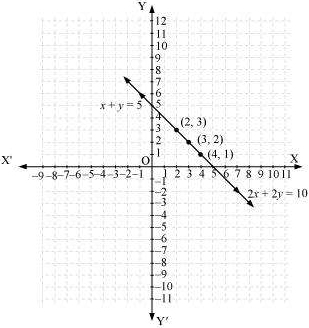
0 likes
View Solution21
Medium
Which of the following pairs of linear equations are consistent/inconsistent? If consistent,obtain the solution graphically: $x-y=8, 3x-3y=16$.
Solution
(N/A) Given equations are $x-y=8$ and $3x-3y=16$.
Comparing with $a_1x + b_1y + c_1 = 0$ and $a_2x + b_2y + c_2 = 0$:
$a_1 = 1, b_1 = -1, c_1 = -8$
$a_2 = 3, b_2 = -3, c_2 = -16$
Calculating the ratios:
$\frac{a_1}{a_2} = \frac{1}{3}$
$\frac{b_1}{b_2} = \frac{-1}{-3} = \frac{1}{3}$
$\frac{c_1}{c_2} = \frac{-8}{-16} = \frac{1}{2}$
Since $\frac{a_1}{a_2} = \frac{b_1}{b_2} \neq \frac{c_1}{c_2}$,the lines represented by these equations are parallel to each other.
Therefore,there is no common point between the lines,which means the pair of linear equations is inconsistent.
Comparing with $a_1x + b_1y + c_1 = 0$ and $a_2x + b_2y + c_2 = 0$:
$a_1 = 1, b_1 = -1, c_1 = -8$
$a_2 = 3, b_2 = -3, c_2 = -16$
Calculating the ratios:
$\frac{a_1}{a_2} = \frac{1}{3}$
$\frac{b_1}{b_2} = \frac{-1}{-3} = \frac{1}{3}$
$\frac{c_1}{c_2} = \frac{-8}{-16} = \frac{1}{2}$
Since $\frac{a_1}{a_2} = \frac{b_1}{b_2} \neq \frac{c_1}{c_2}$,the lines represented by these equations are parallel to each other.
Therefore,there is no common point between the lines,which means the pair of linear equations is inconsistent.
0 likes
View Solution22
DifficultMCQ
Which of the following pairs of linear equations are consistent/inconsistent? If consistent,obtain the solution graphically: $2x + y - 6 = 0, 4x - 2y - 4 = 0$.
A
Consistent
B
Inconsistent
C
Dependent
D
None of these
Solution
(A) Given equations are $2x + y - 6 = 0$ and $4x - 2y - 4 = 0$.
Comparing with $a_1x + b_1y + c_1 = 0$ and $a_2x + b_2y + c_2 = 0$:
$a_1 = 2, b_1 = 1, c_1 = -6$
$a_2 = 4, b_2 = -2, c_2 = -4$
Calculating ratios:
$\frac{a_1}{a_2} = \frac{2}{4} = \frac{1}{2}$
$\frac{b_1}{b_2} = \frac{1}{-2} = -\frac{1}{2}$
Since $\frac{a_1}{a_2} \neq \frac{b_1}{b_2}$,the lines intersect at a unique point,meaning the system is consistent.
For $2x + y - 6 = 0 \implies y = 6 - 2x$:
If $x=0, y=6$; if $x=1, y=4$; if $x=2, y=2$.
For $4x - 2y - 4 = 0 \implies y = 2x - 2$:
If $x=0, y=-2$; if $x=1, y=0$; if $x=2, y=2$.
The lines intersect at $(2, 2)$.
Comparing with $a_1x + b_1y + c_1 = 0$ and $a_2x + b_2y + c_2 = 0$:
$a_1 = 2, b_1 = 1, c_1 = -6$
$a_2 = 4, b_2 = -2, c_2 = -4$
Calculating ratios:
$\frac{a_1}{a_2} = \frac{2}{4} = \frac{1}{2}$
$\frac{b_1}{b_2} = \frac{1}{-2} = -\frac{1}{2}$
Since $\frac{a_1}{a_2} \neq \frac{b_1}{b_2}$,the lines intersect at a unique point,meaning the system is consistent.
For $2x + y - 6 = 0 \implies y = 6 - 2x$:
If $x=0, y=6$; if $x=1, y=4$; if $x=2, y=2$.
For $4x - 2y - 4 = 0 \implies y = 2x - 2$:
If $x=0, y=-2$; if $x=1, y=0$; if $x=2, y=2$.
The lines intersect at $(2, 2)$.
0 likes
View Solution23
Medium
Which of the following pairs of linear equations are consistent/inconsistent? If consistent,obtain the solution graphically: $2x - 2y - 2 = 0, 4x - 4y - 5 = 0$.
Solution
(B) Given equations are:
$2x - 2y - 2 = 0$ (Equation $1$)
$4x - 4y - 5 = 0$ (Equation $2$)
Comparing these with the standard form $a_1x + b_1y + c_1 = 0$ and $a_2x + b_2y + c_2 = 0$,we get:
$a_1 = 2, b_1 = -2, c_1 = -2$
$a_2 = 4, b_2 = -4, c_2 = -5$
Now,find the ratios:
$\frac{a_1}{a_2} = \frac{2}{4} = \frac{1}{2}$
$\frac{b_1}{b_2} = \frac{-2}{-4} = \frac{1}{2}$
$\frac{c_1}{c_2} = \frac{-2}{-5} = \frac{2}{5}$
Since $\frac{a_1}{a_2} = \frac{b_1}{b_2} \neq \frac{c_1}{c_2}$,the lines are parallel to each other.
Therefore,the pair of linear equations is inconsistent and has no solution.
$2x - 2y - 2 = 0$ (Equation $1$)
$4x - 4y - 5 = 0$ (Equation $2$)
Comparing these with the standard form $a_1x + b_1y + c_1 = 0$ and $a_2x + b_2y + c_2 = 0$,we get:
$a_1 = 2, b_1 = -2, c_1 = -2$
$a_2 = 4, b_2 = -4, c_2 = -5$
Now,find the ratios:
$\frac{a_1}{a_2} = \frac{2}{4} = \frac{1}{2}$
$\frac{b_1}{b_2} = \frac{-2}{-4} = \frac{1}{2}$
$\frac{c_1}{c_2} = \frac{-2}{-5} = \frac{2}{5}$
Since $\frac{a_1}{a_2} = \frac{b_1}{b_2} \neq \frac{c_1}{c_2}$,the lines are parallel to each other.
Therefore,the pair of linear equations is inconsistent and has no solution.
0 likes
View Solution24
Difficult
Half the perimeter of a rectangular garden,whose length is $4\, m$ more than its width,is $36\, m$. Find the dimensions of the garden.
Solution
(N/A) Let the width of the garden be $x$ and the length be $y$.
According to the question:
$y - x = 4$ $...(1)$
$y + x = 36$ $...(2)$
From equation $(1)$,$y = x + 4$. The table of values is:
From equation $(2)$,$y = 36 - x$. The table of values is:
By plotting these lines on a graph,we observe that they intersect at the point $(16, 20)$.
Therefore,the width of the garden is $16\, m$ and the length is $20\, m$.
According to the question:
$y - x = 4$ $...(1)$
$y + x = 36$ $...(2)$
From equation $(1)$,$y = x + 4$. The table of values is:
| $x$ | $0$ | $8$ | $12$ |
| $y$ | $4$ | $12$ | $16$ |
From equation $(2)$,$y = 36 - x$. The table of values is:
| $x$ | $0$ | $36$ | $16$ |
| $y$ | $36$ | $0$ | $20$ |
By plotting these lines on a graph,we observe that they intersect at the point $(16, 20)$.
Therefore,the width of the garden is $16\, m$ and the length is $20\, m$.
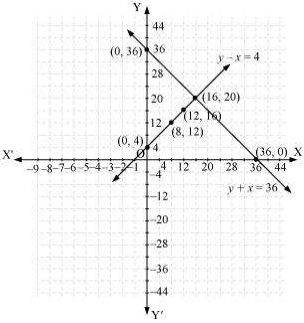
0 likes
View Solution25
Easy
Given the linear equation $2x + 3y - 8 = 0$,write another linear equation in two variables such that the geometrical representation of the pair so formed is intersecting lines.
Solution
(N/A) For a pair of linear equations $a_1x + b_1y + c_1 = 0$ and $a_2x + b_2y + c_2 = 0$ to represent intersecting lines,the condition is $\frac{a_1}{a_2} \neq \frac{b_1}{b_2}$.
Given the equation $2x + 3y - 8 = 0$,we have $a_1 = 2$ and $b_1 = 3$.
We need to choose $a_2$ and $b_2$ such that $\frac{2}{a_2} \neq \frac{3}{b_2}$.
If we choose $a_2 = 3$ and $b_2 = 2$,then $\frac{2}{3} \neq \frac{3}{2}$,which satisfies the condition.
Thus,one such equation is $3x + 2y - 5 = 0$ (or any other equation satisfying the condition).
Given the equation $2x + 3y - 8 = 0$,we have $a_1 = 2$ and $b_1 = 3$.
We need to choose $a_2$ and $b_2$ such that $\frac{2}{a_2} \neq \frac{3}{b_2}$.
If we choose $a_2 = 3$ and $b_2 = 2$,then $\frac{2}{3} \neq \frac{3}{2}$,which satisfies the condition.
Thus,one such equation is $3x + 2y - 5 = 0$ (or any other equation satisfying the condition).
0 likes
View Solution26
Easy
Given the linear equation $2x + 3y - 8 = 0$,write another linear equation in two variables such that the geometrical representation of the pair so formed is parallel lines.
Solution
(A) For two lines $a_1x + b_1y + c_1 = 0$ and $a_2x + b_2y + c_2 = 0$ to be parallel,the condition is $\frac{a_1}{a_2} = \frac{b_1}{b_2} \neq \frac{c_1}{c_2}$.
Given the equation $2x + 3y - 8 = 0$,we have $a_1 = 2, b_1 = 3, c_1 = -8$.
To satisfy the condition,we can choose $a_2 = 4$ and $b_2 = 6$ (which makes $\frac{a_1}{a_2} = \frac{b_1}{b_2} = \frac{1}{2}$) and choose $c_2$ such that $\frac{c_1}{c_2} \neq \frac{1}{2}$.
Let $c_2 = -10$. Then the equation is $4x + 6y - 10 = 0$.
Checking the condition: $\frac{2}{4} = \frac{3}{6} \neq \frac{-8}{-10}$,which simplifies to $\frac{1}{2} = \frac{1}{2} \neq \frac{4}{5}$.
Thus,$4x + 6y - 10 = 0$ is a valid answer.
Given the equation $2x + 3y - 8 = 0$,we have $a_1 = 2, b_1 = 3, c_1 = -8$.
To satisfy the condition,we can choose $a_2 = 4$ and $b_2 = 6$ (which makes $\frac{a_1}{a_2} = \frac{b_1}{b_2} = \frac{1}{2}$) and choose $c_2$ such that $\frac{c_1}{c_2} \neq \frac{1}{2}$.
Let $c_2 = -10$. Then the equation is $4x + 6y - 10 = 0$.
Checking the condition: $\frac{2}{4} = \frac{3}{6} \neq \frac{-8}{-10}$,which simplifies to $\frac{1}{2} = \frac{1}{2} \neq \frac{4}{5}$.
Thus,$4x + 6y - 10 = 0$ is a valid answer.
0 likes
View Solution27
EasyMCQ
Given the linear equation $2x + 3y - 8 = 0$,write another linear equation in two variables such that the geometrical representation of the pair so formed is coincident lines.
A
$4x + 6y - 16 = 0$
B
$2x + 3y - 10 = 0$
C
$4x + 6y - 8 = 0$
D
$2x + 3y + 8 = 0$
Solution
(A) For two linear equations $a_1x + b_1y + c_1 = 0$ and $a_2x + b_2y + c_2 = 0$ to represent coincident lines,the condition is $\frac{a_1}{a_2} = \frac{b_1}{b_2} = \frac{c_1}{c_2}$.
Given the equation $2x + 3y - 8 = 0$,we have $a_1 = 2, b_1 = 3, c_1 = -8$.
To find another equation,we can multiply the given equation by any non-zero constant $k$. Let $k = 2$.
Multiplying the equation by $2$,we get $2(2x + 3y - 8) = 2(0)$,which simplifies to $4x + 6y - 16 = 0$.
Checking the condition: $\frac{2}{4} = \frac{3}{6} = \frac{-8}{-16} = \frac{1}{2}$.
Since the ratios are equal,the lines are coincident. Thus,$4x + 6y - 16 = 0$ is a valid answer.
Given the equation $2x + 3y - 8 = 0$,we have $a_1 = 2, b_1 = 3, c_1 = -8$.
To find another equation,we can multiply the given equation by any non-zero constant $k$. Let $k = 2$.
Multiplying the equation by $2$,we get $2(2x + 3y - 8) = 2(0)$,which simplifies to $4x + 6y - 16 = 0$.
Checking the condition: $\frac{2}{4} = \frac{3}{6} = \frac{-8}{-16} = \frac{1}{2}$.
Since the ratios are equal,the lines are coincident. Thus,$4x + 6y - 16 = 0$ is a valid answer.
0 likes
View Solution28
Easy
Draw the graphs of the equations $x-y+1=0$ and $3x+2y-12=0$. Determine the coordinates of the vertices of the triangle formed by these lines and the $x$-axis,and shade the triangular region.
Solution
(N/A) For the equation $x-y+1=0$,we can write $x=y-1$. The table of values is:
For the equation $3x+2y-12=0$,we can write $x=\frac{12-2y}{3}$. The table of values is:
By plotting these points on a graph,we obtain two intersecting lines. The lines intersect each other at the point $(2,3)$ and intersect the $x$-axis at $(-1,0)$ and $(4,0)$.
Thus,the vertices of the triangle formed by these lines and the $x$-axis are $(2,3)$,$(-1,0)$,and $(4,0)$.
| $x$ | $0$ | $1$ | $2$ |
| $y$ | $1$ | $2$ | $3$ |
For the equation $3x+2y-12=0$,we can write $x=\frac{12-2y}{3}$. The table of values is:
| $x$ | $4$ | $2$ | $0$ |
| $y$ | $0$ | $3$ | $6$ |
By plotting these points on a graph,we obtain two intersecting lines. The lines intersect each other at the point $(2,3)$ and intersect the $x$-axis at $(-1,0)$ and $(4,0)$.
Thus,the vertices of the triangle formed by these lines and the $x$-axis are $(2,3)$,$(-1,0)$,and $(4,0)$.
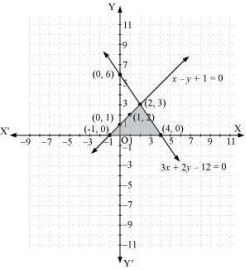
0 likes
View Solution29
Medium
Solve the following pair of equations by substitution method:
$7x - 15y = 2$ $...(1)$
$x + 2y = 3$ $...(2)$
$7x - 15y = 2$ $...(1)$
$x + 2y = 3$ $...(2)$
Solution
(N/A) Step $1:$ We pick either of the equations and write one variable in terms of the other. Let us consider Equation $(2)$.
$x + 2y = 3$
We can write it as $x = 3 - 2y$ $...(3)$
Step $2:$ Substitute the value of $x$ from Equation $(3)$ into Equation $(1)$. We get:
$7(3 - 2y) - 15y = 2$
$21 - 14y - 15y = 2$
$-29y = 2 - 21$
$-29y = -19$
Therefore,$y = \frac{19}{29}$
Step $3:$ Substituting this value of $y$ in Equation $(3)$,we get:
$x = 3 - 2\left(\frac{19}{29}\right)$
$x = 3 - \frac{38}{29}$
$x = \frac{87 - 38}{29} = \frac{49}{29}$
Therefore,the solution is $x = \frac{49}{29}, y = \frac{19}{29}$.
$x + 2y = 3$
We can write it as $x = 3 - 2y$ $...(3)$
Step $2:$ Substitute the value of $x$ from Equation $(3)$ into Equation $(1)$. We get:
$7(3 - 2y) - 15y = 2$
$21 - 14y - 15y = 2$
$-29y = 2 - 21$
$-29y = -19$
Therefore,$y = \frac{19}{29}$
Step $3:$ Substituting this value of $y$ in Equation $(3)$,we get:
$x = 3 - 2\left(\frac{19}{29}\right)$
$x = 3 - \frac{38}{29}$
$x = \frac{87 - 38}{29} = \frac{49}{29}$
Therefore,the solution is $x = \frac{49}{29}, y = \frac{19}{29}$.
0 likes
View Solution30
Easy
Solve by the method of substitution. Aftab tells his daughter,"Seven years ago,$I$ was seven times as old as you were then. Also,three years from now,$I$ shall be three times as old as you will be." Represent this situation algebraically.
Solution
(N/A) Let $s$ and $t$ be the current ages (in years) of Aftab and his daughter,respectively.
According to the first condition,seven years ago:
$(s - 7) = 7(t - 7)$
$s - 7 = 7t - 49$
$s - 7t = -42$ $...(1)$
According to the second condition,three years from now:
$(s + 3) = 3(t + 3)$
$s + 3 = 3t + 9$
$s - 3t = 6$ $...(2)$
From Equation $(2)$,we get $s = 3t + 6$.
Substituting this value of $s$ into Equation $(1)$:
$(3t + 6) - 7t = -42$
$-4t + 6 = -42$
$-4t = -48$
$t = 12$
Now,substitute $t = 12$ into $s = 3t + 6$:
$s = 3(12) + 6 = 36 + 6 = 42$
Thus,the current age of Aftab is $42$ years and his daughter is $12$ years old.
According to the first condition,seven years ago:
$(s - 7) = 7(t - 7)$
$s - 7 = 7t - 49$
$s - 7t = -42$ $...(1)$
According to the second condition,three years from now:
$(s + 3) = 3(t + 3)$
$s + 3 = 3t + 9$
$s - 3t = 6$ $...(2)$
From Equation $(2)$,we get $s = 3t + 6$.
Substituting this value of $s$ into Equation $(1)$:
$(3t + 6) - 7t = -42$
$-4t + 6 = -42$
$-4t = -48$
$t = 12$
Now,substitute $t = 12$ into $s = 3t + 6$:
$s = 3(12) + 6 = 36 + 6 = 42$
Thus,the current age of Aftab is $42$ years and his daughter is $12$ years old.
0 likes
View Solution31
Medium
The cost of $2$ pencils and $3$ erasers is ₹ $9$,and the cost of $4$ pencils and $6$ erasers is ₹ $18$. Determine the cost of each pencil and each eraser.
Solution
(D) Let the cost of one pencil be ₹ $x$ and the cost of one eraser be ₹ $y$.
According to the problem,the pair of linear equations formed are:
$2x + 3y = 9$ $...(1)$
$4x + 6y = 18$ $...(2)$
We observe that equation $(2)$ is exactly $2$ times equation $(1)$.
Dividing equation $(2)$ by $2$,we get $2x + 3y = 9$,which is identical to equation $(1)$.
Since both equations represent the same line,they are coincident.
Therefore,there are infinitely many solutions for $x$ and $y$ that satisfy these equations. We cannot determine a unique cost for each pencil and eraser.
According to the problem,the pair of linear equations formed are:
$2x + 3y = 9$ $...(1)$
$4x + 6y = 18$ $...(2)$
We observe that equation $(2)$ is exactly $2$ times equation $(1)$.
Dividing equation $(2)$ by $2$,we get $2x + 3y = 9$,which is identical to equation $(1)$.
Since both equations represent the same line,they are coincident.
Therefore,there are infinitely many solutions for $x$ and $y$ that satisfy these equations. We cannot determine a unique cost for each pencil and eraser.
0 likes
View Solution32
Difficult
Two rails are represented by the equations $x + 2y - 4 = 0$ and $2x + 4y - 12 = 0$. Will the rails cross each other?
Solution
(B) The given pair of linear equations is:
$x + 2y - 4 = 0$ $...(1)$
$2x + 4y - 12 = 0$ $...(2)$
Comparing these equations with the standard form $a_1x + b_1y + c_1 = 0$ and $a_2x + b_2y + c_2 = 0$,we get:
$a_1 = 1, b_1 = 2, c_1 = -4$
$a_2 = 2, b_2 = 4, c_2 = -12$
Now,we find the ratios of the coefficients:
$\frac{a_1}{a_2} = \frac{1}{2}$
$\frac{b_1}{b_2} = \frac{2}{4} = \frac{1}{2}$
$\frac{c_1}{c_2} = \frac{-4}{-12} = \frac{1}{3}$
Since $\frac{a_1}{a_2} = \frac{b_1}{b_2} \neq \frac{c_1}{c_2}$,the lines represented by these equations are parallel.
Therefore,the rails will not cross each other.
$x + 2y - 4 = 0$ $...(1)$
$2x + 4y - 12 = 0$ $...(2)$
Comparing these equations with the standard form $a_1x + b_1y + c_1 = 0$ and $a_2x + b_2y + c_2 = 0$,we get:
$a_1 = 1, b_1 = 2, c_1 = -4$
$a_2 = 2, b_2 = 4, c_2 = -12$
Now,we find the ratios of the coefficients:
$\frac{a_1}{a_2} = \frac{1}{2}$
$\frac{b_1}{b_2} = \frac{2}{4} = \frac{1}{2}$
$\frac{c_1}{c_2} = \frac{-4}{-12} = \frac{1}{3}$
Since $\frac{a_1}{a_2} = \frac{b_1}{b_2} \neq \frac{c_1}{c_2}$,the lines represented by these equations are parallel.
Therefore,the rails will not cross each other.
0 likes
View Solution33
Medium
Solve the following pair of linear equations by the substitution method.
$x+y=14$
$x-y=4$
$x+y=14$
$x-y=4$
Solution
(A) $x+y=14$ $....(1)$
$x-y=4$ $....(2)$
From equation $(1)$,we express $x$ in terms of $y$:
$x=14-y$ $....(3)$
Substituting the value of $x$ from equation $(3)$ into equation $(2)$:
$(14-y)-y=4$
$14-2y=4$
$14-4=2y$
$10=2y$
$y=5$ $....(4)$
Now,substituting the value of $y=5$ into equation $(3)$:
$x=14-5$
$x=9$
Therefore,the solution is $x=9$ and $y=5$.
$x-y=4$ $....(2)$
From equation $(1)$,we express $x$ in terms of $y$:
$x=14-y$ $....(3)$
Substituting the value of $x$ from equation $(3)$ into equation $(2)$:
$(14-y)-y=4$
$14-2y=4$
$14-4=2y$
$10=2y$
$y=5$ $....(4)$
Now,substituting the value of $y=5$ into equation $(3)$:
$x=14-5$
$x=9$
Therefore,the solution is $x=9$ and $y=5$.
0 likes
View Solution34
Difficult
Solve the following pair of linear equations by the substitution method.
$s-t=3$
$\frac{s}{3}+\frac{t}{2}=6$
$s-t=3$
$\frac{s}{3}+\frac{t}{2}=6$
Solution
(S=9, T=6) $s-t=3$ $...(1)$
$\frac{s}{3}+\frac{t}{2}=6$ $...(2)$
From equation $(1)$,we express $s$ in terms of $t$:
$s = t + 3$ $...(3)$
Substituting the value of $s$ from equation $(3)$ into equation $(2)$:
$\frac{t+3}{3} + \frac{t}{2} = 6$
Multiply the entire equation by $6$ (the $LCM$ of $3$ and $2$) to clear the denominators:
$2(t+3) + 3t = 36$
$2t + 6 + 3t = 36$
$5t + 6 = 36$
$5t = 30$
$t = 6$ $...(4)$
Now,substitute the value of $t = 6$ into equation $(3)$:
$s = 6 + 3$
$s = 9$
Therefore,the solution is $s = 9$ and $t = 6$.
$\frac{s}{3}+\frac{t}{2}=6$ $...(2)$
From equation $(1)$,we express $s$ in terms of $t$:
$s = t + 3$ $...(3)$
Substituting the value of $s$ from equation $(3)$ into equation $(2)$:
$\frac{t+3}{3} + \frac{t}{2} = 6$
Multiply the entire equation by $6$ (the $LCM$ of $3$ and $2$) to clear the denominators:
$2(t+3) + 3t = 36$
$2t + 6 + 3t = 36$
$5t + 6 = 36$
$5t = 30$
$t = 6$ $...(4)$
Now,substitute the value of $t = 6$ into equation $(3)$:
$s = 6 + 3$
$s = 9$
Therefore,the solution is $s = 9$ and $t = 6$.
0 likes
View Solution35
Medium
Solve the following pair of linear equations by the substitution method.
$3x - y = 3$
$9x - 3y = 9$
$3x - y = 3$
$9x - 3y = 9$
Solution
(D) Given equations are:
$3x - y = 3$ $...(1)$
$9x - 3y = 9$ $...(2)$
From equation $(1)$,we can express $y$ in terms of $x$:
$y = 3x - 3$ $...(3)$
Substituting the value of $y$ from equation $(3)$ into equation $(2)$:
$9x - 3(3x - 3) = 9$
$9x - 9x + 9 = 9$
$9 = 9$
Since $9 = 9$ is a true statement for all values of $x$,the two equations are coincident lines.
Therefore,the given pair of linear equations has infinitely many solutions.
The relationship between the variables is given by $y = 3x - 3$.
$3x - y = 3$ $...(1)$
$9x - 3y = 9$ $...(2)$
From equation $(1)$,we can express $y$ in terms of $x$:
$y = 3x - 3$ $...(3)$
Substituting the value of $y$ from equation $(3)$ into equation $(2)$:
$9x - 3(3x - 3) = 9$
$9x - 9x + 9 = 9$
$9 = 9$
Since $9 = 9$ is a true statement for all values of $x$,the two equations are coincident lines.
Therefore,the given pair of linear equations has infinitely many solutions.
The relationship between the variables is given by $y = 3x - 3$.
0 likes
View Solution36
Difficult
Solve the following pair of linear equations by the substitution method.
$0.2 x + 0.3 y = 1.3$
$0.4 x + 0.5 y = 2.3$
$0.2 x + 0.3 y = 1.3$
$0.4 x + 0.5 y = 2.3$
Solution
(N/A) Given equations are:
$0.2 x + 0.3 y = 1.3$ $...(1)$
$0.4 x + 0.5 y = 2.3$ $...(2)$
From equation $(1)$,we express $x$ in terms of $y$:
$0.2 x = 1.3 - 0.3 y$
$x = \frac{1.3 - 0.3 y}{0.2}$ $...(3)$
Substituting the value of $x$ from equation $(3)$ into equation $(2)$:
$0.4 \left( \frac{1.3 - 0.3 y}{0.2} \right) + 0.5 y = 2.3$
$2(1.3 - 0.3 y) + 0.5 y = 2.3$
$2.6 - 0.6 y + 0.5 y = 2.3$
$2.6 - 0.1 y = 2.3$
$2.6 - 2.3 = 0.1 y$
$0.3 = 0.1 y$
$y = \frac{0.3}{0.1} = 3$
Now,substitute $y = 3$ into equation $(3)$:
$x = \frac{1.3 - 0.3(3)}{0.2}$
$x = \frac{1.3 - 0.9}{0.2}$
$x = \frac{0.4}{0.2} = 2$
Therefore,the solution is $x = 2$ and $y = 3$.
$0.2 x + 0.3 y = 1.3$ $...(1)$
$0.4 x + 0.5 y = 2.3$ $...(2)$
From equation $(1)$,we express $x$ in terms of $y$:
$0.2 x = 1.3 - 0.3 y$
$x = \frac{1.3 - 0.3 y}{0.2}$ $...(3)$
Substituting the value of $x$ from equation $(3)$ into equation $(2)$:
$0.4 \left( \frac{1.3 - 0.3 y}{0.2} \right) + 0.5 y = 2.3$
$2(1.3 - 0.3 y) + 0.5 y = 2.3$
$2.6 - 0.6 y + 0.5 y = 2.3$
$2.6 - 0.1 y = 2.3$
$2.6 - 2.3 = 0.1 y$
$0.3 = 0.1 y$
$y = \frac{0.3}{0.1} = 3$
Now,substitute $y = 3$ into equation $(3)$:
$x = \frac{1.3 - 0.3(3)}{0.2}$
$x = \frac{1.3 - 0.9}{0.2}$
$x = \frac{0.4}{0.2} = 2$
Therefore,the solution is $x = 2$ and $y = 3$.
0 likes
View Solution37
DifficultMCQ
Solve the following pair of linear equations by the substitution method:
$\sqrt{2} x + \sqrt{3} y = 0$
$\sqrt{3} x - \sqrt{8} y = 0$
$\sqrt{2} x + \sqrt{3} y = 0$
$\sqrt{3} x - \sqrt{8} y = 0$
A
$x = 0, y = 0$
B
$x = 1, y = 1$
C
$x = 2, y = 2$
D
$x = -1, y = -1$
Solution
(A) Given equations are:
$\sqrt{2} x + \sqrt{3} y = 0$ $...(1)$
$\sqrt{3} x - \sqrt{8} y = 0$ $...(2)$
From equation $(1)$,we express $x$ in terms of $y$:
$x = -\frac{\sqrt{3} y}{\sqrt{2}}$ $...(3)$
Substituting the value of $x$ from equation $(3)$ into equation $(2)$:
$\sqrt{3} \left( -\frac{\sqrt{3} y}{\sqrt{2}} \right) - \sqrt{8} y = 0$
$-\frac{3 y}{\sqrt{2}} - 2\sqrt{2} y = 0$
Factoring out $y$:
$y \left( -\frac{3}{\sqrt{2}} - 2\sqrt{2} \right) = 0$
Since the term in the bracket is non-zero,we must have $y = 0$.
Substituting $y = 0$ into equation $(3)$:
$x = -\frac{\sqrt{3} (0)}{\sqrt{2}} = 0$
Thus,the solution is $x = 0$ and $y = 0$.
$\sqrt{2} x + \sqrt{3} y = 0$ $...(1)$
$\sqrt{3} x - \sqrt{8} y = 0$ $...(2)$
From equation $(1)$,we express $x$ in terms of $y$:
$x = -\frac{\sqrt{3} y}{\sqrt{2}}$ $...(3)$
Substituting the value of $x$ from equation $(3)$ into equation $(2)$:
$\sqrt{3} \left( -\frac{\sqrt{3} y}{\sqrt{2}} \right) - \sqrt{8} y = 0$
$-\frac{3 y}{\sqrt{2}} - 2\sqrt{2} y = 0$
Factoring out $y$:
$y \left( -\frac{3}{\sqrt{2}} - 2\sqrt{2} \right) = 0$
Since the term in the bracket is non-zero,we must have $y = 0$.
Substituting $y = 0$ into equation $(3)$:
$x = -\frac{\sqrt{3} (0)}{\sqrt{2}} = 0$
Thus,the solution is $x = 0$ and $y = 0$.
0 likes
View Solution38
MediumMCQ
Solve the following pair of linear equations by the substitution method:
$\frac{3x}{2} - \frac{5y}{3} = -2$
$\frac{x}{3} + \frac{y}{2} = \frac{13}{6}$
$\frac{3x}{2} - \frac{5y}{3} = -2$
$\frac{x}{3} + \frac{y}{2} = \frac{13}{6}$
A
$x = 2, y = 3$
B
$x = 3, y = 2$
C
$x = 1, y = 2$
D
$x = 2, y = 1$
Solution
(A) Given equations are:
$(1) \frac{3x}{2} - \frac{5y}{3} = -2$
$(2) \frac{x}{3} + \frac{y}{2} = \frac{13}{6}$
Step $1$: Simplify the equations.
Multiply $(1)$ by $6$: $9x - 10y = -12$ --- $(3)$
Multiply $(2)$ by $6$: $2x + 3y = 13$ --- $(4)$
Step $2$: Express $x$ in terms of $y$ from equation $(4)$:
$2x = 13 - 3y$
$x = \frac{13 - 3y}{2}$ --- $(5)$
Step $3$: Substitute $(5)$ into $(3)$:
$9(\frac{13 - 3y}{2}) - 10y = -12$
Multiply by $2$: $9(13 - 3y) - 20y = -24$
$117 - 27y - 20y = -24$
$-47y = -24 - 117$
$-47y = -141$
$y = \frac{141}{47} = 3$
Step $4$: Substitute $y = 3$ into $(5)$:
$x = \frac{13 - 3(3)}{2} = \frac{13 - 9}{2} = \frac{4}{2} = 2$
Thus,the solution is $x = 2, y = 3$.
$(1) \frac{3x}{2} - \frac{5y}{3} = -2$
$(2) \frac{x}{3} + \frac{y}{2} = \frac{13}{6}$
Step $1$: Simplify the equations.
Multiply $(1)$ by $6$: $9x - 10y = -12$ --- $(3)$
Multiply $(2)$ by $6$: $2x + 3y = 13$ --- $(4)$
Step $2$: Express $x$ in terms of $y$ from equation $(4)$:
$2x = 13 - 3y$
$x = \frac{13 - 3y}{2}$ --- $(5)$
Step $3$: Substitute $(5)$ into $(3)$:
$9(\frac{13 - 3y}{2}) - 10y = -12$
Multiply by $2$: $9(13 - 3y) - 20y = -24$
$117 - 27y - 20y = -24$
$-47y = -24 - 117$
$-47y = -141$
$y = \frac{141}{47} = 3$
Step $4$: Substitute $y = 3$ into $(5)$:
$x = \frac{13 - 3(3)}{2} = \frac{13 - 9}{2} = \frac{4}{2} = 2$
Thus,the solution is $x = 2, y = 3$.
0 likes
View Solution39
Difficult
Solve $2x + 3y = 11$ and $2x - 4y = -24$ and hence find the value of $m$ for which $y = mx + 3$.
Solution
(M = -1) Given equations are:
$2x + 3y = 11$ $...(1)$
$2x - 4y = -24$ $...(2)$
From equation $(1)$,we express $x$ in terms of $y$:
$2x = 11 - 3y$
$x = \frac{11 - 3y}{2}$ $...(3)$
Substituting the value of $x$ from equation $(3)$ into equation $(2)$:
$2\left(\frac{11 - 3y}{2}\right) - 4y = -24$
$11 - 3y - 4y = -24$
$11 - 7y = -24$
$-7y = -24 - 11$
$-7y = -35$
$y = 5$
Now,substitute $y = 5$ into equation $(3)$ to find $x$:
$x = \frac{11 - 3(5)}{2} = \frac{11 - 15}{2} = \frac{-4}{2} = -2$
So,the solution is $x = -2$ and $y = 5$.
Now,substitute these values into the equation $y = mx + 3$ to find $m$:
$5 = m(-2) + 3$
$5 - 3 = -2m$
$2 = -2m$
$m = -1$
$2x + 3y = 11$ $...(1)$
$2x - 4y = -24$ $...(2)$
From equation $(1)$,we express $x$ in terms of $y$:
$2x = 11 - 3y$
$x = \frac{11 - 3y}{2}$ $...(3)$
Substituting the value of $x$ from equation $(3)$ into equation $(2)$:
$2\left(\frac{11 - 3y}{2}\right) - 4y = -24$
$11 - 3y - 4y = -24$
$11 - 7y = -24$
$-7y = -24 - 11$
$-7y = -35$
$y = 5$
Now,substitute $y = 5$ into equation $(3)$ to find $x$:
$x = \frac{11 - 3(5)}{2} = \frac{11 - 15}{2} = \frac{-4}{2} = -2$
So,the solution is $x = -2$ and $y = 5$.
Now,substitute these values into the equation $y = mx + 3$ to find $m$:
$5 = m(-2) + 3$
$5 - 3 = -2m$
$2 = -2m$
$m = -1$
0 likes
View Solution40
Easy
Form the pair of linear equations for the following problem and find their solution by the substitution method.
The difference between two numbers is $26$ and one number is three times the other. Find the numbers.
The difference between two numbers is $26$ and one number is three times the other. Find the numbers.
Solution
(N/A) Let the first number be $x$ and the other number be $y$ such that $y > x$.
According to the given information:
$y = 3x$ $...(1)$
$y - x = 26$ $...(2)$
On substituting the value of $y$ from equation $(1)$ into equation $(2)$,we obtain:
$3x - x = 26$
$2x = 26$
$x = 13$ $...(3)$
Substituting the value of $x$ in equation $(1)$,we obtain:
$y = 3(13) = 39$
Hence,the two numbers are $13$ and $39$.
According to the given information:
$y = 3x$ $...(1)$
$y - x = 26$ $...(2)$
On substituting the value of $y$ from equation $(1)$ into equation $(2)$,we obtain:
$3x - x = 26$
$2x = 26$
$x = 13$ $...(3)$
Substituting the value of $x$ in equation $(1)$,we obtain:
$y = 3(13) = 39$
Hence,the two numbers are $13$ and $39$.
1 likes
View Solution41
Medium
Form the pair of linear equations for the following problem and find their solution by the substitution method.
The larger of two supplementary angles exceeds the smaller by $18^{\circ}$. Find the angles.
The larger of two supplementary angles exceeds the smaller by $18^{\circ}$. Find the angles.
Solution
(A) Let the larger angle be $x$ and the smaller angle be $y$.
We know that the sum of the measures of angles of a supplementary pair is always $180^{\circ}$.
According to the given information:
$x + y = 180^{\circ}$ $...(1)$
$x - y = 18^{\circ}$ $...(2)$
From equation $(1)$,we obtain:
$x = 180^{\circ} - y$ $...(3)$
Substituting the value of $x$ in equation $(2)$,we get:
$(180^{\circ} - y) - y = 18^{\circ}$
$180^{\circ} - 2y = 18^{\circ}$
$180^{\circ} - 18^{\circ} = 2y$
$162^{\circ} = 2y$
$y = 81^{\circ}$ $...(4)$
Substituting the value of $y$ in equation $(3)$,we get:
$x = 180^{\circ} - 81^{\circ}$
$x = 99^{\circ}$
Hence,the two angles are $99^{\circ}$ and $81^{\circ}$.
We know that the sum of the measures of angles of a supplementary pair is always $180^{\circ}$.
According to the given information:
$x + y = 180^{\circ}$ $...(1)$
$x - y = 18^{\circ}$ $...(2)$
From equation $(1)$,we obtain:
$x = 180^{\circ} - y$ $...(3)$
Substituting the value of $x$ in equation $(2)$,we get:
$(180^{\circ} - y) - y = 18^{\circ}$
$180^{\circ} - 2y = 18^{\circ}$
$180^{\circ} - 18^{\circ} = 2y$
$162^{\circ} = 2y$
$y = 81^{\circ}$ $...(4)$
Substituting the value of $y$ in equation $(3)$,we get:
$x = 180^{\circ} - 81^{\circ}$
$x = 99^{\circ}$
Hence,the two angles are $99^{\circ}$ and $81^{\circ}$.
0 likes
View Solution42
Difficult
Form the pair of linear equations for the following problems and find their solution by the substitution method.
The coach of a cricket team buys $7$ bats and $6$ balls for ₹ $3800$. Later,she buys $3$ bats and $5$ balls for ₹ $1750$. Find the cost of each bat and each ball.
The coach of a cricket team buys $7$ bats and $6$ balls for ₹ $3800$. Later,she buys $3$ bats and $5$ balls for ₹ $1750$. Find the cost of each bat and each ball.
Solution
(A) Let the cost of a bat be $x$ and the cost of a ball be $y$.
According to the given information:
$7x + 6y = 3800$ $...(1)$
$3x + 5y = 1750$ $...(2)$
From equation $(1)$,we express $y$ in terms of $x$:
$6y = 3800 - 7x$
$y = \frac{3800 - 7x}{6}$ $...(3)$
Substituting this value of $y$ into equation $(2)$:
$3x + 5\left(\frac{3800 - 7x}{6}\right) = 1750$
Multiply the entire equation by $6$ to simplify:
$18x + 5(3800 - 7x) = 10500$
$18x + 19000 - 35x = 10500$
$-17x = 10500 - 19000$
$-17x = -8500$
$x = 500$
Now,substitute $x = 500$ into equation $(3)$:
$y = \frac{3800 - 7(500)}{6}$
$y = \frac{3800 - 3500}{6}$
$y = \frac{300}{6} = 50$
Therefore,the cost of one bat is ₹ $500$ and the cost of one ball is ₹ $50$.
According to the given information:
$7x + 6y = 3800$ $...(1)$
$3x + 5y = 1750$ $...(2)$
From equation $(1)$,we express $y$ in terms of $x$:
$6y = 3800 - 7x$
$y = \frac{3800 - 7x}{6}$ $...(3)$
Substituting this value of $y$ into equation $(2)$:
$3x + 5\left(\frac{3800 - 7x}{6}\right) = 1750$
Multiply the entire equation by $6$ to simplify:
$18x + 5(3800 - 7x) = 10500$
$18x + 19000 - 35x = 10500$
$-17x = 10500 - 19000$
$-17x = -8500$
$x = 500$
Now,substitute $x = 500$ into equation $(3)$:
$y = \frac{3800 - 7(500)}{6}$
$y = \frac{3800 - 3500}{6}$
$y = \frac{300}{6} = 50$
Therefore,the cost of one bat is ₹ $500$ and the cost of one ball is ₹ $50$.
0 likes
View Solution43
Difficult
Form the pair of linear equations for the following problem and find their solution by the substitution method.
The taxi charges in a city consist of a fixed charge together with the charge for the distance covered. For a distance of $10 \, km$,the charge paid is ₹ $105$ and for a journey of $15 \, km$,the charge paid is ₹ $155$. What are the fixed charges and the charge per $km$? How much does a person have to pay for travelling a distance of $25 \, km$?
The taxi charges in a city consist of a fixed charge together with the charge for the distance covered. For a distance of $10 \, km$,the charge paid is ₹ $105$ and for a journey of $15 \, km$,the charge paid is ₹ $155$. What are the fixed charges and the charge per $km$? How much does a person have to pay for travelling a distance of $25 \, km$?
Solution
(D) Let the fixed charge be ₹ $x$ and the charge per $km$ be ₹ $y$.
According to the given information:
$x + 10y = 105$ $(1)$
$x + 15y = 155$ $(2)$
From equation $(1)$,we obtain:
$x = 105 - 10y$ $(3)$
Substituting the value of $x$ from equation $(3)$ into equation $(2)$:
$(105 - 10y) + 15y = 155$
$105 + 5y = 155$
$5y = 155 - 105$
$5y = 50$
$y = 10$
Substituting $y = 10$ in equation $(3)$:
$x = 105 - 10(10)$
$x = 105 - 100$
$x = 5$
Thus,the fixed charge is ₹ $5$ and the charge per $km$ is ₹ $10$.
For a distance of $25 \, km$,the total charge is:
$x + 25y = 5 + 25(10) = 5 + 250 = ₹ 255$.
According to the given information:
$x + 10y = 105$ $(1)$
$x + 15y = 155$ $(2)$
From equation $(1)$,we obtain:
$x = 105 - 10y$ $(3)$
Substituting the value of $x$ from equation $(3)$ into equation $(2)$:
$(105 - 10y) + 15y = 155$
$105 + 5y = 155$
$5y = 155 - 105$
$5y = 50$
$y = 10$
Substituting $y = 10$ in equation $(3)$:
$x = 105 - 10(10)$
$x = 105 - 100$
$x = 5$
Thus,the fixed charge is ₹ $5$ and the charge per $km$ is ₹ $10$.
For a distance of $25 \, km$,the total charge is:
$x + 25y = 5 + 25(10) = 5 + 250 = ₹ 255$.
0 likes
View Solution44
Difficult
Form the pair of linear equations for the following problem and find their solution by the substitution method.
$A$ fraction becomes $\frac{9}{11}$ if $2$ is added to both the numerator and the denominator. If $3$ is added to both the numerator and the denominator,it becomes $\frac{5}{6}$. Find the fraction.
$A$ fraction becomes $\frac{9}{11}$ if $2$ is added to both the numerator and the denominator. If $3$ is added to both the numerator and the denominator,it becomes $\frac{5}{6}$. Find the fraction.
Solution
(A) Let the numerator of the fraction be $x$ and the denominator be $y$. The fraction is $\frac{x}{y}$.
According to the first condition: $\frac{x+2}{y+2} = \frac{9}{11}$.
Cross-multiplying gives: $11(x+2) = 9(y+2) \implies 11x + 22 = 9y + 18 \implies 11x - 9y = -4$ (Equation $1$).
According to the second condition: $\frac{x+3}{y+3} = \frac{5}{6}$.
Cross-multiplying gives: $6(x+3) = 5(y+3) \implies 6x + 18 = 5y + 15 \implies 6x - 5y = -3$ (Equation $2$).
From Equation $2$,$5y = 6x + 3 \implies y = \frac{6x+3}{5}$.
Substituting this into Equation $1$: $11x - 9(\frac{6x+3}{5}) = -4$.
Multiply by $5$: $55x - 9(6x+3) = -20 \implies 55x - 54x - 27 = -20 \implies x = 7$.
Now,find $y$: $y = \frac{6(7)+3}{5} = \frac{42+3}{5} = \frac{45}{5} = 9$.
The fraction is $\frac{7}{9}$.
According to the first condition: $\frac{x+2}{y+2} = \frac{9}{11}$.
Cross-multiplying gives: $11(x+2) = 9(y+2) \implies 11x + 22 = 9y + 18 \implies 11x - 9y = -4$ (Equation $1$).
According to the second condition: $\frac{x+3}{y+3} = \frac{5}{6}$.
Cross-multiplying gives: $6(x+3) = 5(y+3) \implies 6x + 18 = 5y + 15 \implies 6x - 5y = -3$ (Equation $2$).
From Equation $2$,$5y = 6x + 3 \implies y = \frac{6x+3}{5}$.
Substituting this into Equation $1$: $11x - 9(\frac{6x+3}{5}) = -4$.
Multiply by $5$: $55x - 9(6x+3) = -20 \implies 55x - 54x - 27 = -20 \implies x = 7$.
Now,find $y$: $y = \frac{6(7)+3}{5} = \frac{42+3}{5} = \frac{45}{5} = 9$.
The fraction is $\frac{7}{9}$.
0 likes
View Solution45
Medium
Form the pair of linear equations for the following problem and find their solution by the substitution method: 'Five years hence,the age of Jacob will be three times that of his son. Five years ago,Jacob's age was seven times that of his son. What are their present ages?'
Solution
(N/A) Let the present age of Jacob be $x$ years and the present age of his son be $y$ years.
Case $1$: Five years hence,Jacob's age will be $(x + 5)$ and his son's age will be $(y + 5)$.
According to the problem,$(x + 5) = 3(y + 5) \implies x + 5 = 3y + 15 \implies x - 3y = 10$ (Equation $1$).
Case $2$: Five years ago,Jacob's age was $(x - 5)$ and his son's age was $(y - 5)$.
According to the problem,$(x - 5) = 7(y - 5) \implies x - 5 = 7y - 35 \implies x - 7y = -30$ (Equation $2$).
From Equation $1$,$x = 3y + 10$.
Substituting this value into Equation $2$: $(3y + 10) - 7y = -30 \implies -4y = -40 \implies y = 10$.
Substituting $y = 10$ into $x = 3y + 10$: $x = 3(10) + 10 = 40$.
Therefore,the present age of Jacob is $40$ years and the present age of his son is $10$ years.
Case $1$: Five years hence,Jacob's age will be $(x + 5)$ and his son's age will be $(y + 5)$.
According to the problem,$(x + 5) = 3(y + 5) \implies x + 5 = 3y + 15 \implies x - 3y = 10$ (Equation $1$).
Case $2$: Five years ago,Jacob's age was $(x - 5)$ and his son's age was $(y - 5)$.
According to the problem,$(x - 5) = 7(y - 5) \implies x - 5 = 7y - 35 \implies x - 7y = -30$ (Equation $2$).
From Equation $1$,$x = 3y + 10$.
Substituting this value into Equation $2$: $(3y + 10) - 7y = -30 \implies -4y = -40 \implies y = 10$.
Substituting $y = 10$ into $x = 3y + 10$: $x = 3(10) + 10 = 40$.
Therefore,the present age of Jacob is $40$ years and the present age of his son is $10$ years.
0 likes
View Solution46
DifficultMCQ
The ratio of incomes of two persons is $9:7$ and the ratio of their expenditures is $4:3$. If each of them manages to save ₹ $2000$ per month,find their monthly incomes.
A
₹ $18,000$ and ₹ $14,000$
B
₹ $16,000$ and ₹ $12,000$
C
₹ $20,000$ and ₹ $16,000$
D
₹ $27,000$ and ₹ $21,000$
Solution
(A) Let the incomes of the two persons be ₹ $9x$ and ₹ $7x$,and their expenditures be ₹ $4y$ and ₹ $3y$ respectively.
Since $\text{Income} - \text{Expenditure} = \text{Savings}$,we have:
$9x - 4y = 2000$ $...(1)$
$7x - 3y = 2000$ $...(2)$
To solve these equations,multiply equation $(1)$ by $3$ and equation $(2)$ by $4$:
$27x - 12y = 6000$ $...(3)$
$28x - 12y = 8000$ $...(4)$
Subtracting equation $(3)$ from equation $(4)$:
$(28x - 27x) - (12y - 12y) = 8000 - 6000$
$x = 2000$
Substituting $x = 2000$ into equation $(1)$:
$9(2000) - 4y = 2000$
$18000 - 4y = 2000$
$4y = 16000$
$y = 4000$
The monthly incomes are $9x = 9 \times 2000 = ₹ 18,000$ and $7x = 7 \times 2000 = ₹ 14,000$.
Since $\text{Income} - \text{Expenditure} = \text{Savings}$,we have:
$9x - 4y = 2000$ $...(1)$
$7x - 3y = 2000$ $...(2)$
To solve these equations,multiply equation $(1)$ by $3$ and equation $(2)$ by $4$:
$27x - 12y = 6000$ $...(3)$
$28x - 12y = 8000$ $...(4)$
Subtracting equation $(3)$ from equation $(4)$:
$(28x - 27x) - (12y - 12y) = 8000 - 6000$
$x = 2000$
Substituting $x = 2000$ into equation $(1)$:
$9(2000) - 4y = 2000$
$18000 - 4y = 2000$
$4y = 16000$
$y = 4000$
The monthly incomes are $9x = 9 \times 2000 = ₹ 18,000$ and $7x = 7 \times 2000 = ₹ 14,000$.
0 likes
View Solution47
Medium
Use the elimination method to find all possible solutions of the following pair of linear equations:
$2x + 3y = 8$ $...(1)$
$4x + 6y = 7$ $...(2)$
$2x + 3y = 8$ $...(1)$
$4x + 6y = 7$ $...(2)$
Solution
(D) Step $1$: Multiply Equation $(1)$ by $2$ and Equation $(2)$ by $1$ to make the coefficients of $x$ equal. Then we get the equations as:
$4x + 6y = 16$ $...(3)$
$4x + 6y = 7$ $...(4)$
Step $2$: Subtracting Equation $(4)$ from Equation $(3)$:
$(4x - 4x) + (6y - 6y) = 16 - 7$
i.e.,$0 = 9$,which is a false statement.
Therefore,the pair of linear equations has no solution.
$4x + 6y = 16$ $...(3)$
$4x + 6y = 7$ $...(4)$
Step $2$: Subtracting Equation $(4)$ from Equation $(3)$:
$(4x - 4x) + (6y - 6y) = 16 - 7$
i.e.,$0 = 9$,which is a false statement.
Therefore,the pair of linear equations has no solution.
0 likes
View Solution48
Difficult
The sum of a two-digit number and the number obtained by reversing the digits is $66$. If the digits of the number differ by $2$,find the number. How many such numbers are there?
Solution
(A) Let the ten's digit be $x$ and the unit's digit be $y$. The number is $10x + y$.
When the digits are reversed,the new number is $10y + x$.
According to the problem,$(10x + y) + (10y + x) = 66$.
$11x + 11y = 66$,which simplifies to $x + y = 6$ $...(1)$.
Given that the digits differ by $2$,we have two cases:
Case $1$: $x - y = 2$ $...(2)$.
Adding $(1)$ and $(2)$: $2x = 8 \implies x = 4$. Substituting $x=4$ in $(1)$,$y = 2$. The number is $42$.
Case $2$: $y - x = 2$ $...(3)$.
Adding $(1)$ and $(3)$: $2y = 8 \implies y = 4$. Substituting $y=4$ in $(1)$,$x = 2$. The number is $24$.
Thus,there are two such numbers: $42$ and $24$.
When the digits are reversed,the new number is $10y + x$.
According to the problem,$(10x + y) + (10y + x) = 66$.
$11x + 11y = 66$,which simplifies to $x + y = 6$ $...(1)$.
Given that the digits differ by $2$,we have two cases:
Case $1$: $x - y = 2$ $...(2)$.
Adding $(1)$ and $(2)$: $2x = 8 \implies x = 4$. Substituting $x=4$ in $(1)$,$y = 2$. The number is $42$.
Case $2$: $y - x = 2$ $...(3)$.
Adding $(1)$ and $(3)$: $2y = 8 \implies y = 4$. Substituting $y=4$ in $(1)$,$x = 2$. The number is $24$.
Thus,there are two such numbers: $42$ and $24$.
0 likes
View Solution49
Difficult
Solve the following pair of linear equations by the elimination method and the substitution method:
$x+y=5$ and $2x-3y=4$
$x+y=5$ and $2x-3y=4$
Solution
(N/A) By elimination method:
$x+y=5$ $...(1)$
$2x-3y=4$ $...(2)$
Multiplying equation $(1)$ by $2$,we obtain:
$2x+2y=10$ $...(3)$
Subtracting equation $(2)$ from equation $(3)$,we obtain:
$(2x+2y) - (2x-3y) = 10 - 4$
$5y = 6$
$y = \frac{6}{5}$ $...(4)$
Substituting the value of $y$ in equation $(1)$,we obtain:
$x + \frac{6}{5} = 5$
$x = 5 - \frac{6}{5} = \frac{25-6}{5} = \frac{19}{5}$
Therefore,$x = \frac{19}{5}, y = \frac{6}{5}$.
By substitution method:
From equation $(1)$,we obtain:
$x = 5 - y$ $...(5)$
Substituting this value in equation $(2)$,we obtain:
$2(5-y) - 3y = 4$
$10 - 2y - 3y = 4$
$10 - 5y = 4$
$-5y = 4 - 10$
$-5y = -6$
$y = \frac{6}{5}$
Substituting the value of $y$ in equation $(5)$,we obtain:
$x = 5 - \frac{6}{5} = \frac{19}{5}$
Therefore,$x = \frac{19}{5}, y = \frac{6}{5}$.
$x+y=5$ $...(1)$
$2x-3y=4$ $...(2)$
Multiplying equation $(1)$ by $2$,we obtain:
$2x+2y=10$ $...(3)$
Subtracting equation $(2)$ from equation $(3)$,we obtain:
$(2x+2y) - (2x-3y) = 10 - 4$
$5y = 6$
$y = \frac{6}{5}$ $...(4)$
Substituting the value of $y$ in equation $(1)$,we obtain:
$x + \frac{6}{5} = 5$
$x = 5 - \frac{6}{5} = \frac{25-6}{5} = \frac{19}{5}$
Therefore,$x = \frac{19}{5}, y = \frac{6}{5}$.
By substitution method:
From equation $(1)$,we obtain:
$x = 5 - y$ $...(5)$
Substituting this value in equation $(2)$,we obtain:
$2(5-y) - 3y = 4$
$10 - 2y - 3y = 4$
$10 - 5y = 4$
$-5y = 4 - 10$
$-5y = -6$
$y = \frac{6}{5}$
Substituting the value of $y$ in equation $(5)$,we obtain:
$x = 5 - \frac{6}{5} = \frac{19}{5}$
Therefore,$x = \frac{19}{5}, y = \frac{6}{5}$.
0 likes
View Solution50
Medium
Solve the following pair of linear equations by the elimination method and the substitution method:
$3x + 4y = 10$ and $2x - 2y = 2$
$3x + 4y = 10$ and $2x - 2y = 2$
Solution
(N/A) By elimination method:
$3x + 4y = 10$ $...(1)$
$2x - 2y = 2$ $...(2)$
Multiplying equation $(2)$ by $2$,we obtain:
$4x - 4y = 4$ $...(3)$
Adding equation $(1)$ and $(3)$,we obtain:
$7x = 14$
$x = 2$ $...(4)$
Substituting $x = 2$ in equation $(1)$,we obtain:
$3(2) + 4y = 10$
$6 + 4y = 10$
$4y = 4$
$y = 1$
Hence,$x = 2, y = 1$.
By substitution method:
From equation $(2)$,we obtain:
$2x = 2 + 2y$
$x = 1 + y$ $...(5)$
Putting this value in equation $(1)$,we obtain:
$3(1 + y) + 4y = 10$
$3 + 3y + 4y = 10$
$7y = 7$
$y = 1$
Substituting the value $y = 1$ in equation $(5)$,we obtain:
$x = 1 + 1 = 2$
Therefore,$x = 2, y = 1$.
$3x + 4y = 10$ $...(1)$
$2x - 2y = 2$ $...(2)$
Multiplying equation $(2)$ by $2$,we obtain:
$4x - 4y = 4$ $...(3)$
Adding equation $(1)$ and $(3)$,we obtain:
$7x = 14$
$x = 2$ $...(4)$
Substituting $x = 2$ in equation $(1)$,we obtain:
$3(2) + 4y = 10$
$6 + 4y = 10$
$4y = 4$
$y = 1$
Hence,$x = 2, y = 1$.
By substitution method:
From equation $(2)$,we obtain:
$2x = 2 + 2y$
$x = 1 + y$ $...(5)$
Putting this value in equation $(1)$,we obtain:
$3(1 + y) + 4y = 10$
$3 + 3y + 4y = 10$
$7y = 7$
$y = 1$
Substituting the value $y = 1$ in equation $(5)$,we obtain:
$x = 1 + 1 = 2$
Therefore,$x = 2, y = 1$.
0 likes
View SolutionPair of Linear Equations in Two Variables — Textbook - Pair of Linear Equations in Two Variables · Frequently Asked Questions
1Are these Pair of Linear Equations in Two Variables questions useful for JEE and NEET?
Yes. All questions in this section are mapped to JEE Main and NEET exam patterns. Previous year questions from JEE Main, NEET, GUJCET and state-level exams are included with full solutions.
2Can I switch to Hindi or Gujarati for these questions?
Yes. Use the language tabs in the hero section or the sidebar to view the same questions and solutions in English, Hindi or Gujarati.
3How do I generate a question paper from this subtopic?
Use the Vedclass Exam Paper Generator — select the chapter and subtopic, set difficulty, and generate Sets A, B, C, D automatically. First 3 chapters of every subject are free.
Vedclass Products
For Students
Vedclass Test Series
Mock tests in real JEE/NEET style with performance analysis. 5-day free trial.
Start Free TrialFor Teachers
Exam Paper Generator
Generate Set A/B/C/D papers from this chapter in 2 minutes. 3 chapters free.
Try FreeFor Institutes
Online Exam Module
Live online exams with unlimited students, 360° analytics & white-label branding.
See DemoFor Teachers & Institutes
Generate a Pair of Linear Equations in Two Variables Exam Paper in 2 Minutes
Select subtopic & difficulty — Sets A, B, C, D auto-generated with No Repeat logic.
First 3 chapters of every subject are free — no payment required.