
A English
Textbook - Pair of Linear Equations in Two Variables Questions in English
Class 10 Mathematics · Pair of Linear Equations in Two Variables · Textbook - Pair of Linear Equations in Two Variables
98+
Questions
English
Language
100%
With Solutions
Showing 48 of 98 questions in English
51
Difficult
Solve the following pair of linear equations by the elimination method and the substitution method:
$3x - 5y - 4 = 0$ and $9x = 2y + 7$
$3x - 5y - 4 = 0$ and $9x = 2y + 7$
Solution
(N/A) Given equations are:
$1) 3x - 5y = 4$
$2) 9x - 2y = 7$
Elimination Method:
Multiply equation $(1)$ by $3$ to make the coefficients of $x$ equal:
$9x - 15y = 12$ $(3)$
Subtract equation $(2)$ from $(3)$:
$(9x - 15y) - (9x - 2y) = 12 - 7$
$-13y = 5$
$y = -5/13$
Substitute $y = -5/13$ into equation $(1)$:
$3x - 5(-5/13) = 4$
$3x + 25/13 = 4$
$3x = 4 - 25/13 = (52 - 25)/13 = 27/13$
$x = 9/13$
Substitution Method:
From equation $(1)$,$3x = 5y + 4$,so $x = (5y + 4)/3$.
Substitute this into equation $(2)$:
$9((5y + 4)/3) - 2y = 7$
$3(5y + 4) - 2y = 7$
$15y + 12 - 2y = 7$
$13y = -5$
$y = -5/13$
Then $x = (5(-5/13) + 4)/3 = (-25/13 + 52/13)/3 = (27/13)/3 = 9/13$.
Thus,the solution is $x = 9/13$ and $y = -5/13$.
$1) 3x - 5y = 4$
$2) 9x - 2y = 7$
Elimination Method:
Multiply equation $(1)$ by $3$ to make the coefficients of $x$ equal:
$9x - 15y = 12$ $(3)$
Subtract equation $(2)$ from $(3)$:
$(9x - 15y) - (9x - 2y) = 12 - 7$
$-13y = 5$
$y = -5/13$
Substitute $y = -5/13$ into equation $(1)$:
$3x - 5(-5/13) = 4$
$3x + 25/13 = 4$
$3x = 4 - 25/13 = (52 - 25)/13 = 27/13$
$x = 9/13$
Substitution Method:
From equation $(1)$,$3x = 5y + 4$,so $x = (5y + 4)/3$.
Substitute this into equation $(2)$:
$9((5y + 4)/3) - 2y = 7$
$3(5y + 4) - 2y = 7$
$15y + 12 - 2y = 7$
$13y = -5$
$y = -5/13$
Then $x = (5(-5/13) + 4)/3 = (-25/13 + 52/13)/3 = (27/13)/3 = 9/13$.
Thus,the solution is $x = 9/13$ and $y = -5/13$.
0 likes
View Solution52
Medium
Solve the following pair of linear equations by the elimination method and the substitution method:
$\frac{x}{2} + \frac{2y}{3} = -1$ and $x - \frac{y}{3} = 3$
$\frac{x}{2} + \frac{2y}{3} = -1$ and $x - \frac{y}{3} = 3$
Solution
(X=2, Y=-3) Given equations:
$(1)$ $\frac{x}{2} + \frac{2y}{3} = -1$
$(2)$ $x - \frac{y}{3} = 3$
Simplify equation $(1)$ by multiplying by $6$: $3x + 4y = -6$ $(3)$
Simplify equation $(2)$ by multiplying by $3$: $3x - y = 9$ $(4)$
Elimination Method:
Subtract $(4)$ from $(3)$: $(3x + 4y) - (3x - y) = -6 - 9$
$5y = -15 \implies y = -3$
Substitute $y = -3$ into $(4)$: $3x - (-3) = 9 \implies 3x + 3 = 9 \implies 3x = 6 \implies x = 2$
Substitution Method:
From $(4)$,$y = 3x - 9$
Substitute into $(3)$: $3x + 4(3x - 9) = -6$
$3x + 12x - 36 = -6 \implies 15x = 30 \implies x = 2$
Substitute $x = 2$ into $y = 3x - 9$: $y = 3(2) - 9 = 6 - 9 = -3$
Final solution: $x = 2, y = -3$.
$(1)$ $\frac{x}{2} + \frac{2y}{3} = -1$
$(2)$ $x - \frac{y}{3} = 3$
Simplify equation $(1)$ by multiplying by $6$: $3x + 4y = -6$ $(3)$
Simplify equation $(2)$ by multiplying by $3$: $3x - y = 9$ $(4)$
Elimination Method:
Subtract $(4)$ from $(3)$: $(3x + 4y) - (3x - y) = -6 - 9$
$5y = -15 \implies y = -3$
Substitute $y = -3$ into $(4)$: $3x - (-3) = 9 \implies 3x + 3 = 9 \implies 3x = 6 \implies x = 2$
Substitution Method:
From $(4)$,$y = 3x - 9$
Substitute into $(3)$: $3x + 4(3x - 9) = -6$
$3x + 12x - 36 = -6 \implies 15x = 30 \implies x = 2$
Substitute $x = 2$ into $y = 3x - 9$: $y = 3(2) - 9 = 6 - 9 = -3$
Final solution: $x = 2, y = -3$.
0 likes
View Solution53
Difficult
Form the pair of linear equations for the following problem,and find their solutions (if they exist) by the elimination method:
If we add $1$ to the numerator and subtract $1$ from the denominator,a fraction reduces to $1$. It becomes $\frac{1}{2}$ if we only add $1$ to the denominator. What is the fraction?
If we add $1$ to the numerator and subtract $1$ from the denominator,a fraction reduces to $1$. It becomes $\frac{1}{2}$ if we only add $1$ to the denominator. What is the fraction?
Solution
(N/A) Let the fraction be $\frac{x}{y}$.
According to the given information:
$\frac{x+1}{y-1} = 1 \implies x+1 = y-1 \implies x-y = -2$ $...(1)$
$\frac{x}{y+1} = \frac{1}{2} \implies 2x = y+1 \implies 2x-y = 1$ $...(2)$
Subtracting equation $(1)$ from equation $(2)$,we obtain:
$(2x-y) - (x-y) = 1 - (-2)$
$2x - y - x + y = 1 + 2$
$x = 3$ $...(3)$
Substituting the value of $x$ in equation $(1)$:
$3 - y = -2$
$-y = -2 - 3$
$-y = -5$
$y = 5$
Therefore,the fraction is $\frac{3}{5}$.
According to the given information:
$\frac{x+1}{y-1} = 1 \implies x+1 = y-1 \implies x-y = -2$ $...(1)$
$\frac{x}{y+1} = \frac{1}{2} \implies 2x = y+1 \implies 2x-y = 1$ $...(2)$
Subtracting equation $(1)$ from equation $(2)$,we obtain:
$(2x-y) - (x-y) = 1 - (-2)$
$2x - y - x + y = 1 + 2$
$x = 3$ $...(3)$
Substituting the value of $x$ in equation $(1)$:
$3 - y = -2$
$-y = -2 - 3$
$-y = -5$
$y = 5$
Therefore,the fraction is $\frac{3}{5}$.
0 likes
View Solution54
Medium
Form the pair of linear equations in the following problems,and find their solutions (if they exist) by the elimination method:
Five years ago,Nuri was thrice as old as Sonu. Ten years later,Nuri will be twice as old as Sonu. How old are Nuri and Sonu?
Five years ago,Nuri was thrice as old as Sonu. Ten years later,Nuri will be twice as old as Sonu. How old are Nuri and Sonu?
Solution
(N/A) Let the present age of Nuri be $x$ years and the present age of Sonu be $y$ years.
According to the given information:
Five years ago,Nuri's age was $(x-5)$ and Sonu's age was $(y-5)$.
$(x-5) = 3(y-5)$
$x - 5 = 3y - 15$
$x - 3y = -10$ $...(1)$
Ten years later,Nuri's age will be $(x+10)$ and Sonu's age will be $(y+10)$.
$(x+10) = 2(y+10)$
$x + 10 = 2y + 20$
$x - 2y = 10$ $...(2)$
Subtracting equation $(1)$ from equation $(2)$:
$(x - 2y) - (x - 3y) = 10 - (-10)$
$x - 2y - x + 3y = 10 + 10$
$y = 20$
Substituting $y = 20$ in equation $(1)$:
$x - 3(20) = -10$
$x - 60 = -10$
$x = 50$
Thus,the present age of Nuri is $50$ years and the present age of Sonu is $20$ years.
According to the given information:
Five years ago,Nuri's age was $(x-5)$ and Sonu's age was $(y-5)$.
$(x-5) = 3(y-5)$
$x - 5 = 3y - 15$
$x - 3y = -10$ $...(1)$
Ten years later,Nuri's age will be $(x+10)$ and Sonu's age will be $(y+10)$.
$(x+10) = 2(y+10)$
$x + 10 = 2y + 20$
$x - 2y = 10$ $...(2)$
Subtracting equation $(1)$ from equation $(2)$:
$(x - 2y) - (x - 3y) = 10 - (-10)$
$x - 2y - x + 3y = 10 + 10$
$y = 20$
Substituting $y = 20$ in equation $(1)$:
$x - 3(20) = -10$
$x - 60 = -10$
$x = 50$
Thus,the present age of Nuri is $50$ years and the present age of Sonu is $20$ years.
0 likes
View Solution55
MediumMCQ
Form the pair of linear equations in the following problems,and find their solutions (if they exist) by the elimination method.
The sum of the digits of a two-digit number is $9$. Also,nine times this number is twice the number obtained by reversing the order of the digits. Find the number.
The sum of the digits of a two-digit number is $9$. Also,nine times this number is twice the number obtained by reversing the order of the digits. Find the number.
A
$18$
B
$81$
C
$27$
D
$72$
Solution
(A) Let the unit digit be $x$ and the tens digit be $y$. Then,the number is $10y + x$.
According to the first condition,the sum of the digits is $9$:
$x + y = 9$ $...(1)$
According to the second condition,nine times the number is twice the number obtained by reversing the digits:
$9(10y + x) = 2(10x + y)$
$90y + 9x = 20x + 2y$
$88y - 11x = 0$
Dividing by $11$,we get:
$8y - x = 0$ or $-x + 8y = 0$ $...(2)$
Adding equation $(1)$ and $(2)$:
$(x + y) + (-x + 8y) = 9 + 0$
$9y = 9$
$y = 1$
Substituting $y = 1$ in equation $(1)$:
$x + 1 = 9$
$x = 8$
Therefore,the number is $10y + x = 10(1) + 8 = 18$.
According to the first condition,the sum of the digits is $9$:
$x + y = 9$ $...(1)$
According to the second condition,nine times the number is twice the number obtained by reversing the digits:
$9(10y + x) = 2(10x + y)$
$90y + 9x = 20x + 2y$
$88y - 11x = 0$
Dividing by $11$,we get:
$8y - x = 0$ or $-x + 8y = 0$ $...(2)$
Adding equation $(1)$ and $(2)$:
$(x + y) + (-x + 8y) = 9 + 0$
$9y = 9$
$y = 1$
Substituting $y = 1$ in equation $(1)$:
$x + 1 = 9$
$x = 8$
Therefore,the number is $10y + x = 10(1) + 8 = 18$.
0 likes
View Solution56
Medium
Form the pair of linear equations in the following problems,and find their solutions (if they exist) by the elimination method.
Meena went to a bank to withdraw ₹ $2000$. She asked the cashier to give her ₹ $50$ and ₹ $100$ notes only. Meena got $25$ notes in all. Find how many notes of ₹ $50$ and ₹ $100$ she received.
Meena went to a bank to withdraw ₹ $2000$. She asked the cashier to give her ₹ $50$ and ₹ $100$ notes only. Meena got $25$ notes in all. Find how many notes of ₹ $50$ and ₹ $100$ she received.
Solution
(A) Let the number of ₹ $50$ notes be $x$ and the number of ₹ $100$ notes be $y$.
According to the given information:
$1$. The total number of notes is $25$,so $x + y = 25$ $...(1)$
$2$. The total value of the notes is ₹ $2000$,so $50x + 100y = 2000$ $...(2)$
To solve by the elimination method,multiply equation $(1)$ by $50$:
$50x + 50y = 1250$ $...(3)$
Subtract equation $(3)$ from equation $(2)$:
$(50x + 100y) - (50x + 50y) = 2000 - 1250$
$50y = 750$
$y = 15$
Substitute $y = 15$ into equation $(1)$:
$x + 15 = 25$
$x = 10$
Therefore,Meena received $10$ notes of ₹ $50$ and $15$ notes of ₹ $100$.
According to the given information:
$1$. The total number of notes is $25$,so $x + y = 25$ $...(1)$
$2$. The total value of the notes is ₹ $2000$,so $50x + 100y = 2000$ $...(2)$
To solve by the elimination method,multiply equation $(1)$ by $50$:
$50x + 50y = 1250$ $...(3)$
Subtract equation $(3)$ from equation $(2)$:
$(50x + 100y) - (50x + 50y) = 2000 - 1250$
$50y = 750$
$y = 15$
Substitute $y = 15$ into equation $(1)$:
$x + 15 = 25$
$x = 10$
Therefore,Meena received $10$ notes of ₹ $50$ and $15$ notes of ₹ $100$.
0 likes
View Solution57
Medium
Form the pair of linear equations for the following problem,and find their solutions (if they exist) by the elimination method:
$A$ lending library has a fixed charge for the first three days and an additional charge for each day thereafter. Saritha paid ₹ $27$ for a book kept for seven days,while Susy paid ₹ $21$ for the book she kept for five days. Find the fixed charge and the charge for each extra day.
$A$ lending library has a fixed charge for the first three days and an additional charge for each day thereafter. Saritha paid ₹ $27$ for a book kept for seven days,while Susy paid ₹ $21$ for the book she kept for five days. Find the fixed charge and the charge for each extra day.
Solution
(N/A) Let the fixed charge for the first three days be $Rs$ $x$ and the additional charge for each day thereafter be $Rs$ $y$.
According to the given information:
For Saritha: The book was kept for $7$ days. This includes $3$ fixed days and $4$ extra days. So,$x + 4y = 27$ $...(1)$
For Susy: The book was kept for $5$ days. This includes $3$ fixed days and $2$ extra days. So,$x + 2y = 21$ $...(2)$
Subtracting equation $(2)$ from equation $(1)$:
$(x + 4y) - (x + 2y) = 27 - 21$
$2y = 6$
$y = 3$ $...(3)$
Substituting the value of $y = 3$ in equation $(1)$:
$x + 4(3) = 27$
$x + 12 = 27$
$x = 15$
Therefore,the fixed charge is $Rs$ $15$ and the charge for each extra day is $Rs$ $3$.
According to the given information:
For Saritha: The book was kept for $7$ days. This includes $3$ fixed days and $4$ extra days. So,$x + 4y = 27$ $...(1)$
For Susy: The book was kept for $5$ days. This includes $3$ fixed days and $2$ extra days. So,$x + 2y = 21$ $...(2)$
Subtracting equation $(2)$ from equation $(1)$:
$(x + 4y) - (x + 2y) = 27 - 21$
$2y = 6$
$y = 3$ $...(3)$
Substituting the value of $y = 3$ in equation $(1)$:
$x + 4(3) = 27$
$x + 12 = 27$
$x = 15$
Therefore,the fixed charge is $Rs$ $15$ and the charge for each extra day is $Rs$ $3$.
0 likes
View Solution58
Easy
From a bus stand in Bangalore,if we buy $2$ tickets to Malleswaram and $3$ tickets to Yeshwanthpur,the total cost is ₹ $46$; but if we buy $3$ tickets to Malleswaram and $5$ tickets to Yeshwanthpur,the total cost is ₹ $74$. Find the fares from the bus stand to Malleswaram and to Yeshwanthpur.
Solution
(N/A) Let ₹ $x$ be the fare from the bus stand in Bangalore to Malleswaram,and ₹ $y$ be the fare to Yeshwanthpur. From the given information,we have:
$2x + 3y = 46$,i.e.,$2x + 3y - 46 = 0$ $...(1)$
$3x + 5y = 74$,i.e.,$3x + 5y - 74 = 0$ $...(2)$
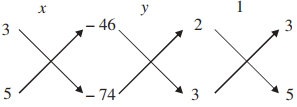
To solve the equations by the cross-multiplication method,we use the coefficients as follows:
$\frac{x}{(3)(-74) - (5)(-46)} = \frac{y}{(-46)(3) - (-74)(2)} = \frac{1}{(2)(5) - (3)(3)}$
i.e.,$\frac{x}{-222 + 230} = \frac{y}{-138 + 148} = \frac{1}{10 - 9}$
i.e.,$\frac{x}{8} = \frac{y}{10} = \frac{1}{1}$
Thus,$\frac{x}{8} = 1$ and $\frac{y}{10} = 1$,which gives $x = 8$ and $y = 10$.
Hence,the fare from the bus stand in Bangalore to Malleswaram is ₹ $8$ and the fare to Yeshwanthpur is ₹ $10$.
$2x + 3y = 46$,i.e.,$2x + 3y - 46 = 0$ $...(1)$
$3x + 5y = 74$,i.e.,$3x + 5y - 74 = 0$ $...(2)$
To solve the equations by the cross-multiplication method,we use the coefficients as follows:
$\frac{x}{(3)(-74) - (5)(-46)} = \frac{y}{(-46)(3) - (-74)(2)} = \frac{1}{(2)(5) - (3)(3)}$
i.e.,$\frac{x}{-222 + 230} = \frac{y}{-138 + 148} = \frac{1}{10 - 9}$
i.e.,$\frac{x}{8} = \frac{y}{10} = \frac{1}{1}$
Thus,$\frac{x}{8} = 1$ and $\frac{y}{10} = 1$,which gives $x = 8$ and $y = 10$.
Hence,the fare from the bus stand in Bangalore to Malleswaram is ₹ $8$ and the fare to Yeshwanthpur is ₹ $10$.
0 likes
View Solution59
EasyMCQ
For which values of $p$ does the pair of equations given below have a unique solution?
$4x + py + 8 = 0$
$2x + 2y + 2 = 0$
$4x + py + 8 = 0$
$2x + 2y + 2 = 0$
A
$p = 4$
B
$p \neq 4$
C
$p = 2$
D
$p \neq 2$
Solution
(B) The given equations are $4x + py + 8 = 0$ and $2x + 2y + 2 = 0$.
Comparing these with the standard form $a_{1}x + b_{1}y + c_{1} = 0$ and $a_{2}x + b_{2}y + c_{2} = 0$,we get:
$a_{1} = 4, b_{1} = p, c_{1} = 8$
$a_{2} = 2, b_{2} = 2, c_{2} = 2$
For a pair of linear equations to have a unique solution,the condition is $\frac{a_{1}}{a_{2}} \neq \frac{b_{1}}{b_{2}}$.
Substituting the values,we get $\frac{4}{2} \neq \frac{p}{2}$.
This simplifies to $2 \neq \frac{p}{2}$.
Multiplying both sides by $2$,we get $p \neq 4$.
Thus,for all real values of $p$ except $4$,the pair of equations has a unique solution.
Comparing these with the standard form $a_{1}x + b_{1}y + c_{1} = 0$ and $a_{2}x + b_{2}y + c_{2} = 0$,we get:
$a_{1} = 4, b_{1} = p, c_{1} = 8$
$a_{2} = 2, b_{2} = 2, c_{2} = 2$
For a pair of linear equations to have a unique solution,the condition is $\frac{a_{1}}{a_{2}} \neq \frac{b_{1}}{b_{2}}$.
Substituting the values,we get $\frac{4}{2} \neq \frac{p}{2}$.
This simplifies to $2 \neq \frac{p}{2}$.
Multiplying both sides by $2$,we get $p \neq 4$.
Thus,for all real values of $p$ except $4$,the pair of equations has a unique solution.
1 likes
View Solution60
DifficultMCQ
For what value of $k$ will the following pair of linear equations have infinitely many solutions?
$kx + 3y - (k - 3) = 0$
$12x + ky - k = 0$
$kx + 3y - (k - 3) = 0$
$12x + ky - k = 0$
A
$k = 6$
B
$k = -6$
C
$k = 0$
D
$k = \pm 6$
Solution
(A) For a pair of linear equations $a_1x + b_1y + c_1 = 0$ and $a_2x + b_2y + c_2 = 0$ to have infinitely many solutions,the condition is $\frac{a_1}{a_2} = \frac{b_1}{b_2} = \frac{c_1}{c_2}$.
Given equations are $kx + 3y - (k - 3) = 0$ and $12x + ky - k = 0$.
Here,$a_1 = k, b_1 = 3, c_1 = -(k - 3)$ and $a_2 = 12, b_2 = k, c_2 = -k$.
Applying the condition: $\frac{k}{12} = \frac{3}{k} = \frac{-(k - 3)}{-k}$.
From $\frac{k}{12} = \frac{3}{k}$,we get $k^2 = 36$,so $k = \pm 6$.
From $\frac{3}{k} = \frac{k - 3}{k}$,we get $3k = k(k - 3) \implies 3k = k^2 - 3k \implies k^2 - 6k = 0 \implies k(k - 6) = 0$. Thus,$k = 0$ or $k = 6$.
The common value satisfying both conditions is $k = 6$.
Given equations are $kx + 3y - (k - 3) = 0$ and $12x + ky - k = 0$.
Here,$a_1 = k, b_1 = 3, c_1 = -(k - 3)$ and $a_2 = 12, b_2 = k, c_2 = -k$.
Applying the condition: $\frac{k}{12} = \frac{3}{k} = \frac{-(k - 3)}{-k}$.
From $\frac{k}{12} = \frac{3}{k}$,we get $k^2 = 36$,so $k = \pm 6$.
From $\frac{3}{k} = \frac{k - 3}{k}$,we get $3k = k(k - 3) \implies 3k = k^2 - 3k \implies k^2 - 6k = 0 \implies k(k - 6) = 0$. Thus,$k = 0$ or $k = 6$.
The common value satisfying both conditions is $k = 6$.
0 likes
View Solution61
Easy
Which of the following pairs of linear equations has a unique solution,no solution,or infinitely many solutions? In case there is a unique solution,find it by using the cross-multiplication method.
$x - 3y - 3 = 0$
$3x - 9y - 2 = 0$
$x - 3y - 3 = 0$
$3x - 9y - 2 = 0$
Solution
(B) Given equations are:
$x - 3y - 3 = 0$ ... $(1)$
$3x - 9y - 2 = 0$ ... $(2)$
Comparing these with the standard form $a_1x + b_1y + c_1 = 0$ and $a_2x + b_2y + c_2 = 0$,we get:
$a_1 = 1, b_1 = -3, c_1 = -3$
$a_2 = 3, b_2 = -9, c_2 = -2$
Now,calculating the ratios:
$\frac{a_1}{a_2} = \frac{1}{3}$
$\frac{b_1}{b_2} = \frac{-3}{-9} = \frac{1}{3}$
$\frac{c_1}{c_2} = \frac{-3}{-2} = \frac{3}{2}$
Since $\frac{a_1}{a_2} = \frac{b_1}{b_2} \neq \frac{c_1}{c_2}$,the lines represented by these equations are parallel to each other.
Therefore,the system of equations has no solution.
$x - 3y - 3 = 0$ ... $(1)$
$3x - 9y - 2 = 0$ ... $(2)$
Comparing these with the standard form $a_1x + b_1y + c_1 = 0$ and $a_2x + b_2y + c_2 = 0$,we get:
$a_1 = 1, b_1 = -3, c_1 = -3$
$a_2 = 3, b_2 = -9, c_2 = -2$
Now,calculating the ratios:
$\frac{a_1}{a_2} = \frac{1}{3}$
$\frac{b_1}{b_2} = \frac{-3}{-9} = \frac{1}{3}$
$\frac{c_1}{c_2} = \frac{-3}{-2} = \frac{3}{2}$
Since $\frac{a_1}{a_2} = \frac{b_1}{b_2} \neq \frac{c_1}{c_2}$,the lines represented by these equations are parallel to each other.
Therefore,the system of equations has no solution.
0 likes
View Solution62
Difficult
Which of the following pairs of linear equations has a unique solution,no solution,or infinitely many solutions? In case there is a unique solution,find it by using the cross-multiplication method.
$2x + y = 5$
$3x + 2y = 8$
$2x + y = 5$
$3x + 2y = 8$
Solution
(A) Given equations are:
$2x + y - 5 = 0$
$3x + 2y - 8 = 0$
Comparing with $a_1x + b_1y + c_1 = 0$ and $a_2x + b_2y + c_2 = 0$:
$a_1 = 2, b_1 = 1, c_1 = -5$
$a_2 = 3, b_2 = 2, c_2 = -8$
Calculating ratios:
$\frac{a_1}{a_2} = \frac{2}{3}, \quad \frac{b_1}{b_2} = \frac{1}{2}, \quad \frac{c_1}{c_2} = \frac{-5}{-8} = \frac{5}{8}$
Since $\frac{a_1}{a_2} \neq \frac{b_1}{b_2}$,the pair of equations has a unique solution.
Using the cross-multiplication method:
$\frac{x}{b_1c_2 - b_2c_1} = \frac{y}{c_1a_2 - c_2a_1} = \frac{1}{a_1b_2 - a_2b_1}$
$\frac{x}{(1)(-8) - (2)(-5)} = \frac{y}{(-5)(3) - (-8)(2)} = \frac{1}{(2)(2) - (3)(1)}$
$\frac{x}{-8 + 10} = \frac{y}{-15 + 16} = \frac{1}{4 - 3}$
$\frac{x}{2} = \frac{y}{1} = \frac{1}{1}$
Thus,$x = 2$ and $y = 1$.
$2x + y - 5 = 0$
$3x + 2y - 8 = 0$
Comparing with $a_1x + b_1y + c_1 = 0$ and $a_2x + b_2y + c_2 = 0$:
$a_1 = 2, b_1 = 1, c_1 = -5$
$a_2 = 3, b_2 = 2, c_2 = -8$
Calculating ratios:
$\frac{a_1}{a_2} = \frac{2}{3}, \quad \frac{b_1}{b_2} = \frac{1}{2}, \quad \frac{c_1}{c_2} = \frac{-5}{-8} = \frac{5}{8}$
Since $\frac{a_1}{a_2} \neq \frac{b_1}{b_2}$,the pair of equations has a unique solution.
Using the cross-multiplication method:
$\frac{x}{b_1c_2 - b_2c_1} = \frac{y}{c_1a_2 - c_2a_1} = \frac{1}{a_1b_2 - a_2b_1}$
$\frac{x}{(1)(-8) - (2)(-5)} = \frac{y}{(-5)(3) - (-8)(2)} = \frac{1}{(2)(2) - (3)(1)}$
$\frac{x}{-8 + 10} = \frac{y}{-15 + 16} = \frac{1}{4 - 3}$
$\frac{x}{2} = \frac{y}{1} = \frac{1}{1}$
Thus,$x = 2$ and $y = 1$.
0 likes
View Solution63
Medium
Which of the following pairs of linear equations has a unique solution,no solution,or infinitely many solutions? In case there is a unique solution,find it by using the cross-multiplication method.
$3x - 5y = 20$
$6x - 10y = 40$
$3x - 5y = 20$
$6x - 10y = 40$
Solution
(D) Given equations are:
$3x - 5y - 20 = 0$ --- $(1)$
$6x - 10y - 40 = 0$ --- $(2)$
Comparing these with the standard form $a_1x + b_1y + c_1 = 0$ and $a_2x + b_2y + c_2 = 0$,we get:
$a_1 = 3, b_1 = -5, c_1 = -20$
$a_2 = 6, b_2 = -10, c_2 = -40$
Now,calculating the ratios:
$\frac{a_1}{a_2} = \frac{3}{6} = \frac{1}{2}$
$\frac{b_1}{b_2} = \frac{-5}{-10} = \frac{1}{2}$
$\frac{c_1}{c_2} = \frac{-20}{-40} = \frac{1}{2}$
Since $\frac{a_1}{a_2} = \frac{b_1}{b_2} = \frac{c_1}{c_2}$,the lines are coincident.
Therefore,the system of linear equations has infinitely many solutions.
$3x - 5y - 20 = 0$ --- $(1)$
$6x - 10y - 40 = 0$ --- $(2)$
Comparing these with the standard form $a_1x + b_1y + c_1 = 0$ and $a_2x + b_2y + c_2 = 0$,we get:
$a_1 = 3, b_1 = -5, c_1 = -20$
$a_2 = 6, b_2 = -10, c_2 = -40$
Now,calculating the ratios:
$\frac{a_1}{a_2} = \frac{3}{6} = \frac{1}{2}$
$\frac{b_1}{b_2} = \frac{-5}{-10} = \frac{1}{2}$
$\frac{c_1}{c_2} = \frac{-20}{-40} = \frac{1}{2}$
Since $\frac{a_1}{a_2} = \frac{b_1}{b_2} = \frac{c_1}{c_2}$,the lines are coincident.
Therefore,the system of linear equations has infinitely many solutions.
0 likes
View Solution64
Difficult
Which of the following pairs of linear equations has a unique solution,no solution,or infinitely many solutions? In case there is a unique solution,find it by using the cross-multiplication method.
$x - 3y - 7 = 0$
$3x - 3y - 15 = 0$
$x - 3y - 7 = 0$
$3x - 3y - 15 = 0$
Solution
(A) Given equations are:
$x - 3y - 7 = 0$ ... $(1)$
$3x - 3y - 15 = 0$ ... $(2)$
Comparing with $a_1x + b_1y + c_1 = 0$ and $a_2x + b_2y + c_2 = 0$:
$a_1 = 1, b_1 = -3, c_1 = -7$
$a_2 = 3, b_2 = -3, c_2 = -15$
Calculating ratios:
$\frac{a_1}{a_2} = \frac{1}{3}, \quad \frac{b_1}{b_2} = \frac{-3}{-3} = 1, \quad \frac{c_1}{c_2} = \frac{-7}{-15} = \frac{7}{15}$
Since $\frac{a_1}{a_2} \neq \frac{b_1}{b_2}$ (i.e.,$\frac{1}{3} \neq 1$),the system has a unique solution.
Using the cross-multiplication method:
$\frac{x}{b_1c_2 - b_2c_1} = \frac{y}{c_1a_2 - c_2a_1} = \frac{1}{a_1b_2 - a_2b_1}$
$\frac{x}{(-3)(-15) - (-3)(-7)} = \frac{y}{(-7)(3) - (-15)(1)} = \frac{1}{(1)(-3) - (3)(-3)}$
$\frac{x}{45 - 21} = \frac{y}{-21 + 15} = \frac{1}{-3 + 9}$
$\frac{x}{24} = \frac{y}{-6} = \frac{1}{6}$
For $x$: $\frac{x}{24} = \frac{1}{6} \implies x = \frac{24}{6} = 4$
For $y$: $\frac{y}{-6} = \frac{1}{6} \implies y = \frac{-6}{6} = -1$
Thus,the unique solution is $x = 4, y = -1$.
$x - 3y - 7 = 0$ ... $(1)$
$3x - 3y - 15 = 0$ ... $(2)$
Comparing with $a_1x + b_1y + c_1 = 0$ and $a_2x + b_2y + c_2 = 0$:
$a_1 = 1, b_1 = -3, c_1 = -7$
$a_2 = 3, b_2 = -3, c_2 = -15$
Calculating ratios:
$\frac{a_1}{a_2} = \frac{1}{3}, \quad \frac{b_1}{b_2} = \frac{-3}{-3} = 1, \quad \frac{c_1}{c_2} = \frac{-7}{-15} = \frac{7}{15}$
Since $\frac{a_1}{a_2} \neq \frac{b_1}{b_2}$ (i.e.,$\frac{1}{3} \neq 1$),the system has a unique solution.
Using the cross-multiplication method:
$\frac{x}{b_1c_2 - b_2c_1} = \frac{y}{c_1a_2 - c_2a_1} = \frac{1}{a_1b_2 - a_2b_1}$
$\frac{x}{(-3)(-15) - (-3)(-7)} = \frac{y}{(-7)(3) - (-15)(1)} = \frac{1}{(1)(-3) - (3)(-3)}$
$\frac{x}{45 - 21} = \frac{y}{-21 + 15} = \frac{1}{-3 + 9}$
$\frac{x}{24} = \frac{y}{-6} = \frac{1}{6}$
For $x$: $\frac{x}{24} = \frac{1}{6} \implies x = \frac{24}{6} = 4$
For $y$: $\frac{y}{-6} = \frac{1}{6} \implies y = \frac{-6}{6} = -1$
Thus,the unique solution is $x = 4, y = -1$.
1 likes
View Solution65
MediumMCQ
For which values of $a$ and $b$ does the following pair of linear equations have an infinite number of solutions?
$2x + 3y = 7$
$(a-b)x + (a+b)y = 3a + b - 2$
$2x + 3y = 7$
$(a-b)x + (a+b)y = 3a + b - 2$
A
$a=5, b=1$
B
$a=1, b=5$
C
$a=2, b=3$
D
$a=3, b=2$
Solution
(A) The given equations are:
$2x + 3y - 7 = 0$
$(a-b)x + (a+b)y - (3a + b - 2) = 0$
For a system of linear equations $\frac{a_1}{a_2}x + \frac{b_1}{b_2}y + \frac{c_1}{c_2} = 0$ to have infinitely many solutions,the condition is $\frac{a_1}{a_2} = \frac{b_1}{b_2} = \frac{c_1}{c_2}$.
Here,$\frac{a_1}{a_2} = \frac{2}{a-b}$,$\frac{b_1}{b_2} = \frac{3}{a+b}$,and $\frac{c_1}{c_2} = \frac{-7}{-(3a+b-2)} = \frac{7}{3a+b-2}$.
Equating the ratios:
$1) \frac{2}{a-b} = \frac{3}{a+b} \implies 2a + 2b = 3a - 3b \implies a - 5b = 0 \implies a = 5b$ (Equation $1$)
$2) \frac{2}{a-b} = \frac{7}{3a+b-2} \implies 6a + 2b - 4 = 7a - 7b \implies a - 9b = -4$ (Equation $2$)
Substituting $a = 5b$ into Equation $2$:
$5b - 9b = -4 \implies -4b = -4 \implies b = 1$.
Now,substituting $b = 1$ into $a = 5b$:
$a = 5(1) = 5$.
Thus,the values are $a = 5$ and $b = 1$.
$2x + 3y - 7 = 0$
$(a-b)x + (a+b)y - (3a + b - 2) = 0$
For a system of linear equations $\frac{a_1}{a_2}x + \frac{b_1}{b_2}y + \frac{c_1}{c_2} = 0$ to have infinitely many solutions,the condition is $\frac{a_1}{a_2} = \frac{b_1}{b_2} = \frac{c_1}{c_2}$.
Here,$\frac{a_1}{a_2} = \frac{2}{a-b}$,$\frac{b_1}{b_2} = \frac{3}{a+b}$,and $\frac{c_1}{c_2} = \frac{-7}{-(3a+b-2)} = \frac{7}{3a+b-2}$.
Equating the ratios:
$1) \frac{2}{a-b} = \frac{3}{a+b} \implies 2a + 2b = 3a - 3b \implies a - 5b = 0 \implies a = 5b$ (Equation $1$)
$2) \frac{2}{a-b} = \frac{7}{3a+b-2} \implies 6a + 2b - 4 = 7a - 7b \implies a - 9b = -4$ (Equation $2$)
Substituting $a = 5b$ into Equation $2$:
$5b - 9b = -4 \implies -4b = -4 \implies b = 1$.
Now,substituting $b = 1$ into $a = 5b$:
$a = 5(1) = 5$.
Thus,the values are $a = 5$ and $b = 1$.
0 likes
View Solution66
MediumMCQ
$k$ ની કઈ કિંમત માટે નીચે આપેલ સુરેખ સમીકરણોની જોડને કોઈ ઉકેલ નથી?
$3x + y = 1$
$(2k - 1)x + (k - 1)y = 2k + 1$
$3x + y = 1$
$(2k - 1)x + (k - 1)y = 2k + 1$
A
$k = 1$
B
$k = 2$
C
$k = 3$
D
$k = 4$
Solution
(B) આપેલ સમીકરણોને પ્રમાણિત સ્વરૂપમાં લખતા:
$3x + y - 1 = 0$
$(2k - 1)x + (k - 1)y - (2k + 1) = 0$
અહીં,$a_1 = 3, b_1 = 1, c_1 = -1$ અને $a_2 = 2k - 1, b_2 = k - 1, c_2 = -(2k + 1)$ છે.
સુરેખ સમીકરણોની જોડને કોઈ ઉકેલ ન હોય તેની શરત છે:
$\frac{a_1}{a_2} = \frac{b_1}{b_2} \neq \frac{c_1}{c_2}$
તેથી,$\frac{3}{2k - 1} = \frac{1}{k - 1} \neq \frac{-1}{-(2k + 1)}$
$\frac{3}{2k - 1} = \frac{1}{k - 1}$ લેતા:
$3(k - 1) = 1(2k - 1)$
$3k - 3 = 2k - 1$
$3k - 2k = -1 + 3$
$k = 2$
આમ,$k = 2$ માટે આપેલ સમીકરણોની જોડને કોઈ ઉકેલ નથી.
$3x + y - 1 = 0$
$(2k - 1)x + (k - 1)y - (2k + 1) = 0$
અહીં,$a_1 = 3, b_1 = 1, c_1 = -1$ અને $a_2 = 2k - 1, b_2 = k - 1, c_2 = -(2k + 1)$ છે.
સુરેખ સમીકરણોની જોડને કોઈ ઉકેલ ન હોય તેની શરત છે:
$\frac{a_1}{a_2} = \frac{b_1}{b_2} \neq \frac{c_1}{c_2}$
તેથી,$\frac{3}{2k - 1} = \frac{1}{k - 1} \neq \frac{-1}{-(2k + 1)}$
$\frac{3}{2k - 1} = \frac{1}{k - 1}$ લેતા:
$3(k - 1) = 1(2k - 1)$
$3k - 3 = 2k - 1$
$3k - 2k = -1 + 3$
$k = 2$
આમ,$k = 2$ માટે આપેલ સમીકરણોની જોડને કોઈ ઉકેલ નથી.
0 likes
View Solution67
Medium
Solve the following pair of linear equations by the substitution and cross-multiplication methods:
$8x + 5y = 9$
$3x + 2y = 4$
$8x + 5y = 9$
$3x + 2y = 4$
Solution
(A) Given equations are:
$8x + 5y = 9$ $...(i)$
$3x + 2y = 4$ $...(ii)$
Substitution Method:
From equation $(ii)$,we get:
$3x = 4 - 2y \implies x = \frac{4 - 2y}{3}$ $...(iii)$
Substituting $(iii)$ in $(i)$:
$8(\frac{4 - 2y}{3}) + 5y = 9$
$32 - 16y + 15y = 27$
$-y = 27 - 32$
$-y = -5 \implies y = 5$
Substituting $y = 5$ in $(iii)$:
$x = \frac{4 - 2(5)}{3} = \frac{4 - 10}{3} = \frac{-6}{3} = -2$
Thus,$x = -2, y = 5$.
Cross-multiplication Method:
$8x + 5y - 9 = 0$
$3x + 2y - 4 = 0$
Using the formula $\frac{x}{b_1c_2 - b_2c_1} = \frac{y}{c_1a_2 - c_2a_1} = \frac{1}{a_1b_2 - a_2b_1}$:
$\frac{x}{(5)(-4) - (2)(-9)} = \frac{y}{(-9)(3) - (-4)(8)} = \frac{1}{(8)(2) - (3)(5)}$
$\frac{x}{-20 + 18} = \frac{y}{-27 + 32} = \frac{1}{16 - 15}$
$\frac{x}{-2} = \frac{y}{5} = \frac{1}{1}$
$x = -2, y = 5$.
$8x + 5y = 9$ $...(i)$
$3x + 2y = 4$ $...(ii)$
Substitution Method:
From equation $(ii)$,we get:
$3x = 4 - 2y \implies x = \frac{4 - 2y}{3}$ $...(iii)$
Substituting $(iii)$ in $(i)$:
$8(\frac{4 - 2y}{3}) + 5y = 9$
$32 - 16y + 15y = 27$
$-y = 27 - 32$
$-y = -5 \implies y = 5$
Substituting $y = 5$ in $(iii)$:
$x = \frac{4 - 2(5)}{3} = \frac{4 - 10}{3} = \frac{-6}{3} = -2$
Thus,$x = -2, y = 5$.
Cross-multiplication Method:
$8x + 5y - 9 = 0$
$3x + 2y - 4 = 0$
Using the formula $\frac{x}{b_1c_2 - b_2c_1} = \frac{y}{c_1a_2 - c_2a_1} = \frac{1}{a_1b_2 - a_2b_1}$:
$\frac{x}{(5)(-4) - (2)(-9)} = \frac{y}{(-9)(3) - (-4)(8)} = \frac{1}{(8)(2) - (3)(5)}$
$\frac{x}{-20 + 18} = \frac{y}{-27 + 32} = \frac{1}{16 - 15}$
$\frac{x}{-2} = \frac{y}{5} = \frac{1}{1}$
$x = -2, y = 5$.
0 likes
View Solution68
Medium
Form the pair of linear equations in the following problems and find their solutions (if they exist) by any algebraic method.
$A$ part of monthly hostel charges is fixed and the remaining depends on the number of days one has taken food in the mess. When a student $A$ takes food for $20$ days she has to pay ₹ $1000$ as hostel charges,whereas a student $B$,who takes food for $26$ days,pays ₹ $1180$ as hostel charges. Find the fixed charges and the cost of food per day.
$A$ part of monthly hostel charges is fixed and the remaining depends on the number of days one has taken food in the mess. When a student $A$ takes food for $20$ days she has to pay ₹ $1000$ as hostel charges,whereas a student $B$,who takes food for $26$ days,pays ₹ $1180$ as hostel charges. Find the fixed charges and the cost of food per day.
Solution
(N/A) Let $x$ be the fixed monthly hostel charge and $y$ be the cost of food per day.
According to the given information:
For student $A$: $x + 20y = 1000$ $...(1)$
For student $B$: $x + 26y = 1180$ $...(2)$
Subtracting equation $(1)$ from equation $(2)$,we get:
$(x + 26y) - (x + 20y) = 1180 - 1000$
$6y = 180$
$y = 30$
Substituting $y = 30$ in equation $(1)$:
$x + 20(30) = 1000$
$x + 600 = 1000$
$x = 400$
Thus,the fixed monthly charge is ₹ $400$ and the cost of food per day is ₹ $30$.
According to the given information:
For student $A$: $x + 20y = 1000$ $...(1)$
For student $B$: $x + 26y = 1180$ $...(2)$
Subtracting equation $(1)$ from equation $(2)$,we get:
$(x + 26y) - (x + 20y) = 1180 - 1000$
$6y = 180$
$y = 30$
Substituting $y = 30$ in equation $(1)$:
$x + 20(30) = 1000$
$x + 600 = 1000$
$x = 400$
Thus,the fixed monthly charge is ₹ $400$ and the cost of food per day is ₹ $30$.
0 likes
View Solution69
Easy
Form the pair of linear equations in the following problems and find their solutions (if they exist) by any algebraic method. $A$ fraction becomes $\frac{1}{3}$ when $1$ is subtracted from the numerator and it becomes $\frac{1}{4}$ when $8$ is added to its denominator. Find the fraction.
Solution
(A) Let the fraction be $\frac{x}{y}$.
According to the given information:
$\frac{x-1}{y} = \frac{1}{3} \implies 3x - y = 3$ $...(1)$
$\frac{x}{y+8} = \frac{1}{4} \implies 4x - y = 8$ $...(2)$
Subtracting equation $(1)$ from equation $(2)$,we obtain:
$(4x - y) - (3x - y) = 8 - 3$
$x = 5$
Substituting the value of $x$ in equation $(1)$:
$3(5) - y = 3$
$15 - y = 3$
$y = 12$
Hence,the fraction is $\frac{5}{12}$.
According to the given information:
$\frac{x-1}{y} = \frac{1}{3} \implies 3x - y = 3$ $...(1)$
$\frac{x}{y+8} = \frac{1}{4} \implies 4x - y = 8$ $...(2)$
Subtracting equation $(1)$ from equation $(2)$,we obtain:
$(4x - y) - (3x - y) = 8 - 3$
$x = 5$
Substituting the value of $x$ in equation $(1)$:
$3(5) - y = 3$
$15 - y = 3$
$y = 12$
Hence,the fraction is $\frac{5}{12}$.
0 likes
View Solution70
Medium
Form the pair of linear equations in the following problems and find their solutions (if they exist) by any algebraic method.
Yash scored $40$ marks in a test,getting $3$ marks for each right answer and losing $1$ mark for each wrong answer. Had $4$ marks been awarded for each correct answer and $2$ marks been deducted for each incorrect answer,then Yash would have scored $50$ marks. How many questions were there in the test?
Yash scored $40$ marks in a test,getting $3$ marks for each right answer and losing $1$ mark for each wrong answer. Had $4$ marks been awarded for each correct answer and $2$ marks been deducted for each incorrect answer,then Yash would have scored $50$ marks. How many questions were there in the test?
Solution
(20) Let the number of right answers be $x$ and the number of wrong answers be $y$.
According to the given information:
For the first case: $3x - y = 40$ $...(1)$
For the second case: $4x - 2y = 50$
Dividing the second equation by $2$,we get: $2x - y = 25$ $...(2)$
Subtracting equation $(2)$ from equation $(1)$:
$(3x - y) - (2x - y) = 40 - 25$
$x = 15$
Substituting $x = 15$ in equation $(2)$:
$2(15) - y = 25$
$30 - y = 25$
$y = 5$
Therefore,the number of right answers is $15$ and the number of wrong answers is $5$.
Total number of questions $= x + y = 15 + 5 = 20$.
According to the given information:
For the first case: $3x - y = 40$ $...(1)$
For the second case: $4x - 2y = 50$
Dividing the second equation by $2$,we get: $2x - y = 25$ $...(2)$
Subtracting equation $(2)$ from equation $(1)$:
$(3x - y) - (2x - y) = 40 - 25$
$x = 15$
Substituting $x = 15$ in equation $(2)$:
$2(15) - y = 25$
$30 - y = 25$
$y = 5$
Therefore,the number of right answers is $15$ and the number of wrong answers is $5$.
Total number of questions $= x + y = 15 + 5 = 20$.
0 likes
View Solution71
Easy
Places $A$ and $B$ are $100 \ km$ apart on a highway. One car starts from $A$ and another from $B$ at the same time. If the cars travel in the same direction at different speeds,they meet in $5 \ hours$. If they travel towards each other,they meet in $1 \ hour$. What are the speeds of the two cars?
Solution
(A) Let the speed of the $1^{st}$ car be $u \ km/h$ and the $2^{nd}$ car be $v \ km/h$.
When the cars travel in the same direction,their relative speed is $(u - v) \ km/h$. Since they meet in $5 \ hours$ covering a distance of $100 \ km$,we have:
$5(u - v) = 100 \Rightarrow u - v = 20 \quad \dots(1)$
When the cars travel towards each other,their relative speed is $(u + v) \ km/h$. Since they meet in $1 \ hour$ covering a distance of $100 \ km$,we have:
$1(u + v) = 100 \Rightarrow u + v = 100 \quad \dots(2)$
Adding equations $(1)$ and $(2)$:
$(u - v) + (u + v) = 20 + 100$
$2u = 120 \Rightarrow u = 60 \ km/h$
Substituting $u = 60$ in equation $(2)$:
$60 + v = 100 \Rightarrow v = 40 \ km/h$
Thus,the speed of the first car is $60 \ km/h$ and the speed of the second car is $40 \ km/h$.
When the cars travel in the same direction,their relative speed is $(u - v) \ km/h$. Since they meet in $5 \ hours$ covering a distance of $100 \ km$,we have:
$5(u - v) = 100 \Rightarrow u - v = 20 \quad \dots(1)$
When the cars travel towards each other,their relative speed is $(u + v) \ km/h$. Since they meet in $1 \ hour$ covering a distance of $100 \ km$,we have:
$1(u + v) = 100 \Rightarrow u + v = 100 \quad \dots(2)$
Adding equations $(1)$ and $(2)$:
$(u - v) + (u + v) = 20 + 100$
$2u = 120 \Rightarrow u = 60 \ km/h$
Substituting $u = 60$ in equation $(2)$:
$60 + v = 100 \Rightarrow v = 40 \ km/h$
Thus,the speed of the first car is $60 \ km/h$ and the speed of the second car is $40 \ km/h$.
0 likes
View Solution72
Medium
Form the pair of linear equations in the following problems and find their solutions (if they exist) by any algebraic method.
The area of a rectangle gets reduced by $9$ square units,if its length is reduced by $5$ units and breadth is increased by $3$ units. If we increase the length by $3$ units and the breadth by $2$ units,the area increases by $67$ square units. Find the dimensions of the rectangle.
The area of a rectangle gets reduced by $9$ square units,if its length is reduced by $5$ units and breadth is increased by $3$ units. If we increase the length by $3$ units and the breadth by $2$ units,the area increases by $67$ square units. Find the dimensions of the rectangle.
Solution
(A) Let the length and breadth of the rectangle be $x$ units and $y$ units respectively.
Area $= x y$
According to the first condition:
$(x - 5)(y + 3) = xy - 9$
$xy + 3x - 5y - 15 = xy - 9$
$3x - 5y = 6$ ...$(1)$
According to the second condition:
$(x + 3)(y + 2) = xy + 67$
$xy + 2x + 3y + 6 = xy + 67$
$2x + 3y = 61$ ...$(2)$
Solving equations $(1)$ and $(2)$ by the cross-multiplication method:
$\frac{x}{(-5)(-61) - (3)(-6)} = \frac{y}{(-6)(2) - (-61)(3)} = \frac{1}{(3)(3) - (-5)(2)}$
$\frac{x}{305 + 18} = \frac{y}{-12 + 183} = \frac{1}{9 + 10}$
$\frac{x}{323} = \frac{y}{171} = \frac{1}{19}$
$x = \frac{323}{19} = 17$
$y = \frac{171}{19} = 9$
Thus,the length is $17$ units and the breadth is $9$ units.
Area $= x y$
According to the first condition:
$(x - 5)(y + 3) = xy - 9$
$xy + 3x - 5y - 15 = xy - 9$
$3x - 5y = 6$ ...$(1)$
According to the second condition:
$(x + 3)(y + 2) = xy + 67$
$xy + 2x + 3y + 6 = xy + 67$
$2x + 3y = 61$ ...$(2)$
Solving equations $(1)$ and $(2)$ by the cross-multiplication method:
$\frac{x}{(-5)(-61) - (3)(-6)} = \frac{y}{(-6)(2) - (-61)(3)} = \frac{1}{(3)(3) - (-5)(2)}$
$\frac{x}{305 + 18} = \frac{y}{-12 + 183} = \frac{1}{9 + 10}$
$\frac{x}{323} = \frac{y}{171} = \frac{1}{19}$
$x = \frac{323}{19} = 17$
$y = \frac{171}{19} = 9$
Thus,the length is $17$ units and the breadth is $9$ units.
0 likes
View Solution73
Difficult
Solve the pair of equations:
$\frac{2}{x} + \frac{3}{y} = 13$
$\frac{5}{x} - \frac{4}{y} = -2$
$\frac{2}{x} + \frac{3}{y} = 13$
$\frac{5}{x} - \frac{4}{y} = -2$
Solution
(N/A) Let us write the given pair of equations as:
$2\left(\frac{1}{x}\right) + 3\left(\frac{1}{y}\right) = 13$ $...(1)$
$5\left(\frac{1}{x}\right) - 4\left(\frac{1}{y}\right) = -2$ $...(2)$
These equations are not in the standard form $ax + by + c = 0$. However,if we substitute $\frac{1}{x} = p$ and $\frac{1}{y} = q$ in equations $(1)$ and $(2)$,we get:
$2p + 3q = 13$ $...(3)$
$5p - 4q = -2$ $...(4)$
Now,we solve these linear equations using the elimination method. Multiply equation $(3)$ by $4$ and equation $(4)$ by $3$:
$8p + 12q = 52$ $...(5)$
$15p - 12q = -6$ $...(6)$
Adding equations $(5)$ and $(6)$:
$23p = 46 \implies p = 2$
Substituting $p = 2$ in equation $(3)$:
$2(2) + 3q = 13 \implies 4 + 3q = 13 \implies 3q = 9 \implies q = 3$
Since $p = \frac{1}{x}$ and $q = \frac{1}{y}$,we have:
$\frac{1}{x} = 2 \implies x = \frac{1}{2}$
$\frac{1}{y} = 3 \implies y = \frac{1}{3}$
Thus,the solution is $x = \frac{1}{2}$ and $y = \frac{1}{3}$.
$2\left(\frac{1}{x}\right) + 3\left(\frac{1}{y}\right) = 13$ $...(1)$
$5\left(\frac{1}{x}\right) - 4\left(\frac{1}{y}\right) = -2$ $...(2)$
These equations are not in the standard form $ax + by + c = 0$. However,if we substitute $\frac{1}{x} = p$ and $\frac{1}{y} = q$ in equations $(1)$ and $(2)$,we get:
$2p + 3q = 13$ $...(3)$
$5p - 4q = -2$ $...(4)$
Now,we solve these linear equations using the elimination method. Multiply equation $(3)$ by $4$ and equation $(4)$ by $3$:
$8p + 12q = 52$ $...(5)$
$15p - 12q = -6$ $...(6)$
Adding equations $(5)$ and $(6)$:
$23p = 46 \implies p = 2$
Substituting $p = 2$ in equation $(3)$:
$2(2) + 3q = 13 \implies 4 + 3q = 13 \implies 3q = 9 \implies q = 3$
Since $p = \frac{1}{x}$ and $q = \frac{1}{y}$,we have:
$\frac{1}{x} = 2 \implies x = \frac{1}{2}$
$\frac{1}{y} = 3 \implies y = \frac{1}{3}$
Thus,the solution is $x = \frac{1}{2}$ and $y = \frac{1}{3}$.
0 likes
View Solution74
Difficult
Solve the following pair of equations by reducing them to a pair of linear equations:
$\frac{5}{x-1} + \frac{1}{y-2} = 2$
$\frac{6}{x-1} - \frac{3}{y-2} = 1$
$\frac{5}{x-1} + \frac{1}{y-2} = 2$
$\frac{6}{x-1} - \frac{3}{y-2} = 1$
Solution
(A) Let us substitute $\frac{1}{x-1} = p$ and $\frac{1}{y-2} = q$. Then the given equations can be written as:
$5p + q = 2$ $...(1)$
$6p - 3q = 1$ $...(2)$
To solve these,multiply equation $(1)$ by $3$:
$15p + 3q = 6$ $...(3)$
Adding equation $(2)$ and $(3)$:
$(6p - 3q) + (15p + 3q) = 1 + 6$
$21p = 7$
$p = \frac{7}{21} = \frac{1}{3}$
Substitute $p = \frac{1}{3}$ into equation $(1)$:
$5(\frac{1}{3}) + q = 2$
$\frac{5}{3} + q = 2$
$q = 2 - \frac{5}{3} = \frac{6-5}{3} = \frac{1}{3}$
Now,substitute back the values of $p$ and $q$:
$\frac{1}{x-1} = \frac{1}{3} \implies x-1 = 3 \implies x = 4$
$\frac{1}{y-2} = \frac{1}{3} \implies y-2 = 3 \implies y = 5$
Thus,the solution is $x = 4, y = 5$.
$5p + q = 2$ $...(1)$
$6p - 3q = 1$ $...(2)$
To solve these,multiply equation $(1)$ by $3$:
$15p + 3q = 6$ $...(3)$
Adding equation $(2)$ and $(3)$:
$(6p - 3q) + (15p + 3q) = 1 + 6$
$21p = 7$
$p = \frac{7}{21} = \frac{1}{3}$
Substitute $p = \frac{1}{3}$ into equation $(1)$:
$5(\frac{1}{3}) + q = 2$
$\frac{5}{3} + q = 2$
$q = 2 - \frac{5}{3} = \frac{6-5}{3} = \frac{1}{3}$
Now,substitute back the values of $p$ and $q$:
$\frac{1}{x-1} = \frac{1}{3} \implies x-1 = 3 \implies x = 4$
$\frac{1}{y-2} = \frac{1}{3} \implies y-2 = 3 \implies y = 5$
Thus,the solution is $x = 4, y = 5$.
0 likes
View Solution75
Difficult
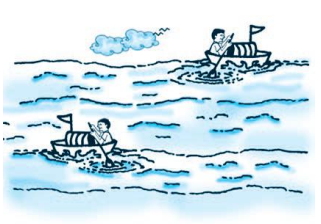
$A$ boat goes $30\, km$ upstream and $44\, km$ downstream in $10\, hours.$ In $13\, hours,$ it can go $40\, km$ upstream and $55\, km$ downstream. Determine the speed of the stream and that of the boat in still water.
Solution
(N/A) Let the speed of the boat in still water be $x\, km/h$ and the speed of the stream be $y\, km/h.$
Then the speed of the boat downstream $= (x+y)\, km/h$ and the speed of the boat upstream $= (x-y)\, km/h.$
Using the formula,$\text{time} = \frac{\text{distance}}{\text{speed}}.$
In the first case,the total time taken is $10\, hours$ for $30\, km$ upstream and $44\, km$ downstream:
$\frac{30}{x-y} + \frac{44}{x+y} = 10 \quad ...(1)$
In the second case,the total time taken is $13\, hours$ for $40\, km$ upstream and $55\, km$ downstream:
$\frac{40}{x-y} + \frac{55}{x+y} = 13 \quad ...(2)$
Let $\frac{1}{x-y} = u$ and $\frac{1}{x+y} = v \quad ...(3)$
Substituting these into equations $(1)$ and $(2)$:
$30u + 44v = 10 \quad ...(4)$
$40u + 55v = 13 \quad ...(5)$
Solving these using the elimination method:
Multiply $(4)$ by $4$ and $(5)$ by $3$:
$120u + 176v = 40$
$120u + 165v = 39$
Subtracting the equations: $11v = 1 \implies v = \frac{1}{11}.$
Substituting $v = \frac{1}{11}$ in $(4)$:
$30u + 44(\frac{1}{11}) = 10 \implies 30u + 4 = 10 \implies 30u = 6 \implies u = \frac{1}{5}.$
Now,$\frac{1}{x-y} = \frac{1}{5} \implies x-y = 5$ and $\frac{1}{x+y} = \frac{1}{11} \implies x+y = 11.$
Adding these: $2x = 16 \implies x = 8.$
Subtracting these: $2y = 6 \implies y = 3.$
Thus,the speed of the boat in still water is $8\, km/h$ and the speed of the stream is $3\, km/h.$
Then the speed of the boat downstream $= (x+y)\, km/h$ and the speed of the boat upstream $= (x-y)\, km/h.$
Using the formula,$\text{time} = \frac{\text{distance}}{\text{speed}}.$
In the first case,the total time taken is $10\, hours$ for $30\, km$ upstream and $44\, km$ downstream:
$\frac{30}{x-y} + \frac{44}{x+y} = 10 \quad ...(1)$
In the second case,the total time taken is $13\, hours$ for $40\, km$ upstream and $55\, km$ downstream:
$\frac{40}{x-y} + \frac{55}{x+y} = 13 \quad ...(2)$
Let $\frac{1}{x-y} = u$ and $\frac{1}{x+y} = v \quad ...(3)$
Substituting these into equations $(1)$ and $(2)$:
$30u + 44v = 10 \quad ...(4)$
$40u + 55v = 13 \quad ...(5)$
Solving these using the elimination method:
Multiply $(4)$ by $4$ and $(5)$ by $3$:
$120u + 176v = 40$
$120u + 165v = 39$
Subtracting the equations: $11v = 1 \implies v = \frac{1}{11}.$
Substituting $v = \frac{1}{11}$ in $(4)$:
$30u + 44(\frac{1}{11}) = 10 \implies 30u + 4 = 10 \implies 30u = 6 \implies u = \frac{1}{5}.$
Now,$\frac{1}{x-y} = \frac{1}{5} \implies x-y = 5$ and $\frac{1}{x+y} = \frac{1}{11} \implies x+y = 11.$
Adding these: $2x = 16 \implies x = 8.$
Subtracting these: $2y = 6 \implies y = 3.$
Thus,the speed of the boat in still water is $8\, km/h$ and the speed of the stream is $3\, km/h.$
0 likes
View Solution76
Medium
Solve the following pair of equations by reducing them to a pair of linear equations:
$\frac{1}{2x} + \frac{1}{3y} = 2$
$\frac{1}{3x} + \frac{1}{2y} = \frac{13}{6}$
$\frac{1}{2x} + \frac{1}{3y} = 2$
$\frac{1}{3x} + \frac{1}{2y} = \frac{13}{6}$
Solution
(X=1/2, Y=1/3) Given equations:
$\frac{1}{2x} + \frac{1}{3y} = 2$ ...$(1)$
$\frac{1}{3x} + \frac{1}{2y} = \frac{13}{6}$ ...$(2)$
Let $\frac{1}{x} = p$ and $\frac{1}{y} = q$. Substituting these into the equations:
$\frac{p}{2} + \frac{q}{3} = 2 \Rightarrow 3p + 2q = 12$ ...$(3)$
$\frac{p}{3} + \frac{q}{2} = \frac{13}{6} \Rightarrow 2p + 3q = 13$ ...$(4)$
Multiply equation $(3)$ by $3$ and equation $(4)$ by $2$:
$9p + 6q = 36$ ...$(5)$
$4p + 6q = 26$ ...$(6)$
Subtracting $(6)$ from $(5)$:
$(9p - 4p) + (6q - 6q) = 36 - 26$
$5p = 10 \Rightarrow p = 2$
Substitute $p = 2$ in equation $(3)$:
$3(2) + 2q = 12$
$6 + 2q = 12 \Rightarrow 2q = 6 \Rightarrow q = 3$
Since $p = \frac{1}{x} = 2$,we get $x = \frac{1}{2}$.
Since $q = \frac{1}{y} = 3$,we get $y = \frac{1}{3}$.
$\frac{1}{2x} + \frac{1}{3y} = 2$ ...$(1)$
$\frac{1}{3x} + \frac{1}{2y} = \frac{13}{6}$ ...$(2)$
Let $\frac{1}{x} = p$ and $\frac{1}{y} = q$. Substituting these into the equations:
$\frac{p}{2} + \frac{q}{3} = 2 \Rightarrow 3p + 2q = 12$ ...$(3)$
$\frac{p}{3} + \frac{q}{2} = \frac{13}{6} \Rightarrow 2p + 3q = 13$ ...$(4)$
Multiply equation $(3)$ by $3$ and equation $(4)$ by $2$:
$9p + 6q = 36$ ...$(5)$
$4p + 6q = 26$ ...$(6)$
Subtracting $(6)$ from $(5)$:
$(9p - 4p) + (6q - 6q) = 36 - 26$
$5p = 10 \Rightarrow p = 2$
Substitute $p = 2$ in equation $(3)$:
$3(2) + 2q = 12$
$6 + 2q = 12 \Rightarrow 2q = 6 \Rightarrow q = 3$
Since $p = \frac{1}{x} = 2$,we get $x = \frac{1}{2}$.
Since $q = \frac{1}{y} = 3$,we get $y = \frac{1}{3}$.
0 likes
View Solution77
Difficult
Solve the following pair of equations by reducing them to a pair of linear equations:
$\frac{2}{\sqrt{x}} + \frac{3}{\sqrt{y}} = 2$
$\frac{4}{\sqrt{x}} - \frac{9}{\sqrt{y}} = -1$
$\frac{2}{\sqrt{x}} + \frac{3}{\sqrt{y}} = 2$
$\frac{4}{\sqrt{x}} - \frac{9}{\sqrt{y}} = -1$
Solution
(X=4, Y=9) Let $\frac{1}{\sqrt{x}} = p$ and $\frac{1}{\sqrt{y}} = q$.
Substituting these into the given equations,we obtain:
$2p + 3q = 2$ $...(1)$
$4p - 9q = -1$ $...(2)$
To eliminate $q$,multiply equation $(1)$ by $3$:
$6p + 9q = 6$ $...(3)$
Adding equation $(2)$ and $(3)$:
$(4p - 9q) + (6p + 9q) = -1 + 6$
$10p = 5$
$p = \frac{5}{10} = \frac{1}{2}$
Substitute $p = \frac{1}{2}$ into equation $(1)$:
$2(\frac{1}{2}) + 3q = 2$
$1 + 3q = 2$
$3q = 1$
$q = \frac{1}{3}$
Now,solve for $x$ and $y$:
$p = \frac{1}{\sqrt{x}} = \frac{1}{2} \implies \sqrt{x} = 2 \implies x = 4$
$q = \frac{1}{\sqrt{y}} = \frac{1}{3} \implies \sqrt{y} = 3 \implies y = 9$
Thus,the solution is $x = 4, y = 9$.
Substituting these into the given equations,we obtain:
$2p + 3q = 2$ $...(1)$
$4p - 9q = -1$ $...(2)$
To eliminate $q$,multiply equation $(1)$ by $3$:
$6p + 9q = 6$ $...(3)$
Adding equation $(2)$ and $(3)$:
$(4p - 9q) + (6p + 9q) = -1 + 6$
$10p = 5$
$p = \frac{5}{10} = \frac{1}{2}$
Substitute $p = \frac{1}{2}$ into equation $(1)$:
$2(\frac{1}{2}) + 3q = 2$
$1 + 3q = 2$
$3q = 1$
$q = \frac{1}{3}$
Now,solve for $x$ and $y$:
$p = \frac{1}{\sqrt{x}} = \frac{1}{2} \implies \sqrt{x} = 2 \implies x = 4$
$q = \frac{1}{\sqrt{y}} = \frac{1}{3} \implies \sqrt{y} = 3 \implies y = 9$
Thus,the solution is $x = 4, y = 9$.
0 likes
View Solution78
Medium
Solve the following pair of equations by reducing them to a pair of linear equations:
$\frac{4}{x} + 3y = 14$
$\frac{3}{x} - 4y = 23$
$\frac{4}{x} + 3y = 14$
$\frac{3}{x} - 4y = 23$
Solution
(A) Given equations are:
$\frac{4}{x} + 3y = 14$ $...(1)$
$\frac{3}{x} - 4y = 23$ $...(2)$
Let $\frac{1}{x} = p$. Substituting this in the equations,we get:
$4p + 3y = 14$ $...(3)$
$3p - 4y = 23$ $...(4)$
Using the elimination method,multiply equation $(3)$ by $4$ and equation $(4)$ by $3$:
$16p + 12y = 56$ $...(5)$
$9p - 12y = 69$ $...(6)$
Adding equations $(5)$ and $(6)$:
$25p = 125$
$p = 5$
Since $p = \frac{1}{x}$,we have $\frac{1}{x} = 5$,which implies $x = \frac{1}{5}$.
Substitute $p = 5$ in equation $(3)$:
$4(5) + 3y = 14$
$20 + 3y = 14$
$3y = 14 - 20$
$3y = -6$
$y = -2$
Thus,the solution is $x = \frac{1}{5}$ and $y = -2$.
$\frac{4}{x} + 3y = 14$ $...(1)$
$\frac{3}{x} - 4y = 23$ $...(2)$
Let $\frac{1}{x} = p$. Substituting this in the equations,we get:
$4p + 3y = 14$ $...(3)$
$3p - 4y = 23$ $...(4)$
Using the elimination method,multiply equation $(3)$ by $4$ and equation $(4)$ by $3$:
$16p + 12y = 56$ $...(5)$
$9p - 12y = 69$ $...(6)$
Adding equations $(5)$ and $(6)$:
$25p = 125$
$p = 5$
Since $p = \frac{1}{x}$,we have $\frac{1}{x} = 5$,which implies $x = \frac{1}{5}$.
Substitute $p = 5$ in equation $(3)$:
$4(5) + 3y = 14$
$20 + 3y = 14$
$3y = 14 - 20$
$3y = -6$
$y = -2$
Thus,the solution is $x = \frac{1}{5}$ and $y = -2$.
0 likes
View Solution79
MediumMCQ
Solve the following pairs of equations by reducing them to a pair of linear equations:
$\frac{5}{x-1} + \frac{1}{y-2} = 2$
$\frac{6}{x-1} - \frac{3}{y-2} = 1$
$\frac{5}{x-1} + \frac{1}{y-2} = 2$
$\frac{6}{x-1} - \frac{3}{y-2} = 1$
A
$x = 4, y = 5$
B
$x = 5, y = 4$
C
$x = 2, y = 3$
D
$x = 3, y = 2$
Solution
(A) Let $u = \frac{1}{x-1}$ and $v = \frac{1}{y-2}$.
Substituting these into the given equations,we get:
$5u + v = 2$ --- $(1)$
$6u - 3v = 1$ --- $(2)$
Multiply equation $(1)$ by $3$ to eliminate $v$:
$15u + 3v = 6$ --- $(3)$
Adding equation $(2)$ and $(3)$:
$(6u - 3v) + (15u + 3v) = 1 + 6$
$21u = 7$
$u = \frac{7}{21} = \frac{1}{3}$
Substitute $u = \frac{1}{3}$ into equation $(1)$:
$5(\frac{1}{3}) + v = 2$
$\frac{5}{3} + v = 2$
$v = 2 - \frac{5}{3} = \frac{6-5}{3} = \frac{1}{3}$
Now,substitute back the values of $u$ and $v$:
$\frac{1}{x-1} = \frac{1}{3} \implies x-1 = 3 \implies x = 4$
$\frac{1}{y-2} = \frac{1}{3} \implies y-2 = 3 \implies y = 5$
Thus,the solution is $x = 4, y = 5$.
Substituting these into the given equations,we get:
$5u + v = 2$ --- $(1)$
$6u - 3v = 1$ --- $(2)$
Multiply equation $(1)$ by $3$ to eliminate $v$:
$15u + 3v = 6$ --- $(3)$
Adding equation $(2)$ and $(3)$:
$(6u - 3v) + (15u + 3v) = 1 + 6$
$21u = 7$
$u = \frac{7}{21} = \frac{1}{3}$
Substitute $u = \frac{1}{3}$ into equation $(1)$:
$5(\frac{1}{3}) + v = 2$
$\frac{5}{3} + v = 2$
$v = 2 - \frac{5}{3} = \frac{6-5}{3} = \frac{1}{3}$
Now,substitute back the values of $u$ and $v$:
$\frac{1}{x-1} = \frac{1}{3} \implies x-1 = 3 \implies x = 4$
$\frac{1}{y-2} = \frac{1}{3} \implies y-2 = 3 \implies y = 5$
Thus,the solution is $x = 4, y = 5$.
0 likes
View Solution80
Medium
Solve the following pairs of equations by reducing them to a pair of linear equations:
$\frac{7x - 2y}{xy} = 5$
$\frac{8x + 7y}{xy} = 15$
$\frac{7x - 2y}{xy} = 5$
$\frac{8x + 7y}{xy} = 15$
Solution
(A) Given equations are:
$1$) $\frac{7x - 2y}{xy} = 5$
$2$) $\frac{8x + 7y}{xy} = 15$
Step $1$: Simplify the equations by dividing each term in the numerator by the denominator $xy$:
Equation $(1)$ becomes: $\frac{7x}{xy} - \frac{2y}{xy} = 5 \implies \frac{7}{y} - \frac{2}{x} = 5$
Equation $(2)$ becomes: $\frac{8x}{xy} + \frac{7y}{xy} = 15 \implies \frac{8}{y} + \frac{7}{x} = 15$
Step $2$: Let $u = \frac{1}{x}$ and $v = \frac{1}{y}$. The equations become:
$(i)$ $-2u + 7v = 5$
(ii) $7u + 8v = 15$
Step $3$: Solve the system of linear equations using the elimination method.
Multiply $(i)$ by $7$ and (ii) by $2$:
$-14u + 49v = 35$
$14u + 16v = 30$
Adding the two equations: $65v = 65 \implies v = 1$.
Step $4$: Substitute $v = 1$ into $(i)$:
$-2u + 7(1) = 5 \implies -2u = -2 \implies u = 1$.
Step $5$: Find $x$ and $y$:
Since $u = \frac{1}{x} = 1 \implies x = 1$.
Since $v = \frac{1}{y} = 1 \implies y = 1$.
Final Answer: $x = 1, y = 1$.
$1$) $\frac{7x - 2y}{xy} = 5$
$2$) $\frac{8x + 7y}{xy} = 15$
Step $1$: Simplify the equations by dividing each term in the numerator by the denominator $xy$:
Equation $(1)$ becomes: $\frac{7x}{xy} - \frac{2y}{xy} = 5 \implies \frac{7}{y} - \frac{2}{x} = 5$
Equation $(2)$ becomes: $\frac{8x}{xy} + \frac{7y}{xy} = 15 \implies \frac{8}{y} + \frac{7}{x} = 15$
Step $2$: Let $u = \frac{1}{x}$ and $v = \frac{1}{y}$. The equations become:
$(i)$ $-2u + 7v = 5$
(ii) $7u + 8v = 15$
Step $3$: Solve the system of linear equations using the elimination method.
Multiply $(i)$ by $7$ and (ii) by $2$:
$-14u + 49v = 35$
$14u + 16v = 30$
Adding the two equations: $65v = 65 \implies v = 1$.
Step $4$: Substitute $v = 1$ into $(i)$:
$-2u + 7(1) = 5 \implies -2u = -2 \implies u = 1$.
Step $5$: Find $x$ and $y$:
Since $u = \frac{1}{x} = 1 \implies x = 1$.
Since $v = \frac{1}{y} = 1 \implies y = 1$.
Final Answer: $x = 1, y = 1$.
0 likes
View Solution81
Medium
Solve the following pair of equations by reducing them to a pair of linear equations:
$6x + 3y = 6xy$
$2x + 4y = 5xy$
$6x + 3y = 6xy$
$2x + 4y = 5xy$
Solution
(A) Given equations are:
$(1)$ $6x + 3y = 6xy$
$(2)$ $2x + 4y = 5xy$
Divide both equations by $xy$:
From $(1)$: $\frac{6x}{xy} + \frac{3y}{xy} = \frac{6xy}{xy} \implies \frac{6}{y} + \frac{3}{x} = 6$
From $(2)$: $\frac{2x}{xy} + \frac{4y}{xy} = \frac{5xy}{xy} \implies \frac{2}{y} + \frac{4}{x} = 5$
Let $u = \frac{1}{x}$ and $v = \frac{1}{y}$. The equations become:
$(3)$ $3u + 6v = 6$
$(4)$ $4u + 2v = 5$
Multiply $(4)$ by $3$ to eliminate $v$:
$12u + 6v = 15$ $(5)$
Subtract $(3)$ from $(5)$:
$(12u + 6v) - (3u + 6v) = 15 - 6$
$9u = 9 \implies u = 1$
Substitute $u = 1$ into $(3)$:
$3(1) + 6v = 6 \implies 6v = 3 \implies v = \frac{1}{2}$
Since $u = \frac{1}{x} = 1 \implies x = 1$
Since $v = \frac{1}{y} = \frac{1}{2} \implies y = 2$
Thus,the solution is $(x, y) = (1, 2)$.
$(1)$ $6x + 3y = 6xy$
$(2)$ $2x + 4y = 5xy$
Divide both equations by $xy$:
From $(1)$: $\frac{6x}{xy} + \frac{3y}{xy} = \frac{6xy}{xy} \implies \frac{6}{y} + \frac{3}{x} = 6$
From $(2)$: $\frac{2x}{xy} + \frac{4y}{xy} = \frac{5xy}{xy} \implies \frac{2}{y} + \frac{4}{x} = 5$
Let $u = \frac{1}{x}$ and $v = \frac{1}{y}$. The equations become:
$(3)$ $3u + 6v = 6$
$(4)$ $4u + 2v = 5$
Multiply $(4)$ by $3$ to eliminate $v$:
$12u + 6v = 15$ $(5)$
Subtract $(3)$ from $(5)$:
$(12u + 6v) - (3u + 6v) = 15 - 6$
$9u = 9 \implies u = 1$
Substitute $u = 1$ into $(3)$:
$3(1) + 6v = 6 \implies 6v = 3 \implies v = \frac{1}{2}$
Since $u = \frac{1}{x} = 1 \implies x = 1$
Since $v = \frac{1}{y} = \frac{1}{2} \implies y = 2$
Thus,the solution is $(x, y) = (1, 2)$.
0 likes
View Solution82
Difficult
Solve the following pairs of equations by reducing them to a pair of linear equations:
$\frac{10}{x+y} + \frac{2}{x-y} = 4$
$\frac{15}{x+y} - \frac{5}{x-y} = -2$
$\frac{10}{x+y} + \frac{2}{x-y} = 4$
$\frac{15}{x+y} - \frac{5}{x-y} = -2$
Solution
(X=3, Y=2) Let $u = \frac{1}{x+y}$ and $v = \frac{1}{x-y}$.
The equations become:
$10u + 2v = 4$ --- $(1)$
$15u - 5v = -2$ --- $(2)$
Multiply $(1)$ by $5$ and $(2)$ by $2$ to eliminate $v$:
$50u + 10v = 20$
$30u - 10v = -4$
Adding these equations: $80u = 16$,so $u = \frac{16}{80} = \frac{1}{5}$.
Substitute $u = \frac{1}{5}$ into $(1)$:
$10(\frac{1}{5}) + 2v = 4 \implies 2 + 2v = 4 \implies 2v = 2 \implies v = 1$.
Now,$\frac{1}{x+y} = \frac{1}{5} \implies x+y = 5$ --- $(3)$
And $\frac{1}{x-y} = 1 \implies x-y = 1$ --- $(4)$
Adding $(3)$ and $(4)$: $2x = 6 \implies x = 3$.
Subtracting $(4)$ from $(3)$: $2y = 4 \implies y = 2$.
Thus,the solution is $x = 3$ and $y = 2$.
The equations become:
$10u + 2v = 4$ --- $(1)$
$15u - 5v = -2$ --- $(2)$
Multiply $(1)$ by $5$ and $(2)$ by $2$ to eliminate $v$:
$50u + 10v = 20$
$30u - 10v = -4$
Adding these equations: $80u = 16$,so $u = \frac{16}{80} = \frac{1}{5}$.
Substitute $u = \frac{1}{5}$ into $(1)$:
$10(\frac{1}{5}) + 2v = 4 \implies 2 + 2v = 4 \implies 2v = 2 \implies v = 1$.
Now,$\frac{1}{x+y} = \frac{1}{5} \implies x+y = 5$ --- $(3)$
And $\frac{1}{x-y} = 1 \implies x-y = 1$ --- $(4)$
Adding $(3)$ and $(4)$: $2x = 6 \implies x = 3$.
Subtracting $(4)$ from $(3)$: $2y = 4 \implies y = 2$.
Thus,the solution is $x = 3$ and $y = 2$.
0 likes
View Solution83
Difficult
Solve the following pair of equations by reducing them to a pair of linear equations:
$\frac{1}{3x+y} + \frac{1}{3x-y} = \frac{3}{4}$
$\frac{1}{2(3x+y)} - \frac{1}{2(3x-y)} = -\frac{1}{8}$
$\frac{1}{3x+y} + \frac{1}{3x-y} = \frac{3}{4}$
$\frac{1}{2(3x+y)} - \frac{1}{2(3x-y)} = -\frac{1}{8}$
Solution
(N/A) Let $u = \frac{1}{3x+y}$ and $v = \frac{1}{3x-y}$.
Substituting these into the given equations:
$u + v = \frac{3}{4}$ --- $(1)$
$\frac{1}{2}u - \frac{1}{2}v = -\frac{1}{8}$ --- $(2)$
Multiply equation $(2)$ by $2$ to simplify:
$u - v = -\frac{1}{4}$ --- $(3)$
Adding equation $(1)$ and $(3)$:
$(u + v) + (u - v) = \frac{3}{4} - \frac{1}{4}$
$2u = \frac{2}{4} = \frac{1}{2}$
$u = \frac{1}{4}$
Substitute $u = \frac{1}{4}$ into equation $(1)$:
$\frac{1}{4} + v = \frac{3}{4}$
$v = \frac{3}{4} - \frac{1}{4} = \frac{2}{4} = \frac{1}{2}$
Now,solve for $x$ and $y$:
$3x+y = \frac{1}{u} = 4$ --- $(4)$
$3x-y = \frac{1}{v} = 2$ --- $(5)$
Adding $(4)$ and $(5)$:
$6x = 6 \implies x = 1$
Substitute $x = 1$ into $(4)$:
$3(1) + y = 4 \implies y = 1$
Thus,the solution is $x = 1, y = 1$.
Substituting these into the given equations:
$u + v = \frac{3}{4}$ --- $(1)$
$\frac{1}{2}u - \frac{1}{2}v = -\frac{1}{8}$ --- $(2)$
Multiply equation $(2)$ by $2$ to simplify:
$u - v = -\frac{1}{4}$ --- $(3)$
Adding equation $(1)$ and $(3)$:
$(u + v) + (u - v) = \frac{3}{4} - \frac{1}{4}$
$2u = \frac{2}{4} = \frac{1}{2}$
$u = \frac{1}{4}$
Substitute $u = \frac{1}{4}$ into equation $(1)$:
$\frac{1}{4} + v = \frac{3}{4}$
$v = \frac{3}{4} - \frac{1}{4} = \frac{2}{4} = \frac{1}{2}$
Now,solve for $x$ and $y$:
$3x+y = \frac{1}{u} = 4$ --- $(4)$
$3x-y = \frac{1}{v} = 2$ --- $(5)$
Adding $(4)$ and $(5)$:
$6x = 6 \implies x = 1$
Substitute $x = 1$ into $(4)$:
$3(1) + y = 4 \implies y = 1$
Thus,the solution is $x = 1, y = 1$.
0 likes
View Solution84
Easy
Formulate the following problems as a pair of equations, and hence find their solutions:
Ritu can row downstream $20\, km$ in $2\, hours,$ and upstream $4\, km$ in $2\, hours.$ Find her speed of rowing in still water and the speed of the current.
Ritu can row downstream $20\, km$ in $2\, hours,$ and upstream $4\, km$ in $2\, hours.$ Find her speed of rowing in still water and the speed of the current.
Solution
(A) Let the speed of Ritu in still water be $x\, km/h$ and the speed of the stream be $y\, km/h$.
Speed of Ritu while rowing:
Upstream $= (x - y)\, km/h$
Downstream $= (x + y)\, km/h$
According to the problem:
For downstream: $2(x + y) = 20 \Rightarrow x + y = 10$ $...(1)$
For upstream: $2(x - y) = 4 \Rightarrow x - y = 2$ $...(2)$
Adding equations $(1)$ and $(2)$:
$(x + y) + (x - y) = 10 + 2$
$2x = 12 \Rightarrow x = 6$
Substituting $x = 6$ in equation $(1)$:
$6 + y = 10 \Rightarrow y = 4$
Hence, Ritu's speed in still water is $6\, km/h$ and the speed of the current is $4\, km/h$.
Speed of Ritu while rowing:
Upstream $= (x - y)\, km/h$
Downstream $= (x + y)\, km/h$
According to the problem:
For downstream: $2(x + y) = 20 \Rightarrow x + y = 10$ $...(1)$
For upstream: $2(x - y) = 4 \Rightarrow x - y = 2$ $...(2)$
Adding equations $(1)$ and $(2)$:
$(x + y) + (x - y) = 10 + 2$
$2x = 12 \Rightarrow x = 6$
Substituting $x = 6$ in equation $(1)$:
$6 + y = 10 \Rightarrow y = 4$
Hence, Ritu's speed in still water is $6\, km/h$ and the speed of the current is $4\, km/h$.
0 likes
View Solution85
Medium
Formulate the following problems as a pair of equations,and hence find their solutions:
$2$ women and $5$ men can together finish an embroidery work in $4$ days,while $3$ women and $6$ men can finish it in $3$ days. Find the time taken by $1$ woman alone to finish the work,and also that taken by $1$ man alone.
$2$ women and $5$ men can together finish an embroidery work in $4$ days,while $3$ women and $6$ men can finish it in $3$ days. Find the time taken by $1$ woman alone to finish the work,and also that taken by $1$ man alone.
Solution
(A) Let the number of days taken by a woman and a man be $x$ and $y$ respectively.
Therefore,the work done by a woman in $1$ day $= \frac{1}{x}$.
The work done by a man in $1$ day $= \frac{1}{y}$.
According to the problem:
$4(\frac{2}{x} + \frac{5}{y}) = 1 \Rightarrow \frac{2}{x} + \frac{5}{y} = \frac{1}{4}$ $(i)$
$3(\frac{3}{x} + \frac{6}{y}) = 1 \Rightarrow \frac{3}{x} + \frac{6}{y} = \frac{1}{3}$ $(ii)$
Let $\frac{1}{x} = p$ and $\frac{1}{y} = q$. Substituting these into the equations:
$2p + 5q = \frac{1}{4} \Rightarrow 8p + 20q = 1$ $(iii)$
$3p + 6q = \frac{1}{3} \Rightarrow 9p + 18q = 1$ $(iv)$
Solving by cross-multiplication:
$\frac{p}{(20)(-1) - (18)(-1)} = \frac{q}{(1)(9) - (1)(8)} = \frac{1}{(8)(18) - (20)(9)}$
$\frac{p}{-20 + 18} = \frac{q}{9 - 8} = \frac{1}{144 - 180}$
$\frac{p}{-2} = \frac{q}{1} = \frac{1}{-36}$
$p = \frac{-2}{-36} = \frac{1}{18}$ and $q = \frac{1}{-36} = -\frac{1}{36}$ (Wait,re-calculating: $p = \frac{1}{18}, q = \frac{1}{36}$).
Thus,$x = 18$ and $y = 36$.
Therefore,$1$ woman alone takes $18$ days and $1$ man alone takes $36$ days.
Therefore,the work done by a woman in $1$ day $= \frac{1}{x}$.
The work done by a man in $1$ day $= \frac{1}{y}$.
According to the problem:
$4(\frac{2}{x} + \frac{5}{y}) = 1 \Rightarrow \frac{2}{x} + \frac{5}{y} = \frac{1}{4}$ $(i)$
$3(\frac{3}{x} + \frac{6}{y}) = 1 \Rightarrow \frac{3}{x} + \frac{6}{y} = \frac{1}{3}$ $(ii)$
Let $\frac{1}{x} = p$ and $\frac{1}{y} = q$. Substituting these into the equations:
$2p + 5q = \frac{1}{4} \Rightarrow 8p + 20q = 1$ $(iii)$
$3p + 6q = \frac{1}{3} \Rightarrow 9p + 18q = 1$ $(iv)$
Solving by cross-multiplication:
$\frac{p}{(20)(-1) - (18)(-1)} = \frac{q}{(1)(9) - (1)(8)} = \frac{1}{(8)(18) - (20)(9)}$
$\frac{p}{-20 + 18} = \frac{q}{9 - 8} = \frac{1}{144 - 180}$
$\frac{p}{-2} = \frac{q}{1} = \frac{1}{-36}$
$p = \frac{-2}{-36} = \frac{1}{18}$ and $q = \frac{1}{-36} = -\frac{1}{36}$ (Wait,re-calculating: $p = \frac{1}{18}, q = \frac{1}{36}$).
Thus,$x = 18$ and $y = 36$.
Therefore,$1$ woman alone takes $18$ days and $1$ man alone takes $36$ days.
0 likes
View Solution86
Difficult
Formulate the following problems as a pair of equations,and hence find their solutions:
Roohi travels $300 \ km$ to her home partly by train and partly by bus. She takes $4 \ hours$ if she travels $60 \ km$ by train and the remaining by bus. If she travels $100 \ km$ by train and the remaining by bus,she takes $10 \ minutes$ longer. Find the speed of the train and the bus separately.
Roohi travels $300 \ km$ to her home partly by train and partly by bus. She takes $4 \ hours$ if she travels $60 \ km$ by train and the remaining by bus. If she travels $100 \ km$ by train and the remaining by bus,she takes $10 \ minutes$ longer. Find the speed of the train and the bus separately.
Solution
(N/A) Let the speed of the train be $u \ km/h$ and the speed of the bus be $v \ km/h$.
According to the given information:
Case $1$: Time taken = $4 \ hours$ for $60 \ km$ by train and $240 \ km$ by bus.
$\frac{60}{u} + \frac{240}{v} = 4 \quad ...(1)$
Case $2$: Time taken = $4 \ hours + 10 \ minutes = 4 + \frac{10}{60} = 4 + \frac{1}{6} = \frac{25}{6} \ hours$ for $100 \ km$ by train and $200 \ km$ by bus.
$\frac{100}{u} + \frac{200}{v} = \frac{25}{6} \quad ...(2)$
Let $\frac{1}{u} = p$ and $\frac{1}{v} = q$. The equations become:
$60p + 240q = 4 \quad ...(3)$
$100p + 200q = \frac{25}{6} \implies 600p + 1200q = 25 \quad ...(4)$
Multiply equation $(3)$ by $10$:
$600p + 2400q = 40 \quad ...(5)$
Subtract equation $(4)$ from $(5)$:
$(600p + 2400q) - (600p + 1200q) = 40 - 25$
$1200q = 15 \implies q = \frac{15}{1200} = \frac{1}{80}$
Substitute $q = \frac{1}{80}$ into equation $(3)$:
$60p + 240(\frac{1}{80}) = 4$
$60p + 3 = 4 \implies 60p = 1 \implies p = \frac{1}{60}$
Since $p = \frac{1}{u} = \frac{1}{60}$ and $q = \frac{1}{v} = \frac{1}{80}$,we get:
$u = 60 \ km/h$ and $v = 80 \ km/h$.
Thus,the speed of the train is $60 \ km/h$ and the speed of the bus is $80 \ km/h$.
According to the given information:
Case $1$: Time taken = $4 \ hours$ for $60 \ km$ by train and $240 \ km$ by bus.
$\frac{60}{u} + \frac{240}{v} = 4 \quad ...(1)$
Case $2$: Time taken = $4 \ hours + 10 \ minutes = 4 + \frac{10}{60} = 4 + \frac{1}{6} = \frac{25}{6} \ hours$ for $100 \ km$ by train and $200 \ km$ by bus.
$\frac{100}{u} + \frac{200}{v} = \frac{25}{6} \quad ...(2)$
Let $\frac{1}{u} = p$ and $\frac{1}{v} = q$. The equations become:
$60p + 240q = 4 \quad ...(3)$
$100p + 200q = \frac{25}{6} \implies 600p + 1200q = 25 \quad ...(4)$
Multiply equation $(3)$ by $10$:
$600p + 2400q = 40 \quad ...(5)$
Subtract equation $(4)$ from $(5)$:
$(600p + 2400q) - (600p + 1200q) = 40 - 25$
$1200q = 15 \implies q = \frac{15}{1200} = \frac{1}{80}$
Substitute $q = \frac{1}{80}$ into equation $(3)$:
$60p + 240(\frac{1}{80}) = 4$
$60p + 3 = 4 \implies 60p = 1 \implies p = \frac{1}{60}$
Since $p = \frac{1}{u} = \frac{1}{60}$ and $q = \frac{1}{v} = \frac{1}{80}$,we get:
$u = 60 \ km/h$ and $v = 80 \ km/h$.
Thus,the speed of the train is $60 \ km/h$ and the speed of the bus is $80 \ km/h$.
0 likes
View Solution87
Difficult
The ages of two friends Ani and Biju differ by $3\, years.$ Ani's father Dharam is twice as old as Ani and Biju is twice as old as his sister Cathy. The ages of Cathy and Dharam differ by $30\, years.$ Find the ages of Ani and Biju.
Solution
(A-D) Let the age of Ani be $x$ years and the age of Biju be $y$ years.
Given that the difference between their ages is $3\, years,$ we have two cases:
Case $I$: $x - y = 3$ or Case $II$: $y - x = 3$.
Ani's father Dharam's age $= 2x$ years.
Biju's sister Cathy's age $= y/2$ years.
The difference between the ages of Dharam and Cathy is $30\, years,$ so $2x - y/2 = 30,$ which simplifies to $4x - y = 60$.
Case $I$: $x - y = 3$ and $4x - y = 60$.
Subtracting the first from the second: $(4x - y) - (x - y) = 60 - 3 \implies 3x = 57 \implies x = 19$.
Then $y = 19 - 3 = 16$.
Case $II$: $y - x = 3 \implies y = x + 3$.
Substituting into $4x - y = 60$: $4x - (x + 3) = 60 \implies 3x = 63 \implies x = 21$.
Then $y = 21 + 3 = 24$.
Thus,the ages of Ani and Biju are either $(19, 16)$ years or $(21, 24)$ years.
Given that the difference between their ages is $3\, years,$ we have two cases:
Case $I$: $x - y = 3$ or Case $II$: $y - x = 3$.
Ani's father Dharam's age $= 2x$ years.
Biju's sister Cathy's age $= y/2$ years.
The difference between the ages of Dharam and Cathy is $30\, years,$ so $2x - y/2 = 30,$ which simplifies to $4x - y = 60$.
Case $I$: $x - y = 3$ and $4x - y = 60$.
Subtracting the first from the second: $(4x - y) - (x - y) = 60 - 3 \implies 3x = 57 \implies x = 19$.
Then $y = 19 - 3 = 16$.
Case $II$: $y - x = 3 \implies y = x + 3$.
Substituting into $4x - y = 60$: $4x - (x + 3) = 60 \implies 3x = 63 \implies x = 21$.
Then $y = 21 + 3 = 24$.
Thus,the ages of Ani and Biju are either $(19, 16)$ years or $(21, 24)$ years.
0 likes
View Solution88
Medium
One says,"Give me a hundred,friend! $I$ shall then become twice as rich as you". The other replies,"If you give me ten,$I$ shall be six times as rich as you". Tell me what is the amount of their (respective) capital?
Solution
(A) Let the amounts of capital with the two friends be $Rs$ $x$ and $Rs$ $y$ respectively.
According to the first condition: "Give me a hundred,friend! $I$ shall then become twice as rich as you."
$x + 100 = 2(y - 100)$
$x + 100 = 2y - 200$
$x - 2y = -300$ $...(i)$
According to the second condition: "If you give me ten,$I$ shall be six times as rich as you."
$6(x - 10) = y + 10$
$6x - 60 = y + 10$
$6x - y = 70$ $...(ii)$
To solve the system,multiply equation $(ii)$ by $2$:
$12x - 2y = 140$ $...(iii)$
Subtract equation $(i)$ from equation $(iii)$:
$(12x - 2y) - (x - 2y) = 140 - (-300)$
$11x = 440$
$x = 40$
Substitute $x = 40$ into equation $(i)$:
$40 - 2y = -300$
$-2y = -340$
$y = 170$
Thus,the amounts of their respective capital are $Rs$ $40$ and $Rs$ $170$.
According to the first condition: "Give me a hundred,friend! $I$ shall then become twice as rich as you."
$x + 100 = 2(y - 100)$
$x + 100 = 2y - 200$
$x - 2y = -300$ $...(i)$
According to the second condition: "If you give me ten,$I$ shall be six times as rich as you."
$6(x - 10) = y + 10$
$6x - 60 = y + 10$
$6x - y = 70$ $...(ii)$
To solve the system,multiply equation $(ii)$ by $2$:
$12x - 2y = 140$ $...(iii)$
Subtract equation $(i)$ from equation $(iii)$:
$(12x - 2y) - (x - 2y) = 140 - (-300)$
$11x = 440$
$x = 40$
Substitute $x = 40$ into equation $(i)$:
$40 - 2y = -300$
$-2y = -340$
$y = 170$
Thus,the amounts of their respective capital are $Rs$ $40$ and $Rs$ $170$.
0 likes
View Solution89
DifficultMCQ
$A$ train covered a certain distance at a uniform speed. If the train would have been $10\, km/h$ faster,it would have taken $2\, hours$ less than the scheduled time. And,if the train were slower by $10\, km/h$,it would have taken $3\, hours$ more than the scheduled time. Find the distance covered by the train. (in $, km$)
A
$600$
B
$500$
C
$400$
D
$700$
Solution
(A) Let the speed of the train be $x\, km/h$ and the time taken be $t\, hours$. The distance $d$ is given by $d = xt$ $...(i)$.
According to the first condition,if the speed is $(x + 10)\, km/h$,the time taken is $(t - 2)\, hours$:
$(x + 10)(t - 2) = d$
$xt - 2x + 10t - 20 = d$
Since $d = xt$,we get $-2x + 10t = 20$,or $-x + 5t = 10$ $...(ii)$.
According to the second condition,if the speed is $(x - 10)\, km/h$,the time taken is $(t + 3)\, hours$:
$(x - 10)(t + 3) = d$
$xt + 3x - 10t - 30 = d$
Since $d = xt$,we get $3x - 10t = 30$ $...(iii)$.
Multiplying equation $(ii)$ by $2$,we get $-2x + 10t = 20$ $...(iv)$.
Adding $(iii)$ and $(iv)$:
$(3x - 10t) + (-2x + 10t) = 30 + 20$
$x = 50\, km/h$.
Substituting $x = 50$ in equation $(ii)$:
$-50 + 5t = 10$
$5t = 60$
$t = 12\, hours$.
Distance $d = xt = 50 \times 12 = 600\, km$.
According to the first condition,if the speed is $(x + 10)\, km/h$,the time taken is $(t - 2)\, hours$:
$(x + 10)(t - 2) = d$
$xt - 2x + 10t - 20 = d$
Since $d = xt$,we get $-2x + 10t = 20$,or $-x + 5t = 10$ $...(ii)$.
According to the second condition,if the speed is $(x - 10)\, km/h$,the time taken is $(t + 3)\, hours$:
$(x - 10)(t + 3) = d$
$xt + 3x - 10t - 30 = d$
Since $d = xt$,we get $3x - 10t = 30$ $...(iii)$.
Multiplying equation $(ii)$ by $2$,we get $-2x + 10t = 20$ $...(iv)$.
Adding $(iii)$ and $(iv)$:
$(3x - 10t) + (-2x + 10t) = 30 + 20$
$x = 50\, km/h$.
Substituting $x = 50$ in equation $(ii)$:
$-50 + 5t = 10$
$5t = 60$
$t = 12\, hours$.
Distance $d = xt = 50 \times 12 = 600\, km$.
0 likes
View Solution90
Difficult
The students of a class are made to stand in rows. If $3$ students are extra in a row,there would be $1$ row less. If $3$ students are less in a row,there would be $2$ rows more. Find the number of students in the class.
Solution
(36) Let the number of rows be $x$ and the number of students in a row be $y$.
Total number of students in the class $= x \times y = xy$.
According to the first condition:
If $3$ students are extra in a row,there would be $1$ row less.
$(x - 1)(y + 3) = xy$
$xy + 3x - y - 3 = xy$
$3x - y = 3$ $...(i)$
According to the second condition:
If $3$ students are less in a row,there would be $2$ rows more.
$(x + 2)(y - 3) = xy$
$xy - 3x + 2y - 6 = xy$
$-3x + 2y = 6$ $...(ii)$
Adding equation $(i)$ and equation $(ii)$:
$(3x - y) + (-3x + 2y) = 3 + 6$
$y = 9$
Substituting $y = 9$ in equation $(i)$:
$3x - 9 = 3$
$3x = 12$
$x = 4$
Total number of students $= xy = 4 \times 9 = 36$.
Total number of students in the class $= x \times y = xy$.
According to the first condition:
If $3$ students are extra in a row,there would be $1$ row less.
$(x - 1)(y + 3) = xy$
$xy + 3x - y - 3 = xy$
$3x - y = 3$ $...(i)$
According to the second condition:
If $3$ students are less in a row,there would be $2$ rows more.
$(x + 2)(y - 3) = xy$
$xy - 3x + 2y - 6 = xy$
$-3x + 2y = 6$ $...(ii)$
Adding equation $(i)$ and equation $(ii)$:
$(3x - y) + (-3x + 2y) = 3 + 6$
$y = 9$
Substituting $y = 9$ in equation $(i)$:
$3x - 9 = 3$
$3x = 12$
$x = 4$
Total number of students $= xy = 4 \times 9 = 36$.
0 likes
View Solution91
Difficult
In a $\Delta ABC$,$\angle C = 3 \angle B = 2(\angle A + \angle B)$. Find the three angles.
Solution
(A) Given that,$\angle C = 3 \angle B = 2(\angle A + \angle B)$.
From $3 \angle B = 2(\angle A + \angle B)$,we get $3 \angle B = 2 \angle A + 2 \angle B$,which simplifies to $\angle B = 2 \angle A$,or $2 \angle A - \angle B = 0 \dots (i)$.
We know that the sum of the angles in a triangle is $180^{\circ}$,so $\angle A + \angle B + \angle C = 180^{\circ}$.
Since $\angle C = 3 \angle B$,we substitute this into the sum: $\angle A + \angle B + 3 \angle B = 180^{\circ}$,which gives $\angle A + 4 \angle B = 180^{\circ} \dots (ii)$.
Multiplying equation $(i)$ by $4$,we get $8 \angle A - 4 \angle B = 0 \dots (iii)$.
Adding equations $(ii)$ and $(iii)$,we get $9 \angle A = 180^{\circ}$,which implies $\angle A = 20^{\circ}$.
Substituting $\angle A = 20^{\circ}$ into equation $(ii)$,we get $20^{\circ} + 4 \angle B = 180^{\circ}$,so $4 \angle B = 160^{\circ}$,which gives $\angle B = 40^{\circ}$.
Finally,$\angle C = 3 \angle B = 3 \times 40^{\circ} = 120^{\circ}$.
Thus,the angles are $\angle A = 20^{\circ}$,$\angle B = 40^{\circ}$,and $\angle C = 120^{\circ}$.
From $3 \angle B = 2(\angle A + \angle B)$,we get $3 \angle B = 2 \angle A + 2 \angle B$,which simplifies to $\angle B = 2 \angle A$,or $2 \angle A - \angle B = 0 \dots (i)$.
We know that the sum of the angles in a triangle is $180^{\circ}$,so $\angle A + \angle B + \angle C = 180^{\circ}$.
Since $\angle C = 3 \angle B$,we substitute this into the sum: $\angle A + \angle B + 3 \angle B = 180^{\circ}$,which gives $\angle A + 4 \angle B = 180^{\circ} \dots (ii)$.
Multiplying equation $(i)$ by $4$,we get $8 \angle A - 4 \angle B = 0 \dots (iii)$.
Adding equations $(ii)$ and $(iii)$,we get $9 \angle A = 180^{\circ}$,which implies $\angle A = 20^{\circ}$.
Substituting $\angle A = 20^{\circ}$ into equation $(ii)$,we get $20^{\circ} + 4 \angle B = 180^{\circ}$,so $4 \angle B = 160^{\circ}$,which gives $\angle B = 40^{\circ}$.
Finally,$\angle C = 3 \angle B = 3 \times 40^{\circ} = 120^{\circ}$.
Thus,the angles are $\angle A = 20^{\circ}$,$\angle B = 40^{\circ}$,and $\angle C = 120^{\circ}$.
0 likes
View Solution92
Difficult
Draw the graphs of the equations $5x - y = 5$ and $3x - y = 3$. Determine the coordinates of the vertices of the triangle formed by these lines and the $y$-axis.
Solution
(N/A) For the equation $5x - y = 5$,we can write $y = 5x - 5$. The solution table is:
For the equation $3x - y = 3$,we can write $y = 3x - 3$. The solution table is:
By plotting these points on a graph,we obtain two lines that intersect at the point $(1, 0)$.
The triangle is formed by the intersection of these two lines and the $y$-axis (where $x = 0$).
The vertices of the triangle are the intersection point of the two lines $(1, 0)$ and the points where each line intersects the $y$-axis,which are $(0, -3)$ and $(0, -5)$.
Thus,the coordinates of the vertices are $(1, 0)$,$(0, -3)$,and $(0, -5)$.
| $x$ | $0$ | $1$ | $2$ |
| $y$ | $-5$ | $0$ | $5$ |
For the equation $3x - y = 3$,we can write $y = 3x - 3$. The solution table is:
| $x$ | $0$ | $1$ | $2$ |
| $y$ | $-3$ | $0$ | $3$ |
By plotting these points on a graph,we obtain two lines that intersect at the point $(1, 0)$.
The triangle is formed by the intersection of these two lines and the $y$-axis (where $x = 0$).
The vertices of the triangle are the intersection point of the two lines $(1, 0)$ and the points where each line intersects the $y$-axis,which are $(0, -3)$ and $(0, -5)$.
Thus,the coordinates of the vertices are $(1, 0)$,$(0, -3)$,and $(0, -5)$.
0 likes
View Solution93
Difficult
Solve the following pair of linear equations:
$px + qy = p - q$
$qx - py = p + q$
$px + qy = p - q$
$qx - py = p + q$
Solution
(N/A) Given equations are:
$px + qy = p - q \quad \dots(1)$
$qx - py = p + q \quad \dots(2)$
To eliminate $y$,multiply equation $(1)$ by $p$ and equation $(2)$ by $q$:
$p(px + qy) = p(p - q) \implies p^2x + pqy = p^2 - pq \quad \dots(3)$
$q(qx - py) = q(p + q) \implies q^2x - pqy = pq + q^2 \quad \dots(4)$
Adding equations $(3)$ and $(4)$:
$(p^2x + pqy) + (q^2x - pqy) = (p^2 - pq) + (pq + q^2)$
$p^2x + q^2x = p^2 + q^2$
$x(p^2 + q^2) = p^2 + q^2$
$x = \frac{p^2 + q^2}{p^2 + q^2} = 1$
Substituting $x = 1$ in equation $(1)$:
$p(1) + qy = p - q$
$p + qy = p - q$
$qy = -q$
$y = -1$
Thus,the solution is $x = 1$ and $y = -1$.
$px + qy = p - q \quad \dots(1)$
$qx - py = p + q \quad \dots(2)$
To eliminate $y$,multiply equation $(1)$ by $p$ and equation $(2)$ by $q$:
$p(px + qy) = p(p - q) \implies p^2x + pqy = p^2 - pq \quad \dots(3)$
$q(qx - py) = q(p + q) \implies q^2x - pqy = pq + q^2 \quad \dots(4)$
Adding equations $(3)$ and $(4)$:
$(p^2x + pqy) + (q^2x - pqy) = (p^2 - pq) + (pq + q^2)$
$p^2x + q^2x = p^2 + q^2$
$x(p^2 + q^2) = p^2 + q^2$
$x = \frac{p^2 + q^2}{p^2 + q^2} = 1$
Substituting $x = 1$ in equation $(1)$:
$p(1) + qy = p - q$
$p + qy = p - q$
$qy = -q$
$y = -1$
Thus,the solution is $x = 1$ and $y = -1$.
0 likes
View Solution94
Difficult
Solve the following pair of linear equations:
$ax + by = c$
$bx + ay = 1 + c$
$ax + by = c$
$bx + ay = 1 + c$
Solution
(N/A) $ax + by = c \dots(1)$
$bx + ay = 1 + c \dots(2)$
Multiplying equation $(1)$ by $a$ and equation $(2)$ by $b$,we obtain:
$a^2x + aby = ac \dots(3)$
$b^2x + aby = b + bc \dots(4)$
Subtracting equation $(4)$ from equation $(3)$:
$(a^2 - b^2)x = ac - bc - b$
$x = \frac{c(a - b) - b}{a^2 - b^2}$
Substituting the value of $x$ in equation $(1)$:
$a \left[ \frac{c(a - b) - b}{a^2 - b^2} \right] + by = c$
$by = c - \frac{ac(a - b) - ab}{a^2 - b^2}$
$by = \frac{c(a^2 - b^2) - (a^2c - abc - ab)}{a^2 - b^2}$
$by = \frac{a^2c - b^2c - a^2c + abc + ab}{a^2 - b^2}$
$by = \frac{abc - b^2c + ab}{a^2 - b^2}$
$by = \frac{bc(a - b) + ab}{a^2 - b^2}$
$y = \frac{c(a - b) + a}{a^2 - b^2}$
$bx + ay = 1 + c \dots(2)$
Multiplying equation $(1)$ by $a$ and equation $(2)$ by $b$,we obtain:
$a^2x + aby = ac \dots(3)$
$b^2x + aby = b + bc \dots(4)$
Subtracting equation $(4)$ from equation $(3)$:
$(a^2 - b^2)x = ac - bc - b$
$x = \frac{c(a - b) - b}{a^2 - b^2}$
Substituting the value of $x$ in equation $(1)$:
$a \left[ \frac{c(a - b) - b}{a^2 - b^2} \right] + by = c$
$by = c - \frac{ac(a - b) - ab}{a^2 - b^2}$
$by = \frac{c(a^2 - b^2) - (a^2c - abc - ab)}{a^2 - b^2}$
$by = \frac{a^2c - b^2c - a^2c + abc + ab}{a^2 - b^2}$
$by = \frac{abc - b^2c + ab}{a^2 - b^2}$
$by = \frac{bc(a - b) + ab}{a^2 - b^2}$
$y = \frac{c(a - b) + a}{a^2 - b^2}$
0 likes
View Solution95
Difficult
Solve the following pair of linear equations:
$(a-b)x + (a+b)y = a^2 - 2ab - b^2$
$(a+b)(x+y) = a^2 + b^2$
$(a-b)x + (a+b)y = a^2 - 2ab - b^2$
$(a+b)(x+y) = a^2 + b^2$
Solution
Given equations are:
$(a-b)x + (a+b)y = a^2 - 2ab - b^2 \dots(1)$
$(a+b)(x+y) = a^2 + b^2 \dots(2)$
Expanding equation $(2)$:
$(a+b)x + (a+b)y = a^2 + b^2 \dots(3)$
Subtracting equation $(3)$ from $(1)$:
$[(a-b)x + (a+b)y] - [(a+b)x + (a+b)y] = (a^2 - 2ab - b^2) - (a^2 + b^2)$
$(a-b-a-b)x = -2ab - 2b^2$
$-2bx = -2b(a+b)$
$x = a+b$
Substituting $x = a+b$ into equation $(1)$:
$(a-b)(a+b) + (a+b)y = a^2 - 2ab - b^2$
$a^2 - b^2 + (a+b)y = a^2 - 2ab - b^2$
$(a+b)y = -2ab$
$y = \frac{-2ab}{a+b}$
$(a-b)x + (a+b)y = a^2 - 2ab - b^2 \dots(1)$
$(a+b)(x+y) = a^2 + b^2 \dots(2)$
Expanding equation $(2)$:
$(a+b)x + (a+b)y = a^2 + b^2 \dots(3)$
Subtracting equation $(3)$ from $(1)$:
$[(a-b)x + (a+b)y] - [(a+b)x + (a+b)y] = (a^2 - 2ab - b^2) - (a^2 + b^2)$
$(a-b-a-b)x = -2ab - 2b^2$
$-2bx = -2b(a+b)$
$x = a+b$
Substituting $x = a+b$ into equation $(1)$:
$(a-b)(a+b) + (a+b)y = a^2 - 2ab - b^2$
$a^2 - b^2 + (a+b)y = a^2 - 2ab - b^2$
$(a+b)y = -2ab$
$y = \frac{-2ab}{a+b}$
0 likes
View Solution96
Difficult
Solve the following pair of linear equations:
$152x - 378y = -74$
$-378x + 152y = -604$
$152x - 378y = -74$
$-378x + 152y = -604$
Solution
(N/A) Given equations are:
$(1)$ $152x - 378y = -74$
$(2)$ $-378x + 152y = -604$
Step $1$: Add the two equations:
$(152x - 378x) + (-378y + 152y) = -74 - 604$
$-226x - 226y = -678$
Divide by $-226$:
$x + y = 3$ --- $(3)$
Step $2$: Subtract equation $(2)$ from equation $(1)$:
$(152x - (-378x)) + (-378y - 152y) = -74 - (-604)$
$530x - 530y = 530$
Divide by $530$:
$x - y = 1$ --- $(4)$
Step $3$: Solve equations $(3)$ and $(4)$:
Adding $(3)$ and $(4)$: $2x = 4 \implies x = 2$
Subtracting $(4)$ from $(3)$: $2y = 2 \implies y = 1$
Thus,the solution is $x = 2, y = 1$.
$(1)$ $152x - 378y = -74$
$(2)$ $-378x + 152y = -604$
Step $1$: Add the two equations:
$(152x - 378x) + (-378y + 152y) = -74 - 604$
$-226x - 226y = -678$
Divide by $-226$:
$x + y = 3$ --- $(3)$
Step $2$: Subtract equation $(2)$ from equation $(1)$:
$(152x - (-378x)) + (-378y - 152y) = -74 - (-604)$
$530x - 530y = 530$
Divide by $530$:
$x - y = 1$ --- $(4)$
Step $3$: Solve equations $(3)$ and $(4)$:
Adding $(3)$ and $(4)$: $2x = 4 \implies x = 2$
Subtracting $(4)$ from $(3)$: $2y = 2 \implies y = 1$
Thus,the solution is $x = 2, y = 1$.
1 likes
View Solution97
Medium
Solve the following pair of linear equations:
$\frac{x}{a} - \frac{y}{b} = 0$
$ax + by = a^2 + b^2$
$\frac{x}{a} - \frac{y}{b} = 0$
$ax + by = a^2 + b^2$
Solution
(A) Given equations are:
$\frac{x}{a} - \frac{y}{b} = 0 \implies bx - ay = 0 \quad \dots(1)$
$ax + by = a^2 + b^2 \quad \dots(2)$
To solve by elimination,multiply equation $(1)$ by $b$ and equation $(2)$ by $a$:
$b^2x - aby = 0 \quad \dots(3)$
$a^2x + aby = a(a^2 + b^2) = a^3 + ab^2 \quad \dots(4)$
Adding equations $(3)$ and $(4)$:
$(b^2x - aby) + (a^2x + aby) = 0 + a^3 + ab^2$
$x(a^2 + b^2) = a(a^2 + b^2)$
$x = a$
Substitute $x = a$ into equation $(1)$:
$b(a) - ay = 0$
$ab - ay = 0$
$ay = ab$
$y = b$
Thus,the solution is $x = a$ and $y = b$.
$\frac{x}{a} - \frac{y}{b} = 0 \implies bx - ay = 0 \quad \dots(1)$
$ax + by = a^2 + b^2 \quad \dots(2)$
To solve by elimination,multiply equation $(1)$ by $b$ and equation $(2)$ by $a$:
$b^2x - aby = 0 \quad \dots(3)$
$a^2x + aby = a(a^2 + b^2) = a^3 + ab^2 \quad \dots(4)$
Adding equations $(3)$ and $(4)$:
$(b^2x - aby) + (a^2x + aby) = 0 + a^3 + ab^2$
$x(a^2 + b^2) = a(a^2 + b^2)$
$x = a$
Substitute $x = a$ into equation $(1)$:
$b(a) - ay = 0$
$ab - ay = 0$
$ay = ab$
$y = b$
Thus,the solution is $x = a$ and $y = b$.
0 likes
View Solution98
Medium
$ABCD$ is a cyclic quadrilateral (see Figure). Find the angles of the cyclic quadrilateral.
Solution
(N/A) We know that the sum of the measures of opposite angles in a cyclic quadrilateral is $180^{\circ}$.
Therefore,$\angle A + \angle C = 180^{\circ}$.
$(4y + 20) + (-4x) = 180$
$-4x + 4y = 160$
$-x + y = 40$ $...(i)$
Also,$\angle B + \angle D = 180^{\circ}$.
$(3y - 5) + (-7x + 5) = 180$
$-7x + 3y = 180$ $...(ii)$
Multiplying equation $(i)$ by $3$,we obtain:
$-3x + 3y = 120$ $...(iii)$
Subtracting equation $(iii)$ from equation $(ii)$:
$(-7x + 3y) - (-3x + 3y) = 180 - 120$
$-4x = 60$
$x = -15$
Substituting $x = -15$ in equation $(i)$:
$-(-15) + y = 40$
$15 + y = 40$
$y = 25$
Now,calculating the angles:
$\angle A = 4y + 20 = 4(25) + 20 = 120^{\circ}$
$\angle B = 3y - 5 = 3(25) - 5 = 70^{\circ}$
$\angle C = -4x = -4(-15) = 60^{\circ}$
$\angle D = -7x + 5 = -7(-15) + 5 = 110^{\circ}$
Therefore,$\angle A + \angle C = 180^{\circ}$.
$(4y + 20) + (-4x) = 180$
$-4x + 4y = 160$
$-x + y = 40$ $...(i)$
Also,$\angle B + \angle D = 180^{\circ}$.
$(3y - 5) + (-7x + 5) = 180$
$-7x + 3y = 180$ $...(ii)$
Multiplying equation $(i)$ by $3$,we obtain:
$-3x + 3y = 120$ $...(iii)$
Subtracting equation $(iii)$ from equation $(ii)$:
$(-7x + 3y) - (-3x + 3y) = 180 - 120$
$-4x = 60$
$x = -15$
Substituting $x = -15$ in equation $(i)$:
$-(-15) + y = 40$
$15 + y = 40$
$y = 25$
Now,calculating the angles:
$\angle A = 4y + 20 = 4(25) + 20 = 120^{\circ}$
$\angle B = 3y - 5 = 3(25) - 5 = 70^{\circ}$
$\angle C = -4x = -4(-15) = 60^{\circ}$
$\angle D = -7x + 5 = -7(-15) + 5 = 110^{\circ}$
0 likes
View SolutionPair of Linear Equations in Two Variables — Textbook - Pair of Linear Equations in Two Variables · Frequently Asked Questions
1Are these Pair of Linear Equations in Two Variables questions useful for JEE and NEET?
Yes. All questions in this section are mapped to JEE Main and NEET exam patterns. Previous year questions from JEE Main, NEET, GUJCET and state-level exams are included with full solutions.
2Can I switch to Hindi or Gujarati for these questions?
Yes. Use the language tabs in the hero section or the sidebar to view the same questions and solutions in English, Hindi or Gujarati.
3How do I generate a question paper from this subtopic?
Use the Vedclass Exam Paper Generator — select the chapter and subtopic, set difficulty, and generate Sets A, B, C, D automatically. First 3 chapters of every subject are free.
Vedclass Products
For Students
Vedclass Test Series
Mock tests in real JEE/NEET style with performance analysis. 5-day free trial.
Start Free TrialFor Teachers
Exam Paper Generator
Generate Set A/B/C/D papers from this chapter in 2 minutes. 3 chapters free.
Try FreeFor Institutes
Online Exam Module
Live online exams with unlimited students, 360° analytics & white-label branding.
See DemoFor Teachers & Institutes
Generate a Pair of Linear Equations in Two Variables Exam Paper in 2 Minutes
Select subtopic & difficulty — Sets A, B, C, D auto-generated with No Repeat logic.
First 3 chapters of every subject are free — no payment required.