
MathematicsQ201–218 of 405 questions
Page 5 of 5 · English
201
MathematicsMediumMCQTS EAMCET · 2019
In a $\triangle ABC$,if the medians $AD$ and $BE$ are such that $AD=4$,$\angle DAB=\frac{\pi}{6}$ and $\angle ABE=\frac{\pi}{3}$,then the area of $\triangle ABC$ (in square units) is
A
$\frac{16}{3 \sqrt{3}}$
B
$\frac{48}{3 \sqrt{3}}$
C
$\frac{64}{3 \sqrt{3}}$
D
$\frac{32}{3 \sqrt{3}}$
Solution
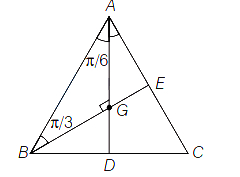
(D) Let $G$ be the centroid of $\triangle ABC$. The medians $AD$ and $BE$ intersect at $G$.
Given $AD=4$,$\angle GAB = \frac{\pi}{6}$,and $\angle GBA = \frac{\pi}{3}$.
In $\triangle AGB$,the sum of angles is $\pi$,so $\angle AGB = \pi - (\frac{\pi}{6} + \frac{\pi}{3}) = \pi - \frac{\pi}{2} = \frac{\pi}{2}$.
Since $G$ is the centroid,$AG = \frac{2}{3} AD = \frac{2}{3} \times 4 = \frac{8}{3}$.
In right-angled $\triangle AGB$,$\sin(\angle GBA) = \frac{AG}{AB} \implies \sin(\frac{\pi}{3}) = \frac{8/3}{AB} \implies \frac{\sqrt{3}}{2} = \frac{8}{3AB} \implies AB = \frac{16}{3\sqrt{3}}$.
Also,$\tan(\angle GBA) = \frac{AG}{BG} \implies \tan(\frac{\pi}{3}) = \frac{8/3}{BG} \implies \sqrt{3} = \frac{8}{3BG} \implies BG = \frac{8}{3\sqrt{3}}$.
Area of $\triangle AGB = \frac{1}{2} \times AG \times BG = \frac{1}{2} \times \frac{8}{3} \times \frac{8}{3\sqrt{3}} = \frac{32}{9\sqrt{3}}$.
Since the centroid divides the triangle into three triangles of equal area,Area$(\triangle ABC)$ = $3 \times$ Area$(\triangle AGB)$ = $3 \times \frac{32}{9\sqrt{3}} = \frac{32}{3\sqrt{3}}$ sq. units.
Given $AD=4$,$\angle GAB = \frac{\pi}{6}$,and $\angle GBA = \frac{\pi}{3}$.
In $\triangle AGB$,the sum of angles is $\pi$,so $\angle AGB = \pi - (\frac{\pi}{6} + \frac{\pi}{3}) = \pi - \frac{\pi}{2} = \frac{\pi}{2}$.
Since $G$ is the centroid,$AG = \frac{2}{3} AD = \frac{2}{3} \times 4 = \frac{8}{3}$.
In right-angled $\triangle AGB$,$\sin(\angle GBA) = \frac{AG}{AB} \implies \sin(\frac{\pi}{3}) = \frac{8/3}{AB} \implies \frac{\sqrt{3}}{2} = \frac{8}{3AB} \implies AB = \frac{16}{3\sqrt{3}}$.
Also,$\tan(\angle GBA) = \frac{AG}{BG} \implies \tan(\frac{\pi}{3}) = \frac{8/3}{BG} \implies \sqrt{3} = \frac{8}{3BG} \implies BG = \frac{8}{3\sqrt{3}}$.
Area of $\triangle AGB = \frac{1}{2} \times AG \times BG = \frac{1}{2} \times \frac{8}{3} \times \frac{8}{3\sqrt{3}} = \frac{32}{9\sqrt{3}}$.
Since the centroid divides the triangle into three triangles of equal area,Area$(\triangle ABC)$ = $3 \times$ Area$(\triangle AGB)$ = $3 \times \frac{32}{9\sqrt{3}} = \frac{32}{3\sqrt{3}}$ sq. units.
0 likesView Solution
202
MathematicsMediumMCQTS EAMCET · 2019
In a $\triangle ABC$,if $a+3b=3c$,then $\sin \frac{A}{2} =$
A
$\frac{a}{2} \sqrt{\frac{3}{bc}}$
B
$\frac{a}{3} \sqrt{\frac{2}{bc}}$
C
$\frac{2a}{3} \sqrt{\frac{1}{bc}}$
D
$\frac{ab}{3} \sqrt{\frac{2}{c}}$
Solution
(B) Given $a+3b=3c$,we have $a=3(c-b)$.
Using the formula $\sin \frac{A}{2} = \sqrt{\frac{(s-b)(s-c)}{bc}}$,where $s = \frac{a+b+c}{2}$.
$s-b = \frac{a+b+c}{2} - b = \frac{a-b+c}{2} = \frac{3(c-b)-b+c}{2} = \frac{4c-4b}{2} = 2(c-b)$.
$s-c = \frac{a+b+c}{2} - c = \frac{a+b-c}{2} = \frac{3(c-b)+b-c}{2} = \frac{2c-2b}{2} = c-b$.
Substituting these into the formula:
$\sin \frac{A}{2} = \sqrt{\frac{2(c-b)(c-b)}{bc}} = \sqrt{\frac{2(c-b)^2}{bc}} = (c-b) \sqrt{\frac{2}{bc}}$.
Since $c-b = \frac{a}{3}$,we get $\sin \frac{A}{2} = \frac{a}{3} \sqrt{\frac{2}{bc}}$.
Thus,option $B$ is correct.
Using the formula $\sin \frac{A}{2} = \sqrt{\frac{(s-b)(s-c)}{bc}}$,where $s = \frac{a+b+c}{2}$.
$s-b = \frac{a+b+c}{2} - b = \frac{a-b+c}{2} = \frac{3(c-b)-b+c}{2} = \frac{4c-4b}{2} = 2(c-b)$.
$s-c = \frac{a+b+c}{2} - c = \frac{a+b-c}{2} = \frac{3(c-b)+b-c}{2} = \frac{2c-2b}{2} = c-b$.
Substituting these into the formula:
$\sin \frac{A}{2} = \sqrt{\frac{2(c-b)(c-b)}{bc}} = \sqrt{\frac{2(c-b)^2}{bc}} = (c-b) \sqrt{\frac{2}{bc}}$.
Since $c-b = \frac{a}{3}$,we get $\sin \frac{A}{2} = \frac{a}{3} \sqrt{\frac{2}{bc}}$.
Thus,option $B$ is correct.
0 likesView Solution
203
MathematicsDifficultTS EAMCET · 2019
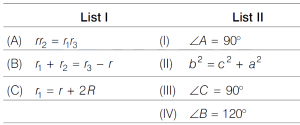
Corresponding to a triangle $ABC$,match the items given in List-$I$ with the items given in List-$II$.
The correct match is:
| List-$I$ | List-$II$ |
| $(A)$ $rr_2 = r_1r_3$ | $(I)$ $\angle A = 90^{\circ}$ |
| $(B)$ $r_1 + r_2 = r_3 - r$ | $(II)$ $b^2 = c^2 + a^2$ |
| $(C)$ $r_1 = r + 2R$ | $(III)$ $\angle C = 90^{\circ}$ |
| $(IV)$ $\angle B = 120^{\circ}$ |
The correct match is:
Solution
(A-II, B-III, C-I) In $\triangle ABC$,we use the standard formulas for exradii $r_1 = \frac{\Delta}{s-a}$,$r_2 = \frac{\Delta}{s-b}$,$r_3 = \frac{\Delta}{s-c}$,and inradius $r = \frac{\Delta}{s}$.
$(A)$ Given $rr_2 = r_1r_3$:
$\frac{\Delta}{s} \cdot \frac{\Delta}{s-b} = \frac{\Delta}{s-a} \cdot \frac{\Delta}{s-c}$
$\Rightarrow (s-a)(s-c) = s(s-b)$
$\Rightarrow s^2 - s(a+c) + ac = s^2 - sb$
Since $a+c = 2s-b$,we have $s^2 - s(2s-b) + ac = s^2 - sb$
$\Rightarrow s^2 - 2s^2 + sb + ac = s^2 - sb$
$\Rightarrow -s^2 + 2sb + ac = 0$. This simplifies to $b^2 = a^2 + c^2$,which implies $\angle B = 90^{\circ}$. Thus,$(A)$ $\rightarrow$ $(II)$.
$(B)$ Given $r_1 + r_2 = r_3 - r$:
$\frac{\Delta}{s-a} + \frac{\Delta}{s-b} = \frac{\Delta}{s-c} - \frac{\Delta}{s}$
$\frac{s-b+s-a}{(s-a)(s-b)} = \frac{s-(s-c)}{s(s-c)}$
$\frac{c}{(s-a)(s-b)} = \frac{c}{s(s-c)}$
$\Rightarrow s(s-c) = (s-a)(s-b)$
$\Rightarrow s^2 - sc = s^2 - s(a+b) + ab$
$\Rightarrow s(a+b-c) = ab$
Since $a+b-c = 2(s-c)$,this leads to $\angle C = 90^{\circ}$. Thus,$(B)$ $\rightarrow$ $(III)$.
$(C)$ Given $r_1 = r + 2R$:
Using $r_1 - r = 4R \sin^2(A/2)$ and $r_1+r_2+r_3-r = 4R$,this specific identity $r_1 = r + 2R$ is known to correspond to $\angle A = 90^{\circ}$. Thus,$(C)$ $\rightarrow$ $(I)$.
$(A)$ Given $rr_2 = r_1r_3$:
$\frac{\Delta}{s} \cdot \frac{\Delta}{s-b} = \frac{\Delta}{s-a} \cdot \frac{\Delta}{s-c}$
$\Rightarrow (s-a)(s-c) = s(s-b)$
$\Rightarrow s^2 - s(a+c) + ac = s^2 - sb$
Since $a+c = 2s-b$,we have $s^2 - s(2s-b) + ac = s^2 - sb$
$\Rightarrow s^2 - 2s^2 + sb + ac = s^2 - sb$
$\Rightarrow -s^2 + 2sb + ac = 0$. This simplifies to $b^2 = a^2 + c^2$,which implies $\angle B = 90^{\circ}$. Thus,$(A)$ $\rightarrow$ $(II)$.
$(B)$ Given $r_1 + r_2 = r_3 - r$:
$\frac{\Delta}{s-a} + \frac{\Delta}{s-b} = \frac{\Delta}{s-c} - \frac{\Delta}{s}$
$\frac{s-b+s-a}{(s-a)(s-b)} = \frac{s-(s-c)}{s(s-c)}$
$\frac{c}{(s-a)(s-b)} = \frac{c}{s(s-c)}$
$\Rightarrow s(s-c) = (s-a)(s-b)$
$\Rightarrow s^2 - sc = s^2 - s(a+b) + ab$
$\Rightarrow s(a+b-c) = ab$
Since $a+b-c = 2(s-c)$,this leads to $\angle C = 90^{\circ}$. Thus,$(B)$ $\rightarrow$ $(III)$.
$(C)$ Given $r_1 = r + 2R$:
Using $r_1 - r = 4R \sin^2(A/2)$ and $r_1+r_2+r_3-r = 4R$,this specific identity $r_1 = r + 2R$ is known to correspond to $\angle A = 90^{\circ}$. Thus,$(C)$ $\rightarrow$ $(I)$.
0 likesView Solution
204
MathematicsMediumMCQTS EAMCET · 2019
In any triangle $ABC$,if $a: b: c = 2: 3: 4$,then $R: r =$
A
$8: 3$
B
$16: 9$
C
$5: 16$
D
$16: 5$
Solution
(D) Given $a: b: c = 2: 3: 4$. Let $a = 2k, b = 3k, c = 4k$.
Semi-perimeter $s = \frac{a+b+c}{2} = \frac{2k+3k+4k}{2} = \frac{9k}{2}$.
Area $\Delta = \sqrt{s(s-a)(s-b)(s-c)} = \sqrt{\frac{9k}{2}(\frac{9k}{2}-2k)(\frac{9k}{2}-3k)(\frac{9k}{2}-4k)} = \sqrt{\frac{9k}{2} \cdot \frac{5k}{2} \cdot \frac{3k}{2} \cdot \frac{k}{2}} = \frac{3k^2\sqrt{15}}{4}$.
We know $R = \frac{abc}{4\Delta}$ and $r = \frac{\Delta}{s}$.
Thus,$\frac{R}{r} = \frac{abc \cdot s}{4\Delta^2} = \frac{(2k)(3k)(4k) \cdot (9k/2)}{4 \cdot (\frac{9k^2\sqrt{15}}{4})^2} = \frac{24k^3 \cdot 9k/2}{4 \cdot \frac{81k^4 \cdot 15}{16}} = \frac{108k^4}{\frac{81k^4 \cdot 15}{4}} = \frac{108 \cdot 4}{81 \cdot 15} = \frac{432}{1215} = \frac{16}{45}$.
Wait,re-evaluating: $\frac{R}{r} = \frac{abc}{4 \cdot \frac{\Delta^2}{s}} = \frac{abc}{4 \cdot s(s-a)(s-b)(s-c)/s} = \frac{abc}{4(s-a)(s-b)(s-c)}$.
$\frac{R}{r} = \frac{(2k)(3k)(4k)}{4(\frac{5k}{2})(\frac{3k}{2})(\frac{k}{2})} = \frac{24k^3}{4 \cdot \frac{15k^3}{8}} = \frac{24k^3}{\frac{15k^3}{2}} = \frac{48}{15} = \frac{16}{5}$.
Therefore,$R: r = 16: 5$.
Semi-perimeter $s = \frac{a+b+c}{2} = \frac{2k+3k+4k}{2} = \frac{9k}{2}$.
Area $\Delta = \sqrt{s(s-a)(s-b)(s-c)} = \sqrt{\frac{9k}{2}(\frac{9k}{2}-2k)(\frac{9k}{2}-3k)(\frac{9k}{2}-4k)} = \sqrt{\frac{9k}{2} \cdot \frac{5k}{2} \cdot \frac{3k}{2} \cdot \frac{k}{2}} = \frac{3k^2\sqrt{15}}{4}$.
We know $R = \frac{abc}{4\Delta}$ and $r = \frac{\Delta}{s}$.
Thus,$\frac{R}{r} = \frac{abc \cdot s}{4\Delta^2} = \frac{(2k)(3k)(4k) \cdot (9k/2)}{4 \cdot (\frac{9k^2\sqrt{15}}{4})^2} = \frac{24k^3 \cdot 9k/2}{4 \cdot \frac{81k^4 \cdot 15}{16}} = \frac{108k^4}{\frac{81k^4 \cdot 15}{4}} = \frac{108 \cdot 4}{81 \cdot 15} = \frac{432}{1215} = \frac{16}{45}$.
Wait,re-evaluating: $\frac{R}{r} = \frac{abc}{4 \cdot \frac{\Delta^2}{s}} = \frac{abc}{4 \cdot s(s-a)(s-b)(s-c)/s} = \frac{abc}{4(s-a)(s-b)(s-c)}$.
$\frac{R}{r} = \frac{(2k)(3k)(4k)}{4(\frac{5k}{2})(\frac{3k}{2})(\frac{k}{2})} = \frac{24k^3}{4 \cdot \frac{15k^3}{8}} = \frac{24k^3}{\frac{15k^3}{2}} = \frac{48}{15} = \frac{16}{5}$.
Therefore,$R: r = 16: 5$.
0 likesView Solution
205
MathematicsEasyMCQTS EAMCET · 2019
If $a$ and $b$ respectively represent the lengths of a side and a diagonal of a regular pentagon that is inscribed in a circle,then $\frac{b}{a}=$
A
$2 \sin \frac{\pi}{5}$
B
$2 \cos \frac{\pi}{5}$
C
$\cos \frac{\pi}{5}$
D
$\sin \frac{\pi}{5}$
Solution
(B) Let $a$ be the side length and $b$ be the diagonal length of a regular pentagon inscribed in a circle.
In a regular pentagon,the interior angle is $\frac{3\pi}{5}$.
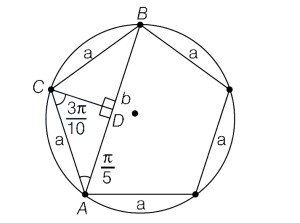
Consider the triangle formed by two sides and a diagonal. By properties of a regular pentagon,the diagonal $b$ subtends an angle of $\frac{2\pi}{5}$ at the center,and the angle between a side and a diagonal is $\frac{\pi}{5}$.
Drawing a perpendicular from vertex $C$ to the diagonal $AB$ at point $D$,we form a right-angled triangle $\triangle ACD$.
In $\triangle ACD$,the angle $\angle CAD = \frac{\pi}{5}$ and the hypotenuse $AC = a$.
Thus,$\cos \frac{\pi}{5} = \frac{AD}{AC} = \frac{AD}{a}$,which implies $AD = a \cos \frac{\pi}{5}$.
Since the diagonal $b$ is bisected by the perpendicular from the opposite vertex in a regular pentagon,$b = 2AD$.
Therefore,$b = 2a \cos \frac{\pi}{5}$,which gives $\frac{b}{a} = 2 \cos \frac{\pi}{5}$.
In a regular pentagon,the interior angle is $\frac{3\pi}{5}$.
Consider the triangle formed by two sides and a diagonal. By properties of a regular pentagon,the diagonal $b$ subtends an angle of $\frac{2\pi}{5}$ at the center,and the angle between a side and a diagonal is $\frac{\pi}{5}$.
Drawing a perpendicular from vertex $C$ to the diagonal $AB$ at point $D$,we form a right-angled triangle $\triangle ACD$.
In $\triangle ACD$,the angle $\angle CAD = \frac{\pi}{5}$ and the hypotenuse $AC = a$.
Thus,$\cos \frac{\pi}{5} = \frac{AD}{AC} = \frac{AD}{a}$,which implies $AD = a \cos \frac{\pi}{5}$.
Since the diagonal $b$ is bisected by the perpendicular from the opposite vertex in a regular pentagon,$b = 2AD$.
Therefore,$b = 2a \cos \frac{\pi}{5}$,which gives $\frac{b}{a} = 2 \cos \frac{\pi}{5}$.
0 likesView Solution
206
MathematicsMediumMCQTS EAMCET · 2019
If $\sinh ^{-1}(\sqrt{8})+\sinh ^{-1}(\sqrt{24})=\alpha$,then $\sinh \alpha=$
A
$6 \sqrt{6}-10 \sqrt{2}$
B
$6 \sqrt{6}+10 \sqrt{2}$
C
$16 \sqrt{6}$
D
$16 \sqrt{6}+4 \sqrt{2}$
Solution
(B) We have,$\sinh ^{-1}(\sqrt{8})+\sinh ^{-1}(\sqrt{24})=\alpha$.
Let $\sinh ^{-1}(\sqrt{8})=x$,then $\sinh x = \sqrt{8}$.
Since $\cosh^2 x - \sinh^2 x = 1$,we have $\cosh x = \sqrt{1 + \sinh^2 x} = \sqrt{1 + 8} = \sqrt{9} = 3$.
Let $\sinh ^{-1}(\sqrt{24})=y$,then $\sinh y = \sqrt{24}$.
Similarly,$\cosh y = \sqrt{1 + \sinh^2 y} = \sqrt{1 + 24} = \sqrt{25} = 5$.
Using the identity $\sinh(x+y) = \sinh x \cosh y + \cosh x \sinh y$,we get:
$\sinh(x+y) = (\sqrt{8})(5) + (3)(\sqrt{24}) = 5(2\sqrt{2}) + 3(2\sqrt{6}) = 10\sqrt{2} + 6\sqrt{6}$.
Since $\alpha = x+y$,we have $\sinh \alpha = 6\sqrt{6} + 10\sqrt{2}$.
Let $\sinh ^{-1}(\sqrt{8})=x$,then $\sinh x = \sqrt{8}$.
Since $\cosh^2 x - \sinh^2 x = 1$,we have $\cosh x = \sqrt{1 + \sinh^2 x} = \sqrt{1 + 8} = \sqrt{9} = 3$.
Let $\sinh ^{-1}(\sqrt{24})=y$,then $\sinh y = \sqrt{24}$.
Similarly,$\cosh y = \sqrt{1 + \sinh^2 y} = \sqrt{1 + 24} = \sqrt{25} = 5$.
Using the identity $\sinh(x+y) = \sinh x \cosh y + \cosh x \sinh y$,we get:
$\sinh(x+y) = (\sqrt{8})(5) + (3)(\sqrt{24}) = 5(2\sqrt{2}) + 3(2\sqrt{6}) = 10\sqrt{2} + 6\sqrt{6}$.
Since $\alpha = x+y$,we have $\sinh \alpha = 6\sqrt{6} + 10\sqrt{2}$.
0 likesView Solution
207
MathematicsEasyMCQTS EAMCET · 2019
The period of $\cos(x + 8x + 27x + \ldots + n^3x)$ is
A
$\frac{2 \pi}{n}$
B
$\frac{2 \pi}{n^2(n+1)^2}$
C
$\frac{8 \pi}{n^2(n+1)^2}$
D
$\frac{8 \pi}{n^3(n+1)^2}$
Solution
(C) We have the expression $\cos(x + 8x + 27x + \ldots + n^3x)$.
This can be written as $\cos\left(\sum_{k=1}^{n} k^3 x\right) = \cos\left(x \sum_{k=1}^{n} k^3\right)$.
Using the formula for the sum of cubes of the first $n$ natural numbers,$\sum_{k=1}^{n} k^3 = \left(\frac{n(n+1)}{2}\right)^2 = \frac{n^2(n+1)^2}{4}$.
Thus,the expression becomes $\cos\left(\frac{n^2(n+1)^2}{4} x\right)$.
The period of $\cos(kx)$ is $\frac{2\pi}{|k|}$.
Here,$k = \frac{n^2(n+1)^2}{4}$.
Therefore,the period is $\frac{2\pi}{\frac{n^2(n+1)^2}{4}} = \frac{8\pi}{n^2(n+1)^2}$.
This can be written as $\cos\left(\sum_{k=1}^{n} k^3 x\right) = \cos\left(x \sum_{k=1}^{n} k^3\right)$.
Using the formula for the sum of cubes of the first $n$ natural numbers,$\sum_{k=1}^{n} k^3 = \left(\frac{n(n+1)}{2}\right)^2 = \frac{n^2(n+1)^2}{4}$.
Thus,the expression becomes $\cos\left(\frac{n^2(n+1)^2}{4} x\right)$.
The period of $\cos(kx)$ is $\frac{2\pi}{|k|}$.
Here,$k = \frac{n^2(n+1)^2}{4}$.
Therefore,the period is $\frac{2\pi}{\frac{n^2(n+1)^2}{4}} = \frac{8\pi}{n^2(n+1)^2}$.
0 likesView Solution
208
MathematicsEasyMCQTS EAMCET · 2019
Let $f: X \rightarrow Y$ be a function and $A_y = f^{-1}(\{y\})$ for $y \in Y$. Then $A_i \cap A_j = \phi$ $(i \neq j)$ for all $i, j \in Y$ and $\bigcup_{y \in Y} A_y = X$,if
A
$f$ is an onto function only
B
$f$ is a one-one function only
C
$f$ is any function
D
$X$ and $Y$ are finite sets only
Solution
(C) Given $f: X \rightarrow Y$ is a function.
By definition,$A_y = f^{-1}(\{y\}) = \{x \in X : f(x) = y\}$.
This set $A_y$ represents the preimage of the element $y$ under the function $f$.
For any two distinct elements $i, j \in Y$ where $i \neq j$,the sets $A_i$ and $A_j$ are disjoint because a function maps each element of the domain to exactly one element in the codomain. Thus,$A_i \cap A_j = \phi$.
Furthermore,the union of all preimages $A_y$ for all $y \in Y$ covers the entire domain $X$,i.e.,$\bigcup_{y \in Y} A_y = X$.
These properties hold true for any function $f: X \rightarrow Y$.
Therefore,option $(C)$ is correct.
By definition,$A_y = f^{-1}(\{y\}) = \{x \in X : f(x) = y\}$.
This set $A_y$ represents the preimage of the element $y$ under the function $f$.
For any two distinct elements $i, j \in Y$ where $i \neq j$,the sets $A_i$ and $A_j$ are disjoint because a function maps each element of the domain to exactly one element in the codomain. Thus,$A_i \cap A_j = \phi$.
Furthermore,the union of all preimages $A_y$ for all $y \in Y$ covers the entire domain $X$,i.e.,$\bigcup_{y \in Y} A_y = X$.
These properties hold true for any function $f: X \rightarrow Y$.
Therefore,option $(C)$ is correct.
0 likesView Solution
209
MathematicsEasyMCQTS EAMCET · 2019
If the minimum value of $f(x)=2x^2+\alpha x+8$ is the same as the maximum value of $g(x)=-3x^2-4x+\alpha^2$,then $\alpha^2=$
A
$\frac{150}{27}$
B
$\frac{160}{27}$
C
$\frac{170}{27}$
D
$\frac{181}{27}$
Solution
(B) The minimum value of a quadratic function $f(x)=ax^2+bx+c$ (where $a>0$) is given by $-\frac{D}{4a} = \frac{4ac-b^2}{4a}$.
For $f(x)=2x^2+\alpha x+8$,we have $a=2, b=\alpha, c=8$. The minimum value is $\frac{4(2)(8)-\alpha^2}{4(2)} = \frac{64-\alpha^2}{8}$.
The maximum value of a quadratic function $g(x)=ax^2+bx+c$ (where $a < 0$) is given by $-\frac{D}{4a} = \frac{4ac-b^2}{4a}$.
For $g(x)=-3x^2-4x+\alpha^2$,we have $a=-3, b=-4, c=\alpha^2$. The maximum value is $\frac{4(-3)(\alpha^2)-(-4)^2}{4(-3)} = \frac{-12\alpha^2-16}{-12} = \frac{12\alpha^2+16}{12}$.
Equating the two values:
$\frac{64-\alpha^2}{8} = \frac{12\alpha^2+16}{12}$
Multiplying both sides by $24$:
$3(64-\alpha^2) = 2(12\alpha^2+16)$
$192-3\alpha^2 = 24\alpha^2+32$
$160 = 27\alpha^2$
$\alpha^2 = \frac{160}{27}$.
Thus,option $(B)$ is correct.
For $f(x)=2x^2+\alpha x+8$,we have $a=2, b=\alpha, c=8$. The minimum value is $\frac{4(2)(8)-\alpha^2}{4(2)} = \frac{64-\alpha^2}{8}$.
The maximum value of a quadratic function $g(x)=ax^2+bx+c$ (where $a < 0$) is given by $-\frac{D}{4a} = \frac{4ac-b^2}{4a}$.
For $g(x)=-3x^2-4x+\alpha^2$,we have $a=-3, b=-4, c=\alpha^2$. The maximum value is $\frac{4(-3)(\alpha^2)-(-4)^2}{4(-3)} = \frac{-12\alpha^2-16}{-12} = \frac{12\alpha^2+16}{12}$.
Equating the two values:
$\frac{64-\alpha^2}{8} = \frac{12\alpha^2+16}{12}$
Multiplying both sides by $24$:
$3(64-\alpha^2) = 2(12\alpha^2+16)$
$192-3\alpha^2 = 24\alpha^2+32$
$160 = 27\alpha^2$
$\alpha^2 = \frac{160}{27}$.
Thus,option $(B)$ is correct.
0 likesView Solution
210
MathematicsEasyMCQTS EAMCET · 2019
If the angles of depression of the top and bottom of a short building from the top of a tall building are $30^{\circ}$ and $60^{\circ}$ respectively,then the ratio of the heights of the short and tall buildings is
A
$2: 3$
B
$1: 2$
C
$1: 3$
D
$1: 4$
Solution
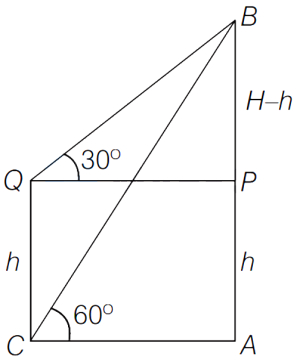
(A) Let $AB$ be the tall building of height $H$ and $CQ$ be the short building of height $h$. Let $A$ be the base of the tall building and $C$ be the base of the short building.
In $\triangle ABC$,$\tan 60^{\circ} = \frac{AB}{AC} = \frac{H}{AC}$. Thus,$AC = \frac{H}{\sqrt{3}}$.
Since $AC = QP$,we have $QP = \frac{H}{\sqrt{3}}$.
In $\triangle BQP$,$\tan 30^{\circ} = \frac{BP}{QP} = \frac{H-h}{QP}$.
Substituting $QP = \frac{H}{\sqrt{3}}$,we get $\frac{1}{\sqrt{3}} = \frac{H-h}{H/\sqrt{3}}$.
This simplifies to $\frac{1}{\sqrt{3}} = \frac{(H-h)\sqrt{3}}{H}$.
$H = 3(H-h)$ $\Rightarrow H = 3H - 3h$ $\Rightarrow 2H = 3h$.
Therefore,the ratio of the height of the short building to the tall building is $\frac{h}{H} = \frac{2}{3}$ or $2:3$.
In $\triangle ABC$,$\tan 60^{\circ} = \frac{AB}{AC} = \frac{H}{AC}$. Thus,$AC = \frac{H}{\sqrt{3}}$.
Since $AC = QP$,we have $QP = \frac{H}{\sqrt{3}}$.
In $\triangle BQP$,$\tan 30^{\circ} = \frac{BP}{QP} = \frac{H-h}{QP}$.
Substituting $QP = \frac{H}{\sqrt{3}}$,we get $\frac{1}{\sqrt{3}} = \frac{H-h}{H/\sqrt{3}}$.
This simplifies to $\frac{1}{\sqrt{3}} = \frac{(H-h)\sqrt{3}}{H}$.
$H = 3(H-h)$ $\Rightarrow H = 3H - 3h$ $\Rightarrow 2H = 3h$.
Therefore,the ratio of the height of the short building to the tall building is $\frac{h}{H} = \frac{2}{3}$ or $2:3$.
0 likesView Solution
211
MathematicsMediumMCQTS EAMCET · 2019
If the greatest divisor of $30 \cdot 5^{2n} + 4 \cdot 2^{3n}$ is $p, \forall n \in N$ and that of $2^{2n+1} - 6n - 2$ is $q, \forall n \in N$,then $p+q=$
A
$26$
B
$52$
C
$104$
D
$13$
Solution
(B) For the first expression $f(n) = 30 \cdot 5^{2n} + 4 \cdot 2^{3n}$:
For $n=1$,$f(1) = 30 \cdot 25 + 4 \cdot 8 = 750 + 32 = 782 = 2 \times 17 \times 23$.
For $n=2$,$f(2) = 30 \cdot 625 + 4 \cdot 64 = 18750 + 256 = 19006 = 2 \times 17 \times 559$.
The greatest common divisor $p = 2 \times 17 = 34$.
For the second expression $g(n) = 2^{2n+1} - 6n - 2$:
For $n=1$,$g(1) = 2^3 - 6(1) - 2 = 8 - 8 = 0$.
For $n=2$,$g(2) = 2^5 - 6(2) - 2 = 32 - 14 = 18$.
For $n=3$,$g(3) = 2^7 - 6(3) - 2 = 128 - 20 = 108$.
The greatest common divisor $q = \text{gcd}(18, 108) = 18$.
Thus,$p+q = 34 + 18 = 52$.
For $n=1$,$f(1) = 30 \cdot 25 + 4 \cdot 8 = 750 + 32 = 782 = 2 \times 17 \times 23$.
For $n=2$,$f(2) = 30 \cdot 625 + 4 \cdot 64 = 18750 + 256 = 19006 = 2 \times 17 \times 559$.
The greatest common divisor $p = 2 \times 17 = 34$.
For the second expression $g(n) = 2^{2n+1} - 6n - 2$:
For $n=1$,$g(1) = 2^3 - 6(1) - 2 = 8 - 8 = 0$.
For $n=2$,$g(2) = 2^5 - 6(2) - 2 = 32 - 14 = 18$.
For $n=3$,$g(3) = 2^7 - 6(3) - 2 = 128 - 20 = 108$.
The greatest common divisor $q = \text{gcd}(18, 108) = 18$.
Thus,$p+q = 34 + 18 = 52$.
0 likesView Solution
212
MathematicsEasyMCQTS EAMCET · 2019
If $\alpha$ and $\beta$ are the least positive integers such that for all $n \in N$,$n^3+\alpha n$ is divisible by $3$ and $n^3-\beta n$ is divisible by $6$,then $\alpha+\beta=$
A
$4$
B
$3$
C
$2$
D
$1$
Solution
(B) For $n^3+\alpha n$ to be divisible by $3$ for all $n \in N$,we check $n=1$: $1^3+\alpha(1) = 1+\alpha$. For this to be divisible by $3$,the least positive integer $\alpha$ is $2$ (since $1+2=3$).
For $n^3-\beta n$ to be divisible by $6$ for all $n \in N$,we check $n=2$: $2^3-\beta(2) = 8-2\beta$. For this to be divisible by $6$,$8-2\beta = 6k$. If $\beta=1$,$8-2=6$,which is divisible by $6$. Thus,the least positive integer $\beta$ is $1$.
Therefore,$\alpha+\beta = 2+1 = 3$.
For $n^3-\beta n$ to be divisible by $6$ for all $n \in N$,we check $n=2$: $2^3-\beta(2) = 8-2\beta$. For this to be divisible by $6$,$8-2\beta = 6k$. If $\beta=1$,$8-2=6$,which is divisible by $6$. Thus,the least positive integer $\beta$ is $1$.
Therefore,$\alpha+\beta = 2+1 = 3$.
0 likesView Solution
213
MathematicsEasyMCQTS EAMCET · 2019
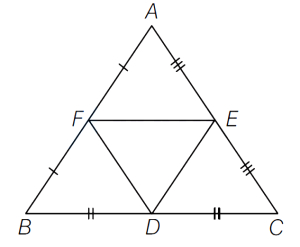
If $(1,0,3), (2,1,5), (-2,3,6)$ are the mid-points of the sides of a triangle,then the centroid of the triangle is
A
$\left(\frac{1}{3}, \frac{4}{3}, -\frac{14}{3}\right)$
B
$\left(\frac{1}{3}, \frac{4}{3}, \frac{14}{3}\right)$
C
$\left(\frac{1}{3}, -\frac{4}{3}, \frac{14}{3}\right)$
D
$\left(-\frac{1}{3}, \frac{4}{3}, \frac{14}{3}\right)$
Solution
(B) Let the mid-points of the sides of $\triangle ABC$ be $D(1,0,3)$,$E(2,1,5)$,and $F(-2,3,6)$.
The centroid of the triangle formed by the mid-points of the sides of a triangle is the same as the centroid of the original triangle.
Therefore,the centroid of $\triangle ABC$ is the same as the centroid of $\triangle DEF$.
The formula for the centroid of a triangle with vertices $(x_1, y_1, z_1), (x_2, y_2, z_2), (x_3, y_3, z_3)$ is $\left(\frac{x_1+x_2+x_3}{3}, \frac{y_1+y_2+y_3}{3}, \frac{z_1+z_2+z_3}{3}\right)$.
Substituting the given mid-points:
Centroid $= \left(\frac{1+2-2}{3}, \frac{0+1+3}{3}, \frac{3+5+6}{3}\right)$
$= \left(\frac{1}{3}, \frac{4}{3}, \frac{14}{3}\right)$.
The centroid of the triangle formed by the mid-points of the sides of a triangle is the same as the centroid of the original triangle.
Therefore,the centroid of $\triangle ABC$ is the same as the centroid of $\triangle DEF$.
The formula for the centroid of a triangle with vertices $(x_1, y_1, z_1), (x_2, y_2, z_2), (x_3, y_3, z_3)$ is $\left(\frac{x_1+x_2+x_3}{3}, \frac{y_1+y_2+y_3}{3}, \frac{z_1+z_2+z_3}{3}\right)$.
Substituting the given mid-points:
Centroid $= \left(\frac{1+2-2}{3}, \frac{0+1+3}{3}, \frac{3+5+6}{3}\right)$
$= \left(\frac{1}{3}, \frac{4}{3}, \frac{14}{3}\right)$.
0 likesView Solution
214
MathematicsEasyMCQTS EAMCET · 2019
If a triangle $ABC$ with two vertices $A(5,4,6)$ and $B(1,-1,3)$ has its centroid at $\left(\frac{10}{3}, 2, \frac{11}{3}\right)$,then the third vertex $C$ is
A
$(4,2,3)$
B
$(-4,-3,2)$
C
$(4,3,2)$
D
$(2,4,3)$
Solution
(C) Let the coordinates of the third vertex $C$ be $(x, y, z)$.
Given vertices are $A(5, 4, 6)$ and $B(1, -1, 3)$.
The centroid $G$ of a triangle with vertices $(x_1, y_1, z_1)$,$(x_2, y_2, z_2)$,and $(x_3, y_3, z_3)$ is given by $\left(\frac{x_1+x_2+x_3}{3}, \frac{y_1+y_2+y_3}{3}, \frac{z_1+z_2+z_3}{3}\right)$.
Given centroid $G = \left(\frac{10}{3}, 2, \frac{11}{3}\right)$.
Equating the coordinates:
$\frac{5+1+x}{3} = \frac{10}{3} \Rightarrow 6+x = 10 \Rightarrow x = 4$.
$\frac{4-1+y}{3} = 2 \Rightarrow 3+y = 6 \Rightarrow y = 3$.
$\frac{6+3+z}{3} = \frac{11}{3} \Rightarrow 9+z = 11 \Rightarrow z = 2$.
Therefore,the third vertex $C$ is $(4, 3, 2)$.
Given vertices are $A(5, 4, 6)$ and $B(1, -1, 3)$.
The centroid $G$ of a triangle with vertices $(x_1, y_1, z_1)$,$(x_2, y_2, z_2)$,and $(x_3, y_3, z_3)$ is given by $\left(\frac{x_1+x_2+x_3}{3}, \frac{y_1+y_2+y_3}{3}, \frac{z_1+z_2+z_3}{3}\right)$.
Given centroid $G = \left(\frac{10}{3}, 2, \frac{11}{3}\right)$.
Equating the coordinates:
$\frac{5+1+x}{3} = \frac{10}{3} \Rightarrow 6+x = 10 \Rightarrow x = 4$.
$\frac{4-1+y}{3} = 2 \Rightarrow 3+y = 6 \Rightarrow y = 3$.
$\frac{6+3+z}{3} = \frac{11}{3} \Rightarrow 9+z = 11 \Rightarrow z = 2$.
Therefore,the third vertex $C$ is $(4, 3, 2)$.
0 likesView Solution
215
MathematicsEasyMCQTS EAMCET · 2019
$A$ bag contains $6$ red,$2$ white and $8$ blue balls. Three balls are drawn at random from the bag. Match the items of List-$I$ with those of List-$II$.
| $A$. Probability that none of the balls is white | $I$. $\frac{1}{70}$ |
| $B$. Probability of getting $2$ white and $1$ blue ball | $II$. $\frac{6}{35}$ |
| $C$. Probability of getting $2$ blue and $1$ white ball | $III$. $\frac{13}{20}$ |
| $D$. Probability of getting $1$ red,$1$ white and $1$ blue ball | $IV$. $\frac{1}{10}$ |
A
$A-III, B-I, C-IV, D-II$
B
$A-III, B-IV, C-V, D-II$
C
$A-IV, B-III, C-I, D-V$
D
$A-II, B-I, C-V, D-IV$
Solution
(A) Total number of balls $= 6 + 2 + 8 = 16$.
Total ways to draw $3$ balls $= ^{16}C_3 = \frac{16 \times 15 \times 14}{3 \times 2 \times 1} = 560$.
$A$. Probability that none of the balls is white (i.e.,all $3$ are from $6$ red and $8$ blue balls):
$P(A) = \frac{^{14}C_3}{^{16}C_3} = \frac{14 \times 13 \times 12}{16 \times 15 \times 14} = \frac{13}{20} = III$.
$B$. Probability of getting $2$ white and $1$ blue ball:
$P(B) = \frac{^{2}C_2 \times ^{8}C_1}{^{16}C_3} = \frac{1 \times 8}{560} = \frac{1}{70} = I$.
$C$. Probability of getting $2$ blue and $1$ white ball:
$P(C) = \frac{^{8}C_2 \times ^{2}C_1}{^{16}C_3} = \frac{28 \times 2}{560} = \frac{56}{560} = \frac{1}{10} = IV$.
$D$. Probability of getting $1$ red,$1$ white and $1$ blue ball:
$P(D) = \frac{^{6}C_1 \times ^{2}C_1 \times ^{8}C_1}{^{16}C_3} = \frac{6 \times 2 \times 8}{560} = \frac{96}{560} = \frac{6}{35} = II$.
Thus,the correct match is $A-III, B-I, C-IV, D-II$.
Total ways to draw $3$ balls $= ^{16}C_3 = \frac{16 \times 15 \times 14}{3 \times 2 \times 1} = 560$.
$A$. Probability that none of the balls is white (i.e.,all $3$ are from $6$ red and $8$ blue balls):
$P(A) = \frac{^{14}C_3}{^{16}C_3} = \frac{14 \times 13 \times 12}{16 \times 15 \times 14} = \frac{13}{20} = III$.
$B$. Probability of getting $2$ white and $1$ blue ball:
$P(B) = \frac{^{2}C_2 \times ^{8}C_1}{^{16}C_3} = \frac{1 \times 8}{560} = \frac{1}{70} = I$.
$C$. Probability of getting $2$ blue and $1$ white ball:
$P(C) = \frac{^{8}C_2 \times ^{2}C_1}{^{16}C_3} = \frac{28 \times 2}{560} = \frac{56}{560} = \frac{1}{10} = IV$.
$D$. Probability of getting $1$ red,$1$ white and $1$ blue ball:
$P(D) = \frac{^{6}C_1 \times ^{2}C_1 \times ^{8}C_1}{^{16}C_3} = \frac{6 \times 2 \times 8}{560} = \frac{96}{560} = \frac{6}{35} = II$.
Thus,the correct match is $A-III, B-I, C-IV, D-II$.
0 likesView Solution
216
MathematicsMediumMCQTS EAMCET · 2019
In a town,the probability that a sick person may need to be admitted to an $ICU$ is $10 \%$. If the probability that a person getting admitted to an $ICU$ goes above $5 \%$,then the threat level is raised. The minimum percentage of the population of the town that should fall sick in order to raise the threat level is
A
$15$
B
$30$
C
$50$
D
$70$
Solution
(C) Let the minimum percentage of the population of the town that should fall sick in order to raise the threat level be $x \%$.
Given that the probability of a sick person being admitted to an $ICU$ is $10 \%$.
Therefore,the probability of any person in the town being admitted to an $ICU$ is $10 \% \text{ of } x \%$.
We are given that the threat level is raised if this probability exceeds $5 \%$.
So,we set up the equation: $\frac{10}{100} \times x = 5$.
Solving for $x$: $0.1x = 5 \Rightarrow x = \frac{5}{0.1} = 50$.
Thus,at least $50 \%$ of the population must fall sick to raise the threat level.
Hence,option $C$ is correct.
Given that the probability of a sick person being admitted to an $ICU$ is $10 \%$.
Therefore,the probability of any person in the town being admitted to an $ICU$ is $10 \% \text{ of } x \%$.
We are given that the threat level is raised if this probability exceeds $5 \%$.
So,we set up the equation: $\frac{10}{100} \times x = 5$.
Solving for $x$: $0.1x = 5 \Rightarrow x = \frac{5}{0.1} = 50$.
Thus,at least $50 \%$ of the population must fall sick to raise the threat level.
Hence,option $C$ is correct.
0 likesView Solution
217
MathematicsEasyMCQTS EAMCET · 2019
If a number is selected from the first $30$ natural numbers,then the probability that the number selected is divisible by $4$ or $7$ is:
A
$\frac{4}{3}$
B
$\frac{1}{5}$
C
$\frac{7}{30}$
D
$\frac{1}{3}$
Solution
(D) The set of the first $30$ natural numbers is $S = \{1, 2, 3, \dots, 30\}$,so the total number of outcomes is $n(S) = 30$.
Let $A$ be the event that the number is divisible by $4$. The numbers are $\{4, 8, 12, 16, 20, 24, 28\}$,so $n(A) = 7$.
Let $B$ be the event that the number is divisible by $7$. The numbers are $\{7, 14, 21, 28\}$,so $n(B) = 4$.
The event $A \cap B$ represents numbers divisible by both $4$ and $7$ (i.e.,divisible by $28$). The only number is $\{28\}$,so $n(A \cap B) = 1$.
Using the addition theorem of probability,$P(A \cup B) = P(A) + P(B) - P(A \cap B)$.
$P(A \cup B) = \frac{7}{30} + \frac{4}{30} - \frac{1}{30} = \frac{10}{30} = \frac{1}{3}$.
Let $A$ be the event that the number is divisible by $4$. The numbers are $\{4, 8, 12, 16, 20, 24, 28\}$,so $n(A) = 7$.
Let $B$ be the event that the number is divisible by $7$. The numbers are $\{7, 14, 21, 28\}$,so $n(B) = 4$.
The event $A \cap B$ represents numbers divisible by both $4$ and $7$ (i.e.,divisible by $28$). The only number is $\{28\}$,so $n(A \cap B) = 1$.
Using the addition theorem of probability,$P(A \cup B) = P(A) + P(B) - P(A \cap B)$.
$P(A \cup B) = \frac{7}{30} + \frac{4}{30} - \frac{1}{30} = \frac{10}{30} = \frac{1}{3}$.
0 likesView Solution
218
MathematicsEasyMCQTS EAMCET · 2019
If two events $E_1$ and $E_2$ are such that $P(E_1 \cup E_2) = \frac{5}{8}$,$P(\bar{E}_1) = \frac{3}{4}$,and $P(E_2) = \frac{1}{2}$,then $E_1$ and $E_2$ are:
A
independent events
B
mutually exclusive events
C
exhaustive events
D
not independent events
Solution
(A) Given that $P(E_1 \cup E_2) = \frac{5}{8}$,$P(\bar{E}_1) = \frac{3}{4}$,and $P(E_2) = \frac{1}{2}$.
First,find $P(E_1)$ using the complement rule: $P(E_1) = 1 - P(\bar{E}_1) = 1 - \frac{3}{4} = \frac{1}{4}$.
Using the addition theorem of probability: $P(E_1 \cup E_2) = P(E_1) + P(E_2) - P(E_1 \cap E_2)$.
Substituting the values: $\frac{5}{8} = \frac{1}{4} + \frac{1}{2} - P(E_1 \cap E_2)$.
$\frac{5}{8} = \frac{3}{4} - P(E_1 \cap E_2)$.
$P(E_1 \cap E_2) = \frac{3}{4} - \frac{5}{8} = \frac{6-5}{8} = \frac{1}{8}$.
Now,check for independence: $P(E_1) \times P(E_2) = \frac{1}{4} \times \frac{1}{2} = \frac{1}{8}$.
Since $P(E_1 \cap E_2) = P(E_1) \times P(E_2)$,the events $E_1$ and $E_2$ are independent events.
First,find $P(E_1)$ using the complement rule: $P(E_1) = 1 - P(\bar{E}_1) = 1 - \frac{3}{4} = \frac{1}{4}$.
Using the addition theorem of probability: $P(E_1 \cup E_2) = P(E_1) + P(E_2) - P(E_1 \cap E_2)$.
Substituting the values: $\frac{5}{8} = \frac{1}{4} + \frac{1}{2} - P(E_1 \cap E_2)$.
$\frac{5}{8} = \frac{3}{4} - P(E_1 \cap E_2)$.
$P(E_1 \cap E_2) = \frac{3}{4} - \frac{5}{8} = \frac{6-5}{8} = \frac{1}{8}$.
Now,check for independence: $P(E_1) \times P(E_2) = \frac{1}{4} \times \frac{1}{2} = \frac{1}{8}$.
Since $P(E_1 \cap E_2) = P(E_1) \times P(E_2)$,the events $E_1$ and $E_2$ are independent events.
0 likesView Solution
Vedclass Products
For Students
Vedclass Test Series
Mock tests in real TS EAMCET style covering Mathematics with performance analysis. 5-day free trial.
Start Free TrialFor Teachers
Exam Paper Generator
Generate Set A/B/C/D Mathematics papers from 7.5L+ questions in 2 minutes. 3 chapters free.
Try FreeFor Institutes
Online Exam Module
Run live TS EAMCET mock exams with unlimited students, 360° analytics & white-label branding.
See DemoFrequently Asked Questions
How many Mathematics questions are in TS EAMCET 2019?
There are 405 Mathematics questions from the TS EAMCET 2019 paper on Vedclass, each with a detailed step-by-step solution in English.
Are TS EAMCET 2019 Mathematics solutions available in English?
Yes. All solutions on this page are in English. You can also switch to English or Hindi using the language buttons above the questions.
Can I practice TS EAMCET 2019 Mathematics as a timed test?
Yes. Use the Vedclass Test Series to attempt a full TS EAMCET mock test covering Mathematics with time limits and instant score analysis.
Can teachers create Mathematics papers from TS EAMCET previous year questions?
Yes. The Vedclass Exam Paper Generator lets teachers mix TS EAMCET Mathematics questions and generate Set A/B/C/D papers in minutes.
For Teachers & Institutes
Build a Custom Mathematics Paper
Pick TS EAMCET 2019 Mathematics questions, set difficulty, and generate Set A/B/C/D in 2 minutes.