
MathematicsQ51–150 of 405 questions
Page 2 of 5 · English
51
MathematicsMediumMCQTS EAMCET · 2019
Let $x$ denote the number of ways of arranging $m$ boys and $m$ girls in a row so that no two boys sit together. If $y$ and $z$ denote the number of ways of arranging $m$ boys and $m$ girls in a row and around a circular table respectively so that boys and girls sit alternately,then $x: y: z=$
A
$m+1: m: m-1$
B
$3: 2: 1$
C
$m-1: m: 2$
D
$(m+1)m: 2m: 1$
Solution
(D) The number of ways to arrange $m$ boys and $m$ girls in a row such that no two boys sit together is $x = (m+1)! m!$.
The number of ways to arrange $m$ boys and $m$ girls in a row such that they sit alternately is $y = m! \times m! \times 2$.
The number of ways to arrange $m$ boys and $m$ girls around a circular table such that they sit alternately is $z = (m-1)! m!$.
Thus,the ratio is:
$x: y: z = (m+1)! m! : 2(m! m!) : (m-1)! m!$
Dividing by $(m-1)! m!$,we get:
$x: y: z = (m+1)m : 2m : 1$.
The number of ways to arrange $m$ boys and $m$ girls in a row such that they sit alternately is $y = m! \times m! \times 2$.
The number of ways to arrange $m$ boys and $m$ girls around a circular table such that they sit alternately is $z = (m-1)! m!$.
Thus,the ratio is:
$x: y: z = (m+1)! m! : 2(m! m!) : (m-1)! m!$
Dividing by $(m-1)! m!$,we get:
$x: y: z = (m+1)m : 2m : 1$.
0 likesView Solution
52
MathematicsEasyMCQTS EAMCET · 2019
The number of different permutations of letters that can be formed by taking $4$ letters at a time from the letters of the word '$REPETITION$' is
A
$210$
B
$720$
C
$1398$
D
$5040$
Solution
(C) The word '$REPETITION$' consists of $10$ letters: $R, E, P, E, T, I, T, I, O, N$. The distinct letters are $R, E, P, T, I, O, N$ ($7$ distinct letters). The repeated letters are $E, T, I$ (each appearing twice).
We need to form permutations of $4$ letters. The cases are:
$(i)$ All $4$ letters are distinct: We choose $4$ letters from $7$ distinct letters and arrange them in $4!$ ways. Number of ways $= {}^{7}C_{4} \times 4! = 35 \times 24 = 840$.
(ii) $2$ letters are the same (one pair) and $2$ are distinct: We choose $1$ pair from $3$ available pairs $(E, T, I)$ and $2$ letters from the remaining $6$ distinct letters. Then we arrange them. Number of ways $= {}^{3}C_{1} \times {}^{6}C_{2} \times \frac{4!}{2!} = 3 \times 15 \times 12 = 540$.
(iii) $2$ pairs of letters: We choose $2$ pairs from $3$ available pairs. Then we arrange them. Number of ways $= {}^{3}C_{2} \times \frac{4!}{2! \times 2!} = 3 \times 6 = 18$.
Total permutations $= 840 + 540 + 18 = 1398$.
Hence,option $(C)$ is correct.
We need to form permutations of $4$ letters. The cases are:
$(i)$ All $4$ letters are distinct: We choose $4$ letters from $7$ distinct letters and arrange them in $4!$ ways. Number of ways $= {}^{7}C_{4} \times 4! = 35 \times 24 = 840$.
(ii) $2$ letters are the same (one pair) and $2$ are distinct: We choose $1$ pair from $3$ available pairs $(E, T, I)$ and $2$ letters from the remaining $6$ distinct letters. Then we arrange them. Number of ways $= {}^{3}C_{1} \times {}^{6}C_{2} \times \frac{4!}{2!} = 3 \times 15 \times 12 = 540$.
(iii) $2$ pairs of letters: We choose $2$ pairs from $3$ available pairs. Then we arrange them. Number of ways $= {}^{3}C_{2} \times \frac{4!}{2! \times 2!} = 3 \times 6 = 18$.
Total permutations $= 840 + 540 + 18 = 1398$.
Hence,option $(C)$ is correct.
0 likesView Solution
53
MathematicsEasyMCQTS EAMCET · 2019
$A$ student is asked to answer $10$ out of $13$ questions in an examination such that he must answer at least four questions from the first five questions. The number of choices available to him is
A
$140$
B
$176$
C
$196$
D
$280$
Solution
(C) The student needs to select $10$ questions out of $13$ total questions,with the constraint of selecting at least $4$ from the first $5$ questions.
Case $I$: Selecting $4$ questions from the first $5$ and $6$ questions from the remaining $8$.
Number of ways $= {}^{5}C_{4} \times {}^{8}C_{6} = 5 \times 28 = 140$.
Case $II$: Selecting $5$ questions from the first $5$ and $5$ questions from the remaining $8$.
Number of ways $= {}^{5}C_{5} \times {}^{8}C_{5} = 1 \times 56 = 56$.
Total number of choices $= 140 + 56 = 196$.
Case $I$: Selecting $4$ questions from the first $5$ and $6$ questions from the remaining $8$.
Number of ways $= {}^{5}C_{4} \times {}^{8}C_{6} = 5 \times 28 = 140$.
Case $II$: Selecting $5$ questions from the first $5$ and $5$ questions from the remaining $8$.
Number of ways $= {}^{5}C_{5} \times {}^{8}C_{5} = 1 \times 56 = 56$.
Total number of choices $= 140 + 56 = 196$.
0 likesView Solution
54
MathematicsEasyMCQTS EAMCET · 2019
Consider the following statements:
$(i)$ The number of one-one functions from set $A$ to set $B$,where $O(A) = m$ and $O(B) = n$ $(m \leq n)$,is given by ${}^n P_m$.
(ii) The number of ways in which $n$ people can be arranged at a circular table is $\frac{(n-1)!}{2}$.
(iii) The number of ways of selecting at least one thing out of the given $n$ distinct things is $2^n - 1$.
(iv) The number of ways in which $n$ distinguishable objects can be distributed into $k$ distinguishable bins is ${}^n C_{k-1}$.
Which of the following is true?
$(i)$ The number of one-one functions from set $A$ to set $B$,where $O(A) = m$ and $O(B) = n$ $(m \leq n)$,is given by ${}^n P_m$.
(ii) The number of ways in which $n$ people can be arranged at a circular table is $\frac{(n-1)!}{2}$.
(iii) The number of ways of selecting at least one thing out of the given $n$ distinct things is $2^n - 1$.
(iv) The number of ways in which $n$ distinguishable objects can be distributed into $k$ distinguishable bins is ${}^n C_{k-1}$.
Which of the following is true?
A
All the statements are true
B
All except (iii) are true
C
Only $(i)$ and (iii) are true
D
Only (ii) is false
0 likesView Solution
55
MathematicsEasyMCQTS EAMCET · 2019
The number of $4$-letter permutations formed using the English alphabet such that the number of distinct vowels is equal to the number of distinct consonants,when repetition is allowed,is
A
$630$
B
$3^5 \times 70$
C
$3^6 \times 70$
D
$3^4 \times 60$
Solution
(C) We need to form a $4$-letter word with $2$ distinct vowels and $2$ distinct consonants,where repetition is allowed.
Let $V$ be the set of $5$ vowels and $C$ be the set of $21$ consonants.
Case $1$: We choose $1$ vowel and $1$ consonant,and each is repeated once.
The number of ways to choose $1$ vowel and $1$ consonant is $\binom{5}{1} \times \binom{21}{1} = 5 \times 21 = 105$.
The number of arrangements of these $4$ letters (e.g.,$V_1 V_1 C_1 C_1$) is $\frac{4!}{2!2!} = 6$.
Total for Case $1 = 105 \times 6 = 630$.
Case $2$: We choose $2$ distinct vowels and $2$ distinct consonants.
The number of ways to choose $2$ vowels and $2$ consonants is $\binom{5}{2} \times \binom{21}{2} = 10 \times 210 = 2100$.
The number of arrangements of these $4$ distinct letters is $4! = 24$.
Total for Case $2 = 2100 \times 24 = 50400$.
Total permutations $= 630 + 50400 = 51030$.
$51030 = 729 \times 70 = 3^6 \times 70$.
Let $V$ be the set of $5$ vowels and $C$ be the set of $21$ consonants.
Case $1$: We choose $1$ vowel and $1$ consonant,and each is repeated once.
The number of ways to choose $1$ vowel and $1$ consonant is $\binom{5}{1} \times \binom{21}{1} = 5 \times 21 = 105$.
The number of arrangements of these $4$ letters (e.g.,$V_1 V_1 C_1 C_1$) is $\frac{4!}{2!2!} = 6$.
Total for Case $1 = 105 \times 6 = 630$.
Case $2$: We choose $2$ distinct vowels and $2$ distinct consonants.
The number of ways to choose $2$ vowels and $2$ consonants is $\binom{5}{2} \times \binom{21}{2} = 10 \times 210 = 2100$.
The number of arrangements of these $4$ distinct letters is $4! = 24$.
Total for Case $2 = 2100 \times 24 = 50400$.
Total permutations $= 630 + 50400 = 51030$.
$51030 = 729 \times 70 = 3^6 \times 70$.
0 likesView Solution
56
MathematicsEasyMCQTS EAMCET · 2019
The number of ways in which $3$ identical balls can be distributed into $7$ distinct bins is
A
$49$
B
$84$
C
$35$
D
$42$
Solution
(B) The problem is equivalent to finding the number of non-negative integer solutions to the equation $x_1 + x_2 + x_3 + x_4 + x_5 + x_6 + x_7 = 3$,where $x_i \ge 0$.
Using the stars and bars formula,the number of ways is given by $\binom{n+r-1}{r-1}$,where $n = 3$ (identical balls) and $r = 7$ (distinct bins).
Number of ways = $\binom{7+3-1}{7-1} = \binom{9}{6}$.
Since $\binom{9}{6} = \binom{9}{3} = \frac{9 \times 8 \times 7}{3 \times 2 \times 1} = 3 \times 4 \times 7 = 84$.
Using the stars and bars formula,the number of ways is given by $\binom{n+r-1}{r-1}$,where $n = 3$ (identical balls) and $r = 7$ (distinct bins).
Number of ways = $\binom{7+3-1}{7-1} = \binom{9}{6}$.
Since $\binom{9}{6} = \binom{9}{3} = \frac{9 \times 8 \times 7}{3 \times 2 \times 1} = 3 \times 4 \times 7 = 84$.
0 likesView Solution
57
MathematicsMediumMCQTS EAMCET · 2019
Consider the following statements:
$i.$ The number of ways of placing $n$ distinct objects in $k$ distinct bins $(k \leq n)$ such that no bin is empty is ${}^{n-1}C_{k-1}$.
$ii.$ The number of ways of writing a positive integer $n$ as a sum of $k$ positive integers is ${}^{n-1}C_{k-1}$.
$iii.$ The number of ways of placing $n$ distinct objects in $k$ distinct bins such that at least one bin is non-empty is ${}^{n-1}C_{k-1}$.
$iv.$ ${}^nC_k - {}^{n-1}C_k = {}^{n-1}C_{k-1}$.
$i.$ The number of ways of placing $n$ distinct objects in $k$ distinct bins $(k \leq n)$ such that no bin is empty is ${}^{n-1}C_{k-1}$.
$ii.$ The number of ways of writing a positive integer $n$ as a sum of $k$ positive integers is ${}^{n-1}C_{k-1}$.
$iii.$ The number of ways of placing $n$ distinct objects in $k$ distinct bins such that at least one bin is non-empty is ${}^{n-1}C_{k-1}$.
$iv.$ ${}^nC_k - {}^{n-1}C_k = {}^{n-1}C_{k-1}$.
A
all the four statements
B
$(iii)$ and $(iv)$ only
C
all except $(iii)$
D
all except $(i)$
Solution
(C) $(i).$ The number of ways of placing $n$ distinct objects into $k$ distinct bins such that no bin is empty is given by the number of positive integral solutions to $x_1 + x_2 + \ldots + x_k = n$,which is ${}^{n-1}C_{k-1}$. This statement is true.
$(ii).$ The number of ways of writing a positive integer $n$ as a sum of $k$ positive integers is equivalent to the number of positive integral solutions to $x_1 + x_2 + \ldots + x_k = n$,which is ${}^{n-1}C_{k-1}$. This statement is true.
$(iii).$ The number of ways of placing $n$ distinct objects in $k$ distinct bins such that at least one bin is non-empty is $k^n - 1$ (if bins are distinct) or involves inclusion-exclusion. The formula ${}^{n-1}C_{k-1}$ is incorrect for this case. This statement is false.
$(iv).$ Using Pascal's Identity,${}^nC_k = {}^{n-1}C_k + {}^{n-1}C_{k-1}$. Rearranging gives ${}^nC_k - {}^{n-1}C_k = {}^{n-1}C_{k-1}$. This statement is true.
Therefore,all statements except $(iii)$ are correct.
$(ii).$ The number of ways of writing a positive integer $n$ as a sum of $k$ positive integers is equivalent to the number of positive integral solutions to $x_1 + x_2 + \ldots + x_k = n$,which is ${}^{n-1}C_{k-1}$. This statement is true.
$(iii).$ The number of ways of placing $n$ distinct objects in $k$ distinct bins such that at least one bin is non-empty is $k^n - 1$ (if bins are distinct) or involves inclusion-exclusion. The formula ${}^{n-1}C_{k-1}$ is incorrect for this case. This statement is false.
$(iv).$ Using Pascal's Identity,${}^nC_k = {}^{n-1}C_k + {}^{n-1}C_{k-1}$. Rearranging gives ${}^nC_k - {}^{n-1}C_k = {}^{n-1}C_{k-1}$. This statement is true.
Therefore,all statements except $(iii)$ are correct.
0 likesView Solution
58
MathematicsEasyMCQTS EAMCET · 2019
If $n=(210)^2(360)(143)$,then the total number of non-trivial factors of $n$ is
A
$256$
B
$872$
C
$1504$
D
$1438$
Solution
(D) The given number is $n = (210)^2(360)(143)$.
First,we find the prime factorization of $n$:
$n = (2 \times 3 \times 5 \times 7)^2 \times (2^3 \times 3^2 \times 5) \times (11 \times 13)$
$n = (2^2 \times 3^2 \times 5^2 \times 7^2) \times (2^3 \times 3^2 \times 5) \times (11 \times 13)$
$n = 2^{2+3} \times 3^{2+2} \times 5^{2+1} \times 7^2 \times 11^1 \times 13^1$
$n = 2^5 \times 3^4 \times 5^3 \times 7^2 \times 11^1 \times 13^1$
The total number of factors of $n$ is given by the product of (exponent + $1$) for each prime factor:
Total factors $= (5+1)(4+1)(3+1)(2+1)(1+1)(1+1)$
Total factors $= 6 \times 5 \times 4 \times 3 \times 2 \times 2 = 1440$
The trivial factors are $1$ and $n$ itself.
Therefore,the number of non-trivial factors is $1440 - 2 = 1438$.
Hence,option $D$ is correct.
First,we find the prime factorization of $n$:
$n = (2 \times 3 \times 5 \times 7)^2 \times (2^3 \times 3^2 \times 5) \times (11 \times 13)$
$n = (2^2 \times 3^2 \times 5^2 \times 7^2) \times (2^3 \times 3^2 \times 5) \times (11 \times 13)$
$n = 2^{2+3} \times 3^{2+2} \times 5^{2+1} \times 7^2 \times 11^1 \times 13^1$
$n = 2^5 \times 3^4 \times 5^3 \times 7^2 \times 11^1 \times 13^1$
The total number of factors of $n$ is given by the product of (exponent + $1$) for each prime factor:
Total factors $= (5+1)(4+1)(3+1)(2+1)(1+1)(1+1)$
Total factors $= 6 \times 5 \times 4 \times 3 \times 2 \times 2 = 1440$
The trivial factors are $1$ and $n$ itself.
Therefore,the number of non-trivial factors is $1440 - 2 = 1438$.
Hence,option $D$ is correct.
0 likesView Solution
59
MathematicsMediumMCQTS EAMCET · 2019
If $\alpha \in R, n \in N$ and $n+2(n-1)+3(n-2)+\ldots+(n-1)2+n.1 = \alpha n(n+1)(n+2)$,then $\alpha =$
A
$\frac{1}{2}$
B
$\frac{1}{3}$
C
$\frac{1}{5}$
D
$\frac{1}{6}$
Solution
(D) The general term of the series is $T_r = r(n-r+1) = nr - r^2 + r$.
Summing from $r=1$ to $n$:
$S_n = \sum_{r=1}^n (nr - r^2 + r) = (n+1) \sum_{r=1}^n r - \sum_{r=1}^n r^2$.
Using standard summation formulas:
$S_n = (n+1) \frac{n(n+1)}{2} - \frac{n(n+1)(2n+1)}{6}$.
Factoring out $\frac{n(n+1)}{2}$:
$S_n = \frac{n(n+1)}{2} [ (n+1) - \frac{2n+1}{3} ] = \frac{n(n+1)}{2} [ \frac{3n+3-2n-1}{3} ] = \frac{n(n+1)(n+2)}{6}$.
Comparing this with $\alpha n(n+1)(n+2)$,we get $\alpha = \frac{1}{6}$.
Summing from $r=1$ to $n$:
$S_n = \sum_{r=1}^n (nr - r^2 + r) = (n+1) \sum_{r=1}^n r - \sum_{r=1}^n r^2$.
Using standard summation formulas:
$S_n = (n+1) \frac{n(n+1)}{2} - \frac{n(n+1)(2n+1)}{6}$.
Factoring out $\frac{n(n+1)}{2}$:
$S_n = \frac{n(n+1)}{2} [ (n+1) - \frac{2n+1}{3} ] = \frac{n(n+1)}{2} [ \frac{3n+3-2n-1}{3} ] = \frac{n(n+1)(n+2)}{6}$.
Comparing this with $\alpha n(n+1)(n+2)$,we get $\alpha = \frac{1}{6}$.
0 likesView Solution
60
MathematicsEasyMCQTS EAMCET · 2019
For all $n \in \mathbb{N}$,if $1^2+2^2+3^2+\ldots+n^2 > x$,then $x=$
A
$\frac{n^3}{3}$
B
$\frac{n^3}{2}$
C
$n^3$
D
$\frac{n^4}{4}$
Solution
(A) We know that the sum of the squares of the first $n$ natural numbers is given by the formula:
$S_n = 1^2+2^2+3^2+\ldots+n^2 = \frac{n(n+1)(2n+1)}{6}$
Expanding this expression,we get:
$S_n = \frac{2n^3+3n^2+n}{6} = \frac{n^3}{3} + \frac{n^2}{2} + \frac{n}{6}$
Since $n \in \mathbb{N}$,$n \ge 1$,therefore $\frac{n^2}{2} + \frac{n}{6} > 0$.
Thus,$S_n = \frac{n^3}{3} + (\text{positive terms}) > \frac{n^3}{3}$.
Comparing this with the given inequality $S_n > x$,we find that $x = \frac{n^3}{3}$.
$S_n = 1^2+2^2+3^2+\ldots+n^2 = \frac{n(n+1)(2n+1)}{6}$
Expanding this expression,we get:
$S_n = \frac{2n^3+3n^2+n}{6} = \frac{n^3}{3} + \frac{n^2}{2} + \frac{n}{6}$
Since $n \in \mathbb{N}$,$n \ge 1$,therefore $\frac{n^2}{2} + \frac{n}{6} > 0$.
Thus,$S_n = \frac{n^3}{3} + (\text{positive terms}) > \frac{n^3}{3}$.
Comparing this with the given inequality $S_n > x$,we find that $x = \frac{n^3}{3}$.
0 likesView Solution
61
MathematicsEasyMCQTS EAMCET · 2019
The sixth term in the expansion of $\left(3-\sqrt{\frac{17}{4}+3 \sqrt{2}}\right)^{10}$ is a
A
positive rational number
B
negative rational number
C
positive irrational number
D
negative irrational number
Solution
(D) The general term $T_{r+1}$ in the expansion of $(a+b)^n$ is given by $T_{r+1} = {}^nC_r a^{n-r} b^r$.
For the expansion of $\left(3-\sqrt{\frac{17}{4}+3 \sqrt{2}}\right)^{10}$,we have $n=10$,$a=3$,and $b=-\sqrt{\frac{17}{4}+3 \sqrt{2}}$.
The sixth term $(T_6)$ corresponds to $r=5$:
$T_6 = {}^{10}C_5 (3)^{10-5} \left(-\sqrt{\frac{17}{4}+3 \sqrt{2}}\right)^5$.
$T_6 = -{}^{10}C_5 (3)^5 \left(\frac{17}{4}+3 \sqrt{2}\right)^{5/2}$.
Since $\sqrt{2}$ is irrational,any power of $\left(\frac{17}{4}+3 \sqrt{2}\right)$ involving a fractional exponent will remain irrational.
Thus,$T_6$ is a negative irrational number.
For the expansion of $\left(3-\sqrt{\frac{17}{4}+3 \sqrt{2}}\right)^{10}$,we have $n=10$,$a=3$,and $b=-\sqrt{\frac{17}{4}+3 \sqrt{2}}$.
The sixth term $(T_6)$ corresponds to $r=5$:
$T_6 = {}^{10}C_5 (3)^{10-5} \left(-\sqrt{\frac{17}{4}+3 \sqrt{2}}\right)^5$.
$T_6 = -{}^{10}C_5 (3)^5 \left(\frac{17}{4}+3 \sqrt{2}\right)^{5/2}$.
Since $\sqrt{2}$ is irrational,any power of $\left(\frac{17}{4}+3 \sqrt{2}\right)$ involving a fractional exponent will remain irrational.
Thus,$T_6$ is a negative irrational number.
0 likesView Solution
62
MathematicsMediumMCQTS EAMCET · 2019
If the $k^{\text{th}}$ term in the expansion of $\left(\frac{3}{2} x^2 - \frac{1}{3x}\right)^6$ is independent of $x$,then the numerically greatest term in the expansion of $\left(\frac{3}{2} x^2 - \frac{1}{3x}\right)^k$ when $x = \frac{2}{3}$ is:
A
$\frac{40}{81}$
B
$\left(\frac{7}{6}\right)^5$
C
$\frac{20}{27}$
D
$\left(\frac{7}{6}\right)^4$
Solution
(C) The general term $T_{r+1}$ in the expansion of $\left(\frac{3}{2} x^2 - \frac{1}{3x}\right)^6$ is given by:
$T_{r+1} = {}^6C_r \left(\frac{3}{2} x^2\right)^{6-r} \left(-\frac{1}{3x}\right)^r = {}^6C_r \left(\frac{3}{2}\right)^{6-r} \left(-\frac{1}{3}\right)^r x^{12-2r-r} = {}^6C_r \left(\frac{3}{2}\right)^{6-r} \left(-\frac{1}{3}\right)^r x^{12-3r}$.
For the term to be independent of $x$,the exponent of $x$ must be $0$:
$12 - 3r = 0 \implies r = 4$.
The $k^{\text{th}}$ term corresponds to $r+1$,so $k = 4+1 = 5$.
Now,we find the numerically greatest term in the expansion of $\left(\frac{3}{2} x^2 - \frac{1}{3x}\right)^5$ at $x = \frac{2}{3}$.
Let $T = \left(\frac{3}{2} x^2 - \frac{1}{3x}\right)^5$. The ratio of consecutive terms is $\left|\frac{T_{r+1}}{T_r}\right| = \left|\frac{n-r+1}{r} \cdot \frac{b}{a}\right|$,where $a = \frac{3}{2}x^2$ and $b = -\frac{1}{3x}$.
$\left|\frac{T_{r+1}}{T_r}\right| = \left|\frac{5-r+1}{r} \cdot \frac{-1/3x}{3/2x^2}\right| = \left|\frac{6-r}{r} \cdot \left(-\frac{2}{9x^3}\right)\right| = \frac{6-r}{r} \cdot \frac{2}{9(2/3)^3} = \frac{6-r}{r} \cdot \frac{2}{9(8/27)} = \frac{6-r}{r} \cdot \frac{2}{8/3} = \frac{6-r}{r} \cdot \frac{3}{4}$.
Setting $\frac{6-r}{r} \cdot \frac{3}{4} \ge 1 \implies 18 - 3r \ge 4r \implies 7r \le 18 \implies r \le 2.57$.
Thus,$T_3$ is the greatest term $(r=2)$.
$T_3 = {}^5C_2 \left(\frac{3}{2} x^2\right)^3 \left(-\frac{1}{3x}\right)^2 = 10 \cdot \frac{27}{8} x^6 \cdot \frac{1}{9x^2} = 10 \cdot \frac{3}{8} x^4 = \frac{30}{8} \left(\frac{2}{3}\right)^4 = \frac{15}{4} \cdot \frac{16}{81} = \frac{5 \cdot 4}{27} = \frac{20}{27}$.
$T_{r+1} = {}^6C_r \left(\frac{3}{2} x^2\right)^{6-r} \left(-\frac{1}{3x}\right)^r = {}^6C_r \left(\frac{3}{2}\right)^{6-r} \left(-\frac{1}{3}\right)^r x^{12-2r-r} = {}^6C_r \left(\frac{3}{2}\right)^{6-r} \left(-\frac{1}{3}\right)^r x^{12-3r}$.
For the term to be independent of $x$,the exponent of $x$ must be $0$:
$12 - 3r = 0 \implies r = 4$.
The $k^{\text{th}}$ term corresponds to $r+1$,so $k = 4+1 = 5$.
Now,we find the numerically greatest term in the expansion of $\left(\frac{3}{2} x^2 - \frac{1}{3x}\right)^5$ at $x = \frac{2}{3}$.
Let $T = \left(\frac{3}{2} x^2 - \frac{1}{3x}\right)^5$. The ratio of consecutive terms is $\left|\frac{T_{r+1}}{T_r}\right| = \left|\frac{n-r+1}{r} \cdot \frac{b}{a}\right|$,where $a = \frac{3}{2}x^2$ and $b = -\frac{1}{3x}$.
$\left|\frac{T_{r+1}}{T_r}\right| = \left|\frac{5-r+1}{r} \cdot \frac{-1/3x}{3/2x^2}\right| = \left|\frac{6-r}{r} \cdot \left(-\frac{2}{9x^3}\right)\right| = \frac{6-r}{r} \cdot \frac{2}{9(2/3)^3} = \frac{6-r}{r} \cdot \frac{2}{9(8/27)} = \frac{6-r}{r} \cdot \frac{2}{8/3} = \frac{6-r}{r} \cdot \frac{3}{4}$.
Setting $\frac{6-r}{r} \cdot \frac{3}{4} \ge 1 \implies 18 - 3r \ge 4r \implies 7r \le 18 \implies r \le 2.57$.
Thus,$T_3$ is the greatest term $(r=2)$.
$T_3 = {}^5C_2 \left(\frac{3}{2} x^2\right)^3 \left(-\frac{1}{3x}\right)^2 = 10 \cdot \frac{27}{8} x^6 \cdot \frac{1}{9x^2} = 10 \cdot \frac{3}{8} x^4 = \frac{30}{8} \left(\frac{2}{3}\right)^4 = \frac{15}{4} \cdot \frac{16}{81} = \frac{5 \cdot 4}{27} = \frac{20}{27}$.
0 likesView Solution
63
MathematicsMediumMCQTS EAMCET · 2019
If $p$ is an integral multiple of $4$ lying between the coefficients of $x^4$ and $x$ in the expansion of $\left(x^2+\frac{1}{x}\right)^8$,then the number of such values of $p$ is
A
$3$
B
$4$
C
$5$
D
$6$
Solution
(A) The general term in the expansion of $\left(x^2+\frac{1}{x}\right)^8$ is given by $T_{r+1} = {}^{8}C_{r} (x^2)^{8-r} (x^{-1})^r = {}^{8}C_{r} x^{16-3r}$.
For the coefficient of $x^4$,we set $16-3r = 4$,which gives $3r = 12$,so $r = 4$. The coefficient is ${}^{8}C_{4} = \frac{8 \times 7 \times 6 \times 5}{4 \times 3 \times 2 \times 1} = 70$.
For the coefficient of $x$,we set $16-3r = 1$,which gives $3r = 15$,so $r = 5$. The coefficient is ${}^{8}C_{5} = {}^{8}C_{3} = \frac{8 \times 7 \times 6}{3 \times 2 \times 1} = 56$.
We need to find the number of integral multiples of $4$ that lie strictly between $56$ and $70$.
The multiples of $4$ are $60, 64, 68$.
There are $3$ such values of $p$.
Thus,option $A$ is correct.
For the coefficient of $x^4$,we set $16-3r = 4$,which gives $3r = 12$,so $r = 4$. The coefficient is ${}^{8}C_{4} = \frac{8 \times 7 \times 6 \times 5}{4 \times 3 \times 2 \times 1} = 70$.
For the coefficient of $x$,we set $16-3r = 1$,which gives $3r = 15$,so $r = 5$. The coefficient is ${}^{8}C_{5} = {}^{8}C_{3} = \frac{8 \times 7 \times 6}{3 \times 2 \times 1} = 56$.
We need to find the number of integral multiples of $4$ that lie strictly between $56$ and $70$.
The multiples of $4$ are $60, 64, 68$.
There are $3$ such values of $p$.
Thus,option $A$ is correct.
0 likesView Solution
64
MathematicsEasyMCQTS EAMCET · 2019
The greatest integer less than or equal to $(\sqrt{3}+2)^5$ is
A
$721$
B
$722$
C
$723$
D
$724$
Solution
(C) Let $(2+\sqrt{3})^5 = I + f$,where $I$ is an integer and $0 < f < 1$.
Consider the expression $(2-\sqrt{3})^5 = f'$.
Since $0 < 2-\sqrt{3} < 1$,it follows that $0 < (2-\sqrt{3})^5 < 1$,so $0 < f' < 1$.
Now,consider the sum $S = (2+\sqrt{3})^5 + (2-\sqrt{3})^5$.
Using the binomial expansion,$S = 2 \times [^5C_0 2^5 + ^5C_2 2^3 (\sqrt{3})^2 + ^5C_4 2^1 (\sqrt{3})^4]$.
$S = 2 \times [32 + 10 \times 8 \times 3 + 5 \times 2 \times 9] = 2 \times [32 + 240 + 90] = 2 \times 362 = 724$.
Since $I + f + f' = 724$ and $0 < f + f' < 2$,the sum $f + f'$ must be an integer.
Given $0 < f < 1$ and $0 < f' < 1$,the only possible value for $f + f'$ is $1$.
Therefore,$I + 1 = 724$,which implies $I = 723$.
Consider the expression $(2-\sqrt{3})^5 = f'$.
Since $0 < 2-\sqrt{3} < 1$,it follows that $0 < (2-\sqrt{3})^5 < 1$,so $0 < f' < 1$.
Now,consider the sum $S = (2+\sqrt{3})^5 + (2-\sqrt{3})^5$.
Using the binomial expansion,$S = 2 \times [^5C_0 2^5 + ^5C_2 2^3 (\sqrt{3})^2 + ^5C_4 2^1 (\sqrt{3})^4]$.
$S = 2 \times [32 + 10 \times 8 \times 3 + 5 \times 2 \times 9] = 2 \times [32 + 240 + 90] = 2 \times 362 = 724$.
Since $I + f + f' = 724$ and $0 < f + f' < 2$,the sum $f + f'$ must be an integer.
Given $0 < f < 1$ and $0 < f' < 1$,the only possible value for $f + f'$ is $1$.
Therefore,$I + 1 = 724$,which implies $I = 723$.
0 likesView Solution
65
MathematicsEasyMCQTS EAMCET · 2019
If the ratio of the $7^{th}$ term from the beginning to the $7^{th}$ term from the end in the expansion of $\left(\sqrt[3]{2}+\frac{1}{\sqrt[3]{3}}\right)^n$ is $\frac{1}{6}$,then $n=$
A
$6$
B
$8$
C
$9$
D
$12$
Solution
(C) The general term in the expansion of $\left(2^{1/3} + 3^{-1/3}\right)^n$ is given by $T_{r+1} = { }^n C_r (2^{1/3})^{n-r} (3^{-1/3})^r = { }^n C_r 2^{(n-r)/3} 3^{-r/3}$.
The $7^{th}$ term from the beginning is $T_7 = { }^n C_6 2^{(n-6)/3} 3^{-6/3} = { }^n C_6 2^{(n-6)/3} 3^{-2}$.
The $7^{th}$ term from the end is the $(n-7+1+1)^{th} = (n-5)^{th}$ term from the beginning,which is $T_{n-5} = { }^n C_{n-6} 2^{(n-(n-6))/3} 3^{-(n-6)/3} = { }^n C_6 2^{6/3} 3^{-(n-6)/3} = { }^n C_6 2^2 3^{(6-n)/3}$.
Given the ratio is $\frac{1}{6}$:
$\frac{{ }^n C_6 2^{(n-6)/3} 3^{-2}}{{ }^n C_6 2^2 3^{(6-n)/3}} = \frac{1}{6}$
$\frac{2^{(n-6)/3}}{2^2} \cdot \frac{3^{-2}}{3^{(6-n)/3}} = \frac{1}{6}$
$2^{(n-6)/3 - 2} \cdot 3^{-2 - (6-n)/3} = 6^{-1}$
$2^{(n-12)/3} \cdot 3^{(n-12)/3} = 6^{-1}$
$(2 \cdot 3)^{(n-12)/3} = 6^{-1}$
$6^{(n-12)/3} = 6^{-1}$
Equating the exponents: $\frac{n-12}{3} = -1$ $\Rightarrow n-12 = -3$ $\Rightarrow n = 9$.
Thus,the correct option is $C$.
The $7^{th}$ term from the beginning is $T_7 = { }^n C_6 2^{(n-6)/3} 3^{-6/3} = { }^n C_6 2^{(n-6)/3} 3^{-2}$.
The $7^{th}$ term from the end is the $(n-7+1+1)^{th} = (n-5)^{th}$ term from the beginning,which is $T_{n-5} = { }^n C_{n-6} 2^{(n-(n-6))/3} 3^{-(n-6)/3} = { }^n C_6 2^{6/3} 3^{-(n-6)/3} = { }^n C_6 2^2 3^{(6-n)/3}$.
Given the ratio is $\frac{1}{6}$:
$\frac{{ }^n C_6 2^{(n-6)/3} 3^{-2}}{{ }^n C_6 2^2 3^{(6-n)/3}} = \frac{1}{6}$
$\frac{2^{(n-6)/3}}{2^2} \cdot \frac{3^{-2}}{3^{(6-n)/3}} = \frac{1}{6}$
$2^{(n-6)/3 - 2} \cdot 3^{-2 - (6-n)/3} = 6^{-1}$
$2^{(n-12)/3} \cdot 3^{(n-12)/3} = 6^{-1}$
$(2 \cdot 3)^{(n-12)/3} = 6^{-1}$
$6^{(n-12)/3} = 6^{-1}$
Equating the exponents: $\frac{n-12}{3} = -1$ $\Rightarrow n-12 = -3$ $\Rightarrow n = 9$.
Thus,the correct option is $C$.
0 likesView Solution
66
MathematicsMediumMCQTS EAMCET · 2019
Match the expressions in List-$I$ with their values in List-$II$ for the expansion $(1+x+x^2)^n = a_0 + a_1 x + a_2 x^2 + \ldots + a_{2n} x^{2n}$.
The correct match is:
| List-$I$ | List-$II$ |
| $(A)$ $a_0 + a_2 + \ldots + a_{2n}$ | $(I)$ $n \cdot 3^{n-1}$ |
| $(B)$ $a_1 + a_3 + \ldots + a_{2n-1}$ | $(II)$ $n \cdot 3^n$ |
| $(C)$ $a_1 + 2a_2 + 3a_3 + \ldots + 2n a_{2n}$ | $(III)$ $\frac{1}{2}(3^n + 1)$ |
| $(IV)$ $\frac{1}{2}(3^n - 1)$ |
The correct match is:
A
$(a) A-IV, B-I, C-III$
B
$(b) A-IV, B-III, C-I$
C
$(c) A-III, B-I, C-II$
D
$(d) A-III, B-IV, C-II$
Solution
(D) Given the expansion: $(1+x+x^2)^n = a_0 + a_1 x + a_2 x^2 + \ldots + a_{2n} x^{2n}$.
Step $1$: Put $x=1$:
$(1+1+1)^n = a_0 + a_1 + a_2 + \ldots + a_{2n} \implies 3^n = a_0 + a_1 + a_2 + \ldots + a_{2n} \quad (i)$
Step $2$: Put $x=-1$:
$(1-1+1)^n = a_0 - a_1 + a_2 - a_3 + \ldots + a_{2n} \implies 1 = a_0 - a_1 + a_2 - a_3 + \ldots + a_{2n} \quad (ii)$
Step $3$: Adding $(i)$ and $(ii)$:
$3^n + 1 = 2(a_0 + a_2 + a_4 + \ldots) \implies a_0 + a_2 + \ldots = \frac{1}{2}(3^n + 1)$. Thus,$A \rightarrow III$.
Step $4$: Subtracting $(ii)$ from $(i)$:
$3^n - 1 = 2(a_1 + a_3 + a_5 + \ldots) \implies a_1 + a_3 + \ldots = \frac{1}{2}(3^n - 1)$. Thus,$B \rightarrow IV$.
Step $5$: Differentiating the expansion with respect to $x$:
$n(1+x+x^2)^{n-1}(1+2x) = a_1 + 2a_2 x + 3a_3 x^2 + \ldots + 2n a_{2n} x^{2n-1}$.
Put $x=1$:
$n(3)^{n-1}(3) = a_1 + 2a_2 + 3a_3 + \ldots + 2n a_{2n} \implies n \cdot 3^n = a_1 + 2a_2 + 3a_3 + \ldots + 2n a_{2n}$. Thus,$C \rightarrow II$.
Therefore,the correct match is $A-III, B-IV, C-II$.
Step $1$: Put $x=1$:
$(1+1+1)^n = a_0 + a_1 + a_2 + \ldots + a_{2n} \implies 3^n = a_0 + a_1 + a_2 + \ldots + a_{2n} \quad (i)$
Step $2$: Put $x=-1$:
$(1-1+1)^n = a_0 - a_1 + a_2 - a_3 + \ldots + a_{2n} \implies 1 = a_0 - a_1 + a_2 - a_3 + \ldots + a_{2n} \quad (ii)$
Step $3$: Adding $(i)$ and $(ii)$:
$3^n + 1 = 2(a_0 + a_2 + a_4 + \ldots) \implies a_0 + a_2 + \ldots = \frac{1}{2}(3^n + 1)$. Thus,$A \rightarrow III$.
Step $4$: Subtracting $(ii)$ from $(i)$:
$3^n - 1 = 2(a_1 + a_3 + a_5 + \ldots) \implies a_1 + a_3 + \ldots = \frac{1}{2}(3^n - 1)$. Thus,$B \rightarrow IV$.
Step $5$: Differentiating the expansion with respect to $x$:
$n(1+x+x^2)^{n-1}(1+2x) = a_1 + 2a_2 x + 3a_3 x^2 + \ldots + 2n a_{2n} x^{2n-1}$.
Put $x=1$:
$n(3)^{n-1}(3) = a_1 + 2a_2 + 3a_3 + \ldots + 2n a_{2n} \implies n \cdot 3^n = a_1 + 2a_2 + 3a_3 + \ldots + 2n a_{2n}$. Thus,$C \rightarrow II$.
Therefore,the correct match is $A-III, B-IV, C-II$.
0 likesView Solution
67
MathematicsMediumMCQTS EAMCET · 2019
For $|x| < \frac{4}{3}$, the approximate value of $\frac{1}{(4-3 x)^{\frac{1}{2}}}$ is
A
$\frac{1}{4}-\frac{2 x}{3}+\frac{12 x^2}{39}$
B
$1-\frac{3 x}{16}-\frac{15}{256} x^2$
C
$\frac{1}{2}+\frac{3 x}{16}+\frac{27 x^2}{256}$
D
$\frac{1}{2}-\frac{3 x}{16}+\frac{15}{256} x^2$
Solution
(C) Given that $|x| < \frac{4}{3}$.
We have $\frac{1}{(4-3 x)^{\frac{1}{2}}} = (4-3 x)^{-\frac{1}{2}} = 4^{-\frac{1}{2}} \left(1-\frac{3 x}{4}\right)^{-\frac{1}{2}} = \frac{1}{2} \left(1-\frac{3 x}{4}\right)^{-\frac{1}{2}}$.
Using the binomial expansion $(1+u)^n = 1 + nu + \frac{n(n-1)}{2!} u^2 + \dots$, where $u = -\frac{3x}{4}$ and $n = -\frac{1}{2}$:
$\frac{1}{2} \left(1-\frac{3 x}{4}\right)^{-\frac{1}{2}} = \frac{1}{2} \left[ 1 + \left(-\frac{1}{2}\right) \left(-\frac{3x}{4}\right) + \frac{(-\frac{1}{2})(-\frac{3}{2})}{2} \left(-\frac{3x}{4}\right)^2 + \dots \right]$
$= \frac{1}{2} \left[ 1 + \frac{3x}{8} + \frac{3}{8} \cdot \frac{9x^2}{16} + \dots \right]$
$= \frac{1}{2} \left[ 1 + \frac{3x}{8} + \frac{27x^2}{128} + \dots \right]$
$= \frac{1}{2} + \frac{3x}{16} + \frac{27x^2}{256} + \dots$
We have $\frac{1}{(4-3 x)^{\frac{1}{2}}} = (4-3 x)^{-\frac{1}{2}} = 4^{-\frac{1}{2}} \left(1-\frac{3 x}{4}\right)^{-\frac{1}{2}} = \frac{1}{2} \left(1-\frac{3 x}{4}\right)^{-\frac{1}{2}}$.
Using the binomial expansion $(1+u)^n = 1 + nu + \frac{n(n-1)}{2!} u^2 + \dots$, where $u = -\frac{3x}{4}$ and $n = -\frac{1}{2}$:
$\frac{1}{2} \left(1-\frac{3 x}{4}\right)^{-\frac{1}{2}} = \frac{1}{2} \left[ 1 + \left(-\frac{1}{2}\right) \left(-\frac{3x}{4}\right) + \frac{(-\frac{1}{2})(-\frac{3}{2})}{2} \left(-\frac{3x}{4}\right)^2 + \dots \right]$
$= \frac{1}{2} \left[ 1 + \frac{3x}{8} + \frac{3}{8} \cdot \frac{9x^2}{16} + \dots \right]$
$= \frac{1}{2} \left[ 1 + \frac{3x}{8} + \frac{27x^2}{128} + \dots \right]$
$= \frac{1}{2} + \frac{3x}{16} + \frac{27x^2}{256} + \dots$
0 likesView Solution
68
MathematicsMediumMCQTS EAMCET · 2019
For $x=\frac{5}{7}$,if $t_k$ is the first negative term in the expansion of $(1+x)^{7/5}$,then $t_1+t_2+\ldots+t_k=$
A
$\frac{13}{7}$
B
$\frac{107}{14}$
C
$\frac{104}{49}$
D
$\frac{921}{28}$
Solution
(C) The expansion of $(1+x)^n$ for $|x| < 1$ is given by $1 + nx + \frac{n(n-1)}{2!}x^2 + \frac{n(n-1)(n-2)}{3!}x^3 + \ldots$
Given $n = \frac{7}{5}$ and $x = \frac{5}{7}$.
$t_1 = 1$
$t_2 = nx = \frac{7}{5} \times \frac{5}{7} = 1$
$t_3 = \frac{n(n-1)}{2!}x^2 = \frac{\frac{7}{5}(\frac{2}{5})}{2} \times (\frac{5}{7})^2 = \frac{7}{25} \times \frac{25}{49} = \frac{1}{7}$
$t_4 = \frac{n(n-1)(n-2)}{3!}x^3 = \frac{\frac{7}{5}(\frac{2}{5})(-\frac{3}{5})}{6} \times (\frac{5}{7})^3 = \frac{-\frac{42}{125}}{6} \times \frac{125}{343} = -\frac{7}{343} = -\frac{1}{49}$
Since $t_4$ is the first negative term,$k=4$.
The sum is $t_1+t_2+t_3+t_4 = 1 + 1 + \frac{1}{7} - \frac{1}{49} = 2 + \frac{7-1}{49} = 2 + \frac{6}{49} = \frac{98+6}{49} = \frac{104}{49}$.
Given $n = \frac{7}{5}$ and $x = \frac{5}{7}$.
$t_1 = 1$
$t_2 = nx = \frac{7}{5} \times \frac{5}{7} = 1$
$t_3 = \frac{n(n-1)}{2!}x^2 = \frac{\frac{7}{5}(\frac{2}{5})}{2} \times (\frac{5}{7})^2 = \frac{7}{25} \times \frac{25}{49} = \frac{1}{7}$
$t_4 = \frac{n(n-1)(n-2)}{3!}x^3 = \frac{\frac{7}{5}(\frac{2}{5})(-\frac{3}{5})}{6} \times (\frac{5}{7})^3 = \frac{-\frac{42}{125}}{6} \times \frac{125}{343} = -\frac{7}{343} = -\frac{1}{49}$
Since $t_4$ is the first negative term,$k=4$.
The sum is $t_1+t_2+t_3+t_4 = 1 + 1 + \frac{1}{7} - \frac{1}{49} = 2 + \frac{7-1}{49} = 2 + \frac{6}{49} = \frac{98+6}{49} = \frac{104}{49}$.
0 likesView Solution
69
MathematicsMediumMCQTS EAMCET · 2019
Assertion $(A)$: If $|x| < 1$,then $\sum_{n=0}^{\infty}(-1)^n x^{n+1} = \frac{x}{x+1}$.
Reason $(R)$: If $|x| < 1$,then $(1+x)^{-1} = 1-x+x^2-x^3+\dots$.
Which one of the following is true?
Reason $(R)$: If $|x| < 1$,then $(1+x)^{-1} = 1-x+x^2-x^3+\dots$.
Which one of the following is true?
A
$A$ and $R$ are true,$R$ is a correct explanation of $A$.
B
$A$ and $R$ are true but $R$ is not a correct explanation of $A$.
C
$A$ is true,but $R$ is false.
D
$A$ is false,but $R$ is true.
Solution
(A) We have,$\frac{x}{x+1} = x(1+x)^{-1}$.
Since $|x| < 1$,the binomial expansion for $(1+x)^{-1}$ is $1-x+x^2-x^3+\dots = \sum_{n=0}^{\infty}(-1)^n x^n$.
Thus,$\frac{x}{x+1} = x \sum_{n=0}^{\infty}(-1)^n x^n = \sum_{n=0}^{\infty}(-1)^n x^{n+1}$.
Therefore,the Assertion $(A)$ is true.
The Reason $(R)$ is the standard expansion of $(1+x)^{-1}$ for $|x| < 1$,which is also true.
Since the Assertion is derived directly from the Reason,$R$ is the correct explanation of $A$.
Since $|x| < 1$,the binomial expansion for $(1+x)^{-1}$ is $1-x+x^2-x^3+\dots = \sum_{n=0}^{\infty}(-1)^n x^n$.
Thus,$\frac{x}{x+1} = x \sum_{n=0}^{\infty}(-1)^n x^n = \sum_{n=0}^{\infty}(-1)^n x^{n+1}$.
Therefore,the Assertion $(A)$ is true.
The Reason $(R)$ is the standard expansion of $(1+x)^{-1}$ for $|x| < 1$,which is also true.
Since the Assertion is derived directly from the Reason,$R$ is the correct explanation of $A$.
0 likesView Solution
70
MathematicsEasyMCQTS EAMCET · 2019
If the $17^{\text{th}}$ and the $18^{\text{th}}$ terms in the expansion of $(2+a)^{50}$ are equal,then the coefficient of $x^{35}$ in the expansion of $(a+x)^{-2}$ is
A
-$35$
B
$35$
C
$36$
D
-$36$
Solution
(D) Given that the $17^{\text{th}}$ and $18^{\text{th}}$ terms in the expansion of $(2+a)^{50}$ are equal.
The general term $T_{r+1}$ in the expansion of $(x+y)^n$ is given by $^{n}C_{r} x^{n-r} y^{r}$.
For $T_{17} = T_{18}$:
$^{50}C_{16} (2)^{50-16} (a)^{16} = ^{50}C_{17} (2)^{50-17} (a)^{17}$
$^{50}C_{16} (2)^{34} (a)^{16} = ^{50}C_{17} (2)^{33} (a)^{17}$
Dividing both sides by $^{50}C_{16} (2)^{33} (a)^{16}$:
$2 = \frac{^{50}C_{17}}{^{50}C_{16}} \times a$
Using the property $\frac{^{n}C_{r}}{^{n}C_{r-1}} = \frac{n-r+1}{r}$:
$2 = \frac{50-17+1}{17} \times a = \frac{34}{17} \times a = 2a$
Thus,$a = 1$.
Now,we need the coefficient of $x^{35}$ in the expansion of $(a+x)^{-2} = (1+x)^{-2}$.
The expansion of $(1+x)^{-n} = 1 - nx + \frac{n(n+1)}{2!} x^2 - \dots + (-1)^{r} \frac{(n+r-1)!}{(n-1)! r!} x^r + \dots$
For $(1+x)^{-2}$,the coefficient of $x^r$ is $(-1)^r \frac{(2+r-1)!}{(2-1)! r!} = (-1)^r (r+1)$.
For $r=35$,the coefficient is $(-1)^{35} (35+1) = -36$.
The general term $T_{r+1}$ in the expansion of $(x+y)^n$ is given by $^{n}C_{r} x^{n-r} y^{r}$.
For $T_{17} = T_{18}$:
$^{50}C_{16} (2)^{50-16} (a)^{16} = ^{50}C_{17} (2)^{50-17} (a)^{17}$
$^{50}C_{16} (2)^{34} (a)^{16} = ^{50}C_{17} (2)^{33} (a)^{17}$
Dividing both sides by $^{50}C_{16} (2)^{33} (a)^{16}$:
$2 = \frac{^{50}C_{17}}{^{50}C_{16}} \times a$
Using the property $\frac{^{n}C_{r}}{^{n}C_{r-1}} = \frac{n-r+1}{r}$:
$2 = \frac{50-17+1}{17} \times a = \frac{34}{17} \times a = 2a$
Thus,$a = 1$.
Now,we need the coefficient of $x^{35}$ in the expansion of $(a+x)^{-2} = (1+x)^{-2}$.
The expansion of $(1+x)^{-n} = 1 - nx + \frac{n(n+1)}{2!} x^2 - \dots + (-1)^{r} \frac{(n+r-1)!}{(n-1)! r!} x^r + \dots$
For $(1+x)^{-2}$,the coefficient of $x^r$ is $(-1)^r \frac{(2+r-1)!}{(2-1)! r!} = (-1)^r (r+1)$.
For $r=35$,the coefficient is $(-1)^{35} (35+1) = -36$.
0 likesView Solution
71
MathematicsEasyMCQTS EAMCET · 2019
The coefficient of $x^6$ in the power series expansion of $\frac{x^4-12x^2+7}{(x^2+1)^3}$ is
A
$149$
B
-$253$
C
-$145$
D
$253$
Solution
(C) We have,$\frac{x^4-12x^2+7}{(x^2+1)^3} = (x^4-12x^2+7)(1+x^2)^{-3}$.
Using the binomial expansion $(1+u)^{-n} = 1 - nu + \frac{n(n+1)}{2!}u^2 - \frac{n(n+1)(n+2)}{3!}u^3 + \dots$,where $u = x^2$ and $n = 3$:
$(1+x^2)^{-3} = 1 - 3x^2 + 6x^4 - 10x^6 + \dots = 1 - 3x^2 + 6x^4 - 10x^6 + \dots$
Now,multiply by $(x^4 - 12x^2 + 7)$:
$(x^4 - 12x^2 + 7)(1 - 3x^2 + 6x^4 - 10x^6 + \dots)$
The terms containing $x^6$ are:
$x^4 \times (6x^4)$ is not $x^6$,but $x^4 \times (-3x^2) = -3x^6$
$-12x^2 \times (6x^4) = -72x^6$
$7 \times (-10x^6) = -70x^6$
Summing these coefficients: $-3 - 72 - 70 = -145$.
Using the binomial expansion $(1+u)^{-n} = 1 - nu + \frac{n(n+1)}{2!}u^2 - \frac{n(n+1)(n+2)}{3!}u^3 + \dots$,where $u = x^2$ and $n = 3$:
$(1+x^2)^{-3} = 1 - 3x^2 + 6x^4 - 10x^6 + \dots = 1 - 3x^2 + 6x^4 - 10x^6 + \dots$
Now,multiply by $(x^4 - 12x^2 + 7)$:
$(x^4 - 12x^2 + 7)(1 - 3x^2 + 6x^4 - 10x^6 + \dots)$
The terms containing $x^6$ are:
$x^4 \times (6x^4)$ is not $x^6$,but $x^4 \times (-3x^2) = -3x^6$
$-12x^2 \times (6x^4) = -72x^6$
$7 \times (-10x^6) = -70x^6$
Summing these coefficients: $-3 - 72 - 70 = -145$.
0 likesView Solution
72
MathematicsEasyMCQTS EAMCET · 2019
$\cos 18^{\circ} = $
A
$\frac{1}{8}(5-\sqrt{5})$
B
$\frac{1}{2 \sqrt{2}} \sqrt{5+\sqrt{5}}$
C
$\frac{\sqrt{5}-1}{4}$
D
$\frac{\sqrt{5}+1}{4}$
Solution
(B) We know that,$\sin 18^{\circ} = \frac{\sqrt{5}-1}{4}$.
Using the identity $\cos^2 \theta + \sin^2 \theta = 1$,we have:
$\cos 18^{\circ} = \sqrt{1 - \sin^2 18^{\circ}}$
$= \sqrt{1 - \left(\frac{\sqrt{5}-1}{4}\right)^2}$
$= \sqrt{1 - \frac{5+1-2\sqrt{5}}{16}}$
$= \sqrt{\frac{16 - 6 + 2\sqrt{5}}{16}}$
$= \sqrt{\frac{10 + 2\sqrt{5}}{16}}$
$= \frac{\sqrt{10 + 2\sqrt{5}}}{4}$
$= \frac{\sqrt{2(5 + \sqrt{5})}}{4} = \frac{\sqrt{2} \cdot \sqrt{5+\sqrt{5}}}{2 \cdot 2} = \frac{\sqrt{5+\sqrt{5}}}{2\sqrt{2}}$.
Using the identity $\cos^2 \theta + \sin^2 \theta = 1$,we have:
$\cos 18^{\circ} = \sqrt{1 - \sin^2 18^{\circ}}$
$= \sqrt{1 - \left(\frac{\sqrt{5}-1}{4}\right)^2}$
$= \sqrt{1 - \frac{5+1-2\sqrt{5}}{16}}$
$= \sqrt{\frac{16 - 6 + 2\sqrt{5}}{16}}$
$= \sqrt{\frac{10 + 2\sqrt{5}}{16}}$
$= \frac{\sqrt{10 + 2\sqrt{5}}}{4}$
$= \frac{\sqrt{2(5 + \sqrt{5})}}{4} = \frac{\sqrt{2} \cdot \sqrt{5+\sqrt{5}}}{2 \cdot 2} = \frac{\sqrt{5+\sqrt{5}}}{2\sqrt{2}}$.
0 likesView Solution
73
MathematicsEasyMCQTS EAMCET · 2019
In a right-angled triangle,if the difference between the two acute angles is $60^{\circ}$,then the ratio of the length of the hypotenuse to the length of the perpendicular drawn to the hypotenuse from its opposite vertex is: (in $: 1$)
A
$2$
B
$4$
C
$8$
D
$3$
Solution
(B) Let the two acute angles be $x$ and $y$ such that $x > y$. In a right-angled triangle,the sum of the two acute angles is $90^{\circ}$.
Given: $x - y = 60^{\circ}$ and $x + y = 90^{\circ}$.
Adding these equations: $2x = 150^{\circ} \implies x = 75^{\circ}$.
Then,$y = 90^{\circ} - 75^{\circ} = 15^{\circ}$.
Let $BD$ be the perpendicular from the right-angled vertex $B$ to the hypotenuse $AC$. In $\triangle ABD$,$\angle ADB = 90^{\circ}$ and $\angle BAD = y = 15^{\circ}$. Thus,$\tan(15^{\circ}) = \frac{BD}{AD} \implies AD = BD \cot(15^{\circ})$.
In $\triangle BDC$,$\angle BDC = 90^{\circ}$ and $\angle BCD = x = 75^{\circ}$. Thus,$\tan(75^{\circ}) = \frac{BD}{CD} \implies CD = BD \cot(75^{\circ})$.
The length of the hypotenuse $AC = AD + CD = BD(\cot(15^{\circ}) + \cot(75^{\circ}))$.
Using $\cot(15^{\circ}) = 2 + \sqrt{3}$ and $\cot(75^{\circ}) = 2 - \sqrt{3}$,we get:
$AC = BD(2 + \sqrt{3} + 2 - \sqrt{3}) = 4BD$.
Therefore,the ratio $\frac{AC}{BD} = 4: 1$.
Given: $x - y = 60^{\circ}$ and $x + y = 90^{\circ}$.
Adding these equations: $2x = 150^{\circ} \implies x = 75^{\circ}$.
Then,$y = 90^{\circ} - 75^{\circ} = 15^{\circ}$.
Let $BD$ be the perpendicular from the right-angled vertex $B$ to the hypotenuse $AC$. In $\triangle ABD$,$\angle ADB = 90^{\circ}$ and $\angle BAD = y = 15^{\circ}$. Thus,$\tan(15^{\circ}) = \frac{BD}{AD} \implies AD = BD \cot(15^{\circ})$.
In $\triangle BDC$,$\angle BDC = 90^{\circ}$ and $\angle BCD = x = 75^{\circ}$. Thus,$\tan(75^{\circ}) = \frac{BD}{CD} \implies CD = BD \cot(75^{\circ})$.
The length of the hypotenuse $AC = AD + CD = BD(\cot(15^{\circ}) + \cot(75^{\circ}))$.
Using $\cot(15^{\circ}) = 2 + \sqrt{3}$ and $\cot(75^{\circ}) = 2 - \sqrt{3}$,we get:
$AC = BD(2 + \sqrt{3} + 2 - \sqrt{3}) = 4BD$.
Therefore,the ratio $\frac{AC}{BD} = 4: 1$.
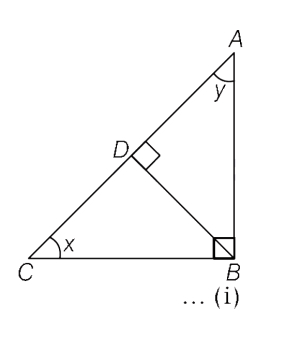
0 likesView Solution
74
MathematicsEasyMCQTS EAMCET · 2019
If $A$ and $B$ are acute angles satisfying $3 \cos ^2 A + 2 \cos ^2 B = 4$ and $\frac{3 \sin A}{\sin B} = \frac{2 \cos B}{\cos A}$,then $A + 2B =$ (in $^{\circ}$)
A
$30$
B
$45$
C
$60$
D
$90$
Solution
(D) Given equations are:
$1) \ 3 \cos^2 A + 2 \cos^2 B = 4$
$2) \ \frac{3 \sin A}{\sin B} = \frac{2 \cos B}{\cos A}$ $\Rightarrow 3 \sin A \cos A = 2 \sin B \cos B$ $\Rightarrow \frac{3}{2} \sin 2A = \sin 2B$
From $(1)$:
$3(1 - \sin^2 A) + 2(1 - \sin^2 B) = 4$
$5 - 3 \sin^2 A - 2 \sin^2 B = 4$
$3 \sin^2 A + 2 \sin^2 B = 1$
$3 \sin^2 A = 1 - 2 \sin^2 B = \cos 2B$
Consider $\cos(A + 2B) = \cos A \cos 2B - \sin A \sin 2B$
Substitute $\cos 2B = 3 \sin^2 A$ and $\sin 2B = \frac{3}{2} \sin 2A = 3 \sin A \cos A$:
$\cos(A + 2B) = \cos A (3 \sin^2 A) - \sin A (3 \sin A \cos A)$
$\cos(A + 2B) = 3 \sin^2 A \cos A - 3 \sin^2 A \cos A = 0$
Since $A, B$ are acute,$A + 2B$ must be $90^{\circ}$.
$1) \ 3 \cos^2 A + 2 \cos^2 B = 4$
$2) \ \frac{3 \sin A}{\sin B} = \frac{2 \cos B}{\cos A}$ $\Rightarrow 3 \sin A \cos A = 2 \sin B \cos B$ $\Rightarrow \frac{3}{2} \sin 2A = \sin 2B$
From $(1)$:
$3(1 - \sin^2 A) + 2(1 - \sin^2 B) = 4$
$5 - 3 \sin^2 A - 2 \sin^2 B = 4$
$3 \sin^2 A + 2 \sin^2 B = 1$
$3 \sin^2 A = 1 - 2 \sin^2 B = \cos 2B$
Consider $\cos(A + 2B) = \cos A \cos 2B - \sin A \sin 2B$
Substitute $\cos 2B = 3 \sin^2 A$ and $\sin 2B = \frac{3}{2} \sin 2A = 3 \sin A \cos A$:
$\cos(A + 2B) = \cos A (3 \sin^2 A) - \sin A (3 \sin A \cos A)$
$\cos(A + 2B) = 3 \sin^2 A \cos A - 3 \sin^2 A \cos A = 0$
Since $A, B$ are acute,$A + 2B$ must be $90^{\circ}$.
0 likesView Solution
75
MathematicsEasyMCQTS EAMCET · 2019
Evaluate: $\left(1+\cos \frac{\pi}{8}\right)\left(1+\cos \frac{3 \pi}{8}\right)\left(1+\cos \frac{5 \pi}{8}\right)\left(1+\cos \frac{7 \pi}{8}\right)$
A
$\frac{1+\sqrt{2}}{2 \sqrt{2}}$
B
$\frac{\pi}{8}$
C
$\frac{1}{8}$
D
$\frac{1}{2}$
Solution
(C) Let the expression be $E = \left(1+\cos \frac{\pi}{8}\right)\left(1+\cos \frac{3 \pi}{8}\right)\left(1+\cos \frac{5 \pi}{8}\right)\left(1+\cos \frac{7 \pi}{8}\right)$.
Using the identity $\cos(\pi - \theta) = -\cos \theta$,we have $\cos \frac{5\pi}{8} = -\cos \frac{3\pi}{8}$ and $\cos \frac{7\pi}{8} = -\cos \frac{\pi}{8}$.
Substituting these values,we get:
$E = \left(1+\cos \frac{\pi}{8}\right)\left(1+\cos \frac{3 \pi}{8}\right)\left(1-\cos \frac{3 \pi}{8}\right)\left(1-\cos \frac{\pi}{8}\right)$
$E = \left(1-\cos^2 \frac{\pi}{8}\right)\left(1-\cos^2 \frac{3 \pi}{8}\right)$
$E = \sin^2 \frac{\pi}{8} \sin^2 \frac{3 \pi}{8}$
Since $\frac{3\pi}{8} = \frac{\pi}{2} - \frac{\pi}{8}$,we have $\sin \frac{3\pi}{8} = \cos \frac{\pi}{8}$.
$E = \sin^2 \frac{\pi}{8} \cos^2 \frac{\pi}{8} = \left(\sin \frac{\pi}{8} \cos \frac{\pi}{8}\right)^2$
Using $2 \sin \theta \cos \theta = \sin 2\theta$,we get $\sin \frac{\pi}{8} \cos \frac{\pi}{8} = \frac{1}{2} \sin \frac{\pi}{4} = \frac{1}{2} \times \frac{1}{\sqrt{2}} = \frac{1}{2\sqrt{2}}$.
$E = \left(\frac{1}{2\sqrt{2}}\right)^2 = \frac{1}{8}$.
Using the identity $\cos(\pi - \theta) = -\cos \theta$,we have $\cos \frac{5\pi}{8} = -\cos \frac{3\pi}{8}$ and $\cos \frac{7\pi}{8} = -\cos \frac{\pi}{8}$.
Substituting these values,we get:
$E = \left(1+\cos \frac{\pi}{8}\right)\left(1+\cos \frac{3 \pi}{8}\right)\left(1-\cos \frac{3 \pi}{8}\right)\left(1-\cos \frac{\pi}{8}\right)$
$E = \left(1-\cos^2 \frac{\pi}{8}\right)\left(1-\cos^2 \frac{3 \pi}{8}\right)$
$E = \sin^2 \frac{\pi}{8} \sin^2 \frac{3 \pi}{8}$
Since $\frac{3\pi}{8} = \frac{\pi}{2} - \frac{\pi}{8}$,we have $\sin \frac{3\pi}{8} = \cos \frac{\pi}{8}$.
$E = \sin^2 \frac{\pi}{8} \cos^2 \frac{\pi}{8} = \left(\sin \frac{\pi}{8} \cos \frac{\pi}{8}\right)^2$
Using $2 \sin \theta \cos \theta = \sin 2\theta$,we get $\sin \frac{\pi}{8} \cos \frac{\pi}{8} = \frac{1}{2} \sin \frac{\pi}{4} = \frac{1}{2} \times \frac{1}{\sqrt{2}} = \frac{1}{2\sqrt{2}}$.
$E = \left(\frac{1}{2\sqrt{2}}\right)^2 = \frac{1}{8}$.
0 likesView Solution
76
MathematicsMediumMCQTS EAMCET · 2019
If $A+B+C=270^{\circ}$,then $\cos 2A + \cos 2B + \cos 2C + 4 \sin A \sin B \sin C =$
A
$3$
B
$2$
C
$1$
D
$-1$
Solution
(C) Given that $A+B+C=270^{\circ}$.
We need to evaluate $\cos 2A + \cos 2B + \cos 2C + 4 \sin A \sin B \sin C$.
Using the sum-to-product formula $\cos 2B + \cos 2C = 2 \cos(B+C) \cos(B-C)$,we get:
$= \cos 2A + 2 \cos(B+C) \cos(B-C) + 4 \sin A \sin B \sin C$.
Since $B+C = 270^{\circ} - A$,then $\cos(B+C) = \cos(270^{\circ} - A) = -\sin A$.
Substituting this:
$= \cos 2A + 2(-\sin A) \cos(B-C) + 4 \sin A \sin B \sin C$
$= (1 - 2 \sin^2 A) - 2 \sin A \cos(B-C) + 4 \sin A \sin B \sin C$
$= 1 - 2 \sin A [\sin A + \cos(B-C)] + 4 \sin A \sin B \sin C$.
Since $\sin A = \sin(270^{\circ} - (B+C)) = -\cos(B+C)$:
$= 1 - 2 \sin A [-\cos(B+C) + \cos(B-C)] + 4 \sin A \sin B \sin C$.
Using the identity $-\cos(B+C) + \cos(B-C) = 2 \sin B \sin C$:
$= 1 - 2 \sin A (2 \sin B \sin C) + 4 \sin A \sin B \sin C$
$= 1 - 4 \sin A \sin B \sin C + 4 \sin A \sin B \sin C$
$= 1$.
We need to evaluate $\cos 2A + \cos 2B + \cos 2C + 4 \sin A \sin B \sin C$.
Using the sum-to-product formula $\cos 2B + \cos 2C = 2 \cos(B+C) \cos(B-C)$,we get:
$= \cos 2A + 2 \cos(B+C) \cos(B-C) + 4 \sin A \sin B \sin C$.
Since $B+C = 270^{\circ} - A$,then $\cos(B+C) = \cos(270^{\circ} - A) = -\sin A$.
Substituting this:
$= \cos 2A + 2(-\sin A) \cos(B-C) + 4 \sin A \sin B \sin C$
$= (1 - 2 \sin^2 A) - 2 \sin A \cos(B-C) + 4 \sin A \sin B \sin C$
$= 1 - 2 \sin A [\sin A + \cos(B-C)] + 4 \sin A \sin B \sin C$.
Since $\sin A = \sin(270^{\circ} - (B+C)) = -\cos(B+C)$:
$= 1 - 2 \sin A [-\cos(B+C) + \cos(B-C)] + 4 \sin A \sin B \sin C$.
Using the identity $-\cos(B+C) + \cos(B-C) = 2 \sin B \sin C$:
$= 1 - 2 \sin A (2 \sin B \sin C) + 4 \sin A \sin B \sin C$
$= 1 - 4 \sin A \sin B \sin C + 4 \sin A \sin B \sin C$
$= 1$.
0 likesView Solution
77
MathematicsDifficultMCQTS EAMCET · 2019
If $0 < A < B < \frac{\pi}{4}$,$\cos (A+B) = \frac{11}{61}$ and $\sin (A-B) = \frac{24}{25}$,then $\sin 2A + \sin 2B = $
A
$\frac{684}{1525}$
B
$\frac{156}{1525}$
C
$\frac{168}{305}$
D
$\frac{137}{305}$
Solution
(C) Given $0 < A < B < \frac{\pi}{4}$,$\cos (A+B) = \frac{11}{61}$ and $\sin (A-B) = \frac{24}{25}$.
Since $0 < A+B < \frac{\pi}{2}$,$\sin (A+B) = \sqrt{1 - (\frac{11}{61})^2} = \sqrt{\frac{3721-121}{3721}} = \frac{60}{61}$.
Since $0 < A-B < 0$ is not possible,we note that $A < B$ implies $A-B < 0$. However,the problem states $\sin(A-B) = \frac{24}{25}$,which implies $A-B$ must be in the first or second quadrant. Given the constraints,we treat the values as magnitudes for the identity.
Using $\cos (A-B) = \sqrt{1 - (\frac{24}{25})^2} = \frac{7}{25}$.
We know $\sin 2A = \sin ((A+B) + (A-B)) = \sin (A+B) \cos (A-B) + \cos (A+B) \sin (A-B) = (\frac{60}{61} \times \frac{7}{25}) + (\frac{11}{61} \times \frac{24}{25}) = \frac{420 + 264}{1525} = \frac{684}{1525}$.
We know $\sin 2B = \sin ((A+B) - (A-B)) = \sin (A+B) \cos (A-B) - \cos (A+B) \sin (A-B) = (\frac{60}{61} \times \frac{7}{25}) - (\frac{11}{61} \times \frac{24}{25}) = \frac{420 - 264}{1525} = \frac{156}{1525}$.
Therefore,$\sin 2A + \sin 2B = \frac{684}{1525} + \frac{156}{1525} = \frac{840}{1525} = \frac{168}{305}$.
Since $0 < A+B < \frac{\pi}{2}$,$\sin (A+B) = \sqrt{1 - (\frac{11}{61})^2} = \sqrt{\frac{3721-121}{3721}} = \frac{60}{61}$.
Since $0 < A-B < 0$ is not possible,we note that $A < B$ implies $A-B < 0$. However,the problem states $\sin(A-B) = \frac{24}{25}$,which implies $A-B$ must be in the first or second quadrant. Given the constraints,we treat the values as magnitudes for the identity.
Using $\cos (A-B) = \sqrt{1 - (\frac{24}{25})^2} = \frac{7}{25}$.
We know $\sin 2A = \sin ((A+B) + (A-B)) = \sin (A+B) \cos (A-B) + \cos (A+B) \sin (A-B) = (\frac{60}{61} \times \frac{7}{25}) + (\frac{11}{61} \times \frac{24}{25}) = \frac{420 + 264}{1525} = \frac{684}{1525}$.
We know $\sin 2B = \sin ((A+B) - (A-B)) = \sin (A+B) \cos (A-B) - \cos (A+B) \sin (A-B) = (\frac{60}{61} \times \frac{7}{25}) - (\frac{11}{61} \times \frac{24}{25}) = \frac{420 - 264}{1525} = \frac{156}{1525}$.
Therefore,$\sin 2A + \sin 2B = \frac{684}{1525} + \frac{156}{1525} = \frac{840}{1525} = \frac{168}{305}$.
0 likesView Solution
78
MathematicsDifficultMCQTS EAMCET · 2019
If $A+B+C=\frac{\pi}{3}$,then $\sin \left(\frac{\pi-6A}{6}\right)+\sin \left(\frac{\pi-6B}{6}\right)+\sin C=$
A
$-1+4 \cos \left(\frac{\pi-6A}{12}\right) \cos \left(\frac{\pi-6B}{12}\right) \sin \frac{C}{2}$
B
$4 \sin \left(\frac{\pi+6A}{12}\right) \sin \left(\frac{\pi+6B}{12}\right) \cos \frac{C}{2}$
C
$1-4 \cos \left(\frac{\pi-6A}{12}\right) \cos \left(\frac{\pi-6B}{12}\right) \cos \left(\frac{\pi-6C}{12}\right)$
D
$4 \cos \left(\frac{\pi-6A}{12}\right) \cos \left(\frac{\pi-6B}{12}\right) \sin \frac{C}{2}$
Solution
(D) Given,$A+B+C=\frac{\pi}{3}$.
We need to evaluate $S = \sin \left(\frac{\pi-6A}{6}\right)+\sin \left(\frac{\pi-6B}{6}\right)+\sin C$.
Using the formula $\sin X + \sin Y = 2 \sin \left(\frac{X+Y}{2}\right) \cos \left(\frac{X-Y}{2}\right)$:
$S = 2 \sin \left(\frac{\frac{\pi-6A}{6} + \frac{\pi-6B}{6}}{2}\right) \cos \left(\frac{\frac{\pi-6A}{6} - \frac{\pi-6B}{6}}{2}\right) + \sin C$
$S = 2 \sin \left(\frac{2\pi - 6(A+B)}{12}\right) \cos \left(\frac{6(B-A)}{12}\right) + \sin C$
Since $A+B = \frac{\pi}{3} - C$,then $6(A+B) = 2\pi - 6C$.
$S = 2 \sin \left(\frac{2\pi - (2\pi - 6C)}{12}\right) \cos \left(\frac{B-A}{2}\right) + \sin C$
$S = 2 \sin \left(\frac{6C}{12}\right) \cos \left(\frac{B-A}{2}\right) + 2 \sin \frac{C}{2} \cos \frac{C}{2}$
$S = 2 \sin \frac{C}{2} \left[ \cos \left(\frac{B-A}{2}\right) + \cos \frac{C}{2} \right]$
Since $C = \frac{\pi}{3} - (A+B)$,$\frac{C}{2} = \frac{\pi}{6} - \frac{A+B}{2}$.
$S = 2 \sin \frac{C}{2} \left[ \cos \left(\frac{B-A}{2}\right) + \cos \left(\frac{\pi}{6} - \frac{A+B}{2}\right) \right]$
Using $\cos X + \cos Y = 2 \cos \left(\frac{X+Y}{2}\right) \cos \left(\frac{X-Y}{2}\right)$:
$S = 2 \sin \frac{C}{2} \left[ 2 \cos \left(\frac{\frac{B-A}{2} + \frac{\pi}{6} - \frac{A+B}{2}}{2}\right) \cos \left(\frac{\frac{B-A}{2} - \frac{\pi}{6} + \frac{A+B}{2}}{2}\right) \right]$
$S = 4 \sin \frac{C}{2} \cos \left(\frac{\pi - 6A}{12}\right) \cos \left(\frac{6B - \pi}{12}\right)$
Since $\cos(-x) = \cos(x)$,$\cos \left(\frac{6B - \pi}{12}\right) = \cos \left(\frac{\pi - 6B}{12}\right)$.
Thus,$S = 4 \cos \left(\frac{\pi-6A}{12}\right) \cos \left(\frac{\pi-6B}{12}\right) \sin \frac{C}{2}$.
We need to evaluate $S = \sin \left(\frac{\pi-6A}{6}\right)+\sin \left(\frac{\pi-6B}{6}\right)+\sin C$.
Using the formula $\sin X + \sin Y = 2 \sin \left(\frac{X+Y}{2}\right) \cos \left(\frac{X-Y}{2}\right)$:
$S = 2 \sin \left(\frac{\frac{\pi-6A}{6} + \frac{\pi-6B}{6}}{2}\right) \cos \left(\frac{\frac{\pi-6A}{6} - \frac{\pi-6B}{6}}{2}\right) + \sin C$
$S = 2 \sin \left(\frac{2\pi - 6(A+B)}{12}\right) \cos \left(\frac{6(B-A)}{12}\right) + \sin C$
Since $A+B = \frac{\pi}{3} - C$,then $6(A+B) = 2\pi - 6C$.
$S = 2 \sin \left(\frac{2\pi - (2\pi - 6C)}{12}\right) \cos \left(\frac{B-A}{2}\right) + \sin C$
$S = 2 \sin \left(\frac{6C}{12}\right) \cos \left(\frac{B-A}{2}\right) + 2 \sin \frac{C}{2} \cos \frac{C}{2}$
$S = 2 \sin \frac{C}{2} \left[ \cos \left(\frac{B-A}{2}\right) + \cos \frac{C}{2} \right]$
Since $C = \frac{\pi}{3} - (A+B)$,$\frac{C}{2} = \frac{\pi}{6} - \frac{A+B}{2}$.
$S = 2 \sin \frac{C}{2} \left[ \cos \left(\frac{B-A}{2}\right) + \cos \left(\frac{\pi}{6} - \frac{A+B}{2}\right) \right]$
Using $\cos X + \cos Y = 2 \cos \left(\frac{X+Y}{2}\right) \cos \left(\frac{X-Y}{2}\right)$:
$S = 2 \sin \frac{C}{2} \left[ 2 \cos \left(\frac{\frac{B-A}{2} + \frac{\pi}{6} - \frac{A+B}{2}}{2}\right) \cos \left(\frac{\frac{B-A}{2} - \frac{\pi}{6} + \frac{A+B}{2}}{2}\right) \right]$
$S = 4 \sin \frac{C}{2} \cos \left(\frac{\pi - 6A}{12}\right) \cos \left(\frac{6B - \pi}{12}\right)$
Since $\cos(-x) = \cos(x)$,$\cos \left(\frac{6B - \pi}{12}\right) = \cos \left(\frac{\pi - 6B}{12}\right)$.
Thus,$S = 4 \cos \left(\frac{\pi-6A}{12}\right) \cos \left(\frac{\pi-6B}{12}\right) \sin \frac{C}{2}$.
0 likesView Solution
79
MathematicsMediumMCQTS EAMCET · 2019
The maximum value of $\left(2 \cos^2 18^{\circ} - \sin 18^{\circ}\right) \left(\cos \theta + 3 \sqrt{2} \cos \left(\theta + \frac{\pi}{4}\right) + 3\right)$ is
A
$5 \sqrt{2}$
B
$4 \sqrt{5}$
C
$3$
D
$12$
Solution
(D) Let $E = \left(2 \cos^2 18^{\circ} - \sin 18^{\circ}\right) \left(\cos \theta + 3 \sqrt{2} \cos \left(\theta + \frac{\pi}{4}\right) + 3\right)$.
First,simplify the constant term: $2 \cos^2 18^{\circ} - \sin 18^{\circ} = (1 + \cos 36^{\circ}) - \sin 18^{\circ}$.
Using $\cos 36^{\circ} = \frac{\sqrt{5} + 1}{4}$ and $\sin 18^{\circ} = \frac{\sqrt{5} - 1}{4}$,we get $1 + \frac{\sqrt{5} + 1}{4} - \frac{\sqrt{5} - 1}{4} = 1 + \frac{2}{4} = \frac{3}{2}$.
Now,simplify the second term: $\cos \theta + 3 \sqrt{2} \left(\cos \theta \cos \frac{\pi}{4} - \sin \theta \sin \frac{\pi}{4}\right) + 3$.
$= \cos \theta + 3 \sqrt{2} \left(\cos \theta \cdot \frac{1}{\sqrt{2}} - \sin \theta \cdot \frac{1}{\sqrt{2}}\right) + 3$.
$= \cos \theta + 3 \cos \theta - 3 \sin \theta + 3 = 4 \cos \theta - 3 \sin \theta + 3$.
Thus,$E = \frac{3}{2} (4 \cos \theta - 3 \sin \theta + 3)$.
The maximum value of $a \cos \theta + b \sin \theta$ is $\sqrt{a^2 + b^2}$.
Here,the maximum value of $4 \cos \theta - 3 \sin \theta$ is $\sqrt{4^2 + (-3)^2} = \sqrt{16 + 9} = 5$.
Therefore,the maximum value of $E = \frac{3}{2} (5 + 3) = \frac{3}{2} \times 8 = 12$.
First,simplify the constant term: $2 \cos^2 18^{\circ} - \sin 18^{\circ} = (1 + \cos 36^{\circ}) - \sin 18^{\circ}$.
Using $\cos 36^{\circ} = \frac{\sqrt{5} + 1}{4}$ and $\sin 18^{\circ} = \frac{\sqrt{5} - 1}{4}$,we get $1 + \frac{\sqrt{5} + 1}{4} - \frac{\sqrt{5} - 1}{4} = 1 + \frac{2}{4} = \frac{3}{2}$.
Now,simplify the second term: $\cos \theta + 3 \sqrt{2} \left(\cos \theta \cos \frac{\pi}{4} - \sin \theta \sin \frac{\pi}{4}\right) + 3$.
$= \cos \theta + 3 \sqrt{2} \left(\cos \theta \cdot \frac{1}{\sqrt{2}} - \sin \theta \cdot \frac{1}{\sqrt{2}}\right) + 3$.
$= \cos \theta + 3 \cos \theta - 3 \sin \theta + 3 = 4 \cos \theta - 3 \sin \theta + 3$.
Thus,$E = \frac{3}{2} (4 \cos \theta - 3 \sin \theta + 3)$.
The maximum value of $a \cos \theta + b \sin \theta$ is $\sqrt{a^2 + b^2}$.
Here,the maximum value of $4 \cos \theta - 3 \sin \theta$ is $\sqrt{4^2 + (-3)^2} = \sqrt{16 + 9} = 5$.
Therefore,the maximum value of $E = \frac{3}{2} (5 + 3) = \frac{3}{2} \times 8 = 12$.
0 likesView Solution
80
MathematicsEasyMCQTS EAMCET · 2019
In a triangle $ABC$,if $\cos A \cos B + \sin A \sin B \sin C = 1$,then $\sin A + \sin B + \sin C = $
A
$\frac{2+\sqrt{3}}{2}$
B
$1+\sqrt{2}$
C
$\frac{2\sqrt{3}-1}{2}$
D
$\frac{3+\sqrt{3}}{2}$
Solution
(B) Given the equation $\cos A \cos B + \sin A \sin B \sin C = 1$ in $\triangle ABC$.
Since $\sin C \le 1$,we have $\cos A \cos B + \sin A \sin B \sin C \le \cos A \cos B + \sin A \sin B = \cos(A - B)$.
Since $\cos(A - B) \le 1$,the equality holds only if $\cos(A - B) = 1$ and $\sin C = 1$.
This implies $A = B$ and $C = 90^{\circ}$.
Since $A + B + C = 180^{\circ}$,we have $2A + 90^{\circ} = 180^{\circ}$,so $A = 45^{\circ}$ and $B = 45^{\circ}$.
Thus,$\sin A + \sin B + \sin C = \sin 45^{\circ} + \sin 45^{\circ} + \sin 90^{\circ} = \frac{1}{\sqrt{2}} + \frac{1}{\sqrt{2}} + 1 = \sqrt{2} + 1$.
Since $\sin C \le 1$,we have $\cos A \cos B + \sin A \sin B \sin C \le \cos A \cos B + \sin A \sin B = \cos(A - B)$.
Since $\cos(A - B) \le 1$,the equality holds only if $\cos(A - B) = 1$ and $\sin C = 1$.
This implies $A = B$ and $C = 90^{\circ}$.
Since $A + B + C = 180^{\circ}$,we have $2A + 90^{\circ} = 180^{\circ}$,so $A = 45^{\circ}$ and $B = 45^{\circ}$.
Thus,$\sin A + \sin B + \sin C = \sin 45^{\circ} + \sin 45^{\circ} + \sin 90^{\circ} = \frac{1}{\sqrt{2}} + \frac{1}{\sqrt{2}} + 1 = \sqrt{2} + 1$.
0 likesView Solution
81
MathematicsEasyMCQTS EAMCET · 2019
Evaluate the sum: $\sin^2(3^{\circ}) + \sin^2(6^{\circ}) + \sin^2(9^{\circ}) + \dots + \sin^2(84^{\circ}) + \sin^2(87^{\circ}) + \sin^2(90^{\circ})$
A
$\frac{31}{2}$
B
$\frac{39}{2}$
C
$\frac{59}{2}$
D
$36$
Solution
(A) The given series is $S = \sin^2(3^{\circ}) + \sin^2(6^{\circ}) + \dots + \sin^2(87^{\circ}) + \sin^2(90^{\circ})$.
This is a series of $30$ terms where the angles are in an arithmetic progression: $3^{\circ}, 6^{\circ}, \dots, 90^{\circ}$.
We can pair terms using the identity $\sin^2(\theta) + \sin^2(90^{\circ} - \theta) = \sin^2(\theta) + \cos^2(\theta) = 1$.
The pairs are $(3^{\circ}, 87^{\circ}), (6^{\circ}, 84^{\circ}), \dots, (42^{\circ}, 48^{\circ})$.
There are $\frac{87-3}{3} + 1 = 29$ terms excluding $\sin^2(90^{\circ})$.
Since $29$ is odd,there are $14$ pairs and one middle term $\sin^2(45^{\circ})$.
Sum $= 14 \times 1 + \sin^2(45^{\circ}) + \sin^2(90^{\circ}) = 14 + (\frac{1}{\sqrt{2}})^2 + 1^2 = 14 + 0.5 + 1 = 15.5 = \frac{31}{2}$.
This is a series of $30$ terms where the angles are in an arithmetic progression: $3^{\circ}, 6^{\circ}, \dots, 90^{\circ}$.
We can pair terms using the identity $\sin^2(\theta) + \sin^2(90^{\circ} - \theta) = \sin^2(\theta) + \cos^2(\theta) = 1$.
The pairs are $(3^{\circ}, 87^{\circ}), (6^{\circ}, 84^{\circ}), \dots, (42^{\circ}, 48^{\circ})$.
There are $\frac{87-3}{3} + 1 = 29$ terms excluding $\sin^2(90^{\circ})$.
Since $29$ is odd,there are $14$ pairs and one middle term $\sin^2(45^{\circ})$.
Sum $= 14 \times 1 + \sin^2(45^{\circ}) + \sin^2(90^{\circ}) = 14 + (\frac{1}{\sqrt{2}})^2 + 1^2 = 14 + 0.5 + 1 = 15.5 = \frac{31}{2}$.
0 likesView Solution
82
MathematicsMediumMCQTS EAMCET · 2019
For $n \in \mathbb{Z}$,the general solution of the trigonometric equation $\sin x - \sqrt{3} \cos x + 4 \sin 2x - 4 \sqrt{3} \cos 2x + \sin 3x - \sqrt{3} \cos 3x = 0$ is
A
$\frac{n \pi}{2} + \frac{\pi}{8}$
B
$\frac{n \pi}{2} + \frac{\pi}{6}$
C
$\frac{n \pi}{2} \pm \frac{\pi}{6}$
D
$2 n \pi \pm \frac{\pi}{6}$
Solution
(B) Given equation: $\sin x - \sqrt{3} \cos x + 4 \sin 2x - 4 \sqrt{3} \cos 2x + \sin 3x - \sqrt{3} \cos 3x = 0$.
Divide by $2$ to use the identity $\sin(A-B) = \sin A \cos B - \cos A \sin B$:
$2[\frac{1}{2} \sin x - \frac{\sqrt{3}}{2} \cos x] + 8[\frac{1}{2} \sin 2x - \frac{\sqrt{3}}{2} \cos 2x] + 2[\frac{1}{2} \sin 3x - \frac{\sqrt{3}}{2} \cos 3x] = 0$.
This simplifies to:
$2 \sin(x - \frac{\pi}{3}) + 8 \sin(2x - \frac{\pi}{3}) + 2 \sin(3x - \frac{\pi}{3}) = 0$.
Divide by $2$:
$\sin(x - \frac{\pi}{3}) + \sin(3x - \frac{\pi}{3}) + 4 \sin(2x - \frac{\pi}{3}) = 0$.
Using $\sin C + \sin D = 2 \sin(\frac{C+D}{2}) \cos(\frac{C-D}{2})$:
$2 \sin(2x - \frac{\pi}{3}) \cos(x) + 4 \sin(2x - \frac{\pi}{3}) = 0$.
$2 \sin(2x - \frac{\pi}{3}) [\cos x + 2] = 0$.
Since $\cos x + 2 \neq 0$ for any real $x$,we must have $\sin(2x - \frac{\pi}{3}) = 0$.
Thus,$2x - \frac{\pi}{3} = n \pi$,which gives $2x = n \pi + \frac{\pi}{3}$,or $x = \frac{n \pi}{2} + \frac{\pi}{6}$.
Divide by $2$ to use the identity $\sin(A-B) = \sin A \cos B - \cos A \sin B$:
$2[\frac{1}{2} \sin x - \frac{\sqrt{3}}{2} \cos x] + 8[\frac{1}{2} \sin 2x - \frac{\sqrt{3}}{2} \cos 2x] + 2[\frac{1}{2} \sin 3x - \frac{\sqrt{3}}{2} \cos 3x] = 0$.
This simplifies to:
$2 \sin(x - \frac{\pi}{3}) + 8 \sin(2x - \frac{\pi}{3}) + 2 \sin(3x - \frac{\pi}{3}) = 0$.
Divide by $2$:
$\sin(x - \frac{\pi}{3}) + \sin(3x - \frac{\pi}{3}) + 4 \sin(2x - \frac{\pi}{3}) = 0$.
Using $\sin C + \sin D = 2 \sin(\frac{C+D}{2}) \cos(\frac{C-D}{2})$:
$2 \sin(2x - \frac{\pi}{3}) \cos(x) + 4 \sin(2x - \frac{\pi}{3}) = 0$.
$2 \sin(2x - \frac{\pi}{3}) [\cos x + 2] = 0$.
Since $\cos x + 2 \neq 0$ for any real $x$,we must have $\sin(2x - \frac{\pi}{3}) = 0$.
Thus,$2x - \frac{\pi}{3} = n \pi$,which gives $2x = n \pi + \frac{\pi}{3}$,or $x = \frac{n \pi}{2} + \frac{\pi}{6}$.
0 likesView Solution
83
MathematicsMediumMCQTS EAMCET · 2019
If $y = \log_e \tan \left(\frac{\pi}{4} + \frac{x}{2}\right)$,then $\tanh \left(\frac{y}{2}\right) = $
A
$\cot \frac{x}{2}$
B
$\tan x$
C
$\coth x$
D
$\tan \frac{x}{2}$
Solution
(D) Given $y = \log_e \tan \left(\frac{\pi}{4} + \frac{x}{2}\right)$.
$e^y = \tan \left(\frac{\pi}{4} + \frac{x}{2}\right) = \frac{1 + \tan \frac{x}{2}}{1 - \tan \frac{x}{2}}$.
We know that $\tanh \left(\frac{y}{2}\right) = \frac{e^y - 1}{e^y + 1}$.
Substituting the value of $e^y$:
$\tanh \left(\frac{y}{2}\right) = \frac{\frac{1 + \tan \frac{x}{2}}{1 - \tan \frac{x}{2}} - 1}{\frac{1 + \tan \frac{x}{2}}{1 - \tan \frac{x}{2}} + 1} = \frac{(1 + \tan \frac{x}{2}) - (1 - \tan \frac{x}{2})}{(1 + \tan \frac{x}{2}) + (1 - \tan \frac{x}{2})} = \frac{2 \tan \frac{x}{2}}{2} = \tan \frac{x}{2}$.
Thus,option $D$ is correct.
$e^y = \tan \left(\frac{\pi}{4} + \frac{x}{2}\right) = \frac{1 + \tan \frac{x}{2}}{1 - \tan \frac{x}{2}}$.
We know that $\tanh \left(\frac{y}{2}\right) = \frac{e^y - 1}{e^y + 1}$.
Substituting the value of $e^y$:
$\tanh \left(\frac{y}{2}\right) = \frac{\frac{1 + \tan \frac{x}{2}}{1 - \tan \frac{x}{2}} - 1}{\frac{1 + \tan \frac{x}{2}}{1 - \tan \frac{x}{2}} + 1} = \frac{(1 + \tan \frac{x}{2}) - (1 - \tan \frac{x}{2})}{(1 + \tan \frac{x}{2}) + (1 - \tan \frac{x}{2})} = \frac{2 \tan \frac{x}{2}}{2} = \tan \frac{x}{2}$.
Thus,option $D$ is correct.
0 likesView Solution
84
MathematicsEasyMCQTS EAMCET · 2019
The number of solutions of the equation $\sin A - 5 \sin 2A + \sin 3A = \cos A - 5 \cos 2A + \cos 3A$ in the interval $(0, \pi)$ is:
A
$1$
B
$2$
C
$3$
D
$4$
Solution
(B) Given equation: $\sin A - 5 \sin 2A + \sin 3A = \cos A - 5 \cos 2A + \cos 3A$
Rearranging terms: $(\sin A + \sin 3A) - 5 \sin 2A = (\cos A + \cos 3A) - 5 \cos 2A$
Using sum-to-product formulas: $2 \sin 2A \cos A - 5 \sin 2A = 2 \cos 2A \cos A - 5 \cos 2A$
Factoring: $2 \cos A (\sin 2A - \cos 2A) - 5 (\sin 2A - \cos 2A) = 0$
$(\sin 2A - \cos 2A)(2 \cos A - 5) = 0$
Since $2 \cos A - 5 = 0$ implies $\cos A = 2.5$,which is impossible,we must have $\sin 2A - \cos 2A = 0$
$\sin 2A = \cos 2A \Rightarrow \tan 2A = 1$
For $A \in (0, \pi)$,$2A \in (0, 2\pi)$
$\tan 2A = 1$ at $2A = \frac{\pi}{4}$ and $2A = \frac{5\pi}{4}$
Thus,$A = \frac{\pi}{8}$ and $A = \frac{5\pi}{8}$
There are $2$ solutions in the given interval.
Rearranging terms: $(\sin A + \sin 3A) - 5 \sin 2A = (\cos A + \cos 3A) - 5 \cos 2A$
Using sum-to-product formulas: $2 \sin 2A \cos A - 5 \sin 2A = 2 \cos 2A \cos A - 5 \cos 2A$
Factoring: $2 \cos A (\sin 2A - \cos 2A) - 5 (\sin 2A - \cos 2A) = 0$
$(\sin 2A - \cos 2A)(2 \cos A - 5) = 0$
Since $2 \cos A - 5 = 0$ implies $\cos A = 2.5$,which is impossible,we must have $\sin 2A - \cos 2A = 0$
$\sin 2A = \cos 2A \Rightarrow \tan 2A = 1$
For $A \in (0, \pi)$,$2A \in (0, 2\pi)$
$\tan 2A = 1$ at $2A = \frac{\pi}{4}$ and $2A = \frac{5\pi}{4}$
Thus,$A = \frac{\pi}{8}$ and $A = \frac{5\pi}{8}$
There are $2$ solutions in the given interval.
0 likesView Solution
85
MathematicsMediumMCQTS EAMCET · 2019
If $\cot \theta + \tan \theta = 3$ and $1 - \cos^2 \theta - \alpha \cos \theta = 0$,then
A
$6 \alpha^2(9 - \alpha^2) = 1$
B
$6 \alpha^2(\alpha^2 - 9) = 1$
C
$9 \alpha^2(6 - \alpha^2) = 1$
D
$9 \alpha^2(\alpha^2 - 6) = 1$
Solution
(C) Given $\cot \theta + \tan \theta = 3$.
Since $\cot \theta + \tan \theta = \frac{\cos \theta}{\sin \theta} + \frac{\sin \theta}{\cos \theta} = \frac{\cos^2 \theta + \sin^2 \theta}{\sin \theta \cos \theta} = \frac{1}{\sin \theta \cos \theta}$,we have $\frac{1}{\sin \theta \cos \theta} = 3$,so $\sin \theta \cos \theta = \frac{1}{3}$.
Also,$1 - \cos^2 \theta - \alpha \cos \theta = 0$ implies $\sin^2 \theta = \alpha \cos \theta$.
Squaring both sides,$\sin^4 \theta = \alpha^2 \cos^2 \theta = \alpha^2(1 - \sin^2 \theta)$.
From $\sin \theta \cos \theta = \frac{1}{3}$,we have $\cos \theta = \frac{1}{3 \sin \theta}$.
Substituting into $\sin^2 \theta = \alpha \cos \theta$,we get $\sin^2 \theta = \alpha \left(\frac{1}{3 \sin \theta}\right)$,so $\sin^3 \theta = \frac{\alpha}{3}$.
Thus,$\sin^2 \theta = \left(\frac{\alpha}{3}\right)^{2/3}$.
Substituting this into $\sin^4 \theta = \alpha^2(1 - \sin^2 \theta)$,we get $\left(\frac{\alpha}{3}\right)^{4/3} = \alpha^2 \left(1 - \left(\frac{\alpha}{3}\right)^{2/3}\right)$.
Dividing by $\alpha^2$,we have $\frac{\alpha^{4/3}}{3^{4/3} \alpha^2} = 1 - \left(\frac{\alpha}{3}\right)^{2/3}$,which simplifies to $\frac{1}{3^{4/3} \alpha^{2/3}} = 1 - \left(\frac{\alpha}{3}\right)^{2/3}$.
Alternatively,from $\sin^2 \theta = \alpha \cos \theta$,we have $\cos \theta = \frac{\sin^2 \theta}{\alpha}$.
Since $\sin^2 \theta \cos^2 \theta = \frac{1}{9}$,we have $\sin^2 \theta \left(\frac{\sin^4 \theta}{\alpha^2}\right) = \frac{1}{9}$,so $\sin^6 \theta = \frac{\alpha^2}{9}$.
Since $\sin^3 \theta = \frac{\alpha}{3}$,this is consistent.
Using $\cos^2 \theta = 1 - \sin^2 \theta = 1 - (\frac{\alpha}{3})^{2/3}$,and $\cos^2 \theta = \frac{\sin^4 \theta}{\alpha^2} = \frac{(\alpha/3)^{4/3}}{\alpha^2} = \frac{\alpha^{4/3}}{3^{4/3} \alpha^2} = \frac{1}{3^{4/3} \alpha^{2/3}}$.
Equating these,$1 - (\frac{\alpha}{3})^{2/3} = \frac{1}{3^{4/3} \alpha^{2/3}}$.
Multiplying by $3^{4/3} \alpha^{2/3}$,we get $3^{4/3} \alpha^{2/3} - 3^{4/3} \frac{\alpha^{4/3}}{3^{2/3}} = 1$,so $3 \cdot 3^{1/3} \alpha^{2/3} - 3 \alpha^{4/3} = 1$.
Cubing both sides leads to $9 \alpha^2(6 - \alpha^2) = 1$.
Since $\cot \theta + \tan \theta = \frac{\cos \theta}{\sin \theta} + \frac{\sin \theta}{\cos \theta} = \frac{\cos^2 \theta + \sin^2 \theta}{\sin \theta \cos \theta} = \frac{1}{\sin \theta \cos \theta}$,we have $\frac{1}{\sin \theta \cos \theta} = 3$,so $\sin \theta \cos \theta = \frac{1}{3}$.
Also,$1 - \cos^2 \theta - \alpha \cos \theta = 0$ implies $\sin^2 \theta = \alpha \cos \theta$.
Squaring both sides,$\sin^4 \theta = \alpha^2 \cos^2 \theta = \alpha^2(1 - \sin^2 \theta)$.
From $\sin \theta \cos \theta = \frac{1}{3}$,we have $\cos \theta = \frac{1}{3 \sin \theta}$.
Substituting into $\sin^2 \theta = \alpha \cos \theta$,we get $\sin^2 \theta = \alpha \left(\frac{1}{3 \sin \theta}\right)$,so $\sin^3 \theta = \frac{\alpha}{3}$.
Thus,$\sin^2 \theta = \left(\frac{\alpha}{3}\right)^{2/3}$.
Substituting this into $\sin^4 \theta = \alpha^2(1 - \sin^2 \theta)$,we get $\left(\frac{\alpha}{3}\right)^{4/3} = \alpha^2 \left(1 - \left(\frac{\alpha}{3}\right)^{2/3}\right)$.
Dividing by $\alpha^2$,we have $\frac{\alpha^{4/3}}{3^{4/3} \alpha^2} = 1 - \left(\frac{\alpha}{3}\right)^{2/3}$,which simplifies to $\frac{1}{3^{4/3} \alpha^{2/3}} = 1 - \left(\frac{\alpha}{3}\right)^{2/3}$.
Alternatively,from $\sin^2 \theta = \alpha \cos \theta$,we have $\cos \theta = \frac{\sin^2 \theta}{\alpha}$.
Since $\sin^2 \theta \cos^2 \theta = \frac{1}{9}$,we have $\sin^2 \theta \left(\frac{\sin^4 \theta}{\alpha^2}\right) = \frac{1}{9}$,so $\sin^6 \theta = \frac{\alpha^2}{9}$.
Since $\sin^3 \theta = \frac{\alpha}{3}$,this is consistent.
Using $\cos^2 \theta = 1 - \sin^2 \theta = 1 - (\frac{\alpha}{3})^{2/3}$,and $\cos^2 \theta = \frac{\sin^4 \theta}{\alpha^2} = \frac{(\alpha/3)^{4/3}}{\alpha^2} = \frac{\alpha^{4/3}}{3^{4/3} \alpha^2} = \frac{1}{3^{4/3} \alpha^{2/3}}$.
Equating these,$1 - (\frac{\alpha}{3})^{2/3} = \frac{1}{3^{4/3} \alpha^{2/3}}$.
Multiplying by $3^{4/3} \alpha^{2/3}$,we get $3^{4/3} \alpha^{2/3} - 3^{4/3} \frac{\alpha^{4/3}}{3^{2/3}} = 1$,so $3 \cdot 3^{1/3} \alpha^{2/3} - 3 \alpha^{4/3} = 1$.
Cubing both sides leads to $9 \alpha^2(6 - \alpha^2) = 1$.
0 likesView Solution
86
MathematicsDifficultMCQTS EAMCET · 2019
$\cos \frac{\pi}{7} - \cos \frac{2\pi}{7} + \cos \frac{3\pi}{7} - \cos \frac{4\pi}{7} + \cos \frac{5\pi}{7} - \cos \frac{6\pi}{7} = $
A
$\frac{1}{2}$
B
$\frac{3}{2}$
C
$\frac{3}{4}$
D
$1$
Solution
(D) Let $S = \cos \frac{\pi}{7} - \cos \frac{2\pi}{7} + \cos \frac{3\pi}{7} - \cos \frac{4\pi}{7} + \cos \frac{5\pi}{7} - \cos \frac{6\pi}{7}$.
Using the property $\cos(\pi - \theta) = -\cos \theta$,we have $\cos \frac{6\pi}{7} = -\cos \frac{\pi}{7}$,$\cos \frac{5\pi}{7} = -\cos \frac{2\pi}{7}$,and $\cos \frac{4\pi}{7} = -\cos \frac{3\pi}{7}$.
Substituting these into the expression:
$S = \cos \frac{\pi}{7} - \cos \frac{2\pi}{7} + \cos \frac{3\pi}{7} - (-\cos \frac{3\pi}{7}) + (-\cos \frac{2\pi}{7}) - (-\cos \frac{\pi}{7})$
$S = \cos \frac{\pi}{7} - \cos \frac{2\pi}{7} + \cos \frac{3\pi}{7} + \cos \frac{3\pi}{7} - \cos \frac{2\pi}{7} + \cos \frac{\pi}{7}$
$S = 2 \cos \frac{\pi}{7} - 2 \cos \frac{2\pi}{7} + 2 \cos \frac{3\pi}{7}$.
Multiply and divide by $2 \sin \frac{\pi}{7}$:
$S = \frac{2 \sin \frac{\pi}{7} \cos \frac{\pi}{7} - 2 \sin \frac{\pi}{7} \cos \frac{2\pi}{7} + 2 \sin \frac{\pi}{7} \cos \frac{3\pi}{7}}{\sin \frac{\pi}{7}}$
Using $2 \sin A \cos B = \sin(A+B) + \sin(A-B)$:
$S = \frac{\sin \frac{2\pi}{7} - (\sin \frac{3\pi}{7} - \sin \frac{\pi}{7}) + (\sin \frac{4\pi}{7} - \sin \frac{2\pi}{7})}{\sin \frac{\pi}{7}}$
$S = \frac{\sin \frac{2\pi}{7} - \sin \frac{3\pi}{7} + \sin \frac{\pi}{7} + \sin \frac{4\pi}{7} - \sin \frac{2\pi}{7}}{\sin \frac{\pi}{7}}$
Since $\sin \frac{4\pi}{7} = \sin(\pi - \frac{4\pi}{7}) = \sin \frac{3\pi}{7}$,the terms cancel out:
$S = \frac{\sin \frac{\pi}{7}}{\sin \frac{\pi}{7}} = 1$.
Using the property $\cos(\pi - \theta) = -\cos \theta$,we have $\cos \frac{6\pi}{7} = -\cos \frac{\pi}{7}$,$\cos \frac{5\pi}{7} = -\cos \frac{2\pi}{7}$,and $\cos \frac{4\pi}{7} = -\cos \frac{3\pi}{7}$.
Substituting these into the expression:
$S = \cos \frac{\pi}{7} - \cos \frac{2\pi}{7} + \cos \frac{3\pi}{7} - (-\cos \frac{3\pi}{7}) + (-\cos \frac{2\pi}{7}) - (-\cos \frac{\pi}{7})$
$S = \cos \frac{\pi}{7} - \cos \frac{2\pi}{7} + \cos \frac{3\pi}{7} + \cos \frac{3\pi}{7} - \cos \frac{2\pi}{7} + \cos \frac{\pi}{7}$
$S = 2 \cos \frac{\pi}{7} - 2 \cos \frac{2\pi}{7} + 2 \cos \frac{3\pi}{7}$.
Multiply and divide by $2 \sin \frac{\pi}{7}$:
$S = \frac{2 \sin \frac{\pi}{7} \cos \frac{\pi}{7} - 2 \sin \frac{\pi}{7} \cos \frac{2\pi}{7} + 2 \sin \frac{\pi}{7} \cos \frac{3\pi}{7}}{\sin \frac{\pi}{7}}$
Using $2 \sin A \cos B = \sin(A+B) + \sin(A-B)$:
$S = \frac{\sin \frac{2\pi}{7} - (\sin \frac{3\pi}{7} - \sin \frac{\pi}{7}) + (\sin \frac{4\pi}{7} - \sin \frac{2\pi}{7})}{\sin \frac{\pi}{7}}$
$S = \frac{\sin \frac{2\pi}{7} - \sin \frac{3\pi}{7} + \sin \frac{\pi}{7} + \sin \frac{4\pi}{7} - \sin \frac{2\pi}{7}}{\sin \frac{\pi}{7}}$
Since $\sin \frac{4\pi}{7} = \sin(\pi - \frac{4\pi}{7}) = \sin \frac{3\pi}{7}$,the terms cancel out:
$S = \frac{\sin \frac{\pi}{7}}{\sin \frac{\pi}{7}} = 1$.
0 likesView Solution
87
MathematicsMediumMCQTS EAMCET · 2019
$\sinh[\log(2+\sqrt{5})] + \cosh[\log(2+\sqrt{3})] = ?$
A
$4$
B
$3$
C
$2$
D
$1$
Solution
(A) We know that $\sinh(x) = \frac{e^x - e^{-x}}{2}$ and $\cosh(x) = \frac{e^x + e^{-x}}{2}$.
For the first term: $\sinh[\log(2+\sqrt{5})] = \frac{e^{\log(2+\sqrt{5})} - e^{-\log(2+\sqrt{5})}}{2} = \frac{(2+\sqrt{5}) - \frac{1}{2+\sqrt{5}}}{2}$.
Since $\frac{1}{2+\sqrt{5}} = \sqrt{5}-2$,we have $\frac{(2+\sqrt{5}) - (\sqrt{5}-2)}{2} = \frac{4}{2} = 2$.
For the second term: $\cosh[\log(2+\sqrt{3})] = \frac{e^{\log(2+\sqrt{3})} + e^{-\log(2+\sqrt{3})}}{2} = \frac{(2+\sqrt{3}) + \frac{1}{2+\sqrt{3}}}{2}$.
Since $\frac{1}{2+\sqrt{3}} = 2-\sqrt{3}$,we have $\frac{(2+\sqrt{3}) + (2-\sqrt{3})}{2} = \frac{4}{2} = 2$.
Adding these results: $2 + 2 = 4$.
For the first term: $\sinh[\log(2+\sqrt{5})] = \frac{e^{\log(2+\sqrt{5})} - e^{-\log(2+\sqrt{5})}}{2} = \frac{(2+\sqrt{5}) - \frac{1}{2+\sqrt{5}}}{2}$.
Since $\frac{1}{2+\sqrt{5}} = \sqrt{5}-2$,we have $\frac{(2+\sqrt{5}) - (\sqrt{5}-2)}{2} = \frac{4}{2} = 2$.
For the second term: $\cosh[\log(2+\sqrt{3})] = \frac{e^{\log(2+\sqrt{3})} + e^{-\log(2+\sqrt{3})}}{2} = \frac{(2+\sqrt{3}) + \frac{1}{2+\sqrt{3}}}{2}$.
Since $\frac{1}{2+\sqrt{3}} = 2-\sqrt{3}$,we have $\frac{(2+\sqrt{3}) + (2-\sqrt{3})}{2} = \frac{4}{2} = 2$.
Adding these results: $2 + 2 = 4$.
0 likesView Solution
88
MathematicsMediumMCQTS EAMCET · 2019
The general solution of $\cos 2x - 2 \tan x + 2 = 0$ is
A
$(2n + 1) \frac{\pi}{3}, n \in Z$
B
$(n + 1) \frac{\pi}{3}, n \in Z$
C
$n\pi + \frac{\pi}{3}, n \in Z$
D
$n\pi + \frac{\pi}{4}, n \in Z$
Solution
(D) Given equation: $\cos 2x - 2 \tan x + 2 = 0$
Using the identity $\cos 2x = \frac{1 - \tan^2 x}{1 + \tan^2 x}$,we get:
$\frac{1 - \tan^2 x}{1 + \tan^2 x} - 2 \tan x + 2 = 0$
Multiplying by $(1 + \tan^2 x)$:
$(1 - \tan^2 x) - 2 \tan x(1 + \tan^2 x) + 2(1 + \tan^2 x) = 0$
$1 - \tan^2 x - 2 \tan x - 2 \tan^3 x + 2 + 2 \tan^2 x = 0$
$-2 \tan^3 x + \tan^2 x - 2 \tan x + 3 = 0$
$2 \tan^3 x - \tan^2 x + 2 \tan x - 3 = 0$
Let $\tan x = t$,then $2t^3 - t^2 + 2t - 3 = 0$.
By inspection,$t = 1$ is a root: $2(1)^3 - (1)^2 + 2(1) - 3 = 2 - 1 + 2 - 3 = 0$.
Dividing by $(t - 1)$,we get $(t - 1)(2t^2 + t + 3) = 0$.
The quadratic $2t^2 + t + 3$ has discriminant $D = 1^2 - 4(2)(3) = 1 - 24 = -23 < 0$,so it has no real roots.
Thus,$\tan x = 1 = \tan \frac{\pi}{4}$.
The general solution is $x = n\pi + \frac{\pi}{4}, n \in Z$.
Using the identity $\cos 2x = \frac{1 - \tan^2 x}{1 + \tan^2 x}$,we get:
$\frac{1 - \tan^2 x}{1 + \tan^2 x} - 2 \tan x + 2 = 0$
Multiplying by $(1 + \tan^2 x)$:
$(1 - \tan^2 x) - 2 \tan x(1 + \tan^2 x) + 2(1 + \tan^2 x) = 0$
$1 - \tan^2 x - 2 \tan x - 2 \tan^3 x + 2 + 2 \tan^2 x = 0$
$-2 \tan^3 x + \tan^2 x - 2 \tan x + 3 = 0$
$2 \tan^3 x - \tan^2 x + 2 \tan x - 3 = 0$
Let $\tan x = t$,then $2t^3 - t^2 + 2t - 3 = 0$.
By inspection,$t = 1$ is a root: $2(1)^3 - (1)^2 + 2(1) - 3 = 2 - 1 + 2 - 3 = 0$.
Dividing by $(t - 1)$,we get $(t - 1)(2t^2 + t + 3) = 0$.
The quadratic $2t^2 + t + 3$ has discriminant $D = 1^2 - 4(2)(3) = 1 - 24 = -23 < 0$,so it has no real roots.
Thus,$\tan x = 1 = \tan \frac{\pi}{4}$.
The general solution is $x = n\pi + \frac{\pi}{4}, n \in Z$.
0 likesView Solution
89
MathematicsMediumMCQTS EAMCET · 2019
The solution of the equation $2 \cosh 2x + 10 \sinh 2x = 5$ is
A
$\frac{1}{2} \log \left(\frac{3}{5}\right)$
B
$\frac{1}{2} \log \left(\frac{4}{3}\right)$
C
$\frac{1}{2} \log \left(\frac{5}{4}\right)$
D
$\frac{1}{2} \log \left(\frac{5}{3}\right)$
Solution
(B) Given the equation: $2 \cosh 2x + 10 \sinh 2x = 5$
Substitute the exponential definitions $\cosh 2x = \frac{e^{2x} + e^{-2x}}{2}$ and $\sinh 2x = \frac{e^{2x} - e^{-2x}}{2}$:
$2 \left(\frac{e^{2x} + e^{-2x}}{2}\right) + 10 \left(\frac{e^{2x} - e^{-2x}}{2}\right) = 5$
$(e^{2x} + e^{-2x}) + 5(e^{2x} - e^{-2x}) = 5$
$e^{2x} + e^{-2x} + 5e^{2x} - 5e^{-2x} = 5$
$6e^{2x} - 4e^{-2x} = 5$
Multiply by $e^{2x}$:
$6(e^{2x})^2 - 5e^{2x} - 4 = 0$
Let $u = e^{2x}$,then $6u^2 - 5u - 4 = 0$
Factor the quadratic: $6u^2 - 8u + 3u - 4 = 0 \Rightarrow 2u(3u - 4) + 1(3u - 4) = 0$
$(2u + 1)(3u - 4) = 0$
Since $u = e^{2x} > 0$,we must have $3u - 4 = 0$,so $u = \frac{4}{3}$
$e^{2x} = \frac{4}{3} \Rightarrow 2x = \log \left(\frac{4}{3}\right)$
$x = \frac{1}{2} \log \left(\frac{4}{3}\right)$
Substitute the exponential definitions $\cosh 2x = \frac{e^{2x} + e^{-2x}}{2}$ and $\sinh 2x = \frac{e^{2x} - e^{-2x}}{2}$:
$2 \left(\frac{e^{2x} + e^{-2x}}{2}\right) + 10 \left(\frac{e^{2x} - e^{-2x}}{2}\right) = 5$
$(e^{2x} + e^{-2x}) + 5(e^{2x} - e^{-2x}) = 5$
$e^{2x} + e^{-2x} + 5e^{2x} - 5e^{-2x} = 5$
$6e^{2x} - 4e^{-2x} = 5$
Multiply by $e^{2x}$:
$6(e^{2x})^2 - 5e^{2x} - 4 = 0$
Let $u = e^{2x}$,then $6u^2 - 5u - 4 = 0$
Factor the quadratic: $6u^2 - 8u + 3u - 4 = 0 \Rightarrow 2u(3u - 4) + 1(3u - 4) = 0$
$(2u + 1)(3u - 4) = 0$
Since $u = e^{2x} > 0$,we must have $3u - 4 = 0$,so $u = \frac{4}{3}$
$e^{2x} = \frac{4}{3} \Rightarrow 2x = \log \left(\frac{4}{3}\right)$
$x = \frac{1}{2} \log \left(\frac{4}{3}\right)$
0 likesView Solution
90
MathematicsEasyMCQTS EAMCET · 2019
If $A+B+C=\pi$,then $\sin A-\sin B+\sin C=$
A
$4 \cos \left(\frac{A}{2}\right) \cos \left(\frac{B}{2}\right) \cos \left(\frac{C}{2}\right)$
B
$4 \sin \left(\frac{A}{2}\right) \sin \left(\frac{B}{2}\right) \cos \left(\frac{C}{2}\right)$
C
$4 \sin \left(\frac{A}{2}\right) \cos \left(\frac{B}{2}\right) \sin \left(\frac{C}{2}\right)$
D
$4 \cos \left(\frac{A}{2}\right) \sin \left(\frac{B}{2}\right) \sin \left(\frac{C}{2}\right)$
Solution
(C) Given,$A+B+C=\pi$.
We need to evaluate $\sin A - \sin B + \sin C$.
Using the sum-to-product formula $\sin A + \sin C = 2 \sin \left(\frac{A+C}{2}\right) \cos \left(\frac{A-C}{2}\right)$ and $\sin B = 2 \sin \frac{B}{2} \cos \frac{B}{2}$:
Since $A+C = \pi - B$,we have $\frac{A+C}{2} = \frac{\pi}{2} - \frac{B}{2}$,so $\sin \left(\frac{A+C}{2}\right) = \cos \frac{B}{2}$.
Thus,$\sin A + \sin C = 2 \cos \frac{B}{2} \cos \left(\frac{A-C}{2}\right)$.
Now,$\sin A - \sin B + \sin C = 2 \cos \frac{B}{2} \cos \left(\frac{A-C}{2}\right) - 2 \sin \frac{B}{2} \cos \frac{B}{2}$.
$= 2 \cos \frac{B}{2} \left[ \cos \left(\frac{A-C}{2}\right) - \sin \frac{B}{2} \right]$.
Since $\frac{B}{2} = \frac{\pi}{2} - \frac{A+C}{2}$,$\sin \frac{B}{2} = \cos \left(\frac{A+C}{2}\right)$.
$= 2 \cos \frac{B}{2} \left[ \cos \left(\frac{A-C}{2}\right) - \cos \left(\frac{A+C}{2}\right) \right]$.
Using $\cos X - \cos Y = 2 \sin \left(\frac{X+Y}{2}\right) \sin \left(\frac{Y-X}{2}\right)$:
$= 2 \cos \frac{B}{2} \left[ 2 \sin \frac{A}{2} \sin \frac{C}{2} \right] = 4 \sin \frac{A}{2} \cos \frac{B}{2} \sin \frac{C}{2}$.
We need to evaluate $\sin A - \sin B + \sin C$.
Using the sum-to-product formula $\sin A + \sin C = 2 \sin \left(\frac{A+C}{2}\right) \cos \left(\frac{A-C}{2}\right)$ and $\sin B = 2 \sin \frac{B}{2} \cos \frac{B}{2}$:
Since $A+C = \pi - B$,we have $\frac{A+C}{2} = \frac{\pi}{2} - \frac{B}{2}$,so $\sin \left(\frac{A+C}{2}\right) = \cos \frac{B}{2}$.
Thus,$\sin A + \sin C = 2 \cos \frac{B}{2} \cos \left(\frac{A-C}{2}\right)$.
Now,$\sin A - \sin B + \sin C = 2 \cos \frac{B}{2} \cos \left(\frac{A-C}{2}\right) - 2 \sin \frac{B}{2} \cos \frac{B}{2}$.
$= 2 \cos \frac{B}{2} \left[ \cos \left(\frac{A-C}{2}\right) - \sin \frac{B}{2} \right]$.
Since $\frac{B}{2} = \frac{\pi}{2} - \frac{A+C}{2}$,$\sin \frac{B}{2} = \cos \left(\frac{A+C}{2}\right)$.
$= 2 \cos \frac{B}{2} \left[ \cos \left(\frac{A-C}{2}\right) - \cos \left(\frac{A+C}{2}\right) \right]$.
Using $\cos X - \cos Y = 2 \sin \left(\frac{X+Y}{2}\right) \sin \left(\frac{Y-X}{2}\right)$:
$= 2 \cos \frac{B}{2} \left[ 2 \sin \frac{A}{2} \sin \frac{C}{2} \right] = 4 \sin \frac{A}{2} \cos \frac{B}{2} \sin \frac{C}{2}$.
0 likesView Solution
91
MathematicsEasyMCQTS EAMCET · 2019
If $\sin x + \sin y = p$ and $\cos x + \cos y = q$,then $\sec(x + y) = $
A
$\frac{2pq}{p^2 + q^2}$
B
$\frac{p^2 + q^2}{q^2 - p^2}$
C
$\frac{2pq}{\sqrt{p^2 + q^2}}$
D
$\frac{p + q}{p^2 + q^2}$
Solution
(B) Given: $\sin x + \sin y = p$ $(i)$ and $\cos x + \cos y = q$ (ii).
Squaring and adding $(i)$ and (ii):
$(\sin x + \sin y)^2 + (\cos x + \cos y)^2 = p^2 + q^2$
$(\sin^2 x + \cos^2 x) + (\sin^2 y + \cos^2 y) + 2(\sin x \sin y + \cos x \cos y) = p^2 + q^2$
$1 + 1 + 2 \cos(x - y) = p^2 + q^2 \implies 2 + 2 \cos(x - y) = p^2 + q^2$ (iii).
Now,consider $q^2 - p^2 = (\cos x + \cos y)^2 - (\sin x + \sin y)^2$
$= (\cos^2 x - \sin^2 x) + (\cos^2 y - \sin^2 y) + 2(\cos x \cos y - \sin x \sin y)$
$= \cos 2x + \cos 2y + 2 \cos(x + y)$
$= 2 \cos(x + y) \cos(x - y) + 2 \cos(x + y) = 2 \cos(x + y) [\cos(x - y) + 1]$.
From (iii),$2 \cos(x - y) + 2 = p^2 + q^2$,so $\cos(x - y) + 1 = \frac{p^2 + q^2}{2}$.
Substituting this into the expression for $q^2 - p^2$:
$q^2 - p^2 = 2 \cos(x + y) \cdot \frac{p^2 + q^2}{2} = \cos(x + y)(p^2 + q^2)$.
Therefore,$\sec(x + y) = \frac{1}{\cos(x + y)} = \frac{p^2 + q^2}{q^2 - p^2}$.
Thus,option $B$ is correct.
Squaring and adding $(i)$ and (ii):
$(\sin x + \sin y)^2 + (\cos x + \cos y)^2 = p^2 + q^2$
$(\sin^2 x + \cos^2 x) + (\sin^2 y + \cos^2 y) + 2(\sin x \sin y + \cos x \cos y) = p^2 + q^2$
$1 + 1 + 2 \cos(x - y) = p^2 + q^2 \implies 2 + 2 \cos(x - y) = p^2 + q^2$ (iii).
Now,consider $q^2 - p^2 = (\cos x + \cos y)^2 - (\sin x + \sin y)^2$
$= (\cos^2 x - \sin^2 x) + (\cos^2 y - \sin^2 y) + 2(\cos x \cos y - \sin x \sin y)$
$= \cos 2x + \cos 2y + 2 \cos(x + y)$
$= 2 \cos(x + y) \cos(x - y) + 2 \cos(x + y) = 2 \cos(x + y) [\cos(x - y) + 1]$.
From (iii),$2 \cos(x - y) + 2 = p^2 + q^2$,so $\cos(x - y) + 1 = \frac{p^2 + q^2}{2}$.
Substituting this into the expression for $q^2 - p^2$:
$q^2 - p^2 = 2 \cos(x + y) \cdot \frac{p^2 + q^2}{2} = \cos(x + y)(p^2 + q^2)$.
Therefore,$\sec(x + y) = \frac{1}{\cos(x + y)} = \frac{p^2 + q^2}{q^2 - p^2}$.
Thus,option $B$ is correct.
0 likesView Solution
92
MathematicsEasyMCQTS EAMCET · 2019
The number of integral values of $k$ for which the equation $7 \cos x + 5 \sin x = 2k + 1$ has a solution is:
A
$4$
B
$6$
C
$8$
D
$10$
Solution
(C) The given equation is $7 \cos x + 5 \sin x = 2k + 1$.
We know that the range of the expression $a \cos x + b \sin x$ is $[-\sqrt{a^2 + b^2}, \sqrt{a^2 + b^2}]$.
Here,$a = 7$ and $b = 5$,so the range is $[-\sqrt{7^2 + 5^2}, \sqrt{7^2 + 5^2}] = [-\sqrt{74}, \sqrt{74}]$.
Since $\sqrt{64} < \sqrt{74} < \sqrt{81}$,we have $8 < \sqrt{74} < 9$,approximately $8.6$.
For the equation to have a solution,we must have $-\sqrt{74} \leq 2k + 1 \leq \sqrt{74}$.
Substituting the approximate value: $-8.6 \leq 2k + 1 \leq 8.6$.
Subtracting $1$ from all parts: $-9.6 \leq 2k \leq 7.6$.
Dividing by $2$: $-4.8 \leq k \leq 3.8$.
Since $k$ is an integer,the possible values for $k$ are $\{-4, -3, -2, -1, 0, 1, 2, 3\}$.
The total number of such integral values is $8$.
We know that the range of the expression $a \cos x + b \sin x$ is $[-\sqrt{a^2 + b^2}, \sqrt{a^2 + b^2}]$.
Here,$a = 7$ and $b = 5$,so the range is $[-\sqrt{7^2 + 5^2}, \sqrt{7^2 + 5^2}] = [-\sqrt{74}, \sqrt{74}]$.
Since $\sqrt{64} < \sqrt{74} < \sqrt{81}$,we have $8 < \sqrt{74} < 9$,approximately $8.6$.
For the equation to have a solution,we must have $-\sqrt{74} \leq 2k + 1 \leq \sqrt{74}$.
Substituting the approximate value: $-8.6 \leq 2k + 1 \leq 8.6$.
Subtracting $1$ from all parts: $-9.6 \leq 2k \leq 7.6$.
Dividing by $2$: $-4.8 \leq k \leq 3.8$.
Since $k$ is an integer,the possible values for $k$ are $\{-4, -3, -2, -1, 0, 1, 2, 3\}$.
The total number of such integral values is $8$.
0 likesView Solution
93
MathematicsEasyMCQTS EAMCET · 2019
If $\sqrt{2} \sin^2 x + (3\sqrt{2} + 1) \sin x + 3 > 0$ and $x^2 - 7x + 10 < 0$,then $x$ lies in the interval
A
$\left(\frac{-\pi}{4}, \frac{3\pi}{4}\right)$
B
$\left(2, \frac{5\pi}{4}\right)$
C
$\left(0, \frac{3\pi}{2}\right)$
D
$\left(\frac{5\pi}{4}, 5\right)$
Solution
(B) Given the inequality $\sqrt{2} \sin^2 x + (3\sqrt{2} + 1) \sin x + 3 > 0$.
Factoring the quadratic expression: $(\sqrt{2} \sin x + 1)(\sin x + 3) > 0$.
Since $\sin x + 3 > 0$ for all real $x$,we must have $\sqrt{2} \sin x + 1 > 0$,which implies $\sin x > -\frac{1}{\sqrt{2}}$.
This inequality holds for $x \in \left(-\frac{\pi}{4} + 2n\pi, \frac{5\pi}{4} + 2n\pi\right)$.
For the second inequality $x^2 - 7x + 10 < 0$,we factor it as $(x - 2)(x - 5) < 0$,which gives $x \in (2, 5)$.
Since $2 \approx 2$ and $\frac{5\pi}{4} \approx 3.927$,the intersection of $x \in (2, 5)$ and the solution set of the trigonometric inequality is $x \in \left(2, \frac{5\pi}{4}\right)$.
Factoring the quadratic expression: $(\sqrt{2} \sin x + 1)(\sin x + 3) > 0$.
Since $\sin x + 3 > 0$ for all real $x$,we must have $\sqrt{2} \sin x + 1 > 0$,which implies $\sin x > -\frac{1}{\sqrt{2}}$.
This inequality holds for $x \in \left(-\frac{\pi}{4} + 2n\pi, \frac{5\pi}{4} + 2n\pi\right)$.
For the second inequality $x^2 - 7x + 10 < 0$,we factor it as $(x - 2)(x - 5) < 0$,which gives $x \in (2, 5)$.
Since $2 \approx 2$ and $\frac{5\pi}{4} \approx 3.927$,the intersection of $x \in (2, 5)$ and the solution set of the trigonometric inequality is $x \in \left(2, \frac{5\pi}{4}\right)$.
0 likesView Solution
94
MathematicsMediumMCQTS EAMCET · 2019
If $A(-2, 1)$,$B(0, -2)$,and $C(1, 2)$ are the vertices of a triangle $ABC$,then the perpendicular distance from its circumcentre to the side $BC$ is
A
$\frac{7 \sqrt{13}}{22}$
B
$\frac{3 \sqrt{17}}{22}$
C
$\frac{5 \sqrt{10}}{11}$
D
$\frac{\sqrt{2026}}{22}$
Solution
(B) Let $O(h, k)$ be the circumcentre of $\triangle ABC$ with vertices $A(-2, 1)$,$B(0, -2)$,and $C(1, 2)$.
Since $O$ is the circumcentre,$OA = OB = OC$.
$OA^2 = OB^2 \Rightarrow (h+2)^2 + (k-1)^2 = h^2 + (k+2)^2$
$h^2 + 4h + 4 + k^2 - 2k + 1 = h^2 + k^2 + 4k + 4$
$4h - 6k + 1 = 0$ --- $(i)$
$OB^2 = OC^2 \Rightarrow h^2 + (k+2)^2 = (h-1)^2 + (k-2)^2$
$h^2 + k^2 + 4k + 4 = h^2 - 2h + 1 + k^2 - 4k + 4$
$2h + 8k - 1 = 0$ --- $(ii)$
Solving equations $(i)$ and $(ii)$:
Multiply $(ii)$ by $2$: $4h + 16k - 2 = 0$ --- $(iii)$
Subtract $(i)$ from $(iii)$: $(4h + 16k - 2) - (4h - 6k + 1) = 0$
$22k - 3 = 0 \Rightarrow k = \frac{3}{22}$
Substitute $k$ in $(ii)$: $2h + 8(\frac{3}{22}) - 1 = 0$ $\Rightarrow 2h + \frac{12}{11} - 1 = 0$ $\Rightarrow 2h = -\frac{1}{11}$ $\Rightarrow h = -\frac{1}{22}$
Equation of line $BC$ passing through $(0, -2)$ and $(1, 2)$:
Slope $m = \frac{2 - (-2)}{1 - 0} = 4$
$y - (-2) = 4(x - 0) \Rightarrow 4x - y - 2 = 0$
Perpendicular distance $d$ from $O(-\frac{1}{22}, \frac{3}{22})$ to $4x - y - 2 = 0$ is:
$d = \frac{|4(-\frac{1}{22}) - \frac{3}{22} - 2|}{\sqrt{4^2 + (-1)^2}} = \frac{|-\frac{4}{22} - \frac{3}{22} - \frac{44}{22}|}{\sqrt{17}} = \frac{|-\frac{51}{22}|}{\sqrt{17}} = \frac{51}{22\sqrt{17}} = \frac{3\sqrt{17}}{22}$
Since $O$ is the circumcentre,$OA = OB = OC$.
$OA^2 = OB^2 \Rightarrow (h+2)^2 + (k-1)^2 = h^2 + (k+2)^2$
$h^2 + 4h + 4 + k^2 - 2k + 1 = h^2 + k^2 + 4k + 4$
$4h - 6k + 1 = 0$ --- $(i)$
$OB^2 = OC^2 \Rightarrow h^2 + (k+2)^2 = (h-1)^2 + (k-2)^2$
$h^2 + k^2 + 4k + 4 = h^2 - 2h + 1 + k^2 - 4k + 4$
$2h + 8k - 1 = 0$ --- $(ii)$
Solving equations $(i)$ and $(ii)$:
Multiply $(ii)$ by $2$: $4h + 16k - 2 = 0$ --- $(iii)$
Subtract $(i)$ from $(iii)$: $(4h + 16k - 2) - (4h - 6k + 1) = 0$
$22k - 3 = 0 \Rightarrow k = \frac{3}{22}$
Substitute $k$ in $(ii)$: $2h + 8(\frac{3}{22}) - 1 = 0$ $\Rightarrow 2h + \frac{12}{11} - 1 = 0$ $\Rightarrow 2h = -\frac{1}{11}$ $\Rightarrow h = -\frac{1}{22}$
Equation of line $BC$ passing through $(0, -2)$ and $(1, 2)$:
Slope $m = \frac{2 - (-2)}{1 - 0} = 4$
$y - (-2) = 4(x - 0) \Rightarrow 4x - y - 2 = 0$
Perpendicular distance $d$ from $O(-\frac{1}{22}, \frac{3}{22})$ to $4x - y - 2 = 0$ is:
$d = \frac{|4(-\frac{1}{22}) - \frac{3}{22} - 2|}{\sqrt{4^2 + (-1)^2}} = \frac{|-\frac{4}{22} - \frac{3}{22} - \frac{44}{22}|}{\sqrt{17}} = \frac{|-\frac{51}{22}|}{\sqrt{17}} = \frac{51}{22\sqrt{17}} = \frac{3\sqrt{17}}{22}$
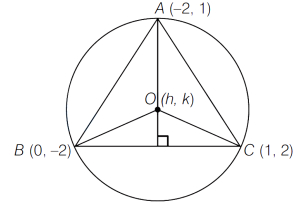
0 likesView Solution
95
MathematicsMediumMCQTS EAMCET · 2019
$A$ line $L$ makes intercepts $a$ and $b$ on the coordinate axes. The axes are rotated through an angle $\theta$ in the positive direction,keeping the origin fixed. If the line $L$ makes intercepts $p$ and $q$ on the new coordinate axes,then $\frac{1}{a^2}+\frac{1}{b^2}=$
A
$\frac{1}{p^2 q^2}$
B
$\frac{1}{p^2}-\frac{1}{q^2}$
C
$\frac{1}{p^2}+\frac{1}{q^2}$
D
$\frac{p q}{p^2+q^2}$
Solution
(C) The equation of the line $L$ with intercepts $a$ and $b$ is given by $\frac{x}{a} + \frac{y}{b} = 1$.
The perpendicular distance $d$ from the origin $(0, 0)$ to this line is given by $d = \frac{|-1|}{\sqrt{(\frac{1}{a})^2 + (\frac{1}{b})^2}} = \frac{1}{\sqrt{\frac{1}{a^2} + \frac{1}{b^2}}}$.
Squaring both sides,we get $\frac{1}{d^2} = \frac{1}{a^2} + \frac{1}{b^2}$.
When the axes are rotated,the origin remains fixed,so the perpendicular distance $d$ from the origin to the line $L$ remains invariant.
In the new coordinate system,the line $L$ makes intercepts $p$ and $q$,so its equation is $\frac{x}{p} + \frac{y}{q} = 1$.
The perpendicular distance $d$ from the origin to this new line is $d = \frac{1}{\sqrt{\frac{1}{p^2} + \frac{1}{q^2}}}$,which implies $\frac{1}{d^2} = \frac{1}{p^2} + \frac{1}{q^2}$.
Since $d$ is the same in both cases,we have $\frac{1}{a^2} + \frac{1}{b^2} = \frac{1}{p^2} + \frac{1}{q^2}$.
The perpendicular distance $d$ from the origin $(0, 0)$ to this line is given by $d = \frac{|-1|}{\sqrt{(\frac{1}{a})^2 + (\frac{1}{b})^2}} = \frac{1}{\sqrt{\frac{1}{a^2} + \frac{1}{b^2}}}$.
Squaring both sides,we get $\frac{1}{d^2} = \frac{1}{a^2} + \frac{1}{b^2}$.
When the axes are rotated,the origin remains fixed,so the perpendicular distance $d$ from the origin to the line $L$ remains invariant.
In the new coordinate system,the line $L$ makes intercepts $p$ and $q$,so its equation is $\frac{x}{p} + \frac{y}{q} = 1$.
The perpendicular distance $d$ from the origin to this new line is $d = \frac{1}{\sqrt{\frac{1}{p^2} + \frac{1}{q^2}}}$,which implies $\frac{1}{d^2} = \frac{1}{p^2} + \frac{1}{q^2}$.
Since $d$ is the same in both cases,we have $\frac{1}{a^2} + \frac{1}{b^2} = \frac{1}{p^2} + \frac{1}{q^2}$.
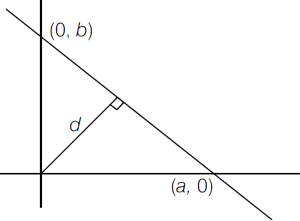
0 likesView Solution
96
MathematicsDifficultMCQTS EAMCET · 2019
Suppose the new axes $X, Y$ are generated by rotating the coordinate axes $x, y$ about the origin through an angle of $30^{\circ}$ in the anti-clockwise direction. Then,the transformed equation of $x^2+2 \sqrt{3} xy - y^2 = 2a^2$ with respect to the new axes $X, Y$ is
A
$X^2 - Y^2 = a^2$
B
$X^2 + Y^2 = 2a^2$
C
$X^2 + 2\sqrt{3}XY - Y^2 = 2a^2$
D
$X^2 - Y^2 = 2a^2$
Solution
(A) The given equation is $x^2 + 2\sqrt{3}xy - y^2 = 2a^2$.
Since the axes are rotated through an angle $\theta = 30^{\circ}$,the transformation equations are:
$x = X \cos 30^{\circ} - Y \sin 30^{\circ} = \frac{\sqrt{3}X - Y}{2}$
$y = X \sin 30^{\circ} + Y \cos 30^{\circ} = \frac{X + \sqrt{3}Y}{2}$
Substituting these into the given equation:
$\left(\frac{\sqrt{3}X - Y}{2}\right)^2 + 2\sqrt{3}\left(\frac{\sqrt{3}X - Y}{2}\right)\left(\frac{X + \sqrt{3}Y}{2}\right) - \left(\frac{X + \sqrt{3}Y}{2}\right)^2 = 2a^2$
Multiplying by $4$:
$(\sqrt{3}X - Y)^2 + 2\sqrt{3}(\sqrt{3}X^2 + 3XY - XY - \sqrt{3}Y^2) - (X + \sqrt{3}Y)^2 = 8a^2$
$(3X^2 - 2\sqrt{3}XY + Y^2) + 2\sqrt{3}(\sqrt{3}X^2 + 2XY - \sqrt{3}Y^2) - (X^2 + 2\sqrt{3}XY + 3Y^2) = 8a^2$
$3X^2 - 2\sqrt{3}XY + Y^2 + 6X^2 + 4\sqrt{3}XY - 6Y^2 - X^2 - 2\sqrt{3}XY - 3Y^2 = 8a^2$
Combining like terms:
$(3 + 6 - 1)X^2 + (-2\sqrt{3} + 4\sqrt{3} - 2\sqrt{3})XY + (1 - 6 - 3)Y^2 = 8a^2$
$8X^2 - 8Y^2 = 8a^2$
$X^2 - Y^2 = a^2$
Since the axes are rotated through an angle $\theta = 30^{\circ}$,the transformation equations are:
$x = X \cos 30^{\circ} - Y \sin 30^{\circ} = \frac{\sqrt{3}X - Y}{2}$
$y = X \sin 30^{\circ} + Y \cos 30^{\circ} = \frac{X + \sqrt{3}Y}{2}$
Substituting these into the given equation:
$\left(\frac{\sqrt{3}X - Y}{2}\right)^2 + 2\sqrt{3}\left(\frac{\sqrt{3}X - Y}{2}\right)\left(\frac{X + \sqrt{3}Y}{2}\right) - \left(\frac{X + \sqrt{3}Y}{2}\right)^2 = 2a^2$
Multiplying by $4$:
$(\sqrt{3}X - Y)^2 + 2\sqrt{3}(\sqrt{3}X^2 + 3XY - XY - \sqrt{3}Y^2) - (X + \sqrt{3}Y)^2 = 8a^2$
$(3X^2 - 2\sqrt{3}XY + Y^2) + 2\sqrt{3}(\sqrt{3}X^2 + 2XY - \sqrt{3}Y^2) - (X^2 + 2\sqrt{3}XY + 3Y^2) = 8a^2$
$3X^2 - 2\sqrt{3}XY + Y^2 + 6X^2 + 4\sqrt{3}XY - 6Y^2 - X^2 - 2\sqrt{3}XY - 3Y^2 = 8a^2$
Combining like terms:
$(3 + 6 - 1)X^2 + (-2\sqrt{3} + 4\sqrt{3} - 2\sqrt{3})XY + (1 - 6 - 3)Y^2 = 8a^2$
$8X^2 - 8Y^2 = 8a^2$
$X^2 - Y^2 = a^2$
0 likesView Solution
97
MathematicsDifficultMCQTS EAMCET · 2019
The distance (in units) between the circumcentre and the centroid of the triangle formed by the vertices $(1, 2)$,$(3, -1)$ and $(4, 0)$ is
A
$1/2$
B
$1$
C
$\frac{11 \sqrt{2}}{30}$
D
$\frac{9 \sqrt{2}}{5}$
Solution
(C) Let the vertices be $A(1, 2)$,$B(3, -1)$,and $C(4, 0)$.
First,calculate the lengths of the sides:
$AB = \sqrt{(3-1)^2 + (-1-2)^2} = \sqrt{2^2 + (-3)^2} = \sqrt{4+9} = \sqrt{13}$
$AC = \sqrt{(4-1)^2 + (0-2)^2} = \sqrt{3^2 + (-2)^2} = \sqrt{9+4} = \sqrt{13}$
Since $AB = AC$,the triangle is isosceles.
Centroid $G = \left(\frac{1+3+4}{3}, \frac{2-1+0}{3}\right) = \left(\frac{8}{3}, \frac{1}{3}\right)$.
For an isosceles triangle,the circumcentre $O$ lies on the altitude from $A$ to $BC$. The slope of $BC$ is $m_{BC} = \frac{0 - (-1)}{4 - 3} = 1$. The altitude from $A$ has slope $-1$ and passes through $(1, 2)$,so its equation is $y - 2 = -1(x - 1) \Rightarrow y = -x + 3$.
The circumcentre $O$ is the intersection of the perpendicular bisectors. The perpendicular bisector of $AC$ passes through the midpoint $E\left(\frac{1+4}{2}, \frac{2+0}{2}\right) = \left(\frac{2.5}{1}, 1\right)$ with slope $m = -\frac{1}{m_{AC}} = -\frac{1}{-2/3} = \frac{3}{2}$.
Equation of perpendicular bisector of $AC$: $y - 1 = \frac{3}{2}(x - 2.5)$ $\Rightarrow y = 1.5x - 3.75 + 1$ $\Rightarrow y = 1.5x - 2.75$.
Solving $y = -x + 3$ and $y = 1.5x - 2.75$: $-x + 3 = 1.5x - 2.75$ $\Rightarrow 2.5x = 5.75$ $\Rightarrow x = 2.3 = \frac{23}{10}$.
Then $y = -2.3 + 3 = 0.7 = \frac{7}{10}$. So $O = \left(\frac{23}{10}, \frac{7}{10}\right)$.
The distance $OG = \sqrt{(\frac{8}{3} - \frac{23}{10})^2 + (\frac{1}{3} - \frac{7}{10})^2} = \sqrt{(\frac{80-69}{30})^2 + (\frac{10-21}{30})^2} = \sqrt{(\frac{11}{30})^2 + (-\frac{11}{30})^2} = \frac{11}{30} \sqrt{2}$.
First,calculate the lengths of the sides:
$AB = \sqrt{(3-1)^2 + (-1-2)^2} = \sqrt{2^2 + (-3)^2} = \sqrt{4+9} = \sqrt{13}$
$AC = \sqrt{(4-1)^2 + (0-2)^2} = \sqrt{3^2 + (-2)^2} = \sqrt{9+4} = \sqrt{13}$
Since $AB = AC$,the triangle is isosceles.
Centroid $G = \left(\frac{1+3+4}{3}, \frac{2-1+0}{3}\right) = \left(\frac{8}{3}, \frac{1}{3}\right)$.
For an isosceles triangle,the circumcentre $O$ lies on the altitude from $A$ to $BC$. The slope of $BC$ is $m_{BC} = \frac{0 - (-1)}{4 - 3} = 1$. The altitude from $A$ has slope $-1$ and passes through $(1, 2)$,so its equation is $y - 2 = -1(x - 1) \Rightarrow y = -x + 3$.
The circumcentre $O$ is the intersection of the perpendicular bisectors. The perpendicular bisector of $AC$ passes through the midpoint $E\left(\frac{1+4}{2}, \frac{2+0}{2}\right) = \left(\frac{2.5}{1}, 1\right)$ with slope $m = -\frac{1}{m_{AC}} = -\frac{1}{-2/3} = \frac{3}{2}$.
Equation of perpendicular bisector of $AC$: $y - 1 = \frac{3}{2}(x - 2.5)$ $\Rightarrow y = 1.5x - 3.75 + 1$ $\Rightarrow y = 1.5x - 2.75$.
Solving $y = -x + 3$ and $y = 1.5x - 2.75$: $-x + 3 = 1.5x - 2.75$ $\Rightarrow 2.5x = 5.75$ $\Rightarrow x = 2.3 = \frac{23}{10}$.
Then $y = -2.3 + 3 = 0.7 = \frac{7}{10}$. So $O = \left(\frac{23}{10}, \frac{7}{10}\right)$.
The distance $OG = \sqrt{(\frac{8}{3} - \frac{23}{10})^2 + (\frac{1}{3} - \frac{7}{10})^2} = \sqrt{(\frac{80-69}{30})^2 + (\frac{10-21}{30})^2} = \sqrt{(\frac{11}{30})^2 + (-\frac{11}{30})^2} = \frac{11}{30} \sqrt{2}$.
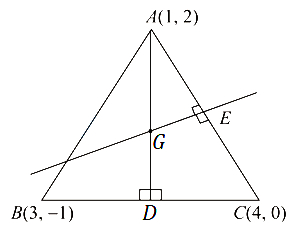
0 likesView Solution
98
MathematicsMediumMCQTS EAMCET · 2019
If the origin is shifted to a point $(h, k)$ by translation of axes in order to make the equation $x^2+5xy+2y^2+5x+6y+7=0$ free from first-order terms,then:
A
$h=-\frac{10}{17}, k=\frac{13}{17}$
B
$h=-\frac{10}{17}, k=-\frac{13}{17}$
C
$h=\frac{10}{17}, k=\frac{13}{17}$
D
$h=\frac{10}{17}, k=-\frac{13}{17}$
Solution
(B) Let the origin be shifted to $(h, k)$. The transformation equations are $x = x' + h$ and $y = y' + k$. Substituting these into the given equation $x^2 + 5xy + 2y^2 + 5x + 6y + 7 = 0$ gives:
$(x' + h)^2 + 5(x' + h)(y' + k) + 2(y' + k)^2 + 5(x' + h) + 6(y' + k) + 7 = 0$.
Expanding this,the terms of the first degree in $x'$ and $y'$ are:
$(2h + 5k + 5)x' + (5h + 4k + 6)y'$.
For the equation to be free from first-order terms,these coefficients must be zero:
$2h + 5k + 5 = 0$ $(i)$
$5h + 4k + 6 = 0$ (ii)
Multiplying $(i)$ by $4$ and (ii) by $5$:
$8h + 20k + 20 = 0$
$25h + 20k + 30 = 0$
Subtracting the first from the second: $17h + 10 = 0 \implies h = -\frac{10}{17}$.
Substituting $h$ into $(i)$: $2(-\frac{10}{17}) + 5k + 5 = 0 \implies -\frac{20}{17} + 5k + 5 = 0 \implies 5k = \frac{20}{17} - 5 = \frac{20-85}{17} = -\frac{65}{17} \implies k = -\frac{13}{17}$.
Thus,$h = -\frac{10}{17}$ and $k = -\frac{13}{17}$.
$(x' + h)^2 + 5(x' + h)(y' + k) + 2(y' + k)^2 + 5(x' + h) + 6(y' + k) + 7 = 0$.
Expanding this,the terms of the first degree in $x'$ and $y'$ are:
$(2h + 5k + 5)x' + (5h + 4k + 6)y'$.
For the equation to be free from first-order terms,these coefficients must be zero:
$2h + 5k + 5 = 0$ $(i)$
$5h + 4k + 6 = 0$ (ii)
Multiplying $(i)$ by $4$ and (ii) by $5$:
$8h + 20k + 20 = 0$
$25h + 20k + 30 = 0$
Subtracting the first from the second: $17h + 10 = 0 \implies h = -\frac{10}{17}$.
Substituting $h$ into $(i)$: $2(-\frac{10}{17}) + 5k + 5 = 0 \implies -\frac{20}{17} + 5k + 5 = 0 \implies 5k = \frac{20}{17} - 5 = \frac{20-85}{17} = -\frac{65}{17} \implies k = -\frac{13}{17}$.
Thus,$h = -\frac{10}{17}$ and $k = -\frac{13}{17}$.
0 likesView Solution
99
MathematicsDifficultMCQTS EAMCET · 2019
If the equations of the perpendicular bisectors of the sides $AB$ and $AC$ of a $\triangle ABC$ are $x-y+5=0$ and $x+2y=0$ respectively,and if $A$ is $(1,-2)$,then the equation of the perpendicular bisector of the side $BC$ is
A
$3x+3y+5=0$
B
$9x-23y+40=0$
C
$6x+15y=5$
D
$23x-14y+100=0$
Solution
(D) The intersection of the perpendicular bisectors of the sides of a triangle is the circumcenter $O$. Solving the equations $x-y+5=0$ and $x+2y=0$,we get $x = -10/3$ and $y = 5/3$. Thus,the circumcenter $O$ is $(-10/3, 5/3)$.
Since $B$ is the reflection of $A(1,-2)$ across the line $x-y+5=0$,we have $\frac{x_B-1}{1} = \frac{y_B+2}{-1} = -2 \frac{1-(-2)+5}{1^2+(-1)^2} = -2 \frac{8}{2} = -8$. This gives $x_B = -7$ and $y_B = 6$. So $B = (-7, 6)$.
Since $C$ is the reflection of $A(1,-2)$ across the line $x+2y=0$,we have $\frac{x_C-1}{1} = \frac{y_C+2}{2} = -2 \frac{1+2(-2)}{1^2+2^2} = -2 \frac{-3}{5} = 6/5$. This gives $x_C = 1+6/5 = 11/5$ and $y_C = -2+12/5 = 2/5$. So $C = (11/5, 2/5)$.
The perpendicular bisector of $BC$ passes through the circumcenter $O(-10/3, 5/3)$ and the midpoint $M$ of $BC$. The midpoint $M$ is $(\frac{-7+11/5}{2}, \frac{6+2/5}{2}) = (-12/5, 16/5)$.
The slope of the line passing through $O(-10/3, 5/3)$ and $M(-12/5, 16/5)$ is $m = \frac{16/5 - 5/3}{-12/5 - (-10/3)} = \frac{48/15 - 25/15}{-36/15 + 50/15} = \frac{23/15}{14/15} = 23/14$.
The equation of the line is $y - 5/3 = 23/14(x + 10/3)$,which simplifies to $14(3y-5) = 69(x+10/3)$ $\Rightarrow 42y - 70 = 69x + 230$ $\Rightarrow 69x - 42y + 300 = 0$ $\Rightarrow 23x - 14y + 100 = 0$.
Since $B$ is the reflection of $A(1,-2)$ across the line $x-y+5=0$,we have $\frac{x_B-1}{1} = \frac{y_B+2}{-1} = -2 \frac{1-(-2)+5}{1^2+(-1)^2} = -2 \frac{8}{2} = -8$. This gives $x_B = -7$ and $y_B = 6$. So $B = (-7, 6)$.
Since $C$ is the reflection of $A(1,-2)$ across the line $x+2y=0$,we have $\frac{x_C-1}{1} = \frac{y_C+2}{2} = -2 \frac{1+2(-2)}{1^2+2^2} = -2 \frac{-3}{5} = 6/5$. This gives $x_C = 1+6/5 = 11/5$ and $y_C = -2+12/5 = 2/5$. So $C = (11/5, 2/5)$.
The perpendicular bisector of $BC$ passes through the circumcenter $O(-10/3, 5/3)$ and the midpoint $M$ of $BC$. The midpoint $M$ is $(\frac{-7+11/5}{2}, \frac{6+2/5}{2}) = (-12/5, 16/5)$.
The slope of the line passing through $O(-10/3, 5/3)$ and $M(-12/5, 16/5)$ is $m = \frac{16/5 - 5/3}{-12/5 - (-10/3)} = \frac{48/15 - 25/15}{-36/15 + 50/15} = \frac{23/15}{14/15} = 23/14$.
The equation of the line is $y - 5/3 = 23/14(x + 10/3)$,which simplifies to $14(3y-5) = 69(x+10/3)$ $\Rightarrow 42y - 70 = 69x + 230$ $\Rightarrow 69x - 42y + 300 = 0$ $\Rightarrow 23x - 14y + 100 = 0$.
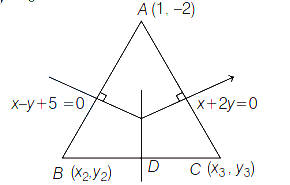
0 likesView Solution
100
MathematicsEasyMCQTS EAMCET · 2019
If a straight line is passing through the point of intersection of the lines $3x - 4y + 1 = 0$ and $5x + y - 1 = 0$ and making equal non-zero intercepts on the coordinate axes,then the area (in sq. units) of the triangle formed by this line with the coordinate axes is
A
$\frac{121}{1058}$
B
$\frac{121}{529}$
C
$\frac{529}{121}$
D
$\frac{1058}{121}$
Solution
(A) The equation of a line passing through the intersection of $3x - 4y + 1 = 0$ and $5x + y - 1 = 0$ is given by $(3x - 4y + 1) + \lambda(5x + y - 1) = 0$.
Rearranging the terms,we get $(3 + 5\lambda)x + (-4 + \lambda)y + (1 - \lambda) = 0$.
Since the line makes equal non-zero intercepts on the axes,the coefficients of $x$ and $y$ must be equal in magnitude and opposite in sign (for the intercept form $\frac{x}{a} + \frac{y}{a} = 1$) or equal in sign (for $\frac{x}{a} + \frac{y}{-a} = 1$).
Setting the coefficients equal: $3 + 5\lambda = -(-4 + \lambda)$ $\Rightarrow 3 + 5\lambda = 4 - \lambda$ $\Rightarrow 6\lambda = 1$ $\Rightarrow \lambda = \frac{1}{6}$.
Substituting $\lambda = \frac{1}{6}$ into the equation: $(3 + \frac{5}{6})x + (-4 + \frac{1}{6})y + (1 - \frac{1}{6}) = 0$ $\Rightarrow \frac{23}{6}x - \frac{23}{6}y + \frac{5}{6} = 0$ $\Rightarrow 23x - 23y + 5 = 0$.
This gives $x - y = -\frac{5}{23}$,which does not yield equal intercepts.
Setting the coefficients equal: $3 + 5\lambda = -4 + \lambda$ $\Rightarrow 4\lambda = -7$ $\Rightarrow \lambda = -\frac{7}{4}$.
Substituting $\lambda = -\frac{7}{4}$: $(3 - \frac{35}{4})x + (-4 - \frac{7}{4})y + (1 + \frac{7}{4}) = 0$ $\Rightarrow -\frac{23}{4}x - \frac{23}{4}y + \frac{11}{4} = 0$ $\Rightarrow 23x + 23y = 11$.
In intercept form: $\frac{x}{11/23} + \frac{y}{11/23} = 1$.
The intercepts are $a = \frac{11}{23}$ and $b = \frac{11}{23}$.
The area of the triangle is $\frac{1}{2} |ab| = \frac{1}{2} \times \frac{11}{23} \times \frac{11}{23} = \frac{121}{1058}$ sq. units.
Rearranging the terms,we get $(3 + 5\lambda)x + (-4 + \lambda)y + (1 - \lambda) = 0$.
Since the line makes equal non-zero intercepts on the axes,the coefficients of $x$ and $y$ must be equal in magnitude and opposite in sign (for the intercept form $\frac{x}{a} + \frac{y}{a} = 1$) or equal in sign (for $\frac{x}{a} + \frac{y}{-a} = 1$).
Setting the coefficients equal: $3 + 5\lambda = -(-4 + \lambda)$ $\Rightarrow 3 + 5\lambda = 4 - \lambda$ $\Rightarrow 6\lambda = 1$ $\Rightarrow \lambda = \frac{1}{6}$.
Substituting $\lambda = \frac{1}{6}$ into the equation: $(3 + \frac{5}{6})x + (-4 + \frac{1}{6})y + (1 - \frac{1}{6}) = 0$ $\Rightarrow \frac{23}{6}x - \frac{23}{6}y + \frac{5}{6} = 0$ $\Rightarrow 23x - 23y + 5 = 0$.
This gives $x - y = -\frac{5}{23}$,which does not yield equal intercepts.
Setting the coefficients equal: $3 + 5\lambda = -4 + \lambda$ $\Rightarrow 4\lambda = -7$ $\Rightarrow \lambda = -\frac{7}{4}$.
Substituting $\lambda = -\frac{7}{4}$: $(3 - \frac{35}{4})x + (-4 - \frac{7}{4})y + (1 + \frac{7}{4}) = 0$ $\Rightarrow -\frac{23}{4}x - \frac{23}{4}y + \frac{11}{4} = 0$ $\Rightarrow 23x + 23y = 11$.
In intercept form: $\frac{x}{11/23} + \frac{y}{11/23} = 1$.
The intercepts are $a = \frac{11}{23}$ and $b = \frac{11}{23}$.
The area of the triangle is $\frac{1}{2} |ab| = \frac{1}{2} \times \frac{11}{23} \times \frac{11}{23} = \frac{121}{1058}$ sq. units.
0 likesView Solution
101
MathematicsMediumMCQTS EAMCET · 2019
If $y^{\cos x}=x^{\sin y}$,then $\frac{d y}{d x}=$
A
$\frac{y(\sin y+x \sin x \log y)}{x(\cos x-y \log x \cos y)}$
B
$\frac{y(x \sin x \log x-\sin y)}{x(\cos x+y \log x \cos y)}$
C
$\frac{y(\sin y-x \log y)}{x(x-y \cos y(\log x))}$
D
$\frac{y(\sin y+x \log y)}{x(x+y \cos y(\log x))}$
Solution
(A) Given equation: $y^{\cos x}=x^{\sin y}$
Taking logarithm on both sides: $\cos x \log y = \sin y \log x$
Differentiating both sides with respect to $x$ using the product rule:
$\frac{d}{dx}(\cos x \log y) = \frac{d}{dx}(\sin y \log x)$
$(\cos x) \cdot \frac{1}{y} \frac{dy}{dx} + (\log y) \cdot (-\sin x) = (\sin y) \cdot \frac{1}{x} + (\log x) \cdot (\cos y) \frac{dy}{dx}$
Rearranging the terms to group $\frac{dy}{dx}$:
$\frac{dy}{dx} \left( \frac{\cos x}{y} - \cos y \log x \right) = \frac{\sin y}{x} + \sin x \log y$
$\frac{dy}{dx} \left( \frac{\cos x - y \cos y \log x}{y} \right) = \frac{\sin y + x \sin x \log y}{x}$
$\frac{dy}{dx} = \frac{y(\sin y + x \sin x \log y)}{x(\cos x - y \cos y \log x)}$
Taking logarithm on both sides: $\cos x \log y = \sin y \log x$
Differentiating both sides with respect to $x$ using the product rule:
$\frac{d}{dx}(\cos x \log y) = \frac{d}{dx}(\sin y \log x)$
$(\cos x) \cdot \frac{1}{y} \frac{dy}{dx} + (\log y) \cdot (-\sin x) = (\sin y) \cdot \frac{1}{x} + (\log x) \cdot (\cos y) \frac{dy}{dx}$
Rearranging the terms to group $\frac{dy}{dx}$:
$\frac{dy}{dx} \left( \frac{\cos x}{y} - \cos y \log x \right) = \frac{\sin y}{x} + \sin x \log y$
$\frac{dy}{dx} \left( \frac{\cos x - y \cos y \log x}{y} \right) = \frac{\sin y + x \sin x \log y}{x}$
$\frac{dy}{dx} = \frac{y(\sin y + x \sin x \log y)}{x(\cos x - y \cos y \log x)}$
0 likesView Solution
102
MathematicsMediumMCQTS EAMCET · 2019
The derivative of $\cosh^{-1} x$ with respect to $\log x$ at $x=5$ is
A
$\frac{5}{\sqrt{24}}$
B
$\frac{1}{\sqrt{24}}$
C
$\frac{5}{\sqrt{26}}$
D
$\frac{1}{\sqrt{26}}$
Solution
(A) Let $u = \cosh^{-1} x$. The derivative is $\frac{du}{dx} = \frac{1}{\sqrt{x^2-1}}$.
Let $v = \log x$. The derivative is $\frac{dv}{dx} = \frac{1}{x}$.
We need to find $\frac{du}{dv} = \frac{du/dx}{dv/dx} = \frac{1/\sqrt{x^2-1}}{1/x} = \frac{x}{\sqrt{x^2-1}}$.
At $x=5$,$\frac{du}{dv} = \frac{5}{\sqrt{5^2-1}} = \frac{5}{\sqrt{25-1}} = \frac{5}{\sqrt{24}}$.
Let $v = \log x$. The derivative is $\frac{dv}{dx} = \frac{1}{x}$.
We need to find $\frac{du}{dv} = \frac{du/dx}{dv/dx} = \frac{1/\sqrt{x^2-1}}{1/x} = \frac{x}{\sqrt{x^2-1}}$.
At $x=5$,$\frac{du}{dv} = \frac{5}{\sqrt{5^2-1}} = \frac{5}{\sqrt{25-1}} = \frac{5}{\sqrt{24}}$.
0 likesView Solution
103
MathematicsMediumMCQTS EAMCET · 2019
If $t$ is a parameter and $x=t+\frac{1}{t}, y=t-\frac{1}{t}$,then $\frac{d^2 y}{d x^2}=$
A
$\frac{4 t}{\left(t^2-1\right)^2}$
B
$\frac{t^2}{\left(t^2-1\right)}$
C
$\frac{4 t^3}{\left(t^2-1\right)^3}$
D
$\frac{-4 t^3}{\left(t^2-1\right)^3}$
Solution
(D) Given $x = t + \frac{1}{t}$ and $y = t - \frac{1}{t}$.
First,find the derivatives with respect to $t$:
$\frac{dx}{dt} = 1 - \frac{1}{t^2} = \frac{t^2-1}{t^2}$
$\frac{dy}{dt} = 1 + \frac{1}{t^2} = \frac{t^2+1}{t^2}$
Now,find $\frac{dy}{dx}$:
$\frac{dy}{dx} = \frac{dy/dt}{dx/dt} = \frac{(t^2+1)/t^2}{(t^2-1)/t^2} = \frac{t^2+1}{t^2-1}$
Next,find $\frac{d^2y}{dx^2}$ by differentiating with respect to $x$:
$\frac{d^2y}{dx^2} = \frac{d}{dt}\left(\frac{t^2+1}{t^2-1}\right) \cdot \frac{dt}{dx}$
Using the quotient rule for $\frac{d}{dt}\left(\frac{t^2+1}{t^2-1}\right)$:
$= \frac{(t^2-1)(2t) - (t^2+1)(2t)}{(t^2-1)^2} = \frac{2t^3 - 2t - 2t^3 - 2t}{(t^2-1)^2} = \frac{-4t}{(t^2-1)^2}$
Since $\frac{dx}{dt} = \frac{t^2-1}{t^2}$,then $\frac{dt}{dx} = \frac{t^2}{t^2-1}$.
Therefore,$\frac{d^2y}{dx^2} = \frac{-4t}{(t^2-1)^2} \cdot \frac{t^2}{t^2-1} = \frac{-4t^3}{(t^2-1)^3}$.
First,find the derivatives with respect to $t$:
$\frac{dx}{dt} = 1 - \frac{1}{t^2} = \frac{t^2-1}{t^2}$
$\frac{dy}{dt} = 1 + \frac{1}{t^2} = \frac{t^2+1}{t^2}$
Now,find $\frac{dy}{dx}$:
$\frac{dy}{dx} = \frac{dy/dt}{dx/dt} = \frac{(t^2+1)/t^2}{(t^2-1)/t^2} = \frac{t^2+1}{t^2-1}$
Next,find $\frac{d^2y}{dx^2}$ by differentiating with respect to $x$:
$\frac{d^2y}{dx^2} = \frac{d}{dt}\left(\frac{t^2+1}{t^2-1}\right) \cdot \frac{dt}{dx}$
Using the quotient rule for $\frac{d}{dt}\left(\frac{t^2+1}{t^2-1}\right)$:
$= \frac{(t^2-1)(2t) - (t^2+1)(2t)}{(t^2-1)^2} = \frac{2t^3 - 2t - 2t^3 - 2t}{(t^2-1)^2} = \frac{-4t}{(t^2-1)^2}$
Since $\frac{dx}{dt} = \frac{t^2-1}{t^2}$,then $\frac{dt}{dx} = \frac{t^2}{t^2-1}$.
Therefore,$\frac{d^2y}{dx^2} = \frac{-4t}{(t^2-1)^2} \cdot \frac{t^2}{t^2-1} = \frac{-4t^3}{(t^2-1)^3}$.
0 likesView Solution
104
MathematicsMediumMCQTS EAMCET · 2019
If $f(x)=\cosh ^{-1}\left(\frac{1-x}{1+x}\right)$ is well defined,then $f^{\prime}(x)=$
A
$\frac{-1}{(1+x) \sqrt{-x}}$
B
$\frac{1}{(1+x) \sqrt{x}}$
C
$\frac{-1}{(1+x) \sqrt{x}}$
D
$\frac{1}{(1+x) \sqrt{-x}}$
Solution
(A) Given $f(x) = \cosh^{-1}\left(\frac{1-x}{1+x}\right)$.
Using the derivative formula $\frac{d}{dx}(\cosh^{-1}(u)) = \frac{1}{\sqrt{u^2-1}} \cdot \frac{du}{dx}$:
$f'(x) = \frac{1}{\sqrt{\left(\frac{1-x}{1+x}\right)^2 - 1}} \cdot \frac{d}{dx}\left(\frac{1-x}{1+x}\right)$
$f'(x) = \frac{1}{\sqrt{\frac{(1-x)^2 - (1+x)^2}{(1+x)^2}}} \cdot \frac{(1+x)(-1) - (1-x)(1)}{(1+x)^2}$
$f'(x) = \frac{1+x}{\sqrt{1 - 2x + x^2 - (1 + 2x + x^2)}} \cdot \frac{-1 - x - 1 + x}{(1+x)^2}$
$f'(x) = \frac{1+x}{\sqrt{-4x}} \cdot \frac{-2}{(1+x)^2}$
$f'(x) = \frac{1+x}{2\sqrt{-x}} \cdot \frac{-2}{(1+x)^2} = \frac{-1}{(1+x)\sqrt{-x}}$.
Using the derivative formula $\frac{d}{dx}(\cosh^{-1}(u)) = \frac{1}{\sqrt{u^2-1}} \cdot \frac{du}{dx}$:
$f'(x) = \frac{1}{\sqrt{\left(\frac{1-x}{1+x}\right)^2 - 1}} \cdot \frac{d}{dx}\left(\frac{1-x}{1+x}\right)$
$f'(x) = \frac{1}{\sqrt{\frac{(1-x)^2 - (1+x)^2}{(1+x)^2}}} \cdot \frac{(1+x)(-1) - (1-x)(1)}{(1+x)^2}$
$f'(x) = \frac{1+x}{\sqrt{1 - 2x + x^2 - (1 + 2x + x^2)}} \cdot \frac{-1 - x - 1 + x}{(1+x)^2}$
$f'(x) = \frac{1+x}{\sqrt{-4x}} \cdot \frac{-2}{(1+x)^2}$
$f'(x) = \frac{1+x}{2\sqrt{-x}} \cdot \frac{-2}{(1+x)^2} = \frac{-1}{(1+x)\sqrt{-x}}$.
0 likesView Solution
105
MathematicsEasyMCQTS EAMCET · 2019
$f(x)$ is a twice differentiable function such that $f^{\prime \prime}(x)=-f(x)$ and $f^{\prime}(x)=g(x)$. If $h(x)=(f(x))^2+(g(x))^2$ and $h(1)=2$,then $h(2)=$
A
$0$
B
$1$
C
$2$
D
$4$
Solution
(C) Given $h(x)=(f(x))^2+(g(x))^2$.
Taking the derivative with respect to $x$:
$h^{\prime}(x)=2f(x)f^{\prime}(x)+2g(x)g^{\prime}(x)$.
Since $f^{\prime}(x)=g(x)$,we have $g^{\prime}(x)=f^{\prime \prime}(x)$.
Given $f^{\prime \prime}(x)=-f(x)$,we have $g^{\prime}(x)=-f(x)$.
Substituting these into the derivative of $h(x)$:
$h^{\prime}(x)=2f(x)g(x)+2g(x)(-f(x)) = 2f(x)g(x)-2f(x)g(x) = 0$.
Since $h^{\prime}(x)=0$,$h(x)$ is a constant function.
Given $h(1)=2$,it follows that $h(x)=2$ for all $x$.
Therefore,$h(2)=2$.
Taking the derivative with respect to $x$:
$h^{\prime}(x)=2f(x)f^{\prime}(x)+2g(x)g^{\prime}(x)$.
Since $f^{\prime}(x)=g(x)$,we have $g^{\prime}(x)=f^{\prime \prime}(x)$.
Given $f^{\prime \prime}(x)=-f(x)$,we have $g^{\prime}(x)=-f(x)$.
Substituting these into the derivative of $h(x)$:
$h^{\prime}(x)=2f(x)g(x)+2g(x)(-f(x)) = 2f(x)g(x)-2f(x)g(x) = 0$.
Since $h^{\prime}(x)=0$,$h(x)$ is a constant function.
Given $h(1)=2$,it follows that $h(x)=2$ for all $x$.
Therefore,$h(2)=2$.
0 likesView Solution
106
MathematicsMediumMCQTS EAMCET · 2019
Suppose,$f(x)=e^{-\sqrt{x}}+e^{-\frac{1}{x^2}}$. If $f^{\prime \prime}(x)=\alpha \cdot \frac{e^{-\sqrt{x}}}{x}\left(1+\frac{1}{\sqrt{x}}\right)+\beta \cdot \frac{e^{-\frac{1}{x^2}}}{x^4}\left(3-\frac{2}{x^2}\right)$,then $(\alpha, \beta)=$
A
$\left(\frac{1}{4}, 2\right)$
B
$\left(\frac{1}{4},-2\right)$
C
$\left(-\frac{1}{4}, 2\right)$
D
$\left(-\frac{1}{4},-2\right)$
Solution
(B) Given the function $f(x)=e^{-\sqrt{x}}+e^{-\frac{1}{x^2}}$.
First,we find the first derivative $f^{\prime}(x)$ using the chain rule:
$f^{\prime}(x) = e^{-\sqrt{x}} \cdot \frac{d}{dx}(-\sqrt{x}) + e^{-\frac{1}{x^2}} \cdot \frac{d}{dx}(-x^{-2})$
$f^{\prime}(x) = e^{-\sqrt{x}} \left(-\frac{1}{2\sqrt{x}}\right) + e^{-\frac{1}{x^2}} \left(\frac{2}{x^3}\right)$
Now,differentiate $f^{\prime}(x)$ again to find $f^{\prime \prime}(x)$:
$f^{\prime \prime}(x) = \frac{d}{dx} \left[ -\frac{1}{2} x^{-1/2} e^{-\sqrt{x}} \right] + \frac{d}{dx} \left[ 2 x^{-3} e^{-\frac{1}{x^2}} \right]$
Using the product rule:
For the first term: $-\frac{1}{2} \left[ e^{-\sqrt{x}} \cdot (-\frac{1}{2} x^{-3/2}) + x^{-1/2} \cdot e^{-\sqrt{x}} \cdot (-\frac{1}{2} x^{-1/2}) \right] = \frac{1}{4} \frac{e^{-\sqrt{x}}}{x} (1 + \frac{1}{\sqrt{x}})$
For the second term: $2 \left[ e^{-\frac{1}{x^2}} \cdot (-3x^{-4}) + x^{-3} \cdot e^{-\frac{1}{x^2}} \cdot (2x^{-3}) \right] = 2 \frac{e^{-\frac{1}{x^2}}}{x^4} (-3 + \frac{2}{x^2}) = -2 \frac{e^{-\frac{1}{x^2}}}{x^4} (3 - \frac{2}{x^2})$
Comparing this with the given expression,we get $\alpha = \frac{1}{4}$ and $\beta = -2$.
First,we find the first derivative $f^{\prime}(x)$ using the chain rule:
$f^{\prime}(x) = e^{-\sqrt{x}} \cdot \frac{d}{dx}(-\sqrt{x}) + e^{-\frac{1}{x^2}} \cdot \frac{d}{dx}(-x^{-2})$
$f^{\prime}(x) = e^{-\sqrt{x}} \left(-\frac{1}{2\sqrt{x}}\right) + e^{-\frac{1}{x^2}} \left(\frac{2}{x^3}\right)$
Now,differentiate $f^{\prime}(x)$ again to find $f^{\prime \prime}(x)$:
$f^{\prime \prime}(x) = \frac{d}{dx} \left[ -\frac{1}{2} x^{-1/2} e^{-\sqrt{x}} \right] + \frac{d}{dx} \left[ 2 x^{-3} e^{-\frac{1}{x^2}} \right]$
Using the product rule:
For the first term: $-\frac{1}{2} \left[ e^{-\sqrt{x}} \cdot (-\frac{1}{2} x^{-3/2}) + x^{-1/2} \cdot e^{-\sqrt{x}} \cdot (-\frac{1}{2} x^{-1/2}) \right] = \frac{1}{4} \frac{e^{-\sqrt{x}}}{x} (1 + \frac{1}{\sqrt{x}})$
For the second term: $2 \left[ e^{-\frac{1}{x^2}} \cdot (-3x^{-4}) + x^{-3} \cdot e^{-\frac{1}{x^2}} \cdot (2x^{-3}) \right] = 2 \frac{e^{-\frac{1}{x^2}}}{x^4} (-3 + \frac{2}{x^2}) = -2 \frac{e^{-\frac{1}{x^2}}}{x^4} (3 - \frac{2}{x^2})$
Comparing this with the given expression,we get $\alpha = \frac{1}{4}$ and $\beta = -2$.
0 likesView Solution
107
MathematicsEasyMCQTS EAMCET · 2019
If $\frac{dy}{dx} = 4$ and $\frac{d^2y}{dx^2} = -3$ at a point $P$ on the curve $y = f(x)$,then $\left(\frac{d^2x}{dy^2}\right)_P = $
A
$0$
B
$-\frac{3}{4}$
C
$\frac{3}{16}$
D
$\frac{3}{64}$
Solution
(D) We know that $\frac{dx}{dy} = \left(\frac{dy}{dx}\right)^{-1}$.
Differentiating both sides with respect to $y$ using the chain rule:
$\frac{d^2x}{dy^2} = \frac{d}{dy} \left(\left(\frac{dy}{dx}\right)^{-1}\right) = -\left(\frac{dy}{dx}\right)^{-2} \cdot \frac{d}{dy} \left(\frac{dy}{dx}\right)$.
Since $\frac{d}{dy} \left(\frac{dy}{dx}\right) = \frac{d}{dx} \left(\frac{dy}{dx}\right) \cdot \frac{dx}{dy} = \frac{d^2y}{dx^2} \cdot \frac{1}{\frac{dy}{dx}}$,we have:
$\frac{d^2x}{dy^2} = -\left(\frac{dy}{dx}\right)^{-2} \cdot \frac{d^2y}{dx^2} \cdot \left(\frac{dy}{dx}\right)^{-1} = -\frac{\frac{d^2y}{dx^2}}{\left(\frac{dy}{dx}\right)^3}$.
Given $\frac{dy}{dx} = 4$ and $\frac{d^2y}{dx^2} = -3$ at point $P$:
$\left(\frac{d^2x}{dy^2}\right)_P = -\frac{-3}{(4)^3} = \frac{3}{64}$.
Differentiating both sides with respect to $y$ using the chain rule:
$\frac{d^2x}{dy^2} = \frac{d}{dy} \left(\left(\frac{dy}{dx}\right)^{-1}\right) = -\left(\frac{dy}{dx}\right)^{-2} \cdot \frac{d}{dy} \left(\frac{dy}{dx}\right)$.
Since $\frac{d}{dy} \left(\frac{dy}{dx}\right) = \frac{d}{dx} \left(\frac{dy}{dx}\right) \cdot \frac{dx}{dy} = \frac{d^2y}{dx^2} \cdot \frac{1}{\frac{dy}{dx}}$,we have:
$\frac{d^2x}{dy^2} = -\left(\frac{dy}{dx}\right)^{-2} \cdot \frac{d^2y}{dx^2} \cdot \left(\frac{dy}{dx}\right)^{-1} = -\frac{\frac{d^2y}{dx^2}}{\left(\frac{dy}{dx}\right)^3}$.
Given $\frac{dy}{dx} = 4$ and $\frac{d^2y}{dx^2} = -3$ at point $P$:
$\left(\frac{d^2x}{dy^2}\right)_P = -\frac{-3}{(4)^3} = \frac{3}{64}$.
0 likesView Solution
108
MathematicsDifficultMCQTS EAMCET · 2019
If $ax^2+2hxy+by^2=3$,then $\frac{d^2y}{dx^2}=$
A
$\frac{(hx^2+by+ax)}{(ax+hy)^2}$
B
$\frac{(axy+hx^2+byx)}{(ax+by)^2}$
C
$\frac{3(h^2-ab)}{(hx+by)^3}$
D
$\frac{(ab+h)^2}{(ax+hy)^2}[h(x^2+y^2)+xy(a+b)]$
Solution
(C) Given the equation: $ax^2+2hxy+by^2=3$.
Differentiating with respect to $x$:
$2ax + 2h(y + x\frac{dy}{dx}) + 2by\frac{dy}{dx} = 0$.
Dividing by $2$: $ax + hy + hx\frac{dy}{dx} + by\frac{dy}{dx} = 0$.
Thus,$\frac{dy}{dx} = -\frac{ax+hy}{hx+by}$.
Differentiating again with respect to $x$:
$\frac{d^2y}{dx^2} = -\frac{(hx+by)(a+h\frac{dy}{dx}) - (ax+hy)(h+b\frac{dy}{dx})}{(hx+by)^2}$.
Substituting $\frac{dy}{dx} = -\frac{ax+hy}{hx+by}$ and simplifying using the original equation $ax^2+2hxy+by^2=3$,we get:
$\frac{d^2y}{dx^2} = \frac{3(h^2-ab)}{(hx+by)^3}$.
Differentiating with respect to $x$:
$2ax + 2h(y + x\frac{dy}{dx}) + 2by\frac{dy}{dx} = 0$.
Dividing by $2$: $ax + hy + hx\frac{dy}{dx} + by\frac{dy}{dx} = 0$.
Thus,$\frac{dy}{dx} = -\frac{ax+hy}{hx+by}$.
Differentiating again with respect to $x$:
$\frac{d^2y}{dx^2} = -\frac{(hx+by)(a+h\frac{dy}{dx}) - (ax+hy)(h+b\frac{dy}{dx})}{(hx+by)^2}$.
Substituting $\frac{dy}{dx} = -\frac{ax+hy}{hx+by}$ and simplifying using the original equation $ax^2+2hxy+by^2=3$,we get:
$\frac{d^2y}{dx^2} = \frac{3(h^2-ab)}{(hx+by)^3}$.
0 likesView Solution
109
MathematicsEasyMCQTS EAMCET · 2019
If $\sqrt{x+y}-\sqrt{x-y}=c$,then $\frac{d^2 y}{d x^2}=$
A
$\frac{1}{y}\left(\frac{d y}{d x}\right)^2$
B
$\frac{-c^4}{4 y^3}$
C
$y\left(\frac{d y}{d x}\right)^2$
D
$\frac{-c^2}{4 y^3}$
Solution
(B) Given that $\sqrt{x+y}-\sqrt{x-y}=c$.
Squaring both sides,we get $(x+y)+(x-y)-2 \sqrt{x^2-y^2}=c^2$.
$2x - c^2 = 2 \sqrt{x^2-y^2}$.
Squaring both sides again,we get $4x^2 + c^4 - 4xc^2 = 4(x^2-y^2) = 4x^2 - 4y^2$.
$c^4 - 4xc^2 = -4y^2$,which implies $4y^2 = 4xc^2 - c^4$.
Differentiating with respect to $x$,we get $8y \frac{dy}{dx} = 4c^2$,so $2y \frac{dy}{dx} = c^2$.
Differentiating again with respect to $x$,we get $2(\frac{dy}{dx})^2 + 2y \frac{d^2y}{dx^2} = 0$.
Thus,$\frac{d^2y}{dx^2} = -\frac{(\frac{dy}{dx})^2}{y}$.
Since $\frac{dy}{dx} = \frac{c^2}{2y}$,we have $\frac{d^2y}{dx^2} = -\frac{(c^2/2y)^2}{y} = -\frac{c^4}{4y^3}$.
Therefore,option $B$ is correct.
Squaring both sides,we get $(x+y)+(x-y)-2 \sqrt{x^2-y^2}=c^2$.
$2x - c^2 = 2 \sqrt{x^2-y^2}$.
Squaring both sides again,we get $4x^2 + c^4 - 4xc^2 = 4(x^2-y^2) = 4x^2 - 4y^2$.
$c^4 - 4xc^2 = -4y^2$,which implies $4y^2 = 4xc^2 - c^4$.
Differentiating with respect to $x$,we get $8y \frac{dy}{dx} = 4c^2$,so $2y \frac{dy}{dx} = c^2$.
Differentiating again with respect to $x$,we get $2(\frac{dy}{dx})^2 + 2y \frac{d^2y}{dx^2} = 0$.
Thus,$\frac{d^2y}{dx^2} = -\frac{(\frac{dy}{dx})^2}{y}$.
Since $\frac{dy}{dx} = \frac{c^2}{2y}$,we have $\frac{d^2y}{dx^2} = -\frac{(c^2/2y)^2}{y} = -\frac{c^4}{4y^3}$.
Therefore,option $B$ is correct.
0 likesView Solution
110
MathematicsEasyMCQTS EAMCET · 2019
Match the items of List-$I$ with those of List-$II$.
| List-$I$ | List-$II$ |
| $A$. If $y = |x| + |x - 2|$,then at $x = 2$,$\frac{dy}{dx} =$ | $I$. $2$ |
| $B$. If $f(x) = |\cos 2x|$,then $f'(\frac{\pi}{4} +) =$ | $II$. $0$ |
| $C$. If $f(x) = \sin(\pi[x])$,where $[x]$ is the greatest integer function,then $f'(1-) =$ | $III$. $-2$ |
| $D$. If $f(x) = \log|x - 1|$,$x \neq 1$,then $f'(\frac{1}{2}) =$ | $IV$. does not exist |
A
$A-IV, B-I, C-II, D-III$
B
$A-IV, B-I, C-III, D-II$
C
$A-IV, B-III, C-I, D-II$
D
$A-IV, B-I, C-II, D-IV$
Solution
(A) . For $y = |x| + |x - 2|$,at $x = 2$,the function has a corner point. Thus,$\frac{dy}{dx}$ does not exist. So,$A \rightarrow IV$.
$B$. For $f(x) = |\cos 2x|$,for $x$ slightly greater than $\frac{\pi}{4}$,$\cos 2x$ is negative,so $f(x) = -\cos 2x$. Then $f'(x) = 2 \sin 2x$. Thus,$f'(\frac{\pi}{4} +) = 2 \sin(\frac{\pi}{2}) = 2$. So,$B \rightarrow I$.
$C$. For $f(x) = \sin(\pi[x])$,for $x$ slightly less than $1$,$[x] = 0$. So $f(x) = \sin(0) = 0$. Thus,$f'(1-) = 0$. So,$C \rightarrow II$.
$D$. For $f(x) = \log|x - 1|$,$f'(x) = \frac{1}{x - 1}$. Then $f'(\frac{1}{2}) = \frac{1}{1/2 - 1} = \frac{1}{-1/2} = -2$. So,$D \rightarrow III$.
Therefore,the correct matching is $A-IV, B-I, C-II, D-III$.
$B$. For $f(x) = |\cos 2x|$,for $x$ slightly greater than $\frac{\pi}{4}$,$\cos 2x$ is negative,so $f(x) = -\cos 2x$. Then $f'(x) = 2 \sin 2x$. Thus,$f'(\frac{\pi}{4} +) = 2 \sin(\frac{\pi}{2}) = 2$. So,$B \rightarrow I$.
$C$. For $f(x) = \sin(\pi[x])$,for $x$ slightly less than $1$,$[x] = 0$. So $f(x) = \sin(0) = 0$. Thus,$f'(1-) = 0$. So,$C \rightarrow II$.
$D$. For $f(x) = \log|x - 1|$,$f'(x) = \frac{1}{x - 1}$. Then $f'(\frac{1}{2}) = \frac{1}{1/2 - 1} = \frac{1}{-1/2} = -2$. So,$D \rightarrow III$.
Therefore,the correct matching is $A-IV, B-I, C-II, D-III$.
0 likesView Solution
111
MathematicsEasyMCQTS EAMCET · 2019
The slope of the tangent at $(1, 2)$ to the curve $x = t^2 - 7t + 7$ and $y = t^2 - 4t - 10$ is:
A
$\frac{8}{5}$
B
$\frac{5}{8}$
C
$-\frac{8}{5}$
D
$-\frac{5}{8}$
Solution
(A) Given the parametric equations of the curve are $x = t^2 - 7t + 7$ and $y = t^2 - 4t - 10$.
To find the value of $t$ at the point $(1, 2)$,we set $x = 1$ and $y = 2$.
For $x = 1$: $t^2 - 7t + 7 = 1 \Rightarrow t^2 - 7t + 6 = 0 \Rightarrow (t - 6)(t - 1) = 0$,so $t = 1$ or $t = 6$.
For $y = 2$: $t^2 - 4t - 10 = 2 \Rightarrow t^2 - 4t - 12 = 0 \Rightarrow (t - 6)(t + 2) = 0$,so $t = 6$ or $t = -2$.
The common value is $t = 6$.
Now,we find the derivatives with respect to $t$:
$\frac{dx}{dt} = 2t - 7$ and $\frac{dy}{dt} = 2t - 4$.
At $t = 6$:
$\frac{dx}{dt} = 2(6) - 7 = 12 - 7 = 5$.
$\frac{dy}{dt} = 2(6) - 4 = 12 - 4 = 8$.
The slope of the tangent is given by $\frac{dy}{dx} = \frac{dy/dt}{dx/dt} = \frac{8}{5}$.
To find the value of $t$ at the point $(1, 2)$,we set $x = 1$ and $y = 2$.
For $x = 1$: $t^2 - 7t + 7 = 1 \Rightarrow t^2 - 7t + 6 = 0 \Rightarrow (t - 6)(t - 1) = 0$,so $t = 1$ or $t = 6$.
For $y = 2$: $t^2 - 4t - 10 = 2 \Rightarrow t^2 - 4t - 12 = 0 \Rightarrow (t - 6)(t + 2) = 0$,so $t = 6$ or $t = -2$.
The common value is $t = 6$.
Now,we find the derivatives with respect to $t$:
$\frac{dx}{dt} = 2t - 7$ and $\frac{dy}{dt} = 2t - 4$.
At $t = 6$:
$\frac{dx}{dt} = 2(6) - 7 = 12 - 7 = 5$.
$\frac{dy}{dt} = 2(6) - 4 = 12 - 4 = 8$.
The slope of the tangent is given by $\frac{dy}{dx} = \frac{dy/dt}{dx/dt} = \frac{8}{5}$.
0 likesView Solution
112
MathematicsMediumMCQTS EAMCET · 2019
The tangent of the angle between the curves $xy=1$ and $x^2+8y=0$ is
A
$\frac{1}{7}$
B
$\frac{2}{7}$
C
$\frac{6}{7}$
D
$\frac{3}{7}$
Solution
(C) Given curves are $xy=1$ $(i)$ and $x^2+8y=0$ (ii).
From $(i)$,$y = \frac{1}{x}$. Substituting in (ii): $x^2 + 8(\frac{1}{x}) = 0 \Rightarrow x^3 + 8 = 0 \Rightarrow x^3 = -8 \Rightarrow x = -2$.
For $x = -2$,$y = \frac{1}{-2} = -\frac{1}{2}$. The point of intersection is $(-2, -\frac{1}{2})$.
Differentiating $(i)$: $y + x \frac{dy}{dx} = 0 \Rightarrow \frac{dy}{dx} = -\frac{y}{x}$. At $(-2, -\frac{1}{2})$,$m_1 = -\frac{-1/2}{-2} = -\frac{1}{4}$.
Differentiating (ii): $2x + 8 \frac{dy}{dx} = 0 \Rightarrow \frac{dy}{dx} = -\frac{x}{4}$. At $(-2, -\frac{1}{2})$,$m_2 = -\frac{-2}{4} = \frac{1}{2}$.
The tangent of the angle $\theta$ between the curves is given by $\tan \theta = |\frac{m_1 - m_2}{1 + m_1 m_2}|$.
Substituting the values: $\tan \theta = |\frac{-1/4 - 1/2}{1 + (-1/4)(1/2)}| = |\frac{-3/4}{1 - 1/8}| = |\frac{-3/4}{7/8}| = |-\frac{3}{4} \times \frac{8}{7}| = |-\frac{6}{7}| = \frac{6}{7}$.
From $(i)$,$y = \frac{1}{x}$. Substituting in (ii): $x^2 + 8(\frac{1}{x}) = 0 \Rightarrow x^3 + 8 = 0 \Rightarrow x^3 = -8 \Rightarrow x = -2$.
For $x = -2$,$y = \frac{1}{-2} = -\frac{1}{2}$. The point of intersection is $(-2, -\frac{1}{2})$.
Differentiating $(i)$: $y + x \frac{dy}{dx} = 0 \Rightarrow \frac{dy}{dx} = -\frac{y}{x}$. At $(-2, -\frac{1}{2})$,$m_1 = -\frac{-1/2}{-2} = -\frac{1}{4}$.
Differentiating (ii): $2x + 8 \frac{dy}{dx} = 0 \Rightarrow \frac{dy}{dx} = -\frac{x}{4}$. At $(-2, -\frac{1}{2})$,$m_2 = -\frac{-2}{4} = \frac{1}{2}$.
The tangent of the angle $\theta$ between the curves is given by $\tan \theta = |\frac{m_1 - m_2}{1 + m_1 m_2}|$.
Substituting the values: $\tan \theta = |\frac{-1/4 - 1/2}{1 + (-1/4)(1/2)}| = |\frac{-3/4}{1 - 1/8}| = |\frac{-3/4}{7/8}| = |-\frac{3}{4} \times \frac{8}{7}| = |-\frac{6}{7}| = \frac{6}{7}$.
0 likesView Solution
113
MathematicsEasyMCQTS EAMCET · 2019
Let $a, b, c \in \mathbb{R}$ be such that $2a + 3b + 6c = 0$ and $g(x)$ be the antiderivative of $f(x) = ax^2 + bx + c$. If the slopes of the tangents drawn to the curve $y = g(x)$ at $(1, g(1))$ and $(2, g(2))$ are equal,then
A
$\frac{a}{3} = \frac{b}{-8} = \frac{c}{3}$
B
$\frac{a}{6} = \frac{b}{-18} = \frac{c}{7}$
C
$\frac{a}{3} = \frac{b}{-6} = \frac{c}{2}$
D
$a = b = c = -1$
Solution
(B) The slope of the tangent to the curve $y = g(x)$ at any point $x$ is given by $g'(x)$.
Since $g(x)$ is the antiderivative of $f(x)$,we have $g'(x) = f(x) = ax^2 + bx + c$.
The slopes of the tangents at $x = 1$ and $x = 2$ are equal,so $g'(1) = g'(2)$.
This implies $f(1) = f(2)$.
Substituting the values,we get $a(1)^2 + b(1) + c = a(2)^2 + b(2) + c$.
$a + b + c = 4a + 2b + c$.
$3a + b = 0 \implies b = -3a$.
We are given the equation $2a + 3b + 6c = 0$.
Substituting $b = -3a$ into this equation: $2a + 3(-3a) + 6c = 0$.
$2a - 9a + 6c = 0 \implies -7a + 6c = 0 \implies 6c = 7a$.
Thus,$a = \frac{a}{1}$,$b = -3a = \frac{a}{-1/3}$,and $c = \frac{7a}{6} = \frac{a}{6/7}$.
To find the ratio,we can write $a : b : c = a : -3a : \frac{7a}{6}$.
Multiplying by $6$,we get $6 : -18 : 7$.
Therefore,$\frac{a}{6} = \frac{b}{-18} = \frac{c}{7}$.
Since $g(x)$ is the antiderivative of $f(x)$,we have $g'(x) = f(x) = ax^2 + bx + c$.
The slopes of the tangents at $x = 1$ and $x = 2$ are equal,so $g'(1) = g'(2)$.
This implies $f(1) = f(2)$.
Substituting the values,we get $a(1)^2 + b(1) + c = a(2)^2 + b(2) + c$.
$a + b + c = 4a + 2b + c$.
$3a + b = 0 \implies b = -3a$.
We are given the equation $2a + 3b + 6c = 0$.
Substituting $b = -3a$ into this equation: $2a + 3(-3a) + 6c = 0$.
$2a - 9a + 6c = 0 \implies -7a + 6c = 0 \implies 6c = 7a$.
Thus,$a = \frac{a}{1}$,$b = -3a = \frac{a}{-1/3}$,and $c = \frac{7a}{6} = \frac{a}{6/7}$.
To find the ratio,we can write $a : b : c = a : -3a : \frac{7a}{6}$.
Multiplying by $6$,we get $6 : -18 : 7$.
Therefore,$\frac{a}{6} = \frac{b}{-18} = \frac{c}{7}$.
0 likesView Solution
114
MathematicsEasyMCQTS EAMCET · 2019
If the normal to the curve $y=f(x)$ at $(1,2)$ makes an angle $\frac{3 \pi}{4}$ with the positive $X$-axis,then $f^{\prime}(1)=$
A
$0$
B
$1$
C
$2$
D
$3$
Solution
(B) The slope of the tangent to the curve $y=f(x)$ at $(1,2)$ is given by $f^{\prime}(1)$.
The slope of the normal to the curve at $(1,2)$ is given by $m_n = -\frac{1}{f^{\prime}(1)}$.
Given that the normal makes an angle $\theta = \frac{3 \pi}{4}$ with the positive $X$-axis,the slope of the normal is $m_n = \tan\left(\frac{3 \pi}{4}\right)$.
We know that $\tan\left(\frac{3 \pi}{4}\right) = -1$.
Equating the two expressions for the slope of the normal: $-\frac{1}{f^{\prime}(1)} = -1$.
Multiplying both sides by $-1$,we get $\frac{1}{f^{\prime}(1)} = 1$.
Therefore,$f^{\prime}(1) = 1$.
The slope of the normal to the curve at $(1,2)$ is given by $m_n = -\frac{1}{f^{\prime}(1)}$.
Given that the normal makes an angle $\theta = \frac{3 \pi}{4}$ with the positive $X$-axis,the slope of the normal is $m_n = \tan\left(\frac{3 \pi}{4}\right)$.
We know that $\tan\left(\frac{3 \pi}{4}\right) = -1$.
Equating the two expressions for the slope of the normal: $-\frac{1}{f^{\prime}(1)} = -1$.
Multiplying both sides by $-1$,we get $\frac{1}{f^{\prime}(1)} = 1$.
Therefore,$f^{\prime}(1) = 1$.
0 likesView Solution
115
MathematicsEasyMCQTS EAMCET · 2019
If at any point $(x_1, y_1)$ on the curve $y=f(x)$ the lengths of the subtangent and subnormal are equal,then the length of the tangent drawn to that curve at that point is
A
$2|y_1|$
B
$\sqrt{2}|y_1|$
C
$\sqrt{5}|y_1|$
D
$\sqrt{2}|\frac{y_1}{x_1}|$
Solution
(B) We know that the length of the subtangent is given by $|y_1 \frac{dx}{dy}|$ and the length of the subnormal is given by $|y_1 \frac{dy}{dx}|$.
Given that the lengths of the subtangent and subnormal are equal at $(x_1, y_1)$,we have:
$|y_1 \frac{dx}{dy}| = |y_1 \frac{dy}{dx}|$
Assuming $y_1 \neq 0$,we get:
$|\frac{dx}{dy}| = |\frac{dy}{dx}|$
Since $\frac{dx}{dy} = \frac{1}{dy/dx}$,this implies:
$|\frac{1}{dy/dx}| = |\frac{dy}{dx}|$
$|\frac{dy}{dx}|^2 = 1 \Rightarrow \frac{dy}{dx} = \pm 1$.
The length of the tangent is given by the formula:
$L = |y_1 \sqrt{1 + (\frac{dx}{dy})^2}|$
Since $\frac{dy}{dx} = \pm 1$,we have $\frac{dx}{dy} = \pm 1$.
Substituting this into the formula:
$L = |y_1 \sqrt{1 + (\pm 1)^2}| = |y_1 \sqrt{1 + 1}| = \sqrt{2}|y_1|$.
Thus,the length of the tangent is $\sqrt{2}|y_1|$.
Given that the lengths of the subtangent and subnormal are equal at $(x_1, y_1)$,we have:
$|y_1 \frac{dx}{dy}| = |y_1 \frac{dy}{dx}|$
Assuming $y_1 \neq 0$,we get:
$|\frac{dx}{dy}| = |\frac{dy}{dx}|$
Since $\frac{dx}{dy} = \frac{1}{dy/dx}$,this implies:
$|\frac{1}{dy/dx}| = |\frac{dy}{dx}|$
$|\frac{dy}{dx}|^2 = 1 \Rightarrow \frac{dy}{dx} = \pm 1$.
The length of the tangent is given by the formula:
$L = |y_1 \sqrt{1 + (\frac{dx}{dy})^2}|$
Since $\frac{dy}{dx} = \pm 1$,we have $\frac{dx}{dy} = \pm 1$.
Substituting this into the formula:
$L = |y_1 \sqrt{1 + (\pm 1)^2}| = |y_1 \sqrt{1 + 1}| = \sqrt{2}|y_1|$.
Thus,the length of the tangent is $\sqrt{2}|y_1|$.
0 likesView Solution
116
MathematicsMediumMCQTS EAMCET · 2019
If the tangent drawn at a point $P$ on the curve $y=3x^2-5x+7$ is parallel to its chord joining the points $(1, y_1)$ and $(2, y_2)$ on it,then the $x$-coordinate of the point $P$ is
A
$\sqrt{2}$
B
$\frac{3}{2}$
C
$\frac{5}{4}$
D
$\frac{4}{3}$
Solution
(B) Let the point $P(h, k)$ be on the curve $y=3x^2-5x+7$.
The slope of the tangent at point $P$ is given by $\frac{dy}{dx} = 6x-5$.
At point $P(h, k)$,the slope is $6h-5$.
The chord joins the points $(1, y_1)$ and $(2, y_2)$.
For $x=1$,$y_1 = 3(1)^2 - 5(1) + 7 = 5$.
For $x=2$,$y_2 = 3(2)^2 - 5(2) + 7 = 12 - 10 + 7 = 9$.
The slope of the chord is $\frac{y_2-y_1}{2-1} = \frac{9-5}{1} = 4$.
Since the tangent is parallel to the chord,their slopes are equal:
$6h-5 = 4$.
$6h = 9$.
$h = \frac{9}{6} = \frac{3}{2}$.
Thus,the $x$-coordinate of point $P$ is $\frac{3}{2}$.
The slope of the tangent at point $P$ is given by $\frac{dy}{dx} = 6x-5$.
At point $P(h, k)$,the slope is $6h-5$.
The chord joins the points $(1, y_1)$ and $(2, y_2)$.
For $x=1$,$y_1 = 3(1)^2 - 5(1) + 7 = 5$.
For $x=2$,$y_2 = 3(2)^2 - 5(2) + 7 = 12 - 10 + 7 = 9$.
The slope of the chord is $\frac{y_2-y_1}{2-1} = \frac{9-5}{1} = 4$.
Since the tangent is parallel to the chord,their slopes are equal:
$6h-5 = 4$.
$6h = 9$.
$h = \frac{9}{6} = \frac{3}{2}$.
Thus,the $x$-coordinate of point $P$ is $\frac{3}{2}$.
0 likesView Solution
117
MathematicsMediumMCQTS EAMCET · 2019
The coordinates of a point on the curve $x=a(\theta+\sin \theta), y=a(1-\cos \theta)$ where the tangent is inclined at an angle $\frac{\pi}{4}$ to the positive $X$-axis,are
A
$\left(a\left(\frac{\pi}{2}-1\right), a\right)$
B
$\left(a\left(\frac{\pi}{2}+1\right), a\right)$
C
$\left(a \frac{\pi}{2}, a\right)$
D
$(a, a)$
Solution
(B) Given the curve $x=a(\theta+\sin \theta)$ and $y=a(1-\cos \theta)$.
Since the tangent is inclined at an angle $\psi = \frac{\pi}{4}$ to the positive $X$-axis,the slope of the tangent is $m = \tan(\frac{\pi}{4}) = 1$.
We know that $\frac{dy}{dx} = \frac{dy/d\theta}{dx/d\theta}$.
Calculating the derivatives:
$\frac{dy}{d\theta} = a \sin \theta$
$\frac{dx}{d\theta} = a(1+\cos \theta)$
Thus,$\frac{dy}{dx} = \frac{a \sin \theta}{a(1+\cos \theta)} = \frac{\sin \theta}{1+\cos \theta} = 1$.
Using trigonometric identities $\sin \theta = 2 \sin(\frac{\theta}{2}) \cos(\frac{\theta}{2})$ and $1+\cos \theta = 2 \cos^2(\frac{\theta}{2})$:
$\frac{2 \sin(\frac{\theta}{2}) \cos(\frac{\theta}{2})}{2 \cos^2(\frac{\theta}{2})} = \tan(\frac{\theta}{2}) = 1$.
Therefore,$\frac{\theta}{2} = \frac{\pi}{4}$,which implies $\theta = \frac{\pi}{2}$.
Now,substitute $\theta = \frac{\pi}{2}$ into the equations for $x$ and $y$:
$x = a(\frac{\pi}{2} + \sin(\frac{\pi}{2})) = a(\frac{\pi}{2} + 1)$
$y = a(1 - \cos(\frac{\pi}{2})) = a(1 - 0) = a$.
The coordinates of the point are $\left(a(\frac{\pi}{2}+1), a\right)$.
Thus,option $B$ is correct.
Since the tangent is inclined at an angle $\psi = \frac{\pi}{4}$ to the positive $X$-axis,the slope of the tangent is $m = \tan(\frac{\pi}{4}) = 1$.
We know that $\frac{dy}{dx} = \frac{dy/d\theta}{dx/d\theta}$.
Calculating the derivatives:
$\frac{dy}{d\theta} = a \sin \theta$
$\frac{dx}{d\theta} = a(1+\cos \theta)$
Thus,$\frac{dy}{dx} = \frac{a \sin \theta}{a(1+\cos \theta)} = \frac{\sin \theta}{1+\cos \theta} = 1$.
Using trigonometric identities $\sin \theta = 2 \sin(\frac{\theta}{2}) \cos(\frac{\theta}{2})$ and $1+\cos \theta = 2 \cos^2(\frac{\theta}{2})$:
$\frac{2 \sin(\frac{\theta}{2}) \cos(\frac{\theta}{2})}{2 \cos^2(\frac{\theta}{2})} = \tan(\frac{\theta}{2}) = 1$.
Therefore,$\frac{\theta}{2} = \frac{\pi}{4}$,which implies $\theta = \frac{\pi}{2}$.
Now,substitute $\theta = \frac{\pi}{2}$ into the equations for $x$ and $y$:
$x = a(\frac{\pi}{2} + \sin(\frac{\pi}{2})) = a(\frac{\pi}{2} + 1)$
$y = a(1 - \cos(\frac{\pi}{2})) = a(1 - 0) = a$.
The coordinates of the point are $\left(a(\frac{\pi}{2}+1), a\right)$.
Thus,option $B$ is correct.
0 likesView Solution
118
MathematicsDifficultMCQTS EAMCET · 2019
Electric current $(I)$ is measured by a galvanometer,where the current is proportional to the tangent of the angle $( \theta)$ of deflection. If the deflection is read as $45^{\circ}$ and an error of $1\%$ is made in reading the angle,the percentage error in the current is:
A
$\pi \%$
B
$\frac{\pi}{2} \%$
C
$\frac{\pi}{3} \%$
D
$\frac{\pi}{4} \%$
Solution
(B) Given that $I \propto \tan \theta$,we can write $I = k \tan \theta$.
Taking the derivative with respect to $\theta$,we get $dI = k \sec^2 \theta \, d\theta$.
The relative error is given by $\frac{dI}{I} = \frac{k \sec^2 \theta \, d\theta}{k \tan \theta} = \frac{\sec^2 \theta}{\tan \theta} d\theta$.
Using $\sec^2 \theta = \frac{1}{\cos^2 \theta}$ and $\tan \theta = \frac{\sin \theta}{\cos \theta}$,we have $\frac{dI}{I} = \frac{1}{\sin \theta \cos \theta} d\theta = \frac{2}{\sin(2\theta)} d\theta$.
Given $\theta = 45^{\circ} = \frac{\pi}{4}$ radians and the percentage error in $\theta$ is $\frac{d\theta}{\theta} \times 100 = 1\%$,so $d\theta = \frac{1}{100} \times \frac{\pi}{4} = \frac{\pi}{400}$ radians.
Substituting the values: $\frac{dI}{I} \times 100 = \frac{2}{\sin(2 \times 45^{\circ})} \times d\theta \times 100 = \frac{2}{\sin(90^{\circ})} \times \frac{\pi}{400} \times 100 = 2 \times 1 \times \frac{\pi}{4} = \frac{\pi}{2} \%$.
Thus,the percentage error in the current is $\frac{\pi}{2} \%$.
Taking the derivative with respect to $\theta$,we get $dI = k \sec^2 \theta \, d\theta$.
The relative error is given by $\frac{dI}{I} = \frac{k \sec^2 \theta \, d\theta}{k \tan \theta} = \frac{\sec^2 \theta}{\tan \theta} d\theta$.
Using $\sec^2 \theta = \frac{1}{\cos^2 \theta}$ and $\tan \theta = \frac{\sin \theta}{\cos \theta}$,we have $\frac{dI}{I} = \frac{1}{\sin \theta \cos \theta} d\theta = \frac{2}{\sin(2\theta)} d\theta$.
Given $\theta = 45^{\circ} = \frac{\pi}{4}$ radians and the percentage error in $\theta$ is $\frac{d\theta}{\theta} \times 100 = 1\%$,so $d\theta = \frac{1}{100} \times \frac{\pi}{4} = \frac{\pi}{400}$ radians.
Substituting the values: $\frac{dI}{I} \times 100 = \frac{2}{\sin(2 \times 45^{\circ})} \times d\theta \times 100 = \frac{2}{\sin(90^{\circ})} \times \frac{\pi}{400} \times 100 = 2 \times 1 \times \frac{\pi}{4} = \frac{\pi}{2} \%$.
Thus,the percentage error in the current is $\frac{\pi}{2} \%$.
0 likesView Solution
119
MathematicsEasyMCQTS EAMCET · 2019
The approximate value of $\tan ^{-1}(0.999)$ (up to $4$ decimal places) is
A
$0.7852$
B
$0.7102$
C
$0.8127$
D
$0.7526$
Solution
(A) Let $y = \tan ^{-1} x$.
Then $y + \Delta y = \tan ^{-1}(x + \Delta x)$.
We choose $x = 1$ and $\Delta x = -0.001$.
The derivative is $\frac{dy}{dx} = \frac{1}{1 + x^2}$.
Using the differential approximation $dy = \frac{dx}{1 + x^2}$,we have $dy = \frac{-0.001}{1 + 1^2} = \frac{-0.001}{2} = -0.0005$.
Since $\tan ^{-1}(0.999) = \tan ^{-1}(1) + dy$,we get $\tan ^{-1}(0.999) = \frac{\pi}{4} - 0.0005$.
Using $\pi \approx 3.14159$,$\frac{\pi}{4} \approx 0.785398$.
Thus,$\tan ^{-1}(0.999) \approx 0.785398 - 0.0005 = 0.784898$.
Rounding to $4$ decimal places,we get $0.7849$.
However,based on the provided options and standard approximation methods: $\frac{\pi}{4} - 0.0005 = 0.785398 - 0.0005 = 0.784898$.
Given the options,$0.7852$ is the closest intended answer.
Then $y + \Delta y = \tan ^{-1}(x + \Delta x)$.
We choose $x = 1$ and $\Delta x = -0.001$.
The derivative is $\frac{dy}{dx} = \frac{1}{1 + x^2}$.
Using the differential approximation $dy = \frac{dx}{1 + x^2}$,we have $dy = \frac{-0.001}{1 + 1^2} = \frac{-0.001}{2} = -0.0005$.
Since $\tan ^{-1}(0.999) = \tan ^{-1}(1) + dy$,we get $\tan ^{-1}(0.999) = \frac{\pi}{4} - 0.0005$.
Using $\pi \approx 3.14159$,$\frac{\pi}{4} \approx 0.785398$.
Thus,$\tan ^{-1}(0.999) \approx 0.785398 - 0.0005 = 0.784898$.
Rounding to $4$ decimal places,we get $0.7849$.
However,based on the provided options and standard approximation methods: $\frac{\pi}{4} - 0.0005 = 0.785398 - 0.0005 = 0.784898$.
Given the options,$0.7852$ is the closest intended answer.
0 likesView Solution
120
MathematicsDifficultMCQTS EAMCET · 2019
The height of a right circular cylinder is decreasing while its diameter is increasing at a rate of $4 \text{ cm/s}$ so as to keep its volume unchanged. The rate of change in its lateral surface area (in $\text{cm}^2/\text{s}$) at the instant when its diameter is $8 \text{ cm}$ and height is $12 \text{ cm}$,is (in $\pi$)
A
$24$
B
$-24$
C
$48$
D
$-48$
Solution
(D) Given: $\frac{d(2r)}{dt} = 4 \text{ cm/s} \implies \frac{dr}{dt} = 2 \text{ cm/s}$.
Volume of cylinder $V = \pi r^2 h$. Since volume is constant, $\frac{dV}{dt} = 0$.
$\frac{dV}{dt} = \pi \left( r^2 \frac{dh}{dt} + 2rh \frac{dr}{dt} \right) = 0$.
$r^2 \frac{dh}{dt} + 2rh(2) = 0 \implies r \frac{dh}{dt} + 4h = 0 \implies \frac{dh}{dt} = -\frac{4h}{r}$.
At $r = 4 \text{ cm}$ and $h = 12 \text{ cm}$, $\frac{dh}{dt} = -\frac{4(12)}{4} = -12 \text{ cm/s}$.
Lateral surface area $S = 2 \pi rh$.
$\frac{dS}{dt} = 2 \pi \left( r \frac{dh}{dt} + h \frac{dr}{dt} \right)$.
Substituting the values: $\frac{dS}{dt} = 2 \pi \left( 4(-12) + 12(2) \right) = 2 \pi (-48 + 24) = 2 \pi (-24) = -48 \pi \text{ cm}^2/\text{s}$.
Volume of cylinder $V = \pi r^2 h$. Since volume is constant, $\frac{dV}{dt} = 0$.
$\frac{dV}{dt} = \pi \left( r^2 \frac{dh}{dt} + 2rh \frac{dr}{dt} \right) = 0$.
$r^2 \frac{dh}{dt} + 2rh(2) = 0 \implies r \frac{dh}{dt} + 4h = 0 \implies \frac{dh}{dt} = -\frac{4h}{r}$.
At $r = 4 \text{ cm}$ and $h = 12 \text{ cm}$, $\frac{dh}{dt} = -\frac{4(12)}{4} = -12 \text{ cm/s}$.
Lateral surface area $S = 2 \pi rh$.
$\frac{dS}{dt} = 2 \pi \left( r \frac{dh}{dt} + h \frac{dr}{dt} \right)$.
Substituting the values: $\frac{dS}{dt} = 2 \pi \left( 4(-12) + 12(2) \right) = 2 \pi (-48 + 24) = 2 \pi (-24) = -48 \pi \text{ cm}^2/\text{s}$.
0 likesView Solution
121
MathematicsEasyMCQTS EAMCET · 2019
If the error in measuring the side $l$ of an equilateral triangle is $0.01$,then the percentage error in the area of the triangle,in terms of its side $l$ is:
A
$\frac{2}{l}$
B
$\frac{3}{l}$
C
$\frac{4}{l}$
D
$\frac{6}{l}$
Solution
(A) Given,the error in side $l$ is $dl = 0.01$.
The area $A$ of an equilateral triangle is given by $A = \frac{\sqrt{3}}{4} l^2$.
Differentiating $A$ with respect to $l$,we get $\frac{dA}{dl} = \frac{\sqrt{3}}{2} l$.
Thus,the approximate change in area is $dA = \frac{\sqrt{3}}{2} l \cdot dl$.
The percentage error in area is given by $\frac{dA}{A} \times 100$.
Substituting the values: $\frac{dA}{A} \times 100 = \frac{\frac{\sqrt{3}}{2} l \cdot dl}{\frac{\sqrt{3}}{4} l^2} \times 100$.
Simplifying this,we get $\frac{dA}{A} \times 100 = \frac{2 \cdot dl}{l} \times 100$.
Given $dl = 0.01$,the percentage error is $\frac{2 \times 0.01}{l} \times 100 = \frac{2}{l}$.
The area $A$ of an equilateral triangle is given by $A = \frac{\sqrt{3}}{4} l^2$.
Differentiating $A$ with respect to $l$,we get $\frac{dA}{dl} = \frac{\sqrt{3}}{2} l$.
Thus,the approximate change in area is $dA = \frac{\sqrt{3}}{2} l \cdot dl$.
The percentage error in area is given by $\frac{dA}{A} \times 100$.
Substituting the values: $\frac{dA}{A} \times 100 = \frac{\frac{\sqrt{3}}{2} l \cdot dl}{\frac{\sqrt{3}}{4} l^2} \times 100$.
Simplifying this,we get $\frac{dA}{A} \times 100 = \frac{2 \cdot dl}{l} \times 100$.
Given $dl = 0.01$,the percentage error is $\frac{2 \times 0.01}{l} \times 100 = \frac{2}{l}$.
0 likesView Solution
122
MathematicsDifficultMCQTS EAMCET · 2019
Electric current is measured by a tangent galvanometer,where the current is proportional to the tangent of the angle $\theta$ of deflection. If the deflection is read as $45^{\circ}$ and an error of $1 \%$ is made in reading it,then the percentage error in the current is:
A
$\pi \%$
B
$\frac{\pi}{2} \%$
C
$\frac{\pi}{3} \%$
D
$\frac{\pi}{4} \%$
Solution
(B) Given that the current $I \propto \tan \theta$.
Taking the derivative with respect to $\theta$,we get $dI = k \sec^2 \theta \, d\theta$.
Dividing by $I = k \tan \theta$,we have $\frac{dI}{I} = \frac{\sec^2 \theta}{\tan \theta} d\theta = \frac{1}{\sin \theta \cos \theta} d\theta = \frac{2}{\sin(2\theta)} d\theta$.
Given $\theta = 45^{\circ} = \frac{\pi}{4}$ radians,and the error in reading $\theta$ is $1 \%$,so $d\theta = \frac{1}{100} \times \frac{\pi}{4} = \frac{\pi}{400}$ radians.
Substituting these values: $\frac{dI}{I} = \frac{2}{\sin(90^{\circ})} \times \frac{\pi}{400} = 2 \times 1 \times \frac{\pi}{400} = \frac{\pi}{200}$.
To find the percentage error: $\frac{dI}{I} \times 100 = \frac{\pi}{200} \times 100 = \frac{\pi}{2} \%$.
Therefore,the correct option is $(b)$.
Taking the derivative with respect to $\theta$,we get $dI = k \sec^2 \theta \, d\theta$.
Dividing by $I = k \tan \theta$,we have $\frac{dI}{I} = \frac{\sec^2 \theta}{\tan \theta} d\theta = \frac{1}{\sin \theta \cos \theta} d\theta = \frac{2}{\sin(2\theta)} d\theta$.
Given $\theta = 45^{\circ} = \frac{\pi}{4}$ radians,and the error in reading $\theta$ is $1 \%$,so $d\theta = \frac{1}{100} \times \frac{\pi}{4} = \frac{\pi}{400}$ radians.
Substituting these values: $\frac{dI}{I} = \frac{2}{\sin(90^{\circ})} \times \frac{\pi}{400} = 2 \times 1 \times \frac{\pi}{400} = \frac{\pi}{200}$.
To find the percentage error: $\frac{dI}{I} \times 100 = \frac{\pi}{200} \times 100 = \frac{\pi}{2} \%$.
Therefore,the correct option is $(b)$.
0 likesView Solution
123
MathematicsEasyMCQTS EAMCET · 2019
The number of real roots of the equation $e^{x-1} + \log x + x - 2 = 0$,where $x > 0$,is
A
$0$
B
$1$
C
$2$
D
$3$
Solution
(B) Let $f(x) = e^{x-1} + \log x + x - 2$. Since $\log x$ is defined for $x > 0$,we consider the domain $(0, \infty)$.
We find the derivative: $f'(x) = e^{x-1} + \frac{1}{x} + 1$.
For all $x > 0$,$e^{x-1} > 0$,$\frac{1}{x} > 0$,and $1 > 0$. Thus,$f'(x) > 0$ for all $x \in (0, \infty)$.
Since $f'(x) > 0$,the function $f(x)$ is strictly increasing on its domain.
As $x \to 0^+$,$f(x) \to -\infty$,and as $x \to \infty$,$f(x) \to \infty$.
By the Intermediate Value Theorem,there exists exactly one real root for the equation $f(x) = 0$.
We find the derivative: $f'(x) = e^{x-1} + \frac{1}{x} + 1$.
For all $x > 0$,$e^{x-1} > 0$,$\frac{1}{x} > 0$,and $1 > 0$. Thus,$f'(x) > 0$ for all $x \in (0, \infty)$.
Since $f'(x) > 0$,the function $f(x)$ is strictly increasing on its domain.
As $x \to 0^+$,$f(x) \to -\infty$,and as $x \to \infty$,$f(x) \to \infty$.
By the Intermediate Value Theorem,there exists exactly one real root for the equation $f(x) = 0$.
0 likesView Solution
124
MathematicsMediumMCQTS EAMCET · 2019
Consider the function $f(x)=2x^3-3x^2-x+1$ and the intervals $I_1=[-1,0]$,$I_2=[0,1]$,$I_3=[1,2]$,$I_4=[-2,-1]$. Then,
A
$f(x)=0$ has a root in the intervals $I_1$ and $I_4$ only
B
$f(x)=0$ has a root in the intervals $I_1$ and $I_2$ only
C
$f(x)=0$ has a root in every interval except in $I_4$
D
$f(x)=0$ has a root in all the four given intervals
Solution
(C) To find the roots of $f(x)=2x^3-3x^2-x+1=0$,we check the sign of $f(x)$ at the endpoints of each interval using the Intermediate Value Theorem.
$f(-2) = 2(-8) - 3(4) - (-2) + 1 = -16 - 12 + 2 + 1 = -25$
$f(-1) = 2(-1) - 3(1) - (-1) + 1 = -2 - 3 + 1 + 1 = -3$
Since $f(-2)$ and $f(-1)$ have the same sign,there is no root in $I_4=[-2,-1]$.
$f(0) = 1$
Since $f(-1)=-3$ and $f(0)=1$,there is a root in $I_1=[-1,0]$.
$f(1) = 2 - 3 - 1 + 1 = -1$
Since $f(0)=1$ and $f(1)=-1$,there is a root in $I_2=[0,1]$.
$f(2) = 2(8) - 3(4) - 2 + 1 = 16 - 12 - 2 + 1 = 3$
Since $f(1)=-1$ and $f(2)=3$,there is a root in $I_3=[1,2]$.
Thus,$f(x)=0$ has a root in every interval except $I_4$.
$f(-2) = 2(-8) - 3(4) - (-2) + 1 = -16 - 12 + 2 + 1 = -25$
$f(-1) = 2(-1) - 3(1) - (-1) + 1 = -2 - 3 + 1 + 1 = -3$
Since $f(-2)$ and $f(-1)$ have the same sign,there is no root in $I_4=[-2,-1]$.
$f(0) = 1$
Since $f(-1)=-3$ and $f(0)=1$,there is a root in $I_1=[-1,0]$.
$f(1) = 2 - 3 - 1 + 1 = -1$
Since $f(0)=1$ and $f(1)=-1$,there is a root in $I_2=[0,1]$.
$f(2) = 2(8) - 3(4) - 2 + 1 = 16 - 12 - 2 + 1 = 3$
Since $f(1)=-1$ and $f(2)=3$,there is a root in $I_3=[1,2]$.
Thus,$f(x)=0$ has a root in every interval except $I_4$.
0 likesView Solution
125
MathematicsMediumMCQTS EAMCET · 2019
Let $f(x) = (x - 3)^{2018}(x - 2)^{2019}, x \in R$. If $f(\alpha)$ is a relative maximum of $f$ at $x = \alpha$,then $2\alpha + 3f(\alpha) =$
A
$\frac{20186}{4037}$
B
$\frac{20186}{4037} - 3 \left( \frac{2018}{4037} \right)^{2018} \left( \frac{2019}{4037} \right)^{2019}$
C
$6$
D
$9$
Solution
(B) The given function is $f(x) = (x - 3)^{2018}(x - 2)^{2019}$.
Applying the product rule,$f'(x) = 2018(x - 3)^{2017}(x - 2)^{2019} + 2019(x - 3)^{2018}(x - 2)^{2018}$.
Factoring out common terms,$f'(x) = (x - 3)^{2017}(x - 2)^{2018} \{2018(x - 2) + 2019(x - 3)\}$.
Simplifying the expression inside the braces,$2018x - 4036 + 2019x - 6057 = 4037x - 10093$.
Thus,$f'(x) = (x - 3)^{2017}(x - 2)^{2018} \cdot 4037 \left( x - \frac{10093}{4037} \right)$.
The critical points are $x = 3, 2, \frac{10093}{4037}$.
Analyzing the sign of $f'(x)$ around $x = \alpha = \frac{10093}{4037}$,the derivative changes from positive to negative,indicating a local maximum.
At $x = \alpha = \frac{10093}{4037}$,we have $x - 3 = \frac{10093 - 12111}{4037} = -\frac{2018}{4037}$ and $x - 2 = \frac{10093 - 8074}{4037} = \frac{2019}{4037}$.
Thus,$f(\alpha) = \left( -\frac{2018}{4037} \right)^{2018} \left( \frac{2019}{4037} \right)^{2019} = \left( \frac{2018}{4037} \right)^{2018} \left( \frac{2019}{4037} \right)^{2019}$.
Therefore,$2\alpha + 3f(\alpha) = 2 \left( \frac{10093}{4037} \right) + 3 \left( \frac{2018}{4037} \right)^{2018} \left( \frac{2019}{4037} \right)^{2019} = \frac{20186}{4037} + 3 \left( \frac{2018}{4037} \right)^{2018} \left( \frac{2019}{4037} \right)^{2019}$.
Note: The provided option $B$ has a minus sign,but based on the calculation,the result is positive.
Applying the product rule,$f'(x) = 2018(x - 3)^{2017}(x - 2)^{2019} + 2019(x - 3)^{2018}(x - 2)^{2018}$.
Factoring out common terms,$f'(x) = (x - 3)^{2017}(x - 2)^{2018} \{2018(x - 2) + 2019(x - 3)\}$.
Simplifying the expression inside the braces,$2018x - 4036 + 2019x - 6057 = 4037x - 10093$.
Thus,$f'(x) = (x - 3)^{2017}(x - 2)^{2018} \cdot 4037 \left( x - \frac{10093}{4037} \right)$.
The critical points are $x = 3, 2, \frac{10093}{4037}$.
Analyzing the sign of $f'(x)$ around $x = \alpha = \frac{10093}{4037}$,the derivative changes from positive to negative,indicating a local maximum.
At $x = \alpha = \frac{10093}{4037}$,we have $x - 3 = \frac{10093 - 12111}{4037} = -\frac{2018}{4037}$ and $x - 2 = \frac{10093 - 8074}{4037} = \frac{2019}{4037}$.
Thus,$f(\alpha) = \left( -\frac{2018}{4037} \right)^{2018} \left( \frac{2019}{4037} \right)^{2019} = \left( \frac{2018}{4037} \right)^{2018} \left( \frac{2019}{4037} \right)^{2019}$.
Therefore,$2\alpha + 3f(\alpha) = 2 \left( \frac{10093}{4037} \right) + 3 \left( \frac{2018}{4037} \right)^{2018} \left( \frac{2019}{4037} \right)^{2019} = \frac{20186}{4037} + 3 \left( \frac{2018}{4037} \right)^{2018} \left( \frac{2019}{4037} \right)^{2019}$.
Note: The provided option $B$ has a minus sign,but based on the calculation,the result is positive.
0 likesView Solution
126
MathematicsEasyMCQTS EAMCET · 2019
The smaller side of the rectangle with the largest area,that can be inscribed inside a semi-circle of radius $2 \ units$ is of length
A
$\sqrt{2}$
B
$\sqrt{3}$
C
$\frac{1}{\sqrt{3}}$
D
$\sqrt{2}$
Solution
(A) Let the radius of the semi-circle be $R = 2$. Let the rectangle have length $2x$ and breadth $y$ inscribed in the semi-circle.
By the Pythagorean theorem,$x^2 + y^2 = R^2 = 2^2 = 4$.
Thus,$x = \sqrt{4 - y^2}$.
The area of the rectangle is $A = (2x) \times y = 2y \sqrt{4 - y^2}$.
To maximize $A$,we maximize $A^2 = 4y^2(4 - y^2) = 16y^2 - 4y^4$.
Let $f(y) = 16y^2 - 4y^4$. Differentiating with respect to $y$,we get $f'(y) = 32y - 16y^3$.
Setting $f'(y) = 0$,we have $16y(2 - y^2) = 0$.
Since $y > 0$,$y^2 = 2$,so $y = \sqrt{2}$.
Then $x = \sqrt{4 - 2} = \sqrt{2}$.
The sides of the rectangle are $2x = 2\sqrt{2}$ and $y = \sqrt{2}$.
The smaller side is $\sqrt{2}$.
By the Pythagorean theorem,$x^2 + y^2 = R^2 = 2^2 = 4$.
Thus,$x = \sqrt{4 - y^2}$.
The area of the rectangle is $A = (2x) \times y = 2y \sqrt{4 - y^2}$.
To maximize $A$,we maximize $A^2 = 4y^2(4 - y^2) = 16y^2 - 4y^4$.
Let $f(y) = 16y^2 - 4y^4$. Differentiating with respect to $y$,we get $f'(y) = 32y - 16y^3$.
Setting $f'(y) = 0$,we have $16y(2 - y^2) = 0$.
Since $y > 0$,$y^2 = 2$,so $y = \sqrt{2}$.
Then $x = \sqrt{4 - 2} = \sqrt{2}$.
The sides of the rectangle are $2x = 2\sqrt{2}$ and $y = \sqrt{2}$.
The smaller side is $\sqrt{2}$.
0 likesView Solution
127
MathematicsEasyMCQTS EAMCET · 2019
$A$ right solid circular cylinder of given volume will have the least total surface area when
A
its height is equal to its radius.
B
its height is equal to its diameter.
C
its height is independent of its radius.
D
its height is $34$ times of its radius.
Solution
(B) Let the height of the solid cylinder be $h$ and its radius be $r$.
The volume $V$ is given by $V = \pi r^2 h$,which implies $h = \frac{V}{\pi r^2}$.
The total surface area $S$ is given by $S = 2\pi rh + 2\pi r^2$.
Substituting $h$ in terms of $V$ and $r$: $S = 2\pi r \left(\frac{V}{\pi r^2}\right) + 2\pi r^2 = \frac{2V}{r} + 2\pi r^2$.
To find the minimum surface area,differentiate $S$ with respect to $r$: $\frac{dS}{dr} = -\frac{2V}{r^2} + 4\pi r$.
Setting $\frac{dS}{dr} = 0$,we get $4\pi r = \frac{2V}{r^2}$,which implies $V = 2\pi r^3$.
Substituting $V = \pi r^2 h$ into this equation: $\pi r^2 h = 2\pi r^3$,which simplifies to $h = 2r$.
Since $2r$ is the diameter,the surface area is least when the height is equal to the diameter.
The volume $V$ is given by $V = \pi r^2 h$,which implies $h = \frac{V}{\pi r^2}$.
The total surface area $S$ is given by $S = 2\pi rh + 2\pi r^2$.
Substituting $h$ in terms of $V$ and $r$: $S = 2\pi r \left(\frac{V}{\pi r^2}\right) + 2\pi r^2 = \frac{2V}{r} + 2\pi r^2$.
To find the minimum surface area,differentiate $S$ with respect to $r$: $\frac{dS}{dr} = -\frac{2V}{r^2} + 4\pi r$.
Setting $\frac{dS}{dr} = 0$,we get $4\pi r = \frac{2V}{r^2}$,which implies $V = 2\pi r^3$.
Substituting $V = \pi r^2 h$ into this equation: $\pi r^2 h = 2\pi r^3$,which simplifies to $h = 2r$.
Since $2r$ is the diameter,the surface area is least when the height is equal to the diameter.
0 likesView Solution
128
MathematicsMediumMCQTS EAMCET · 2019
Let $f: D \rightarrow R$,$D \subseteq R$,$c \in D$ and $r$ be a non-zero real number. Consider the following statements:
$Y$. $c$ is an extreme point of $f \Rightarrow c$ is an extreme point of $rf$
$M$. $c$ is an extreme point of $f \Rightarrow c$ is an extreme point of $r+f$
Which of the following is correct?
$Y$. $c$ is an extreme point of $f \Rightarrow c$ is an extreme point of $rf$
$M$. $c$ is an extreme point of $f \Rightarrow c$ is an extreme point of $r+f$
Which of the following is correct?
A
Only $Y$ is true
B
Only $M$ is true
C
Both $Y$ and $M$ are true
D
Neither $Y$ nor $M$ is true
Solution
(C) An extreme point $c$ of a differentiable function $f$ satisfies $f'(c) = 0$.
For statement $Y$: Let $g(x) = rf(x)$. Then $g'(x) = rf'(x)$. At $x=c$,$g'(c) = rf'(c) = r(0) = 0$. Thus,$c$ is an extreme point of $rf$.
For statement $M$: Let $h(x) = r + f(x)$. Then $h'(x) = f'(x)$. At $x=c$,$h'(c) = f'(c) = 0$. Thus,$c$ is an extreme point of $r+f$.
Therefore,both statements are true.
For statement $Y$: Let $g(x) = rf(x)$. Then $g'(x) = rf'(x)$. At $x=c$,$g'(c) = rf'(c) = r(0) = 0$. Thus,$c$ is an extreme point of $rf$.
For statement $M$: Let $h(x) = r + f(x)$. Then $h'(x) = f'(x)$. At $x=c$,$h'(c) = f'(c) = 0$. Thus,$c$ is an extreme point of $r+f$.
Therefore,both statements are true.
0 likesView Solution
129
MathematicsDifficultMCQTS EAMCET · 2019
If $\int \frac{\cos x+x}{1+\sin x} d x=f(x)+\int \frac{3 \cos \frac{x}{2}-\sin \frac{x}{2}}{\cos \frac{x}{2}+\sin \frac{x}{2}} d x+c_r$ then $f(x)=$
A
$\frac{-2 x}{1+\tan \frac{x}{2}}$
B
$\frac{-x \cos \frac{x}{2}}{\cos \frac{x}{2}+\sin \frac{x}{2}}$
C
$\frac{2 x}{1+\tan \frac{x}{2}}$
D
$\frac{x \cos \frac{x}{2}}{\cos \frac{x}{2}+\sin \frac{x}{2}}$
Solution
(A) Given $\int \frac{\cos x+x}{1+\sin x} d x=f(x)+\int \frac{3 \cos \frac{x}{2}-\sin \frac{x}{2}}{\cos \frac{x}{2}+\sin \frac{x}{2}} d x+c_r$.
$f(x) = \int \left( \frac{\cos x+x}{1+\sin x} - \frac{3 \cos \frac{x}{2}-\sin \frac{x}{2}}{\cos \frac{x}{2}+\sin \frac{x}{2}} \right) d x$.
Using $1+\sin x = (\cos \frac{x}{2} + \sin \frac{x}{2})^2$ and $\cos x = \cos^2 \frac{x}{2} - \sin^2 \frac{x}{2}$,we simplify the integrand.
Note that $\frac{3 \cos \frac{x}{2}-\sin \frac{x}{2}}{\cos \frac{x}{2}+\sin \frac{x}{2}} = \frac{(3 \cos \frac{x}{2}-\sin \frac{x}{2})(\cos \frac{x}{2}+\sin \frac{x}{2})}{1+\sin x} = \frac{3 \cos^2 \frac{x}{2} + 2 \sin \frac{x}{2} \cos \frac{x}{2} - \sin^2 \frac{x}{2}}{1+\sin x} = \frac{2 \cos^2 \frac{x}{2} + \sin x + 1}{1+\sin x} = \frac{1+\cos x + \sin x}{1+\sin x} = \frac{\cos x}{1+\sin x} + 1$.
Substituting this back,$f(x) = \int \left( \frac{\cos x+x}{1+\sin x} - (\frac{\cos x}{1+\sin x} + 1) \right) d x = \int (\frac{x}{1+\sin x} - 1) d x$.
Using $1+\sin x = (\cos \frac{x}{2} + \sin \frac{x}{2})^2$,we find $f(x) = \frac{-2x}{1+\tan \frac{x}{2}}$.
Thus,the correct option is $A$.
$f(x) = \int \left( \frac{\cos x+x}{1+\sin x} - \frac{3 \cos \frac{x}{2}-\sin \frac{x}{2}}{\cos \frac{x}{2}+\sin \frac{x}{2}} \right) d x$.
Using $1+\sin x = (\cos \frac{x}{2} + \sin \frac{x}{2})^2$ and $\cos x = \cos^2 \frac{x}{2} - \sin^2 \frac{x}{2}$,we simplify the integrand.
Note that $\frac{3 \cos \frac{x}{2}-\sin \frac{x}{2}}{\cos \frac{x}{2}+\sin \frac{x}{2}} = \frac{(3 \cos \frac{x}{2}-\sin \frac{x}{2})(\cos \frac{x}{2}+\sin \frac{x}{2})}{1+\sin x} = \frac{3 \cos^2 \frac{x}{2} + 2 \sin \frac{x}{2} \cos \frac{x}{2} - \sin^2 \frac{x}{2}}{1+\sin x} = \frac{2 \cos^2 \frac{x}{2} + \sin x + 1}{1+\sin x} = \frac{1+\cos x + \sin x}{1+\sin x} = \frac{\cos x}{1+\sin x} + 1$.
Substituting this back,$f(x) = \int \left( \frac{\cos x+x}{1+\sin x} - (\frac{\cos x}{1+\sin x} + 1) \right) d x = \int (\frac{x}{1+\sin x} - 1) d x$.
Using $1+\sin x = (\cos \frac{x}{2} + \sin \frac{x}{2})^2$,we find $f(x) = \frac{-2x}{1+\tan \frac{x}{2}}$.
Thus,the correct option is $A$.
0 likesView Solution
130
MathematicsEasyMCQTS EAMCET · 2019
If $\int_0^3 (3x^2 - 4x + 2) dx = k$,then a root of $3x^2 - 4x + 2 = \frac{3k}{5}$ that lies in the interval $[0, 3]$ is
A
$\frac{2}{3}$
B
$\frac{7}{3}$
C
$\frac{1}{2}$
D
$\frac{5}{2}$
Solution
(B) First,we evaluate the definite integral:
$\int_0^3 (3x^2 - 4x + 2) dx = [x^3 - 2x^2 + 2x]_0^3$
$= (3^3 - 2(3^2) + 2(3)) - (0) = 27 - 18 + 6 = 15$.
Thus,$k = 15$.
Now,we solve the equation $3x^2 - 4x + 2 = \frac{3k}{5}$:
$3x^2 - 4x + 2 = \frac{3(15)}{5} = 9$.
$3x^2 - 4x - 7 = 0$.
Factoring the quadratic equation:
$3x^2 - 7x + 3x - 7 = 0$
$x(3x - 7) + 1(3x - 7) = 0$
$(x + 1)(3x - 7) = 0$.
The roots are $x = -1$ and $x = \frac{7}{3}$.
Since we require the root in the interval $[0, 3]$,the valid root is $x = \frac{7}{3}$.
$\int_0^3 (3x^2 - 4x + 2) dx = [x^3 - 2x^2 + 2x]_0^3$
$= (3^3 - 2(3^2) + 2(3)) - (0) = 27 - 18 + 6 = 15$.
Thus,$k = 15$.
Now,we solve the equation $3x^2 - 4x + 2 = \frac{3k}{5}$:
$3x^2 - 4x + 2 = \frac{3(15)}{5} = 9$.
$3x^2 - 4x - 7 = 0$.
Factoring the quadratic equation:
$3x^2 - 7x + 3x - 7 = 0$
$x(3x - 7) + 1(3x - 7) = 0$
$(x + 1)(3x - 7) = 0$.
The roots are $x = -1$ and $x = \frac{7}{3}$.
Since we require the root in the interval $[0, 3]$,the valid root is $x = \frac{7}{3}$.
0 likesView Solution
131
MathematicsEasyMCQTS EAMCET · 2019
$\int \frac{2 x^3-4 x^2-x-3}{x^2-2 x-3} d x=$
A
$\frac{7}{2} \log |x-1|+\frac{3}{2} \log |x+3|+c$
B
$2 \log |x-1|+\frac{7}{2} \log |x+3|+c$
C
$2 x+\frac{1}{2} \log |x+1|+\frac{3}{4} \log |x-3|+c$
D
$x^2+2 \log |x+1|+3 \log |x-3|+c$
Solution
(D) First,perform polynomial long division of the numerator by the denominator:
$2x^3 - 4x^2 - x - 3 = (2x)(x^2 - 2x - 3) + (5x - 3)$.
Thus,the integrand becomes:
$\frac{2x^3 - 4x^2 - x - 3}{x^2 - 2x - 3} = 2x + \frac{5x - 3}{(x+1)(x-3)}$.
Now,use partial fraction decomposition for $\frac{5x - 3}{(x+1)(x-3)}$:
$\frac{5x - 3}{(x+1)(x-3)} = \frac{A}{x+1} + \frac{B}{x-3}$.
$5x - 3 = A(x-3) + B(x+1)$.
Setting $x = -1$,we get $-8 = A(-4) \implies A = 2$.
Setting $x = 3$,we get $12 = B(4) \implies B = 3$.
Therefore,the integral is:
$I = \int (2x + \frac{2}{x+1} + \frac{3}{x-3}) dx = x^2 + 2 \log |x+1| + 3 \log |x-3| + c$.
$2x^3 - 4x^2 - x - 3 = (2x)(x^2 - 2x - 3) + (5x - 3)$.
Thus,the integrand becomes:
$\frac{2x^3 - 4x^2 - x - 3}{x^2 - 2x - 3} = 2x + \frac{5x - 3}{(x+1)(x-3)}$.
Now,use partial fraction decomposition for $\frac{5x - 3}{(x+1)(x-3)}$:
$\frac{5x - 3}{(x+1)(x-3)} = \frac{A}{x+1} + \frac{B}{x-3}$.
$5x - 3 = A(x-3) + B(x+1)$.
Setting $x = -1$,we get $-8 = A(-4) \implies A = 2$.
Setting $x = 3$,we get $12 = B(4) \implies B = 3$.
Therefore,the integral is:
$I = \int (2x + \frac{2}{x+1} + \frac{3}{x-3}) dx = x^2 + 2 \log |x+1| + 3 \log |x-3| + c$.
0 likesView Solution
132
MathematicsEasyMCQTS EAMCET · 2019
If $\int e^{\alpha x}\left(\frac{1-\beta \sin x}{1-\cos x}\right) d x=-e^x \cot \frac{x}{2}+c$,then $\frac{\alpha^2+\beta^2}{2 \alpha \beta}=$
A
-$1$
B
$1$
C
$2$
D
-$2$
Solution
(B) Given,$\int e^{\alpha x}\left(\frac{1-\beta \sin x}{1-\cos x}\right) d x=-e^x \cot \frac{x}{2}+c$.
By differentiating both sides with respect to $x$,we get:
$e^{\alpha x}\left(\frac{1-\beta \sin x}{1-\cos x}\right) = \frac{d}{dx} \left(-e^x \cot \frac{x}{2}\right) + 0$.
Using the product rule,$\frac{d}{dx}(uv) = u'v + uv'$:
$e^{\alpha x}\left(\frac{1-\beta \sin x}{1-\cos x}\right) = -\left[e^x \cot \frac{x}{2} + e^x \left(-\frac{1}{2} \csc^2 \frac{x}{2}\right)\right]$.
$e^{\alpha x}\left(\frac{1-\beta \sin x}{1-\cos x}\right) = -e^x \left[\frac{\cos(x/2)}{\sin(x/2)} - \frac{1}{2 \sin^2(x/2)}\right]$.
$e^{\alpha x}\left(\frac{1-\beta \sin x}{1-\cos x}\right) = -e^x \left[\frac{2 \sin(x/2) \cos(x/2) - 1}{2 \sin^2(x/2)}\right]$.
Using $2 \sin(x/2) \cos(x/2) = \sin x$ and $2 \sin^2(x/2) = 1 - \cos x$:
$e^{\alpha x}\left(\frac{1-\beta \sin x}{1-\cos x}\right) = -e^x \left[\frac{\sin x - 1}{1 - \cos x}\right] = e^x \left(\frac{1 - \sin x}{1 - \cos x}\right)$.
Comparing both sides,we get $\alpha = 1$ and $\beta = 1$.
Therefore,$\frac{\alpha^2 + \beta^2}{2 \alpha \beta} = \frac{1^2 + 1^2}{2(1)(1)} = \frac{2}{2} = 1$.
By differentiating both sides with respect to $x$,we get:
$e^{\alpha x}\left(\frac{1-\beta \sin x}{1-\cos x}\right) = \frac{d}{dx} \left(-e^x \cot \frac{x}{2}\right) + 0$.
Using the product rule,$\frac{d}{dx}(uv) = u'v + uv'$:
$e^{\alpha x}\left(\frac{1-\beta \sin x}{1-\cos x}\right) = -\left[e^x \cot \frac{x}{2} + e^x \left(-\frac{1}{2} \csc^2 \frac{x}{2}\right)\right]$.
$e^{\alpha x}\left(\frac{1-\beta \sin x}{1-\cos x}\right) = -e^x \left[\frac{\cos(x/2)}{\sin(x/2)} - \frac{1}{2 \sin^2(x/2)}\right]$.
$e^{\alpha x}\left(\frac{1-\beta \sin x}{1-\cos x}\right) = -e^x \left[\frac{2 \sin(x/2) \cos(x/2) - 1}{2 \sin^2(x/2)}\right]$.
Using $2 \sin(x/2) \cos(x/2) = \sin x$ and $2 \sin^2(x/2) = 1 - \cos x$:
$e^{\alpha x}\left(\frac{1-\beta \sin x}{1-\cos x}\right) = -e^x \left[\frac{\sin x - 1}{1 - \cos x}\right] = e^x \left(\frac{1 - \sin x}{1 - \cos x}\right)$.
Comparing both sides,we get $\alpha = 1$ and $\beta = 1$.
Therefore,$\frac{\alpha^2 + \beta^2}{2 \alpha \beta} = \frac{1^2 + 1^2}{2(1)(1)} = \frac{2}{2} = 1$.
0 likesView Solution
133
MathematicsMediumMCQTS EAMCET · 2019
$\int \sqrt{1+2 \cot x(\cot x+\operatorname{cosec} x)} \, dx =$
A
$2 \log \left|\sin \frac{x}{2}\right|+c$
B
$2 \log \left|\cos \frac{x}{2}\right|+c$
C
$\log \left|\sin \frac{x}{2}+\cos \frac{x}{2}\right|+c$
D
$2 \log |\sin x+\cos x|+c$
Solution
(A) Given integral $I = \int \sqrt{1+2 \cot x(\cot x+\operatorname{cosec} x)} \, dx$.
Using the identity $1+\cot^2 x = \operatorname{cosec}^2 x$,we expand the expression inside the square root:
$I = \int \sqrt{1+2 \cot^2 x + 2 \operatorname{cosec} x \cot x} \, dx$.
Since $1+\cot^2 x = \operatorname{cosec}^2 x$,we have $1 = \operatorname{cosec}^2 x - \cot^2 x$.
Substituting this:
$I = \int \sqrt{\operatorname{cosec}^2 x - \cot^2 x + 2 \cot^2 x + 2 \operatorname{cosec} x \cot x} \, dx$
$I = \int \sqrt{\operatorname{cosec}^2 x + \cot^2 x + 2 \operatorname{cosec} x \cot x} \, dx$
$I = \int \sqrt{(\operatorname{cosec} x + \cot x)^2} \, dx$
$I = \int (\operatorname{cosec} x + \cot x) \, dx$
Integrating term by term:
$I = \ln |\operatorname{cosec} x - \cot x| + \ln |\sin x| + c$
$I = \ln |(\operatorname{cosec} x - \cot x) \sin x| + c$
$I = \ln |1 - \cos x| + c$
Using the identity $1 - \cos x = 2 \sin^2 \frac{x}{2}$:
$I = \ln |2 \sin^2 \frac{x}{2}| + c = \ln 2 + 2 \ln |\sin \frac{x}{2}| + c$
Since $\ln 2$ is a constant,we can absorb it into $c$:
$I = 2 \ln |\sin \frac{x}{2}| + c$.
Using the identity $1+\cot^2 x = \operatorname{cosec}^2 x$,we expand the expression inside the square root:
$I = \int \sqrt{1+2 \cot^2 x + 2 \operatorname{cosec} x \cot x} \, dx$.
Since $1+\cot^2 x = \operatorname{cosec}^2 x$,we have $1 = \operatorname{cosec}^2 x - \cot^2 x$.
Substituting this:
$I = \int \sqrt{\operatorname{cosec}^2 x - \cot^2 x + 2 \cot^2 x + 2 \operatorname{cosec} x \cot x} \, dx$
$I = \int \sqrt{\operatorname{cosec}^2 x + \cot^2 x + 2 \operatorname{cosec} x \cot x} \, dx$
$I = \int \sqrt{(\operatorname{cosec} x + \cot x)^2} \, dx$
$I = \int (\operatorname{cosec} x + \cot x) \, dx$
Integrating term by term:
$I = \ln |\operatorname{cosec} x - \cot x| + \ln |\sin x| + c$
$I = \ln |(\operatorname{cosec} x - \cot x) \sin x| + c$
$I = \ln |1 - \cos x| + c$
Using the identity $1 - \cos x = 2 \sin^2 \frac{x}{2}$:
$I = \ln |2 \sin^2 \frac{x}{2}| + c = \ln 2 + 2 \ln |\sin \frac{x}{2}| + c$
Since $\ln 2$ is a constant,we can absorb it into $c$:
$I = 2 \ln |\sin \frac{x}{2}| + c$.
0 likesView Solution
134
MathematicsEasyMCQTS EAMCET · 2019
$\int e^x \left( \frac{\sec^2 x + \tan x - \cot x}{\sin x} \right) dx =$
A
$e^x(\operatorname{cosec} x + \cot x) + c$
B
$e^x \left( \frac{\sec^2 x + \tan x}{\sin x} \right) + c$
C
$e^x \left( \frac{1 + \tan^2 x}{\sin x} \right) + c$
D
$e^x(\operatorname{cosec} x + \sec x) + c$
Solution
(D) Let $I = \int e^x \left( \frac{\sec^2 x + \tan x - \cot x}{\sin x} \right) dx$.
We can rewrite the integrand as:
$I = \int e^x \left( \frac{\sec^2 x}{\sin x} + \frac{\tan x}{\sin x} - \frac{\cot x}{\sin x} \right) dx$
$I = \int e^x \left( \sec^2 x \operatorname{cosec} x + \sec x - \cot x \operatorname{cosec} x \right) dx$
Using the identity $\sec^2 x = 1 + \tan^2 x$,we have:
$I = \int e^x \left( \operatorname{cosec} x(1 + \tan^2 x) + \sec x - \cot x \operatorname{cosec} x \right) dx$
$I = \int e^x \left( \operatorname{cosec} x + \operatorname{cosec} x \tan^2 x + \sec x - \cot x \operatorname{cosec} x \right) dx$
Since $\operatorname{cosec} x \tan^2 x = \frac{1}{\sin x} \cdot \frac{\sin^2 x}{\cos^2 x} = \frac{\sin x}{\cos^2 x} = \sec x \tan x$,the expression becomes:
$I = \int e^x \left( (\operatorname{cosec} x - \cot x \operatorname{cosec} x) + (\sec x + \sec x \tan x) \right) dx$
This is of the form $\int e^x (f(x) + f'(x)) dx = e^x f(x) + c$.
Here,$f(x) = \operatorname{cosec} x + \sec x$,and $f'(x) = -\operatorname{cosec} x \cot x + \sec x \tan x$.
Thus,$I = e^x(\operatorname{cosec} x + \sec x) + c$.
Therefore,option $(D)$ is correct.
We can rewrite the integrand as:
$I = \int e^x \left( \frac{\sec^2 x}{\sin x} + \frac{\tan x}{\sin x} - \frac{\cot x}{\sin x} \right) dx$
$I = \int e^x \left( \sec^2 x \operatorname{cosec} x + \sec x - \cot x \operatorname{cosec} x \right) dx$
Using the identity $\sec^2 x = 1 + \tan^2 x$,we have:
$I = \int e^x \left( \operatorname{cosec} x(1 + \tan^2 x) + \sec x - \cot x \operatorname{cosec} x \right) dx$
$I = \int e^x \left( \operatorname{cosec} x + \operatorname{cosec} x \tan^2 x + \sec x - \cot x \operatorname{cosec} x \right) dx$
Since $\operatorname{cosec} x \tan^2 x = \frac{1}{\sin x} \cdot \frac{\sin^2 x}{\cos^2 x} = \frac{\sin x}{\cos^2 x} = \sec x \tan x$,the expression becomes:
$I = \int e^x \left( (\operatorname{cosec} x - \cot x \operatorname{cosec} x) + (\sec x + \sec x \tan x) \right) dx$
This is of the form $\int e^x (f(x) + f'(x)) dx = e^x f(x) + c$.
Here,$f(x) = \operatorname{cosec} x + \sec x$,and $f'(x) = -\operatorname{cosec} x \cot x + \sec x \tan x$.
Thus,$I = e^x(\operatorname{cosec} x + \sec x) + c$.
Therefore,option $(D)$ is correct.
0 likesView Solution
135
MathematicsEasyMCQTS EAMCET · 2019
If $\int \frac{\sqrt{2} \, dx}{\cos x \sqrt{\sin 2x}} = f(x) + c$,then $f(x) =$
A
$2 \sqrt{\sec x}$
B
$\sqrt{\tan x}$
C
$2 \sqrt{\tan x}$
D
$2 \sqrt{2} \sqrt{\tan x}$
Solution
(C) Given integral: $I = \int \frac{\sqrt{2} \, dx}{\cos x \sqrt{\sin 2x}}$.
Using the identity $\sin 2x = 2 \sin x \cos x$,we have $\sqrt{\sin 2x} = \sqrt{2} \sqrt{\sin x} \sqrt{\cos x}$.
Substituting this into the integral:
$I = \int \frac{\sqrt{2} \, dx}{\cos x \cdot \sqrt{2} \sqrt{\sin x} \sqrt{\cos x}} = \int \frac{dx}{\cos x \sqrt{\sin x} \sqrt{\cos x}} = \int \frac{dx}{(\cos x)^{3/2} \sqrt{\sin x}}$.
Divide numerator and denominator by $\cos^2 x$:
$I = \int \frac{\sec^2 x \, dx}{\sqrt{\frac{\sin x}{\cos x}}} = \int \frac{\sec^2 x \, dx}{\sqrt{\tan x}}$.
Let $u = \tan x$,then $du = \sec^2 x \, dx$.
$I = \int \frac{du}{\sqrt{u}} = \int u^{-1/2} \, du = 2u^{1/2} + c = 2 \sqrt{\tan x} + c$.
Thus,$f(x) = 2 \sqrt{\tan x}$.
Using the identity $\sin 2x = 2 \sin x \cos x$,we have $\sqrt{\sin 2x} = \sqrt{2} \sqrt{\sin x} \sqrt{\cos x}$.
Substituting this into the integral:
$I = \int \frac{\sqrt{2} \, dx}{\cos x \cdot \sqrt{2} \sqrt{\sin x} \sqrt{\cos x}} = \int \frac{dx}{\cos x \sqrt{\sin x} \sqrt{\cos x}} = \int \frac{dx}{(\cos x)^{3/2} \sqrt{\sin x}}$.
Divide numerator and denominator by $\cos^2 x$:
$I = \int \frac{\sec^2 x \, dx}{\sqrt{\frac{\sin x}{\cos x}}} = \int \frac{\sec^2 x \, dx}{\sqrt{\tan x}}$.
Let $u = \tan x$,then $du = \sec^2 x \, dx$.
$I = \int \frac{du}{\sqrt{u}} = \int u^{-1/2} \, du = 2u^{1/2} + c = 2 \sqrt{\tan x} + c$.
Thus,$f(x) = 2 \sqrt{\tan x}$.
0 likesView Solution
136
MathematicsMediumMCQTS EAMCET · 2019
$\int \frac{\sqrt{\cos 2 x}}{\sin x} d x=$
A
$\frac{1}{2 \sqrt{2}} \log \left|\frac{\sqrt{2}+\sqrt{1-\tan ^2 x}}{\sqrt{2}-\sqrt{1-\tan ^2 x}}\right|-\frac{1}{2} \log \left|\frac{1-\sqrt{1-\tan ^2 x}}{1+\sqrt{1-\tan ^2 x}}\right|+c$
B
$\frac{1}{\sqrt{2}} \log \left|\frac{\sqrt{2}+\sqrt{1-\tan ^2 x}}{\sqrt{2}-\sqrt{1-\tan ^2 x}}\right|-\frac{1}{2} \log \left|\frac{1+\sqrt{1-\tan ^2 x}}{1-\sqrt{1-\tan ^2 x}}\right|+c$
C
$\frac{1}{4 \sqrt{2}} \log \left|\frac{\sqrt{2}-\sqrt{1-\tan ^2 x}}{\sqrt{2}+\sqrt{1-\tan ^2 x}}\right|+\frac{1}{2} \log \left|\frac{1-\sqrt{1-\tan ^2 x}}{1+\sqrt{1-\tan ^2 x}}\right|+c$
D
$\frac{1}{4 \sqrt{2}} \log \left|\frac{2-\sqrt{1-\tan ^2 x}}{2+\sqrt{1-\tan ^2 x}}\right|+\frac{1}{2 \sqrt{2}} \log \left|\frac{1-\sqrt{1-\tan ^2 x}}{1+\sqrt{1-\tan ^2 x}}\right|+c$
Solution
(B) Let $I = \int \frac{\sqrt{\cos 2x}}{\sin x} dx$.
We know that $\cos 2x = \frac{1-\tan^2 x}{1+\tan^2 x}$.
So,$I = \int \frac{\sqrt{1-\tan^2 x}}{\sec x \sin x} dx = \int \frac{\sqrt{1-\tan^2 x}}{\tan x} dx$.
Let $1-\tan^2 x = t^2$,then $-2\tan x \sec^2 x dx = 2t dt$,which implies $dx = \frac{-t dt}{\tan x (1+\tan^2 x)} = \frac{-t dt}{\sqrt{1-t^2}(2-t^2)}$.
Substituting these,$I = \int \frac{t}{\sqrt{1-t^2}} \cdot \frac{-t dt}{\sqrt{1-t^2}(2-t^2)} = -\int \frac{t^2}{(1-t^2)(2-t^2)} dt$.
Using partial fractions,$\frac{t^2}{(1-t^2)(2-t^2)} = \frac{2}{t^2-2} - \frac{1}{t^2-1}$.
Thus,$I = -\int \left( \frac{2}{t^2-2} - \frac{1}{t^2-1} \right) dt = 2 \int \frac{1}{2-t^2} dt + \int \frac{1}{t^2-1} dt$.
Using standard integrals,$I = 2 \cdot \frac{1}{2\sqrt{2}} \log \left| \frac{\sqrt{2}+t}{\sqrt{2}-t} \right| + \frac{1}{2} \log \left| \frac{t-1}{t+1} \right| + c$.
Substituting $t = \sqrt{1-\tan^2 x}$,we get $I = \frac{1}{\sqrt{2}} \log \left| \frac{\sqrt{2}+\sqrt{1-\tan^2 x}}{\sqrt{2}-\sqrt{1-\tan^2 x}} \right| - \frac{1}{2} \log \left| \frac{1+\sqrt{1-\tan^2 x}}{1-\sqrt{1-\tan^2 x}} \right| + c$.
We know that $\cos 2x = \frac{1-\tan^2 x}{1+\tan^2 x}$.
So,$I = \int \frac{\sqrt{1-\tan^2 x}}{\sec x \sin x} dx = \int \frac{\sqrt{1-\tan^2 x}}{\tan x} dx$.
Let $1-\tan^2 x = t^2$,then $-2\tan x \sec^2 x dx = 2t dt$,which implies $dx = \frac{-t dt}{\tan x (1+\tan^2 x)} = \frac{-t dt}{\sqrt{1-t^2}(2-t^2)}$.
Substituting these,$I = \int \frac{t}{\sqrt{1-t^2}} \cdot \frac{-t dt}{\sqrt{1-t^2}(2-t^2)} = -\int \frac{t^2}{(1-t^2)(2-t^2)} dt$.
Using partial fractions,$\frac{t^2}{(1-t^2)(2-t^2)} = \frac{2}{t^2-2} - \frac{1}{t^2-1}$.
Thus,$I = -\int \left( \frac{2}{t^2-2} - \frac{1}{t^2-1} \right) dt = 2 \int \frac{1}{2-t^2} dt + \int \frac{1}{t^2-1} dt$.
Using standard integrals,$I = 2 \cdot \frac{1}{2\sqrt{2}} \log \left| \frac{\sqrt{2}+t}{\sqrt{2}-t} \right| + \frac{1}{2} \log \left| \frac{t-1}{t+1} \right| + c$.
Substituting $t = \sqrt{1-\tan^2 x}$,we get $I = \frac{1}{\sqrt{2}} \log \left| \frac{\sqrt{2}+\sqrt{1-\tan^2 x}}{\sqrt{2}-\sqrt{1-\tan^2 x}} \right| - \frac{1}{2} \log \left| \frac{1+\sqrt{1-\tan^2 x}}{1-\sqrt{1-\tan^2 x}} \right| + c$.
0 likesView Solution
137
MathematicsMediumMCQTS EAMCET · 2019
$\int \frac{x^2-1}{x^3 \sqrt{2 x^4-2 x^2+1}} d x=$
A
$\sqrt{2 x^2+2+\frac{3}{x^2}}+c$
B
$\sqrt{2 x^2-\frac{1}{x^2}+2}+c$
C
$\sqrt{2 x^2+x-2}+c$
D
$\frac{1}{2} \sqrt{2-\frac{2}{x^2}+\frac{1}{x^4}}+c$
Solution
(D) We have,$I = \int \frac{x^2-1}{x^3 \sqrt{2 x^4-2 x^2+1}} dx$.
Divide the numerator and denominator inside the square root by $x^4$:
$I = \int \frac{x^2-1}{x^3 \cdot x^2 \sqrt{2 - \frac{2}{x^2} + \frac{1}{x^4}}} dx = \int \frac{x^2-1}{x^5 \sqrt{2 - 2x^{-2} + x^{-4}}} dx$.
$I = \int \frac{x^{-3} - x^{-5}}{\sqrt{2 - 2x^{-2} + x^{-4}}} dx$.
Let $t = \sqrt{2 - 2x^{-2} + x^{-4}}$.
Then $t^2 = 2 - 2x^{-2} + x^{-4}$.
Differentiating both sides with respect to $x$:
$2t \frac{dt}{dx} = 4x^{-3} - 4x^{-5} = 4(x^{-3} - x^{-5})$.
So,$(x^{-3} - x^{-5}) dx = \frac{1}{2} t dt$.
Substituting this into the integral:
$I = \int \frac{\frac{1}{2} t dt}{t} = \frac{1}{2} \int dt = \frac{1}{2} t + c$.
Substituting back $t$:
$I = \frac{1}{2} \sqrt{2 - \frac{2}{x^2} + \frac{1}{x^4}} + c$.
Divide the numerator and denominator inside the square root by $x^4$:
$I = \int \frac{x^2-1}{x^3 \cdot x^2 \sqrt{2 - \frac{2}{x^2} + \frac{1}{x^4}}} dx = \int \frac{x^2-1}{x^5 \sqrt{2 - 2x^{-2} + x^{-4}}} dx$.
$I = \int \frac{x^{-3} - x^{-5}}{\sqrt{2 - 2x^{-2} + x^{-4}}} dx$.
Let $t = \sqrt{2 - 2x^{-2} + x^{-4}}$.
Then $t^2 = 2 - 2x^{-2} + x^{-4}$.
Differentiating both sides with respect to $x$:
$2t \frac{dt}{dx} = 4x^{-3} - 4x^{-5} = 4(x^{-3} - x^{-5})$.
So,$(x^{-3} - x^{-5}) dx = \frac{1}{2} t dt$.
Substituting this into the integral:
$I = \int \frac{\frac{1}{2} t dt}{t} = \frac{1}{2} \int dt = \frac{1}{2} t + c$.
Substituting back $t$:
$I = \frac{1}{2} \sqrt{2 - \frac{2}{x^2} + \frac{1}{x^4}} + c$.
0 likesView Solution
138
MathematicsEasyMCQTS EAMCET · 2019
$\int \sin ^{-1} \sqrt{\frac{x}{a+x}} d x=$
A
$\operatorname{cosec}\left(\sqrt{\frac{x}{a+x}}\right)\left(\frac{x}{a}\right)+a x+c$
B
$\cos ^{-1}\left(\sqrt{\frac{x}{a}}\right)(a-x)^2-\sqrt{a x}+c$
C
$\cos ^{-1}\left(\sqrt{\frac{x}{a}}\right)(a+x)-\sqrt{a x}+c$
D
$\tan ^{-1}\left(\sqrt{\frac{x}{a}}\right)(a+x)-\sqrt{a x}+c$
Solution
(D) Let $I = \int \sin ^{-1} \sqrt{\frac{x}{a+x}} d x$.
Substitute $x = a \tan^2 \theta$,then $dx = 2a \tan \theta \sec^2 \theta d\theta$.
Then $\sqrt{\frac{x}{a+x}} = \sqrt{\frac{a \tan^2 \theta}{a(1+\tan^2 \theta)}} = \sqrt{\sin^2 \theta} = \sin \theta$.
So,$I = \int \theta \cdot 2a \tan \theta \sec^2 \theta d\theta = 2a \int \theta \tan \theta \sec^2 \theta d\theta$.
Using integration by parts,let $u = \theta$ and $dv = \tan \theta \sec^2 \theta d\theta$. Then $du = d\theta$ and $v = \frac{1}{2} \tan^2 \theta$.
$I = 2a \left[ \frac{1}{2} \theta \tan^2 \theta - \int \frac{1}{2} \tan^2 \theta d\theta \right] = a \theta \tan^2 \theta - a \int (\sec^2 \theta - 1) d\theta$.
$I = a \theta \tan^2 \theta - a (\tan \theta - \theta) + c = a \theta (\tan^2 \theta + 1) - a \tan \theta + c$.
Since $\tan^2 \theta = \frac{x}{a}$,we have $\theta = \tan^{-1} \sqrt{\frac{x}{a}}$.
$I = a \tan^{-1} \sqrt{\frac{x}{a}} (\frac{x}{a} + 1) - a \sqrt{\frac{x}{a}} + c = (x+a) \tan^{-1} \sqrt{\frac{x}{a}} - \sqrt{ax} + c$.
Substitute $x = a \tan^2 \theta$,then $dx = 2a \tan \theta \sec^2 \theta d\theta$.
Then $\sqrt{\frac{x}{a+x}} = \sqrt{\frac{a \tan^2 \theta}{a(1+\tan^2 \theta)}} = \sqrt{\sin^2 \theta} = \sin \theta$.
So,$I = \int \theta \cdot 2a \tan \theta \sec^2 \theta d\theta = 2a \int \theta \tan \theta \sec^2 \theta d\theta$.
Using integration by parts,let $u = \theta$ and $dv = \tan \theta \sec^2 \theta d\theta$. Then $du = d\theta$ and $v = \frac{1}{2} \tan^2 \theta$.
$I = 2a \left[ \frac{1}{2} \theta \tan^2 \theta - \int \frac{1}{2} \tan^2 \theta d\theta \right] = a \theta \tan^2 \theta - a \int (\sec^2 \theta - 1) d\theta$.
$I = a \theta \tan^2 \theta - a (\tan \theta - \theta) + c = a \theta (\tan^2 \theta + 1) - a \tan \theta + c$.
Since $\tan^2 \theta = \frac{x}{a}$,we have $\theta = \tan^{-1} \sqrt{\frac{x}{a}}$.
$I = a \tan^{-1} \sqrt{\frac{x}{a}} (\frac{x}{a} + 1) - a \sqrt{\frac{x}{a}} + c = (x+a) \tan^{-1} \sqrt{\frac{x}{a}} - \sqrt{ax} + c$.
0 likesView Solution
139
MathematicsEasyMCQTS EAMCET · 2019
$\int \frac{x+1}{x(1+x e^x)} d x=$
A
$\log \left|\frac{1+x e^x}{x+1}\right|+C$
B
$\log \left|\frac{x e^x}{1+x e^x}\right|+C$
C
$\log \left|\frac{(x+1) e^x}{1+e^x}\right|+C$
D
$\log \left|\frac{x e^x}{x+e^x}\right|+C$
Solution
(B) Let $I = \int \frac{x+1}{x(1+x e^x)} d x$.
Multiply the numerator and denominator by $e^x$:
$I = \int \frac{(x+1) e^x}{x e^x(1+x e^x)} d x$.
Let $t = 1 + x e^x$.
Then $d t = (e^x + x e^x) d x = (1+x) e^x d x$.
Also,from $t = 1 + x e^x$,we have $x e^x = t - 1$.
Substituting these into the integral:
$I = \int \frac{d t}{(t-1) t}$.
Using partial fractions:
$\frac{1}{(t-1) t} = \frac{1}{t-1} - \frac{1}{t}$.
Integrating both sides:
$I = \int \left( \frac{1}{t-1} - \frac{1}{t} \right) d t = \log |t-1| - \log |t| + C = \log \left| \frac{t-1}{t} \right| + C$.
Substituting $t = 1 + x e^x$ back:
$I = \log \left| \frac{x e^x}{1+x e^x} \right| + C$.
Multiply the numerator and denominator by $e^x$:
$I = \int \frac{(x+1) e^x}{x e^x(1+x e^x)} d x$.
Let $t = 1 + x e^x$.
Then $d t = (e^x + x e^x) d x = (1+x) e^x d x$.
Also,from $t = 1 + x e^x$,we have $x e^x = t - 1$.
Substituting these into the integral:
$I = \int \frac{d t}{(t-1) t}$.
Using partial fractions:
$\frac{1}{(t-1) t} = \frac{1}{t-1} - \frac{1}{t}$.
Integrating both sides:
$I = \int \left( \frac{1}{t-1} - \frac{1}{t} \right) d t = \log |t-1| - \log |t| + C = \log \left| \frac{t-1}{t} \right| + C$.
Substituting $t = 1 + x e^x$ back:
$I = \log \left| \frac{x e^x}{1+x e^x} \right| + C$.
0 likesView Solution
140
MathematicsEasyMCQTS EAMCET · 2019
$\int \frac{x^3+2 x}{x^4+4} d x=$
A
$\frac{1}{2}\left[\tan ^{-1}\left(\frac{x^2}{2}\right)+\log \left(\frac{\sqrt{x^4+4}}{2}\right)\right]+C$
B
$\frac{1}{2} \tan ^{-1}\left(\frac{x^2+2}{2 x}\right)+C$
C
$\frac{1}{2}\left[\tan ^{-1}\left(\frac{x^2}{2}\right)-\log \left(\frac{\sqrt{x^4+4}}{4}\right)\right]+C$
D
$\frac{1}{\sqrt{2}} \tan ^{-1}\left(\frac{x^2+1}{\sqrt{2} x}\right)+C$
Solution
(A) Let $I = \int \frac{x^3+2x}{x^4+4} dx$.
Split the integral into two parts: $I = \int \frac{x^3}{x^4+4} dx + \int \frac{2x}{x^4+4} dx$.
For the first part,let $u = x^4+4$,then $du = 4x^3 dx$,so $\int \frac{x^3}{x^4+4} dx = \frac{1}{4} \log|x^4+4| + C_1$.
For the second part,let $t = x^2$,then $dt = 2x dx$,so $\int \frac{2x}{(x^2)^2+4} dx = \int \frac{dt}{t^2+2^2} = \frac{1}{2} \tan^{-1}(\frac{t}{2}) + C_2 = \frac{1}{2} \tan^{-1}(\frac{x^2}{2}) + C_2$.
Combining these,$I = \frac{1}{4} \log(x^4+4) + \frac{1}{2} \tan^{-1}(\frac{x^2}{2}) + C$.
Note that $\frac{1}{4} \log(x^4+4) = \frac{1}{2} \log(\sqrt{x^4+4}) = \frac{1}{2} \log(\frac{\sqrt{x^4+4}}{2} \times 2) = \frac{1}{2} \log(\frac{\sqrt{x^4+4}}{2}) + \frac{1}{2} \log(2)$.
Absorbing the constant $\frac{1}{2} \log(2)$ into $C$,we get $I = \frac{1}{2} \left[ \tan^{-1}(\frac{x^2}{2}) + \log(\frac{\sqrt{x^4+4}}{2}) \right] + C$.
Split the integral into two parts: $I = \int \frac{x^3}{x^4+4} dx + \int \frac{2x}{x^4+4} dx$.
For the first part,let $u = x^4+4$,then $du = 4x^3 dx$,so $\int \frac{x^3}{x^4+4} dx = \frac{1}{4} \log|x^4+4| + C_1$.
For the second part,let $t = x^2$,then $dt = 2x dx$,so $\int \frac{2x}{(x^2)^2+4} dx = \int \frac{dt}{t^2+2^2} = \frac{1}{2} \tan^{-1}(\frac{t}{2}) + C_2 = \frac{1}{2} \tan^{-1}(\frac{x^2}{2}) + C_2$.
Combining these,$I = \frac{1}{4} \log(x^4+4) + \frac{1}{2} \tan^{-1}(\frac{x^2}{2}) + C$.
Note that $\frac{1}{4} \log(x^4+4) = \frac{1}{2} \log(\sqrt{x^4+4}) = \frac{1}{2} \log(\frac{\sqrt{x^4+4}}{2} \times 2) = \frac{1}{2} \log(\frac{\sqrt{x^4+4}}{2}) + \frac{1}{2} \log(2)$.
Absorbing the constant $\frac{1}{2} \log(2)$ into $C$,we get $I = \frac{1}{2} \left[ \tan^{-1}(\frac{x^2}{2}) + \log(\frac{\sqrt{x^4+4}}{2}) \right] + C$.
0 likesView Solution
141
MathematicsMediumMCQTS EAMCET · 2019
$\int \frac{dx}{(1+x) \sqrt{8+7x-x^2}} = $
A
$-\frac{2}{9} \sqrt{\frac{8-x}{1+x}} + c$
B
$-\frac{1}{9} \sqrt{\frac{1+x}{8-x}} + c$
C
$-\frac{2}{9} \sqrt{\frac{1+x}{8-x}} + c$
D
$\frac{2}{9} \sqrt{\frac{8+x}{1+x}} + c$
Solution
(A) Let $I = \int \frac{dx}{(1+x) \sqrt{8+7x-x^2}}$.
Factor the quadratic expression: $8+7x-x^2 = (8-x)(1+x)$.
So,$I = \int \frac{dx}{(1+x) \sqrt{(8-x)(1+x)}} = \int \frac{dx}{(1+x)^{3/2} \sqrt{8-x}} = \int \frac{dx}{(1+x)^2 \sqrt{\frac{8-x}{1+x}}}$.
Let $t^2 = \frac{8-x}{1+x}$.
Differentiating both sides with respect to $x$:
$2t \frac{dt}{dx} = \frac{(1+x)(-1) - (8-x)(1)}{(1+x)^2} = \frac{-1-x-8+x}{(1+x)^2} = \frac{-9}{(1+x)^2}$.
Thus,$\frac{dx}{(1+x)^2} = -\frac{2}{9} t \, dt$.
Substituting these into the integral:
$I = \int \frac{1}{t} \left(-\frac{2}{9} t \, dt\right) = -\frac{2}{9} \int dt = -\frac{2}{9} t + c$.
Substituting $t = \sqrt{\frac{8-x}{1+x}}$ back:
$I = -\frac{2}{9} \sqrt{\frac{8-x}{1+x}} + c$.
Factor the quadratic expression: $8+7x-x^2 = (8-x)(1+x)$.
So,$I = \int \frac{dx}{(1+x) \sqrt{(8-x)(1+x)}} = \int \frac{dx}{(1+x)^{3/2} \sqrt{8-x}} = \int \frac{dx}{(1+x)^2 \sqrt{\frac{8-x}{1+x}}}$.
Let $t^2 = \frac{8-x}{1+x}$.
Differentiating both sides with respect to $x$:
$2t \frac{dt}{dx} = \frac{(1+x)(-1) - (8-x)(1)}{(1+x)^2} = \frac{-1-x-8+x}{(1+x)^2} = \frac{-9}{(1+x)^2}$.
Thus,$\frac{dx}{(1+x)^2} = -\frac{2}{9} t \, dt$.
Substituting these into the integral:
$I = \int \frac{1}{t} \left(-\frac{2}{9} t \, dt\right) = -\frac{2}{9} \int dt = -\frac{2}{9} t + c$.
Substituting $t = \sqrt{\frac{8-x}{1+x}}$ back:
$I = -\frac{2}{9} \sqrt{\frac{8-x}{1+x}} + c$.
0 likesView Solution
142
MathematicsDifficultMCQTS EAMCET · 2019
$\int \frac{3 \sin x+5 \cos x+4}{\sin x+\cos x+2} d x=$
A
$\log (\sin x+\cos x+2)+4 x-4 \tan ^{-1}\left(1+\tan \frac{x}{2}\right)+c$
B
$\log (\sin x+\cos x+2)+4 x-4 \sqrt{2} \tan ^{-1}\left(\frac{1+\tan \frac{x}{2}}{\sqrt{2}}\right)+c$
C
$4 \log (\sin x+\cos x+2)+x-4 \sqrt{2} \tan ^{-1}\left(\frac{1+\tan \frac{x}{2}}{\sqrt{2}}\right)+c$
D
$4 \log (\sin x+\cos x+2)+4 x-4 \sqrt{2} \tan ^{-1}\left(\frac{1-\tan \frac{x}{2}}{\sqrt{2}}\right)+c$
Solution
(B) Let $I = \int \frac{3 \sin x + 5 \cos x + 4}{\sin x + \cos x + 2} dx$.
We express the numerator as $A(\sin x + \cos x + 2) + B \frac{d}{dx}(\sin x + \cos x + 2) + C$.
$3 \sin x + 5 \cos x + 4 = A(\sin x + \cos x + 2) + B(\cos x - \sin x) + C$.
Equating coefficients:
$A - B = 3$
$A + B = 5$
$2A + C = 4$
Solving these,we get $2A = 8 \Rightarrow A = 4$,$B = 1$,and $C = 4 - 2(4) = -4$.
Thus,$I = \int 4 dx + \int \frac{\cos x - \sin x}{\sin x + \cos x + 2} dx - 4 \int \frac{dx}{\sin x + \cos x + 2}$.
$I = 4x + \log|\sin x + \cos x + 2| - 4 \int \frac{dx}{\sin x + \cos x + 2}$.
Using the substitution $\tan(x/2) = t$,$dx = \frac{2 dt}{1+t^2}$,$\sin x = \frac{2t}{1+t^2}$,$\cos x = \frac{1-t^2}{1+t^2}$.
$\int \frac{dx}{\sin x + \cos x + 2} = \int \frac{2 dt / (1+t^2)}{\frac{2t}{1+t^2} + \frac{1-t^2}{1+t^2} + 2} = \int \frac{2 dt}{2t + 1 - t^2 + 2 + 2t^2} = \int \frac{2 dt}{t^2 + 2t + 3} = \int \frac{2 dt}{(t+1)^2 + 2}$.
$= 2 \cdot \frac{1}{\sqrt{2}} \tan^{-1}\left(\frac{t+1}{\sqrt{2}}\right) = \sqrt{2} \tan^{-1}\left(\frac{\tan(x/2) + 1}{\sqrt{2}}\right)$.
Therefore,$I = 4x + \log|\sin x + \cos x + 2| - 4\sqrt{2} \tan^{-1}\left(\frac{\tan(x/2) + 1}{\sqrt{2}}\right) + c$.
We express the numerator as $A(\sin x + \cos x + 2) + B \frac{d}{dx}(\sin x + \cos x + 2) + C$.
$3 \sin x + 5 \cos x + 4 = A(\sin x + \cos x + 2) + B(\cos x - \sin x) + C$.
Equating coefficients:
$A - B = 3$
$A + B = 5$
$2A + C = 4$
Solving these,we get $2A = 8 \Rightarrow A = 4$,$B = 1$,and $C = 4 - 2(4) = -4$.
Thus,$I = \int 4 dx + \int \frac{\cos x - \sin x}{\sin x + \cos x + 2} dx - 4 \int \frac{dx}{\sin x + \cos x + 2}$.
$I = 4x + \log|\sin x + \cos x + 2| - 4 \int \frac{dx}{\sin x + \cos x + 2}$.
Using the substitution $\tan(x/2) = t$,$dx = \frac{2 dt}{1+t^2}$,$\sin x = \frac{2t}{1+t^2}$,$\cos x = \frac{1-t^2}{1+t^2}$.
$\int \frac{dx}{\sin x + \cos x + 2} = \int \frac{2 dt / (1+t^2)}{\frac{2t}{1+t^2} + \frac{1-t^2}{1+t^2} + 2} = \int \frac{2 dt}{2t + 1 - t^2 + 2 + 2t^2} = \int \frac{2 dt}{t^2 + 2t + 3} = \int \frac{2 dt}{(t+1)^2 + 2}$.
$= 2 \cdot \frac{1}{\sqrt{2}} \tan^{-1}\left(\frac{t+1}{\sqrt{2}}\right) = \sqrt{2} \tan^{-1}\left(\frac{\tan(x/2) + 1}{\sqrt{2}}\right)$.
Therefore,$I = 4x + \log|\sin x + \cos x + 2| - 4\sqrt{2} \tan^{-1}\left(\frac{\tan(x/2) + 1}{\sqrt{2}}\right) + c$.
0 likesView Solution
143
MathematicsMediumMCQTS EAMCET · 2019
$\int \frac{d x}{4 \sin x+3 \cos x}=$
A
$\frac{1}{5} \log \left|\sec \left(x-\tan ^{-1} \frac{4}{3}\right)\right|+c$
B
$\frac{1}{5} \log \left|\tan \left(\frac{\pi}{4}-x+\tan ^{-1} \frac{4}{3}\right)\right|+c$
C
$\frac{1}{5} \log \left|\sec \left(x-\tan ^{-1} \frac{4}{3}\right)+\tan \left(x-\tan ^{-1} \frac{4}{3}\right)\right|+c$
D
$\frac{1}{5} \log \left|\operatorname{cosec}\left(x-\tan ^{-1} \frac{4}{3}\right)+\cot \left(x-\tan ^{-1} \frac{4}{3}\right)\right|+c$
Solution
(C) $I = \int \frac{dx}{4 \sin x + 3 \cos x}$
Let $3 = r \cos \theta$ and $4 = r \sin \theta$.
Squaring and adding,we get $r^2 = 3^2 + 4^2 = 25$,so $r = 5$.
Dividing,we get $\tan \theta = \frac{4}{3}$,so $\theta = \tan^{-1} \frac{4}{3}$.
The integral becomes $I = \int \frac{dx}{r(\sin x \cos \theta + \cos x \sin \theta)} = \int \frac{dx}{r \sin(x + \theta)}$.
Alternatively,using $4 \sin x + 3 \cos x = 5(\frac{4}{5} \sin x + \frac{3}{5} \cos x) = 5 \cos(x - \theta)$ where $\cos \theta = \frac{3}{5}$ and $\sin \theta = \frac{4}{5}$,which implies $\theta = \tan^{-1} \frac{4}{3}$.
Thus,$I = \int \frac{dx}{5 \cos(x - \theta)} = \frac{1}{5} \int \sec(x - \theta) dx$.
Using the formula $\int \sec u du = \log |\sec u + \tan u| + c$,we get:
$I = \frac{1}{5} \log |\sec(x - \theta) + \tan(x - \theta)| + c$.
Substituting $\theta = \tan^{-1} \frac{4}{3}$,we get $I = \frac{1}{5} \log |\sec(x - \tan^{-1} \frac{4}{3}) + \tan(x - \tan^{-1} \frac{4}{3})| + c$.
Let $3 = r \cos \theta$ and $4 = r \sin \theta$.
Squaring and adding,we get $r^2 = 3^2 + 4^2 = 25$,so $r = 5$.
Dividing,we get $\tan \theta = \frac{4}{3}$,so $\theta = \tan^{-1} \frac{4}{3}$.
The integral becomes $I = \int \frac{dx}{r(\sin x \cos \theta + \cos x \sin \theta)} = \int \frac{dx}{r \sin(x + \theta)}$.
Alternatively,using $4 \sin x + 3 \cos x = 5(\frac{4}{5} \sin x + \frac{3}{5} \cos x) = 5 \cos(x - \theta)$ where $\cos \theta = \frac{3}{5}$ and $\sin \theta = \frac{4}{5}$,which implies $\theta = \tan^{-1} \frac{4}{3}$.
Thus,$I = \int \frac{dx}{5 \cos(x - \theta)} = \frac{1}{5} \int \sec(x - \theta) dx$.
Using the formula $\int \sec u du = \log |\sec u + \tan u| + c$,we get:
$I = \frac{1}{5} \log |\sec(x - \theta) + \tan(x - \theta)| + c$.
Substituting $\theta = \tan^{-1} \frac{4}{3}$,we get $I = \frac{1}{5} \log |\sec(x - \tan^{-1} \frac{4}{3}) + \tan(x - \tan^{-1} \frac{4}{3})| + c$.
0 likesView Solution
144
MathematicsEasyMCQTS EAMCET · 2019
$\int (\log x)^2 dx =$
A
$x \log x - 2x \log x + c$
B
$x \log x + 2x \log x + c$
C
$x(\log x)^2 - 2x(\log x - 1) + c$
D
$x(\log x)^2 + 2x(\log x - 1) + c$
Solution
(C) To evaluate the integral $I = \int (\log x)^2 dx$,we use the method of integration by parts: $\int u dv = uv - \int v du$.
Let $u = (\log x)^2$ and $dv = dx$.
Then $du = 2 \log x \cdot \frac{1}{x} dx$ and $v = x$.
Applying the formula:
$I = x(\log x)^2 - \int x \cdot \frac{2 \log x}{x} dx + c$
$I = x(\log x)^2 - 2 \int \log x dx + c$
Now,integrate $\int \log x dx$ using integration by parts again (let $u = \log x, dv = dx$):
$\int \log x dx = x \log x - \int x \cdot \frac{1}{x} dx = x \log x - x$.
Substituting this back into the expression for $I$:
$I = x(\log x)^2 - 2(x \log x - x) + c$
$I = x(\log x)^2 - 2x \log x + 2x + c$
$I = x(\log x)^2 - 2x(\log x - 1) + c$.
Let $u = (\log x)^2$ and $dv = dx$.
Then $du = 2 \log x \cdot \frac{1}{x} dx$ and $v = x$.
Applying the formula:
$I = x(\log x)^2 - \int x \cdot \frac{2 \log x}{x} dx + c$
$I = x(\log x)^2 - 2 \int \log x dx + c$
Now,integrate $\int \log x dx$ using integration by parts again (let $u = \log x, dv = dx$):
$\int \log x dx = x \log x - \int x \cdot \frac{1}{x} dx = x \log x - x$.
Substituting this back into the expression for $I$:
$I = x(\log x)^2 - 2(x \log x - x) + c$
$I = x(\log x)^2 - 2x \log x + 2x + c$
$I = x(\log x)^2 - 2x(\log x - 1) + c$.
0 likesView Solution
145
MathematicsEasyMCQTS EAMCET · 2019
$\int(\log (\sin x)+x \cot x) d x=$
A
$x \log (\sin x)+c$
B
$x^2 \log (\sin x)+c$
C
$-x \log (\sin x)+c$
D
$-x^2 \log (\sin x)+c$
Solution
(A) Let $I = \int (\log(\sin x) + x \cot x) dx$.
We can split the integral as $I = \int \log(\sin x) dx + \int x \cot x dx$.
Consider the first part $I_1 = \int \log(\sin x) dx$. Using integration by parts,let $u = \log(\sin x)$ and $dv = dx$.
Then $du = \frac{1}{\sin x} \cdot \cos x dx = \cot x dx$ and $v = x$.
Applying the integration by parts formula $\int u dv = uv - \int v du$,we get:
$I_1 = x \log(\sin x) - \int x \cot x dx$.
Substituting this back into the expression for $I$:
$I = (x \log(\sin x) - \int x \cot x dx) + \int x \cot x dx + c$.
$I = x \log(\sin x) + c$.
We can split the integral as $I = \int \log(\sin x) dx + \int x \cot x dx$.
Consider the first part $I_1 = \int \log(\sin x) dx$. Using integration by parts,let $u = \log(\sin x)$ and $dv = dx$.
Then $du = \frac{1}{\sin x} \cdot \cos x dx = \cot x dx$ and $v = x$.
Applying the integration by parts formula $\int u dv = uv - \int v du$,we get:
$I_1 = x \log(\sin x) - \int x \cot x dx$.
Substituting this back into the expression for $I$:
$I = (x \log(\sin x) - \int x \cot x dx) + \int x \cot x dx + c$.
$I = x \log(\sin x) + c$.
0 likesView Solution
146
MathematicsMediumMCQTS EAMCET · 2019
If $\int \frac{(2 x+3)}{x(x+1)(x+2)(x+3)+1} d x =-\frac{1}{p x^2+q x+r}+c$,then $\frac{3 p-q}{r}=$
A
$0$
B
$1$
C
$2$
D
-$1$
Solution
(A) We have,$I = \int \frac{2 x+3}{x(x+1)(x+2)(x+3)+1} d x$.
Rearranging the terms in the denominator:
$x(x+3) = x^2+3x$ and $(x+1)(x+2) = x^2+3x+2$.
So,$I = \int \frac{2 x+3}{(x^2+3 x)(x^2+3 x+2)+1} d x$.
Let $t = x^2+3 x$,then $dt = (2x+3) dx$.
Substituting these into the integral:
$I = \int \frac{d t}{t(t+2)+1} = \int \frac{d t}{t^2+2 t+1} = \int \frac{d t}{(t+1)^2}$.
Integrating,we get $I = -\frac{1}{t+1} + c$.
Substituting $t = x^2+3x$ back,we get $I = -\frac{1}{x^2+3 x+1} + c$.
Comparing this with $-\frac{1}{p x^2+q x+r} + c$,we find $p=1, q=3, r=1$.
Therefore,$\frac{3 p-q}{r} = \frac{3(1)-3}{1} = \frac{0}{1} = 0$.
Rearranging the terms in the denominator:
$x(x+3) = x^2+3x$ and $(x+1)(x+2) = x^2+3x+2$.
So,$I = \int \frac{2 x+3}{(x^2+3 x)(x^2+3 x+2)+1} d x$.
Let $t = x^2+3 x$,then $dt = (2x+3) dx$.
Substituting these into the integral:
$I = \int \frac{d t}{t(t+2)+1} = \int \frac{d t}{t^2+2 t+1} = \int \frac{d t}{(t+1)^2}$.
Integrating,we get $I = -\frac{1}{t+1} + c$.
Substituting $t = x^2+3x$ back,we get $I = -\frac{1}{x^2+3 x+1} + c$.
Comparing this with $-\frac{1}{p x^2+q x+r} + c$,we find $p=1, q=3, r=1$.
Therefore,$\frac{3 p-q}{r} = \frac{3(1)-3}{1} = \frac{0}{1} = 0$.
0 likesView Solution
147
MathematicsDifficultMCQTS EAMCET · 2019
Evaluate the integral: $\int \sec^5 x \, dx$
A
$\frac{1}{4} \sec^3 x \tan x + \frac{3}{8} \sec x \tan x + \frac{3}{8} \ln |\sec x + \tan x| + c$
B
$\frac{1}{4} \tan^3 x \sec x + \frac{5}{8} \sec x \tan x + \frac{3}{8} \ln |\sec x + \tan x| + c$
C
$\frac{1}{4} \sec^2 x \tan x + \frac{3}{8} \sec x \tan x + \frac{3}{4} \ln |\sec x + \tan x| + c$
D
$\frac{1}{4} \sec x \tan^3 x + \frac{11}{8} \sec x \tan x + \frac{3}{4} \ln |\sec x + \tan x| + c$
Solution
(B) Let $I = \int \sec^5 x \, dx = \int \sec^3 x \cdot \sec^2 x \, dx$.
Using integration by parts,let $u = \sec^3 x$ and $dv = \sec^2 x \, dx$. Then $du = 3 \sec^2 x (\sec x \tan x) \, dx = 3 \sec^3 x \tan x \, dx$ and $v = \tan x$.
$I = \sec^3 x \tan x - \int 3 \sec^3 x \tan^2 x \, dx$.
Since $\tan^2 x = \sec^2 x - 1$,we have:
$I = \sec^3 x \tan x - 3 \int \sec^3 x (\sec^2 x - 1) \, dx$.
$I = \sec^3 x \tan x - 3 \int \sec^5 x \, dx + 3 \int \sec^3 x \, dx$.
$4I = \sec^3 x \tan x + 3 \int \sec^3 x \, dx$.
Using the standard formula $\int \sec^3 x \, dx = \frac{1}{2} (\sec x \tan x + \ln |\sec x + \tan x|) + c_1$:
$4I = \sec^3 x \tan x + \frac{3}{2} \sec x \tan x + \frac{3}{2} \ln |\sec x + \tan x| + C$.
$I = \frac{1}{4} \sec^3 x \tan x + \frac{3}{8} \sec x \tan x + \frac{3}{8} \ln |\sec x + \tan x| + c$.
Since $\sec^3 x = \sec x (1 + \tan^2 x) = \sec x + \sec x \tan^2 x$,the expression can also be written as:
$I = \frac{1}{4} \sec x \tan^3 x + \frac{5}{8} \sec x \tan x + \frac{3}{8} \ln |\sec x + \tan x| + c$.
Using integration by parts,let $u = \sec^3 x$ and $dv = \sec^2 x \, dx$. Then $du = 3 \sec^2 x (\sec x \tan x) \, dx = 3 \sec^3 x \tan x \, dx$ and $v = \tan x$.
$I = \sec^3 x \tan x - \int 3 \sec^3 x \tan^2 x \, dx$.
Since $\tan^2 x = \sec^2 x - 1$,we have:
$I = \sec^3 x \tan x - 3 \int \sec^3 x (\sec^2 x - 1) \, dx$.
$I = \sec^3 x \tan x - 3 \int \sec^5 x \, dx + 3 \int \sec^3 x \, dx$.
$4I = \sec^3 x \tan x + 3 \int \sec^3 x \, dx$.
Using the standard formula $\int \sec^3 x \, dx = \frac{1}{2} (\sec x \tan x + \ln |\sec x + \tan x|) + c_1$:
$4I = \sec^3 x \tan x + \frac{3}{2} \sec x \tan x + \frac{3}{2} \ln |\sec x + \tan x| + C$.
$I = \frac{1}{4} \sec^3 x \tan x + \frac{3}{8} \sec x \tan x + \frac{3}{8} \ln |\sec x + \tan x| + c$.
Since $\sec^3 x = \sec x (1 + \tan^2 x) = \sec x + \sec x \tan^2 x$,the expression can also be written as:
$I = \frac{1}{4} \sec x \tan^3 x + \frac{5}{8} \sec x \tan x + \frac{3}{8} \ln |\sec x + \tan x| + c$.
0 likesView Solution
148
MathematicsDifficultMCQTS EAMCET · 2019
$\int \operatorname{cosec}^5 x \, dx =$
A
$\frac{\operatorname{cosec} x \cot^3 x}{4} - \frac{5}{8} \operatorname{cosec} x \cot x + \frac{3}{8} \log \left|\tan \frac{x}{2}\right| + c$
B
$-\frac{\operatorname{cosec} x \cot^3 x}{4} - \frac{5}{8} \operatorname{cosec} x \cot x + \frac{3}{8} \log \left|\tan \frac{x}{2}\right| + c$
C
$-\frac{\operatorname{cosec}^3 x \cot x}{4} - \frac{3}{8} \operatorname{cosec} x \cot x + \frac{3}{8} \log \left|\tan \frac{x}{2}\right| + c$
D
$-\frac{\operatorname{cosec}^3 x \cot x}{4} + \frac{3}{8} \operatorname{cosec} x \cot x - \frac{3}{8} \log \left|\tan \frac{x}{2}\right| + c$
Solution
(C) Let $I = \int \operatorname{cosec}^5 x \, dx = \int \operatorname{cosec}^3 x \cdot \operatorname{cosec}^2 x \, dx$.
Using integration by parts,let $u = \operatorname{cosec}^3 x$ and $dv = \operatorname{cosec}^2 x \, dx$. Then $du = 3 \operatorname{cosec}^2 x (-\operatorname{cosec} x \cot x) \, dx$ and $v = -\cot x$.
$I = \operatorname{cosec}^3 x(-\cot x) - \int (-\cot x) (-3 \operatorname{cosec}^3 x \cot x) \, dx$
$I = -\operatorname{cosec}^3 x \cot x - 3 \int \operatorname{cosec}^3 x \cot^2 x \, dx$
$I = -\operatorname{cosec}^3 x \cot x - 3 \int \operatorname{cosec}^3 x (\operatorname{cosec}^2 x - 1) \, dx$
$I = -\operatorname{cosec}^3 x \cot x - 3 \int \operatorname{cosec}^5 x \, dx + 3 \int \operatorname{cosec}^3 x \, dx$
$I = -\operatorname{cosec}^3 x \cot x - 3I + 3I_1$,where $I_1 = \int \operatorname{cosec}^3 x \, dx$.
$4I = -\operatorname{cosec}^3 x \cot x + 3I_1$.
For $I_1 = \int \operatorname{cosec}^3 x \, dx$,using integration by parts:
$I_1 = \operatorname{cosec} x(-\cot x) - \int (-\cot x)(-\operatorname{cosec} x \cot x) \, dx = -\operatorname{cosec} x \cot x - \int \operatorname{cosec} x(\operatorname{cosec}^2 x - 1) \, dx$
$I_1 = -\operatorname{cosec} x \cot x - I_1 + \log|\tan \frac{x}{2}| \implies 2I_1 = -\operatorname{cosec} x \cot x + \log|\tan \frac{x}{2}|$.
Substituting $I_1$ into the expression for $4I$:
$4I = -\operatorname{cosec}^3 x \cot x + 3 \left( -\frac{1}{2} \operatorname{cosec} x \cot x + \frac{1}{2} \log|\tan \frac{x}{2}| \right)$
$4I = -\operatorname{cosec}^3 x \cot x - \frac{3}{2} \operatorname{cosec} x \cot x + \frac{3}{2} \log|\tan \frac{x}{2}|$
$I = -\frac{\operatorname{cosec}^3 x \cot x}{4} - \frac{3}{8} \operatorname{cosec} x \cot x + \frac{3}{8} \log|\tan \frac{x}{2}| + C$.
Using integration by parts,let $u = \operatorname{cosec}^3 x$ and $dv = \operatorname{cosec}^2 x \, dx$. Then $du = 3 \operatorname{cosec}^2 x (-\operatorname{cosec} x \cot x) \, dx$ and $v = -\cot x$.
$I = \operatorname{cosec}^3 x(-\cot x) - \int (-\cot x) (-3 \operatorname{cosec}^3 x \cot x) \, dx$
$I = -\operatorname{cosec}^3 x \cot x - 3 \int \operatorname{cosec}^3 x \cot^2 x \, dx$
$I = -\operatorname{cosec}^3 x \cot x - 3 \int \operatorname{cosec}^3 x (\operatorname{cosec}^2 x - 1) \, dx$
$I = -\operatorname{cosec}^3 x \cot x - 3 \int \operatorname{cosec}^5 x \, dx + 3 \int \operatorname{cosec}^3 x \, dx$
$I = -\operatorname{cosec}^3 x \cot x - 3I + 3I_1$,where $I_1 = \int \operatorname{cosec}^3 x \, dx$.
$4I = -\operatorname{cosec}^3 x \cot x + 3I_1$.
For $I_1 = \int \operatorname{cosec}^3 x \, dx$,using integration by parts:
$I_1 = \operatorname{cosec} x(-\cot x) - \int (-\cot x)(-\operatorname{cosec} x \cot x) \, dx = -\operatorname{cosec} x \cot x - \int \operatorname{cosec} x(\operatorname{cosec}^2 x - 1) \, dx$
$I_1 = -\operatorname{cosec} x \cot x - I_1 + \log|\tan \frac{x}{2}| \implies 2I_1 = -\operatorname{cosec} x \cot x + \log|\tan \frac{x}{2}|$.
Substituting $I_1$ into the expression for $4I$:
$4I = -\operatorname{cosec}^3 x \cot x + 3 \left( -\frac{1}{2} \operatorname{cosec} x \cot x + \frac{1}{2} \log|\tan \frac{x}{2}| \right)$
$4I = -\operatorname{cosec}^3 x \cot x - \frac{3}{2} \operatorname{cosec} x \cot x + \frac{3}{2} \log|\tan \frac{x}{2}|$
$I = -\frac{\operatorname{cosec}^3 x \cot x}{4} - \frac{3}{8} \operatorname{cosec} x \cot x + \frac{3}{8} \log|\tan \frac{x}{2}| + C$.
0 likesView Solution
149
MathematicsMediumMCQTS EAMCET · 2019
If $\int \frac{2 x^2}{\left(2 x^2+\alpha\right)\left(x^2+5\right)} d x=\frac{\sqrt{5}}{3} \tan ^{-1} \frac{x}{\sqrt{5}}-\frac{\sqrt{2}}{3} \tan ^{-1} \frac{x}{\sqrt{2}}+c$,then $\alpha=$
A
$1$
B
$2$
C
$3$
D
$4$
Solution
(D) Given,$\int \frac{2 x^2}{\left(2 x^2+\alpha\right)\left(x^2+5\right)} d x=\frac{\sqrt{5}}{3} \tan ^{-1} \frac{x}{\sqrt{5}}-\frac{\sqrt{2}}{3} \tan ^{-1} \frac{x}{\sqrt{2}}+c$.
Differentiating both sides with respect to $x$,we get:
$\frac{2 x^2}{\left(2 x^2+\alpha\right)\left(x^2+5\right)} = \frac{\sqrt{5}}{3} \cdot \frac{1}{1+\frac{x^2}{5}} \cdot \frac{1}{\sqrt{5}} - \frac{\sqrt{2}}{3} \cdot \frac{1}{1+\frac{x^2}{2}} \cdot \frac{1}{\sqrt{2}}$.
Simplifying the right-hand side:
$= \frac{1}{3} \cdot \frac{5}{x^2+5} - \frac{1}{3} \cdot \frac{2}{x^2+2} = \frac{1}{3} \left( \frac{5(x^2+2) - 2(x^2+5)}{(x^2+5)(x^2+2)} \right)$.
$= \frac{1}{3} \left( \frac{5x^2 + 10 - 2x^2 - 10}{(x^2+5)(x^2+2)} \right) = \frac{3x^2}{3(x^2+5)(x^2+2)} = \frac{x^2}{(x^2+5)(x^2+2)}$.
Comparing this with the left-hand side $\frac{2x^2}{(2x^2+\alpha)(x^2+5)}$,we have:
$\frac{2x^2}{(2x^2+\alpha)(x^2+5)} = \frac{x^2}{(x^2+5)(x^2+2)}$.
This implies $2(x^2+2) = 2x^2 + \alpha$,so $2x^2 + 4 = 2x^2 + \alpha$.
Thus,$\alpha = 4$.
Differentiating both sides with respect to $x$,we get:
$\frac{2 x^2}{\left(2 x^2+\alpha\right)\left(x^2+5\right)} = \frac{\sqrt{5}}{3} \cdot \frac{1}{1+\frac{x^2}{5}} \cdot \frac{1}{\sqrt{5}} - \frac{\sqrt{2}}{3} \cdot \frac{1}{1+\frac{x^2}{2}} \cdot \frac{1}{\sqrt{2}}$.
Simplifying the right-hand side:
$= \frac{1}{3} \cdot \frac{5}{x^2+5} - \frac{1}{3} \cdot \frac{2}{x^2+2} = \frac{1}{3} \left( \frac{5(x^2+2) - 2(x^2+5)}{(x^2+5)(x^2+2)} \right)$.
$= \frac{1}{3} \left( \frac{5x^2 + 10 - 2x^2 - 10}{(x^2+5)(x^2+2)} \right) = \frac{3x^2}{3(x^2+5)(x^2+2)} = \frac{x^2}{(x^2+5)(x^2+2)}$.
Comparing this with the left-hand side $\frac{2x^2}{(2x^2+\alpha)(x^2+5)}$,we have:
$\frac{2x^2}{(2x^2+\alpha)(x^2+5)} = \frac{x^2}{(x^2+5)(x^2+2)}$.
This implies $2(x^2+2) = 2x^2 + \alpha$,so $2x^2 + 4 = 2x^2 + \alpha$.
Thus,$\alpha = 4$.
0 likesView Solution
150
MathematicsMediumMCQTS EAMCET · 2019
If $\int_0^{2a} x^2 \sqrt{2ax-x^2} dx = ka^4$,then $k : \pi =$ (in $:8$)
A
$1$
B
$3$
C
$5$
D
$9$
Solution
(C) Let $I = \int_0^{2a} x^2 \sqrt{2ax-x^2} dx$.
Substitute $x = 2a \sin^2 \theta$,then $dx = 4a \sin \theta \cos \theta d\theta$.
The limits change: when $x=0, \theta=0$; when $x=2a, \theta=\frac{\pi}{2}$.
Also,$\sqrt{2ax-x^2} = \sqrt{2a(2a \sin^2 \theta) - (2a \sin^2 \theta)^2} = \sqrt{4a^2 \sin^2 \theta \cos^2 \theta} = 2a \sin \theta \cos \theta$.
Substituting these into the integral:
$I = \int_0^{\pi/2} (2a \sin^2 \theta)^2 (2a \sin \theta \cos \theta) (4a \sin \theta \cos \theta) d\theta$
$I = \int_0^{\pi/2} (4a^2 \sin^4 \theta) (8a^2 \sin^2 \theta \cos^2 \theta) d\theta$
$I = 32a^4 \int_0^{\pi/2} \sin^6 \theta \cos^2 \theta d\theta$.
Using Wallis' formula $\int_0^{\pi/2} \sin^m \theta \cos^n \theta d\theta = \frac{(m-1)!!(n-1)!!}{(m+n)!!} \cdot \frac{\pi}{2}$ (for even $m, n$):
$I = 32a^4 \cdot \frac{(5 \cdot 3 \cdot 1) \cdot (1)}{(8 \cdot 6 \cdot 4 \cdot 2)} \cdot \frac{\pi}{2} = 32a^4 \cdot \frac{15}{384} \cdot \frac{\pi}{2} = \frac{5\pi a^4}{8}$.
Given $I = ka^4$,we have $k = \frac{5\pi}{8}$,so $k : \pi = 5 : 8$.
Substitute $x = 2a \sin^2 \theta$,then $dx = 4a \sin \theta \cos \theta d\theta$.
The limits change: when $x=0, \theta=0$; when $x=2a, \theta=\frac{\pi}{2}$.
Also,$\sqrt{2ax-x^2} = \sqrt{2a(2a \sin^2 \theta) - (2a \sin^2 \theta)^2} = \sqrt{4a^2 \sin^2 \theta \cos^2 \theta} = 2a \sin \theta \cos \theta$.
Substituting these into the integral:
$I = \int_0^{\pi/2} (2a \sin^2 \theta)^2 (2a \sin \theta \cos \theta) (4a \sin \theta \cos \theta) d\theta$
$I = \int_0^{\pi/2} (4a^2 \sin^4 \theta) (8a^2 \sin^2 \theta \cos^2 \theta) d\theta$
$I = 32a^4 \int_0^{\pi/2} \sin^6 \theta \cos^2 \theta d\theta$.
Using Wallis' formula $\int_0^{\pi/2} \sin^m \theta \cos^n \theta d\theta = \frac{(m-1)!!(n-1)!!}{(m+n)!!} \cdot \frac{\pi}{2}$ (for even $m, n$):
$I = 32a^4 \cdot \frac{(5 \cdot 3 \cdot 1) \cdot (1)}{(8 \cdot 6 \cdot 4 \cdot 2)} \cdot \frac{\pi}{2} = 32a^4 \cdot \frac{15}{384} \cdot \frac{\pi}{2} = \frac{5\pi a^4}{8}$.
Given $I = ka^4$,we have $k = \frac{5\pi}{8}$,so $k : \pi = 5 : 8$.
0 likesView Solution
Vedclass Products
For Students
Vedclass Test Series
Mock tests in real TS EAMCET style covering Mathematics with performance analysis. 5-day free trial.
Start Free TrialFor Teachers
Exam Paper Generator
Generate Set A/B/C/D Mathematics papers from 7.5L+ questions in 2 minutes. 3 chapters free.
Try FreeFor Institutes
Online Exam Module
Run live TS EAMCET mock exams with unlimited students, 360° analytics & white-label branding.
See DemoFrequently Asked Questions
How many Mathematics questions are in TS EAMCET 2019?
There are 405 Mathematics questions from the TS EAMCET 2019 paper on Vedclass, each with a detailed step-by-step solution in English.
Are TS EAMCET 2019 Mathematics solutions available in English?
Yes. All solutions on this page are in English. You can also switch to English or Hindi using the language buttons above the questions.
Can I practice TS EAMCET 2019 Mathematics as a timed test?
Yes. Use the Vedclass Test Series to attempt a full TS EAMCET mock test covering Mathematics with time limits and instant score analysis.
Can teachers create Mathematics papers from TS EAMCET previous year questions?
Yes. The Vedclass Exam Paper Generator lets teachers mix TS EAMCET Mathematics questions and generate Set A/B/C/D papers in minutes.
For Teachers & Institutes
Build a Custom Mathematics Paper
Pick TS EAMCET 2019 Mathematics questions, set difficulty, and generate Set A/B/C/D in 2 minutes.