
MathematicsQ151–200 of 497 questions
Page 4 of 7 · English
151
MathematicsEasyMCQMHT CET · 2021
If $f(x) = \frac{x}{2x+1}$ and $g(x) = \frac{x}{x+1}$,then $(f \circ g)(x) = $
A
$\frac{2x-1}{x+1}$
B
$\frac{x}{3x+1}$
C
$\frac{x+1}{x+2}$
D
$\frac{x-1}{2x+1}$
Solution
(B) We are given $f(x) = \frac{x}{2x+1}$ and $g(x) = \frac{x}{x+1}$.
To find $(f \circ g)(x)$,we calculate $f(g(x))$:
$(f \circ g)(x) = f\left(\frac{x}{x+1}\right)$
Substitute $\frac{x}{x+1}$ into the function $f(x)$:
$(f \circ g)(x) = \frac{\left(\frac{x}{x+1}\right)}{2\left(\frac{x}{x+1}\right) + 1}$
Multiply the numerator and denominator by $(x+1)$ to simplify:
$(f \circ g)(x) = \frac{x}{2x + 1(x+1)}$
$(f \circ g)(x) = \frac{x}{2x + x + 1}$
$(f \circ g)(x) = \frac{x}{3x + 1}$
To find $(f \circ g)(x)$,we calculate $f(g(x))$:
$(f \circ g)(x) = f\left(\frac{x}{x+1}\right)$
Substitute $\frac{x}{x+1}$ into the function $f(x)$:
$(f \circ g)(x) = \frac{\left(\frac{x}{x+1}\right)}{2\left(\frac{x}{x+1}\right) + 1}$
Multiply the numerator and denominator by $(x+1)$ to simplify:
$(f \circ g)(x) = \frac{x}{2x + 1(x+1)}$
$(f \circ g)(x) = \frac{x}{2x + x + 1}$
$(f \circ g)(x) = \frac{x}{3x + 1}$
0 likesView Solution
152
MathematicsDifficultMCQMHT CET · 2021
If $2 f(x)-3 f\left(\frac{1}{x}\right)=x$,then $\int_1^e f(x) d x=$
A
$-\left(\frac{2+e^2}{5}\right)$
B
$\frac{2+e}{5}$
C
$\frac{2+e^2}{5}$
D
$\frac{2-e^2}{5}$
Solution
(A) Given equation is $2 f(x)-3 f\left(\frac{1}{x}\right)=x$ ---$(1)$
Replacing $x$ with $\frac{1}{x}$ in equation $(1)$,we get:
$2 f\left(\frac{1}{x}\right)-3 f(x)=\frac{1}{x}$ ---$(2)$
To eliminate $f\left(\frac{1}{x}\right)$,multiply equation $(1)$ by $2$ and equation $(2)$ by $3$,then add them:
$4 f(x)-6 f\left(\frac{1}{x}\right)=2 x$
$6 f\left(\frac{1}{x}\right)-9 f(x)=\frac{3}{x}$
Adding these two equations:
$-5 f(x)=2 x+\frac{3}{x} \implies f(x)=-\frac{2}{5} x-\frac{3}{5 x}$
Now,calculate the integral:
$\int_1^e f(x) d x = \int_1^e \left(-\frac{2}{5} x-\frac{3}{5 x}\right) d x$
$= -\frac{2}{5} \int_1^e x d x - \frac{3}{5} \int_1^e \frac{1}{x} d x$
$= -\frac{2}{5} \left[\frac{x^2}{2}\right]_1^e - \frac{3}{5} [\ln x]_1^e$
$= -\frac{1}{5} (e^2-1) - \frac{3}{5} (\ln e - \ln 1)$
$= -\frac{e^2}{5} + \frac{1}{5} - \frac{3}{5} (1 - 0)$
$= -\frac{e^2}{5} - \frac{2}{5} = -\left(\frac{2+e^2}{5}\right)$
Replacing $x$ with $\frac{1}{x}$ in equation $(1)$,we get:
$2 f\left(\frac{1}{x}\right)-3 f(x)=\frac{1}{x}$ ---$(2)$
To eliminate $f\left(\frac{1}{x}\right)$,multiply equation $(1)$ by $2$ and equation $(2)$ by $3$,then add them:
$4 f(x)-6 f\left(\frac{1}{x}\right)=2 x$
$6 f\left(\frac{1}{x}\right)-9 f(x)=\frac{3}{x}$
Adding these two equations:
$-5 f(x)=2 x+\frac{3}{x} \implies f(x)=-\frac{2}{5} x-\frac{3}{5 x}$
Now,calculate the integral:
$\int_1^e f(x) d x = \int_1^e \left(-\frac{2}{5} x-\frac{3}{5 x}\right) d x$
$= -\frac{2}{5} \int_1^e x d x - \frac{3}{5} \int_1^e \frac{1}{x} d x$
$= -\frac{2}{5} \left[\frac{x^2}{2}\right]_1^e - \frac{3}{5} [\ln x]_1^e$
$= -\frac{1}{5} (e^2-1) - \frac{3}{5} (\ln e - \ln 1)$
$= -\frac{e^2}{5} + \frac{1}{5} - \frac{3}{5} (1 - 0)$
$= -\frac{e^2}{5} - \frac{2}{5} = -\left(\frac{2+e^2}{5}\right)$
0 likesView Solution
153
MathematicsEasyMCQMHT CET · 2021
If $f(x)=3[x]+\{x+1\}$,where $[x]$ is the greatest integer function of $x$ and $\{x\}$ is the fractional part function of $x$,then $f(-1.32)=$
A
-$4.6$
B
-$2.6$
C
-$7.4$
D
-$3.4$
Solution
(B) Given $f(x)=3[x]+\{x+1\}$.
For $x=-1.32$,we have $[x]=[-1.32]=-2$.
Also,$x+1=-1.32+1=-0.32$.
We know that for any real number $y$,$y=[y]+\{y\}$,so $\{y\}=y-[y]$.
Thus,$\{x+1\} = (x+1) - [x+1] = -0.32 - [-0.32] = -0.32 - (-1) = 0.68$.
Substituting these values into the function:
$f(-1.32) = 3(-2) + 0.68$
$f(-1.32) = -6 + 0.68 = -5.32$.
Wait,checking the provided options,let us re-evaluate the expression $f(x)=3[x]+\{x+1\}$.
If the expression was $f(x)=3[x]+5\{x+1\}$ as per the provided solution logic:
$f(-1.32) = 3(-2) + 5(0.68) = -6 + 3.4 = -2.6$.
For $x=-1.32$,we have $[x]=[-1.32]=-2$.
Also,$x+1=-1.32+1=-0.32$.
We know that for any real number $y$,$y=[y]+\{y\}$,so $\{y\}=y-[y]$.
Thus,$\{x+1\} = (x+1) - [x+1] = -0.32 - [-0.32] = -0.32 - (-1) = 0.68$.
Substituting these values into the function:
$f(-1.32) = 3(-2) + 0.68$
$f(-1.32) = -6 + 0.68 = -5.32$.
Wait,checking the provided options,let us re-evaluate the expression $f(x)=3[x]+\{x+1\}$.
If the expression was $f(x)=3[x]+5\{x+1\}$ as per the provided solution logic:
$f(-1.32) = 3(-2) + 5(0.68) = -6 + 3.4 = -2.6$.
0 likesView Solution
154
MathematicsEasyMCQMHT CET · 2021
If $f(x) = [8x] - 3$,where $[x]$ is the greatest integer function of $x$,then $f(\pi) = $
A
$21$
B
$25$
C
$23$
D
$22$
Solution
(D) Given the function $f(x) = [8x] - 3$.
To find $f(\pi)$,we substitute $x = \pi$ into the function.
Since $\pi \approx 3.14159$,we have $8\pi \approx 8 \times 3.14159 = 25.1327$.
Therefore,$f(\pi) = [8\pi] - 3 = [25.1327] - 3$.
The greatest integer function $[25.1327]$ is $25$.
Thus,$f(\pi) = 25 - 3 = 22$.
To find $f(\pi)$,we substitute $x = \pi$ into the function.
Since $\pi \approx 3.14159$,we have $8\pi \approx 8 \times 3.14159 = 25.1327$.
Therefore,$f(\pi) = [8\pi] - 3 = [25.1327] - 3$.
The greatest integer function $[25.1327]$ is $25$.
Thus,$f(\pi) = 25 - 3 = 22$.
0 likesView Solution
155
MathematicsEasyMCQMHT CET · 2021
If $f(x)=2\{x\}+5x$,where $\{x\}$ is the fractional part function,then $f(-1.4)$ is
A
$8.2$
B
-$8.2$
C
-$5.8$
D
-$5$
Solution
(C) We know that for any real number $x$,$x = [x] + \{x\}$,where $[x]$ is the greatest integer function and $\{x\}$ is the fractional part function.
For $x = -1.4$,the greatest integer $[x] = [-1.4] = -2$.
Thus,the fractional part is $\{x\} = x - [x] = -1.4 - (-2) = 0.6$.
Given the function $f(x) = 2\{x\} + 5x$.
Substituting $x = -1.4$ and $\{x\} = 0.6$ into the function:
$f(-1.4) = 2(0.6) + 5(-1.4)$
$f(-1.4) = 1.2 - 7.0$
$f(-1.4) = -5.8$.
For $x = -1.4$,the greatest integer $[x] = [-1.4] = -2$.
Thus,the fractional part is $\{x\} = x - [x] = -1.4 - (-2) = 0.6$.
Given the function $f(x) = 2\{x\} + 5x$.
Substituting $x = -1.4$ and $\{x\} = 0.6$ into the function:
$f(-1.4) = 2(0.6) + 5(-1.4)$
$f(-1.4) = 1.2 - 7.0$
$f(-1.4) = -5.8$.
0 likesView Solution
156
MathematicsMediumMCQMHT CET · 2021
$\int [1+2 \tan x(\tan x+\sec x)]^{\frac{1}{2}} dx = $
A
$\log [\sec x(\sec x-\tan x)]+c$
B
$\log [\operatorname{cosec} x(\sec x+\tan x)]+c$
C
$\log [\sec x(\sec x+\tan x)]+c$
D
$\log [\sec x+\tan x]+c$
Solution
(C) Let $I = \int [1+2 \tan^2 x + 2 \tan x \sec x]^{1/2} dx$.
Since $1 + \tan^2 x = \sec^2 x$,we can rewrite the expression inside the square root as:
$I = \int [\sec^2 x + \tan^2 x + 2 \sec x \tan x]^{1/2} dx$.
This is a perfect square:
$I = \int [(\sec x + \tan x)^2]^{1/2} dx = \int (\sec x + \tan x) dx$.
Integrating term by term:
$I = \int \sec x dx + \int \tan x dx$.
$I = \log |\sec x + \tan x| + \log |\sec x| + c$.
Using the property $\log a + \log b = \log(ab)$:
$I = \log |\sec x(\sec x + \tan x)| + c$.
Since $1 + \tan^2 x = \sec^2 x$,we can rewrite the expression inside the square root as:
$I = \int [\sec^2 x + \tan^2 x + 2 \sec x \tan x]^{1/2} dx$.
This is a perfect square:
$I = \int [(\sec x + \tan x)^2]^{1/2} dx = \int (\sec x + \tan x) dx$.
Integrating term by term:
$I = \int \sec x dx + \int \tan x dx$.
$I = \log |\sec x + \tan x| + \log |\sec x| + c$.
Using the property $\log a + \log b = \log(ab)$:
$I = \log |\sec x(\sec x + \tan x)| + c$.
0 likesView Solution
157
MathematicsMediumMCQMHT CET · 2021
$\int e^x \left( \frac{x-1}{x^2} \right) dx =$
A
$\frac{-e^x}{x^2} + c$
B
$\frac{-e^x}{x} + c$
C
$\frac{e^x}{x^2} + c$
D
$\frac{e^x}{x} + c$
Solution
(D) We know that the integral of the form $\int e^x [f(x) + f'(x)] dx = e^x f(x) + c$.
Here,let $f(x) = \frac{1}{x}$.
Then,$f'(x) = -\frac{1}{x^2}$.
Substituting these into the integral:
$I = \int e^x \left( \frac{1}{x} - \frac{1}{x^2} \right) dx = \int e^x \left( f(x) + f'(x) \right) dx$.
Using the formula,we get $I = e^x f(x) + c = \frac{e^x}{x} + c$.
Here,let $f(x) = \frac{1}{x}$.
Then,$f'(x) = -\frac{1}{x^2}$.
Substituting these into the integral:
$I = \int e^x \left( \frac{1}{x} - \frac{1}{x^2} \right) dx = \int e^x \left( f(x) + f'(x) \right) dx$.
Using the formula,we get $I = e^x f(x) + c = \frac{e^x}{x} + c$.
0 likesView Solution
158
MathematicsMediumMCQMHT CET · 2021
$\int \frac{1}{\cos x+\sqrt{3} \sin x} dx =$
A
$\frac{1}{2} \log \left|\tan \left(\frac{x}{2}+\frac{\pi}{12}\right)\right|+c$
B
$\frac{1}{2} \log \left|\tan \left(\frac{x}{2}-\frac{\pi}{12}\right)\right|+c$
C
$2 \log \left|\tan \left(\frac{x}{2}+\frac{\pi}{12}\right)\right|+c$
D
$2 \log \left|\tan \left(\frac{x}{2}-\frac{\pi}{12}\right)\right|+c$
Solution
(A) To evaluate the integral $I = \int \frac{1}{\cos x+\sqrt{3} \sin x} dx$,we multiply and divide the denominator by $2$:
$I = \int \frac{1}{2(\frac{1}{2} \cos x + \frac{\sqrt{3}}{2} \sin x)} dx$
Using the identity $\sin(A+B) = \sin A \cos B + \cos A \sin B$,we can write $\frac{1}{2} \cos x + \frac{\sqrt{3}}{2} \sin x = \sin(x + \frac{\pi}{6})$:
$I = \frac{1}{2} \int \frac{1}{\sin(x + \frac{\pi}{6})} dx$
$I = \frac{1}{2} \int \csc(x + \frac{\pi}{6}) dx$
Using the standard integral formula $\int \csc \theta d\theta = \log |\tan(\frac{\theta}{2})| + C$:
$I = \frac{1}{2} \log |\tan(\frac{x}{2} + \frac{\pi}{12})| + C$
$I = \int \frac{1}{2(\frac{1}{2} \cos x + \frac{\sqrt{3}}{2} \sin x)} dx$
Using the identity $\sin(A+B) = \sin A \cos B + \cos A \sin B$,we can write $\frac{1}{2} \cos x + \frac{\sqrt{3}}{2} \sin x = \sin(x + \frac{\pi}{6})$:
$I = \frac{1}{2} \int \frac{1}{\sin(x + \frac{\pi}{6})} dx$
$I = \frac{1}{2} \int \csc(x + \frac{\pi}{6}) dx$
Using the standard integral formula $\int \csc \theta d\theta = \log |\tan(\frac{\theta}{2})| + C$:
$I = \frac{1}{2} \log |\tan(\frac{x}{2} + \frac{\pi}{12})| + C$
0 likesView Solution
159
MathematicsMediumMCQMHT CET · 2021
If $\int \frac{\sin x}{\sin (x-\alpha)} dx = Ax + B \log |\sin (x-\alpha)| + c$,then the values of $A$ and $B$ are respectively (where $c$ is a constant of integration).
A
$\cos \alpha, \sin \alpha$
B
$\sin \alpha, \cos \alpha$
C
$-\cos \alpha, \sin \alpha$
D
$-\sin \alpha, \cos \alpha$
Solution
(A) Let $I = \int \frac{\sin x}{\sin (x-\alpha)} dx$.
We can rewrite the numerator as $\sin x = \sin ((x-\alpha) + \alpha)$.
Using the identity $\sin (A+B) = \sin A \cos B + \cos A \sin B$,we get:
$\sin ((x-\alpha) + \alpha) = \sin (x-\alpha) \cos \alpha + \cos (x-\alpha) \sin \alpha$.
Substituting this into the integral:
$I = \int \frac{\sin (x-\alpha) \cos \alpha + \cos (x-\alpha) \sin \alpha}{\sin (x-\alpha)} dx$.
$I = \int \cos \alpha dx + \int \sin \alpha \frac{\cos (x-\alpha)}{\sin (x-\alpha)} dx$.
$I = \cos \alpha \int dx + \sin \alpha \int \cot (x-\alpha) dx$.
Integrating,we get $I = x \cos \alpha + \sin \alpha \log |\sin (x-\alpha)| + c$.
Comparing this with the given form $Ax + B \log |\sin (x-\alpha)| + c$,we find $A = \cos \alpha$ and $B = \sin \alpha$.
We can rewrite the numerator as $\sin x = \sin ((x-\alpha) + \alpha)$.
Using the identity $\sin (A+B) = \sin A \cos B + \cos A \sin B$,we get:
$\sin ((x-\alpha) + \alpha) = \sin (x-\alpha) \cos \alpha + \cos (x-\alpha) \sin \alpha$.
Substituting this into the integral:
$I = \int \frac{\sin (x-\alpha) \cos \alpha + \cos (x-\alpha) \sin \alpha}{\sin (x-\alpha)} dx$.
$I = \int \cos \alpha dx + \int \sin \alpha \frac{\cos (x-\alpha)}{\sin (x-\alpha)} dx$.
$I = \cos \alpha \int dx + \sin \alpha \int \cot (x-\alpha) dx$.
Integrating,we get $I = x \cos \alpha + \sin \alpha \log |\sin (x-\alpha)| + c$.
Comparing this with the given form $Ax + B \log |\sin (x-\alpha)| + c$,we find $A = \cos \alpha$ and $B = \sin \alpha$.
0 likesView Solution
160
MathematicsDifficultMCQMHT CET · 2021
$\int \frac{x+\sin x}{1+\cos x} d x=$
A
$x \tan \left(\frac{x}{2}\right)+c$
B
$\log (x+\sin x)+c$
C
$\tan \left(\frac{x}{2}\right)+c$
D
$\log (1+\cos x)+c$
Solution
(A) Let $I = \int \frac{x+\sin x}{1+\cos x} dx$.
Using the identities $1+\cos x = 2\cos^2 \frac{x}{2}$ and $\sin x = 2\sin \frac{x}{2} \cos \frac{x}{2}$,we get:
$I = \int \frac{x + 2\sin \frac{x}{2} \cos \frac{x}{2}}{2\cos^2 \frac{x}{2}} dx$
$I = \int \frac{x}{2\cos^2 \frac{x}{2}} dx + \int \frac{2\sin \frac{x}{2} \cos \frac{x}{2}}{2\cos^2 \frac{x}{2}} dx$
$I = \frac{1}{2} \int x \sec^2 \frac{x}{2} dx + \int \tan \frac{x}{2} dx$
Applying integration by parts to the first term $\int x \sec^2 \frac{x}{2} dx$ (taking $u=x$ and $dv=\sec^2 \frac{x}{2} dx$):
$\int x \sec^2 \frac{x}{2} dx = x(2\tan \frac{x}{2}) - \int 2\tan \frac{x}{2} dx = 2x\tan \frac{x}{2} - 2 \int \tan \frac{x}{2} dx$
Substituting this back into the expression for $I$:
$I = \frac{1}{2} [2x\tan \frac{x}{2} - 2 \int \tan \frac{x}{2} dx] + \int \tan \frac{x}{2} dx$
$I = x\tan \frac{x}{2} - \int \tan \frac{x}{2} dx + \int \tan \frac{x}{2} dx$
$I = x\tan \frac{x}{2} + c$.
Using the identities $1+\cos x = 2\cos^2 \frac{x}{2}$ and $\sin x = 2\sin \frac{x}{2} \cos \frac{x}{2}$,we get:
$I = \int \frac{x + 2\sin \frac{x}{2} \cos \frac{x}{2}}{2\cos^2 \frac{x}{2}} dx$
$I = \int \frac{x}{2\cos^2 \frac{x}{2}} dx + \int \frac{2\sin \frac{x}{2} \cos \frac{x}{2}}{2\cos^2 \frac{x}{2}} dx$
$I = \frac{1}{2} \int x \sec^2 \frac{x}{2} dx + \int \tan \frac{x}{2} dx$
Applying integration by parts to the first term $\int x \sec^2 \frac{x}{2} dx$ (taking $u=x$ and $dv=\sec^2 \frac{x}{2} dx$):
$\int x \sec^2 \frac{x}{2} dx = x(2\tan \frac{x}{2}) - \int 2\tan \frac{x}{2} dx = 2x\tan \frac{x}{2} - 2 \int \tan \frac{x}{2} dx$
Substituting this back into the expression for $I$:
$I = \frac{1}{2} [2x\tan \frac{x}{2} - 2 \int \tan \frac{x}{2} dx] + \int \tan \frac{x}{2} dx$
$I = x\tan \frac{x}{2} - \int \tan \frac{x}{2} dx + \int \tan \frac{x}{2} dx$
$I = x\tan \frac{x}{2} + c$.
0 likesView Solution
161
MathematicsMediumMCQMHT CET · 2021
If $\int \frac{1+x^2}{1+x^4} dx=\frac{1}{\sqrt{2}} \tan ^{-1}\left[\frac{f(x)}{\sqrt{2}}\right]+c$,then $f(x)=$
A
$x+\frac{1}{x^2}$
B
$x-\frac{1}{x^2}$
C
$x+\frac{2}{x}$
D
$x-\frac{1}{x}$
Solution
(D) Let $I = \int \frac{1+x^2}{1+x^4} dx$.
Divide the numerator and denominator by $x^2$:
$I = \int \frac{\frac{1}{x^2} + 1}{\frac{1}{x^2} + x^2} dx = \int \frac{1 + \frac{1}{x^2}}{x^2 + \frac{1}{x^2}} dx$.
We can write the denominator as $(x - \frac{1}{x})^2 + 2$:
$I = \int \frac{1 + \frac{1}{x^2}}{(x - \frac{1}{x})^2 + 2} dx$.
Let $t = x - \frac{1}{x}$. Then $dt = (1 + \frac{1}{x^2}) dx$.
Substituting these into the integral:
$I = \int \frac{dt}{t^2 + 2} = \int \frac{dt}{t^2 + (\sqrt{2})^2}$.
Using the formula $\int \frac{dx}{x^2 + a^2} = \frac{1}{a} \tan^{-1}(\frac{x}{a}) + c$:
$I = \frac{1}{\sqrt{2}} \tan^{-1}(\frac{t}{\sqrt{2}}) + c$.
Substituting $t = x - \frac{1}{x}$ back:
$I = \frac{1}{\sqrt{2}} \tan^{-1}\left[\frac{x - \frac{1}{x}}{\sqrt{2}}\right] + c$.
Comparing this with the given expression $\frac{1}{\sqrt{2}} \tan^{-1}\left[\frac{f(x)}{\sqrt{2}}\right] + c$,we get $f(x) = x - \frac{1}{x}$.
Divide the numerator and denominator by $x^2$:
$I = \int \frac{\frac{1}{x^2} + 1}{\frac{1}{x^2} + x^2} dx = \int \frac{1 + \frac{1}{x^2}}{x^2 + \frac{1}{x^2}} dx$.
We can write the denominator as $(x - \frac{1}{x})^2 + 2$:
$I = \int \frac{1 + \frac{1}{x^2}}{(x - \frac{1}{x})^2 + 2} dx$.
Let $t = x - \frac{1}{x}$. Then $dt = (1 + \frac{1}{x^2}) dx$.
Substituting these into the integral:
$I = \int \frac{dt}{t^2 + 2} = \int \frac{dt}{t^2 + (\sqrt{2})^2}$.
Using the formula $\int \frac{dx}{x^2 + a^2} = \frac{1}{a} \tan^{-1}(\frac{x}{a}) + c$:
$I = \frac{1}{\sqrt{2}} \tan^{-1}(\frac{t}{\sqrt{2}}) + c$.
Substituting $t = x - \frac{1}{x}$ back:
$I = \frac{1}{\sqrt{2}} \tan^{-1}\left[\frac{x - \frac{1}{x}}{\sqrt{2}}\right] + c$.
Comparing this with the given expression $\frac{1}{\sqrt{2}} \tan^{-1}\left[\frac{f(x)}{\sqrt{2}}\right] + c$,we get $f(x) = x - \frac{1}{x}$.
0 likesView Solution
162
MathematicsMediumMCQMHT CET · 2021
$\int \frac{x^3}{\sqrt{1+x^2}} dx = a(1+x^2)^{\frac{3}{2}} + b \sqrt{1+x^2} + c$,(where $c$ is the constant of integration). Find the value of $a+b$.
A
$\frac{-2}{3}$
B
$\frac{-1}{3}$
C
$\frac{1}{3}$
D
$\frac{2}{3}$
Solution
(A) Let $I = \int \frac{x^3}{\sqrt{1+x^2}} dx = \int \frac{x^2 \cdot x}{\sqrt{1+x^2}} dx$.
Substitute $t = \sqrt{1+x^2}$,so $t^2 = 1+x^2$ and $x^2 = t^2 - 1$.
Differentiating,$2t dt = 2x dx$,which implies $x dx = t dt$.
Substituting these into the integral: $I = \int \frac{(t^2 - 1) t dt}{t} = \int (t^2 - 1) dt$.
Integrating,we get $I = \frac{t^3}{3} - t + c$.
Substituting back $t = \sqrt{1+x^2}$,we get $I = \frac{(1+x^2)^{\frac{3}{2}}}{3} - \sqrt{1+x^2} + c$.
Comparing this with the given expression $a(1+x^2)^{\frac{3}{2}} + b \sqrt{1+x^2} + c$,we find $a = \frac{1}{3}$ and $b = -1$.
Therefore,$a+b = \frac{1}{3} - 1 = \frac{-2}{3}$.
Substitute $t = \sqrt{1+x^2}$,so $t^2 = 1+x^2$ and $x^2 = t^2 - 1$.
Differentiating,$2t dt = 2x dx$,which implies $x dx = t dt$.
Substituting these into the integral: $I = \int \frac{(t^2 - 1) t dt}{t} = \int (t^2 - 1) dt$.
Integrating,we get $I = \frac{t^3}{3} - t + c$.
Substituting back $t = \sqrt{1+x^2}$,we get $I = \frac{(1+x^2)^{\frac{3}{2}}}{3} - \sqrt{1+x^2} + c$.
Comparing this with the given expression $a(1+x^2)^{\frac{3}{2}} + b \sqrt{1+x^2} + c$,we find $a = \frac{1}{3}$ and $b = -1$.
Therefore,$a+b = \frac{1}{3} - 1 = \frac{-2}{3}$.
0 likesView Solution
163
MathematicsMediumMCQMHT CET · 2021
$\int e^{\tan x}(\sec^2 x + \sec^3 x \sin x) dx =$
A
$\tan x \cdot e^{\tan x} + c$
B
$(1 + \tan x) e^{\tan x} + c$
C
$\sec x \cdot e^{\tan x} + c$
D
$e^{\tan x + \tan x} + c$
Solution
(A) We have the integral $I = \int e^{\tan x}(\sec^2 x + \sec^3 x \sin x) dx$.
Since $\sec^3 x \sin x = \sec^2 x \cdot \sec x \sin x = \sec^2 x \tan x$,we can rewrite the integral as:
$I = \int e^{\tan x}(\sec^2 x + \sec^2 x \tan x) dx = \int e^{\tan x} \sec^2 x (1 + \tan x) dx$.
Let $u = \tan x$,then $du = \sec^2 x dx$.
Substituting these into the integral,we get:
$I = \int e^u (1 + u) du = \int (e^u + u e^u) du$.
Using the standard integral form $\int e^u (f(u) + f'(u)) du = e^u f(u) + c$,where $f(u) = u$ and $f'(u) = 1$:
$I = e^u \cdot u + c = e^{\tan x} \tan x + c$.
Since $\sec^3 x \sin x = \sec^2 x \cdot \sec x \sin x = \sec^2 x \tan x$,we can rewrite the integral as:
$I = \int e^{\tan x}(\sec^2 x + \sec^2 x \tan x) dx = \int e^{\tan x} \sec^2 x (1 + \tan x) dx$.
Let $u = \tan x$,then $du = \sec^2 x dx$.
Substituting these into the integral,we get:
$I = \int e^u (1 + u) du = \int (e^u + u e^u) du$.
Using the standard integral form $\int e^u (f(u) + f'(u)) du = e^u f(u) + c$,where $f(u) = u$ and $f'(u) = 1$:
$I = e^u \cdot u + c = e^{\tan x} \tan x + c$.
0 likesView Solution
164
MathematicsMediumMCQMHT CET · 2021
$\int \frac{1}{x^{\frac{1}{2}}+x^{\frac{1}{3}}} \, dx =$
A
$\sqrt{x}-\sqrt[3]{x}+\sqrt[6]{x}-\log |\sqrt[6]{x}+1|+c$
B
$2 \sqrt{x}-3 \sqrt[3]{x}+6 \sqrt[6]{x}-6 \log |\sqrt[6]{x}+1|+c$
C
$2 \sqrt{x}+3 \sqrt[3]{x}+6 \sqrt[6]{x}+6 \log |\sqrt[6]{x}+1|+c$
D
$\sqrt{x}+\sqrt[3]{x}+\sqrt[6]{x}+\log |\sqrt[6]{x}+1|+c$
Solution
(B) Let $I = \int \frac{dx}{x^{\frac{1}{2}} + x^{\frac{1}{3}}}$.
Substitute $x^{\frac{1}{6}} = t$,then $x = t^6$ and $dx = 6t^5 \, dt$.
Also,$x^{\frac{1}{2}} = t^3$ and $x^{\frac{1}{3}} = t^2$.
Substituting these into the integral:
$I = \int \frac{6t^5 \, dt}{t^3 + t^2} = 6 \int \frac{t^5}{t^2(t+1)} \, dt = 6 \int \frac{t^3}{t+1} \, dt$.
Using polynomial division or algebraic manipulation:
$I = 6 \int \frac{(t^3 + 1) - 1}{t+1} \, dt = 6 \int \left( \frac{(t+1)(t^2 - t + 1)}{t+1} - \frac{1}{t+1} \right) \, dt$.
$I = 6 \int (t^2 - t + 1) \, dt - 6 \int \frac{1}{t+1} \, dt$.
$I = 6 \left( \frac{t^3}{3} - \frac{t^2}{2} + t \right) - 6 \log |t+1| + c$.
$I = 2t^3 - 3t^2 + 6t - 6 \log |t+1| + c$.
Substituting back $t = x^{\frac{1}{6}}$:
$I = 2 \sqrt{x} - 3 \sqrt[3]{x} + 6 \sqrt[6]{x} - 6 \log |\sqrt[6]{x} + 1| + c$.
Substitute $x^{\frac{1}{6}} = t$,then $x = t^6$ and $dx = 6t^5 \, dt$.
Also,$x^{\frac{1}{2}} = t^3$ and $x^{\frac{1}{3}} = t^2$.
Substituting these into the integral:
$I = \int \frac{6t^5 \, dt}{t^3 + t^2} = 6 \int \frac{t^5}{t^2(t+1)} \, dt = 6 \int \frac{t^3}{t+1} \, dt$.
Using polynomial division or algebraic manipulation:
$I = 6 \int \frac{(t^3 + 1) - 1}{t+1} \, dt = 6 \int \left( \frac{(t+1)(t^2 - t + 1)}{t+1} - \frac{1}{t+1} \right) \, dt$.
$I = 6 \int (t^2 - t + 1) \, dt - 6 \int \frac{1}{t+1} \, dt$.
$I = 6 \left( \frac{t^3}{3} - \frac{t^2}{2} + t \right) - 6 \log |t+1| + c$.
$I = 2t^3 - 3t^2 + 6t - 6 \log |t+1| + c$.
Substituting back $t = x^{\frac{1}{6}}$:
$I = 2 \sqrt{x} - 3 \sqrt[3]{x} + 6 \sqrt[6]{x} - 6 \log |\sqrt[6]{x} + 1| + c$.
0 likesView Solution
165
MathematicsMediumMCQMHT CET · 2021
$\int [\sin(\log x) + \cos(\log x)] dx = $
A
$\sin(\log x) + c$
B
$\cos(\log x) + c$
C
$x \cos(\log x) + c$
D
$x \sin(\log x) + c$
Solution
(D) Let $I = \int [\sin(\log x) + \cos(\log x)] dx$.
Substitute $\log x = t$,which implies $x = e^t$ and $dx = e^t dt$.
Substituting these into the integral,we get:
$I = \int (\sin t + \cos t) e^t dt$.
Using the standard integral formula $\int e^t [f(t) + f'(t)] dt = e^t f(t) + c$,where $f(t) = \sin t$ and $f'(t) = \cos t$.
Therefore,$I = e^t \sin t + c$.
Substituting back $t = \log x$,we get $I = x \sin(\log x) + c$.
Substitute $\log x = t$,which implies $x = e^t$ and $dx = e^t dt$.
Substituting these into the integral,we get:
$I = \int (\sin t + \cos t) e^t dt$.
Using the standard integral formula $\int e^t [f(t) + f'(t)] dt = e^t f(t) + c$,where $f(t) = \sin t$ and $f'(t) = \cos t$.
Therefore,$I = e^t \sin t + c$.
Substituting back $t = \log x$,we get $I = x \sin(\log x) + c$.
0 likesView Solution
166
MathematicsDifficultMCQMHT CET · 2021
$\int \sin ^{-1}\left(\frac{2 x}{1+x^2}\right) d x = ?$ (where $|x| < 1$)
A
$2 \tan ^{-1} x - \log |1+x^2| + c$
B
$x \tan ^{-1} x + \log |1+x^2| + c$
C
$\tan ^{-1} x + \log |1+x^2| + c$
D
$2 x \tan ^{-1} x - \log |1+x^2| + c$
Solution
(D) Let $I = \int \sin ^{-1}\left(\frac{2 x}{1+x^2}\right) d x$.
Substitute $x = \tan \theta$,then $dx = \sec ^2 \theta d \theta$.
Since $|x| < 1$,we have $\sin ^{-1}\left(\frac{2 x}{1+x^2}\right) = \sin ^{-1}(\sin 2 \theta) = 2 \theta$.
Thus,$I = \int 2 \theta \sec ^2 \theta d \theta = 2 \int \theta \sec ^2 \theta d \theta$.
Using integration by parts,$\int u dv = uv - \int v du$,where $u = \theta$ and $dv = \sec ^2 \theta d \theta$:
$I = 2 [\theta \tan \theta - \int \tan \theta d \theta] = 2 [\theta \tan \theta - \log |\sec \theta|] + c$.
Since $\tan \theta = x$ and $\sec \theta = \sqrt{1+x^2}$,we have $\theta = \tan ^{-1} x$.
$I = 2 [x \tan ^{-1} x - \log |\sqrt{1+x^2}|] + c = 2 x \tan ^{-1} x - 2 \log (1+x^2)^{1/2} + c$.
$I = 2 x \tan ^{-1} x - \log |1+x^2| + c$.
Substitute $x = \tan \theta$,then $dx = \sec ^2 \theta d \theta$.
Since $|x| < 1$,we have $\sin ^{-1}\left(\frac{2 x}{1+x^2}\right) = \sin ^{-1}(\sin 2 \theta) = 2 \theta$.
Thus,$I = \int 2 \theta \sec ^2 \theta d \theta = 2 \int \theta \sec ^2 \theta d \theta$.
Using integration by parts,$\int u dv = uv - \int v du$,where $u = \theta$ and $dv = \sec ^2 \theta d \theta$:
$I = 2 [\theta \tan \theta - \int \tan \theta d \theta] = 2 [\theta \tan \theta - \log |\sec \theta|] + c$.
Since $\tan \theta = x$ and $\sec \theta = \sqrt{1+x^2}$,we have $\theta = \tan ^{-1} x$.
$I = 2 [x \tan ^{-1} x - \log |\sqrt{1+x^2}|] + c = 2 x \tan ^{-1} x - 2 \log (1+x^2)^{1/2} + c$.
$I = 2 x \tan ^{-1} x - \log |1+x^2| + c$.
0 likesView Solution
167
MathematicsDifficultMCQMHT CET · 2021
$\int \frac{\sec^8 x}{\operatorname{cosec} x} \, dx =$
A
$\frac{\sec^8 x}{8} + c$
B
$\frac{\sec^6 x}{6} + c$
C
$\frac{\sec^7 x}{7} + c$
D
$\frac{\sec^9 x}{9} + c$
Solution
(A) Let $I = \int \frac{\sec^8 x}{\operatorname{cosec} x} \, dx$.
Since $\frac{1}{\operatorname{cosec} x} = \sin x$,we have:
$I = \int \sec^8 x \cdot \sin x \, dx$.
We can rewrite this as:
$I = \int \sec^7 x \cdot (\sec x \tan x) \, dx$.
Let $t = \sec x$,then $dt = \sec x \tan x \, dx$.
Substituting these into the integral:
$I = \int t^7 \, dt$.
Integrating with respect to $t$:
$I = \frac{t^8}{8} + c$.
Wait,let us re-evaluate the substitution:
$I = \int \sec^7 x (\sec x \tan x) \, dx = \frac{\sec^8 x}{8} + c$.
Upon re-checking the original expression $\int \frac{\sec^8 x}{\operatorname{cosec} x} \, dx = \int \sec^7 x \tan x \, dx$,the integral is $\frac{\sec^8 x}{8} + c$.
Since $\frac{1}{\operatorname{cosec} x} = \sin x$,we have:
$I = \int \sec^8 x \cdot \sin x \, dx$.
We can rewrite this as:
$I = \int \sec^7 x \cdot (\sec x \tan x) \, dx$.
Let $t = \sec x$,then $dt = \sec x \tan x \, dx$.
Substituting these into the integral:
$I = \int t^7 \, dt$.
Integrating with respect to $t$:
$I = \frac{t^8}{8} + c$.
Wait,let us re-evaluate the substitution:
$I = \int \sec^7 x (\sec x \tan x) \, dx = \frac{\sec^8 x}{8} + c$.
Upon re-checking the original expression $\int \frac{\sec^8 x}{\operatorname{cosec} x} \, dx = \int \sec^7 x \tan x \, dx$,the integral is $\frac{\sec^8 x}{8} + c$.
0 likesView Solution
168
MathematicsDifficultMCQMHT CET · 2021
$\int_{\frac{\pi}{6}}^{\frac{\pi}{2}} \frac{\operatorname{cosec} x \cdot \cot x}{1+\operatorname{cosec}^2 x} d x=$
A
$\frac{\pi}{4}-\tan ^{-1} 2$
B
$\tan ^{-1} 1$
C
$\tan ^{-1} 2$
D
$\tan ^{-1}\left(\frac{1}{3}\right)$
Solution
(D) Let $I = \int_{\frac{\pi}{6}}^{\frac{\pi}{2}} \frac{\operatorname{cosec} x \cdot \cot x}{1+\operatorname{cosec}^2 x} d x$.
Substitute $t = \operatorname{cosec} x$,then $dt = -\operatorname{cosec} x \cot x \, dx$,which implies $\operatorname{cosec} x \cot x \, dx = -dt$.
When $x = \frac{\pi}{6}$,$t = \operatorname{cosec}(\frac{\pi}{6}) = 2$.
When $x = \frac{\pi}{2}$,$t = \operatorname{cosec}(\frac{\pi}{2}) = 1$.
Thus,$I = \int_{2}^{1} \frac{-dt}{1+t^2} = \int_{1}^{2} \frac{dt}{1+t^2}$.
Evaluating the integral,we get $I = [\tan^{-1} t]_{1}^{2} = \tan^{-1}(2) - \tan^{-1}(1)$.
Using the formula $\tan^{-1} x - \tan^{-1} y = \tan^{-1}(\frac{x-y}{1+xy})$,we have $I = \tan^{-1}(\frac{2-1}{1+2 \cdot 1}) = \tan^{-1}(\frac{1}{3})$.
Substitute $t = \operatorname{cosec} x$,then $dt = -\operatorname{cosec} x \cot x \, dx$,which implies $\operatorname{cosec} x \cot x \, dx = -dt$.
When $x = \frac{\pi}{6}$,$t = \operatorname{cosec}(\frac{\pi}{6}) = 2$.
When $x = \frac{\pi}{2}$,$t = \operatorname{cosec}(\frac{\pi}{2}) = 1$.
Thus,$I = \int_{2}^{1} \frac{-dt}{1+t^2} = \int_{1}^{2} \frac{dt}{1+t^2}$.
Evaluating the integral,we get $I = [\tan^{-1} t]_{1}^{2} = \tan^{-1}(2) - \tan^{-1}(1)$.
Using the formula $\tan^{-1} x - \tan^{-1} y = \tan^{-1}(\frac{x-y}{1+xy})$,we have $I = \tan^{-1}(\frac{2-1}{1+2 \cdot 1}) = \tan^{-1}(\frac{1}{3})$.
0 likesView Solution
169
MathematicsMediumMCQMHT CET · 2021
$\int \frac{\tan ^4 \sqrt{x} \cdot \sec ^2 \sqrt{x}}{\sqrt{x}} d x=$
A
$\frac{-5}{2}[\tan \sqrt{x}]^5+c$
B
$[\tan \sqrt{x}]^5+c$
C
$\frac{2}{5}[\tan \sqrt{x}]^5+c$
D
$\frac{5}{2}[\tan \sqrt{x}]^5+c$
Solution
(C) Let $I = \int \frac{\tan ^4 \sqrt{x} \cdot \sec ^2 \sqrt{x}}{\sqrt{x}} d x$.
Substitute $\sqrt{x} = t$,then $\frac{1}{2\sqrt{x}} dx = dt$,which implies $\frac{dx}{\sqrt{x}} = 2 dt$.
Substituting these into the integral,we get $I = 2 \int \tan ^4 t \cdot \sec ^2 t dt$.
Now,let $u = \tan t$,then $du = \sec ^2 t dt$.
Substituting $u$ into the integral,we get $I = 2 \int u^4 du$.
Integrating $u^4$ with respect to $u$,we get $I = 2 \cdot \frac{u^5}{5} + c = \frac{2}{5} u^5 + c$.
Substituting back $u = \tan t$ and $t = \sqrt{x}$,we get $I = \frac{2}{5} \tan ^5 \sqrt{x} + c$.
Substitute $\sqrt{x} = t$,then $\frac{1}{2\sqrt{x}} dx = dt$,which implies $\frac{dx}{\sqrt{x}} = 2 dt$.
Substituting these into the integral,we get $I = 2 \int \tan ^4 t \cdot \sec ^2 t dt$.
Now,let $u = \tan t$,then $du = \sec ^2 t dt$.
Substituting $u$ into the integral,we get $I = 2 \int u^4 du$.
Integrating $u^4$ with respect to $u$,we get $I = 2 \cdot \frac{u^5}{5} + c = \frac{2}{5} u^5 + c$.
Substituting back $u = \tan t$ and $t = \sqrt{x}$,we get $I = \frac{2}{5} \tan ^5 \sqrt{x} + c$.
0 likesView Solution
170
MathematicsDifficultMCQMHT CET · 2021
$\int \cos ^3 x \cdot e^{\log (\sin x)} d x=$
A
$\frac{-\cos ^4 x}{4}+c$
B
$\frac{-\sin ^4 x}{4}+c$
C
$\frac{\cos ^4 x}{4}+c$
D
$\frac{\sin ^4 x}{4}+c$
Solution
(A) Given the integral $I = \int \cos ^3 x \cdot e^{\log (\sin x)} d x$.
Since $e^{\log (f(x))} = f(x)$,the integral simplifies to:
$I = \int \cos ^3 x \cdot \sin x d x$.
Let $u = \cos x$.
Then $du = -\sin x d x$,which implies $\sin x d x = -du$.
Substituting these into the integral:
$I = \int u^3 (-du) = -\int u^3 du$.
Integrating $u^3$ gives $\frac{u^4}{4}$.
Thus,$I = -\frac{u^4}{4} + c$.
Substituting back $u = \cos x$,we get:
$I = -\frac{\cos ^4 x}{4} + c$.
Since $e^{\log (f(x))} = f(x)$,the integral simplifies to:
$I = \int \cos ^3 x \cdot \sin x d x$.
Let $u = \cos x$.
Then $du = -\sin x d x$,which implies $\sin x d x = -du$.
Substituting these into the integral:
$I = \int u^3 (-du) = -\int u^3 du$.
Integrating $u^3$ gives $\frac{u^4}{4}$.
Thus,$I = -\frac{u^4}{4} + c$.
Substituting back $u = \cos x$,we get:
$I = -\frac{\cos ^4 x}{4} + c$.
0 likesView Solution
171
MathematicsDifficultMCQMHT CET · 2021
If $\int \frac{(\cos x-\sin x)}{8-\sin 2 x} d x=\frac{1}{p} \log \left[\frac{3+\sin x+\cos x}{3-\sin x-\cos x}\right]+c$,then $p=$ (Where $c$ is a constant of integration)
A
$12$
B
$\frac{1}{6}$
C
$6$
D
$3$
Solution
(C) Let $I = \int \frac{\cos x - \sin x}{8 - \sin 2x} dx$.
We know that $\sin 2x = 1 - (1 - \sin 2x) = 1 - (\sin x - \cos x)^2$. However,it is easier to write $8 - \sin 2x = 9 - (1 + \sin 2x) = 9 - (\sin x + \cos x)^2$.
So,$I = \int \frac{\cos x - \sin x}{3^2 - (\sin x + \cos x)^2} dx$.
Let $t = \sin x + \cos x$. Then $dt = (\cos x - \sin x) dx$.
Substituting these into the integral,we get $I = \int \frac{dt}{3^2 - t^2}$.
Using the standard formula $\int \frac{dx}{a^2 - x^2} = \frac{1}{2a} \log \left| \frac{a+x}{a-x} \right| + c$,we have:
$I = \frac{1}{2(3)} \log \left| \frac{3+t}{3-t} \right| + c = \frac{1}{6} \log \left| \frac{3 + \sin x + \cos x}{3 - (\sin x + \cos x)} \right| + c$.
Comparing this with the given expression $\frac{1}{p} \log \left[ \frac{3 + \sin x + \cos x}{3 - \sin x - \cos x} \right] + c$,we find $p = 6$.
We know that $\sin 2x = 1 - (1 - \sin 2x) = 1 - (\sin x - \cos x)^2$. However,it is easier to write $8 - \sin 2x = 9 - (1 + \sin 2x) = 9 - (\sin x + \cos x)^2$.
So,$I = \int \frac{\cos x - \sin x}{3^2 - (\sin x + \cos x)^2} dx$.
Let $t = \sin x + \cos x$. Then $dt = (\cos x - \sin x) dx$.
Substituting these into the integral,we get $I = \int \frac{dt}{3^2 - t^2}$.
Using the standard formula $\int \frac{dx}{a^2 - x^2} = \frac{1}{2a} \log \left| \frac{a+x}{a-x} \right| + c$,we have:
$I = \frac{1}{2(3)} \log \left| \frac{3+t}{3-t} \right| + c = \frac{1}{6} \log \left| \frac{3 + \sin x + \cos x}{3 - (\sin x + \cos x)} \right| + c$.
Comparing this with the given expression $\frac{1}{p} \log \left[ \frac{3 + \sin x + \cos x}{3 - \sin x - \cos x} \right] + c$,we find $p = 6$.
0 likesView Solution
172
MathematicsDifficultMCQMHT CET · 2021
$\int_0^{\pi / 2} \frac{\cos x}{3 \cos x+\sin x} d x=$
A
$\frac{3 \pi}{20}-\frac{\log 3}{100}$
B
$\frac{3 \pi}{10}-\frac{\log 3}{10}$
C
$\frac{3 \pi}{20}+\frac{\log 3}{10}$
D
$\frac{3 \pi}{20}-\frac{\log 3}{10}$
Solution
(D) Let $I = \int_0^{\pi / 2} \frac{\cos x}{3 \cos x + \sin x} dx$.
We express the numerator as: $\cos x = A(3 \cos x + \sin x) + B \frac{d}{dx}(3 \cos x + \sin x)$.
$\cos x = A(3 \cos x + \sin x) + B(-3 \sin x + \cos x)$.
Comparing coefficients of $\cos x$ and $\sin x$:
$3A + B = 1$ and $A - 3B = 0$.
From the second equation,$A = 3B$. Substituting into the first: $3(3B) + B = 1 \implies 10B = 1 \implies B = \frac{1}{10}$.
Then $A = 3(\frac{1}{10}) = \frac{3}{10}$.
Now,$I = \int_0^{\pi / 2} \left( \frac{3}{10} \frac{3 \cos x + \sin x}{3 \cos x + \sin x} + \frac{1}{10} \frac{-3 \sin x + \cos x}{3 \cos x + \sin x} \right) dx$.
$I = \frac{3}{10} \int_0^{\pi / 2} dx + \frac{1}{10} \int_0^{\pi / 2} \frac{d(3 \cos x + \sin x)}{3 \cos x + \sin x}$.
$I = \frac{3}{10} [x]_0^{\pi / 2} + \frac{1}{10} [\log |3 \cos x + \sin x|]_0^{\pi / 2}$.
$I = \frac{3}{10} (\frac{\pi}{2} - 0) + \frac{1}{10} (\log |3(0) + 1| - \log |3(1) + 0|)$.
$I = \frac{3 \pi}{20} + \frac{1}{10} (\log 1 - \log 3) = \frac{3 \pi}{20} - \frac{\log 3}{10}$.
We express the numerator as: $\cos x = A(3 \cos x + \sin x) + B \frac{d}{dx}(3 \cos x + \sin x)$.
$\cos x = A(3 \cos x + \sin x) + B(-3 \sin x + \cos x)$.
Comparing coefficients of $\cos x$ and $\sin x$:
$3A + B = 1$ and $A - 3B = 0$.
From the second equation,$A = 3B$. Substituting into the first: $3(3B) + B = 1 \implies 10B = 1 \implies B = \frac{1}{10}$.
Then $A = 3(\frac{1}{10}) = \frac{3}{10}$.
Now,$I = \int_0^{\pi / 2} \left( \frac{3}{10} \frac{3 \cos x + \sin x}{3 \cos x + \sin x} + \frac{1}{10} \frac{-3 \sin x + \cos x}{3 \cos x + \sin x} \right) dx$.
$I = \frac{3}{10} \int_0^{\pi / 2} dx + \frac{1}{10} \int_0^{\pi / 2} \frac{d(3 \cos x + \sin x)}{3 \cos x + \sin x}$.
$I = \frac{3}{10} [x]_0^{\pi / 2} + \frac{1}{10} [\log |3 \cos x + \sin x|]_0^{\pi / 2}$.
$I = \frac{3}{10} (\frac{\pi}{2} - 0) + \frac{1}{10} (\log |3(0) + 1| - \log |3(1) + 0|)$.
$I = \frac{3 \pi}{20} + \frac{1}{10} (\log 1 - \log 3) = \frac{3 \pi}{20} - \frac{\log 3}{10}$.
0 likesView Solution
173
MathematicsMediumMCQMHT CET · 2021
$\int \frac{10^{\frac{x}{2}}}{\sqrt{10^{-x}-10^x}} dx=$
A
$2 \sqrt{10^{-x}-10^x}+c$
B
$\frac{1}{\log 10} \sin ^{-1}\left(10^x\right)+c$
C
$2 \sqrt{10^{-x}+10^x}+c$
D
$\frac{1}{\log 10} \cos ^{-1}\left(10^x\right)+c$
Solution
(B) Let $I = \int \frac{10^{\frac{x}{2}}}{\sqrt{10^{-x}-10^x}} dx$
We can rewrite the denominator as:
$\sqrt{10^{-x}-10^x} = \sqrt{\frac{1}{10^x} - 10^x} = \sqrt{\frac{1-(10^x)^2}{10^x}} = \frac{\sqrt{1-(10^x)^2}}{10^{\frac{x}{2}}}$
Substituting this into the integral:
$I = \int \frac{10^{\frac{x}{2}}}{\frac{\sqrt{1-(10^x)^2}}{10^{\frac{x}{2}}}} dx = \int \frac{10^x}{\sqrt{1-(10^x)^2}} dx$
Let $t = 10^x$. Then $dt = 10^x (\log 10) dx$,which implies $10^x dx = \frac{dt}{\log 10}$.
Substituting $t$ into the integral:
$I = \frac{1}{\log 10} \int \frac{dt}{\sqrt{1-t^2}} = \frac{1}{\log 10} \sin^{-1}(t) + c$
Replacing $t$ with $10^x$:
$I = \frac{1}{\log 10} \sin^{-1}(10^x) + c$
We can rewrite the denominator as:
$\sqrt{10^{-x}-10^x} = \sqrt{\frac{1}{10^x} - 10^x} = \sqrt{\frac{1-(10^x)^2}{10^x}} = \frac{\sqrt{1-(10^x)^2}}{10^{\frac{x}{2}}}$
Substituting this into the integral:
$I = \int \frac{10^{\frac{x}{2}}}{\frac{\sqrt{1-(10^x)^2}}{10^{\frac{x}{2}}}} dx = \int \frac{10^x}{\sqrt{1-(10^x)^2}} dx$
Let $t = 10^x$. Then $dt = 10^x (\log 10) dx$,which implies $10^x dx = \frac{dt}{\log 10}$.
Substituting $t$ into the integral:
$I = \frac{1}{\log 10} \int \frac{dt}{\sqrt{1-t^2}} = \frac{1}{\log 10} \sin^{-1}(t) + c$
Replacing $t$ with $10^x$:
$I = \frac{1}{\log 10} \sin^{-1}(10^x) + c$
0 likesView Solution
174
MathematicsEasyMCQMHT CET · 2021
$\int e^{(e^{x}+x)} dx=$
A
$e^{x}+x+c$
B
$e^{(e^{x})} \cdot x+c$
C
$e^{(e^{x})}+c$
D
$e^{(e^{x})}(e^{x}-1)+c$
Solution
(C) We are given the integral $I = \int e^{(e^{x}+x)} dx$.
Using the property of exponents $e^{a+b} = e^{a} \cdot e^{b}$,we can rewrite the integral as:
$I = \int e^{e^{x}} \cdot e^{x} dx$.
Now,let us use the method of substitution.
Let $t = e^{x}$.
Then,differentiating both sides with respect to $x$,we get $dt = e^{x} dx$.
Substituting these into the integral,we get:
$I = \int e^{t} dt$.
The integral of $e^{t}$ with respect to $t$ is $e^{t} + c$.
Substituting $t = e^{x}$ back into the result,we get:
$I = e^{(e^{x})} + c$.
Using the property of exponents $e^{a+b} = e^{a} \cdot e^{b}$,we can rewrite the integral as:
$I = \int e^{e^{x}} \cdot e^{x} dx$.
Now,let us use the method of substitution.
Let $t = e^{x}$.
Then,differentiating both sides with respect to $x$,we get $dt = e^{x} dx$.
Substituting these into the integral,we get:
$I = \int e^{t} dt$.
The integral of $e^{t}$ with respect to $t$ is $e^{t} + c$.
Substituting $t = e^{x}$ back into the result,we get:
$I = e^{(e^{x})} + c$.
0 likesView Solution
175
MathematicsEasyMCQMHT CET · 2021
$\int \frac{d x}{\cos x \sqrt{\cos 2 x}} = $
A
$\sin ^{-1}(\tan x)+c$
B
$\frac{1}{2} \log \left|\tan \left(\frac{\pi}{4}+x\right)\right|+c$
C
$2 \log \left|\frac{1+\tan x}{1-\tan x}\right|+c$
D
$\frac{1}{2} \log \left|\frac{1-\tan x}{1+\tan x}\right|+c$
Solution
(A) Let $I = \int \frac{d x}{\cos x \sqrt{\cos 2 x}}$.
Divide the numerator and denominator by $\cos x$ inside the square root,or rewrite the expression:
$I = \int \frac{d x}{\cos x \sqrt{\cos^2 x - \sin^2 x}} = \int \frac{d x}{\cos x \cdot \cos x \sqrt{1 - \tan^2 x}} = \int \frac{\sec^2 x}{\sqrt{1 - \tan^2 x}} d x$.
Substitute $t = \tan x$,then $dt = \sec^2 x d x$.
Thus,$I = \int \frac{dt}{\sqrt{1 - t^2}} = \sin^{-1}(t) + c$.
Substituting back $t = \tan x$,we get $I = \sin^{-1}(\tan x) + c$.
Divide the numerator and denominator by $\cos x$ inside the square root,or rewrite the expression:
$I = \int \frac{d x}{\cos x \sqrt{\cos^2 x - \sin^2 x}} = \int \frac{d x}{\cos x \cdot \cos x \sqrt{1 - \tan^2 x}} = \int \frac{\sec^2 x}{\sqrt{1 - \tan^2 x}} d x$.
Substitute $t = \tan x$,then $dt = \sec^2 x d x$.
Thus,$I = \int \frac{dt}{\sqrt{1 - t^2}} = \sin^{-1}(t) + c$.
Substituting back $t = \tan x$,we get $I = \sin^{-1}(\tan x) + c$.
0 likesView Solution
176
MathematicsDifficultMCQMHT CET · 2021
If $\int \frac{\sqrt{x}}{x(x+1)} dx = k \tan^{-1} m + c$,(where $c$ is the constant of integration),then:
A
$k=1, m=\sqrt{x}$
B
$k=2, m=\sqrt{x}$
C
$k=1, m=x$
D
$k=2, m=x$
Solution
(B) Let $I = \int \frac{\sqrt{x}}{x(x+1)} dx$.
Substitute $x = t^2$,so $dx = 2t dt$.
Then $I = \int \frac{t}{t^2(t^2+1)} (2t dt) = \int \frac{2t^2}{t^2(t^2+1)} dt$.
$I = \int \frac{2}{t^2+1} dt = 2 \tan^{-1}(t) + c$.
Since $t = \sqrt{x}$,we have $I = 2 \tan^{-1}(\sqrt{x}) + c$.
Comparing this with $k \tan^{-1} m + c$,we get $k=2$ and $m=\sqrt{x}$.
Substitute $x = t^2$,so $dx = 2t dt$.
Then $I = \int \frac{t}{t^2(t^2+1)} (2t dt) = \int \frac{2t^2}{t^2(t^2+1)} dt$.
$I = \int \frac{2}{t^2+1} dt = 2 \tan^{-1}(t) + c$.
Since $t = \sqrt{x}$,we have $I = 2 \tan^{-1}(\sqrt{x}) + c$.
Comparing this with $k \tan^{-1} m + c$,we get $k=2$ and $m=\sqrt{x}$.
0 likesView Solution
177
MathematicsMediumMCQMHT CET · 2021
$\int \frac{dx}{e^x+e^{-x}+2} = $
A
$\frac{1}{e^{2x}+1}+c$
B
$\frac{-1}{e^x+1}+c$
C
$\frac{1}{e^x}+c$
D
$\frac{-1}{e^x}+c$
Solution
(B) Let $I = \int \frac{dx}{e^x+e^{-x}+2}$.
We can rewrite the denominator as:
$e^x + \frac{1}{e^x} + 2 = \frac{e^{2x} + 1 + 2e^x}{e^x} = \frac{(e^x+1)^2}{e^x}$.
Therefore,the integral becomes:
$I = \int \frac{e^x}{(e^x+1)^2} dx$.
Let $u = e^x + 1$. Then $du = e^x dx$.
Substituting these into the integral:
$I = \int \frac{du}{u^2} = \int u^{-2} du$.
Integrating with respect to $u$:
$I = \frac{u^{-1}}{-1} + c = -\frac{1}{u} + c$.
Substituting back $u = e^x + 1$:
$I = -\frac{1}{e^x+1} + c$.
We can rewrite the denominator as:
$e^x + \frac{1}{e^x} + 2 = \frac{e^{2x} + 1 + 2e^x}{e^x} = \frac{(e^x+1)^2}{e^x}$.
Therefore,the integral becomes:
$I = \int \frac{e^x}{(e^x+1)^2} dx$.
Let $u = e^x + 1$. Then $du = e^x dx$.
Substituting these into the integral:
$I = \int \frac{du}{u^2} = \int u^{-2} du$.
Integrating with respect to $u$:
$I = \frac{u^{-1}}{-1} + c = -\frac{1}{u} + c$.
Substituting back $u = e^x + 1$:
$I = -\frac{1}{e^x+1} + c$.
0 likesView Solution
178
MathematicsEasyMCQMHT CET · 2021
$\int \cos ^3 x e^{\log (\sin x)^2} d x=$
A
$\frac{\sin ^3 x}{3}-\sin ^5 x+c$
B
$\frac{\sin ^3 x}{3}-\frac{\sin ^5 x}{5}+c$
C
$\frac{\sin ^3 x}{3}+\frac{\sin ^5 x}{5}+c$
D
$\sin ^3 x+\sin ^5 x+c$
Solution
(B) Given integral is $I = \int \cos ^3 x e^{\log (\sin x)^2} dx$.
Using the property $e^{\log f(x)} = f(x)$,we have $e^{\log (\sin x)^2} = (\sin x)^2$.
So,$I = \int \cos ^3 x \sin ^2 x dx$.
We can write this as $I = \int \cos ^2 x \sin ^2 x \cos x dx$.
Since $\cos ^2 x = 1 - \sin ^2 x$,we get $I = \int (1 - \sin ^2 x) \sin ^2 x \cos x dx$.
Let $\sin x = t$,then $\cos x dx = dt$.
Substituting these into the integral,we get $I = \int (1 - t^2) t^2 dt = \int (t^2 - t^4) dt$.
Integrating with respect to $t$,we get $I = \frac{t^3}{3} - \frac{t^5}{5} + c$.
Substituting $t = \sin x$ back,we get $I = \frac{\sin ^3 x}{3} - \frac{\sin ^5 x}{5} + c$.
Using the property $e^{\log f(x)} = f(x)$,we have $e^{\log (\sin x)^2} = (\sin x)^2$.
So,$I = \int \cos ^3 x \sin ^2 x dx$.
We can write this as $I = \int \cos ^2 x \sin ^2 x \cos x dx$.
Since $\cos ^2 x = 1 - \sin ^2 x$,we get $I = \int (1 - \sin ^2 x) \sin ^2 x \cos x dx$.
Let $\sin x = t$,then $\cos x dx = dt$.
Substituting these into the integral,we get $I = \int (1 - t^2) t^2 dt = \int (t^2 - t^4) dt$.
Integrating with respect to $t$,we get $I = \frac{t^3}{3} - \frac{t^5}{5} + c$.
Substituting $t = \sin x$ back,we get $I = \frac{\sin ^3 x}{3} - \frac{\sin ^5 x}{5} + c$.
0 likesView Solution
179
MathematicsDifficultMCQMHT CET · 2021
$\int \operatorname{cosec}(x-a) \operatorname{cosec} x \, dx =$
A
$\operatorname{cosec} a \cdot \log \left| \frac{\sin(x-a)}{\sin x} \right| + c$
B
$\operatorname{cosec} a \cdot \log \left| \frac{\sin x}{\sin(x-a)} \right| + c$
C
$\sin a \cdot \log \left| \frac{\sin(x-a)}{\sin x} \right| + c$
D
$\operatorname{cosec} a \cdot \log | \sin(x-a) \sin x | + c$
Solution
(A) Let $I = \int \operatorname{cosec}(x-a) \operatorname{cosec} x \, dx = \int \frac{dx}{\sin(x-a) \sin x}$.
Multiply and divide by $\sin a$:
$I = \frac{1}{\sin a} \int \frac{\sin a}{\sin(x-a) \sin x} \, dx$.
Since $a = x - (x-a)$,we have:
$I = \frac{1}{\sin a} \int \frac{\sin(x - (x-a))}{\sin(x-a) \sin x} \, dx$.
Using $\sin(A-B) = \sin A \cos B - \cos A \sin B$:
$I = \frac{1}{\sin a} \int \frac{\sin x \cos(x-a) - \cos x \sin(x-a)}{\sin(x-a) \sin x} \, dx$.
$I = \frac{1}{\sin a} \left( \int \frac{\cos(x-a)}{\sin(x-a)} \, dx - \int \frac{\cos x}{\sin x} \, dx \right)$.
$I = \frac{1}{\sin a} (\log |\sin(x-a)| - \log |\sin x|) + c$.
$I = \operatorname{cosec} a \cdot \log \left| \frac{\sin(x-a)}{\sin x} \right| + c$.
Multiply and divide by $\sin a$:
$I = \frac{1}{\sin a} \int \frac{\sin a}{\sin(x-a) \sin x} \, dx$.
Since $a = x - (x-a)$,we have:
$I = \frac{1}{\sin a} \int \frac{\sin(x - (x-a))}{\sin(x-a) \sin x} \, dx$.
Using $\sin(A-B) = \sin A \cos B - \cos A \sin B$:
$I = \frac{1}{\sin a} \int \frac{\sin x \cos(x-a) - \cos x \sin(x-a)}{\sin(x-a) \sin x} \, dx$.
$I = \frac{1}{\sin a} \left( \int \frac{\cos(x-a)}{\sin(x-a)} \, dx - \int \frac{\cos x}{\sin x} \, dx \right)$.
$I = \frac{1}{\sin a} (\log |\sin(x-a)| - \log |\sin x|) + c$.
$I = \operatorname{cosec} a \cdot \log \left| \frac{\sin(x-a)}{\sin x} \right| + c$.
0 likesView Solution
180
MathematicsDifficultMCQMHT CET · 2021
$\int \cos^{-1} x \, dx =$
A
$x \cos^{-1} x + \sqrt{1-x^2} + c$
B
$-x \cos^{-1} x + \sqrt{1+x^2} + c$
C
$x \cos^{-1} x - \sqrt{1+x^2} + c$
D
$x \cos^{-1} x - \sqrt{1-x^2} + c$
Solution
(D) To evaluate the integral $I = \int \cos^{-1} x \, dx$,we use the method of integration by parts: $\int u \, dv = uv - \int v \, du$.
Let $u = \cos^{-1} x$ and $dv = dx$.
Then $du = -\frac{1}{\sqrt{1-x^2}} \, dx$ and $v = x$.
Applying the formula: $I = x \cos^{-1} x - \int x \left( -\frac{1}{\sqrt{1-x^2}} \right) \, dx$.
$I = x \cos^{-1} x + \int \frac{x}{\sqrt{1-x^2}} \, dx$.
To solve $\int \frac{x}{\sqrt{1-x^2}} \, dx$,let $t = 1-x^2$,so $dt = -2x \, dx$ or $x \, dx = -\frac{1}{2} \, dt$.
The integral becomes $\int \frac{-1/2}{\sqrt{t}} \, dt = -\frac{1}{2} \int t^{-1/2} \, dt = -\frac{1}{2} \left( \frac{t^{1/2}}{1/2} \right) = -\sqrt{t} = -\sqrt{1-x^2}$.
Therefore,$I = x \cos^{-1} x - \sqrt{1-x^2} + c$.
Let $u = \cos^{-1} x$ and $dv = dx$.
Then $du = -\frac{1}{\sqrt{1-x^2}} \, dx$ and $v = x$.
Applying the formula: $I = x \cos^{-1} x - \int x \left( -\frac{1}{\sqrt{1-x^2}} \right) \, dx$.
$I = x \cos^{-1} x + \int \frac{x}{\sqrt{1-x^2}} \, dx$.
To solve $\int \frac{x}{\sqrt{1-x^2}} \, dx$,let $t = 1-x^2$,so $dt = -2x \, dx$ or $x \, dx = -\frac{1}{2} \, dt$.
The integral becomes $\int \frac{-1/2}{\sqrt{t}} \, dt = -\frac{1}{2} \int t^{-1/2} \, dt = -\frac{1}{2} \left( \frac{t^{1/2}}{1/2} \right) = -\sqrt{t} = -\sqrt{1-x^2}$.
Therefore,$I = x \cos^{-1} x - \sqrt{1-x^2} + c$.
0 likesView Solution
181
MathematicsEasyMCQMHT CET · 2021
$\int \sec ^{-1} x \, dx =$
A
$x \sec ^{-1} x + \log \left| x + \sqrt{x^2 - 1} \right| + c$
B
$x \sec ^{-1} x - \log \left| x + \sqrt{x^2 - 1} \right| + c$
C
$x \sec ^{-1} x - \log \left| x + \sqrt{x^2 + 1} \right| + c$
D
$x \sec ^{-1} x + \log \left| x + \sqrt{x^2 + 1} \right| + c$
Solution
(B) To evaluate the integral $I = \int \sec^{-1} x \, dx$,we use the method of integration by parts: $\int u \, dv = uv - \int v \, du$.
Let $u = \sec^{-1} x$ and $dv = dx$.
Then $du = \frac{1}{|x| \sqrt{x^2 - 1}} \, dx$ and $v = x$.
Applying the formula:
$I = x \sec^{-1} x - \int x \cdot \frac{1}{|x| \sqrt{x^2 - 1}} \, dx$.
Assuming $x > 1$,we have $|x| = x$,so:
$I = x \sec^{-1} x - \int \frac{1}{\sqrt{x^2 - 1}} \, dx$.
Using the standard integral formula $\int \frac{1}{\sqrt{x^2 - a^2}} \, dx = \log \left| x + \sqrt{x^2 - a^2} \right| + C$,we get:
$I = x \sec^{-1} x - \log \left| x + \sqrt{x^2 - 1} \right| + C$.
Let $u = \sec^{-1} x$ and $dv = dx$.
Then $du = \frac{1}{|x| \sqrt{x^2 - 1}} \, dx$ and $v = x$.
Applying the formula:
$I = x \sec^{-1} x - \int x \cdot \frac{1}{|x| \sqrt{x^2 - 1}} \, dx$.
Assuming $x > 1$,we have $|x| = x$,so:
$I = x \sec^{-1} x - \int \frac{1}{\sqrt{x^2 - 1}} \, dx$.
Using the standard integral formula $\int \frac{1}{\sqrt{x^2 - a^2}} \, dx = \log \left| x + \sqrt{x^2 - a^2} \right| + C$,we get:
$I = x \sec^{-1} x - \log \left| x + \sqrt{x^2 - 1} \right| + C$.
0 likesView Solution
182
MathematicsDifficultMCQMHT CET · 2021
$ \int \frac{2 x^2-1}{x^4-x^2-20} d x $
A
$\frac{1}{\sqrt{5}} \log \left|\frac{x+\sqrt{5}}{x-\sqrt{5}}\right|+\tan ^{-1}\left(\frac{x}{2}\right)+c$
B
$\frac{1}{2 \sqrt{5}} \log \left|\frac{x+\sqrt{5}}{x-\sqrt{5}}\right|+\tan ^{-1}\left(\frac{x}{2}\right)+c$
C
$\frac{1}{2 \sqrt{5}} \log \left|\frac{x-\sqrt{5}}{x+\sqrt{5}}\right|+\frac{1}{2} \tan ^{-1}\left(\frac{x}{2}\right)+c$
D
$\frac{1}{2} \log \left|\frac{x-\sqrt{5}}{x+\sqrt{5}}\right|+\frac{1}{2} \tan ^{-1}\left(\frac{x}{2}\right)+c$
Solution
(C) Let $I = \int \frac{2 x^2-1}{x^4-x^2-20} d x$.
Substitute $x^2 = t$,then the integrand becomes $\frac{2 t-1}{t^2-t-20} = \frac{2 t-1}{(t-5)(t+4)}$.
Using partial fractions,let $\frac{2 t-1}{(t-5)(t+4)} = \frac{A}{t-5} + \frac{B}{t+4}$.
Then $2t-1 = A(t+4) + B(t-5)$.
For $t=5$,$9 = 9A \implies A=1$.
For $t=-4$,$-9 = -9B \implies B=1$.
Thus,$I = \int \left( \frac{1}{x^2-5} + \frac{1}{x^2+4} \right) d x$.
Using the standard integrals $\int \frac{1}{x^2-a^2} d x = \frac{1}{2a} \log \left| \frac{x-a}{x+a} \right| + c$ and $\int \frac{1}{x^2+a^2} d x = \frac{1}{a} \tan^{-1} \left( \frac{x}{a} \right) + c$,we get:
$I = \frac{1}{2\sqrt{5}} \log \left| \frac{x-\sqrt{5}}{x+\sqrt{5}} \right| + \frac{1}{2} \tan^{-1} \left( \frac{x}{2} \right) + c$.
Substitute $x^2 = t$,then the integrand becomes $\frac{2 t-1}{t^2-t-20} = \frac{2 t-1}{(t-5)(t+4)}$.
Using partial fractions,let $\frac{2 t-1}{(t-5)(t+4)} = \frac{A}{t-5} + \frac{B}{t+4}$.
Then $2t-1 = A(t+4) + B(t-5)$.
For $t=5$,$9 = 9A \implies A=1$.
For $t=-4$,$-9 = -9B \implies B=1$.
Thus,$I = \int \left( \frac{1}{x^2-5} + \frac{1}{x^2+4} \right) d x$.
Using the standard integrals $\int \frac{1}{x^2-a^2} d x = \frac{1}{2a} \log \left| \frac{x-a}{x+a} \right| + c$ and $\int \frac{1}{x^2+a^2} d x = \frac{1}{a} \tan^{-1} \left( \frac{x}{a} \right) + c$,we get:
$I = \frac{1}{2\sqrt{5}} \log \left| \frac{x-\sqrt{5}}{x+\sqrt{5}} \right| + \frac{1}{2} \tan^{-1} \left( \frac{x}{2} \right) + c$.
0 likesView Solution
183
MathematicsMediumMCQMHT CET · 2021
If $\int \sec ^4 x \cdot \tan ^4 x \, dx = \frac{\tan ^m x}{m} + \frac{\tan ^n x}{n} + c$ (where $c$ is the constant of integration),then $m + n =$
A
$8$
B
$12$
C
$10$
D
$16$
Solution
(B) Let $I = \int \sec ^4 x \tan ^4 x \, dx$.
We can rewrite the integral as $I = \int \sec ^2 x \cdot \sec ^2 x \cdot \tan ^4 x \, dx$.
Using the identity $\sec ^2 x = 1 + \tan ^2 x$,we get $I = \int (1 + \tan ^2 x) \tan ^4 x \cdot \sec ^2 x \, dx$.
Let $\tan x = t$,then $\sec ^2 x \, dx = dt$.
Substituting these into the integral,we get $I = \int (1 + t^2) t^4 \, dt = \int (t^4 + t^6) \, dt$.
Integrating with respect to $t$,we obtain $I = \frac{t^5}{5} + \frac{t^7}{7} + c$.
Substituting back $t = \tan x$,we have $I = \frac{\tan ^5 x}{5} + \frac{\tan ^7 x}{7} + c$.
Comparing this with the given form $\frac{\tan ^m x}{m} + \frac{\tan ^n x}{n} + c$,we get $m = 5$ and $n = 7$ (or vice versa).
Therefore,$m + n = 5 + 7 = 12$.
We can rewrite the integral as $I = \int \sec ^2 x \cdot \sec ^2 x \cdot \tan ^4 x \, dx$.
Using the identity $\sec ^2 x = 1 + \tan ^2 x$,we get $I = \int (1 + \tan ^2 x) \tan ^4 x \cdot \sec ^2 x \, dx$.
Let $\tan x = t$,then $\sec ^2 x \, dx = dt$.
Substituting these into the integral,we get $I = \int (1 + t^2) t^4 \, dt = \int (t^4 + t^6) \, dt$.
Integrating with respect to $t$,we obtain $I = \frac{t^5}{5} + \frac{t^7}{7} + c$.
Substituting back $t = \tan x$,we have $I = \frac{\tan ^5 x}{5} + \frac{\tan ^7 x}{7} + c$.
Comparing this with the given form $\frac{\tan ^m x}{m} + \frac{\tan ^n x}{n} + c$,we get $m = 5$ and $n = 7$ (or vice versa).
Therefore,$m + n = 5 + 7 = 12$.
0 likesView Solution
184
MathematicsDifficultMCQMHT CET · 2021
If $\int \frac{5 \tan x}{\tan x-2} d x=x+a \log |\sin x-2 \cos x|+c$,then find the value of $a$ (where $c$ is the constant of integration).
A
$1$
B
$-2$
C
$-1$
D
$2$
Solution
(D) Let $I = \int \frac{5 \tan x}{\tan x-2} d x$.
Expressing in terms of $\sin x$ and $\cos x$:
$I = \int \frac{5 \sin x}{\sin x-2 \cos x} d x$.
Let the numerator be $5 \sin x = A(\sin x - 2 \cos x) + B \frac{d}{dx}(\sin x - 2 \cos x)$.
$5 \sin x = A(\sin x - 2 \cos x) + B(\cos x + 2 \sin x)$.
$5 \sin x = (A + 2B) \sin x + (B - 2A) \cos x$.
Comparing coefficients:
$A + 2B = 5$ and $B - 2A = 0 \implies B = 2A$.
Substituting $B = 2A$ into the first equation: $A + 2(2A) = 5 \implies 5A = 5 \implies A = 1$.
Thus,$B = 2(1) = 2$.
So,$5 \sin x = 1(\sin x - 2 \cos x) + 2(\cos x + 2 \sin x)$.
$I = \int \frac{1(\sin x - 2 \cos x) + 2(\cos x + 2 \sin x)}{\sin x - 2 \cos x} d x$.
$I = \int 1 d x + 2 \int \frac{\cos x + 2 \sin x}{\sin x - 2 \cos x} d x$.
$I = x + 2 \log |\sin x - 2 \cos x| + c$.
Comparing this with the given expression $x + a \log |\sin x - 2 \cos x| + c$,we get $a = 2$.
Expressing in terms of $\sin x$ and $\cos x$:
$I = \int \frac{5 \sin x}{\sin x-2 \cos x} d x$.
Let the numerator be $5 \sin x = A(\sin x - 2 \cos x) + B \frac{d}{dx}(\sin x - 2 \cos x)$.
$5 \sin x = A(\sin x - 2 \cos x) + B(\cos x + 2 \sin x)$.
$5 \sin x = (A + 2B) \sin x + (B - 2A) \cos x$.
Comparing coefficients:
$A + 2B = 5$ and $B - 2A = 0 \implies B = 2A$.
Substituting $B = 2A$ into the first equation: $A + 2(2A) = 5 \implies 5A = 5 \implies A = 1$.
Thus,$B = 2(1) = 2$.
So,$5 \sin x = 1(\sin x - 2 \cos x) + 2(\cos x + 2 \sin x)$.
$I = \int \frac{1(\sin x - 2 \cos x) + 2(\cos x + 2 \sin x)}{\sin x - 2 \cos x} d x$.
$I = \int 1 d x + 2 \int \frac{\cos x + 2 \sin x}{\sin x - 2 \cos x} d x$.
$I = x + 2 \log |\sin x - 2 \cos x| + c$.
Comparing this with the given expression $x + a \log |\sin x - 2 \cos x| + c$,we get $a = 2$.
0 likesView Solution
185
MathematicsMediumMCQMHT CET · 2021
$\int e^x \left( \frac{1+\sin x}{1+\cos x} \right) dx =$
A
$e^x \tan \frac{x}{2} + c$
B
$e^x \cot \frac{x}{2} + c$
C
$e^x \cos \frac{x}{2} + c$
D
$e^x \sin \frac{x}{2} + c$
Solution
(A) We know that $\int e^x [f(x) + f'(x)] dx = e^x f(x) + c$.
Given integral is $I = \int e^x \left( \frac{1+\sin x}{1+\cos x} \right) dx$.
Using trigonometric identities $1+\cos x = 2 \cos^2 \frac{x}{2}$ and $\sin x = 2 \sin \frac{x}{2} \cos \frac{x}{2}$:
$I = \int e^x \left( \frac{1 + 2 \sin \frac{x}{2} \cos \frac{x}{2}}{2 \cos^2 \frac{x}{2}} \right) dx$
$I = \int e^x \left( \frac{1}{2 \cos^2 \frac{x}{2}} + \frac{2 \sin \frac{x}{2} \cos \frac{x}{2}}{2 \cos^2 \frac{x}{2}} \right) dx$
$I = \int e^x \left( \frac{1}{2} \sec^2 \frac{x}{2} + \tan \frac{x}{2} \right) dx$
Let $f(x) = \tan \frac{x}{2}$. Then $f'(x) = \sec^2 \frac{x}{2} \cdot \frac{1}{2} = \frac{1}{2} \sec^2 \frac{x}{2}$.
Since the integral is in the form $\int e^x [f(x) + f'(x)] dx$,the result is $e^x f(x) + c$.
Therefore,$I = e^x \tan \frac{x}{2} + c$.
Given integral is $I = \int e^x \left( \frac{1+\sin x}{1+\cos x} \right) dx$.
Using trigonometric identities $1+\cos x = 2 \cos^2 \frac{x}{2}$ and $\sin x = 2 \sin \frac{x}{2} \cos \frac{x}{2}$:
$I = \int e^x \left( \frac{1 + 2 \sin \frac{x}{2} \cos \frac{x}{2}}{2 \cos^2 \frac{x}{2}} \right) dx$
$I = \int e^x \left( \frac{1}{2 \cos^2 \frac{x}{2}} + \frac{2 \sin \frac{x}{2} \cos \frac{x}{2}}{2 \cos^2 \frac{x}{2}} \right) dx$
$I = \int e^x \left( \frac{1}{2} \sec^2 \frac{x}{2} + \tan \frac{x}{2} \right) dx$
Let $f(x) = \tan \frac{x}{2}$. Then $f'(x) = \sec^2 \frac{x}{2} \cdot \frac{1}{2} = \frac{1}{2} \sec^2 \frac{x}{2}$.
Since the integral is in the form $\int e^x [f(x) + f'(x)] dx$,the result is $e^x f(x) + c$.
Therefore,$I = e^x \tan \frac{x}{2} + c$.
0 likesView Solution
186
MathematicsEasyMCQMHT CET · 2021
Evaluate: $\cos ^{-1}\left(\frac{4}{5}\right)+\cos ^{-1}\left(\frac{12}{13}\right)$
A
$\cos ^{-1}\left(\frac{24}{25}\right)$
B
$\cos ^{-1}\left(\frac{33}{65}\right)$
C
$\cos ^{-1}\left(\frac{5}{13}\right)$
D
$\cos ^{-1}\left(\frac{3}{5}\right)$
Solution
(B) Let $\alpha = \cos ^{-1}\left(\frac{4}{5}\right)$ and $\beta = \cos ^{-1}\left(\frac{12}{13}\right)$.
Then $\cos \alpha = \frac{4}{5}$ and $\cos \beta = \frac{12}{13}$.
Using the identity $\sin \theta = \sqrt{1 - \cos^2 \theta}$,we get $\sin \alpha = \sqrt{1 - \left(\frac{4}{5}\right)^2} = \frac{3}{5}$ and $\sin \beta = \sqrt{1 - \left(\frac{12}{13}\right)^2} = \frac{5}{13}$.
Using the formula $\cos(\alpha + \beta) = \cos \alpha \cos \beta - \sin \alpha \sin \beta$:
$\cos(\alpha + \beta) = \left(\frac{4}{5}\right)\left(\frac{12}{13}\right) - \left(\frac{3}{5}\right)\left(\frac{5}{13}\right)$
$= \frac{48}{65} - \frac{15}{65} = \frac{33}{65}$.
Therefore,$\alpha + \beta = \cos ^{-1}\left(\frac{33}{65}\right)$.
Then $\cos \alpha = \frac{4}{5}$ and $\cos \beta = \frac{12}{13}$.
Using the identity $\sin \theta = \sqrt{1 - \cos^2 \theta}$,we get $\sin \alpha = \sqrt{1 - \left(\frac{4}{5}\right)^2} = \frac{3}{5}$ and $\sin \beta = \sqrt{1 - \left(\frac{12}{13}\right)^2} = \frac{5}{13}$.
Using the formula $\cos(\alpha + \beta) = \cos \alpha \cos \beta - \sin \alpha \sin \beta$:
$\cos(\alpha + \beta) = \left(\frac{4}{5}\right)\left(\frac{12}{13}\right) - \left(\frac{3}{5}\right)\left(\frac{5}{13}\right)$
$= \frac{48}{65} - \frac{15}{65} = \frac{33}{65}$.
Therefore,$\alpha + \beta = \cos ^{-1}\left(\frac{33}{65}\right)$.
0 likesView Solution
187
MathematicsMediumMCQMHT CET · 2021
If $\tan ^{-1}\left(\frac{x-1}{x-2}\right)+\tan ^{-1}\left(\frac{x+1}{x+2}\right)=\frac{\pi}{4}$,then the values of $x$ are
A
$\pm \frac{3}{\sqrt{2}}$
B
$\pm \frac{1}{2}$
C
$\pm \frac{1}{\sqrt{2}}$
D
$\pm \frac{\sqrt{3}}{2}$
Solution
(C) Given the equation: $\tan ^{-1}\left(\frac{x-1}{x-2}\right)+\tan ^{-1}\left(\frac{x+1}{x+2}\right)=\frac{\pi}{4}$
Using the formula $\tan ^{-1} A + \tan ^{-1} B = \tan ^{-1} \left( \frac{A+B}{1-AB} \right)$:
$\tan ^{-1} \left[ \frac{\frac{x-1}{x-2} + \frac{x+1}{x+2}}{1 - \left( \frac{x-1}{x-2} \right) \left( \frac{x+1}{x+2} \right)} \right] = \frac{\pi}{4}$
Taking $\tan$ on both sides:
$\frac{(x-1)(x+2) + (x+1)(x-2)}{(x-2)(x+2) - (x-1)(x+1)} = \tan \frac{\pi}{4} = 1$
Expanding the terms:
$\frac{(x^2+x-2) + (x^2-x-2)}{(x^2-4) - (x^2-1)} = 1$
$\frac{2x^2 - 4}{-4 + 1} = 1$
$\frac{2x^2 - 4}{-3} = 1$
$2x^2 - 4 = -3$
$2x^2 = 1$
$x^2 = \frac{1}{2}$
$x = \pm \frac{1}{\sqrt{2}}$
Using the formula $\tan ^{-1} A + \tan ^{-1} B = \tan ^{-1} \left( \frac{A+B}{1-AB} \right)$:
$\tan ^{-1} \left[ \frac{\frac{x-1}{x-2} + \frac{x+1}{x+2}}{1 - \left( \frac{x-1}{x-2} \right) \left( \frac{x+1}{x+2} \right)} \right] = \frac{\pi}{4}$
Taking $\tan$ on both sides:
$\frac{(x-1)(x+2) + (x+1)(x-2)}{(x-2)(x+2) - (x-1)(x+1)} = \tan \frac{\pi}{4} = 1$
Expanding the terms:
$\frac{(x^2+x-2) + (x^2-x-2)}{(x^2-4) - (x^2-1)} = 1$
$\frac{2x^2 - 4}{-4 + 1} = 1$
$\frac{2x^2 - 4}{-3} = 1$
$2x^2 - 4 = -3$
$2x^2 = 1$
$x^2 = \frac{1}{2}$
$x = \pm \frac{1}{\sqrt{2}}$
0 likesView Solution
188
MathematicsMediumMCQMHT CET · 2021
If $\sin ^{-1}\left(\frac{3}{5}\right)+\cos ^{-1}\left(\frac{12}{13}\right)=\sin ^{-1} \alpha$,then $\alpha=$
A
$\frac{56}{65}$
B
$\frac{61}{65}$
C
$\frac{63}{65}$
D
$\frac{62}{65}$
Solution
(A) Let $\sin ^{-1}\left(\frac{3}{5}\right) = x$ and $\cos ^{-1}\left(\frac{12}{13}\right) = y$.
Then $\sin x = \frac{3}{5} \implies \cos x = \sqrt{1 - (\frac{3}{5})^2} = \frac{4}{5}$.
And $\cos y = \frac{12}{13} \implies \sin y = \sqrt{1 - (\frac{12}{13})^2} = \frac{5}{13}$.
We are given $x + y = \sin ^{-1} \alpha$,which means $\sin(x + y) = \alpha$.
Using the identity $\sin(x + y) = \sin x \cos y + \cos x \sin y$:
$\alpha = (\frac{3}{5}) \times (\frac{12}{13}) + (\frac{4}{5}) \times (\frac{5}{13})$
$\alpha = \frac{36}{65} + \frac{20}{65} = \frac{56}{65}$.
Then $\sin x = \frac{3}{5} \implies \cos x = \sqrt{1 - (\frac{3}{5})^2} = \frac{4}{5}$.
And $\cos y = \frac{12}{13} \implies \sin y = \sqrt{1 - (\frac{12}{13})^2} = \frac{5}{13}$.
We are given $x + y = \sin ^{-1} \alpha$,which means $\sin(x + y) = \alpha$.
Using the identity $\sin(x + y) = \sin x \cos y + \cos x \sin y$:
$\alpha = (\frac{3}{5}) \times (\frac{12}{13}) + (\frac{4}{5}) \times (\frac{5}{13})$
$\alpha = \frac{36}{65} + \frac{20}{65} = \frac{56}{65}$.
0 likesView Solution
189
MathematicsEasyMCQMHT CET · 2021
$\tan ^{-1}\left(\tan \frac{5 \pi}{6}\right)+\cos ^{-1}\left(\cos \frac{13 \pi}{6}\right) = $
A
$0$
B
$3 \pi$
C
$-\frac{\pi}{6}$
D
$\frac{\pi}{6}$
Solution
(A) We know that the principal value branch of $\tan^{-1} x$ is $(-\frac{\pi}{2}, \frac{\pi}{2})$ and for $\cos^{-1} x$ is $[0, \pi]$.
First,evaluate $\tan^{-1}(\tan \frac{5\pi}{6})$:
$\tan^{-1}(\tan(\pi - \frac{\pi}{6})) = \tan^{-1}(-\tan \frac{\pi}{6}) = \tan^{-1}(\tan(-\frac{\pi}{6})) = -\frac{\pi}{6}$.
Next,evaluate $\cos^{-1}(\cos \frac{13\pi}{6})$:
$\cos^{-1}(\cos(2\pi + \frac{\pi}{6})) = \cos^{-1}(\cos \frac{\pi}{6}) = \frac{\pi}{6}$.
Adding these results:
$-\frac{\pi}{6} + \frac{\pi}{6} = 0$.
First,evaluate $\tan^{-1}(\tan \frac{5\pi}{6})$:
$\tan^{-1}(\tan(\pi - \frac{\pi}{6})) = \tan^{-1}(-\tan \frac{\pi}{6}) = \tan^{-1}(\tan(-\frac{\pi}{6})) = -\frac{\pi}{6}$.
Next,evaluate $\cos^{-1}(\cos \frac{13\pi}{6})$:
$\cos^{-1}(\cos(2\pi + \frac{\pi}{6})) = \cos^{-1}(\cos \frac{\pi}{6}) = \frac{\pi}{6}$.
Adding these results:
$-\frac{\pi}{6} + \frac{\pi}{6} = 0$.
0 likesView Solution
190
MathematicsEasyMCQMHT CET · 2021
The value of $\sin ^{-1}\left(\frac{-1}{2}\right)+\sin ^{-1}\left(\frac{-\sqrt{3}}{2}\right)$ is
A
$\frac{\pi}{3}$
B
$\frac{-\pi}{6}$
C
$\frac{-\pi}{3}$
D
$\frac{-\pi}{2}$
Solution
(D) We know that the range of the principal value branch of $\sin ^{-1} x$ is $[-\frac{\pi}{2}, \frac{\pi}{2}]$.
First,evaluate $\sin ^{-1}\left(\frac{-1}{2}\right)$:
Since $\sin(\frac{-\pi}{6}) = \frac{-1}{2}$,we have $\sin ^{-1}\left(\frac{-1}{2}\right) = \frac{-\pi}{6}$.
Next,evaluate $\sin ^{-1}\left(\frac{-\sqrt{3}}{2}\right)$:
Since $\sin(\frac{-\pi}{3}) = \frac{-\sqrt{3}}{2}$,we have $\sin ^{-1}\left(\frac{-\sqrt{3}}{2}\right) = \frac{-\pi}{3}$.
Adding these values together:
$\frac{-\pi}{6} + (\frac{-\pi}{3}) = \frac{-\pi - 2\pi}{6} = \frac{-3\pi}{6} = \frac{-\pi}{2}$.
First,evaluate $\sin ^{-1}\left(\frac{-1}{2}\right)$:
Since $\sin(\frac{-\pi}{6}) = \frac{-1}{2}$,we have $\sin ^{-1}\left(\frac{-1}{2}\right) = \frac{-\pi}{6}$.
Next,evaluate $\sin ^{-1}\left(\frac{-\sqrt{3}}{2}\right)$:
Since $\sin(\frac{-\pi}{3}) = \frac{-\sqrt{3}}{2}$,we have $\sin ^{-1}\left(\frac{-\sqrt{3}}{2}\right) = \frac{-\pi}{3}$.
Adding these values together:
$\frac{-\pi}{6} + (\frac{-\pi}{3}) = \frac{-\pi - 2\pi}{6} = \frac{-3\pi}{6} = \frac{-\pi}{2}$.
0 likesView Solution
191
MathematicsMediumMCQMHT CET · 2021
If $4 \sin ^{-1} x + 6 \cos ^{-1} x = 3 \pi$,where $-1 \leq x \leq 1$,then $x =$
A
$1/2$
B
$1/\sqrt{2}$
C
$-1/2$
D
$0$
Solution
(D) Given the equation: $4 \sin ^{-1} x + 6 \cos ^{-1} x = 3 \pi$
We know the identity: $\sin ^{-1} x + \cos ^{-1} x = \frac{\pi}{2}$
Rewrite the equation as: $4(\sin ^{-1} x + \cos ^{-1} x) + 2 \cos ^{-1} x = 3 \pi$
Substitute the identity: $4(\frac{\pi}{2}) + 2 \cos ^{-1} x = 3 \pi$
Simplify: $2 \pi + 2 \cos ^{-1} x = 3 \pi$
Subtract $2 \pi$ from both sides: $2 \cos ^{-1} x = \pi$
Divide by $2$: $\cos ^{-1} x = \frac{\pi}{2}$
Taking cosine on both sides: $x = \cos(\frac{\pi}{2})$
Therefore: $x = 0$
We know the identity: $\sin ^{-1} x + \cos ^{-1} x = \frac{\pi}{2}$
Rewrite the equation as: $4(\sin ^{-1} x + \cos ^{-1} x) + 2 \cos ^{-1} x = 3 \pi$
Substitute the identity: $4(\frac{\pi}{2}) + 2 \cos ^{-1} x = 3 \pi$
Simplify: $2 \pi + 2 \cos ^{-1} x = 3 \pi$
Subtract $2 \pi$ from both sides: $2 \cos ^{-1} x = \pi$
Divide by $2$: $\cos ^{-1} x = \frac{\pi}{2}$
Taking cosine on both sides: $x = \cos(\frac{\pi}{2})$
Therefore: $x = 0$
0 likesView Solution
192
MathematicsMediumMCQMHT CET · 2021
Evaluate: $\sin ^{-1}\left[\sin \left(-600^{\circ}\right)\right]+\cot ^{-1}(-\sqrt{3})$
A
$\frac{\pi}{6}$
B
$\frac{\pi}{4}$
C
$\frac{\pi}{3}$
D
$\frac{7 \pi}{6}$
Solution
(D) We need to evaluate $\sin ^{-1}[\sin (-600^{\circ})] + \cot ^{-1}(-\sqrt{3})$.
First,simplify $\sin (-600^{\circ})$:
$\sin (-600^{\circ}) = -\sin (600^{\circ}) = -\sin (360^{\circ} + 240^{\circ}) = -\sin (240^{\circ}) = -\sin (180^{\circ} + 60^{\circ}) = -(-\sin 60^{\circ}) = \sin 60^{\circ}$.
Thus,$\sin ^{-1}[\sin (-600^{\circ})] = \sin ^{-1}(\sin 60^{\circ}) = 60^{\circ} = \frac{\pi}{3}$.
Next,evaluate $\cot ^{-1}(-\sqrt{3})$:
Since $\cot ^{-1}(-x) = \pi - \cot ^{-1}(x)$,we have $\cot ^{-1}(-\sqrt{3}) = \pi - \cot ^{-1}(\sqrt{3}) = \pi - \frac{\pi}{6} = \frac{5\pi}{6}$.
Adding the two results:
$\frac{\pi}{3} + \frac{5\pi}{6} = \frac{2\pi + 5\pi}{6} = \frac{7\pi}{6}$.
First,simplify $\sin (-600^{\circ})$:
$\sin (-600^{\circ}) = -\sin (600^{\circ}) = -\sin (360^{\circ} + 240^{\circ}) = -\sin (240^{\circ}) = -\sin (180^{\circ} + 60^{\circ}) = -(-\sin 60^{\circ}) = \sin 60^{\circ}$.
Thus,$\sin ^{-1}[\sin (-600^{\circ})] = \sin ^{-1}(\sin 60^{\circ}) = 60^{\circ} = \frac{\pi}{3}$.
Next,evaluate $\cot ^{-1}(-\sqrt{3})$:
Since $\cot ^{-1}(-x) = \pi - \cot ^{-1}(x)$,we have $\cot ^{-1}(-\sqrt{3}) = \pi - \cot ^{-1}(\sqrt{3}) = \pi - \frac{\pi}{6} = \frac{5\pi}{6}$.
Adding the two results:
$\frac{\pi}{3} + \frac{5\pi}{6} = \frac{2\pi + 5\pi}{6} = \frac{7\pi}{6}$.
0 likesView Solution
193
MathematicsMediumMCQMHT CET · 2021
If $2 \tan^{-1}(\cos x) = \tan^{-1}(2 \operatorname{cosec} x)$,then the value of $x$ is
A
$\frac{\pi}{6}$
B
$\frac{\pi}{4}$
C
$\frac{\pi}{3}$
D
$\frac{\pi}{12}$
Solution
(B) Given the equation: $2 \tan^{-1}(\cos x) = \tan^{-1}(2 \operatorname{cosec} x)$.
Using the formula $2 \tan^{-1}(\theta) = \tan^{-1}\left(\frac{2\theta}{1-\theta^2}\right)$,we get:
$\tan^{-1}\left(\frac{2 \cos x}{1-\cos^2 x}\right) = \tan^{-1}\left(\frac{2}{\sin x}\right)$.
Since $\tan^{-1}$ is a one-to-one function,we equate the arguments:
$\frac{2 \cos x}{\sin^2 x} = \frac{2}{\sin x}$.
Assuming $\sin x \neq 0$,we can divide both sides by $\frac{2}{\sin x}$:
$\frac{\cos x}{\sin x} = 1$,which implies $\cot x = 1$.
Therefore,$x = \frac{\pi}{4}$.
Using the formula $2 \tan^{-1}(\theta) = \tan^{-1}\left(\frac{2\theta}{1-\theta^2}\right)$,we get:
$\tan^{-1}\left(\frac{2 \cos x}{1-\cos^2 x}\right) = \tan^{-1}\left(\frac{2}{\sin x}\right)$.
Since $\tan^{-1}$ is a one-to-one function,we equate the arguments:
$\frac{2 \cos x}{\sin^2 x} = \frac{2}{\sin x}$.
Assuming $\sin x \neq 0$,we can divide both sides by $\frac{2}{\sin x}$:
$\frac{\cos x}{\sin x} = 1$,which implies $\cot x = 1$.
Therefore,$x = \frac{\pi}{4}$.
0 likesView Solution
194
MathematicsMediumMCQMHT CET · 2021
$\int_1^3 \left[ \tan^{-1} \left( \frac{x}{x^2-1} \right) + \tan^{-1} \left( \frac{x^2-1}{x} \right) \right] dx =$
A
$\pi$
B
$\frac{\pi}{4}$
C
$\frac{\pi}{2}$
D
$2\pi$
Solution
(A) We know that $\tan^{-1}(u) + \cot^{-1}(u) = \frac{\pi}{2}$ for all $u \in \mathbb{R}$.
Given the integral $I = \int_1^3 \left[ \tan^{-1} \left( \frac{x}{x^2-1} \right) + \tan^{-1} \left( \frac{x^2-1}{x} \right) \right] dx$.
Since $\tan^{-1} \left( \frac{x^2-1}{x} \right) = \cot^{-1} \left( \frac{x}{x^2-1} \right)$,the expression becomes $\tan^{-1} \left( \frac{x}{x^2-1} \right) + \cot^{-1} \left( \frac{x}{x^2-1} \right)$.
Thus,the integrand simplifies to $\frac{\pi}{2}$.
Therefore,$I = \int_1^3 \frac{\pi}{2} dx = \frac{\pi}{2} [x]_1^3 = \frac{\pi}{2} (3-1) = \frac{\pi}{2} \times 2 = \pi$.
Given the integral $I = \int_1^3 \left[ \tan^{-1} \left( \frac{x}{x^2-1} \right) + \tan^{-1} \left( \frac{x^2-1}{x} \right) \right] dx$.
Since $\tan^{-1} \left( \frac{x^2-1}{x} \right) = \cot^{-1} \left( \frac{x}{x^2-1} \right)$,the expression becomes $\tan^{-1} \left( \frac{x}{x^2-1} \right) + \cot^{-1} \left( \frac{x}{x^2-1} \right)$.
Thus,the integrand simplifies to $\frac{\pi}{2}$.
Therefore,$I = \int_1^3 \frac{\pi}{2} dx = \frac{\pi}{2} [x]_1^3 = \frac{\pi}{2} (3-1) = \frac{\pi}{2} \times 2 = \pi$.
0 likesView Solution
195
MathematicsMediumMCQMHT CET · 2021
$\tan \left(\cos ^{-1}\left(\frac{4}{5}\right)+\tan ^{-1}\left(\frac{2}{3}\right)\right) = $
A
$\frac{17}{6}$
B
$\frac{17}{3}$
C
$\frac{18}{5}$
D
$\frac{7}{15}$
Solution
(A) Let $\theta_1 = \cos^{-1}\left(\frac{4}{5}\right)$. Then $\cos \theta_1 = \frac{4}{5}$.
Using the identity $\tan \theta_1 = \frac{\sqrt{1-\cos^2 \theta_1}}{\cos \theta_1} = \frac{\sqrt{1-(16/25)}}{4/5} = \frac{3/5}{4/5} = \frac{3}{4}$.
So,$\cos^{-1}\left(\frac{4}{5}\right) = \tan^{-1}\left(\frac{3}{4}\right)$.
Now,the expression becomes $\tan \left(\tan^{-1}\left(\frac{3}{4}\right) + \tan^{-1}\left(\frac{2}{3}\right)\right)$.
Using the formula $\tan^{-1} x + \tan^{-1} y = \tan^{-1} \left(\frac{x+y}{1-xy}\right)$:
$= \tan \left(\tan^{-1} \left(\frac{\frac{3}{4} + \frac{2}{3}}{1 - \frac{3}{4} \times \frac{2}{3}}\right)\right)$.
$= \tan \left(\tan^{-1} \left(\frac{\frac{9+8}{12}}{1 - \frac{6}{12}}\right)\right) = \tan \left(\tan^{-1} \left(\frac{17/12}{6/12}\right)\right) = \tan \left(\tan^{-1} \left(\frac{17}{6}\right)\right) = \frac{17}{6}$.
Using the identity $\tan \theta_1 = \frac{\sqrt{1-\cos^2 \theta_1}}{\cos \theta_1} = \frac{\sqrt{1-(16/25)}}{4/5} = \frac{3/5}{4/5} = \frac{3}{4}$.
So,$\cos^{-1}\left(\frac{4}{5}\right) = \tan^{-1}\left(\frac{3}{4}\right)$.
Now,the expression becomes $\tan \left(\tan^{-1}\left(\frac{3}{4}\right) + \tan^{-1}\left(\frac{2}{3}\right)\right)$.
Using the formula $\tan^{-1} x + \tan^{-1} y = \tan^{-1} \left(\frac{x+y}{1-xy}\right)$:
$= \tan \left(\tan^{-1} \left(\frac{\frac{3}{4} + \frac{2}{3}}{1 - \frac{3}{4} \times \frac{2}{3}}\right)\right)$.
$= \tan \left(\tan^{-1} \left(\frac{\frac{9+8}{12}}{1 - \frac{6}{12}}\right)\right) = \tan \left(\tan^{-1} \left(\frac{17/12}{6/12}\right)\right) = \tan \left(\tan^{-1} \left(\frac{17}{6}\right)\right) = \frac{17}{6}$.
0 likesView Solution
196
MathematicsEasyMCQMHT CET · 2021
If $\tan ^{-1}(2 x)+\tan ^{-1}(3 x)=\frac{\pi}{4}$,where $x>0$,then $x=$
A
$1$
B
$\frac{1}{6}$
C
$\frac{1}{3}$
D
$\frac{1}{2}$
Solution
(B) Given the equation: $\tan ^{-1}(2 x)+\tan ^{-1}(3 x)=\frac{\pi}{4}$
Using the identity $\tan ^{-1}(A)+\tan ^{-1}(B)=\tan ^{-1}\left(\frac{A+B}{1-AB}\right)$,we get:
$\tan ^{-1}\left(\frac{2 x+3 x}{1-(2 x)(3 x)}\right)=\frac{\pi}{4}$
$\tan ^{-1}\left(\frac{5 x}{1-6 x^2}\right)=\frac{\pi}{4}$
Taking $\tan$ on both sides:
$\frac{5 x}{1-6 x^2}=\tan\left(\frac{\pi}{4}\right)=1$
$5 x = 1 - 6 x^2$
$6 x^2 + 5 x - 1 = 0$
Factoring the quadratic equation:
$(6 x - 1)(x + 1) = 0$
This gives $x = \frac{1}{6}$ or $x = -1$.
Since the problem states $x > 0$,we discard $x = -1$.
Therefore,$x = \frac{1}{6}$.
Using the identity $\tan ^{-1}(A)+\tan ^{-1}(B)=\tan ^{-1}\left(\frac{A+B}{1-AB}\right)$,we get:
$\tan ^{-1}\left(\frac{2 x+3 x}{1-(2 x)(3 x)}\right)=\frac{\pi}{4}$
$\tan ^{-1}\left(\frac{5 x}{1-6 x^2}\right)=\frac{\pi}{4}$
Taking $\tan$ on both sides:
$\frac{5 x}{1-6 x^2}=\tan\left(\frac{\pi}{4}\right)=1$
$5 x = 1 - 6 x^2$
$6 x^2 + 5 x - 1 = 0$
Factoring the quadratic equation:
$(6 x - 1)(x + 1) = 0$
This gives $x = \frac{1}{6}$ or $x = -1$.
Since the problem states $x > 0$,we discard $x = -1$.
Therefore,$x = \frac{1}{6}$.
0 likesView Solution
197
MathematicsEasyMCQMHT CET · 2021
The value of $\tan ^{-1} 2 + \tan ^{-1} 3$ is
A
$\left(\frac{3 \pi}{4}\right)^c$
B
$\left(\frac{\pi}{2}\right)^c$
C
$\left(\frac{\pi}{4}\right)^c$
D
$\left(\frac{\pi}{6}\right)^c$
Solution
(A) We use the formula $\tan ^{-1} x + \tan ^{-1} y = \pi + \tan ^{-1} \left( \frac{x+y}{1-xy} \right)$ when $xy > 1$.
Here,$x = 2$ and $y = 3$,so $xy = 6 > 1$.
Therefore,$\tan ^{-1} 2 + \tan ^{-1} 3 = \pi + \tan ^{-1} \left( \frac{2+3}{1-(2)(3)} \right)$.
$= \pi + \tan ^{-1} \left( \frac{5}{1-6} \right) = \pi + \tan ^{-1} (-1)$.
$= \pi - \frac{\pi}{4} = \frac{3 \pi}{4}$.
Thus,the value is $\left( \frac{3 \pi}{4} \right)^c$.
Here,$x = 2$ and $y = 3$,so $xy = 6 > 1$.
Therefore,$\tan ^{-1} 2 + \tan ^{-1} 3 = \pi + \tan ^{-1} \left( \frac{2+3}{1-(2)(3)} \right)$.
$= \pi + \tan ^{-1} \left( \frac{5}{1-6} \right) = \pi + \tan ^{-1} (-1)$.
$= \pi - \frac{\pi}{4} = \frac{3 \pi}{4}$.
Thus,the value is $\left( \frac{3 \pi}{4} \right)^c$.
0 likesView Solution
198
MathematicsEasyMCQMHT CET · 2021
The shaded part of the given figure indicates the feasible region. Then the constraints are
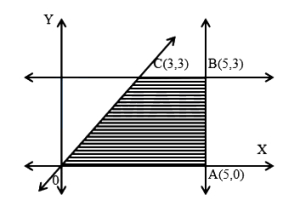
A
$x, y \geq 0 ; x-y \geq 0 ; x \leq 5 ; y \leq 3$
B
$x, y \geq 0 ; x-y \geq 0 ; x \leq 5 ; y \geq 3$
C
$x, y \geq 0 ; x+y \geq 0 ; x \geq 5 ; y \leq 3$
D
$x, y \geq 0 ; x-y \geq 0 ; x \geq 5 ; y \leq 3$
Solution
(A) $1$. The shaded region is bounded by the lines $x=0$ ($Y$-axis),$y=0$ ($X$-axis),$x=5$,$y=3$,and the line passing through $(0,0)$ and $(3,3)$.
$2$. The line passing through $(0,0)$ and $(3,3)$ has the equation $y=x$,which can be written as $x-y=0$. Since the shaded region lies below this line,the constraint is $x-y \geq 0$.
$3$. The vertical line $x=5$ bounds the region on the right,so $x \leq 5$.
$4$. The horizontal line $y=3$ bounds the region on the top,so $y \leq 3$.
$5$. Since the region is in the first quadrant,$x \geq 0$ and $y \geq 0$.
$6$. Combining these,the constraints are $x, y \geq 0, x-y \geq 0, x \leq 5, y \leq 3$.
$2$. The line passing through $(0,0)$ and $(3,3)$ has the equation $y=x$,which can be written as $x-y=0$. Since the shaded region lies below this line,the constraint is $x-y \geq 0$.
$3$. The vertical line $x=5$ bounds the region on the right,so $x \leq 5$.
$4$. The horizontal line $y=3$ bounds the region on the top,so $y \leq 3$.
$5$. Since the region is in the first quadrant,$x \geq 0$ and $y \geq 0$.
$6$. Combining these,the constraints are $x, y \geq 0, x-y \geq 0, x \leq 5, y \leq 3$.
0 likesView Solution
199
MathematicsMediumMCQMHT CET · 2021
The objective function $z = 4x + 5y$ subject to the constraints $2x + y \geq 7$,$2x + 3y \leq 15$,$y \leq 3$,$x \geq 0$,and $y \geq 0$ has a minimum value at which point?
A
on the line $2x + 3y = 15$
B
on the $X$-axis
C
on the $Y$-axis
D
at the origin
Solution
(B) The constraints are $2x + y \geq 7$,$2x + 3y \leq 15$,$y \leq 3$,$x \geq 0$,and $y \geq 0$.
From the graph,the vertices of the feasible region are $A(3.5, 0)$,$B(7.5, 0)$,$C(3, 3)$,and $D(2, 3)$.
We evaluate the objective function $z = 4x + 5y$ at these vertices:
$z(A) = 4(3.5) + 5(0) = 14 + 0 = 14$
$z(B) = 4(7.5) + 5(0) = 30 + 0 = 30$
$z(C) = 4(3) + 5(3) = 12 + 15 = 27$
$z(D) = 4(2) + 5(3) = 8 + 15 = 23$
The minimum value is $14$,which occurs at point $A(3.5, 0)$. Since point $A$ lies on the $X$-axis,the minimum value occurs on the $X$-axis.
From the graph,the vertices of the feasible region are $A(3.5, 0)$,$B(7.5, 0)$,$C(3, 3)$,and $D(2, 3)$.
We evaluate the objective function $z = 4x + 5y$ at these vertices:
$z(A) = 4(3.5) + 5(0) = 14 + 0 = 14$
$z(B) = 4(7.5) + 5(0) = 30 + 0 = 30$
$z(C) = 4(3) + 5(3) = 12 + 15 = 27$
$z(D) = 4(2) + 5(3) = 8 + 15 = 23$
The minimum value is $14$,which occurs at point $A(3.5, 0)$. Since point $A$ lies on the $X$-axis,the minimum value occurs on the $X$-axis.
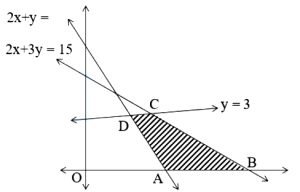
0 likesView Solution
200
MathematicsEasyMCQMHT CET · 2021
The maximum value of $Z = 10x + 25y$ subject to $0 \leq x \leq 3$,$0 \leq y \leq 3$,and $x + y \leq 5$ occurs at the point:
A
$(3, 2)$
B
$(2, 3)$
C
$(4, 3)$
D
$(5, 4)$
Solution
(B) The feasible region is determined by the constraints $0 \leq x \leq 3$,$0 \leq y \leq 3$,and $x + y \leq 5$.
The vertices of the feasible region are:
$O(0, 0)$,$A(3, 0)$,$B(3, 2)$,$C(2, 3)$,and $D(0, 3)$.
We evaluate the objective function $Z = 10x + 25y$ at each vertex:
Comparing the values,the maximum value of $Z$ is $95$,which occurs at the point $(2, 3)$.
The vertices of the feasible region are:
$O(0, 0)$,$A(3, 0)$,$B(3, 2)$,$C(2, 3)$,and $D(0, 3)$.
We evaluate the objective function $Z = 10x + 25y$ at each vertex:
| Vertex | $Z = 10x + 25y$ |
| $O(0, 0)$ | $10(0) + 25(0) = 0$ |
| $A(3, 0)$ | $10(3) + 25(0) = 30$ |
| $B(3, 2)$ | $10(3) + 25(2) = 30 + 50 = 80$ |
| $C(2, 3)$ | $10(2) + 25(3) = 20 + 75 = 95$ |
| $D(0, 3)$ | $10(0) + 25(3) = 75$ |
Comparing the values,the maximum value of $Z$ is $95$,which occurs at the point $(2, 3)$.
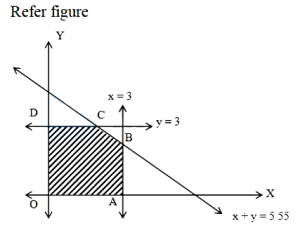
0 likesView Solution
Vedclass Products
For Students
Vedclass Test Series
Mock tests in real MHT CET style covering Mathematics with performance analysis. 5-day free trial.
Start Free TrialFor Teachers
Exam Paper Generator
Generate Set A/B/C/D Mathematics papers from 7.5L+ questions in 2 minutes. 3 chapters free.
Try FreeFor Institutes
Online Exam Module
Run live MHT CET mock exams with unlimited students, 360° analytics & white-label branding.
See DemoFrequently Asked Questions
How many Mathematics questions are in MHT CET 2021?
There are 497 Mathematics questions from the MHT CET 2021 paper on Vedclass, each with a detailed step-by-step solution in English.
Are MHT CET 2021 Mathematics solutions available in English?
Yes. All solutions on this page are in English. You can also switch to English or Hindi using the language buttons above the questions.
Can I practice MHT CET 2021 Mathematics as a timed test?
Yes. Use the Vedclass Test Series to attempt a full MHT CET mock test covering Mathematics with time limits and instant score analysis.
Can teachers create Mathematics papers from MHT CET previous year questions?
Yes. The Vedclass Exam Paper Generator lets teachers mix MHT CET Mathematics questions and generate Set A/B/C/D papers in minutes.
For Teachers & Institutes
Build a Custom Mathematics Paper
Pick MHT CET 2021 Mathematics questions, set difficulty, and generate Set A/B/C/D in 2 minutes.