
MathematicsQ1–13 of 13 questions
Page 1 of 1 · English
1
MathematicsMediumMCQIIT JEE · 1978
The real part of $(1 - \cos \theta + 2i\sin \theta )^{-1}$ is
A
$\frac{1}{3 + 5\cos \theta }$
B
$\frac{1}{5 - 3\cos \theta }$
C
$\frac{1}{3 - 5\cos \theta }$
D
$\frac{1}{5 + 3\cos \theta }$
Solution
(D) Let $z = (1 - \cos \theta ) + i(2\sin \theta )$. We want the real part of $z^{-1} = \frac{1}{z}$.
Using trigonometric identities,$1 - \cos \theta = 2\sin^2(\frac{\theta}{2})$ and $2\sin \theta = 4\sin(\frac{\theta}{2})\cos(\frac{\theta}{2})$.
So,$z = 2\sin(\frac{\theta}{2}) [\sin(\frac{\theta}{2}) + 2i\cos(\frac{\theta}{2})]$.
Then,$z^{-1} = \frac{1}{2\sin(\frac{\theta}{2})} \cdot \frac{1}{\sin(\frac{\theta}{2}) + 2i\cos(\frac{\theta}{2})}$.
Multiply numerator and denominator by the conjugate $\sin(\frac{\theta}{2}) - 2i\cos(\frac{\theta}{2})$:
$z^{-1} = \frac{1}{2\sin(\frac{\theta}{2})} \cdot \frac{\sin(\frac{\theta}{2}) - 2i\cos(\frac{\theta}{2})}{\sin^2(\frac{\theta}{2}) + 4\cos^2(\frac{\theta}{2})}$.
The real part is $\frac{\sin(\frac{\theta}{2})}{2\sin(\frac{\theta}{2}) [\sin^2(\frac{\theta}{2}) + 4\cos^2(\frac{\theta}{2})]} = \frac{1}{2[\sin^2(\frac{\theta}{2}) + 4\cos^2(\frac{\theta}{2})]}$.
Using $\sin^2(\frac{\theta}{2}) = \frac{1 - \cos \theta}{2}$ and $\cos^2(\frac{\theta}{2}) = \frac{1 + \cos \theta}{2}$:
Real part $= \frac{1}{2[\frac{1 - \cos \theta}{2} + 4(\frac{1 + \cos \theta}{2})]} = \frac{1}{1 - \cos \theta + 4 + 4\cos \theta} = \frac{1}{5 + 3\cos \theta }$.
Using trigonometric identities,$1 - \cos \theta = 2\sin^2(\frac{\theta}{2})$ and $2\sin \theta = 4\sin(\frac{\theta}{2})\cos(\frac{\theta}{2})$.
So,$z = 2\sin(\frac{\theta}{2}) [\sin(\frac{\theta}{2}) + 2i\cos(\frac{\theta}{2})]$.
Then,$z^{-1} = \frac{1}{2\sin(\frac{\theta}{2})} \cdot \frac{1}{\sin(\frac{\theta}{2}) + 2i\cos(\frac{\theta}{2})}$.
Multiply numerator and denominator by the conjugate $\sin(\frac{\theta}{2}) - 2i\cos(\frac{\theta}{2})$:
$z^{-1} = \frac{1}{2\sin(\frac{\theta}{2})} \cdot \frac{\sin(\frac{\theta}{2}) - 2i\cos(\frac{\theta}{2})}{\sin^2(\frac{\theta}{2}) + 4\cos^2(\frac{\theta}{2})}$.
The real part is $\frac{\sin(\frac{\theta}{2})}{2\sin(\frac{\theta}{2}) [\sin^2(\frac{\theta}{2}) + 4\cos^2(\frac{\theta}{2})]} = \frac{1}{2[\sin^2(\frac{\theta}{2}) + 4\cos^2(\frac{\theta}{2})]}$.
Using $\sin^2(\frac{\theta}{2}) = \frac{1 - \cos \theta}{2}$ and $\cos^2(\frac{\theta}{2}) = \frac{1 + \cos \theta}{2}$:
Real part $= \frac{1}{2[\frac{1 - \cos \theta}{2} + 4(\frac{1 + \cos \theta}{2})]} = \frac{1}{1 - \cos \theta + 4 + 4\cos \theta} = \frac{1}{5 + 3\cos \theta }$.
0 likesView Solution
2
MathematicsEasyMCQIIT JEE · 1978
If $x = a + b$,$y = a\alpha + b\beta$,and $z = a\beta + b\alpha$,where $\alpha$ and $\beta$ are complex cube roots of unity,then $xyz$ =
A
$a^2 + b^2$
B
$a^3 + b^3$
C
$a^3b^3$
D
$a^3 - b^3$
Solution
(B) Given that $\alpha$ and $\beta$ are complex cube roots of unity,we have $\alpha = \omega$ and $\beta = \omega^2$ (or vice versa),where $1 + \omega + \omega^2 = 0$ and $\omega^3 = 1$.
We need to calculate $xyz = (a + b)(a\omega + b\omega^2)(a\omega^2 + b\omega)$.
First,multiply $y$ and $z$:
$yz = (a\omega + b\omega^2)(a\omega^2 + b\omega) = a^2\omega^3 + ab\omega^2 + ab\omega^4 + b^2\omega^3$.
Since $\omega^3 = 1$ and $\omega^4 = \omega$,this simplifies to:
$yz = a^2(1) + ab(\omega^2 + \omega) + b^2(1) = a^2 + ab(-1) + b^2 = a^2 - ab + b^2$.
Now,multiply by $x$:
$xyz = (a + b)(a^2 - ab + b^2) = a^3 + b^3$.
We need to calculate $xyz = (a + b)(a\omega + b\omega^2)(a\omega^2 + b\omega)$.
First,multiply $y$ and $z$:
$yz = (a\omega + b\omega^2)(a\omega^2 + b\omega) = a^2\omega^3 + ab\omega^2 + ab\omega^4 + b^2\omega^3$.
Since $\omega^3 = 1$ and $\omega^4 = \omega$,this simplifies to:
$yz = a^2(1) + ab(\omega^2 + \omega) + b^2(1) = a^2 + ab(-1) + b^2 = a^2 - ab + b^2$.
Now,multiply by $x$:
$xyz = (a + b)(a^2 - ab + b^2) = a^3 + b^3$.
0 likesView Solution
3
MathematicsDifficultMCQIIT JEE · 1978
If $9, x, y, z, a$ are in $A.P.$ such that $x + y + z = 15$,and $9, x, y, z, a$ are in $H.P.$ such that $\frac{1}{x} + \frac{1}{y} + \frac{1}{z} = \frac{5}{3}$,then the value of $a$ is:
A
$1$
B
$2$
C
$3$
D
$9$
Solution
(A) Case $1$: If $9, x, y, z, a$ are in $A.P.$,then the sum of the terms is $9 + x + y + z + a = \frac{5}{2}(9 + a)$.
Given $x + y + z = 15$,we have $9 + 15 + a = \frac{5}{2}(9 + a)$.
$24 + a = \frac{45 + 5a}{2}$.
$48 + 2a = 45 + 5a$.
$3a = 3 \Rightarrow a = 1$.
Case $2$: If $9, x, y, z, a$ are in $H.P.$,then $\frac{1}{9}, \frac{1}{x}, \frac{1}{y}, \frac{1}{z}, \frac{1}{a}$ are in $A.P.$
The sum of these terms is $\frac{1}{9} + \frac{1}{x} + \frac{1}{y} + \frac{1}{z} + \frac{1}{a} = \frac{5}{2}\left(\frac{1}{9} + \frac{1}{a}\right)$.
Given $\frac{1}{x} + \frac{1}{y} + \frac{1}{z} = \frac{5}{3}$,we have $\frac{1}{9} + \frac{5}{3} + \frac{1}{a} = \frac{5}{2}\left(\frac{1}{9} + \frac{1}{a}\right)$.
$\frac{16}{9} + \frac{1}{a} = \frac{5}{18} + \frac{5}{2a}$.
$\frac{1}{a} - \frac{5}{2a} = \frac{5}{18} - \frac{16}{9}$.
$-\frac{3}{2a} = \frac{5 - 32}{18} = -\frac{27}{18} = -\frac{3}{2}$.
$-\frac{3}{2a} = -\frac{3}{2} \Rightarrow a = 1$.
Given $x + y + z = 15$,we have $9 + 15 + a = \frac{5}{2}(9 + a)$.
$24 + a = \frac{45 + 5a}{2}$.
$48 + 2a = 45 + 5a$.
$3a = 3 \Rightarrow a = 1$.
Case $2$: If $9, x, y, z, a$ are in $H.P.$,then $\frac{1}{9}, \frac{1}{x}, \frac{1}{y}, \frac{1}{z}, \frac{1}{a}$ are in $A.P.$
The sum of these terms is $\frac{1}{9} + \frac{1}{x} + \frac{1}{y} + \frac{1}{z} + \frac{1}{a} = \frac{5}{2}\left(\frac{1}{9} + \frac{1}{a}\right)$.
Given $\frac{1}{x} + \frac{1}{y} + \frac{1}{z} = \frac{5}{3}$,we have $\frac{1}{9} + \frac{5}{3} + \frac{1}{a} = \frac{5}{2}\left(\frac{1}{9} + \frac{1}{a}\right)$.
$\frac{16}{9} + \frac{1}{a} = \frac{5}{18} + \frac{5}{2a}$.
$\frac{1}{a} - \frac{5}{2a} = \frac{5}{18} - \frac{16}{9}$.
$-\frac{3}{2a} = \frac{5 - 32}{18} = -\frac{27}{18} = -\frac{3}{2}$.
$-\frac{3}{2a} = -\frac{3}{2} \Rightarrow a = 1$.
0 likesView Solution
4
MathematicsMediumMCQIIT JEE · 1978
If $\alpha, \beta$ are the roots of $x^2 + px + 1 = 0$ and $\gamma, \delta$ are the roots of $x^2 + qx + 1 = 0$,then $q^2 - p^2$ is equal to:
A
$(\alpha - \gamma)(\beta - \gamma)(\alpha + \delta)(\beta + \delta)$
B
$(\alpha + \gamma)(\beta + \gamma)(\alpha - \delta)(\beta + \delta)$
C
$(\alpha + \gamma)(\beta + \gamma)(\alpha + \delta)(\beta + \delta)$
D
None of these
Solution
(A) Given that $\alpha, \beta$ are roots of $x^2 + px + 1 = 0$,we have $\alpha + \beta = -p$ and $\alpha \beta = 1$.
Given that $\gamma, \delta$ are roots of $x^2 + qx + 1 = 0$,we have $\gamma + \delta = -q$ and $\gamma \delta = 1$.
Consider the expression $(\alpha - \gamma)(\beta - \gamma)(\alpha + \delta)(\beta + \delta)$:
$= (\alpha \beta - \gamma(\alpha + \beta) + \gamma^2)(\alpha \beta + \delta(\alpha + \beta) + \delta^2)$
$= (1 + p\gamma + \gamma^2)(1 - p\delta + \delta^2)$.
Since $\gamma$ is a root of $x^2 + qx + 1 = 0$,$\gamma^2 + q\gamma + 1 = 0$,so $1 + \gamma^2 = -q\gamma$.
Similarly,$\delta^2 + 1 = -q\delta$.
Substituting these into the expression:
$= (-q\gamma + p\gamma)(-q\delta - p\delta)$
$= \gamma(p - q) \times \delta(-p - q)$
$= -\gamma \delta (p - q)(p + q)$
$= -1(p^2 - q^2) = q^2 - p^2$.
Given that $\gamma, \delta$ are roots of $x^2 + qx + 1 = 0$,we have $\gamma + \delta = -q$ and $\gamma \delta = 1$.
Consider the expression $(\alpha - \gamma)(\beta - \gamma)(\alpha + \delta)(\beta + \delta)$:
$= (\alpha \beta - \gamma(\alpha + \beta) + \gamma^2)(\alpha \beta + \delta(\alpha + \beta) + \delta^2)$
$= (1 + p\gamma + \gamma^2)(1 - p\delta + \delta^2)$.
Since $\gamma$ is a root of $x^2 + qx + 1 = 0$,$\gamma^2 + q\gamma + 1 = 0$,so $1 + \gamma^2 = -q\gamma$.
Similarly,$\delta^2 + 1 = -q\delta$.
Substituting these into the expression:
$= (-q\gamma + p\gamma)(-q\delta - p\delta)$
$= \gamma(p - q) \times \delta(-p - q)$
$= -\gamma \delta (p - q)(p + q)$
$= -1(p^2 - q^2) = q^2 - p^2$.
0 likesView Solution
5
MathematicsMediumMCQIIT JEE · 1978
If $\tan \alpha = \frac{m}{m + 1}$ and $\tan \beta = \frac{1}{2m + 1}$,then $\alpha + \beta = $
A
$\frac{\pi}{3}$
B
$\frac{\pi}{4}$
C
$\frac{\pi}{6}$
D
None of these
Solution
(B) We have $\tan \alpha = \frac{m}{m + 1}$ and $\tan \beta = \frac{1}{2m + 1}$.
Using the formula $\tan(\alpha + \beta) = \frac{\tan \alpha + \tan \beta}{1 - \tan \alpha \tan \beta}$:
$\tan(\alpha + \beta) = \frac{\frac{m}{m + 1} + \frac{1}{2m + 1}}{1 - \left(\frac{m}{m + 1}\right) \left(\frac{1}{2m + 1}\right)}$
$= \frac{\frac{m(2m + 1) + (m + 1)}{(m + 1)(2m + 1)}}{\frac{(m + 1)(2m + 1) - m}{(m + 1)(2m + 1)}}$
$= \frac{2m^2 + m + m + 1}{2m^2 + m + 2m + 1 - m}$
$= \frac{2m^2 + 2m + 1}{2m^2 + 2m + 1} = 1$
Since $\tan(\alpha + \beta) = 1$,we have $\alpha + \beta = \frac{\pi}{4}$.
Using the formula $\tan(\alpha + \beta) = \frac{\tan \alpha + \tan \beta}{1 - \tan \alpha \tan \beta}$:
$\tan(\alpha + \beta) = \frac{\frac{m}{m + 1} + \frac{1}{2m + 1}}{1 - \left(\frac{m}{m + 1}\right) \left(\frac{1}{2m + 1}\right)}$
$= \frac{\frac{m(2m + 1) + (m + 1)}{(m + 1)(2m + 1)}}{\frac{(m + 1)(2m + 1) - m}{(m + 1)(2m + 1)}}$
$= \frac{2m^2 + m + m + 1}{2m^2 + m + 2m + 1 - m}$
$= \frac{2m^2 + 2m + 1}{2m^2 + 2m + 1} = 1$
Since $\tan(\alpha + \beta) = 1$,we have $\alpha + \beta = \frac{\pi}{4}$.
0 likesView Solution
6
MathematicsEasyMCQIIT JEE · 1978
$\mathop {\lim }\limits_{x \to a} \frac{{\sqrt {a + 2x} - \sqrt {3x} }}{{\sqrt {3a + x} - 2\sqrt x }} = \dots$ (where $a \ne 0$)
A
$\frac{1}{{\sqrt 3 }}$
B
$\frac{2}{{3\sqrt 3 }}$
C
$\frac{2}{{\sqrt 3 }}$
D
$\frac{2}{3}$
Solution
(A) Given limit: $L = \mathop {\lim }\limits_{x \to a} \frac{{\sqrt {a + 2x} - \sqrt {3x} }}{{\sqrt {3a + x} - 2\sqrt x }}$
Rationalizing the numerator and denominator:
$L = \mathop {\lim }\limits_{x \to a} \frac{(\sqrt {a + 2x} - \sqrt {3x})(\sqrt {a + 2x} + \sqrt {3x})}{(\sqrt {3a + x} - 2\sqrt x)(\sqrt {3a + x} + 2\sqrt x)} \times \frac{\sqrt {3a + x} + 2\sqrt x}{\sqrt {a + 2x} + \sqrt {3x}}$
$L = \mathop {\lim }\limits_{x \to a} \frac{(a + 2x - 3x)}{(3a + x - 4x)} \times \frac{\sqrt {3a + x} + 2\sqrt x}{\sqrt {a + 2x} + \sqrt {3x}}$
$L = \mathop {\lim }\limits_{x \to a} \frac{a - x}{3a - 3x} \times \frac{\sqrt {3a + x} + 2\sqrt x}{\sqrt {a + 2x} + \sqrt {3x}}$
$L = \mathop {\lim }\limits_{x \to a} \frac{a - x}{3(a - x)} \times \frac{\sqrt {3a + x} + 2\sqrt x}{\sqrt {a + 2x} + \sqrt {3x}}$
$L = \frac{1}{3} \times \frac{\sqrt {3a + a} + 2\sqrt a}{\sqrt {a + 2a} + \sqrt {3a}} = \frac{1}{3} \times \frac{2\sqrt {4a} + 2\sqrt a}{2\sqrt {3a}} = \frac{1}{3} \times \frac{2(2\sqrt a) + 2\sqrt a}{2\sqrt {3a}} = \frac{1}{3} \times \frac{6\sqrt a}{2\sqrt {3a}} = \frac{1}{3} \times \frac{3}{\sqrt 3} = \frac{1}{\sqrt 3} = \frac{\sqrt 3}{3}$.
Wait,re-evaluating the limit: $\frac{1}{3} \times \frac{2\sqrt{4a} + 2\sqrt{a}}{2\sqrt{3a}} = \frac{1}{3} \times \frac{4\sqrt{a} + 2\sqrt{a}}{2\sqrt{3a}} = \frac{1}{3} \times \frac{6\sqrt{a}}{2\sqrt{3a}} = \frac{1}{3} \times \frac{3}{\sqrt{3}} = \frac{1}{\sqrt{3}}$.
Correction: The provided option $B$ is $\frac{2}{3\sqrt{3}}$. Let's re-check the simplification: $\frac{1}{3} \times \frac{2\sqrt{4a} + 2\sqrt{a}}{2\sqrt{3a}} = \frac{1}{3} \times \frac{4\sqrt{a} + 2\sqrt{a}}{2\sqrt{3a}} = \frac{6\sqrt{a}}{6\sqrt{3a}} = \frac{1}{\sqrt{3}}$.
Actually,$\frac{1}{\sqrt{3}} = \frac{\sqrt{3}}{3}$. The correct value is $\frac{1}{\sqrt{3}}$.
Rationalizing the numerator and denominator:
$L = \mathop {\lim }\limits_{x \to a} \frac{(\sqrt {a + 2x} - \sqrt {3x})(\sqrt {a + 2x} + \sqrt {3x})}{(\sqrt {3a + x} - 2\sqrt x)(\sqrt {3a + x} + 2\sqrt x)} \times \frac{\sqrt {3a + x} + 2\sqrt x}{\sqrt {a + 2x} + \sqrt {3x}}$
$L = \mathop {\lim }\limits_{x \to a} \frac{(a + 2x - 3x)}{(3a + x - 4x)} \times \frac{\sqrt {3a + x} + 2\sqrt x}{\sqrt {a + 2x} + \sqrt {3x}}$
$L = \mathop {\lim }\limits_{x \to a} \frac{a - x}{3a - 3x} \times \frac{\sqrt {3a + x} + 2\sqrt x}{\sqrt {a + 2x} + \sqrt {3x}}$
$L = \mathop {\lim }\limits_{x \to a} \frac{a - x}{3(a - x)} \times \frac{\sqrt {3a + x} + 2\sqrt x}{\sqrt {a + 2x} + \sqrt {3x}}$
$L = \frac{1}{3} \times \frac{\sqrt {3a + a} + 2\sqrt a}{\sqrt {a + 2a} + \sqrt {3a}} = \frac{1}{3} \times \frac{2\sqrt {4a} + 2\sqrt a}{2\sqrt {3a}} = \frac{1}{3} \times \frac{2(2\sqrt a) + 2\sqrt a}{2\sqrt {3a}} = \frac{1}{3} \times \frac{6\sqrt a}{2\sqrt {3a}} = \frac{1}{3} \times \frac{3}{\sqrt 3} = \frac{1}{\sqrt 3} = \frac{\sqrt 3}{3}$.
Wait,re-evaluating the limit: $\frac{1}{3} \times \frac{2\sqrt{4a} + 2\sqrt{a}}{2\sqrt{3a}} = \frac{1}{3} \times \frac{4\sqrt{a} + 2\sqrt{a}}{2\sqrt{3a}} = \frac{1}{3} \times \frac{6\sqrt{a}}{2\sqrt{3a}} = \frac{1}{3} \times \frac{3}{\sqrt{3}} = \frac{1}{\sqrt{3}}$.
Correction: The provided option $B$ is $\frac{2}{3\sqrt{3}}$. Let's re-check the simplification: $\frac{1}{3} \times \frac{2\sqrt{4a} + 2\sqrt{a}}{2\sqrt{3a}} = \frac{1}{3} \times \frac{4\sqrt{a} + 2\sqrt{a}}{2\sqrt{3a}} = \frac{6\sqrt{a}}{6\sqrt{3a}} = \frac{1}{\sqrt{3}}$.
Actually,$\frac{1}{\sqrt{3}} = \frac{\sqrt{3}}{3}$. The correct value is $\frac{1}{\sqrt{3}}$.
0 likesView Solution
7
MathematicsMediumMCQIIT JEE · 1978
$\mathop {\lim }\limits_{x \to 1} (1 - x)\tan \left( {\frac{{\pi x}}{2}} \right) = $
A
$\frac{\pi }{2}$
B
$\pi $
C
$\frac{2}{\pi }$
D
$0$
Solution
(C) Let $L = \mathop {\lim }\limits_{x \to 1} (1 - x)\tan \left( {\frac{{\pi x}}{2}} \right)$.
Substitute $y = 1 - x$,so as $x \to 1$,$y \to 0$ and $x = 1 - y$.
Then $L = \mathop {\lim }\limits_{y \to 0} y \tan \left( {\frac{{\pi (1 - y)}}{2}} \right) = \mathop {\lim }\limits_{y \to 0} y \tan \left( {\frac{\pi }{2} - \frac{{\pi y}}{2}} \right)$.
Using the identity $\tan \left( {\frac{\pi }{2} - \theta } \right) = \cot \theta$,we get:
$L = \mathop {\lim }\limits_{y \to 0} y \cot \left( {\frac{{\pi y}}{2}} \right) = \mathop {\lim }\limits_{y \to 0} \frac{y}{\tan \left( {\frac{{\pi y}}{2}} \right)}$.
Multiply and divide by $\frac{\pi }{2}$:
$L = \mathop {\lim }\limits_{y \to 0} \frac{1}{\frac{\pi }{2}} \cdot \frac{{\frac{{\pi y}}{2}}}{{\tan \left( {\frac{{\pi y}}{2}} \right)}} = \frac{2}{\pi } \cdot 1 = \frac{2}{\pi }$.
Substitute $y = 1 - x$,so as $x \to 1$,$y \to 0$ and $x = 1 - y$.
Then $L = \mathop {\lim }\limits_{y \to 0} y \tan \left( {\frac{{\pi (1 - y)}}{2}} \right) = \mathop {\lim }\limits_{y \to 0} y \tan \left( {\frac{\pi }{2} - \frac{{\pi y}}{2}} \right)$.
Using the identity $\tan \left( {\frac{\pi }{2} - \theta } \right) = \cot \theta$,we get:
$L = \mathop {\lim }\limits_{y \to 0} y \cot \left( {\frac{{\pi y}}{2}} \right) = \mathop {\lim }\limits_{y \to 0} \frac{y}{\tan \left( {\frac{{\pi y}}{2}} \right)}$.
Multiply and divide by $\frac{\pi }{2}$:
$L = \mathop {\lim }\limits_{y \to 0} \frac{1}{\frac{\pi }{2}} \cdot \frac{{\frac{{\pi y}}{2}}}{{\tan \left( {\frac{{\pi y}}{2}} \right)}} = \frac{2}{\pi } \cdot 1 = \frac{2}{\pi }$.
0 likesView Solution
8
MathematicsDifficultMCQIIT JEE · 1978
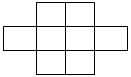
Six '$X$'s have to be placed in the squares of the figure such that each row contains at least one '$X$'. In how many different ways can this be done?
A
$28$
B
$27$
C
$26$
D
None of these
Solution
(C) The figure consists of $8$ squares arranged in three rows: top row ($2$ squares),middle row ($4$ squares),and bottom row ($2$ squares).
We need to place $6$ '$X$'s in these $8$ squares.
The total number of ways to place $6$ '$X$'s in $8$ squares is $^8C_6 = \frac{8 \times 7}{2 \times 1} = 28$.
We must ensure each row contains at least one '$X$'.
Let $R_1, R_2, R_3$ be the top,middle,and bottom rows respectively.
Total squares = $2 + 4 + 2 = 8$.
If the top row $(R_1)$ has no '$X$',then all $6$ '$X$'s must be placed in the remaining $8 - 2 = 6$ squares. This can be done in $^6C_6 = 1$ way.
If the bottom row $(R_3)$ has no '$X$',then all $6$ '$X$'s must be placed in the remaining $8 - 2 = 6$ squares. This can be done in $^6C_6 = 1$ way.
Note that it is impossible for both the top and bottom rows to have no '$X$' simultaneously,as that would require placing $6$ '$X$'s in only $4$ squares,which is impossible.
Thus,the number of invalid ways is $1 + 1 = 2$.
The required number of ways is $28 - 2 = 26$.
We need to place $6$ '$X$'s in these $8$ squares.
The total number of ways to place $6$ '$X$'s in $8$ squares is $^8C_6 = \frac{8 \times 7}{2 \times 1} = 28$.
We must ensure each row contains at least one '$X$'.
Let $R_1, R_2, R_3$ be the top,middle,and bottom rows respectively.
Total squares = $2 + 4 + 2 = 8$.
If the top row $(R_1)$ has no '$X$',then all $6$ '$X$'s must be placed in the remaining $8 - 2 = 6$ squares. This can be done in $^6C_6 = 1$ way.
If the bottom row $(R_3)$ has no '$X$',then all $6$ '$X$'s must be placed in the remaining $8 - 2 = 6$ squares. This can be done in $^6C_6 = 1$ way.
Note that it is impossible for both the top and bottom rows to have no '$X$' simultaneously,as that would require placing $6$ '$X$'s in only $4$ squares,which is impossible.
Thus,the number of invalid ways is $1 + 1 = 2$.
The required number of ways is $28 - 2 = 26$.
0 likesView Solution
9
MathematicsMediumMCQIIT JEE · 1978
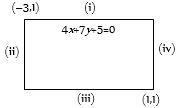
One side of a rectangle lies along the line $4x + 7y + 5 = 0.$ Two of its vertices are $(-3, 1)$ and $(1, 1).$ Then the equations of the other three sides are
A
$7x - 4y + 25 = 0, 4x + 7y = 11$ and $7x - 4y - 3 = 0$
B
$7x + 4y + 25 = 0, 7y + 4x - 11 = 0$ and $7x - 4y - 3 = 0$
C
$4x - 7y + 25 = 0, 7x + 4y - 11 = 0$ and $4x - 7y - 3 = 0$
D
None of these
Solution
(A) Given one side is $4x + 7y + 5 = 0.$ The vertices are $A(-3, 1)$ and $B(1, 1).$
Since $A$ and $B$ do not satisfy the given line equation,the side containing $A$ and $B$ is parallel to the given line.
Let the side containing $A$ and $B$ be $4x + 7y + k = 0.$
Since it passes through $(-3, 1),$ $4(-3) + 7(1) + k = 0 \implies -12 + 7 + k = 0 \implies k = 5.$
So,the side is $4x + 7y - 5 = 0.$
Wait,the side containing $A$ and $B$ is $4x + 7y - 5 = 0.$
The other side parallel to this is $4x + 7y + k' = 0.$
Passing through $(1, 1),$ $4(1) + 7(1) + k' = 0 \implies k' = -11.$
So,the opposite side is $4x + 7y - 11 = 0.$
The perpendicular sides have slope $7/4.$
Side through $(-3, 1): y - 1 = \frac{7}{4}(x + 3) \implies 4y - 4 = 7x + 21 \implies 7x - 4y + 25 = 0.$
Side through $(1, 1): y - 1 = \frac{7}{4}(x - 1) \implies 4y - 4 = 7x - 7 \implies 7x - 4y - 3 = 0.$
Thus,the equations are $4x + 7y - 11 = 0, 7x - 4y + 25 = 0$ and $7x - 4y - 3 = 0.$
Comparing with options,option $(A)$ matches the form $7x - 4y + 25 = 0, 4x + 7y - 11 = 0$ and $7x - 4y - 3 = 0.$
Since $A$ and $B$ do not satisfy the given line equation,the side containing $A$ and $B$ is parallel to the given line.
Let the side containing $A$ and $B$ be $4x + 7y + k = 0.$
Since it passes through $(-3, 1),$ $4(-3) + 7(1) + k = 0 \implies -12 + 7 + k = 0 \implies k = 5.$
So,the side is $4x + 7y - 5 = 0.$
Wait,the side containing $A$ and $B$ is $4x + 7y - 5 = 0.$
The other side parallel to this is $4x + 7y + k' = 0.$
Passing through $(1, 1),$ $4(1) + 7(1) + k' = 0 \implies k' = -11.$
So,the opposite side is $4x + 7y - 11 = 0.$
The perpendicular sides have slope $7/4.$
Side through $(-3, 1): y - 1 = \frac{7}{4}(x + 3) \implies 4y - 4 = 7x + 21 \implies 7x - 4y + 25 = 0.$
Side through $(1, 1): y - 1 = \frac{7}{4}(x - 1) \implies 4y - 4 = 7x - 7 \implies 7x - 4y - 3 = 0.$
Thus,the equations are $4x + 7y - 11 = 0, 7x - 4y + 25 = 0$ and $7x - 4y - 3 = 0.$
Comparing with options,option $(A)$ matches the form $7x - 4y + 25 = 0, 4x + 7y - 11 = 0$ and $7x - 4y - 3 = 0.$
0 likesView Solution
10
MathematicsMediumMCQIIT JEE · 1978
If $x = cy + bz$,$y = az + cx$,$z = bx + ay$ (where $x, y, z$ are not all zero) have a solution other than $x = 0, y = 0, z = 0$,then $a, b$,and $c$ are connected by the relation:
A
$a^2 + b^2 + c^2 + 3abc = 0$
B
$a^2 + b^2 + c^2 + 2abc = 0$
C
$a^2 + b^2 + c^2 + 2abc = 1$
D
$a^2 + b^2 + c^2 - bc - ca - ab = 1$
Solution
(C) The given system of homogeneous linear equations is:
$x - cy - bz = 0$
$-cx + y - az = 0$
$-bx - ay + z = 0$
For this system to have a non-trivial solution (where $x, y, z$ are not all zero),the determinant of the coefficient matrix must be zero:
$\Delta = \begin{vmatrix} 1 & -c & -b \\ -c & 1 & -a \\ -b & -a & 1 \end{vmatrix} = 0$
Expanding the determinant along the first row:
$1(1 - a^2) - (-c)(-c - ab) + (-b)(ac + b) = 0$
$1 - a^2 - c^2 - abc - abc - b^2 = 0$
$1 - a^2 - b^2 - c^2 - 2abc = 0$
Rearranging the terms,we get:
$a^2 + b^2 + c^2 + 2abc = 1$
$x - cy - bz = 0$
$-cx + y - az = 0$
$-bx - ay + z = 0$
For this system to have a non-trivial solution (where $x, y, z$ are not all zero),the determinant of the coefficient matrix must be zero:
$\Delta = \begin{vmatrix} 1 & -c & -b \\ -c & 1 & -a \\ -b & -a & 1 \end{vmatrix} = 0$
Expanding the determinant along the first row:
$1(1 - a^2) - (-c)(-c - ab) + (-b)(ac + b) = 0$
$1 - a^2 - c^2 - abc - abc - b^2 = 0$
$1 - a^2 - b^2 - c^2 - 2abc = 0$
Rearranging the terms,we get:
$a^2 + b^2 + c^2 + 2abc = 1$
0 likesView Solution
11
MathematicsEasyMCQIIT JEE · 1978
$\int \frac{x}{1 + x^4} \, dx = $
A
$\frac{1}{2} \cot^{-1}(x^2) + c$
B
$\frac{1}{2} \tan^{-1}(x^2) + c$
C
$\cot^{-1}(x^2) + c$
D
$\tan^{-1}(x^2) + c$
Solution
(B) Let $t = x^2$.
Then,differentiating both sides with respect to $x$,we get $dt = 2x \, dx$,which implies $x \, dx = \frac{1}{2} \, dt$.
Substituting these into the integral:
$\int \frac{x}{1 + x^4} \, dx = \int \frac{1}{1 + (x^2)^2} \cdot (x \, dx) = \int \frac{1}{1 + t^2} \cdot \frac{1}{2} \, dt$.
$= \frac{1}{2} \int \frac{1}{1 + t^2} \, dt$.
Using the standard integral formula $\int \frac{1}{1 + t^2} \, dt = \tan^{-1}(t) + c$,we get:
$= \frac{1}{2} \tan^{-1}(t) + c$.
Substituting $t = x^2$ back,the final result is $\frac{1}{2} \tan^{-1}(x^2) + c$.
Then,differentiating both sides with respect to $x$,we get $dt = 2x \, dx$,which implies $x \, dx = \frac{1}{2} \, dt$.
Substituting these into the integral:
$\int \frac{x}{1 + x^4} \, dx = \int \frac{1}{1 + (x^2)^2} \cdot (x \, dx) = \int \frac{1}{1 + t^2} \cdot \frac{1}{2} \, dt$.
$= \frac{1}{2} \int \frac{1}{1 + t^2} \, dt$.
Using the standard integral formula $\int \frac{1}{1 + t^2} \, dt = \tan^{-1}(t) + c$,we get:
$= \frac{1}{2} \tan^{-1}(t) + c$.
Substituting $t = x^2$ back,the final result is $\frac{1}{2} \tan^{-1}(x^2) + c$.
0 likesView Solution
12
MathematicsDifficultMCQIIT JEE · 1978
$\int e^x \sin x \, dx = $
A
$\frac{1}{2} e^x (\sin x + \cos x) + c$
B
$\frac{1}{2} e^x (\sin x - \cos x) + c$
C
$e^x (\sin x + \cos x) + c$
D
$e^x (\sin x - \cos x) + c$
Solution
(B) Let $I = \int e^x \sin x \, dx$.
Using integration by parts,$\int u v \, dx = u \int v \, dx - \int (u' \int v \, dx) \, dx$.
Taking $u = \sin x$ and $v = e^x$,we get:
$I = \sin x \cdot e^x - \int \cos x \cdot e^x \, dx$.
Applying integration by parts again to $\int e^x \cos x \, dx$ with $u = \cos x$ and $v = e^x$:
$\int e^x \cos x \, dx = \cos x \cdot e^x - \int (-\sin x) \cdot e^x \, dx = e^x \cos x + \int e^x \sin x \, dx$.
Substituting this back into the equation for $I$:
$I = e^x \sin x - (e^x \cos x + I) + c$.
$I = e^x \sin x - e^x \cos x - I + c$.
$2I = e^x (\sin x - \cos x) + c$.
$I = \frac{1}{2} e^x (\sin x - \cos x) + c$.
Using integration by parts,$\int u v \, dx = u \int v \, dx - \int (u' \int v \, dx) \, dx$.
Taking $u = \sin x$ and $v = e^x$,we get:
$I = \sin x \cdot e^x - \int \cos x \cdot e^x \, dx$.
Applying integration by parts again to $\int e^x \cos x \, dx$ with $u = \cos x$ and $v = e^x$:
$\int e^x \cos x \, dx = \cos x \cdot e^x - \int (-\sin x) \cdot e^x \, dx = e^x \cos x + \int e^x \sin x \, dx$.
Substituting this back into the equation for $I$:
$I = e^x \sin x - (e^x \cos x + I) + c$.
$I = e^x \sin x - e^x \cos x - I + c$.
$2I = e^x (\sin x - \cos x) + c$.
$I = \frac{1}{2} e^x (\sin x - \cos x) + c$.
0 likesView Solution
13
MathematicsMediumMCQIIT JEE · 1978
The area of a triangle is $5$. If two of its vertices are $(2, 1)$ and $(3, -2)$ and the third vertex lies on the line $y = x + 3$,then the third vertex is
A
$\left( -\frac{7}{2}, -\frac{13}{2} \right)$
B
$\left( -\frac{7}{2}, \frac{13}{2} \right)$
C
$\left( \frac{7}{2}, -\frac{13}{2} \right)$
D
$\left( \frac{7}{2}, \frac{13}{2} \right)$
Solution
(D) Let the third vertex be $(p, q)$. Since it lies on the line $y = x + 3$,we have $q = p + 3$ $(i)$.
Given the area of the triangle is $5$,the area formula is:
$\frac{1}{2} |x_1(y_2 - y_3) + x_2(y_3 - y_1) + x_3(y_1 - y_2)| = 5$
$\frac{1}{2} |2(-2 - q) + 3(q - 1) + p(1 - (-2))| = 5$
$|2(-2 - q) + 3(q - 1) + 3p| = 10$
$|-4 - 2q + 3q - 3 + 3p| = 10$
$|q + 3p - 7| = 10$
Substituting $q = p + 3$ into the equation:
$|(p + 3) + 3p - 7| = 10$
$|4p - 4| = 10$
Case $1$: $4p - 4 = 10$ $\Rightarrow 4p = 14$ $\Rightarrow p = \frac{7}{2}$. Then $q = \frac{7}{2} + 3 = \frac{13}{2}$.
Case $2$: $4p - 4 = -10$ $\Rightarrow 4p = -6$ $\Rightarrow p = -\frac{3}{2}$. Then $q = -\frac{3}{2} + 3 = \frac{3}{2}$.
The possible vertices are $\left( \frac{7}{2}, \frac{13}{2} \right)$ or $\left( -\frac{3}{2}, \frac{3}{2} \right)$.
Comparing with the given options,the correct option is $D$.
Given the area of the triangle is $5$,the area formula is:
$\frac{1}{2} |x_1(y_2 - y_3) + x_2(y_3 - y_1) + x_3(y_1 - y_2)| = 5$
$\frac{1}{2} |2(-2 - q) + 3(q - 1) + p(1 - (-2))| = 5$
$|2(-2 - q) + 3(q - 1) + 3p| = 10$
$|-4 - 2q + 3q - 3 + 3p| = 10$
$|q + 3p - 7| = 10$
Substituting $q = p + 3$ into the equation:
$|(p + 3) + 3p - 7| = 10$
$|4p - 4| = 10$
Case $1$: $4p - 4 = 10$ $\Rightarrow 4p = 14$ $\Rightarrow p = \frac{7}{2}$. Then $q = \frac{7}{2} + 3 = \frac{13}{2}$.
Case $2$: $4p - 4 = -10$ $\Rightarrow 4p = -6$ $\Rightarrow p = -\frac{3}{2}$. Then $q = -\frac{3}{2} + 3 = \frac{3}{2}$.
The possible vertices are $\left( \frac{7}{2}, \frac{13}{2} \right)$ or $\left( -\frac{3}{2}, \frac{3}{2} \right)$.
Comparing with the given options,the correct option is $D$.
0 likesView Solution
Vedclass Products
For Students
Vedclass Test Series
Mock tests in real IIT JEE style covering Mathematics with performance analysis. 5-day free trial.
Start Free TrialFor Teachers
Exam Paper Generator
Generate Set A/B/C/D Mathematics papers from 7.5L+ questions in 2 minutes. 3 chapters free.
Try FreeFor Institutes
Online Exam Module
Run live IIT JEE mock exams with unlimited students, 360° analytics & white-label branding.
See DemoFrequently Asked Questions
How many Mathematics questions are in IIT JEE 1978?
There are 13 Mathematics questions from the IIT JEE 1978 paper on Vedclass, each with a detailed step-by-step solution in English.
Are IIT JEE 1978 Mathematics solutions available in English?
Yes. All solutions on this page are in English. You can also switch to English or Hindi using the language buttons above the questions.
Can I practice IIT JEE 1978 Mathematics as a timed test?
Yes. Use the Vedclass Test Series to attempt a full IIT JEE mock test covering Mathematics with time limits and instant score analysis.
Can teachers create Mathematics papers from IIT JEE previous year questions?
Yes. The Vedclass Exam Paper Generator lets teachers mix IIT JEE Mathematics questions and generate Set A/B/C/D papers in minutes.
For Teachers & Institutes
Build a Custom Mathematics Paper
Pick IIT JEE 1978 Mathematics questions, set difficulty, and generate Set A/B/C/D in 2 minutes.