
MathematicsQ1–8 of 8 questions
Page 1 of 1 · English
1
MathematicsMediumMCQIIT JEE · 1973
$0.4\overline{23} = ?$
A
$\frac{419}{990}$
B
$\frac{419}{999}$
C
$\frac{417}{990}$
D
$\frac{417}{999}$
Solution
(A) Let $x = 0.4232323...$ (Equation $1$)
Multiply by $10$ on both sides: $10x = 4.232323...$ (Equation $2$)
Multiply Equation $1$ by $1000$: $1000x = 423.232323...$ (Equation $3$)
Subtract Equation $2$ from Equation $3$:
$1000x - 10x = 423.232323... - 4.232323...$
$990x = 419$
$x = \frac{419}{990}$.
Multiply by $10$ on both sides: $10x = 4.232323...$ (Equation $2$)
Multiply Equation $1$ by $1000$: $1000x = 423.232323...$ (Equation $3$)
Subtract Equation $2$ from Equation $3$:
$1000x - 10x = 423.232323... - 4.232323...$
$990x = 419$
$x = \frac{419}{990}$.
0 likesView Solution
2
MathematicsMediumMCQIIT JEE · 1973
The sum of the series $1 \cdot 3^2 + 2 \cdot 5^2 + 3 \cdot 7^2 + \dots$ up to $20$ terms is
A
$188090$
B
$189080$
C
$199080$
D
None of these
Solution
(A) The $n^{th}$ term of the series is given by $T_n = n(2n + 1)^2$.
Expanding this,we get $T_n = n(4n^2 + 4n + 1) = 4n^3 + 4n^2 + n$.
To find the sum of $20$ terms,we calculate $S_{20} = \sum_{n=1}^{20} (4n^3 + 4n^2 + n) = 4\sum_{n=1}^{20} n^3 + 4\sum_{n=1}^{20} n^2 + \sum_{n=1}^{20} n$.
Using the standard summation formulas:
$\sum_{n=1}^{N} n^3 = [\frac{N(N+1)}{2}]^2 = [\frac{20 \cdot 21}{2}]^2 = 210^2 = 44100$.
$\sum_{n=1}^{N} n^2 = \frac{N(N+1)(2N+1)}{6} = \frac{20 \cdot 21 \cdot 41}{6} = 2870$.
$\sum_{n=1}^{N} n = \frac{N(N+1)}{2} = \frac{20 \cdot 21}{2} = 210$.
Substituting these values: $S_{20} = 4(44100) + 4(2870) + 210 = 176400 + 11480 + 210 = 188090$.
Expanding this,we get $T_n = n(4n^2 + 4n + 1) = 4n^3 + 4n^2 + n$.
To find the sum of $20$ terms,we calculate $S_{20} = \sum_{n=1}^{20} (4n^3 + 4n^2 + n) = 4\sum_{n=1}^{20} n^3 + 4\sum_{n=1}^{20} n^2 + \sum_{n=1}^{20} n$.
Using the standard summation formulas:
$\sum_{n=1}^{N} n^3 = [\frac{N(N+1)}{2}]^2 = [\frac{20 \cdot 21}{2}]^2 = 210^2 = 44100$.
$\sum_{n=1}^{N} n^2 = \frac{N(N+1)(2N+1)}{6} = \frac{20 \cdot 21 \cdot 41}{6} = 2870$.
$\sum_{n=1}^{N} n = \frac{N(N+1)}{2} = \frac{20 \cdot 21}{2} = 210$.
Substituting these values: $S_{20} = 4(44100) + 4(2870) + 210 = 176400 + 11480 + 210 = 188090$.
0 likesView Solution
3
MathematicsMediumMCQIIT JEE · 1973
The diagonal passing through the origin of a quadrilateral formed by $x = 0, y = 0, x + y = 1$ and $6x + y = 3$ is
A
$3x - 2y = 0$
B
$2x - 3y = 0$
C
$3x + 2y = 0$
D
None of these
Solution
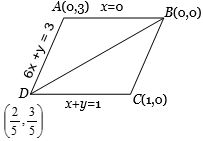
(A) The vertices of the quadrilateral are formed by the intersection of the lines:
$1$. $x=0$ and $y=0$ intersect at $B(0,0)$.
$2$. $x=0$ and $6x+y=3$ intersect at $A(0,3)$.
$3$. $y=0$ and $x+y=1$ intersect at $C(1,0)$.
$4$. $x+y=1$ and $6x+y=3$ intersect at $D(\frac{2}{5}, \frac{3}{5})$.
The diagonal passing through the origin $B(0,0)$ must also pass through the vertex $D(\frac{2}{5}, \frac{3}{5})$.
The equation of a line passing through $(0,0)$ and $(x_1, y_1)$ is $y = \frac{y_1}{x_1}x$.
Substituting $x_1 = \frac{2}{5}$ and $y_1 = \frac{3}{5}$:
$y = \frac{3/5}{2/5}x$
$y = \frac{3}{2}x$
$2y = 3x$
$3x - 2y = 0$.
$1$. $x=0$ and $y=0$ intersect at $B(0,0)$.
$2$. $x=0$ and $6x+y=3$ intersect at $A(0,3)$.
$3$. $y=0$ and $x+y=1$ intersect at $C(1,0)$.
$4$. $x+y=1$ and $6x+y=3$ intersect at $D(\frac{2}{5}, \frac{3}{5})$.
The diagonal passing through the origin $B(0,0)$ must also pass through the vertex $D(\frac{2}{5}, \frac{3}{5})$.
The equation of a line passing through $(0,0)$ and $(x_1, y_1)$ is $y = \frac{y_1}{x_1}x$.
Substituting $x_1 = \frac{2}{5}$ and $y_1 = \frac{3}{5}$:
$y = \frac{3/5}{2/5}x$
$y = \frac{3}{2}x$
$2y = 3x$
$3x - 2y = 0$.
0 likesView Solution
4
MathematicsMediumMCQIIT JEE · 1973
The equation of the base of an equilateral triangle is $x + y = 2$ and the vertex is $(2, -1)$. The length of the side of the triangle is
A
$\sqrt{3/2}$
B
$\sqrt{2}$
C
$\sqrt{2/3}$
D
None of these
Solution
(C) Let $p$ be the length of the perpendicular from the vertex $(2, -1)$ to the base $x + y - 2 = 0$.
The formula for the perpendicular distance from a point $(x_1, y_1)$ to the line $Ax + By + C = 0$ is $p = \frac{|Ax_1 + By_1 + C|}{\sqrt{A^2 + B^2}}$.
Substituting the values,we get $p = \frac{|1(2) + 1(-1) - 2|}{\sqrt{1^2 + 1^2}} = \frac{|2 - 1 - 2|}{\sqrt{2}} = \frac{1}{\sqrt{2}}$.
For an equilateral triangle with side length $a$,the altitude $p$ is given by $p = a \sin(60^{\circ}) = \frac{a\sqrt{3}}{2}$.
Equating the two expressions for $p$: $\frac{1}{\sqrt{2}} = \frac{a\sqrt{3}}{2}$.
Solving for $a$: $a = \frac{2}{\sqrt{2} \times \sqrt{3}} = \frac{\sqrt{2}}{\sqrt{3}} = \sqrt{\frac{2}{3}}$.
The formula for the perpendicular distance from a point $(x_1, y_1)$ to the line $Ax + By + C = 0$ is $p = \frac{|Ax_1 + By_1 + C|}{\sqrt{A^2 + B^2}}$.
Substituting the values,we get $p = \frac{|1(2) + 1(-1) - 2|}{\sqrt{1^2 + 1^2}} = \frac{|2 - 1 - 2|}{\sqrt{2}} = \frac{1}{\sqrt{2}}$.
For an equilateral triangle with side length $a$,the altitude $p$ is given by $p = a \sin(60^{\circ}) = \frac{a\sqrt{3}}{2}$.
Equating the two expressions for $p$: $\frac{1}{\sqrt{2}} = \frac{a\sqrt{3}}{2}$.
Solving for $a$: $a = \frac{2}{\sqrt{2} \times \sqrt{3}} = \frac{\sqrt{2}}{\sqrt{3}} = \sqrt{\frac{2}{3}}$.
0 likesView Solution
5
MathematicsEasyMCQIIT JEE · 1973
The area of a parallelogram formed by the lines $ax \pm by \pm c = 0$ is
A
$\frac{c^2}{ab}$
B
$\frac{2c^2}{ab}$
C
$\frac{c^2}{2ab}$
D
None of these
Solution
(B) The given lines are $ax + by + c = 0$,$ax + by - c = 0$,$ax - by + c = 0$,and $ax - by - c = 0$.
These can be rewritten in intercept form as $\frac{x}{\pm c/a} + \frac{y}{\pm c/b} = 1$.
The vertices of the parallelogram are the intersection points of these lines:
$A(\frac{c}{a}, 0)$,$B(0, \frac{c}{b})$,$C(-\frac{c}{a}, 0)$,and $D(0, -\frac{c}{b})$.
The diagonals of this quadrilateral are $AC$ and $BD$,which lie along the $x$-axis and $y$-axis respectively.
Since the axes are perpendicular,the diagonals are perpendicular,making the parallelogram a rhombus.
The length of diagonal $AC = |\frac{c}{a} - (-\frac{c}{a})| = \frac{2c}{a}$.
The length of diagonal $BD = |\frac{c}{b} - (-\frac{c}{b})| = \frac{2c}{b}$.
The area of the rhombus is $\frac{1}{2} \times AC \times BD = \frac{1}{2} \times \frac{2c}{a} \times \frac{2c}{b} = \frac{2c^2}{ab}$.
These can be rewritten in intercept form as $\frac{x}{\pm c/a} + \frac{y}{\pm c/b} = 1$.
The vertices of the parallelogram are the intersection points of these lines:
$A(\frac{c}{a}, 0)$,$B(0, \frac{c}{b})$,$C(-\frac{c}{a}, 0)$,and $D(0, -\frac{c}{b})$.
The diagonals of this quadrilateral are $AC$ and $BD$,which lie along the $x$-axis and $y$-axis respectively.
Since the axes are perpendicular,the diagonals are perpendicular,making the parallelogram a rhombus.
The length of diagonal $AC = |\frac{c}{a} - (-\frac{c}{a})| = \frac{2c}{a}$.
The length of diagonal $BD = |\frac{c}{b} - (-\frac{c}{b})| = \frac{2c}{b}$.
The area of the rhombus is $\frac{1}{2} \times AC \times BD = \frac{1}{2} \times \frac{2c}{a} \times \frac{2c}{b} = \frac{2c^2}{ab}$.
0 likesView Solution
6
MathematicsMediumMCQIIT JEE · 1973
The circles $x^2 + y^2 - 2x - 4y = 0$ and $x^2 + y^2 - 8y - 4 = 0$:
A
Touch each other internally
B
Touch each other externally
C
Cut each other at two points
D
None of these
Solution
(A) For the first circle $x^2 + y^2 - 2x - 4y = 0$,the center $C_1 = (1, 2)$ and radius $R_1 = \sqrt{1^2 + 2^2 - 0} = \sqrt{5}$.
For the second circle $x^2 + y^2 - 8y - 4 = 0$,the center $C_2 = (0, 4)$ and radius $R_2 = \sqrt{0^2 + 4^2 - (-4)} = \sqrt{20} = 2\sqrt{5}$.
The distance between the centers $C_1$ and $C_2$ is $C_1C_2 = \sqrt{(1-0)^2 + (2-4)^2} = \sqrt{1^2 + (-2)^2} = \sqrt{1+4} = \sqrt{5}$.
We observe that $|R_2 - R_1| = |2\sqrt{5} - \sqrt{5}| = \sqrt{5}$.
Since $C_1C_2 = |R_2 - R_1|$,the circles touch each other internally.
For the second circle $x^2 + y^2 - 8y - 4 = 0$,the center $C_2 = (0, 4)$ and radius $R_2 = \sqrt{0^2 + 4^2 - (-4)} = \sqrt{20} = 2\sqrt{5}$.
The distance between the centers $C_1$ and $C_2$ is $C_1C_2 = \sqrt{(1-0)^2 + (2-4)^2} = \sqrt{1^2 + (-2)^2} = \sqrt{1+4} = \sqrt{5}$.
We observe that $|R_2 - R_1| = |2\sqrt{5} - \sqrt{5}| = \sqrt{5}$.
Since $C_1C_2 = |R_2 - R_1|$,the circles touch each other internally.
0 likesView Solution
7
MathematicsDifficultMCQIIT JEE · 1973
$\mathop {\lim }\limits_{x \to \pi /2} \frac{2x - \pi}{\cos x} = $
A
$2$
B
$1$
C
$-2$
D
None of these
Solution
(C) Given limit: $L = \mathop {\lim }\limits_{x \to \pi /2} \frac{2x - \pi}{\cos x}$.
Since the form is $\frac{0}{0}$,we apply $L$-Hospital's rule by differentiating the numerator and denominator with respect to $x$:
$L = \mathop {\lim }\limits_{x \to \pi /2} \frac{\frac{d}{dx}(2x - \pi)}{\frac{d}{dx}(\cos x)}$
$L = \mathop {\lim }\limits_{x \to \pi /2} \frac{2}{-\sin x}$
Substituting $x = \pi /2$:
$L = \frac{2}{-\sin(\pi /2)} = \frac{2}{-1} = -2$.
Thus,the correct option is $C$.
Since the form is $\frac{0}{0}$,we apply $L$-Hospital's rule by differentiating the numerator and denominator with respect to $x$:
$L = \mathop {\lim }\limits_{x \to \pi /2} \frac{\frac{d}{dx}(2x - \pi)}{\frac{d}{dx}(\cos x)}$
$L = \mathop {\lim }\limits_{x \to \pi /2} \frac{2}{-\sin x}$
Substituting $x = \pi /2$:
$L = \frac{2}{-\sin(\pi /2)} = \frac{2}{-1} = -2$.
Thus,the correct option is $C$.
0 likesView Solution
8
MathematicsMediumMCQIIT JEE · 1973
The number of ways in which five identical balls can be distributed among ten identical boxes such that no box contains more than one ball is:
A
$10!$
B
$\frac{10!}{5!}$
C
$\frac{10!}{(5!)^2}$
D
None of these
Solution
(C) Since the $5$ balls are identical and the $10$ boxes are identical,distributing the balls such that no box contains more than one ball is equivalent to selecting $5$ boxes out of $10$ to place the balls in.
Because the boxes are identical,the arrangement does not depend on the specific labels of the boxes,but rather on the selection of the positions.
However,in standard combinatorial problems of this type where boxes are considered distinct positions,the number of ways is given by the combination formula $C(n, r) = \binom{n}{r}$.
If the boxes are truly identical (indistinguishable),there is only $1$ way to place the balls. Given the options provided,the question implies the boxes are distinct positions,leading to the calculation $\binom{10}{5} = \frac{10!}{5!5!}$.
Because the boxes are identical,the arrangement does not depend on the specific labels of the boxes,but rather on the selection of the positions.
However,in standard combinatorial problems of this type where boxes are considered distinct positions,the number of ways is given by the combination formula $C(n, r) = \binom{n}{r}$.
If the boxes are truly identical (indistinguishable),there is only $1$ way to place the balls. Given the options provided,the question implies the boxes are distinct positions,leading to the calculation $\binom{10}{5} = \frac{10!}{5!5!}$.
0 likesView Solution
Vedclass Products
For Students
Vedclass Test Series
Mock tests in real IIT JEE style covering Mathematics with performance analysis. 5-day free trial.
Start Free TrialFor Teachers
Exam Paper Generator
Generate Set A/B/C/D Mathematics papers from 7.5L+ questions in 2 minutes. 3 chapters free.
Try FreeFor Institutes
Online Exam Module
Run live IIT JEE mock exams with unlimited students, 360° analytics & white-label branding.
See DemoFrequently Asked Questions
How many Mathematics questions are in IIT JEE 1973?
There are 8 Mathematics questions from the IIT JEE 1973 paper on Vedclass, each with a detailed step-by-step solution in English.
Are IIT JEE 1973 Mathematics solutions available in English?
Yes. All solutions on this page are in English. You can also switch to English or Hindi using the language buttons above the questions.
Can I practice IIT JEE 1973 Mathematics as a timed test?
Yes. Use the Vedclass Test Series to attempt a full IIT JEE mock test covering Mathematics with time limits and instant score analysis.
Can teachers create Mathematics papers from IIT JEE previous year questions?
Yes. The Vedclass Exam Paper Generator lets teachers mix IIT JEE Mathematics questions and generate Set A/B/C/D papers in minutes.
For Teachers & Institutes
Build a Custom Mathematics Paper
Pick IIT JEE 1973 Mathematics questions, set difficulty, and generate Set A/B/C/D in 2 minutes.