
PhysicsQ1–55 of 55 questions
Page 1 of 1 · English
1
PhysicsMediumMCQAIIMS · 2010
Dimensions of the coefficient of viscosity are
A
$M L^2 T^{-2}$
B
$M L^2 T^{-1}$
C
$M L^{-1} T^{-1}$
D
$M L T$
Solution
(C) The viscous force $F$ acting on a fluid layer is given by Newton's law of viscosity: $F = -\eta A \frac{dv}{dx}$.
Here,$F$ is the force,$\eta$ is the coefficient of viscosity,$A$ is the area,and $\frac{dv}{dx}$ is the velocity gradient.
Rearranging for $\eta$: $\eta = \frac{F}{A (dv/dx)}$.
Substituting the dimensions: $[F] = [M L T^{-2}]$,$[A] = [L^2]$,$[dv] = [L T^{-1}]$,and $[dx] = [L]$.
Thus,$[\eta] = \frac{[M L T^{-2}]}{[L^2] [L T^{-1} / L]} = \frac{[M L T^{-2}]}{[L^2] [T^{-1}]} = [M L^{-1} T^{-1}]$.
Therefore,the correct option is $C$.
Here,$F$ is the force,$\eta$ is the coefficient of viscosity,$A$ is the area,and $\frac{dv}{dx}$ is the velocity gradient.
Rearranging for $\eta$: $\eta = \frac{F}{A (dv/dx)}$.
Substituting the dimensions: $[F] = [M L T^{-2}]$,$[A] = [L^2]$,$[dv] = [L T^{-1}]$,and $[dx] = [L]$.
Thus,$[\eta] = \frac{[M L T^{-2}]}{[L^2] [L T^{-1} / L]} = \frac{[M L T^{-2}]}{[L^2] [T^{-1}]} = [M L^{-1} T^{-1}]$.
Therefore,the correct option is $C$.
0 likesView Solution
2
PhysicsDifficultMCQAIIMS · 2010
$A$ student is standing at a distance of $50 \, m$ from the bus. As soon as the bus begins its motion with an acceleration of $1 \, m/s^2$,the student starts running towards the bus with a uniform velocity $u$. Assuming the motion to be along a straight road,the minimum value of $u$,so that the student is able to catch the bus is.........$m/s$.
A
$5$
B
$8$
C
$10$
D
$12$
Solution
(C) Let the student catch the bus after time $t \, s$. The distance covered by the student is $s_s = ut$.
The distance covered by the bus starting from rest is $s_b = \frac{1}{2}at^2 = \frac{1}{2}(1)t^2 = \frac{t^2}{2}$.
For the student to catch the bus,the total distance covered by the student must equal the initial distance plus the distance covered by the bus:
$ut = 50 + \frac{t^2}{2}$.
Rearranging for $u$:
$u = \frac{50}{t} + \frac{t}{2}$.
To find the minimum velocity $u$,we differentiate $u$ with respect to $t$ and set it to zero:
$\frac{du}{dt} = -\frac{50}{t^2} + \frac{1}{2} = 0$.
Solving for $t$:
$\frac{50}{t^2} = \frac{1}{2} \implies t^2 = 100 \implies t = 10 \, s$.
Substituting $t = 10 \, s$ back into the equation for $u$:
$u = \frac{50}{10} + \frac{10}{2} = 5 + 5 = 10 \, m/s$.
The distance covered by the bus starting from rest is $s_b = \frac{1}{2}at^2 = \frac{1}{2}(1)t^2 = \frac{t^2}{2}$.
For the student to catch the bus,the total distance covered by the student must equal the initial distance plus the distance covered by the bus:
$ut = 50 + \frac{t^2}{2}$.
Rearranging for $u$:
$u = \frac{50}{t} + \frac{t}{2}$.
To find the minimum velocity $u$,we differentiate $u$ with respect to $t$ and set it to zero:
$\frac{du}{dt} = -\frac{50}{t^2} + \frac{1}{2} = 0$.
Solving for $t$:
$\frac{50}{t^2} = \frac{1}{2} \implies t^2 = 100 \implies t = 10 \, s$.
Substituting $t = 10 \, s$ back into the equation for $u$:
$u = \frac{50}{10} + \frac{10}{2} = 5 + 5 = 10 \, m/s$.
0 likesView Solution
3
PhysicsMediumMCQAIIMS · 2010
$A$ satellite $S$ is moving in an elliptical orbit around the Earth. The mass of the satellite is very small compared to the mass of the Earth.
A
The acceleration of $S$ is always directed towards the centre of the Earth.
B
The angular momentum of $S$ about the centre of the Earth changes in direction but its magnitude remains constant.
C
The total mechanical energy of $S$ varies periodically with time.
D
The linear momentum of $S$ remains constant in magnitude.
Solution
(A) The gravitational force exerted by the Earth on the satellite always acts towards the centre of the Earth. According to Newton's second law,$F = ma$,the acceleration of the satellite is always directed towards the centre of the Earth.
Since the gravitational force is a central force,the torque acting on the satellite about the centre of the Earth is zero. Therefore,the angular momentum $L$ of the satellite remains constant in both magnitude and direction.
According to the law of conservation of energy,in the absence of non-conservative forces,the total mechanical energy of the satellite remains constant throughout its orbit.
Since the distance $r$ of the satellite from the Earth varies in an elliptical orbit,the orbital velocity $v$ must change to conserve angular momentum $(L = mvr \sin \theta)$. Consequently,the linear momentum $p = mv$ is not constant.
Since the gravitational force is a central force,the torque acting on the satellite about the centre of the Earth is zero. Therefore,the angular momentum $L$ of the satellite remains constant in both magnitude and direction.
According to the law of conservation of energy,in the absence of non-conservative forces,the total mechanical energy of the satellite remains constant throughout its orbit.
Since the distance $r$ of the satellite from the Earth varies in an elliptical orbit,the orbital velocity $v$ must change to conserve angular momentum $(L = mvr \sin \theta)$. Consequently,the linear momentum $p = mv$ is not constant.
0 likesView Solution
4
PhysicsMediumMCQAIIMS · 2010
Let $\bar{v}$,${v_{rms}}$ and ${v_p}$ respectively denote the mean speed,root mean square speed,and most probable speed of the molecules in an ideal monoatomic gas at absolute temperature $T$. The mass of a molecule is $m$. Then
A
No molecule can have speed less than ${v_p}/\sqrt{2}$
B
The average kinetic energy of a molecule is $\frac{3}{4}mv_p^2$
C
${v_p} < \bar{v} < {v_{rms}}$
D
Both $(b)$ and $(c)$
Solution
(D) For an ideal gas,the speeds are defined as:
${v_{rms}} = \sqrt{\frac{3kT}{m}}$,${v_p} = \sqrt{\frac{2kT}{m}}$,and $\bar{v} = \sqrt{\frac{8kT}{\pi m}}$.
Comparing these values:
${v_p} = \sqrt{2} \sqrt{\frac{kT}{m}} \approx 1.414 \sqrt{\frac{kT}{m}}$
$\bar{v} = \sqrt{\frac{8}{3.14}} \sqrt{\frac{kT}{m}} \approx 1.596 \sqrt{\frac{kT}{m}}$
${v_{rms}} = \sqrt{3} \sqrt{\frac{kT}{m}} \approx 1.732 \sqrt{\frac{kT}{m}}$
Thus,${v_p} < \bar{v} < {v_{rms}}$,which confirms option $(c)$ is correct.
For the average kinetic energy:
${E_{av}} = \frac{1}{2} m v_{rms}^2 = \frac{1}{2} m \left( \frac{3kT}{m} \right) = \frac{3}{2} kT$.
Since ${v_p}^2 = \frac{2kT}{m}$,we have $kT = \frac{1}{2} m v_p^2$.
Substituting this into the energy equation:
${E_{av}} = \frac{3}{2} \left( \frac{1}{2} m v_p^2 \right) = \frac{3}{4} m v_p^2$,which confirms option $(b)$ is correct.
Therefore,both $(b)$ and $(c)$ are correct.
${v_{rms}} = \sqrt{\frac{3kT}{m}}$,${v_p} = \sqrt{\frac{2kT}{m}}$,and $\bar{v} = \sqrt{\frac{8kT}{\pi m}}$.
Comparing these values:
${v_p} = \sqrt{2} \sqrt{\frac{kT}{m}} \approx 1.414 \sqrt{\frac{kT}{m}}$
$\bar{v} = \sqrt{\frac{8}{3.14}} \sqrt{\frac{kT}{m}} \approx 1.596 \sqrt{\frac{kT}{m}}$
${v_{rms}} = \sqrt{3} \sqrt{\frac{kT}{m}} \approx 1.732 \sqrt{\frac{kT}{m}}$
Thus,${v_p} < \bar{v} < {v_{rms}}$,which confirms option $(c)$ is correct.
For the average kinetic energy:
${E_{av}} = \frac{1}{2} m v_{rms}^2 = \frac{1}{2} m \left( \frac{3kT}{m} \right) = \frac{3}{2} kT$.
Since ${v_p}^2 = \frac{2kT}{m}$,we have $kT = \frac{1}{2} m v_p^2$.
Substituting this into the energy equation:
${E_{av}} = \frac{3}{2} \left( \frac{1}{2} m v_p^2 \right) = \frac{3}{4} m v_p^2$,which confirms option $(b)$ is correct.
Therefore,both $(b)$ and $(c)$ are correct.
0 likesView Solution
5
PhysicsDifficultMCQAIIMS · 2010
Two identical containers $A$ and $B$ with frictionless pistons contain the same ideal gas at the same temperature and the same volume $V$. The mass of the gas in $A$ is ${m_A}$ and that in $B$ is ${m_B}$. The gas in each cylinder is now allowed to expand isothermally to the same final volume $2V$. The changes in the pressure in $A$ and $B$ are found to be $\Delta P$ and $1.5 \Delta P$ respectively. Then:
A
$4{m_A} = 9{m_B}$
B
$2{m_A} = 3{m_B}$
C
$3{m_A} = 2{m_B}$
D
$9{m_A} = 3{m_B}$
Solution
(C) The process is isothermal,therefore $T = \text{constant}$.
Since $PV = \mu RT$,we have $P = \frac{\mu RT}{V}$.
For chamber $A$,the change in pressure is $\Delta P = P_i - P_f = \frac{\mu_A RT}{V} - \frac{\mu_A RT}{2V} = \frac{\mu_A RT}{2V} \dots (i)$.
For chamber $B$,the change in pressure is $1.5 \Delta P = P_i - P_f = \frac{\mu_B RT}{V} - \frac{\mu_B RT}{2V} = \frac{\mu_B RT}{2V} \dots (ii)$.
Dividing equation $(i)$ by $(ii)$,we get $\frac{\Delta P}{1.5 \Delta P} = \frac{\mu_A}{\mu_B} \implies \frac{1}{1.5} = \frac{\mu_A}{\mu_B} \implies \frac{\mu_A}{\mu_B} = \frac{2}{3}$.
Since $\mu = \frac{m}{M}$,where $M$ is the molar mass,we have $\frac{m_A/M}{m_B/M} = \frac{2}{3} \implies \frac{m_A}{m_B} = \frac{2}{3}$.
Therefore,$3m_A = 2m_B$.
Since $PV = \mu RT$,we have $P = \frac{\mu RT}{V}$.
For chamber $A$,the change in pressure is $\Delta P = P_i - P_f = \frac{\mu_A RT}{V} - \frac{\mu_A RT}{2V} = \frac{\mu_A RT}{2V} \dots (i)$.
For chamber $B$,the change in pressure is $1.5 \Delta P = P_i - P_f = \frac{\mu_B RT}{V} - \frac{\mu_B RT}{2V} = \frac{\mu_B RT}{2V} \dots (ii)$.
Dividing equation $(i)$ by $(ii)$,we get $\frac{\Delta P}{1.5 \Delta P} = \frac{\mu_A}{\mu_B} \implies \frac{1}{1.5} = \frac{\mu_A}{\mu_B} \implies \frac{\mu_A}{\mu_B} = \frac{2}{3}$.
Since $\mu = \frac{m}{M}$,where $M$ is the molar mass,we have $\frac{m_A/M}{m_B/M} = \frac{2}{3} \implies \frac{m_A}{m_B} = \frac{2}{3}$.
Therefore,$3m_A = 2m_B$.
0 likesView Solution
6
PhysicsMediumMCQAIIMS · 2010
The wavelength of maximum energy released during an atomic explosion was $2.93 \times 10^{-10} \ m$. Given that Wien's constant is $b = 2.93 \times 10^{-3} \ m \cdot K$,the maximum temperature attained must be of the order of:
A
$10^{-7} \ K$
B
$10^7 \ K$
C
$10^{-13} \ K$
D
$5.86 \times 10^7 \ K$
Solution
(B) According to Wien's displacement law,the product of the wavelength of maximum emission $(\lambda_m)$ and the absolute temperature $(T)$ of the black body is a constant $(b)$:
$\lambda_m T = b$
Given:
$\lambda_m = 2.93 \times 10^{-10} \ m$
$b = 2.93 \times 10^{-3} \ m \cdot K$
Substituting the values into the formula:
$T = \frac{b}{\lambda_m} = \frac{2.93 \times 10^{-3}}{2.93 \times 10^{-10}}$
$T = 10^{-3 - (-10)} \ K = 10^7 \ K$
Thus,the maximum temperature attained is of the order of $10^7 \ K$.
$\lambda_m T = b$
Given:
$\lambda_m = 2.93 \times 10^{-10} \ m$
$b = 2.93 \times 10^{-3} \ m \cdot K$
Substituting the values into the formula:
$T = \frac{b}{\lambda_m} = \frac{2.93 \times 10^{-3}}{2.93 \times 10^{-10}}$
$T = 10^{-3 - (-10)} \ K = 10^7 \ K$
Thus,the maximum temperature attained is of the order of $10^7 \ K$.
0 likesView Solution
7
PhysicsEasyMCQAIIMS · 2010
$Assertion$ : When percentage errors in the measurement of mass and velocity are $1\%$ and $2\%$ respectively,the percentage error in $K.E.$ is $5\%$.
$Reason$ : $\frac{{\Delta E}}{E} = \frac{{\Delta m}}{m} + \frac{{2\Delta v}}{v}$
$Reason$ : $\frac{{\Delta E}}{E} = \frac{{\Delta m}}{m} + \frac{{2\Delta v}}{v}$
A
If both Assertion and Reason are correct and the Reason is a correct explanation of the Assertion.
B
If both Assertion and Reason are correct but Reason is not a correct explanation of the Assertion.
C
If the Assertion is correct but Reason is incorrect.
D
If both the Assertion and Reason are incorrect.
Solution
(A) The kinetic energy $E$ is given by the formula $E = \frac{1}{2}mv^2$.
Taking the relative error,we use the formula for propagation of errors:
$\frac{\Delta E}{E} = \frac{\Delta m}{m} + 2\frac{\Delta v}{v}$.
Given that the percentage error in mass $\frac{\Delta m}{m} \times 100 = 1\%$ and the percentage error in velocity $\frac{\Delta v}{v} \times 100 = 2\%$.
Substituting these values into the error equation:
$\frac{\Delta E}{E} \times 100 = (\frac{\Delta m}{m} \times 100) + 2 \times (\frac{\Delta v}{v} \times 100)$
$\frac{\Delta E}{E} \times 100 = 1\% + 2 \times 2\% = 1\% + 4\% = 5\%$.
Since both the Assertion and the Reason are correct and the Reason correctly explains the propagation of error formula used in the Assertion,the correct option is $A$.
Taking the relative error,we use the formula for propagation of errors:
$\frac{\Delta E}{E} = \frac{\Delta m}{m} + 2\frac{\Delta v}{v}$.
Given that the percentage error in mass $\frac{\Delta m}{m} \times 100 = 1\%$ and the percentage error in velocity $\frac{\Delta v}{v} \times 100 = 2\%$.
Substituting these values into the error equation:
$\frac{\Delta E}{E} \times 100 = (\frac{\Delta m}{m} \times 100) + 2 \times (\frac{\Delta v}{v} \times 100)$
$\frac{\Delta E}{E} \times 100 = 1\% + 2 \times 2\% = 1\% + 4\% = 5\%$.
Since both the Assertion and the Reason are correct and the Reason correctly explains the propagation of error formula used in the Assertion,the correct option is $A$.
0 likesView Solution
8
PhysicsMediumMCQAIIMS · 2010
An aircraft executes a horizontal loop with a speed of $150\, m/s$ with its wings banked at an angle of $12^\circ$. The radius of the loop is .......... $km$ $(g = 10\, m/s^2 \text{ and } \tan 12^\circ = 0.2125)$
A
$10.6$
B
$9.6$
C
$7.4$
D
$5.8$
Solution
(A) The formula for the angle of banking in a horizontal circular turn is given by $\tan \theta = \frac{v^2}{rg}$.
Given values are speed $v = 150\, m/s$,angle $\theta = 12^\circ$,$g = 10\, m/s^2$,and $\tan 12^\circ = 0.2125$.
Substituting these values into the formula:
$0.2125 = \frac{(150)^2}{r \times 10}$
$0.2125 = \frac{22500}{10r}$
$0.2125 = \frac{2250}{r}$
$r = \frac{2250}{0.2125} \approx 10588.2\, m$.
Converting the radius into kilometers:
$r \approx 10.588\, km \approx 10.6\, km$.
Given values are speed $v = 150\, m/s$,angle $\theta = 12^\circ$,$g = 10\, m/s^2$,and $\tan 12^\circ = 0.2125$.
Substituting these values into the formula:
$0.2125 = \frac{(150)^2}{r \times 10}$
$0.2125 = \frac{22500}{10r}$
$0.2125 = \frac{2250}{r}$
$r = \frac{2250}{0.2125} \approx 10588.2\, m$.
Converting the radius into kilometers:
$r \approx 10.588\, km \approx 10.6\, km$.
0 likesView Solution
9
PhysicsEasyMCQAIIMS · 2010
For ordinary terrestrial experiments,the observer in an inertial frame in the following cases is
A
a child revolving in a giant wheel
B
a driver in a sports car moving with a constant high speed of $200 \ km \ h^{-1}$ on a straight road
C
the pilot of an aeroplane which is taking off
D
a cyclist negotiating a sharp curve
Solution
(B) An inertial frame is a frame of reference that is either at rest or moving with a constant velocity (zero acceleration).
In option $A$,the child is in circular motion,which involves centripetal acceleration.
In option $B$,the car is moving with a constant speed on a straight road,meaning its velocity is constant and its acceleration is zero. Therefore,it acts as an inertial frame.
In option $C$,the aeroplane is accelerating during takeoff.
In option $D$,the cyclist is changing direction,which involves acceleration.
Thus,the driver in the sports car is the correct observer in an inertial frame.
In option $A$,the child is in circular motion,which involves centripetal acceleration.
In option $B$,the car is moving with a constant speed on a straight road,meaning its velocity is constant and its acceleration is zero. Therefore,it acts as an inertial frame.
In option $C$,the aeroplane is accelerating during takeoff.
In option $D$,the cyclist is changing direction,which involves acceleration.
Thus,the driver in the sports car is the correct observer in an inertial frame.
0 likesView Solution
10
PhysicsEasyMCQAIIMS · 2010
$Assertion$ : When a particle moves in a circle with a uniform speed,its velocity and acceleration both change.
$Reason$ : The centripetal acceleration in circular motion is dependent on the angular velocity of the body.
$Reason$ : The centripetal acceleration in circular motion is dependent on the angular velocity of the body.
A
If both $Assertion$ and $Reason$ are correct and the $Reason$ is a correct explanation of the $Assertion$.
B
If both $Assertion$ and $Reason$ are correct but $Reason$ is not a correct explanation of the $Assertion$.
C
If the $Assertion$ is correct but $Reason$ is incorrect.
D
If both the $Assertion$ and $Reason$ are incorrect.
Solution
(A) In uniform circular motion,the speed of the particle remains constant,but the direction of motion changes continuously. Since velocity is a vector quantity,a change in direction implies a change in velocity.
Similarly,the centripetal acceleration is directed towards the center of the circle. As the particle moves,the direction of the center relative to the particle changes,so the direction of acceleration also changes.
The centripetal acceleration is given by the formula $a_c = \omega^2 r$,where $\omega$ is the angular velocity and $r$ is the radius of the circle. Thus,the $Reason$ is also correct and explains why the acceleration vector changes (as $\omega$ or the position changes).
Therefore,both $Assertion$ and $Reason$ are correct,and the $Reason$ explains the $Assertion$.
Similarly,the centripetal acceleration is directed towards the center of the circle. As the particle moves,the direction of the center relative to the particle changes,so the direction of acceleration also changes.
The centripetal acceleration is given by the formula $a_c = \omega^2 r$,where $\omega$ is the angular velocity and $r$ is the radius of the circle. Thus,the $Reason$ is also correct and explains why the acceleration vector changes (as $\omega$ or the position changes).
Therefore,both $Assertion$ and $Reason$ are correct,and the $Reason$ explains the $Assertion$.
0 likesView Solution
11
PhysicsEasyMCQAIIMS · 2010
When a horse pulls a wagon,the force that causes the horse to move forward is the force
A
the ground exerts on it
B
it exerts on the ground
C
the wagon exerts on it
D
it exerts on the wagon
Solution
(A) According to Newton's third law of motion,when a horse pushes the ground backward with its hooves,the ground exerts an equal and opposite reaction force on the horse in the forward direction. This reaction force from the ground is what causes the horse to move forward.
0 likesView Solution
12
PhysicsDifficultMCQAIIMS · 2010
$A$ ball loses $15.0\%$ of its kinetic energy when it bounces back from a concrete wall. With what speed must you throw it vertically down from a height of $12.4\, m$ to have it bounce back to the same height (ignore air resistance)? ............. $m / s$
A
$6.55$
B
$12$
C
$8.6$
D
$4.55$
Solution
(A) Let $u$ be the initial downward velocity and $h = 12.4\, m$ be the height. The velocity $v$ of the ball just before hitting the ground is given by $v^2 = u^2 + 2gh$.
Kinetic energy just before impact is $K_1 = \frac{1}{2}mv^2 = \frac{1}{2}m(u^2 + 2gh)$.
The ball loses $15\%$ of its kinetic energy,so the kinetic energy after impact is $K_2 = 0.85 K_1$.
Let $v_2$ be the velocity just after impact. Then $\frac{1}{2}mv_2^2 = 0.85 \times \frac{1}{2}m(u^2 + 2gh)$,which simplifies to $v_2^2 = 0.85(u^2 + 2gh)$.
For the ball to reach the same height $h$,the upward velocity $v_2$ must satisfy $v_2^2 = 2gh$.
Equating the two expressions for $v_2^2$: $0.85(u^2 + 2gh) = 2gh$.
Substituting $g = 9.8\, m/s^2$ and $h = 12.4\, m$:
$0.85(u^2 + 2 \times 9.8 \times 12.4) = 2 \times 9.8 \times 12.4$.
$0.85(u^2 + 243.04) = 243.04$.
$u^2 + 243.04 = \frac{243.04}{0.85} \approx 285.93$.
$u^2 = 285.93 - 243.04 = 42.89$.
$u = \sqrt{42.89} \approx 6.55\, m/s$.
Kinetic energy just before impact is $K_1 = \frac{1}{2}mv^2 = \frac{1}{2}m(u^2 + 2gh)$.
The ball loses $15\%$ of its kinetic energy,so the kinetic energy after impact is $K_2 = 0.85 K_1$.
Let $v_2$ be the velocity just after impact. Then $\frac{1}{2}mv_2^2 = 0.85 \times \frac{1}{2}m(u^2 + 2gh)$,which simplifies to $v_2^2 = 0.85(u^2 + 2gh)$.
For the ball to reach the same height $h$,the upward velocity $v_2$ must satisfy $v_2^2 = 2gh$.
Equating the two expressions for $v_2^2$: $0.85(u^2 + 2gh) = 2gh$.
Substituting $g = 9.8\, m/s^2$ and $h = 12.4\, m$:
$0.85(u^2 + 2 \times 9.8 \times 12.4) = 2 \times 9.8 \times 12.4$.
$0.85(u^2 + 243.04) = 243.04$.
$u^2 + 243.04 = \frac{243.04}{0.85} \approx 285.93$.
$u^2 = 285.93 - 243.04 = 42.89$.
$u = \sqrt{42.89} \approx 6.55\, m/s$.
0 likesView Solution
13
PhysicsMediumMCQAIIMS · 2010
Two bodies of masses $0.1\, kg$ and $0.4\, kg$ move towards each other with the velocities $1\, m/s$ and $0.1\, m/s$ respectively. After collision they stick together. In $10\, s$,the combined mass travels ............ $m$.
A
$120$
B
$0.12$
C
$12$
D
$1.2$
Solution
(D) According to the law of conservation of linear momentum,the total momentum before the collision is equal to the total momentum after the collision.
Let $m_1 = 0.1\, kg$ and $m_2 = 0.4\, kg$ be the masses.
Let $v_1 = 1\, m/s$ and $v_2 = -0.1\, m/s$ be their respective velocities (taking the direction of the first body as positive).
After the collision,they stick together,so they move with a common velocity $v$.
$m_1 v_1 + m_2 v_2 = (m_1 + m_2)v$
$(0.1)(1) + (0.4)(-0.1) = (0.1 + 0.4)v$
$0.1 - 0.04 = 0.5v$
$0.06 = 0.5v$
$v = \frac{0.06}{0.5} = 0.12\, m/s$
The distance covered in $t = 10\, s$ is given by $d = v \times t$.
$d = 0.12\, m/s \times 10\, s = 1.2\, m$.
Let $m_1 = 0.1\, kg$ and $m_2 = 0.4\, kg$ be the masses.
Let $v_1 = 1\, m/s$ and $v_2 = -0.1\, m/s$ be their respective velocities (taking the direction of the first body as positive).
After the collision,they stick together,so they move with a common velocity $v$.
$m_1 v_1 + m_2 v_2 = (m_1 + m_2)v$
$(0.1)(1) + (0.4)(-0.1) = (0.1 + 0.4)v$
$0.1 - 0.04 = 0.5v$
$0.06 = 0.5v$
$v = \frac{0.06}{0.5} = 0.12\, m/s$
The distance covered in $t = 10\, s$ is given by $d = v \times t$.
$d = 0.12\, m/s \times 10\, s = 1.2\, m$.
0 likesView Solution
14
PhysicsMediumMCQAIIMS · 2010
$Assertion$: $n$ small balls each of mass $m$ collide elastically each second on a surface with velocity $u$. The force experienced by the surface is $2mnu$.
$Reason$: On elastic collision,the ball rebounds with the same velocity.
$Reason$: On elastic collision,the ball rebounds with the same velocity.
A
If both $Assertion$ and $Reason$ are correct and the $Reason$ is a correct explanation of the $Assertion$.
B
If both $Assertion$ and $Reason$ are correct but $Reason$ is not a correct explanation of the $Assertion$.
C
If the $Assertion$ is correct but $Reason$ is incorrect.
D
If both the $Assertion$ and $Reason$ are incorrect.
Solution
(A) In an elastic collision,kinetic energy is conserved,therefore the ball rebounds with the same velocity $u$ in the opposite direction.
According to Newton's second law,the force $F$ exerted by the surface is equal to the rate of change of momentum.
The change in momentum for one ball is $\Delta p = m(u - (-u)) = 2mu$.
Since $n$ balls collide per second,the total change in momentum per second is $n \times 2mu = 2mnu$.
Therefore,the force experienced by the surface is $F = 2mnu$.
Both the $Assertion$ and $Reason$ are correct,and the $Reason$ explains why the change in momentum is $2mu$ per ball.
According to Newton's second law,the force $F$ exerted by the surface is equal to the rate of change of momentum.
The change in momentum for one ball is $\Delta p = m(u - (-u)) = 2mu$.
Since $n$ balls collide per second,the total change in momentum per second is $n \times 2mu = 2mnu$.
Therefore,the force experienced by the surface is $F = 2mnu$.
Both the $Assertion$ and $Reason$ are correct,and the $Reason$ explains why the change in momentum is $2mu$ per ball.
0 likesView Solution
15
PhysicsEasyMCQAIIMS · 2010
$Assertion$ : $A$ helicopter must necessarily have two propellers.
$Reason$ : Two propellers are provided in a helicopter in order to conserve linear momentum.
$Reason$ : Two propellers are provided in a helicopter in order to conserve linear momentum.
A
If both $Assertion$ and $Reason$ are correct and the $Reason$ is a correct explanation of the $Assertion$.
B
If both $Assertion$ and $Reason$ are correct but $Reason$ is not a correct explanation of the $Assertion$.
C
If the $Assertion$ is correct but $Reason$ is incorrect.
D
If both the $Assertion$ and $Reason$ are incorrect.
Solution
(D) The $Assertion$ is incorrect because many helicopters operate with a single main rotor and a smaller tail rotor,not necessarily two main propellers.
The $Reason$ is also incorrect because the purpose of the second rotor (tail rotor) is to balance the torque produced by the main rotor to prevent the helicopter from spinning in the opposite direction,which is based on the conservation of angular momentum,not linear momentum.
The $Reason$ is also incorrect because the purpose of the second rotor (tail rotor) is to balance the torque produced by the main rotor to prevent the helicopter from spinning in the opposite direction,which is based on the conservation of angular momentum,not linear momentum.
0 likesView Solution
16
PhysicsMediumMCQAIIMS · 2010
$A$ wire of mass $m$ and length $l$ is bent in the form of a circular ring. The moment of inertia of the ring about its axis is:
A
$\left( \frac{1}{8\pi^2} \right) ml^2$
B
$\left( \frac{1}{2\pi^2} \right) ml^2$
C
$\left( \frac{1}{4\pi^2} \right) ml^2$
D
$ml^2$
Solution
(C) The length of the wire is $l$ and its mass is $m$.
When the wire is bent into a circular ring of radius $r$,the circumference of the ring is equal to the length of the wire.
$2\pi r = l$
Therefore,the radius of the ring is $r = \frac{l}{2\pi}$.
The moment of inertia $I$ of a ring of mass $m$ and radius $r$ about its central axis is given by the formula:
$I = mr^2$
Substituting the value of $r$ into the formula:
$I = m \left( \frac{l}{2\pi} \right)^2$
$I = m \left( \frac{l^2}{4\pi^2} \right)$
$I = \left( \frac{1}{4\pi^2} \right) ml^2$
When the wire is bent into a circular ring of radius $r$,the circumference of the ring is equal to the length of the wire.
$2\pi r = l$
Therefore,the radius of the ring is $r = \frac{l}{2\pi}$.
The moment of inertia $I$ of a ring of mass $m$ and radius $r$ about its central axis is given by the formula:
$I = mr^2$
Substituting the value of $r$ into the formula:
$I = m \left( \frac{l}{2\pi} \right)^2$
$I = m \left( \frac{l^2}{4\pi^2} \right)$
$I = \left( \frac{1}{4\pi^2} \right) ml^2$
0 likesView Solution
17
PhysicsEasyMCQAIIMS · 2010
$Assertion$ : If polar ice melts, days will be shorter.
$Reason$ : Moment of inertia decreases and thus angular velocity increases.
$Reason$ : Moment of inertia decreases and thus angular velocity increases.
A
If both $Assertion$ and $Reason$ are correct and the $Reason$ is a correct explanation of the $Assertion$.
B
If both $Assertion$ and $Reason$ are correct but $Reason$ is not a correct explanation of the $Assertion$.
C
If the $Assertion$ is correct but $Reason$ is incorrect.
D
If both the $Assertion$ and $Reason$ are incorrect.
Solution
(D) When polar ice melts, the water flows from the poles towards the equator.
This redistribution of mass increases the moment of inertia $(I)$ of the Earth because mass is moved further from the axis of rotation.
According to the principle of conservation of angular momentum $(L = I\omega)$, if the angular momentum $L$ remains constant and the moment of inertia $I$ increases, the angular velocity $(\omega)$ must decrease.
Since the angular velocity $\omega = 2\pi / T$ decreases, the time period $(T)$ of the Earth's rotation increases.
Therefore, the length of the day becomes longer, not shorter.
Thus, the $Assertion$ is incorrect and the $Reason$ is also incorrect.
This redistribution of mass increases the moment of inertia $(I)$ of the Earth because mass is moved further from the axis of rotation.
According to the principle of conservation of angular momentum $(L = I\omega)$, if the angular momentum $L$ remains constant and the moment of inertia $I$ increases, the angular velocity $(\omega)$ must decrease.
Since the angular velocity $\omega = 2\pi / T$ decreases, the time period $(T)$ of the Earth's rotation increases.
Therefore, the length of the day becomes longer, not shorter.
Thus, the $Assertion$ is incorrect and the $Reason$ is also incorrect.
0 likesView Solution
18
PhysicsMediumMCQAIIMS · 2010
If the earth were to cease rotating about its own axis,the increase in the value of $g$ in the $C.G.S.$ system at a place of latitude of $45^{\circ}$ will be ........ $cm/sec^{2}$.
A
$2.68$
B
$1.68$
C
$3.36$
D
$0.34$
Solution
(B) The effective acceleration due to gravity $g'$ at a latitude $\lambda$ is given by $g' = g - R\omega^2 \cos^2 \lambda$,where $g$ is the acceleration due to gravity if the earth were stationary,$R$ is the radius of the earth,and $\omega$ is the angular velocity of the earth.
The increase in the value of $g$ when the earth stops rotating is $\Delta g = g - g' = R\omega^2 \cos^2 \lambda$.
Given:
$R = 6400 \times 10^3 \ m = 6.4 \times 10^6 \ m$
$\lambda = 45^{\circ} \implies \cos^2 45^{\circ} = (1/\sqrt{2})^2 = 0.5$
$\omega = \frac{2\pi}{T} = \frac{2 \times 3.14}{24 \times 3600} \approx 7.27 \times 10^{-5} \ rad/sec$
Substituting the values:
$\Delta g = (6.4 \times 10^6) \times (7.27 \times 10^{-5})^2 \times 0.5$
$\Delta g = (6.4 \times 10^6) \times (52.85 \times 10^{-10}) \times 0.5$
$\Delta g \approx 0.0169 \ m/sec^2$
Converting to $C.G.S.$ units $(cm/sec^2)$:
$1 \ m/sec^2 = 100 \ cm/sec^2$
$\Delta g = 0.0169 \times 100 = 1.69 \ cm/sec^2 \approx 1.68 \ cm/sec^2$.
The increase in the value of $g$ when the earth stops rotating is $\Delta g = g - g' = R\omega^2 \cos^2 \lambda$.
Given:
$R = 6400 \times 10^3 \ m = 6.4 \times 10^6 \ m$
$\lambda = 45^{\circ} \implies \cos^2 45^{\circ} = (1/\sqrt{2})^2 = 0.5$
$\omega = \frac{2\pi}{T} = \frac{2 \times 3.14}{24 \times 3600} \approx 7.27 \times 10^{-5} \ rad/sec$
Substituting the values:
$\Delta g = (6.4 \times 10^6) \times (7.27 \times 10^{-5})^2 \times 0.5$
$\Delta g = (6.4 \times 10^6) \times (52.85 \times 10^{-10}) \times 0.5$
$\Delta g \approx 0.0169 \ m/sec^2$
Converting to $C.G.S.$ units $(cm/sec^2)$:
$1 \ m/sec^2 = 100 \ cm/sec^2$
$\Delta g = 0.0169 \times 100 = 1.69 \ cm/sec^2 \approx 1.68 \ cm/sec^2$.
0 likesView Solution
19
PhysicsMediumMCQAIIMS · 2010
$A$ boy has a mass of $60\, kg$. He wants to swim in a river with the help of a wooden log. If the relative density of the wood is $0.6$,what is the minimum volume of the wooden log required? (Density of river water is $1000\, kg/m^3$)
A
$0.66\, m^3$
B
$150\, m^3$
C
$\frac{3}{1}\, m^3$
D
$\frac{3}{20}\, m^3$
Solution
(D) According to the principle of flotation,for the boy and the log to float,the total weight of the system must be equal to the upthrust (buoyant force) exerted by the water.
Let $V$ be the volume of the wooden log.
Mass of the boy = $60\, kg$.
Density of wood $\rho_{wood} = 0.6 \times 1000 = 600\, kg/m^3$.
Density of water $\rho_{water} = 1000\, kg/m^3$.
Total weight of the system = Weight of boy + Weight of log
$= 60g + (V \times 600)g$
Upthrust (Buoyant force) = Weight of water displaced by the log
$= V \times 1000 \times g$
Equating the two:
$60g + 600Vg = 1000Vg$
$60 = 1000V - 600V$
$60 = 400V$
$V = \frac{60}{400} = \frac{3}{20}\, m^3$.
Let $V$ be the volume of the wooden log.
Mass of the boy = $60\, kg$.
Density of wood $\rho_{wood} = 0.6 \times 1000 = 600\, kg/m^3$.
Density of water $\rho_{water} = 1000\, kg/m^3$.
Total weight of the system = Weight of boy + Weight of log
$= 60g + (V \times 600)g$
Upthrust (Buoyant force) = Weight of water displaced by the log
$= V \times 1000 \times g$
Equating the two:
$60g + 600Vg = 1000Vg$
$60 = 1000V - 600V$
$60 = 400V$
$V = \frac{60}{400} = \frac{3}{20}\, m^3$.
1 likesView Solution
20
PhysicsEasyMCQAIIMS · 2010
$Assertion :$ $A$ large force is required to draw apart two glass plates enclosing a thin water film.
$Reason :$ Water acts as a glue and sticks the two glass plates together.
$Reason :$ Water acts as a glue and sticks the two glass plates together.
A
If both $Assertion$ and $Reason$ are correct and the $Reason$ is a correct explanation of the $Assertion$.
B
If both $Assertion$ and $Reason$ are correct but $Reason$ is not a correct explanation of the $Assertion$.
C
If the $Assertion$ is correct but $Reason$ is incorrect.
D
If both the $Assertion$ and $Reason$ are incorrect.
Solution
(C) The $Assertion$ is correct. When a thin film of water is placed between two glass plates,a large force is required to separate them.
This is primarily due to the surface tension of water and the adhesive forces between the water molecules and the glass surface.
The pressure inside the thin water film becomes less than the atmospheric pressure due to the concave meniscus formed at the edges,creating a pressure difference that holds the plates together.
The $Reason$ is incorrect because water does not act as a 'glue' in the chemical sense; rather,the phenomenon is explained by the physics of surface tension and capillary action,not by the adhesive properties of glue.
This is primarily due to the surface tension of water and the adhesive forces between the water molecules and the glass surface.
The pressure inside the thin water film becomes less than the atmospheric pressure due to the concave meniscus formed at the edges,creating a pressure difference that holds the plates together.
The $Reason$ is incorrect because water does not act as a 'glue' in the chemical sense; rather,the phenomenon is explained by the physics of surface tension and capillary action,not by the adhesive properties of glue.
0 likesView Solution
21
PhysicsEasyMCQAIIMS · 2010
$Assertion:$ Two thin blankets put together are warmer than a single blanket of double the thickness.
$Reason:$ Thickness increases because of the air layer enclosed between the two blankets.
$Reason:$ Thickness increases because of the air layer enclosed between the two blankets.
A
If both $Assertion$ and $Reason$ are correct and the $Reason$ is a correct explanation of the $Assertion$.
B
If both $Assertion$ and $Reason$ are correct but $Reason$ is not a correct explanation of the $Assertion$.
C
If the $Assertion$ is correct but $Reason$ is incorrect.
D
If both the $Assertion$ and $Reason$ are incorrect.
Solution
(A) When two thin blankets are placed together,a layer of air is trapped between them.
Since air is a very poor conductor of heat (a good insulator),this trapped air layer prevents the heat from the body from escaping to the surroundings.
Therefore,the combination of two thin blankets provides better insulation and warmth compared to a single thick blanket of the same total thickness,as the air layer acts as an additional thermal barrier.
Since air is a very poor conductor of heat (a good insulator),this trapped air layer prevents the heat from the body from escaping to the surroundings.
Therefore,the combination of two thin blankets provides better insulation and warmth compared to a single thick blanket of the same total thickness,as the air layer acts as an additional thermal barrier.
0 likesView Solution
22
PhysicsMediumMCQAIIMS · 2010
The change in the entropy of $1$ mole of an ideal gas which undergoes an isothermal process from an initial state $(P_1, V_1, T)$ to the final state $(P_2, V_2, T)$ is equal to
A
zero
B
$R \ln T$
C
$R \ln \frac{V_1}{V_2}$
D
$R \ln \frac{V_2}{V_1}$
Solution
(D) For an isothermal process,the temperature $T$ remains constant.
For $n$ moles of an ideal gas,the heat exchanged $\Delta Q$ during an isothermal expansion from $V_1$ to $V_2$ is equal to the work done $W$,because the change in internal energy $\Delta U = 0$.
$W = \int_{V_1}^{V_2} P \, dV = \int_{V_1}^{V_2} \frac{nRT}{V} \, dV = nRT \ln \frac{V_2}{V_1}$.
Given $n = 1$ mole,the heat exchanged is $\Delta Q = RT \ln \frac{V_2}{V_1}$.
The change in entropy $\Delta S$ is defined as $\Delta S = \frac{\Delta Q}{T}$.
Substituting the value of $\Delta Q$,we get $\Delta S = \frac{RT \ln \frac{V_2}{V_1}}{T} = R \ln \frac{V_2}{V_1}$.
For $n$ moles of an ideal gas,the heat exchanged $\Delta Q$ during an isothermal expansion from $V_1$ to $V_2$ is equal to the work done $W$,because the change in internal energy $\Delta U = 0$.
$W = \int_{V_1}^{V_2} P \, dV = \int_{V_1}^{V_2} \frac{nRT}{V} \, dV = nRT \ln \frac{V_2}{V_1}$.
Given $n = 1$ mole,the heat exchanged is $\Delta Q = RT \ln \frac{V_2}{V_1}$.
The change in entropy $\Delta S$ is defined as $\Delta S = \frac{\Delta Q}{T}$.
Substituting the value of $\Delta Q$,we get $\Delta S = \frac{RT \ln \frac{V_2}{V_1}}{T} = R \ln \frac{V_2}{V_1}$.
0 likesView Solution
23
PhysicsMediumMCQAIIMS · 2010
$A$ pendulum is swinging in an elevator. Its period will be greatest when the elevator is
A
moving upwards at constant speed
B
moving downwards
C
moving downwards at constant speed
D
accelerating downwards
Solution
(D) The time period of a simple pendulum is given by the formula $T = 2 \pi \sqrt{\frac{l}{g_{eff}}}$,where $g_{eff}$ is the effective acceleration due to gravity.
When an elevator accelerates downwards with an acceleration $a$,the effective acceleration becomes $g_{eff} = (g - a)$.
Since $T \propto \frac{1}{\sqrt{g_{eff}}}$,as $g_{eff}$ decreases,the time period $T$ increases.
Among the given options,when the elevator is accelerating downwards,$g_{eff}$ is minimized (assuming $a < g$),resulting in the greatest time period.
When an elevator accelerates downwards with an acceleration $a$,the effective acceleration becomes $g_{eff} = (g - a)$.
Since $T \propto \frac{1}{\sqrt{g_{eff}}}$,as $g_{eff}$ decreases,the time period $T$ increases.
Among the given options,when the elevator is accelerating downwards,$g_{eff}$ is minimized (assuming $a < g$),resulting in the greatest time period.
0 likesView Solution
24
PhysicsMediumMCQAIIMS · 2010
If $A$ is the area of cross-section of a spring,$L$ is its length,$E$ is the Young's modulus of the material of the spring,then the time period and force constant of the spring will be respectively:
A
$T = 2\pi \sqrt {\frac{{EA}}{{ML}}} ,k = \frac{L}{{EA}}$
B
$T = \frac{1}{{2\pi }}\sqrt {\frac{{EA}}{{ML}}} ,k = \frac{A}{{EL}}$
C
$T = \frac{1}{{2\pi }}\sqrt {\frac{{EL}}{{MA}}} ,k = \sqrt {\frac{{EA}}{L}}$
D
$T = 2\pi \sqrt {\frac{{ML}}{{EA}}} ,k = \frac{{EA}}{L}$
Solution
(D) According to the definition of Young's modulus $(E)$:
$E = \frac{F L}{A \Delta L}$
where $F$ is the force,$L$ is the original length,$A$ is the cross-sectional area,and $\Delta L$ is the extension.
Rearranging for force $(F)$:
$F = \left( \frac{EA}{L} \right) \Delta L$ --- $(1)$
According to Hooke's law,the restoring force is given by:
$F = k \Delta L$ --- $(2)$
Comparing equations $(1)$ and $(2)$,we get the force constant $(k)$:
$k = \frac{EA}{L}$
The time period $(T)$ of a spring-mass system is given by:
$T = 2\pi \sqrt{\frac{M}{k}}$
Substituting the value of $k$:
$T = 2\pi \sqrt{\frac{M}{EA/L}} = 2\pi \sqrt{\frac{ML}{EA}}$
Thus,the time period is $2\pi \sqrt{\frac{ML}{EA}}$ and the force constant is $\frac{EA}{L}$.
$E = \frac{F L}{A \Delta L}$
where $F$ is the force,$L$ is the original length,$A$ is the cross-sectional area,and $\Delta L$ is the extension.
Rearranging for force $(F)$:
$F = \left( \frac{EA}{L} \right) \Delta L$ --- $(1)$
According to Hooke's law,the restoring force is given by:
$F = k \Delta L$ --- $(2)$
Comparing equations $(1)$ and $(2)$,we get the force constant $(k)$:
$k = \frac{EA}{L}$
The time period $(T)$ of a spring-mass system is given by:
$T = 2\pi \sqrt{\frac{M}{k}}$
Substituting the value of $k$:
$T = 2\pi \sqrt{\frac{M}{EA/L}} = 2\pi \sqrt{\frac{ML}{EA}}$
Thus,the time period is $2\pi \sqrt{\frac{ML}{EA}}$ and the force constant is $\frac{EA}{L}$.
0 likesView Solution
25
PhysicsEasyMCQAIIMS · 2010
The time period of a seconds pendulum is $2\, s$. The spherical bob,which is empty from inside,has a mass of $50\, g$. This is now replaced by another solid bob of the same radius but with a mass of $100\, g$. The new time period will be ..... $s$.
A
$2$
B
$8$
C
$4$
D
$1$
Solution
(A) The time period of a simple pendulum is given by the formula $T = 2\pi \sqrt{\frac{L}{g}}$.
Here,$L$ is the effective length of the pendulum and $g$ is the acceleration due to gravity.
As observed from the formula,the time period $T$ is independent of the mass of the bob.
Since the length of the pendulum and the acceleration due to gravity remain unchanged,the time period will remain the same regardless of the change in mass.
Therefore,the new time period is $2\, s$.
Here,$L$ is the effective length of the pendulum and $g$ is the acceleration due to gravity.
As observed from the formula,the time period $T$ is independent of the mass of the bob.
Since the length of the pendulum and the acceleration due to gravity remain unchanged,the time period will remain the same regardless of the change in mass.
Therefore,the new time period is $2\, s$.
1 likesView Solution
26
PhysicsMediumMCQAIIMS · 2010
$A$ particle executes $SHM$ of amplitude $25\, cm$ and time period $3\, s$. What is the minimum time required for the particle to move between two points $12.5\, cm$ on either side of the mean position?
A
$0.5$
B
$1$
C
$1.5$
D
$2$
Solution
(A) The equation of motion for a particle in $SHM$ starting from the mean position is given by $y = A \sin(\omega t)$,where $A = 25\, cm$ and $\omega = \frac{2\pi}{T} = \frac{2\pi}{3}$.
To find the time taken to reach $y = 12.5\, cm$ from the mean position $(y = 0)$:
$12.5 = 25 \sin(\frac{2\pi}{3} t)$
$\frac{1}{2} = \sin(\frac{2\pi}{3} t)$
Since $\sin(\frac{\pi}{6}) = \frac{1}{2}$,we have $\frac{\pi}{6} = \frac{2\pi}{3} t$.
Solving for $t$,we get $t = \frac{1}{4} = 0.25\, s$.
The particle moves from $-12.5\, cm$ to $+12.5\, cm$ passing through the mean position. The total time taken is $2t = 2 \times 0.25 = 0.5\, s$.
To find the time taken to reach $y = 12.5\, cm$ from the mean position $(y = 0)$:
$12.5 = 25 \sin(\frac{2\pi}{3} t)$
$\frac{1}{2} = \sin(\frac{2\pi}{3} t)$
Since $\sin(\frac{\pi}{6}) = \frac{1}{2}$,we have $\frac{\pi}{6} = \frac{2\pi}{3} t$.
Solving for $t$,we get $t = \frac{1}{4} = 0.25\, s$.
The particle moves from $-12.5\, cm$ to $+12.5\, cm$ passing through the mean position. The total time taken is $2t = 2 \times 0.25 = 0.5\, s$.
0 likesView Solution
27
PhysicsMediumMCQAIIMS · 2010
$Assertion :$ Resonance is a special case of forced vibration in which the natural frequency of vibration of the body is the same as the impressed frequency of external periodic force and the amplitude of forced vibration is maximum.
$Reason :$ The amplitude of forced vibrations of a body increases with an increase in the frequency of the externally impressed periodic force.
$Reason :$ The amplitude of forced vibrations of a body increases with an increase in the frequency of the externally impressed periodic force.
A
If both Assertion and Reason are correct and the Reason is a correct explanation of the Assertion.
B
If both Assertion and Reason are correct but Reason is not a correct explanation of the Assertion.
C
If the Assertion is correct but Reason is incorrect.
D
If both the Assertion and Reason are incorrect.
Solution
(C) The $Assertion$ is correct. Resonance occurs when the driving frequency $(\omega)$ equals the natural frequency $(\omega_{0})$ of the system,resulting in maximum amplitude.
The $Reason$ is incorrect. The amplitude of forced vibrations does not simply increase with the frequency of the external force. Instead,the amplitude follows a resonance curve; it increases as the driving frequency approaches the natural frequency and decreases as it moves away from it.
The amplitude of oscillation for a forced,damped oscillator is given by:
$A = \frac{F_{0} / m}{\sqrt{(\omega^{2} - \omega_{0}^{2})^{2} + (b \omega / m)^{2}}}$
where $b$ is the damping constant and $\omega_{0} = \sqrt{k / m}$ is the natural frequency. As $\omega$ approaches $\omega_{0}$,the denominator decreases,causing the amplitude $A$ to reach its maximum value.
The $Reason$ is incorrect. The amplitude of forced vibrations does not simply increase with the frequency of the external force. Instead,the amplitude follows a resonance curve; it increases as the driving frequency approaches the natural frequency and decreases as it moves away from it.
The amplitude of oscillation for a forced,damped oscillator is given by:
$A = \frac{F_{0} / m}{\sqrt{(\omega^{2} - \omega_{0}^{2})^{2} + (b \omega / m)^{2}}}$
where $b$ is the damping constant and $\omega_{0} = \sqrt{k / m}$ is the natural frequency. As $\omega$ approaches $\omega_{0}$,the denominator decreases,causing the amplitude $A$ to reach its maximum value.
0 likesView Solution
28
PhysicsMediumMCQAIIMS · 2010
$Assertion :$ For the formation of stationary waves,the medium must be bounded having definite boundaries.
$Reason :$ In the stationary wave,some particles of the medium remain permanently at rest.
$Reason :$ In the stationary wave,some particles of the medium remain permanently at rest.
A
If both $Assertion$ and $Reason$ are correct and the $Reason$ is a correct explanation of the $Assertion$.
B
If both $Assertion$ and $Reason$ are correct but $Reason$ is not a correct explanation of the $Assertion$.
C
If the $Assertion$ is correct but $Reason$ is incorrect.
D
If both the $Assertion$ and $Reason$ are incorrect.
Solution
(B) For the formation of stationary waves,it is necessary that the medium should be bounded. When a wave propagates in a bounded medium,it reflects at the boundary,producing a wave of the same frequency and amplitude travelling in the opposite direction. The superposition of these two waves results in a stationary wave. Thus,the $Assertion$ is correct.
In stationary waves,there are specific points in the medium where the displacement is always zero. These points are called nodes,and the particles at these positions remain permanently at rest. Thus,the $Reason$ is also correct.
However,the fact that some particles remain at rest (nodes) is a property of stationary waves,not the cause of why the medium must be bounded. Therefore,the $Reason$ is not the correct explanation of the $Assertion$.
In stationary waves,there are specific points in the medium where the displacement is always zero. These points are called nodes,and the particles at these positions remain permanently at rest. Thus,the $Reason$ is also correct.
However,the fact that some particles remain at rest (nodes) is a property of stationary waves,not the cause of why the medium must be bounded. Therefore,the $Reason$ is not the correct explanation of the $Assertion$.
0 likesView Solution
29
PhysicsMediumMCQAIIMS · 2010
The core of any transformer is laminated so as to
A
make it light weight
B
reduce the energy loss due to eddy currents
C
make it robust and strong
D
increase the secondary voltage
Solution
(B) The core of a transformer is laminated to minimize the energy losses due to eddy currents. When a time-varying magnetic flux passes through the metallic core,it induces eddy currents in the core,which lead to heating and energy dissipation. By using thin,insulated laminated sheets,the path for these eddy currents is restricted,significantly reducing the magnitude of the currents and thus minimizing energy loss.
0 likesView Solution
30
PhysicsMediumMCQAIIMS · 2010
The potential at a point $P$ due to an electric dipole is $1.8 \times 10^5 \, V$. If $P$ is at a distance of $50 \, cm$ from the centre $O$ of the dipole and the line $OP$ makes an angle of $60^{\circ}$ with the positive side of the axial line of the dipole,what is the dipole moment?
A
$10 \, C-m$
B
$10^{-3} \, C-m$
C
$10^{-4} \, C-m$
D
$10^{-5} \, C-m$
Solution
(D) The electric potential $V$ due to an electric dipole at a point $(r, \theta)$ is given by the formula:
$V = \frac{1}{4 \pi \varepsilon_{0}} \frac{p \cos \theta}{r^{2}}$
Given values:
$V = 1.8 \times 10^{5} \, V$
$\theta = 60^{\circ}$
$r = 50 \, cm = 0.5 \, m$
$\frac{1}{4 \pi \varepsilon_{0}} = 9 \times 10^{9} \, N \cdot m^2/C^2$
Substituting these values into the formula:
$1.8 \times 10^{5} = (9 \times 10^{9}) \times \frac{p \cos 60^{\circ}}{(0.5)^{2}}$
Since $\cos 60^{\circ} = 0.5$:
$1.8 \times 10^{5} = 9 \times 10^{9} \times \frac{p \times 0.5}{0.25}$
$1.8 \times 10^{5} = 9 \times 10^{9} \times p \times 2$
$p = \frac{1.8 \times 10^{5}}{18 \times 10^{9}}$
$p = 0.1 \times 10^{-4} = 10^{-5} \, C-m$
$V = \frac{1}{4 \pi \varepsilon_{0}} \frac{p \cos \theta}{r^{2}}$
Given values:
$V = 1.8 \times 10^{5} \, V$
$\theta = 60^{\circ}$
$r = 50 \, cm = 0.5 \, m$
$\frac{1}{4 \pi \varepsilon_{0}} = 9 \times 10^{9} \, N \cdot m^2/C^2$
Substituting these values into the formula:
$1.8 \times 10^{5} = (9 \times 10^{9}) \times \frac{p \cos 60^{\circ}}{(0.5)^{2}}$
Since $\cos 60^{\circ} = 0.5$:
$1.8 \times 10^{5} = 9 \times 10^{9} \times \frac{p \times 0.5}{0.25}$
$1.8 \times 10^{5} = 9 \times 10^{9} \times p \times 2$
$p = \frac{1.8 \times 10^{5}}{18 \times 10^{9}}$
$p = 0.1 \times 10^{-4} = 10^{-5} \, C-m$
0 likesView Solution
31
PhysicsMediumMCQAIIMS · 2010
$A$ capacitor is charged by using a battery which is then disconnected. $A$ dielectric slab is introduced between the plates which results in
A
increase in the potential difference across the plates and reduction in stored energy but no change in the charge on the plates
B
decrease in the potential difference across the plates and reduction in the stored energy but no change in the charge on the plates
C
reduction of charge on the plates and increase of potential difference across the plates
D
increase in stored energy but no change in potential difference across the plates
Solution
(B) When a capacitor is charged and then disconnected from the battery,the charge $Q$ on the plates remains constant.
When a dielectric slab of dielectric constant $K$ is introduced between the plates,the capacitance increases to $C' = KC$.
Since $Q$ is constant,the new potential difference $V' = \frac{Q}{C'} = \frac{Q}{KC} = \frac{V}{K}$,which means the potential difference decreases.
The stored energy $U = \frac{Q^2}{2C}$ becomes $U' = \frac{Q^2}{2C'} = \frac{Q^2}{2KC} = \frac{U}{K}$,which means the stored energy decreases.
Therefore,the potential difference and stored energy decrease,while the charge remains unchanged.
When a dielectric slab of dielectric constant $K$ is introduced between the plates,the capacitance increases to $C' = KC$.
Since $Q$ is constant,the new potential difference $V' = \frac{Q}{C'} = \frac{Q}{KC} = \frac{V}{K}$,which means the potential difference decreases.
The stored energy $U = \frac{Q^2}{2C}$ becomes $U' = \frac{Q^2}{2C'} = \frac{Q^2}{2KC} = \frac{U}{K}$,which means the stored energy decreases.
Therefore,the potential difference and stored energy decrease,while the charge remains unchanged.
0 likesView Solution
32
PhysicsMediumMCQAIIMS · 2010
The maximum electric field that can be held in air without producing ionization of air is $10^7\,V/m$. The maximum potential,therefore,to which a conducting sphere of radius $0.10\,m$ can be charged in air is:
A
$10^9\,V$
B
$10^8\,V$
C
$10^7\,V$
D
$10^6\,V$
Solution
(D) The electric field $E$ at the surface of a conducting sphere of radius $r$ is given by $E = \frac{V}{r}$,where $V$ is the potential of the sphere.
Given,the maximum electric field $E_{max} = 10^7\,V/m$ and the radius $r = 0.10\,m$.
To find the maximum potential $V_{max}$,we use the relation $V_{max} = E_{max} \times r$.
Substituting the values: $V_{max} = 10^7\,V/m \times 0.10\,m$.
$V_{max} = 10^7 \times 10^{-1} = 10^6\,V$.
Thus,the maximum potential to which the sphere can be charged is $10^6\,V$.
Given,the maximum electric field $E_{max} = 10^7\,V/m$ and the radius $r = 0.10\,m$.
To find the maximum potential $V_{max}$,we use the relation $V_{max} = E_{max} \times r$.
Substituting the values: $V_{max} = 10^7\,V/m \times 0.10\,m$.
$V_{max} = 10^7 \times 10^{-1} = 10^6\,V$.
Thus,the maximum potential to which the sphere can be charged is $10^6\,V$.
0 likesView Solution
33
PhysicsDifficultMCQAIIMS · 2010
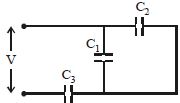
Three capacitors $C_1, C_2$ and $C_3$ are connected as shown in the figure to a battery of $V$ volt. If the capacitor $C_3$ breaks down electrically,the change in total charge on the combination of capacitors is
A
$(C_1 + C_2) V [1 - C_3/(C_1 + C_2 + C_3)]$
B
$(C_1 + C_2) V [1 - (C_1 + C_2)/(C_1 + C_2 + C_3)]$
C
$(C_1 + C_2) V [1 + C_3/(C_1 + C_2 + C_3)]$
D
$(C_1 + C_2) V [1 - C_2/(C_1 + C_2 + C_3)]$
Solution
(A) The equivalent capacitance of the circuit is given by:
$\frac{1}{C_{eq}} = \frac{1}{C_3} + \frac{1}{C_1 + C_2}$
(since $C_1$ and $C_2$ are in parallel,and this combination is in series with $C_3$).
Thus,$\frac{1}{C_{eq}} = \frac{C_1 + C_2 + C_3}{C_3(C_1 + C_2)}$
$\therefore C_{eq} = \frac{C_3(C_1 + C_2)}{C_1 + C_2 + C_3}$
Since $V$ is the voltage of the battery,the initial total charge is $q = C_{eq} V = \frac{C_3(C_1 + C_2) V}{C_1 + C_2 + C_3}$.
If the capacitor $C_3$ breaks down (acts as a short circuit),the effective capacitance becomes $C_{eq}' = C_1 + C_2$.
The new charge is $q' = C_{eq}' V = (C_1 + C_2) V$.
The change in total charge is $\Delta q = q' - q = (C_1 + C_2) V - \frac{C_3(C_1 + C_2) V}{C_1 + C_2 + C_3}$.
Factoring out $(C_1 + C_2) V$,we get:
$\Delta q = (C_1 + C_2) V \left[ 1 - \frac{C_3}{C_1 + C_2 + C_3} \right]$.
$\frac{1}{C_{eq}} = \frac{1}{C_3} + \frac{1}{C_1 + C_2}$
(since $C_1$ and $C_2$ are in parallel,and this combination is in series with $C_3$).
Thus,$\frac{1}{C_{eq}} = \frac{C_1 + C_2 + C_3}{C_3(C_1 + C_2)}$
$\therefore C_{eq} = \frac{C_3(C_1 + C_2)}{C_1 + C_2 + C_3}$
Since $V$ is the voltage of the battery,the initial total charge is $q = C_{eq} V = \frac{C_3(C_1 + C_2) V}{C_1 + C_2 + C_3}$.
If the capacitor $C_3$ breaks down (acts as a short circuit),the effective capacitance becomes $C_{eq}' = C_1 + C_2$.
The new charge is $q' = C_{eq}' V = (C_1 + C_2) V$.
The change in total charge is $\Delta q = q' - q = (C_1 + C_2) V - \frac{C_3(C_1 + C_2) V}{C_1 + C_2 + C_3}$.
Factoring out $(C_1 + C_2) V$,we get:
$\Delta q = (C_1 + C_2) V \left[ 1 - \frac{C_3}{C_1 + C_2 + C_3} \right]$.
0 likesView Solution
34
PhysicsMediumMCQAIIMS · 2010
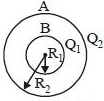
Assertion : Two concentric charged shells are given. The potential difference between the shells depends on the charge of the inner shell.
Reason : Potential due to the charge of the outer shell remains the same at every point inside the sphere.
Reason : Potential due to the charge of the outer shell remains the same at every point inside the sphere.

A
If both Assertion and Reason are correct and Reason is the correct explanation of Assertion.
B
If both Assertion and Reason are correct,but Reason is not the correct explanation of Assertion.
C
If Assertion is correct but Reason is incorrect.
D
If both the Assertion and Reason are incorrect.
Solution
(A) Let the inner shell $B$ have radius $R_1$ and charge $Q_1$,and the outer shell $A$ have radius $R_2$ and charge $Q_2$.
The potential at the surface of the outer shell $A$ is $V_A = \frac{1}{4 \pi \varepsilon_0} \frac{Q_1 + Q_2}{R_2}$.
The potential at the surface of the inner shell $B$ is $V_B = \frac{1}{4 \pi \varepsilon_0} \left( \frac{Q_1}{R_1} + \frac{Q_2}{R_2} \right)$.
The potential difference between the shells is $V_B - V_A = \frac{1}{4 \pi \varepsilon_0} \left( \frac{Q_1}{R_1} + \frac{Q_2}{R_2} - \frac{Q_1 + Q_2}{R_2} \right) = \frac{1}{4 \pi \varepsilon_0} Q_1 \left( \frac{1}{R_1} - \frac{1}{R_2} \right)$.
This shows that the potential difference depends only on the charge of the inner shell $Q_1$. Thus,the Assertion is correct.
The potential due to the charge of the outer shell $Q_2$ at any point inside it (including the surface of the inner shell) is constant and equal to $\frac{1}{4 \pi \varepsilon_0} \frac{Q_2}{R_2}$. Thus,the Reason is also correct and explains why the $Q_2$ term cancels out in the potential difference calculation.
The potential at the surface of the outer shell $A$ is $V_A = \frac{1}{4 \pi \varepsilon_0} \frac{Q_1 + Q_2}{R_2}$.
The potential at the surface of the inner shell $B$ is $V_B = \frac{1}{4 \pi \varepsilon_0} \left( \frac{Q_1}{R_1} + \frac{Q_2}{R_2} \right)$.
The potential difference between the shells is $V_B - V_A = \frac{1}{4 \pi \varepsilon_0} \left( \frac{Q_1}{R_1} + \frac{Q_2}{R_2} - \frac{Q_1 + Q_2}{R_2} \right) = \frac{1}{4 \pi \varepsilon_0} Q_1 \left( \frac{1}{R_1} - \frac{1}{R_2} \right)$.
This shows that the potential difference depends only on the charge of the inner shell $Q_1$. Thus,the Assertion is correct.
The potential due to the charge of the outer shell $Q_2$ at any point inside it (including the surface of the inner shell) is constant and equal to $\frac{1}{4 \pi \varepsilon_0} \frac{Q_2}{R_2}$. Thus,the Reason is also correct and explains why the $Q_2$ term cancels out in the potential difference calculation.
0 likesView Solution
35
PhysicsMediumMCQAIIMS · 2010
$A$ potentiometer is connected between $A$ and $B$ and the balance point is obtained at $203.6 \, cm$. When the end of the potentiometer connected to $B$ is shifted to $C$,then the balance point is obtained at $24.6 \, cm$. If now the potentiometer be connected between $B$ and $C$,the balance point will be at ................. $cm$.

A
$179$
B
$197.2$
C
$212$
D
$228$
Solution
(A) Let $V_{AB}$ be the potential difference between $A$ and $B$ and $V_{BC}$ be the potential difference between $B$ and $C$. Let $k$ be the potential gradient of the potentiometer wire.
When connected between $A$ and $B$,the balance length $l_1 = 203.6 \, cm$. Thus,$V_{AB} = k \cdot l_1 = k \cdot 203.6 \, cm$.
When the end is shifted to $C$,the total potential difference is $V_{AC} = V_{AB} + V_{BC}$. The balance length is $l_2 = 24.6 \, cm$. However,since $V_{AC} > V_{AB}$,the balance length should increase. The problem implies the polarity is reversed or the connection is $V_{AB} - V_{BC}$. Given the balance point is $24.6 \, cm$,we have $V_{AB} - V_{BC} = k \cdot 24.6 \, cm$.
Subtracting the two equations:
$V_{AB} = k \cdot 203.6 \, cm$
$V_{AB} - V_{BC} = k \cdot 24.6 \, cm$
$V_{BC} = k \cdot (203.6 - 24.6) = k \cdot 179.0 \, cm$.
Thus,the balance point for $B$ and $C$ is $179.0 \, cm$.
When connected between $A$ and $B$,the balance length $l_1 = 203.6 \, cm$. Thus,$V_{AB} = k \cdot l_1 = k \cdot 203.6 \, cm$.
When the end is shifted to $C$,the total potential difference is $V_{AC} = V_{AB} + V_{BC}$. The balance length is $l_2 = 24.6 \, cm$. However,since $V_{AC} > V_{AB}$,the balance length should increase. The problem implies the polarity is reversed or the connection is $V_{AB} - V_{BC}$. Given the balance point is $24.6 \, cm$,we have $V_{AB} - V_{BC} = k \cdot 24.6 \, cm$.
Subtracting the two equations:
$V_{AB} = k \cdot 203.6 \, cm$
$V_{AB} - V_{BC} = k \cdot 24.6 \, cm$
$V_{BC} = k \cdot (203.6 - 24.6) = k \cdot 179.0 \, cm$.
Thus,the balance point for $B$ and $C$ is $179.0 \, cm$.
0 likesView Solution
36
PhysicsMediumMCQAIIMS · 2010
Four wires of the same diameter are connected in turn between two points,maintained at a constant potential difference. Their resistivities and lengths are: $\rho$ and $L$ (wire $1$),$1.2\rho$ and $1.2L$ (wire $2$),$0.9\rho$ and $0.9L$ (wire $3$),and $\rho$ and $1.5L$ (wire $4$). Rank the wires according to the rates at which energy is dissipated as heat,greatest first.
A
$4 > 3 > 1 > 2$
B
$4 > 2 > 1 > 3$
C
$1 > 2 > 3 > 4$
D
$3 > 1 > 2 > 4$
Solution
(D) The resistance of a wire is given by $R = \frac{\rho L}{A}$. Since the diameter is the same for all wires,the cross-sectional area $A$ is constant.
Calculating resistance for each wire:
$R_1 = \frac{\rho L}{A}$
$R_2 = \frac{(1.2\rho)(1.2L)}{A} = 1.44 \frac{\rho L}{A}$
$R_3 = \frac{(0.9\rho)(0.9L)}{A} = 0.81 \frac{\rho L}{A}$
$R_4 = \frac{\rho(1.5L)}{A} = 1.5 \frac{\rho L}{A}$
Comparing the resistances: $R_3 < R_1 < R_2 < R_4$.
The rate of energy dissipation (power) for a constant potential difference $V$ is given by $P = \frac{V^2}{R}$.
Since $P \propto \frac{1}{R}$,the wire with the smallest resistance will have the greatest power dissipation.
Therefore,the order of power dissipation from greatest to least is: $P_3 > P_1 > P_2 > P_4$.
Calculating resistance for each wire:
$R_1 = \frac{\rho L}{A}$
$R_2 = \frac{(1.2\rho)(1.2L)}{A} = 1.44 \frac{\rho L}{A}$
$R_3 = \frac{(0.9\rho)(0.9L)}{A} = 0.81 \frac{\rho L}{A}$
$R_4 = \frac{\rho(1.5L)}{A} = 1.5 \frac{\rho L}{A}$
Comparing the resistances: $R_3 < R_1 < R_2 < R_4$.
The rate of energy dissipation (power) for a constant potential difference $V$ is given by $P = \frac{V^2}{R}$.
Since $P \propto \frac{1}{R}$,the wire with the smallest resistance will have the greatest power dissipation.
Therefore,the order of power dissipation from greatest to least is: $P_3 > P_1 > P_2 > P_4$.
0 likesView Solution
37
PhysicsMediumMCQAIIMS · 2010
The resistance of a galvanometer is $50\,\Omega$ and the current required to give full-scale deflection is $100\,\mu A$. In order to convert it into an ammeter for reading up to $10\,A$,it is necessary to put a resistance of:
A
$3.5 \times 10^{-4}\,\Omega$
B
$10 \times 10^{-4}\,\Omega$
C
$2.5 \times 10^{-4}\,\Omega$
D
$5 \times 10^{-4}\,\Omega$
Solution
(D) Given: Galvanometer resistance $G = 50\,\Omega$,full-scale deflection current $I_G = 100\,\mu A = 100 \times 10^{-6}\,A$,and the desired range $I = 10\,A$.
To convert a galvanometer into an ammeter,a shunt resistance $S$ must be connected in parallel with the galvanometer.
The formula for shunt resistance is $S = \left( \frac{I_G}{I - I_G} \right) G$.
Substituting the values: $S = \left( \frac{100 \times 10^{-6}}{10 - 100 \times 10^{-6}} \right) \times 50$.
Since $100 \times 10^{-6} = 10^{-4}$ is very small compared to $10$,the denominator $10 - 10^{-4} \approx 10$.
Thus,$S \approx \left( \frac{10^{-4}}{10} \right) \times 50 = 10^{-5} \times 50 = 5 \times 10^{-4}\,\Omega$.
To convert a galvanometer into an ammeter,a shunt resistance $S$ must be connected in parallel with the galvanometer.
The formula for shunt resistance is $S = \left( \frac{I_G}{I - I_G} \right) G$.
Substituting the values: $S = \left( \frac{100 \times 10^{-6}}{10 - 100 \times 10^{-6}} \right) \times 50$.
Since $100 \times 10^{-6} = 10^{-4}$ is very small compared to $10$,the denominator $10 - 10^{-4} \approx 10$.
Thus,$S \approx \left( \frac{10^{-4}}{10} \right) \times 50 = 10^{-5} \times 50 = 5 \times 10^{-4}\,\Omega$.
0 likesView Solution
38
PhysicsEasyMCQAIIMS · 2010
An electron moves at right angles to a magnetic field of $1.5 \times 10^{-2} \, T$ with a speed of $6 \times 10^7 \, m/s$. If the specific charge of the electron is $1.7 \times 10^{11} \, C/kg$,the radius of the circular path will be ...... $cm$.
A
$3.31$
B
$4.31$
C
$1.31$
D
$2.35$
Solution
(D) Given:
Magnetic field $B = 1.5 \times 10^{-2} \, T$
Speed $v = 6 \times 10^7 \, m/s$
Specific charge $\frac{e}{m} = 1.7 \times 10^{11} \, C/kg$
Angle $\theta = 90^{\circ}$ (since it moves at right angles),so $\sin \theta = 1$.
The radius $r$ of the circular path of a charged particle in a magnetic field is given by the formula:
$r = \frac{mv}{qB}$
Since the specific charge is $\frac{q}{m} = 1.7 \times 10^{11} \, C/kg$,we can write the radius as:
$r = \frac{v}{B(q/m)}$
Substituting the values:
$r = \frac{6 \times 10^7}{(1.5 \times 10^{-2}) \times (1.7 \times 10^{11})}$
$r = \frac{6 \times 10^7}{2.55 \times 10^9}$
$r \approx 2.35 \times 10^{-2} \, m$
Converting to centimeters:
$r = 2.35 \, cm$.
Magnetic field $B = 1.5 \times 10^{-2} \, T$
Speed $v = 6 \times 10^7 \, m/s$
Specific charge $\frac{e}{m} = 1.7 \times 10^{11} \, C/kg$
Angle $\theta = 90^{\circ}$ (since it moves at right angles),so $\sin \theta = 1$.
The radius $r$ of the circular path of a charged particle in a magnetic field is given by the formula:
$r = \frac{mv}{qB}$
Since the specific charge is $\frac{q}{m} = 1.7 \times 10^{11} \, C/kg$,we can write the radius as:
$r = \frac{v}{B(q/m)}$
Substituting the values:
$r = \frac{6 \times 10^7}{(1.5 \times 10^{-2}) \times (1.7 \times 10^{11})}$
$r = \frac{6 \times 10^7}{2.55 \times 10^9}$
$r \approx 2.35 \times 10^{-2} \, m$
Converting to centimeters:
$r = 2.35 \, cm$.
0 likesView Solution
39
PhysicsEasyMCQAIIMS · 2010
Assertion : If the current in a solenoid is reversed in direction while keeping the same magnitude,the magnetic field energy stored in the solenoid remains unchanged.
Reason : Magnetic field energy density is proportional to the magnetic field.
Reason : Magnetic field energy density is proportional to the magnetic field.
A
If both Assertion and Reason are correct and Reason is the correct explanation of Assertion.
B
If both Assertion and Reason are correct,but Reason is not the correct explanation of Assertion.
C
If Assertion is correct but Reason is incorrect.
D
If both the Assertion and Reason are incorrect.
Solution
(C) The magnetic field $B$ produced by a solenoid is given by $B = \mu_0 n I$. When the current $I$ is reversed,the direction of the magnetic field $B$ is reversed,but its magnitude remains the same.
The magnetic field energy density $u$ is given by the formula $u = \frac{B^2}{2\mu_0}$.
Since the energy density depends on the square of the magnetic field magnitude $(B^2)$,the sign of $B$ does not affect the energy density.
Therefore,the total magnetic field energy stored in the solenoid,$U = u \times V$ (where $V$ is the volume),remains unchanged.
However,the Reason states that the energy density is proportional to the magnetic field,which is incorrect because it is proportional to the square of the magnetic field $(B^2)$.
Thus,the Assertion is correct,but the Reason is incorrect.
The magnetic field energy density $u$ is given by the formula $u = \frac{B^2}{2\mu_0}$.
Since the energy density depends on the square of the magnetic field magnitude $(B^2)$,the sign of $B$ does not affect the energy density.
Therefore,the total magnetic field energy stored in the solenoid,$U = u \times V$ (where $V$ is the volume),remains unchanged.
However,the Reason states that the energy density is proportional to the magnetic field,which is incorrect because it is proportional to the square of the magnetic field $(B^2)$.
Thus,the Assertion is correct,but the Reason is incorrect.
0 likesView Solution
40
PhysicsEasyMCQAIIMS · 2010
Which of the following conclusions can be drawn from the result $\oint \vec{B} \cdot d\vec{A} = 0$?
A
Magnetic field is zero everywhere
B
Magnetic monopole cannot exist
C
Magnetic lines of force do not intersect each other
D
$A$ current produces magnetic field
Solution
(B) The equation $\oint \vec{B} \cdot d\vec{A} = 0$ represents Gauss's Law for magnetism.
It states that the net magnetic flux through any closed surface is always zero.
This implies that there are no isolated magnetic charges (magnetic monopoles) in nature.
Magnetic field lines always form closed loops,meaning every north pole must be accompanied by a south pole.
It states that the net magnetic flux through any closed surface is always zero.
This implies that there are no isolated magnetic charges (magnetic monopoles) in nature.
Magnetic field lines always form closed loops,meaning every north pole must be accompanied by a south pole.
0 likesView Solution
41
PhysicsMediumMCQAIIMS · 2010
$A$ wheel with ten metallic spokes,each $0.50\,m$ long,is rotated with a speed of $120\,rev/min$ in a plane normal to the Earth's magnetic field at the place. If the magnitude of the field is $0.40\,G$,the induced $emf$ between the axle and the rim of the wheel is equal to:
A
$1.256 \times 10^{-3}\,V$
B
$6.28 \times 10^{-4}\,V$
C
$1.256 \times 10^{-4}\,V$
D
$6.28 \times 10^{-5}\,V$
Solution
(B) The induced $emf$ across a rotating spoke is given by the formula $e = \frac{1}{2} B \omega \ell^2$.
Given:
$B = 0.40\,G = 0.40 \times 10^{-4}\,T$
$l = 0.50\,m$
$f = 120\,rev/min = \frac{120}{60}\,rev/s = 2\,Hz$
Angular velocity $\omega = 2 \pi f = 2 \times \pi \times 2 = 4\pi\,rad/s$.
Substituting the values:
$e = \frac{1}{2} \times (0.40 \times 10^{-4}) \times (4\pi) \times (0.50)^2$
$e = \frac{1}{2} \times 0.40 \times 10^{-4} \times 4 \times 3.14 \times 0.25$
$e = 0.20 \times 10^{-4} \times 4 \times 3.14 \times 0.25$
$e = 0.628 \times 10^{-4}\,V$.
Given:
$B = 0.40\,G = 0.40 \times 10^{-4}\,T$
$l = 0.50\,m$
$f = 120\,rev/min = \frac{120}{60}\,rev/s = 2\,Hz$
Angular velocity $\omega = 2 \pi f = 2 \times \pi \times 2 = 4\pi\,rad/s$.
Substituting the values:
$e = \frac{1}{2} \times (0.40 \times 10^{-4}) \times (4\pi) \times (0.50)^2$
$e = \frac{1}{2} \times 0.40 \times 10^{-4} \times 4 \times 3.14 \times 0.25$
$e = 0.20 \times 10^{-4} \times 4 \times 3.14 \times 0.25$
$e = 0.628 \times 10^{-4}\,V$.
0 likesView Solution
42
PhysicsDifficultMCQAIIMS · 2010
$A$ coil has an inductance of $0.7 \, H$ and is joined in series with a resistance of $220 \, \Omega$. When an alternating $emf$ of $220 \, V$ at $50 \, Hz$ is applied to it,the phase angle by which the current lags behind the applied $emf$ and the wattless component of the current in the circuit are respectively:
A
$30^o, \, 1 \, A$
B
$45^o, \, 0.5 \, A$
C
$60^o, \, 1.5 \, A$
D
none of these
Solution
(B) Given: $L = 0.7 \, H$,$R = 220 \, \Omega$,$V_{rms} = 220 \, V$,$f = 50 \, Hz$.
First,calculate the inductive reactance $X_L$:
$X_L = 2 \pi f L = 2 \times \frac{22}{7} \times 50 \times 0.7 = 220 \, \Omega$.
Phase angle $\phi$ is given by:
$\tan \phi = \frac{X_L}{R} = \frac{220}{220} = 1 \implies \phi = 45^o$.
The total impedance $Z$ is:
$Z = \sqrt{R^2 + X_L^2} = \sqrt{220^2 + 220^2} = 220\sqrt{2} \, \Omega$.
The $rms$ current $I_{rms}$ is:
$I_{rms} = \frac{V_{rms}}{Z} = \frac{220}{220\sqrt{2}} = \frac{1}{\sqrt{2}} \, A$.
The wattless component of current is $I_{rms} \sin \phi$:
$I_{wattless} = I_{rms} \sin 45^o = \frac{1}{\sqrt{2}} \times \frac{1}{\sqrt{2}} = 0.5 \, A$.
Thus,the phase angle is $45^o$ and the wattless component is $0.5 \, A$.
First,calculate the inductive reactance $X_L$:
$X_L = 2 \pi f L = 2 \times \frac{22}{7} \times 50 \times 0.7 = 220 \, \Omega$.
Phase angle $\phi$ is given by:
$\tan \phi = \frac{X_L}{R} = \frac{220}{220} = 1 \implies \phi = 45^o$.
The total impedance $Z$ is:
$Z = \sqrt{R^2 + X_L^2} = \sqrt{220^2 + 220^2} = 220\sqrt{2} \, \Omega$.
The $rms$ current $I_{rms}$ is:
$I_{rms} = \frac{V_{rms}}{Z} = \frac{220}{220\sqrt{2}} = \frac{1}{\sqrt{2}} \, A$.
The wattless component of current is $I_{rms} \sin \phi$:
$I_{wattless} = I_{rms} \sin 45^o = \frac{1}{\sqrt{2}} \times \frac{1}{\sqrt{2}} = 0.5 \, A$.
Thus,the phase angle is $45^o$ and the wattless component is $0.5 \, A$.
0 likesView Solution
43
PhysicsEasyMCQAIIMS · 2010
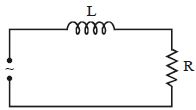
An inductor and a resistor in series are connected to an $A.C.$ supply of variable frequency. As the frequency of the source is increased,the phase angle between current and the potential difference across $L$ will
A
first increase and then decrease
B
first decrease and then increase
C
go on decreasing
D
go on increasing
Solution
(D) In a pure inductor,the current lags behind the potential difference across the inductor by a phase angle of $\pi/2$ radians (or $90^{\circ}$).
This phase relationship is independent of the frequency of the $A.C.$ source.
Therefore,the phase angle between the current and the potential difference across the inductor $L$ remains constant at $90^{\circ}$ regardless of the change in frequency.
However,if the question refers to the phase angle $\phi$ of the entire $LR$ series circuit,it is given by $\tan \phi = \frac{X_L}{R} = \frac{\omega L}{R} = \frac{2\pi f L}{R}$.
As the frequency $f$ increases,$\tan \phi$ increases,and thus the phase angle $\phi$ between the source voltage and current increases.
Given the specific phrasing 'phase angle between current and the potential difference across $L$',the answer is that it remains constant. Since this is not an option,the question likely intends to ask for the phase angle of the circuit,which increases as frequency increases.
This phase relationship is independent of the frequency of the $A.C.$ source.
Therefore,the phase angle between the current and the potential difference across the inductor $L$ remains constant at $90^{\circ}$ regardless of the change in frequency.
However,if the question refers to the phase angle $\phi$ of the entire $LR$ series circuit,it is given by $\tan \phi = \frac{X_L}{R} = \frac{\omega L}{R} = \frac{2\pi f L}{R}$.
As the frequency $f$ increases,$\tan \phi$ increases,and thus the phase angle $\phi$ between the source voltage and current increases.
Given the specific phrasing 'phase angle between current and the potential difference across $L$',the answer is that it remains constant. Since this is not an option,the question likely intends to ask for the phase angle of the circuit,which increases as frequency increases.
0 likesView Solution
44
PhysicsMediumMCQAIIMS · 2010
In an $AC$ circuit,the voltage and current are described by $V = 200 \sin(314t - \frac{\pi}{6}) \text{ V}$ and $i = 50 \sin(314t + \frac{\pi}{6}) \text{ mA}$ respectively. The average power dissipated in the circuit is $...... \text{ W}$.
A
$2.5$
B
$5$
C
$10$
D
$50$
Solution
(A) The given equations are $V = V_0 \sin(\omega t + \phi_1)$ and $i = i_0 \sin(\omega t + \phi_2)$.
Here,$V_0 = 200 \text{ V}$,$i_0 = 50 \text{ mA} = 50 \times 10^{-3} \text{ A} = 0.05 \text{ A}$.
The phase difference $\phi = \phi_1 - \phi_2 = -\frac{\pi}{6} - \frac{\pi}{6} = -\frac{\pi}{3}$.
The average power dissipated is given by $P = V_{rms} I_{rms} \cos \phi = \frac{V_0}{\sqrt{2}} \frac{i_0}{\sqrt{2}} \cos \phi = \frac{V_0 i_0}{2} \cos \phi$.
Substituting the values: $P = \frac{200 \times 0.05}{2} \cos(-\frac{\pi}{3}) = \frac{10}{2} \times \frac{1}{2} = 5 \times 0.5 = 2.5 \text{ W}$.
Here,$V_0 = 200 \text{ V}$,$i_0 = 50 \text{ mA} = 50 \times 10^{-3} \text{ A} = 0.05 \text{ A}$.
The phase difference $\phi = \phi_1 - \phi_2 = -\frac{\pi}{6} - \frac{\pi}{6} = -\frac{\pi}{3}$.
The average power dissipated is given by $P = V_{rms} I_{rms} \cos \phi = \frac{V_0}{\sqrt{2}} \frac{i_0}{\sqrt{2}} \cos \phi = \frac{V_0 i_0}{2} \cos \phi$.
Substituting the values: $P = \frac{200 \times 0.05}{2} \cos(-\frac{\pi}{3}) = \frac{10}{2} \times \frac{1}{2} = 5 \times 0.5 = 2.5 \text{ W}$.
0 likesView Solution
45
PhysicsEasyMCQAIIMS · 2010
Assertion : The resistance offered by an inductor in a $d.c.$ circuit is always constant.
Reason : The resistance of an inductor in a steady state is non-zero.
Reason : The resistance of an inductor in a steady state is non-zero.
A
If both Assertion and Reason are correct and the Reason is a correct explanation of the Assertion.
B
If both Assertion and Reason are correct but Reason is not a correct explanation of the Assertion.
C
If the Assertion is correct but Reason is incorrect.
D
If both the Assertion and Reason are incorrect.
Solution
(D) An inductor in a $d.c.$ circuit behaves as an open circuit at $t = 0$ (infinite resistance) and as a short circuit at steady state ($t \to \infty$,zero resistance).
Since the resistance changes from infinity to zero,the assertion that it is 'always constant' is incorrect.
In a steady state,an ideal inductor has zero resistance,so the statement that it is 'non-zero' is also incorrect.
Therefore,both the Assertion and the Reason are incorrect.
Since the resistance changes from infinity to zero,the assertion that it is 'always constant' is incorrect.
In a steady state,an ideal inductor has zero resistance,so the statement that it is 'non-zero' is also incorrect.
Therefore,both the Assertion and the Reason are incorrect.
0 likesView Solution
46
PhysicsMediumMCQAIIMS · 2010
The focal length of the objective and eyepiece of a telescope are respectively $200 \, cm$ and $5 \, cm$. The maximum magnifying power of the telescope will be
A
$-100$
B
$-60$
C
$-48$
D
$-40$
Solution
(C) The magnifying power $M$ of a telescope in normal adjustment is given by $M = -\frac{f_o}{f_e}$.
However,for maximum magnifying power,the image is formed at the least distance of distinct vision $(d = 25 \, cm)$.
The formula for maximum magnifying power is $M = -\frac{f_o}{f_e} \left(1 + \frac{f_e}{d}\right)$.
Given $f_o = 200 \, cm$,$f_e = 5 \, cm$,and $d = 25 \, cm$.
Substituting the values: $M = -\frac{200}{5} \left(1 + \frac{5}{25}\right)$.
$M = -40 \left(1 + 0.2\right) = -40 \times 1.2$.
$M = -48$.
However,for maximum magnifying power,the image is formed at the least distance of distinct vision $(d = 25 \, cm)$.
The formula for maximum magnifying power is $M = -\frac{f_o}{f_e} \left(1 + \frac{f_e}{d}\right)$.
Given $f_o = 200 \, cm$,$f_e = 5 \, cm$,and $d = 25 \, cm$.
Substituting the values: $M = -\frac{200}{5} \left(1 + \frac{5}{25}\right)$.
$M = -40 \left(1 + 0.2\right) = -40 \times 1.2$.
$M = -48$.
0 likesView Solution
47
PhysicsEasyMCQAIIMS · 2010
Assertion : Position of image approaches focus of a lens,only when object approaches infinity.
Reason : Paraxial rays incident parallel to principal axis intersect at the focus after refraction from lens.
Reason : Paraxial rays incident parallel to principal axis intersect at the focus after refraction from lens.
A
If both Assertion and Reason are correct and the Reason is a correct explanation of the Assertion.
B
If both Assertion and Reason are correct but Reason is not a correct explanation of the Assertion.
C
If the Assertion is correct but Reason is incorrect.
D
If both the Assertion and Reason are incorrect.
Solution
(A) The lens formula is given by $\frac{1}{f} = \frac{1}{v} - \frac{1}{u}$.
As the object distance $u$ approaches infinity $(\infty)$,the term $\frac{1}{u}$ approaches $0$.
Substituting this into the lens formula,we get $\frac{1}{v} = \frac{1}{f}$,which implies $v = f$.
Thus,the image position approaches the focus when the object is at infinity.
This is a fundamental property of lenses,and the reason provided correctly explains that rays parallel to the principal axis (which originate from an object at infinity) converge at the focus after refraction.
Therefore,both the Assertion and the Reason are correct,and the Reason is the correct explanation of the Assertion.
As the object distance $u$ approaches infinity $(\infty)$,the term $\frac{1}{u}$ approaches $0$.
Substituting this into the lens formula,we get $\frac{1}{v} = \frac{1}{f}$,which implies $v = f$.
Thus,the image position approaches the focus when the object is at infinity.
This is a fundamental property of lenses,and the reason provided correctly explains that rays parallel to the principal axis (which originate from an object at infinity) converge at the focus after refraction.
Therefore,both the Assertion and the Reason are correct,and the Reason is the correct explanation of the Assertion.
0 likesView Solution
48
PhysicsMediumMCQAIIMS · 2010
The energy of a photon of light with wavelength $5000\,\mathring{A}$ is approximately $2.5\,\text{eV}$. In this way,the energy of an $X$-ray photon with wavelength $1\,\mathring{A}$ would be:
A
$12500\,\text{eV}$
B
$2.5 \times 5000\,\text{eV}$
C
$2.5 \times 500\,\text{eV}$
D
$2.5 \times 1000\,\text{eV}$
Solution
(B) The energy of a photon is given by the formula $E = \frac{hc}{\lambda}$.
For the first photon:
$E_1 = 2.5\,\text{eV}$ and $\lambda_1 = 5000\,\mathring{A}$.
So,$2.5 = \frac{hc}{5000\,\mathring{A}} \implies hc = 2.5 \times 5000\,\text{eV} \cdot \mathring{A}$.
For the $X$-ray photon:
$E_2 = \frac{hc}{\lambda_2}$ where $\lambda_2 = 1\,\mathring{A}$.
Substituting the value of $hc$:
$E_2 = \frac{2.5 \times 5000}{1} = 12500\,\text{eV}$.
Thus,the energy is $2.5 \times 5000\,\text{eV}$.
For the first photon:
$E_1 = 2.5\,\text{eV}$ and $\lambda_1 = 5000\,\mathring{A}$.
So,$2.5 = \frac{hc}{5000\,\mathring{A}} \implies hc = 2.5 \times 5000\,\text{eV} \cdot \mathring{A}$.
For the $X$-ray photon:
$E_2 = \frac{hc}{\lambda_2}$ where $\lambda_2 = 1\,\mathring{A}$.
Substituting the value of $hc$:
$E_2 = \frac{2.5 \times 5000}{1} = 12500\,\text{eV}$.
Thus,the energy is $2.5 \times 5000\,\text{eV}$.
0 likesView Solution
49
PhysicsEasyMCQAIIMS · 2010
Assertion : Soft and hard $X-$ rays differ in frequency as well as velocity.
Reason : The penetrating power of hard $X-$ rays is more than the penetrating power of soft $X-$ rays.
Reason : The penetrating power of hard $X-$ rays is more than the penetrating power of soft $X-$ rays.
A
If both Assertion and Reason are correct and the Reason is a correct explanation of the Assertion.
B
If both Assertion and Reason are correct but Reason is not a correct explanation of the Assertion.
C
If the Assertion is correct but Reason is incorrect.
D
If both the Assertion and Reason are incorrect.
Solution
(D) The Assertion is incorrect because while soft and hard $X-$ rays differ in frequency,they both travel with the same velocity,which is the speed of light $(c \approx 3 \times 10^8 \ m/s)$ in a vacuum.
The Reason is correct because hard $X-$ rays have higher energy and frequency,which gives them greater penetrating power compared to soft $X-$ rays.
Therefore,the Assertion is incorrect and the Reason is correct.
The Reason is correct because hard $X-$ rays have higher energy and frequency,which gives them greater penetrating power compared to soft $X-$ rays.
Therefore,the Assertion is incorrect and the Reason is correct.
0 likesView Solution
50
PhysicsEasyMCQAIIMS · 2010
Assertion: In a photoemissive cell,an inert gas is used.
Reason: An inert gas in the photoemissive cell provides a greater current.
Reason: An inert gas in the photoemissive cell provides a greater current.
A
If both Assertion and Reason are correct and the Reason is a correct explanation of the Assertion.
B
If both Assertion and Reason are correct but Reason is not a correct explanation of the Assertion.
C
If the Assertion is correct but Reason is incorrect.
D
If both the Assertion and Reason are incorrect.
Solution
(A) photoemissive cell consists of two electrodes enclosed in a glass bulb,which may be evacuated or filled with an inert gas at low pressure.
When an inert gas is present,the photoelectrons emitted from the cathode collide with the gas atoms,causing ionization. This process increases the number of charge carriers,resulting in a greater current compared to an evacuated cell.
Therefore,both the Assertion and the Reason are correct,and the Reason correctly explains why an inert gas is used in such cells.
When an inert gas is present,the photoelectrons emitted from the cathode collide with the gas atoms,causing ionization. This process increases the number of charge carriers,resulting in a greater current compared to an evacuated cell.
Therefore,both the Assertion and the Reason are correct,and the Reason correctly explains why an inert gas is used in such cells.
0 likesView Solution
51
PhysicsMediumMCQAIIMS · 2010
The half-life of a radioactive substance against $\alpha$-decay is $1.2 \times 10^7 \, s$. What is the decay rate for $4.0 \times 10^{15}$ atoms of the substance?
A
$4.6 \times 10^{12} \, \text{atoms/s}$
B
$2.3 \times 10^{11} \, \text{atoms/s}$
C
$4.6 \times 10^{10} \, \text{atoms/s}$
D
$2.3 \times 10^{8} \, \text{atoms/s}$
Solution
(D) The decay rate (activity) is given by the formula: $\frac{dN}{dt} = \lambda N$.
First, calculate the decay constant $\lambda$ using the half-life $T_{1/2} = 1.2 \times 10^7 \, s$:
$\lambda = \frac{0.693}{T_{1/2}} = \frac{0.693}{1.2 \times 10^7} \, s^{-1}$.
Now, substitute the values of $\lambda$ and $N = 4.0 \times 10^{15}$ atoms into the decay rate formula:
$\frac{dN}{dt} = \left( \frac{0.693}{1.2 \times 10^7} \right) \times (4.0 \times 10^{15})$
$\frac{dN}{dt} = \frac{0.693 \times 4.0}{1.2} \times 10^{15-7}$
$\frac{dN}{dt} = \frac{2.772}{1.2} \times 10^8$
$\frac{dN}{dt} = 2.31 \times 10^8 \, \text{atoms/s}$.
Rounding to the appropriate significant figures, the decay rate is $2.3 \times 10^8 \, \text{atoms/s}$.
First, calculate the decay constant $\lambda$ using the half-life $T_{1/2} = 1.2 \times 10^7 \, s$:
$\lambda = \frac{0.693}{T_{1/2}} = \frac{0.693}{1.2 \times 10^7} \, s^{-1}$.
Now, substitute the values of $\lambda$ and $N = 4.0 \times 10^{15}$ atoms into the decay rate formula:
$\frac{dN}{dt} = \left( \frac{0.693}{1.2 \times 10^7} \right) \times (4.0 \times 10^{15})$
$\frac{dN}{dt} = \frac{0.693 \times 4.0}{1.2} \times 10^{15-7}$
$\frac{dN}{dt} = \frac{2.772}{1.2} \times 10^8$
$\frac{dN}{dt} = 2.31 \times 10^8 \, \text{atoms/s}$.
Rounding to the appropriate significant figures, the decay rate is $2.3 \times 10^8 \, \text{atoms/s}$.
0 likesView Solution
52
PhysicsMediumMCQAIIMS · 2010
Mobilities of electrons and holes in a sample of intrinsic $Ge$ at room temperature are $0.35 \, m^2/V-s$ and $0.18 \, m^2/V-s$ respectively. If the electron and hole densities are each equal to $2.5 \times 10^{19} \, /m^3$,the $Ge$ conductivity will be.....$S/m$ (in $.12$)
A
$3$
B
$2$
C
$1$
D
$4$
Solution
(B) The conductivity $\sigma$ of an intrinsic semiconductor is given by the formula:
$\sigma = e(n_e \mu_e + n_h \mu_h)$
Given:
$e = 1.6 \times 10^{-19} \, C$
$n_e = n_h = 2.5 \times 10^{19} \, /m^3$
$\mu_e = 0.35 \, m^2/V-s$
$\mu_h = 0.18 \, m^2/V-s$
Substituting the values:
$\sigma = 1.6 \times 10^{-19} \times (2.5 \times 10^{19} \times 0.35 + 2.5 \times 10^{19} \times 0.18)$
$\sigma = 1.6 \times 10^{-19} \times 2.5 \times 10^{19} \times (0.35 + 0.18)$
$\sigma = 1.6 \times 2.5 \times 0.53$
$\sigma = 4 \times 0.53 = 2.12 \, S/m$
$\sigma = e(n_e \mu_e + n_h \mu_h)$
Given:
$e = 1.6 \times 10^{-19} \, C$
$n_e = n_h = 2.5 \times 10^{19} \, /m^3$
$\mu_e = 0.35 \, m^2/V-s$
$\mu_h = 0.18 \, m^2/V-s$
Substituting the values:
$\sigma = 1.6 \times 10^{-19} \times (2.5 \times 10^{19} \times 0.35 + 2.5 \times 10^{19} \times 0.18)$
$\sigma = 1.6 \times 10^{-19} \times 2.5 \times 10^{19} \times (0.35 + 0.18)$
$\sigma = 1.6 \times 2.5 \times 0.53$
$\sigma = 4 \times 0.53 = 2.12 \, S/m$
0 likesView Solution
53
PhysicsMediumMCQAIIMS · 2010
An $LED$ (Light Emitting Diode) is constructed from a $p-n$ junction based on a certain $Ga-As-P$ semiconducting material whose energy gap is $1.9\, eV$. What is the wavelength of the emitted light?
A
$650\, nm$
B
$65\, \mathring{A}$
C
$800\, nm$
D
$8000\, \mathring{A}$
Solution
(A) The wavelength $\lambda$ of the emitted light is given by the relation:
$\lambda = \frac{hc}{E_g}$
where $h = 6.63 \times 10^{-34} \, J \cdot s$ is Planck's constant,$c = 3 \times 10^8 \, m/s$ is the speed of light,and $E_g$ is the energy gap.
Given $E_g = 1.9 \, eV = 1.9 \times 1.6 \times 10^{-19} \, J$.
Substituting the values:
$\lambda = \frac{6.63 \times 10^{-34} \times 3 \times 10^8}{1.9 \times 1.6 \times 10^{-19}} \, m$
$\lambda \approx \frac{19.89 \times 10^{-26}}{3.04 \times 10^{-19}} \, m$
$\lambda \approx 6.54 \times 10^{-7} \, m$
$\lambda \approx 654 \times 10^{-9} \, m = 654 \, nm$.
Rounding to the nearest provided option,the wavelength is $650 \, nm$.
$\lambda = \frac{hc}{E_g}$
where $h = 6.63 \times 10^{-34} \, J \cdot s$ is Planck's constant,$c = 3 \times 10^8 \, m/s$ is the speed of light,and $E_g$ is the energy gap.
Given $E_g = 1.9 \, eV = 1.9 \times 1.6 \times 10^{-19} \, J$.
Substituting the values:
$\lambda = \frac{6.63 \times 10^{-34} \times 3 \times 10^8}{1.9 \times 1.6 \times 10^{-19}} \, m$
$\lambda \approx \frac{19.89 \times 10^{-26}}{3.04 \times 10^{-19}} \, m$
$\lambda \approx 6.54 \times 10^{-7} \, m$
$\lambda \approx 654 \times 10^{-9} \, m = 654 \, nm$.
Rounding to the nearest provided option,the wavelength is $650 \, nm$.
0 likesView Solution
54
PhysicsMediumMCQAIIMS · 2010
In an $n-p-n$ transistor circuit,the collector current is $10 \, mA$. If $90 \%$ of the electrons reach the collector,then the emitter current will be:
A
$1 \, mA$
B
$0.1 \, mA$
C
$2 \, mA$
D
nearly $11 \, mA$
Solution
(D) Given that the collector current $I_{c} = 10 \, mA$.
Since $90 \%$ of the electrons emitted from the emitter reach the collector,we have the relation $I_{c} = 0.90 \times I_{e}$.
To find the emitter current $I_{e}$,we rearrange the formula:
$I_{e} = \frac{I_{c}}{0.90} = \frac{10 \, mA}{0.9} = \frac{100}{9} \, mA$.
Calculating this value,$I_{e} \approx 11.11 \, mA$.
Therefore,the emitter current is nearly $11 \, mA$.
Since $90 \%$ of the electrons emitted from the emitter reach the collector,we have the relation $I_{c} = 0.90 \times I_{e}$.
To find the emitter current $I_{e}$,we rearrange the formula:
$I_{e} = \frac{I_{c}}{0.90} = \frac{10 \, mA}{0.9} = \frac{100}{9} \, mA$.
Calculating this value,$I_{e} \approx 11.11 \, mA$.
Therefore,the emitter current is nearly $11 \, mA$.
0 likesView Solution
55
PhysicsMediumMCQAIIMS · 2010
Communication on ground is through electromagnetic waves of wavelength
A
larger than $600\, m$
B
between $200\, m$ and $600\, m$
C
between $1\, m$ and $5\, m$
D
between $10^{-3}\, m$ and $0.1\, m$
Solution
(D) Ground wave propagation is a method of radio wave propagation that uses the area between the surface of the Earth and the ionosphere for waveguide.
Ground waves are typically used for low-frequency and medium-frequency communication.
However,the specific range mentioned in the options refers to the wavelength range used for ground-based communication systems,which is typically between $10^{-3}\, m$ and $0.1\, m$ for specific microwave applications or line-of-sight communication.
Ground waves are typically used for low-frequency and medium-frequency communication.
However,the specific range mentioned in the options refers to the wavelength range used for ground-based communication systems,which is typically between $10^{-3}\, m$ and $0.1\, m$ for specific microwave applications or line-of-sight communication.
0 likesView Solution
Vedclass Products
For Students
Vedclass Test Series
Mock tests in real AIIMS style covering Physics with performance analysis. 5-day free trial.
Start Free TrialFor Teachers
Exam Paper Generator
Generate Set A/B/C/D Physics papers from 7.5L+ questions in 2 minutes. 3 chapters free.
Try FreeFor Institutes
Online Exam Module
Run live AIIMS mock exams with unlimited students, 360° analytics & white-label branding.
See DemoFrequently Asked Questions
How many Physics questions are in AIIMS 2010?
There are 55 Physics questions from the AIIMS 2010 paper on Vedclass, each with a detailed step-by-step solution in English.
Are AIIMS 2010 Physics solutions available in English?
Yes. All solutions on this page are in English. You can also switch to English or Hindi using the language buttons above the questions.
Can I practice AIIMS 2010 Physics as a timed test?
Yes. Use the Vedclass Test Series to attempt a full AIIMS mock test covering Physics with time limits and instant score analysis.
Can teachers create Physics papers from AIIMS previous year questions?
Yes. The Vedclass Exam Paper Generator lets teachers mix AIIMS Physics questions and generate Set A/B/C/D papers in minutes.
For Teachers & Institutes
Build a Custom Physics Paper
Pick AIIMS 2010 Physics questions, set difficulty, and generate Set A/B/C/D in 2 minutes.