
PhysicsQ1–8 of 8 questions
Page 1 of 1 · English
1
PhysicsEasyMCQAIIMS · 1987
Two vectors $\vec{A}$ and $\vec{B}$ are at right angles to each other,when
A
$\vec{A} + \vec{B} = 0$
B
$\vec{A} - \vec{B} = 0$
C
$\vec{A} \times \vec{B} = 0$
D
$\vec{A} \cdot \vec{B} = 0$
Solution
(D) The dot product of two vectors $\vec{A}$ and $\vec{B}$ is defined as $\vec{A} \cdot \vec{B} = |\vec{A}| |\vec{B}| \cos \theta$,where $\theta$ is the angle between the vectors.
If the vectors are at right angles,then $\theta = 90^\circ$.
Substituting this into the formula,we get $\vec{A} \cdot \vec{B} = |\vec{A}| |\vec{B}| \cos 90^\circ$.
Since $\cos 90^\circ = 0$,the dot product $\vec{A} \cdot \vec{B} = 0$.
If the vectors are at right angles,then $\theta = 90^\circ$.
Substituting this into the formula,we get $\vec{A} \cdot \vec{B} = |\vec{A}| |\vec{B}| \cos 90^\circ$.
Since $\cos 90^\circ = 0$,the dot product $\vec{A} \cdot \vec{B} = 0$.
0 likesView Solution
2
PhysicsMediumMCQAIIMS · 1987
Of the following quantities,which one has dimensions different from the remaining three?
A
Energy per unit volume
B
Force per unit area
C
Product of voltage and charge per unit volume
D
Angular momentum per unit mass
Solution
(D) Energy per unit volume = $\frac{[ML^2T^{-2}]}{[L^3]} = [ML^{-1}T^{-2}]$.
Force per unit area = $\frac{[MLT^{-2}]}{[L^2]} = [ML^{-1}T^{-2}]$.
Product of voltage and charge per unit volume = $\frac{V \times Q}{\text{Volume}} = \frac{\text{Energy}}{\text{Volume}} = [ML^{-1}T^{-2}]$.
Angular momentum per unit mass = $\frac{[ML^2T^{-1}]}{[M]} = [L^2T^{-1}]$.
Thus,angular momentum per unit mass has dimensions different from the other three.
Force per unit area = $\frac{[MLT^{-2}]}{[L^2]} = [ML^{-1}T^{-2}]$.
Product of voltage and charge per unit volume = $\frac{V \times Q}{\text{Volume}} = \frac{\text{Energy}}{\text{Volume}} = [ML^{-1}T^{-2}]$.
Angular momentum per unit mass = $\frac{[ML^2T^{-1}]}{[M]} = [L^2T^{-1}]$.
Thus,angular momentum per unit mass has dimensions different from the other three.
0 likesView Solution
3
PhysicsMediumMCQAIIMS · 1987
$A$ spherical body of mass $m$ and radius $r$ is allowed to fall in a medium of viscosity $\eta$. The time in which the velocity of the body increases from zero to $0.63$ times the terminal velocity $(v_t)$ is called the time constant $(\tau)$. Dimensionally,$\tau$ can be represented by:
A
$\frac{m}{6\pi \eta r}$
B
$\sqrt{\frac{6\pi mr\eta}{g^2}}$
C
$\frac{m}{6\pi \eta rv_t}$
D
None of the above
Solution
(A) The equation of motion for a sphere falling in a viscous medium is given by $m \frac{dv}{dt} = mg - 6\pi \eta rv$.
At terminal velocity $v_t$,the acceleration is zero,so $mg = 6\pi \eta rv_t$.
Substituting this,we get $m \frac{dv}{dt} = 6\pi \eta r (v_t - v)$.
Rearranging,$\frac{dv}{v_t - v} = \frac{6\pi \eta r}{m} dt$.
Integrating from $v=0$ to $v=0.63v_t$,we find the time constant $\tau = \frac{m}{6\pi \eta r}$.
Checking dimensions: $[\tau] = [T]$.
Dimension of $\frac{m}{6\pi \eta r} = \frac{[M]}{[ML^{-1}T^{-1}][L]} = \frac{[M]}{[MT^{-1}]} = [T]$.
Thus,option $(a)$ is dimensionally correct.
At terminal velocity $v_t$,the acceleration is zero,so $mg = 6\pi \eta rv_t$.
Substituting this,we get $m \frac{dv}{dt} = 6\pi \eta r (v_t - v)$.
Rearranging,$\frac{dv}{v_t - v} = \frac{6\pi \eta r}{m} dt$.
Integrating from $v=0$ to $v=0.63v_t$,we find the time constant $\tau = \frac{m}{6\pi \eta r}$.
Checking dimensions: $[\tau] = [T]$.
Dimension of $\frac{m}{6\pi \eta r} = \frac{[M]}{[ML^{-1}T^{-1}][L]} = \frac{[M]}{[MT^{-1}]} = [T]$.
Thus,option $(a)$ is dimensionally correct.
0 likesView Solution
4
PhysicsEasyMCQAIIMS · 1987
$A$ bucket tied at the end of a $1.6\, m$ long string is whirled in a vertical circle with constant speed. What should be the minimum speed so that the water from the bucket does not spill,when the bucket is at the highest position? (Take $g = 10\, m/s^2$)
A
$4$
B
$6.25$
C
$16$
D
None of the above
Solution
(A) The condition for water not to spill from a bucket at the highest point of a vertical circle is that the centripetal force must be at least equal to the gravitational force.
At the highest point,the minimum velocity $v$ is given by the formula $v = \sqrt{gR}$.
Given,radius $R = 1.6\, m$ and acceleration due to gravity $g = 10\, m/s^2$.
Substituting the values: $v = \sqrt{10 \times 1.6} = \sqrt{16} = 4\, m/s$.
Therefore,the minimum speed required is $4\, m/s$.
At the highest point,the minimum velocity $v$ is given by the formula $v = \sqrt{gR}$.
Given,radius $R = 1.6\, m$ and acceleration due to gravity $g = 10\, m/s^2$.
Substituting the values: $v = \sqrt{10 \times 1.6} = \sqrt{16} = 4\, m/s$.
Therefore,the minimum speed required is $4\, m/s$.
0 likesView Solution
5
PhysicsMediumMCQAIIMS · 1987
Two masses of $1 \,g$ and $4 \,g$ are moving with equal kinetic energies. The ratio of the magnitudes of their linear momenta is
A
$4:1$
B
$\sqrt{2}:1$
C
$1:2$
D
$1:16$
Solution
(C) The relationship between linear momentum $P$,mass $m$,and kinetic energy $E$ is given by $P = \sqrt{2mE}$.
Since the kinetic energies $E$ are equal for both masses,we have $P \propto \sqrt{m}$.
Therefore,the ratio of their linear momenta is $\frac{P_1}{P_2} = \sqrt{\frac{m_1}{m_2}}$.
Substituting the given values $m_1 = 1 \,g$ and $m_2 = 4 \,g$,we get $\frac{P_1}{P_2} = \sqrt{\frac{1}{4}} = \frac{1}{2}$.
Thus,the ratio is $1:2$.
Since the kinetic energies $E$ are equal for both masses,we have $P \propto \sqrt{m}$.
Therefore,the ratio of their linear momenta is $\frac{P_1}{P_2} = \sqrt{\frac{m_1}{m_2}}$.
Substituting the given values $m_1 = 1 \,g$ and $m_2 = 4 \,g$,we get $\frac{P_1}{P_2} = \sqrt{\frac{1}{4}} = \frac{1}{2}$.
Thus,the ratio is $1:2$.
0 likesView Solution
6
PhysicsEasyMCQAIIMS · 1987
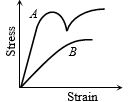
The diagram shows the stress versus strain curve for materials $A$ and $B$. From the curves,we infer that:
A
$A$ is brittle but $B$ is ductile
B
$A$ is ductile and $B$ is brittle
C
Both $A$ and $B$ are ductile
D
Both $A$ and $B$ are brittle
Solution
(B) The stress-strain curve for a ductile material shows a significant plastic region where the material undergoes large deformation before breaking,often showing a yield point.
In contrast,a brittle material breaks shortly after the elastic limit,showing little to no plastic deformation.
Looking at the graph,material $A$ exhibits a clear yield point and a significant plastic region,which is characteristic of a ductile material.
Material $B$ shows a curve that ends abruptly without a significant plastic region or yield point,which is characteristic of a brittle material.
Therefore,$A$ is ductile and $B$ is brittle.
In contrast,a brittle material breaks shortly after the elastic limit,showing little to no plastic deformation.
Looking at the graph,material $A$ exhibits a clear yield point and a significant plastic region,which is characteristic of a ductile material.
Material $B$ shows a curve that ends abruptly without a significant plastic region or yield point,which is characteristic of a brittle material.
Therefore,$A$ is ductile and $B$ is brittle.
0 likesView Solution
7
PhysicsEasyMCQAIIMS · 1987
The surface tension of a soap solution is $25 \times 10^{-3} \, N/m$. The excess pressure inside a soap bubble of diameter $1 \, cm$ is ....... $Pa$.
A
$10$
B
$20$
C
$5$
D
None of the above
Solution
(B) The formula for excess pressure inside a soap bubble is given by $\Delta P = \frac{4T}{r}$.
Given:
Surface tension $T = 25 \times 10^{-3} \, N/m$.
Diameter $d = 1 \, cm = 10^{-2} \, m$.
Radius $r = \frac{d}{2} = 0.5 \times 10^{-2} \, m$.
Substituting the values:
$\Delta P = \frac{4 \times 25 \times 10^{-3}}{0.5 \times 10^{-2}}$
$\Delta P = \frac{100 \times 10^{-3}}{0.5 \times 10^{-2}} = \frac{0.1}{0.005} = 20 \, Pa$.
Thus,the excess pressure is $20 \, Pa$.
Given:
Surface tension $T = 25 \times 10^{-3} \, N/m$.
Diameter $d = 1 \, cm = 10^{-2} \, m$.
Radius $r = \frac{d}{2} = 0.5 \times 10^{-2} \, m$.
Substituting the values:
$\Delta P = \frac{4 \times 25 \times 10^{-3}}{0.5 \times 10^{-2}}$
$\Delta P = \frac{100 \times 10^{-3}}{0.5 \times 10^{-2}} = \frac{0.1}{0.005} = 20 \, Pa$.
Thus,the excess pressure is $20 \, Pa$.
0 likesView Solution
8
PhysicsEasyMCQAIIMS · 1987
The process of superimposing a signal frequency (i.e.,audio wave) on a carrier wave is known as:
A
Transmission
B
Reception
C
Modulation
D
Detection
Solution
(C) The process of superimposing a low-frequency information signal (such as an audio wave) onto a high-frequency carrier wave is defined as modulation.
This process allows the signal to be transmitted over long distances efficiently.
Therefore,the correct option is $C$.
This process allows the signal to be transmitted over long distances efficiently.
Therefore,the correct option is $C$.
0 likesView Solution
Vedclass Products
For Students
Vedclass Test Series
Mock tests in real AIIMS style covering Physics with performance analysis. 5-day free trial.
Start Free TrialFor Teachers
Exam Paper Generator
Generate Set A/B/C/D Physics papers from 7.5L+ questions in 2 minutes. 3 chapters free.
Try FreeFor Institutes
Online Exam Module
Run live AIIMS mock exams with unlimited students, 360° analytics & white-label branding.
See DemoFrequently Asked Questions
How many Physics questions are in AIIMS 1987?
There are 8 Physics questions from the AIIMS 1987 paper on Vedclass, each with a detailed step-by-step solution in English.
Are AIIMS 1987 Physics solutions available in English?
Yes. All solutions on this page are in English. You can also switch to English or Hindi using the language buttons above the questions.
Can I practice AIIMS 1987 Physics as a timed test?
Yes. Use the Vedclass Test Series to attempt a full AIIMS mock test covering Physics with time limits and instant score analysis.
Can teachers create Physics papers from AIIMS previous year questions?
Yes. The Vedclass Exam Paper Generator lets teachers mix AIIMS Physics questions and generate Set A/B/C/D papers in minutes.
For Teachers & Institutes
Build a Custom Physics Paper
Pick AIIMS 1987 Physics questions, set difficulty, and generate Set A/B/C/D in 2 minutes.