
BiologyQ1–8 of 8 questions
Page 1 of 1 · English
1
BiologyEasyMCQAIIMS · 1986
The term "phylum" in animal classification was coined by
A
$E$. Haeckel
B
John Ray
C
$G$.$L$. Cuvier
D
Carolus Linnaeus
Solution
(A) The term "phylum" was introduced by the German biologist Ernst Haeckel in $1866$.
It was used to describe the primary divisions of the animal kingdom based on body plan and evolutionary relationships.
It was used to describe the primary divisions of the animal kingdom based on body plan and evolutionary relationships.
0 likesView Solution
2
BiologyMediumMCQAIIMS · 1986
The floral formula of mustard (or Brassicaceae/Cruciferae) is:
A
$ \oplus \, K_{2+2} \, C_{4} \, A_{2+4} \, \underline{G}_{(2)} $
B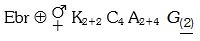
$ \oplus \, K_{2+2} \, C_{4} \, A_{2+4} \, \overline{G}_{(2)} $
C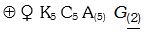
$ \% \, K_{2+2} \, C_{4} \, A_{2+4} \, \underline{G}_{(2)} $
D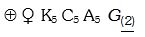
$ \oplus \, K_{4} \, C_{4} \, A_{2+4} \, \underline{G}_{(2)} $
Solution
The floral formula of mustard (Brassicaceae) is $ \oplus \, K_{2+2} \, C_{4} \, A_{2+4} \, \underline{G}_{(2)} $.
0 likesView Solution
3
BiologyMediumMCQAIIMS · 1986
In which part of mitochondria is $ATP$ generated?
A
Matrix
B
Cristae
C
Outer membrane
D
$F_1$ particles (oxysomes)
Solution
(D) The generation of $ATP$ in mitochondria occurs through the process of oxidative phosphorylation. This process takes place in the inner mitochondrial membrane,specifically at the $F_1$ particles,also known as oxysomes or $ATP$ synthase complexes. These particles project into the mitochondrial matrix and are responsible for the synthesis of $ATP$ from $ADP$ and inorganic phosphate using the proton gradient established across the inner membrane.
0 likesView Solution
4
BiologyEasyMCQAIIMS · 1986
Movements of leaves of sensitive plant, $Mimosa \text{ } pudica$, are due to
A
Thermonasty
B
Seismonasty
C
Hydrotropism
D
Chemonasty
Solution
(B) The movement of leaves in the sensitive plant, $Mimosa \text{ } pudica$ (touch-me-not, family $Mimosaceae$), is known as seismonasty.
Seismonasty is a type of nastic movement in plants that occurs in response to mechanical stimuli such as touch, vibration, or shock.
When the leaves are touched, the turgor pressure in the pulvinus (the swollen base of the leaf) decreases, causing the leaves to fold inward.
Seismonasty is a type of nastic movement in plants that occurs in response to mechanical stimuli such as touch, vibration, or shock.
When the leaves are touched, the turgor pressure in the pulvinus (the swollen base of the leaf) decreases, causing the leaves to fold inward.
0 likesView Solution
5
BiologyEasyMCQAIIMS · 1986
Exogenous application of gibberellins induces male flower formation on genetically female plants in
A
Carica
B
Cucumis
C
Coccinia
D
Cucurbita
Solution
(B) Gibberellins are plant growth regulators that influence sex expression in certain plants.
In species like $Cucumis$ (e.g.,cucumber),the application of gibberellins promotes the development of male flowers on genetically female plants.
This is a well-documented physiological effect where hormonal treatment alters the phenotypic expression of sex in dioecious or monoecious plants.
In species like $Cucumis$ (e.g.,cucumber),the application of gibberellins promotes the development of male flowers on genetically female plants.
This is a well-documented physiological effect where hormonal treatment alters the phenotypic expression of sex in dioecious or monoecious plants.
0 likesView Solution
6
BiologyMediumMCQAIIMS · 1986
Which one of the following ratios is constant in $DNAs$ of different species?
A
$A + T / C + G$
B
$A + G / T + C$
C
$A + C / U + G$
D
$A + U / C + G$
Solution
(B) According to Chargaff's rules,in a double-stranded $DNA$ molecule,the amount of Adenine $(A)$ equals the amount of Thymine $(T)$,and the amount of Guanine $(G)$ equals the amount of Cytosine $(C)$.
Therefore,$A = T$ and $G = C$.
This implies that the ratio $(A + G) / (T + C)$ is equal to $1$,because $(A + G) = (T + C)$.
This ratio is constant for all species,although the base composition $(A + T) / (G + C)$ varies significantly between different species.
Therefore,$A = T$ and $G = C$.
This implies that the ratio $(A + G) / (T + C)$ is equal to $1$,because $(A + G) = (T + C)$.
This ratio is constant for all species,although the base composition $(A + T) / (G + C)$ varies significantly between different species.
0 likesView Solution
7
BiologyEasyMCQAIIMS · 1986
Hybridomas are employed for
A
Synthesis of antibiotics
B
Killing cancer cells
C
Synthesis of monoclonal antibodies
D
Production of somatic hybrids
Solution
(C) Hybridoma technology is a method used for the production of monoclonal antibodies.
In this process,a specific antibody-producing $B$-lymphocyte is fused with a myeloma (cancer) cell to form a hybridoma cell.
These hybridoma cells are immortal and can be cultured to produce large quantities of specific,uniform antibodies known as monoclonal antibodies,which are highly specific to a single antigen.
In this process,a specific antibody-producing $B$-lymphocyte is fused with a myeloma (cancer) cell to form a hybridoma cell.
These hybridoma cells are immortal and can be cultured to produce large quantities of specific,uniform antibodies known as monoclonal antibodies,which are highly specific to a single antigen.
0 likesView Solution
8
BiologyMediumMCQAIIMS · 1986
Biotic potential refers to
A
Increase of population under optimum conditions
B
Increase of population under given conditions
C
Increase of population under natural conditions
D
Increase of population under climatic conditions
Solution
(A) Biotic potential is defined as the maximum reproductive capacity of an organism or population under ideal or optimum environmental conditions,where resources are unlimited and environmental resistance is minimal.
0 likesView Solution
Vedclass Products
For Students
Vedclass Test Series
Mock tests in real AIIMS style covering Biology with performance analysis. 5-day free trial.
Start Free TrialFor Teachers
Exam Paper Generator
Generate Set A/B/C/D Biology papers from 7.5L+ questions in 2 minutes. 3 chapters free.
Try FreeFor Institutes
Online Exam Module
Run live AIIMS mock exams with unlimited students, 360° analytics & white-label branding.
See DemoFrequently Asked Questions
How many Biology questions are in AIIMS 1986?
There are 8 Biology questions from the AIIMS 1986 paper on Vedclass, each with a detailed step-by-step solution in English.
Are AIIMS 1986 Biology solutions available in English?
Yes. All solutions on this page are in English. You can also switch to English or Hindi using the language buttons above the questions.
Can I practice AIIMS 1986 Biology as a timed test?
Yes. Use the Vedclass Test Series to attempt a full AIIMS mock test covering Biology with time limits and instant score analysis.
Can teachers create Biology papers from AIIMS previous year questions?
Yes. The Vedclass Exam Paper Generator lets teachers mix AIIMS Biology questions and generate Set A/B/C/D papers in minutes.
For Teachers & Institutes
Build a Custom Biology Paper
Pick AIIMS 1986 Biology questions, set difficulty, and generate Set A/B/C/D in 2 minutes.