
A English
Time and Distances Questions in English
Competitive Exam Quantitative Aptitude · Time and Distances · Time and Distances
349+
Questions
English
Language
100%
With Solutions
Showing 50 of 349 questions in English
201
EasyMCQ
$A$ person covers half of his journey at $30 \text{ km/h}$ and the remaining half at $20 \text{ km/h}$. The average speed for the whole journey is (in $\text{km/h}$)
A
$25$
B
$28$
C
$32$
D
None of these
Solution
(D) Let the total distance of the journey be $2d$.
The time taken to cover the first half $(d)$ at $30 \text{ km/h}$ is $t_1 = \frac{d}{30}$.
The time taken to cover the second half $(d)$ at $20 \text{ km/h}$ is $t_2 = \frac{d}{20}$.
Average speed is defined as the total distance divided by the total time:
$\text{Average speed} = \frac{\text{Total distance}}{\text{Total time}} = \frac{2d}{t_1 + t_2} = \frac{2d}{\frac{d}{30} + \frac{d}{20}}$.
Factoring out $d$ from the denominator:
$\text{Average speed} = \frac{2}{\frac{1}{30} + \frac{1}{20}} = \frac{2}{\frac{2+3}{60}} = \frac{2 \times 60}{5} = \frac{120}{5} = 24 \text{ km/h}$.
Since the calculated average speed is $24 \text{ km/h}$,which is not among the options $25, 28, 32$,the correct choice is $D$.
The time taken to cover the first half $(d)$ at $30 \text{ km/h}$ is $t_1 = \frac{d}{30}$.
The time taken to cover the second half $(d)$ at $20 \text{ km/h}$ is $t_2 = \frac{d}{20}$.
Average speed is defined as the total distance divided by the total time:
$\text{Average speed} = \frac{\text{Total distance}}{\text{Total time}} = \frac{2d}{t_1 + t_2} = \frac{2d}{\frac{d}{30} + \frac{d}{20}}$.
Factoring out $d$ from the denominator:
$\text{Average speed} = \frac{2}{\frac{1}{30} + \frac{1}{20}} = \frac{2}{\frac{2+3}{60}} = \frac{2 \times 60}{5} = \frac{120}{5} = 24 \text{ km/h}$.
Since the calculated average speed is $24 \text{ km/h}$,which is not among the options $25, 28, 32$,the correct choice is $D$.
0 likes
View Solution202
EasyMCQ
Rajesh covers a certain distance by bus at $16 \text{ km/h}$ and returns to the starting point on a cycle at $9 \text{ km/h}$. His average speed for the whole journey is (in $\text{km/h}$):
A
$13.54$
B
$11.52$
C
$15.52$
D
None of these
Solution
(B) Let the distance covered be $d$.
Time taken to travel by bus,$t_1 = \frac{d}{16}$.
Time taken to return by cycle,$t_2 = \frac{d}{9}$.
Total distance covered = $d + d = 2d$.
Total time taken = $t_1 + t_2 = \frac{d}{16} + \frac{d}{9} = \frac{9d + 16d}{144} = \frac{25d}{144}$.
Average speed = $\frac{\text{Total distance}}{\text{Total time}} = \frac{2d}{\frac{25d}{144}} = \frac{2 \times 144}{25} = \frac{288}{25} = 11.52 \text{ km/h}$.
Alternatively,using the formula for average speed when distance is constant: $\text{Average speed} = \frac{2s_1s_2}{s_1 + s_2} = \frac{2 \times 16 \times 9}{16 + 9} = \frac{288}{25} = 11.52 \text{ km/h}$.
Time taken to travel by bus,$t_1 = \frac{d}{16}$.
Time taken to return by cycle,$t_2 = \frac{d}{9}$.
Total distance covered = $d + d = 2d$.
Total time taken = $t_1 + t_2 = \frac{d}{16} + \frac{d}{9} = \frac{9d + 16d}{144} = \frac{25d}{144}$.
Average speed = $\frac{\text{Total distance}}{\text{Total time}} = \frac{2d}{\frac{25d}{144}} = \frac{2 \times 144}{25} = \frac{288}{25} = 11.52 \text{ km/h}$.
Alternatively,using the formula for average speed when distance is constant: $\text{Average speed} = \frac{2s_1s_2}{s_1 + s_2} = \frac{2 \times 16 \times 9}{16 + 9} = \frac{288}{25} = 11.52 \text{ km/h}$.
0 likes
View Solution203
MediumMCQ
$A$ and $B$ are two towns. $A$ car goes from $A$ to $B$ at a speed of $64 \, km/h$ and returns to $A$ at a slower speed. If its average speed for the whole journey is $56 \, km/h$,find its return speed (in $km/h$).
A
$52.54$
B
$47.74$
C
$49.78$
D
None of these
Solution
(C) Let the speed of the car from $A$ to $B$ be $v_1 = 64 \, km/h$ and the return speed from $B$ to $A$ be $v_2 = x \, km/h$.
The formula for average speed for a round trip is given by $v_{avg} = \frac{2 v_1 v_2}{v_1 + v_2}$.
Given that $v_{avg} = 56 \, km/h$,we substitute the values:
$56 = \frac{2 \times 64 \times x}{64 + x}$
Divide both sides by $8$:
$7 = \frac{2 \times 8 \times x}{64 + x} = \frac{16x}{64 + x}$
Cross-multiply:
$7(64 + x) = 16x$
$448 + 7x = 16x$
$16x - 7x = 448$
$9x = 448$
$x = \frac{448}{9} \approx 49.78 \, km/h$.
Thus,the return speed is $49.78 \, km/h$.
The formula for average speed for a round trip is given by $v_{avg} = \frac{2 v_1 v_2}{v_1 + v_2}$.
Given that $v_{avg} = 56 \, km/h$,we substitute the values:
$56 = \frac{2 \times 64 \times x}{64 + x}$
Divide both sides by $8$:
$7 = \frac{2 \times 8 \times x}{64 + x} = \frac{16x}{64 + x}$
Cross-multiply:
$7(64 + x) = 16x$
$448 + 7x = 16x$
$16x - 7x = 448$
$9x = 448$
$x = \frac{448}{9} \approx 49.78 \, km/h$.
Thus,the return speed is $49.78 \, km/h$.
0 likes
View Solution204
MediumMCQ
$A$ bicycle rider covers his onward journey from $A$ to $B$ at $10 \text{ km/h}$ and during the return journey from $B$ to $A$ he covers the same distance at $8 \text{ km/h}$. If he finishes the onward and return journey in $4 \frac{1}{2} \text{ hours}$,then the total distance covered by him during the entire journey is (in $\text{km}$)
A
$30$
B
$40$
C
$50$
D
none of these
Solution
(B) Let the distance between $A$ and $B$ be $d \text{ km}$.
Time taken for the onward journey from $A$ to $B$ is $t_1 = \frac{d}{10} \text{ hours}$.
Time taken for the return journey from $B$ to $A$ is $t_2 = \frac{d}{8} \text{ hours}$.
The total time taken is $t_1 + t_2 = 4 \frac{1}{2} = \frac{9}{2} \text{ hours}$.
So,$\frac{d}{10} + \frac{d}{8} = \frac{9}{2}$.
Taking the least common multiple of $10$ and $8$,which is $40$,we get $\frac{4d + 5d}{40} = \frac{9}{2}$.
$\frac{9d}{40} = \frac{9}{2}$.
$d = \frac{9}{2} \times \frac{40}{9} = 20 \text{ km}$.
The total distance covered during the entire journey is the sum of the onward and return distances,which is $d + d = 2d$.
Total distance $= 2 \times 20 = 40 \text{ km}$.
Time taken for the onward journey from $A$ to $B$ is $t_1 = \frac{d}{10} \text{ hours}$.
Time taken for the return journey from $B$ to $A$ is $t_2 = \frac{d}{8} \text{ hours}$.
The total time taken is $t_1 + t_2 = 4 \frac{1}{2} = \frac{9}{2} \text{ hours}$.
So,$\frac{d}{10} + \frac{d}{8} = \frac{9}{2}$.
Taking the least common multiple of $10$ and $8$,which is $40$,we get $\frac{4d + 5d}{40} = \frac{9}{2}$.
$\frac{9d}{40} = \frac{9}{2}$.
$d = \frac{9}{2} \times \frac{40}{9} = 20 \text{ km}$.
The total distance covered during the entire journey is the sum of the onward and return distances,which is $d + d = 2d$.
Total distance $= 2 \times 20 = 40 \text{ km}$.
0 likes
View Solution205
MediumMCQ
On a tour,a man travels at the rate of $64 \text{ km/h}$ for the first $160 \text{ km}$,then travels the next $160 \text{ km}$ at the rate of $80 \text{ km/h}$. The average speed in $\text{km/h}$ for the first $320 \text{ km}$ of the tour is:
A
$81.13$
B
$73.11$
C
$71.11$
D
None of these
Solution
(C) The formula for average speed when the distance covered is the same for two different speeds is given by $\text{Average Speed} = \frac{2s_1s_2}{s_1 + s_2}$.
Here,$s_1 = 64 \text{ km/h}$ and $s_2 = 80 \text{ km/h}$.
Substituting the values into the formula:
$\text{Average Speed} = \frac{2 \times 64 \times 80}{64 + 80}$
$\text{Average Speed} = \frac{10240}{144}$
$\text{Average Speed} = 71.11 \text{ km/h}$.
Here,$s_1 = 64 \text{ km/h}$ and $s_2 = 80 \text{ km/h}$.
Substituting the values into the formula:
$\text{Average Speed} = \frac{2 \times 64 \times 80}{64 + 80}$
$\text{Average Speed} = \frac{10240}{144}$
$\text{Average Speed} = 71.11 \text{ km/h}$.
0 likes
View Solution206
EasyMCQ
$A$ car completes a journey in $6\, hours$. It covers half the distance at $50\, km/h$ and the rest at $70\, km/h$. The length of the journey is (in $km$):
A
$165$
B
$175$
C
$185$
D
none of these
Solution
(D) Let the total distance of the journey be $D\, km$.
Time taken to cover the first half of the distance $(D/2)$ at $50\, km/h$ is $t_1 = \frac{D/2}{50} = \frac{D}{100}\, hours$.
Time taken to cover the remaining half of the distance $(D/2)$ at $70\, km/h$ is $t_2 = \frac{D/2}{70} = \frac{D}{140}\, hours$.
The total time taken is $t_1 + t_2 = 6\, hours$.
So,$\frac{D}{100} + \frac{D}{140} = 6$.
Taking the least common multiple of $100$ and $140$,which is $700$:
$\frac{7D + 5D}{700} = 6$
$\frac{12D}{700} = 6$
$12D = 4200$
$D = \frac{4200}{12} = 350\, km$.
Wait,re-evaluating the formula provided in the prompt: The average speed for equal distances is $v_{avg} = \frac{2s_1s_2}{s_1+s_2}$.
Total distance $D = v_{avg} \times T = \left(\frac{2 \times 50 \times 70}{50+70}\right) \times 6 = \left(\frac{7000}{120}\right) \times 6 = \frac{7000}{20} = 350\, km$.
Since $350$ is not among the options,the correct answer is $D$ (none of these).
Time taken to cover the first half of the distance $(D/2)$ at $50\, km/h$ is $t_1 = \frac{D/2}{50} = \frac{D}{100}\, hours$.
Time taken to cover the remaining half of the distance $(D/2)$ at $70\, km/h$ is $t_2 = \frac{D/2}{70} = \frac{D}{140}\, hours$.
The total time taken is $t_1 + t_2 = 6\, hours$.
So,$\frac{D}{100} + \frac{D}{140} = 6$.
Taking the least common multiple of $100$ and $140$,which is $700$:
$\frac{7D + 5D}{700} = 6$
$\frac{12D}{700} = 6$
$12D = 4200$
$D = \frac{4200}{12} = 350\, km$.
Wait,re-evaluating the formula provided in the prompt: The average speed for equal distances is $v_{avg} = \frac{2s_1s_2}{s_1+s_2}$.
Total distance $D = v_{avg} \times T = \left(\frac{2 \times 50 \times 70}{50+70}\right) \times 6 = \left(\frac{7000}{120}\right) \times 6 = \frac{7000}{20} = 350\, km$.
Since $350$ is not among the options,the correct answer is $D$ (none of these).
0 likes
View Solution207
EasyMCQ
Rakesh sets out to cycle from Delhi to Mathura and at the same time Suresh starts from Mathura to Delhi. After passing each other,they complete their journeys in $9$ and $16 \, \text{hours}$,respectively. At what speed does Suresh cycle if Rakesh cycles at $16 \, \text{km/h}$?
A
$12 \, \text{km/h}$
B
$16 \, \text{km/h}$
C
$14 \, \text{km/h}$
D
None of these
Solution
(A) Let Rakesh's speed be $v_1$ and Suresh's speed be $v_2$.
Let the time taken by them after meeting be $T_1 = 9 \, \text{hours}$ and $T_2 = 16 \, \text{hours}$ respectively.
The formula for the ratio of speeds when two people meet and then complete their journeys in times $T_1$ and $T_2$ is given by $\frac{v_1}{v_2} = \sqrt{\frac{T_2}{T_1}}$.
Substituting the given values: $\frac{16}{v_2} = \sqrt{\frac{16}{9}}$.
$\frac{16}{v_2} = \frac{4}{3}$.
$4 \times v_2 = 16 \times 3$.
$4 \times v_2 = 48$.
$v_2 = 12 \, \text{km/h}$.
Thus,Suresh's speed is $12 \, \text{km/h}$.
Let the time taken by them after meeting be $T_1 = 9 \, \text{hours}$ and $T_2 = 16 \, \text{hours}$ respectively.
The formula for the ratio of speeds when two people meet and then complete their journeys in times $T_1$ and $T_2$ is given by $\frac{v_1}{v_2} = \sqrt{\frac{T_2}{T_1}}$.
Substituting the given values: $\frac{16}{v_2} = \sqrt{\frac{16}{9}}$.
$\frac{16}{v_2} = \frac{4}{3}$.
$4 \times v_2 = 16 \times 3$.
$4 \times v_2 = 48$.
$v_2 = 12 \, \text{km/h}$.
Thus,Suresh's speed is $12 \, \text{km/h}$.
0 likes
View Solution208
MediumMCQ
$A$ train travels $225 \ km$ in $3.5 \ hours$ and $370 \ km$ in $5 \ hours.$ Find out the average speed of the train in $km/h$.
A
$80$
B
$60$
C
$70$
D
None of these
Solution
(C) The average speed is defined as the total distance traveled divided by the total time taken.
Total distance $= 225 \ km + 370 \ km = 595 \ km$.
Total time $= 3.5 \ hours + 5 \ hours = 8.5 \ hours$.
Average speed $= \frac{\text{Total distance}}{\text{Total time}} = \frac{595}{8.5} \ km/h$.
Average speed $= 70 \ km/h$.
Total distance $= 225 \ km + 370 \ km = 595 \ km$.
Total time $= 3.5 \ hours + 5 \ hours = 8.5 \ hours$.
Average speed $= \frac{\text{Total distance}}{\text{Total time}} = \frac{595}{8.5} \ km/h$.
Average speed $= 70 \ km/h$.
0 likes
View Solution209
DifficultMCQ
$A$ man walks $6 \, km$ at a speed of $1 \frac{1}{2} \, km/h$,runs $8 \, km$ at a speed of $2 \, km/h$,and travels another $32 \, km$ by bus. The speed of the bus is $8 \, km/h$. Find the average speed of the man in $km/h$.
A
$4 \frac{5}{6}$
B
$3 \frac{5}{6}$
C
$5 \frac{7}{6}$
D
None of these
Solution
(B) Average speed is defined as the total distance traveled divided by the total time taken.
Total distance $D = 6 + 8 + 32 = 46 \, km$.
Time taken for walking $t_1 = \frac{6}{1.5} = 4 \, hours$.
Time taken for running $t_2 = \frac{8}{2} = 4 \, hours$.
Time taken for bus travel $t_3 = \frac{32}{8} = 4 \, hours$.
Total time $T = t_1 + t_2 + t_3 = 4 + 4 + 4 = 12 \, hours$.
Average speed $= \frac{D}{T} = \frac{46}{12} = \frac{23}{6} = 3 \frac{5}{6} \, km/h$.
Total distance $D = 6 + 8 + 32 = 46 \, km$.
Time taken for walking $t_1 = \frac{6}{1.5} = 4 \, hours$.
Time taken for running $t_2 = \frac{8}{2} = 4 \, hours$.
Time taken for bus travel $t_3 = \frac{32}{8} = 4 \, hours$.
Total time $T = t_1 + t_2 + t_3 = 4 + 4 + 4 = 12 \, hours$.
Average speed $= \frac{D}{T} = \frac{46}{12} = \frac{23}{6} = 3 \frac{5}{6} \, km/h$.
0 likes
View Solution210
MediumMCQ
$A$ car during its journey travels $30 \text{ minutes}$ at a speed of $40 \text{ km/h}$,another $45 \text{ minutes}$ at a speed of $60 \text{ km/h}$,and $2 \text{ hours}$ at a speed of $70 \text{ km/h}$. The average speed of the car is (in $\text{km/h}$):
A
$63$
B
$65$
C
$70$
D
None of these
Solution
(D) The formula for average speed is $\text{Average Speed} = \frac{\text{Total Distance}}{\text{Total Time}}$.
First,convert all time intervals into hours:
$T_1 = 30 \text{ min} = 0.5 \text{ h}$
$T_2 = 45 \text{ min} = 0.75 \text{ h}$
$T_3 = 2 \text{ h}$
Next,calculate the distance traveled in each interval $(D = \text{speed} \times \text{time})$:
$D_1 = 40 \times 0.5 = 20 \text{ km}$
$D_2 = 60 \times 0.75 = 45 \text{ km}$
$D_3 = 70 \times 2 = 140 \text{ km}$
Total Distance $= 20 + 45 + 140 = 205 \text{ km}$
Total Time $= 0.5 + 0.75 + 2 = 3.25 \text{ h}$
$\text{Average Speed} = \frac{205}{3.25} \approx 63.07 \text{ km/h}$.
Since $63.07$ is not among the options,the correct answer is $D$.
First,convert all time intervals into hours:
$T_1 = 30 \text{ min} = 0.5 \text{ h}$
$T_2 = 45 \text{ min} = 0.75 \text{ h}$
$T_3 = 2 \text{ h}$
Next,calculate the distance traveled in each interval $(D = \text{speed} \times \text{time})$:
$D_1 = 40 \times 0.5 = 20 \text{ km}$
$D_2 = 60 \times 0.75 = 45 \text{ km}$
$D_3 = 70 \times 2 = 140 \text{ km}$
Total Distance $= 20 + 45 + 140 = 205 \text{ km}$
Total Time $= 0.5 + 0.75 + 2 = 3.25 \text{ h}$
$\text{Average Speed} = \frac{205}{3.25} \approx 63.07 \text{ km/h}$.
Since $63.07$ is not among the options,the correct answer is $D$.
0 likes
View Solution211
MediumMCQ
By walking at $\frac{3}{4}$ of his usual speed,a man reaches his office $20 \text{ minutes}$ later than usual. His usual time is (in $\text{minutes}$):
A
$65$
B
$60$
C
$70$
D
None of these
Solution
(B) Let the usual speed be $S$ and the usual time be $T$.
Since distance is constant,$D = S \times T$.
When the speed becomes $\frac{3}{4}S$,the new time taken is $T + 20$.
Thus,$S \times T = \frac{3}{4}S \times (T + 20)$.
Dividing both sides by $S$,we get $T = \frac{3}{4}(T + 20)$.
$4T = 3T + 60$.
$T = 60 \text{ minutes}$.
Therefore,the usual time is $60 \text{ minutes}$.
Since distance is constant,$D = S \times T$.
When the speed becomes $\frac{3}{4}S$,the new time taken is $T + 20$.
Thus,$S \times T = \frac{3}{4}S \times (T + 20)$.
Dividing both sides by $S$,we get $T = \frac{3}{4}(T + 20)$.
$4T = 3T + 60$.
$T = 60 \text{ minutes}$.
Therefore,the usual time is $60 \text{ minutes}$.
0 likes
View Solution212
DifficultMCQ
Two men start together to walk a certain distance,one at $4 \, km/h$ and another at $3 \, km/h$. The former arrives half an hour before the latter. Find out the distance in $km$.
A
$6$
B
$9$
C
$8$
D
None of these
Solution
(A) Let the distance be $d \, km$.
Time taken by the first man $= \frac{d}{4} \, hours$.
Time taken by the second man $= \frac{d}{3} \, hours$.
According to the problem,the first man arrives half an hour $(0.5 \, hours)$ before the second man.
Therefore,$\frac{d}{3} - \frac{d}{4} = 0.5$.
Taking the common denominator,we get $\frac{4d - 3d}{12} = 0.5$.
$\frac{d}{12} = 0.5$.
$d = 0.5 \times 12 = 6 \, km$.
Thus,the distance is $6 \, km$.
Time taken by the first man $= \frac{d}{4} \, hours$.
Time taken by the second man $= \frac{d}{3} \, hours$.
According to the problem,the first man arrives half an hour $(0.5 \, hours)$ before the second man.
Therefore,$\frac{d}{3} - \frac{d}{4} = 0.5$.
Taking the common denominator,we get $\frac{4d - 3d}{12} = 0.5$.
$\frac{d}{12} = 0.5$.
$d = 0.5 \times 12 = 6 \, km$.
Thus,the distance is $6 \, km$.
0 likes
View Solution213
MediumMCQ
$A$ car starts from $A$ for $B$ travelling at $20 \, km/h$. $1 \frac{1}{2} \, hours$ later,another car starts from $A$ and,travelling at the rate of $30 \, km/h$,reaches $B$ $2 \frac{1}{2} \, hours$ before the first car. Find the distance from $A$ to $B$ (in $km$).
A
$280$
B
$260$
C
$240$
D
none of these
Solution
(C) Let the distance between $A$ and $B$ be $d \, km$.
Time taken by the first car to cover the distance $d$ is $t_1 = \frac{d}{20} \, hours$.
Time taken by the second car to cover the distance $d$ is $t_2 = \frac{d}{30} \, hours$.
The second car starts $1.5 \, hours$ later and reaches $2.5 \, hours$ earlier,so the difference in time is $t_1 - t_2 = 1.5 + 2.5 = 4 \, hours$.
Substituting the values: $\frac{d}{20} - \frac{d}{30} = 4$.
Taking the $LCM$ of $20$ and $30$,which is $60$: $\frac{3d - 2d}{60} = 4$.
$\frac{d}{60} = 4$.
$d = 240 \, km$.
Thus,the distance from $A$ to $B$ is $240 \, km$.
Time taken by the first car to cover the distance $d$ is $t_1 = \frac{d}{20} \, hours$.
Time taken by the second car to cover the distance $d$ is $t_2 = \frac{d}{30} \, hours$.
The second car starts $1.5 \, hours$ later and reaches $2.5 \, hours$ earlier,so the difference in time is $t_1 - t_2 = 1.5 + 2.5 = 4 \, hours$.
Substituting the values: $\frac{d}{20} - \frac{d}{30} = 4$.
Taking the $LCM$ of $20$ and $30$,which is $60$: $\frac{3d - 2d}{60} = 4$.
$\frac{d}{60} = 4$.
$d = 240 \, km$.
Thus,the distance from $A$ to $B$ is $240 \, km$.
0 likes
View Solution214
DifficultMCQ
Mohan walks from Tilak Nagar to Moti Nagar and back in a certain time at the rate of $3 \frac{1}{2} \, km/h$. But,if he had walked from Tilak Nagar to Moti Nagar at the rate of $3 \, km/h$ and back from Moti Nagar to Tilak Nagar at the rate of $4 \, km/h$,he would have taken $10 \, minutes$ longer. The distance between Tilak Nagar and Moti Nagar is (in $km$)
A
$28$
B
$32$
C
$24$
D
none of these
Solution
(D) Let the distance between Tilak Nagar and Moti Nagar be $d \, km$.
In the first case,the total time taken is $T_1 = \frac{d}{3.5} + \frac{d}{3.5} = \frac{2d}{3.5} = \frac{4d}{7} \, hours$.
In the second case,the total time taken is $T_2 = \frac{d}{3} + \frac{d}{4} = \frac{4d + 3d}{12} = \frac{7d}{12} \, hours$.
Given that the difference in time is $10 \, minutes = \frac{10}{60} = \frac{1}{6} \, hours$.
So,$T_2 - T_1 = \frac{1}{6}$.
$\frac{7d}{12} - \frac{4d}{7} = \frac{1}{6}$.
Taking $LCM$ of $12$ and $7$ as $84$:
$\frac{49d - 48d}{84} = \frac{1}{6}$.
$\frac{d}{84} = \frac{1}{6}$.
$d = \frac{84}{6} = 14 \, km$.
Since $14 \, km$ is not among the options,the correct answer is $D$ (none of these).
In the first case,the total time taken is $T_1 = \frac{d}{3.5} + \frac{d}{3.5} = \frac{2d}{3.5} = \frac{4d}{7} \, hours$.
In the second case,the total time taken is $T_2 = \frac{d}{3} + \frac{d}{4} = \frac{4d + 3d}{12} = \frac{7d}{12} \, hours$.
Given that the difference in time is $10 \, minutes = \frac{10}{60} = \frac{1}{6} \, hours$.
So,$T_2 - T_1 = \frac{1}{6}$.
$\frac{7d}{12} - \frac{4d}{7} = \frac{1}{6}$.
Taking $LCM$ of $12$ and $7$ as $84$:
$\frac{49d - 48d}{84} = \frac{1}{6}$.
$\frac{d}{84} = \frac{1}{6}$.
$d = \frac{84}{6} = 14 \, km$.
Since $14 \, km$ is not among the options,the correct answer is $D$ (none of these).
0 likes
View Solution215
MediumMCQ
$A$ train completes a non-stop journey in $8 \, \text{hours}$. If it had travelled $5 \, \text{km/h}$ faster, it would have completed the journey in $6 \, \text{hours} \, 40 \, \text{minutes}$. What is its lowest speed in $\text{km/h}$?
A
$35$
B
$25$
C
$40$
D
None of these
Solution
(B) Let the original speed of the train be $s \, \text{km/h}$.
The time taken at this speed is $T_1 = 8 \, \text{hours}$.
The distance $D$ covered is $D = \text{speed} \times \text{time} = 8s$.
If the speed is increased by $5 \, \text{km/h}$, the new speed is $(s + 5) \, \text{km/h}$.
The new time taken is $6 \, \text{hours} \, 40 \, \text{minutes} = 6 + \frac{40}{60} = 6 + \frac{2}{3} = \frac{20}{3} \, \text{hours}$.
Since the distance remains the same, we equate the two expressions for distance:
$8s = (s + 5) \times \frac{20}{3}$
Multiply both sides by $3$:
$24s = 20(s + 5)$
$24s = 20s + 100$
$4s = 100$
$s = 25 \, \text{km/h}$.
Thus, the lowest speed of the train is $25 \, \text{km/h}$.
The time taken at this speed is $T_1 = 8 \, \text{hours}$.
The distance $D$ covered is $D = \text{speed} \times \text{time} = 8s$.
If the speed is increased by $5 \, \text{km/h}$, the new speed is $(s + 5) \, \text{km/h}$.
The new time taken is $6 \, \text{hours} \, 40 \, \text{minutes} = 6 + \frac{40}{60} = 6 + \frac{2}{3} = \frac{20}{3} \, \text{hours}$.
Since the distance remains the same, we equate the two expressions for distance:
$8s = (s + 5) \times \frac{20}{3}$
Multiply both sides by $3$:
$24s = 20(s + 5)$
$24s = 20s + 100$
$4s = 100$
$s = 25 \, \text{km/h}$.
Thus, the lowest speed of the train is $25 \, \text{km/h}$.
0 likes
View Solution216
EasyMCQ
Without any stoppage, a person travels a certain distance at an average speed of $42 \, km/h$ and with stoppages he covers the same distance at an average speed of $28 \, km/h$. How many minutes per hour does he stop?
A
$25$
B
$30$
C
$20$
D
None of these
Solution
(C) Let the speed without stoppage be $s_{1} = 42 \, km/h$ and the speed with stoppage be $s_{2} = 28 \, km/h$.
The formula for stoppage time per hour is given by: $\text{Stoppage time} = \frac{s_{1} - s_{2}}{s_{1}} \times 60 \, \text{minutes}$.
Substituting the values: $\text{Stoppage time} = \frac{42 - 28}{42} \times 60 \, \text{minutes}$.
$= \frac{14}{42} \times 60 \, \text{minutes}$.
$= \frac{1}{3} \times 60 \, \text{minutes} = 20 \, \text{minutes}$.
Therefore, the person stops for $20 \, \text{minutes per hour}$.
The formula for stoppage time per hour is given by: $\text{Stoppage time} = \frac{s_{1} - s_{2}}{s_{1}} \times 60 \, \text{minutes}$.
Substituting the values: $\text{Stoppage time} = \frac{42 - 28}{42} \times 60 \, \text{minutes}$.
$= \frac{14}{42} \times 60 \, \text{minutes}$.
$= \frac{1}{3} \times 60 \, \text{minutes} = 20 \, \text{minutes}$.
Therefore, the person stops for $20 \, \text{minutes per hour}$.
0 likes
View Solution217
MediumMCQ
$A$ train is running at a uniform speed of $60 \, km/h$. It passes a railway platform in $15 \, s$. If the length of the platform is $130 \, m$,then the length of the train is (in $m$):
A
$160$
B
$120$
C
$140$
D
None of these
Solution
(B) First,convert the speed of the train from $km/h$ to $m/s$ by multiplying by $\frac{5}{18}$:
Speed $= 60 \times \frac{5}{18} = \frac{300}{18} = \frac{50}{3} \, m/s$.
Let the length of the train be $L \, m$.
When a train passes a platform,the total distance covered is the sum of the length of the train and the length of the platform.
Distance $= L + 130 \, m$.
Using the formula: $\text{Distance} = \text{Speed} \times \text{Time}$.
$L + 130 = \frac{50}{3} \times 15$.
$L + 130 = 50 \times 5$.
$L + 130 = 250$.
$L = 250 - 130 = 120 \, m$.
Speed $= 60 \times \frac{5}{18} = \frac{300}{18} = \frac{50}{3} \, m/s$.
Let the length of the train be $L \, m$.
When a train passes a platform,the total distance covered is the sum of the length of the train and the length of the platform.
Distance $= L + 130 \, m$.
Using the formula: $\text{Distance} = \text{Speed} \times \text{Time}$.
$L + 130 = \frac{50}{3} \times 15$.
$L + 130 = 50 \times 5$.
$L + 130 = 250$.
$L = 250 - 130 = 120 \, m$.
0 likes
View Solution218
MediumMCQ
$A$ train passes through a telegraph post in $9$ $seconds$ moving at a speed of $54 \, km/h$. The length of the train is (in $meters$):
A
$135$
B
$145$
C
$125$
D
None of these
Solution
(A) The speed of the train is given as $54 \, km/h$.
To convert the speed from $km/h$ to $m/s$,we multiply by $\frac{5}{18}$:
$\text{Speed} = 54 \times \frac{5}{18} = 3 \times 5 = 15 \, m/s$.
The time taken to cross the telegraph post is $9 \, seconds$.
Since the train covers its own length while passing a stationary point (telegraph post),the length of the train is calculated as:
$\text{Length} = \text{Speed} \times \text{Time}$
$\text{Length} = 15 \, m/s \times 9 \, s = 135 \, m$.
Therefore,the length of the train is $135 \, meters$.
To convert the speed from $km/h$ to $m/s$,we multiply by $\frac{5}{18}$:
$\text{Speed} = 54 \times \frac{5}{18} = 3 \times 5 = 15 \, m/s$.
The time taken to cross the telegraph post is $9 \, seconds$.
Since the train covers its own length while passing a stationary point (telegraph post),the length of the train is calculated as:
$\text{Length} = \text{Speed} \times \text{Time}$
$\text{Length} = 15 \, m/s \times 9 \, s = 135 \, m$.
Therefore,the length of the train is $135 \, meters$.
0 likes
View Solution219
EasyMCQ
$A$ $135\, m$ long train is running with a speed of $54\, km/h$. In what time will it pass a telegraph post? (in $seconds$)
A
$11$
B
$9$
C
$7$
D
None of these
Solution
(B) To pass a telegraph post,the train must cover a distance equal to its own length.
Given:
Length of the train $(L)$ = $135\, m$
Speed of the train $(v)$ = $54\, km/h$
First,convert the speed from $km/h$ to $m/s$:
$v = 54 \times \frac{5}{18} = 3 \times 5 = 15\, m/s$
Time taken $(t)$ = $\frac{\text{Distance}}{\text{Speed}} = \frac{L}{v}$
$t = \frac{135}{15} = 9\, seconds$
Therefore,the train will pass the telegraph post in $9\, seconds$.
Given:
Length of the train $(L)$ = $135\, m$
Speed of the train $(v)$ = $54\, km/h$
First,convert the speed from $km/h$ to $m/s$:
$v = 54 \times \frac{5}{18} = 3 \times 5 = 15\, m/s$
Time taken $(t)$ = $\frac{\text{Distance}}{\text{Speed}} = \frac{L}{v}$
$t = \frac{135}{15} = 9\, seconds$
Therefore,the train will pass the telegraph post in $9\, seconds$.
0 likes
View Solution220
MediumMCQ
$A$ train $160 \ m$ long passes a standing man in $18 \ s$. The speed of the train is (in $km/h$):
A
$35$
B
$45$
C
$32$
D
None of these
Solution
(C) The speed of the train is calculated by dividing the length of the train by the time taken to cross the man.
Speed $= \frac{\text{Length of the train}}{\text{Time taken}}$
Speed $= \frac{160 \ m}{18 \ s} = \frac{80}{9} \ m/s$.
To convert the speed from $m/s$ to $km/h$,multiply by $\frac{18}{5}$.
Speed in $km/h = \frac{80}{9} \times \frac{18}{5} \ km/h$.
Speed $= 16 \times 2 = 32 \ km/h$.
Speed $= \frac{\text{Length of the train}}{\text{Time taken}}$
Speed $= \frac{160 \ m}{18 \ s} = \frac{80}{9} \ m/s$.
To convert the speed from $m/s$ to $km/h$,multiply by $\frac{18}{5}$.
Speed in $km/h = \frac{80}{9} \times \frac{18}{5} \ km/h$.
Speed $= 16 \times 2 = 32 \ km/h$.
0 likes
View Solution221
MediumMCQ
$A$ $280\,m$ long train is moving at a speed of $60\,km/h$. The time taken by the train to cross a platform $220\,m$ long is (in $seconds$):
A
$30$
B
$40$
C
$60$
D
$20$
Solution
(A) To cross a platform,the total distance covered by the train is the sum of the length of the train and the length of the platform.
Total distance $= 280\,m + 220\,m = 500\,m$.
The speed of the train is $60\,km/h$. Converting this to $m/s$:
Speed $= 60 \times \frac{5}{18} = \frac{300}{18} = \frac{50}{3}\,m/s$.
Time taken $= \frac{\text{Total distance}}{\text{Speed}} = \frac{500}{50/3} = \frac{500 \times 3}{50} = 10 \times 3 = 30\,seconds$.
Total distance $= 280\,m + 220\,m = 500\,m$.
The speed of the train is $60\,km/h$. Converting this to $m/s$:
Speed $= 60 \times \frac{5}{18} = \frac{300}{18} = \frac{50}{3}\,m/s$.
Time taken $= \frac{\text{Total distance}}{\text{Speed}} = \frac{500}{50/3} = \frac{500 \times 3}{50} = 10 \times 3 = 30\,seconds$.
0 likes
View Solution222
EasyMCQ
$A$ train $50\, m$ long passes a platform $100\, m$ long in $10\, s$. The speed of the train in $m/s$ is:
A
$25$
B
$15$
C
$35$
D
None of these
Solution
(B) To find the speed of the train,we use the formula:
Speed = (Total distance covered) / (Time taken)
When a train passes a platform,the total distance covered is the sum of the length of the train and the length of the platform.
Total distance = $50\, m + 100\, m = 150\, m$.
Time taken = $10\, s$.
Speed = $150\, m / 10\, s = 15\, m/s$.
Therefore,the correct option is $B$.
Speed = (Total distance covered) / (Time taken)
When a train passes a platform,the total distance covered is the sum of the length of the train and the length of the platform.
Total distance = $50\, m + 100\, m = 150\, m$.
Time taken = $10\, s$.
Speed = $150\, m / 10\, s = 15\, m/s$.
Therefore,the correct option is $B$.
0 likes
View Solution223
MediumMCQ
$A$ train $300 \text{ m}$ long is running at a speed of $90 \text{ km/h}$. How many seconds will it take to cross a $200 \text{ m}$ long train running in the opposite direction at a speed of $60 \text{ km/h}$?
A
$70$
B
$60$
C
$50$
D
None of these
Solution
(D) Length of the first train,$L_1 = 300 \text{ m}$.
Length of the second train,$L_2 = 200 \text{ m}$.
Total distance to be covered to cross each other,$D = L_1 + L_2 = 300 + 200 = 500 \text{ m}$.
Since the trains are moving in opposite directions,their relative speed is the sum of their individual speeds.
Relative speed,$S_{rel} = 90 \text{ km/h} + 60 \text{ km/h} = 150 \text{ km/h}$.
Convert the relative speed into $\text{m/s}$ by multiplying by $\frac{5}{18}$:
$S_{rel} = 150 \times \frac{5}{18} = \frac{750}{18} = \frac{125}{3} \text{ m/s}$.
Time taken to cross each other,$T = \frac{D}{S_{rel}} = \frac{500}{125/3} = \frac{500 \times 3}{125} = 4 \times 3 = 12 \text{ seconds}$.
Length of the second train,$L_2 = 200 \text{ m}$.
Total distance to be covered to cross each other,$D = L_1 + L_2 = 300 + 200 = 500 \text{ m}$.
Since the trains are moving in opposite directions,their relative speed is the sum of their individual speeds.
Relative speed,$S_{rel} = 90 \text{ km/h} + 60 \text{ km/h} = 150 \text{ km/h}$.
Convert the relative speed into $\text{m/s}$ by multiplying by $\frac{5}{18}$:
$S_{rel} = 150 \times \frac{5}{18} = \frac{750}{18} = \frac{125}{3} \text{ m/s}$.
Time taken to cross each other,$T = \frac{D}{S_{rel}} = \frac{500}{125/3} = \frac{500 \times 3}{125} = 4 \times 3 = 12 \text{ seconds}$.
0 likes
View Solution224
MediumMCQ
Two trains are running in opposite directions with the same speed. If the length of each train is $135 \, m$ and they cross each other in $18 \, s$,the speed of each train is (in $km/h$):
A
$29$
B
$35$
C
$27$
D
none of these
Solution
(C) Let the speed of each train be $x \, m/s$.
Given: Length of each train $L_1 = L_2 = 135 \, m$ and speed $s_1 = s_2 = x \, m/s$.
Since the trains are moving in opposite directions,their relative speed is $s_1 + s_2 = x + x = 2x \, m/s$.
The total distance covered to cross each other is the sum of their lengths: $D = 135 + 135 = 270 \, m$.
Using the formula: $\text{Time} = \frac{\text{Distance}}{\text{Relative Speed}}$
$18 = \frac{270}{2x}$
$2x = \frac{270}{18} = 15 \, m/s$
$x = 7.5 \, m/s$.
To convert the speed from $m/s$ to $km/h$,multiply by $\frac{18}{5}$:
$\text{Speed} = 7.5 \times \frac{18}{5} = 1.5 \times 18 = 27 \, km/h$.
Given: Length of each train $L_1 = L_2 = 135 \, m$ and speed $s_1 = s_2 = x \, m/s$.
Since the trains are moving in opposite directions,their relative speed is $s_1 + s_2 = x + x = 2x \, m/s$.
The total distance covered to cross each other is the sum of their lengths: $D = 135 + 135 = 270 \, m$.
Using the formula: $\text{Time} = \frac{\text{Distance}}{\text{Relative Speed}}$
$18 = \frac{270}{2x}$
$2x = \frac{270}{18} = 15 \, m/s$
$x = 7.5 \, m/s$.
To convert the speed from $m/s$ to $km/h$,multiply by $\frac{18}{5}$:
$\text{Speed} = 7.5 \times \frac{18}{5} = 1.5 \times 18 = 27 \, km/h$.
0 likes
View Solution225
EasyMCQ
$A$ train $150 \, m$ long is running at $95 \, km/h$. How much time will it take to pass a man moving in the same direction at $5 \, km/h$? (in $seconds$)
A
$9$
B
$7$
C
$6$
D
none of these
Solution
(C) The length of the train is $L = 150 \, m$.
The speed of the train is $v_t = 95 \, km/h$.
The speed of the man is $v_m = 5 \, km/h$.
Since both are moving in the same direction,the relative speed is $v_{rel} = v_t - v_m = 95 - 5 = 90 \, km/h$.
Convert the relative speed into $m/s$: $v_{rel} = 90 \times \frac{5}{18} = 25 \, m/s$.
The time taken to pass the man is $t = \frac{\text{Distance}}{\text{Relative Speed}} = \frac{150}{25} = 6 \, seconds$.
The speed of the train is $v_t = 95 \, km/h$.
The speed of the man is $v_m = 5 \, km/h$.
Since both are moving in the same direction,the relative speed is $v_{rel} = v_t - v_m = 95 - 5 = 90 \, km/h$.
Convert the relative speed into $m/s$: $v_{rel} = 90 \times \frac{5}{18} = 25 \, m/s$.
The time taken to pass the man is $t = \frac{\text{Distance}}{\text{Relative Speed}} = \frac{150}{25} = 6 \, seconds$.
0 likes
View Solution226
MediumMCQ
$A$ train $100 \, m$ long takes $3 \frac{3}{5} \, s$ to cross a man walking at the rate of $6 \, km/h$ in a direction opposite to that of the train. Find the speed of the train in $km/h$.
A
$76$
B
$94$
C
$86$
D
None of these
Solution
(B) Length of the train $(L_1)$ = $100 \, m$.
Speed of the man $(s_2)$ = $6 \, km/h$.
Time taken $(t)$ = $3 \frac{3}{5} \, s = \frac{18}{5} \, s$.
Let the speed of the train be $x \, km/h$.
Since the man and the train are moving in opposite directions,their relative speed is $(x + 6) \, km/h$.
Converting the relative speed to $m/s$: $(x + 6) \times \frac{5}{18} \, m/s$.
Using the formula: $\text{Time} = \frac{\text{Distance}}{\text{Relative Speed}}$.
$\frac{18}{5} = \frac{100}{(x + 6) \times \frac{5}{18}}$.
$\frac{18}{5} = \frac{100 \times 18}{(x + 6) \times 5}$.
$18 = \frac{100 \times 18}{x + 6}$.
$1 = \frac{100}{x + 6}$.
$x + 6 = 100$.
$x = 94 \, km/h$.
Speed of the man $(s_2)$ = $6 \, km/h$.
Time taken $(t)$ = $3 \frac{3}{5} \, s = \frac{18}{5} \, s$.
Let the speed of the train be $x \, km/h$.
Since the man and the train are moving in opposite directions,their relative speed is $(x + 6) \, km/h$.
Converting the relative speed to $m/s$: $(x + 6) \times \frac{5}{18} \, m/s$.
Using the formula: $\text{Time} = \frac{\text{Distance}}{\text{Relative Speed}}$.
$\frac{18}{5} = \frac{100}{(x + 6) \times \frac{5}{18}}$.
$\frac{18}{5} = \frac{100 \times 18}{(x + 6) \times 5}$.
$18 = \frac{100 \times 18}{x + 6}$.
$1 = \frac{100}{x + 6}$.
$x + 6 = 100$.
$x = 94 \, km/h$.
0 likes
View Solution227
DifficultMCQ
Two trains are moving in the same direction at $50 \, km/h$ and $30 \, km/h$. The faster train crosses a man in the slower train in $18 \, seconds$. Find the length of the faster train (in $m$).
A
$120$
B
$110$
C
$100$
D
None of these
Solution
(C) Relative speed of the two trains moving in the same direction is the difference of their speeds.
Relative speed $= (50 - 30) \, km/h = 20 \, km/h$.
To convert the speed from $km/h$ to $m/s$,multiply by $\frac{5}{18}$.
Relative speed $= 20 \times \frac{5}{18} = \frac{100}{18} = \frac{50}{9} \, m/s$.
The faster train crosses a man in the slower train,which means the distance covered is equal to the length of the faster train.
Distance $= \text{Relative speed} \times \text{Time}$.
Distance $= \frac{50}{9} \, m/s \times 18 \, s = 50 \times 2 = 100 \, m$.
Therefore,the length of the faster train is $100 \, m$.
Relative speed $= (50 - 30) \, km/h = 20 \, km/h$.
To convert the speed from $km/h$ to $m/s$,multiply by $\frac{5}{18}$.
Relative speed $= 20 \times \frac{5}{18} = \frac{100}{18} = \frac{50}{9} \, m/s$.
The faster train crosses a man in the slower train,which means the distance covered is equal to the length of the faster train.
Distance $= \text{Relative speed} \times \text{Time}$.
Distance $= \frac{50}{9} \, m/s \times 18 \, s = 50 \times 2 = 100 \, m$.
Therefore,the length of the faster train is $100 \, m$.
0 likes
View Solution228
MediumMCQ
Two trains,$130 \,m$ and $110 \,m$ long,are moving in the same direction. The faster train takes $1 \,minute$ to pass the other completely. If they are moving in opposite directions,they pass each other completely in $3 \,seconds$. Find the speed of each train (in $m/s$).
A
$42, 38$
B
$38, 36$
C
$36, 42$
D
None of these
Solution
(A) Let the speeds of the two trains be $v_1$ and $v_2$ (where $v_1 > v_2$) in $m/s$.
Total length of the trains $L = 130 + 110 = 240 \,m$.
When moving in the same direction,relative speed is $(v_1 - v_2)$. Time taken is $60 \,s$.
$v_1 - v_2 = \frac{240}{60} = 4 \,m/s$ --- (Equation $1$)
When moving in opposite directions,relative speed is $(v_1 + v_2)$. Time taken is $3 \,s$.
$v_1 + v_2 = \frac{240}{3} = 80 \,m/s$ --- (Equation $2$)
Adding Equation $1$ and Equation $2$:
$2v_1 = 84 \implies v_1 = 42 \,m/s$.
Subtracting Equation $1$ from Equation $2$:
$2v_2 = 76 \implies v_2 = 38 \,m/s$.
Thus,the speeds are $42 \,m/s$ and $38 \,m/s$.
Total length of the trains $L = 130 + 110 = 240 \,m$.
When moving in the same direction,relative speed is $(v_1 - v_2)$. Time taken is $60 \,s$.
$v_1 - v_2 = \frac{240}{60} = 4 \,m/s$ --- (Equation $1$)
When moving in opposite directions,relative speed is $(v_1 + v_2)$. Time taken is $3 \,s$.
$v_1 + v_2 = \frac{240}{3} = 80 \,m/s$ --- (Equation $2$)
Adding Equation $1$ and Equation $2$:
$2v_1 = 84 \implies v_1 = 42 \,m/s$.
Subtracting Equation $1$ from Equation $2$:
$2v_2 = 76 \implies v_2 = 38 \,m/s$.
Thus,the speeds are $42 \,m/s$ and $38 \,m/s$.
0 likes
View Solution229
DifficultMCQ
Two trains,each of length $90\, m,$ run on parallel tracks. When running in the same direction,the faster train passes the slower train completely in $18\, s,$ but when they are running in opposite directions approaching each other at the same speeds as before,they cross each other in $9\, s.$ Find the speed of each train (in $m/s$).
A
$9, 15$
B
$7, 5$
C
$15, 5$
D
None of these
Solution
(C) Let the speed of the faster train be $v_1$ and the speed of the slower train be $v_2$ in $m/s$.
Total length of both trains $= 90 + 90 = 180\, m$.
When moving in the same direction,relative speed $= v_1 - v_2$.
Time taken $= \frac{\text{Total distance}}{\text{Relative speed}} \implies 18 = \frac{180}{v_1 - v_2} \implies v_1 - v_2 = 10\, (i)$.
When moving in opposite directions,relative speed $= v_1 + v_2$.
Time taken $= \frac{\text{Total distance}}{\text{Relative speed}} \implies 9 = \frac{180}{v_1 + v_2} \implies v_1 + v_2 = 20\, (ii)$.
Adding equations $(i)$ and $(ii)$:
$2v_1 = 30 \implies v_1 = 15\, m/s$.
Subtracting $(i)$ from $(ii)$:
$2v_2 = 10 \implies v_2 = 5\, m/s$.
Thus,the speeds are $15\, m/s$ and $5\, m/s$.
Total length of both trains $= 90 + 90 = 180\, m$.
When moving in the same direction,relative speed $= v_1 - v_2$.
Time taken $= \frac{\text{Total distance}}{\text{Relative speed}} \implies 18 = \frac{180}{v_1 - v_2} \implies v_1 - v_2 = 10\, (i)$.
When moving in opposite directions,relative speed $= v_1 + v_2$.
Time taken $= \frac{\text{Total distance}}{\text{Relative speed}} \implies 9 = \frac{180}{v_1 + v_2} \implies v_1 + v_2 = 20\, (ii)$.
Adding equations $(i)$ and $(ii)$:
$2v_1 = 30 \implies v_1 = 15\, m/s$.
Subtracting $(i)$ from $(ii)$:
$2v_2 = 10 \implies v_2 = 5\, m/s$.
Thus,the speeds are $15\, m/s$ and $5\, m/s$.
0 likes
View Solution230
DifficultMCQ
$A$ train leaves the station at $5 \, am$ at $60 \, km/h$. Another train leaves the same station at $6.30 \, am$ at $75 \, km/h$ and travels in the same direction as the first train. At what time and at what distance from the station will they meet?
A
$12.30 \, pm, 450 \, km$
B
$1.30 \, pm, 375 \, km$
C
$11.30 \, am, 425 \, km$
D
None of these
Solution
$(A)$ The first train travels for $1.5$ hours ($1 \frac{1}{2}$ hours) before the second train starts.
Distance covered by the first train in $1.5$ hours $= 60 \times 1.5 = 90 \, km$.
Relative speed of the second train with respect to the first train $= 75 - 60 = 15 \, km/h$.
Time taken by the second train to catch up with the first train $= \frac{\text{Distance}}{\text{Relative Speed}} = \frac{90}{15} = 6$ hours.
Meeting time $= 6.30 \, am + 6$ hours $= 12.30 \, pm$.
Distance from the station $= 75 \, km/h \times 6$ hours $= 450 \, km$.
Distance covered by the first train in $1.5$ hours $= 60 \times 1.5 = 90 \, km$.
Relative speed of the second train with respect to the first train $= 75 - 60 = 15 \, km/h$.
Time taken by the second train to catch up with the first train $= \frac{\text{Distance}}{\text{Relative Speed}} = \frac{90}{15} = 6$ hours.
Meeting time $= 6.30 \, am + 6$ hours $= 12.30 \, pm$.
Distance from the station $= 75 \, km/h \times 6$ hours $= 450 \, km$.
0 likes
View Solution231
MediumMCQ
Two stations $A$ and $B$ are $100 \, km$ apart on a straight line. One train starts from $A$ at $7 \, am$ and travels towards $B$ at $20 \, km/h$ speed. Another train starts from $B$ at $8 \, am$ and travels towards $A$ at $25 \, km/h$ speed. At what time will they meet?
A
$10:30 \, am$
B
$11:00 \, am$
C
$10:00 \, am$
D
None of these
Solution
(D) $1$. The distance between stations $A$ and $B$ is $100 \, km$.
$2$. The train from $A$ starts at $7 \, am$ and travels at $20 \, km/h$. By $8 \, am$,it has traveled for $1 \, hour$,covering $20 \, km \times 1 \, h = 20 \, km$.
$3$. At $8 \, am$,the remaining distance between the two trains is $100 \, km - 20 \, km = 80 \, km$.
$4$. Since the trains are moving towards each other,their relative speed is $20 \, km/h + 25 \, km/h = 45 \, km/h$.
$5$. The time taken to meet after $8 \, am$ is $\text{Time} = \frac{\text{Distance}}{\text{Relative Speed}} = \frac{80 \, km}{45 \, km/h} = \frac{16}{9} \, hours = 1 \, hour \, 46 \, minutes \, 40 \, seconds$.
$6$. Therefore,the meeting time is $8:00 \, am + 1 \, hour \, 46 \, minutes \, 40 \, seconds = 9:46:40 \, am$.
$7$. Since $9:46:40 \, am$ is not among the options,the correct choice is $D$.
$2$. The train from $A$ starts at $7 \, am$ and travels at $20 \, km/h$. By $8 \, am$,it has traveled for $1 \, hour$,covering $20 \, km \times 1 \, h = 20 \, km$.
$3$. At $8 \, am$,the remaining distance between the two trains is $100 \, km - 20 \, km = 80 \, km$.
$4$. Since the trains are moving towards each other,their relative speed is $20 \, km/h + 25 \, km/h = 45 \, km/h$.
$5$. The time taken to meet after $8 \, am$ is $\text{Time} = \frac{\text{Distance}}{\text{Relative Speed}} = \frac{80 \, km}{45 \, km/h} = \frac{16}{9} \, hours = 1 \, hour \, 46 \, minutes \, 40 \, seconds$.
$6$. Therefore,the meeting time is $8:00 \, am + 1 \, hour \, 46 \, minutes \, 40 \, seconds = 9:46:40 \, am$.
$7$. Since $9:46:40 \, am$ is not among the options,the correct choice is $D$.
0 likes
View Solution232
MediumMCQ
$A$ train starts from station $A$ at $9\, am$ and travels at $50\, km/h$ towards station $B,$ which is $210\, km$ away. Another train starts from station $B$ at $11\, am$ and travels at $60\, km/h$ towards station $A.$ At what distance from station $A$ will they meet? (in $km$)
A
$150$
B
$200$
C
$250$
D
None of these
Solution
(A) $1$. The first train starts at $9\, am$ and travels for $2$ hours until the second train starts at $11\, am$.
$2$. Distance covered by the first train in $2$ hours $= 50\, km/h \times 2\, h = 100\, km$.
$3$. Remaining distance between the two trains at $11\, am = 210\, km - 100\, km = 110\, km$.
$4$. Since the trains are moving towards each other,their relative speed $= 50\, km/h + 60\, km/h = 110\, km/h$.
$5$. Time taken to meet after $11\, am = \frac{\text{Remaining Distance}}{\text{Relative Speed}} = \frac{110\, km}{110\, km/h} = 1\, hour$.
$6$. The trains meet at $12\, pm$ (noon).
$7$. Total distance from station $A$ at the meeting point = (Distance covered by first train in $2$ hours) + (Distance covered by first train in $1$ hour after $11\, am$) = $100\, km + (50\, km/h \times 1\, h) = 150\, km$.
$2$. Distance covered by the first train in $2$ hours $= 50\, km/h \times 2\, h = 100\, km$.
$3$. Remaining distance between the two trains at $11\, am = 210\, km - 100\, km = 110\, km$.
$4$. Since the trains are moving towards each other,their relative speed $= 50\, km/h + 60\, km/h = 110\, km/h$.
$5$. Time taken to meet after $11\, am = \frac{\text{Remaining Distance}}{\text{Relative Speed}} = \frac{110\, km}{110\, km/h} = 1\, hour$.
$6$. The trains meet at $12\, pm$ (noon).
$7$. Total distance from station $A$ at the meeting point = (Distance covered by first train in $2$ hours) + (Distance covered by first train in $1$ hour after $11\, am$) = $100\, km + (50\, km/h \times 1\, h) = 150\, km$.
0 likes
View Solution233
MediumMCQ
Two trains start at the same time from Mumbai and Pune and proceed towards each other at the speeds of $60\, km/h$ and $40\, km/h$, respectively. When they meet, it is found that one train has travelled $20\, km$ more than the other. Find the distance between Mumbai and Pune (in $km$).
A
$150$
B
$100$
C
$120$
D
None of these
Solution
(B) Let the time taken by the trains to meet be $t$ hours.
Distance travelled by the first train $(d_1)$ = $60t$.
Distance travelled by the second train $(d_2)$ = $40t$.
According to the problem, the difference in distance is $20\, km$:
$60t - 40t = 20$
$20t = 20$
$t = 1\, \text{hour}$.
The total distance between Mumbai and Pune is the sum of the distances covered by both trains:
Total Distance = $d_1 + d_2 = 60t + 40t = 100t$.
Substituting $t = 1$, we get:
Total Distance = $100 \times 1 = 100\, km$.
Distance travelled by the first train $(d_1)$ = $60t$.
Distance travelled by the second train $(d_2)$ = $40t$.
According to the problem, the difference in distance is $20\, km$:
$60t - 40t = 20$
$20t = 20$
$t = 1\, \text{hour}$.
The total distance between Mumbai and Pune is the sum of the distances covered by both trains:
Total Distance = $d_1 + d_2 = 60t + 40t = 100t$.
Substituting $t = 1$, we get:
Total Distance = $100 \times 1 = 100\, km$.
0 likes
View Solution234
EasyMCQ
$A$ car covers four successive $3 \, km$ stretches at speeds of $10 \, km/h$,$20 \, km/h$,$30 \, km/h$,and $60 \, km/h$ respectively. Its average speed over this total distance is (in $km/h$):
A
$10$
B
$20$
C
$30$
D
$25$
Solution
(B) The total distance covered is $3 + 3 + 3 + 3 = 12 \, km$.
The time taken for each stretch is calculated using the formula $\text{time} = \frac{\text{distance}}{\text{speed}}$.
Time $t_1 = \frac{3}{10} \, h$,$t_2 = \frac{3}{20} \, h$,$t_3 = \frac{3}{30} \, h$,and $t_4 = \frac{3}{60} \, h$.
Total time $T = \frac{3}{10} + \frac{3}{20} + \frac{3}{30} + \frac{3}{60} = \frac{18 + 9 + 6 + 3}{60} = \frac{36}{60} = \frac{3}{5} \, h$.
Average speed $= \frac{\text{Total distance}}{\text{Total time}} = \frac{12}{3/5} = \frac{12 \times 5}{3} = 20 \, km/h$.
The time taken for each stretch is calculated using the formula $\text{time} = \frac{\text{distance}}{\text{speed}}$.
Time $t_1 = \frac{3}{10} \, h$,$t_2 = \frac{3}{20} \, h$,$t_3 = \frac{3}{30} \, h$,and $t_4 = \frac{3}{60} \, h$.
Total time $T = \frac{3}{10} + \frac{3}{20} + \frac{3}{30} + \frac{3}{60} = \frac{18 + 9 + 6 + 3}{60} = \frac{36}{60} = \frac{3}{5} \, h$.
Average speed $= \frac{\text{Total distance}}{\text{Total time}} = \frac{12}{3/5} = \frac{12 \times 5}{3} = 20 \, km/h$.
0 likes
View Solution235
EasyMCQ
Two men $A$ and $B$ walk from $P$ to $Q$ at a distance of $21 \text{ km}$ at speeds of $3 \text{ km/h}$ and $4 \text{ km/h}$ respectively. $B$ reaches $Q$ and returns immediately and meets $A$ at $R$. The distance from $P$ to $R$ is (in $\text{km}$):
A
$14$
B
$20$
C
$16$
D
$18$
Solution
(D) Let the distance from $P$ to $R$ be $x \text{ km}$.
Since both men start at the same time and meet at $R$,the time taken by $A$ to reach $R$ is equal to the time taken by $B$ to reach $Q$ and then return to $R$.
Time taken by $A$ to cover distance $PR = x \text{ km}$ at $3 \text{ km/h}$ is $t_A = \frac{x}{3} \text{ hours}$.
Time taken by $B$ to cover distance $PQ = 21 \text{ km}$ and then $QR = (21 - x) \text{ km}$ at $4 \text{ km/h}$ is $t_B = \frac{21 + (21 - x)}{4} = \frac{42 - x}{4} \text{ hours}$.
Equating the times: $\frac{x}{3} = \frac{42 - x}{4}$.
Cross-multiplying: $4x = 3(42 - x)$.
$4x = 126 - 3x$.
$7x = 126$.
$x = \frac{126}{7} = 18 \text{ km}$.
Since both men start at the same time and meet at $R$,the time taken by $A$ to reach $R$ is equal to the time taken by $B$ to reach $Q$ and then return to $R$.
Time taken by $A$ to cover distance $PR = x \text{ km}$ at $3 \text{ km/h}$ is $t_A = \frac{x}{3} \text{ hours}$.
Time taken by $B$ to cover distance $PQ = 21 \text{ km}$ and then $QR = (21 - x) \text{ km}$ at $4 \text{ km/h}$ is $t_B = \frac{21 + (21 - x)}{4} = \frac{42 - x}{4} \text{ hours}$.
Equating the times: $\frac{x}{3} = \frac{42 - x}{4}$.
Cross-multiplying: $4x = 3(42 - x)$.
$4x = 126 - 3x$.
$7x = 126$.
$x = \frac{126}{7} = 18 \text{ km}$.

0 likes
View Solution236
MediumMCQ
$A$ boy takes as much time in running $12 \, m$ as a car takes in covering $36 \, m$. The ratio of the speeds of the boy and the car is
A
$1:3$
B
$1:2$
C
$2:3$
D
$2:5$
Solution
(A) Let the speed of the boy be $v_b$ and the speed of the car be $v_c$.
Since the time taken $t$ is the same for both,we use the formula $\text{speed} = \frac{\text{distance}}{\text{time}}$,which implies $\text{time} = \frac{\text{distance}}{\text{speed}}$.
Given that the time taken is equal:
$\frac{12}{v_b} = \frac{36}{v_c}$
Rearranging the terms to find the ratio of speeds $\frac{v_b}{v_c}$:
$\frac{v_b}{v_c} = \frac{12}{36}$
$\frac{v_b}{v_c} = \frac{1}{3}$
Therefore,the ratio of the speeds of the boy and the car is $1:3$.
Since the time taken $t$ is the same for both,we use the formula $\text{speed} = \frac{\text{distance}}{\text{time}}$,which implies $\text{time} = \frac{\text{distance}}{\text{speed}}$.
Given that the time taken is equal:
$\frac{12}{v_b} = \frac{36}{v_c}$
Rearranging the terms to find the ratio of speeds $\frac{v_b}{v_c}$:
$\frac{v_b}{v_c} = \frac{12}{36}$
$\frac{v_b}{v_c} = \frac{1}{3}$
Therefore,the ratio of the speeds of the boy and the car is $1:3$.
0 likes
View Solution237
MediumMCQ
$A$ and $B$ are two stations. $A$ train goes from $A$ to $B$ at $64 \text{ km/h}$ and returns to $A$ at a slower speed. If its average speed for the whole journey is $56 \text{ km/h}$,at what speed did it return? (in $\text{km/h}$)
A
$48$
B
$49.77$
C
$30$
D
$47.46$
Solution
(B) Let the speed from $A$ to $B$ be $v_1 = 64 \text{ km/h}$ and the return speed from $B$ to $A$ be $v_2 = x \text{ km/h}$.
The formula for average speed when the distance is the same for both legs of the journey is given by:
$\text{Average Speed} = \frac{2 v_1 v_2}{v_1 + v_2}$
Given that the average speed is $56 \text{ km/h}$,we have:
$56 = \frac{2 \times 64 \times x}{64 + x}$
Multiply both sides by $(64 + x)$:
$56(64 + x) = 128x$
$3584 + 56x = 128x$
Subtract $56x$ from both sides:
$3584 = 128x - 56x$
$3584 = 72x$
Solve for $x$:
$x = \frac{3584}{72} \approx 49.77 \text{ km/h}$
The formula for average speed when the distance is the same for both legs of the journey is given by:
$\text{Average Speed} = \frac{2 v_1 v_2}{v_1 + v_2}$
Given that the average speed is $56 \text{ km/h}$,we have:
$56 = \frac{2 \times 64 \times x}{64 + x}$
Multiply both sides by $(64 + x)$:
$56(64 + x) = 128x$
$3584 + 56x = 128x$
Subtract $56x$ from both sides:
$3584 = 128x - 56x$
$3584 = 72x$
Solve for $x$:
$x = \frac{3584}{72} \approx 49.77 \text{ km/h}$
0 likes
View Solution238
EasyMCQ
Excluding stoppages, the speed of a bus is $54 \, km/h$ and including stoppages, it is $45 \, km/h$. For how many minutes does the bus stop per hour?
A
$9$
B
$10$
C
$12$
D
$20$
Solution
(B) The speed of the bus excluding stoppages is $54 \, km/h$.
This means the bus covers $54 \, km$ in $60$ minutes.
The speed of the bus including stoppages is $45 \, km/h$.
This means the bus covers $45 \, km$ in $60$ minutes.
The distance lost due to stoppages in one hour is $54 \, km - 45 \, km = 9 \, km$.
The time taken to cover this distance of $9 \, km$ at the original speed of $54 \, km/h$ is:
$\text{Time} = \frac{\text{Distance}}{\text{Speed}} = \frac{9 \, km}{54 \, km/h} = \frac{1}{6} \, \text{hours}$.
Converting this into minutes: $\frac{1}{6} \times 60 \, \text{minutes} = 10 \, \text{minutes}$.
Therefore, the bus stops for $10$ minutes per hour.
This means the bus covers $54 \, km$ in $60$ minutes.
The speed of the bus including stoppages is $45 \, km/h$.
This means the bus covers $45 \, km$ in $60$ minutes.
The distance lost due to stoppages in one hour is $54 \, km - 45 \, km = 9 \, km$.
The time taken to cover this distance of $9 \, km$ at the original speed of $54 \, km/h$ is:
$\text{Time} = \frac{\text{Distance}}{\text{Speed}} = \frac{9 \, km}{54 \, km/h} = \frac{1}{6} \, \text{hours}$.
Converting this into minutes: $\frac{1}{6} \times 60 \, \text{minutes} = 10 \, \text{minutes}$.
Therefore, the bus stops for $10$ minutes per hour.
0 likes
View Solution239
MediumMCQ
Two boys jointly begin to write a booklet containing $817$ lines. The first boy starts with the first line and writes $200$ lines an hour. The second boy starts with the last line,then writes line $816$ and so on,proceeding backwards at the rate of $150$ lines an hour. They will meet on:
A
$467^{th}$ line
B
$466^{th}$ line
C
$460^{th}$ line
D
$472^{th}$ line
Solution
(A) Let the time taken for them to meet be $t$ hours.
In time $t$,the first boy writes $200t$ lines.
The second boy writes $150t$ lines.
The total number of lines written by both is $817$.
So,$200t + 150t = 817$.
$350t = 817$.
$t = \frac{817}{350} \approx 2.334$ hours.
The number of lines written by the first boy is $200 \times \frac{817}{350} = \frac{817 \times 4}{7} = \frac{3268}{7} \approx 466.85$.
Since the first boy has completed $466$ lines and is currently working on the $467^{th}$ line,they will meet on the $467^{th}$ line.
In time $t$,the first boy writes $200t$ lines.
The second boy writes $150t$ lines.
The total number of lines written by both is $817$.
So,$200t + 150t = 817$.
$350t = 817$.
$t = \frac{817}{350} \approx 2.334$ hours.
The number of lines written by the first boy is $200 \times \frac{817}{350} = \frac{817 \times 4}{7} = \frac{3268}{7} \approx 466.85$.
Since the first boy has completed $466$ lines and is currently working on the $467^{th}$ line,they will meet on the $467^{th}$ line.
0 likes
View Solution240
MediumMCQ
Ramesh sees a train passing over a $1 \, km$ long bridge. The length of the train is half that of the bridge. If the train passes the bridge in $2 \, minutes$,the speed of the train is (in $km/h$)
A
$45$
B
$43$
C
$50$
D
None of these
Solution
(A) The length of the bridge is $1 \, km$.
The length of the train is half the length of the bridge,which is $0.5 \, km$.
To pass the bridge completely,the train must cover a total distance equal to the sum of the length of the bridge and the length of the train.
Total distance $= 1 \, km + 0.5 \, km = 1.5 \, km$.
The time taken is $2 \, minutes$,which is equal to $\frac{2}{60} \, hours = \frac{1}{30} \, hours$.
Speed $= \frac{\text{Total distance}}{\text{Total time}} = \frac{1.5 \, km}{1/30 \, h} = 1.5 \times 30 \, km/h = 45 \, km/h$.
The length of the train is half the length of the bridge,which is $0.5 \, km$.
To pass the bridge completely,the train must cover a total distance equal to the sum of the length of the bridge and the length of the train.
Total distance $= 1 \, km + 0.5 \, km = 1.5 \, km$.
The time taken is $2 \, minutes$,which is equal to $\frac{2}{60} \, hours = \frac{1}{30} \, hours$.
Speed $= \frac{\text{Total distance}}{\text{Total time}} = \frac{1.5 \, km}{1/30 \, h} = 1.5 \times 30 \, km/h = 45 \, km/h$.
0 likes
View Solution241
DifficultMCQ
$A$ bullock cart has to cover a distance of $80 \text{ km}$ in $10 \text{ hours}$. If it covers half of the journey in $\frac{3}{5}$ of the total time,what should be its speed to cover the remaining distance in the time left? (in $\text{km/h}$)
A
$8$
B
$20$
C
$6.4$
D
$10$
Solution
(D) Total distance $= 80 \text{ km}$.
Total time $= 10 \text{ hours}$.
Half of the journey $= 40 \text{ km}$.
Time taken for the first half $= \frac{3}{5} \times 10 = 6 \text{ hours}$.
Remaining distance $= 80 - 40 = 40 \text{ km}$.
Remaining time $= 10 - 6 = 4 \text{ hours}$.
Required speed for the remaining distance $= \frac{\text{Remaining Distance}}{\text{Remaining Time}} = \frac{40}{4} = 10 \text{ km/h}$.
Total time $= 10 \text{ hours}$.
Half of the journey $= 40 \text{ km}$.
Time taken for the first half $= \frac{3}{5} \times 10 = 6 \text{ hours}$.
Remaining distance $= 80 - 40 = 40 \text{ km}$.
Remaining time $= 10 - 6 = 4 \text{ hours}$.
Required speed for the remaining distance $= \frac{\text{Remaining Distance}}{\text{Remaining Time}} = \frac{40}{4} = 10 \text{ km/h}$.
0 likes
View Solution242
MediumMCQ
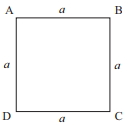
Amit started cycling along the boundaries of a square field from corner point $A$. After half an hour,he reached the corner point $C$,diagonally opposite to $A$. If his speed was $8 \, km/h$,what is the area of the field in square $km$?
A
$4$
B
$2$
C
$1$
D
$16$
Solution
(A) Let the side of the square field be $a \, km$.
The distance covered by Amit from $A$ to $C$ along the boundary is $AB + BC = a + a = 2a$.
Time taken is $0.5 \, h$ and speed is $8 \, km/h$.
Distance = $\text{Speed} \times \text{Time} = 8 \times 0.5 = 4 \, km$.
Therefore,$2a = 4 \, km$,which gives $a = 2 \, km$.
The area of the square field is $a^2 = 2^2 = 4 \, km^2$.
The distance covered by Amit from $A$ to $C$ along the boundary is $AB + BC = a + a = 2a$.
Time taken is $0.5 \, h$ and speed is $8 \, km/h$.
Distance = $\text{Speed} \times \text{Time} = 8 \times 0.5 = 4 \, km$.
Therefore,$2a = 4 \, km$,which gives $a = 2 \, km$.
The area of the square field is $a^2 = 2^2 = 4 \, km^2$.
0 likes
View Solution243
MediumMCQ
$A$ $100\, m$ long train completely passes a man walking in the same direction at $6\, km/h$ in $5\, s$ and also a car travelling in the same direction in $6\, s$. At what speed was the car travelling? (in $km/h$)
A
$18$
B
$48$
C
$24$
D
$30$
Solution
(A) Let the speed of the train be $x\, km/h$.
Since the man is walking in the same direction,the relative speed is $(x - 6)\, km/h$.
Converting to $m/s$,the relative speed is $(x - 6) \times \frac{5}{18}\, m/s$.
The train covers its own length $(100\, m)$ in $5\, s$:
$(x - 6) \times \frac{5}{18} \times 5 = 100$
$(x - 6) \times \frac{25}{18} = 100$
$x - 6 = 100 \times \frac{18}{25} = 72$
$x = 78\, km/h$.
Now,let the speed of the car be $y\, km/h$. The relative speed is $(78 - y)\, km/h$.
The train passes the car in $6\, s$:
$(78 - y) \times \frac{5}{18} \times 6 = 100$
$(78 - y) \times \frac{5}{3} = 100$
$78 - y = 100 \times \frac{3}{5} = 60$
$y = 78 - 60 = 18\, km/h$.
Since the man is walking in the same direction,the relative speed is $(x - 6)\, km/h$.
Converting to $m/s$,the relative speed is $(x - 6) \times \frac{5}{18}\, m/s$.
The train covers its own length $(100\, m)$ in $5\, s$:
$(x - 6) \times \frac{5}{18} \times 5 = 100$
$(x - 6) \times \frac{25}{18} = 100$
$x - 6 = 100 \times \frac{18}{25} = 72$
$x = 78\, km/h$.
Now,let the speed of the car be $y\, km/h$. The relative speed is $(78 - y)\, km/h$.
The train passes the car in $6\, s$:
$(78 - y) \times \frac{5}{18} \times 6 = 100$
$(78 - y) \times \frac{5}{3} = 100$
$78 - y = 100 \times \frac{3}{5} = 60$
$y = 78 - 60 = 18\, km/h$.
0 likes
View Solution244
EasyMCQ
$A$ motorcyclist travels from Mumbai to Pune,a distance of $192 \, km$,at an average speed of $32 \, km/h$. Another man starts from Mumbai by travelling in a car,$2 \frac{1}{2} \, hours$ after the motorcyclist and reaches Pune half an hour earlier. What is the ratio of the speeds of the motorcycle and the car?
A
$1:2$
B
$1:3$
C
$10:27$
D
$5:4$
Solution
(A) $1$. Time taken by the motorcyclist to travel from Mumbai to Pune: $\text{Time} = \frac{\text{Distance}}{\text{Speed}} = \frac{192 \, km}{32 \, km/h} = 6 \, hours$.
$2$. The car starts $2.5 \, hours$ after the motorcyclist and reaches $0.5 \, hours$ earlier than the motorcyclist.
$3$. Total time taken by the car: $6 \, hours - 2.5 \, hours - 0.5 \, hours = 3 \, hours$.
$4$. Speed of the car: $\text{Speed} = \frac{\text{Distance}}{\text{Time}} = \frac{192 \, km}{3 \, hours} = 64 \, km/h$.
$5$. Ratio of the speed of the motorcycle to the speed of the car: $\frac{32}{64} = \frac{1}{2}$,which is $1:2$.
$2$. The car starts $2.5 \, hours$ after the motorcyclist and reaches $0.5 \, hours$ earlier than the motorcyclist.
$3$. Total time taken by the car: $6 \, hours - 2.5 \, hours - 0.5 \, hours = 3 \, hours$.
$4$. Speed of the car: $\text{Speed} = \frac{\text{Distance}}{\text{Time}} = \frac{192 \, km}{3 \, hours} = 64 \, km/h$.
$5$. Ratio of the speed of the motorcycle to the speed of the car: $\frac{32}{64} = \frac{1}{2}$,which is $1:2$.
0 likes
View Solution245
MediumMCQ
Two trains are running in opposite directions with speeds of $62 \, km/h$ and $40 \, km/h$,respectively. If the length of one train is $250 \, m$ and they cross each other in $18 \, seconds$,then the length of the other train is (in $m$):
A
$145$
B
$230$
C
$260$
D
Cannot be determined
Solution
(C) Let the length of the other train be $x \, m$.
Since the trains are moving in opposite directions,their relative speed is the sum of their individual speeds:
Relative speed $= (62 + 40) \, km/h = 102 \, km/h$.
Convert the relative speed into $m/s$ by multiplying by $\frac{5}{18}$:
Relative speed $= 102 \times \frac{5}{18} = \frac{510}{18} = \frac{85}{3} \, m/s$.
The total distance covered when crossing each other is the sum of the lengths of the two trains,which is $(250 + x) \, m$.
Using the formula $\text{Distance} = \text{Speed} \times \text{Time}$:
$250 + x = \left(\frac{85}{3}\right) \times 18$
$250 + x = 85 \times 6$
$250 + x = 510$
$x = 510 - 250 = 260 \, m$.
Thus,the length of the other train is $260 \, m$.
Since the trains are moving in opposite directions,their relative speed is the sum of their individual speeds:
Relative speed $= (62 + 40) \, km/h = 102 \, km/h$.
Convert the relative speed into $m/s$ by multiplying by $\frac{5}{18}$:
Relative speed $= 102 \times \frac{5}{18} = \frac{510}{18} = \frac{85}{3} \, m/s$.
The total distance covered when crossing each other is the sum of the lengths of the two trains,which is $(250 + x) \, m$.
Using the formula $\text{Distance} = \text{Speed} \times \text{Time}$:
$250 + x = \left(\frac{85}{3}\right) \times 18$
$250 + x = 85 \times 6$
$250 + x = 510$
$x = 510 - 250 = 260 \, m$.
Thus,the length of the other train is $260 \, m$.
0 likes
View Solution246
EasyMCQ
$A$ train speeds past a pole in $15 \, \text{seconds}$ and speeds past a $100 \, \text{meters}$ long platform in $25 \, \text{seconds}$. Its length in meters is:
A
$200$
B
$150$
C
$50$
D
Data inadequate
Solution
(B) Let the length of the train be $x \, \text{meters}$ and its speed be $y \, \text{meters/second}$.
When the train passes a pole, the distance covered is equal to its own length:
$\frac{x}{y} = 15 \implies y = \frac{x}{15} \quad \dots(1)$
When the train passes a $100 \, \text{meter}$ long platform, the total distance covered is $(x + 100) \, \text{meters}$:
$\frac{x + 100}{y} = 25 \implies x + 100 = 25y \quad \dots(2)$
Substitute the value of $y$ from equation $(1)$ into equation $(2)$:
$x + 100 = 25 \times \left( \frac{x}{15} \right)$
$x + 100 = \frac{5x}{3}$
$3x + 300 = 5x$
$2x = 300$
$x = 150 \, \text{meters}$.
Thus, the length of the train is $150 \, \text{meters}$.
When the train passes a pole, the distance covered is equal to its own length:
$\frac{x}{y} = 15 \implies y = \frac{x}{15} \quad \dots(1)$
When the train passes a $100 \, \text{meter}$ long platform, the total distance covered is $(x + 100) \, \text{meters}$:
$\frac{x + 100}{y} = 25 \implies x + 100 = 25y \quad \dots(2)$
Substitute the value of $y$ from equation $(1)$ into equation $(2)$:
$x + 100 = 25 \times \left( \frac{x}{15} \right)$
$x + 100 = \frac{5x}{3}$
$3x + 300 = 5x$
$2x = 300$
$x = 150 \, \text{meters}$.
Thus, the length of the train is $150 \, \text{meters}$.
0 likes
View Solution247
MediumMCQ
$A$ $150 \, m$ long train takes $10 \, s$ to pass over another $100 \, m$ long train coming from the opposite direction. If the speed of the first train is $30 \, km/h$,the speed of the second train is (in $km/h$):
A
$54$
B
$60$
C
$72$
D
$36$
Solution
(B) The total distance to be covered to pass each other is the sum of the lengths of both trains: $D = 150 \, m + 100 \, m = 250 \, m$.
Time taken is $t = 10 \, s$.
Relative speed $v_{rel} = \frac{D}{t} = \frac{250 \, m}{10 \, s} = 25 \, m/s$.
To convert the relative speed into $km/h$,multiply by $\frac{18}{5}$: $v_{rel} = 25 \times \frac{18}{5} = 90 \, km/h$.
Since the trains are moving in opposite directions,their relative speed is the sum of their individual speeds: $v_{rel} = v_1 + v_2$.
Given $v_1 = 30 \, km/h$,we have $30 + v_2 = 90$.
Therefore,$v_2 = 90 - 30 = 60 \, km/h$.
Time taken is $t = 10 \, s$.
Relative speed $v_{rel} = \frac{D}{t} = \frac{250 \, m}{10 \, s} = 25 \, m/s$.
To convert the relative speed into $km/h$,multiply by $\frac{18}{5}$: $v_{rel} = 25 \times \frac{18}{5} = 90 \, km/h$.
Since the trains are moving in opposite directions,their relative speed is the sum of their individual speeds: $v_{rel} = v_1 + v_2$.
Given $v_1 = 30 \, km/h$,we have $30 + v_2 = 90$.
Therefore,$v_2 = 90 - 30 = 60 \, km/h$.
0 likes
View Solution248
DifficultMCQ
$A$ person sets out to cover a distance of $12 \, km$ in $45 \, minutes$. If he covers $\frac{3}{4}$ of the distance in $\frac{2}{3}$ of the time,what should be his speed to cover the remaining distance in the remaining time? (in $km/h$)
A
$16$
B
$8$
C
$12$
D
$14$
Solution
(C) Total distance $= 12 \, km$.
Total time $= 45 \, minutes = \frac{45}{60} \, hours = 0.75 \, hours$.
Distance covered $= \frac{3}{4} \times 12 \, km = 9 \, km$.
Time taken $= \frac{2}{3} \times 45 \, minutes = 30 \, minutes = 0.5 \, hours$.
Remaining distance $= 12 \, km - 9 \, km = 3 \, km$.
Remaining time $= 45 \, minutes - 30 \, minutes = 15 \, minutes = \frac{15}{60} \, hours = 0.25 \, hours$.
Required speed $= \frac{\text{Remaining distance}}{\text{Remaining time}} = \frac{3 \, km}{0.25 \, h} = 12 \, km/h$.
Total time $= 45 \, minutes = \frac{45}{60} \, hours = 0.75 \, hours$.
Distance covered $= \frac{3}{4} \times 12 \, km = 9 \, km$.
Time taken $= \frac{2}{3} \times 45 \, minutes = 30 \, minutes = 0.5 \, hours$.
Remaining distance $= 12 \, km - 9 \, km = 3 \, km$.
Remaining time $= 45 \, minutes - 30 \, minutes = 15 \, minutes = \frac{15}{60} \, hours = 0.25 \, hours$.
Required speed $= \frac{\text{Remaining distance}}{\text{Remaining time}} = \frac{3 \, km}{0.25 \, h} = 12 \, km/h$.
0 likes
View Solution249
MediumMCQ
$A$ $110 \text{ meters}$ long train passes a man walking at the speed of $6 \text{ km/h}$ against it in $6 \text{ seconds}$. The speed of the train in $\text{km/h}$ is:
A
$60$
B
$45$
C
$50$
D
$55$
Solution
(A) Let the speed of the train be $x \text{ km/h}$.
Since the man is moving against the train,the relative speed is $(x + 6) \text{ km/h}$.
To convert the relative speed into $\text{m/s}$,we multiply by $\frac{5}{18}$:
Relative speed $= (x + 6) \times \frac{5}{18} \text{ m/s}$.
The distance covered by the train to pass the man is equal to its own length,which is $110 \text{ meters}$.
Using the formula $\text{Distance} = \text{Speed} \times \text{Time}$:
$110 = (x + 6) \times \frac{5}{18} \times 6$.
$110 = (x + 6) \times \frac{30}{18}$.
$110 = (x + 6) \times \frac{5}{3}$.
$x + 6 = 110 \times \frac{3}{5}$.
$x + 6 = 22 \times 3$.
$x + 6 = 66$.
$x = 66 - 6 = 60 \text{ km/h}$.
Thus,the speed of the train is $60 \text{ km/h}$.
Since the man is moving against the train,the relative speed is $(x + 6) \text{ km/h}$.
To convert the relative speed into $\text{m/s}$,we multiply by $\frac{5}{18}$:
Relative speed $= (x + 6) \times \frac{5}{18} \text{ m/s}$.
The distance covered by the train to pass the man is equal to its own length,which is $110 \text{ meters}$.
Using the formula $\text{Distance} = \text{Speed} \times \text{Time}$:
$110 = (x + 6) \times \frac{5}{18} \times 6$.
$110 = (x + 6) \times \frac{30}{18}$.
$110 = (x + 6) \times \frac{5}{3}$.
$x + 6 = 110 \times \frac{3}{5}$.
$x + 6 = 22 \times 3$.
$x + 6 = 66$.
$x = 66 - 6 = 60 \text{ km/h}$.
Thus,the speed of the train is $60 \text{ km/h}$.
0 likes
View Solution250
DifficultMCQ
If a $110 \, m$ long train passes a man walking at a speed of $6 \, km/h$ against it in $6 \, s$,it will pass another man walking at the same speed in the same direction in how many seconds?
A
$9 \frac{1}{3}$
B
$10 \frac{2}{3}$
C
$8$
D
$7 \frac{1}{3}$
Solution
(D) Let the speed of the train be $x \, km/h$.
When the train moves against the man,the relative speed is $(x + 6) \, km/h$.
Converting to $m/s$: $(x + 6) \times \frac{5}{18} \, m/s$.
Using the formula $\text{Distance} = \text{Speed} \times \text{Time}$,we have:
$110 = (x + 6) \times \frac{5}{18} \times 6$
$110 = (x + 6) \times \frac{5}{3}$
$x + 6 = \frac{110 \times 3}{5} = 66$
$x = 60 \, km/h$.
When the train moves in the same direction as the man,the relative speed is $(60 - 6) \, km/h = 54 \, km/h$.
Converting to $m/s$: $54 \times \frac{5}{18} = 15 \, m/s$.
Time taken to cross the second man $= \frac{\text{Length of train}}{\text{Relative speed}} = \frac{110}{15} = \frac{22}{3} = 7 \frac{1}{3} \, s$.
When the train moves against the man,the relative speed is $(x + 6) \, km/h$.
Converting to $m/s$: $(x + 6) \times \frac{5}{18} \, m/s$.
Using the formula $\text{Distance} = \text{Speed} \times \text{Time}$,we have:
$110 = (x + 6) \times \frac{5}{18} \times 6$
$110 = (x + 6) \times \frac{5}{3}$
$x + 6 = \frac{110 \times 3}{5} = 66$
$x = 60 \, km/h$.
When the train moves in the same direction as the man,the relative speed is $(60 - 6) \, km/h = 54 \, km/h$.
Converting to $m/s$: $54 \times \frac{5}{18} = 15 \, m/s$.
Time taken to cross the second man $= \frac{\text{Length of train}}{\text{Relative speed}} = \frac{110}{15} = \frac{22}{3} = 7 \frac{1}{3} \, s$.
0 likes
View SolutionTime and Distances — Time and Distances · Frequently Asked Questions
1Are these Time and Distances questions useful for JEE and NEET?
Yes. All questions in this section are mapped to JEE Main and NEET exam patterns. Previous year questions from JEE Main, NEET, GUJCET and state-level exams are included with full solutions.
2Can I switch to Hindi or Gujarati for these questions?
Yes. Use the language tabs in the hero section or the sidebar to view the same questions and solutions in English, Hindi or Gujarati.
3How do I generate a question paper from this subtopic?
Use the Vedclass Exam Paper Generator — select the chapter and subtopic, set difficulty, and generate Sets A, B, C, D automatically. First 3 chapters of every subject are free.
Vedclass Products
For Students
Vedclass Test Series
Mock tests in real JEE/NEET style with performance analysis. 5-day free trial.
Start Free TrialFor Teachers
Exam Paper Generator
Generate Set A/B/C/D papers from this chapter in 2 minutes. 3 chapters free.
Try FreeFor Institutes
Online Exam Module
Live online exams with unlimited students, 360° analytics & white-label branding.
See DemoFor Teachers & Institutes
Generate a Time and Distances Exam Paper in 2 Minutes
Select subtopic & difficulty — Sets A, B, C, D auto-generated with No Repeat logic.
First 3 chapters of every subject are free — no payment required.