
A English
Time and Distances Questions in English
Competitive Exam Quantitative Aptitude · Time and Distances · Time and Distances
349+
Questions
English
Language
100%
With Solutions
Showing 49 of 349 questions in English
301
EasyMCQ
$A$ gun is fired at a distance of $1.34$ $km$ from Geeta. She hears the sound after $4$ $sec$. The speed at which sound travels is (in $m/sec$):
A
$300$
B
$325$
C
$335$
D
$330$
Solution
(C) The formula for speed is given by $S = \frac{D}{T}$.
Given distance $D = 1.34$ $km = 1340$ $m$.
Given time $T = 4$ $sec$.
Substituting the values into the formula:
$S = \frac{1340 \text{ } m}{4 \text{ } sec} = 335$ $m/sec$.
Therefore,the speed of sound is $335$ $m/sec$.
Given distance $D = 1.34$ $km = 1340$ $m$.
Given time $T = 4$ $sec$.
Substituting the values into the formula:
$S = \frac{1340 \text{ } m}{4 \text{ } sec} = 335$ $m/sec$.
Therefore,the speed of sound is $335$ $m/sec$.
0 likes
View Solution302
EasyMCQ
$A$ speed of $45\, km/h$ is equivalent to which speed in $m/s$?
A
$15$
B
$12$
C
$12.5$
D
$13$
Solution
(C) To convert speed from $km/h$ to $m/s$,we multiply the value by $\frac{5}{18}$.
Given speed $= 45\, km/h$.
Speed in $m/s = 45 \times \frac{5}{18}$.
Speed $= 2.5 \times 5 = 12.5\, m/s$.
Given speed $= 45\, km/h$.
Speed in $m/s = 45 \times \frac{5}{18}$.
Speed $= 2.5 \times 5 = 12.5\, m/s$.
0 likes
View Solution303
MediumMCQ
$A$ train travelling at a speed of $55\, km/hr$ travels from place $X$ to place $Y$ in $4\, hours$. If its speed is increased by $5\, km/hr$,then the time of journey is reduced by (in $minutes$):
A
$20$
B
$30$
C
$25$
D
$36$
Solution
(A) Total distance between place $X$ and $Y$ is calculated as: $\text{Distance} = \text{Speed} \times \text{Time} = 55\, km/hr \times 4\, hours = 220\, km$.
New speed after increasing by $5\, km/hr$ is: $55 + 5 = 60\, km/hr$.
Time taken with the new speed is: $\text{Time} = \frac{\text{Distance}}{\text{New Speed}} = \frac{220}{60}\, hours = \frac{11}{3}\, hours = 3\, hours + \frac{2}{3} \times 60\, minutes = 3\, hours + 40\, minutes$.
The initial time was $4\, hours$ $(240\, minutes)$.
The reduction in time is: $240\, minutes - 220\, minutes = 20\, minutes$.
New speed after increasing by $5\, km/hr$ is: $55 + 5 = 60\, km/hr$.
Time taken with the new speed is: $\text{Time} = \frac{\text{Distance}}{\text{New Speed}} = \frac{220}{60}\, hours = \frac{11}{3}\, hours = 3\, hours + \frac{2}{3} \times 60\, minutes = 3\, hours + 40\, minutes$.
The initial time was $4\, hours$ $(240\, minutes)$.
The reduction in time is: $240\, minutes - 220\, minutes = 20\, minutes$.
0 likes
View Solution304
DifficultMCQ
$A$ train leaves station $A$ at $7 \, am$ and reaches station $B$ at $11 \, am$. Another train leaves station $B$ at $8 \, am$ and reaches station $A$ at $11.30 \, am$. At what time do the two trains cross each other?
A
$8.96$
B
$8.56$
C
$9.00$
D
$9.24$
Solution
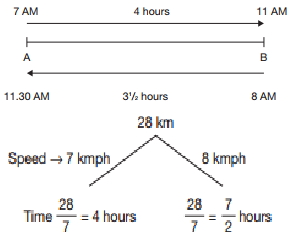
(D) Let the distance between station $A$ and $B$ be $28 \, km$ ($LCM$ of $4$ and $3.5$).
Speed of train from $A = \frac{28}{4} = 7 \, km/h$.
Speed of train from $B = \frac{28}{3.5} = 8 \, km/h$.
The train from $A$ starts at $7 \, am$. By $8 \, am$,it has traveled for $1$ hour.
Distance covered by train from $A$ in $1$ hour $= 7 \, km/h \times 1 \, h = 7 \, km$.
Remaining distance at $8 \, am = 28 - 7 = 21 \, km$.
Since the trains are moving towards each other,their relative speed $= 7 + 8 = 15 \, km/h$.
Time taken to cover the remaining distance $= \frac{21}{15} \, hours = \frac{7}{5} \, hours = 1 \, hour \, 24 \, minutes$.
Therefore,the trains cross each other at $8 \, am + 1 \, hour \, 24 \, minutes = 9:24 \, am$.
Speed of train from $A = \frac{28}{4} = 7 \, km/h$.
Speed of train from $B = \frac{28}{3.5} = 8 \, km/h$.
The train from $A$ starts at $7 \, am$. By $8 \, am$,it has traveled for $1$ hour.
Distance covered by train from $A$ in $1$ hour $= 7 \, km/h \times 1 \, h = 7 \, km$.
Remaining distance at $8 \, am = 28 - 7 = 21 \, km$.
Since the trains are moving towards each other,their relative speed $= 7 + 8 = 15 \, km/h$.
Time taken to cover the remaining distance $= \frac{21}{15} \, hours = \frac{7}{5} \, hours = 1 \, hour \, 24 \, minutes$.
Therefore,the trains cross each other at $8 \, am + 1 \, hour \, 24 \, minutes = 9:24 \, am$.
0 likes
View Solution305
EasyMCQ
$A$ train goes from Ballygunge to Sealdah at an average speed of $20 \text{ km/h}$ and comes back at an average speed of $30 \text{ km/h}$. The average speed of the train for the whole journey is (in $\text{km/h}$)
A
$27$
B
$26$
C
$25$
D
$24$
Solution
(D) When a body covers a certain distance at a speed of $x \text{ km/h}$ and returns the same distance at a speed of $y \text{ km/h}$,the average speed for the entire journey is given by the formula: $\text{Average Speed} = \frac{2xy}{x+y}$.
Here,$x = 20 \text{ km/h}$ and $y = 30 \text{ km/h}$.
Substituting these values into the formula:
$\text{Average Speed} = \frac{2 \times 20 \times 30}{20 + 30} \text{ km/h}$.
$\text{Average Speed} = \frac{1200}{50} \text{ km/h}$.
$\text{Average Speed} = 24 \text{ km/h}$.
Thus,the average speed of the train for the whole journey is $24 \text{ km/h}$.
Here,$x = 20 \text{ km/h}$ and $y = 30 \text{ km/h}$.
Substituting these values into the formula:
$\text{Average Speed} = \frac{2 \times 20 \times 30}{20 + 30} \text{ km/h}$.
$\text{Average Speed} = \frac{1200}{50} \text{ km/h}$.
$\text{Average Speed} = 24 \text{ km/h}$.
Thus,the average speed of the train for the whole journey is $24 \text{ km/h}$.
0 likes
View Solution306
EasyMCQ
$A$ certain distance is covered by a cyclist at a certain speed. If a jogger covers half the distance in double the time,the ratio of the speed of the jogger to that of the cyclist is
A
$1:4$
B
$4:1$
C
$1:2$
D
$2:1$
Solution
(A) Let the distance covered by the cyclist be $D$ and the time taken be $T$.
Then,the speed of the cyclist is $S_c = D / T$.
For the jogger,the distance covered is $D_j = D / 2$ and the time taken is $T_j = 2T$.
Therefore,the speed of the jogger is $S_j = D_j / T_j = (D / 2) / (2T) = D / (4T)$.
The ratio of the speed of the jogger to that of the cyclist is $S_j / S_c = (D / 4T) / (D / T) = 1 / 4$.
Thus,the ratio is $1:4$.
Then,the speed of the cyclist is $S_c = D / T$.
For the jogger,the distance covered is $D_j = D / 2$ and the time taken is $T_j = 2T$.
Therefore,the speed of the jogger is $S_j = D_j / T_j = (D / 2) / (2T) = D / (4T)$.
The ratio of the speed of the jogger to that of the cyclist is $S_j / S_c = (D / 4T) / (D / T) = 1 / 4$.
Thus,the ratio is $1:4$.
0 likes
View Solution307
MediumMCQ
The distance between places $A$ and $B$ is $999 \text{ km}$. An express train leaves place $A$ at $6:00 \text{ am}$ and runs at a speed of $55.5 \text{ km/h}$. The train stops on the way for $1 \text{ hour } 20 \text{ minutes}$. At what time does it reach place $B$ (in $\text{pm}$)?
A
$1:20$
B
$12:00$
C
$6:00$
D
$11:00$
Solution
(A) Step $1$: Calculate the travel time without stops.
$\text{Time} = \frac{\text{Distance}}{\text{Speed}} = \frac{999}{55.5} = 18 \text{ hours}$.
Step $2$: Add the duration of the stops.
$\text{Total time} = 18 \text{ hours} + 1 \text{ hour } 20 \text{ minutes} = 19 \text{ hours } 20 \text{ minutes}$.
Step $3$: Calculate the arrival time.
The train starts at $6:00 \text{ am}$. Adding $19 \text{ hours } 20 \text{ minutes}$ to $6:00 \text{ am}$:
$6:00 \text{ am} + 12 \text{ hours} = 6:00 \text{ pm}$.
Remaining time to add: $19 \text{ hours } 20 \text{ minutes} - 12 \text{ hours} = 7 \text{ hours } 20 \text{ minutes}$.
$6:00 \text{ pm} + 7 \text{ hours } 20 \text{ minutes} = 1:20 \text{ am}$ (next day).
Note: The question asks for the time in $\text{pm}$,but based on the calculation,the arrival is at $1:20 \text{ am}$. Given the options,$1:20$ is the correct numerical value.
$\text{Time} = \frac{\text{Distance}}{\text{Speed}} = \frac{999}{55.5} = 18 \text{ hours}$.
Step $2$: Add the duration of the stops.
$\text{Total time} = 18 \text{ hours} + 1 \text{ hour } 20 \text{ minutes} = 19 \text{ hours } 20 \text{ minutes}$.
Step $3$: Calculate the arrival time.
The train starts at $6:00 \text{ am}$. Adding $19 \text{ hours } 20 \text{ minutes}$ to $6:00 \text{ am}$:
$6:00 \text{ am} + 12 \text{ hours} = 6:00 \text{ pm}$.
Remaining time to add: $19 \text{ hours } 20 \text{ minutes} - 12 \text{ hours} = 7 \text{ hours } 20 \text{ minutes}$.
$6:00 \text{ pm} + 7 \text{ hours } 20 \text{ minutes} = 1:20 \text{ am}$ (next day).
Note: The question asks for the time in $\text{pm}$,but based on the calculation,the arrival is at $1:20 \text{ am}$. Given the options,$1:20$ is the correct numerical value.
0 likes
View Solution308
MediumMCQ
If a boy travels from his house to school at the rate of $4 \, km/h$,he reaches the school $10 \, minutes$ earlier than the scheduled time. However,if he walks at the rate of $3 \, km/h$,he reaches $10 \, minutes$ late. Find the distance of the school from his house (in $km$).
A
$5$
B
$4$
C
$6$
D
$4.5$
Solution
(B) Let the distance of the school from the house be $x \, km$.
Time taken at $4 \, km/h$ is $t_1 = \frac{x}{4} \, hours$.
Time taken at $3 \, km/h$ is $t_2 = \frac{x}{3} \, hours$.
The difference between the two times is $10 \, minutes$ early and $10 \, minutes$ late,which is $10 + 10 = 20 \, minutes$.
Converting $20 \, minutes$ into hours: $\frac{20}{60} = \frac{1}{3} \, hours$.
According to the problem:
$\frac{x}{3} - \frac{x}{4} = \frac{1}{3}$
Taking the least common multiple of $3$ and $4$,which is $12$:
$\frac{4x - 3x}{12} = \frac{1}{3}$
$\frac{x}{12} = \frac{1}{3}$
$x = \frac{12}{3} = 4 \, km$.
Therefore,the distance of the school from his house is $4 \, km$.
Time taken at $4 \, km/h$ is $t_1 = \frac{x}{4} \, hours$.
Time taken at $3 \, km/h$ is $t_2 = \frac{x}{3} \, hours$.
The difference between the two times is $10 \, minutes$ early and $10 \, minutes$ late,which is $10 + 10 = 20 \, minutes$.
Converting $20 \, minutes$ into hours: $\frac{20}{60} = \frac{1}{3} \, hours$.
According to the problem:
$\frac{x}{3} - \frac{x}{4} = \frac{1}{3}$
Taking the least common multiple of $3$ and $4$,which is $12$:
$\frac{4x - 3x}{12} = \frac{1}{3}$
$\frac{x}{12} = \frac{1}{3}$
$x = \frac{12}{3} = 4 \, km$.
Therefore,the distance of the school from his house is $4 \, km$.
0 likes
View Solution309
MediumMCQ
Two trains are running at a speed of $40 \, km/h$ and $20 \, km/h$ respectively in the same direction. The fast train completely passes a man sitting in the slow train in $5 \, seconds$. The length of the fast train is (in $m$):
A
$23 \frac{2}{9}$
B
$27$
C
$27 \frac{7}{9}$
D
$23$
Solution
(C) The relative speed of the two trains moving in the same direction is the difference of their speeds.
Relative speed $= (40 - 20) \, km/h = 20 \, km/h$.
To convert the speed from $km/h$ to $m/s$,multiply by $\frac{5}{18}$.
Relative speed in $m/s = 20 \times \frac{5}{18} = \frac{100}{18} = \frac{50}{9} \, m/s$.
The fast train passes a man sitting in the slow train,which means the distance covered is equal to the length of the fast train.
Length of the fast train $=$ Relative speed $\times$ Time.
Length $= \frac{50}{9} \times 5 = \frac{250}{9} \, m$.
Converting to a mixed fraction: $\frac{250}{9} = 27 \frac{7}{9} \, m$.
Relative speed $= (40 - 20) \, km/h = 20 \, km/h$.
To convert the speed from $km/h$ to $m/s$,multiply by $\frac{5}{18}$.
Relative speed in $m/s = 20 \times \frac{5}{18} = \frac{100}{18} = \frac{50}{9} \, m/s$.
The fast train passes a man sitting in the slow train,which means the distance covered is equal to the length of the fast train.
Length of the fast train $=$ Relative speed $\times$ Time.
Length $= \frac{50}{9} \times 5 = \frac{250}{9} \, m$.
Converting to a mixed fraction: $\frac{250}{9} = 27 \frac{7}{9} \, m$.
0 likes
View Solution310
MediumMCQ
$A$ boy started from his house by bicycle at $10:00 \, am$ at a speed of $12 \, km/h$. His elder brother started after $1 \, hour \, 15 \, minutes$ by scooter along the same path and caught him at $1:30 \, pm$. The speed of the scooter was (in $km/h$):
A
$4.5$
B
$36$
C
$18 \frac{2}{3}$
D
$9$
Solution
(C) The boy started at $10:00 \, am$ and was caught at $1:30 \, pm$. The total time taken by the boy is $3 \, hours \, 30 \, minutes = 3.5 \, hours = \frac{7}{2} \, hours$.
Distance covered by the boy = $\text{Speed} \times \text{Time} = 12 \times \frac{7}{2} = 42 \, km$.
The elder brother started $1 \, hour \, 15 \, minutes$ later,so his travel time is $3 \, hours \, 30 \, minutes - 1 \, hour \, 15 \, minutes = 2 \, hours \, 15 \, minutes = 2.25 \, hours = \frac{9}{4} \, hours$.
Since the distance covered by both is the same,let the speed of the scooter be $x \, km/h$.
$x \times \frac{9}{4} = 42$.
$x = \frac{42 \times 4}{9} = \frac{14 \times 4}{3} = \frac{56}{3} = 18 \frac{2}{3} \, km/h$.
Distance covered by the boy = $\text{Speed} \times \text{Time} = 12 \times \frac{7}{2} = 42 \, km$.
The elder brother started $1 \, hour \, 15 \, minutes$ later,so his travel time is $3 \, hours \, 30 \, minutes - 1 \, hour \, 15 \, minutes = 2 \, hours \, 15 \, minutes = 2.25 \, hours = \frac{9}{4} \, hours$.
Since the distance covered by both is the same,let the speed of the scooter be $x \, km/h$.
$x \times \frac{9}{4} = 42$.
$x = \frac{42 \times 4}{9} = \frac{14 \times 4}{3} = \frac{56}{3} = 18 \frac{2}{3} \, km/h$.
0 likes
View Solution311
EasyMCQ
$A$ person travels from $P$ to $Q$ at a speed of $40 \, km/h$ and returns from $Q$ to $P$ by increasing his speed by $50\%$. What is his average speed for the entire journey? (in $km/h$)
A
$36$
B
$45$
C
$48$
D
$50$
Solution
(C) The speed of the person from $P$ to $Q$ is $v_1 = 40 \, km/h$.
The speed of the person from $Q$ to $P$ is increased by $50\%$,so $v_2 = 40 + (50\% \text{ of } 40) = 40 + 20 = 60 \, km/h$.
The formula for average speed when the distance traveled is the same for both legs of the journey is $\text{Average Speed} = \frac{2v_1v_2}{v_1 + v_2}$.
Substituting the values: $\text{Average Speed} = \frac{2 \times 40 \times 60}{40 + 60} = \frac{4800}{100} = 48 \, km/h$.
The speed of the person from $Q$ to $P$ is increased by $50\%$,so $v_2 = 40 + (50\% \text{ of } 40) = 40 + 20 = 60 \, km/h$.
The formula for average speed when the distance traveled is the same for both legs of the journey is $\text{Average Speed} = \frac{2v_1v_2}{v_1 + v_2}$.
Substituting the values: $\text{Average Speed} = \frac{2 \times 40 \times 60}{40 + 60} = \frac{4800}{100} = 48 \, km/h$.
0 likes
View Solution312
MediumMCQ
$A$ $180\, m$ long train crosses another $270\, m$ long train running in the opposite direction in $10.8\, seconds$. If the speed of the first train is $60\, km/h$, what is the speed of the second train in $km/h$?
A
$80$
B
$90$
C
$150$
D
Cannot be determined
Solution
(B) Let the speed of the second train be $x\, km/h$.
Since the trains are moving in opposite directions, their relative speed is $(x + 60)\, km/h$.
To convert the relative speed into $m/s$, we multiply by $\frac{5}{18}$:
Relative speed $= (x + 60) \times \frac{5}{18}\, m/s$.
The total distance to be covered is the sum of the lengths of both trains:
Total distance $= 180\, m + 270\, m = 450\, m$.
Using the formula $\text{Distance} = \text{Speed} \times \text{Time}$:
$450 = (x + 60) \times \frac{5}{18} \times 10.8$.
$450 = (x + 60) \times 5 \times 0.6$.
$450 = (x + 60) \times 3$.
$150 = x + 60$.
$x = 150 - 60 = 90\, km/h$.
Since the trains are moving in opposite directions, their relative speed is $(x + 60)\, km/h$.
To convert the relative speed into $m/s$, we multiply by $\frac{5}{18}$:
Relative speed $= (x + 60) \times \frac{5}{18}\, m/s$.
The total distance to be covered is the sum of the lengths of both trains:
Total distance $= 180\, m + 270\, m = 450\, m$.
Using the formula $\text{Distance} = \text{Speed} \times \text{Time}$:
$450 = (x + 60) \times \frac{5}{18} \times 10.8$.
$450 = (x + 60) \times 5 \times 0.6$.
$450 = (x + 60) \times 3$.
$150 = x + 60$.
$x = 150 - 60 = 90\, km/h$.
0 likes
View Solution313
MediumMCQ
Paschim Express left Delhi for Mumbai at $14:30\, \text{hours}$ travelling at a speed of $60\, \text{km/h}$. August Kranti Express left Delhi for Mumbai on the same day at $16:30\, \text{hours}$ travelling at a speed of $80\, \text{km/h}$. How far away from Delhi will the two trains meet (stoppages excluded)? (in $\text{km}$)
A
$500$
B
$480$
C
$360$
D
$240$
Solution
(B) Let the two trains meet at a distance of $x\, \text{km}$ from Delhi.
The time taken by Paschim Express to cover $x\, \text{km}$ is $t_1 = \frac{x}{60}\, \text{hours}$.
The time taken by August Kranti Express to cover $x\, \text{km}$ is $t_2 = \frac{x}{80}\, \text{hours}$.
Since August Kranti Express starts $2\, \text{hours}$ later than Paschim Express $(16:30 - 14:30 = 2\, \text{hours})$,the difference in time taken is $2\, \text{hours}$.
Therefore,$\frac{x}{60} - \frac{x}{80} = 2$.
Taking the least common multiple of $60$ and $80$,which is $240$:
$\frac{4x - 3x}{240} = 2$.
$\frac{x}{240} = 2$.
$x = 480\, \text{km}$.
Thus,the two trains will meet at a distance of $480\, \text{km}$ from Delhi.
The time taken by Paschim Express to cover $x\, \text{km}$ is $t_1 = \frac{x}{60}\, \text{hours}$.
The time taken by August Kranti Express to cover $x\, \text{km}$ is $t_2 = \frac{x}{80}\, \text{hours}$.
Since August Kranti Express starts $2\, \text{hours}$ later than Paschim Express $(16:30 - 14:30 = 2\, \text{hours})$,the difference in time taken is $2\, \text{hours}$.
Therefore,$\frac{x}{60} - \frac{x}{80} = 2$.
Taking the least common multiple of $60$ and $80$,which is $240$:
$\frac{4x - 3x}{240} = 2$.
$\frac{x}{240} = 2$.
$x = 480\, \text{km}$.
Thus,the two trains will meet at a distance of $480\, \text{km}$ from Delhi.
0 likes
View Solution314
EasyMCQ
$A$ man starts from his home and walks $10 \, km$ towards South. Then he turns right and walks $6 \, km$,again he turns right and goes $10 \, km$. Finally,he turns right and walks $5 \, km$. At what distance is he from his starting point? (in $km$)
A
$31$
B
$2 \sqrt{101}$
C
$1$
D
$\sqrt{125}+\sqrt{136}$
Solution
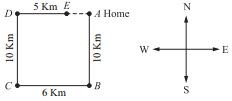
(C) Let the starting point be $A$.
$1$. The man walks $10 \, km$ South to reach point $B$.
$2$. He turns right (West) and walks $6 \, km$ to reach point $C$.
$3$. He turns right (North) and walks $10 \, km$ to reach point $D$.
$4$. Finally,he turns right (East) and walks $5 \, km$ to reach point $E$.
$5$. The distance from the starting point $A$ is $AE = AB - CD$ (if we consider the horizontal displacement) or more simply,looking at the diagram:
Horizontal distance from $A$ to $E$ is $6 \, km - 5 \, km = 1 \, km$.
Thus,the man is $1 \, km$ away from his starting point.
$1$. The man walks $10 \, km$ South to reach point $B$.
$2$. He turns right (West) and walks $6 \, km$ to reach point $C$.
$3$. He turns right (North) and walks $10 \, km$ to reach point $D$.
$4$. Finally,he turns right (East) and walks $5 \, km$ to reach point $E$.
$5$. The distance from the starting point $A$ is $AE = AB - CD$ (if we consider the horizontal displacement) or more simply,looking at the diagram:
Horizontal distance from $A$ to $E$ is $6 \, km - 5 \, km = 1 \, km$.
Thus,the man is $1 \, km$ away from his starting point.
0 likes
View Solution315
DifficultMCQ
If a train runs at $40 \text{ km/h}$,it reaches its destination late by $11 \text{ minutes}$,but if it runs at $50 \text{ km/h}$,it is late by $5 \text{ minutes}$ only. Find the correct time for the train to complete its journey (in minutes).
A
$19$
B
$20$
C
$21$
D
$18$
Solution
(A) Let the distance be $d \text{ km}$ and the scheduled time be $t \text{ minutes}$.
When the speed is $40 \text{ km/h}$,the time taken is $\frac{d}{40} \text{ hours} = \frac{60d}{40} \text{ minutes} = 1.5d \text{ minutes}$.
Given that the train is $11 \text{ minutes}$ late,we have: $1.5d = t + 11$ ... $(1)$
When the speed is $50 \text{ km/h}$,the time taken is $\frac{d}{50} \text{ hours} = \frac{60d}{50} \text{ minutes} = 1.2d \text{ minutes}$.
Given that the train is $5 \text{ minutes}$ late,we have: $1.2d = t + 5$ ... $(2)$
Subtracting equation $(2)$ from equation $(1)$:
$(1.5d - 1.2d) = (t + 11) - (t + 5)$
$0.3d = 6$
$d = \frac{6}{0.3} = 20 \text{ km}$.
Substituting $d = 20$ into equation $(1)$:
$1.5(20) = t + 11$
$30 = t + 11$
$t = 30 - 11 = 19 \text{ minutes}$.
Thus,the correct time is $19 \text{ minutes}$.
When the speed is $40 \text{ km/h}$,the time taken is $\frac{d}{40} \text{ hours} = \frac{60d}{40} \text{ minutes} = 1.5d \text{ minutes}$.
Given that the train is $11 \text{ minutes}$ late,we have: $1.5d = t + 11$ ... $(1)$
When the speed is $50 \text{ km/h}$,the time taken is $\frac{d}{50} \text{ hours} = \frac{60d}{50} \text{ minutes} = 1.2d \text{ minutes}$.
Given that the train is $5 \text{ minutes}$ late,we have: $1.2d = t + 5$ ... $(2)$
Subtracting equation $(2)$ from equation $(1)$:
$(1.5d - 1.2d) = (t + 11) - (t + 5)$
$0.3d = 6$
$d = \frac{6}{0.3} = 20 \text{ km}$.
Substituting $d = 20$ into equation $(1)$:
$1.5(20) = t + 11$
$30 = t + 11$
$t = 30 - 11 = 19 \text{ minutes}$.
Thus,the correct time is $19 \text{ minutes}$.
0 likes
View Solution316
MediumMCQ
$P$ and $Q$ are $27 \, km$ apart. Two trains with speeds of $24 \, km/h$ and $18 \, km/h$ respectively start simultaneously from $P$ and $Q$ and travel in the same direction. They meet at a point $R$ beyond $Q$. The distance $QR$ is (in $km$):
A
$126$
B
$81$
C
$48$
D
$36$
Solution
(B) Let the trains meet after $t$ hours.
The train starting from $P$ travels a distance $PR = 24t$.
The train starting from $Q$ travels a distance $QR = 18t$.
Since $P, Q,$ and $R$ are in a straight line with $R$ beyond $Q$,we have:
$PR - QR = PQ$
$24t - 18t = 27$
$6t = 27$
$t = \frac{27}{6} = 4.5 \text{ hours}$.
Therefore,the distance $QR = 18 \times 4.5 = 81 \, km$.
The train starting from $P$ travels a distance $PR = 24t$.
The train starting from $Q$ travels a distance $QR = 18t$.
Since $P, Q,$ and $R$ are in a straight line with $R$ beyond $Q$,we have:
$PR - QR = PQ$
$24t - 18t = 27$
$6t = 27$
$t = \frac{27}{6} = 4.5 \text{ hours}$.
Therefore,the distance $QR = 18 \times 4.5 = 81 \, km$.

0 likes
View Solution317
MediumMCQ
Two trains,$A$ and $B,$ start from stations $X$ and $Y$ towards $Y$ and $X$ respectively. After passing each other,they take $4\, \text{hours } 48\, \text{minutes}$ and $3\, \text{hours } 20\, \text{minutes}$ to reach $Y$ and $X$ respectively. If train $A$ is moving at $45\, \text{km/h},$ then the speed of train $B$ is (in $\text{km/h}$)
A
$60$
B
$64.8$
C
$54$
D
$37.5$
Solution
(C) Let the speed of train $A$ be $v_A = 45\, \text{km/h}$ and the speed of train $B$ be $v_B$.
Let $t_1$ be the time taken by train $A$ to reach $Y$ after passing $B$,and $t_2$ be the time taken by train $B$ to reach $X$ after passing $A$.
Given: $t_1 = 4\, \text{hours } 48\, \text{minutes} = 4 + \frac{48}{60} = 4 + \frac{4}{5} = \frac{24}{5}\, \text{hours}$.
Given: $t_2 = 3\, \text{hours } 20\, \text{minutes} = 3 + \frac{20}{60} = 3 + \frac{1}{3} = \frac{10}{3}\, \text{hours}$.
The formula for the ratio of speeds when two objects meet and then travel to their respective destinations is $\frac{v_A}{v_B} = \sqrt{\frac{t_2}{t_1}}$.
Substituting the values: $\frac{45}{v_B} = \sqrt{\frac{10/3}{24/5}} = \sqrt{\frac{10}{3} \times \frac{5}{24}} = \sqrt{\frac{50}{72}} = \sqrt{\frac{25}{36}} = \frac{5}{6}$.
Therefore,$5 \times v_B = 45 \times 6$.
$v_B = \frac{45 \times 6}{5} = 9 \times 6 = 54\, \text{km/h}$.
Let $t_1$ be the time taken by train $A$ to reach $Y$ after passing $B$,and $t_2$ be the time taken by train $B$ to reach $X$ after passing $A$.
Given: $t_1 = 4\, \text{hours } 48\, \text{minutes} = 4 + \frac{48}{60} = 4 + \frac{4}{5} = \frac{24}{5}\, \text{hours}$.
Given: $t_2 = 3\, \text{hours } 20\, \text{minutes} = 3 + \frac{20}{60} = 3 + \frac{1}{3} = \frac{10}{3}\, \text{hours}$.
The formula for the ratio of speeds when two objects meet and then travel to their respective destinations is $\frac{v_A}{v_B} = \sqrt{\frac{t_2}{t_1}}$.
Substituting the values: $\frac{45}{v_B} = \sqrt{\frac{10/3}{24/5}} = \sqrt{\frac{10}{3} \times \frac{5}{24}} = \sqrt{\frac{50}{72}} = \sqrt{\frac{25}{36}} = \frac{5}{6}$.
Therefore,$5 \times v_B = 45 \times 6$.
$v_B = \frac{45 \times 6}{5} = 9 \times 6 = 54\, \text{km/h}$.
0 likes
View Solution318
MediumMCQ
$A$ train covers a distance between station $A$ and station $B$ in $45\, minutes.$ If the speed of the train is reduced by $5\, km/h,$ then the same distance is covered in $48\, minutes.$ The distance between stations $A$ and $B$ is (in $km$):
A
$60$
B
$64$
C
$80$
D
$55$
Solution
(A) Let the distance between station $A$ and station $B$ be $x\, km.$
The time taken is $45\, minutes = \frac{45}{60} = \frac{3}{4}\, hours.$
The original speed of the train is $v = \frac{\text{Distance}}{\text{Time}} = \frac{x}{3/4} = \frac{4x}{3}\, km/h.$
According to the problem,if the speed is reduced by $5\, km/h,$ the new speed becomes $(\frac{4x}{3} - 5)\, km/h.$
The new time taken is $48\, minutes = \frac{48}{60} = \frac{4}{5}\, hours.$
Using the formula $\text{Distance} = \text{Speed} \times \text{Time}$:
$x = (\frac{4x}{3} - 5) \times \frac{4}{5}$
Multiplying both sides by $5$:
$5x = (\frac{4x}{3} - 5) \times 4$
$5x = \frac{16x}{3} - 20$
Multiplying by $3$ to clear the denominator:
$15x = 16x - 60$
$60 = 16x - 15x$
$x = 60\, km.$
Thus,the distance between the stations is $60\, km.$
The time taken is $45\, minutes = \frac{45}{60} = \frac{3}{4}\, hours.$
The original speed of the train is $v = \frac{\text{Distance}}{\text{Time}} = \frac{x}{3/4} = \frac{4x}{3}\, km/h.$
According to the problem,if the speed is reduced by $5\, km/h,$ the new speed becomes $(\frac{4x}{3} - 5)\, km/h.$
The new time taken is $48\, minutes = \frac{48}{60} = \frac{4}{5}\, hours.$
Using the formula $\text{Distance} = \text{Speed} \times \text{Time}$:
$x = (\frac{4x}{3} - 5) \times \frac{4}{5}$
Multiplying both sides by $5$:
$5x = (\frac{4x}{3} - 5) \times 4$
$5x = \frac{16x}{3} - 20$
Multiplying by $3$ to clear the denominator:
$15x = 16x - 60$
$60 = 16x - 15x$
$x = 60\, km.$
Thus,the distance between the stations is $60\, km.$
0 likes
View Solution319
MediumMCQ
The fare of a bus is $Rs. X$ for the first five kilometres and $Rs. 13$ per kilometer thereafter. If a passenger pays $Rs. 2402$ for a journey of $187$ kilometres,what is the value of $X$? (in $Rs.$)
A
$29$
B
$39$
C
$36$
D
$31$
Solution
(C) Let the fare for the first five kilometres be $Rs. X$.
Total distance of the journey $= 187 \text{ km}$.
The fare for the first $5 \text{ km}$ is $X$.
The remaining distance $= 187 - 5 = 182 \text{ km}$.
The fare for the remaining distance at the rate of $Rs. 13$ per kilometer is $182 \times 13 = 2366$.
According to the problem,the total fare is $Rs. 2402$.
So,$X + 2366 = 2402$.
$X = 2402 - 2366$.
$X = 36$.
Therefore,the value of $X$ is $Rs. 36$.
Total distance of the journey $= 187 \text{ km}$.
The fare for the first $5 \text{ km}$ is $X$.
The remaining distance $= 187 - 5 = 182 \text{ km}$.
The fare for the remaining distance at the rate of $Rs. 13$ per kilometer is $182 \times 13 = 2366$.
According to the problem,the total fare is $Rs. 2402$.
So,$X + 2366 = 2402$.
$X = 2402 - 2366$.
$X = 36$.
Therefore,the value of $X$ is $Rs. 36$.
0 likes
View Solution320
DifficultMCQ
$A$ $320\, m$ long train moving at an average speed of $120\, km/h$ crosses a platform in $24\, seconds$. $A$ man crosses the same platform in $4\, minutes$. What is the speed of the man in $m/s$?
A
$2.4$
B
$1.5$
C
$1.6$
D
$2.0$
Solution
(D) Speed of the train $= 120\, km/h$.
Converting to $m/s$: $120 \times \frac{5}{18} = \frac{100}{3}\, m/s$.
Let the length of the platform be $x\, m$.
When the train crosses the platform,the total distance covered is $(x + 320)\, m$.
Using the formula $\text{Distance} = \text{Speed} \times \text{Time}$:
$x + 320 = \frac{100}{3} \times 24$.
$x + 320 = 100 \times 8 = 800$.
$x = 800 - 320 = 480\, m$.
The man crosses the same platform $(480\, m)$ in $4\, minutes$.
Time in seconds $= 4 \times 60 = 240\, s$.
Speed of the man $= \frac{\text{Distance}}{\text{Time}} = \frac{480}{240} = 2\, m/s$.
Converting to $m/s$: $120 \times \frac{5}{18} = \frac{100}{3}\, m/s$.
Let the length of the platform be $x\, m$.
When the train crosses the platform,the total distance covered is $(x + 320)\, m$.
Using the formula $\text{Distance} = \text{Speed} \times \text{Time}$:
$x + 320 = \frac{100}{3} \times 24$.
$x + 320 = 100 \times 8 = 800$.
$x = 800 - 320 = 480\, m$.
The man crosses the same platform $(480\, m)$ in $4\, minutes$.
Time in seconds $= 4 \times 60 = 240\, s$.
Speed of the man $= \frac{\text{Distance}}{\text{Time}} = \frac{480}{240} = 2\, m/s$.
0 likes
View Solution321
EasyMCQ
The average speed of a car is $1 \frac{4}{5}$ times the average speed of a bus. $A$ tractor covers $575 \text{ km}$ in $23 \text{ hours}$. How much distance will the car cover in $4 \text{ hours}$ if the speed of the bus is twice the speed of the tractor? (in $\text{km}$)
A
$340$
B
$480$
C
$360$
D
$450$
Solution
(C) Average speed of a tractor $= \frac{575 \text{ km}}{23 \text{ hours}} = 25 \text{ km/h}$.
The speed of a bus is twice the speed of the tractor,so speed of bus $= 25 \times 2 = 50 \text{ km/h}$.
The average speed of a car is $1 \frac{4}{5} = \frac{9}{5}$ times the average speed of a bus,so speed of car $= 50 \times \frac{9}{5} = 90 \text{ km/h}$.
Distance covered by the car in $4 \text{ hours} = \text{speed} \times \text{time} = 90 \times 4 = 360 \text{ km}$.
The speed of a bus is twice the speed of the tractor,so speed of bus $= 25 \times 2 = 50 \text{ km/h}$.
The average speed of a car is $1 \frac{4}{5} = \frac{9}{5}$ times the average speed of a bus,so speed of car $= 50 \times \frac{9}{5} = 90 \text{ km/h}$.
Distance covered by the car in $4 \text{ hours} = \text{speed} \times \text{time} = 90 \times 4 = 360 \text{ km}$.
0 likes
View Solution322
MediumMCQ
Train $A$ crosses a pole in $25 \text{ seconds}$ and another Train $B$ crosses a pole in $1 \text{ minute}$ and $15 \text{ seconds}$. The length of Train $A$ is half the length of Train $B$. What is the respective ratio between the speeds of Train $A$ and Train $B$?
A
$3:2$
B
$3:4$
C
$4:3$
D
Cannot be determined
Solution
(A) Let the length of Train $B$ be $x \text{ m}$.
Then the length of Train $A$ is $\frac{x}{2} \text{ m}$.
Time taken by Train $A$ = $25 \text{ seconds}$.
Time taken by Train $B$ = $1 \text{ minute } 15 \text{ seconds} = 60 + 15 = 75 \text{ seconds}$.
Speed of Train $A$ = $\frac{\text{Distance}}{\text{Time}} = \frac{x/2}{25} = \frac{x}{50} \text{ m/s}$.
Speed of Train $B$ = $\frac{\text{Distance}}{\text{Time}} = \frac{x}{75} \text{ m/s}$.
Ratio of speed of Train $A$ to Train $B$ = $\frac{x/50}{x/75} = \frac{75}{50} = \frac{3}{2} = 3:2$.
Then the length of Train $A$ is $\frac{x}{2} \text{ m}$.
Time taken by Train $A$ = $25 \text{ seconds}$.
Time taken by Train $B$ = $1 \text{ minute } 15 \text{ seconds} = 60 + 15 = 75 \text{ seconds}$.
Speed of Train $A$ = $\frac{\text{Distance}}{\text{Time}} = \frac{x/2}{25} = \frac{x}{50} \text{ m/s}$.
Speed of Train $B$ = $\frac{\text{Distance}}{\text{Time}} = \frac{x}{75} \text{ m/s}$.
Ratio of speed of Train $A$ to Train $B$ = $\frac{x/50}{x/75} = \frac{75}{50} = \frac{3}{2} = 3:2$.
0 likes
View Solution323
DifficultMCQ
$A$ car covers $\frac{1}{5}$ of the distance from $A$ to $B$ at the speed of $8 \, km/h$,$\frac{1}{10}$ of the distance at $25 \, km/h$,and the remaining at the speed of $20 \, km/h$. Find the average speed of the whole journey in $km/h$. (in $.625$)
A
$12$
B
$13$
C
$14$
D
$15$
Solution
(D) Let the total distance be $D = 1 \, km$.
Time taken for the first part $(t_1)$ $= \frac{1/5}{8} = \frac{1}{40} \, h$.
Time taken for the second part $(t_2)$ $= \frac{1/10}{25} = \frac{1}{250} \, h$.
Remaining distance $= 1 - (\frac{1}{5} + \frac{1}{10}) = 1 - \frac{3}{10} = \frac{7}{10} \, km$.
Time taken for the remaining part $(t_3)$ $= \frac{7/10}{20} = \frac{7}{200} \, h$.
Total time taken $(T)$ $= t_1 + t_2 + t_3 = \frac{1}{40} + \frac{1}{250} + \frac{7}{200}$.
Finding a common denominator $(1000)$: $T = \frac{25}{1000} + \frac{4}{1000} + \frac{35}{1000} = \frac{64}{1000} = \frac{8}{125} \, h$.
Average speed $= \frac{\text{Total distance}}{\text{Total time}} = \frac{1}{8/125} = \frac{125}{8} = 15.625 \, km/h$.
Time taken for the first part $(t_1)$ $= \frac{1/5}{8} = \frac{1}{40} \, h$.
Time taken for the second part $(t_2)$ $= \frac{1/10}{25} = \frac{1}{250} \, h$.
Remaining distance $= 1 - (\frac{1}{5} + \frac{1}{10}) = 1 - \frac{3}{10} = \frac{7}{10} \, km$.
Time taken for the remaining part $(t_3)$ $= \frac{7/10}{20} = \frac{7}{200} \, h$.
Total time taken $(T)$ $= t_1 + t_2 + t_3 = \frac{1}{40} + \frac{1}{250} + \frac{7}{200}$.
Finding a common denominator $(1000)$: $T = \frac{25}{1000} + \frac{4}{1000} + \frac{35}{1000} = \frac{64}{1000} = \frac{8}{125} \, h$.
Average speed $= \frac{\text{Total distance}}{\text{Total time}} = \frac{1}{8/125} = \frac{125}{8} = 15.625 \, km/h$.
0 likes
View Solution324
EasyMCQ
Walking at $3 \, km/h$,Pintu reaches his school $5 \, minutes$ late. If he walks at $4 \, km/h$,he will be $5 \, minutes$ early. The distance of Pintu's school from his house is (in $km$):
A
$1\frac{1}{2}$
B
$2$
C
$2\frac{1}{2}$
D
$5$
Solution
(B) Let the distance of the school from his house be $x \, km$.
The time taken to reach school at $3 \, km/h$ is $t_1 = \frac{x}{3} \, hours$.
The time taken to reach school at $4 \, km/h$ is $t_2 = \frac{x}{4} \, hours$.
According to the problem,the difference between these two times is $5 \, minutes$ late and $5 \, minutes$ early,which totals $10 \, minutes$.
Converting $10 \, minutes$ to hours: $10 \, minutes = \frac{10}{60} \, hours = \frac{1}{6} \, hours$.
Therefore,the equation is:
$\frac{x}{3} - \frac{x}{4} = \frac{1}{6}$
Taking the least common multiple $(LCM)$ of $3$ and $4$,which is $12$:
$\frac{4x - 3x}{12} = \frac{1}{6}$
$\frac{x}{12} = \frac{1}{6}$
$x = \frac{12}{6} = 2 \, km$.
Thus,the distance of the school from his house is $2 \, km$.
The time taken to reach school at $3 \, km/h$ is $t_1 = \frac{x}{3} \, hours$.
The time taken to reach school at $4 \, km/h$ is $t_2 = \frac{x}{4} \, hours$.
According to the problem,the difference between these two times is $5 \, minutes$ late and $5 \, minutes$ early,which totals $10 \, minutes$.
Converting $10 \, minutes$ to hours: $10 \, minutes = \frac{10}{60} \, hours = \frac{1}{6} \, hours$.
Therefore,the equation is:
$\frac{x}{3} - \frac{x}{4} = \frac{1}{6}$
Taking the least common multiple $(LCM)$ of $3$ and $4$,which is $12$:
$\frac{4x - 3x}{12} = \frac{1}{6}$
$\frac{x}{12} = \frac{1}{6}$
$x = \frac{12}{6} = 2 \, km$.
Thus,the distance of the school from his house is $2 \, km$.
0 likes
View Solution325
EasyMCQ
$A$ man driving at $\frac{3}{4}$ of his original speed reaches his destination $20 \text{ minutes}$ later than the usual time. Then the usual time is (in $\text{minutes}$)
A
$45$
B
$60$
C
$75$
D
$120$
Solution
(B) Let the usual speed be $v$ and the usual time taken be $t$.
Since the distance $d$ is constant,$d = v \times t$.
When the man drives at $\frac{3}{4}$ of his original speed,the new speed is $v' = \frac{3}{4}v$.
The new time taken is $t' = t + 20$.
Since $d = v' \times t'$,we have $v \times t = \frac{3}{4}v \times (t + 20)$.
Dividing both sides by $v$,we get $t = \frac{3}{4}(t + 20)$.
$4t = 3t + 60$.
$t = 60 \text{ minutes}$.
Thus,the usual time is $60 \text{ minutes}$.
Since the distance $d$ is constant,$d = v \times t$.
When the man drives at $\frac{3}{4}$ of his original speed,the new speed is $v' = \frac{3}{4}v$.
The new time taken is $t' = t + 20$.
Since $d = v' \times t'$,we have $v \times t = \frac{3}{4}v \times (t + 20)$.
Dividing both sides by $v$,we get $t = \frac{3}{4}(t + 20)$.
$4t = 3t + 60$.
$t = 60 \text{ minutes}$.
Thus,the usual time is $60 \text{ minutes}$.
0 likes
View Solution326
MediumMCQ
What is the speed of the train in $km/h$?
Statements:
$I.$ The train crosses an $x$ meter-long platform in $n$ seconds.
$II.$ The length of the train is $y$ meters.
$III.$ The train crosses a signal pole in $m$ seconds.
Statements:
$I.$ The train crosses an $x$ meter-long platform in $n$ seconds.
$II.$ The length of the train is $y$ meters.
$III.$ The train crosses a signal pole in $m$ seconds.
A
Any two of the three
B
Only $II.$ and $III.$
C
Only $I.$ and $III.$
D
Question cannot be answered even with information in all three statements.
Solution
(D) Let the length of the train be $L$ meters and its speed be $v$ $m/s$.
From statement $II$,we know $L = y$.
From statement $III$,the train crosses a signal pole in $m$ seconds. The distance covered is the length of the train $(y)$. Thus,$v = y/m$ $m/s$.
From statement $I$,the train crosses a platform of length $x$ in $n$ seconds. The total distance covered is $(x + y)$. Thus,$v = (x + y)/n$ $m/s$.
While we can express the speed $v$ using statements $II$ and $III$ (or $I$ and $II$),the variables $x, y, n, m$ are not defined as numerical values. Without specific numerical values for these variables,the speed cannot be calculated as a specific numerical value in $km/h$. Therefore,the question cannot be answered.
From statement $II$,we know $L = y$.
From statement $III$,the train crosses a signal pole in $m$ seconds. The distance covered is the length of the train $(y)$. Thus,$v = y/m$ $m/s$.
From statement $I$,the train crosses a platform of length $x$ in $n$ seconds. The total distance covered is $(x + y)$. Thus,$v = (x + y)/n$ $m/s$.
While we can express the speed $v$ using statements $II$ and $III$ (or $I$ and $II$),the variables $x, y, n, m$ are not defined as numerical values. Without specific numerical values for these variables,the speed cannot be calculated as a specific numerical value in $km/h$. Therefore,the question cannot be answered.
0 likes
View Solution327
EasyMCQ
The average speed of a train is $1 \frac{3}{7}$ times the average speed of a car. The car covers a distance of $588 \text{ km}$ in $6 \text{ hours}$. How much distance will the train cover in $13 \text{ hours}$? (in $\text{km}$)
A
$1750$
B
$1760$
C
$1720$
D
$1820$
Solution
(D) Step $1$: Calculate the speed of the car.
$\text{Speed of the car} = \frac{\text{Distance}}{\text{Time}} = \frac{588 \text{ km}}{6 \text{ hours}} = 98 \text{ km/h}$.
Step $2$: Calculate the speed of the train.
The speed of the train is $1 \frac{3}{7} = \frac{10}{7}$ times the speed of the car.
$\text{Speed of the train} = \frac{10}{7} \times 98 \text{ km/h} = 10 \times 14 \text{ km/h} = 140 \text{ km/h}$.
Step $3$: Calculate the distance covered by the train in $13 \text{ hours}$.
$\text{Distance} = \text{Speed} \times \text{Time} = 140 \text{ km/h} \times 13 \text{ hours} = 1820 \text{ km}$.
$\text{Speed of the car} = \frac{\text{Distance}}{\text{Time}} = \frac{588 \text{ km}}{6 \text{ hours}} = 98 \text{ km/h}$.
Step $2$: Calculate the speed of the train.
The speed of the train is $1 \frac{3}{7} = \frac{10}{7}$ times the speed of the car.
$\text{Speed of the train} = \frac{10}{7} \times 98 \text{ km/h} = 10 \times 14 \text{ km/h} = 140 \text{ km/h}$.
Step $3$: Calculate the distance covered by the train in $13 \text{ hours}$.
$\text{Distance} = \text{Speed} \times \text{Time} = 140 \text{ km/h} \times 13 \text{ hours} = 1820 \text{ km}$.
0 likes
View Solution328
EasyMCQ
$A$ car covers the first $39 \, km$ of its journey in $45 \, minutes$ and the remaining $25 \, km$ in $35 \, minutes$. What is the average speed of the car in $km/h$?
A
$40$
B
$64$
C
$49$
D
$48$
Solution
(D) Average speed is defined as the ratio of the total distance covered to the total time taken.
Total distance $= 39 \, km + 25 \, km = 64 \, km$.
Total time $= 45 \, minutes + 35 \, minutes = 80 \, minutes$.
To convert the time into hours,divide by $60$: $80 \, minutes = \frac{80}{60} \, hours = \frac{4}{3} \, hours$.
Average speed $= \frac{\text{Total distance}}{\text{Total time}} = \frac{64 \, km}{(4/3) \, h} = 64 \times \frac{3}{4} \, km/h = 16 \times 3 \, km/h = 48 \, km/h$.
Total distance $= 39 \, km + 25 \, km = 64 \, km$.
Total time $= 45 \, minutes + 35 \, minutes = 80 \, minutes$.
To convert the time into hours,divide by $60$: $80 \, minutes = \frac{80}{60} \, hours = \frac{4}{3} \, hours$.
Average speed $= \frac{\text{Total distance}}{\text{Total time}} = \frac{64 \, km}{(4/3) \, h} = 64 \times \frac{3}{4} \, km/h = 16 \times 3 \, km/h = 48 \, km/h$.
0 likes
View Solution329
MediumMCQ
The ratio of the speed of a bus to that of a train is $15: 27$. Also,a car covered a distance of $720 \text{ km}$ in $9 \text{ hours}$. The speed of the bus is $\frac{3}{4}$ the speed of the car. How much distance will the train cover in $7 \text{ hours}$? (in $\text{km}$)
A
$760$
B
$756$
C
$740$
D
Cannot be determined
Solution
(B) Speed of the car $= \frac{\text{Distance}}{\text{Time}} = \frac{720 \text{ km}}{9 \text{ h}} = 80 \text{ km/h}$.
Speed of the bus $= \frac{3}{4} \times 80 \text{ km/h} = 60 \text{ km/h}$.
Given the ratio of the speed of the bus to the train is $15:27$,we have $\frac{\text{Speed of bus}}{\text{Speed of train}} = \frac{15}{27}$.
Speed of the train $= \frac{27}{15} \times 60 \text{ km/h} = 27 \times 4 = 108 \text{ km/h}$.
Distance covered by the train in $7 \text{ hours} = \text{Speed} \times \text{Time} = 108 \text{ km/h} \times 7 \text{ h} = 756 \text{ km}$.
Speed of the bus $= \frac{3}{4} \times 80 \text{ km/h} = 60 \text{ km/h}$.
Given the ratio of the speed of the bus to the train is $15:27$,we have $\frac{\text{Speed of bus}}{\text{Speed of train}} = \frac{15}{27}$.
Speed of the train $= \frac{27}{15} \times 60 \text{ km/h} = 27 \times 4 = 108 \text{ km/h}$.
Distance covered by the train in $7 \text{ hours} = \text{Speed} \times \text{Time} = 108 \text{ km/h} \times 7 \text{ h} = 756 \text{ km}$.
0 likes
View Solution330
EasyMCQ
The call rate of a $SIM$ of Company $A$ is one paisa for every three seconds. Another $SIM$ of Company $B$ charges $45 \text{ paisa per minute}$. $A$ man talked for $591 \text{ seconds}$ from the $SIM$ of Company $A$ and $780 \text{ seconds}$ from the $SIM$ of Company $B$. What would be the total amount he spent? (in $Rs.$)
A
$7.80$
B
$7.40$
C
$7.46$
D
$7.82$
Solution
(D) For Company $A$: The rate is $1 \text{ paisa}$ per $3 \text{ seconds}$.
Total time spent $= 591 \text{ seconds}$.
Cost for Company $A = \frac{591}{3} = 197 \text{ paisa}$.
For Company $B$: The rate is $45 \text{ paisa}$ per $60 \text{ seconds}$ $(1 \text{ minute})$.
Total time spent $= 780 \text{ seconds}$.
Cost for Company $B = \frac{45}{60} \times 780 = 45 \times 13 = 585 \text{ paisa}$.
Total amount spent $= 197 + 585 = 782 \text{ paisa}$.
Since $100 \text{ paisa} = 1 \text{ Rs.}$,the total amount is $7.82 \text{ Rs.}$
Total time spent $= 591 \text{ seconds}$.
Cost for Company $A = \frac{591}{3} = 197 \text{ paisa}$.
For Company $B$: The rate is $45 \text{ paisa}$ per $60 \text{ seconds}$ $(1 \text{ minute})$.
Total time spent $= 780 \text{ seconds}$.
Cost for Company $B = \frac{45}{60} \times 780 = 45 \times 13 = 585 \text{ paisa}$.
Total amount spent $= 197 + 585 = 782 \text{ paisa}$.
Since $100 \text{ paisa} = 1 \text{ Rs.}$,the total amount is $7.82 \text{ Rs.}$
0 likes
View Solution331
MediumMCQ
$A$ $280 \, m$ long train moving with an average speed of $108 \, km/h$ crosses a platform in $12 \, s$. $A$ man crosses the same platform in $10 \, s$. What is the speed of the man in $m/s$?
A
$5$
B
$8$
C
$12$
D
Cannot be determined
Solution
(B) First,convert the speed of the train from $km/h$ to $m/s$:
$108 \, km/h = 108 \times \frac{5}{18} = 30 \, m/s$.
Let the length of the platform be $L \, m$.
When the train crosses the platform,the total distance covered is the sum of the length of the train and the length of the platform:
$\text{Speed} = \frac{\text{Total Distance}}{\text{Time}}$
$30 = \frac{280 + L}{12}$
$360 = 280 + L$
$L = 360 - 280 = 80 \, m$.
The man crosses the same platform of length $80 \, m$ in $10 \, s$. Assuming the man's length is negligible:
$\text{Speed of the man} = \frac{\text{Length of platform}}{\text{Time}} = \frac{80}{10} = 8 \, m/s$.
$108 \, km/h = 108 \times \frac{5}{18} = 30 \, m/s$.
Let the length of the platform be $L \, m$.
When the train crosses the platform,the total distance covered is the sum of the length of the train and the length of the platform:
$\text{Speed} = \frac{\text{Total Distance}}{\text{Time}}$
$30 = \frac{280 + L}{12}$
$360 = 280 + L$
$L = 360 - 280 = 80 \, m$.
The man crosses the same platform of length $80 \, m$ in $10 \, s$. Assuming the man's length is negligible:
$\text{Speed of the man} = \frac{\text{Length of platform}}{\text{Time}} = \frac{80}{10} = 8 \, m/s$.
0 likes
View Solution332
MediumMCQ
The average speed of a car is $1 \frac{4}{5}$ times the average speed of a bus. $A$ tractor covers $575 \, km$ in $23 \, hours$. How much distance will the car cover in $4 \, hours$ if the speed of the bus is twice the speed of the tractor? (in $km$)
A
$340$
B
$480$
C
$360$
D
$450$
Solution
(C) Step $1$: Calculate the speed of the tractor.
Speed of the tractor $= \frac{\text{Distance}}{\text{Time}} = \frac{575 \, km}{23 \, hours} = 25 \, km/h$.
Step $2$: Calculate the speed of the bus.
Given that the speed of the bus is twice the speed of the tractor.
Speed of the bus $= 2 \times 25 \, km/h = 50 \, km/h$.
Step $3$: Calculate the speed of the car.
The average speed of the car is $1 \frac{4}{5} = \frac{9}{5}$ times the speed of the bus.
Speed of the car $= \frac{9}{5} \times 50 \, km/h = 90 \, km/h$.
Step $4$: Calculate the distance covered by the car in $4 \, hours$.
Distance $= \text{Speed} \times \text{Time} = 90 \, km/h \times 4 \, hours = 360 \, km$.
Speed of the tractor $= \frac{\text{Distance}}{\text{Time}} = \frac{575 \, km}{23 \, hours} = 25 \, km/h$.
Step $2$: Calculate the speed of the bus.
Given that the speed of the bus is twice the speed of the tractor.
Speed of the bus $= 2 \times 25 \, km/h = 50 \, km/h$.
Step $3$: Calculate the speed of the car.
The average speed of the car is $1 \frac{4}{5} = \frac{9}{5}$ times the speed of the bus.
Speed of the car $= \frac{9}{5} \times 50 \, km/h = 90 \, km/h$.
Step $4$: Calculate the distance covered by the car in $4 \, hours$.
Distance $= \text{Speed} \times \text{Time} = 90 \, km/h \times 4 \, hours = 360 \, km$.
0 likes
View Solution333
MediumMCQ
$A$ car covers the first $39 \, km$ of its journey in $45 \, minutes$ and the remaining $25 \, km$ in $35 \, minutes.$ What is the average speed of the car (in $km/h$)?
A
$40$
B
$64$
C
$49$
D
$48$
Solution
(D) Average speed is defined as the ratio of total distance covered to the total time taken.
Total distance $= 39 \, km + 25 \, km = 64 \, km$.
Total time $= 45 \, minutes + 35 \, minutes = 80 \, minutes$.
To convert the time into hours,divide by $60$: Total time $= \frac{80}{60} \, hours = \frac{4}{3} \, hours$.
Average speed $= \frac{\text{Total distance}}{\text{Total time}} = \frac{64 \, km}{\frac{4}{3} \, hours} = 64 \times \frac{3}{4} \, km/h = 16 \times 3 \, km/h = 48 \, km/h$.
Total distance $= 39 \, km + 25 \, km = 64 \, km$.
Total time $= 45 \, minutes + 35 \, minutes = 80 \, minutes$.
To convert the time into hours,divide by $60$: Total time $= \frac{80}{60} \, hours = \frac{4}{3} \, hours$.
Average speed $= \frac{\text{Total distance}}{\text{Total time}} = \frac{64 \, km}{\frac{4}{3} \, hours} = 64 \times \frac{3}{4} \, km/h = 16 \times 3 \, km/h = 48 \, km/h$.
0 likes
View Solution334
MediumMCQ
$A$ train,$300 \, m$ long,passes a man walking along the line in the same direction at the rate of $3 \, km/h$ in $33 \, s$. The speed of the train is (in $km/h$):
A
$30$
B
$2$
C
$32 \frac{8}{11}$
D
$35 \frac{8}{11}$
Solution
(D) Let the speed of the train be $x \, km/h$.
Since the man is walking in the same direction,the relative speed is $(x - 3) \, km/h$.
To convert the relative speed into $m/s$,we multiply by $\frac{5}{18}$. So,relative speed $= (x - 3) \times \frac{5}{18} \, m/s$.
The distance covered by the train to pass the man is equal to its own length,which is $300 \, m$.
Using the formula $\text{Speed} = \frac{\text{Distance}}{\text{Time}}$,we have:
$(x - 3) \times \frac{5}{18} = \frac{300}{33}$
$(x - 3) = \frac{300}{33} \times \frac{18}{5}$
$(x - 3) = \frac{60}{11} \times 6 = \frac{360}{11} = 32 \frac{8}{11}$
$x = 32 \frac{8}{11} + 3 = 35 \frac{8}{11} \, km/h$.
Since the man is walking in the same direction,the relative speed is $(x - 3) \, km/h$.
To convert the relative speed into $m/s$,we multiply by $\frac{5}{18}$. So,relative speed $= (x - 3) \times \frac{5}{18} \, m/s$.
The distance covered by the train to pass the man is equal to its own length,which is $300 \, m$.
Using the formula $\text{Speed} = \frac{\text{Distance}}{\text{Time}}$,we have:
$(x - 3) \times \frac{5}{18} = \frac{300}{33}$
$(x - 3) = \frac{300}{33} \times \frac{18}{5}$
$(x - 3) = \frac{60}{11} \times 6 = \frac{360}{11} = 32 \frac{8}{11}$
$x = 32 \frac{8}{11} + 3 = 35 \frac{8}{11} \, km/h$.
0 likes
View Solution335
EasyMCQ
Buses start from a bus terminal with a speed of $20 \text{ km/h}$ at intervals of $10 \text{ mins}$. What is the speed of a man coming from the opposite direction towards the bus terminal if he meets the buses at intervals of $8 \text{ mins}$? (in $\text{km/h}$)
A
$3$
B
$4$
C
$5$
D
$7$
Solution
(C) Let the speed of the buses be $v_b = 20 \text{ km/h}$ and the speed of the man be $v_m = x \text{ km/h}$.
The distance between two consecutive buses is the distance covered by a bus in $10 \text{ minutes}$.
Distance $D = v_b \times \text{time} = 20 \times (10/60) \text{ km} = 20/6 \text{ km} = 10/3 \text{ km}$.
When the man moves in the opposite direction,the relative speed of the man with respect to the bus is $(v_b + v_m) = (20 + x) \text{ km/h}$.
The man meets the buses at intervals of $8 \text{ minutes}$,which means the distance $D$ is covered by the relative speed in $8 \text{ minutes}$.
$D = (v_b + v_m) \times \text{time interval}$.
$10/3 = (20 + x) \times (8/60)$.
$10/3 = (20 + x) \times (2/15)$.
Multiply both sides by $15/2$:
$(10/3) \times (15/2) = 20 + x$.
$5 \times 5 = 20 + x$.
$25 = 20 + x$.
$x = 5 \text{ km/h}$.
The distance between two consecutive buses is the distance covered by a bus in $10 \text{ minutes}$.
Distance $D = v_b \times \text{time} = 20 \times (10/60) \text{ km} = 20/6 \text{ km} = 10/3 \text{ km}$.
When the man moves in the opposite direction,the relative speed of the man with respect to the bus is $(v_b + v_m) = (20 + x) \text{ km/h}$.
The man meets the buses at intervals of $8 \text{ minutes}$,which means the distance $D$ is covered by the relative speed in $8 \text{ minutes}$.
$D = (v_b + v_m) \times \text{time interval}$.
$10/3 = (20 + x) \times (8/60)$.
$10/3 = (20 + x) \times (2/15)$.
Multiply both sides by $15/2$:
$(10/3) \times (15/2) = 20 + x$.
$5 \times 5 = 20 + x$.
$25 = 20 + x$.
$x = 5 \text{ km/h}$.
0 likes
View Solution336
EasyMCQ
Car $A$ runs at the speed of $65 \text{ km/h}$ and reaches its destination in $8 \text{ hours}$. Car $B$ runs at the speed of $70 \text{ km/h}$ and reaches its destination in $4 \text{ hours}$. What is the respective ratio of distances covered by Car $A$ and Car $B$?
A
$11:7$
B
$7:13$
C
$13:7$
D
$7:11$
Solution
(C) Distance travelled by Car $A = \text{Speed} \times \text{Time} = 65 \text{ km/h} \times 8 \text{ h} = 520 \text{ km}$.
Distance travelled by Car $B = \text{Speed} \times \text{Time} = 70 \text{ km/h} \times 4 \text{ h} = 280 \text{ km}$.
The ratio of distances covered by Car $A$ to Car $B$ is $\frac{520}{280}$.
Simplifying the fraction: $\frac{520}{280} = \frac{52}{28} = \frac{13}{7}$.
Thus, the ratio is $13:7$.
Distance travelled by Car $B = \text{Speed} \times \text{Time} = 70 \text{ km/h} \times 4 \text{ h} = 280 \text{ km}$.
The ratio of distances covered by Car $A$ to Car $B$ is $\frac{520}{280}$.
Simplifying the fraction: $\frac{520}{280} = \frac{52}{28} = \frac{13}{7}$.
Thus, the ratio is $13:7$.
0 likes
View Solution337
MediumMCQ
Deepa drives a bike at an average speed of $30 \, km/h$ and reaches her destination in $6 \, hours$. Hema covers that same distance in $4 \, hours$. If Deepa increases her average speed by $10 \, km/h$ and Hema increases her average speed by $5 \, km/h$,then what will be the difference in time taken by them to reach their destination?
A
$54 \, minutes$
B
$1 \, hour$
C
$40 \, minutes$
D
$45 \, minutes$
Solution
(A) The distance between the starting point and the destination is calculated as: $\text{Distance} = \text{Speed} \times \text{Time} = 30 \, km/h \times 6 \, h = 180 \, km$.
Hema's original speed is: $\text{Speed} = \frac{180 \, km}{4 \, h} = 45 \, km/h$.
Deepa's new speed is $30 + 10 = 40 \, km/h$. The new time taken by Deepa is: $\text{Time} = \frac{180 \, km}{40 \, km/h} = 4.5 \, h = 4 \, hours \, 30 \, minutes$.
Hema's new speed is $45 + 5 = 50 \, km/h$. The new time taken by Hema is: $\text{Time} = \frac{180 \, km}{50 \, km/h} = 3.6 \, h = 3 \, hours \, 36 \, minutes$.
The difference in time taken is: $4 \, hours \, 30 \, minutes - 3 \, hours \, 36 \, minutes = 54 \, minutes$.
Hema's original speed is: $\text{Speed} = \frac{180 \, km}{4 \, h} = 45 \, km/h$.
Deepa's new speed is $30 + 10 = 40 \, km/h$. The new time taken by Deepa is: $\text{Time} = \frac{180 \, km}{40 \, km/h} = 4.5 \, h = 4 \, hours \, 30 \, minutes$.
Hema's new speed is $45 + 5 = 50 \, km/h$. The new time taken by Hema is: $\text{Time} = \frac{180 \, km}{50 \, km/h} = 3.6 \, h = 3 \, hours \, 36 \, minutes$.
The difference in time taken is: $4 \, hours \, 30 \, minutes - 3 \, hours \, 36 \, minutes = 54 \, minutes$.
0 likes
View Solution338
MediumMCQ
The ratio between the speed of a train and a car is $16: 15$. Also,a bus covered a distance of $480 \, km$ in $8 \, hours$. The speed of the bus is $\frac{3}{4}$ the speed of the train. How much distance will the car cover in $6 \, hours$? (in $km$)
A
$450$
B
$480$
C
$360$
D
Cannot be determined
Solution
(A) Speed of bus $= \frac{480 \, km}{8 \, h} = 60 \, km/h$.
Given that the speed of the bus is $\frac{3}{4}$ of the speed of the train,we have: $60 = \frac{3}{4} \times \text{Speed of train}$.
Speed of train $= \frac{60 \times 4}{3} = 80 \, km/h$.
The ratio of the speed of the train to the car is $16: 15$. Let the speed of the train be $16x$ and the speed of the car be $15x$.
Since $16x = 80$,we find $x = 5$.
Speed of car $= 15 \times 5 = 75 \, km/h$.
Distance covered by the car in $6 \, hours = \text{Speed} \times \text{Time} = 75 \, km/h \times 6 \, h = 450 \, km$.
Given that the speed of the bus is $\frac{3}{4}$ of the speed of the train,we have: $60 = \frac{3}{4} \times \text{Speed of train}$.
Speed of train $= \frac{60 \times 4}{3} = 80 \, km/h$.
The ratio of the speed of the train to the car is $16: 15$. Let the speed of the train be $16x$ and the speed of the car be $15x$.
Since $16x = 80$,we find $x = 5$.
Speed of car $= 15 \times 5 = 75 \, km/h$.
Distance covered by the car in $6 \, hours = \text{Speed} \times \text{Time} = 75 \, km/h \times 6 \, h = 450 \, km$.
0 likes
View Solution339
MediumMCQ
The bus fare for one person is $Rs. 420$ from Agra to Aligarh and the train fare between the same places for one person is equal to $\frac{3}{4}$ of the bus fare for $2$ persons between the same places. What is the total fare paid by $2$ persons traveling by bus and $4$ persons traveling by train between the two places? (in $Rs.$)
A
$3360$
B
$3460$
C
$3440$
D
$3406$
Solution
(A) Bus fare for $1$ person $= Rs. 420$.
Bus fare for $2$ persons $= 420 \times 2 = Rs. 840$.
Train fare for $1$ person $= \frac{3}{4} \times (\text{Bus fare for } 2 \text{ persons}) = \frac{3}{4} \times 840 = 3 \times 210 = Rs. 630$.
Total fare for $2$ persons by bus and $4$ persons by train $= (2 \times 420) + (4 \times 630)$.
$= 840 + 2520 = Rs. 3360$.
Bus fare for $2$ persons $= 420 \times 2 = Rs. 840$.
Train fare for $1$ person $= \frac{3}{4} \times (\text{Bus fare for } 2 \text{ persons}) = \frac{3}{4} \times 840 = 3 \times 210 = Rs. 630$.
Total fare for $2$ persons by bus and $4$ persons by train $= (2 \times 420) + (4 \times 630)$.
$= 840 + 2520 = Rs. 3360$.
0 likes
View Solution340
EasyMCQ
Train $A$ crosses a stationary Train $B$ in $50 \,s$ and a pole in $20 \,s$ with the same speed. The length of Train $A$ is $240 \,m$. What is the length of the stationary Train $B$ (in $m$)?
A
$360$
B
$260$
C
$300$
D
Cannot be determined
Solution
(A) Let the length of Train $B$ be $x \,m$. Since the speed of Train $A$ is constant,we can equate the speed calculated from both scenarios.
Speed of Train $A$ when crossing the pole: $v = \frac{\text{Length of Train } A}{\text{Time}} = \frac{240 \,m}{20 \,s} = 12 \,m/s$.
When Train $A$ crosses the stationary Train $B$,the total distance covered is the sum of the lengths of both trains: $D = 240 + x$.
Using the formula $\text{Speed} = \frac{\text{Distance}}{\text{Time}}$,we have:
$12 = \frac{240 + x}{50}$
Multiplying both sides by $50$:
$600 = 240 + x$
Solving for $x$:
$x = 600 - 240 = 360 \,m$.
Thus,the length of the stationary Train $B$ is $360 \,m$.
Speed of Train $A$ when crossing the pole: $v = \frac{\text{Length of Train } A}{\text{Time}} = \frac{240 \,m}{20 \,s} = 12 \,m/s$.
When Train $A$ crosses the stationary Train $B$,the total distance covered is the sum of the lengths of both trains: $D = 240 + x$.
Using the formula $\text{Speed} = \frac{\text{Distance}}{\text{Time}}$,we have:
$12 = \frac{240 + x}{50}$
Multiplying both sides by $50$:
$600 = 240 + x$
Solving for $x$:
$x = 600 - 240 = 360 \,m$.
Thus,the length of the stationary Train $B$ is $360 \,m$.
0 likes
View Solution341
EasyMCQ
$A$ bike covers a certain distance at a speed of $64 \, km/h$ in $8 \, hours$. If the bike were to cover the same distance in approximately $6 \, hours$,at what approximate speed should the bike travel? (in $km/h$)
A
$80$
B
$85$
C
$90$
D
$75$
Solution
(B) The total distance covered by the bike is calculated using the formula: $\text{Distance} = \text{Speed} \times \text{Time}$.
Given,$\text{Speed} = 64 \, km/h$ and $\text{Time} = 8 \, hours$.
$\text{Distance} = 64 \times 8 = 512 \, km$.
Now,to cover the same distance of $512 \, km$ in $6 \, hours$,the required speed is calculated as:
$\text{Speed} = \frac{\text{Distance}}{\text{Time}} = \frac{512}{6} \, km/h$.
$\text{Speed} \approx 85.33 \, km/h$.
Rounding to the nearest whole number,the approximate speed is $85 \, km/h$.
Given,$\text{Speed} = 64 \, km/h$ and $\text{Time} = 8 \, hours$.
$\text{Distance} = 64 \times 8 = 512 \, km$.
Now,to cover the same distance of $512 \, km$ in $6 \, hours$,the required speed is calculated as:
$\text{Speed} = \frac{\text{Distance}}{\text{Time}} = \frac{512}{6} \, km/h$.
$\text{Speed} \approx 85.33 \, km/h$.
Rounding to the nearest whole number,the approximate speed is $85 \, km/h$.
0 likes
View Solution342
MediumMCQ
If $A$ travels to his school from his house at the speed of $3 \, km/h$,he reaches the school $5 \, minutes$ late. If he travels at the speed of $4 \, km/h$,he reaches the school $5 \, minutes$ earlier than the scheduled time. The distance of his school from his house is (in $km$):
A
$1$
B
$2$
C
$3$
D
$4$
Solution
(B) Let the distance between the house and the school be $x \, km$.
Time taken at $3 \, km/h = \frac{x}{3} \, hours$.
Time taken at $4 \, km/h = \frac{x}{4} \, hours$.
The difference in time between the two scenarios is $5 \, minutes$ late and $5 \, minutes$ early,which equals $10 \, minutes$ or $\frac{10}{60} = \frac{1}{6} \, hours$.
According to the problem:
$\frac{x}{3} - \frac{x}{4} = \frac{1}{6}$
Taking the common denominator:
$\frac{4x - 3x}{12} = \frac{1}{6}$
$\frac{x}{12} = \frac{1}{6}$
$x = \frac{12}{6} = 2 \, km$.
Therefore,the distance is $2 \, km$.
Time taken at $3 \, km/h = \frac{x}{3} \, hours$.
Time taken at $4 \, km/h = \frac{x}{4} \, hours$.
The difference in time between the two scenarios is $5 \, minutes$ late and $5 \, minutes$ early,which equals $10 \, minutes$ or $\frac{10}{60} = \frac{1}{6} \, hours$.
According to the problem:
$\frac{x}{3} - \frac{x}{4} = \frac{1}{6}$
Taking the common denominator:
$\frac{4x - 3x}{12} = \frac{1}{6}$
$\frac{x}{12} = \frac{1}{6}$
$x = \frac{12}{6} = 2 \, km$.
Therefore,the distance is $2 \, km$.
0 likes
View Solution343
DifficultMCQ
Two places $A$ and $B$ are $100 \, km$ apart on a highway. One car starts from $A$ and another from $B$ at the same time. If the cars travel in the same direction at a constant speed,they meet in $5 \, hours$. If the cars travel towards each other,they meet in $1 \, hour$. What is the speed of the car running faster? (in $km/h$)
A
$60$
B
$50$
C
$40$
D
$32$
Solution
(A) Let the speeds of the cars starting from $A$ and $B$ be $x \, km/h$ and $y \, km/h$ respectively,where $x > y$.
Case $I$: When both cars travel in the same direction,the relative speed is $(x - y) \, km/h$.
Given that they meet in $5 \, hours$ over a distance of $100 \, km$:
$5(x - y) = 100 \Rightarrow x - y = 20$ .....$(1)$
Case $II$: When both cars travel towards each other,the relative speed is $(x + y) \, km/h$.
Given that they meet in $1 \, hour$ over a distance of $100 \, km$:
$1(x + y) = 100 \Rightarrow x + y = 100$ .....$(2)$
Adding equations $(1)$ and $(2)$:
$(x - y) + (x + y) = 20 + 100$
$2x = 120 \Rightarrow x = 60 \, km/h$.
Substituting $x = 60$ in equation $(2)$:
$60 + y = 100 \Rightarrow y = 40 \, km/h$.
The speed of the faster car is $60 \, km/h$.
Case $I$: When both cars travel in the same direction,the relative speed is $(x - y) \, km/h$.
Given that they meet in $5 \, hours$ over a distance of $100 \, km$:
$5(x - y) = 100 \Rightarrow x - y = 20$ .....$(1)$
Case $II$: When both cars travel towards each other,the relative speed is $(x + y) \, km/h$.
Given that they meet in $1 \, hour$ over a distance of $100 \, km$:
$1(x + y) = 100 \Rightarrow x + y = 100$ .....$(2)$
Adding equations $(1)$ and $(2)$:
$(x - y) + (x + y) = 20 + 100$
$2x = 120 \Rightarrow x = 60 \, km/h$.
Substituting $x = 60$ in equation $(2)$:
$60 + y = 100 \Rightarrow y = 40 \, km/h$.
The speed of the faster car is $60 \, km/h$.
0 likes
View Solution344
DifficultMCQ
$A$ train travelling with a speed of $60 \, km/h$ catches another train travelling in the same direction and then leaves it $120 \, m$ behind in $18 \, seconds$. The speed of the second train is (in $km/h$):
A
$26$
B
$35$
C
$36$
D
$63$
Solution
(C) Speed of the first train $(v_1)$ $= 60 \, km/h$.
Converting to $m/s$: $v_1 = 60 \times \frac{5}{18} = \frac{50}{3} \, m/s$.
Let the speed of the second train be $v_2 \, m/s$.
Since both trains are moving in the same direction,the relative speed is $(v_1 - v_2) = (\frac{50}{3} - v_2) \, m/s$.
The first train covers a relative distance of $120 \, m$ in $18 \, seconds$.
Using the formula: $\text{Relative Speed} = \frac{\text{Distance}}{\text{Time}}$.
$\frac{50}{3} - v_2 = \frac{120}{18} = \frac{20}{3}$.
$v_2 = \frac{50}{3} - \frac{20}{3} = \frac{30}{3} = 10 \, m/s$.
Converting back to $km/h$: $10 \times \frac{18}{5} = 36 \, km/h$.
Converting to $m/s$: $v_1 = 60 \times \frac{5}{18} = \frac{50}{3} \, m/s$.
Let the speed of the second train be $v_2 \, m/s$.
Since both trains are moving in the same direction,the relative speed is $(v_1 - v_2) = (\frac{50}{3} - v_2) \, m/s$.
The first train covers a relative distance of $120 \, m$ in $18 \, seconds$.
Using the formula: $\text{Relative Speed} = \frac{\text{Distance}}{\text{Time}}$.
$\frac{50}{3} - v_2 = \frac{120}{18} = \frac{20}{3}$.
$v_2 = \frac{50}{3} - \frac{20}{3} = \frac{30}{3} = 10 \, m/s$.
Converting back to $km/h$: $10 \times \frac{18}{5} = 36 \, km/h$.
0 likes
View Solution345
MediumMCQ
$A$ man crosses a stationary bus in $18\, s$. The same bus crosses a pole in $4\, s$. What is the ratio of the speed of the bus to the speed of the man?
A
$9:2$
B
$9:4$
C
$18:5$
D
Cannot be determined
Solution
(A) Let the length of the bus be $l$ units.
Speed of the man $= \frac{l}{18} \text{ units/s}$.
Speed of the bus $= \frac{l}{4} \text{ units/s}$.
Ratio of the speed of the bus to the speed of the man $= \frac{l/4}{l/18} = \frac{18}{4} = \frac{9}{2}$.
Therefore,the ratio is $9:2$.
Speed of the man $= \frac{l}{18} \text{ units/s}$.
Speed of the bus $= \frac{l}{4} \text{ units/s}$.
Ratio of the speed of the bus to the speed of the man $= \frac{l/4}{l/18} = \frac{18}{4} = \frac{9}{2}$.
Therefore,the ratio is $9:2$.
0 likes
View Solution346
EasyMCQ
Train $A$ crosses a stationary Train $B$ in $50 \text{ seconds}$ and a pole in $20 \text{ seconds}$ with the same speed. The length of Train $A$ is $240 \text{ meters}$. What is the length of the stationary Train $B$ (in meters)?
A
$360$
B
$260$
C
$300$
D
Cannot be determined
Solution
(A) Step $1$: Calculate the speed of Train $A$. Since it crosses a pole in $20 \text{ seconds}$,the speed is $v = \frac{\text{Length of Train } A}{\text{Time}} = \frac{240 \text{ m}}{20 \text{ s}} = 12 \text{ m/s}$.
Step $2$: Calculate the total distance covered when crossing Train $B$. In $50 \text{ seconds}$,the distance covered is $D = \text{speed} \times \text{time} = 12 \text{ m/s} \times 50 \text{ s} = 600 \text{ meters}$.
Step $3$: The total distance covered when crossing a stationary train is the sum of the lengths of both trains $(L_A + L_B)$.
Therefore,$240 + L_B = 600 \text{ meters}$.
$L_B = 600 - 240 = 360 \text{ meters}$.
Step $2$: Calculate the total distance covered when crossing Train $B$. In $50 \text{ seconds}$,the distance covered is $D = \text{speed} \times \text{time} = 12 \text{ m/s} \times 50 \text{ s} = 600 \text{ meters}$.
Step $3$: The total distance covered when crossing a stationary train is the sum of the lengths of both trains $(L_A + L_B)$.
Therefore,$240 + L_B = 600 \text{ meters}$.
$L_B = 600 - 240 = 360 \text{ meters}$.
0 likes
View Solution347
EasyMCQ
The ratio of the speeds of a car,a jeep,and a tractor is $3:5:2$. The speed of the jeep is $250\%$ of the speed of the tractor,which covers $360\,km$ in $12\,hours$. What is the average speed of the car and the jeep together? (in $km/h$)
A
$60$
B
$75$
C
$40$
D
Cannot be determined
Solution
(A) Speed of the tractor $= \frac{360\,km}{12\,h} = 30\,km/h$.
Given the ratio of speeds of car,jeep,and tractor is $3:5:2$. Let the speeds be $3x$,$5x$,and $2x$ respectively.
Since the speed of the tractor is $30\,km/h$,we have $2x = 30$,which implies $x = 15$.
Speed of the car $= 3x = 3 \times 15 = 45\,km/h$.
Speed of the jeep $= 5x = 5 \times 15 = 75\,km/h$.
Average speed of the car and the jeep $= \frac{45 + 75}{2} = \frac{120}{2} = 60\,km/h$.
Given the ratio of speeds of car,jeep,and tractor is $3:5:2$. Let the speeds be $3x$,$5x$,and $2x$ respectively.
Since the speed of the tractor is $30\,km/h$,we have $2x = 30$,which implies $x = 15$.
Speed of the car $= 3x = 3 \times 15 = 45\,km/h$.
Speed of the jeep $= 5x = 5 \times 15 = 75\,km/h$.
Average speed of the car and the jeep $= \frac{45 + 75}{2} = \frac{120}{2} = 60\,km/h$.
0 likes
View Solution348
MediumMCQ
The ratio of the speeds of a car,a train,and a bus is $5:9:4$. The average speed of the car,the bus,and the train together is $72 \text{ km/h}$. What is the average speed of the car and the train together? (in $\text{km/h}$)
A
$82$
B
$78$
C
$84$
D
Cannot be determined
Solution
(C) Let the speeds of the car,train,and bus be $5x \text{ km/h}$,$9x \text{ km/h}$,and $4x \text{ km/h}$,respectively.
The average speed of the three is given by $\frac{5x + 9x + 4x}{3} = \frac{18x}{3} = 6x \text{ km/h}$.
Given that the average speed is $72 \text{ km/h}$,we have $6x = 72$,which implies $x = 12 \text{ km/h}$.
The average speed of the car and the train together is $\frac{5x + 9x}{2} = \frac{14x}{2} = 7x$.
Substituting the value of $x$,we get $7 \times 12 = 84 \text{ km/h}$.
The average speed of the three is given by $\frac{5x + 9x + 4x}{3} = \frac{18x}{3} = 6x \text{ km/h}$.
Given that the average speed is $72 \text{ km/h}$,we have $6x = 72$,which implies $x = 12 \text{ km/h}$.
The average speed of the car and the train together is $\frac{5x + 9x}{2} = \frac{14x}{2} = 7x$.
Substituting the value of $x$,we get $7 \times 12 = 84 \text{ km/h}$.
0 likes
View Solution349
MediumMCQ
$A$ $180 \, m$ long train crosses another $270 \, m$ long train running from the opposite direction in $10.8 \, s$. If the speed of the first train is $60 \, km/h$,what is the speed of the second train in $km/h$?
A
$80$
B
$90$
C
$150$
D
Cannot be determined
Solution
(B) The total distance covered by the two trains to cross each other is the sum of their lengths: $180 \, m + 270 \, m = 450 \, m$.
Time taken to cross is $10.8 \, s$.
Relative speed of the two trains in $m/s = \frac{\text{Total Distance}}{\text{Time}} = \frac{450}{10.8} \, m/s = \frac{4500}{108} \, m/s$.
To convert the relative speed from $m/s$ to $km/h$,multiply by $\frac{18}{5}$:
Relative speed $= \frac{4500}{108} \times \frac{18}{5} \, km/h = \frac{900}{6} \, km/h = 150 \, km/h$.
Since the trains are moving in opposite directions,their relative speed is the sum of their individual speeds: $V_{rel} = V_1 + V_2$.
$150 \, km/h = 60 \, km/h + V_2$.
Therefore,the speed of the second train $V_2 = 150 \, km/h - 60 \, km/h = 90 \, km/h$.
Time taken to cross is $10.8 \, s$.
Relative speed of the two trains in $m/s = \frac{\text{Total Distance}}{\text{Time}} = \frac{450}{10.8} \, m/s = \frac{4500}{108} \, m/s$.
To convert the relative speed from $m/s$ to $km/h$,multiply by $\frac{18}{5}$:
Relative speed $= \frac{4500}{108} \times \frac{18}{5} \, km/h = \frac{900}{6} \, km/h = 150 \, km/h$.
Since the trains are moving in opposite directions,their relative speed is the sum of their individual speeds: $V_{rel} = V_1 + V_2$.
$150 \, km/h = 60 \, km/h + V_2$.
Therefore,the speed of the second train $V_2 = 150 \, km/h - 60 \, km/h = 90 \, km/h$.
0 likes
View SolutionTime and Distances — Time and Distances · Frequently Asked Questions
1Are these Time and Distances questions useful for JEE and NEET?
Yes. All questions in this section are mapped to JEE Main and NEET exam patterns. Previous year questions from JEE Main, NEET, GUJCET and state-level exams are included with full solutions.
2Can I switch to Hindi or Gujarati for these questions?
Yes. Use the language tabs in the hero section or the sidebar to view the same questions and solutions in English, Hindi or Gujarati.
3How do I generate a question paper from this subtopic?
Use the Vedclass Exam Paper Generator — select the chapter and subtopic, set difficulty, and generate Sets A, B, C, D automatically. First 3 chapters of every subject are free.
Vedclass Products
For Students
Vedclass Test Series
Mock tests in real JEE/NEET style with performance analysis. 5-day free trial.
Start Free TrialFor Teachers
Exam Paper Generator
Generate Set A/B/C/D papers from this chapter in 2 minutes. 3 chapters free.
Try FreeFor Institutes
Online Exam Module
Live online exams with unlimited students, 360° analytics & white-label branding.
See DemoFor Teachers & Institutes
Generate a Time and Distances Exam Paper in 2 Minutes
Select subtopic & difficulty — Sets A, B, C, D auto-generated with No Repeat logic.
First 3 chapters of every subject are free — no payment required.