
A English
HCF and LCM Questions in English
Competitive Exam Quantitative Aptitude · HCF and LCM · HCF and LCM
136+
Questions
English
Language
100%
With Solutions
Showing 36 of 136 questions in English
101
MediumMCQ
Three electronic devices make a beep after every $48\, seconds$,$72\, seconds$,and $108\, seconds$ respectively. They beeped together at $10:00\, a.m.$ The time when they will next make a beep together at the earliest is:
A
$10:07:12\, a.m.$
B
$10:07:24\, a.m.$
C
$10:07:36\, a.m.$
D
$10:07:48\, a.m.$
Solution
(A) To find the next time the devices beep together,we need to calculate the Least Common Multiple $(LCM)$ of their individual beep intervals: $48$,$72$,and $108$.
Prime factorization:
$48 = 2^4 \times 3^1$
$72 = 2^3 \times 3^2$
$108 = 2^2 \times 3^3$
$LCM(48, 72, 108) = 2^4 \times 3^3 = 16 \times 27 = 432\, seconds$.
Now,convert $432\, seconds$ into minutes and seconds:
$432 \div 60 = 7\, minutes$ and $12\, seconds$.
Since they last beeped together at $10:00\, a.m.$,they will next beep together at $10:00\, a.m. + 7\, minutes\, 12\, seconds = 10:07:12\, a.m.$
Prime factorization:
$48 = 2^4 \times 3^1$
$72 = 2^3 \times 3^2$
$108 = 2^2 \times 3^3$
$LCM(48, 72, 108) = 2^4 \times 3^3 = 16 \times 27 = 432\, seconds$.
Now,convert $432\, seconds$ into minutes and seconds:
$432 \div 60 = 7\, minutes$ and $12\, seconds$.
Since they last beeped together at $10:00\, a.m.$,they will next beep together at $10:00\, a.m. + 7\, minutes\, 12\, seconds = 10:07:12\, a.m.$
0 likes
View Solution102
EasyMCQ
Two pipes of length $1.5\, m$ and $1.2\, m$ are to be cut into equal pieces without leaving any extra length of pipes. The greatest length of the pipe pieces of same size which can be cut from these two lengths will be (in $metre$)
A
$0.13$
B
$0.4$
C
$0.3$
D
$0.41$
Solution
(C) To find the greatest length of the pipe pieces of the same size that can be cut from both pipes without any remainder,we need to calculate the Highest Common Factor $(HCF)$ of the two lengths.
Given lengths are $1.5\, m$ and $1.2\, m$.
To simplify,we can express these in terms of decimeters or multiply by $10$: $15$ and $12$.
The factors of $15$ are $1, 3, 5, 15$.
The factors of $12$ are $1, 2, 3, 4, 6, 12$.
The greatest common factor of $15$ and $12$ is $3$.
Therefore,the $HCF$ of $1.5$ and $1.2$ is $0.3\, m$.
Given lengths are $1.5\, m$ and $1.2\, m$.
To simplify,we can express these in terms of decimeters or multiply by $10$: $15$ and $12$.
The factors of $15$ are $1, 3, 5, 15$.
The factors of $12$ are $1, 2, 3, 4, 6, 12$.
The greatest common factor of $15$ and $12$ is $3$.
Therefore,the $HCF$ of $1.5$ and $1.2$ is $0.3\, m$.
0 likes
View Solution103
MediumMCQ
What is the least value that should be added to $1812$ to make it divisible by $7, 11,$ and $14$?
A
$12$
B
$36$
C
$72$
D
$154$
Solution
(B) To find the number that is divisible by $7, 11,$ and $14$,we first need to find their Least Common Multiple $(LCM)$.
Step $1$: Find $\operatorname{LCM}(7, 11, 14)$.
$7 = 7 \times 1$
$11 = 11 \times 1$
$14 = 2 \times 7$
$\operatorname{LCM} = 2 \times 7 \times 11 = 154$.
Step $2$: Divide $1812$ by $154$ to find the remainder.
$1812 \div 154 = 11$ with a remainder.
$154 \times 11 = 1694$.
$1812 - 1694 = 118$.
So,the remainder is $118$.
Step $3$: Calculate the value to be added.
To make $1812$ divisible by $154$,we need to add the difference between the divisor $(154)$ and the remainder $(118)$.
Value to be added $= 154 - 118 = 36$.
Step $1$: Find $\operatorname{LCM}(7, 11, 14)$.
$7 = 7 \times 1$
$11 = 11 \times 1$
$14 = 2 \times 7$
$\operatorname{LCM} = 2 \times 7 \times 11 = 154$.
Step $2$: Divide $1812$ by $154$ to find the remainder.
$1812 \div 154 = 11$ with a remainder.
$154 \times 11 = 1694$.
$1812 - 1694 = 118$.
So,the remainder is $118$.
Step $3$: Calculate the value to be added.
To make $1812$ divisible by $154$,we need to add the difference between the divisor $(154)$ and the remainder $(118)$.
Value to be added $= 154 - 118 = 36$.
0 likes
View Solution104
EasyMCQ
How many numbers are there from $300$ to $700$ which are divisible by $2, 3,$ and $7$?
A
$7$
B
$8$
C
$9$
D
$10$
Solution
(C) To find numbers divisible by $2, 3,$ and $7$,we must find the Least Common Multiple $(LCM)$ of these numbers.
Since $2, 3,$ and $7$ are prime numbers,their $LCM = 2 \times 3 \times 7 = 42$.
We need to find the count of multiples of $42$ in the range $[300, 700]$.
First,find the number of multiples of $42$ up to $700$: $\lfloor 700 / 42 \rfloor = 16$.
Next,find the number of multiples of $42$ up to $299$: $\lfloor 299 / 42 \rfloor = 7$.
The number of multiples between $300$ and $700$ is $16 - 7 = 9$.
Since $2, 3,$ and $7$ are prime numbers,their $LCM = 2 \times 3 \times 7 = 42$.
We need to find the count of multiples of $42$ in the range $[300, 700]$.
First,find the number of multiples of $42$ up to $700$: $\lfloor 700 / 42 \rfloor = 16$.
Next,find the number of multiples of $42$ up to $299$: $\lfloor 299 / 42 \rfloor = 7$.
The number of multiples between $300$ and $700$ is $16 - 7 = 9$.
0 likes
View Solution105
MediumMCQ
The $LCM$ of two prime numbers $x$ and $y$ $(x > y)$ is $161$. Find the value of $(3y - x)$.
A
$-2$
B
$-1$
C
$1$
D
$2$
Solution
(A) Since $x$ and $y$ are prime numbers,their $LCM$ is simply their product,$x \times y = 161$.
We factorize $161$ into prime factors: $161 = 7 \times 23$.
Given $x > y$,we assign $x = 23$ and $y = 7$.
Now,substitute these values into the expression $(3y - x)$:
$(3 \times 7) - 23 = 21 - 23 = -2$.
We factorize $161$ into prime factors: $161 = 7 \times 23$.
Given $x > y$,we assign $x = 23$ and $y = 7$.
Now,substitute these values into the expression $(3y - x)$:
$(3 \times 7) - 23 = 21 - 23 = -2$.
0 likes
View Solution106
EasyMCQ
The product of two $2$-digit numbers is $2160$ and their $H.C.F.$ is $12$. The numbers are:
A
$(12, 60)$
B
$(72, 30)$
C
$(36, 60)$
D
$(60, 72)$
Solution
(C) Let the two numbers be $12x$ and $12y$,where $x$ and $y$ are coprime.
Given that the product of the numbers is $2160$,we have:
$12x \times 12y = 2160$
$144xy = 2160$
$xy = \frac{2160}{144} = 15$
Since $x$ and $y$ are coprime and their product is $15$,the possible pairs for $(x, y)$ are $(1, 15)$ or $(3, 5)$.
If $(x, y) = (1, 15)$,the numbers are $12(1) = 12$ and $12(15) = 180$. However,$180$ is not a $2$-digit number.
If $(x, y) = (3, 5)$,the numbers are $12(3) = 36$ and $12(5) = 60$. Both are $2$-digit numbers.
Thus,the numbers are $(36, 60)$.
Given that the product of the numbers is $2160$,we have:
$12x \times 12y = 2160$
$144xy = 2160$
$xy = \frac{2160}{144} = 15$
Since $x$ and $y$ are coprime and their product is $15$,the possible pairs for $(x, y)$ are $(1, 15)$ or $(3, 5)$.
If $(x, y) = (1, 15)$,the numbers are $12(1) = 12$ and $12(15) = 180$. However,$180$ is not a $2$-digit number.
If $(x, y) = (3, 5)$,the numbers are $12(3) = 36$ and $12(5) = 60$. Both are $2$-digit numbers.
Thus,the numbers are $(36, 60)$.
0 likes
View Solution107
MediumMCQ
Find the greatest number that will divide $390, 495,$ and $300$ without leaving a remainder.
A
$5$
B
$15$
C
$25$
D
$35$
Solution
(B) To find the greatest number that divides $390, 495,$ and $300$ without leaving a remainder,we need to calculate the Highest Common Factor $(HCF)$ of these numbers.
Step $1$: Prime factorization of the numbers:
$390 = 2 \times 3 \times 5 \times 13$
$495 = 3^2 \times 5 \times 11$
$300 = 2^2 \times 3 \times 5^2$
Step $2$: Identify the common prime factors with the lowest exponent:
The common prime factors are $3$ and $5$.
The lowest power of $3$ is $3^1 = 3$.
The lowest power of $5$ is $5^1 = 5$.
Step $3$: Calculate the $HCF$:
$HCF = 3 \times 5 = 15$.
Therefore,the greatest number that divides all three numbers is $15$.
Step $1$: Prime factorization of the numbers:
$390 = 2 \times 3 \times 5 \times 13$
$495 = 3^2 \times 5 \times 11$
$300 = 2^2 \times 3 \times 5^2$
Step $2$: Identify the common prime factors with the lowest exponent:
The common prime factors are $3$ and $5$.
The lowest power of $3$ is $3^1 = 3$.
The lowest power of $5$ is $5^1 = 5$.
Step $3$: Calculate the $HCF$:
$HCF = 3 \times 5 = 15$.
Therefore,the greatest number that divides all three numbers is $15$.
0 likes
View Solution108
EasyMCQ
In a school,$391$ boys and $323$ girls have been divided into the largest possible equal classes,so that each class of boys numbers the same as each class of girls. What is the number of classes?
A
$23$
B
$19$
C
$44$
D
$17$
Solution
(C) To find the largest possible number of students in each class such that the number of boys and girls in each class is equal,we need to calculate the $H.C.F.$ of $391$ and $323$.
First,find the prime factorization of $391$ and $323$:
$391 = 17 \times 23$
$323 = 17 \times 19$
The $H.C.F.$ of $391$ and $323$ is $17$. This means each class contains $17$ students.
Now,calculate the total number of classes:
Number of boys' classes = $391 / 17 = 23$
Number of girls' classes = $323 / 17 = 19$
Total number of classes = $23 + 19 = 42$.
First,find the prime factorization of $391$ and $323$:
$391 = 17 \times 23$
$323 = 17 \times 19$
The $H.C.F.$ of $391$ and $323$ is $17$. This means each class contains $17$ students.
Now,calculate the total number of classes:
Number of boys' classes = $391 / 17 = 23$
Number of girls' classes = $323 / 17 = 19$
Total number of classes = $23 + 19 = 42$.
0 likes
View Solution109
MediumMCQ
The $HCF$ of $x^{8}-1$ and $x^{4}+2x^{3}-2x-1$ is
A
$x^{2}+1$
B
$x+1$
C
$x^{2}-1$
D
$x-1$
Solution
(C) To find the $HCF$,we factorize both expressions.
First expression: $x^{8}-1 = (x^{4}-1)(x^{4}+1) = (x^{2}-1)(x^{2}+1)(x^{4}+1) = (x-1)(x+1)(x^{2}+1)(x^{4}+1)$.
Second expression: $x^{4}+2x^{3}-2x-1 = (x^{4}-1) + 2x(x^{2}-1) = (x^{2}-1)(x^{2}+1) + 2x(x^{2}-1) = (x^{2}-1)(x^{2}+2x+1) = (x-1)(x+1)(x+1)^{2} = (x-1)(x+1)^{3}$.
The common factors are $(x-1)$ and $(x+1)$.
Therefore,the $HCF = (x-1)(x+1) = x^{2}-1$.
First expression: $x^{8}-1 = (x^{4}-1)(x^{4}+1) = (x^{2}-1)(x^{2}+1)(x^{4}+1) = (x-1)(x+1)(x^{2}+1)(x^{4}+1)$.
Second expression: $x^{4}+2x^{3}-2x-1 = (x^{4}-1) + 2x(x^{2}-1) = (x^{2}-1)(x^{2}+1) + 2x(x^{2}-1) = (x^{2}-1)(x^{2}+2x+1) = (x-1)(x+1)(x+1)^{2} = (x-1)(x+1)^{3}$.
The common factors are $(x-1)$ and $(x+1)$.
Therefore,the $HCF = (x-1)(x+1) = x^{2}-1$.
0 likes
View Solution110
MediumMCQ
Three numbers are in the ratio $1: 2: 3$ and their $HCF$ is $12$. The numbers are:
A
$12, 24, 36$
B
$5, 10, 15$
C
$4, 8, 12$
D
$10, 20, 30$
Solution
(A) Let the three numbers be $1x, 2x,$ and $3x$,where $x$ is the common factor.
Since the $HCF$ of these numbers is $12$,the common factor $x$ must be equal to $12$.
Therefore,the numbers are:
$1 \times 12 = 12$
$2 \times 12 = 24$
$3 \times 12 = 36$
Thus,the numbers are $12, 24, 36$.
Since the $HCF$ of these numbers is $12$,the common factor $x$ must be equal to $12$.
Therefore,the numbers are:
$1 \times 12 = 12$
$2 \times 12 = 24$
$3 \times 12 = 36$
Thus,the numbers are $12, 24, 36$.
0 likes
View Solution111
MediumMCQ
Find the least number which when divided separately by $15, 20, 36$ and $48$ leaves $3$ as remainder in each case.
A
$183$
B
$243$
C
$483$
D
$723$
Solution
(D) The required number is given by the formula: $\text{Required Number} = (\text{L.C.M. of } 15, 20, 36, 48) + 3$.
First,we find the $L.C.M.$ of $15, 20, 36$ and $48$ using the division method:
$\begin{array}{c|cccc} 2 & 15, & 20, & 36, & 48 \\ \hline 2 & 15, & 10, & 18, & 24 \\ \hline 3 & 15, & 5, & 9, & 12 \\ \hline 5 & 5, & 1, & 3, & 4 \end{array}$
$\therefore L.C.M. = 2 \times 2 \times 3 \times 5 \times 1 \times 1 \times 3 \times 4 = 720$.
Now,add the remainder $3$ to the $L.C.M.$:
$\text{Required Number} = 720 + 3 = 723$.
First,we find the $L.C.M.$ of $15, 20, 36$ and $48$ using the division method:
$\begin{array}{c|cccc} 2 & 15, & 20, & 36, & 48 \\ \hline 2 & 15, & 10, & 18, & 24 \\ \hline 3 & 15, & 5, & 9, & 12 \\ \hline 5 & 5, & 1, & 3, & 4 \end{array}$
$\therefore L.C.M. = 2 \times 2 \times 3 \times 5 \times 1 \times 1 \times 3 \times 4 = 720$.
Now,add the remainder $3$ to the $L.C.M.$:
$\text{Required Number} = 720 + 3 = 723$.
0 likes
View Solution112
DifficultMCQ
If the $L.C.M.$ and $H.C.F.$ of two expressions are $(x^{2}+6x+8)(x+1)$ and $(x+1)$ respectively, and one of the expressions is $x^{2}+3x+2$, find the other.
A
$x^{2}+5x+4$
B
$x^{2}-5x+4$
C
$x^{2}+4x+5$
D
$x^{2}-4x+5$
Solution
(A) We know that for any two expressions, the product of the expressions is equal to the product of their $H.C.F.$ and $L.C.M.$
First expression $\times$ Second expression $= H.C.F. \times L.C.M.$
Given:
$L.C.M. = (x^{2}+6x+8)(x+1) = (x+2)(x+4)(x+1)$
$H.C.F. = (x+1)$
First expression $= x^{2}+3x+2 = (x+2)(x+1)$
Let the second expression be $P(x)$.
$(x+2)(x+1) \times P(x) = (x+2)(x+4)(x+1) \times (x+1)$
$P(x) = \frac{(x+2)(x+4)(x+1)(x+1)}{(x+2)(x+1)}$
$P(x) = (x+4)(x+1)$
$P(x) = x^{2}+x+4x+4 = x^{2}+5x+4$
First expression $\times$ Second expression $= H.C.F. \times L.C.M.$
Given:
$L.C.M. = (x^{2}+6x+8)(x+1) = (x+2)(x+4)(x+1)$
$H.C.F. = (x+1)$
First expression $= x^{2}+3x+2 = (x+2)(x+1)$
Let the second expression be $P(x)$.
$(x+2)(x+1) \times P(x) = (x+2)(x+4)(x+1) \times (x+1)$
$P(x) = \frac{(x+2)(x+4)(x+1)(x+1)}{(x+2)(x+1)}$
$P(x) = (x+4)(x+1)$
$P(x) = x^{2}+x+4x+4 = x^{2}+5x+4$
0 likes
View Solution113
EasyMCQ
What is the smallest number by which $625$ must be divided so that the quotient is a perfect cube?
A
$125$
B
$5$
C
$2$
D
$3$
Solution
(B) First,find the prime factorization of $625$:
$\begin{array}{l|l} 5 & 625 \\ \hline 5 & 125 \\ \hline 5 & 25 \\ \hline & 5 \end{array}$
Thus,$625 = 5 \times 5 \times 5 \times 5 = 5^3 \times 5$.
To make the quotient a perfect cube,we must divide $625$ by the factor that is not part of the triplet,which is $5$.
Therefore,$625 \div 5 = 125$,and $125 = 5^3$,which is a perfect cube.
The smallest number is $5$.
$\begin{array}{l|l} 5 & 625 \\ \hline 5 & 125 \\ \hline 5 & 25 \\ \hline & 5 \end{array}$
Thus,$625 = 5 \times 5 \times 5 \times 5 = 5^3 \times 5$.
To make the quotient a perfect cube,we must divide $625$ by the factor that is not part of the triplet,which is $5$.
Therefore,$625 \div 5 = 125$,and $125 = 5^3$,which is a perfect cube.
The smallest number is $5$.
0 likes
View Solution114
MediumMCQ
Find the greatest number which exactly divides $200$ and $320$.
A
$10$
B
$20$
C
$16$
D
$40$
Solution
(D) To find the greatest number that exactly divides $200$ and $320$,we need to calculate the Highest Common Factor $(H.C.F.)$ of $200$ and $320$.
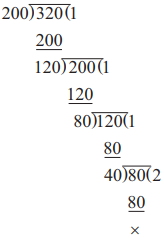
Using the division method:
$320 = 200 \times 1 + 120$
$200 = 120 \times 1 + 80$
$120 = 80 \times 1 + 40$
$80 = 40 \times 2 + 0$
Since the remainder is $0$,the $H.C.F.$ is $40$.
Therefore,the greatest number is $40$.
Using the division method:
$320 = 200 \times 1 + 120$
$200 = 120 \times 1 + 80$
$120 = 80 \times 1 + 40$
$80 = 40 \times 2 + 0$
Since the remainder is $0$,the $H.C.F.$ is $40$.
Therefore,the greatest number is $40$.
0 likes
View Solution115
MediumMCQ
The greatest $4-$digit number exactly divisible by $10, 15$ and $20$ is
A
$9990$
B
$9960$
C
$9980$
D
$9995$
Solution
(B) Step $1$: Find the $L.C.M.$ of $10, 15$ and $20$.
$10 = 2 \times 5$
$15 = 3 \times 5$
$20 = 2^2 \times 5$
$L.C.M. = 2^2 \times 3 \times 5 = 60$.
Step $2$: Identify the greatest $4-$digit number,which is $9999$.
Step $3$: Divide $9999$ by $60$ to find the remainder.
$9999 \div 60 = 166$ with a remainder of $39$.
Step $4$: Subtract the remainder from the greatest $4-$digit number to get the largest number divisible by $60$.
$9999 - 39 = 9960$.
Therefore,the greatest $4-$digit number exactly divisible by $10, 15$ and $20$ is $9960$.
$10 = 2 \times 5$
$15 = 3 \times 5$
$20 = 2^2 \times 5$
$L.C.M. = 2^2 \times 3 \times 5 = 60$.
Step $2$: Identify the greatest $4-$digit number,which is $9999$.
Step $3$: Divide $9999$ by $60$ to find the remainder.
$9999 \div 60 = 166$ with a remainder of $39$.
Step $4$: Subtract the remainder from the greatest $4-$digit number to get the largest number divisible by $60$.
$9999 - 39 = 9960$.
Therefore,the greatest $4-$digit number exactly divisible by $10, 15$ and $20$ is $9960$.
0 likes
View Solution116
MediumMCQ
If the students of $9^{th}$ class are arranged in rows of $6, 8, 12$ or $16$,no student is left behind. The possible number of students in the class is
A
$60$
B
$72$
C
$80$
D
$96$
Solution
(D) To find the number of students that can be arranged in rows of $6, 8, 12$,or $16$ without any student being left behind,we need to find the Least Common Multiple $(L.C.M.)$ of these numbers.
$L.C.M.$ of $6, 8, 12, 16$:
$L.C.M. = 2 \times 2 \times 2 \times 2 \times 3 = 48$.
The number of students must be a multiple of $48$. Among the given options,$96$ is a multiple of $48$ $(48 \times 2 = 96)$.
$L.C.M.$ of $6, 8, 12, 16$:
| $2$ | $6, 8, 12, 16$ |
| $2$ | $3, 4, 6, 8$ |
| $2$ | $3, 2, 3, 4$ |
| $2$ | $3, 1, 3, 2$ |
| $3$ | $3, 1, 3, 1$ |
| $1, 1, 1, 1$ |
$L.C.M. = 2 \times 2 \times 2 \times 2 \times 3 = 48$.
The number of students must be a multiple of $48$. Among the given options,$96$ is a multiple of $48$ $(48 \times 2 = 96)$.
0 likes
View Solution117
MediumMCQ
If $A$ and $B$ are the $H.C.F.$ and $L.C.M.$ respectively of two algebraic expressions $x$ and $y,$ and $A+B = x+y,$ then the value of $A^{3}+B^{3}$ is
A
$x^{3}-y^{3}$
B
$x^{3}$
C
$y^{3}$
D
$x^{3}+y^{3}$
Solution
(D) We know that for any two numbers or expressions $x$ and $y$,the product of their $H.C.F.$ $(A)$ and $L.C.M.$ $(B)$ is equal to the product of the numbers themselves.
So,$A \times B = x \times y$.
We are given $A + B = x + y$.
Consider the identity $(A+B)^3 = A^3 + B^3 + 3AB(A+B)$.
Substituting the given values,we get $(x+y)^3 = A^3 + B^3 + 3xy(x+y)$.
Rearranging for $A^3 + B^3$,we have $A^3 + B^3 = (x+y)^3 - 3xy(x+y)$.
Factoring out $(x+y)$,we get $A^3 + B^3 = (x+y)((x+y)^2 - 3xy)$.
Expanding the term inside the bracket: $A^3 + B^3 = (x+y)(x^2 + 2xy + y^2 - 3xy)$.
$A^3 + B^3 = (x+y)(x^2 - xy + y^2)$.
Using the algebraic identity $a^3 + b^3 = (a+b)(a^2 - ab + b^2)$,we conclude that $A^3 + B^3 = x^3 + y^3$.
So,$A \times B = x \times y$.
We are given $A + B = x + y$.
Consider the identity $(A+B)^3 = A^3 + B^3 + 3AB(A+B)$.
Substituting the given values,we get $(x+y)^3 = A^3 + B^3 + 3xy(x+y)$.
Rearranging for $A^3 + B^3$,we have $A^3 + B^3 = (x+y)^3 - 3xy(x+y)$.
Factoring out $(x+y)$,we get $A^3 + B^3 = (x+y)((x+y)^2 - 3xy)$.
Expanding the term inside the bracket: $A^3 + B^3 = (x+y)(x^2 + 2xy + y^2 - 3xy)$.
$A^3 + B^3 = (x+y)(x^2 - xy + y^2)$.
Using the algebraic identity $a^3 + b^3 = (a+b)(a^2 - ab + b^2)$,we conclude that $A^3 + B^3 = x^3 + y^3$.
0 likes
View Solution118
MediumMCQ
The greatest number that divides $411, 684,$ and $821$ and leaves $3, 4,$ and $5$ as remainders,respectively,is
A
$254$
B
$146$
C
$136$
D
$204$
Solution
(C) To find the greatest number that divides $411, 684,$ and $821$ leaving remainders $3, 4,$ and $5$ respectively,we first subtract the remainders from the respective numbers:
$411 - 3 = 408$
$684 - 4 = 680$
$821 - 5 = 816$
Now,we need to find the $H.C.F.$ of $408, 680,$ and $816$.
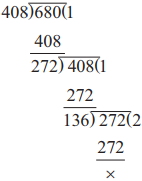
First,find the $H.C.F.$ of $408$ and $680$:
$680 = 408 \times 1 + 272$
$408 = 272 \times 1 + 136$
$272 = 136 \times 2 + 0$
So,the $H.C.F.$ of $408$ and $680$ is $136$.
Next,find the $H.C.F.$ of $136$ and $816$:
$816 = 136 \times 6 + 0$
Since $136$ divides $816$ completely,the $H.C.F.$ of $408, 680,$ and $816$ is $136$.
Therefore,the required number is $136$.
$411 - 3 = 408$
$684 - 4 = 680$
$821 - 5 = 816$
Now,we need to find the $H.C.F.$ of $408, 680,$ and $816$.
First,find the $H.C.F.$ of $408$ and $680$:
$680 = 408 \times 1 + 272$
$408 = 272 \times 1 + 136$
$272 = 136 \times 2 + 0$
So,the $H.C.F.$ of $408$ and $680$ is $136$.
Next,find the $H.C.F.$ of $136$ and $816$:
$816 = 136 \times 6 + 0$
Since $136$ divides $816$ completely,the $H.C.F.$ of $408, 680,$ and $816$ is $136$.
Therefore,the required number is $136$.
0 likes
View Solution119
DifficultMCQ
$L.C.M.$ and $H.C.F.$ of two numbers $x$ and $y$ are $315$ and $3,$ respectively. If $x+y=36,$ the value of $\frac{1}{x}+\frac{1}{y}$ is
A
$1$
B
$\frac{1}{6}$
C
$\frac{12}{315}$
D
$\frac{4}{35}$
Solution
(D) We know that for any two numbers $x$ and $y$,the product of the numbers is equal to the product of their $H.C.F.$ and $L.C.M.$
$x \times y = H.C.F. \times L.C.M.$
Given that $H.C.F. = 3$ and $L.C.M. = 315$,we have:
$x \times y = 3 \times 315 = 945$
We need to find the value of $\frac{1}{x} + \frac{1}{y}$.
$\frac{1}{x} + \frac{1}{y} = \frac{x + y}{x y}$
Given $x + y = 36$,substitute the values:
$\frac{1}{x} + \frac{1}{y} = \frac{36}{3 \times 315}$
Simplify the expression:
$\frac{1}{x} + \frac{1}{y} = \frac{12}{315} = \frac{4}{35}$
$x \times y = H.C.F. \times L.C.M.$
Given that $H.C.F. = 3$ and $L.C.M. = 315$,we have:
$x \times y = 3 \times 315 = 945$
We need to find the value of $\frac{1}{x} + \frac{1}{y}$.
$\frac{1}{x} + \frac{1}{y} = \frac{x + y}{x y}$
Given $x + y = 36$,substitute the values:
$\frac{1}{x} + \frac{1}{y} = \frac{36}{3 \times 315}$
Simplify the expression:
$\frac{1}{x} + \frac{1}{y} = \frac{12}{315} = \frac{4}{35}$
0 likes
View Solution120
DifficultMCQ
Given: $\sqrt[3]{4}, \sqrt{3}, \sqrt[6]{25}$ and $\sqrt[12]{289},$ the greatest and least of them are respectively
A
$\sqrt[12]{289}$ and $\sqrt[3]{4}$
B
$\sqrt{3}$ and $\sqrt[3]{4}$
C
$\sqrt[6]{25}$ and $\sqrt{3}$
D
$\sqrt[3]{4}$ and $\sqrt[6]{25}$
Solution
(B) To compare the surds,we find the $L.C.M.$ of the indices $(3, 2, 6, 12)$,which is $12$.
Convert each surd to an equivalent surd with index $12$:
$1. \sqrt[3]{4} = 4^{1/3} = 4^{4/12} = \sqrt[12]{4^4} = \sqrt[12]{256}$
$2. \sqrt{3} = 3^{1/2} = 3^{6/12} = \sqrt[12]{3^6} = \sqrt[12]{729}$
$3. \sqrt[6]{25} = 25^{1/6} = 25^{2/12} = \sqrt[12]{25^2} = \sqrt[12]{625}$
$4. \sqrt[12]{289} = \sqrt[12]{289}$
Comparing the radicands: $729 > 625 > 289 > 256$.
Therefore,the greatest value is $\sqrt{3}$ and the least value is $\sqrt[3]{4}$.
Convert each surd to an equivalent surd with index $12$:
$1. \sqrt[3]{4} = 4^{1/3} = 4^{4/12} = \sqrt[12]{4^4} = \sqrt[12]{256}$
$2. \sqrt{3} = 3^{1/2} = 3^{6/12} = \sqrt[12]{3^6} = \sqrt[12]{729}$
$3. \sqrt[6]{25} = 25^{1/6} = 25^{2/12} = \sqrt[12]{25^2} = \sqrt[12]{625}$
$4. \sqrt[12]{289} = \sqrt[12]{289}$
Comparing the radicands: $729 > 625 > 289 > 256$.
Therefore,the greatest value is $\sqrt{3}$ and the least value is $\sqrt[3]{4}$.
0 likes
View Solution121
MediumMCQ
In four consecutive prime numbers that are in ascending order,the product of the first three is $385$ and that of the last three is $1001$. The largest given prime number is
A
$11$
B
$13$
C
$17$
D
$19$
Solution
(B) Let the four consecutive prime numbers be $a, b, c,$ and $d$ in ascending order,such that $a < b < c < d$.
Given that the product of the first three is $a \times b \times c = 385$ and the product of the last three is $b \times c \times d = 1001$.
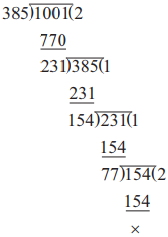
To find the common factors,we calculate the Highest Common Factor $(HCF)$ of $385$ and $1001$.
$385 = 5 \times 7 \times 11$
$1001 = 7 \times 11 \times 13$
The common factors are $7$ and $11$,so $b \times c = 7 \times 11 = 77$.
Now,using the product of the last three numbers: $b \times c \times d = 1001$.
Substituting $b \times c = 77$,we get $77 \times d = 1001$.
Therefore,$d = \frac{1001}{77} = 13$.
The four consecutive prime numbers are $5, 7, 11, 13$. The largest prime number is $13$.
Given that the product of the first three is $a \times b \times c = 385$ and the product of the last three is $b \times c \times d = 1001$.
To find the common factors,we calculate the Highest Common Factor $(HCF)$ of $385$ and $1001$.
$385 = 5 \times 7 \times 11$
$1001 = 7 \times 11 \times 13$
The common factors are $7$ and $11$,so $b \times c = 7 \times 11 = 77$.
Now,using the product of the last three numbers: $b \times c \times d = 1001$.
Substituting $b \times c = 77$,we get $77 \times d = 1001$.
Therefore,$d = \frac{1001}{77} = 13$.
The four consecutive prime numbers are $5, 7, 11, 13$. The largest prime number is $13$.
0 likes
View Solution122
MediumMCQ
$H.C.F.$ of $\frac{2}{3}, \frac{4}{5}$ and $\frac{6}{7}$ is
A
$\frac{48}{105}$
B
$\frac{2}{105}$
C
$\frac{1}{105}$
D
$\frac{24}{105}$
Solution
(B) To find the $H.C.F.$ of fractions,we use the formula:
$H.C.F. = \frac{H.C.F. \text{ of numerators}}{L.C.M. \text{ of denominators}}$
Given fractions: $\frac{2}{3}, \frac{4}{5}, \frac{6}{7}$
Step $1$: Find the $H.C.F.$ of the numerators $(2, 4, 6)$.
The factors of $2$ are $1, 2$.
The factors of $4$ are $1, 2, 4$.
The factors of $6$ are $1, 2, 3, 6$.
The greatest common factor is $2$.
Step $2$: Find the $L.C.M.$ of the denominators $(3, 5, 7)$.
Since $3, 5,$ and $7$ are all prime numbers,their $L.C.M.$ is their product:
$3 \times 5 \times 7 = 105$.
Step $3$: Combine the results.
$H.C.F. = \frac{2}{105}$.
$H.C.F. = \frac{H.C.F. \text{ of numerators}}{L.C.M. \text{ of denominators}}$
Given fractions: $\frac{2}{3}, \frac{4}{5}, \frac{6}{7}$
Step $1$: Find the $H.C.F.$ of the numerators $(2, 4, 6)$.
The factors of $2$ are $1, 2$.
The factors of $4$ are $1, 2, 4$.
The factors of $6$ are $1, 2, 3, 6$.
The greatest common factor is $2$.
Step $2$: Find the $L.C.M.$ of the denominators $(3, 5, 7)$.
Since $3, 5,$ and $7$ are all prime numbers,their $L.C.M.$ is their product:
$3 \times 5 \times 7 = 105$.
Step $3$: Combine the results.
$H.C.F. = \frac{2}{105}$.
0 likes
View Solution123
EasyMCQ
There are five bells which start ringing together at intervals of $3, 6, 9, 12$ and $15$ seconds respectively. In $36$ minutes,how many times will the bells ring simultaneously?
A
$13$
B
$12$
C
$6$
D
$5$
Solution
(A) To find when the bells ring together,we need to calculate the $L.C.M.$ of the given intervals: $3, 6, 9, 12, 15$ seconds.
Prime factorization:
$3 = 3^1$
$6 = 2^1 \times 3^1$
$9 = 3^2$
$12 = 2^2 \times 3^1$
$15 = 3^1 \times 5^1$
$L.C.M. = 2^2 \times 3^2 \times 5^1 = 4 \times 9 \times 5 = 180$ seconds.
This means the bells ring together every $180$ seconds,which is equal to $3$ minutes.
In $36$ minutes,the number of times they ring together is $\frac{36}{3} = 12$ times.
Since they start ringing together at the $0^{th}$ minute,we add $1$ to the result.
Total times = $12 + 1 = 13$ times.
Prime factorization:
$3 = 3^1$
$6 = 2^1 \times 3^1$
$9 = 3^2$
$12 = 2^2 \times 3^1$
$15 = 3^1 \times 5^1$
$L.C.M. = 2^2 \times 3^2 \times 5^1 = 4 \times 9 \times 5 = 180$ seconds.
This means the bells ring together every $180$ seconds,which is equal to $3$ minutes.
In $36$ minutes,the number of times they ring together is $\frac{36}{3} = 12$ times.
Since they start ringing together at the $0^{th}$ minute,we add $1$ to the result.
Total times = $12 + 1 = 13$ times.
0 likes
View Solution124
EasyMCQ
Philip, Tom, and Brad start jogging around a circular field and complete a single round in $18\, \text{seconds}$, $22\, \text{seconds}$, and $30\, \text{seconds}$, respectively. In how much time will they meet again at the starting point?
A
$3\, \text{minutes } 15\, \text{seconds}$
B
$21\, \text{minutes}$
C
$16\, \text{minutes } 30\, \text{seconds}$
D
$12\, \text{minutes}$
Solution
(C) To find the time when they meet again at the starting point, we need to calculate the Least Common Multiple $(LCM)$ of the time taken by each person to complete one round.
The times are $18\, \text{seconds}$, $22\, \text{seconds}$, and $30\, \text{seconds}$.
Prime factorization:
$18 = 2 \times 3^2$
$22 = 2 \times 11$
$30 = 2 \times 3 \times 5$
$LCM(18, 22, 30) = 2^1 \times 3^2 \times 5^1 \times 11^1 = 2 \times 9 \times 5 \times 11 = 990\, \text{seconds}$.
Now, convert $990\, \text{seconds}$ into minutes:
$990 / 60 = 16.5\, \text{minutes}$.
$0.5\, \text{minutes} = 0.5 \times 60 = 30\, \text{seconds}$.
Therefore, they will meet again at the starting point after $16\, \text{minutes and } 30\, \text{seconds}$.
The times are $18\, \text{seconds}$, $22\, \text{seconds}$, and $30\, \text{seconds}$.
Prime factorization:
$18 = 2 \times 3^2$
$22 = 2 \times 11$
$30 = 2 \times 3 \times 5$
$LCM(18, 22, 30) = 2^1 \times 3^2 \times 5^1 \times 11^1 = 2 \times 9 \times 5 \times 11 = 990\, \text{seconds}$.
Now, convert $990\, \text{seconds}$ into minutes:
$990 / 60 = 16.5\, \text{minutes}$.
$0.5\, \text{minutes} = 0.5 \times 60 = 30\, \text{seconds}$.
Therefore, they will meet again at the starting point after $16\, \text{minutes and } 30\, \text{seconds}$.
0 likes
View Solution125
MediumMCQ
The $H.C.F.$ and $L.C.M.$ of two numbers are $12$ and $924,$ respectively. Then the number of such pairs is
A
$0$
B
$1$
C
$2$
D
$3$
Solution
(C) Let the two numbers be $12x$ and $12y$,where $x$ and $y$ are coprime (i.e.,their $H.C.F.$ is $1$).
The $L.C.M.$ of these two numbers is given by $12xy$.
According to the problem,$12xy = 924$.
Dividing both sides by $12$,we get $xy = \frac{924}{12} = 77$.
Now,we need to find pairs of coprime factors $(x, y)$ such that their product is $77$.
The factors of $77$ are $1, 7, 11, 77$.
The possible pairs $(x, y)$ are $(1, 77)$ and $(7, 11)$.
Since both pairs consist of coprime numbers,there are $2$ such pairs.
The $L.C.M.$ of these two numbers is given by $12xy$.
According to the problem,$12xy = 924$.
Dividing both sides by $12$,we get $xy = \frac{924}{12} = 77$.
Now,we need to find pairs of coprime factors $(x, y)$ such that their product is $77$.
The factors of $77$ are $1, 7, 11, 77$.
The possible pairs $(x, y)$ are $(1, 77)$ and $(7, 11)$.
Since both pairs consist of coprime numbers,there are $2$ such pairs.
0 likes
View Solution126
MediumMCQ
What is the least number which,when divided by $5, 6, 7, 8$ gives the remainder $3$ but is divisible by $9$?
A
$1463$
B
$1573$
C
$1683$
D
$1793$
Solution
(C) First,find the $L.C.M.$ of $5, 6, 7, 8$.
$5 = 5$
$6 = 2 \times 3$
$7 = 7$
$8 = 2^3$
$L.C.M. = 5 \times 3 \times 7 \times 8 = 840$.
Any number that leaves a remainder of $3$ when divided by $5, 6, 7, 8$ is of the form $(840x + 3)$,where $x$ is a natural number.
We are given that this number is divisible by $9$.
So,$(840x + 3) \div 9$ must be an integer.
$840x + 3 = (837x + 3x + 3) = 9(93x) + 3(x + 1)$.
For this to be divisible by $9$,$(x + 1)$ must be a multiple of $3$.
For the least number,let $x + 1 = 3$,which gives $x = 2$.
Substituting $x = 2$ in $(840x + 3)$:
Required number $= 840(2) + 3 = 1680 + 3 = 1683$.
$5 = 5$
$6 = 2 \times 3$
$7 = 7$
$8 = 2^3$
$L.C.M. = 5 \times 3 \times 7 \times 8 = 840$.
Any number that leaves a remainder of $3$ when divided by $5, 6, 7, 8$ is of the form $(840x + 3)$,where $x$ is a natural number.
We are given that this number is divisible by $9$.
So,$(840x + 3) \div 9$ must be an integer.
$840x + 3 = (837x + 3x + 3) = 9(93x) + 3(x + 1)$.
For this to be divisible by $9$,$(x + 1)$ must be a multiple of $3$.
For the least number,let $x + 1 = 3$,which gives $x = 2$.
Substituting $x = 2$ in $(840x + 3)$:
Required number $= 840(2) + 3 = 1680 + 3 = 1683$.
0 likes
View Solution127
MediumMCQ
The $L.C.M.$ of two numbers is $120$ and their $H.C.F.$ is $10.$ Which of the following can be the sum of those two numbers?
A
$140$
B
$80$
C
$60$
D
$70$
Solution
(D) Let the two numbers be $10x$ and $10y$,where $x$ and $y$ are coprime to each other.
Given that the $H.C.F.$ is $10$,the numbers must be multiples of $10$.
The $L.C.M.$ of $10x$ and $10y$ is $10xy$.
We are given $10xy = 120$,which implies $xy = 12$.
The possible pairs of $(x, y)$ such that they are coprime are $(1, 12)$ and $(3, 4)$.
Case $1$: If the pair is $(1, 12)$,the numbers are $10(1) = 10$ and $10(12) = 120$. Their sum is $10 + 120 = 130$.
Case $2$: If the pair is $(3, 4)$,the numbers are $10(3) = 30$ and $10(4) = 40$. Their sum is $30 + 40 = 70$.
Comparing with the given options,$70$ is present.
Given that the $H.C.F.$ is $10$,the numbers must be multiples of $10$.
The $L.C.M.$ of $10x$ and $10y$ is $10xy$.
We are given $10xy = 120$,which implies $xy = 12$.
The possible pairs of $(x, y)$ such that they are coprime are $(1, 12)$ and $(3, 4)$.
Case $1$: If the pair is $(1, 12)$,the numbers are $10(1) = 10$ and $10(12) = 120$. Their sum is $10 + 120 = 130$.
Case $2$: If the pair is $(3, 4)$,the numbers are $10(3) = 30$ and $10(4) = 40$. Their sum is $30 + 40 = 70$.
Comparing with the given options,$70$ is present.
0 likes
View Solution128
MediumMCQ
The traffic lights at three different road crossings change after $24$ seconds,$36$ seconds,and $54$ seconds,respectively. If they all change simultaneously at $10:15:00$ am,then at what time will they again change simultaneously?
A
$10:16:54$ am
B
$10:18:36$ am
C
$10:17:02$ am
D
$10:22:12$ am
Solution
(B) To find when the traffic lights will change simultaneously again,we need to calculate the Least Common Multiple $(LCM)$ of the time intervals: $24$,$36$,and $54$ seconds.
Prime factorization:
$24 = 2^3 \times 3^1$
$36 = 2^2 \times 3^2$
$54 = 2^1 \times 3^3$
$LCM = 2^3 \times 3^3 = 8 \times 27 = 216$ seconds.
Convert $216$ seconds into minutes:
$216 \div 60 = 3$ minutes and $36$ seconds.
Adding this duration to the initial time of $10:15:00$ am:
$10:15:00 + 0:03:36 = 10:18:36$ am.
Therefore,the traffic lights will again change simultaneously at $10:18:36$ am.
Prime factorization:
$24 = 2^3 \times 3^1$
$36 = 2^2 \times 3^2$
$54 = 2^1 \times 3^3$
$LCM = 2^3 \times 3^3 = 8 \times 27 = 216$ seconds.
Convert $216$ seconds into minutes:
$216 \div 60 = 3$ minutes and $36$ seconds.
Adding this duration to the initial time of $10:15:00$ am:
$10:15:00 + 0:03:36 = 10:18:36$ am.
Therefore,the traffic lights will again change simultaneously at $10:18:36$ am.
0 likes
View Solution129
EasyMCQ
Amit,Sucheta,and Neeti start running around a circular track and complete one round in $18 \text{ seconds}$,$24 \text{ seconds}$,and $32 \text{ seconds}$,respectively. In how many seconds will the three meet again at the starting point if they all started running at the same time?
A
$196$
B
$288$
C
$324$
D
Cannot be determined
Solution
(B) To find the time when they will meet again at the starting point,we need to calculate the Least Common Multiple $(LCM)$ of the times taken by each person to complete one round.
The times taken are $18$,$24$,and $32$ seconds.
Prime factorization:
$18 = 2 \times 3^2$
$24 = 2^3 \times 3$
$32 = 2^5$
$LCM$ is the product of the highest powers of all prime factors involved:
$LCM(18, 24, 32) = 2^5 \times 3^2 = 32 \times 9 = 288$.
Therefore,they will meet again at the starting point after $288 \text{ seconds}$.
The times taken are $18$,$24$,and $32$ seconds.
Prime factorization:
$18 = 2 \times 3^2$
$24 = 2^3 \times 3$
$32 = 2^5$
$LCM$ is the product of the highest powers of all prime factors involved:
$LCM(18, 24, 32) = 2^5 \times 3^2 = 32 \times 9 = 288$.
Therefore,they will meet again at the starting point after $288 \text{ seconds}$.
0 likes
View Solution130
MediumMCQ
Seema,Meena,and Reena start jogging around a circular stadium and complete one round in $54 \text{ seconds}$,$42 \text{ seconds}$,and $63 \text{ seconds}$ respectively. Approximately after how many minutes will they meet again at the starting point?
A
$8$
B
$10$
C
$3$
D
$6$
Solution
(D) To find when they will meet again at the starting point,we need to calculate the Least Common Multiple $(LCM)$ of the time taken by each person to complete one round.
The times are $54 \text{ seconds}$,$42 \text{ seconds}$,and $63 \text{ seconds}$.
Prime factorization:
$54 = 2 \times 3^3$
$42 = 2 \times 3 \times 7$
$63 = 3^2 \times 7$
$LCM = 2 \times 3^3 \times 7 = 2 \times 27 \times 7 = 378 \text{ seconds}$.
To convert seconds into minutes,divide by $60$:
$\frac{378}{60} = 6.3 \text{ minutes}$.
Rounding to the nearest whole number,they will meet after approximately $6 \text{ minutes}$.
The times are $54 \text{ seconds}$,$42 \text{ seconds}$,and $63 \text{ seconds}$.
Prime factorization:
$54 = 2 \times 3^3$
$42 = 2 \times 3 \times 7$
$63 = 3^2 \times 7$
$LCM = 2 \times 3^3 \times 7 = 2 \times 27 \times 7 = 378 \text{ seconds}$.
To convert seconds into minutes,divide by $60$:
$\frac{378}{60} = 6.3 \text{ minutes}$.
Rounding to the nearest whole number,they will meet after approximately $6 \text{ minutes}$.
0 likes
View Solution131
EasyMCQ
The greatest number,which when subtracted from $5834$,gives a number exactly divisible by each of $20, 28, 32$ and $35$,is
A
$1120$
B
$4714$
C
$5200$
D
$5600$
Solution
(B) To find the number that is exactly divisible by $20, 28, 32$ and $35$,we must first calculate their Least Common Multiple $(L.C.M.)$.
Prime factorization of the numbers:
$20 = 2^2 \times 5$
$28 = 2^2 \times 7$
$32 = 2^5$
$35 = 5 \times 7$
$L.C.M. = 2^5 \times 5 \times 7 = 32 \times 35 = 1120$.
We need to find a number $x$ such that $(5834 - x)$ is exactly divisible by $1120$. To make $(5834 - x)$ the largest possible multiple of $1120$ that is less than $5834$,we divide $5834$ by $1120$:
$5834 \div 1120 = 5$ with a remainder of $234$.
So,$5834 = (1120 \times 5) + 234$.
To get a number exactly divisible by $1120$,we must subtract the remainder $234$ from $5834$:
$5834 - 234 = 5600$.
However,the question asks for the number which when subtracted from $5834$ gives a result divisible by $1120$. If we subtract $234$ from $5834$,we get $5600$,which is divisible by $1120$. Thus,the number to be subtracted is $234$.
Wait,re-evaluating the question: "The greatest number,which when subtracted from $5834$,gives a number exactly divisible by each of $20, 28, 32$ and $35$". This implies we want the result $(5834 - x)$ to be a multiple of $1120$. The multiples of $1120$ are $1120, 2240, 3360, 4480, 5600$.
To make $x$ the greatest,$(5834 - x)$ must be the smallest multiple,which is $1120$.
$5834 - x = 1120 \implies x = 5834 - 1120 = 4714$.
Prime factorization of the numbers:
$20 = 2^2 \times 5$
$28 = 2^2 \times 7$
$32 = 2^5$
$35 = 5 \times 7$
$L.C.M. = 2^5 \times 5 \times 7 = 32 \times 35 = 1120$.
We need to find a number $x$ such that $(5834 - x)$ is exactly divisible by $1120$. To make $(5834 - x)$ the largest possible multiple of $1120$ that is less than $5834$,we divide $5834$ by $1120$:
$5834 \div 1120 = 5$ with a remainder of $234$.
So,$5834 = (1120 \times 5) + 234$.
To get a number exactly divisible by $1120$,we must subtract the remainder $234$ from $5834$:
$5834 - 234 = 5600$.
However,the question asks for the number which when subtracted from $5834$ gives a result divisible by $1120$. If we subtract $234$ from $5834$,we get $5600$,which is divisible by $1120$. Thus,the number to be subtracted is $234$.
Wait,re-evaluating the question: "The greatest number,which when subtracted from $5834$,gives a number exactly divisible by each of $20, 28, 32$ and $35$". This implies we want the result $(5834 - x)$ to be a multiple of $1120$. The multiples of $1120$ are $1120, 2240, 3360, 4480, 5600$.
To make $x$ the greatest,$(5834 - x)$ must be the smallest multiple,which is $1120$.
$5834 - x = 1120 \implies x = 5834 - 1120 = 4714$.
0 likes
View Solution132
MediumMCQ
The $H.C.F.$ and $L.C.M.$ of two numbers are $8$ and $48,$ respectively. If one of the numbers is $24,$ then the other number is
A
$48$
B
$36$
C
$24$
D
$16$
Solution
(D) The relationship between two numbers and their $H.C.F.$ and $L.C.M.$ is given by the formula:
Product of two numbers $= H.C.F. \times L.C.M.$
Let the other number be $x$.
Given: $H.C.F. = 8$,$L.C.M. = 48$,and one number $= 24$.
Substituting the values in the formula:
$24 \times x = 8 \times 48$
$x = \frac{8 \times 48}{24}$
$x = 8 \times 2 = 16$
Therefore,the other number is $16$.
Product of two numbers $= H.C.F. \times L.C.M.$
Let the other number be $x$.
Given: $H.C.F. = 8$,$L.C.M. = 48$,and one number $= 24$.
Substituting the values in the formula:
$24 \times x = 8 \times 48$
$x = \frac{8 \times 48}{24}$
$x = 8 \times 2 = 16$
Therefore,the other number is $16$.
0 likes
View Solution133
DifficultMCQ
Two numbers are in the ratio $3:4$. Their $L.C.M.$ is $84$. The greater number is
A
$21$
B
$24$
C
$28$
D
$84$
Solution
(C) Let the two numbers be $3x$ and $4x$,where $x$ is the common factor.
The prime factorization of the numbers is:
$3x = 3 \times x$
$4x = 2^2 \times x$
The $L.C.M.$ of $3x$ and $4x$ is $3 \times 2^2 \times x = 12x$.
Given that the $L.C.M.$ is $84$,we set up the equation:
$12x = 84$
Solving for $x$:
$x = 84 / 12 = 7$
Now,calculate the two numbers:
First number $= 3x = 3 \times 7 = 21$
Second number $= 4x = 4 \times 7 = 28$
Comparing the two numbers,$21$ and $28$,the greater number is $28$.
The prime factorization of the numbers is:
$3x = 3 \times x$
$4x = 2^2 \times x$
The $L.C.M.$ of $3x$ and $4x$ is $3 \times 2^2 \times x = 12x$.
Given that the $L.C.M.$ is $84$,we set up the equation:
$12x = 84$
Solving for $x$:
$x = 84 / 12 = 7$
Now,calculate the two numbers:
First number $= 3x = 3 \times 7 = 21$
Second number $= 4x = 4 \times 7 = 28$
Comparing the two numbers,$21$ and $28$,the greater number is $28$.
0 likes
View Solution134
MediumMCQ
Two numbers are in the ratio $5:6$. If their $H.C.F.$ is $4$,then their $L.C.M.$ will be
A
$90$
B
$96$
C
$120$
D
$150$
Solution
(C) Let the two numbers be $5x$ and $6x$,where $x$ is the common factor.
The $H.C.F.$ of $5x$ and $6x$ is $x$.
Given that the $H.C.F.$ is $4$,we have $x = 4$.
Therefore,the numbers are $5 \times 4 = 20$ and $6 \times 4 = 24$.
The $L.C.M.$ of two numbers is given by the product of the ratio parts and the $H.C.F.$:
$L.C.M. = 5 \times 6 \times 4 = 120$.
Alternatively,using the formula: $L.C.M. = \frac{\text{Product of numbers}}{H.C.F.} = \frac{20 \times 24}{4} = 20 \times 6 = 120$.
The $H.C.F.$ of $5x$ and $6x$ is $x$.
Given that the $H.C.F.$ is $4$,we have $x = 4$.
Therefore,the numbers are $5 \times 4 = 20$ and $6 \times 4 = 24$.
The $L.C.M.$ of two numbers is given by the product of the ratio parts and the $H.C.F.$:
$L.C.M. = 5 \times 6 \times 4 = 120$.
Alternatively,using the formula: $L.C.M. = \frac{\text{Product of numbers}}{H.C.F.} = \frac{20 \times 24}{4} = 20 \times 6 = 120$.
0 likes
View Solution135
EasyMCQ
$A$ number, when divided successively by $4, 5$ and $6$, leaves remainders $2, 3$ and $4$ respectively. The least such number is
A
$50$
B
$53$
C
$58$
D
$214$
Solution
(C) Observe the difference between the divisor and the remainder in each case:
$4 - 2 = 2$
$5 - 3 = 2$
$6 - 4 = 2$
Since the difference is constant $(2)$, the required number is of the form
$\text{LCM of } 4, 5, 6 - 2$.
First, find the LCM of $4, 5$ and $6$:
$4 = 2^2$
$5 = 5^1$
$6 = 2 \times 3$
$\text{LCM} = 2^2 \times 3 \times 5 = 4 \times 3 \times 5 = 60$
Therefore, the least such number is:
$60 - 2 = 58$
$4 - 2 = 2$
$5 - 3 = 2$
$6 - 4 = 2$
Since the difference is constant $(2)$, the required number is of the form
$\text{LCM of } 4, 5, 6 - 2$.
First, find the LCM of $4, 5$ and $6$:
$4 = 2^2$
$5 = 5^1$
$6 = 2 \times 3$
$\text{LCM} = 2^2 \times 3 \times 5 = 4 \times 3 \times 5 = 60$
Therefore, the least such number is:
$60 - 2 = 58$
0 likes
View Solution136
MediumMCQ
The greatest number that divides $43, 91,$ and $183$ so as to leave the same remainder in each case is:
A
$9$
B
$8$
C
$4$
D
$3$
Solution
(C) Let the greatest number be $x$ and the common remainder be $k$.
Then,we have:
$43 = nx + k$ $...(1)$
$91 = mx + k$ $...(2)$
$183 = lx + k$ $...(3)$
Subtracting the equations:
$(2) - (1) \Rightarrow 91 - 43 = (m - n)x \Rightarrow 48 = (m - n)x$
$(3) - (2) \Rightarrow 183 - 91 = (l - m)x \Rightarrow 92 = (l - m)x$
$(3) - (1) \Rightarrow 183 - 43 = (l - n)x \Rightarrow 140 = (l - n)x$
The greatest number $x$ is the $H.C.F.$ of the differences $48, 92,$ and $140$.
Prime factorization:
$48 = 2^4 \times 3$
$92 = 2^2 \times 23$
$140 = 2^2 \times 5 \times 7$
$H.C.F. = 2^2 = 4$.
Thus,the greatest number is $4$.
Then,we have:
$43 = nx + k$ $...(1)$
$91 = mx + k$ $...(2)$
$183 = lx + k$ $...(3)$
Subtracting the equations:
$(2) - (1) \Rightarrow 91 - 43 = (m - n)x \Rightarrow 48 = (m - n)x$
$(3) - (2) \Rightarrow 183 - 91 = (l - m)x \Rightarrow 92 = (l - m)x$
$(3) - (1) \Rightarrow 183 - 43 = (l - n)x \Rightarrow 140 = (l - n)x$
The greatest number $x$ is the $H.C.F.$ of the differences $48, 92,$ and $140$.
Prime factorization:
$48 = 2^4 \times 3$
$92 = 2^2 \times 23$
$140 = 2^2 \times 5 \times 7$
$H.C.F. = 2^2 = 4$.
Thus,the greatest number is $4$.
0 likes
View SolutionHCF and LCM — HCF and LCM · Frequently Asked Questions
1Are these HCF and LCM questions useful for JEE and NEET?
Yes. All questions in this section are mapped to JEE Main and NEET exam patterns. Previous year questions from JEE Main, NEET, GUJCET and state-level exams are included with full solutions.
2Can I switch to Hindi or Gujarati for these questions?
Yes. Use the language tabs in the hero section or the sidebar to view the same questions and solutions in English, Hindi or Gujarati.
3How do I generate a question paper from this subtopic?
Use the Vedclass Exam Paper Generator — select the chapter and subtopic, set difficulty, and generate Sets A, B, C, D automatically. First 3 chapters of every subject are free.
Vedclass Products
For Students
Vedclass Test Series
Mock tests in real JEE/NEET style with performance analysis. 5-day free trial.
Start Free TrialFor Teachers
Exam Paper Generator
Generate Set A/B/C/D papers from this chapter in 2 minutes. 3 chapters free.
Try FreeFor Institutes
Online Exam Module
Live online exams with unlimited students, 360° analytics & white-label branding.
See DemoFor Teachers & Institutes
Generate a HCF and LCM Exam Paper in 2 Minutes
Select subtopic & difficulty — Sets A, B, C, D auto-generated with No Repeat logic.
First 3 chapters of every subject are free — no payment required.