
A English
HCF and LCM Questions in English
Competitive Exam Quantitative Aptitude · HCF and LCM · HCF and LCM
136+
Questions
English
Language
100%
With Solutions
Showing 50 of 136 questions in English
1
EasyMCQ
The sum of two numbers is $468$ and their $HCF$ is $39$. How many pairs of such numbers can be formed?
A
$1$
B
$2$
C
$3$
D
$4$
Solution
(B) Let the two numbers be $39x$ and $39y$,where $x$ and $y$ are coprime (i.e.,$gcd(x, y) = 1$).
Given that the sum of the numbers is $468$,we have $39x + 39y = 468$.
Dividing by $39$,we get $x + y = \frac{468}{39} = 12$.
We need to find pairs of coprime numbers $(x, y)$ such that $x + y = 12$ and $x < y$ (to avoid counting the same pair twice).
The possible pairs $(x, y)$ that sum to $12$ are:
$(1, 11)$ where $gcd(1, 11) = 1$ (Valid)
$(2, 10)$ where $gcd(2, 10) = 2$ (Invalid)
$(3, 9)$ where $gcd(3, 9) = 3$ (Invalid)
$(4, 8)$ where $gcd(4, 8) = 4$ (Invalid)
$(5, 7)$ where $gcd(5, 7) = 1$ (Valid)
$(6, 6)$ where $gcd(6, 6) = 6$ (Invalid)
Thus,there are $2$ such pairs: $(1, 11)$ and $(5, 7)$.
Given that the sum of the numbers is $468$,we have $39x + 39y = 468$.
Dividing by $39$,we get $x + y = \frac{468}{39} = 12$.
We need to find pairs of coprime numbers $(x, y)$ such that $x + y = 12$ and $x < y$ (to avoid counting the same pair twice).
The possible pairs $(x, y)$ that sum to $12$ are:
$(1, 11)$ where $gcd(1, 11) = 1$ (Valid)
$(2, 10)$ where $gcd(2, 10) = 2$ (Invalid)
$(3, 9)$ where $gcd(3, 9) = 3$ (Invalid)
$(4, 8)$ where $gcd(4, 8) = 4$ (Invalid)
$(5, 7)$ where $gcd(5, 7) = 1$ (Valid)
$(6, 6)$ where $gcd(6, 6) = 6$ (Invalid)
Thus,there are $2$ such pairs: $(1, 11)$ and $(5, 7)$.
0 likes
View Solution2
EasyMCQ
Find the sum of the numbers between $500$ and $700$ such that when they are divided by $6, 8$ and $12$ it leaves no remainder.
A
$3200$
B
$4600$
C
$5300$
D
$5400$
Solution
(D) The least number which is divisible by $6, 8$ and $12$ is the $LCM$ of $6, 8$ and $12$,which is $24$.
We need to find the numbers between $500$ and $700$ that are multiples of $24$.
Dividing $500$ by $24$: $500 = 24 \times 20 + 20$. The first multiple of $24$ greater than $500$ is $24 \times 21 = 504$.
Dividing $700$ by $24$: $700 = 24 \times 29 + 4$. The last multiple of $24$ less than $700$ is $24 \times 29 = 696$.
These numbers form an arithmetic progression: $504, 528, 552, \dots, 696$.
Here,the first term $a = 504$,the last term $l = 696$,and the common difference $d = 24$.
The number of terms $n$ is given by $l = a + (n - 1)d$,so $696 = 504 + (n - 1)24$.
$192 = (n - 1)24 \implies n - 1 = 8 \implies n = 9$.
The sum $S_n = \frac{n}{2}(a + l) = \frac{9}{2}(504 + 696) = \frac{9}{2}(1200) = 9 \times 600 = 5400$.
We need to find the numbers between $500$ and $700$ that are multiples of $24$.
Dividing $500$ by $24$: $500 = 24 \times 20 + 20$. The first multiple of $24$ greater than $500$ is $24 \times 21 = 504$.
Dividing $700$ by $24$: $700 = 24 \times 29 + 4$. The last multiple of $24$ less than $700$ is $24 \times 29 = 696$.
These numbers form an arithmetic progression: $504, 528, 552, \dots, 696$.
Here,the first term $a = 504$,the last term $l = 696$,and the common difference $d = 24$.
The number of terms $n$ is given by $l = a + (n - 1)d$,so $696 = 504 + (n - 1)24$.
$192 = (n - 1)24 \implies n - 1 = 8 \implies n = 9$.
The sum $S_n = \frac{n}{2}(a + l) = \frac{9}{2}(504 + 696) = \frac{9}{2}(1200) = 9 \times 600 = 5400$.
0 likes
View Solution3
EasyMCQ
Is it possible to divide $1,000$ into two parts such that their $HCF$ is $15$?
A
Yes,it is possible
B
No,it is sometimes possible
C
Yes,it may be possible
D
Never possible
Solution
(D) Let the two parts be $15x$ and $15y$,where $x$ and $y$ are coprime integers.
Their sum is $15x + 15y = 1000$.
Dividing by $15$,we get $x + y = 1000 / 15 = 200 / 3$.
Since $x$ and $y$ must be integers,their sum $x + y$ must also be an integer.
However,$200 / 3$ is not an integer $(66.66...)$.
Therefore,it is not possible to divide $1000$ into two parts such that their $HCF$ is $15$.
Hence,the correct answer is $(d)$.
Their sum is $15x + 15y = 1000$.
Dividing by $15$,we get $x + y = 1000 / 15 = 200 / 3$.
Since $x$ and $y$ must be integers,their sum $x + y$ must also be an integer.
However,$200 / 3$ is not an integer $(66.66...)$.
Therefore,it is not possible to divide $1000$ into two parts such that their $HCF$ is $15$.
Hence,the correct answer is $(d)$.
0 likes
View Solution4
MediumMCQ
In a school,$442$ boys and $374$ girls have been divided into the largest possible equal classes,so that each class of boys numbers the same as each class of girls. What is the number of classes?
A
$16$
B
$18$
C
$20$
D
$24$
Solution
(D) Number of boys $= 442$; Number of girls $= 374$.
To find the largest possible equal number of students in each class,we calculate the $HCF$ of $442$ and $374$.
Prime factorization of $442 = 2 \times 13 \times 17$.
Prime factorization of $374 = 2 \times 11 \times 17$.
$HCF(442, 374) = 2 \times 17 = 34$.
So,each class contains $34$ students.
Number of classes of boys $= 442 \div 34 = 13$.
Number of classes of girls $= 374 \div 34 = 11$.
Total number of classes $= 13 + 11 = 24$.
To find the largest possible equal number of students in each class,we calculate the $HCF$ of $442$ and $374$.
Prime factorization of $442 = 2 \times 13 \times 17$.
Prime factorization of $374 = 2 \times 11 \times 17$.
$HCF(442, 374) = 2 \times 17 = 34$.
So,each class contains $34$ students.
Number of classes of boys $= 442 \div 34 = 13$.
Number of classes of girls $= 374 \div 34 = 11$.
Total number of classes $= 13 + 11 = 24$.
0 likes
View Solution5
MediumMCQ
Find the greatest number of $4$ digits and the least number of $5$ digits that have $196$ as their $HCF$.
A
$9998, 10184$
B
$9996, 10192$
C
$9994, 10194$
D
$9998, 10196$
Solution
(B) The greatest number of $4$ digits is $9999$.
Dividing $9999$ by $196$,we get $9999 = 196 \times 51 + 3$. The remainder is $3$.
Thus,the greatest $4$-digit number divisible by $196$ is $9999 - 3 = 9996$.
The least number of $5$ digits is $10000$.
Dividing $10000$ by $196$,we get $10000 = 196 \times 51 + 4$. The remainder is $4$.
To find the least $5$-digit number divisible by $196$,we add $(196 - 4)$ to $10000$.
Thus,the required $5$-digit number is $10000 + (196 - 4) = 10000 + 192 = 10192$.
Dividing $9999$ by $196$,we get $9999 = 196 \times 51 + 3$. The remainder is $3$.
Thus,the greatest $4$-digit number divisible by $196$ is $9999 - 3 = 9996$.
The least number of $5$ digits is $10000$.
Dividing $10000$ by $196$,we get $10000 = 196 \times 51 + 4$. The remainder is $4$.
To find the least $5$-digit number divisible by $196$,we add $(196 - 4)$ to $10000$.
Thus,the required $5$-digit number is $10000 + (196 - 4) = 10000 + 192 = 10192$.
0 likes
View Solution6
MediumMCQ
The product of two numbers is $4212$ and their $HCF$ is $9$. Find the possible pair of numbers.
A
$32, 121$
B
$36, 117$
C
$42, 114$
D
$45, 110$
Solution
(B) Let the two numbers be $9a$ and $9b$,where $a$ and $b$ are co-prime numbers.
Given that the product of the numbers is $4212$.
So,$(9a) \times (9b) = 4212$.
$81ab = 4212$.
$ab = \frac{4212}{81} = 52$.
Now,we find pairs of co-prime factors of $52$. The factors of $52$ are $(1, 52)$ and $(4, 13)$.
Case $1$: If $a=1, b=52$,then the numbers are $9 \times 1 = 9$ and $9 \times 52 = 468$.
Case $2$: If $a=4, b=13$,then the numbers are $9 \times 4 = 36$ and $9 \times 13 = 117$.
Comparing with the given options,the pair $(36, 117)$ is correct.
Given that the product of the numbers is $4212$.
So,$(9a) \times (9b) = 4212$.
$81ab = 4212$.
$ab = \frac{4212}{81} = 52$.
Now,we find pairs of co-prime factors of $52$. The factors of $52$ are $(1, 52)$ and $(4, 13)$.
Case $1$: If $a=1, b=52$,then the numbers are $9 \times 1 = 9$ and $9 \times 52 = 468$.
Case $2$: If $a=4, b=13$,then the numbers are $9 \times 4 = 36$ and $9 \times 13 = 117$.
Comparing with the given options,the pair $(36, 117)$ is correct.
0 likes
View Solution7
MediumMCQ
The $HCF$ and $LCM$ of two numbers are $36$ and $756$ respectively. Find the possible pair of numbers.
A
$72, 378$
B
$108, 252$
C
$144, 658$
D
$180, 622$
Solution
(B) Given that $HCF = 36$ and $LCM = 756$.
We know that the product of two numbers is equal to the product of their $HCF$ and $LCM$.
Let the two numbers be $36a$ and $36b$,where $a$ and $b$ are coprime numbers.
Then,$HCF \times LCM = 36a \times 36b = 36 \times 756$.
Dividing both sides by $36^2$,we get $a \times b = \frac{756}{36} = 21$.
The possible pairs of coprime factors of $21$ are $(1, 21)$ and $(3, 7)$.
Case $1$: If $(a, b) = (1, 21)$,the numbers are $(36 \times 1, 36 \times 21) = (36, 756)$.
Case $2$: If $(a, b) = (3, 7)$,the numbers are $(36 \times 3, 36 \times 7) = (108, 252)$.
Comparing with the given options,the pair $(108, 252)$ is present.
We know that the product of two numbers is equal to the product of their $HCF$ and $LCM$.
Let the two numbers be $36a$ and $36b$,where $a$ and $b$ are coprime numbers.
Then,$HCF \times LCM = 36a \times 36b = 36 \times 756$.
Dividing both sides by $36^2$,we get $a \times b = \frac{756}{36} = 21$.
The possible pairs of coprime factors of $21$ are $(1, 21)$ and $(3, 7)$.
Case $1$: If $(a, b) = (1, 21)$,the numbers are $(36 \times 1, 36 \times 21) = (36, 756)$.
Case $2$: If $(a, b) = (3, 7)$,the numbers are $(36 \times 3, 36 \times 7) = (108, 252)$.
Comparing with the given options,the pair $(108, 252)$ is present.
0 likes
View Solution8
EasyMCQ
Find the maximum possible length which can be used to measure exactly the lengths $6 \, m$,$4 \, m \, 75 \, cm$,and $10 \, m \, 25 \, cm$. (in $, cm$)
A
$20$
B
$25$
C
$30$
D
$35$
Solution
(B) To find the maximum length that can measure the given lengths exactly,we need to calculate the $HCF$ (Highest Common Factor) of the lengths.
First,convert all lengths into centimeters $(cm)$:
$6 \, m = 600 \, cm$
$4 \, m \, 75 \, cm = 475 \, cm$
$10 \, m \, 25 \, cm = 1025 \, cm$
Now,find the $HCF$ of $600$,$475$,and $1025$:
Prime factorization of $600 = 2^3 \times 3 \times 5^2$
Prime factorization of $475 = 5^2 \times 19$
Prime factorization of $1025 = 5^2 \times 41$
The common factor with the lowest exponent is $5^2 = 25$.
Therefore,the maximum possible length is $25 \, cm$.
First,convert all lengths into centimeters $(cm)$:
$6 \, m = 600 \, cm$
$4 \, m \, 75 \, cm = 475 \, cm$
$10 \, m \, 25 \, cm = 1025 \, cm$
Now,find the $HCF$ of $600$,$475$,and $1025$:
Prime factorization of $600 = 2^3 \times 3 \times 5^2$
Prime factorization of $475 = 5^2 \times 19$
Prime factorization of $1025 = 5^2 \times 41$
The common factor with the lowest exponent is $5^2 = 25$.
Therefore,the maximum possible length is $25 \, cm$.
0 likes
View Solution9
MediumMCQ
The $LCM$ of two numbers is $1008$ and their $HCF$ is $36$. If one of the two numbers is $144$,find the other number.
A
$288$
B
$252$
C
$576$
D
$504$
Solution
(B) Let the second number be $x$.
The product of two numbers is equal to the product of their $HCF$ and $LCM$.
$x \times 144 = 36 \times 1008$
$x = \frac{36 \times 1008}{144}$
Since $144 = 36 \times 4$,we have:
$x = \frac{36 \times 1008}{36 \times 4} = \frac{1008}{4} = 252$
Therefore,the other number is $252$.
The product of two numbers is equal to the product of their $HCF$ and $LCM$.
$x \times 144 = 36 \times 1008$
$x = \frac{36 \times 1008}{144}$
Since $144 = 36 \times 4$,we have:
$x = \frac{36 \times 1008}{36 \times 4} = \frac{1008}{4} = 252$
Therefore,the other number is $252$.
0 likes
View Solution10
EasyMCQ
Three bells ring together and they will ring at intervals of $6$ seconds,$7$ seconds and $8$ seconds respectively. After what interval will they again ring together? (in seconds)
A
$178$
B
$174$
C
$168$
D
$164$
Solution
(C) Since the bells ring at intervals of $6$ seconds,$7$ seconds,and $8$ seconds respectively,the next time they will ring together is after an interval equal to the $LCM$ of $6, 7,$ and $8$ seconds.
To find the $LCM$ of $6, 7,$ and $8$:
$6 = 2 \times 3$
$7 = 7 \times 1$
$8 = 2^3$
$LCM = 2^3 \times 3 \times 7 = 8 \times 3 \times 7 = 24 \times 7 = 168$.
Therefore,the required time is $168$ seconds.
To find the $LCM$ of $6, 7,$ and $8$:
$6 = 2 \times 3$
$7 = 7 \times 1$
$8 = 2^3$
$LCM = 2^3 \times 3 \times 7 = 8 \times 3 \times 7 = 24 \times 7 = 168$.
Therefore,the required time is $168$ seconds.
0 likes
View Solution11
MediumMCQ
Find the least number of square tiles required to pave the ceiling of a hall $17 \, m \, 55 \, cm$ long and $8 \, m \, 10 \, cm$ broad.
A
$78$
B
$64$
C
$84$
D
$92$
Solution
(A) To find the least number of square tiles,we must first determine the maximum size of a square tile that can perfectly fit the dimensions of the hall.
The maximum side length of the square tile is the $HCF$ of the length and breadth of the hall.
Length $= 17 \, m \, 55 \, cm = 1755 \, cm$.
Breadth $= 8 \, m \, 10 \, cm = 810 \, cm$.
Now,find the $HCF$ of $1755$ and $810$:
$1755 = 135 \times 13$
$810 = 135 \times 6$
So,$HCF = 135 \, cm$.
The number of tiles required $= \frac{\text{Area of the hall}}{\text{Area of one tile}} = \frac{1755 \times 810}{135 \times 135}$.
$= \frac{1755}{135} \times \frac{810}{135} = 13 \times 6 = 78$.
The maximum side length of the square tile is the $HCF$ of the length and breadth of the hall.
Length $= 17 \, m \, 55 \, cm = 1755 \, cm$.
Breadth $= 8 \, m \, 10 \, cm = 810 \, cm$.
Now,find the $HCF$ of $1755$ and $810$:
$1755 = 135 \times 13$
$810 = 135 \times 6$
So,$HCF = 135 \, cm$.
The number of tiles required $= \frac{\text{Area of the hall}}{\text{Area of one tile}} = \frac{1755 \times 810}{135 \times 135}$.
$= \frac{1755}{135} \times \frac{810}{135} = 13 \times 6 = 78$.
0 likes
View Solution12
EasyMCQ
Find the smallest whole number which is exactly divisible by $6, 8, 15, 18$ and $24$.
A
$120$
B
$240$
C
$740$
D
$360$
Solution
(D) To find the smallest whole number exactly divisible by a set of numbers,we need to calculate the Least Common Multiple $(LCM)$ of those numbers.
Step $1$: Find the prime factorization of each number:
$6 = 2 \times 3$
$8 = 2^3$
$15 = 3 \times 5$
$18 = 2 \times 3^2$
$24 = 2^3 \times 3$
Step $2$: Identify the highest power of each prime factor present in the factorizations:
Prime factors involved are $2, 3,$ and $5$.
Highest power of $2 = 2^3 = 8$
Highest power of $3 = 3^2 = 9$
Highest power of $5 = 5^1 = 5$
Step $3$: Multiply these highest powers to find the $LCM$:
$LCM = 8 \times 9 \times 5 = 72 \times 5 = 360$.
Therefore,the smallest whole number divisible by $6, 8, 15, 18,$ and $24$ is $360$.
Step $1$: Find the prime factorization of each number:
$6 = 2 \times 3$
$8 = 2^3$
$15 = 3 \times 5$
$18 = 2 \times 3^2$
$24 = 2^3 \times 3$
Step $2$: Identify the highest power of each prime factor present in the factorizations:
Prime factors involved are $2, 3,$ and $5$.
Highest power of $2 = 2^3 = 8$
Highest power of $3 = 3^2 = 9$
Highest power of $5 = 5^1 = 5$
Step $3$: Multiply these highest powers to find the $LCM$:
$LCM = 8 \times 9 \times 5 = 72 \times 5 = 360$.
Therefore,the smallest whole number divisible by $6, 8, 15, 18,$ and $24$ is $360$.
0 likes
View Solution13
MediumMCQ
Find the highest common factor of $36$ and $84.$
A
$4$
B
$6$
C
$12$
D
$18$
Solution
(C) To find the highest common factor $(HCF)$ of $36$ and $84$,we perform prime factorization for both numbers:
$36 = 2 \times 2 \times 3 \times 3 = 2^2 \times 3^2$
$84 = 2 \times 2 \times 3 \times 7 = 2^2 \times 3^1 \times 7^1$
The $HCF$ is the product of the lowest powers of common prime factors:
$HCF = 2^2 \times 3^1 = 4 \times 3 = 12$
Therefore,the highest common factor of $36$ and $84$ is $12$.
$36 = 2 \times 2 \times 3 \times 3 = 2^2 \times 3^2$
$84 = 2 \times 2 \times 3 \times 7 = 2^2 \times 3^1 \times 7^1$
The $HCF$ is the product of the lowest powers of common prime factors:
$HCF = 2^2 \times 3^1 = 4 \times 3 = 12$
Therefore,the highest common factor of $36$ and $84$ is $12$.
0 likes
View Solution14
MediumMCQ
Find the least common multiple of $24, 36,$ and $40.$
A
$120$
B
$240$
C
$360$
D
$480$
Solution
(C) To find the Least Common Multiple $(LCM)$ of $24, 36,$ and $40$,we use the prime factorization method or the division method.
Using the division method:
$\begin{array}{c|ccc} 2 & 24, & 36, & 40 \\ \hline 2 & 12, & 18, & 20 \\ \hline 2 & 6, & 9, & 10 \\ \hline 3 & 3, & 9, & 5 \\ \hline & 1, & 3, & 5 \end{array}$
$\therefore LCM = 2 \times 2 \times 2 \times 3 \times 3 \times 5 = 360$
Thus,the $LCM$ of $24, 36,$ and $40$ is $360$.
Using the division method:
$\begin{array}{c|ccc} 2 & 24, & 36, & 40 \\ \hline 2 & 12, & 18, & 20 \\ \hline 2 & 6, & 9, & 10 \\ \hline 3 & 3, & 9, & 5 \\ \hline & 1, & 3, & 5 \end{array}$
$\therefore LCM = 2 \times 2 \times 2 \times 3 \times 3 \times 5 = 360$
Thus,the $LCM$ of $24, 36,$ and $40$ is $360$.
0 likes
View Solution15
EasyMCQ
The ratio of two numbers is $3:4$ and their $HCF$ is $4$. Their $LCM$ is
A
$12$
B
$16$
C
$24$
D
$48$
Solution
(D) Let the two numbers be $3x$ and $4x$,where $x$ is the common factor.
Given that the $HCF$ of the numbers is $4$,we have $x = 4$.
Therefore,the numbers are $3 \times 4 = 12$ and $4 \times 4 = 16$.
The $LCM$ of two numbers is given by the product of the ratio terms and the $HCF$: $LCM = 3 \times 4 \times 4 = 48$.
Given that the $HCF$ of the numbers is $4$,we have $x = 4$.
Therefore,the numbers are $3 \times 4 = 12$ and $4 \times 4 = 16$.
The $LCM$ of two numbers is given by the product of the ratio terms and the $HCF$: $LCM = 3 \times 4 \times 4 = 48$.
0 likes
View Solution16
MediumMCQ
The product of two numbers is $4107$. If the $HCF$ of these numbers is $37$,then the greater number is
A
$101$
B
$107$
C
$111$
D
$185$
Solution
(C) Let the two numbers be $37x$ and $37y$,where $x$ and $y$ are coprime numbers.
Given that the product of the numbers is $4107$.
So,$(37x) \times (37y) = 4107$.
$1369 \times (xy) = 4107$.
$xy = \frac{4107}{1369} = 3$.
Since $x$ and $y$ are coprime,the possible pairs for $(x, y)$ are $(1, 3)$.
Therefore,the numbers are $37 \times 1 = 37$ and $37 \times 3 = 111$.
The greater number is $111$.
Given that the product of the numbers is $4107$.
So,$(37x) \times (37y) = 4107$.
$1369 \times (xy) = 4107$.
$xy = \frac{4107}{1369} = 3$.
Since $x$ and $y$ are coprime,the possible pairs for $(x, y)$ are $(1, 3)$.
Therefore,the numbers are $37 \times 1 = 37$ and $37 \times 3 = 111$.
The greater number is $111$.
0 likes
View Solution17
EasyMCQ
The $HCF$ and $LCM$ of two numbers are $21$ and $84$ respectively. If the ratio of the two numbers is $1:4$,then the larger of the two numbers is
A
$12$
B
$48$
C
$84$
D
$108$
Solution
(C) Given: $HCF = 21$ and $LCM = 84$.
Let the two numbers be $21x$ and $21y$,where $x$ and $y$ are coprime.
The ratio of the numbers is given as $1:4$,so $\frac{21x}{21y} = \frac{1}{4}$,which implies $\frac{x}{y} = \frac{1}{4}$.
We know the property: Product of two numbers $= HCF \times LCM$.
So,$(21x) \times (21y) = 21 \times 84$.
$441(xy) = 1764$.
$xy = \frac{1764}{441} = 4$.
Since $\frac{x}{y} = \frac{1}{4}$,we have $y = 4x$. Substituting this into $xy = 4$,we get $x(4x) = 4$,so $4x^2 = 4$,which means $x^2 = 1$,so $x = 1$.
Then $y = 4(1) = 4$.
The numbers are $21(1) = 21$ and $21(4) = 84$.
The larger number is $84$.
Let the two numbers be $21x$ and $21y$,where $x$ and $y$ are coprime.
The ratio of the numbers is given as $1:4$,so $\frac{21x}{21y} = \frac{1}{4}$,which implies $\frac{x}{y} = \frac{1}{4}$.
We know the property: Product of two numbers $= HCF \times LCM$.
So,$(21x) \times (21y) = 21 \times 84$.
$441(xy) = 1764$.
$xy = \frac{1764}{441} = 4$.
Since $\frac{x}{y} = \frac{1}{4}$,we have $y = 4x$. Substituting this into $xy = 4$,we get $x(4x) = 4$,so $4x^2 = 4$,which means $x^2 = 1$,so $x = 1$.
Then $y = 4(1) = 4$.
The numbers are $21(1) = 21$ and $21(4) = 84$.
The larger number is $84$.
0 likes
View Solution18
MediumMCQ
The $HCF$ of two numbers is $8$. Which one of the following can never be their $LCM$?
A
$24$
B
$48$
C
$56$
D
$60$
Solution
(D) The $HCF$ (Highest Common Factor) of two numbers always divides their $LCM$ (Least Common Multiple) exactly.
Given that the $HCF$ is $8$,the $LCM$ must be a multiple of $8$.
Checking the options:
$24 \div 8 = 3$ (Divisible)
$48 \div 8 = 6$ (Divisible)
$56 \div 8 = 7$ (Divisible)
$60 \div 8 = 7.5$ (Not divisible)
Therefore,$60$ can never be the $LCM$ of two numbers whose $HCF$ is $8$.
Given that the $HCF$ is $8$,the $LCM$ must be a multiple of $8$.
Checking the options:
$24 \div 8 = 3$ (Divisible)
$48 \div 8 = 6$ (Divisible)
$56 \div 8 = 7$ (Divisible)
$60 \div 8 = 7.5$ (Not divisible)
Therefore,$60$ can never be the $LCM$ of two numbers whose $HCF$ is $8$.
0 likes
View Solution19
MediumMCQ
Two numbers,both greater than $29$,have $HCF$ $29$ and $LCM$ $4147$. The sum of the numbers is
A
$666$
B
$669$
C
$696$
D
$966$
Solution
(C) Let the two numbers be $29x$ and $29y$,where $x$ and $y$ are coprime.
Given that $LCM = 29 \times x \times y = 4147$.
Therefore,$xy = \frac{4147}{29} = 143$.
The factors of $143$ are $(1, 143)$ and $(11, 13)$.
If we choose $(1, 143)$,the numbers are $29 \times 1 = 29$ and $29 \times 143 = 4147$. However,the problem states that both numbers must be greater than $29$.
If we choose $(11, 13)$,the numbers are $29 \times 11 = 319$ and $29 \times 13 = 377$.
Both $319$ and $377$ are greater than $29$.
Therefore,the sum of the numbers is $319 + 377 = 696$.
Given that $LCM = 29 \times x \times y = 4147$.
Therefore,$xy = \frac{4147}{29} = 143$.
The factors of $143$ are $(1, 143)$ and $(11, 13)$.
If we choose $(1, 143)$,the numbers are $29 \times 1 = 29$ and $29 \times 143 = 4147$. However,the problem states that both numbers must be greater than $29$.
If we choose $(11, 13)$,the numbers are $29 \times 11 = 319$ and $29 \times 13 = 377$.
Both $319$ and $377$ are greater than $29$.
Therefore,the sum of the numbers is $319 + 377 = 696$.
0 likes
View Solution20
MediumMCQ
The least number which when divided by $5, 6, 7$ and $8$ leaves $3$ as a remainder,but when divided by $9$ leaves no remainder,is:
A
$1677$
B
$1683$
C
$2523$
D
$3363$
Solution
(B) First,find the $LCM$ of $5, 6, 7$ and $8$.
$\begin{array}{c|cccc} 2 & 5, & 6, & 7, & 8 \\ \hline & 5, & 3, & 7, & 4 \end{array}$
$LCM = 2 \times 5 \times 3 \times 7 \times 4 = 840$.
The number must be of the form $840k + 3$,where $k$ is a positive integer.
We need to find the smallest $k$ such that $(840k + 3)$ is divisible by $9$.
$840k + 3 = (837k + 3k) + 3 = 9(93k) + 3k + 3$.
For $(840k + 3)$ to be divisible by $9$,$(3k + 3)$ must be divisible by $9$.
If $k = 1$,$3(1) + 3 = 6$ (not divisible by $9$).
If $k = 2$,$3(2) + 3 = 9$ (divisible by $9$).
Therefore,the required number is $840(2) + 3 = 1680 + 3 = 1683$.
$\begin{array}{c|cccc} 2 & 5, & 6, & 7, & 8 \\ \hline & 5, & 3, & 7, & 4 \end{array}$
$LCM = 2 \times 5 \times 3 \times 7 \times 4 = 840$.
The number must be of the form $840k + 3$,where $k$ is a positive integer.
We need to find the smallest $k$ such that $(840k + 3)$ is divisible by $9$.
$840k + 3 = (837k + 3k) + 3 = 9(93k) + 3k + 3$.
For $(840k + 3)$ to be divisible by $9$,$(3k + 3)$ must be divisible by $9$.
If $k = 1$,$3(1) + 3 = 6$ (not divisible by $9$).
If $k = 2$,$3(2) + 3 = 9$ (divisible by $9$).
Therefore,the required number is $840(2) + 3 = 1680 + 3 = 1683$.
0 likes
View Solution21
MediumMCQ
The least multiple of $7,$ which leaves a remainder of $4,$ when divided by $6, 9, 15,$ and $18$ is
A
$74$
B
$94$
C
$184$
D
$364$
Solution
(D) First,find the $LCM$ of $6, 9, 15,$ and $18$.
$\begin{array}{c|cccc} 2 & 6, & 9, & 15, & 18 \\ \hline 3 & 3, & 9, & 15, & 9 \\ \hline 3 & 1, & 3, & 5, & 3 \\ \hline & 1, & 1, & 5, & 1 \end{array}$
$LCM = 2 \times 3 \times 3 \times 5 = 90$.
Let the number be of the form $90k + 4$,where $k$ is a positive integer.
We are given that the number is divisible by $7$. Therefore,$90k + 4 \equiv 0 \pmod{7}$.
Simplifying $90 \pmod{7}$: $90 = 7 \times 12 + 6$,so $90 \equiv 6 \equiv -1 \pmod{7}$.
Thus,$-k + 4 \equiv 0 \pmod{7}$,which means $k \equiv 4 \pmod{7}$.
The least positive integer $k$ is $4$.
Substituting $k = 4$ into the expression $90k + 4$:
Required number $= 90(4) + 4 = 360 + 4 = 364$.
$\begin{array}{c|cccc} 2 & 6, & 9, & 15, & 18 \\ \hline 3 & 3, & 9, & 15, & 9 \\ \hline 3 & 1, & 3, & 5, & 3 \\ \hline & 1, & 1, & 5, & 1 \end{array}$
$LCM = 2 \times 3 \times 3 \times 5 = 90$.
Let the number be of the form $90k + 4$,where $k$ is a positive integer.
We are given that the number is divisible by $7$. Therefore,$90k + 4 \equiv 0 \pmod{7}$.
Simplifying $90 \pmod{7}$: $90 = 7 \times 12 + 6$,so $90 \equiv 6 \equiv -1 \pmod{7}$.
Thus,$-k + 4 \equiv 0 \pmod{7}$,which means $k \equiv 4 \pmod{7}$.
The least positive integer $k$ is $4$.
Substituting $k = 4$ into the expression $90k + 4$:
Required number $= 90(4) + 4 = 360 + 4 = 364$.
0 likes
View Solution22
DifficultMCQ
The least number which when divided by $12, 15, 20$ and $54$ leaves in each case a remainder of $8$ is:
A
$504$
B
$536$
C
$544$
D
$548$
Solution
(D) To find the least number that leaves a remainder of $8$ when divided by $12, 15, 20$ and $54$, we first find the Least Common Multiple $(LCM)$ of these numbers.
$\begin{array}{r|rrrr} 2 & 12, & 15, & 20, & 54 \\ \hline 2 & 6, & 15, & 10, & 27 \\ \hline 3 & 3, & 15, & 5, & 27 \\ \hline 3 & 1, & 5, & 5, & 9 \\ \hline 5 & 1, & 1, & 1, & 3 \end{array}$
$LCM = 2 \times 2 \times 3 \times 3 \times 5 \times 3 = 540$.
The required number is $LCM + \text{remainder} = 540 + 8 = 548$.
$\begin{array}{r|rrrr} 2 & 12, & 15, & 20, & 54 \\ \hline 2 & 6, & 15, & 10, & 27 \\ \hline 3 & 3, & 15, & 5, & 27 \\ \hline 3 & 1, & 5, & 5, & 9 \\ \hline 5 & 1, & 1, & 1, & 3 \end{array}$
$LCM = 2 \times 2 \times 3 \times 3 \times 5 \times 3 = 540$.
The required number is $LCM + \text{remainder} = 540 + 8 = 548$.
0 likes
View Solution23
DifficultMCQ
The smallest number which when diminished by $7,$ is divisible by $12, 16, 18, 21$ and $28$ is
A
$1008$
B
$1015$
C
$1022$
D
$1032$
Solution
(B) To find the smallest number which when diminished by $7$ is divisible by $12, 16, 18, 21,$ and $28,$ we first need to find the Least Common Multiple $(LCM)$ of these numbers.
Step $1$: Find the prime factorization of each number:
$12 = 2^2 \times 3$
$16 = 2^4$
$18 = 2 \times 3^2$
$21 = 3 \times 7$
$28 = 2^2 \times 7$
Step $2$: The $LCM$ is the product of the highest powers of all prime factors present:
$LCM = 2^4 \times 3^2 \times 7 = 16 \times 9 \times 7 = 1008$
Step $3$: The number which when diminished by $7$ gives $1008$ is $1008 + 7 = 1015$.
Therefore,the required number is $1015$.
Step $1$: Find the prime factorization of each number:
$12 = 2^2 \times 3$
$16 = 2^4$
$18 = 2 \times 3^2$
$21 = 3 \times 7$
$28 = 2^2 \times 7$
Step $2$: The $LCM$ is the product of the highest powers of all prime factors present:
$LCM = 2^4 \times 3^2 \times 7 = 16 \times 9 \times 7 = 1008$
Step $3$: The number which when diminished by $7$ gives $1008$ is $1008 + 7 = 1015$.
Therefore,the required number is $1015$.
0 likes
View Solution24
DifficultMCQ
What will be the least number which when doubled will be exactly divisible by $12, 18, 21$ and $30$?
A
$196$
B
$630$
C
$1260$
D
$2520$
Solution
(B) To find the least number which when doubled is divisible by $12, 18, 21$ and $30$,we first find the Least Common Multiple $(LCM)$ of these numbers.
$LCM$ of $12, 18, 21, 30$:
$LCM = 2 \times 3 \times 2 \times 3 \times 7 \times 5 = 1260$.
Let the required number be $x$. According to the problem,$2x$ must be divisible by $1260$.
Therefore,$2x = 1260$.
$x = \frac{1260}{2} = 630$.
Thus,the required number is $630$.
$LCM$ of $12, 18, 21, 30$:
| $2$ | $12, 18, 21, 30$ |
| $3$ | $6, 9, 21, 15$ |
| $2, 3, 7, 5$ |
$LCM = 2 \times 3 \times 2 \times 3 \times 7 \times 5 = 1260$.
Let the required number be $x$. According to the problem,$2x$ must be divisible by $1260$.
Therefore,$2x = 1260$.
$x = \frac{1260}{2} = 630$.
Thus,the required number is $630$.
0 likes
View Solution25
MediumMCQ
Find the greatest number which,on dividing $1657$ and $2037$,leaves remainders $6$ and $5$ respectively.
A
$123$
B
$127$
C
$235$
D
$305$
Solution
(B) To find the greatest number that divides $1657$ and $2037$ leaving remainders $6$ and $5$ respectively,we need to find the $HCF$ of $(1657 - 6)$ and $(2037 - 5)$.
Step $1$: Subtract the remainders from the numbers.
$1657 - 6 = 1651$
$2037 - 5 = 2032$
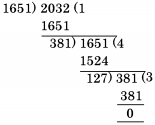
Step $2$: Find the $HCF$ of $1651$ and $2032$ using the division method.
$2032 = 1651 \times 1 + 381$
$1651 = 381 \times 4 + 127$
$381 = 127 \times 3 + 0$
Since the remainder is $0$,the $HCF$ is $127$.
Therefore,the greatest number is $127$.
Step $1$: Subtract the remainders from the numbers.
$1657 - 6 = 1651$
$2037 - 5 = 2032$
Step $2$: Find the $HCF$ of $1651$ and $2032$ using the division method.
$2032 = 1651 \times 1 + 381$
$1651 = 381 \times 4 + 127$
$381 = 127 \times 3 + 0$
Since the remainder is $0$,the $HCF$ is $127$.
Therefore,the greatest number is $127$.
0 likes
View Solution26
MediumMCQ
Let $N$ be the greatest number that will divide $1305, 4665,$ and $6905,$ leaving the same remainder in each case. Then the sum of the digits in $N$ is:
A
$4$
B
$5$
C
$6$
D
$8$
Solution
(A) To find the greatest number $N$ that divides $a, b,$ and $c$ leaving the same remainder,we calculate the $HCF$ of the differences of the numbers: $(b-a), (c-b),$ and $(c-a)$.
Here,$a = 1305, b = 4665, c = 6905$.
Differences are:
$4665 - 1305 = 3360$
$6905 - 4665 = 2240$
$6905 - 1305 = 5600$
Now,find the $HCF$ of $3360, 2240,$ and $5600$.
$3360 = 1120 \times 3$
$2240 = 1120 \times 2$
$5600 = 1120 \times 5$
Thus,$N = HCF(3360, 2240, 5600) = 1120$.
The sum of the digits of $N = 1 + 1 + 2 + 0 = 4$.
Here,$a = 1305, b = 4665, c = 6905$.
Differences are:
$4665 - 1305 = 3360$
$6905 - 4665 = 2240$
$6905 - 1305 = 5600$
Now,find the $HCF$ of $3360, 2240,$ and $5600$.
$3360 = 1120 \times 3$
$2240 = 1120 \times 2$
$5600 = 1120 \times 5$
Thus,$N = HCF(3360, 2240, 5600) = 1120$.
The sum of the digits of $N = 1 + 1 + 2 + 0 = 4$.
0 likes
View Solution27
EasyMCQ
Find the greatest number that will divide $43, 91$ and $183$ so as to leave the same remainder in each case.
A
$4$
B
$7$
C
$9$
D
$13$
Solution
(A) To find the greatest number that divides $43, 91,$ and $183$ leaving the same remainder,we calculate the differences between the numbers:
$91 - 43 = 48$
$183 - 91 = 92$
$183 - 43 = 140$
Now,we find the $HCF$ of these differences: $48, 92,$ and $140$.
Prime factorization of $48 = 2^4 \times 3$
Prime factorization of $92 = 2^2 \times 23$
Prime factorization of $140 = 2^2 \times 5 \times 7$
The common factor with the lowest power is $2^2 = 4$.
Therefore,the greatest number is $4$.
$91 - 43 = 48$
$183 - 91 = 92$
$183 - 43 = 140$
Now,we find the $HCF$ of these differences: $48, 92,$ and $140$.
Prime factorization of $48 = 2^4 \times 3$
Prime factorization of $92 = 2^2 \times 23$
Prime factorization of $140 = 2^2 \times 5 \times 7$
The common factor with the lowest power is $2^2 = 4$.
Therefore,the greatest number is $4$.
0 likes
View Solution28
MediumMCQ
The maximum number of students among whom $1001$ pens and $910$ pencils can be distributed in such a way that each student gets the same number of pens and the same number of pencils is:
A
$91$
B
$910$
C
$1001$
D
$1911$
Solution
(A) To find the maximum number of students,we need to calculate the Highest Common Factor $(HCF)$ of $1001$ and $910$.
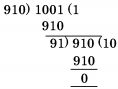
Using the division method:
$1001 = 910 \times 1 + 91$
$910 = 91 \times 10 + 0$
Since the remainder is $0$,the $HCF$ of $1001$ and $910$ is $91$.
Therefore,the maximum number of students is $91$.
Using the division method:
$1001 = 910 \times 1 + 91$
$910 = 91 \times 10 + 0$
Since the remainder is $0$,the $HCF$ of $1001$ and $910$ is $91$.
Therefore,the maximum number of students is $91$.
0 likes
View Solution29
MediumMCQ
The greatest possible length which can be used to measure exactly the lengths $7 \ m$,$3 \ m \ 85 \ cm$,and $12 \ m \ 95 \ cm$ is .......... $cm$.
A
$15$
B
$25$
C
$35$
D
$42$
Solution
(C) To find the greatest possible length that can measure the given lengths exactly,we need to find the Highest Common Factor $(HCF)$ of the given values.
First,convert all lengths into centimeters $(cm)$:
$7 \ m = 700 \ cm$
$3 \ m \ 85 \ cm = 385 \ cm$
$12 \ m \ 95 \ cm = 1295 \ cm$
Now,find the $HCF$ of $700$,$385$,and $1295$.
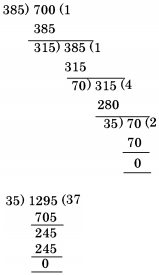
Using the division method:
$HCF$ of $700$ and $385$:
$700 = 385 \times 1 + 315$
$385 = 315 \times 1 + 70$
$315 = 70 \times 4 + 35$
$70 = 35 \times 2 + 0$
So,$HCF$ of $700$ and $385$ is $35$.
Now,find the $HCF$ of $35$ and $1295$:
$1295 = 35 \times 37 + 0$
Thus,the $HCF$ of $700$,$385$,and $1295$ is $35$.
The greatest possible length is $35 \ cm$.
First,convert all lengths into centimeters $(cm)$:
$7 \ m = 700 \ cm$
$3 \ m \ 85 \ cm = 385 \ cm$
$12 \ m \ 95 \ cm = 1295 \ cm$
Now,find the $HCF$ of $700$,$385$,and $1295$.
Using the division method:
$HCF$ of $700$ and $385$:
$700 = 385 \times 1 + 315$
$385 = 315 \times 1 + 70$
$315 = 70 \times 4 + 35$
$70 = 35 \times 2 + 0$
So,$HCF$ of $700$ and $385$ is $35$.
Now,find the $HCF$ of $35$ and $1295$:
$1295 = 35 \times 37 + 0$
Thus,the $HCF$ of $700$,$385$,and $1295$ is $35$.
The greatest possible length is $35 \ cm$.
0 likes
View Solution30
MediumMCQ
The $HCF$ and $LCM$ of two numbers are $11$ and $385$ respectively. If one number lies between $75$ and $125,$ then that number is
A
$77$
B
$88$
C
$99$
D
$110$
Solution
(A) Let the two numbers be $a$ and $b$.
We know that the product of two numbers is equal to the product of their $HCF$ and $LCM$,so $a \times b = HCF \times LCM$.
Given $HCF = 11$ and $LCM = 385$.
Therefore,$a \times b = 11 \times 385 = 11 \times (5 \times 7 \times 11) = (11 \times 5) \times (11 \times 7) = 55 \times 77$.
Since both numbers must be multiples of the $HCF$ $(11)$,the possible factors are $11 \times 1, 11 \times 5, 11 \times 7, 11 \times 35$.
The two numbers are $55$ and $77$.
We are given that one number lies between $75$ and $125$.
Since $77$ is between $75$ and $125$,the required number is $77$.
We know that the product of two numbers is equal to the product of their $HCF$ and $LCM$,so $a \times b = HCF \times LCM$.
Given $HCF = 11$ and $LCM = 385$.
Therefore,$a \times b = 11 \times 385 = 11 \times (5 \times 7 \times 11) = (11 \times 5) \times (11 \times 7) = 55 \times 77$.
Since both numbers must be multiples of the $HCF$ $(11)$,the possible factors are $11 \times 1, 11 \times 5, 11 \times 7, 11 \times 35$.
The two numbers are $55$ and $77$.
We are given that one number lies between $75$ and $125$.
Since $77$ is between $75$ and $125$,the required number is $77$.
0 likes
View Solution31
MediumMCQ
The $HCF$ of two numbers is $23$ and the other two factors of their $LCM$ are $13$ and $14.$ Then the larger of the two numbers is
A
$276$
B
$299$
C
$322$
D
$345$
Solution
(C) Let the two numbers be $a$ and $b$.
Given that the $HCF$ of the two numbers is $23$.
Any two numbers can be expressed as $a = HCF \times x$ and $b = HCF \times y$,where $x$ and $y$ are coprime factors.
The $LCM$ of these two numbers is given by $LCM = HCF \times x \times y$.
We are given that the other two factors of the $LCM$ are $13$ and $14$,so $x = 13$ and $y = 14$.
The two numbers are:
$a = 23 \times 13 = 299$
$b = 23 \times 14 = 322$
Comparing the two numbers,the larger number is $322$.
Given that the $HCF$ of the two numbers is $23$.
Any two numbers can be expressed as $a = HCF \times x$ and $b = HCF \times y$,where $x$ and $y$ are coprime factors.
The $LCM$ of these two numbers is given by $LCM = HCF \times x \times y$.
We are given that the other two factors of the $LCM$ are $13$ and $14$,so $x = 13$ and $y = 14$.
The two numbers are:
$a = 23 \times 13 = 299$
$b = 23 \times 14 = 322$
Comparing the two numbers,the larger number is $322$.
0 likes
View Solution32
EasyMCQ
The product of two co-prime numbers is $117$. Their $LCM$ should be:
A
$1$
B
$117$
C
equal to their $HCF$
D
cannot be calculated
Solution
(B) Two numbers are said to be co-prime if their $HCF$ (Highest Common Factor) is $1$.
We know the relationship between two numbers,their $HCF$,and their $LCM$ is given by:
$\text{Product of two numbers} = HCF \times LCM$
Given that the product of the two co-prime numbers is $117$ and their $HCF$ is $1$,we have:
$117 = 1 \times LCM$
Therefore,$LCM = 117$.
We know the relationship between two numbers,their $HCF$,and their $LCM$ is given by:
$\text{Product of two numbers} = HCF \times LCM$
Given that the product of the two co-prime numbers is $117$ and their $HCF$ is $1$,we have:
$117 = 1 \times LCM$
Therefore,$LCM = 117$.
0 likes
View Solution33
DifficultMCQ
If the sum of two numbers is $55$ and the $HCF$ and $LCM$ of these numbers are $5$ and $120$ respectively,then the sum of the reciprocals of the numbers is equal to
A
$\frac{55}{601}$
B
$\frac{601}{55}$
C
$\frac{11}{120}$
D
$\frac{120}{11}$
Solution
(C) Let the two numbers be $x$ and $y$.
Given that the sum of the numbers is $x + y = 55$ $....(1)$
We are given $HCF = 5$ and $LCM = 120$.
We know the property that for any two numbers,the product of the numbers is equal to the product of their $HCF$ and $LCM$:
$x \times y = HCF \times LCM$
$x \times y = 5 \times 120 = 600$ $....(2)$
We need to find the sum of the reciprocals of the numbers,which is $\frac{1}{x} + \frac{1}{y}$.
$\frac{1}{x} + \frac{1}{y} = \frac{x + y}{x \times y}$
Substituting the values from equation $(1)$ and $(2)$:
$\frac{1}{x} + \frac{1}{y} = \frac{55}{600}$
Simplifying the fraction by dividing both numerator and denominator by $5$:
$\frac{55 \div 5}{600 \div 5} = \frac{11}{120}$
Given that the sum of the numbers is $x + y = 55$ $....(1)$
We are given $HCF = 5$ and $LCM = 120$.
We know the property that for any two numbers,the product of the numbers is equal to the product of their $HCF$ and $LCM$:
$x \times y = HCF \times LCM$
$x \times y = 5 \times 120 = 600$ $....(2)$
We need to find the sum of the reciprocals of the numbers,which is $\frac{1}{x} + \frac{1}{y}$.
$\frac{1}{x} + \frac{1}{y} = \frac{x + y}{x \times y}$
Substituting the values from equation $(1)$ and $(2)$:
$\frac{1}{x} + \frac{1}{y} = \frac{55}{600}$
Simplifying the fraction by dividing both numerator and denominator by $5$:
$\frac{55 \div 5}{600 \div 5} = \frac{11}{120}$
0 likes
View Solution34
DifficultMCQ
The $LCM$ of two numbers is $495$ and their $HCF$ is $5.$ If the sum of the numbers is $100,$ then their difference is
A
$10$
B
$46$
C
$70$
D
$90$
Solution
(A) Let the two numbers be $x$ and $y$.
Given that the sum of the numbers is $x + y = 100$ $....(1)$
We know that for any two numbers,the product of the numbers is equal to the product of their $LCM$ and $HCF$.
$x \times y = LCM \times HCF$
$x \times y = 495 \times 5 = 2475$ $....(2)$
We need to find the difference,$|x - y|$.
Using the algebraic identity $(x - y)^2 = (x + y)^2 - 4xy$:
$(x - y)^2 = (100)^2 - 4(2475)$
$(x - y)^2 = 10000 - 9900$
$(x - y)^2 = 100$
Taking the square root on both sides,we get:
$x - y = \sqrt{100} = 10$
Therefore,the difference between the two numbers is $10$.
Given that the sum of the numbers is $x + y = 100$ $....(1)$
We know that for any two numbers,the product of the numbers is equal to the product of their $LCM$ and $HCF$.
$x \times y = LCM \times HCF$
$x \times y = 495 \times 5 = 2475$ $....(2)$
We need to find the difference,$|x - y|$.
Using the algebraic identity $(x - y)^2 = (x + y)^2 - 4xy$:
$(x - y)^2 = (100)^2 - 4(2475)$
$(x - y)^2 = 10000 - 9900$
$(x - y)^2 = 100$
Taking the square root on both sides,we get:
$x - y = \sqrt{100} = 10$
Therefore,the difference between the two numbers is $10$.
0 likes
View Solution35
MediumMCQ
The $HCF$ of two numbers is $11$ and their $LCM$ is $7700.$ If one of the numbers is $275,$ then the other is:
A
$279$
B
$283$
C
$308$
D
$318$
Solution
(C) Given: $HCF = 11$,$LCM = 7700$,and one number $x = 275$.
We know the relationship: $\text{Product of two numbers} = HCF \times LCM$.
Let the other number be $y$.
So,$275 \times y = 11 \times 7700$.
$y = \frac{11 \times 7700}{275}$.
Dividing $275$ by $11$,we get $25$.
$y = \frac{7700}{25}$.
$y = 308$.
Therefore,the other number is $308$.
We know the relationship: $\text{Product of two numbers} = HCF \times LCM$.
Let the other number be $y$.
So,$275 \times y = 11 \times 7700$.
$y = \frac{11 \times 7700}{275}$.
Dividing $275$ by $11$,we get $25$.
$y = \frac{7700}{25}$.
$y = 308$.
Therefore,the other number is $308$.
0 likes
View Solution36
MediumMCQ
The product of two numbers is $2028$ and their $HCF$ is $13$. The number of such pairs is
A
$1$
B
$2$
C
$3$
D
$4$
Solution
(B) Let the two numbers be $x$ and $y$.
Given that the product $x \times y = 2028$ and the $HCF = 13$.
Since $HCF$ is a factor of both numbers,we can write $x = 13a$ and $y = 13b$,where $a$ and $b$ are coprime numbers (i.e.,$gcd(a, b) = 1$).
Substituting these into the product equation: $(13a) \times (13b) = 2028$.
$169 \times ab = 2028$.
$ab = \frac{2028}{169} = 12$.
Now,we find pairs of factors $(a, b)$ such that their product is $12$ and they are coprime:
$1$. $(1, 12)$ where $gcd(1, 12) = 1$.
$2$. $(3, 4)$ where $gcd(3, 4) = 1$.
Note: $(2, 6)$ is not considered because $gcd(2, 6) = 2 \neq 1$.
Thus,there are $2$ such pairs of numbers.
Given that the product $x \times y = 2028$ and the $HCF = 13$.
Since $HCF$ is a factor of both numbers,we can write $x = 13a$ and $y = 13b$,where $a$ and $b$ are coprime numbers (i.e.,$gcd(a, b) = 1$).
Substituting these into the product equation: $(13a) \times (13b) = 2028$.
$169 \times ab = 2028$.
$ab = \frac{2028}{169} = 12$.
Now,we find pairs of factors $(a, b)$ such that their product is $12$ and they are coprime:
$1$. $(1, 12)$ where $gcd(1, 12) = 1$.
$2$. $(3, 4)$ where $gcd(3, 4) = 1$.
Note: $(2, 6)$ is not considered because $gcd(2, 6) = 2 \neq 1$.
Thus,there are $2$ such pairs of numbers.
0 likes
View Solution37
MediumMCQ
The sum of two numbers is $528$ and their $HCF$ is $33$. The number of pairs of numbers satisfying the above conditions is
A
$4$
B
$6$
C
$8$
D
$12$
Solution
(A) Let the two numbers be $33a$ and $33b$,where $a$ and $b$ are coprime numbers (i.e.,$gcd(a, b) = 1$).
Given that the sum of the numbers is $528$,we have $33a + 33b = 528$.
Dividing by $33$,we get $a + b = \frac{528}{33} = 16$.
We need to find pairs $(a, b)$ such that $a + b = 16$ and $gcd(a, b) = 1$ (since $HCF$ is $33$):
Possible pairs $(a, b)$ where $a < b$ are $(1, 15), (3, 13), (5, 11), (7, 9)$.
Note: $(2, 14), (4, 12), (6, 10), (8, 8)$ are excluded because they have a common factor other than $1$.
Thus,there are $4$ such pairs.
Given that the sum of the numbers is $528$,we have $33a + 33b = 528$.
Dividing by $33$,we get $a + b = \frac{528}{33} = 16$.
We need to find pairs $(a, b)$ such that $a + b = 16$ and $gcd(a, b) = 1$ (since $HCF$ is $33$):
Possible pairs $(a, b)$ where $a < b$ are $(1, 15), (3, 13), (5, 11), (7, 9)$.
Note: $(2, 14), (4, 12), (6, 10), (8, 8)$ are excluded because they have a common factor other than $1$.
Thus,there are $4$ such pairs.
0 likes
View Solution38
MediumMCQ
Three numbers are in the ratio $1:2:3$ and their $HCF$ is $12$. The numbers are
A
$4, 8, 12$
B
$5, 10, 15$
C
$10, 20, 30$
D
$12, 24, 36$
Solution
(D) Let the three numbers be $x, 2x,$ and $3x$ where $x$ is a common factor.
Since the $HCF$ of these numbers is $12$,the common factor $x$ must be equal to $12$.
Substituting the value of $x$ into the expressions:
First number $= 1 \times 12 = 12$
Second number $= 2 \times 12 = 24$
Third number $= 3 \times 12 = 36$
Therefore,the numbers are $12, 24,$ and $36$.
Hence,the correct option is $(d)$.
Since the $HCF$ of these numbers is $12$,the common factor $x$ must be equal to $12$.
Substituting the value of $x$ into the expressions:
First number $= 1 \times 12 = 12$
Second number $= 2 \times 12 = 24$
Third number $= 3 \times 12 = 36$
Therefore,the numbers are $12, 24,$ and $36$.
Hence,the correct option is $(d)$.
0 likes
View Solution39
DifficultMCQ
The $LCM$ of $22, 54, 108, 135$ and $198$ is
A
$330$
B
$1980$
C
$5940$
D
$11880$
Solution
(C) To find the $LCM$ of $22, 54, 108, 135,$ and $198$,we perform prime factorization:
$22 = 2 \times 11$
$54 = 2 \times 3^3$
$108 = 2^2 \times 3^3$
$135 = 3^3 \times 5$
$198 = 2 \times 3^2 \times 11$
The $LCM$ is the product of the highest powers of all prime factors present:
$LCM = 2^2 \times 3^3 \times 5 \times 11 = 4 \times 27 \times 5 \times 11 = 5940$
Alternatively,using the division method:
$LCM = 2 \times 2 \times 3 \times 3 \times 3 \times 5 \times 11 = 5940$.
$22 = 2 \times 11$
$54 = 2 \times 3^3$
$108 = 2^2 \times 3^3$
$135 = 3^3 \times 5$
$198 = 2 \times 3^2 \times 11$
The $LCM$ is the product of the highest powers of all prime factors present:
$LCM = 2^2 \times 3^3 \times 5 \times 11 = 4 \times 27 \times 5 \times 11 = 5940$
Alternatively,using the division method:
| $2$ | $22, 54, 108, 135, 198$ |
| $2$ | $11, 27, 54, 135, 99$ |
| $3$ | $11, 27, 27, 135, 99$ |
| $3$ | $11, 9, 9, 45, 33$ |
| $3$ | $11, 3, 3, 15, 11$ |
| $5$ | $11, 1, 1, 5, 11$ |
| $11$ | $11, 1, 1, 1, 11$ |
| $1, 1, 1, 1, 1$ |
$LCM = 2 \times 2 \times 3 \times 3 \times 3 \times 5 \times 11 = 5940$.
0 likes
View Solution40
MediumMCQ
$HCF$ of $4 \times 27 \times 3125$,$8 \times 9 \times 25 \times 7$ and $16 \times 81 \times 5 \times 11 \times 49$ is
A
$180$
B
$360$
C
$540$
D
$1260$
Solution
(A) First,express each number in its prime factorization form:
$4 \times 27 \times 3125 = 2^2 \times 3^3 \times 5^5$
$8 \times 9 \times 25 \times 7 = 2^3 \times 3^2 \times 5^2 \times 7^1$
$16 \times 81 \times 5 \times 11 \times 49 = 2^4 \times 3^4 \times 5^1 \times 11^1 \times 7^2$
To find the $HCF$,take the lowest power of each common prime factor present in all three numbers:
Common prime factors are $2, 3,$ and $5$.
Lowest power of $2$ is $2^2 = 4$.
Lowest power of $3$ is $3^2 = 9$.
Lowest power of $5$ is $5^1 = 5$.
Therefore,$HCF = 2^2 \times 3^2 \times 5 = 4 \times 9 \times 5 = 180$.
$4 \times 27 \times 3125 = 2^2 \times 3^3 \times 5^5$
$8 \times 9 \times 25 \times 7 = 2^3 \times 3^2 \times 5^2 \times 7^1$
$16 \times 81 \times 5 \times 11 \times 49 = 2^4 \times 3^4 \times 5^1 \times 11^1 \times 7^2$
To find the $HCF$,take the lowest power of each common prime factor present in all three numbers:
Common prime factors are $2, 3,$ and $5$.
Lowest power of $2$ is $2^2 = 4$.
Lowest power of $3$ is $3^2 = 9$.
Lowest power of $5$ is $5^1 = 5$.
Therefore,$HCF = 2^2 \times 3^2 \times 5 = 4 \times 9 \times 5 = 180$.
0 likes
View Solution41
MediumMCQ
The fraction $\frac{1095}{1168}$ when expressed in its simplest form is:
A
$\frac{13}{16}$
B
$\frac{15}{16}$
C
$\frac{17}{26}$
D
$\frac{25}{26}$
Solution
(B) To simplify the fraction $\frac{1095}{1168}$,we need to find the Greatest Common Divisor $(GCD)$ of $1095$ and $1168$.
Using the Euclidean algorithm:
$1168 = 1 \times 1095 + 73$
$1095 = 15 \times 73 + 0$
Thus,the $GCD$ is $73$.
Now,divide both the numerator and the denominator by $73$:
$\frac{1095 \div 73}{1168 \div 73} = \frac{15}{16}$.
Using the Euclidean algorithm:
$1168 = 1 \times 1095 + 73$
$1095 = 15 \times 73 + 0$
Thus,the $GCD$ is $73$.
Now,divide both the numerator and the denominator by $73$:
$\frac{1095 \div 73}{1168 \div 73} = \frac{15}{16}$.
0 likes
View Solution42
DifficultMCQ
Three numbers which are co-prime to each other are such that the product of the first two is $551$ and that of the last two is $1073$. The sum of the three numbers is:
A
$75$
B
$81$
C
$85$
D
$89$
Solution
(C) Let the three co-prime numbers be $x, y,$ and $z$.
Given that the product of the first two is $xy = 551$ and the product of the last two is $yz = 1073$.
Since $y$ is a common factor of both products,we find the Highest Common Factor $(HCF)$ of $551$ and $1073$.
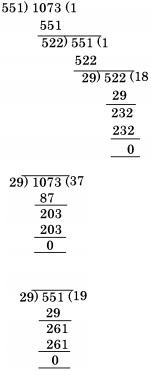
Using the division method:
$1073 = 551 \times 1 + 522$
$551 = 522 \times 1 + 29$
$522 = 29 \times 18 + 0$
Thus,the $HCF$ is $29$,which means $y = 29$.
Now,find $x$ and $z$:
$x = 551 / 29 = 19$
$z = 1073 / 29 = 37$
The three numbers are $19, 29,$ and $37$. These are co-prime to each other.
The sum of the three numbers is $19 + 29 + 37 = 85$.
Given that the product of the first two is $xy = 551$ and the product of the last two is $yz = 1073$.
Since $y$ is a common factor of both products,we find the Highest Common Factor $(HCF)$ of $551$ and $1073$.
Using the division method:
$1073 = 551 \times 1 + 522$
$551 = 522 \times 1 + 29$
$522 = 29 \times 18 + 0$
Thus,the $HCF$ is $29$,which means $y = 29$.
Now,find $x$ and $z$:
$x = 551 / 29 = 19$
$z = 1073 / 29 = 37$
The three numbers are $19, 29,$ and $37$. These are co-prime to each other.
The sum of the three numbers is $19 + 29 + 37 = 85$.
0 likes
View Solution43
MediumMCQ
The $LCM$ of two numbers is $48$. The numbers are in the ratio $2:3$. Find the sum of the numbers.
A
$28$
B
$32$
C
$40$
D
$64$
Solution
(C) Given that the $LCM$ of two numbers is $48$ and the ratio of the numbers is $2:3$.
Let the two numbers be $2x$ and $3x$,where $x$ is a common multiplier.
The $LCM$ of $2x$ and $3x$ is $2 \times 3 \times x = 6x$.
According to the problem,$6x = 48$.
Solving for $x$,we get $x = 48 / 6 = 8$.
Therefore,the numbers are $2 \times 8 = 16$ and $3 \times 8 = 24$.
The sum of the numbers is $16 + 24 = 40$.
Let the two numbers be $2x$ and $3x$,where $x$ is a common multiplier.
The $LCM$ of $2x$ and $3x$ is $2 \times 3 \times x = 6x$.
According to the problem,$6x = 48$.
Solving for $x$,we get $x = 48 / 6 = 8$.
Therefore,the numbers are $2 \times 8 = 16$ and $3 \times 8 = 24$.
The sum of the numbers is $16 + 24 = 40$.
0 likes
View Solution44
MediumMCQ
Three numbers are in the ratio $3: 4: 5$ and their $LCM$ is $2400$. Their $HCF$ is
A
$40$
B
$80$
C
$120$
D
$200$
Solution
(A) Let the three numbers be $3x, 4x,$ and $5x$, where $x$ is the $HCF$ of the numbers.
The $LCM$ of these numbers is given by the product of the common factor $x$ and the $LCM$ of the remaining ratios $(3, 4, 5)$.
$LCM = x \times LCM(3, 4, 5) = x \times 60 = 60x$.
Given that the $LCM$ is $2400$, we have:
$60x = 2400$.
Solving for $x$:
$x = 2400 / 60 = 40$.
Since $x$ represents the $HCF$, the $HCF$ of the numbers is $40$.
The $LCM$ of these numbers is given by the product of the common factor $x$ and the $LCM$ of the remaining ratios $(3, 4, 5)$.
$LCM = x \times LCM(3, 4, 5) = x \times 60 = 60x$.
Given that the $LCM$ is $2400$, we have:
$60x = 2400$.
Solving for $x$:
$x = 2400 / 60 = 40$.
Since $x$ represents the $HCF$, the $HCF$ of the numbers is $40$.
0 likes
View Solution45
DifficultMCQ
The $LCM$ of two prime numbers $x$ and $y$ $(x > y)$ is $161$. The value of $3y - x$ is
A
$-2$
B
$-1$
C
$1$
D
$2$
Solution
(A) Given that the $LCM$ of two prime numbers $x$ and $y$ is $161$.
Since $x$ and $y$ are prime numbers,their $HCF$ is $1$.
We know that for any two numbers,$LCM \times HCF = \text{Product of the numbers}$.
Therefore,$x \times y = 161$.
By prime factorization of $161$,we get $161 = 7 \times 23$.
Since $x > y$,we assign $x = 23$ and $y = 7$.
Now,calculating the value of $3y - x$:
$3(7) - 23 = 21 - 23 = -2$.
Since $x$ and $y$ are prime numbers,their $HCF$ is $1$.
We know that for any two numbers,$LCM \times HCF = \text{Product of the numbers}$.
Therefore,$x \times y = 161$.
By prime factorization of $161$,we get $161 = 7 \times 23$.
Since $x > y$,we assign $x = 23$ and $y = 7$.
Now,calculating the value of $3y - x$:
$3(7) - 23 = 21 - 23 = -2$.
0 likes
View Solution46
DifficultMCQ
The least number, which when divided by $48, 60, 72, 108$ and $140$ leaves $38, 50, 62, 98$ and $130$ as remainders respectively is
A
$11115$
B
$15110$
C
$15120$
D
$15210$
Solution
(B) First, observe the difference between each divisor and its corresponding remainder:
$48 - 38 = 10$
$60 - 50 = 10$
$72 - 62 = 10$
$108 - 98 = 10$
$140 - 130 = 10$
Since the difference is constant $(10)$, the required number is $(LCM \text{ of } 48, 60, 72, 108, 140) - 10$.
Prime factorization:
$48 = 2^4 \times 3$
$60 = 2^2 \times 3 \times 5$
$72 = 2^3 \times 3^2$
$108 = 2^2 \times 3^3$
$140 = 2^2 \times 5 \times 7$
$LCM = 2^4 \times 3^3 \times 5 \times 7 = 16 \times 27 \times 35 = 15120$.
Therefore, the required number $= 15120 - 10 = 15110$.
$48 - 38 = 10$
$60 - 50 = 10$
$72 - 62 = 10$
$108 - 98 = 10$
$140 - 130 = 10$
Since the difference is constant $(10)$, the required number is $(LCM \text{ of } 48, 60, 72, 108, 140) - 10$.
Prime factorization:
$48 = 2^4 \times 3$
$60 = 2^2 \times 3 \times 5$
$72 = 2^3 \times 3^2$
$108 = 2^2 \times 3^3$
$140 = 2^2 \times 5 \times 7$
$LCM = 2^4 \times 3^3 \times 5 \times 7 = 16 \times 27 \times 35 = 15120$.
Therefore, the required number $= 15120 - 10 = 15110$.
0 likes
View Solution47
MediumMCQ
Let $N$ be the least six-digit number which,when divided by $4, 6, 10,$ and $15,$ leaves the same remainder of $2$ in each case. The sum of the digits in $N$ is:
A
$3$
B
$4$
C
$5$
D
$6$
Solution
(C) First,find the $LCM$ of $4, 6, 10,$ and $15$.
$4 = 2^2$
$6 = 2 \times 3$
$10 = 2 \times 5$
$15 = 3 \times 5$
$LCM = 2^2 \times 3 \times 5 = 60$.
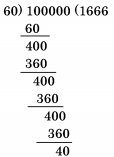
The smallest six-digit number is $100000$.
Divide $100000$ by $60$:
$100000 = 60 \times 1666 + 40$.
To find the smallest six-digit number exactly divisible by $60$,we add $(60 - 40) = 20$ to $100000$.
So,the number is $100000 + 20 = 100020$.
Since the number must leave a remainder of $2$ in each case,we add $2$ to this result:
$N = 100020 + 2 = 100022$.
The sum of the digits of $N$ is $1 + 0 + 0 + 0 + 2 + 2 = 5$.
$4 = 2^2$
$6 = 2 \times 3$
$10 = 2 \times 5$
$15 = 3 \times 5$
$LCM = 2^2 \times 3 \times 5 = 60$.
The smallest six-digit number is $100000$.
Divide $100000$ by $60$:
$100000 = 60 \times 1666 + 40$.
To find the smallest six-digit number exactly divisible by $60$,we add $(60 - 40) = 20$ to $100000$.
So,the number is $100000 + 20 = 100020$.
Since the number must leave a remainder of $2$ in each case,we add $2$ to this result:
$N = 100020 + 2 = 100022$.
The sum of the digits of $N$ is $1 + 0 + 0 + 0 + 2 + 2 = 5$.
0 likes
View Solution48
DifficultMCQ
Find the smallest number of five digits exactly divisible by $12, 16, 18$ and $27$.
A
$10432$
B
$10342$
C
$10368$
D
$10638$
Solution
(C) The smallest five-digit number is $10000$.
First,find the $LCM$ of $12, 16, 18$ and $27$:
$12 = 2^2 \times 3$
$16 = 2^4$
$18 = 2 \times 3^2$
$27 = 3^3$
$LCM = 2^4 \times 3^3 = 16 \times 27 = 432$.
Now,divide $10000$ by $432$ to find the remainder:
$10000 \div 432 = 23$ with a remainder of $64$.
To find the smallest five-digit number exactly divisible by $432$,we subtract the remainder from the divisor and add it to the smallest five-digit number:
Required number $= 10000 - 64 + 432 = 10368$.
First,find the $LCM$ of $12, 16, 18$ and $27$:
$12 = 2^2 \times 3$
$16 = 2^4$
$18 = 2 \times 3^2$
$27 = 3^3$
$LCM = 2^4 \times 3^3 = 16 \times 27 = 432$.
Now,divide $10000$ by $432$ to find the remainder:
$10000 \div 432 = 23$ with a remainder of $64$.
To find the smallest five-digit number exactly divisible by $432$,we subtract the remainder from the divisor and add it to the smallest five-digit number:
Required number $= 10000 - 64 + 432 = 10368$.
0 likes
View Solution49
DifficultMCQ
Find the largest number of four digits exactly divisible by $14, 24, 27$ and $32$.
A
$9968$
B
$9048$
C
$6048$
D
$6408$
Solution
(C) The largest four-digit number is $9999$.
To find the number exactly divisible by $14, 24, 27$,and $32$,we first calculate their $LCM$:
$14 = 2 \times 7$
$24 = 2^{3} \times 3$
$27 = 3^{3}$
$32 = 2^{5}$
$LCM = 2^{5} \times 3^{3} \times 7 = 32 \times 27 \times 7 = 6048$.
Now,we divide the largest four-digit number by the $LCM$:
$9999 \div 6048 = 1$ with a remainder of $3951$.
To find the largest four-digit number divisible by $6048$,we subtract the remainder from $9999$:
$9999 - 3951 = 6048$.
Therefore,the largest four-digit number exactly divisible by $14, 24, 27$,and $32$ is $6048$.
To find the number exactly divisible by $14, 24, 27$,and $32$,we first calculate their $LCM$:
$14 = 2 \times 7$
$24 = 2^{3} \times 3$
$27 = 3^{3}$
$32 = 2^{5}$
$LCM = 2^{5} \times 3^{3} \times 7 = 32 \times 27 \times 7 = 6048$.
Now,we divide the largest four-digit number by the $LCM$:
$9999 \div 6048 = 1$ with a remainder of $3951$.
To find the largest four-digit number divisible by $6048$,we subtract the remainder from $9999$:
$9999 - 3951 = 6048$.
Therefore,the largest four-digit number exactly divisible by $14, 24, 27$,and $32$ is $6048$.
0 likes
View Solution50
MediumMCQ
The $LCM$ of $2^{2} \times 3^{2} \times 5 \times 11$,$2^{4} \times 3^{4} \times 5^{2} \times 7$,and $2^{5} \times 3^{3} \times 5^{2} \times 7^{2} \times 11$ is:
A
$2^{3} \times 3^{2} \times 5$
B
$2^{5} \times 3^{4} \times 5^{2} \times 7^{2} \times 11$
C
$2^{2} \times 3^{2} \times 5 \times 7 \times 11$
D
$2^{5} \times 3^{4} \times 5^{2} \times 7^{2} \times 11$
Solution
(B) To find the $LCM$ of numbers given in prime factorization form,we take the highest power of each prime factor present in any of the numbers.
The given numbers are:
$1) \ 2^{2} \times 3^{2} \times 5^{1} \times 11^{1}$
$2) \ 2^{4} \times 3^{4} \times 5^{2} \times 7^{1}$
$3) \ 2^{5} \times 3^{3} \times 5^{2} \times 7^{2} \times 11^{1}$
Identifying the highest powers of each prime factor:
- For $2$: The highest power is $2^{5}$.
- For $3$: The highest power is $3^{4}$.
- For $5$: The highest power is $5^{2}$.
- For $7$: The highest power is $7^{2}$.
- For $11$: The highest power is $11^{1}$.
Therefore,the $LCM = 2^{5} \times 3^{4} \times 5^{2} \times 7^{2} \times 11^{1}$.
The given numbers are:
$1) \ 2^{2} \times 3^{2} \times 5^{1} \times 11^{1}$
$2) \ 2^{4} \times 3^{4} \times 5^{2} \times 7^{1}$
$3) \ 2^{5} \times 3^{3} \times 5^{2} \times 7^{2} \times 11^{1}$
Identifying the highest powers of each prime factor:
- For $2$: The highest power is $2^{5}$.
- For $3$: The highest power is $3^{4}$.
- For $5$: The highest power is $5^{2}$.
- For $7$: The highest power is $7^{2}$.
- For $11$: The highest power is $11^{1}$.
Therefore,the $LCM = 2^{5} \times 3^{4} \times 5^{2} \times 7^{2} \times 11^{1}$.
0 likes
View SolutionHCF and LCM — HCF and LCM · Frequently Asked Questions
1Are these HCF and LCM questions useful for JEE and NEET?
Yes. All questions in this section are mapped to JEE Main and NEET exam patterns. Previous year questions from JEE Main, NEET, GUJCET and state-level exams are included with full solutions.
2Can I switch to Hindi or Gujarati for these questions?
Yes. Use the language tabs in the hero section or the sidebar to view the same questions and solutions in English, Hindi or Gujarati.
3How do I generate a question paper from this subtopic?
Use the Vedclass Exam Paper Generator — select the chapter and subtopic, set difficulty, and generate Sets A, B, C, D automatically. First 3 chapters of every subject are free.
Vedclass Products
For Students
Vedclass Test Series
Mock tests in real JEE/NEET style with performance analysis. 5-day free trial.
Start Free TrialFor Teachers
Exam Paper Generator
Generate Set A/B/C/D papers from this chapter in 2 minutes. 3 chapters free.
Try FreeFor Institutes
Online Exam Module
Live online exams with unlimited students, 360° analytics & white-label branding.
See DemoFor Teachers & Institutes
Generate a HCF and LCM Exam Paper in 2 Minutes
Select subtopic & difficulty — Sets A, B, C, D auto-generated with No Repeat logic.
First 3 chapters of every subject are free — no payment required.