
A English
HCF and LCM Questions in English
Competitive Exam Quantitative Aptitude · HCF and LCM · HCF and LCM
136+
Questions
English
Language
100%
With Solutions
Showing 50 of 136 questions in English
51
MediumMCQ
What is the $H.C.F.$ of $27, 18$ and $36$?
A
$7$
B
$11$
C
$9$
D
None of these
Solution
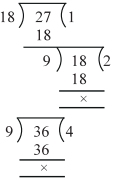
(C) To find the $H.C.F.$ of $27, 18$ and $36$:
Step $1$: Find the $H.C.F.$ of $27$ and $18$.
$27 = 18 \times 1 + 9$
$18 = 9 \times 2 + 0$
So,the $H.C.F.$ of $27$ and $18$ is $9$.
Step $2$: Find the $H.C.F.$ of the result $(9)$ and the remaining number $(36)$.
$36 = 9 \times 4 + 0$
So,the $H.C.F.$ of $9$ and $36$ is $9$.
Therefore,the $H.C.F.$ of $27, 18$ and $36$ is $9$.
Step $1$: Find the $H.C.F.$ of $27$ and $18$.
$27 = 18 \times 1 + 9$
$18 = 9 \times 2 + 0$
So,the $H.C.F.$ of $27$ and $18$ is $9$.
Step $2$: Find the $H.C.F.$ of the result $(9)$ and the remaining number $(36)$.
$36 = 9 \times 4 + 0$
So,the $H.C.F.$ of $9$ and $36$ is $9$.
Therefore,the $H.C.F.$ of $27, 18$ and $36$ is $9$.
0 likes
View Solution52
DifficultMCQ
Determine the $L.C.M.$ of $\frac{2}{5}, \frac{3}{10}$ and $\frac{6}{25}$.
A
$\frac{6}{5}$
B
$\frac{11}{5}$
C
$\frac{9}{5}$
D
None of these
Solution
(A) The $L.C.M.$ of fractions is calculated using the formula:
$L.C.M. = \frac{L.C.M. \text{ of numerators}}{H.C.F. \text{ of denominators}}$
For the fractions $\frac{2}{5}, \frac{3}{10}, \frac{6}{25}$:
$L.C.M. \text{ of } (2, 3, 6) = 6$
$H.C.F. \text{ of } (5, 10, 25) = 5$
Therefore,the required $L.C.M. = \frac{6}{5}$.
$L.C.M. = \frac{L.C.M. \text{ of numerators}}{H.C.F. \text{ of denominators}}$
For the fractions $\frac{2}{5}, \frac{3}{10}, \frac{6}{25}$:
$L.C.M. \text{ of } (2, 3, 6) = 6$
$H.C.F. \text{ of } (5, 10, 25) = 5$
Therefore,the required $L.C.M. = \frac{6}{5}$.
0 likes
View Solution53
MediumMCQ
What is the $L.C.M.$ of $25, 30, 35$ and $40$?
A
$3800$
B
$4200$
C
$4400$
D
None of these
Solution
(B) To find the $L.C.M.$ of $25, 30, 35$ and $40$,we use the division method:
$\therefore \quad$ The $L.C.M.$ is the product of the divisors and the remaining terms:
$L.C.M. = 2 \times 5 \times 5 \times 3 \times 7 \times 4$
$L.C.M. = 10 \times 5 \times 3 \times 7 \times 4$
$L.C.M. = 50 \times 3 \times 7 \times 4$
$L.C.M. = 150 \times 7 \times 4$
$L.C.M. = 1050 \times 4$
$L.C.M. = 4200$
Thus,the correct option is $B$.
| $2$ | $25, 30, 35, 40$ |
| $5$ | $25, 15, 35, 20$ |
| $5, 3, 7, 4$ |
$\therefore \quad$ The $L.C.M.$ is the product of the divisors and the remaining terms:
$L.C.M. = 2 \times 5 \times 5 \times 3 \times 7 \times 4$
$L.C.M. = 10 \times 5 \times 3 \times 7 \times 4$
$L.C.M. = 50 \times 3 \times 7 \times 4$
$L.C.M. = 150 \times 7 \times 4$
$L.C.M. = 1050 \times 4$
$L.C.M. = 4200$
Thus,the correct option is $B$.
0 likes
View Solution54
MediumMCQ
What is the greatest number which divides $852, 1065$ and $1491$ exactly?
A
$193$
B
$183$
C
$223$
D
$213$
Solution
(D) To find the greatest number that divides $852, 1065,$ and $1491$ exactly,we need to find the Highest Common Factor $(H.C.F.)$ of these three numbers.
Step $1$: Find the $H.C.F.$ of $852$ and $1065$ using the division method.
$1065 = 852 \times 1 + 213$
$852 = 213 \times 4 + 0$
So,the $H.C.F.$ of $852$ and $1065$ is $213$.
Step $2$: Find the $H.C.F.$ of the result $(213)$ and the third number $(1491)$.
$1491 = 213 \times 7 + 0$
Since $1491$ is perfectly divisible by $213$,the $H.C.F.$ of all three numbers is $213$.
Step $1$: Find the $H.C.F.$ of $852$ and $1065$ using the division method.
$1065 = 852 \times 1 + 213$
$852 = 213 \times 4 + 0$
So,the $H.C.F.$ of $852$ and $1065$ is $213$.
Step $2$: Find the $H.C.F.$ of the result $(213)$ and the third number $(1491)$.
$1491 = 213 \times 7 + 0$
Since $1491$ is perfectly divisible by $213$,the $H.C.F.$ of all three numbers is $213$.
0 likes
View Solution55
MediumMCQ
What is the $H.C.F.$ of $\frac{4}{9}, \frac{10}{21}$ and $\frac{20}{63}$?
A
$\frac{4}{189}$
B
$\frac{6}{23}$
C
$\frac{2}{63}$
D
None of these
Solution
(C) To find the $H.C.F.$ of fractions,we use the formula:
$H.C.F. = \frac{H.C.F. \text{ of numerators}}{L.C.M. \text{ of denominators}}$
Given fractions: $\frac{4}{9}, \frac{10}{21}, \frac{20}{63}$
Step $1$: Find the $H.C.F.$ of the numerators $(4, 10, 20)$:
Factors of $4 = 2 \times 2$
Factors of $10 = 2 \times 5$
Factors of $20 = 2 \times 2 \times 5$
The common factor is $2$. So,$H.C.F. = 2$.
Step $2$: Find the $L.C.M.$ of the denominators $(9, 21, 63)$:
$9 = 3^2$
$21 = 3 \times 7$
$63 = 3^2 \times 7$
$L.C.M. = 3^2 \times 7 = 9 \times 7 = 63$.
Step $3$: Combine the results:
$H.C.F. = \frac{2}{63}$.
$H.C.F. = \frac{H.C.F. \text{ of numerators}}{L.C.M. \text{ of denominators}}$
Given fractions: $\frac{4}{9}, \frac{10}{21}, \frac{20}{63}$
Step $1$: Find the $H.C.F.$ of the numerators $(4, 10, 20)$:
Factors of $4 = 2 \times 2$
Factors of $10 = 2 \times 5$
Factors of $20 = 2 \times 2 \times 5$
The common factor is $2$. So,$H.C.F. = 2$.
Step $2$: Find the $L.C.M.$ of the denominators $(9, 21, 63)$:
$9 = 3^2$
$21 = 3 \times 7$
$63 = 3^2 \times 7$
$L.C.M. = 3^2 \times 7 = 9 \times 7 = 63$.
Step $3$: Combine the results:
$H.C.F. = \frac{2}{63}$.
0 likes
View Solution56
MediumMCQ
Find the least number which when divided by $16, 18, 20$ and $25$ leaves $4$ as a remainder in each case,but when divided by $7$ leaves no remainder.
A
$8004$
B
$13004$
C
$18004$
D
$18014$
Solution
(C) First,find the $L.C.M.$ of $16, 18, 20$ and $25$.
$16 = 2^4$
$18 = 2 \times 3^2$
$20 = 2^2 \times 5$
$25 = 5^2$
$L.C.M. = 2^4 \times 3^2 \times 5^2 = 16 \times 9 \times 25 = 3600$.
Any number that leaves a remainder of $4$ when divided by $16, 18, 20$ and $25$ is of the form $(3600K + 4)$,where $K$ is a natural number.
We are given that this number is divisible by $7$.
$(3600K + 4) \div 7 = 0$ remainder.
$3600 \div 7$ leaves a remainder of $2$ (since $3600 = 7 \times 514 + 2$).
So,$(2K + 4)$ must be divisible by $7$.
For $K = 1, 2K+4 = 6$ (not divisible by $7$).
For $K = 2, 2K+4 = 8$ (not divisible by $7$).
For $K = 3, 2K+4 = 10$ (not divisible by $7$).
For $K = 4, 2K+4 = 12$ (not divisible by $7$).
For $K = 5, 2K+4 = 14$ (divisible by $7$).
Thus,the required number $= 3600 \times 5 + 4 = 18000 + 4 = 18004$.
$16 = 2^4$
$18 = 2 \times 3^2$
$20 = 2^2 \times 5$
$25 = 5^2$
$L.C.M. = 2^4 \times 3^2 \times 5^2 = 16 \times 9 \times 25 = 3600$.
Any number that leaves a remainder of $4$ when divided by $16, 18, 20$ and $25$ is of the form $(3600K + 4)$,where $K$ is a natural number.
We are given that this number is divisible by $7$.
$(3600K + 4) \div 7 = 0$ remainder.
$3600 \div 7$ leaves a remainder of $2$ (since $3600 = 7 \times 514 + 2$).
So,$(2K + 4)$ must be divisible by $7$.
For $K = 1, 2K+4 = 6$ (not divisible by $7$).
For $K = 2, 2K+4 = 8$ (not divisible by $7$).
For $K = 3, 2K+4 = 10$ (not divisible by $7$).
For $K = 4, 2K+4 = 12$ (not divisible by $7$).
For $K = 5, 2K+4 = 14$ (divisible by $7$).
Thus,the required number $= 3600 \times 5 + 4 = 18000 + 4 = 18004$.
0 likes
View Solution57
DifficultMCQ
The areas of three fields are $165 \ m^2$,$195 \ m^2$,and $85 \ m^2$ respectively. In each of the fields,a flower bed of equal length has to be made. If the flower bed in each of the fields is $3 \ m$ wide,then what is the maximum length of the flower bed in each of the fields? (in $m$)
A
$7$
B
$9$
C
$5$
D
None of these
Solution
(D) Let the length of the flower bed be $L$ meters. Since the width is $3 \ m$,the area of the flower bed in each field is $3L \ m^2$.
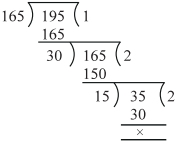
Since $3L$ must be a common divisor of the areas $165, 195,$ and $85$,we first find the $H.C.F.$ of $165, 195,$ and $85$.
Prime factorization:
$165 = 3 \times 5 \times 11$
$195 = 3 \times 5 \times 13$
$85 = 5 \times 17$
The $H.C.F.$ of $165, 195,$ and $85$ is $5$.
Thus,the maximum area of the flower bed that can be carved out of each field is $5 \ m^2$.
Given the width is $3 \ m$,we have $3 \times L = 5$.
Therefore,$L = \frac{5}{3} \ m \approx 1.67 \ m$.
Since $\frac{5}{3}$ is not among the options,the correct answer is "None of these".
Since $3L$ must be a common divisor of the areas $165, 195,$ and $85$,we first find the $H.C.F.$ of $165, 195,$ and $85$.
Prime factorization:
$165 = 3 \times 5 \times 11$
$195 = 3 \times 5 \times 13$
$85 = 5 \times 17$
The $H.C.F.$ of $165, 195,$ and $85$ is $5$.
Thus,the maximum area of the flower bed that can be carved out of each field is $5 \ m^2$.
Given the width is $3 \ m$,we have $3 \times L = 5$.
Therefore,$L = \frac{5}{3} \ m \approx 1.67 \ m$.
Since $\frac{5}{3}$ is not among the options,the correct answer is "None of these".
0 likes
View Solution58
DifficultMCQ
Find the greatest number which will divide $2112$ and $2792$ leaving the remainder $4$ in each case.
A
$78$
B
$68$
C
$65$
D
$63$
Solution
(B) To find the greatest number that divides $2112$ and $2792$ leaving a remainder of $4$ in each case,we follow these steps:
$1$. Subtract the remainder from both numbers to make them perfectly divisible by the required number.
$2112 - 4 = 2108$
$2792 - 4 = 2788$
$2$. Find the Highest Common Factor $(HCF)$ of $2108$ and $2788$.
Prime factorization of $2108 = 2^2 \times 17 \times 31 = 4 \times 17 \times 31$
Prime factorization of $2788 = 2^2 \times 17 \times 41 = 4 \times 17 \times 41$
$3$. The $HCF$ is the product of the common prime factors:
$HCF = 4 \times 17 = 68$
Therefore,the greatest number is $68$.
$1$. Subtract the remainder from both numbers to make them perfectly divisible by the required number.
$2112 - 4 = 2108$
$2792 - 4 = 2788$
$2$. Find the Highest Common Factor $(HCF)$ of $2108$ and $2788$.
Prime factorization of $2108 = 2^2 \times 17 \times 31 = 4 \times 17 \times 31$
Prime factorization of $2788 = 2^2 \times 17 \times 41 = 4 \times 17 \times 41$
$3$. The $HCF$ is the product of the common prime factors:
$HCF = 4 \times 17 = 68$
Therefore,the greatest number is $68$.
0 likes
View Solution59
MediumMCQ
The $H.C.F.$ of two numbers is $12$ and their difference is $12$. The numbers are:
A
$66, 78$
B
$70, 82$
C
$94, 106$
D
$84, 96$
Solution
(D) Let the two numbers be $12x$ and $12y$,where $x$ and $y$ are coprime integers and $x < y$.
Since the $H.C.F.$ is $12$,both numbers must be multiples of $12$.
The difference between the numbers is given as $12y - 12x = 12$,which simplifies to $y - x = 1$.
This means the numbers are consecutive multiples of $12$.
Checking the options:
For $84$ and $96$: $H.C.F.(84, 96) = 12$ and $96 - 84 = 12$.
Thus,the numbers are $84$ and $96$.
Since the $H.C.F.$ is $12$,both numbers must be multiples of $12$.
The difference between the numbers is given as $12y - 12x = 12$,which simplifies to $y - x = 1$.
This means the numbers are consecutive multiples of $12$.
Checking the options:
For $84$ and $96$: $H.C.F.(84, 96) = 12$ and $96 - 84 = 12$.
Thus,the numbers are $84$ and $96$.
0 likes
View Solution60
MediumMCQ
$A$ merchant has $435$ litres,$493$ litres,and $551$ litres of three different kinds of milk. Find the least number of casks of equal size required to store all the milk without mixing.
A
$51$
B
$61$
C
$47$
D
$45$
Solution
(A) To find the least number of casks,the capacity of each cask must be the greatest possible value that divides $435$,$493$,and $551$ exactly. This capacity is the $H.C.F.$ of $435$,$493$,and $551$.
First,find the $H.C.F.$ of $435$ and $493$:
$493 = 435 \times 1 + 58$
$435 = 58 \times 7 + 29$
$58 = 29 \times 2 + 0$
So,the $H.C.F.$ of $435$ and $493$ is $29$.
Now,check if $551$ is divisible by $29$:
$551 \div 29 = 19$.
Thus,the $H.C.F.$ of $435, 493,$ and $551$ is $29$.
The capacity of each cask is $29$ litres.
Total number of casks required $= (435 \div 29) + (493 \div 29) + (551 \div 29)$
$= 15 + 17 + 19 = 51$.
First,find the $H.C.F.$ of $435$ and $493$:
$493 = 435 \times 1 + 58$
$435 = 58 \times 7 + 29$
$58 = 29 \times 2 + 0$
So,the $H.C.F.$ of $435$ and $493$ is $29$.
Now,check if $551$ is divisible by $29$:
$551 \div 29 = 19$.
Thus,the $H.C.F.$ of $435, 493,$ and $551$ is $29$.
The capacity of each cask is $29$ litres.
Total number of casks required $= (435 \div 29) + (493 \div 29) + (551 \div 29)$
$= 15 + 17 + 19 = 51$.
0 likes
View Solution61
MediumMCQ
Find the greatest number which will divide $25, 73$ and $97$ so as to leave the same remainder in each case.
A
$12$
B
$18$
C
$24$
D
$32$
Solution
(C) To find the greatest number that leaves the same remainder when dividing $25, 73,$ and $97$,we calculate the differences between the numbers:
$73 - 25 = 48$
$97 - 73 = 24$
$97 - 25 = 72$
Now,find the $H.C.F.$ of these differences: $48, 24,$ and $72$.
The prime factorization of the numbers is:
$48 = 2^4 \times 3$
$24 = 2^3 \times 3$
$72 = 2^3 \times 3^2$
The $H.C.F.$ is the product of the lowest powers of common prime factors: $2^3 \times 3 = 8 \times 3 = 24$.
Thus,the greatest number is $24$.
$73 - 25 = 48$
$97 - 73 = 24$
$97 - 25 = 72$
Now,find the $H.C.F.$ of these differences: $48, 24,$ and $72$.
The prime factorization of the numbers is:
$48 = 2^4 \times 3$
$24 = 2^3 \times 3$
$72 = 2^3 \times 3^2$
The $H.C.F.$ is the product of the lowest powers of common prime factors: $2^3 \times 3 = 8 \times 3 = 24$.
Thus,the greatest number is $24$.
0 likes
View Solution62
EasyMCQ
The sum of two numbers is $216$ and their $H.C.F.$ is $27$. The numbers are
A
$54, 162$
B
$108, 118$
C
$27, 189$
D
None of these
Solution
(C) Let the two numbers be $27a$ and $27b$,where $a$ and $b$ are co-prime numbers.
Given that the sum of the numbers is $216$,we have:
$27a + 27b = 216$
$27(a + b) = 216$
$a + b = \frac{216}{27} = 8$
Now,we find pairs of co-prime numbers $(a, b)$ such that their sum is $8$:
Possible pairs are $(1, 7)$ and $(3, 5)$.
For the pair $(1, 7)$,the numbers are $(27 \times 1, 27 \times 7) = (27, 189)$.
For the pair $(3, 5)$,the numbers are $(27 \times 3, 27 \times 5) = (81, 135)$.
Since $(27, 189)$ is given in the options,the correct answer is $(27, 189)$.
Given that the sum of the numbers is $216$,we have:
$27a + 27b = 216$
$27(a + b) = 216$
$a + b = \frac{216}{27} = 8$
Now,we find pairs of co-prime numbers $(a, b)$ such that their sum is $8$:
Possible pairs are $(1, 7)$ and $(3, 5)$.
For the pair $(1, 7)$,the numbers are $(27 \times 1, 27 \times 7) = (27, 189)$.
For the pair $(3, 5)$,the numbers are $(27 \times 3, 27 \times 5) = (81, 135)$.
Since $(27, 189)$ is given in the options,the correct answer is $(27, 189)$.
0 likes
View Solution63
EasyMCQ
How often will five bells toll together in one hour if they start together and toll at intervals of $5, 6, 8, 12, 20$ seconds,respectively?
A
$29$
B
$30$
C
$31$
D
$120$
Solution
(C) The time interval after which the five bells will toll together is the $L.C.M.$ of $5, 6, 8, 12,$ and $20$ seconds.
Prime factorization:
$5 = 5^1$
$6 = 2^1 \times 3^1$
$8 = 2^3$
$12 = 2^2 \times 3^1$
$20 = 2^2 \times 5^1$
$L.C.M. = 2^3 \times 3^1 \times 5^1 = 8 \times 3 \times 5 = 120$ seconds.
Since $120$ seconds $= 2$ minutes,the bells toll together every $2$ minutes.
In one hour ($3600$ seconds),the number of intervals is $3600 \div 120 = 30$.
Since the bells start tolling together at the beginning ($0$ seconds),we add $1$ to the total number of intervals.
Total number of times they toll together $= 30 + 1 = 31$.
Prime factorization:
$5 = 5^1$
$6 = 2^1 \times 3^1$
$8 = 2^3$
$12 = 2^2 \times 3^1$
$20 = 2^2 \times 5^1$
$L.C.M. = 2^3 \times 3^1 \times 5^1 = 8 \times 3 \times 5 = 120$ seconds.
Since $120$ seconds $= 2$ minutes,the bells toll together every $2$ minutes.
In one hour ($3600$ seconds),the number of intervals is $3600 \div 120 = 30$.
Since the bells start tolling together at the beginning ($0$ seconds),we add $1$ to the total number of intervals.
Total number of times they toll together $= 30 + 1 = 31$.
0 likes
View Solution64
MediumMCQ
Find the greatest number that will divide $964, 1238$ and $1400$ leaving remainders $41, 31$ and $51$ respectively.
A
$71$
B
$81$
C
$61$
D
$73$
Solution
(A) To find the greatest number that divides $964, 1238,$ and $1400$ leaving remainders $41, 31,$ and $51$ respectively,we first subtract the remainders from the respective numbers:
$964 - 41 = 923$
$1238 - 31 = 1207$
$1400 - 51 = 1349$
Now,we need to find the Highest Common Factor $(H.C.F.)$ of $923, 1207,$ and $1349$.
First,find the $H.C.F.$ of $923$ and $1207$:
$1207 = 923 \times 1 + 284$
$923 = 284 \times 3 + 71$
$284 = 71 \times 4 + 0$
So,the $H.C.F.$ of $923$ and $1207$ is $71$.
Next,find the $H.C.F.$ of $71$ and $1349$:
$1349 = 71 \times 19 + 0$
Since $1349$ is divisible by $71$,the $H.C.F.$ of $923, 1207,$ and $1349$ is $71$.
Therefore,the greatest number is $71$.
$964 - 41 = 923$
$1238 - 31 = 1207$
$1400 - 51 = 1349$
Now,we need to find the Highest Common Factor $(H.C.F.)$ of $923, 1207,$ and $1349$.
First,find the $H.C.F.$ of $923$ and $1207$:
$1207 = 923 \times 1 + 284$
$923 = 284 \times 3 + 71$
$284 = 71 \times 4 + 0$
So,the $H.C.F.$ of $923$ and $1207$ is $71$.
Next,find the $H.C.F.$ of $71$ and $1349$:
$1349 = 71 \times 19 + 0$
Since $1349$ is divisible by $71$,the $H.C.F.$ of $923, 1207,$ and $1349$ is $71$.
Therefore,the greatest number is $71$.
0 likes
View Solution65
EasyMCQ
Find the side of the largest square slab which can be paved on the floor of a room $5 \, m \, 44 \, cm$ long and $3 \, m \, 74 \, cm$ broad.
A
$56$
B
$42$
C
$38$
D
$34$
Solution
(D) To find the side of the largest square slab,we need to calculate the $H.C.F.$ of the length and breadth of the room.
First,convert the dimensions into centimeters:
Length $= 5 \, m \, 44 \, cm = 544 \, cm$.
Breadth $= 3 \, m \, 74 \, cm = 374 \, cm$.
Now,find the $H.C.F.$ of $544$ and $374$:
$544 = 2 \times 2 \times 2 \times 2 \times 2 \times 17 = 2^5 \times 17$.
$374 = 2 \times 11 \times 17$.
The $H.C.F.$ is the product of the common prime factors with the lowest powers:
$H.C.F. = 2 \times 17 = 34$.
Therefore,the side of the largest square slab is $34 \, cm$.
First,convert the dimensions into centimeters:
Length $= 5 \, m \, 44 \, cm = 544 \, cm$.
Breadth $= 3 \, m \, 74 \, cm = 374 \, cm$.
Now,find the $H.C.F.$ of $544$ and $374$:
$544 = 2 \times 2 \times 2 \times 2 \times 2 \times 17 = 2^5 \times 17$.
$374 = 2 \times 11 \times 17$.
The $H.C.F.$ is the product of the common prime factors with the lowest powers:
$H.C.F. = 2 \times 17 = 34$.
Therefore,the side of the largest square slab is $34 \, cm$.
0 likes
View Solution66
MediumMCQ
The traffic lights at three different road crossings change after every $48\, seconds,$ $72\, seconds$ and $108\, seconds,$ respectively. If they all change simultaneously at $8: 20: 00$ $hours,$ then they will again change simultaneously at
A
$8: 27: 12\, hours$
B
$8: 27: 24\, hours$
C
$8: 27: 36\, hours$
D
$8: 27: 48\, hours$
Solution
(A) To find when the traffic lights will change simultaneously again,we need to calculate the Least Common Multiple $(LCM)$ of the given intervals: $48, 72,$ and $108$ seconds.
Prime factorization of $48 = 2^4 \times 3^1$.
Prime factorization of $72 = 2^3 \times 3^2$.
Prime factorization of $108 = 2^2 \times 3^3$.
$LCM = 2^4 \times 3^3 = 16 \times 27 = 432$ seconds.
Now,convert $432$ seconds into minutes and seconds:
$432 \div 60 = 7$ minutes with a remainder of $12$ seconds.
Therefore,the lights will change simultaneously after $7$ minutes and $12$ seconds.
Adding this to the initial time of $8: 20: 00$ hours:
$8: 20: 00 + 0: 07: 12 = 8: 27: 12$ hours.
Prime factorization of $48 = 2^4 \times 3^1$.
Prime factorization of $72 = 2^3 \times 3^2$.
Prime factorization of $108 = 2^2 \times 3^3$.
$LCM = 2^4 \times 3^3 = 16 \times 27 = 432$ seconds.
Now,convert $432$ seconds into minutes and seconds:
$432 \div 60 = 7$ minutes with a remainder of $12$ seconds.
Therefore,the lights will change simultaneously after $7$ minutes and $12$ seconds.
Adding this to the initial time of $8: 20: 00$ hours:
$8: 20: 00 + 0: 07: 12 = 8: 27: 12$ hours.
0 likes
View Solution67
MediumMCQ
The product of two numbers is $6760$ and their $H.C.F.$ is $13.$ How many such pairs can be formed?
A
$2$
B
$3$
C
$4$
D
only one
Solution
(A) Let the two numbers be $13x$ and $13y$,where $x$ and $y$ are co-prime numbers.
Given that the product of the numbers is $6760$.
$13x \times 13y = 6760$
$169xy = 6760$
$xy = \frac{6760}{169} = 40$
Now,we need to find pairs of co-prime numbers $(x, y)$ such that their product is $40$.
The factors of $40$ are $(1, 40), (2, 20), (4, 10), (5, 8)$.
For the numbers to have an $H.C.F.$ of $13$,$x$ and $y$ must be co-prime (i.e.,their $H.C.F.$ must be $1$).
Checking the pairs:
$(1, 40)$: $H.C.F.(1, 40) = 1$ (Valid)
$(2, 20)$: $H.C.F.(2, 20) = 2$ (Invalid)
$(4, 10)$: $H.C.F.(4, 10) = 2$ (Invalid)
$(5, 8)$: $H.C.F.(5, 8) = 1$ (Valid)
Thus,there are $2$ such pairs: $(1, 40)$ and $(5, 8)$.
Given that the product of the numbers is $6760$.
$13x \times 13y = 6760$
$169xy = 6760$
$xy = \frac{6760}{169} = 40$
Now,we need to find pairs of co-prime numbers $(x, y)$ such that their product is $40$.
The factors of $40$ are $(1, 40), (2, 20), (4, 10), (5, 8)$.
For the numbers to have an $H.C.F.$ of $13$,$x$ and $y$ must be co-prime (i.e.,their $H.C.F.$ must be $1$).
Checking the pairs:
$(1, 40)$: $H.C.F.(1, 40) = 1$ (Valid)
$(2, 20)$: $H.C.F.(2, 20) = 2$ (Invalid)
$(4, 10)$: $H.C.F.(4, 10) = 2$ (Invalid)
$(5, 8)$: $H.C.F.(5, 8) = 1$ (Valid)
Thus,there are $2$ such pairs: $(1, 40)$ and $(5, 8)$.
0 likes
View Solution68
EasyMCQ
Find the greatest number of four digits which when divided by $10, 15, 21$ and $28$ leaves $4, 9, 15$ and $22$ as remainders,respectively.
A
$9654$
B
$9666$
C
$9664$
D
$9864$
Solution
(A) Step $1$: Observe the difference between the divisors and their respective remainders:
$10 - 4 = 6$
$15 - 9 = 6$
$21 - 15 = 6$
$28 - 22 = 6$
Since the difference is constant $(6)$,the required number is $(L.C.M. \text{ of } 10, 15, 21, 28) \times k - 6$.
Step $2$: Find the $L.C.M.$ of $10, 15, 21, 28$.
$10 = 2 \times 5$
$15 = 3 \times 5$
$21 = 3 \times 7$
$28 = 2^2 \times 7$
$L.C.M. = 2^2 \times 3 \times 5 \times 7 = 420$.
Step $3$: Find the greatest $4$-digit number divisible by $420$.
The greatest $4$-digit number is $9999$.
$9999 \div 420 = 23$ with a remainder of $339$.
So,$9999 - 339 = 9660$.
Step $4$: Subtract the constant difference $(6)$ from this number.
$9660 - 6 = 9654$.
$10 - 4 = 6$
$15 - 9 = 6$
$21 - 15 = 6$
$28 - 22 = 6$
Since the difference is constant $(6)$,the required number is $(L.C.M. \text{ of } 10, 15, 21, 28) \times k - 6$.
Step $2$: Find the $L.C.M.$ of $10, 15, 21, 28$.
$10 = 2 \times 5$
$15 = 3 \times 5$
$21 = 3 \times 7$
$28 = 2^2 \times 7$
$L.C.M. = 2^2 \times 3 \times 5 \times 7 = 420$.
Step $3$: Find the greatest $4$-digit number divisible by $420$.
The greatest $4$-digit number is $9999$.
$9999 \div 420 = 23$ with a remainder of $339$.
So,$9999 - 339 = 9660$.
Step $4$: Subtract the constant difference $(6)$ from this number.
$9660 - 6 = 9654$.
0 likes
View Solution69
MediumMCQ
The number of prime factors in the expression $(6)^{10} \times (7)^{17} \times (11)^{27}$ is
A
$54$
B
$64$
C
$71$
D
$81$
Solution
(B) To find the number of prime factors,first express the base $6$ as a product of its prime factors: $6 = 2 \times 3$.
Substituting this into the expression,we get $(2 \times 3)^{10} \times (7)^{17} \times (11)^{27} = 2^{10} \times 3^{10} \times 7^{17} \times 11^{27}$.
The total number of prime factors is the sum of the exponents of these prime numbers.
Total number of prime factors $= 10 + 10 + 17 + 27 = 64$.
Substituting this into the expression,we get $(2 \times 3)^{10} \times (7)^{17} \times (11)^{27} = 2^{10} \times 3^{10} \times 7^{17} \times 11^{27}$.
The total number of prime factors is the sum of the exponents of these prime numbers.
Total number of prime factors $= 10 + 10 + 17 + 27 = 64$.
0 likes
View Solution70
MediumMCQ
Find the greatest number which will divide $3962, 4085$ and $4167$ leaving the same remainder in each case.
A
$37$
B
$39$
C
$41$
D
$43$
Solution
(C) To find the greatest number that divides $3962, 4085,$ and $4167$ leaving the same remainder,we calculate the differences between the numbers:
$4085 - 3962 = 123$
$4167 - 4085 = 82$
$4167 - 3962 = 205$
Now,we find the $H.C.F.$ of these differences: $123, 82,$ and $205$.
$123 = 41 \times 3$
$82 = 41 \times 2$
$205 = 41 \times 5$
The $H.C.F.$ is $41$.
Therefore,the greatest number is $41$.
$4085 - 3962 = 123$
$4167 - 4085 = 82$
$4167 - 3962 = 205$
Now,we find the $H.C.F.$ of these differences: $123, 82,$ and $205$.
$123 = 41 \times 3$
$82 = 41 \times 2$
$205 = 41 \times 5$
The $H.C.F.$ is $41$.
Therefore,the greatest number is $41$.
0 likes
View Solution71
EasyMCQ
$A$ wholesale tea dealer has $408$ kilograms,$468$ kilograms,and $516$ kilograms of three different qualities of tea. He wants to pack all of it into boxes of equal size without mixing the different qualities. Find the capacity of the largest possible box.
A
$50$
B
$36$
C
$24$
D
$12$
Solution
(D) To find the capacity of the largest possible box that can pack each quantity of tea completely,we need to calculate the Highest Common Factor $(H.C.F.)$ of $408, 468,$ and $516$.
Step $1$: Prime factorization of $408 = 2^3 \times 3 \times 17$.
Step $2$: Prime factorization of $468 = 2^2 \times 3^2 \times 13$.
Step $3$: Prime factorization of $516 = 2^2 \times 3 \times 43$.
Step $4$: The $H.C.F.$ is the product of the lowest powers of common prime factors,which is $2^2 \times 3 = 4 \times 3 = 12$.
Therefore,the capacity of the largest possible box is $12 \text{ kg}$.
Step $1$: Prime factorization of $408 = 2^3 \times 3 \times 17$.
Step $2$: Prime factorization of $468 = 2^2 \times 3^2 \times 13$.
Step $3$: Prime factorization of $516 = 2^2 \times 3 \times 43$.
Step $4$: The $H.C.F.$ is the product of the lowest powers of common prime factors,which is $2^2 \times 3 = 4 \times 3 = 12$.
Therefore,the capacity of the largest possible box is $12 \text{ kg}$.
0 likes
View Solution72
MediumMCQ
$A$ room is $4\, m\, 37\, cm$ long and $3\, m\, 23\, cm$ broad. It is required to pave the floor with minimum square slabs. Find the number of slabs required for this purpose.
A
$485$
B
$431$
C
$391$
D
$381$
Solution
(C) Length of the room $= 4\, m\, 37\, cm = 437\, cm$.
Breadth of the room $= 3\, m\, 23\, cm = 323\, cm$.
To find the minimum number of square slabs,the side of each square slab must be the $H.C.F.$ of the length and breadth of the room.
$H.C.F.$ of $437$ and $323$:
$437 = 19 \times 23$
$323 = 19 \times 17$
Thus,$H.C.F. = 19\, cm$.
The side of the square slab is $19\, cm$.
Number of slabs $= \frac{\text{Area of the room}}{\text{Area of one slab}} = \frac{437 \times 323}{19 \times 19}$.
Number of slabs $= 23 \times 17 = 391$.
Breadth of the room $= 3\, m\, 23\, cm = 323\, cm$.
To find the minimum number of square slabs,the side of each square slab must be the $H.C.F.$ of the length and breadth of the room.
$H.C.F.$ of $437$ and $323$:
$437 = 19 \times 23$
$323 = 19 \times 17$
Thus,$H.C.F. = 19\, cm$.
The side of the square slab is $19\, cm$.
Number of slabs $= \frac{\text{Area of the room}}{\text{Area of one slab}} = \frac{437 \times 323}{19 \times 19}$.
Number of slabs $= 23 \times 17 = 391$.
0 likes
View Solution73
MediumMCQ
The least perfect square number which is divisible by $3, 4, 5, 6$ and $8$ is:
A
$900$
B
$1200$
C
$2500$
D
$3600$
Solution
(D) To find the least perfect square number divisible by $3, 4, 5, 6$,and $8$,we first find their Least Common Multiple $(LCM)$.
$\begin{array}{c|ccccc} 2 & 3, & 4, & 5, & 6, & 8 \\ \hline 2 & 3, & 2, & 5, & 3, & 4 \\ \hline 3 & 3, & 1, & 5, & 3, & 2 \\ \hline & 1, & 1, & 5, & 1, & 2 \end{array}$
$LCM = 2 \times 2 \times 3 \times 5 \times 2 = 120$.
Prime factorization of $120 = 2^3 \times 3^1 \times 5^1$.
For a number to be a perfect square,the exponent of each prime factor must be even. To make $120$ a perfect square,we multiply it by the factors needed to make the exponents even: $2^1 \times 3^1 \times 5^1 = 30$.
Required number $= 120 \times 30 = 3600$.
$\begin{array}{c|ccccc} 2 & 3, & 4, & 5, & 6, & 8 \\ \hline 2 & 3, & 2, & 5, & 3, & 4 \\ \hline 3 & 3, & 1, & 5, & 3, & 2 \\ \hline & 1, & 1, & 5, & 1, & 2 \end{array}$
$LCM = 2 \times 2 \times 3 \times 5 \times 2 = 120$.
Prime factorization of $120 = 2^3 \times 3^1 \times 5^1$.
For a number to be a perfect square,the exponent of each prime factor must be even. To make $120$ a perfect square,we multiply it by the factors needed to make the exponents even: $2^1 \times 3^1 \times 5^1 = 30$.
Required number $= 120 \times 30 = 3600$.
0 likes
View Solution74
EasyMCQ
Find the least number of five digits which when divided by $12, 16, 21, 36$ and $40$ leaves a remainder of $8$ in each case.
A
$10088$
B
$10072$
C
$10080$
D
None of these
Solution
(A) Step $1$: Find the $L.C.M.$ of $12, 16, 21, 36, 40$.
$12 = 2^2 \times 3$
$16 = 2^4$
$21 = 3 \times 7$
$36 = 2^2 \times 3^2$
$40 = 2^3 \times 5$
$L.C.M. = 2^4 \times 3^2 \times 5 \times 7 = 16 \times 9 \times 5 \times 7 = 5040$.
Step $2$: The smallest $5$-digit number is $10000$.
Divide $10000$ by $5040$: $10000 = 5040 \times 1 + 4960$.
Step $3$: To find the smallest $5$-digit number divisible by $5040$,we add $(5040 - 4960) = 80$ to $10000$.
Number $= 10000 + 80 = 10080$.
Step $4$: To get a remainder of $8$ in each case,add the remainder to the multiple of $L.C.M.$
Required number $= 10080 + 8 = 10088$.
$12 = 2^2 \times 3$
$16 = 2^4$
$21 = 3 \times 7$
$36 = 2^2 \times 3^2$
$40 = 2^3 \times 5$
$L.C.M. = 2^4 \times 3^2 \times 5 \times 7 = 16 \times 9 \times 5 \times 7 = 5040$.
Step $2$: The smallest $5$-digit number is $10000$.
Divide $10000$ by $5040$: $10000 = 5040 \times 1 + 4960$.
Step $3$: To find the smallest $5$-digit number divisible by $5040$,we add $(5040 - 4960) = 80$ to $10000$.
Number $= 10000 + 80 = 10080$.
Step $4$: To get a remainder of $8$ in each case,add the remainder to the multiple of $L.C.M.$
Required number $= 10080 + 8 = 10088$.
0 likes
View Solution75
MediumMCQ
Three pieces of timber $42 \ m$,$49 \ m$,and $63 \ m$ long have to be divided into planks of the same length. What is the greatest possible length of each plank (in $m$)?
A
$7$
B
$14$
C
$42$
D
$63$
Solution
(A) To find the greatest possible length of each plank,we need to calculate the Highest Common Factor $(HCF)$ of the lengths of the timber pieces,which are $42 \ m$,$49 \ m$,and $63 \ m$.
Step $1$: Find the prime factorization of each number:
$42 = 2 \times 3 \times 7$
$49 = 7 \times 7$
$63 = 3 \times 3 \times 7$
Step $2$: Identify the common factor$(s)$ present in all three numbers:
The only common factor is $7$.
Therefore,the $HCF$ of $42, 49,$ and $63$ is $7$.
The greatest possible length of each plank is $7 \ m$.
Step $1$: Find the prime factorization of each number:
$42 = 2 \times 3 \times 7$
$49 = 7 \times 7$
$63 = 3 \times 3 \times 7$
Step $2$: Identify the common factor$(s)$ present in all three numbers:
The only common factor is $7$.
Therefore,the $HCF$ of $42, 49,$ and $63$ is $7$.
The greatest possible length of each plank is $7 \ m$.
0 likes
View Solution76
MediumMCQ
Three men start together to travel the same way around a circular track of $11 \text{ km}$ in circumference. Their speeds are $4 \text{ km/h}$,$5.5 \text{ km/h}$,and $8 \text{ km/h}$ respectively. When will they meet at the starting point? (in hours)
A
$11$
B
$12$
C
$23$
D
$22$
Solution
(D) The time taken by each man to complete one revolution is calculated as $\text{Time} = \frac{\text{Distance}}{\text{Speed}}$.
For the first man: $T_1 = \frac{11}{4} \text{ hours}$.
For the second man: $T_2 = \frac{11}{5.5} = \frac{11}{11/2} = 2 \text{ hours}$.
For the third man: $T_3 = \frac{11}{8} \text{ hours}$.
The time at which they will meet at the starting point is the Least Common Multiple $(LCM)$ of the times taken to complete one revolution: $\text{LCM}(\frac{11}{4}, 2, \frac{11}{8})$.
To find the $LCM$ of fractions,use the formula: $\text{LCM}(\frac{a}{b}, \frac{c}{d}, \frac{e}{f}) = \frac{\text{LCM}(a, c, e)}{\text{HCF}(b, d, f)}$.
Here,the fractions are $\frac{11}{4}, \frac{2}{1}, \frac{11}{8}$.
$\text{LCM}(11, 2, 11) = 22$.
$\text{HCF}(4, 1, 8) = 1$.
Therefore,the required time is $\frac{22}{1} = 22 \text{ hours}$.
For the first man: $T_1 = \frac{11}{4} \text{ hours}$.
For the second man: $T_2 = \frac{11}{5.5} = \frac{11}{11/2} = 2 \text{ hours}$.
For the third man: $T_3 = \frac{11}{8} \text{ hours}$.
The time at which they will meet at the starting point is the Least Common Multiple $(LCM)$ of the times taken to complete one revolution: $\text{LCM}(\frac{11}{4}, 2, \frac{11}{8})$.
To find the $LCM$ of fractions,use the formula: $\text{LCM}(\frac{a}{b}, \frac{c}{d}, \frac{e}{f}) = \frac{\text{LCM}(a, c, e)}{\text{HCF}(b, d, f)}$.
Here,the fractions are $\frac{11}{4}, \frac{2}{1}, \frac{11}{8}$.
$\text{LCM}(11, 2, 11) = 22$.
$\text{HCF}(4, 1, 8) = 1$.
Therefore,the required time is $\frac{22}{1} = 22 \text{ hours}$.
0 likes
View Solution77
DifficultMCQ
Five bells begin to toll together and toll at intervals of $36, 45, 72, 81$ and $108$ seconds. After what interval of time will they keep on tolling together? (in $seconds$)
A
$3240$
B
$3080$
C
$3140$
D
$3200$
Solution
(A) To find the time interval after which the bells will toll together again,we need to calculate the $L.C.M.$ (Least Common Multiple) of the given intervals: $36, 45, 72, 81,$ and $108$ seconds.
Performing prime factorization or division method:
$L.C.M. = 2 \times 2 \times 2 \times 3 \times 3 \times 3 \times 3 \times 5$
$L.C.M. = 8 \times 81 \times 5 = 40 \times 81 = 3240$
Thus,the bells will toll together again after $3240$ seconds.
Performing prime factorization or division method:
| $2$ | $36, 45, 72, 81, 108$ |
| $2$ | $18, 45, 36, 81, 54$ |
| $2$ | $9, 45, 18, 81, 27$ |
| $3$ | $9, 45, 9, 81, 27$ |
| $3$ | $3, 15, 3, 27, 9$ |
| $3$ | $1, 5, 1, 9, 3$ |
| $3$ | $1, 5, 1, 3, 1$ |
| $5$ | $1, 5, 1, 1, 1$ |
$L.C.M. = 2 \times 2 \times 2 \times 3 \times 3 \times 3 \times 3 \times 5$
$L.C.M. = 8 \times 81 \times 5 = 40 \times 81 = 3240$
Thus,the bells will toll together again after $3240$ seconds.
0 likes
View Solution78
EasyMCQ
Three different containers contain different quantities of a mixture of milk and water,measuring $403 \ kg$,$434 \ kg$,and $465 \ kg$. What is the largest measure that can measure all these quantities exactly? (in $kg$)
A
$1$
B
$7$
C
$31$
D
$41$
Solution
(C) To find the largest measure that can measure all the given quantities exactly,we need to calculate the Highest Common Factor $(H.C.F.)$ of $403$,$434$,and $465$.
Step $1$: Find the prime factorization of each number.
$403 = 13 \times 31$
$434 = 2 \times 7 \times 31$
$465 = 3 \times 5 \times 31$
Step $2$: Identify the common factor.
The only common factor among $403$,$434$,and $465$ is $31$.
Therefore,the largest measure is $31 \ kg$.
Step $1$: Find the prime factorization of each number.
$403 = 13 \times 31$
$434 = 2 \times 7 \times 31$
$465 = 3 \times 5 \times 31$
Step $2$: Identify the common factor.
The only common factor among $403$,$434$,and $465$ is $31$.
Therefore,the largest measure is $31 \ kg$.
0 likes
View Solution79
MediumMCQ
The $L.C.M.$ and $G.C.D.$ of two numbers are $1530$ and $51,$ respectively. Find how many such pairs are possible?
A
$2$
B
$3$
C
$4$
D
Only one
Solution
(C) Let the two numbers be $51x$ and $51y$,where $x$ and $y$ are co-prime numbers (i.e.,$gcd(x, y) = 1$).
We know that the product of two numbers is equal to the product of their $L.C.M.$ and $G.C.D.$
Therefore,$(51x) \times (51y) = 51 \times 1530$.
Dividing both sides by $51^2$,we get $x \times y = \frac{1530}{51} = 30$.
We need to find pairs of co-prime numbers $(x, y)$ such that their product is $30$.
The factors of $30$ are $1, 2, 3, 5, 6, 10, 15, 30$.
The possible pairs $(x, y)$ such that $x \times y = 30$ and $gcd(x, y) = 1$ are:
$1) (1, 30)$
$2) (2, 15)$
$3) (3, 10)$
$4) (5, 6)$
Since all these four pairs are co-prime,there are $4$ such possible pairs.
We know that the product of two numbers is equal to the product of their $L.C.M.$ and $G.C.D.$
Therefore,$(51x) \times (51y) = 51 \times 1530$.
Dividing both sides by $51^2$,we get $x \times y = \frac{1530}{51} = 30$.
We need to find pairs of co-prime numbers $(x, y)$ such that their product is $30$.
The factors of $30$ are $1, 2, 3, 5, 6, 10, 15, 30$.
The possible pairs $(x, y)$ such that $x \times y = 30$ and $gcd(x, y) = 1$ are:
$1) (1, 30)$
$2) (2, 15)$
$3) (3, 10)$
$4) (5, 6)$
Since all these four pairs are co-prime,there are $4$ such possible pairs.
0 likes
View Solution80
MediumMCQ
Find the least number of five digits which when divided by $63, 56$ and $42$ leaves remainder $1$ in each case.
A
$10082$
B
$10081$
C
$10001$
D
$10071$
Solution
(B) To find the least number of $5$ digits that leaves a remainder of $1$ when divided by $63, 56$,and $42$,we first find the $L.C.M.$ of these numbers.
Prime factorization:
$63 = 3^2 \times 7$
$56 = 2^3 \times 7$
$42 = 2 \times 3 \times 7$
$L.C.M. = 2^3 \times 3^2 \times 7 = 8 \times 9 \times 7 = 504$.
The smallest $5$-digit number is $10000$.
Divide $10000$ by $504$:
$10000 \div 504 = 19$ with a remainder of $424$.
The smallest $5$-digit number exactly divisible by $504$ is $10000 + (504 - 424) = 10000 + 80 = 10080$.
Since the required number must leave a remainder of $1$ in each case,we add $1$ to the $L.C.M.$ multiple:
Required number $= 10080 + 1 = 10081$.
Prime factorization:
$63 = 3^2 \times 7$
$56 = 2^3 \times 7$
$42 = 2 \times 3 \times 7$
$L.C.M. = 2^3 \times 3^2 \times 7 = 8 \times 9 \times 7 = 504$.
The smallest $5$-digit number is $10000$.
Divide $10000$ by $504$:
$10000 \div 504 = 19$ with a remainder of $424$.
The smallest $5$-digit number exactly divisible by $504$ is $10000 + (504 - 424) = 10000 + 80 = 10080$.
Since the required number must leave a remainder of $1$ in each case,we add $1$ to the $L.C.M.$ multiple:
Required number $= 10080 + 1 = 10081$.
0 likes
View Solution81
EasyMCQ
The $H.C.F.$ and $L.C.M.$ of two numbers are $44$ and $264,$ respectively. If the first number is divided by $2,$ the quotient is $44.$ The other number is
A
$33$
B
$66$
C
$132$
D
$264$
Solution
(C) We know that for any two numbers,the product of the numbers is equal to the product of their $H.C.F.$ and $L.C.M.$
Let the two numbers be $x$ and $y.$
Given: $H.C.F. = 44$,$L.C.M. = 264.$
According to the problem,the first number $x$ divided by $2$ gives a quotient of $44.$
So,$x / 2 = 44 \implies x = 44 \times 2 = 88.$
Using the formula: $x \times y = H.C.F. \times L.C.M.$
$88 \times y = 44 \times 264.$
$y = (44 \times 264) / 88.$
$y = 264 / 2 = 132.$
Therefore,the other number is $132$.
Let the two numbers be $x$ and $y.$
Given: $H.C.F. = 44$,$L.C.M. = 264.$
According to the problem,the first number $x$ divided by $2$ gives a quotient of $44.$
So,$x / 2 = 44 \implies x = 44 \times 2 = 88.$
Using the formula: $x \times y = H.C.F. \times L.C.M.$
$88 \times y = 44 \times 264.$
$y = (44 \times 264) / 88.$
$y = 264 / 2 = 132.$
Therefore,the other number is $132$.
0 likes
View Solution82
EasyMCQ
The largest natural number which exactly divides the product of any four consecutive natural numbers is
A
$6$
B
$12$
C
$24$
D
$120$
Solution
(C) The product of $n$ consecutive natural numbers is always divisible by $n!$ (n factorial).
For $n = 4$,the product of any four consecutive natural numbers is divisible by $4!$.
$4! = 1 \times 2 \times 3 \times 4 = 24$.
To verify,consider the first four natural numbers: $1 \times 2 \times 3 \times 4 = 24$.
Consider the next set: $2 \times 3 \times 4 \times 5 = 120$,which is also divisible by $24$ $(120 / 24 = 5)$.
Therefore,the largest natural number that divides the product of any four consecutive natural numbers is $24$.
For $n = 4$,the product of any four consecutive natural numbers is divisible by $4!$.
$4! = 1 \times 2 \times 3 \times 4 = 24$.
To verify,consider the first four natural numbers: $1 \times 2 \times 3 \times 4 = 24$.
Consider the next set: $2 \times 3 \times 4 \times 5 = 120$,which is also divisible by $24$ $(120 / 24 = 5)$.
Therefore,the largest natural number that divides the product of any four consecutive natural numbers is $24$.
0 likes
View Solution83
MediumMCQ
Find the least number of six digits which is exactly divisible by $15, 21$ and $28$.
A
$100480$
B
$100270$
C
$100380$
D
$100340$
Solution
(C) First,find the $L.C.M.$ of $15, 21$ and $28$.
$15 = 3 \times 5$
$21 = 3 \times 7$
$28 = 2^2 \times 7$
$L.C.M. = 2^2 \times 3 \times 5 \times 7 = 4 \times 3 \times 5 \times 7 = 420$.
The smallest $6$-digit number is $100000$.
Divide $100000$ by $420$ to find the remainder:
$100000 \div 420 = 238$ with a remainder of $40$.
To find the least $6$-digit number exactly divisible by $420$,we add the difference between the divisor and the remainder to the smallest $6$-digit number:
Required number $= 100000 + (420 - 40) = 100000 + 380 = 100380$.
$15 = 3 \times 5$
$21 = 3 \times 7$
$28 = 2^2 \times 7$
$L.C.M. = 2^2 \times 3 \times 5 \times 7 = 4 \times 3 \times 5 \times 7 = 420$.
The smallest $6$-digit number is $100000$.
Divide $100000$ by $420$ to find the remainder:
$100000 \div 420 = 238$ with a remainder of $40$.
To find the least $6$-digit number exactly divisible by $420$,we add the difference between the divisor and the remainder to the smallest $6$-digit number:
Required number $= 100000 + (420 - 40) = 100000 + 380 = 100380$.
0 likes
View Solution84
MediumMCQ
Find the greatest number of five digits which when divided by $12, 15, 21, 25$ and $28$ leaves $5, 8, 14, 18$ and $21$ as remainders, respectively.
A
$98696$
B
$98700$
C
$97693$
D
$98693$
Solution
(D) First, observe the difference between the divisors and their respective remainders:
$12 - 5 = 7$
$15 - 8 = 7$
$21 - 14 = 7$
$25 - 18 = 7$
$28 - 21 = 7$
Since the difference is constant $(7)$, the required number is $(L.C.M. \text{ of } 12, 15, 21, 25, 28) \times k - 7$.
Calculate the $L.C.M.$ of $12, 15, 21, 25, 28$:
$12 = 2^2 \times 3$
$15 = 3 \times 5$
$21 = 3 \times 7$
$25 = 5^2$
$28 = 2^2 \times 7$
$L.C.M. = 2^2 \times 3 \times 5^2 \times 7 = 4 \times 3 \times 25 \times 7 = 2100$.
The greatest five-digit number is $99999$.
Divide $99999$ by $2100$:
$99999 \div 2100 = 47$ with a remainder of $1299$.
Subtract the remainder from $99999$ to find the largest multiple of $2100$ less than $100000$:
$99999 - 1299 = 98700$.
Finally, subtract the constant difference $(7)$:
$98700 - 7 = 98693$.
$12 - 5 = 7$
$15 - 8 = 7$
$21 - 14 = 7$
$25 - 18 = 7$
$28 - 21 = 7$
Since the difference is constant $(7)$, the required number is $(L.C.M. \text{ of } 12, 15, 21, 25, 28) \times k - 7$.
Calculate the $L.C.M.$ of $12, 15, 21, 25, 28$:
$12 = 2^2 \times 3$
$15 = 3 \times 5$
$21 = 3 \times 7$
$25 = 5^2$
$28 = 2^2 \times 7$
$L.C.M. = 2^2 \times 3 \times 5^2 \times 7 = 4 \times 3 \times 25 \times 7 = 2100$.
The greatest five-digit number is $99999$.
Divide $99999$ by $2100$:
$99999 \div 2100 = 47$ with a remainder of $1299$.
Subtract the remainder from $99999$ to find the largest multiple of $2100$ less than $100000$:
$99999 - 1299 = 98700$.
Finally, subtract the constant difference $(7)$:
$98700 - 7 = 98693$.
0 likes
View Solution85
MediumMCQ
What is the smallest number which when increased by $3$ is divisible by $16, 24, 30$ and $32$?
A
$480$
B
$475$
C
$472$
D
$477$
Solution
(D) To find the smallest number that is divisible by $16, 24, 30$ and $32$,we first calculate the Least Common Multiple $(LCM)$ of these numbers.
Prime factorization of the numbers:
$16 = 2^4$
$24 = 2^3 \times 3^1$
$30 = 2^1 \times 3^1 \times 5^1$
$32 = 2^5$
$LCM = 2^5 \times 3^1 \times 5^1 = 32 \times 3 \times 5 = 480$.
The number we are looking for,when increased by $3$,becomes $480$.
Therefore,the required number $= 480 - 3 = 477$.
Prime factorization of the numbers:
$16 = 2^4$
$24 = 2^3 \times 3^1$
$30 = 2^1 \times 3^1 \times 5^1$
$32 = 2^5$
$LCM = 2^5 \times 3^1 \times 5^1 = 32 \times 3 \times 5 = 480$.
The number we are looking for,when increased by $3$,becomes $480$.
Therefore,the required number $= 480 - 3 = 477$.
0 likes
View Solution86
MediumMCQ
The least number of square tiles required to cover the ceiling of a room $15\, m\, 17\, cm$ long and $9\, m\, 2\, cm$ broad is:
A
$656$
B
$738$
C
$814$
D
$902$
Solution
(C) First,convert the dimensions of the room into centimeters:
Length $= 15\, m\, 17\, cm = 1517\, cm$
Breadth $= 9\, m\, 2\, cm = 902\, cm$
To find the least number of square tiles,the side of each square tile must be the $H.C.F.$ of the length and breadth of the room.
$H.C.F.$ of $1517$ and $902$:
$1517 = 41 \times 37$
$902 = 41 \times 22$
Thus,$H.C.F. = 41\, cm$.
The side of each square tile is $41\, cm$.
The number of tiles required $= \frac{\text{Area of the ceiling}}{\text{Area of one tile}} = \frac{1517 \times 902}{41 \times 41} = 37 \times 22 = 814$.
Length $= 15\, m\, 17\, cm = 1517\, cm$
Breadth $= 9\, m\, 2\, cm = 902\, cm$
To find the least number of square tiles,the side of each square tile must be the $H.C.F.$ of the length and breadth of the room.
$H.C.F.$ of $1517$ and $902$:
$1517 = 41 \times 37$
$902 = 41 \times 22$
Thus,$H.C.F. = 41\, cm$.
The side of each square tile is $41\, cm$.
The number of tiles required $= \frac{\text{Area of the ceiling}}{\text{Area of one tile}} = \frac{1517 \times 902}{41 \times 41} = 37 \times 22 = 814$.
0 likes
View Solution87
EasyMCQ
Find the least number which when divided by $2, 3, 4, 5$ and $6$ leaves $1, 2, 3, 4$ and $5$ as remainders,respectively,but when divided by $7$ leaves no remainder.
A
$210$
B
$119$
C
$126$
D
$154$
Solution
(B) Let the number be $x$. The conditions are $x \equiv 1 \pmod 2$,$x \equiv 2 \pmod 3$,$x \equiv 3 \pmod 4$,$x \equiv 4 \pmod 5$,and $x \equiv 5 \pmod 6$.
This implies $x+1$ is divisible by $2, 3, 4, 5$ and $6$.
The $L.C.M.$ of $2, 3, 4, 5, 6$ is $60$.
So,$x+1 = 60k$,which means $x = 60k - 1$.
For $k=1$,$x = 59$. For $k=2$,$x = 119$. For $k=3$,$x = 179$.
We are given that $x$ is divisible by $7$.
Checking the values: $59/7$ (remainder $3$),$119/7 = 17$ (remainder $0$).
Thus,the least number is $119$.
This implies $x+1$ is divisible by $2, 3, 4, 5$ and $6$.
The $L.C.M.$ of $2, 3, 4, 5, 6$ is $60$.
So,$x+1 = 60k$,which means $x = 60k - 1$.
For $k=1$,$x = 59$. For $k=2$,$x = 119$. For $k=3$,$x = 179$.
We are given that $x$ is divisible by $7$.
Checking the values: $59/7$ (remainder $3$),$119/7 = 17$ (remainder $0$).
Thus,the least number is $119$.
0 likes
View Solution88
EasyMCQ
Find the greatest number of five digits which when divided by $4, 6, 10$ and $15$ leaves the same remainder $3$ in each case.
A
$99993$
B
$99063$
C
$90093$
D
$99963$
Solution
(D) First,find the $L.C.M.$ of the divisors $4, 6, 10,$ and $15$.
Prime factorization: $4 = 2^2, 6 = 2 \times 3, 10 = 2 \times 5, 15 = 3 \times 5$.
$L.C.M. = 2^2 \times 3 \times 5 = 4 \times 3 \times 5 = 60$.
The greatest five-digit number is $99999$.
Divide $99999$ by $60$ to find the remainder: $99999 \div 60 = 1666$ with a remainder of $39$.
Subtract the remainder from the greatest five-digit number to find the largest number divisible by $60$: $99999 - 39 = 99960$.
To leave a remainder of $3$ in each case,add $3$ to this number: $99960 + 3 = 99963$.
Prime factorization: $4 = 2^2, 6 = 2 \times 3, 10 = 2 \times 5, 15 = 3 \times 5$.
$L.C.M. = 2^2 \times 3 \times 5 = 4 \times 3 \times 5 = 60$.
The greatest five-digit number is $99999$.
Divide $99999$ by $60$ to find the remainder: $99999 \div 60 = 1666$ with a remainder of $39$.
Subtract the remainder from the greatest five-digit number to find the largest number divisible by $60$: $99999 - 39 = 99960$.
To leave a remainder of $3$ in each case,add $3$ to this number: $99960 + 3 = 99963$.
0 likes
View Solution89
MediumMCQ
Find the least number which is a multiple of $31$ and when divided by $15, 24$ and $32$ leaves the remainders $2, 11$ and $19$,respectively.
A
$2418$
B
$2387$
C
$2356$
D
$2325$
Solution
(B) Let the required number be $N$.
Given that $N$ is a multiple of $31$,so $N = 31k$.
Also,$N$ leaves remainders $2, 11, 19$ when divided by $15, 24, 32$ respectively.
Note that $15 - 2 = 13$,$24 - 11 = 13$,and $32 - 19 = 13$.
Thus,$N + 13$ is exactly divisible by $15, 24,$ and $32$.
$L.C.M.$ of $15, 24, 32$ is $480$.
So,$N + 13 = 480m$,which implies $N = 480m - 13$.
Since $N$ is a multiple of $31$,$480m - 13 \equiv 0 \pmod{31}$.
$480 = 31 \times 15 + 15$,so $15m - 13 \equiv 0 \pmod{31}$.
For $m = 5$,$15(5) - 13 = 75 - 13 = 62$,which is divisible by $31$.
Therefore,$N = 480(5) - 13 = 2400 - 13 = 2387$.
Given that $N$ is a multiple of $31$,so $N = 31k$.
Also,$N$ leaves remainders $2, 11, 19$ when divided by $15, 24, 32$ respectively.
Note that $15 - 2 = 13$,$24 - 11 = 13$,and $32 - 19 = 13$.
Thus,$N + 13$ is exactly divisible by $15, 24,$ and $32$.
$L.C.M.$ of $15, 24, 32$ is $480$.
So,$N + 13 = 480m$,which implies $N = 480m - 13$.
Since $N$ is a multiple of $31$,$480m - 13 \equiv 0 \pmod{31}$.
$480 = 31 \times 15 + 15$,so $15m - 13 \equiv 0 \pmod{31}$.
For $m = 5$,$15(5) - 13 = 75 - 13 = 62$,which is divisible by $31$.
Therefore,$N = 480(5) - 13 = 2400 - 13 = 2387$.
0 likes
View Solution90
EasyMCQ
Find the two largest numbers of four digits having $531$ as their $H.C.F$.
A
$9231, 9762$
B
$9027, 9558$
C
$9037, 9568$
D
$9127, 9658$
Solution
(B) The largest four-digit number is $9999$.
To find the largest multiple of $531$ less than or equal to $9999$, we divide $9999$ by $531$.
$9999 \div 531 \approx 18.83$.
So, the largest four-digit multiple of $531$ is $531 \times 18 = 9558$.
The second largest four-digit multiple of $531$ is $9558 - 531 = 9027$.
Thus, the two largest four-digit numbers having $531$ as their $H.C.F$ are $9558$ and $9027$.
To find the largest multiple of $531$ less than or equal to $9999$, we divide $9999$ by $531$.
$9999 \div 531 \approx 18.83$.
So, the largest four-digit multiple of $531$ is $531 \times 18 = 9558$.
The second largest four-digit multiple of $531$ is $9558 - 531 = 9027$.
Thus, the two largest four-digit numbers having $531$ as their $H.C.F$ are $9558$ and $9027$.
0 likes
View Solution91
MediumMCQ
Find the greatest number of five digits which becomes exactly divisible by $10, 12, 15$ and $18$ when $3769$ is added to it.
A
$99811$
B
$99911$
C
$98911$
D
$99011$
Solution
(B) First,find the $L.C.M.$ of $10, 12, 15$ and $18$.
$10 = 2 \times 5$
$12 = 2^2 \times 3$
$15 = 3 \times 5$
$18 = 2 \times 3^2$
$L.C.M. = 2^2 \times 3^2 \times 5 = 4 \times 9 \times 5 = 180$.
Let the required number be $x$. According to the problem,$(x + 3769)$ must be divisible by $180$.
The greatest $5$-digit number is $99999$.
We want the largest $x$ such that $x + 3769 = 180k$ for some integer $k$.
Since $x$ is a $5$-digit number,$x \leq 99999$,so $x + 3769 \leq 99999 + 3769 = 103768$.
Dividing $103768$ by $180$ gives $103768 = 180 \times 576 + 88$.
To find the largest multiple of $180$ less than or equal to $103768$,we subtract the remainder: $103768 - 88 = 103680$.
Thus,$x + 3769 = 103680$.
$x = 103680 - 3769 = 99911$.
$10 = 2 \times 5$
$12 = 2^2 \times 3$
$15 = 3 \times 5$
$18 = 2 \times 3^2$
$L.C.M. = 2^2 \times 3^2 \times 5 = 4 \times 9 \times 5 = 180$.
Let the required number be $x$. According to the problem,$(x + 3769)$ must be divisible by $180$.
The greatest $5$-digit number is $99999$.
We want the largest $x$ such that $x + 3769 = 180k$ for some integer $k$.
Since $x$ is a $5$-digit number,$x \leq 99999$,so $x + 3769 \leq 99999 + 3769 = 103768$.
Dividing $103768$ by $180$ gives $103768 = 180 \times 576 + 88$.
To find the largest multiple of $180$ less than or equal to $103768$,we subtract the remainder: $103768 - 88 = 103680$.
Thus,$x + 3769 = 103680$.
$x = 103680 - 3769 = 99911$.
0 likes
View Solution92
MediumMCQ
Find the least number which when decreased by $11$ is divisible by $14, 15, 21, 32$ and $60$.
A
$4371$
B
$3271$
C
$3371$
D
$3360$
Solution
(C) To find the least number that satisfies the condition,we first need to find the Least Common Multiple $(LCM)$ of the given numbers: $14, 15, 21, 32, 60$.
Prime factorization:
$14 = 2 \times 7$
$15 = 3 \times 5$
$21 = 3 \times 7$
$32 = 2^5$
$60 = 2^2 \times 3 \times 5$
$LCM = 2^5 \times 3 \times 5 \times 7 = 32 \times 15 \times 7 = 480 \times 7 = 3360$.
The problem states that the number,when decreased by $11$,is divisible by these numbers. This means the required number is $LCM + 11$.
Required number $= 3360 + 11 = 3371$.
Prime factorization:
$14 = 2 \times 7$
$15 = 3 \times 5$
$21 = 3 \times 7$
$32 = 2^5$
$60 = 2^2 \times 3 \times 5$
$LCM = 2^5 \times 3 \times 5 \times 7 = 32 \times 15 \times 7 = 480 \times 7 = 3360$.
The problem states that the number,when decreased by $11$,is divisible by these numbers. This means the required number is $LCM + 11$.
Required number $= 3360 + 11 = 3371$.
0 likes
View Solution93
EasyMCQ
Find the least number of five digits which when divided by $8, 12, 16$ and $20$ leaves remainders $1, 5, 9$ and $13$ respectively.
A
$10003$
B
$10093$
C
$10073$
D
$10013$
Solution
(C) First, observe the difference between the divisors and their respective remainders:
$8 - 1 = 7$
$12 - 5 = 7$
$16 - 9 = 7$
$20 - 13 = 7$
The common difference is $7$.
Next, find the $L.C.M.$ of $8, 12, 16$ and $20$:
$8 = 2^3$
$12 = 2^2 \times 3$
$16 = 2^4$
$20 = 2^2 \times 5$
$L.C.M. = 2^4 \times 3 \times 5 = 16 \times 15 = 240$.
The smallest five-digit number is $10000$.
Divide $10000$ by $240$:
$10000 \div 240 = 41$ with a remainder of $160$.
The smallest five-digit number exactly divisible by $240$ is $10000 + (240 - 160) = 10080$.
The required number is $(L.C.M. \text{ of divisors}) - (\text{common difference}) = 10080 - 7 = 10073$.
$8 - 1 = 7$
$12 - 5 = 7$
$16 - 9 = 7$
$20 - 13 = 7$
The common difference is $7$.
Next, find the $L.C.M.$ of $8, 12, 16$ and $20$:
$8 = 2^3$
$12 = 2^2 \times 3$
$16 = 2^4$
$20 = 2^2 \times 5$
$L.C.M. = 2^4 \times 3 \times 5 = 16 \times 15 = 240$.
The smallest five-digit number is $10000$.
Divide $10000$ by $240$:
$10000 \div 240 = 41$ with a remainder of $160$.
The smallest five-digit number exactly divisible by $240$ is $10000 + (240 - 160) = 10080$.
The required number is $(L.C.M. \text{ of divisors}) - (\text{common difference}) = 10080 - 7 = 10073$.
0 likes
View Solution94
MediumMCQ
The $H.C.F.$ of two numbers is $11$ and their $L.C.M.$ is $693$. If one of the numbers is $77$,find the other.
A
$909$
B
$119$
C
$66$
D
$99$
Solution
(D) We know that for any two numbers,the product of the numbers is equal to the product of their $H.C.F.$ and $L.C.M.$
Let the other number be $x$.
Given: $H.C.F. = 11$,$L.C.M. = 693$,and one number $= 77$.
According to the formula: $77 \times x = 11 \times 693$.
$x = \frac{11 \times 693}{77}$.
$x = \frac{693}{7} = 99$.
Therefore,the other number is $99$.
Let the other number be $x$.
Given: $H.C.F. = 11$,$L.C.M. = 693$,and one number $= 77$.
According to the formula: $77 \times x = 11 \times 693$.
$x = \frac{11 \times 693}{77}$.
$x = \frac{693}{7} = 99$.
Therefore,the other number is $99$.
0 likes
View Solution95
MediumMCQ
Find the greatest number of four digits which is exactly divisible by $24, 28, 30$ and $35$.
A
$9225$
B
$9240$
C
$9250$
D
$9260$
Solution
(B) To find the greatest four-digit number divisible by $24, 28, 30$,and $35$,we first calculate the $L.C.M.$ of these numbers.
$\begin{array}{r|rrrr} 2 & 24, & 28, & 30, & 35 \\ \hline 2 & 12, & 14, & 15, & 35 \\ \hline 3 & 6, & 7, & 15, & 35 \\ \hline 5 & 2, & 7, & 5, & 35 \\ \hline 7 & 2, & 7, & 1, & 7 \\ \hline & 2, & 1, & 1, & 1 \end{array}$
$L.C.M. = 2 \times 2 \times 2 \times 3 \times 5 \times 7 = 840$.
The greatest four-digit number is $9999$.
Divide $9999$ by $840$:
$9999 \div 840 = 11$ with a remainder of $759$.
To find the greatest four-digit number divisible by $840$,subtract the remainder from $9999$:
$9999 - 759 = 9240$.
Thus,the required number is $9240$.
$\begin{array}{r|rrrr} 2 & 24, & 28, & 30, & 35 \\ \hline 2 & 12, & 14, & 15, & 35 \\ \hline 3 & 6, & 7, & 15, & 35 \\ \hline 5 & 2, & 7, & 5, & 35 \\ \hline 7 & 2, & 7, & 1, & 7 \\ \hline & 2, & 1, & 1, & 1 \end{array}$
$L.C.M. = 2 \times 2 \times 2 \times 3 \times 5 \times 7 = 840$.
The greatest four-digit number is $9999$.
Divide $9999$ by $840$:
$9999 \div 840 = 11$ with a remainder of $759$.
To find the greatest four-digit number divisible by $840$,subtract the remainder from $9999$:
$9999 - 759 = 9240$.
Thus,the required number is $9240$.
0 likes
View Solution96
MediumMCQ
Find the greatest number of four digits which must be added to $5231$ so that the final number becomes exactly divisible by $12, 15, 27, 32$ and $40$.
A
$7929$
B
$7829$
C
$9729$
D
$7729$
Solution
(D) First,find the $L.C.M.$ of $12, 15, 27, 32$ and $40$.
$12 = 2^2 \times 3$
$15 = 3 \times 5$
$27 = 3^3$
$32 = 2^5$
$40 = 2^3 \times 5$
$L.C.M. = 2^5 \times 3^3 \times 5 = 32 \times 27 \times 5 = 4320$.
We need to find a four-digit number $X$ such that $(5231 + X)$ is divisible by $4320$. Since we want the greatest four-digit number,we consider the range of possible sums. The next multiple of $4320$ after $5231$ is $4320 \times 2 = 8640$. The next is $4320 \times 3 = 12960$ (which is a five-digit number).
To keep the sum as a four-digit number,the maximum possible sum is $9999$. However,the question asks for the greatest number to be added such that the result is divisible by $4320$. The largest multiple of $4320$ that is a four-digit number is $8640$.
Thus,$5231 + X = 8640$.
$X = 8640 - 5231 = 3409$.
Wait,re-evaluating the prompt: "Find the greatest number of four digits which must be added to $5231$". If we add $X$ to $5231$,the result must be divisible by $4320$. The largest four-digit number is $9999$. The multiples of $4320$ are $4320, 8640, 12960, \dots$. The largest four-digit multiple is $8640$. Therefore,$5231 + X = 8640$,which gives $X = 3409$. Given the provided options,there seems to be a misunderstanding of the question phrasing. If the question implies the result itself is the greatest four-digit number divisible by the $L.C.M.$,then $8640$ is the target. If the question implies $X$ is the greatest four-digit number,that is impossible. Based on the provided answer $7729$,it appears the question meant: "Find the number which when added to $5231$ gives the greatest four-digit number divisible by $12, 15, 27, 32, 40$." $8640 - 5231 = 3409$. Given the options,$7729$ is $12960 - 5231$. Thus,the result is $12960$.
$12 = 2^2 \times 3$
$15 = 3 \times 5$
$27 = 3^3$
$32 = 2^5$
$40 = 2^3 \times 5$
$L.C.M. = 2^5 \times 3^3 \times 5 = 32 \times 27 \times 5 = 4320$.
We need to find a four-digit number $X$ such that $(5231 + X)$ is divisible by $4320$. Since we want the greatest four-digit number,we consider the range of possible sums. The next multiple of $4320$ after $5231$ is $4320 \times 2 = 8640$. The next is $4320 \times 3 = 12960$ (which is a five-digit number).
To keep the sum as a four-digit number,the maximum possible sum is $9999$. However,the question asks for the greatest number to be added such that the result is divisible by $4320$. The largest multiple of $4320$ that is a four-digit number is $8640$.
Thus,$5231 + X = 8640$.
$X = 8640 - 5231 = 3409$.
Wait,re-evaluating the prompt: "Find the greatest number of four digits which must be added to $5231$". If we add $X$ to $5231$,the result must be divisible by $4320$. The largest four-digit number is $9999$. The multiples of $4320$ are $4320, 8640, 12960, \dots$. The largest four-digit multiple is $8640$. Therefore,$5231 + X = 8640$,which gives $X = 3409$. Given the provided options,there seems to be a misunderstanding of the question phrasing. If the question implies the result itself is the greatest four-digit number divisible by the $L.C.M.$,then $8640$ is the target. If the question implies $X$ is the greatest four-digit number,that is impossible. Based on the provided answer $7729$,it appears the question meant: "Find the number which when added to $5231$ gives the greatest four-digit number divisible by $12, 15, 27, 32, 40$." $8640 - 5231 = 3409$. Given the options,$7729$ is $12960 - 5231$. Thus,the result is $12960$.
0 likes
View Solution97
MediumMCQ
$A$ heap of stones can be made up into groups of $21$. When made up into groups of $16, 20, 25$ and $45$,there are $3$ stones left in each case. How many stones at least can there be in the heap?
A
$7203$
B
$2403$
C
$3603$
D
$4803$
Solution
(A) Let the number of stones be $N$.
According to the problem,$N$ is a multiple of $21$,so $N = 21k$ for some integer $k$.
Also,when $N$ is divided by $16, 20, 25,$ and $45$,the remainder is $3$ in each case.
This means $N - 3$ must be exactly divisible by the $L.C.M.$ of $16, 20, 25,$ and $45$.
First,find the $L.C.M.$ of $16, 20, 25, 45$:
$16 = 2^4$
$20 = 2^2 \times 5$
$25 = 5^2$
$45 = 3^2 \times 5$
$L.C.M. = 2^4 \times 3^2 \times 5^2 = 16 \times 9 \times 25 = 3600$.
So,$N = 3600m + 3$ for some integer $m$.
We test values of $m$ such that $3600m + 3$ is divisible by $21$:
For $m = 1$,$N = 3600(1) + 3 = 3603$. $3603 / 21 = 171.57$ (Not divisible).
For $m = 2$,$N = 3600(2) + 3 = 7203$. $7203 / 21 = 343$ (Divisible).
Thus,the minimum number of stones is $7203$.
According to the problem,$N$ is a multiple of $21$,so $N = 21k$ for some integer $k$.
Also,when $N$ is divided by $16, 20, 25,$ and $45$,the remainder is $3$ in each case.
This means $N - 3$ must be exactly divisible by the $L.C.M.$ of $16, 20, 25,$ and $45$.
First,find the $L.C.M.$ of $16, 20, 25, 45$:
$16 = 2^4$
$20 = 2^2 \times 5$
$25 = 5^2$
$45 = 3^2 \times 5$
$L.C.M. = 2^4 \times 3^2 \times 5^2 = 16 \times 9 \times 25 = 3600$.
So,$N = 3600m + 3$ for some integer $m$.
We test values of $m$ such that $3600m + 3$ is divisible by $21$:
For $m = 1$,$N = 3600(1) + 3 = 3603$. $3603 / 21 = 171.57$ (Not divisible).
For $m = 2$,$N = 3600(2) + 3 = 7203$. $7203 / 21 = 343$ (Divisible).
Thus,the minimum number of stones is $7203$.
0 likes
View Solution98
DifficultMCQ
Find the greatest number of five digits which when divided by $8, 9$ and $10$ leaves $3$ as a remainder in each case.
A
$99996$
B
$99723$
C
$99983$
D
None of these
Solution
(B) Step $1$: Find the $L.C.M.$ of $8, 9$ and $10$.
$8 = 2^3$
$9 = 3^2$
$10 = 2 \times 5$
$L.C.M. = 2^3 \times 3^2 \times 5 = 8 \times 9 \times 5 = 360$.
Step $2$: Find the greatest $5$-digit number,which is $99999$.
Step $3$: Divide $99999$ by $360$ to find the remainder.
$99999 \div 360 = 277$ with a remainder of $279$.
Step $4$: Subtract the remainder from the greatest $5$-digit number to find the largest number divisible by $360$.
$99999 - 279 = 99720$.
Step $5$: Add the required remainder $(3)$ to this number.
$99720 + 3 = 99723$.
Therefore,the required number is $99723$.
$8 = 2^3$
$9 = 3^2$
$10 = 2 \times 5$
$L.C.M. = 2^3 \times 3^2 \times 5 = 8 \times 9 \times 5 = 360$.
Step $2$: Find the greatest $5$-digit number,which is $99999$.
Step $3$: Divide $99999$ by $360$ to find the remainder.
$99999 \div 360 = 277$ with a remainder of $279$.
Step $4$: Subtract the remainder from the greatest $5$-digit number to find the largest number divisible by $360$.
$99999 - 279 = 99720$.
Step $5$: Add the required remainder $(3)$ to this number.
$99720 + 3 = 99723$.
Therefore,the required number is $99723$.
0 likes
View Solution99
MediumMCQ
What is the least number of cut pieces of equal length that can be cut out of two lengths $10\, m\, 857\, mm$ and $15\, m\, 87\, mm$?
A
$174$
B
$172$
C
$164$
D
$184$
Solution
(D) First,convert both lengths into millimeters:
$10\, m\, 857\, mm = 10857\, mm$
$15\, m\, 87\, mm = 15087\, mm$
To get the least number of pieces,the length of each piece must be the greatest common divisor $(HCF)$ of the two lengths.
Find the $HCF$ of $10857$ and $15087$:
$10857 = 3 \times 3619 = 3 \times 77 \times 47 = 141 \times 77$
$15087 = 3 \times 5029 = 3 \times 47 \times 107 = 141 \times 107$
$HCF = 141\, mm$.
The number of pieces from the first length $= 10857 \div 141 = 77$.
The number of pieces from the second length $= 15087 \div 141 = 107$.
Total number of pieces $= 77 + 107 = 184$.
$10\, m\, 857\, mm = 10857\, mm$
$15\, m\, 87\, mm = 15087\, mm$
To get the least number of pieces,the length of each piece must be the greatest common divisor $(HCF)$ of the two lengths.
Find the $HCF$ of $10857$ and $15087$:
$10857 = 3 \times 3619 = 3 \times 77 \times 47 = 141 \times 77$
$15087 = 3 \times 5029 = 3 \times 47 \times 107 = 141 \times 107$
$HCF = 141\, mm$.
The number of pieces from the first length $= 10857 \div 141 = 77$.
The number of pieces from the second length $= 15087 \div 141 = 107$.
Total number of pieces $= 77 + 107 = 184$.
0 likes
View Solution100
EasyMCQ
$M$ is the largest $4$-digit number which,when divided by $4, 5, 6,$ and $7,$ leaves remainders $2, 3, 4,$ and $5$ respectively. What is the remainder when $M$ is divided by $9$?
A
$2$
B
$1$
C
$3$
D
$6$
Solution
(B) The divisors are $4, 5, 6, 7$ and the remainders are $2, 3, 4, 5$. Note that the difference between each divisor and its corresponding remainder is constant: $4-2=2, 5-3=2, 6-4=2, 7-5=2$.
Let the number be $N$. Then $N = k \times LCM(4, 5, 6, 7) - 2$.
$LCM(4, 5, 6, 7) = 420$.
So,$N = 420k - 2$.
We want the largest $4$-digit number $M$. The largest $4$-digit number is $9999$.
$420k - 2 \leq 9999 \implies 420k \leq 10001 \implies k \leq 23.81$.
Taking $k = 23$,$M = 420(23) - 2 = 9660 - 2 = 9658$.
Now,we find the remainder when $M = 9658$ is divided by $9$.
The sum of the digits of $9658$ is $9 + 6 + 5 + 8 = 28$.
$28 \div 9$ leaves a remainder of $1$ (since $28 = 9 \times 3 + 1$).
Let the number be $N$. Then $N = k \times LCM(4, 5, 6, 7) - 2$.
$LCM(4, 5, 6, 7) = 420$.
So,$N = 420k - 2$.
We want the largest $4$-digit number $M$. The largest $4$-digit number is $9999$.
$420k - 2 \leq 9999 \implies 420k \leq 10001 \implies k \leq 23.81$.
Taking $k = 23$,$M = 420(23) - 2 = 9660 - 2 = 9658$.
Now,we find the remainder when $M = 9658$ is divided by $9$.
The sum of the digits of $9658$ is $9 + 6 + 5 + 8 = 28$.
$28 \div 9$ leaves a remainder of $1$ (since $28 = 9 \times 3 + 1$).
0 likes
View SolutionHCF and LCM — HCF and LCM · Frequently Asked Questions
1Are these HCF and LCM questions useful for JEE and NEET?
Yes. All questions in this section are mapped to JEE Main and NEET exam patterns. Previous year questions from JEE Main, NEET, GUJCET and state-level exams are included with full solutions.
2Can I switch to Hindi or Gujarati for these questions?
Yes. Use the language tabs in the hero section or the sidebar to view the same questions and solutions in English, Hindi or Gujarati.
3How do I generate a question paper from this subtopic?
Use the Vedclass Exam Paper Generator — select the chapter and subtopic, set difficulty, and generate Sets A, B, C, D automatically. First 3 chapters of every subject are free.
Vedclass Products
For Students
Vedclass Test Series
Mock tests in real JEE/NEET style with performance analysis. 5-day free trial.
Start Free TrialFor Teachers
Exam Paper Generator
Generate Set A/B/C/D papers from this chapter in 2 minutes. 3 chapters free.
Try FreeFor Institutes
Online Exam Module
Live online exams with unlimited students, 360° analytics & white-label branding.
See DemoFor Teachers & Institutes
Generate a HCF and LCM Exam Paper in 2 Minutes
Select subtopic & difficulty — Sets A, B, C, D auto-generated with No Repeat logic.
First 3 chapters of every subject are free — no payment required.